 The themes of early Lent are pretty basic. The ashes of Ash Wednesday announce the simple truth that we are going to die, and thereafter we will face judgment. Hence we need to repent and come to believe the good news that only Jesus can save us.
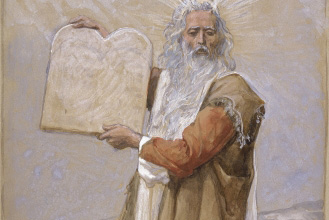
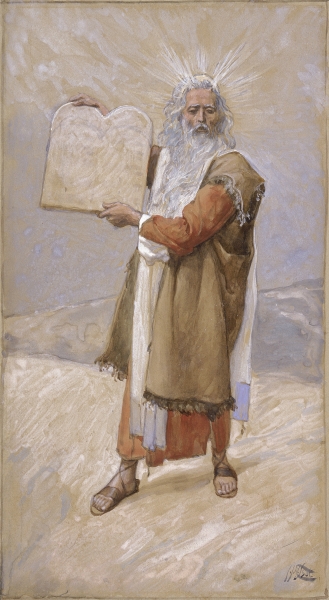
The reading for Thursday after Ash Wednesday features Moses laying out the basic reality that all of us have a choice to make. He says to us,
Today I have set before you
life and prosperity, death and doom…
I call heaven and earth today to witness against you:
I have set before you life and death,
the blessing and the curse. (Dt 30:15, 20)
So there it is, our choice: life or death, prosperity or doom. An old Latin expression says, Tertium non datur (no third way is given). We often like to think that we can plow some middle path. But in the matter of the last things, there is no middle path, no third way. Either we choose God and his kingdom, and then reflect that choice in all of our smaller decisions, or we do not.
To those who think that a middle path is possible, I would say that it is in effect the way of compromise, ambivalence, and tepidity. Walking such a path shows a lack of real commitment and a refusal to witness to Christ. These are not virtues that belong to God’s Kingdom; they pertain more to the kingdom of darkness. Jesus says, Let what you say be simply ‘Yes’ or ‘No’; anything more than this comes from evil. (Matt 5:37). He also says, No one can serve two masters. Either you will hate the one and love the other, or you will be devoted to the one and despise the other. You cannot serve both God and money. (Matt 6:24)
So we are back to a choice: for the Kingdom of Light or for the kingdom of darkness; for the world and its ways, or for God and His ways. Do we choose to gratify the flesh or nourish the spirit, to serve Satan and his agenda or to serve Christ and His will and plan?
You are free to choose, but you’re not free not to choose. That is to say, you must choose. And if you think that you can go on simply not choosing one or the other, I’ve got news for you: not choosing is choosing the kingdom of darkness.
While it is true that many do not directly choose Satan, but rather indirectly choose him by following his ways, we are asked to directly choose God by accepting the gift of faith and basing our life on what the Lord commands. Faith is not some sort of “default position” we can have by accident. Faith is the supernaturally-assisted and transformed human decision for God and all that that choice implies. Faith is a gift freely offered, and one that we must also freely accept; it is a choice that will not be forced on us. And through many daily choices, we are called to reaffirm, by grace, the choice we have made for God.
So again, life is about choices: the fundamental choice of Faith, and all the daily choices that either affirm or deny the reality of our faith.
We live in times in which people like to demand free choice, but also like to evade the responsibilities that come with making choices. Moses goes on in the reading today to describe the fact that the choice we make for or against God will have consequences:
If you obey the commandments of the LORD, your God,
which I enjoin on you today,
loving him, and walking in his ways,
and keeping his commandments, statutes and decrees,
you will live and grow numerous,
and the LORD, your God,
will bless you in the land you are entering to occupy.
If, however, you turn away your hearts and will not listen,
but are led astray and adore and serve other gods,
I tell you now that you will certainly perish;
you will not have a long life
on the land that you are crossing the Jordan to enter and occupy. (Dt 30)
Yes, choices have consequences. And even little daily choices have the cumulative affect of moving us in one direction or the other, toward God and our goal or away.
Many little choices also have a way of forming our hearts. Deeds become habits; habits become character; character becomes destiny. Many little choices form our hearts, establish our character, and move us into one future or another.
And while it is true that sudden and dramatic conversions are possible as long as we are still living, it is more common that, as we make our journey, our hearts become more fixed, and our fundamental character becomes less and less likely to change. As we get older, it’s harder to change because that’s what choices do to us: they move us in a certain direction, down a certain path. And the further along that path we go, the less likely we are to turn back.
Therefore daily choices are important, and making frequent examinations of conscience and frequent confession are essential. Each day we ought to ask and consider the question, “Where am I going with my life?” If we go on too long living an unreflective life, it is easy to find ourselves deeply locked in sinful habits and patterns that are harder and harder to break. Thus frequent reflection is necessary, and we ought not make light of small daily decisions.
We live in times in which, to some degree, it is easier to insulate ourselves from the immediate consequences of many choices we make. Medicine, technology, social safety nets, etc. are all good things in and of themselves, but they do tend to shield us from immediate consequences, and they help cultivate the illusion that consequences can be forever evaded.
We also live in times in which, perhaps more than ever before, the community is often willing to bear the burden of many bad individual choices. Again, this is not in and of itself a bad thing, but it does become an enabler of bad behavior, and fosters the illusion that consequences can be avoided forever. They cannot.
Our own culture is currently under the weight of a colossal number of poor individual choices, ones that have added up to a financial, spiritual, moral, and emotional debt that we cannot pay. Sexual misconduct, divorce, cohabitation, abortion, STDs, the use of hallucinogenic and addictive drugs, the casting off of of discipline and parental responsibility, the rejection of faith and ancient and tested wisdom, rebellion, silence in the face of sin and injustice, greed, consumerism gone mad, factions, envy discord and on and on… all of this is creating a tremendous toll. The consequences are mounting and it is becoming clear that even the most basic functions of society such as raising the next generation, preserving order and stability, and ensuring the common good are gravely threatened.
And what is true collectively is also true for us as individuals. Lots of bad little choices quickly draw us into self-destructive patterns that get deeper and deeper. And without regular reflection and penitential seasons like Lent, we lose our way too easily! St. Augustine noted this in his Confession, in which he described himself as being bound, “not by another’s irons, but by my own iron will…For in truth lust is made out of a perverse will, and when lust is served, it becomes habit, and when habit is not resisted, it becomes necessity” (Conf 8.5.10)
Moses’ warnings are before us as never before.
Back in 1917, a beautiful and holy Woman (Our Lady) appeared to three little children. She explained that the horrifying war (WW I) was finally coming to an end. But, she warned, if people did not turn back to her Son Jesus and start praying, a worse war would ensue; Russia would spread her errors and great disaster would befall this world. Do I need to tell you what happened? Of course not! Any even casual assessment of the 20th Century would find it hard to conclude that the century was anything but satanic.
Life and Death, prosperity and doom. What will you choose? What will we choose?
Choices! Consequences!
From heavy to a little humor: