Most of us have very sentimental notions about angels in general, and especially our Guardian Angels. And yet the Bible depicts then as powerful, fierce, and almost warlike. They are holy and good, but their glory overwhelms. In Scripture, almost any time someone encounters an angel, the person becomes filled with fear and very disconcerted.
Further, while many of us think of the angels as here more to help us, God tells us to obey them.
[The Lord God says], See, I am sending an angel ahead of you to guard you along the way and to bring you to the place I have prepared. Pay attention to him and listen to what he says. Do not rebel against him; he will not forgive your rebellion, since my Name is in him. If you listen carefully to what he says and do all that I say, I will be an enemy to your enemies and will oppose those who oppose you. (Exodus 23:20-22).
So angels are to be revered and respected. They are not the prancing, doll-like figures we often imagine.
I do not write this to dash sentimental notions, only to add balance. Our angels love and serve us, but they do this with a divine authority that we ought not to trivialize.
Humorously, I thought of all this when I ran across this old commercial of linebacker Terry Tate who is brought into a business to “motivate” the workers to follow their better natures. Please take this in the humor I intend it. I am not saying that angels act in this manner. But what makes me laugh most is that I have often wondered if my own angel doesn’t sometimes need tactics like this in order to shape me up!
Enjoy the commercial, and remember your Guardian Angel and obey him!
The teaching of sacred Scripture on intercessory prayer is complex, and unless we maintain a balanced view of the fuller teaching of Scripture, distortions in our understanding of the prayer of petition (or intercession) can occur.
In the Gospel for Thursday in the first week of Lent, the Lord gives a teaching on prayer that seems quite straightforward. He says:
Ask and it will be given to you; seek and you will find; knock and the door will be opened to you. For everyone who asks, receives; and the one who seeks, finds; and to the one who knocks, the door will be opened. Which one of you would hand his son a stone when he asked for a loaf of bread, or a snake when he asked for a fish? If you then, who are wicked, know how to give good gifts to your children, how much more will your heavenly Father give good things to those who ask him. (Matt 7:7-11)
Now on the one hand, this teaching seems to be rather simple: that we should ask and we will receive. On the other hand, experience is often a teacher and can cause discouragement among the faithful who think that they have asked, sometimes repeatedly, for things that they did not get. And this is why it is important to lay hold of the wider teachings of Scripture on prayers of intercession.
It will be noted that even in this text, Jesus indicates that the Father wants to give “good things,” not just anything, to those who ask him. This qualification is important.
Elsewhere, Scripture lists any number of other teachings that indicate possible reasons that God either says “No” to our prayer, or delays in His answer to us. It is important to refer to these sorts of texts. The danger always remains in reading Scripture, that we take one line and make it the whole of Scripture. To do such a thing is inauthentic and does not respect the fact Scripture often speaks far more richly on topics. Sloganizing certain verses is disrespectful both to God and to the Holy Word entrusted to our care. The Bible is not to be reduced to a few favorite verses but is to be read as a whole, in context, and with a careful balance that respects how any particular verse relates to the wider Scriptures, the teaching and Tradition of the Church, and the overall trajectory of God’s revelation.
There are other texts that, while not canceling the confident expectation of asking and receiving, teach that God does not simply hand over his sovereignty to our whimsical requests. There are in fact reasons why God sometimes says “No,” or sometimes delays in His answer. I have written on this previously here: When God says “No”
But for our purposes here, we do well to return to Jesus’ expression that the Father wants to give “good things” (not just anything), to those who ask Him. This statement of Jesus should lead us to ponder whether we really do ask for the best and most important things God really wants to give us, or whether we ask for lesser things.
Truth be told, we tend to be more focused on lesser and passing things than on better and eternal things. The Book of James warns about this in saying:
You have not because you ask not. You ask and do not receive, because you ask with wrong motives, so that you may spend it on your lusts. Adulterers! Do you not know that friendship with the world is hostility toward God? Therefore whoever wishes to be a friend of the world makes himself an enemy of God (James 4:2-4)
Now while this saying from the book of James may be a bit strongly worded (James usually is!), it remains true that we easily and quickly run to God about matters of finance, our health, a job, or some material need. Yet when was the last time we asked for wisdom, chastity, greater holiness, the gift to love our enemy, greater love for our family, or a greater thirst for prayer, etc.?
An old spiritual says “King Jesus is a-listening all day long, to hear some sinner pray.” Yes, it may well be that Jesus lives for the day when I ask for something that really matters. Consider, for example, the opening prayer from the Mass in which this reading was found (Thursday, Week 1 of Lent):
Bestow on us, we pray, O Lord, a spirit always pondering on what is right and of hastening to carry it out, and, since without you we cannot exist, may we be enabled to live according to your will. Through our Lord Jesus Christ, your Son who lives and reigns with you in the unity of the Holy Spirit, one God, for ever and ever. Amen.
The prayers of Mass are meant to be a model for us; they’re not simply gibberish that the priest says and we say amen at the end of the “formula.” We ought to learn from such prayers how to pray. Now note what this prayer is asking! It is asking for a mind and heart that seek and hunger for what is good, right, just, and true. It is asking not only for a hunger for good things, but for a will, a desire, to carry it out promptly, zealously, and without delay.
Now when was the last time you or I really prayed this way – from the heart? Too often we are content to ask God to fix our finances, fix our health, open some door or opportunity here, give us good weather for the picnic, or make something go well. None of this is wrong, and to some extent we ought to pray for every little and big thing in our life. But the impression is almost given, when this is all we pray about, that if God will just make this world a little better place we’ll be willing to stay here forever. Our prayers often imply we love the world and the things of the world more than we love God and the things of God.
How God must “wait for the day” when we would pray a prayer like the one above from the heart and really mean it! What are you praying about? Is it what God wants you to pray about? Really? Is God delighted in what you pray for? There is nothing wrong in praying for the lesser things and needs of this world, but if that is all we pray for, our omission of eternal, holy, and lasting things is significant and sad.
Consider by way of conclusion a story about the early life of Solomon:
At Gibeon the Lord appeared to Solomon during the night in a dream, and God said, “Ask for whatever you want me to give you.” Solomon answered, “You have shown great kindness to your servant, my father David, because he was faithful to you and righteous and upright in heart. You have continued this great kindness to him and have given him a son to sit on his throne this very day. “Now, Lord my God, you have made your servant king in place of my father David. But I am only a little child and do not know how to carry out my duties. Your servant is here among the people you have chosen, a great people, too numerous to count or number. So give your servant a discerning heart to govern your people and to distinguish between right and wrong. For who is able to govern this great people of yours?”
The Lord was pleased that Solomon had asked for this. So God said to him, “Since you have asked for this and not for long life or wealth for yourself, nor have asked for the death of your enemies but for discernment in administering justice, I will do what you have asked. I will give you a wise and discerning heart, so that there will never have been anyone like you, nor will there ever be. Moreover, I will give you what you have not asked for—both wealth and honor—so that in your lifetime you will have no equal among kings. And if you walk in obedience to me and keep my decrees and commands as David your father did, I will give you a long life.” (1 Kings 3:5-14)
How pleased the Lord was with Solomon’s request! And the Lord replied abundantly. We often wonder if God will answer our prayers, but do we ever ask if God is pleased with our requests?
The Father wants to give “good things” to those who ask him. To ask for greater holiness and for a mind and heart that seeks God’s will, not merely to tell him our will, must please God greatly. So does a repentant heart that seeks mercy and reconciliation. Yes, “King Jesus is a-listening all day long, to hear some sinner pray!”
If, on the way to court, you received advice on how you could influence the judge to be less severe in your case, would you not consider following that advice? Surely you would, unless the “way” involved bribery, or something corrupt.
And in fact Jesus, our very judge, has described an upright way that we can avoid severity on the Day of Judgment. Simply put, the way is for us to show mercy.
Now I don’t know about you, but I am going to need a lot of mercy on the Day of Judgment. So I, and probably you as well, am glad that the Lord has shown how we can positively influence the Day we are judged and see that mercy is magnified. Consider some of the following texts:
Blessed are the merciful, for they will be shown mercy. (Matt 5:7)
For if you forgive men when they sin against you, your heavenly Father will also forgive you. But if you do not forgive men their sins, your Father will not forgive your sins. (Matt 6:14-15)
Speak and act as those who are going to be judged by the law that gives freedom, because judgment without mercy will be shown to anyone who has not been merciful. But mercy triumphs over judgment! (James 2:12-13)
If a man shuts his ears to the cry of the poor, he too will cry out and not be answered. (Proverbs 21:13)
Do not condemn, and you will not be condemned. Forgive, and you will be forgiven. (Luke 6:37)
For the measure with which you measure others, will be the measure by which you are measured (Mark 4:24)
And then there is the terrifying parable too long to quote here of the man who owed a huge debt he could never repay. The king cancelled the whole debt. But the man refused to cancel the debt of one who owed him a smaller amount. To this unmerciful man the King then decreed: You wicked servant,’ he said, ‘I canceled all that debt of yours because you begged me to. Shouldn’t you have had mercy on your fellow servant just as I had on you?’ In anger his master turned him over to the jailers to be tortured, until he should pay back all he owed. “This is how my heavenly Father will treat each of you unless you forgive your brother from your heart.” (Matt 18:32-35)
So the basic point is clear enough: if we want to be shown mercy in our judgment (and trust me, we’re all going to need a LOT of it), then we need to pray for a merciful heart.
Let’s go so far as to say that if anyone is harsh, mean-spirited, unforgiving, hypercritical, or condemning, he is a fool. He is simply storing up wrath for himself on the Day of Judgment. Now why do that?
Mercy is our only hope of avoiding strict judgment. And these texts show us that mercy here will lead to mercy there.
It is true that there are times in this world when punishments must be issued and penalties assessed. But to the degree that these are made with an eye to correction and reform, they are part of love, and relate to mercy. For fraternal correction is a work of charity. It is better to suffer punishment here that leads to reform, than to evade punishment here and possibly end in hell. Thus, not all punishment is excluded by the edict of mercy, but, only let mercy and love be the sources from which it comes.
So, some advice to the wise: bury the hatchet now. Ask the Lord for a merciful and forgiving heart, or suffer the full force of a strict judgment. Pay attention! The judge is willing to be influenced on our behalf and has signaled what will move him in our direction. Why hesitate any longer? The merciful are blessed because they are going to be shown mercy. And without mercy, we don’t stand a chance.
Here is the great Miserere by Allegri. The text, sung in Latin is Psalm 51 which begins, “Have Mercy on me Lord in your great mercy.”
In today’s Gospel (Tue. Week 1 Lent) is the Lord’s discourse on prayer. The Lord begins with the familiar admonition:
And when you pray, do not keep on babbling like pagans, for they think they will be heard because of their many words. Do not be like them, for your Father knows what you need before you ask him. (Matt 6:7-8)
The underlying Greek word is βαττολογέω (battalogeo); from battos (a stammerer) + logos (word). Hence the word means to chatter, utter long-winded or empty words, to stammer or engage in vain repetition.
Of course when such a text is considered, critics of the Catholic practice of rosaries and other litanies go into rebuke mode, and Catholics go into defense mode. And while there are legitimate debates about what the Lord is actually referring to historically, there is the danger that we can miss the deeper summons of the Lord’s teaching here.
At the real heart of the Lord’s message here is not the concern for babbling, but the concern that we lay hold of the truth that “your Father knows what you need.” In fact, as I have argued elsewhere (e.g., HERE and HERE), the whole focus of Matthew 6 (the midpoint of the Sermon on the Mount) is for us to shift our focus from human praise and worldly preoccupations to “our Heavenly Father.” In fact, Jesus mentions the Father a dozen times in Matthew 6. Add to that the fact that the Lord’s Prayer is given here by Jesus.
Thus, to focus the debate on “babbling” and how many words are too many is to lose our way; it is to focus on words rather than to focus on the Father. And focusing on the Father is the real goal of Jesus in this midpoint of the Sermon on the Mount.
Jesus insists, “Your Father knows what you need.” In teaching this he invites us to a deep and trusting relationship with his Father.
Consider the following analogy: if I am going to make a request of some powerful person I don’t really know who has something I need, I will approach the moment of request nervously. I will likely rehearse my speech and even ask others for advice in order to carefully craft it. I will also likely multiply words and try to say a lot quickly, attempting various entreaties that appeal to several motives he might have. I do this since I do not really know the person or what words might “work” to produce the desired result. Thus anxiety and a lack of a personal relationship will tend to make me nervously multiply words to try to “cover all the bases.”
But how differently I will approach the moment if I go to ask a beloved and well-known friend or caring family member. I will speak plainly and unassumingly. I will not nervously prattle on, and would find little need to rehearse a speech or get others to craft my message. I would simply and plainly, and confidently state my request.
And this is what Jesus is teaching. He is summoning us to a deep and trusting relationship with his Father, a tender, affectionate relationship wherein we experience that we are sons and daughters of our heavenly Father. And in this experience of our Father we do not feel anxious about asking him anything. Neither do we feel the need to carefully craft our words, or multiply our words to coax an unwilling potentate. We are not praying merely to the “Deity” or the Godhead. Our Father is not a stranger, or at least should not be experienced by us this way. We are praying to our Father who loves us and whom we love. We speak naturally, affectionately, confidently, plainly, and unassumingly. And if we do multiply words, it is only out of an extravagance of love, not because we think that such a tactic is necessary to “spring the result.”
It is true that Jesus tells us elsewhere to persevere in prayer, and persist in asking. But this is different than nervously or superstitiously multiplying words, or thinking we need to use certain catch-phrases, etc.
Here then is the heart of Jesus’ message: your Father knows what you need. That is, your Father loves you. Speak to him in this confidence; come to realize that you are his beloved children in me and approach him reverently, but naturally, lovingly, and without pretension.
To focus merely on words (how many and what kind), is to miss the message.
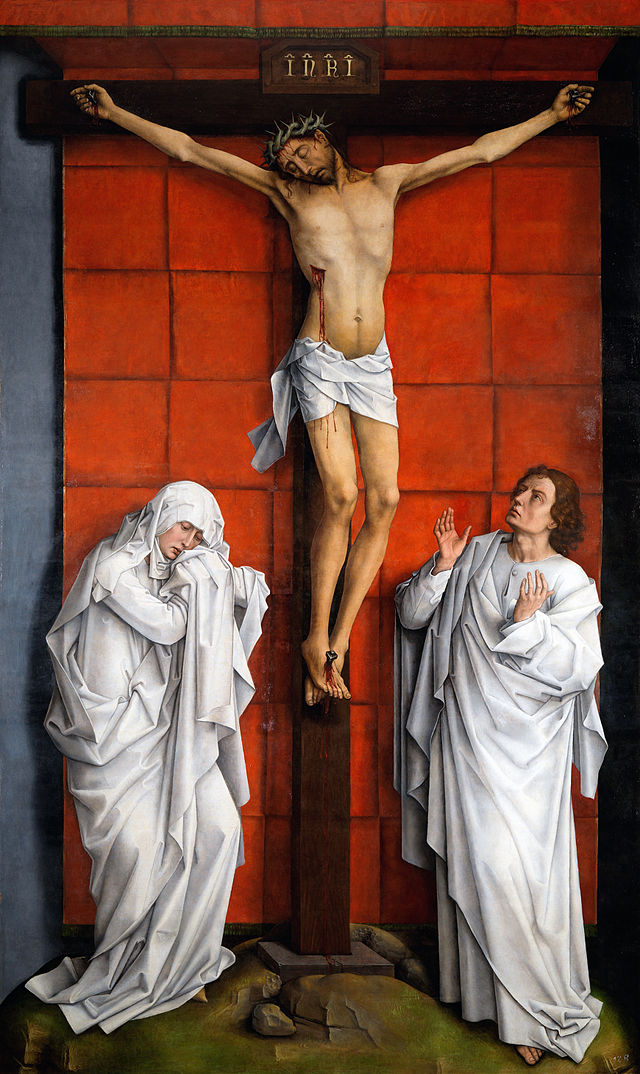
When I was younger and through my seminary years, I had usually seen the crucifix and Jesus’ suffering on the cross in somber tones. It was my sin that put him there, that had made him suffer. The cross was something that compelled a silent reverence, and suggested to me that I meditate deeply on what Jesus had to go through. Perhaps, too, I would think of Mary and John and the other women beneath the cross, mournfully beholding Jesus slowly and painfully dying.
These were heavy and somber notes, but deeply moving themes.
In addition, the crucifix also called forth memories that I must carry a cross and go through the Fridays of my life. I needed to learn the meaning of sacrifice.
Liturgically I also saw the crucifix as a way of restoring greater reverence in the Mass. Through the 70s and 80s, parishes had largely removed crucifixes and replaced them, quite often, with “resurrection crosses,” or just an image of Jesus floating in midair. I used to call this image “touchdown Jesus” since he floated in front of the cross with his arms up in the air as if indicating a touchdown had just been scored. In those years we had moved away from the understanding of the Mass as a sacrifice and were more into “meal theology.” The removal of the crucifix from the sanctuary was powerfully indicative of this shift. Many priests and liturgists saw the cross as too somber a theme for their vision of a new and more welcoming Church, upbeat and positive.
A cross-less Christianity tended to give way to what I thought was a rather silly, celebratory style of mass in those years, and I came to see the restoration of the Crucifix as a necessary remedy to restore proper balance. I was delighted when, through the mid-80s and later, the Vatican began insisting in new liturgical norms that a crucifix (not just a cross) be prominent in the sanctuary and visible to all. Further, that the processional cross had to bear the image of the crucified, not just be a bare cross.
Balance Restored – I was (and still am) very happy about these new norms because they restore the proper balance in seeing the Mass as a making-present of the once-and-for-all, perfect sacrifice of Jesus on the cross. It is also a sacred meal, but it is the sacrifice that gives it its power. I further thought that such a move would help restore greater and proper solemnity to the Mass, and to some extent this has been true.
All of this background is just to say that I saw the Cross, the crucifix, in somber, serious tones, a theme that was meant to instill solemnity and sobriety, a meditation on the awful reality of sin and on our need to repent. And all of this is fine and true.
But the Lord wasn’t finished with me yet and wanted me to see another understanding of the Cross.
In effect, he wanted me to also experience the “good” in Good Friday. For while the cross is all the things said above, it is also a place of victory and love, of God’s faithfulness and our deliverance. There’s a lot to celebrate at the foot of the cross.
It happened one Sunday in Lent of 1994, one of my first in an African-American Catholic Parish. It being Lent, I expected the highly celebratory quality of Mass to be scaled back a bit. But, much to my surprise, the opening song began with an upbeat, toe-tapping gospel riff. At first I frowned. But the choir began to sing:
Down at the cross where my Savior died, Down where for cleansing from sin I cried, There to my heart was the blood applied; Glory to His name!
Ah, so this WAS a Lenten theme! But how unusual for me to hear of the cross being sung of so joyfully. (You can hear the song in the video below; try not to tap your toe too much).
It was something quite new for me. Perhaps it shouldn’t have been, but it was. The 70s and 80s Catholicism that had been my experience found it necessary to remove the cross in order to celebrate. But here was celebration with and in the cross! Here was the good in Good Friday.
The Choir continued:
I am so wondrously saved from sin, Jesus so sweetly abides within; There at the cross where He took me in; Glory to His name!
Congregation and choir were stepping in time and clapping, rejoicing in the cross, seeing it in the resurrection light of its saving power and as a glorious reflection of God’s love for us. Up the aisle the procession wound, and the last verse was transposed a half-step up, an even brighter key:
Oh, precious fountain that saves from sin, I am so glad I have entered in; There Jesus saves me and keeps me clean; Glory to His name!
Yes, indeed, glory to his name! A lot of dots were connected for me that day. The cross indeed was a place of great pain, but also of great love; there was grief, but there was also glory; there was suffering, but there was also victory.
Please do not misunderstand my point. There IS a place and time for quiet, somber reflection at the foot of the cross. All the things said above are true. But one of the glories of the human person is that we can have more than one feeling at a time. We can even have opposite feelings going on at almost the same moment!
The Balance – Some in the Church of the 70s and 80s rejected the cross as too somber a theme, too negative. They wanted to be more upbeat, less focused on sin; and so, out went the cross. There was no need to do this, and it was an unbalanced reaction. For at the cross, the vertical, upward pillar of man’s pride and sin is transected by the horizontal and outstretched arms of God’s love. With strong hand, and outstretched arms the Lord has won the victory for us: there at the cross where he took me in, glory to his name!
And the Balance is for the individual and for the Church. For some prefer a more somber meditation on the cross to prevail, and others feel moved by the Spirit to celebrate joyfully at the foot of the Cross. The Church needs both, and I suppose we all need some of both experiences. Yes, it is right to weep at the cross, to behold the awful reality of sin, to remember Christ’s sacrifice. But rejoice, too, for the Lord has won the victory for us, right there: Down at the Cross. There’s a lot of good in Good Friday.
Here is the song I heard that Sunday in 1994, sung in very much the style I heard.
I have often thought that the second greatest prayer ever written is the Universal Prayer attributed to Pope Clement XI. Most people have never heard of it. But it is magnificent. Its sweeping themes cascade like a fountain and it is comprehensive without being too detailed so that it loses its poetry.
So many themes are covered in its short verses: faith, trust, beginnings and ends, wisdom, justice, mercy, mindfulness, purity, repentance, journey, judgment, authority, greed, gentleness, generosity, apathy, fervor, prudence, courage, justice, temperance, fortitude, vigilance, and our last end, just to mention some.
If you are among the many who have never heard of this prayer, click here to see it:
And yet as I pray it, the prayer is so sweeping that I often feel overwhelmed by its sheer volume. It’s as though I am standing before an open fire hydrant with a little Dixie cup trying to capture the water. Most of it rushes past me.
So for Lent I have thought to pray this prayer every day but also to take one line and meditate on it in particular. Here is a version of the Prayer that I have numbered so as to focus on a particular line for each of the forty days:
I hope the Universal prayer will bless you as much as it has blessed me. Consider this practice. Print out the PDF files and use them when you can. I think you’ll find that the prayer provides a lot on which to meditate.
In case you would like the Latin original with a literal and poetic translation it is here:
The Gospel today says that Jesus was tempted by the Devil in the desert. Hebrews 4:15 also affirms: For we do not have a high priest who cannot sympathize with our weaknesses, but one who has been tempted in all things as we are, yet without sin.
How exactly a divine person, with a sinless human nature, experiences temptation is somewhat mysterious to us. And yet the text affirms that He does experience it. A Lenten antiphon from the Breviary teaches that he did this, or allowed this, for our sake: Come, let us worship Christ the Lord, who for our sake endured temptation and suffering (Invitatory Antiphon for Lent). Hence, even without pondering too deeply the mystery of how he was tempted or how he experienced it, we can still learn what Jesus teaches us about how to endure temptation and be victorious over it. (More on the question of how Christ was tempted HERE.)
Before we look at each temptation, we might learn a few general aspects of what the Lord teaches us in electing to endure temptation.
1. Temptation and Sin – The fact that the Lord is tempted, but did not sin, tells us that there is a distinction to be made between temptation and sin. Too often the very experience of temptation makes us feel sinful, makes us feel that we have already sinned. But that is not necessarily the case. For Jesus, who never sinned, experienced temptation. Therefore experiencing temptation is not simply to be equated with sin. One of the tactics of the Devil is to discourage us into thinking that the mere experience of temptation is already sin. It may be true that some of our past sins influence the amount and degree to which we feel tempted, but, in and of itself, we need not conclude that we have already sinned, or newly sinned, merely because we are tempted. Rather than to feel shame and run from God, we ought to run to him with confidence and seek his help. But do not conclude you have sinned merely because you are tempted.
2. Temptation and Scripture – Notice how, to every temptation, Jesus responds with Scripture. This is not to be equated with merely proof-texting, or pronouncing biblical slogans. Rather we ought to see it as indicative of the fact that Jesus was deeply rooted in Scripture, in the wisdom of the Biblical vision. In rebuking temptation in this way, Jesus is teaching us to do the same. It will not be enough for us to know a few biblical sayings. But, to the degree that we are deeply rooted in the wisdom of God’s truth available to us through Scripture and the teachings of the Church, we are able to strongly rebuke unholy, worldly, or fleshly thinking. Half the battle to defeating temptation is knowing instinctively its erroneous vision and stupidity. Having our minds transformed by the teachings of Scripture and the Church is an essential weapon in fighting temptation. Scripture says, Do not be conformed to this world, but be transformed by the renewal of your mind, that by testing you may discern what is the will of God, what is good and acceptable and perfect (Romans 12:2). Ephesian 6:17 also speaks of the Word of God as “the sword of the Spirit” with which we are properly armed for spiritual warfare. Thus, we are taught here by the Lord to be deeply rooted in his Word.
3. Temptation and Strength – Notice that Jesus is tempted three times, after which the devil leaves him. In a certain way the spiritual life is like the physical life, in that we grow stronger through repeated action. After lifting weights repeatedly, our physical strength increases and we are able to overcome increasingly difficult challenges. It is the same with the spiritual life. An old Gospel songs says, Yield not to temptation, for yielding is sin. Each victory will help you, some other to win. Scripture says, Resist the Devil and he will flee (James 4:7). We need not conclude here that Jesus needed to be strengthened (he did not) in order to understand that he is still teaching us what WE need to do. The battle against temptation is not a “one and you’re done” scenario, but an ongoing battle wherein each victory makes us stronger and the devil more discouraged. Eventually, as we grow stronger, he stops wasting his time tempting us in certain areas. At times the battle may weary us, but in the long run it strengthens us. Jesus illustrates this with his threefold battle with Satan.
Having reviewed a few general principles, let’s look at the three temptation scenes.
Scene I: The Temptation of Passions. The text says. At that time Jesus was led by the Spirit into the desert to be tempted by the devil. He fasted for forty days and forty nights, and afterwards he was hungry. The tempter approached and said to him, “If you are the Son of God, command that these stones become loaves of bread.” He said in reply, “It is written: One does not live on bread alone, but on every word that comes forth from the mouth of God.”
Hunger, as a desire, is a passion. It is not evil per se, for without it we would perish. The same is true with other natural desires for things like life, drink, and propagation (sexuality). Other sorts of passion also exist in us such as anger and love, joy, aversion, hatred, hope, despair, fear, courage, and so forth. In and of themselves, these passions are neither good nor bad, but become so only in relation to their object, or insofar as we allow them to become inordinate.
Hence there is nothing wrong with Jesus as he experiences hunger. What the devil tries to do is to draw Jesus into sin by yielding to his hunger and using his power inappropriately. Remember, Jesus had been led into the desert to fast and pray by the Spirit. This is his call. His hunger is real and without sin, but now he is tempted to set aside his call, and to yield to his hunger in an inappropriate way, by rejecting his call to fast. He is tempted to serve himself. Now he has the power to do this, to turn stones into bread, and so a second aspect of the temptation is to use his power inappropriately, not to glorify His Father, but rather to gratify and serve himself.
What about us? We too have passions. And they are not wrong in and of themselves. But what can happen is that we freely allow them to become inordinate, or we gratify them in unlawful ways. Remember we, like Jesus, are called to fast. Our fast is from things like sin, injustice, unrighteousness, sexual impurity, unlawful pleasures, excessive indulgence, and so forth. And we too have it have it within our power to choose to reject our fast and to gratify our desires by rejecting our call to serve God. And the devil says: reject your call and use your power to gratify your passions: lie, cheat, steal, vent your anger, fornicate, be gluttonous, greedy… and so forth.
But notice how Jesus has recourse to God’s Word:Man does not live on bread alone, but on every Word that comes from the mouth of God. Jesus says to Satan that He would rather live and be sustained by the Word; that his food is to do the will of his Father.
What about us? Can we say with Job: Neither have I gone back from the commandment of his lips; I have esteemed the words of his mouth more than my necessary food (Job 23:12)? Can we, like Jesus, say that God’s Word is more to me than my desires for satisfaction, sex, self-preservation, popularity, worldly joys, power, prestige, or possessions? My strongest desire is for God and things waiting for me in heaven, and I will gladly forsake all I have for it.
Scene II. The Temptation of Presumption – The text says, Then the devil took him to the holy city, and made him stand on the parapet of the temple, and said to him, “If you are the Son of God, throw yourself down. For it is written: He will command his angels concerning you and with their hands they will support you, lest you dash your foot against a stone.” Jesus answered him, “Again it is written, You shall not put the Lord, your God, to the test.”
There is a value in trusting God, but this is not an invitation to act recklessly. There will come a time when Jesus will throw himself down on the Cross in complete assurance that the Father will raise him. He has this command from his Father. But now is not that time and he must act to preserve and protect his life so as to accomplish his full mission.
For us, too, there is no sin in trusting in God’s care for us. But that is not a license to act recklessly. Presumption is a terrible problem today. Too many people think that they can go on sinning and that there will be, or should be, no consequences. This is true in worldly ways and in spiritual ways as well. Too many people engage in risky and ruinous behavior and figure, “I’ll be OK….I’ll escape….I won’t be a statistic….I won’t get caught….I won’t lose my job. Many say, “I can use drugs and not get addicted, I can have evil friends and still stay good and live morally, I can skip school and still get good grades and get into college, I can be promiscuous and won’t get an STD or AIDS….I won’t get pregnant. They think, I can drive recklessly and won’t have an accident or kill someone…I can be disrespectful and still be treated with respect.” In all this, people are simply “cruisin’ for a bruisin’.”
And regarding the moral presumptiveness of thinking that no matter what I or others do, heaven will still be the result, the Lord warns
Sirach 5:4 Say not I have sinned, yet what has befallen me? For the Lord bides his time. But of forgiveness be not overconfident adding sin upon sin. …Delay not your conversion to the Lord, put it not off from day to day for mercy and justice are alike with him.
Gal 6:7 Do not be deceived; God is not mocked, for whatever a man sows, that he will also reap. For he who sows to his own flesh will from the flesh reap corruption; but he who sows to the Spirit will from the Spirit reap eternal life. And let us not grow weary in well‑doing, for in due season we shall reap, if we do not lose heart.
Hosea 8:7 For they have sown the wind, and they shall reap the whirlwind.
Psalm 81:11 “But my people would not listen to me; Israel would not submit to me. So I gave them over to their stubborn hearts to follow their own devices. “If my people would but listen to me, if Israel would follow my ways, how quickly would I subdue their enemies and turn my hand against their foes!
God is clear to warn us that sin sets us on a path that hardens our hearts and makes our final conversion increasingly unlikely. He is pleading with us in this Lenten season to be serious about sin and its consequences. Sin renders us not only unfit for heaven, but simply incapable of entering it.
Bad idea – Simply presuming that everything will be fine is not only a poor strategy, it is a temptation and snare of the devil, who seeks to cloud our minds with false hope and unreasonable expectations. Jesus has a very clear message for the devil and for any of us who would engage in presumption (a VERY common sin today): “Don’t you dare put the Lord your God to the test in this way. Obey him out of love, but do not put Him to the test.” Presumption is a very bad and foolish idea.
Scene III. The Temptation of Possessions – The text says, Then the devil took him up to a very high mountain, and showed him all the kingdoms of the world in their magnificence, and he said to him, “All these I shall give to you, if you will prostrate yourself and worship me.” At this, Jesus said to him, “Get away, Satan! It is written: The Lord, your God, shall you worship and him alone shall you serve.”
There is here the obvious temptation of worldly possessions. Everything, EVERYTHING, is offered by Satan to Jesus in exchange for a little worship of the devil. Now, it may seem strange to us that having an abundance of things would be linked to worshiping the devil and forsaking God, but scripture attests to the connection elsewhere:
Adulterous people! Do you not know that friendship with the world is hatred toward God? Whoever therefore wants to be a friend of the world makes himself an enemy of God. (James 4:4)
Do not love the world or anything in the world. If anyone loves the world, the love of the Father is not in him. (1 John 2:15)
No one can serve two masters. Either he will hate the one and love the other, or he will be devoted to the one and despise the other. You cannot serve both God and Money (Matt 6:24)
All pretty blunt. We want to have both, but the Lord is clear in rebuking the temptation by insisting that we have to serve God alone, to adore God alone. The inordinate love of this world causes us to hate God more and more and to bow before Satan in order to get it. Don’t kid yourself. If this seems extreme, then we are calling God an extremist. The Lord is warning us that there is a major conflict here that steals our heart. For where a man’s treasure is, there is his heart (Matt 6:21). It is not wrong to desire what we really need to live, but it is our wants that get us into trouble. And the desire for riches ruins us and makes God seem as a thief, rather than a savior. This is a very severe temptation and Jesus rebukes it forcefully. Him ALONE shall you serve.
We need to beg God for a single-hearted devotion to him. The Book of Proverbs has a nice prayer in this regard: Give me neither poverty nor riches, lest in my poverty I steal or in my riches I say “Who is the Lord?” (Prov 30:8-9 gloss).
In the end, temptations are real, and we either accept God’s grace to fight them, or else “we are going down.” The Lord wants to teach us today about the reality of temptation and how to fight it, by his grace. Remember, the battle is the Lord’s, and no weapon waged against us will prosper if we cling to God’s grace. But in the end, the choice is clear: either tackle temptation (by God’s grace) or risk ruination (by Satan’s “ministrations”).
(Photo credit above right: Evolutionary Times (right click on photo for URL))
This song says, Yield not to temptation, for yielding is sin. Each victory will help you, some other to win. Fight valiantly onward. Evil passions subdue. Look ever to Jesus, He will carry you through. Ask the Savior to help you, comfort strengthen and keep you; he is willing to aid you, He will carry you through.
There was a tendency in ancient plays in Greece and Rome to introduce something that was called a deus ex machina solution (literally “God from a Machine”). For very often, the playwrights had concocted a plot so complicated, with so many subplots and difficult situations, that they themselves really couldn’t resolve the mess they’d written. Thus, “gods” (marionettes or actors really) would be lowered down onto the stage from above, using winches and other machines. These “gods” would simply and magically solve all the problems. Hence the expression deus ex machine has come in English to mean “a contrived or unlikely solution.”
Somehow, I thought about that as I saw the cartoon below. I also thought a lot about the mess that we’re currently in in our culture, and throughout the whole world. For where, really, aren’t things just an awful mess? Marriage, family, sexuality, and the meaning and purpose of life, are all confused. Social order, self-restraint, and any moral consensus, let alone the practice of virtue or even common sense, are becoming hard to find.
How are we ever to clean up this mess? The depth of confusion and increasing social chaos, along with base and reprehensible behavior that many actually celebrate, make it hard to imagine that we’re going anywhere, except to a very bad place, and with increasing rapidity.
Yes, it’s a little bit like the ancient playwrights of Greece and Rome who had written themselves into such a chaotic corner that they had to use fake gods to bail themselves out. As for us, only the one, true God can snatch us out of the quicksand.
In the cartoon below, there is a secret agent man who seems to think he has everything under control. But even as the cartoon opens, we can see he’s a bit foolish, unsteady on his feet, and can barely cross the street without getting killed. Let’s call this secret agent man “Modern Man.” He thinks he amounts to something, but he ain’t all that.
There comes into “Modern Man’s” life a pesky pigeon that he just can’t beat. Let’s call the pigeon “Consequences.” For all Modern Man’s gadgets and apparent smarts, the pigeon Consequences just keeps outsmarting Modern Man. In fact, it is exactly Modern Man’s technology that the pigeon, Consequences, is able to exploit. In effect, the pigeon hoists Modern Man with his own petard.
And though utter disaster is ultimately avoided by Modern Man, as the video draws to its conclusion the pesky pigeon is still there. He’ll never go away! Then comes a surprise ending, a kind of deus ex machina solution.
What does all of this have to say to us modern men (and women)? Well, very much like “Modern Man” in the cartoon, we too have been hoisted with our own petards. Despite our bravado and our prideful self-assurance, we ain’t all that. We can barely cross the road without getting killed. In other words, it is only by the sheer mercy of God that we have not annihilated ourselves with nuclear weapons, etc.
But like Modern Man in the cartoon, we are increasingly dogged by the consequences of our many bad choices. Like the man in the video that just can’t beat the pigeon, we just can’t seem to get away from the consequences that afflict us. And it is often our modern way of life and technology that are the very things that cause the greatest harm.
And while we have somehow avoided complete disaster, it becomes increasingly hard to imagine how we can ever get out of this mess that we are in. Yes, only a solution from above, only God, can save us.
How he will do it? I don’t really know. I am afraid that the only way I can see of pressing the “reset button” in a world gone mad would be for some awful calamity to happen that would so rock us back on our heels that we would actually have to start living ordered lives again.
But of course, I am not God, thanks be to God! God has in the past effected great reforms, seemingly out of the blue. For example, even as the Roman Empire crumbled in the 4th Century and the Church lost all of North Africa to the Muslims in the 7th Century, God worked the miracle that the Barbarian tribes of the north suddenly began to embrace Christ.
At another great crisis in the “Dark Ages,” when much seemed lost to plague and social disorder, suddenly people like Francis of Assisi and St. Dominic appeared on the scene. And later came St. Bernard, St. Teresa of Avila, and St. John of the Cross, ushering in great reforms in response to the Protestant Revolt. And when millions walked out of the Church in Europe, nine million came in in Mexico, through Our Lady of Guadalupe.
We can only pray that God will do it again; namely, effect a great reform, as if out of the blue. Lord knows we were in an awful mess emerging from the Satanic 20th-century. It’s going to take a miracle, or a calamity (I hope not), to reset and restore the modern world seemingly gone mad.
For the sake of Thy sorrowful passion, have mercy on us, and on the whole world.
Anyway, enjoy the cartoon. It’s a good little allegory about a prideful secret agent who thinks he’s all that, but he ain’t; and how a little pigeon practically pecks him to death. Only a solution from above can save him from the awful bird called “Consequences.”