 At the bottom of this post is a video of dogs and cats who apparently never “got the memo” that they are supposed to fear and hate each other. As the video makes clear, they are bosom buddies who love to romp, play, wrestle, and even snuggle. How unlikely! And yet there it is before our eyes.
While the interactions between animals are mysterious and not to be compared with human relationships, I can’t help thinking of humanity as I look at these animals. What would things be like if some of the “memos” we pass back and forth were never received or got lost?
I remember some years ago when the former Yugoslavia broke apart as the long reign of communism concluded. It was good news, as Soviet-style rule there ended. But then a horrible bloodbath ensued and the Bosnian, Serbians, and Croatians turned on one another, rekindling old hatreds going back hundreds of years. I remember wondering how people who had lived largely without violence for so long could still hate one another so. It seemed that the injustices of the past predated most of the people who were alive now.
Bosnian babies were not born hating Croatian babies. Someone must have taught them to hate one another. Someone “gave them the memo.” So when the “strongman,” Tito, left the scene, ancient hatreds that had continued to be handed down from parent to child exploded. Looking with my American eyes, I wondered how the Bosnian, Croatian, and Serbian people could even distinguish one another. To me they all “looked alike.” But they surely knew the differences, drew the lines, and spiraled right down into the hell of hatred.
I realize that I may be oversimplifying things, but there is also the tendency to overcomplicate matters. The fact is, children do not enter this world with an intrinsic hated of an entire group of other children. Someone teaches them that. That part isn’t complicated.
Another awful example of this was what happened in Rwanda in the early 1990s. There, the Hutu and Tutsi tribes had separated back in 1959. But suddenly in 1990 civil war exploded and in 1994 a Tutsi Tribe undertook an attempted genocide of the Hutu tribe killing as many as a million people in a very short period of time. Some argued that the tensions went all the way back to colonial times. But here, too, most of grievances seemed to predate the soldiers and vigilantes who undertook the massacres. Who taught them this hatred? Who “gave them the memo”?
When I was a child, I lived in Chicago, Illinois. I never remember my parents ever telling me to hate or even be wary of black people. I give them a lot of credit for that. Neither do I remember any awareness of racial tension or hatred in my neighborhood. However, to be clear, I was still very young and the racial riots that followed Dr. King’s assassination did not really register in my 7-year-old mind.
But in 1969 we moved to Northern Florida (think “Southern Georgia”). And there racial tension was in the air. I remember being confused and bewildered by the unexplained resentments and fears. I guess I was too young. I was a newcomer and had not “read the memo” telling me that I should be suspicious, hateful, and that I should in no way mix with “them.” I remember seeing black children on the other side of the playground and they were playing with some “really cool” toys. Not having “read the memo,” I went to join them. I was rebuffed not only by fellow whites, but also by some of the black children who were unaware that I had not “read the memo” and considered my “incursion” unwanted and even threatening.
Crazy stuff. We are not born hating any person, any race, or any ethnicity. Someone teaches us that. And this very fact increases the total disgrace that such hatred is. There is an old phrase that talks about “burying the hatchet.” You may call me naive and simplistic, even myopic, but I wonder what might happen if we could just “tear up the memo.”
I hope most of you know me by now well enough by now to understand that I am no moral relativist. I am not suggesting there is no such thing as truth, right and wrong, injustice, etc. Neither am I one to dispense platitudes such as “Can’t we all just get along?” or “Coexist.” For these sorts of bromides often rest on the faulty premise that there is no real truth to announce or protect. But honestly, some of the hatreds we struggle with go back to things long gone, things that predate any of us here today, and which, quite frankly, are not even grievances we know much about. There are just some “memos” that need to go to the shredder.
The Catechism makes some very helpful observations:
Deliberate hatred is contrary to charity. Hatred of the neighbor is a sin when one deliberately wishes him evil. Hatred of the neighbor is a grave sin when one deliberately desires him grave harm. “But I say to you, Love your enemies and pray for those who persecute you, so that you may be sons of your Father who is in heaven.” …
Peace is not merely the absence of war, and it is not limited to maintaining a balance of powers between adversaries. Peace cannot be attained on earth without safeguarding the goods of persons, free communication among men, respect for the dignity of persons and peoples, and the assiduous practice of fraternity. Peace is the tranquility of order. Peace is the work of justice and the effect of charity …
Injustice, excessive economic or social inequalities, envy, distrust, and pride raging among men and nations constantly threaten peace and cause wars. Everything done to overcome these disorders contributes to building up peace and avoiding war: Insofar as men are sinners, the threat of war hangs over them and will so continue until Christ comes again; but insofar as they can vanquish sin by coming together in charity, violence itself will be vanquished and these words will be fulfilled: “they shall beat their swords into plowshares, and their spears into pruning hooks; nation shall not lift up sword against nation, neither shall they learn war any more (CCC # 2303,2304, 2317).
Well if nothing else, enjoy this video of animals who never “got the memo” that they are supposed to be mortal enemies and consider joining me in the dream that some of us humans, too, will never “get the memo.”




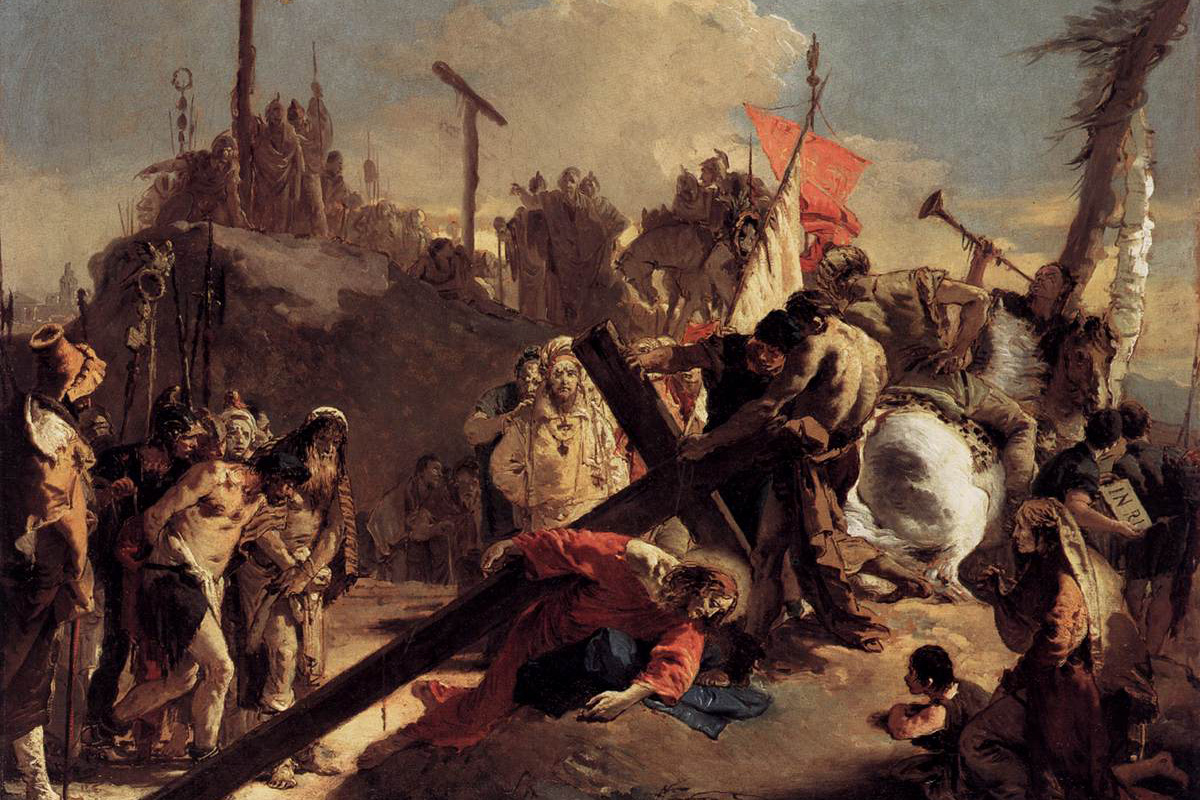
 What is a yoke? Essentially “yoke” is used here as a euphemism for the cross. A yoke is a wooden truss that makes it easier to carry a heavy load by distributing the weight along a wider part of the body or by causing the weight to be shared by two or more people or animals. In the picture at left, the woman is able to carry the heavy water more easily with the weight across her shoulders rather than in the narrow section of her hands. This eases the load by involving the whole body more evenly. Yokes are also used to join two animals and help them work together in pulling a load.