God on His Terms, Not Ours

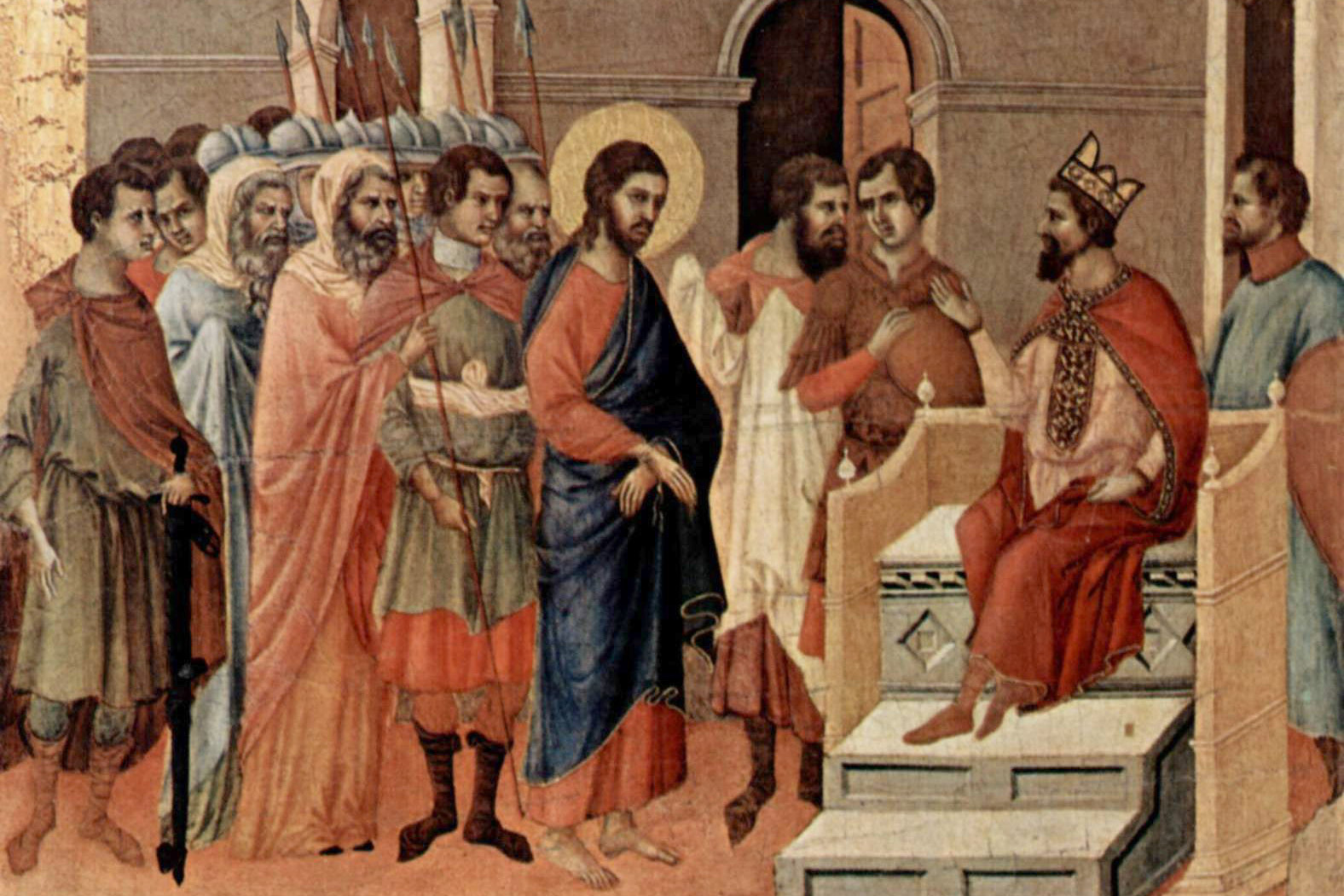
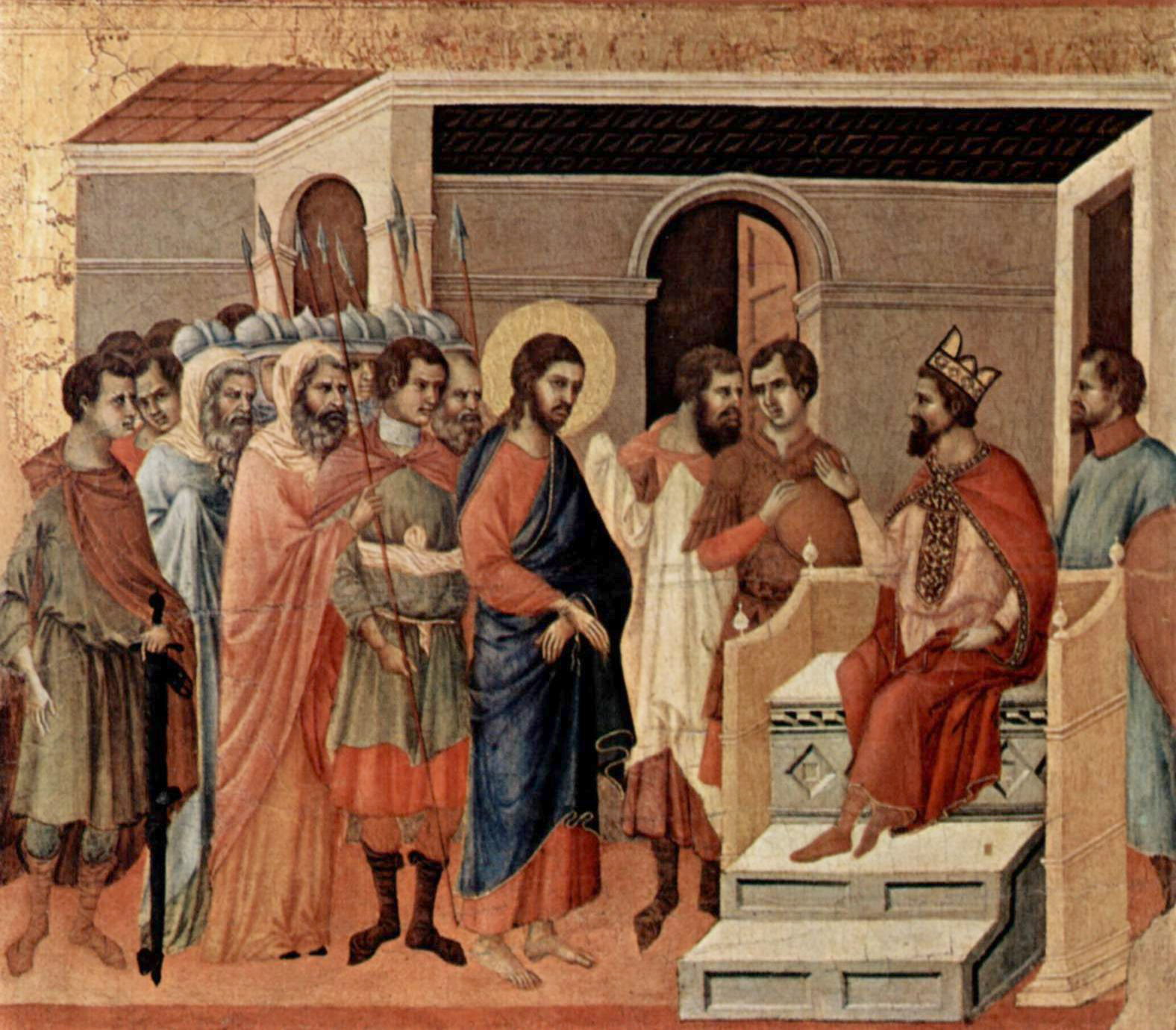
043015There is a brief interaction between Jesus and certain unbelieving Jews on the Temple Mount which illustrates the rather common human tendency to demand that God be God on our terms, not His. Here is that dialogue:

And Jesus walked about in the temple area on the Portico of Solomon.
So the Jews gathered around him and said to him,
“How long are you going to keep us in suspense?
If you are the Christ, tell us plainly.”
Jesus answered them, “I told you and you do not believe.
The works I do in my Father’s name testify to me.
But you do not believe, because you are not among my sheep (Jn 10:22-25).

Their demand to be told plainly is, in effect, a way of insisting that Jesus be the Christ, the Messiah, on their terms. It is as if they are saying, “OK, Jesus, repeat after me. Say, ‘I am the Messiah. I am the one you have been waiting for.'”

But of course the problem with Jesus saying this is that they would have heard the word “Messiah” on their terms, not His. They would have understood the Messiah and His role with their flawed worldly notions. They expected a Messiah who would ride in on a warhorse, gather an army, defeat and slaughter their Roman oppressors, and reestablish the Kingdom of David in worldly prosperity, power, and glory.

This was “Messiah” on their terms, but not His. Jesus would not be reduced to some military general or political figure. He is God and Lord. He does not fit into our neat little reductions and often foolish distinctions, factions, and parties.

Early on, Jesus, though accepting the title among the apostles discreetly (e.g., Mat 16:16-17), would not let them spread this word (Mat 16:20). This was because of the mistaken notions of Messiah described above. Only at the end, under oath and with the Cross in sight, did Jesus finally accept the title. But even then He did so with distinctions that both elevated the Messiah beyond some earthly kingship (to a heavenly one) and delineated His role as the suffering servant.

Pope Benedict, writing as Joseph Ratzinger, describes Jesus’ public declaration of His role as Messiah as follows:

According to Mark, the high priest’s question is: “Are you the Christ, the Son of the Blessed?” And Jesus answers “I am; and you will see the Son of Man sitting at the right hand of power and coming on the clouds of heaven (Mk 14:62). … The high priest’s question [to] Jesus about his messiahship refers to it in terms of Psalm 2:27 and 110:3 using the expression, “Son of the Blessed”—Son of God. … Jesus then explains more closely, basing himself on Psalm 110:1 and Daniel 7:13, how messiahship and sonship are to be understood … he explains how he wants his mission to be understood. From this we may conclude that Jesus accepted the title Messiah, with all the meanings accruing to it from the tradition, but at the same time he qualified it in a way that could only lead to a guilty verdict [but] He left no room for political or military interpretations. … He claims to sit at the right hand of the power, that is to say, to come from God in the manner of Daniel’s Son of Man, in order to establish God’s definitive Kingdom (Jesus of Nazareth Vol. 2, pp. 180-181).

And therefore Jesus was Messiah, all right, not only in the humble sense of suffering servant, but also in the more glorified sense of the Son of Man described in Daniel. He is God and Lord, judge of the living and the dead, and He will come on the clouds one day and be seen by all for who He really is. Thus, a kind of high Christology  and suffering servant meet in Christ, the true Messiah. He is not high enough for the political glories of this world, yet at the same time He is too high for this world, which would seek to restrain Him in “manageable” glories and roles so that His “handlers” could also benefit from His office.

But Jesus will not be handled or managed by us. He will not do our political bidding, join our parties, or be our candidate. He is too much for us. He bursts our notions and exceeds our expectations. Not only is He outside our box, He is outside our world. He is God on His terms, not ours.

Now this is important, since many in our world today seek to define God on their own terms. In effect, we moderns say, “Be God on my terms,” or “I will believe in you if you conform to my expectations. Tell me plainly, in my terms, if you will be the kind of God I expect and want you to be.” The ecclesial version of this is “When the Catholic Church conforms to my views and expectations I will put faith in her and join, otherwise I won’t.” And thus God and the Church He founded are not to be discovered, they are to be reworked according to modern sensibilities. In terms of God, we used to call this idolatry. In terms of the Church, this is called “designer religion.”

Try for a minute to step back and be appalled at the arrogance of this modern trend. So many in our culture think they have a perfect right to design God rather than to go out and meet Him on His own terms, as revealed in Scripture and the ancient Tradition of the Church. For many today, it is God in the image of man, not man in the image of God.

To the ancients who took this stance Jesus simply said, “You are not my sheep.” Not a good thing to hear from the lips of the Savior! To them He had given the proof of miracles, the testimony of John the Baptist, the voice of the Father in their hearts, and the fulfillment of countless Scriptures. To us today He gives the miracle of a two-thousand-year-old Church and Tradition, the testimony of countless saints, the voice of the Father and the Holy Spirit, and His revealed Word, tested time and time again and found to be true and reliable.

To those who are not His sheep, no explanation is possible. To those who are, no explanation is necessary. Pray for many massive and sudden conversions. Ask for a miracle to break the arrogance of our times, which dare to say to God, “Be God on my terms or be gone.”

More Precious than Silver or Gold – A Meditation on the Spiritual Work of Mercy to Instruct the Ignorant

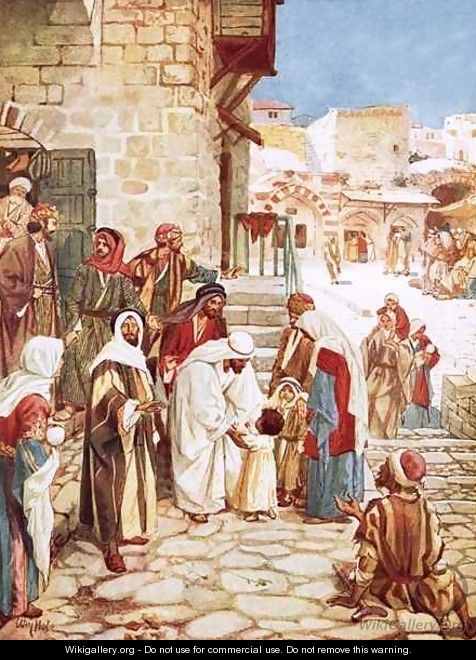
 "Jesus blessing little children”  oil on canvas by William Brassey Hole This file is licensed under the  Creative Commons Attribution-Share Alike 2.0 Generic license.
“Jesus blessing little children” oil on canvas by William Brassey Hole
This file is licensed under the Creative Commons Attribution-Share Alike 2.0 Generic license.

To instruct comes from the Latin in + struere, which means to build up or (even more literally) to pile up. In English, there is also the notion of strewing something. For example, to strew hay or to say that the seed has been strewn. Thus, to instruct means to disperse knowledge or build someone up in what is learned.

These days, the word “ignorant” is most often used in a negative or pejorative sense. And thus to say that someone is ignorant usually means (in modern English) that he is stupid or foolish. But more literally and less pejoratively, the word simply refers to someone who does not know something. And while some ignorance can be said to be inexcusable (in that a person should know better), it can also be more innocent: one simply does not happen to know something and can benefit from instruction in the matter.

And this is what is meant by the spiritual work of mercy “Instruct the Ignorant.” All of us can benefit from proper instruction by those who know more about a certain subject or issue than we do. And it is a work of mercy when someone takes the time to instruct us. It is an even greater work of mercy when the knowledge conferred is something essential or saving for us.

Can any of us ever really be grateful enough for all those who took the time to teach us down through the years, whether it was as young children in school, or as we grew through maturity and into a career, or even today as we learn new technologies or new issues and things that are on the scene? A patient and generous teacher is a great gift. And indeed the knowledge we gain is so enormously valuable as to be literally invaluable.

Yes, to instruct the ignorant is a great great work of mercy, and knowledge is one of our most precious gifts.

In speaking of instructing the ignorant as a spiritual work of mercy, at least two things are meant. First, because the intellect is a faculty of the soul, our human spirit is nourished by all instruction.

Second, however (and more particularly), the Church has in mind the kind of instruction that most benefits the soul: instruction in religious truth rooted in the Holy Scriptures and in the Sacred Tradition of the teachings of the Church. If secular instruction can benefit us unto worldly ends, how much greater the benefits of religion instruction that has heavenly and eternal rewards.

The goal of religious instruction is always to place one into a saving relationship with God. And thus the goal is not to simply help people know about the Lord, but to know the Lord, and by that relationship with Him in the truth, to be saved.  What an enormous boon, what a wealth and treasure it is to know the sacred truths of God!

Psalm 119, the longest in the Bible, goes on for 176 verses praising the glory of God’s truth, which is more precious than gold many times refined. The book of Baruch says, Blessed are we, O Israel; for what pleases God is known to us! (Baruch 4:4)  Yes, how I love your law, O Lord.

The second and more particular sense of instructing the ignorant, however, seems to have been largely lost. Many otherwise good and conscientious parents place a low priority on the religious instruction of their children. Math and science classes must be passed; if trouble emerges a tutor needs to be secured! School attendance is essential, for indeed the child’s future very much depends on success in academic subjects. But there seems to be little concern if children do not grasp religious truths or balk at attending Mass.

Even more than understanding worldly truths, laying hold of sacred doctrine is essential for children’s eternal salvation. But too few parents have any sense of urgency about conveying these truths.

Part of the problem is theological, since many today have a diminished sense of the possibility of Hell, erroneously thinking little of the Day of Judgment for which we should have a holy fear and sobriety, not to mention a careful preparation.

Sociologically, however, the problem seems to have its roots in the last two centuries, when the religious instruction of youth was largely consigned to priests and religious. The idea of parents as the chief educators of their children in the ways of faith was largely eclipsed by a ceding of this authority to a professional class. And thus the Catholic school system, one of our greatest strengths and assets, also has had unfortunate and unintended consequences at the family level.

Today there is a greater emphasis from the Church on the need for parents to be equipped for their role as the primary educators of their children. But effective programs are still hard to come by. In my own parish, I have made the instruction of parents the most critical pillar in our Sunday school program. While the children are in the classroom, I am in the cafeteria teaching the same material to the parents. Nothing is more essential for parents than to hand on the saving truths of the faith to their children. Train up a child in the way he should go: and when he is old, he will not depart from it (Prov 22:6). 

Instructing the ignorant: a great and wonderful spiritual work of mercy whereby  souls are saved; the wonderful, astonishing, and inestimable gift of knowledge, given like food for the soul and light for the mind.

Be extravagant in teaching your own soul by frequent recourse to Holy Scripture and all sources of good knowledge and holy wisdom. Be extravagant in sharing what you have learned with others.

Oh, how I love your law!
I meditate on it all day long.
Your commands are always with me
and make me wiser than my enemies …
Your statutes are my heritage forever;
they are the joy of my heart.
My heart is set on keeping your decrees
to the very end.
Your statutes are wonderful;
therefore I obey them.
The unfolding of your words gives light;
it gives understanding to the simple (Psalm 119).

There Are Some Things That Are Not for You to Know – A Meditation on the Seven Thunders of the Book of Revelation

042815In the Office last week, we read a poignant passage from the Book of Revelation. It reminds us that there are some things that are not for us to know.

Then I saw another mighty angel coming down from heaven. He was robed in a cloud, with a rainbow above his head; his face was like the sun, and his legs were like fiery pillars. He was holding a little scroll, which lay open in his hand. He planted his right foot on the sea and his left foot on the land, and he gave a loud shout like the roar of a lion. When he shouted, the voices of the seven thunders spoke. And when the seven thunders spoke, I was about to write; but I heard a voice from heaven say, “Seal up what the seven thunders have said and do not write it down” (Rev 10:1-4).

A similar passage occurs in the Book of Daniel, where, having had certain things revealed to him, he is told,

But thou, O Daniel, shut up the words and seal the book, even to the time of the end (Dan 12:4).

And to the Apostles, who pined for knowledge of the last things, Jesus said,

It is not for you to know the times or the seasons, which the Father hath put in his own power (Acts 1:7).

In all these texts we are reminded that there are some things, even many things, that are not for us to know. This is a warning against sinful curiosity and a solemn reminder that not all God’s purposes or plans are revealed to us.

Several reasons come to mind for this silence and for the command to seal up the revelation of the seven thunders:

  1. It is an instruction against arrogance and sinful curiosity. Usually, especially in our modern setting, people think they have right to know just about anything. The press speaks of the people’s “right to know.” And while this may be true about the affairs of government, it is not true about people’s private lives, and it is surely not true about all the mysteries of God. There are just some things that we have no right to know, that are none of our business. Much of our prying and nosing around is a mere pretext for gossip, and for the opportunity to see others’ failures and faults. It is probably not an exaggeration to say that more than half of what we talk about all day long is none of our business.
  2. It is a rebuke of our misuse of knowledge. Sadly, especially in the “information age,” we speak of knowledge as power. We seek to know in order to control, rather than to repent and conform to the truth. We think that we should be able to do anything we know how to do. Even more reason, then, that God should withhold from us the knowledge of many things, seeing as how we have confused knowledge with wisdom, and have used our knowledge as a pretext to abuse power, to kill with nuclear might, and to pervert the glory of human life with “reproductive technology.” Knowledge abused in this way is not wisdom; it is foolishness and is a path to grave evils.
  3. It is to spare us from the effects of knowing things we cannot handle. The very fact that the Revelation text above describes this knowledge as “seven thunders” indicates that these hidden utterances are of fearful weightiness. Seven is a number that refers to the fullness of something, so these are loud and devastating thunders. God, in His mercy to us, does not reveal all the fearsome terrors that will come on this sinful world, which cannot endure the glorious and fiery presence of His justice.  Too much for this world are the arrows of His quiver, which are not exhausted. Besides the terrors already foretold in Scripture, the seven thunders may well conceal others that are unutterable and too horrifying for the world to endure, a world that is incapable of enduring His holiness or of standing when He shall appear.

What, then, is to be our stance in light of the many things too great for us to know and which God mercifully conceals from us? We should have the humility of a child, who knows what he does not know but is content that his father knows. One of the psalms says,

O Lord, my heart is not proud
nor haughty my eyes.
I have not gone after things too great
nor marvels beyond me.

Truly I have set my soul
in silence and peace.
Like a weaned child on its mother’s lap,
even so is my soul.

O Israel, hope in the Lord
both now and forever (Psalm 131 in toto).

Yes, like a humble child we should seek to learn, realizing that there are many things that are beyond us, that are too great for us. So we should seek to learn, but in the humility that is the reverence for the truth, a humility that realizes that we are but little children, not lords and masters.

Scripture says, Beyond these created wonders many things lie hid. Only a few of God’s works have we seen (Sirach 43:34).

Thank you, Lord, for what you have taught us and revealed to us. Thank you, too, for what you have mercifully kept hidden and which is too much for us to know. Thank you, Lord. Help us learn and keep us humble, like little children.

Eyes That Are Humble – A Meditation on the Humbling Thorn of St. Paul

042715The story of St. Paul’s conversion is well known and we read it last week in daily Mass. But there is a detail that I have often pondered which, though speculative, ought not be overlooked. Indeed, even my choice of the words “speculative” and “overlooked” (both of which refer to the eyes) indicate that we ought to give an eye (i.e., a look) to St. Paul’s eyes.

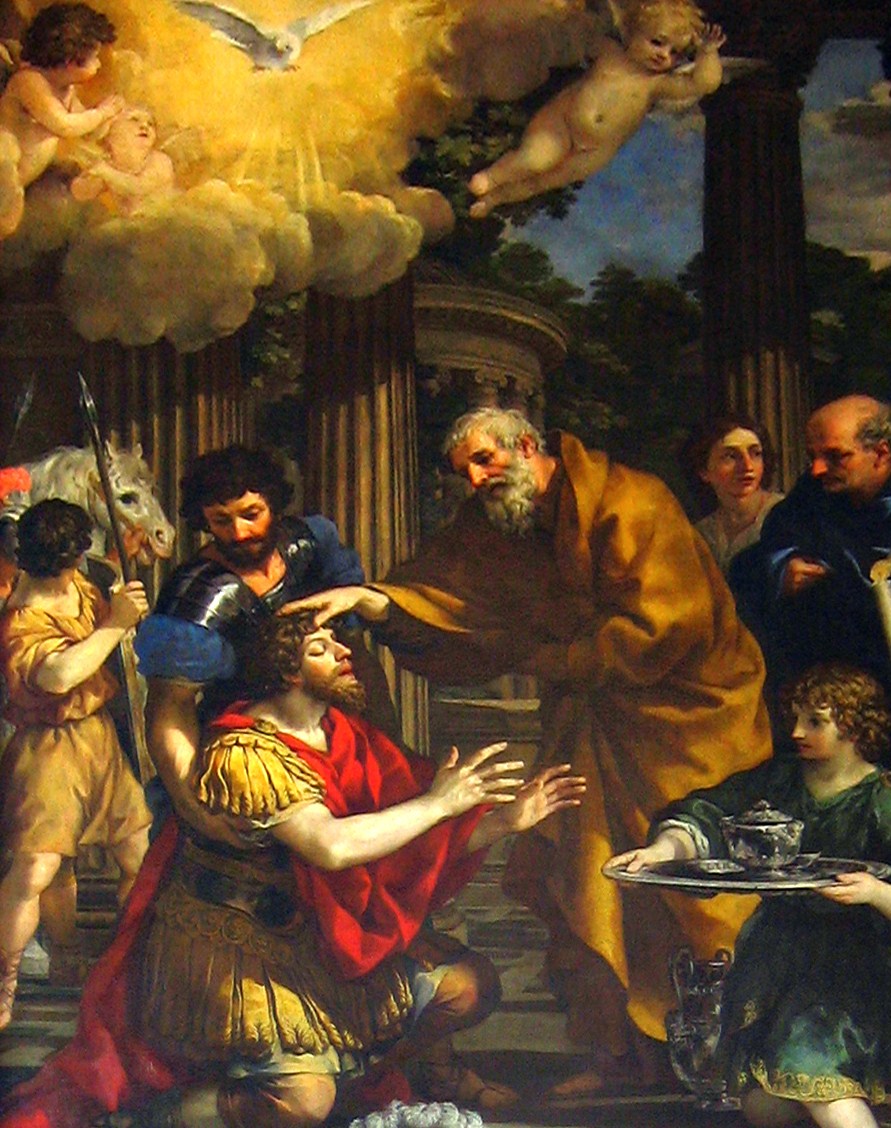
As you probably recall, St. Paul was not just struck down on the road to Damascus, he was blinded as well. The text of Acts 9 says,

Saul got up from the ground,
but when he opened his eyes he could see nothing;
so they led him by the hand and brought him to Damascus.
For three days he was unable to see, and he neither ate nor drank.

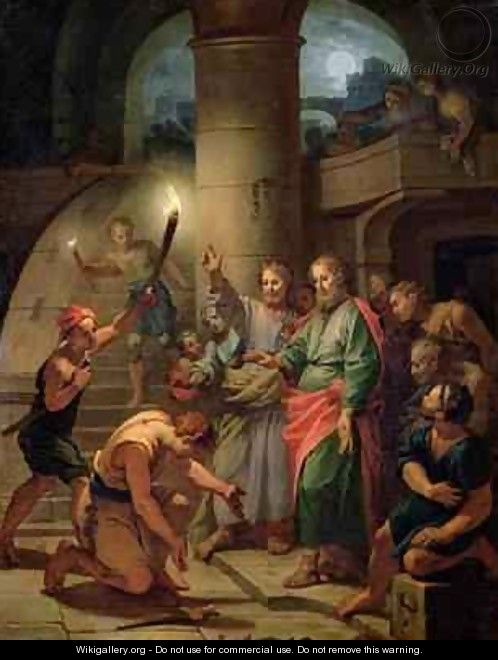
Having persecuted the Lord, Paul must now confront the darkness of sin and unbelief. It is as though the Lord wanted nothing to distract him as he pondered his experience, neither the delights of food and drink, nor the delights of the eye. It was a kind of dying and being with Christ for three days in the tomb before he would rise. And like the dead, Paul was unable to eat and was enveloped in the deep darkness of blindness. He could do little during that time but think and pray.

And pray he did, for the Lord said to a mysterious but chosen figure named Ananias,

“Get up and go to the street called Straight
and ask at the house of Judas for a man from Tarsus named Saul.
He is there praying,
and in a vision he has seen a man named Ananias
come in and lay his hands on him,
that he may regain his sight.”

… Ananias went and entered the house;
laying his hands on him, he said,
“Saul, my brother, the Lord has sent me,
Jesus who appeared to you on the way by which you came,
that you may regain your sight and be filled with the Holy Spirit.”
Immediately things like scales fell from his eyes
and he regained his sight.
He got up and was baptized,
and when he had eaten, he recovered his strength.

Through Word and Sacrament, Paul’s eyes were healed. Or were they? Surely they were, for in the years that would follow, Paul saw well enough to travel the world speaking of Christ!

But I’m convinced that some vestige of blindness, some physical memory remained in Paul’s eyes for his whole life, something to remind him of his need for mercy and to keep him humbly mindful of how that mercy was extended.

As background, we do well to recall the story of Jacob, who wrestled with God one night. Jacob was strong with God in that great contest, so much so that God would give him a new name, Israel, meaning “he who wrestles or strives with God.” But God also left Jacob with a permanent memory of that nighttime battle.  Scripture says that God knocked out his sciatic muscle (Genesis 32:32), such that Jacob would walk with a limp for the rest of his life, leaning on a staff.  It was a kind of reminder that Jacob was always to lean on the Lord (Heb 11:21).

And so too, perhaps, for St. Paul. For though he prevailed through the three dark days with God, and his eyesight was restored, it would seem there was a weakness in his eyes that remained. Later, St. Paul would speak of an ailment, a mysterious thorn in his flesh (2 Cor 12:7). Three times he begged God to remove it, but the Lord told him to endure it for the sake of humility.

What was it? What was the mysterious physical affliction? I’m convinced it had something to do with his eyes. Paul told the Galatians,

As you know, it was because of an illness that I first preached the gospel to you, and even though my illness was a trial to you, you did not treat me with contempt or scorn. Instead, you welcomed me as if I were an angel of God, as if I were Christ Jesus himself. Where, then, is your blessing of me now? I can testify that, if you could have done so, you would have torn out your eyes and given them to me (Gal 4:13-15).

While some speculation is necessary, it seems that Paul had something to akin to conjunctivitis, also called “pink eye.” It is an affliction that make the eyes fill with pus and become red. It is often contagious, humiliating, and repulsive to others. Indeed it was quite difficult to endure in the era before modern medicine.

But whatever his actual affliction, it seems (if the Galatians text is acknowledged as descriptive) to have involved the eyes. Yes, Paul’s eyes, those eyes that had been healed but perhaps with a reminder left in them of the need for humility and for remembrance of how God saved him.

What is your thorn? What is your limp? What is your conjunctivitis? All of us have things that keep us humble and remind us of our need to lean on God, and to look to Him, not with haughty eyes, but with eyes that are humble, respectful, and grateful.

This song says, “Nobody knows the trouble I’ve seen … Nobody knows but Jesus”

Please Pray This Week for Traditional Marriage – The Supreme Court Is in Session

042615The March for Marriage yesterday in Washington, D.C. was successful for numerous reasons. Among them was the turnout: over 10,000 people. This is especially impressive given the date change (the march had been planned for June but was moved to April when the Supreme Court’s schedule for the marriage cases was announced).

Second, the march manifested a diversity that shows that the concerns for traditional marriage are not coming only from older white Catholics and Pentecostals. You can see some pictures from the march here: March for Marriage 2015. Indeed if anything, the march had a distinctly black and brown hue. Though this should not matter, it does matter (at least politically) that a diverse and hard-to-categorize plurality can hold together.

Among the Catholic leaders and speakers present were the Archbishop of Baltimore and Chairman of the U.S. Bishop’s committee on religious freedom, William Lori; the President of the U.S. Conference of Catholic Bishops, Joseph Kurtz of Louisville; and the Pope’s Ambassador to the United States, Archbishop Carlo Maria Vigano.

It is encouraging that such prominent Catholic bishops were present and we need to pray for them.  Let us pray that they can courageously endure the difficulties that increasingly beset Catholic clergy who stand up publicly for what the Scriptures and the Catechism teach on matters of sexuality and marriage.

Oral arguments take place in the Supreme Court on Tuesday. A decision is expected to be handed down in June, and it may decide the status of marriage nationally in a way no less sweeping than did the Roe v. Wade decision in the matter of abortion.

With that in mind, I’d like to present highlights from an amicus curiae brief submitted by the USCCB, which defends traditional marriage. Many Catholics have expressed concerns that our clergy are too silent on these matters. But here is a document that clearly states Catholic opposition to redefining marriage, presenting it to the highest court in the land. Here is clarity and firm articulation of our opposition. Please read this, pray, and be willing to defend Church teaching.  It is an uphill journey and court-watchers say that the Court is like to find against us. So read, and pray as you read, and read as you pray. And pray. And did I mention that you should pray? Pray!

The following are my highlights from the amicus brief. The full document can be read here: Amicus Curiae – Obergefell v. Hodges. The numeration and the red and blue summary bullets are mine; the rest (in italics) is taken directly from the brief.

I. We are not bigots and cannot be categorized politically into any facile category. The USCCB advocates and promotes the pastoral teaching of the U.S. Catholic Bishops in such diverse areas of the nation’s life as the free expression of ideas, fair employment and equal opportunity for the underprivileged, protection of the rights of parents and children, the sanctity of life, and the nature of marriage.

II. Traditional marriage is quite distinct from other unions and deserves a distinct status in civil law. The State laws at issue here encourage and support the union of one man and one woman as husband and wife, as distinct from other interpersonal relationships, by conferring upon such unions a unique set of benefits. There are at least two reasons for doing so.

A. Heterosexual unions can produce children, others cannot. First, as a matter of simple biology, the sexual union of one man and one woman is the only union capable of creating new life. A home with a mother and a father is the optimal environment for raising children, an ideal that State law encourages and promotes. Given both the unique capacity for reproduction and the unique value of homes with a mother and father, it is reasonable and just for a State to treat the union of one man and one woman as having a public value that is absent from other intimate, interpersonal relationships. … Every child has a mother and a father, and only marriage, understood as the union of one man and one woman, assures that children will have the opportunity to be raised by both a mother and a father. A mother and father each bring something unique and irreplaceable to child-rearing that the other cannot.

Put another way, it is reasonable for the government to view the union of one man and one woman united in marriage as the preferred environment for the bearing and upbringing of children, even if, as it happens, some children are born and raised in non-marital contexts as well.

B. Traditional marriage is also better for the adults involved. Second … Government support for a marital bond between mothers and fathers serves the interest of reducing, or preventing further increases in, the incidence of single parenthood and the consequent burdens it places upon the custodial parent (usually the mother) … The government’s support and encouragement is particularly helpful in countering the negative personal and societal consequences specific to fatherlessness.

To be sure, marriage serves to connect children to both their mother and their father, but it plays an especially important role in joining men with their children and with the mother of their children in the shared task of parenting. The physical presence and identity of the mother of a child is assured at birth without the assistance of the law; but the assistance of the law is helpful, if not indispensable, in assuring the presence and identity of the father.

III. We are not bigots. The legal definition of marriage as the union of one man and one woman is not based on hatred, bigotry, or animus against any class of persons. … While the law may not draw classifications based upon mere thoughts, beliefs, or inclination, it can and routinely does distinguish between types of conduct. Here as elsewhere, the mere fact that a law declines to support certain conduct does not imply hatred of the person who might engage in that conduct.

A. Different things can be treated differently. Because sexual acts between a man and a woman have different practical consequences, the government can reasonably distinguish them in law from same-sex sexual acts. … Because sexual conduct between persons of the same sex never results in children, legal reinforcement of a permanent bond between them does not serve the same interests. … There is no bigotry in treating genuinely different things differently.

B. Immutable traits are different from behaviors. When the government treats persons differently because of their race, sex, or national origin, it discriminates on the basis of an immutable trait identifiable from conception or birth. In contrast, a decision to participate in a same-sex relationship is not a trait, but a species of conduct.

 C. Forsaking discrimination is not the same as active support. This Court has held that laws forbidding private, consensual, homosexual conduct between adults lack a rational basis; but it does not follow that States have a constitutional duty to support such conduct, which is precisely what would occur if the definition of marriage were expanded to encompass such conduct.

The King of Love My Shepherd Is – A Homily for the 4th Sunday of Easter

"StJohnsAshfield StainedGlass GoodShepherd Portrait" by Stained glass: Alfred Handel, d. 1946[2], photo: Toby Hudson - Own work.  Licensed under CC BY-SA 3.0 via Wikimedia Commons
“St Johns Ashfield Stained Glass Good Shepherd Portrait” by Stained glass: Alfred Handel, d. 1946[2]
photo: Toby Hudson – Own work. Licensed under CC BY-SA 3.0 via Wikimedia Commons

On this fourth Sunday of Easter we turn a corner of sorts. Up until now we have been reading of the resurrection appearances themselves. Today we begin to see how the risen Lord ministers to us as the Good Shepherd. In effect, the Lord gives us four basic pictures or teachings of how, as the King of Love, He shepherds us. Here, then, are four portraits of His love:

I. Passionate love – Jesus says, I am the Good Shepherd, a good shepherd lays down his life for the sheep. Purely gratuitous love is a hard thing to come by in human relationships. In one sense we are too needy to be able to give it purely. In another sense our motives tend to be a mixture of self-love and love of the other. This is our human condition, and few of us rise above it in a consistent way.

But Jesus loves us purely, gratuitously, and for our own sake. His love is passionate in the sense that it is sacrificial. He lays down His life for us, doing it though we are still sinners and often alienated from Him. He dies for us though we cursed, mocked, and ridiculed Him.  He loves us and lays down His life for us though He gets nothing out of it.

Hired shepherds, on the other hand, work for pay; above all else they seek their own good. When there is a danger to the sheep, hired shepherds will not risk themselves to rescue the sheep. Theirs is a service based on pay; it is subordinated to their own needs and safety.

Only one Shepherd died for you. In this world there are many politicians, musicians, movie stars, and organizations that seek our loyalty, our votes, our membership, and our dues. They also make us promises in return, even as they want to influence us and exercise leadership over us. None of this is necessarily wrong. People form relationships and seek leaders for any number of reasons. But note this important difference: none of these leaders or “shepherds” ever died for you. Only Jesus died for you.

There remains this problem: many Christians have greater loyalty to political  leaders, musicians, movies stars, and the like than to Jesus Christ. Too many people tuck their faith under their politics, giving greater credence to what popular figures say than to what Jesus says in His Word and through His Church.

Only Jesus died for you. Human beings too easily bring along their own needs and agendas. Only Jesus Christ loves you perfectly; only He died for you. Only He is deserving of the role of Chief Shepherd of your life.

II. Personal love – Jesus says, I know my sheep and mine know me. No one knows you the way Jesus Christ does, because He knew you before He ever formed you in your mother’s womb (cf Jer 1:4). He has always thought about you; He created you; He knit you together in your mother’s womb and every one of your days was written in His book before one of them ever came to be (cf Ps 139).

You’ve never been unloved. No matter what you think you may have done to cancel His love, He knew you would do it before He ever made you—and yet still He made you. Do not doubt His love for you or that He knows you better than you know yourself.

An old hymn says,

Perverse and foolish oft I strayed,
But yet in love He sought me,
And on His shoulder gently laid,
And home, rejoicing, brought me.

Jesus also says that His sheep know Him. And that is both our invitation and our call. We often like to quote the 23rd Psalm “The Lord is my Shepherd.” But this is not a slogan, nor is it merely a psalm of consolation. It is a psalm of confession: that I am one of the Lord’s sheep. The Lord says, “My sheep know me.” He does not say that we merely know about Him.

Do you know Him? To be in the Lord’s flock is to be in a life-changing, transformative relationship with the Lord. To know the Lord is to see our life changed by that very relationship. It is to know the voice of Jesus and be able to distinguish it from others. As Jesus says elsewhere: [The Shepherd] calls his own sheep by name and leads them out. When he has brought out all his own, he goes on ahead of them, and his sheep follow him because they know his voice. But they will never follow a stranger; in fact, they will run away from him because they do not recognize a stranger’s voice. (John 10:3-5). Are you smarter than a sheep? Do you run from other voices contrary to Jesus?

Now be very careful as well for many today have wanted to remake and refashion the true Jesus of Scripture and thereby distort his voice. On of the most common ways this is done is to screen our his less pleasant teachings such as when he warns (alot) about judgment and hell or says “woe.” Another was is to set up a false dichotomy between the Gospels and the Epistles. And thus it is often said that Jesus never said anything about homosexuality, etc. Yes, he did, in numerous places, through his apostles whom he commissioned to speak in his name. He said to them, “He who hears you hears me.” Further never wrote a book or a word. He entrusted his entire teaching to his apostles  to preach, teach and write in his name.

The Gospels and epistles have the same level of authority and are inspired and authored by the same Holy Spirit. To say that Jesus never said something but only Paul (or James or John or Peter) is to set up a false dichotomy. To hear an apostle speak in either the Gospel (for the apostles and evangelists wrote the Gospels) or the epistles is always to hear Jesus who said: Whoever listens to you listens to me; whoever rejects you rejects me; but whoever rejects me rejects him who sent me. (Luke 10:16) and also, You will receive power when the Holy Spirit has come upon you; and you shall be My witnesses both in Jerusalem, and in all Judea and Samaria, and even to the remotest part of the earth.” (Acts 1:8)

Be very careful therefore of those who try to distort the voice of Jesus by limiting it. The Apostles and Evangelists spoke for him in toto and Jesus continues to speak in the doctrinal teachings of the Church and the living voice of his magisterium which apply his word given through he apostles.

III. Persistent love – The Lord says, I have other sheep that do not belong to this fold, These also I must lead, and they will hear my voice, and there will be one flock and one shepherd. Jesus is not content merely to shepherd a few thousand Jewish disciples in the Holy Land. He wants His love to spread to the whole world. He wants to embrace and hold close everyone He has ever made. He wants to call every human person into a saving relationship.

Part of our journey as disciples, as sheep of the Lord, is to experience the call to evangelize. But that call will only take flight when Christ’s love for all people fills our heart.

Christ has a persistent love to embrace and hold everyone close to Him. Do you sense that love? He wants to draw others to Himself, through you. Many people leave the work of evangelizing and growing the flock to the priest. But shepherds don’t have sheep, sheep have sheep.

IV. Powerful love – Jesus says, I lay down my life, in order to take it up again. No one takes it from me, I lay it down on my own. I have the power to lay it down, and I have the power to take it up again.

We see how Jesus does this for Himself. But as Lord and Shepherd of our life He does it for us, too. Our old self was crucified and died with Him. We have also risen with Him to new life. And this life is the totally new and transformed life that Christ died to give us.

He has the power to crucify our old and sinful self as well as the power to raise it up again. And it is not merely our old self that rises; it is a new and transformed humanity that the Lord takes up on our behalf. He has the ability to do this, for His love powerful.

I am a witness of this and I pray that you are as well. He has the power!

Thus, as King of Love, Jesus the Risen Lord shepherds us with a love that is passionate, personal, persistent, and powerful. No one loves you more than Jesus does, with His Father and the Holy Spirit. He is the King of Love and He is your Shepherd. Here is the final line of the beautiful hymn “The King of Love My Shepherd Is.”

And so through all the length of days
Thy goodness faileth never;
Good Shepherd, may I sing Thy praise
Within Thy house forever
.

Here is a performance of that hymn, one of my favorites. Its peaceful strains amount to a kind of musical onomatopoeia (a word, or in this case a song, that sounds like what it describes).


Here is an another magnificent musical onomatopoeia:

When We Cast Off What Has Empowered Us, Only God Knows How Strange It Can Get – As Seen in a Commercial

The video below shows a world gone mad, a world in which chaos and unpredictability have taken over. Watch it and see the cause to which the commercial ascribes the problem. But allow it to be an allegory of what happens when

  • we let God’s presence die in our hearts and minds,
  • we let natural law die in our culture, and
  • we let time-tested and ancient wisdom die in our times.

Yes, as the commercial says, only God knows what awful, bizarre, unexpected, hideous, and devastating things can happen when we let important things die. Don’t miss the allegory; its message is powerful. A lot of unexpected things happen when we cast off what has empowered us.

On Praying for a Deep Hatred and Fear of Sin and Its Darkness

Woman shadow behind translucent mirror.We ought to ask the Lord to inspire us with a holy hatred of sin. There is a kind of inverse relationship that we ought to seek: if we love the truth staunchly we will detest sin and lies more fully. It is impossible to love the truth vigorously without also detesting error. Similarly, as we grow in the love of God, we grow in the love of holiness, for God is holy.

As our love for Him deepens, we become increasingly averse to all that is unholy. We begin to detest anything that would separate us from the beautiful, loving holiness of God. As we learn to love the light and become accustomed to it, the darkness becomes unfathomable to us. We cannot see into its depths at all.

But sadly many of us, though we were made for the light (with retinas attuned to bright days and easily lost in the dark), do just fine in the dark. Imagine you are in a well-lit room, when suddenly the lights go out. Because you have become accustomed to the light, the room seems pitch black at first; you feel disoriented and confused. But in a moment or two, you begin to become accustomed to the dark. You can start to make out a few things, and then more and more. After a while you can even navigate around pretty well in the darkness. This scenario parallels the spiritual situation with truth and holiness as compared to lies and sin. And while the ability to become accustomed to the darkness is a good thing in the physical world, it is a terrible thing to happen to us spiritually.

Spiritual darkness is something to which we should never become accustomed. We should not want to be able to navigate the darkness. We should detest the darkness, dreading it with a holy fear that makes us quickly seek the light again.

Woe to us who are willing to live in the twilight, appreciating the light of God’s truth, but not so much that we detest the darkness and find it unfathomable. Too many of us Christians are willing and able to navigate the darkness and do not have a proper fear of it. We are not shocked by sin, as when the lights first go out in a room. Instead of quickly seeking to restore the light, we settle down in the darkness and learn to navigate in the shadows. Once we are used to the dark, things become increasingly silhouetted in a way that they were not when the lights first went out.

And thus our love for the light diminishes; we no longer hate it or are shocked by it. We begin to navigate its shadows just fine. Slowly, we, who were made to walk in the light, become content and able to exist like weasels and groundhogs, who are quite able to navigate the darkness.

Once used to the dark, or at least to the twilight, even we who are to be children of the light can be heard to say that the undiluted light of God’s truth is too harsh, too revealing of painful things, too intolerant, and so forth. And when we speak like this, it is certain that the darkness has us in its grips and that we prefer its shadows to the glory and clarity of the light.

What a disgrace! In John’s Gospel, Jesus warns of the battle against our love of darkness: This is the verdict: Light has come into the world, but people loved darkness instead of light because their deeds were evil. Everyone who does evil hates the light, and will not come into the light for fear that their deeds will be exposed. But whoever lives by the truth comes into the light, so that it may be seen plainly that what they have done has been done in the sight of God (Jn 3:19-21).

Indeed, pray for a hatred of sin, for a fear of being lost in its darkness. May we never learn to navigate its twilight, but ever stumble about in it crying out again for the light. May the darkness be detestable to us and may its ways and depths be unfathomable to us.

Yes, pray for a hatred of sin. Pray for shock at its darkness. Pray for an inability to accustom yourself to its lifeless shadows. Pray to be crippled by it, unable to move about in it or compromise with its shadows. Pray for a deep fear of it. Pray for the ability to cry out for light and only light.

When I was a child I feared the dark and would call out for my parents. But do I now? Do you?

Pray for a deep hatred of sin, a sadness for it. Pray for the zeal to flee its first shadows. Please do not click away from this blog until you have done so.

Jesus light of the world, please help me to fear and detest the darkness. Help me to love the light and be shocked and disoriented by the darkness. May I never be able to navigate its shadows or find the twilight a happy medium. Only the light of you, pure, dear Lord, only light. May all else depress, disorient, and cause me to despise it without compromise. In Jesus’ name, Amen!