With Father’s Day approaching, the commercial below seems very appropriate. God the Father is surely the origin of all fatherhood here on Earth.
And yet most of us struggle with the fact that God allows bad things to happen. Why does he not intervene more often to protect us from attacks of various sorts and from events that cause sadness, setbacks, or suffering?
While the answer is mysterious, the clearest response is that God allows suffering in order that some greater blessing may occur. To some degree I have found this to be so in my life. Some of my greatest blessings required that a door slam shut or that I endure some suffering. Had my college sweetheart not dumped me, it is not likely that I would be priest today. Had I gotten some of my preferred assignments during my early years as a priest, I would not have been enriched by the assignments I did have. Those assignments helped draw me out and grow me far more than the cozy, familiar places I had wanted. Had I not entered into the crucible of depression and anxiety in my 30s, I would not have learned to trust God as much as I do, and I would have missed learning important lessons about myself and about life.
So despite that fact that we (understandably) fear suffering, for reasons of His own (reasons He knows best), God does allow some degree of it in our lives.
Yet I wonder if we really consider the countless times God did step in to prevent disasters in our life. We tend to focus on the negative things, overlooking an enormous number of often-hidden blessings: every beat of our heart, every proper function of every cell in our body, and all the perfect balances that exist in nature and the cosmos in order to sustain us.
Just consider the simple act of walking and all the missteps we might make each time but do not. Think of all the foolish risks we have taken in our life, especially when we were young, that did not end in catastrophe but surely could have. Think of all the poor choices we have made and yet escaped the worst possible consequences.
Yes, we sometimes wonder why we and others suffer and why God allows it. But do we ever wonder why we don’t suffer? Do we ever think about why and how we have escaped the consequences of some foolish things we have done? In typical human fashion, we minimize our many, many blessings and magnify and resent our sufferings.
One of the expressions I have picked up over the years, and that I use in response to people who ask me how I am doing, is this: “I’m pretty well blessed for a sinner.” I have heard others say, “I am more blessed than I deserve to be.” Yes, pretty well blessed indeed!
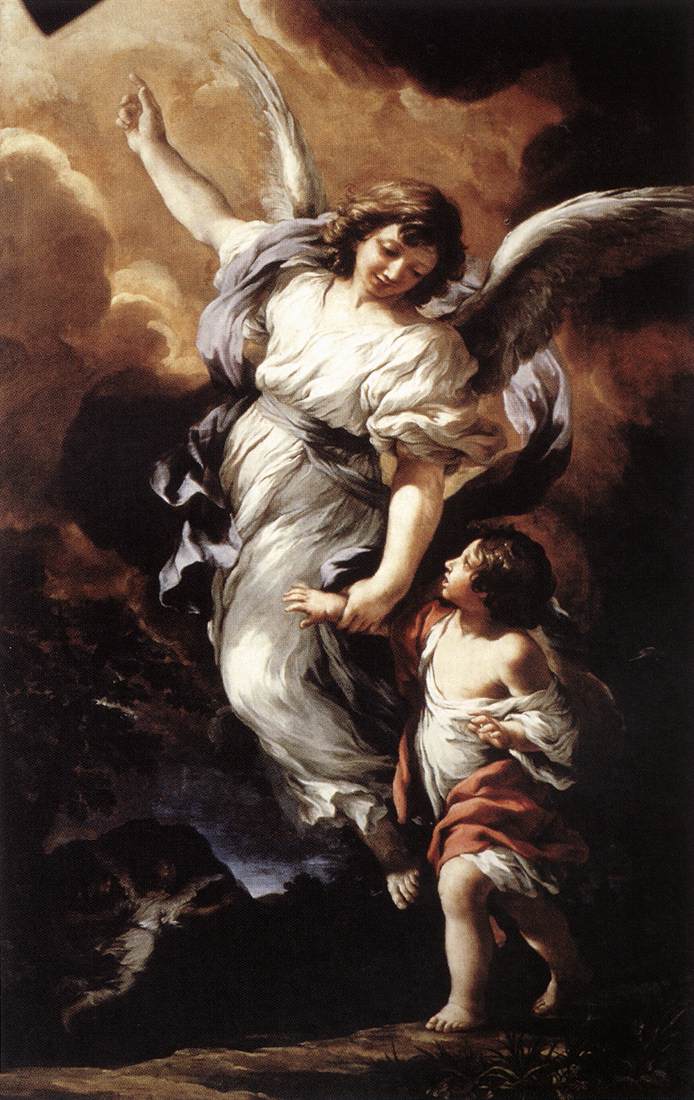
I thought of all these things as I watched the commercial below (it aired during the Super Bowl). And while it speaks of the watchfulness of a father, it also makes me think of my guardian angel, who has surely protected me from many disasters.
As you watch the commercial, don’t forget to thank God for the many hidden rescues He has executed for you through your guardian angel. Thank Him, too, for the hidden blessings—blessings you know nothing of—that He bestowed upon you anyway. And finally, think of the wonderful mercy He has often shown in protecting you from the worst of your foolishness.
One of the great paradoxes of the modern age is that we have so many ways to communicate, yet seem to have so little in the way of authentic communion, friendship, and relationship. A look down the sidewalk, or in the subway, or even in restaurants will reveal people lost in their devices: texting, checking email or Facebook, or listening to music. They are all but oblivious to the actual human beings around them. The virtual has eclipsed the real; cyberspace has become many people’s preferred living space.
Lost, too, long before the “electronic device age,” was the family dinner. This was once a fairly regular and expected part of family life. It is now rare in most homes, so rare that the dining room table (if there is one) is piled high with anything but dishes and food. Long gone is the family meal as well as the sharing (and sometimes arguing) that went along with it.
Long ago, a scribe asked Jesus, “Who is my neighbor?” Jesus responded with a parable showing that your neighbors are those nearest you at any moment, especially those who are in need or can help you in your need. Consider this: if you are involved in an accident, the folks at the other end of your device aren’t going to be of much use in helping you to climb out of the wreck. Suddenly you will realize that your neighbor is not merely your “friend” out in cyberspace; it is the one whose hand is stretched out to help you escape the danger, or the one who needs your help.
Enjoy the far-reaching connection of the Internet, but do not forget that the virtual can never replace the real. Greet your neighbors as you walk around; stay connected, not just virtually but really. In the twinkling of an eye you might need them far more than you ever imagined.
Enjoy this humorous video of a mother who wanted to reintroduce her family to one other. If this device doesn’t exist, it certainly should!
There is a lesser known hymn, at least in Catholic circles, that is remarkably appropriate for our times. It challenges us to see the choice before us soberly, and encourages us with the fact that the victory is already ours if we choose Christ Jesus. In times like these we need courage and conviction; this hymn serves as a powerful anthem to such a call. I would like to present the verses of the hymn and supply commentary throughout. First, though, a little background:
The hymn, Once to Every Man and Nation was based on a poem written by James Russell Lowell. Lowell was born in Cambridge, Massachusetts in 1819. His father was the pastor of the West Congregational Church in Boston for 55 years. After graduating from Harvard in 1838, Lowell became a lawyer, poet, and the editor of Atlantic Monthly. He was also an ardent champion of the movement to abolish slavery.
In 1876, President Rutherford B. Hayes appointed him ambassador to Spain, and in 1880 ambassador to Great Britain. Lowell was in great demand as a public speaker.
Written over 160 years ago, Once to Every Man and Nation is a poignant reminder of who is in control of history, and who will ultimately write the last chapter.
The basis for this hymn was Lowell’s poem, “The Present Crisis,” which spoke to the national crisis over slavery leading up to the Civil War.
Lowell was right; the darkness of slavery could not ultimately prevail over the light of truth. This hymn can serve today to summon us to courage and to remind us that the increasing moral darkness of these present times cannot ultimately stand; the light of day will return. We have already won the victory in Christ Jesus.
And now the hymn, with my comments in red.
Once to every man and nation, comes the moment to decide, In the strife of truth with falsehood, for the good or evil side; Some great cause, some great decision, offering each the bloom or blight, And the choice goes by forever, ’twixt that darkness and that light.
Yes, we have to decide. There are only two ways, God’s or the world’s. Tertium non datur (no third way is given). The Lord says, No one can serve two masters. Either he will hate the one and love the other, or he will be devoted to the one and despise the other (Mat 6:24). Joshua warned, But if serving the LORD seems undesirable to you, then choose for yourselves this day whom you will serve, whether the gods your forefathers served beyond the River, or the gods of the Amorites, in whose land you are living. But as for me and my household, we will serve the LORD (Jos 24:15). And James also warned, You adulterous people, don’t you know that friendship with the world is hatred toward God? Anyone who chooses to be a friend of the world becomes an enemy of God (James 4:4).
And yet far too many want two lovers; they want to serve the world and get its fleeting blessing, and also inherit God’s blessing. But there comes a moment when we must decide.
And now as never before we see how the path of this world is moving steadily and inexorably away from God. Sin, evil, open rebellion, sexual confusion, secularism, atheism, shredded families, and the growing tyranny of relativism and false tolerance are poisoning our culture. Secular culture increasingly sees the light of faith as harsh and obnoxious, something to be ridiculed, marginalized, and ultimately criminalized.
Our choice is ever clearer and the distinctions are ever starker. It is time for Catholics, for the Church, to stake out far more clearly our choice for God. And if there ever was a time when lukewarm would do (no such time has ever really existed), surely it is not now. The Word of the Lord rebukes the lukewarm:
I know your deeds, that you are neither cold nor hot. I wish you were either one or the other! So, because you are lukewarm—neither hot nor cold—I am about to spit you out of my mouth. You say, ‘I am rich; I have acquired wealth and do not need a thing.’ But you do not realize that you are wretched, pitiful, poor, blind and naked. I counsel you to buy from me gold refined in the fire, so you can become rich; and white clothes to wear, so you can cover your shameful nakedness; and salve to put on your eyes, so you can see. Those whom I love I rebuke and discipline. So be earnest, and repent (Rev 3:14-19).
In the near future, it’s going to become a lot tougher to be a Catholic; it’s going to take fiery believers, people who are prepared to speak the truth in love, endure persecution and ridicule, and suffer loss. The Lord has been purifying and pruning His Church in recent years for just this moment. It is decision time. Once to every man and nation and Church, comes the moment to decide.
The hymn continues,
Then to side with truth is noble, when we share her wretched crust, Once her cause brought fame and profit, and was prosperous to be just; Now it is the brave man chooses while the coward stands aside, Till the multitude make virtue of the faith they had denied.
In a way it is a glorious time to be a Catholic, to be a Christian. In the past one could even be praised for being religious. In the once-Judeo/Christian setting, religion was gain.
Now all that is changing. There is a glory in choosing God when that choice brings only ridicule, what the song calls “wretched crust.” It is one thing to be a Christian when it is easy; it is a far more noble and glorious thing to be one when it is hard and even dangerous.
The distinction between the courageous and the cowardly, to which the song refers, is once again becoming clear. Gideon of old had an army of 30,000 and faced the Midianites, who had 60,000. But God said to him, “Your army is too large. Tell the cowards to go home.” So Gideon dismissed any of the soldiers who didn’t think they were up for this battle; 20,000 left. Now with only 10,000 remaining God said to Gideon, “Your army is still too large, lest you think you would win this battle on your own.” So God had Gideon observe the men at the stream as they drank water. Some drank leisurely and others lapped up the water like dogs. “That is your army,” said the Lord, “300 men and I will be with you.” Gideon won that day with just the 300 men whom the Lord had chosen. God thinned his ranks, choosing only a remnant as his true soldiers (cf Judges 6 & 7).
Yes it is a time to stand up and be counted. It is a time for courage. It is a time to be prepared to suffer loss and endure ridicule. It is a glorious time in the valley of decision (cf Joel 3:14).
Onward to the next verse:
By the light of burning martyrs, Christ, Thy bleeding feet we track, Toiling up new Calv’ries ever with the cross that turns not back; New occasions teach new duties, time makes ancient good uncouth, They must upward still and onward, who would keep abreast of truth.
We walk the path of Christ, who said, If the world hates you, keep in mind that it hated me first. If you belonged to the world, it would love you as its own. As it is, you do not belong to the world, but I have chosen you out of the world. That is why the world hates you. Remember the words I spoke to you: “No servant is greater than his master.” If they persecuted me, they will persecute you also. If they obeyed my teaching, they will obey yours also. They will treat you this way because of my name, for they do not know the One who sent me (John 15:18-21).
Although, for a brief time, the world had some tolerance for Christ and His followers, that is now going away. Frankly, we are returning to the normal state for true Christians, a state in which we are despised by the world. Too many Christians spend too much time and effort trying to gain the love and respect of this world. No can do−unless you’re willing to compromise and even outright surrender the gospel.
So, welcome to the normal Christian life.
The hymn speaks of times like these, which make “ancient good uncouth.” That is, as our world heads steadily downward into unbelief and the rejection of God’s truth, those of us who remain with the Lord’s vision are considered uncouth. We are considered rude, boorish, ill-mannered, hateful, bigoted, homophobic, and intolerant.
But it is not we who have changed, nor has God changed. It is the world that has slouched toward Sodom, ridiculing ancient good and wisdom as uncouth. We who would dare doubt the cultural radicals are assailed in this way.
And we ought to be sober about it. For mere name-calling soon becomes demonizing; it paves the way for persecution about which the persecutors even feel self-righteous. Marginalization soon replaces ridicule and then criminalization follows. Get ready for more assaults like the HHS mandate and so called “hate-crime” legislation directed against biblical Christians who still follow the “ancient good,” now seen by the radicals as uncouth.
The hymn concludes,
Though the cause of evil prosper, yet the truth alone is strong; Though her portion be the scaffold, and upon the throne be wrong; Yet on that scaffold sways the future, and behind the dim unknown, Standeth God within the shadow, keeping watch above His own.
The truth will out. The light always conquers the darkness; the dawn always returns after every dark night.
Every now and again on this blog I receive scoffing remarks from secularists and militant atheists who laugh and ridicule us, saying that the days of the Church are over, that the world has come of age and no longer believes our “infantile myths.” Yes, they scoff that our days are done, that we are close to disappearing and will soon be gone forever.
Not only do such remarks demonstrate a lack of knowledge of God, they also show an ignorance of history. The Church has perdured through the rise and fall of many civilizations, nations, and philosophies. They have come and gone, risen and fallen; the Church alone remains. All those in the past who announced the Church’s doom are gone. The Church is still here, the gospel is still being preached, and the sacraments are still being celebrated. The Church has buried every one of her undertakers. Where is Caesar now? Where is Napoleon now? Where is the Soviet Socialist Republic now?
The darkness cannot win; it is always destined to be scattered by the light of the upcoming day. The hymn refers to martyrs on the gallows, saying, “on that scaffold sways the future.” The darkness of unbelief is not natural to the human family; the light of belief will always return.
I do not know what will ultimately become of Western culture, but whether it stays or goes, the Church will surely remain. Perhaps it is necessary that she be pruned for a time, or her numbers even reduced. But remember that Gideon’s army, small as it was, won the day against overwhelming odds.
The Church is undefeatable, by the Lord’s promise (cf Matthew 16:18). And we carry the same promise, as did the army of Gideon: the promise of the Lord, who said, and I will be with you (Judges 7:7; Matt 28:20). The darkness of these times cannot win; the light wins. He always wins.
Here is a video of the hymn. The tune is “Ebeneezer” and the clip is from a Polish movie about the Christian martyrs of Rome. I have offered this video before, but I want to warn you that the content is graphically violent. However, it is an accurate depiction of the death of the martyrs.
Life is filled with distractions and one of the most critical decisions we make from moment to moment is choosing what to focus on. Brain scientists have studied for years how our eyes and ears, along with our brain, filter out lots of background data. If they didn’t, our stress levels would be overwhelming, as we sought to process every sound, image, movement, and change in our immediate surroundings. Focus is essential lest we be overwhelmed.
It is the same in the spiritual life. Setting our focus on the Lord and His Kingdom is essential for us, lest the burdens, distractions, and trivialities of this world stress and overwhelm us. Daily prayer, ever deeper immersion in the truths of God, and practicing the presence of God are essential practices that help filter out the less important things.
The Lord has a plan to simplify our lives. He tells us not to serve two masters and to “fear” Him above all others. If we fear the Lord, we don’t really have to fear anyone else. If we do not fear him, we will fear ten thousand other people and things. If we serve the Lord, our life is simpler; if we do not, ten thousand masters with differing demands assail us.
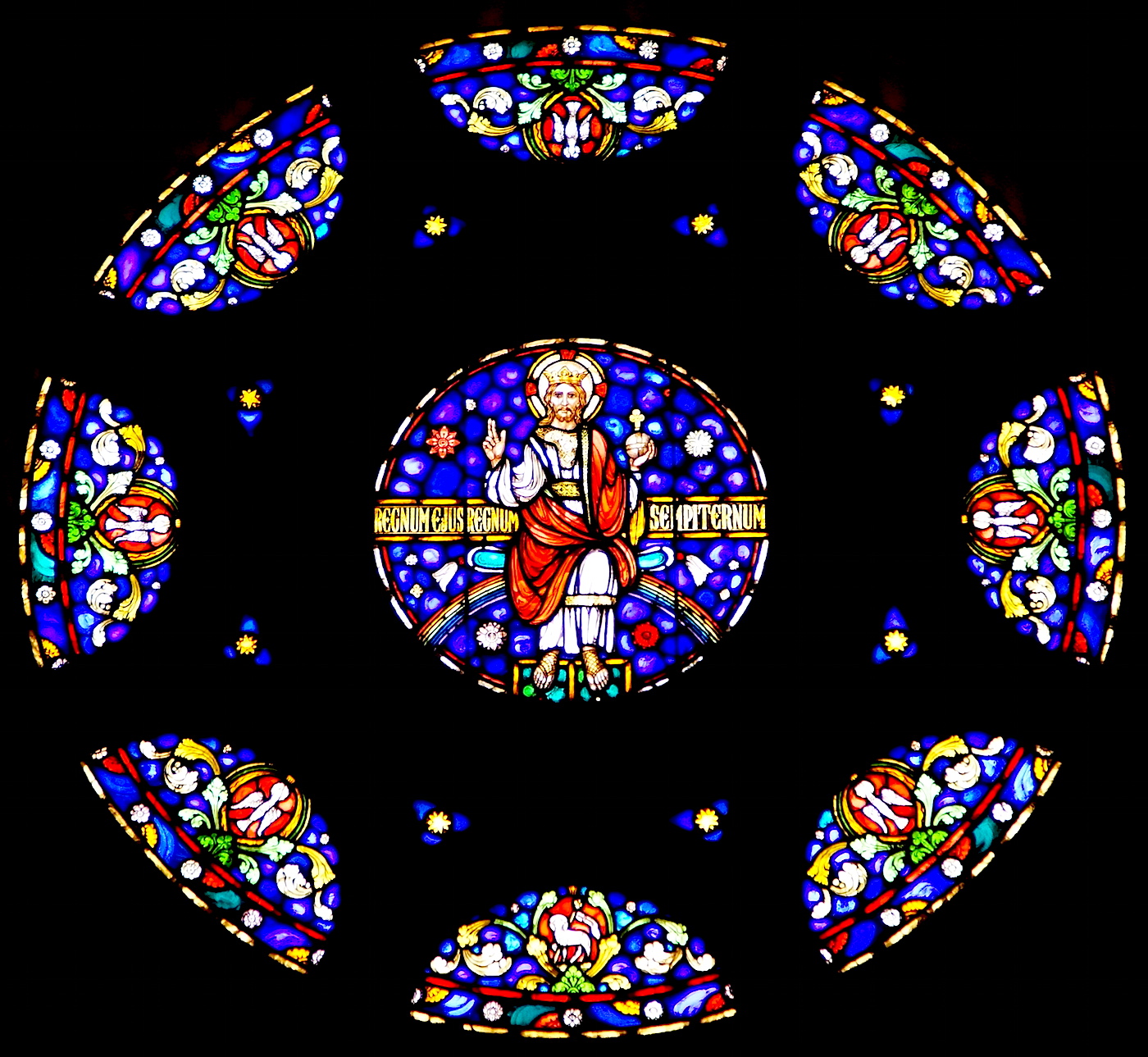
Set your focus and simplify. The rose window at the upper right (from my parish) is a picture of this. The petals of the rose represent the many aspects of your life: family, vocation, career, etc. But at the center is Jesus, who is to unite and organize everything else.
Enjoy this interesting video, which has a surprising lesson to teach us about focus.
Of all the things about which I preach, very few (if any) provoke as strong (and usually negative) a reaction as the call to forgive. I get more angry pushback after a Mass at which I preach on forgiveness than when I speak about chastity, greed, or any other challenging moral topic.
It would seem that the anger is rooted in two things: first, that the call to forgive implies some dishonoring or diminishing of the pain or injustice someone has experienced, and second, that it seems to imply that there is a requirement to stay in or resume relationships that are poisonous or dysfunctional. But forgiveness need not imply either of these.
Forgiveness is a concept that is often misunderstood. Many people interpret it to mean that they must stop having negative feelings about something that happened to them, or toward someone who hurt them. Many also think of forgiveness as a work they must do out of their own power, rather than as a gift to be received from God. No! Forgiveness is a work of God within us, whereby He acts to free us from the poisonous effects of bitterness and grief that often accompany the harm that was inflicted upon us.
Forgiveness is letting go of the need to change the past. Obviously, we cannot change the past; we cannot change what has happened. But we too easily think that ruminating over past hurts will somehow change what happened or even “get back at” the other person. It will not. Refusing to forgive is like drinking poison and expecting the other person to die. Clinging to our hurt and anger, understandable though it may be, only harms us.
Thus forgiveness is first for us, more so than for the other. In calling us to forgive, God is offering us the gift to be free of a great deal of poison and of a costly emotional state that robs us of joy and strength. Carrying anger and hurt is like lugging around bowling balls all day long. What a relief it is to just be free of that weight! And this is what God offers when He gives us the grace to forgive, to let go of the need to change the past, to let go of the desire for others to suffer because of what they have done to us.
Forgiveness does not necessarily mean that we are able or even should resume relationships with people who have done us great harm. At times we are able to do so, but it is not always advisable. Sometimes relationships are poisonous for both parties involved. Sometimes, because the other person has not or cannot repent (perhaps because of addictions or deep-seated drives), it is too dangerous to be close to him or her. Thus Scripture says, If possible, so far as it depends on you, be at peace with all men. Never take your own revenge, beloved, but leave room for the wrath of God, for it is written, “Vengeance is mine, I will repay,” says the Lord (Rom 12:18).
Receiving the gift of forgiveness requires a growing relationship with God and a trust that He sees and knows all things. As my relationship with God grows, it increasingly becomes enough for me to know that if someone who has harmed me does not repent (and I pray that he does), he is going to have to answer to God one day. God sees all things, understands all things, and will deal with things in the best way. Increasingly, I am content to leave most things to Him.
How is the forgiving of injuries a spiritual work of mercy? First of all, as we have seen, it is a work of mercy toward our very self. Anger, hurt, and nursing grudges all sap us of strength, stress us, and vex us. Receiving the gift to forgive is a mercy for us since we are relieved of these burdens. Our strength and energy can be directed to other, better things. We even sleep better!
And because our strength is directed to good and profitable things, we are now better able to love and be available to others. This, too, is a great mercy.
It is not always the case that the harm to us is so great that we cannot be restored to a relationship with those who have harmed us. Thus, forgiving injuries is also a work of mercy to the one who has harmed us; it can restore to them a relationship with us that is important to them. It is a very great gift to offer mercy and pardon to one who has harmed us and seeks our forgiveness.
In the family and in the wider community as well, forgiving injuries is a work of mercy, since it breaks the cycle of anger and retribution that often tears families, communities, and nations apart. It is a restorative work that knits together ties that have frayed.
This is a great work of mercy indeed. In moments of grave harm it may be difficult to access, but always pray for this gift. Almost nothing is more poisonous, both to us and others, than festering anger and resentment. Thus, to forgive injuries is a great, healing gift to receive from God and share with others. Ah, the beauty of mercy!
In yesterday’s post we examined some fundamental principles related to Holy Communion: that it is not akin to the “table fellowship” Jesus had with sinners but is rooted in the “family meal” of the Passover Celebration, and that it must be received worthily and authentically based on what Scripture and Tradition have set forth. Our “Amen” is more than an affirmation of the presence of Jesus in the Eucharist, it is an “Amen” to all that the Catholic Church believes, teaches, and proclaims to be revealed by God.
Today I would like to discuss some related issues.
What is mortal sin?
Why are the divorced and remarried asked to refrain from Communion?
What should be done about Catholics who prominently and publicly dissent from the faith?
Is there a way forward in restoring proper discipline in the reception of the Holy Eucharist?
I. What is mortal sin? – It is one thing to hear that we must confess all serious or mortal sins prior to receiving Holy Communion. As we saw in yesterday’s post, Scripture teaches that those who receive the Eucharist in an unworthy state (i.e., while in serious sin) do not obtain a blessing, but rather a condemnation.
But is there a simple list to be consulted to determine what serious or mortal sin is? No. But surely there is some guidance to be found. Common sense also tells us that certain acts are more or less serious depending on circumstances, not simply by declaration. For example, lying can range from being a very serious matter to a lighter one: there are serious lies that can ruin reputations and gravely mislead people, and then there are little polite lies (“white lies”) meant to avoid hurting someone’s feelings. Other sins such as lust can range from rape to impure thoughts. Anger can range from physical assault to angry thoughts.
Thus a simple “list” approach to mortal sin will not suffice. However, we usually know that there are more serious sins in our life and less serious ones. With some degree of certainty we can also know what is more serious from what is less serious. We are asked to counsel with our own conscience, to allow it to be properly formed based on God’s teaching and to make honest judgments regarding ourselves.
Here are some parameters for mortal sin from the Catechism and Scripture:
1. When the will sets itself upon something that is of its nature incompatible with the charity that orients man toward his ultimate end, then the sin is mortal by its very object … whether it contradicts the love of God, such as blasphemy or perjury, or the love of neighbor, such as homicide or adultery. … But when the sinner’s will is set upon something that of its nature involves a disorder, but is not opposed to the love of God and neighbor, such as thoughtless chatter or immoderate laughter and the like, such sins are venial. … If it is not redeemed by repentance and God’s forgiveness, it causes exclusion from Christ’s kingdom and the eternal death of hell, for our freedom has the power to make choices for ever, with no turning back (Catechism of the Catholic Church #s 1856, 1861).
2. For a sin to be mortal, three conditions must together be met: “Mortal sin is sin whose object is grave matter and which is also committed with full knowledge and deliberate consent” (Catechism # 1857).
3. Grave matter is specified by the Ten Commandments, corresponding to the answer of Jesus to the rich young man: “Do not kill, Do not commit adultery, Do not steal, Do not bear false witness, Do not defraud, Honor your father and your mother.” The gravity of sins is more or less great: murder is graver than theft. One must also take into account who is wronged: violence against parents is in itself graver than violence against a stranger (Catechism # 1858).
4. One area, because it causes frequent trouble for many, especially younger men, receives special mention in the Catechism in terms of assessing culpability: By masturbation is to be understood the deliberate stimulation of the genital organs in order to derive sexual pleasure. “Both the Magisterium of the Church, in the course of a constant tradition, and the moral sense of the faithful have been in no doubt and have firmly maintained that masturbation is an intrinsically and gravely disordered action.” “The deliberate use of the sexual faculty, for whatever reason, outside of marriage is essentially contrary to its purpose.” For here sexual pleasure is sought outside of “the sexual relationship which is demanded by the moral order and in which the total meaning of mutual self-giving and human procreation in the context of true love is achieved.” To form an equitable judgment about the subjects’ moral responsibility and to guide pastoral action, one must take into account the affective immaturity, force of acquired habit, conditions of anxiety or other psychological or social factors that lessen, if not even reduce to a minimum, moral culpability. (Catechism 2352). However, since no one is a judge in his own case, if this area is a struggle one ought to confer with a confessor in order to set forth a regular schedule for confession that is reasonable and assists the penitent in staying faithful also to Holy Communion.
5. By extension, there are other scriptural lists of sins that can exclude one from the Kingdom of Heaven:
1 Cor 6:9-10 – Or do you not know that wrongdoers will not inherit the kingdom of God? Do not be deceived: Neither the sexually immoral nor idolaters nor adulterers nor homosexual offenders, nor thieves nor the greedy nor drunkards nor slanderers nor swindlers will inherit the kingdom of God. And that is what some of you were.
Gal 5:19-2:1 – The acts of the flesh are obvious: sexual immorality, impurity, and debauchery; idolatry and witchcraft; hatred, discord, jealousy, fits of rage, selfish ambition, dissensions, factions and envy; drunkenness, orgies, and the like. I warn you, as I did before, that those who live like this will not inherit the kingdom of God.
Eph 5:3-6 – But among you there must not be even a hint of sexual immorality, or of any kind of impurity, or of greed, because these are improper for God’s holy people. Nor should there be obscenity, foolish talk or coarse joking, which are out of place, but rather thanksgiving. For of this you can be sure: No sexually immoral, impure, or greedy person—such a person is an idolater—has any inheritance in the kingdom of Christ and of God. Let no one deceive you with empty words, for because of such things God’s wrath comes on those who are disobedient. Therefore do not be partners with them.
Rev. 22:12-16 – Look, I am coming soon! My reward is with me, and I will give to each person according to what they have done. I am the Alpha and the Omega, the First and the Last, the Beginning and the End. Blessed are those who wash their robes, that they may have the right to the tree of life and may go through the gates into the city. Outside are the dogs, those who practice magic arts, the sexually immoral, the murderers, the idolaters and everyone who loves and practices falsehood. I, Jesus, have sent my angel to give you this testimony for the churches. I am the Root and the Offspring of David, and the bright Morning Star.
Matt 25:41-46 – Then he will say to those on his left, “Depart from me, you who are cursed, into the eternal fire prepared for the devil and his angels. For I was hungry and you gave me nothing to eat, I was thirsty and you gave me nothing to drink, I was a stranger and you did not invite me in, I needed clothes and you did not clothe me, I was sick and in prison and you did not look after me.” They also will answer, “Lord, when did we see you hungry or thirsty or a stranger or needing clothes or sick or in prison, and did not help you?” He will reply, “Truly I tell you, whatever you did not do for one of the least of these, you did not do for me.” Then they will go away to eternal punishment, but the righteous to eternal life.
And therefore we do well to examine ourselves and discern any serious sins we have committed and should confess them. And while we should avoid overly scrupulous fears, we also must not casually dismiss our sins with empty excuses. If we are faithful, God the Holy Spirit will bestow on us a Godly sorrow for sins, rather than a “worldly sorrow” that is deadly and discouraging (cf 2 Cor 7:10).
II. Why are the divorce and remarried asked to refrain from communion? – This matter became quite prominent at the extraordinary Synod in Rome last year. The odd thing is that there are already very generous possibilities offered in the Church to accommodate those in such situations. Some are so generous in fact that many wonder if we grant too many annulments for less-than-clear reasons (that is not a matter for this post, however).
But why is there an obstacle to such individuals receiving Holy Communion? Is this “another example” of an overly strict Church? No! The issue was set forth by Jesus himself, who was quite “restrictive” in offering divorce and remarriage to His disciples. He was asked if such a practice was to be allowed, as Moses had allowed it. The answer from Jesus was a strong “no,” with very little exception. Consider for example this rather typical answer of Jesus to the question of divorce:
And Pharisees came up to him and tested him by asking, “Is it lawful to divorce one’s wife for any cause?” He answered, “Have you not read that he who created them from the beginning made them male and female, and said, ‘Therefore a man shall leave his father and his mother and hold fast to his wife, and the two shall become one flesh’? So they are no longer two but one flesh. What therefore God has joined together, let not man separate.” They said to him, “Why then did Moses command one to give a certificate of divorce and to send her away?” He said to them, “Because of your hardness of heart Moses allowed you to divorce your wives, but from the beginning it was not so. And I say to you: whoever divorces his wife, except for sexual immorality, and marries another, commits adultery” (Matt 19:3-9).
There are numerous other places in Scripture where Jesus and the Apostles make similar pronuncements and set strict limits against divorce and remarriage.
Now the Lord uses the word “adultery” to describe divorcing one and marrying another. This is His word. And He teaches in many places using this word. So we cannot simply say he had a “bad day” or that this is just an unusual saying of the Lord. It was His consistent teaching. The teaching was unpopular and considered irksome even when the Lord gave it. (See Matthew 19:10.)
As an Apostle of the Lord, St. Paul echoed the same stance:
To the married I give this charge (not I, but the Lord): the wife should not separate from her husband (but if she does, she should remain unmarried or else be reconciled to her husband), and the husband should not divorce his wife (1 Cor 7:10-11).
Thus one in the state of being divorced and married to another is in an ongoing situation of what the Lord calls adultery, and cannot present himself for Holy Communion unless and until the objective conditions are changed. To those who consider this unkind or too strict we can only refer them to the Lord Himself, who unambiguously asserted it. In today’s “divorce culture,” we do well to ask ourselves who is wrong. Clearly, it is the culture that is wrong, not Jesus.
There are options and possible solutions. We can investigate prior bonds for the possibility of annulment and then grant annulments when possible and appropriate. In the meantime (or if an annulment cannot be reasonably obtained), the couple in the second marriage can live as “brother and sister.” Some scoff at this as being unrealistic. But some of the same scoffers see the denial of Holy Communion as so odious as to deny them essential graces. If they see Holy Communion as so essential (a good thing), then why are they not willing to make this sacrifice? Sex is not the only thing in life.
If they cannot obtain an annulment, and cannot live as brother and sister (for the reason of not wishing to deny their current spouse jus in corporis, (i.e., the expected recourse to marital intimacy)), then they must refrain from Holy Communion until the death of the current or former spouse or until they cease sexual intimacy with the current spouse.
Otherwise, we are dealing with a case of ongoing adultery (Jesus’ description, not mine). Adultery is objectively a serious violation of the 6th Commandment, even if there are subjective factors involved that some or all parties think mitigate the situation. No one is a judge in his own case and even the Church cannot blithely set aside the teaching of Jesus.
People in this situation who cannot reasonably attain an annulment (and that is rare today) or live as brother and sister should continue attending Mass for the other blessings available, such as the prayers, blessings, the proclaimed Word, the fellowship, the praise, and so forth. God, too, may be able to understand and offer them blessings that the Church, given our limits, cannot.
The fact is that many good people are caught in situations that often stretch back years before a conversion. Some of these situations are bound to occur in a culture as broken and dysfunctional as ours. But the Church can only do so much. God knows the heart, and the faithful in these situations should be taught to reach out to God and allow Him to care for them in other ways, unless and until the Church, which has some necessary limits, can readmit them to Holy Communion.
The Church cannot simply regard the needs of the individual but must also concern herself with the common good, the need to heed Jesus’ words and insist on the permanence of marriage. But God’s mercies are not exhausted and His compassion is not spent.
III. What should be done about Catholics who prominently and publicly dissent from the faith?– More and more Catholics in the public eye today dissent from the faith. Some of those even support things like abortion, euthanasia, and same-sex unions.
Canon 915 speaks rather explicitly to this situation:
Those who have been excommunicated or interdicted after the imposition or declaration of the penalty and others obstinately persevering in manifest grave sin are not to be admitted to Holy Communion.
Cardinal Ratizinger, in a 2004 Memo to Cardinal Theodore McCarrick, applied Canon 915 rather insistently. Here are some excerpts:
The Church teaches that abortion or euthanasia is a grave sin … there is a grave and clear obligation to oppose them by conscientious objection. […] In the case of an intrinsically unjust law, such as a law permitting abortion or euthanasia, it is therefore never licit to obey it, or to take part in a propaganda campaign in favour of such a law or vote for it … Christians have a grave obligation of conscience not to cooperate formally in practices which, even if permitted by civil legislation, are contrary to God’s law. Indeed, from the moral standpoint, it is never licit to cooperate formally in evil. …
Regarding the grave sin of abortion or euthanasia, when a person’s formal cooperation becomes manifest (understood, in the case of a Catholic politician, as his consistently campaigning and voting for permissive abortion and euthanasia laws), his Pastor should meet with him, instructing him about the Church’s teaching, informing him that he is not to present himself for Holy Communion until he brings to an end the objective situation of sin, and warning him that he will otherwise be denied the Eucharist. …
Not all moral issues have the same moral weight as abortion and euthanasia. For example, if a Catholic were to be at odds with the Holy Father on the application of capital punishment or on the decision to wage war, he would not for that reason be considered unworthy to present himself to receive Holy Communion. [***]
And thus there is a clear teaching regarding what is to be done in such cases. That many bishops have declined to enforce Canon 915 and apply the norm as set forth by the congregation is irksome to many. Refraining from judging them or claiming to know their motives, it seems likely that a way forward needs to include a broad teaching by all the bishops to all of God’s people about the need to receive Communion worthily and in a way wherein their “Amen” includes not only a recognition of Christ’s presence in the Eucharist, but also a union with his whole body, the Church (as we saw in yesterday’s post). This would avoid, to some degree, the charge that politicians of a certain party were being singled out. Fair or not, the charge would surely come in the current political environment in this country, in which popularity and power are more important than right and wrong. In such an environment, moral teaching and instruction is often misconstrued as mere politics. It is not a fair charge, but realistically there is little chance that a focused teaching of this sort will be heard through the static of the political filter.
IV. Is there a way forward in restoring proper discipline in the reception of the Holy Eucharist? – A broad initiative by all the bishops that includes all Catholics may be the best approach. On any given Sunday, there are many Catholics who should not approach Holy Communion for any number of reasons. Many of these reasons can be dealt with through the Sacrament of Confession. Other situations are more ongoing such as with those in invalid marriages and must be addressed in greater detail. Those who are in significant, obstinate, and often public dissent from one or many Church teachings need to work through their doubts and decide more clearly for the faith. Some who merely struggle to understand Church teaching might not need to stay away from Holy Communion. But we need to be clearer for all Catholics that our “Amen” confesses both the true presence of Jesus in the Eucharist, and our belief in all the Holy Catholic Church believes, teaches, and professes to be revealed by God.
Collectively speaking, it is clear that we in the Church, especially bishops and pastors, have not had proper balance in teaching on the worthy reception of the Eucharist. We have rightly sought to encourage frequent reception of Holy Communion, but often have not balanced that encouragement with instruction on the need for worthy reception. It is a Church-wide problem that affects far more than just Catholic politicians. Clear but charitable instruction must be more ardently offered in parishes and from the bishops to all the faithful. This post is my own humble attempt to do so.
It should go without saying that Confession must be more readily available, both prior to Masses and at other times, to assist those who can to confess and thus receive Communion frequently.
I indicated yesterday an intention to expand on the need for the reverent and worthy reception of Holy Communion, to develop an apologetic for the Church’s practice of what some call “closed communion.” Not everyone who uses this terminology means it pejoratively, though some do. But to some extent it is fair to say that we do have “closed communion.” For the Catholic Church, Holy Communion is not a “come one, come all” event. It is reserved for those who, by grace, preserve union with the Church through adherence to all the Catholic Church believes, teaches, and proclaims to be revealed by God. Our response of “Amen” at Holy Communion signifies our communion with these realities along with our faith in the true presence of Christ in the Eucharist.
But many today have reduced Holy Communion to a mere sign of hospitality, such that if the Church does not extend Holy Communion to all, we are considered unkind. There is often a mistaken notion about the nature of the Last Supper (and the Eucharist that proceeds from it) that lurks behind this misconception. Many years ago, Joseph Cardinal Ratzinger articulated the misunderstanding well. I summarize the description here from his Collected Works, Vol 11, Ignatius Press pp 273-274:
Nowadays [some] New Testament scholars … say that the Eucharist … is the continuation of the meals with sinners that Jesus had held … a notion with far-reaching consequences. It would mean that the Eucharist is the sinners’ banquet, where Jesus sits at the table; [that] the Eucharist is the public gesture by which we invite everyone without exception. The logic of this is expressed in a far-reaching criticism of the Church’s Eucharist, since it implies that the Eucharist cannot be conditional on anything, not depending on denomination or even on baptism. It is necessarily an open table to which all may come to encounter the universal God …
However tempting the idea may be, it contradicts what we find in the Bible. Jesus’ Last Supper was not one of those meals he held with “publicans and sinners”. He made it subject to the basic form of the Passover, which implies that the meal was held in a family setting. Thus he kept it with his new family, with the Twelve; with those whose feet he washed, whom he had prepared by his Word and by this cleansing of absolution (John 13:10) to receive a blood relationship with him, to become one body with him.
The Eucharist is not itself the sacrament of reconciliation, but in fact it presupposes that sacrament. It is the sacrament of the reconciled, to which the Lord invites all those who have become one with him; who certainly still remain weak sinners, but yet have given their hand to him and have become part of his family.
That is why, from the beginning, the Eucharist has been preceded by a discernment … (I Corinthians 11:27 ff). The Teaching of the Twelve Apostles [the Didache] is one of the oldest writings outside the New Testament, from the beginning of the Second Century, it takes up this apostolic tradition and has the priest, just before distributing the sacrament saying:”Whoever is holy, let him approach, whoever is not, let him do penance” (Didache 10).
Thanks to Pope Benedict’s writing prior to his papacy, we can see the root of the problem: the failure to see the Eucharist for what it truly is—a sacred banquet wherein those who enjoy communion with the Lord (by His grace) partake of the sign and sacrament of that communion. Holy Communion serves to celebrate and deepen the communion already operative through the other sacraments of Baptism, Confirmation, and Confession.
If you want to call this communion “closed,” fine, but at its heart it is more positively called a “sacrum convivium,” a sacred meal of those who share a life together (con = with or together + vivium = life). This is not a “come one, come all” meal; it is a Holy Banquet for those who wear the wedding garment. The garment is righteousness and those who refuse to wear it are cast out (cf: Matt 22:11-12 & Rev 19:8).
Many moderns surely would prefer a “no questions asked” invitation to all who wish to come. We moderns love this notion of unity. But to a large degree it is a contrived unity that overlooks truth (the opposite of which is falsehood, not just a different viewpoint). Yes, it overlooks the truth necessary for honest, real, and substantive unity. Such a notion of communion is shallow at best and a lie at worst. How can people approach the Eucharist, the sacrament of Holy Communion and unity, and say “Amen” when they differ with the Church over essentials such as that Baptism is necessary; that there are seven Sacraments; that the Pope is the successor of Peter and the Vicar of Christ on Earth; that homosexual acts, fornication, and adultery are gravely sinful; that women cannot be admitted to Holy Orders; that there is in fact a priesthood; that Scripture must be read in the light of the Magisterium; and on and on? Saying that there is communion in such a case is either a contrivance or a lie, but in either case, it does not suffice for the “Amen” that is required at the moment of reception of Holy Communion.
Such divisions do not make for a family meal or a “sacrum convivium.” Hence, to share Holy Communion with Protestants, dissenters, and others who do not live in communion with the Church is incoherent. To paraphrase Cardinal Ratzinger (Pope Benedict), the Eucharist is not a table fellowship with publicans and other “sinners”; it is a family meal that presupposes grace and shared faith.
This, then, leads us to a second point: the need to approach the Sacrament of Holy Communion free from serious and unrepentant sin. Let’s consider some texts to show that the Church’s desire that her sons and daughters receive Holy Communion in a state free from serious sin is not only a proper requirement but a loving one. Each quote is followed by some of my own commentary in plain red text.
So then, whoever eats the bread or drinks the cup of the Lord in an unworthy manner will be guilty of sinning against the body and blood of the Lord. Everyone ought to examine themselves before they eat of the bread and drink from the cup. For those who eat and drink without discerning the body of Christ eat and drink judgment on themselves. That is why many among you are weak and sick, and a number of you have fallen asleep. But if we were more discerning with regard to ourselves, we would not come under such judgment. Nevertheless, when we are judged in this way by the Lord, we are being disciplined so that we will not be finally condemned with the world (1 Cor 11:27-32).
St. Paul teaches that examining oneself is a prerequisite for worthy reception of the Eucharist. If not, Holy Communion has the opposite of the desired effect of union with our Lord, bringing condemnation rather than blessing. So, out of respect for Christ and for our own good, the Church requires us to be in a state of grace when we receive. We are required to abstain only when there is mortal sin. Confessions of devotion, however, are highly recommended.
[At the Last Supper the disciples asked]: “Lord, who is it [who will betray you]?” Jesus answered, “It is he to whom I will give this morsel of bread when I have dipped it.” So when he had dipped the morsel, he gave it to Judas, the son of Simon Iscariot. Then after he had taken the morsel, Satan entered into him. Jesus said to him, “What you are going to do, do quickly.” Now no one at the table knew why he said this to him. Some thought that, because Judas had the moneybag, Jesus was telling him, “Buy what we need for the feast,” or that he should give something to the poor. So, after receiving the morsel of bread, he immediately went out. And it was night (Jn 13:21-30).
It is unclear and debatable if the “morsel” taken by Judas was Holy Communion (why would Jesus have dipped it?). But still, there is something of a picture of what unworthy (sacrilegious) reception of Holy Communion might cause in an extreme case.
So if you are offering your gift at the altar and there remember that your brother has something against you, leave your gift there before the altar and go. First be reconciled to your brother, and then come and offer your gift. Come to terms quickly with your accuser while you are going with him to court, lest your accuser hand you over to the judge, and the judge to the guard, and you be put in prison. Truly, I say to you, you will never get out until you have paid the last penny (Mat 5:21-26).
Note the use of the simple word “first.” Jesus teaches that we cannot approach the altar if we are filled with hate or injustice toward our brethren. Reconciliation and the restoration of unity are required prior to approaching the Sacrament of Holy Communion, lest our “Amen” be incoherent or a lie.
A person who is conscious of grave sin is not to celebrate Mass or to receive the Body of the Lord without prior sacramental confession unless a grave reason is present and there is no opportunity of confessing; in this case the person is to be mindful of the obligation to make an act of perfect contrition, including the intention of confessing as soon as possible (Code of Canon Law # 916).
Note that the use of the Act of Contrition mentioned here is an exception requiring moral or physical impossibility to go to Confession beforehand and the necessity of receiving Communion immediately (such as a priest who MUST celebrate Mass). There are some pastoral notes that can be added here later for those who struggle with certain habitual sins that are possibly grave such as masturbation. The Catechism has some notes to review that a confessor can apply to a penitent in such cases. But no Catholic should simply take it upon himself to use the exception described in Canon 916. A confessor must be consulted.
To respond to this invitation we must prepare ourselves for so great and so holy a moment. St. Paul urges us to examine our conscience: “Whoever, therefore, eats the bread or drinks the cup of the Lord in an unworthy manner will be guilty of profaning the body and blood of the Lord. Let a man examine himself, and so eat of the bread and drink of the cup. For any one who eats and drinks without discerning the body eats and drinks judgment upon himself.” Anyone conscious of a grave sin must receive the sacrament of Reconciliation before coming to communion (Catechism # 1385).
If any one is holy, let him approach; if any one is not so, let him repent. Maranatha. Amen. … But let no one eat or drink of your Eucharist, unless they have been baptized into the name of the Lord; for concerning this also the Lord has said, “Give not that which is holy to the dogs”(Didache 10, 9).
Note that the Didache was written sometime between 90 and 110 AD. Hence very early on there was an understanding that the Eucharist was not a mere “table fellowship with sinners” but rather a sacral meal that presupposed grace and communion with the Church.
Presenting oneself to receive Holy Communion should be a conscious decision, based on a reasoned judgment regarding one’s worthiness to do so, according to the Church’s objective criteria, asking such questions as: “Am I in full communion with the Catholic Church? Am I guilty of grave sin? Have I incurred a penalty (e.g., excommunication, interdict) that forbids me to receive Holy Communion? Have I prepared myself by fasting for at least an hour?” The practice of indiscriminately presenting oneself to receive Holy Communion, merely as a consequence of being present at Mass, is an abuse that must be corrected (Ratzinger Memo to Cardinal McCarrick, # 1). Clear enough!
In all these quotes we see a tradition that is Scriptural, ancient, and clear: the Eucharist is a sacred meal that requires of us something more than just “showing up.” Indeed, there are warnings against irreverent reception, in which the Eucharist as regarded as ordinary or is treated casually.
Is the Church merely being “fussy” about Holy Communion? No more so than were St. Paul and the Holy Spirit, who inspired him to write and warn us against unworthy reception of the Eucharist. As such, the Church is charitably exhorting us to receive the Eucharist, but also charitably warning those who are unprepared to refrain from reception. Indeed, Scripture warns that the unworthy reception of Holy Communion brings not a blessing but a condemnation. This is God’s teaching, not mine.
Perhaps an analogy can be found by noting that some people are allergic to penicillin. For them, a drug that has saved many lives can threaten their own. They are simply not able to receive it, though it is good in itself. Sinners, too, not by accident or birth or genetics, but by choice will also find the Eucharist, though it gives life to many, to be problematic for them. In charity, the Church teaches that those individuals unprepared to receive Communion refrain from doing so until the problem can be resolved. This is charity, not cruelty or a lack of hospitality.
In tomorrow’s post I will develop some of these principles further and present some pastoral issues and solutions related to the Church’s stance. For indeed, questions arise as to what we mean by mortal sin and how to handle the current problem of dissenters, those in serious sin, and those in invalid marriages or other irregular situations. Such questions and issues must be handled charitably and equitably by the Church, but not in a way that violates the principles given by Scripture and Tradition as to the need for worthy reception of Holy Communion. The clear instruction by Cardinal Ratzinger in 2004 deserves to be reiterated and needs to be better taught and applied with clarity and charity:
The practice of indiscriminately presenting oneself to receive Holy Communion, merely as a consequence of being present at Mass, is an abuse that must be corrected (Joseph Cardinal Ratzinger, 2004).
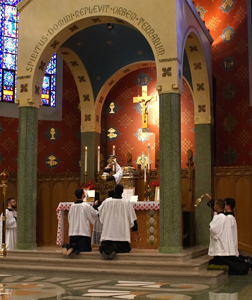
In many places, this Sunday features the (moved) Solemnity of the Most Holy Body and Blood of Christ, Our Lord.
While you may be puzzling over the title of today’s post, allow me to delay a bit before explaining. On a solemn feast like this many things occur that might be preached and taught. Here are three areas for reflection: the reality of the Eucharist, the requirement of the Eucharist, and the reverence for the Eucharist. We will look at each in turn.
I. The Reality of the Eucharist – On this solemn feast we are called above all to faith in the fact (as revealed by the Lord Himself) that the Eucharist, the Holy Communion of which we partake, is in fact a reception of the very Body, Blood, Soul, and Divinity of Jesus Christ, whole and entire, in His glorified state. We do not partake of a symbol. The Eucharist is not a metaphor; it is truly the Lord. Neither is it a “piece” of His flesh; it is Christ, whole and entire. Scripture attests to this in many places.
A. Luke 22:19-20And he took bread, and when he had given thanks he broke it and gave it to them, saying, “This is my body which is given for you. Do this in remembrance of me.” And likewise the cup after supper, saying, “This cup which is poured out for you is the new covenant in my blood.”
B. 1 Cor 10:16 The cup of blessing which we bless, is it not a partaking in the blood of Christ? The bread which we break, is it not a partaking in the body of Christ?
C. Luke 24:35They recognized him in the breaking of the bread.
D. 1 Cor 11:29For anyone who eats and drinks without recognizing the body of the Lord eats and drinks judgment on himself.
E. John 6:51I am the living bread which came down from heaven; if any one eats of this bread, he will live for ever; and the bread which I shall give for the life of the world is my flesh.
This last quote is a profound theology of the Eucharist from Jesus Himself. He makes it clear that we are not to think of the Eucharist as symbolic or metaphorical.
As Jesus spoke the words saying that the bread was His flesh, the Jewish people grumbled in protest. But Jesus did not seek to reassure them or to say that He was speaking only symbolically when saying that they must eat His flesh. Rather, He became even more adamant, shifting His choice of words from the polite form of eating, φάγητε (phagete – meaning simply “to eat”), to the impolite form, τρώγων (trogon – meaning to “munch, gnaw or chew”).
So insistent was He that they grasp this, that He permitted most of them to leave, no longer following in His company due to this teaching (cf Jn 6:66). Yes, the Lord paid quite a price for His graphic and “hard” teaching (Jn 6:60).
Today, He asks us, Do you also want to leave me?(Jn 6:67) We must supply our answer each time we approach the altar and hear the words, “The Body of Christ.” It is at this time that we answer the Lord, “Amen,” as if to say, Lord, to whom shall we go? You have the words of eternal life! (Jn 6:68)
Would that people grasped that the Lord Himself is truly present in our Churches! Were that so, one would never be able to empty our parishes of those seeking to pray with the Lord. As it is, though, only 25% of Catholics attend Mass regularly. This is more evidence of the “narrow road” and of how few there are who find it. Jesus experienced that most left him 2000 years ago, and many today continue to leave Him (or stand far away), either through indifference or false notions.
What father would not be alarmed if one of his children stopped eating? Consider, then, God’s alarm that many of us have stopped eating. This leads us to the next point.
II. The Requirement of the Eucharist – This is where the “Unless!” in my title comes in. When I was young I thought of Church and Communion as just something my mother made me do; it was just a bunch of rituals and stuff. I never thought of it as essential for my survival. But Jesus teaches something very profound in John’s Gospel today. In effect, He says that without Holy Communion (the Eucharist) we will starve and die spiritually.
Here is what Jesus says: Unless you eat the flesh of the Son of Man and drink his blood, you have no life in you (John 6:53).
As a child and even as a young adult I never thought of Holy Communion as essential for my life, as something that, if not received regularly, would cause me to die spiritually. But it makes sense, doesn’t it? If we don’t eat food in our physical lives, we grow weak and eventually die. It is the same with Holy Communion with respect to our spiritual lives.
Remember in the Book of Exodus that the people in the desert were without food and feared for their lives. So God gave them bread from Heaven called “manna” that they collected each morning. Without eating that bread from Heaven they would never have made it to the Promised Land; they would have died in the desert.
It is the same with us. Without receiving Jesus, our Living Manna from Heaven, in Holy Communion we will not make it to our Promised Land of Heaven! I guess it’s not just a ritual after all; it is essential for our survival.
Don’t miss Holy Communion! Jesus urges you to eat.
A mother and father in my parish recently noticed that their daughter wasn’t eating. Within a very short time they took her to a doctor, who diagnosed the problem; now the young girl is able to eat again. Those parents would have moved Heaven and Earth to make sure their daughter was able to eat.
It is the same with God. Jesus urges us to eat, to receive the Holy Communion every Sunday without fail. Jesus urges us with this word: “Unless!” Holy Communion is our required food.
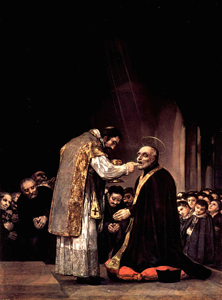
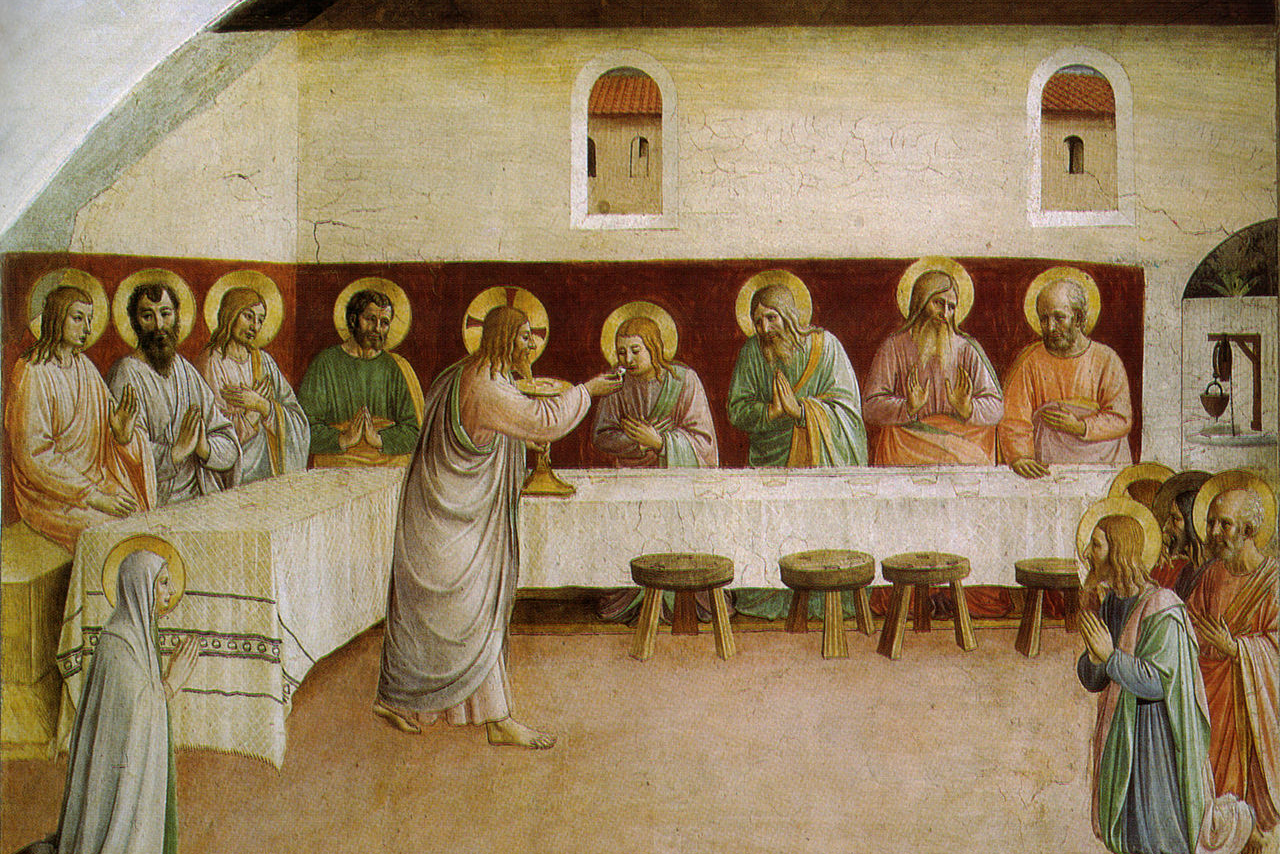
III. The Reverence for the Eucharist – One of the mistaken notions about the Eucharist is confusing this sacred meal with the table fellowship Jesus had with sinners. He was known to “welcome sinners and eat with them.” But Holy Mass is not one of those sorts of meals. The Last Supper, wherein the essential reality of the Mass was first set forth, was held in the context of the Passover. This was a sacred meal shared within the family. And thus Jesus celebrated that Last Supper with the twelve Apostles.
The confusion by many today about the difference between the sacred meal of the Eucharist and common table fellowship leads many to misconstrue the Eucharist; it also helps to explain the Church’s stance.
Those who think of the Mass as the mere table fellowship Jesus had with sinners, think of the Eucharist as a “Come one, come all” sort of meal. And many also add, “Come as you are.” In their view, there are no requirements; all that matters is that Jesus is offering. “Don’t worry,” they say, “about ‘membership’ or the need to be reconciled from sin. After all, Jesus ate with sinners and didn’t worry about that stuff.”
But again, this is not what the Last Supper was. Jesus celebrated the Mass in the context of the Passover. Such meals presupposed that the people gathered together were family. This was an intimate meal celebrated in the context of faith, however weak or strong, but a faith that was presupposed. Jesus said to them, “You are the men who have stood by me in my trials” (Lk 22:28).
This is one reason that the Church has always limited the Eucharist to those who are initiated, who are “members of Christ’s Body” through faith, and who keep communion with His Body the Church through assent to her teachings, remaining members of His Body by being in a state of grace.
It further explains the need to receive the Eucharist worthily by first confessing our serious sins through the Sacrament of Confession. St Paul teaches,
Let a person examine himself, then, and so eat of the bread and drink of the cup. For anyone who eats and drinks without discerning the body eats and drinks judgment on himself. That is why many of you are weak and ill, and some have died (1 Cor 11:28-30).
So here, too, we see that the Mass is not akin to the table fellowship that Jesus at times kept with sinners. Rather, it is a sacred meal that presupposes membership in Christ’s Body through faith and the forgiveness of all serious sins that might have severed that communion. Holy Communion is meant to strengthen a communion that already exists. And thus our “Amen” upon receiving Holy Communion is not a lie, but is consonant with the reality of existing communion.
I will write more on this in the coming week. But for now, simply note that our reverence for Holy Communion requires us to receive worthily, in a state of grace that has preserved the communion we celebrate. Further, to receive worthily also requires that we have the faith of the Church, the Body of Christ, and keep communion by a belief in conformity and communion with it.
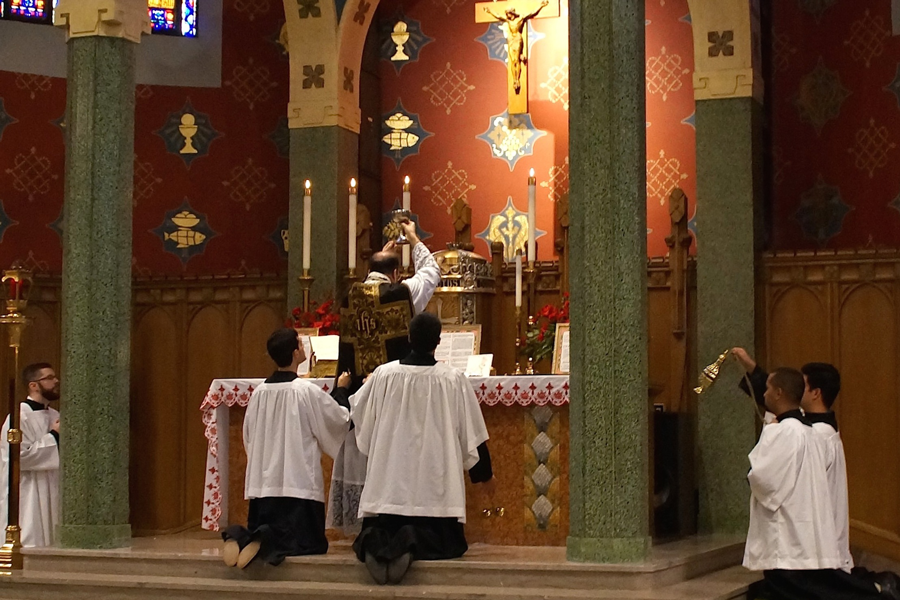
On this Solemnity of the Body of Christ we are summoned to deepen our faith in the Lord, present in the Eucharist and acting through His Sacraments. Routine may have somewhat of a dulling effect, but it cannot be so much so that we receive the Lord of glory in any way that could be called mindless or lacking in the reverence we ought to have for Him.
Ask the Lord to anoint your mind so that you never forget your need for the Eucharist. Unless! Unless you eat the flesh of the Son of Man and drink His Blood, you have no life in you (cf Jn 6:53). But receive this great gift worthily and with a communion that befits the Holy Communion to which we are summoned.


 With Father’s Day approaching, the commercial below seems very appropriate. God the Father is surely the origin of all fatherhood here on Earth.