The Fire Next Time: A Meditation on the Glance of God from the Fiery Cloud

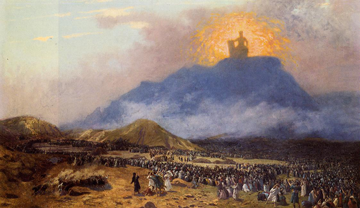
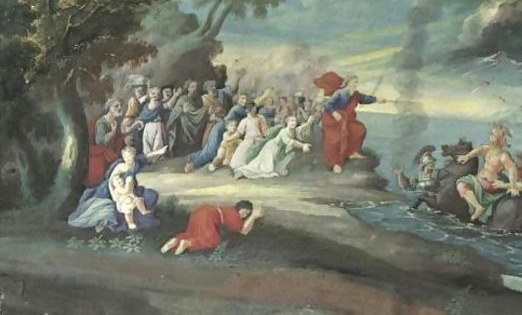
blog7-22As we read through the Book of Exodus in daily Mass at this time of year (16th Week of the year) there comes the passage about the crossing of the Red Sea. As God parted the waters, He went on ahead of the people in the fiery column of His presence. And describing the Egyptians pursuit of the Israelites is this passage:

In the night watch just before dawn
the LORD, through the column of the fiery cloud,
cast a glance upon the Egyptian force that threw it into a panic
; (Ex 14:25)

It’s quite a remarkable line, filled with drama and mystery. And though it is a matter of vindication for the Israelites and all who seek to follow God, we cannot fail to have a holy fear of the Lord, whose mere glance could send an ancient, powerful, and well-trained army into a panic.

What are we to make of this look of the Lord, this glance of God? It is a look that sees into the depths of the heart, discloses thoughts, lays bare guilt, and burns away rationalizations and pretensions. It is a look of truth that diffuses lies and error. And yes, it is a look of love, a look that offers the light of truth to those who will accept and endure its disclosing power and seek to acclimate themselves to its bright glory.

Perhaps some other Scriptures will help frame this glance of God.

  1. On the Lord’s Day I (John) was in the Spirit, and I heard behind me a loud voice like a trumpet … I turned around to see the voice that was speaking to me. And when I turned I saw seven golden lampstands, and among the lampstands was one like a Son of Man…The hair on his head was white like wool, as white as snow, and his eyes were like blazing fire….His face was like the sun shining in all its brilliance (Rev 1:12-18, selected).
  2. I lifted my eyes and looked, and behold, there was a certain man…his face had the appearance of lightning, his eyes were like flaming torches (Dan 10:6).
  3. And I saw heaven opened, and behold, a white horse, and He who sat on it is called Faithful and True, and in righteousness He judges and wages war. His eyes are a flame of fire, and on His head are many diadems; and He has a name written on Him which no one knows except Himself. He is clothed with a robe dipped in blood, and His name is called The Word of God (Rev 19:11-13).
  4. The Lord is in his holy temple, the Lord, whose throne is in heaven. His eyes look down on the world; his gaze tests mortal men (Psalm 11:4).
  5. For the word of God is living and active and sharper than any two-edged sword, and piercing as far as the division of soul and spirit, of both joints and marrow, and able to judge the thoughts and intentions of the heart. And there is no creature hidden from His sight, but all things are open and laid bare to the eyes of Him with whom we must render an account (Heb 4:12-14).
  6. For [The LORD] looks to the ends of the earth and sees everything under the heavens (Job 28:24).
  7. And the wicked say: “The Lord does not see; the God of Jacob pays no heed.” Mark this, most senseless of people; fools, when will you understand? Can he who made the ear, not hear? Can he who formed the eye, not see? Will he who trains nations not punish? Will he who instructs us not have knowledge The Lord knows the thoughts of men. He knows they are no more than a breath (Psalm 94:8-11).
  8. And Jesus looked at them and said … (Cited in dozens of places in all four gospels).

Yes, the look, the mere glance; the fiery eyes of God, which see but also give light.

And to those who love the light, his look can be that of love, even when that look must disclose our sins, hurts, resentments, or erroneous thoughts. Yet it is a look that can heal, even if it first wounds or convicts.

But to those who prefer the darkness (cf John 3:19), the look is blinding, disconcerting, and provokes a wrath in them that they project back on God, who is Love.

And thus from the pillar of fire the Lord cast a glance! In what condition does His glance find you and me? And how do you and I experience His glance?

God Still Has His Seven Thousand – A Meditation for Those Who Feel Alone and Discouraged

fortitude
Last week in the Office of Readings we read of the struggles of Elijah the Prophet, who spent his life fighting the influence of the Canaanite god Baal in Israel.

Every now and again in times like these, times of cultural confusion, times when so many Catholics have fallen away from the practice of the faith or are so breezily dissenting, I think of the prophet Elijah at his lowest moment. He was in a cave, anxious and fretting, so depressed he could barely eat.

Those were very dark times, when huge numbers of Jews fell away from the exclusive worship of the LORD and bent the knee to Baal. Jezebel, the foreign wife of the Jewish King Ahab, was instrumental in this widespread and growing apostasy. Elijah fought and fought against it, and at times felt quite alone.

So there he was, fleeing from Queen Jezebel (who sought his life) and deeply discouraged by his fellow Jews, who were either too confused or too fearful to resist the religion of the Baals required by Jezebel. Elijah seems to have felt quite alone. Perhaps he thought he was the last of those who held the true religion. In the cave, Elijah pours out his lament.

And there he came to a cave, and lodged there; and behold, the word of the LORD came to him, and he said to him, “What are you doing here, Elijah?” He said, “I have been very jealous for the LORD, the God of hosts; for the people of Israel have forsaken thy covenant, thrown down thy altars, and slain thy prophets with the sword; and I, even I only, am left; and they seek my life, to take it away” (1 Ki 19:9–10).

But God will have none of this despair or complaining, and says to Elijah,

Go, return on your way to the wilderness of Damascus; and when you arrive, you shall anoint Hazael to be king over Syria; and Jehu the son of Nimshi you shall anoint to be king over Israel; and Elisha the son of Shaphat of Abel-meholah you shall anoint to be prophet in your place. And him who escapes from the sword of Hazael shall Jehu slay; and him who escapes from the sword of Jehu shall Elisha slay. Yet I have seven thousand in Israel, that have never bent the knee to nor bowed to Baal, nor kissed him with the mouth (1 Ki 19:15–18).

So there ARE others! It is a small remnant to be sure, but Elijah is not alone. A small remnant remains faithful and God will rebuild, working with them.

Elijah is commanded not to give way to discouragement, but rather to keep preaching and to anoint leaders and a prophet who will keep preaching after him.

And here, then, is a lesson for all of us.

In times like these, it is hard not to feel like Elijah: deeply disappointed and even discouraged in the face of our current cultural decline. How many of our countrymen and even fellow Catholics have bowed the knee to the Baals of our time, accepting the doctrines of demons? How many have been led astray by the Jezebels and the false religion of the Baals of our time, setting aside the Cross and substituting the pillow of comfort and selfish desire? And thus now, like then, many are told to immolate their children, to kill the innocent through abortion (and call it “choice,” or “women’s healthcare,” or “reproductive freedom”). There is widespread misunderstanding about marriage; rampant divorce, cohabitation, and fornication; children being born outside of holy matrimony; and wide approval for same-sex unions—even the open celebration of homosexual activity. All of this harms children grievously, by shredding the family—the very institution that needs to be strong so as to raise them well.

Euthanasia is also back in the news, and polygamy seems to be on the horizon.

So here we are today in a culture of rebellion. And, sadly, too many in the Church (even among the clergy and Church hierarchy) are bewitched, succumbing to false compassion.

But lest we become like Elijah in the cave, discouraged and edging toward despair, we ought to hear again the words of God to Elijah: I have seven thousand in Israel that have never bent the knee to nor bowed to Baal.

God has a way of working with remnants in order to rebuild His Kingdom. Mysteriously, He allows a kind of pruning, a falling away of what He calls the cowards (e.g., Judges 7:3, Rev 21:8). But with those who are left, He can effect a great victory.

Consider that, at the foot of the cross, only one bishop (i.e., one priest, one man) had the courage to be there. Only four or five women had such courage. But Jesus was there. And with a remnant, a mere fraction of His followers, He won thorough to the end.

Are you praying with me? Stay firm; stay confident; do not despair. There are seven thousand who have not bent the knee to the Baals of this age. With a small group, the Lord can win through to the end. Are you among the seven thousand? Or do the Baals hold some of your allegiance? Where do you stand?

Elijah was reminded that he was not alone. As I hear of the faith of so many of you readers, I remember, too, that I am not alone. When I hear the “Amens” in my congregation as I preach the Old Time Religion, I remember that I am not alone. There are many good souls still to be found. Seek them out; build alliances and stand ready to resist, to fight the coming and already-present onslaughts.

I am not sure of the ultimate fate of Western culture (frankly, it doesn’t look good). I am not sure if these are the end times or just the end of an era. But of this I am sure: Jesus wins and so do all who stand with Him and persevere to the end. Get up, Elijah. Go prophesy, even if you are killed for it. Keep preaching until the last soul is converted.

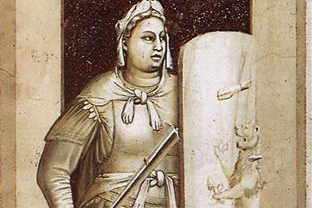
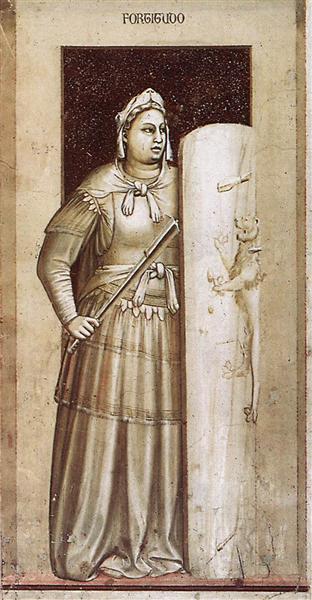
Fortitude, Patience, and Meekness: Three Virtues We Often Separate, but That Belong Together

fortitude
There is an important interplay and balance between the virtues that many modern minds set in opposition to one another. False dichotomies often prevail when the subtlety of virtues are lost or their meanings are grasped in simplistic or inaccurate ways.

Consider three virtues that are related and which enable and moderate one other: fortitude, patience, and meekness. To most people, these virtues seem more opposed than related. Today, fortitude conjures up an image of a fearless warrior in battle, or an intense prophet fearing nothing of the opinion of men. And meekness seems to be thought synonymous with weakness and conciliation. Finally, patience in modern parlance often means either not acting at all, or acting indecisively and without courage.

There are, of course, many problems with this thinking; the modern understanding of these words is quite different from their biblical or scholastic meaning. So part of our task is to recover a more accurate understanding of these words. But another aspect is to see how these virtues balance and moderate one another.

Fortitude Consider first that fortitude is the virtue that enables us to withstand even great difficulties that hinder us from attaining our true goal. A chief feature of fortitude is enduring difficulties and seeing an act or decision through to the end. Thus it is not merely being brave in the face of danger or of sallying forth into battle; it is also being steadfast in spite of obstacles and enduring without sadness or loss of faith.

As with any virtue, there are certain sins that may emerge (by excess or defect) in relation to fortitude. Timidity, pusillanimity, faintheartedness, and softness are defects of fortitude. Yet there are also excesses related to fortitude such as being foolhardy, presumptuous, overly ambitious, vainglorious, and headstrong (pertinacious).

And thus patience and meekness are aspects of fortitude, especially in helping to govern excesses related to fortitude. While the modern mind considers them to be in opposition to fortitude, they are actually integral parts of it, since they not only moderate fortitude but are ways of living and expressing it.

Patience This is perhaps the most frequent form under which fortitude is exercised in the face of the difficulties of life. St. Thomas Aquinas said that patience is attached to fortitude because it helps us to resist giving way to sadness, and to bear up under the difficulties of life with a certain equanimity or steadiness of soul. By it, we do not give way easily to emotional sadness or excessive anger. Thus patience is an act of fortitude, since it bids us to endure painful or difficult things without weakening in our faith or our commitment to the truth. With patience, we are steady in the face of the vexations and contradictions of life.

Sadly, many in our culture equate patience with weakness. But to be patient and to endure is a great strength.

Now the fact is that many troubles and contradictions last for a long time. Not all (or even most) things can be changed for the better simply or quickly. And so patience and suffering are often necessary acts of fortitude; they require great strength and brave endurance. Jesus says, In this world you shall have tribulation, but have courage, I have overcome the world (John 16:33). And St Paul adds, Through many tribulations we must enter into the kingdom of God (Acts 14:21).

So while fortitude will often summon us to face danger bravely, to proclaim the faith, and to do what is right; while it will rebuke cowardliness, faintheartedness, and softness; it will also enable us to endure difficulties without sadness, fear, depression, or excessive anger. In all these ways there is strength and courage to be found. While the modern mind does not often connect patience with fortitude, it is in fact one of its most common manifestations.

MeeknessEven more so the modern mind does not connect meekness to fortitude. The average person today does not even know the real definition of the word “meekness.” Most consider the word to be associated with being a pushover or a doormat. In this flawed sense, meekness is despised as weakness and fearfulness.

But meekness, in its traditional and theological sense, is anything but weakness. The meek are those who have authority over their anger, who can command and control its power, moderating and directing its energy to good rather than destructive ends.

Aristotle defined meekness as the proper middle ground between too much anger and not enough. Anger has an important place in the human psyche but it must be mastered and moderated, for it is unruly. The meek are those who have mastered their anger and know how to use its creative power to set things right.

In our culture, the “angry prophet” gets some credit as he denounces the powerful and vents his anger. But a prophet who is merely angry is not a true prophet. True prophets love God’s people; their anger results from the love of God, of His truth and of His people. Beware mistaking true zeal borne out of love from angry zeal, which sermonizes indiscriminately. The angry prophet preaches to get something off his chest and to vent his anger. The true prophet speaks out of zealous love and from a meekness that is able to have authority over his anger and zeal.

Fortitude without patience and meekness is like fire with nothing to contain it. Such a fire spreads wildly and destroys what it should illuminate and heat; it destroys what it should purify and transform.

Therefore patience is not opposed to fortitude but is itself an act of fortitude, since it courageously resists discouragement when the battle seems long and fierce. It enables fortitude to act over a long period, consistently and persistently, to attain an end that mere zeal would impatiently forsake in the absence of immediate results.

Similarly, meekness is also not opposed to fortitude but is also a form of it, by authoritatively governing the anger directed against injustice and error. The meek person is ultimately at peace deep inside, even while engaging in a struggle on the outside. This, of course, is essential for fortitude to reach its goal since reaching a goal (say, of establishing the truth, refuting error, or restoring justice and respect for life) is nearly impossible for a soul consumed by anger. Meekness therefore is the courage of fortitude along with the control that helps focus anger, zeal, and brave action.

Thus, as with so many things, we ought not to separate what God has joined: in this case fortitude, patience, and meekness. Scripture says, be angry but sin not (Eph 4:26). And for our virtues we might add: have the courage and zeal of fortitude, but be not foolhardy, presumptuous, or headstrong.

So, have the courage and zeal to enter the battle. Don’t be like so many today who are soft, cowardly, and indiscriminately conciliatory. But enter not with wild, ungoverned fortitude (which isn’t really true fortitude at all); enter with a fortitude that is patient and willing to endure through what may well be a long battle. Enter with a fortitude that is authoritatively mastered and stable through meekness.

By God’s grace, true fortitude will win the day.

All Have Fallen Short of the Glory of God – A Reflection on the Need to Remember That Heroes Are Still Human

Throughout my youth, my father had many teachings and expressions that we came to call “dad-isms.” They were memorable little sayings packed with truth. One of them I recall him saying to me in the aftermath of a disappointment I had experienced regarding a friend. He simply said, “Charlie, people disappoint.”

Yes, they do. We need not be cynics to understand and accept that people cannot always come through for you. Sometimes they let you down and even shock you. It is a hard but freeing truth. Human beings struggle, are imperfect, and even have mighty falls. But that doesn’t mean we should be fearful or refuse to trust others at all. However, we do need to be sober because “People disappoint.”

The recent allegations against Bill Cosby seem to have been confirmed now, even by him. Disappointment, shock, and anger have been common responses.

But allow a moment like this to cause us all to reflect on our own national (and personal?) tendency to size people up based on very little real information. We often ask public figures to fulfill our idealistic (but unrealistic) notions and be the people of our dreams.

Unrealistic expectations are premeditated resentments. Idealizing our “heroes” can cause us deep hurt. Some of these hurts and shocks can be prevented, or at least lessened, by prayerful and careful discernment as we go through life.

Discernment is a spiritual discipline that is important for us to develop in our Christian walk. The word “discern” is derived from the Medieval Latin word cernere, meaning to sift, separate, or distinguish. Hence, discernment is a discipline that counsels us to make careful distinctions and to avoid rash conclusions.

Yes, it is an often-troublesome human tendency to “size things up” too quickly, before we really have all the information and can carefully sift, separate, and distinguish. There is also the tendency to make conclusions that are too sweeping or simplistic, given the limited information we have. We do this in the case of both people and situations.

Regarding people, too often we like to assess them quickly and put them into one category or another. For example, we may conclude that “Jane is a really wonderful person!” based on just a few interactions with her or on very limited information.

We do this a great deal with the famous personalities and “heroes” of our culture, seeing them in broad and simplistic ways. In fact, we usually know very little about them at all other than what we see in a rather cursory and public way. In lionizing and idealizing people, we are often setting ourselves up for deep disappointment. And this disappointment is rooted in our rushed and simplistic judgments about people.

The fact is, people are generally a mixed bag, often possessed of great gifts, yet afflicted by human weaknesses and flaws. Scripture says, No one is good but God alone (Mk 10:18 inter al). It also says, For God regards all men as sinners, that he may have mercy on all (Rom 11:23). This the human condition: gifted but flawed.

Hence, we do well to carefully discern, to sift, sort, and distinguish when we assess one another. Not all things or people are as they first appear. And no one should be regarded simplistically. We are usually a complicated mix of gifts and struggles.

In Scripture, there is the story of Samuel, who was sent by God to find and anoint a king among Jesse’s sons. Arriving and seeing the eldest and strongest of the sons, Samuel was quick to conclude that he must be the one to be anointed:

But the LORD said to Samuel, “Do not look on his appearance or on the height of his stature, because I have rejected him. For the LORD sees not as man sees: man looks on the outward appearance, but the LORD looks on the heart” (1 Sam 16:6).

Samuel was eventually led to anoint the youngest and least likely of the brothers, David.

Here are some other references from Scripture:

  1. Call no one blessed before his death, for by his end shall a man be known (Sir 11:28).
  2. Paul cautions Timothy, Do not be hasty in the laying on of hands, and do not share in the sins of others. Keep yourself pure … Remember, the sins of some men are obvious, leading them to certain judgment. But there are others whose sins will not be revealed until later (1 Tim 5:22,24).
  3. Sometimes we fail to note the gifts of others. Scripture says, So we have stopped evaluating others from a human point of view. At one time we thought of Christ merely from a human point of view. How differently we know him now! (2 Cor 5:16)

Discernment regarding people ought to proceed with careful deliberation, so that we resist the urge to quickly size them up or categorize them. We should exercise careful discernment that is ongoing, charitable, and sober.

Regarding situations, the rush to judgment is also to be avoided. Often we do not have all the facts and so our judgment can be both rash and wrong. We often think we know the whole story when in fact we do not.

Likewise it is often easy to take sides quickly in disputes and to assess blame in simplistic ways. In marriage counseling, for example, I have learned to resist the urge to be too sympathetic toward one spouse or the other. In the past I would tend to be more sympathetic to the one who had called to make the appointment, and whose side I had heard the most of already. But a one- sided pancake is pretty thin; there’s always another side. Very few marriages are in trouble because one is a saint and the other is the devil. There are usually issues on both sides; there is both bad and good in each of them.

Thus, as with people, the assessment of situations also requires discernment, the careful sorting, sifting, and distinguishing of many things.

Disclaimer – Discernment should be seen as a middle ground between quickly claiming we know everything, and claiming we can know nothing at all. The need for discernment does not mean that there is no truth to be found, or that we are locked away in a purely subjective and relativistic world where no judgments can be made at all. Rather, it is a caution against making sweeping, simplistic, or rash judgments that are not based on things we really know; it is a call to sobriety. People and situations are usually more complicated than we first grasp, and it takes time to make proper assessments.

Some (including me) have criticized the Church for not operating at the breakneck speed of the modern world. We often want quick and bold statements to be issued. We want rapid responses and bold initiatives made in response to every issue that emerges. Of themselves, these desires are not wrong, but they need to be balanced with an appreciation that discernment is often accomplished at slower speeds than we would like. A quick response may sometimes be desired and even necessary, but there is something to be said for following the priority of the important rather than the urgent. Careful discernment is important and has its place.

To discern: to sift, separate, or distinguish.

A Video With a Shocking Ending

MarriageThis is one of those videos that I think you should watch before I say much about it.

There is something shocking about the ending, something awful. And yet the request by the young man in the video is a common one, though it often comes cloaked in more subtle forms. People today use one another in the most crass, utilitarian, and selfish ways! Do others exist merely to give you pleasure? Is this not often the message of cohabitation and sex without marital commitment?

Let me ask you one question about the ending of the video: Why does what the young man says shock you?

Three Words That Can Change Your Life

Move, Breath, Trust

Move, Breath, trustSometimes we like to complicate things. Every now and again it is good to simplify, to make it plain and simple. The other day it occurred to me that three words describe the well-being I have discovered in my physical, emotional, and spiritual life. They are, respectively, move, breathe, and trust.

Let’s look at each in turn. “Move” pertains to the physical, “breathe” to the emotional and psychological, and “trust” to the spiritual.

I. Move – Some years ago, my doctor told me that the secret to good health, strength, and longevity, comes down to one word: “move.” A sedentary lifestyle can cause innumerable problems: weight gain, lethargy, fatigue, boredom, depression, muscular atrophy, weak and/or brittle bones, shallowness of breath, poor posture, a weakened heart, an increase in the likelihood of pulmonary issues such as asthma, less-oxygenated blood, and less-clear thinking … just to name a few.

Well, you get the point. Move! Walk every day. Except for swimming, there is almost no better exercise. If your joints are already arthritic or problematic, an elliptical machine is a good low-impact option.

I was a runner earlier in life but my knees suffered. I don’t personally think that the human body was designed for sustained distance running; there’s just too much impact on the joints. Injury is common and some of the damage to the joints can be permanent. Because of this, I took up walking about fifteen years ago and walk at least two miles a day, six days a week.

Walking is low impact and easy on the body. It promotes aerobic breathing rather than the anaerobic panting of running. It requires little or no equipment, and provides time for praying, listening to music or podcasts, talking with a walking partner, or chatting on the phone (I recommend a hands-free device so the arms can swing naturally). I really look forward to my evening walks!

The people of the Bible were amazing walkers. Our Mother Mary, St. Joseph, Jesus, and all the Apostles made the annual trek to Jerusalem on foot, 70 miles each way. They walked nearly everywhere they went, through very hilly and mountainous regions. Mary walked 70 miles to Bethlehem when she was nine months pregnant. She and Joseph walked hundreds of miles to Egypt, carrying Jesus, and then back again. The people of the Bible were hardy; they walked nearly everywhere, often carrying heavy loads.

Move! Walk every day if you can. If you need to, start by just walking one block; then try to increase the distance a bit every day. But move. When you can, take the stairs instead of the elevator, walk instead of driving, but get off the sofa. Some people even have standing desks to work at in their offices. (See photo above right.)

There’s a handy little device called the “UP” bracelet that actually counts your steps for you each day. The goal for the average adult is 10,000 steps per day. Yours truly averages 12,000-15,000 thousand a day. There’s a video at the bottom that describes the “UP” system. (And, no, I’m not getting a kickback!)

Move; it will change your life, improving not only your body but your soul as well.

II. Breathe – My psychotherapist has a plaque on her desk that reads, “BREATHE.” Most of us don’t know how to breathe properly. We breathe with our chest and only fill the top of our lungs.

It isn’t hard to learn how to breathe better, using the belly. Babies do it naturally, but as we get older and more self-conscious about the appearance of our bellies, we tend to breathe less deeply. There is a video below that demonstrates the proper way to breathe deeply.

To breathe is to get in touch with our innermost self and also our body. Breathing is very spiritual. As we breathe in, we receive the blessings of God. As we breathe out, we let go of inner stresses and struggles. Exhaling is a form of release, inhaling a form of receiving.

Deep breathing can be very relaxing; it reduces stress and is a wonderful way to prepare ourselves to pray. Too many of us are out of touch with our body and our very self. Breathing can reconnect us to our own self and to God. Too many of us store up a lot of stress. We need to learn how to exhale. Too many of us live on fumes. We need to learn how to draw more deeply from the life breath God offers.
Breathe!

III. Trust – My Spiritual Director has often reduced his advice to one word: “trust.” The root of all the anxiety I have ever experienced is the fact that I did not trust God. To the degree that I have learned to trust God, I am less anxious. In fact, I rarely get anxious anymore. It is the result of a fifteen-year journey out of panic disorder and into trust.

I cannot write a whole article here on trust, but two things ought to be emphasized.

First, the illusion of control is a big enemy of trust in God. Control is ultimately an illusion. You may have a few things under your control, such as what you will eat for dinner, where you will shop for clothes etc. But even those things you think you can control are based on innumerable things that you cannot control: the next beat of your heart, whether or not there will be an accident that backs up traffic on your way to the store, whether or not your car will break down, etc. You also have no control over whether the store burns down or the item you want is to buy is actually in stock.

Thus, control, in any thorough sense, is both illusory and limited. Thinking we can and should be in control is to live under an illusion, and living under such an illusion is stressful and frustrating.

We often think that if we could just be in control we would be less anxious; but this is not so. The great paradox about serenity is that acceptance of the fact that there are many things we cannot control reduces anxiety and brings peace. The fact that we are not in control is a “hard” truth that brings great serenity and induces trust if we come to accept it.

Second, a central way to open the door to trust is to remember to be grateful. In the spiritual sense, to remember means to have deeply present in my mind and heart what God has done for me, so that I am grateful to Him and different because of it. To remember is to discipline my mind and heart to ponder how good and faithful God has been, to spend time every day considering the gifts and graces of God and how He has sustained and provided for me. This makes me grateful and different.

It also builds trust, and trust drives out our fears, resentments, and all forms of anxiety. Through gratitude I become a man of hope. That is, I confidently expect God’s help and providence to see me through to my goal of being with Him in glory.

An old song says, “Through it all, I’ve learned to trust in Jesus, I’ve learned to trust in God … I’ve learned to depend upon His Word.”

That is my story; I’ve learned to trust. And over the years, in the laboratory of my own life, I have proved God’s Word and His promises and found them to be true. Learn to trust, to lean, to let go. God says, “I’ve got this, so you let go.”

These are three words that can change your life: move, breathe, and trust.

Things Are Often Not as They Seem – A Lesson from the Life of Moses

moses-0715We are currently reading the story of Moses in daily Mass. The story reminds us that not all things are as they appear, and that God’s ways are not our ways.

Moses’ early years are marked with clear signs that he is gifted and chosen. Drawn from the water by Pharaoh’s own daughter, Moses’ very own mother is chosen to be his caretaker and is paid for that privilege by getting to live in Pharaoh’s palace. Pharaoh pays for Moses’ diapers, his food, and his education. And he is unwittingly preparing and equipping his nemesis. God can be very sly!

But at age forty, Moses gets ahead of God (never a good idea). He grows angry at an Egyptian who is oppressing a Hebrew and ends up killing the Egyptian. Moses has to flee.

Now why has God let this happen? From our perspective, Moses was in the prime of his life. At forty, he has experience but has not lost his youth. He is educated, gifted, and has access to power and lots of connections in Pharaoh’s own palace. Moses is in a perfect position to lead the people out of slavery! Or so we think. Except for one problem: God doesn’t think so.

But why not? In a word, pride. Moses, in getting out ahead of God and trying to take things in his own hands, is exhibiting pride. God says, in effect, “You’re too proud. I can’t use you in this condition. It’s time for some lessons in humility.”

And so Moses learns humility. He is forced to flee (humiliating). He must live out in the desert (humbling). And he marries and has children (quite humbling indeed! J).

Ok, so a few years’ worth of humility lessons and then Moses gets started. No, not a few, forty years’ worth!

Now Moses is eighty. He’s feeble, leaning on a staff, and he stutters when he talks. And God comes and tells Moses that it’s time to lead the people out. Moses says, in effect, “Are you crazy? I’m old, I can’t speak, I’m feeble … I can’t do it.” And that’s just the attitude that God needs from Moses: that he can’t do it. And he couldn’t do it at forty, either; he just didn’t know it. God has to do it and Moses will be His instrument. But now this instrument will be docile in the hands of the artist, now Moses can be useful to God.

This is not the way we think. We equate ability and leadership with vigor, power, money, access, talent, etc. For us, the prime of life is in our thirties, forties, and fifties. But God’s ways are not our ways; His thoughts are not our thoughts. Moses at eighty is what God needs. Moses at forty was not of use.

What are some conclusions we can draw?

First, be careful how you assess your own life. In typical earthly fashion most of us consider our prime as being those years when we were most in command of our gifts, when we were working, “making a difference,” earning an income. We measure human life in its prime in terms of money, power, access, physical strength, stamina, etc.

But has it occurred to us that our most powerful moments might be on our deathbed? For there we have many sufferings to offer and our prayers will pierce the clouds as never before. The Lord hears the cry of the poor, the suffering, and the repentant.

I often counsel the bedridden, and the dying in this way: I tell them that we are depending on their prayers as never before because their prayers are more important than ever before. And even if they have a hard time, because of age and discomfort, formulating prayers, just one word on our behalf, “Help!” may change the history of the world. St. Augustine said, More is accomplished in prayer by sighs and tears, than by many words (Letter to Proba).

Yes, be very careful how you assess your life’s worth. Our math is not God’s math; our thoughts are not His. God sizes us up quite differently.

Second, be careful how you assess the lives of others. Here, too, we tend to value those people who are powerful, have money, strength, beauty, talents, and “obvious” gifts. But the Lord warns us in many places that we should esteem the poor, the disabled, and the suffering. He says, Many who are last shall be first (Matt 19:30).

God also counsels that we ought to make friends among the needy and poor by our use of worldly wealth, so that when worldly wealth fails us (and it will), the poor and needy, those who benefitted from our generosity, will welcome us to eternal dwellings (See Lk 16:9).

Yes, befriend the needy, the disabled, and the poor. In this world they need us, but in the next world, we are going to need them! Those who have suffered and those who were poor due to injustice, if they have been faithful, are going to be in high places in Heaven. We’re going to have to get an appointment to see them! Things are not always as they appear. The poor, the disabled, and the suffering are quite often among the real powerhouses of this world.

So pay attention to what the story of Moses tells us. Not as man sees does God see (1 Sam 16:7). We are vainglorious and we look to worldly power and its categories. God is not impressed with our sandcastles, our big brains, and our bulging muscles. He bids us in stories like these to say, with St. Paul, Therefore I am well content with weaknesses, with insults, with distresses, with persecutions, with difficulties, for Christ’s sake; for when I am weak, then I am strong (2 Cor 12:10).

Things are often not as they appear to us. Put on your “God glasses” and by God’s grace see more as He sees.

Three Helpful Prayers from the Roman Missal for Those Living in Dark and Difficult Times

light in darknessOne of the great and often-missed moments in the Mass is the opening prayer, also known as the “collect.” It is called this because after priest says to the faithful, “Let us pray,” he waits a moment as they do so and then “collects” their prayers and directs them to God.

Most of the collects (pronounced káh’-lects) are quite ancient and are minor masterpieces. They are succinct, like most of the prayers of the Roman Rite, and make use of creative word order, almost as if to paint a picture of sorts. Reading them in English never does them justice, because word order is more rigid in English and the creativity of the Latin is often lost.

Even in English, though, they remain a great source for reflection, especially the newer and more faithful translations. Father John Zuhlsdorf is, of course, the great master in breaking these prayers open for us.

As my own poor contribution to this end, I would simply like to place before you three of the collects that occur during these summer months, since they are encouraging for us in dealing with the current cultural meltdown that is picking up speed almost daily.

All three of these prayers point to the problem of error and darkness in this world and ask protection for the faithful, and the courage to reject error, embrace and reflect truth, and journey bravely to our heavenly home through an uncertain and rebellious world.

Let’s look at them in their English translation. I won’t examine the Latin extensively, just making a few observations with each prayer.

O God, who through the grace of adoption chose us to be children of the light, grant, we pray, that we may not be wrapped in the darkness of error but always be seen to stand in the bright light of truth. Through our Lord Jesus Christ … (13th Sunday of Ordinary Time)

This is a prayer that reminds us of the great battle between light and darkness spoken of so extensively in Johannine literature. Recall some of the key lines from St. John:

  1. In [Jesus] was life, and that life was the light of all mankind. The light shines in the darkness, and the darkness has not overcome it (John 1:4-5).
  2. This is the verdict: Light has come into the world, but people loved darkness instead of light because their deeds were evil. Everyone who does evil hates the light, and will not come into the light for fear that their deeds will be exposed. But whoever lives by the truth comes into the light, so that it may be seen plainly that what they have done has been done in the sight of God (John 3:19-21).
  3. Jesus spoke again to the people, he said, “I am the light of the world. Whoever follows me will never walk in darkness, but will have the light of life” (Jn 8:12).
  4. We must work the works of him who sent me while it is day; night is coming, when no one can work. As long as I am in the world, I am the light of the world” (John 9:4-5).
  5. The Crowds rebuked Jesus saying … who is this Son of Man? So Jesus said to them, “For a little while longer the Light is among you. Walk while you have the Light, so that darkness will not overtake you; he who walks in the darkness does not know where he goes. “While you have the Light, believe in the Light, so that you may become sons of Light” (John 12:34-36).
  6. As soon as Judas had taken the bread, he went out. And it was night (John 13:30).
  7. The one who loves his brother abides in the Light and there is no cause for stumbling in him. But the one who hates his brother is in the darkness and walks in the darkness, and does not know where he is going because the darkness has blinded his eyes … (1 John 2:10-11)

And thus we see in the prayer the great drama between the darkness of sin and the Light of God’s glory and holiness. It is a drama that unfolds all around us and we ask to be preserved from the deadly advance of enveloping darkness. We base our hope on God’s grace and the fact that Scripture says, For the Lord has rescued us from the dominion of darkness and brought us into the kingdom of the Son he loves (Col 1:13). And now, recalling that grace, we ask to be preserved in the gift He has given us in letting us be the children of light.

The Latin verb translated here as “wrapped” is involvamur. This can also be translated as “enveloped” and gives the impression of motion. Thus, may we not, O Lord, be caught up in the darkness of error. May we not be enveloped, or spun about and disoriented by the darkness of sin and error! Yes, spare us, O Lord!

And though the English translation asks that we always be seen to “stand” in the bright light of truth, the Latin verb is maneamus, and can also be translated as “remain.” Remaining or abiding in the truth and with the Lord is a very precious Johannine concept. The goal of our life is to remain in the Lord and dwell habitually in His light.

The prayer also asks that we may be seen to stand (remain) in the truth. This is the public witness of our love of the truth and our rejection of error. Here, too, the Latin word conspicui delivers a stronger message. In other words, may our remaining in the bright light of truth be conspicuous; may it be obvious by what we say and do.

Not a bad prayer for dark and erroneous times! Here’s the second prayer:

O God, who show the light of your truth to those who go astray, so that they may return to the right path, give all, who for the faith they profess are accounted Christians the grace to reject whatever is contrary to the Name of Christ and to strive after all that does it honor. Through our Lord Jesus Christ … (15th Sunday of Ordinary Time)

This is a similar prayer, but more focused on recalling those who have been lost in error. Indeed, how many have been lost and thus how necessary such a prayer! Restore those lost in error, O Lord, those who have strayed! For indeed, there are many things in this fallen world that are contrary to Christ and His Holy Name, which is truth.

Latin contains many words that are quite physical, even violent. The Latin word translated here as “reject” is respuere. The word literally means to spit, to eject by spewing out. And this is what we must do: radically cast off whatever is contrary to the truth of Jesus and His teaching.

The image evokes the Easter Vigil when, in some ancient accounts, the catechumens, just before their Baptism, turned to the West (toward the darkness) and renounced Satan and all his works and all his empty promises, spitting as they did so. They then turned to the East (toward the light) and professed their faith in God.

Yes, this, too, is a very powerful prayer with a memorable vigor. May we spew from our life anything contrary to the Lord’s truth and strive to live His truth!

Finally consider this third prayer for difficult times like these:

O God, who cause the minds of the faithful to unite in a single purpose, grant your people to love what you command and to desire what you promise, that amid the uncertainties of this world, our hearts may be fixed on that place where true joys are. Through our Lord Jesus Christ … (21st Sunday of Ordinary Time)

Such a beautiful prayer, and quite a masterpiece in describing the grace of the New Law! Indeed, to love what God commands and desire what He promises is the essential grace of the New Covenant that we must seek and lay hold of. It is best expressed by Ezekiel:

And I will give you a new heart, and a new spirit I will put within you. And I will remove the heart of stone from your flesh and give you a heart of flesh. I will put My Spirit within you and cause you to walk in My statutes, and you will be careful to observe My ordinances (Ez 36:26-27).

Yes, for us who live in a fallen, darkened, rebellious, and confused world, grace is needed to overcome the stubborn and obtuse rejection of God’s truth by our flesh. God can and does do this. Of this I am a witness in my own life and I pray that you are as well. I have learned to love what He commands and to hate what is contrary to His truth.

The prayer goes on to describe the fickle and passing qualities of this world. It is something that we must ultimately escape. And while journeying through its deceptive and passing beauty, its trendy and flashy sinfulness, we ask the grace to keep our hearts fixed where true gladness is found.

Amen! These are three good prayers for us who are journeying through dark and difficult times. Don’t “tune out” during the opening prayer of Mass. Listen carefully. There are real riches to be found.