A Walk with the Wise: A meditation on the Feast of Epiphany

010513

There are so many wonderful details in the Epiphany story: the call of the Gentiles, the nations, and their enthusiastic response, the significance of the star they see, and the gifts they bring, the dramatic interaction with Herod and their ultimate rejection of him in favor Christ.

In this meditation I would like especially to follow these wise men in their journey of faith. We can observe how they journey in stages from the light of a star, to the bright and glorious Light of Jesus Christ. And, of course to authentically encounter the Lord is to experience conversion. All the elements of this story serve ultimately to cause them to “return to their country by another route.” Let’s look at the stages of their journey to Jesus, let’s walk the way of the wise men.

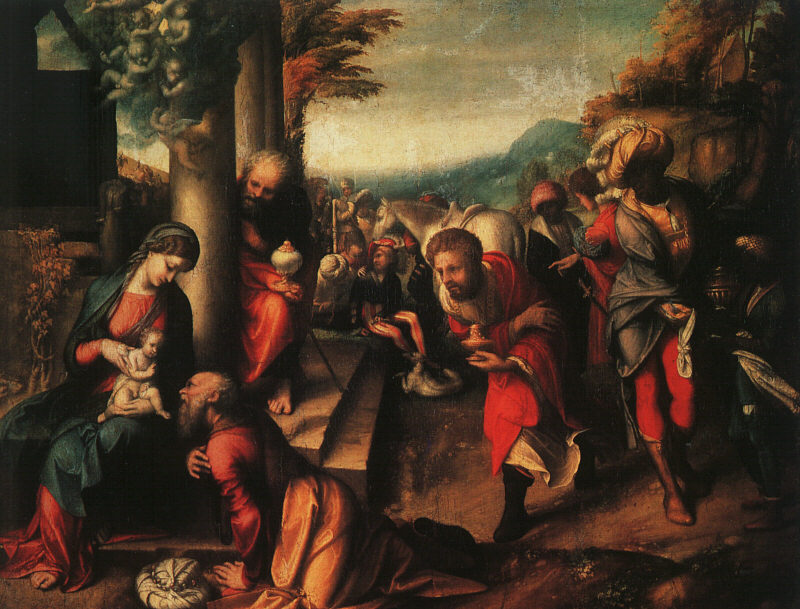
Stage 1. CALL – The text says – When Jesus was born in Bethlehem of Judea, in the days of King Herod, behold, magi from the east arrived in Jerusalem, saying, “Where is the newborn king of the Jews? We saw his star at its rising and have come to do him homage.” – Notice first the identity of these individuals. They are called Magi, (μάγοι, (magoi) in Greek) and they are from the East.

Exactly what “Magi” are is debated. Perhaps they are wise men, perhaps they are ancient astronomers. We often think of them as Kings though the text does not call them that. It also seems Herod would have been far more anxious had they been actual potentates from an Eastern Kingdom. In our imagination we often think of them as Kings since Psalm 72, read in today’s Mass, speaks of “Kings” coming from the East bearing gifts of gold and frankincense. However, for the record, the text in today’s gospel does not call them kings, but “magi.”

Yet, here is their key identity: they are Gentiles and they have been called. Up to this point in the Christmas story, only Jews had found their way to Bethlehem. But now the Gentiles come. This detail cannot be overlooked, for it is clear that the gospel is going out to all the world.

St. Paul rejoices in this fact in today’s second reading as he says: that the Gentiles are coheirs, members of the same body, and co-partners in the promise in Christ Jesus through the gospel (Eph 3:6). Most of us are not Jewish by ancestry, and hence we ought to rejoice for in the call of these Magi is prefigured our call.

And notice that God calls them through something in the natural world. In this case a star. God uses something in creation to call out to them.

We do well to wonder what is the star that God used to call us? Perhaps it was Scripture, but more usually, it is first someone God has used to reach us, a parent, a family member, a friend, a priest, religious sister, or devoted lay person. Who are the stars in your life by whom God called you?

God can also use inanimate creation like he did for these Magi. Perhaps it was a beautiful Church, a painting or a song. By someone or something God calls. He puts a star in our sky. These wise men, these Magi, follow the call of God and begin their journey to Jesus.

Stage 2. CONSTANCY – Upon their arrival in Jerusalem the Magi find a rather confusing and perhaps discouraging situation. The reigning King, Herod, knows nothing of the birth of this new King. It must have seemed probable to them that the newborn King would be related to the current King, so his surprise may have confused them. But Herod seems more than surprised, he seems threatened and agitated.

Even more puzzling, he calls religious leaders to further inform him of this King. They open the sacred writings and the Magi hear of a promised King. Ah! So the birth of this king has religious significance! How interesting!

But, these religious leaders seem unenthusiastic of the newborn King and after giving the location of his birth seem to make no effort to follow the Magi. There is no rejoicing, no summoning of the people that a longed for king had finally been born. Not even further inquiry!

So the wicked (e.g. Herod and his court), are wakeful, and the saints are sleepy. How odd this must have seemed to the Magi. Perhaps it occurred to them to suspend their search. After all, the actual king knew nothing of this birth, and those who did, seemed little interested.

Ah, but praise the Lord they persevere in their search. They do not give up!

Thanks be to God too, that many today have found their way to Christ despite the fact that parents, clergy and others, who should have led them joyfully to Jesus, were either asleep, or ignorant or just plain lazy. I am often amazed at some of the conversion stories I have heard, people who found their way to Christ and his Church, despite some pretty discouraging obstacles like poor religious upbringing, scandalous clergy and bad example. God sometimes allows our faith and call to be tested but Those who persevere to the end will be saved (Matt 24:13).

Stage 3. CONFESSION OF FAITH – The text says, After their audience with the king they set out. And behold, the star that they had seen at its rising preceded them, until it came and stopped over the place where the child was. They were overjoyed at seeing the star, and on entering the house they saw the child with Mary his mother. They prostrated themselves and did him homage. – With what little information they have they set out and continue to follow the call of God through the star.

Note that they enter a “house.” We often think of the Magi as coming that same Christmas night to the cave or stable but it seems not. Mary (Joseph) and Jesus are found now in a house. It would seem that decent lodging has now been found. Has it been days since the birth? Perhaps even longer, but we are likely dealing with a different day than Christmas Day.

Notice too that they “prostrate” themselves before Jesus. The Greek word is προσεκύνησαν (prosekunēsan) which means more literally “to fall down in worship” or “give adoration.” The verb is used 12 times in the New Testament and it is clear each time that religious worship is the purpose of the prostration.

This is no mere homage or a sign of respect to an earthly King, this is religious worship. This is a confession of faith. So our Magi manifest faith!

But is it a real faith, or just a perfunctory observance? It’s not enough to answer an altar call, or to get baptized. Faith is never alone. It is a transformative relationship with Jesus Christ. So lets look for the effects of a real and saving faith.

Stage 4. COST There is a cost to discipleship. The magi are moved to give three symbolic gifts that show some of what true faith includes. And they are costly gifts.

Gold is a symbol of all our possessions. In laying this gift before Jesus they and we are saying, “I acknowledge that everything I have is yours. I put all my resources and wealth under your authority and will use them only according to your will.” A conversion that has not reached the wallet is not complete.

Frankincense. is the gift of worship, for in the Bible incense is a symbol of prayer and worship (eg. psalm 141). In laying down this gift we promise to pray and worship God all the days of our life. To be in his holy house each Sunday and render him the praise and worship he is due. To listen to his word and to consent to be fed the Eucharist by him. To worship him worthily by frequent confession and to praise him at all times. And they give

Myrrh – a strange gift for an infant. Myrrh is usually understood as burial ointment. Surely this prefigures Jesus’ death but it also symbolizes our own. In laying this gift before Jesus we are saying, my life is yours. I want to die so that you may live your life in me. May you increase and may I decrease. Use me and my life as you will. So here are gifts that are highly symbolic.

The magi manifest more than a little homage to Jesus. They are showing forth the fruits of saving faith. And if we can give these gifts so too are we.

Stage 5. CONVERSION – The text says, And having been warned in a dream not to return to Herod, they departed for their country by another way.

Here then is essential evidence for faith: conversion. It is not enough to get happy in Church, we have to obey. Hence, these wise men are walking differently now. They are not going home by the same way they came. They’ve changed direction, they’ve turned around (conversio). They are now willing to walk the straight and narrow path that leads to life rather than the wide road that leads to damnation. They are going to obey Christ. They are going to exhibit what St. Paul calls the “obedience of faith” (Rom 1:5; 16:26). They have not just engaged in a possibly perfunctory worship, they are showing signs of a true and saving faith. They are not just calling Jesus “Lord, Lord!” They are doing what he tells them (cf Luke 6:46).

So there it is. Through careful stages the Lord has brought the Gentiles (this means you) to conversion. He called. They remained constant, confessed him to be Lord, accepted the cost of discipleship and manifested conversion. Have you? Have I?

Walk in the ways of the Wise men! Wise men still seek him. Even wiser ones listen to him and obey. Are we willing to go back to our country by another route? Is on-going conversion part of our journey home to heaven? If Epiphany means “manifestation” how is our faith manifest in our deeds and conversion?

I have it on the best of authority that as the wise men went home by another route they were singing a Gospel song: “It’s a highway to heaven! None can walk up there but the pure in heart. I walking up the King’s Highway. If you’re not walking start while I’m talking. There’ll be a blessing you’ll be possessing, walking up the King’s Highway. “

Recovering God’s Plan for Marriage and Family: A Sermon on the Feast of the Holy Family

Here in the middle of the Christmas Octave, the Church bids us to celebrate the feast of the Holy Family. On the old calendar, the feast of the Holy Family falls on the Sunday after Epiphany, which makes some sense. For it is a bit odd to read a gospel portraying Jesus as 12 years of age, a mere 5 days after his birth. And then, next week, we revert back to a Gospel where he is an infant, on the Feast of Epiphany.

Click here to hear a recording of this sermon

Nevertheless, here we are. Perhaps, it is a good time to reflect on family life. For, at Christmas time family, and extended family, often gather together. In terms of this feast of the Holy Family, let us make a consideration along three lines: Structure, Struggles, and Strategy.

I. Structure–All through the readings for today’s mass we are instructed on the basic form, the basic structure of the family. For example:

  1. God sets a father in honor over his children; a mother’s authority he confirms over her sons. (Sirach 3:2).
  2. May your wife be like a fruitful vine, in the recesses of your home; your children like olive plants, around your table (Psalm 128:3).
  3. Wives, be subordinate to your husbands, as is proper in the Lord. Husbands, love your wives, and avoid any bitterness toward them. Children, obey your parents in everything, for this is pleasing to the Lord. Fathers, do not provoke your children, so that they may not become discouraged. (Colossians 3:20–21).
  4. Each year, Jesus parents went to Jerusalem for the feast of Passover… Your father and I have been looking for you with great anxiety… (Luke 2:45, 51,).
  5. And he was obedient to them;… And Jesus advanced in age and wisdom and favor before God and man (Luke 2:51–52).

And thus we see the basic structure of family:

  1. A father in honor over his children
  2. A wife and mother, supportive of her husband and his authority.
  3. A mother, having authority over her children, supported loved and encouraged by her husband, and obeyed by her children.
  4. Children who both honor and obey their parents.
  5. Fathers, and by extension mothers, who instruct and admonish their children, but not in the way that badgers and discourages them, but in a way that encourages and builds them up.
  6. A family structure that helps children to advance in wisdom, and age, and favor before God and man.

Here then, is God’s basic teaching on family and marriage. Here is the basic structure for the family, as God sets it forth: a man who loves his wife, a woman, who loves her husband. And in this stable, lasting, and faithful union of mutual support and love, they conceive and raise their children in the holy fear of the Lord.

Add to this, the principal description of the book of Genesis, which describes how God says forth marriage: “A man shall leave his father and mother, cling to his wife, and the two of them shall become one flesh.” (Genesis 2:24). And to this first couple, God gives the mandate, “Be fruitful and multiply.” (Genesis 1:22).

And thus we have set forth biblically  the basic structure for the family: a father, a mother, and children, all reverential, and supportive of one another, in their various roles and duties.

Note how the structure of the family, take its basic form in terms of its essential fruit: the procreation and rearing of children. Why should marriage be a stable and lasting union? Why is Adam told to cling to his wife, to form a stable and lasting union with her? Why?

Because, this is what is best for, and just for children! Children both need and deserve a stable and lasting union, of a father and a mother, of a complementary influence of the different sexes. Here is what is best for children to be raised and formed. Hence, the family structure of a father and a mother, a male and female parent, flows from what is best, and just for children. The structure of the family, as set forth by God, is rooted in what is best, and just for children. Here is what is sensible and best, sociologically, and psychologically, in terms of the proper development of Children.

Even before we open the Bible, it makes sense that a child should have a father and a mother, a male and female influence, and teaching. There are things that a male, and a father, can teach a child, that a mother, and a female, cannot best teach. Further, the mother, and a female, can teach, and model for children what only a mother, and a female best teaches.

This much is clear before we even open the Bible. Male and female influence are essential for the proper psychological and sociological development of the child. Clearly then, God’s biblical mandates that marriage should include a father and a mother, is not without basis in simple human reason, and common sense.

To intentionally deprive a child of this context is both unjust to the child, and unwise. Hence, we see that the basic structure for marriage takes its shape from what is best, and what is just for children. Both God, and nature, provide for a father and a mother, a male and a female, to conceive and raise a child.

It also makes sense based on simple human reasoning that that relationship should be stable, something the child can depend on from day-to-day, month-to-month, and year-to-year, through all the formative years.

Here then is the proper structure for marriage. It is set forth both by God, and by human reason.

II. Struggles–And yet, what should be obvious to us as a culture seems to be strangely absent in the minds of many. Let us be clear, sin clouds our judgment, and makes many think that what is sinful and improper is in fact okay and good. It is not. In our current modern culture we gravely sin against God and against our children by consistent misconduct, and by the refusal to accept what is obviously true. The words of St. Paul are fulfilled in our modern times: their senseless minds were darkened, and they became vain and foolish in their reasoning. (Rom 1:21).

It is clear today that the family is in grave crisis. And it is also clear, that it is the children who suffer the most. Our modern age, in the Western world shows forth the mentality that is both deeply flawed, and gravely harmful to children.

Marriage and family are in great crisis do the willful and sinful habits of the vast majority of adults in our culture regarding sexuality, marriage, and family life. The rebellion of adults against the plan and order of God have caused endless grief and hardship, and set forth a culture that is poisonous to the proper raising and blessing of children.

Last week, we commented on this on the blog. Without repeating that whole blog post that the following excerpt stands forth:

Children have much to suffer in this world of our collective making. And while not all of us are equally guilty of contributing to the suffering of children, none of us are wholly innocent either, if for no other reason than our silence.

Consider that most children born today are no longer born into the stable and lasting family units they justly deserve with a father and mother committed to one another till death do them part.

The problems begin with fornication, which is rampant in our culture. And while most do not think of this as a sin of injustice, it is. It is so because of what it does primarily to children.

The fact is many children are conceived of fornication. Tragically most of these children who are thus conceived are outright murdered by abortion. 85% of abortions are performed on unmarried women. And for all the vaunted declarations of how contraception makes every baby a wanted baby, nothing could be further from the truth. Abortion has skyrocketed with the availability of contraception. This is because the problem is not fertility, it is lust, promiscuity, fornication and adultery. And contraception fuels these problems by further enabling them. The promises associated with contraception are lies, it does the opposite of what it promises.

Thus fornication and the contraceptive mentality (founded on lies) cause grave harm to children, beginning with death, in huge numbers. And the children, conceived of fornication who do (thankfully) survive are, nevertheless subjected to the injustice of usually being born into irregular situations. There are single mothers, some single fathers, and many other irregularities.

Add to this picture the large number of divorced families. And make no mistake, these shredded families cause great hardships and pain for children that include: children be shuttled back and forth between different household each week, having to meet “daddy’s new girlfriend” or mommy’s new “live-in boy-friend” and all sorts of other family chaos. Blended families also dramatically increase the likelihood of sexual and emotional abuse, since legal relationships seldom have the built-in protections of natural relationships.

All of this misbehavior, individual and cultural, harms children. Not being raised in a traditional marriage dramatically increases a child’s likelihood of suffering many other social ills, starting with poverty.

The chief cause of poverty in this country, is the single motherhood, absent fatherhood.
71% of poor families are not married.
Children of single parent homes are 2 times more likely to be arrested for juvenile crime,
2 times more likely be treated for emotional and behavioral problems,
Twice as likely to be suspended or expelled from school,
33% more likely to drop out of school,
3 times more likely to end up in jail by age 30.
50% more likely to live in poverty as adults,
And twice as likely to have a child outside of marriage themselves
. [*]

Add to the burdens children must experience, the new trend of same sex adoption. Never mind that it is best for the psychological development of a child to have a father and mother, a male and female influence. No, what is best and just children must be sacrificed on the altar of political correctness. Same sex couples must now be given equal consideration under law (in many states) to heterosexual couples. It’s the adults and their rights that seem to matter most here, what is best for children is quite secondary.

Here then are our struggles. Our families are in grave crisis and MOST children in our culture are not raised in the stable and committed homes they deserve. And let us be even more clear, to intentionally deprive children of this sort of home by raising them outside of marriage, or in same sex unions etc., is sinful, wrong and an injustice.

Let us also be clear that it is not possible to personally judge every case of a broken family. The modern world has experienced as cultural tsunami and many have been influenced by lies and other false promises. It may be true that, if you are divorced you tried to save your marriage, but your spouse was unwilling. Perhaps in a moment of weakness, perhaps before your your conversion to Christ, you fell and bore children outside of marriage, but have done your best to raise them well.

But in the end we must say that children have had much to suffer on account of adult misbehavior in our culture. It is a true and sad fact, and we need to repent, and beg God’s grace and mercy to undue our grave sins of commission, omission and silence. We have set forth a bitter world for our children to inherit.

III. Strategy – What are we to do? In phrase, “Preach the Word.” What ever the sins of us, in this present generation (and there are many), we must be prepared to unambiguously re-propose the wisdom of God’s Word to our children, grandchildren and great-grandchildren.  Even if many of us in the current generation have fallen short, we cannot hesitate to announce God’s plan for sexuality, marriage, and family.

Our strategic proclamation must include these key elements:

  1. No sex before marriage, ever, or under any circumstances. Sexual intercourse is rooted in the procreation of children and there no legitimate use of it outside of marriage, ever; no exceptions to this.
  2. Children deserve and have the right to expect two parents, a father and mother, committed to each other till death do them part. Anything short of this is a grave injustice to children and a mortal sin before God.
  3. Gay unions, or single mothers and fathers, are NOT an acceptable alternative to biblical marriage, and to intentionally subject children to this for the sake of “political correctness” is a grave injustice to them.
  4. Marriage is about what is best for children, not adults.
  5. Married couples must learn to work out their differences (as was done in the past) and not rush to divorce courts, which offends God (cf Malachi 2:16).
  6. The needs of children far outweigh the preferences and needs of adults.

Whatever the personal failings of any of us in this present evil age (cf Gal 1:4), our strategy must be to preach the undiluted plan of God for sexuality, marriage and family to our children, grandchildren and great-grandchildren.

In a phrase or two: “Back to the Bible! Back to the plan of God! Away with modern experiments and unbiblical schemes.” God has given us a plan. And we, thinking we had better notions, have caused great sorrow and hardship for our descendants. We have acted unjustly, murdered or children through abortion, and, sowing in the wind, have caused those who have survived our misbehavior, to inherit the whirlwind. It is time to repent and help our heirs to rejoice in chastity, marriage and biblical family. Otherwise we are doomed to perish.

God has a plan and it must be our strategy out of our struggles and back to God’s structure for our families.

This song says, So, humbly I come to you and say As I sound aloud the warfare of today Hear me, I pray What about the children?

On The Feast of the Holy Innocents, A Meditation on the Sins Committed Against Children

Exactly two weeks ago many young children lost their lives in a cruel and horrifying shooting in Connecticut. I do not need to remind any of you of the detail. They are seared in our memory.

Today, we observe the feast of the Holy Innocents, a feast commemorating the young children, of even younger age who were cruelly murdered by the paranoid and crazed killer known as Herod “the Great.” So paranoid was he that others might usurp or limit his power that he killed three of his own sons, and his wife. He ruthlessly killed many others as well. As his own death drew near, according to Josephus,  Herod decreed that in order that the nation properly mourn his death, one member of each family should be killed in his honor, and thus the mourning in all Israel for him would be sincere. His last and final act as King was to rise from his death bed and sentence to death a group of Jewish zealots who had removed an Eagle he place over the entrance of the temple. They had thought the image a desecration. Having killed them, he himself died (in bed) the next day.

Herod was a cruel tyrant and a ruthless and paranoid killer. Calling him “the Great” can only be a reference to his skill in architecture and building and to his headship of the equally cruel Herodian dynasty.

Of the young killer two weeks ago we know little, other than that he was a troubled young man, likely mentally ill. And while we cannot compare him to Herod, the deaths he wrought cannot but make this year’s observance of Holy Innocents more profound and poignant.

I was asked in a recent television interview if the killings did not somehow diminish this year’s celebration of Christmas. To the contrary, I thought. While we moderns like to be sentimental about Christmas, the first Christmas, the biblical one, was anything but pleasant and sentimental: a 70 mile walk for a pregnant woman in the ninth month of her pregnancy due to a census conducted by an oppressive government; no room in the inn; Jesus born in a filthy and stinking stable, a feeding tough for a crib; and then the tragic murder of the innocents that followed; and then a flight by night to Egypt. Nothing cozy here, it was a crisis at Christmas, no delicacies to savor, only disasters to be endured.

Yet here Christ was born and found, in the midst of crisis and disaster. More than ever, the Christmas message is relevant. For despite our cruelty and despite the crises of this world, Christ is still to be found. He was born in one of the most crisis-torn regions of the world. He bids us to find him in just these sorts of places and times, as if to say, there is still hope: The mercies of the Lord are not exhausted, his compassion is not spent; it is renewed each morning (Lam 3:22-23).

That he was willing to be born in such circumstances is clear, and from this we see his mercy.

But  from our perspective he should not have to have been born like this. And thus our call to repentance remains. This crisis at Christmas was our human doing, our insensitivity. As Scripture says, He came unto his own, and his own received him not (Jn 1:11). That’s us the scriptures are talking about, No room in the inn.

And while Herod may be said to have acted alone, we cannot evade all responsibility, for to some extent we all participate in making and maintaining a cruel world where such ignominies routinely happen.

Children have much to suffer in this world of our collective making. And while not all of us are equally guilty of contributing to the suffering of children, none of us are wholly innocent either, if for no other reason than our silence.

Consider that most children born today are no longer born into the stable and lasting family units they deserve with a father and mother committed to one another till death do them part.

The problems begin with fornication, which is rampant in our culture. And while most do not think of this as a sin of injustice, it is. It is so because of what it does primarily to children.

The fact is many children are conceived of fornication. Tragically most of these children who are thus conceived are outright murdered by abortion. 85% of abortions are performed on unmarried women. And for all the vaunted declarations of how contraception makes every baby a wanted baby, nothing could be further from the truth. Abortion has skyrocketed with the availability of contraception. This is because the problem is not fertility, it is lust, promiscuity, fornication and adultery. And contraception fuels these problems by further enabling them. The promises associated with contraception are lies, it does the opposite of what it promises.

Thus fornication and the contraceptive mentality (founded on lies) cause grave harm to children, beginning with death, in huge numbers. And the children, conceived of fornication who do (thankfully) survive are, nevertheless subjected to the injustice of usually being born into irregular situations. There are single mothers, some single fathers, and many other irregularities.

Add to this picture the large number of divorced families. And make no mistake, these shredded families cause great hardships and pain for children that include: children be shuttled back and forth between different household each week, having to meet “daddy’s new girlfriend” or mommy’s new “live-in boy-friend” and all sorts of other family chaos. Blended families also dramatically increase the likelihood of sexual and emotional abuse, since legal relationships seldom have the built-in protections of natural relationships.

All of this misbehavior, individual and cultural, harms children. Not being raised in a traditional marriage dramatically increases a child’s likelihood of suffering many other social ills, starting with poverty.

The chief cause of poverty in this country, is the single motherhood, absent fatherhood.
71% of poor families are not married.
Children of single parent homes are 2 times more likely to be arrested for juvenile crime,
2 times more likely be treated for emotional and behavioral problems,
Twice as likely to be suspended or expelled from school,
33% more likely to drop out of school,
3 times more likely to end up in jail by age 30.
50% more likely to live in poverty as adults,
And twice as likely to have a child outside of marriage themselves
. [*]

Add to the burdens children must experience, the new trend of same sex adoption. Never mind that it is best for the psychological development of a child to have a father and mother, a male and female influence. No, what is best and just children must be sacrificed on the altar of political correctness. Same sex couples must now be given equal consideration under law (in many states) to heterosexual couples. It’s the adults and their rights that seem to matter most here, what is best for children is quite secondary.

Our culture has also sinned against children by sexualizing them, by robbing them of their innocence at an earlier and earlier age, by targeting them directly in marketing campaigns, and exposing them to all sorts of political and social indoctrination and experimentation in the schools that they should be spared. We also fail to properly correct and admonish children in many ways.

Again, not all of us do all these things personally and to the same degree. We should further note that abortion is complex and some women have recourse to it out of despair, others are pressured and so forth. But the point emphasized in this reflection is that all of us do contribute to the sort of culture that is increasingly poisonous and unjust to children if not downright deadly.

If nothing else, too many of (starting with clergy) are far too silent about the sins of injustice committed against children. Many remain quite silent while the bad behaviors adults pile up in our culture. Our silence is largely the product of fearing to offend other adults. Meanwhile children suffer, and the injustices pile higher, beginning with the body count of aborted babies and watered by the tears of surviving children who have had much to suffer.

Something to think about on the feast of the Holy Innocents.

I put the following video together to honor these young martyrs. The musical setting is by Michael Haydn of the hymn for the Feast of the Holy Innocents: Salvete Flores Martyrum – It is from his Vesperae In F for Equal Voices, Soli and Orchestra.The singers are the The Group singing is Collegium Instrumentale Brugense. This music is available at iTunes. The Latin text of this ancient hymn is quite beautiful. I produce here the Latin text followed by a fairly literal translation. I would like to call your attention to the second verse and a very charming detail. That verse described these young, two year old martyrs and holding palm branches (the symbol of martyrdom) but as they hold them they play with them, in the way a young child will often fiddle with palm branches in Church. Beautiful and so very human!

Salvete flores martyrum, – Hail Martyr Flowers
quos lucis ipso in limine – On the very threshold of the dawn (of life)
Christi insecutor sustulit – Christ’s persecutor destroyed (you)
ceu turbo nascentes rosas. – like the whirlwind does the budding roses.

Vos prima Christi victima, – You Christ’s firstfruits
grex immolatorum tener, – A flock of tender sacrificial victims
aram sub ipsam simplices – right up by the very altar
palma et coronis luditis. – now play with your palms and crowns

Iesu, tibi sit gloria, – Jesus to you be glory
qui natus es de Virgine, – who were born of the Virgin
cum Patre et almo Spiritu, – with the Father and loving Spirit
in sempiterna saecula. Amen. – unto to eternal ages. Amen.

Today is Born a Savior. And here are some of His saving Gifts

There is a Scripture reading proclaimed at the Christmas Liturgy that usually gets overlooked. And yet it should elicit considerable reflection since it is proclaimed at the Christmas Midnight Mass, one of the Church’s most prominent Liturgies. It is from the Letter to Titus in the Second Chapter. I would like to reproduce it in full and then give some commentary following.

The grace of God has appeared, saving all
and training us to reject godless ways and worldly desires
and to live temperately, justly, and devoutly in this age,
as we await the blessed hope,
the appearance of the glory of our great God
and savior Jesus Christ,
who gave himself for us to deliver us from all lawlessness
and to cleanse for himself a people as his own, eager to do what is good
. Titus 2:11-14

  1. The Moral Life is a gift – The grace of God has appeared The Word Grace (χάρις – charis) most fundamentally means, “grace” but it also means “gift.” And this word “gift” needs to govern the whole remainder of the passage which is an exhortation to receive the gift of a new moral life in Christ. One of the biggest mistakes made by most Christians regarding the Christian moral life is that it is something we must, by our own flesh power, “do.” It is not. It is something we must receive as a gift. Without this understanding the Gospel is not good news at all, it is just a long and burdensome list of requirements that we must do “or else.” Frankly, some of the more demanding passages of the New Testament (e.g. that we should love our enemies, never have lustful thoughts and be perfect and the heavenly Father is perfect) ought to clue us in that this is going to have to be God’s gift and God’s work in us. This text is teaching us that the grace (gift) of God’s very own life is available to us. Jesus Christ wants to live his life in us and offers us that relationship. As he begins to live his life in us sin is put to death and the grace (the very life and love of God) comes alive in us. Of course we can then love our enemies because it is God who is doing this in us. Lust, greed, self-centeredness, anger, resentments, fear and the like all begin to die and are replaced by joy, serenity, peace, patience, chastity, love, generosity, self-control and the like. A completely new life is made available to us. If anyone is in Christ, he is a new creation (2 Cor 5:17). This grace, (the gift of the very life of God) has now appeared in Jesus Christ and is available to you right now. Don’t leave this gift under the tree!
  2. The gift is offered to all – saving all – The gift is offered to all. As I live, says the Lord, I do not want the sinner to die but to turn to me and live! (Ez 33:11) No one can say they are excluded or that that they are not being offered the gift of a new life in Christ. Therefore the Church’s moral exhortation cannot exclude anyone. There are many today who want to claim exemption from some aspect of the moral law. The claim comes most commonly today from the Gay community who say that God “made me this way” and thus that the Law of Chastity does not apply for them in the same way as others. But this cannot be so for it would amount to a denial that God’s call was universal and that his grace is sufficient. No indeed, God can equip, empower and enable all of us, whatever our condition or apparent limitations to receive and live this new life. ALL are offered this grace. Don’t leave any gifts under your tree unopened!
  3. The gift does not just inform, it transforms and training us to reject godless ways and worldly desires– The Greek word translated here as “training” is παιδεύουσα (paideuosa). First note it is a present participle which signifies an on-going action. As Catholics we see salvation as a process more than just an event. The training involved here is lifelong. We ought to have the experience that we are growing into the perfection that God has promised. I may not be what I want to be but at least I’m not what I used to be! Our training and transformation are on-going and lifelong. Secondly, we need to grasp what is meant by training. Some translators render this as “instructing.” But let’s be clear, our instruction is more than an intellectual thing. It is experiential as well. The Greek word παιδεύουσα is rooted in the Greek word paideuo which means to train up a child by discipline and instruction. Perhaps the best example we have of this today for adults is the notion of a personal trainer. A personal trainer does not just write instructions or talk over the phone. They show up and take you through the exercises personally. They point out bad form that will bring on injury and establish an exercise routine that works all the major muscle groups. They also impose a kind of discipline or routine until the next visit. This is what God wants to do for us. He wants to personally train us and build up strength in us so that we will recognize godless ways and worldly desires and he gives us the strength and will to reject them not merely because we have to but because we want to. Make sure you open and receive this gift from under your tree.
  4. The gift of a clear, clean, sober mind – and to live temperately, justly, and devoutly in this age – The Greek word translated as “temperately” here is σωφρόνως (sophronos) and it more usually means sober, of sound mind, and by extension it can mean moderately or temperately. Obviously intemperate, extreme behavior causes our mind to be unsound. A good, clear mind is a gift that God wants to offer us by also giving us the gift to temper our behavior. To live justly is to be in right relationship with God and others, render to each what is due and receiving also what is due. This too is a very great gift to be sought. So often we are NOT in right relationships with God and others and the result is guilt, anger and frustration. The Greek word translated here as “devoutly” is εὐσεβῶς (eusebos) and it is an adverb meaning more commonly “reverently.” This helps us to understand the word more widely. To be devout is usually interpreted in religious terms as being prayerful. That is a good thing to be sure but the reverent behavior that is the gift here is to be respectful not only of God per se but also of everyone. The gift that the Lord offers in this verse is that with clear and sober minds we live in a right and reverent relationship with God and others. Don’t leave this gift under your tree either.
  5. The gift of hope – as we await the blessed hope, the appearance of the glory of our great God and savior Jesus Christ – To live with hope is a very great gift. The Theological Virtue of Hope is the gift to have a confident expectation of God’s help in attaining eternal life. Therefore hope is not some vague wish, it is a confident expectation. We ought to live with great confidence for our God has the power to save and the will to save us. And if we but open the gifts under our Christmas Tree and allow them to flourish in our life we can look with confidence to our judgement and to the glorious second coming.
  6. A very personal gift – who gave himself for us to deliver us from all lawlessness – Notice again, the moral life is a gift. We are delivered from lawlessness. We are not just warned not to be lawless we are offered the gift of deliverance. And this gift isn’t something Jesus went and got at some store. He paid the price for it with his own blood. We are delivered from lawlessness by the precious blood of Jesus. This is a very personal gift. Now don’t leave it unwrapped!
  7. The gift of a willing heart – and to cleanse for himself a people as his own, eager to do what is good – The final expression of the gift is that when we receive the gift of the moral life from Jesus we are not only cleansed, our desires begin to be reformed. Thus we do not keep the law merely because we have to but because we WANT to. We become eager and joyful at keeping God’s law, not resentful and mournful about it. What a gift. Don’t leave it to be lost under the tree!

So, Here are gifts by which our savior saves us. There are many gifts he offers us but the fundamental gift he offers us is the gift of a new life, a reformed and restored heart and mind, eager to do what is right. This is his gift to us this Christmas and every day.

Why is the Christmas Feast Celebrated Largely at Night?

O Holy night! Yes, a silent night! and, it came upon a midnight clear. Christmas, it would seem, is a festival of the mid night. Jesus is born when it is dark, dark midnight. We are sure of it. And why not?

Even though we are not told the exact hour of his birth we are sure it must have been night. Scripture does say that the Shepherds who heard the glad tidings were keeping watch over their flock “by night” (cf Luke 2:9). Further the Magi sought him by the light of a star, and stars are seen at night, deep midnight. None of this is evidence that Jesus was born at 11:59 PM, but it sets our clocks for night, deep midnight.

Add to this the fact that Christmas is celebrated at the Winter solstice, the very darkest time of the year in the northern hemisphere. More specifically Christmas breaks in on the very days that the light begins its subtle return. The darkest and shortest days of the year make their impression on December 21 and 22. But by December 23 and 24 we notice a definite, but subtle trend, the days are getting longer, the light is returning! Time to celebrate the return of the light, it is going to be alright!

How fitting now, to celebrate the birth of Jesus, the true Light of the World, in a deep and dark December.  Jesus our light, kindles a light and a fire that never dies away. Indeed, in the dark hours of December, we have noticed a trend. The light is returning, the darkness is abating, the days are growing longer from here on out. It is subtle now! But it will grow. And with the return of light, we celebrate our True Light: Jesus.

But light is best appreciated in contrast. We think most, and appreciate most, the glory of light when the darkness assails. There’s just something about Christmas Eve. As the time approaches through December, and the darkness grows, we light lights. Yes, all through December as the darkness grows, we light Advent candles, more as it grows darkest! Even the secular among us string lights in dark December, in malls, on their houses, as if to say, the darkness cannot win, the light conquers!

And lights have their true glory in contrast the darkness. Who sees the stars in mid day? And who appreciates the beauty of light until they have experienced the darkness? Yes, Christmas is a feast of the light. We confront the darkness of December and declare to it: “Your deepest days are over, the light is returning.” And for us of faith, we say to a world in ever deeper darkness, “Your darkness cannot remain. It wil be overcome and replaced.”  For though darkness has its season, it is always conquered by the light.

An atheist recently scoffed at me on the com box of this blog that our day is over, the world has rejected faith… Sorry dear Atheist friend, the light always wins. On December 22, the darkness recedes, the light returns and all darkness is scattered. It seems subtle at first, but the light always returns, the darkness cannot last.

Light has a way of simply replacing the darkness. In three months the equinox (equal night and day) occurs, and in six months the summer solstice (the longest day) comes. And the darkness will once again seek to conquer. BUT IT ALWAYS LOSES. The light will return. Jesus is always born at the hour of darkness’ greatest moment. Just when the darkness is celebrating most, it’s hour is over, the light dawns again.

Yes we celebrate after sundown on December 24. Even at midnight. Christmas morning is almost an afterthought. Most pastors know, the majority of their people have come the “night” before. The darkness cannot win. Light scatters darkness, it overwhelms and replaces it. In a deep and dark December, a light comes forth, a star, shines in the heavens.

We gather, in and on a dark night. We smile. We are moved by the cry of a small infant, by whose voice the heavens were made. His little cry lights up the night. The darkness must go, the light has come, day is at hand.

Yes, we celebrate at night to bid farewell to the darkness. It cannot prevail. It is destined to be scattered by the Light far more powerful than it, a Light it must obey, a Light that overwhelms and replaces it. Farewell to darkness, the Light of the World has come.

Jesus the light of the world.

The video below is a celebration of light. As a Christmas gift to myself on December 22nd, the darkest day of the year, I took an afternoon off and went to photograph the triumph of light over darkness. I went to a Mausoleum, Yes, to a place where thousands are buried in the walls. But also in those walls are windows, glorious windows where light breaks through, and Christ shines forth. Some of the most beautiful stained glass in the city of Washington resides in that place of death and darkness. The light breaks through and it speaks of Christ.

This video is a testimony to just some of those windows (I am putting together another video of other windows to be shown later). In this place, a place of death,  a light breaks through, the light of faith, the Light of Christ. The text of the music in this video is from Taize, and it says, Christe lux mundi, qui sequitur te, habebit lumen vitae, lumen vitae (Christ, Light of the World! Who follows you has the light of life, the light of life).

As you view this video of the Life of Christ, ponder that stained glass begins as opaque sand. But when subject to, and purified by the fire, it radiates the glory of light which can now shine through it. So it is for us. Born in darkness, but purified by Christ and the Fire of the Spirit, we begin to radiate his many splendored Light shining through us, to a dark world.

The Light wins, He always wins.

A Summary of our Salvation – A Meditation on the Readings from the 4th Sunday of Advent

Here on the 4th Sunday of Advent, we are but a day away, practically speaking, from the unfolding of the great mystery of the Word made flesh. It is possible for us to look right past this 4th Sunday of Advent, but we do well to pause and ponder what is taught to us today about the salvation that is to unfold. One significant way we can do this is by pondering the first reading today from the prophet Micah. In four short verses we behold a kind of summary of our salvation, a snapshot of what ails us and how God heals us. Let’s look and see what the Lord, and the Church have to teach us.

I. Our Humility–The text begins: And you, Bethlehem-Ephrathah, too small to be among the clans of Judah, from you shall come forth for me one who is to be ruler in Israel.

Of all the towns and villages in the land of Judah, one of the lowliest was Bethlehem. Though not far from the great city of Jerusalem, a matter of a few miles, the town was little more than a rundown frontier village, with little to recommend itself. It was a place by which one passed quickly, on their way to nearby Jerusalem.

Even today, after all that happened there, Bethlehem remains a troubled, and rundown little city, impoverished and crowded. It’s steep, hilly streets feature little that is pleasant on the eyes. There is a great sorrow that hangs over the city. It is hemmed in by walls, covered with razor wire, and guard towers. These are signs of a great standoff between Israel and the Palestinians. Largely isolated economically, the city shows forth great poverty and unemployment.

The ancient Church of the Nativity at the top of the hill looks every bit of its 1500 years in age. It is dingy covered in smoky soot, and largely in poor repair, due to a standoff among the Orthodox factions which oversee the building in different corners of the church. The tensions are palpable as one enters the church, and nervous tour guides engage in delicate negotiations, to ensure a quick visit to the cave of the Nativity beneath the altar.

Yes, Bethlehem remains lowly, troubled, and very humble. And yet it is here that our Savior chooses to be born, among the humble, among the troubled. He does not choose nearby Jerusalem, or the distant city of Rome, or any great and Imperial city. Not in a palace he is born, but in a cave. And even in this humble and lowly city, one has to get mighty low to find the place where Christ was born. One descends down steep and narrow steps into a cave. And even in this cave, one must stoop lower still, even kneel on the floor, to touch the place where Christ was born.

A lowly place, in a lowly village. Here is where Christ is born. See how the Lord is esteems humility. God hates pride, he just can’t stand it. Pride is our greatest enemy, it is at the root of every sin we commit. And thus it is the Lord teaches us that humility is one of our greatest gifts.

The story also reminds us of something that took place in Bethlehem 1000 years before. The prophet Samuel was sent to anoint a new King to replace Saul. Having been sent to lowly Bethlehem, Samuel surveys the sons of Jesse. Samuel is impressed by the strong young men he sees before him, but none of these seven were the king he was sent to anoint. There was other one son, so young and insignificant, that Jesse had not even thought to include him. It was little David, out in the field tending the sheep. Yes, the lowliest one, he’s the one whom God chose. Humility won the day. (cf 1 Sam 16)

And so it is, that Bethlehem shows forth the humility, the lowliness that alone opens the door to God. Bethlehem, a name which means “house of bread,” not house of caviar, not house a fine wine, rather, the house of ordinary bread. Humility ushers in our God.

II. Our Hardship–The text goes on to speak of our condition, prior to the coming of Jesus: Therefore, the Lord will give them up, until the time when she will is to give birth has borne.

For indeed, our condition without Christ is grave. We are given up, given over to sin and to our own fruitless and self-destructive tendencies. And thus we learn of the gravity of our condition, that we cannot save ourselves. The prophet Isaiah had cried out,  Oh, that you would rend the heavens and come down, that the mountains would tremble before you! …All of us have become like one who is unclean, and all our righteous acts are like filthy rags; we all shrivel up like a leaf and like the wind our sins sweep us away. No one calls on your name or strives to lay hold of you; for you have hidden your face from us and made us waste away because of our sins. (Is 64:1,6-7)

Yes, our condition apart from Christ is hard and quite hopeless. In the age of the Law and the prophets,  we learned the hard way that, strive though we might, we cannot save ourselves. Our wounds too deep, our pride too tall, our hearts too dull, in our minds too dark. We are lost without God. How often have deluded men sought to create utopia only to discover ruins. We have only to consider the utopian notions of the last bloody century.

Yes, the age of the Law and the Prophets in the Old Testament, shouts to us that we cannot save ourselves. We must rely on God we must turn to him. We don’t just need an Angel, we need a savior. And until she who was to give birth has borne the son, the only way to describe the human family is just the way this text form Micah does, we had been given up, that is, given over to our own sins so as to discover humility and our need for a Savior.

Isaiah wrote, All we like sheep have gone astray, every one to his own way (Is 53:6) St. Paul would later write of the time before Christ,  we were dead in our sins (Eph 2:1), given over to our transgressions and iniquity.

So here is our hardship, wandering, lost and in need of a Savior.

III. Our Head – the text goes on to speak of our Savior, our shepherd, our ruler and head. Speaking of him:  Whose origin is from of old, from ancient times. He shall stand firm and shepherd his flock by the strength of the Lord,  in the majestic name of the Lord, his God.

And thus we see that our Savior will be both God and man. He is God, for his origin is from of old, from ancient times (cf also Hebrews 7:3). He also saves us by the strength of the Lord. And yet, he is also one of us, for the text speaks of him as acting in the name of the Lord, his God.

He must be God, to have the power to save us, and yet he must also be one of us, in order to speak and act on our behalf. As God, he cannot obey God, for there is only one divine will. But as man, having a human will, he is able to obey the Father. Thus it makes sense that our Savior must be God, and man.

It is said that he will shepherd his flock. Shepherds feed, lead and protect their flocks. And all this, the Lord does for us. It is a trait of sheep to be wayward animals, sheep tend to stray. They need the watchful care of a shepherd. And thus, even after saving us from our sins, the Lord must continue to feed us, lead us, and protect us. Lest having been snatched from the wolf, we run into a bear, or having been saved from the edge of a cliff, we wander into a thicket.

Thus, Christ our shepherd and head must go before us, showing us and opening the way. He must walk behind us, to guard us and observe our every action. And he was walk beside us to keep our paths straight. We need a Savior, not just on Good Friday, we need him every hour, every day.

IV. Our Healing — The text goes on to say and the rest of his kindred shall return to the children of Israel and they shall remain, for now his greatness shall reach to the ends of the earth; he shall be peace.

And thus we see that the essential task of Jesus in healing us, is not simply a personal healing for me alone, or you alone. But it is also healing that removes the division’s within and among us. One of the chief sources of our suffering in this world are our divisions. Nation is divided against nation, races and ethnic groups in competition, conflict and crushing hatred.

At the time of Jesus, Jews and Gentiles, (largely Romans and Greeks) were in major conflict. The Jews of Jesus time were taught to love their neighbor and fellow Jews, but hate their enemy. Jesus taught that we must love and forgive our enemies, and he began the process of establishing a universal, a Catholic Church. He gave the apostles standing orders to preach the gospel to every nation, and to unite everyone under the common title of disciple, of Christian. The dignity of baptism and of being a child of God was to be offered to all and, as this text of Micah prophesies, the Lord’s salvation and greatness shall reach to the ends of the earth.

The text goes on to say, He shall be our peace. Not that this shall be a slogan-like peace as in “can we all just get along” but that “He” shall be our peace. That is to say the Lord Jesus Christ, and the truth he proclaims are to be the source of our unity. In sending the apostles forth to proclaim the gospel to every nation Jesus says that they should teach them to observe everything he has commanded, and draw them into the life of the church through baptism (cf Matt 28:19). He is our peace, Jesus and his teachings are what are meant to unite us. Every other form of peace is not a true peace or lasting peace.

Thus Jesus initiated a process that was not meant to politically conquer the world, but rather, he initiated a process whereby his truth and his grace would be proclaimed, and that men and women accepting these gifts, would be able to come to greater and more lasting peace.

This peace must begin in the heart and mind of every individual believer, who by the grace of Jesus Christ, experiences and inner healing of the many conflicts and destructive drives caused by sin. Then, by drawing others to that same healing through evangelization to a  life-changing transformative relationship with Jesus Christ, that peace is meant to spread throughout the world, putting an end to divisions, bringing together the children of God, and showing forth God’s greatness and truth, his salvation and peace, to the ends of the earth.

He is our peace, Jesus is our healing.

Here, just prior to the in-breaking of the Christmas reality, we are thus given a summary of iur salvation. It is a summary that extols our need for humility, describes our hardship, announces our Head a Shepherd, and sets for the basis for our healing. In a Word, the Word made flesh: Jesus.

This song says,

We need to hear from you
We need a word from you
If we don’t hear from you
What will we do
Wanting you more each day
Show us your perfect way
There is no other way
That we can live.

Destruction is now is now in view
Seems the world has forgotten all about you
Children are crying and people are dying
They’re lost without you, so lost without you
But you said if we seek
Lord if we seek your face
And turn from our wicked, our wicked ways
You promised to heal our land
Father you can

On the Virtue of Holy Silence Before the Mysteries of God. A Meditation on the Silence Imposed on Zechariah

The Gospel of December 19th features the story of Zechariah and Elizabeth and the conception of John the Baptist. And while there are certainly many teachings to be drawn from this passage, there is perhaps some value to focus for a moment on the imposition of silence made upon Zechariah. This aspect of the story maybe a particular value since we live in time marked By a lack of reflection and silence, and of often stridently expressed opinions and opposition to the hidden things of God.

The Gospel opens with a description of Zechariah and Elizabeth being devout observers of the Law, and with the observation that they have reached their later years without having children. Zechariah, in his priestly ministry, is selected to enter the Temple and offer incense at the designated hour. Within he encounters the Archangel Gabriel who announces the birth of John the Baptist. Zechariah wonders

How shall I know this? For I am an old man, and my wife is advanced in years.

In this he is rebuked by Gabriel for his lack of faith and told,

You will be silent and unable to talk until the day these things take place, because you did not believe my words, which will be fulfilled at their proper time. (Luke 1:19)

This rebuke causes some wonderment on our part. For it would seem that Zechariah’s response is not unlike that of the Blessed Mother who said, How will this be, since I know not man? (Lk 1:34). In our puzzlement we must remember that we have before us only a written text. We cannot hear the tone of voice that was used, or see other clues that indicate the attitude of Zechariah as he wonders how this can be. There must have been differences, for Mary’s question brings reassurance from Gabriel, Zechariah’s question draws rebuke.

Whatever the reason, let us ponder the the punishment declared by the Archangel.

In the first place, it seems that err if we regard the action merely as a punitive. Rather, we ought also to see it as a kind of remedy. In effect The Archangel draws of Zechariah into a kind of holy silence before the great mystery of the conception of John the Baptist. This silence will give him time to reflect and ponder, without speaking.

There is a human tendency to be analytical. Our intellect is central to our glory, and we have well used it to master nature, and unlock many aspects of the created world. And yet, glorious though our intellect is, it is also something over which we tend to stumble. There is a time simply to become quiet and ponder in reverent silence the fact that there are many mysteries beyond our ability to analyze or dissect.

For many, who think merely in the flesh, mysteries are something to be solved, something to be conquered. We moderns especially, presume that anything we do not currently understand, anything currently mysterious, we will one day fully understand, it is just a matter of time.

But the Christian tradition speaks more cautiously, about mystery. Mystery is something requires reverence. Mysteries are often something meant to be appreciated and respected, not merely to be set upon in order to be solved or unraveled. This is especially true with mysteries related to God, and to some extent human person.

Consider for example the mystery of your own person. You know much about yourself, but much lies hidden. Many things about us defy simple analysis, or categorization. In the face of this mystery, silence and reverence are essential. And while are insights about our inner self grow deeper with the passing years, we can never say we have conquered the mystery of our very self. Scripture says,

More tortuous than all else is the human heart, and beyond cure. Who can understand it? “I the Lord search the heart and examine the mind (Jer 17:9-10),

And if we are to have this reverence for our very self, we must also have it for one another. We must reverence the mystery of one another, never demanding insistently to know things which are not ours to know. And we must never arrogantly presume that we have someone “figured out.” To claim this trivializes the human person.

A fortiori – If reverence and a holy silence is appropriate before human mysteries, how much more reverent must our attitude be toward the mysteries of God and his ways. Scripture in many places commands us to a kind of holy silence before the mystery of God:

  1. Silence, all people, in the presence of the LORD, who stirs forth from his holy dwelling. (Zechariah 2:17)
  2. Be silent before the Sovereign LORD, for the day of the LORD is near. (Zephaniah 1:7)
  3. Be still, and know that I am God; I will be exalted among the nations, I will be exalted in the earth. (Psalm 46:10)
  4. Then Job answered the Lord:“I am unworthy—how can I reply to you? I put my hand over my mouth. I spoke once, but I have no answer—twice, but I will say no more.” (Job 40:4-6)

And thus we see in today’s Gospel, how Zechariah has imposed upon him the kind of holy silence, that he might reflect more deeply and reverently on the mysteries of God. He is not to speak, he is to be still, silent before the Lord who stirs from His holy dwelling. Words reduce and seek to capture mystery. Zechariah is to ponder in reverent silence. Not one word will he utter until it all comes true.

Zechariah also manifests another common human tendency, the tendency to scoff at things we do not understand. Rather than to draw back and seek to learn in holy silence and docility, we scoff at how unlikely or uncertain things are. Since we cannot understand it, it cannot possibly be. Never mind that with God all things are possible, or that even our sciences have shown us things which we never dreamed possible, discoveries of processes in nature that baffle the mind.

Yes, there is a time to speak, a time to ask, and a time to open our mouth in teaching. But there is also a time to sit quietly, to listen, to learn, ponder in silence. There is a time to reverence mystery in quiet, wordless admiration. There is a time to humbly except that there are many things beyond my ability to know or understand.

In this reverent silence there comes forth kind of holy wisdom, a wisdom that is not easily reduced to words. It is the wisdom that appreciates that the acceptance of mystery, is itself insight. It is a silence that opens us upward and outward away from the more tiny world of things we have “figured out.”

And thus Zechariah is reduced by the angel to silence, a holy and reflective silence before the mysterious and merciful work of God.

And what of us who are approaching the mystery of the incarnation, and who live in a world steeped in mystery? Do we scoff and what we do not understand? Do we rush to open our mouth in doubt or ridicule, or do silently ponder and listen, seeking to be taught? Do we accept that humility both opens the door to wisdom and is a kind of wisdom itself?

Find silence before Christmas: God stirs from His holy dwelling.

Finding Serenity and Joy in the Midst of Conflict and Sorrow. A Mediatation on Gaudete Sunday

Given recent circumstances and events, having Gaudete (rejoice) Sunday is a bit inconvenient this year. And yet the Liturgical calendar transcends time and current contexts and summons us beyond the merely present to the eternal realities of God.

Nevertheless I must say that I changed my approach to this Sunday based on the current violence and murder in Connecticut. St. Paul’s second reading has moved to the forefront ahead of the Gospel and I would like to focus attention here. For St. Paul does not just say “rejoice,” he says how.

We tend in modern times to link our notions of happiness and inner well-being to external circumstances and happenstance. And thus happiness will be found when the things of this world are arranged in the way and quantity we like. If we just get enough money and creature comforts, we will be happy and have a better sense of mental well being.

And yet, it remains true that many can endure difficult external circumstances and yet remain inwardly content, happy and optimistic. Further, many who have much are still not content and are beset with great mental anguish, anxiety and unhappiness. Ultimately happiness is not about happenstance or circumstances, it is an inside job.

St. Paul says,

For I have learned to be content whatever the circumstances. I know what it is to be in need, and I know what it is to have plenty. I have learned the secret of being content in any and every situation, whether well fed or hungry, whether living in plenty or in want. (Phil 4:11-12)

Interesting, Paul wrote theses words, and the words of today’s Second reading from Jail. So its not a bunch of slogans.

In today’s second reading he tells us the “secret” to this contentedness, to joy and mental well-being whatever the circumstances. He gives a kind of five point plan, that, if we work it, will set the stage for a deeper, inner peace, a sense of mental well-being and contentedness not easily affected by external circumstances. Let’s review what St. Paul has to say as a kind of five-point plan. (I am indebted to Rev. Adrian Rogers for the alliterated list, though the substance is my own reflection).

Here is the text of St. Paul’s five point plan for better mental health. And then we look to each point.

Rejoice in the Lord always. I will say it again: Rejoice! Let your moderateness be evident to all. The Lord is near. Do not be anxious about anything, but in everything, by prayer and petition, with thanksgiving, present your requests to God. And the peace of God, which transcends all understanding, will guard your hearts and your minds in Christ Jesus. Finally, brothers, whatever is true, whatever is noble, whatever is right, whatever is pure, whatever is lovely, whatever is admirable—if anything is excellent or praiseworthy—think about such things. Whatever you have learned or received or heard from me, or seen in me—put it into practice. And the God of peace will be with you. (Phil 4:4-9)

Note that the final verse is not in today’s liturgical proclamation, but it seems well to include it in these reflections, so I do.

Step I. Rejoice in the Presence of the Lord – The text says, Rejoice in the Lord always. I will say it again: Rejoice! Let your moderateness be evident to all. The Lord is near.

Of supreme importance in the Christian life is to request, receive and cultivate the gift of the presence of the Lord. We are too easily turned inward and forgetful of God’s presence. To become more consciously and stably aware of God’s presence is to be filled with joy and peace.

As an aside, note that the text mentions joy, (χαίρω – Chairoo) but it also mentions moderateness. The Greek word here is ἐπιεικὲς (epieikes) which means to be gentle, mild, forbearing, fair, reasonable, or moderate. Epieíkeia relaxes unnecessary strictness in favor of gentleness whenever possible. Such an attitude is common when one is joyful and unafraid. By contrast, an unbending and unyielding attitude often bespeaks fear.

There are of course times to insist on precision and to not easily give way. But often there is room for some leeway and the assumption of good will. A serene mind and spirit which are the gift of the presence of God can often allow for some leeway and presume good will. There is an increasing ability to allow things to unfold rather than to control and manipulate conversations and outcomes and to win on every point.

But the central point is, as we become more aware of God’s presence and thus serene and less conflicted within, we no longer need to shout or win in every moment and on every point. We insist on what is true, but are able to express ourselves more moderately and serenely. We are able to stay in the conversation and are content to sow seeds rather than insist on reaping every harvest of victory.

Cultivating a joyful sense of the presence of God and the serenity and moderateness that are its fruits are a first step toward and sure sign of greater mental health and contentment.

Step II. Rely on the Power of the Lord – The text says – Do not be anxious about anything, but in everything, by prayer and petition…present your requests to God.

There are very few things as destructive to our mental health as worry. Worry is like sand in a machine. It not only hinders the working of the machine, it damages it. But simply being told not to worry isn’t very helpful. In this case St. Paul is not simply saying “Don’t worry.”

Paul has already laid a groundwork for the diminishment of worry in telling us to cultivate a sense of the presence of God. Some years ago when I was a little boy, my Father left for the Vietnam war. For the year he was away, I spent many anxious nights worrying about a lot of things. But when my Father returned my fears went away. Daddy was home, everything is alright.

And for all of us, to the degree that we really experience that God is near, so many of our fear just go away. My own experience is that as my awareness of God’s presence has grown, my anxieties have significantly diminished.

Paul also says, that the power of God is only a prayer away. Here too, I and many can testify that God has a way of working things out. He may not always come when you want him, or handle things exactly as you want, but when I look back over my life, and I think things over, I can truly say that God has made a way for me. And whatever my struggles and disappointments, none of them has ever destroyed me. If anything, they strengthened me.

Whatever it is, take it to the Lord in prayer. And ponder deeply how he has delivered you in the past, made a way out of no way, and drew straight with crooked lines.

Let the Holy Spirit anoint your memory to make you aware of God’s saving power in your life and recall how God has delivered you. These memories give us serenity when we consider how prayer is both effective and an every present source of power.

Antidote – So much worry, which is a kind of mental illness just goes away to the degree that we experience God is both present and that his power is only one prayer away.

And here is the second step to greater mental health, knowing by experience that God can and that God will make a way.

Step III. Remember the Provision of the Lord – The text says, with thanksgiving,

Thanksgiving is a way of disciplining the mind to count our blessings. Why is this important? Because too easily we become negative. Every day ten trillion things go right, and about a half a dozen things go wrong. But what do we tend to focus on? You bet, the half a dozen things that go wrong. This is a form of mental illness that feeds our anxiety and comes from our fallen nature.

But gratitude disciplines our mind to count our blessings. As we do this, we begin to become men and women of hope, and of confidence. Why? Because what you feed grows. If you feed the negative it will grow. If you feed the positive it will grow. And the fact is, God richly blesses us everyday if we will but open our eyes to see it.

Step three is disciplining our fallen minds to see the wider reality of our rich blessings. This heals and gives us us great peace and serene minds.

Step IV. Rest in the Peace of the Lord And the peace of God, which transcends all understanding, will guard your hearts and your minds in Christ Jesus.

As we begin to undertake these steps our mental outlook and health improves. Gradually, serenity becomes a deeper and more stable reality for us. The text here says that this serenity will not only be present, it will “guard” or as some translations say “keep” our hearts and minds in Christ Jesus. In other words as this serenity grows it screens out the negativity of this world and the demons of discouragement. Having this peace allows us to see the Lord, and seeing the Lord deepens that peace… and the cycle grows and continues!

It has been my experience that the profound anxiety and anger that beset my early years has not only gone away, but also the serenity I now increasingly enjoy makes all that anxiety unlikely to return. I am guarded and protected increasingly by the serenity God gives.

Step V. Reflect on the Plan of the Lord – Finally, brothers, whatever is true, whatever is noble, whatever is right, whatever is pure, whatever is lovely, whatever is admirable—if anything is excellent or praiseworthy—think about such things. Whatever you have learned or received or heard from me, or seen in me—put it into practice.

Maintenance plan – And as this serenity, this sense of well being, this mental health, comes to us, St. Paul finally advises a kind of maintenance plan wherein we intentionally and actively focus our thoughts and attention on what is Godly, true, good and beautiful.

What you feed grows – While it may be true that we need to stay up with the news of the world, be careful of too steady a diet of the 24/7 news cycle. They focus on the bad news, on what is controversial and adversarial. If it bleeds it leads. Too much of that and you’re unsettled before you know it. Limit your portions of this and focus on the greater, better and lasting things of God. Ponder his plan, his truth, his glory, his priorities.

And old song says, More about Jesus would I know, more of his saving mercy show, More of his saving fulness see, more of his love who died for me.

Yes, more about Jesus, less of this world. How can we expect to keep our mental health and serenity on a steady dose of insanity, stinking thinking, wrongful priorities, endless adversity, darkness, chaos and foolishness?

Do you want peace? Reflect on the plan of the Lord for you.

So then, here are some steps to better mental health. It all begins with the practice of the presence of the Lord, calling on his power and being grateful for his providence, savoring his peace which inevitably comes and turning our attention more to the things of God and less to the things of this world.

Here’s to good mental health for us all! In times like these we need to balance our sorrow with the capacity to rejoice in God’s ability to draw good even fro the worst of circumstances.