
From Despair to Deliverance: The Journey of Jairus – A Homily for the 13th Sunday of the Year

062715The gospel today focuses on a man named Jairus and a journey he makes from despair to deliverance, with the help of Jesus. Of course Jairus is not merely a synagogue official who lived two thousand years ago. You are Jairus and his journey is your journey.

We also meet in this gospel a woman of great faith, to whom the Lord points as an exemplar. If you are ready to accept it, she also can be you.

Let’s observe this gospel in six stages, as Jairus makes his journey.

I. TRIAL – The text says, When Jesus had crossed again in the boat to the other side, a large crowd gathered around him, and he stayed close to the sea. One of the synagogue officials, named Jairus, came forward. Seeing him he fell at his feet and pleaded earnestly with him, saying, “My daughter is at the point of death. Please, come lay your hands on her that she may get well and live.”

Jarius is in a great crisis, a great trial. Most of us have experienced similar things. Perhaps it is the grave illness or injury of someone we love. Perhaps it is the loss of our job or our health. Perhaps it is the effects of a storm or natural disaster. Perhaps it is simply the fear of some catastrophe that looms.

In his crisis, Jairus seeks Christ and, falling to his knees, he pleads for help and healing for his beloved daughter.

Note that it is this very crisis that brings him to Jesus so prayerfully. While suffering remains a mystery, it sometimes takes suffering and crisis to bring us to Jesus. It should not be this way, but it often is. Even for regular Church-goers, it sometimes takes a real crisis to make us finally cry out, “Lord, I really need you! I cannot survive without you!”

And thus Jairus, quite possibly a proud synagogue official possessed of great dignity, is now at the feet of Jesus pleading for mercy. And what of us? Does it take this? Perhaps it does. But for whatever purpose, God often allows suffering for a reason and for a season.

Jairus is now undergoing a trial, a test. But remember, there is a test in every testimony.

II. TARRYING – The text says, [Jesus] went off with him, and a large crowd followed him and pressed upon him.

Note that there is a kind of tarrying here. Jesus could simply have healed the daughter instantly from where he was (as he did with the centurion’s servant). But instead Jesus says to Jairus, in effect, “Let us journey together for a while.” The Lord delays the healing of the daughter and, as we shall see, this delay means her death.

We, too, must often experience the Lord’s delay, for our crying out for healing and mercy does not often yield instant results. It is as if the Lord wants us to live with our questions and struggles for a while. It is as if He wants to walk with us in a journey of faith that requires waiting and watchful trust.

Such a delay is likely part of God’s plan to build our trust and faith, but whatever its cause, the Lord often requires that we wait, that we hold out. Gospel music is replete with such themes. One song says, “I promised the Lord that I would hold out. He said he’d meet me in Galilee.” Another song says, “Hold on just a little while longer, everything’s gonna be all right.” Another says, “Keep your hand on the plow; hold on!” Yet another says, “Lord, help me to hold out until my change comes.”

Thus, the Lord walks with Jairus and with us, summoning us to a faith that holds out. Scripture says, Weeping may endure for a night, but joy will come with the morning light (Ps 30:3).

III. TESTIMONY – Along the way, the Lord arranges a lesson in trust for Jairus in the person of a woman of strong faith. The text says,

There was a woman afflicted with hemorrhages for twelve years. She had suffered greatly at the hands of many doctors and had spent all that she had. Yet she was not helped but only grew worse. She had heard about Jesus and came up behind him in the crowd and touched his cloak. She said, “If I but touch his clothes, I shall be cured.” Immediately her flow of blood dried up. She felt in her body that she was healed of her affliction. Jesus, aware at once that power had gone out from him, turned around in the crowd and asked, “Who has touched my clothes?” But his disciples said to Jesus, “You see how the crowd is pressing upon you, and yet you ask, ‘Who touched me?'” And he looked around to see who had done it. The woman, realizing what had happened to her, approached in fear and trembling. She fell down before Jesus and told him the whole truth. He said to her, “Daughter, your faith has saved you. Go in peace and be cured of your affliction.”

Here is a woman of remarkable faith. She has come to a point in her life’s journey that she simply knows by faith that all she needs to do in order to be healed is to touch Jesus. Surely she has come to this faith only through a long and painful journey. But she has come to this moment, and now she has the faith to be saved.

And she touches Jesus.

Do not miss the significance of this touch; Jesus does not. Sensing the power of her faith, and that healing power has gone out from Him, He says, “Who touched me?” The disciples react with exasperation, in effect saying, “Lord, hundreds of people have been bumping up against you in the crowd!” But Jesus did not ask who had bumped up against Him or who had brushed aside Him. Rather, He asked, “Who touched me?” For it is one thing to bump up against the Lord and another thing to touch Him, to touch Him in faith.

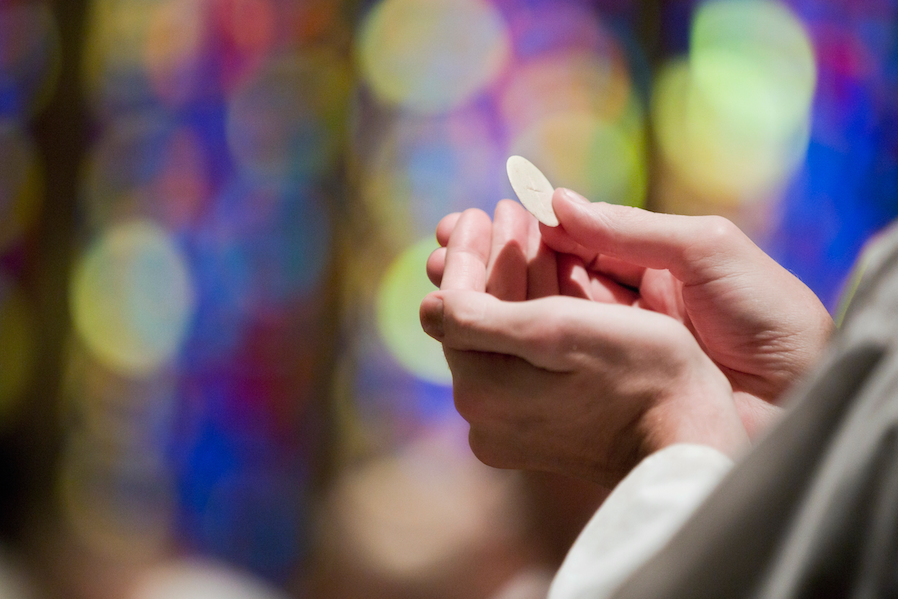
How many of us really touch God when we come to Mass? He speaks to us in the Liturgy of the Word, but do we really hear Him? He touches us in Holy Communion, but do we touch Him? Do we really expect healing when we go to Mass? Do we really expect a healing touch? Or are we only going to be in a crowd bumping up against Jesus?

Many people put more faith in Tylenol than they do in the Eucharist, because when they take Tylenol they actually expect something to happen; they expect that the pain will go away and healing will happen. But what do they expect when they receive Holy Communion? Often nothing.

How about you? Are you like the woman who touches Jesus expecting healing or like the crowd that just brushes past Him?

Jesus insists on meeting this woman of faith. And it may well be that He had Jairus in mind, as if to say, “Pay attention to this woman, Jairus. Do you see what her faith has gotten her? Do you believe, Jairus?” And into our own life, the Lord will also often send those who can testify to us of faith and show what faith can do.

Thus, on this journey, Jairus is given a witness to encourage his faith. Who are the witnesses in your life whom the Lord has sent?

IV. TEMPTATION – The text says, While [Jesus] was still speaking, people from the synagogue official’s house arrived and said, “Your daughter has died; why trouble the teacher any longer?”

Note that while there is, on Jairus’ journey, an encouraging testimony of what faith can do, there are also temptations against faith, and temptations to despair and hopelessness.

And what of us? We, too, often must confront a world and individuals that are largely negative.

And note how Jairus is told by the negative ones that he should dismiss Jesus: “Why bother the teacher any more?” Yes, there are many in our life and in this world who not only have no hope, but who insist that we dismiss Jesus, who tell us that He is of no relevance. Many secularists, themselves having no hope, ridicule us who do and taunt us to dismiss the Lord from our journey.

This is a temptation that must be rejected.

V. TRUST – The text says, Disregarding the message that was reported, Jesus said to the synagogue official, “Do not be afraid; just have faith.” When they arrived at the house of the synagogue official, he caught sight of a commotion, people weeping and wailing loudly. So he went in and said to them, “Why this commotion and weeping? The child is not dead but asleep.” And they ridiculed him. Then he put them all out.

To such as these, who are negative and who ridicule, Jesus has only a rebuke: he “put[s] them all out.”

Turning to Jairus, Jesus then says, “Be not afraid; just have faith.” The command that we have faith resonates not merely as an “order” from Jesus but also as a dynamic principle. For the same God who said, “Let there be light,” and there was light, now says, “Be not afraid; just have faith.” And so trusting and saving faith is possible for Jairus and for us.

One of the principal tasks of Jesus and His Holy Spirit is to grow faith within us. And as this faith grows, our victories become more and more evident and existent. Scripture says,

For thus says the Lord God, the holy One of Israel, “By waiting and calm you shall be saved, in quiet and in trust your strength lies … (Is 30:15)

Even youths shall faint and be weary, and young men shall fall exhausted; but they who wait for the LORD shall renew their strength, they shall mount up with wings like eagles, they shall run and not be weary, they shall walk and not faint (Is 40:30-31).

So do not throw away your confidence; it will be richly rewarded. You need to persevere so that when you have done the will of God, you will receive what he has promised. For in just a very little while, “He who is coming will come and will not delay. But my righteous one will live by faith. And if he shrinks back, I will not be pleased with him.” But we are not of those who shrink back and are destroyed, but of those who believe and are saved (Heb 10:35-39).

Hence the Lord Jesus commands faith to bring us reward. And that leads us to the final place in the journey.

VI. TRIUMPH – The text says, He took along the child’s father and mother and those who were with him and entered the room where the child was. He took the child by the hand and said to her, “Talitha koum,” which means, “Little girl, I say to you, arise!” The girl, a child of twelve, arose immediately and walked around. At that they were utterly astounded. He gave strict orders that no one should know this and said that she should be given something to eat.

Sure enough, Jairus’ journey with Jesus leads to victory. And so will ours. It may not be the Lord’s will to raise every recently deceased relative, but the Lord will surely give us the victory in every travail and difficulty. And to those who die in Him, He will surely say, as He said to the little girl, “I say to you, arise!”

And for us, in every trial, if you are in the Lord and journeying with Him, I promise you complete victory in Jesus. To every trial and distress, just say, “I’ll rise!”

In sufferings and sickness … “I’ll rise!”
In setbacks and sorrows … “I’ll rise!”
Tears in my eyes … “I’ll rise!”
Temptations against faith … “I’ll rise!”
No money in my pocket … “I’ll rise!”
Struggles with sin … “I’ll rise!”
On the rough side of the mountain … “I’ll rise!”
Though death is surely coming … “I’ll rise!”
Yes, just say, “I’ll rise!”

Jairus has made a journey with Jesus, from trial to traveling with Jesus; through testimony and temptation to the empowering command: “Trust!”; and thereby unto triumph.

The journey of Jairus is our journey, and his victory is our victory if we, like him, journey with Jesus.

What Does It Mean to Preach With Authority? A Consideration of the Concluding Line of the Sermon on the Mount

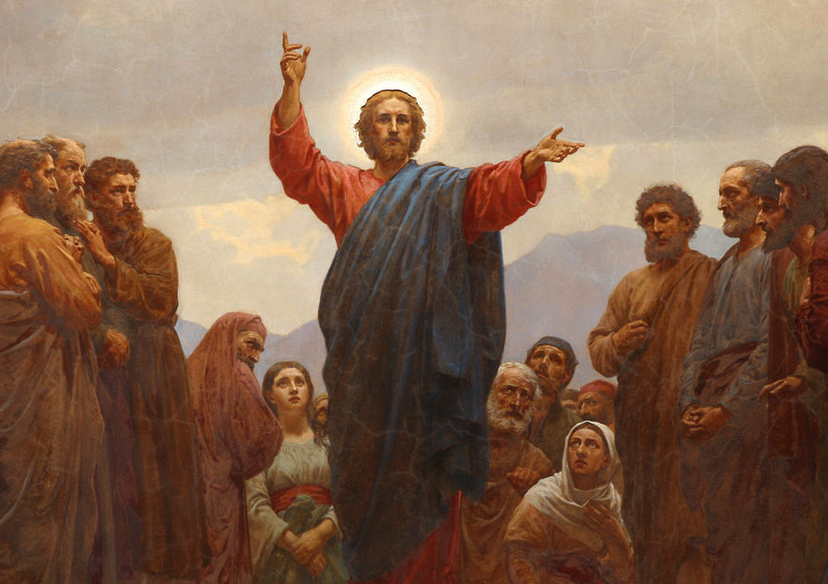
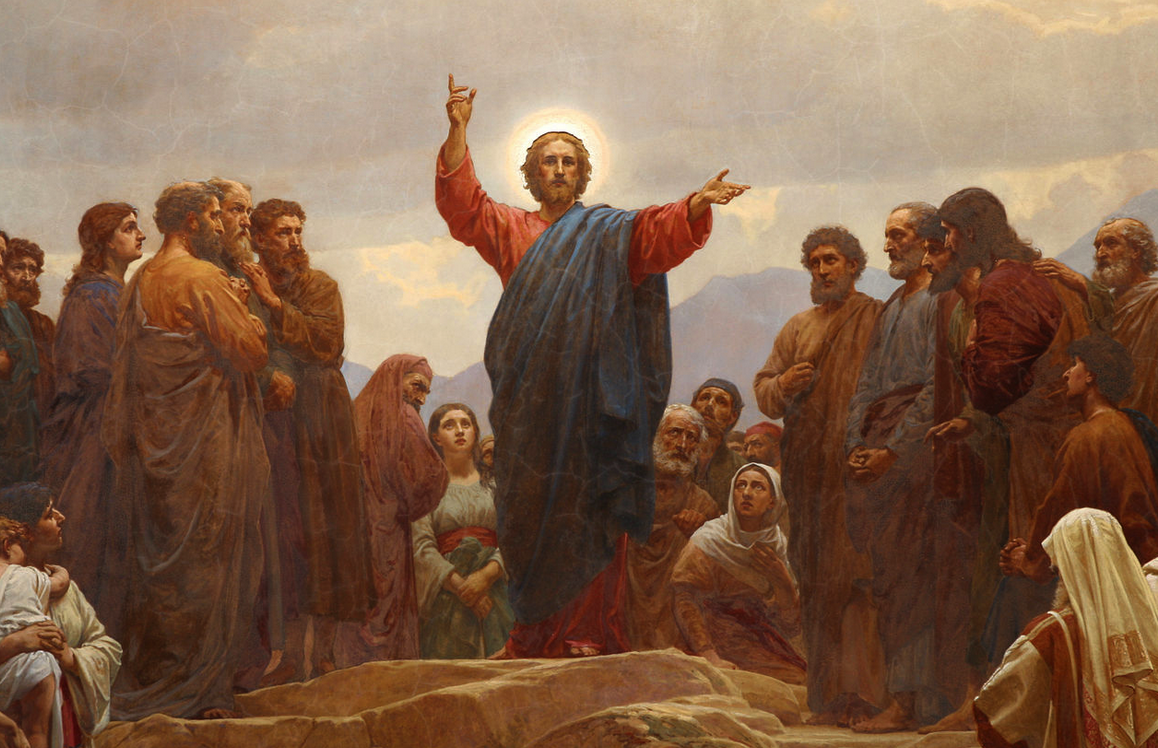
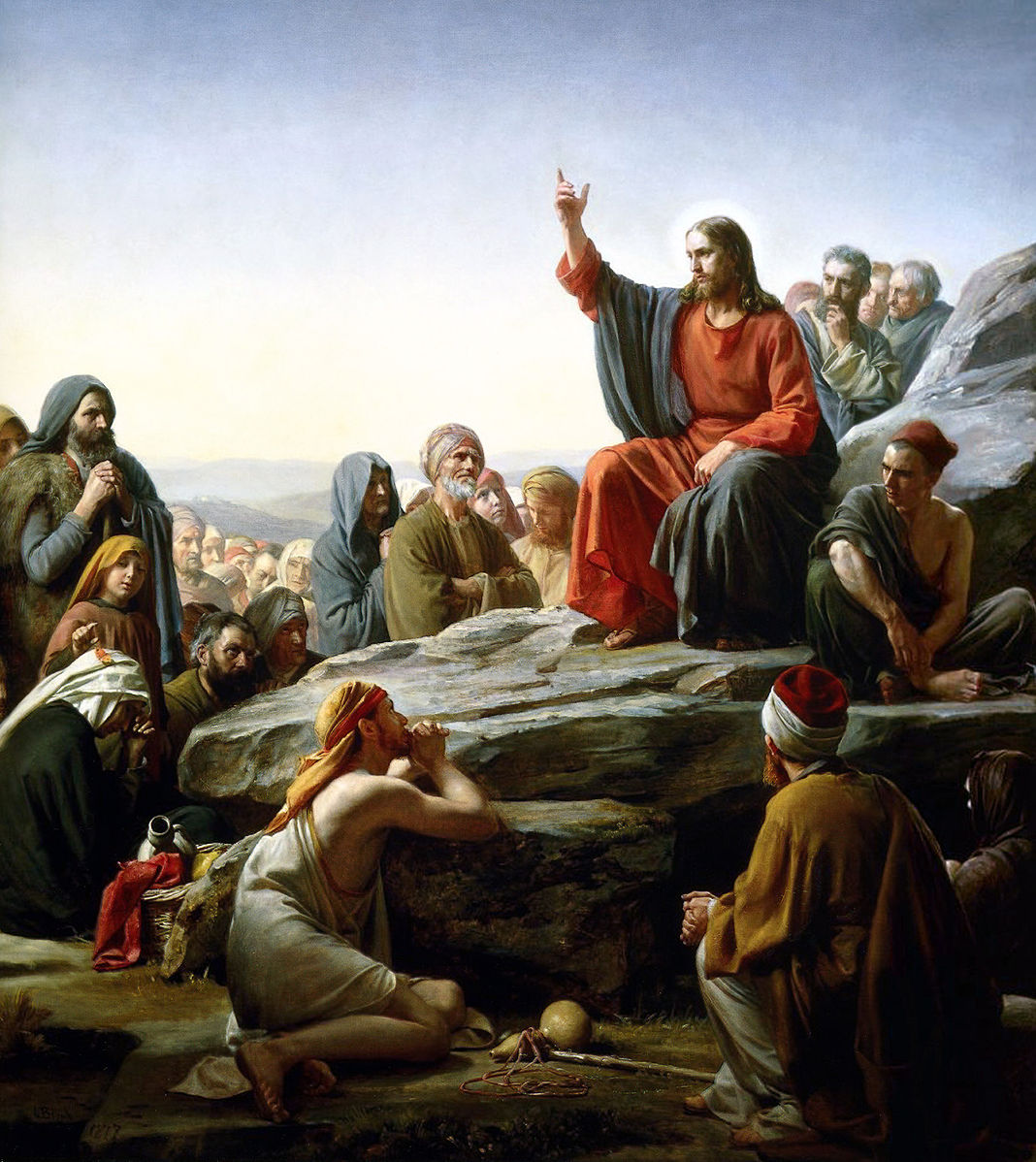
blog-062515On Thursday in daily Mass we finished reading the Sermon on the Mount (Mat 7-9). In it, there is a line describing the reaction of the crowd that day on the slopes of the Mount of Beatitudes:

And when Jesus finished these sayings, the crowds were astonished at his teaching, for he was teaching them as one who had authority, and not as their scribes (Mat 7:28-29).

What does it mean that Jesus spoke “with authority”? The Greek word translated here as “authority” is ἐξουσίαν (exousian), which means “to (speak) out of one’s being or substance.”

In other words, one who has authority is one speaks of what he knows by experience. He is not merely repeating what others have said, nor is he simply quoting slogans or common sayings. He speaks from his own substance, from his own experience.

Jesus is distinguished from the scribes, who were famous for quoting only one another or other reputable, safe sources. In and of itself, this is good. But if it merely stops there, then what makes preaching any different from just staying at home and reading a book?

Too many Christians, including Catholic preachers, are content to live and preach by quoting others rather than teaching by and from experience. Too many are content to repeat what others have said rather than speaking out of what they personally know, have seen, and have experienced.

To preach with authority (exousia) means to be able to proclaim the Word of God with personal knowledge and experience. It means being able to say, “What the Lord and the Church have always proclaimed, I know personally. For I have tested and experienced the Word of God in the laboratory of my own life, and found it to be true. And now I speak to you, not merely of what others have said, but what I know and experience to be true. Out of the substance of my own being (exousia) I announce this truth to you.”

This is what it means to preach with authority (exousia).  Jesus did not simply quote what others said. He said what He personally knew.

What about you and me? Are you able to speak with authority? Well, do you know what the Lord is doing in your life? Have you personally experienced the truth of what the Scriptures and the Church have always announced? Or are you just quoting slogans, passages, and what others have said?

Of course the Scriptures and the authoritative teachings of the Church are the essential foundation of what we know. Please don’t go out and invent your own religion! But do you personally know that the Faith is true? How? Do you speak to your children of what you know or do you merely say, “The Church says … “?  Clearly you are to say what the Church says, but to teach with authority means that you know and have experienced that what the Church says is true, and that you can personally attest to it. This is the basis of preaching and teaching with authority.

Pray especially for preachers, teachers, and parents, that we may find the Gospel and the Lord in our own lives, that we may connect the dots and preach with the authority that comes from the lived and substantial experience of these in our lives.

Exousia! Authority!

My Soul Looks Back and Wonders How I Got Over – A Homily for the 12th Sunday of the Year

Lightening Storm
Lightening StormThe gospel today is something of a storm journal, a kind of picture of the Christian life as we journey through a stormy world against winds contrary to the gospel. There are distinctive stages, beginning with the call of Jesus to cross to the other shore. But as we cross there are surely storms and difficulties that assail us. No matter, the charge to have and keep making the crossing remains the same. Let’s look in more detail at the stages of this gospel and see how the disciples get over to the other shore with Jesus.
I. It begins with the CALL of Jesus: Let us go across to the other side. This is not merely a call to cross an ancient lake 2,000 years ago. This summons echoes down to us individually today, as the call to journey to the other shore, to Heaven.
Such crossings are not uncommon in the Scriptures. The Jewish nation crossed the Red Sea, which God parted for them. They set out as pursued slaves, crossed over, and reached the other shore to enjoy the glorious freedom of the Children of God.  And then, too, they crossed the River Jordan to enter the promised land, which is a symbol of entering Heaven. Having made that crossing, they received their inheritance.
A lot of the old spirituals contain references to crossing to the other side as symbolic of the journey to Heaven:

Michael, row the boat a-shore Hallelujah!
Then you’ll hear the trumpet blow Hallelujah!

Jordan’s river is deep and wide,
Meet my mother on the other side.

Jordan’s river is chilly and cold.
Chills the body, but not the soul.

Allow this call of Jesus, Let us go across to the other side, to be your summons to follow Him to Heaven. The disciples boarded a wooden boat to get to the other side. We cross to Heaven by the wood of the cross.

Listen to Jesus’ call and then set out! Heaven lies ahead, just over on the other shore!

II. Then comes the COMMENCEMENT: And leaving the crowd, they took Jesus with them in the boat, just as he wasIt is one thing to be called by Jesus to cross to the other shore. It is another thing to respond and set out with Him. And thus the second stage of this gospel depicts the required response: that one set out, or commence the journey.
Note three things that are said here about the commencement of the journey: they renounce, they receive and they respect.
A.  They Renounce – The text says they “leave the crowd.” We are called to renounce the world, the flesh, and the devil. In our Baptism we renounced the devil and by extension the world, of which he is prince. Scripture says, You adulterous people! Do you not know that friendship with the world is enmity with God? Therefore whoever wishes to be a friend of the world makes himself an enemy of God (James 4:3-4). Jesus says, No one can serve two masters; for either he will hate the one and love the other, or he will be devoted to one and despise the other. You cannot serve God and wealth (Mat 6:24). And yet again, I have chosen you out of the world, therefore the world hates you (Jn 15:19).
Therefore the text says that they “leave the crowd.” They forsake the wide, popular road that leads to destruction and go out on the narrow way of the cross that leads to the other shore. You cannot have both Jesus and the world; you must choose. You cannot have the crowd and its values. Jesus warns, Woe to you when all speak well of you (Lk 6:26). We must be ready to leave the crowd, forsake popular ideas, and embrace the “foolishness” of the cross.
B. They Receive – The text says that they “took Jesus with them in the boat.” That is, they receive Jesus into the “boat” that is their life. They agree to journey with Him, not the world. They let Him pilot their ship. In the baptismal liturgy not only do we renounce Satan and the pomps of the world, we also accept Christ and profess our belief in God—Father, Son, and Spirit—and in the Church, which is Christ’s Body. Now Jesus enters the “boat” of our life and leads us in the crossing to the other shore. Jesus’ command is simple, “Follow me” (Jn 12:26; Lk 9:59; Mk 2:14; Mat 9:9; et alibi).
C. They respect – The text says that they “took Jesus with them in the boat, just as he was.” Even in the Greek, this text is a bit complex. What does it mean that they took Jesus in the boat “just as he was”? Many think that the text is trying to indicate that Jesus was in fact already in the boat. Thus a possible understanding is that they took Jesus with them in the boat because in fact he was already aboard.
Perhaps, but for our purposes here, let’s take the text less literally: to accept Jesus into our life just as He is means to place no conditions on His admittance. It is to accept the real Jesus, not some fake or refashioned Jesus. The real Jesus is complex. He sets impossible demands but then forgives the worst of sinners, He is kind and understanding one moment, but stern and refusing of any excuses the next. He consoles and challenges, affirms and unsettles.
Many today have attempted to remake Jesus into a kind of “harmless hippie” who told pleasant stories and went around blessing everyone. And while it is true that He blessed many, He was a stumbling block for others. Jesus was a master preacher and storyteller but He also warned in those stories that some were sheep and some were goats, some were wise and some were foolish, some were at the feast and others were cast out into the darkness, some heard “Come blessed of my Father” and others heard “I know you not, depart from me you evildoers.” And elsewhere Jesus warned, Unless you come to believe that I AM, you will die in your sins (Jn 8:24). So Jesus is complex and we must learn to accept Him into our lives “just as he is.” St. Paul lamented, For if someone comes and preaches another Jesus than the one we preached … you put up with it well enough (2 Cor 11:4). Learn of the real Jesus and accept Him just as He is.
So having taken Jesus into the boat, they commence the journey to the other shore. But the journey is not always smooth, for the waters of this world are choppy and the winds are contrary.
III. For indeed, next comes the CONCERN: And a great storm of wind arose, and the waves beat into the boat, so that the boat was already filling. Here they are, the inevitable storms of life that will test and purify our faith. Such aspects of life often trouble us greatly.
Why does God permit such things? Why do they last so long? Why does God, who could instantly solve all things, allow trouble to go on?
He has His reasons, most of which are mysterious. However we can surely understand some of the ways in which trouble helps to purify and strengthen us. When we are in trouble we discover gifts we didn’t know we had; we gain wisdom; we learn detachment and humility. In living our questions we deepen our search and grow to appreciate the answers and the truth more. Trouble often brings maturity and helps us to hone our skills. No tension, no change. Trouble is also tied up in the freedom God allows His children. Some abuse their freedom and cause harm.
So we can get a small glimpse of why God permits trouble. Yet much is still mysterious.
Some people even notice that storms in their life increase rather than decrease after they begin to follow Christ! Well, take that as a compliment. Maybe there was a time in your life when you were traveling in a similar direction to Satan and so barely noticed him on the periphery. And then you turned around and ran right into him. Do not despair; you are still going in the right direction and Satan doesn’t like it.
Indeed another reason that those who set out on a voyage to cross the sea often encounter more storms than the “land-lovers” who stay back in mediocrity is that, frankly, there are more storms at sea.  The “sea” here is a symbol of the way of the cross as opposed to the wide road that leads to destruction (cf Mat 7:13). The way of the cross is bound to have special troubles, but the cross, though not comfortable, is necessary. Jesus says, If you were of the world, the world would love you as its own. But since you are not of the world, for I have called you out of the world, therefore the world hates you (Jn 15:19). So again, take storms like these as a compliment, a sign you have set out with Christ across the deeper waters.
And thus this storm at sea is a picture of our life in this storm-tossed world. An old hymn says,
When the storms of live are raging stand by me.
When the world is tossing me like a ship upon the sea,
Thou who rulest wind and water, stand by me.
IV. But note the CALM of Jesus that brings peace to the others: But he was in the stern, asleep on the cushion; and they woke him and said to him, “Teacher, do you not care if we perish?” And he awoke and rebuked the wind, and said to the sea, “Peace! Be still!” And the wind ceased, and there was a great calm.
In life it seldom helps to be in a panic. If you want to bring peace, you have to be at peace. Jesus is not unaware of the storm, but He is not alarmed by it. He is able to sleep through it just fine. In life, two people can be involved in the same incident and yet have very different experiences.
Some years ago I was out walking with a friend when a large dog, a Golden Labrador, came lumbering toward us. I had grown up with dogs and thus could tell the difference between a dog moving aggressively and one approaching benignly seeking merely to establish contact. But my friend had not grown up with dogs and in fact had been bitten by one as a youngster. Each of us looked at the dog approaching us. We saw the same scene but reacted to it very differently. My friend was afraid, while I was delighted. He reacted angrily and defensively. I put my hand out and greeted the dog, patting it on the head and letting it smell my hand. With my experience, I was able to bring peace to the situation. An agitated reaction might well have provoked the dog to turn aggressive.
And so we see something similar here in the boat. Jesus is able to sleep peacefully in the storm, but the disciples are panicked. Jesus knows His Father; He also knows the end of the story. Do you? Have you not read that for those who love and trust in the Lord all things work together for good? (cf Rom 8:28) Why are we so afraid? Storms will come and storms will go, but if we love God we will be saved, even if we die to this world.
If you have this peace, you too will calm storms. Peaceful people have an effect on others around them. We cannot give what we do not have. Ask the Lord for a heart that is at peace, not just for your own sake but for that of others. Because He is at peace, Jesus can rebuke the storm. How about you?
V. Finally, note the CHARGE:  “Why are you afraid? Have you no faith?” And they were filled with awe, and said to one another, “Who then is this, that even wind and sea obey him?”
And thus it is that the Lord charges them to grow in faith so as to be at peace and to bring peace to others. How do we lay hold of this peace? By growing in our experience and in our wonder and awe at what the Lord can do, and by learning to trust that God is bigger than our storms and concerns. We also learn that some of the storms are actually to our benefit; they help to strengthen us, even speeding our journey along.
Faith is a way of knowing. And thus we who grow in it are less terrified of storms. We have come to experience how God delivers us and strengthens us, often in paradoxical ways, and that none of the things of this world can destroy us if we have faith.
In my own life I have made this part of the journey to greater faith. I used to be very anxious about many things. Today I am seldom anxious because I have learned by faith and experience that God is working His purposes out. Most of the things I was anxious about in the past turned out fine, or at the very least OK. And even the stunning blows contained secret gifts, hidden at the time, only to be revealed later. This is the knowing of faith, that brings calm in the storms of life.
So our charge is to have faith.
Here, then, is a quick sketch of our life as disciples. We hear the CALL of the Lord to set out. We COMMENCE our journey with Him. Whatever the CONCERNs or storms, we learn the CALM of Jesus and let it reach us by the CHARGE of faith.

If You Can Use Anything Lord, You Can Use Me – Homily for the 11th Sunday of the Year

faith like a mustard seed

The readings today speak of God’s providence, which is often displayed in humble, hidden, and mysterious ways. While it is true that God sometimes works in overpowering ways, His more common method seems to be to use the humble and even unlikely things of the created order to accomplish His goals.

For us who are disciples, there are three related teachings that speak of how God will make use of us and of others. It will also be good to link these teaching to Father’s Day, which occurs next weekend in the U.S. These three teachings can be described as Adaptability, “Awe-Ability,” and Accountability.

I. ADAPTABILITY – In today’s first reading as well as in the gospel, we hear how God can take something humble and adapt it to be mighty and powerful.

The tender shoot of the first reading becomes a mighty oak: I, [the Lord], will take from the crest of the cedar … a tender shoot, and plant it on a high and lofty mountain; … It shall put forth branches and bear fruit, and become a majestic cedar (Ezekiel 17:22-23).

The mustard seed of the first reading becomes a great shade tree: The … kingdom of God … is like a mustard seed that, when it is sown in the ground, is the smallest of all the seeds on the earth. But once it is sown, it springs up and becomes the largest of plants and puts forth large branches, so that the birds of the sky can dwell in its shade (Mk 4:32-33).

Yes, God adapts us for His purposes and no one should say, “I cannot be used.” An old song says, “If you can use anything Lord, you can use me.” And an old litany says,

The next time you think God can’t use you, remember

Noah was a drunk
Abraham was too old
Isaac was a daydreamer
Jacob was a liar
Leah was ugly
Joseph was abused
Moses was murderer had a stuttering problem
Gideon was afraid
Samson had long hair and was a womanizer
Rahab was a prostitute
Jeremiah and Timothy were too young
David had an affair and was a murderer
Elijah was suicidal
Isaiah preached naked
Jonah ran from God
Naomi was a widow
Job went bankrupt and was depressed
Peter denied Christ
The Disciples fell asleep while praying
Martha worried about everything
The Samaritan woman was divorced, more than once
Zacchaeus was too small
Paul was too religious
Timothy had an ulcer
Lazarus was dead!

No excuses then, God chooses the weak and makes them strong

In fact, it is often our very weakness that is the open door for God. In our strength we are usually too proud to be of any use to Him. Moses was too strong at age forty when he pridefully murdered a man, thinking he was doing both the Jews and God a favor. It was only forty years later, at the age of eighty, that was Moses weak and humble enough to depend on God. Only then could God use him.

We are invited in this principle to consider that it is not merely in the “biggie-wow” things we do that God can work. It is also in the humble and imperfect things about us, the mustard seed of faith, the tiny shoots, and the humble growth that God can magnify His power.

So the first principle is adaptability. God can take and adapt even the humblest, most ordinary, lowliest things and from them bring forth might and lasting fruit. Never despair over what is most humble about you, or that you are of little account on the world’s stage. It is precisely our humble state that God most often uses to bring forth His greatest and most lasting works.

II. “AWE-ABILITY” – This is the capacity to reverence mystery and to have wonder and awe at what God does. In today’s gospel, Jesus emphasizes that though a man plants seeds, he does not really know the deeper mysteries of life and growth:

This is how it is with the kingdom of God; it is as if a man were to scatter seed on the land and would sleep and rise night and day and through it all the seed would sprout and grow, he knows not how (Mk 4:26-27).

Despite our often self-congratulatory celebration of our scientific prowess and of how much we know, there is much more that we neither know nor understand. We do well to maintain a reverential awe of the deeper mysteries of God’s works and His ways. We are also rather poor at assessing how effective our methods are. We may come away from a project considering it to have been very effective, and yet little comes of it in the long run. Conversely, sometimes what we consider to have been an ineffective effort may bear great fruit. God works in His own ways and we do well to remember that God can surprise us, reminding us that He is able and is in charge.

Some years ago, a friend of mine had on her desk a “God can.” It was a metal cookie tin with the following saying on its cover: “He worketh in strange and mysterious ways, his wonders to perform.” Into this box she would place slips of papers on which were written the challenges, struggles, and failures of her life. When she met the limits of her strengths and abilities, she would say, “I can’t … but God can.” So into this metal “God can” went the slips of paper, placed there in the hope that God would make a way out of no way. And quite often He did.

We do well to cultivate a sense of wonder and awe at who God is and how He works. Not only does this bring us joy, but it also opens us to hope and to the possibility that God can work in hidden ways to exalt what is humble and to transform those who are cast down and troubled, including us and our culture. As we saw in the “adaptability” section, it is often in the humblest things that God does His mightiest works.

III. ACCOUNTABILITY – If it is true that we can’t, but God can; if it is true that God can use us mightily despite our humble state, our weakness, and even our sin; then there can be no excuse for not bearing fruit in our life. All of us are accountable to the Lord as to how we let Him use us and work through us to further His Kingdom,

The second reading today reminds us, For we must all appear before the judgment seat of Christ, so that each may receive recompense, according to what he did in the body, whether good or evil (2 Cor 5:9-10).

As we have seen, God is able to adapt and to work in wondrous and hidden ways to lift us up, even if we are humble and struggling. Given this capacity of God’s, we must one day render an account of how we have responded to God’s grace and His invitation to be exalted.

On the Day of Judgment, the answer “I couldn’t” will ring hollow because, as we have seen, “God can.” Today’s readings remind us to be open to what God can do, often in mysterious ways, and even with the most humble things in our lives.

As Father’s Day approaches, I am calling the men in my parish to account. I am summoning them to spend a year preparing, with prayer, Bible study, and fellowship to make the following pledge:

I DO solemnly resolve before God to take full responsibility for myself, my wife, and my children.
I WILL love them, protect them, serve them, and teach them the Word of God as the spiritual leader of my home.
I WILL be faithful to my wife, love and honor her, and be willing to lay down my life for her as Jesus Christ did for me.
I WILL bless my children and teach them to love God with all of their heart, all of their mind, and all of their strength.
I WILL train my children to honor authority and to live responsibly.
I WILL confront evil, pursue justice, and love mercy.
I WILL pray for others and treat them with kindness, respect, and compassion.
I WILL work diligently to provide for the needs of my family.
I WILL forgive those who have wronged me and reconcile with those I have wronged.
I WILL learn from my mistakes, repent of my sins, and walk with integrity as a man answerable to God.
I WILL seek to honor God, be faithful to His church, obey His Word, and do His will.
I WILL work courageously with the strength God provides to fulfill this resolution for the rest of my life and for His glory.

As for me and my house, we will serve the Lord (Joshua 24:15).

This resolution comes from a movie of a few years ago called Courageous, which I strongly recommend you see (if you have not already done so).

Indeed all of us, men and women, will be held accountable. For even if we can’t, God can. And even if we feel too humble and insignificant, God does His greatest work with humble things and humble people. For us, it is simply to say that we have an adaptability that God can use. This should inspire in us an “Awe-ability” that joyfully acknowledges God’s often secretive and hidden power. If that be the case, then, knowing our accountability, it simply remains for us to say, “If you can use anything, Lord, you can use me!”

Perspectives on the Feast of the Presentation of Our Lord Jesus, the Light of the World

The Liturgical instinct of the Feast of the Presentation which we Celebrate today is “Light.” For Christ is our light and the people who walked in darkness have seen a great light! In the Gospel Simeon holds Jesus and calls him “A light for revelation to the Gentiles.” And thus, this feast has long featured the carrying of candles by the faithful in procession, and the blessing of candles. For this reason the feast was often called “Candlemas.”

Biblically the feast celebrates the “purification” of our Lady when, as a Jewish woman, she would present herself forty days after giving birth to be welcomed back to the community and was blessed. I have written more the history of that here: The Churching of Women

For this reflection, perhaps we do well to attend to four teachings or perspectives we gain of Jesus our Light in the readings. We are taught that our relationship with Jesus is: Cleansing, Consoling, Compelling, and Communing.

I. Cleansing – The Gospel opens with this description: When the days were completed for their purification according to the law of Moses, Mary and Joseph took Jesus up to Jerusalem to present him to the Lord, just as it is written in the law of the Lord, Every male that opens the womb shall be consecrated to the Lord, and to offer the sacrifice of a pair of turtledoves or two young pigeons, in accordance with the dictate in the law of the Lord.

It might strike us as odd, even irritating that a woman or a couple would need to be purified after giving birth. But ancient Jewish practice exhibited great reverence for rituals of birth and death. And on account of the deep mysteries of life that were represented not only by these events, but also the fluids (e.g. blood, and amniotic fluids) that accompanied them, a kind of purification or blessing was deemed necessary for those who returned to the community after these events. (See more at the link above).

And while we may wonder at (or even scoff) at these notions, the fact is that all of us need purification and cleansing. We are sinners, and we live in a world tainted by sin. The Lord must purify us all; and unless this happens, we will never be able to endure the great holiness, glory and purity of God or heaven.

Jesus our savior alone can cleanse and purify us and make us able to endure the glory of God. The first reading both describes our need for purification and also points to Jesus, the one who purifies us:

But who can endure the day of [the Lord’s] coming? And who can stand when he appears? For he is like the refiner’s fire, or like the fuller’s lye. He will sit refining and purifying silver, and he will purify the sons of Levi, Refining them like gold or like silver that they may offer due sacrifice to the LORD. Then the sacrifice of Judah and Jerusalem will please the LORD, as in the days of old, as in years gone by. (Mal 3:2-4)

Yes, only the Lord himself can purify us to endure his glory. Thank you Jesus, our Light and Savior for the sanctifying grace by which, alone, we could ever hope to endure and rejoice in the glory that waits. Thank you Jesus for your grace and mercy by which we are able to stand before our Father and praise him for all eternity. Thank you Jesus our purifier, our savior and Lord.

The first gift our saving relationship with Jesus is cleansing.

II. Consoling – Well aware of the burden of sin, ancient Israel longed for a savior. The pious knew well that sin brought strife, pain, and deep grief. Among the pious who longed for the Messiah were Simeon and Anna, who frequented the Temple looking, and longing. Of Simeon we are told:

[He] was righteous and devout, awaiting the consolation of Israel, and the Holy Spirit was upon him. It had been revealed to him by the Holy Spirit that he should not see death before he had seen the Christ of the Lord.

And of Anna who is described as among those who were awaiting the redemption of Jerusalem, we are told she was:

a prophetess, the daughter of Phanuel, of the tribe of Asher. She was advanced in years, having lived seven years with her husband after her marriage, and then as a widow until she was eighty-four. She never left the temple, but worshiped night and day with fasting and prayer.

So here are two of the pious of Israel longing and looking for the consolation of the Messiah who would save the people and bring consolation and peace.

But what is true consolation and peace? It is to be reconciled to the Father, Abba; to once again see Him and be able to walk with him in the Garden in the cool of the morning. True consolation and peace are found only when the gates of heaven are opened and we look once again on the glorious and serene face of our Father who loves us.

Here too is a gift that can come only by the ministry of Jesus, for no one knows the Father but him and anyone to whom Jesus reveals Him. Jesus is our peace and our consolation by leading us back to his Father in and through his Sacred Heart, and by his Holy Passion.

Simeon, as he holds Jesus, is holding the Gift of the Father, and thus a tremendous gift of peace and consolation come to him in a kind of prevenient way. So he can say:

 Now, Master, you may let your servant go  in peace, according to your word, for my eyes have seen your salvation, which you prepared in the sight of all the peoples: a light for revelation to the Gentiles, and glory for your people Israel.

Such a consolation to hold the infant Jesus, and know that God so loved the world that he sent his only Son to save us. Yes, and now Simeon can go forth in peace from this world for he has beheld the light of God’s saving love in Jesus.

III. Compelling – Among the things were are told in this Gospel is that Jesus is no merely neutral figure. He is the one on whom all human history, both collective and personal, hinges. And the “hinge” is our choice for or against Jesus. Simeon says to Mary,

Behold, this child is destined for the fall and rise of many in Israel, and to be a sign that will be contradicted —and you yourself a sword will pierce— so that the thoughts of many hearts may be revealed.

Yes, all of human history, personal and collective hinges on Jesus. Jesus compels a choice. We are free to choose for or against him, but we must choose. And on this choice we must make depends the rise or fall of us all.

Here is a dramatic truth, Jesus our savior has come, and now we must choose. Choose wisely and carefully, for upon your choice depends your rise or fall.

Jesus says, Whoever is not with me is against me, and whoever does not gather with me scatters. (Matt 12:30).

St Paul says, In the past God overlooked ignorance, but now he commands all people everywhere to repent. For he has set a day when he will judge the world with justice by the man he has appointed. He has given proof of this to everyone by raising him from the dead. (Acts 17:30).  And again, We are therefore Christ’s ambassadors, as though God were making his appeal through us. We implore you on Christ’s behalf: Be reconciled to God! (2 Cor 5:20)

Where will you spend eternity? That depends on your stance toward Jesus. Your future rises or falls on Him. Will you choose him? You are free to choose, but you are not free not to choose! Jesus compels a choice, and on this choice your very life will rise or fall.

IV. Communing – It is a remarkable truth that Jesus did not merely save us from on high. He became flesh and lived among us. Today’s Gospel says,

When they had fulfilled all the prescriptions of the law of the Lord, they returned to Galilee, to their own town of Nazareth. The child grew and became strong, filled with wisdom; and the favor of God was upon him.

Imagine the intimacy of Jesus dwelling among us then, and still now “tabernacling” among us in the Blessed Sacrament and in the temples of our heart through His Spirit. Our Lord seeks communion with us, and is not ashamed to call us his brethren (Heb 2:11).

On this feast of the Presentation allow the allow the Lord into the temple of your heart. Give him access to your soul by receiving him in Holy Communion and seek his presence tabernacled in our Church. Today Jesus is not only presented in the temple, he is presented to you. Reach out to hold on to him and receive in your heart, like Simeon. Run and tell others to come, like Anna.

Jesus our Light and salvation is here. He brings with him cleansing, consoling, and communing. He also compels a choice. Choose him now, run to him, he is here and he is calling!

Come and Go with Me, to My Father’s House – A Homily for the 3rd Sunday of the Year

012514In these early weeks of “ordinary” time we are increasingly introduced to Jesus and to the beginnings of his public ministry. In Matthew’s Gospel today we hear described how Jesus began his public ministry in the wake of the arrest of John the Baptist. And Matthew tells us Four things regarding this ministry of Jesus: its Context, its Content, its Call and its Comprehensiveness. Let’s look at each in turn.

I. The CONTEXT of Jesus Ministry – The text says, When Jesus heard that John had been arrested, he withdrew to Galilee. He left Nazareth and went to live in Capernaum by the sea, in the region of Zebulun and Naphtali, that what had been said through Isaiah the prophet might be fulfilled: Land of Zebulun and land of Naphtali, the way to the sea, beyond the Jordan, Galilee of the Gentiles, the people who sit in darkness have seen a great light, on those dwelling in a land overshadowed by death light has arisen.

The relocation of Jesus northward from Judea up to Galilee tells us some important truths. First, it tells us of the hostility of the southern regions to the message of John the Baptist and Jesus. The area in and around Judea which included, principally, Jerusalem was controlled by a sort of religious ruling class (the Sadducees especially, and to a lesser extent the Pharisees). Since they were in strong but often controverted leadership in these areas, they were far less open to ideas which in any way threatened their leadership or questioned the rituals related to the Temple.

As we know, Jesus did not come to abolish the Law but he did come to fulfill it and this was threatening to those tied to the current status quo, most of whom did not distinguish fulfillment from abolition, and saw only threat. Further, the Herodian dynasty was also threatening especially in the south and had arrested John the Baptist.

Jesus thus, moves north to more fertile territory to begin his public ministry. The Jewish people in Galilee were less hostile. In fact the people of Jerusalem often looked down upon them for their more simple, agrarian ways and “rural accent.” But here was more fertile ground for Jesus to begin.

Now there is an important lesson for us in this. While we must carefully preserve Christian orthodoxy and only accept a development of doctrine that is organic and faithful to the received Apostolic Tradition, it is also true that we can sometimes stifle the Holy Spirit who will speak to us through unexpected people and in unexpected ways.

The Pharisee leaders simply rejected the notion that any prophet could come from Galilee. When Nicodemus encouraged them to give Jesus a hearing they scoffed: Are you from Galilee too? Search and see that no prophet arises from Galilee (Jn 7:52). It is possible for us to insist upon things where freedom is permitted for a Christian. There are various degrees of expression permitted in the liturgy and there are often different schools of theological thought which the Church sanctions.

Balance is required of us. There may be preferences that we have for Thomistic formulations, Carmelite spirituality, charismatic worship, or traditional Latin Mass worship. Such things are legitimate matters for on-going discussion, but we can too easily be threatened by what the Church currently deems to be legitimate diversity. Discovering a the range and limits of diversity is an on-going matter for the Church but we ought not permit the field of our own soul to be hostile to Jesus and his ministry, which may come to us more diverse ways that we, of our self, prefer.

How tragic it was for Judea that Jesus thought he had to move on to more fertile territory, and what a blessing it was for Galilee that he moved there. The fact is, that unfounded stubbornness can be hinder the Word of God in us. Jesus moved on to a more accepting context wherein his ministry could bear the greatest fruit. St. Gregory the Great has this to say about the context for preaching and necessary fertility of the field:

For frequently the preacher’s tongue is bound fast on account of his own wickedness. as the psalmist says: But God asks the sinner: Why do you recite my commandments? (PS 50:16) On the other hand it sometimes happens that because of the people’s sins the word of preaching is withdrawn from those who preside over the assembly as the Lord tells Ezekiel: I will make your tongue cleave to the roof of your mouth, so that you shall be dumb and unable to reprove them, for they are a rebellious house. (Ez 3:26) He clearly means this: the word of preaching will be taken away for they are unworthy to hear the exhortation of truth. It is not easy to know for whose sinfulness the preacher’s word is withheld, but it is indisputable that the shepherd’s silence while often injurious to himself will always harm his flock. – (St. Gregory the Great Hom. 17,3, 14)

For Galilee there was this boon: The people who walked in darkness have seen a great light; those who dwelt in a land of deep darkness, on them has light shined (Is 9:2) But for others, Jesus had only this to say, Therefore I tell you that the kingdom of God will be taken away from you and given to a people who will produce its fruit. (Matt 21:43)

II. The CONTENT of his MINISTRY – The text says, From that time on, Jesus began to preach and say, “Repent, for the kingdom of heaven is at hand.”

We have discussed before the careful balance of Jesus’ preaching. He is willing to challenge and so say, Repent! But he also declares the good news that the kingdom of heaven is at hand! Accepting the ministry of Jesus requires that we avoid both presumption and despair.

To those who make light of sin and their condition as a sinner, Jesus says repent. It is wrong to presume that we do not need an on-going healing power from the Lord to overcome our sin. And perhaps our greatest sin is our blindness to our sin. Most human beings do not seem to comprehend how serious their condition is. The word translated here as “Repent!” is μετανοεῖτε (metanoeite) which means more literally “to come to a new mind, or a new way of thinking.” In our sin soaked world where sin is so pervasive as to almost be unnoticed, Jesus says, “Come to a new mind. Understand your condition and need for mercy and grace. Come to understand that without the rescue that only God can give, you are lost.” And hence we are told to reject presumption.

But we are also told to reject despair, for the Kingdom of God is at hand. In other words, the grace and mercy of God are now available to rescue us from this present evil age and from our carnal condition. Through Christ we are granted admittance to the Kingdom and the Spirit of God can overcome our carnal, sin nature and bring us true holiness.

The proper mean between presumption and despair is the theological virtue of Hope. By hope we confidently expect God’s help in attaining eternal life. By proper metanoia (repentance) we know that we need that help, and by hope confidently reach for it.

In our own proclamation of the kingdom we also need the proper balance exhibited by Jesus. Consider how, with children, that if all they hear is criticism they become discouraged (despair). But if all they hear is praise and are never corrected: they become spoiled and prideful and presume everything should be just as they want it.

For the Church too, a balance is necessary. Too many expect the Church only to affirm and “be positive.” But this leads to a more selfish and incorrigible world and to a presumption that nothing matters (as we can plainly see). Thus the Church must announce the call to repentance. But the Church must also offer hope and mercy to sinners. She must offer grace though the Sacraments and by her preaching which, with God’s power, makes the Kingdom of God to be “at hand.”

III. The CALL of his Ministry The text says, As he was walking by the Sea of Galilee, he saw two brothers, Simon who is called Peter, and his brother Andrew, casting a net into the sea; they were fishermen. He said to them, “Come after me, and I will make you fishers of men.” At once they left their nets and followed him. He walked along from there and saw two other brothers, James, the son of Zebedee, and his brother John. They were in a boat, with their father Zebedee, mending their nets. He called them, and immediately they left their boat and their father and followed him.

Jesus, in building his kingdom, summons men to follow him. He will train them to be the leaders of his Church as Apostles. The Kingdom of God is not only about calling disciples but also about developing leaders to provide order and authority in the Church.

Even the most “democratic” of organizations requires authority and leadership. Without these there is anarchy and a battle of wills. Hence the Lord calls not only disciples, in the early stages of his public ministry, he also grooms leaders. Consider three things about the Lord’s call here.

A. His ARTICULATENESS: He says to these apostles, Come Follow me! Notice that his announcement is unambiguous. Good leaders like the Lord are clear to make known what they ask, indeed, what is demanded. He is clear to set the course and point the way. And HE is that way.

B. His APPEAL – Jesus must have had a personal appeal and exuded an authority that was strong and reassuring. His appeal to them was personal: come follow ME. He did not merely say come and “learn my doctrine,” or “accept my vision.” He said, follow ME. So too, as we hand on the faith to our children and to others, we cannot simply say, here is a Catechism follow it. We must also take the next step and say follow the Lord with me. We cannot simply say what a book says, correct though that book is. Ultimately we must be able to say, I am a personal witness to the fact that God is real and that the truth he has given to the Church is authentic and is changing my life. Our appeal must include the personal testimony that what we proclaim is real and is changing our life: COme and go with me to my Father’s house.

C. His APPROACH Note that the Lord builds on what they know: fishing. He starts with the familiar to draw them to the less familiar. In a way he is saying that the gifts they are currently using are just the gifts they can use as leaders in God’s Kingdom. Fishermen are:

  • Patient Fishermen often wait long hours for the fish to bite. So too as Apostles and Bishops there must be a patience, a capacity to wait long periods before there is a catch for the Lord.
  • Perceptive Fishermen learn to know the fish and their behavior and what attracts them. So too Apostles and clergy must learn of their people and what will attract them to Christ.
  • Persevering Fishermen must often go out for many days with little catch. Only through perseverance is there real gain in fishing. So too with the Work of the clergy who may go long stretches with little to show. The gospel may go “out of season” even for decades in certain cultures (like our own). The good leader will persevere, will stay at the task.

IV. The COMPREHENSIVENESS of his Ministry – The text says, He went around all of Galilee, teaching in their synagogues, proclaiming the gospel of the kingdom, and curing every disease and illness among the people.

Therefore note that all of Galilee was his mission field and he covered it comprehensively. He also cured of every disease and illness. And thus the Church is catholic and must also address every part of the world and provide a comprehensive vision for life. We may not have the power to simplistically cure every ailment and problem, but we can provide the vision of the Paschal mystery that sheds light and brings spiritual healing to every affliction. If we are suffering and dying, so to did Jesus but only to rise and be glorified on account of his fidelity and obedience.

So too for the Church and for the Christian, the grace and the comprehensive answer to every affliction is that we are always carrying about in our bodies the dying of Christ so that the rising of Christ may also be manifest in us (2 Cor 4:10). We seek to bring healing to everyone we can, and where physical remedies are not possible, the truth of the Gospel reassures that every Friday, faithfully endured, brings forth, by God’s grace an Easter Sunday.

Here then are four crucial insights to the beginning of Jesus public ministry. They remain for the Church and for all of us who would follow in Jesus’ footsteps important insights for us to acknowledge and imitate.

Now journey with me back to 1971, a year of funny hair to be sure, but here is the old Classic “Come and God With Me to My Father’s House”

Who is Jesus Christ? A Homily for the 2nd Sunday of the Year

011814As Ordinary time (tempus per anum) opens up, the lectionary continues to “introduce” Christ to us. Last week he was baptized obtained many gifts for us as he was manifested by the Father.

This week is a continuation of sorts as John the Baptist elaborates on Who Jesus is. John’s words are brief but they are packed with Christological teaching. In this Gospel we learn at least five things about Jesus. He learn that he is prefigured, preexistent, preeminent, powerful and the presence of God. Let’s look at each one.

1. Prefigured – The text says, John the Baptist saw Jesus coming toward him and said, “Behold, the Lamb of God, who takes away the sin of the world. Now, unless you know the history of this moment, it seems a little odd. A full grown man approaches John the Baptist and he says, Look! There is the Lamb of God.

But for those who know the scriptures John is really answering a question that was asked by Isaac some 1800 years prior to this event. Abraham has received from God a strange and terrible command that he take his son to Mt. Moriah (present day Jerusalem) and there offer him in sacrifice. As they arrive at the foot of Moriah, here is where we join the Genesis text:

And Abraham took the wood of the burnt offering, and laid it on Isaac his son; and he took in his hand the fire and the knife. So they went both of them together. And Isaac said to his father Abraham, “My father!” And he said, “Here am I, my son.” He said, “Behold, the fire and the wood; but where is the lamb for a burnt offering?” Abraham said, “God will provide himself the lamb for a burnt offering, my son.” So they went both of them together. (Gen 22:6ff).

Do you get it? A promised son has wood laid upon his shoulder and is made to carry it up a hillside, the same hillside where “Golgotha” will one day be found. There, on the top of that hill he is to be laid on the wood and killed. Sound familiar? Of course, it is a prefigurement of Christ, or a “type” of Christ. Things are starting to look grim for Isaac who gets nervous and says, “Daddy – where is the Lamb?” You know the rest of the story. It is true that there was a ram caught in the thicket which God provided that day, but that ram pointed to Christ.

And so the question, “Where is the Lamb?” wafted up on the breeze and got repeated down through the generations. Some five hundred years later at the end of the Egyptian slavery the blood of the lamb also protected Isaac’s descendants from death. And every Passover the question was still asked, where is the Lamb, referring to the Passover lamb. Here too, the Passover lamb was but a symbol, a prefigurement of Christ.

Now, standing on the banks of the Jordan John the Baptist answers Isaac’s question repeated down through the centuries: “Where is the Lamb?” “Look! There is the Lamb of God!” So the first thing we learn of Christ is that he was prefigured, here and in many other places in the Old Testament.

2. Preexistent – The text says, He is the one of whom I said, ‘A man is coming after me who ranks ahead of me because he existed before me.’ Now this too is a strange thing for a man to say about his younger cousin. Jesus was born six months after John the Baptist, yet John says, he existed before me. But John is clearly teaching us here of Christ’s pre-existence. Before his assuming a human nature, Jesus existed eternally with the Father. There never was a time when Jesus the Son was not. He is eternally begotten by the Father, he existed before all ages. Scripture says of him:

  • For in him all things were created, in heaven and on earth, visible and invisible, whether thrones or dominions or principalities or authorities ‑‑ all things were created through him and for him. He is before all things, and in him all things hold together. (Col 1:16)
  • In the beginning was the Word, and the Word was with God, and the Word was God. He was in the beginning with God; all things were made through him, and without him was not anything made that was made. (John 1:1).
  • And yet again, Jesus himself said, Your father Abraham rejoiced that he was to see my day; he saw it and was glad.” The Jews then said to him, “You are not yet fifty years old, and have you seen Abraham?” Jesus said to them, “Truly, truly, I say to you, before Abraham was, I am.” (John 8:56)

3. Preeminent – The text says I did not know him, but the reason why I came baptizing with water was that he might be made known to Israel.” In effect John is saying, I exist for him. My purpose is to reveal him. He must increase, but I must decrease (John 3:30) Jesus is greater than John or any prophet or any world leader. Jesus is the Groom, John is but the best man.

4. Powerful – The text says, John testified further, saying, “I saw the Spirit come down like a dove from heaven and remain upon him. I did not know him, but the one who sent me to baptize with water told me, ‘On whomever you see the Spirit come down and remain, he is the one who will baptize with the Holy Spirit.’

The baptism of John could only announce repentance and call for it. But it could not truly wash away sins. The Baptism of Jesus can.

Even more, it does not only take away sins but Jesus’ Baptism also confers the Holy Spirit. We are thus given a whole new life. Sin is taken away and in its place grace upon grace is given. Grace to restore us, renew us and refashion us. Grace that equips, empowers and enables us. Grace that sanctifies, gives sonship and seals us with the Holy Spirit.

All this is in fulfillment of Ezekiel 36:25ff which says I will sprinkle clean water upon you, and you shall be clean from all your uncleannesses, and from all your idols I will cleanse you. A new heart I will give you, and a new spirit I will put within you; and I will take out of your flesh the heart of stone and give you a heart of flesh. And I will put my spirit within you, and cause you to walk in my statutes and be careful to observe my ordinances. Scripture also says, But to all who received him, who believed in his name, he gave power to become the children of God; (Jn 1:12)

5. Presence of God – the text says, Now I have seen and testified that he is the Son of God.” Jesus would say elsewhere, To see me is to have seen the Father, the Father and I are one (John 14:9) As the Son of God, he manifests the Father, he is the presence of God in this world. He shares fully in the one divine essence and as Son shows us the Father. He is the presence of God among us.

So here in a brief passage are five important teachings about Jesus Christ. He has existed forever, was prefigured in the Old Testament, has priority above and beyond anyone we know or think important, he has the power not only to save us from sin but to give us the very life of God, and as Son of God, He is God, and thus is God’s very presence among us. He is not just the man from Galilee, he is very God from Heaven.

Will the Real January 1st Please Stand Up. A Homily For New Years Day and the Solemnity of Mary Mother of God

123113This feast day, of January 1, is a very complex tapestry, both culturally in liturgically. Perhaps we can use the second reading by St. Paul to the Galatians as a way to weave through some of the many details. We can look at it in three parts.

I. The Chronology of our celebration. The text from St. Paul’s letter to the Galatians says, When the fullness of time had come…

Most people, both in the wider culture and in the Church are going about today saying, “Happy New Year!” And rightfully so, for it is the beginning of the new year. But most people think of New Years in almost wholly secular terms. Sadly, it is best known for rather loud parties and excessive drinking.

Yet it is a mistake to see New Years simply as a secular holiday. St. Paul reminds us, in speaking of “the fullness of time,” that all time belongs to God, and all the ages.

It is not simply 2014, it is 2014 Anno Domini (A.D). Even the most secular and unbelieving of people in the Western world locate their place in time in relation to Jesus Christ. It is 2014 years since the birth of Christ. Every time we write the date of the top of the letter, or a check, every time we see the date at the top of the newspaper or on our computer screen, that number, 2014, points back to Christ. He is the Lord of history. Jesus sets the date he is the clock we go by. All time belongs to him.

Jesus says in the book of RevelationI am the Alpha and the Omega, the first and the last, The beginning and the end. He who is, and who was, and who is to come” (Revelation 22:13).

If it is true, that 2014 references the birth of Christ,  the question arises as to why Christmas Day is not also New Year’s Day. But this too makes a lot of sense, if we understand liturgical and spiritual sensibilities.

In the Church, and stretching back into Jewish times, it was customary to celebrate the high feasts of faith over the period of a week. In Christian tradition this came to be known as the “octave.”  Though we think of a week as seven days, it does not take long to consider that we celebrated Christmas last week on Wednesday. Now this week we celebrate New Year’s on Wednesday, and Wednesday to Wednesday inclusive is eight days.

Wednesday, January 1, 2014 is the eighth day of Christmas. In the Christian tradition the octave, is considered really as one long day of eight days. Therefore, Wednesday, January 1, 2014 completes Christmas Day; Christmas day is fulfilled. Or as St. Paul says, the fullness of time, in terms of Christmas day has come. And thus, the calendars flip from one year to the next. Now at the end of Christmas Day, our calendars go from 2013 to 2014 A.D.

The rest of the secular world has largely moved on, barely thinking of Christmas anymore. As I walk my neighborhood, the strange spectacle appears of Christmas trees already being set out at the curb to be picked up by the recycling truck. Yes, for many in our hurried world, Christmas is over. But we, in the Church, continue to celebrate the great Christmas feast and cycle. Having completed the octave, we move onto Epiphany week.

Thus, this New Year, we contemplate the “fullness of time.” The passage of another year, reminds us of the magnificent truth that, to God, all time: past present and future, is equally present. He holds all things together in himself. He is the same, yesterday, today and forever. And whenever he acts, he always acts in our time, out of the fullness of time. This is a very deep mystery, and we should in silence ponder the mystery that, for God all things ARE. He is not waiting for things to happen. For him, everything is accomplished. I will write more on this in tomorrow’s blog.

II. The Content of our celebration. St. Paul goes on to say, God sent forth his son born of a woman. And with this statement we are again reminded that we are still in the Christmas cycle.

We’ve already discussed the concept of the eighth day, of the octave. And while it is New Year’s Day, there is also a complex tapestry of religious meanings to this day as well.

And we’ve already seen, it is still Christmas day, the eighth day of the one long day that we call Christmas Day.

Historically, this is also be the day of Christ’s circumcision. And for a long period in Church history that was the name given to this feast day, “The Circumcision of the Lord.” As I wrote yesterday, I personally regret the loss of this feast, at least in terms of its title.

This is the day when Joseph and Mary brought Christ to be circumcised. In this, Jesus as man, but also as God, reverences the Covenant he has made with his people. There is a beautiful truth that God seeks relationship with his people. And in this covenant act of the circumcision is the moving truth that,  as The Letter to the Hebrews puts it, Jesus is not ashamed to call us his brothers (Heb 2:11).

There is also here the first shedding of blood by Jesus. Also sign of his love for us.

Another truth about the content of this feast, is the most Holy Name of Jesus. For not only was a Jewish boy circumcised on the eighth day, but was also given his name, and all hear that name for the first time.

The name Jesus means “God saves.” And indeed, this most Holy Name of Jesus, when use in reverence has saving power. We are baptized in his Holy Name, along with that of the Father and the Holy Spirit. And all of our prayers conclude with his Holy Name. Scripture says of his great and holy name:

Therefore God exalted him to the highest place and gave him the name that is above every name, that at the name of Jesus every knee should bow, in heaven and on earth and under the earth, and every tongue acknowledge that Jesus Christ is Lord, to the glory of God the Father. (Phil 2: 9-11)

And yet another identity and content of this feast day is its current and formal title: The Solemnity of Mary Mother of God. This title replaced the title of the Feast of the Circumcision back in 1970. However, it is the most ancient title for this feast day. Again, you can read more of this issue in yesterday’s blog post.

We note in the reading that Paul says that God sent forth his Son, born of a woman. Jesus is the eternal Son of the Father; he is God from God, Light from Light, True God from True God. Jesus is God, and since Mary gives birth to Jesus, Mary is the Mother of God,  because Jesus is not two different persons.

Mary did not just give birth to part of Jesus, she gives birth to Jesus. And thus the title “Mother of God” speaks to us as much about Jesus as about Mary. It is a title that she has because of the Church’s insistence that Jesus cannot be divided up into two different people, and we cannot say Mary gives birth to one Jesus but not “the other.” There is only one Jesus, though he has two natures, human and divine.

And thus, on this feast of Christmas, on this eighth day of Christmas, we are reminded, and solemnly taught that Jesus is human, he is also divine;  and that in taking a human nature to himself from his mother Mary, he remains one person. God has sent forth his son born of woman

III. The Consolation of our celebration – St. Paul goes on to say, Born under the law to ransom those under the law so that we might receive adoption as sons. As proof that you are sons, God sent the Spirit of his Son in our hearts crying out Abba, Father! So you are no longer a slave,  but a son, and, if a son, also an heir through God.

Note Three things about this text:

A. Our Adoption. We have already noted how Jesus, on the eighth day is circumcised and enters into the Covenant,  into the Law. In the incarnation, he joins the human family, in the Covenant he joins our family of faith. He will fulfill the old Covenant, and inaugurate the new one. And by this New Covenant, by baptism into him, we become members of his Body and thereby become adopted as sons.

We become sons in the Son. When God the Father looks to his Son, loving his Son, he is also looking at us and loving us, for we are in Christ Jesus, members of his Body through baptism. God is now our Father, not in some allegorical sense, but in a very real sense. We are in Jesus, and therefore God really is our Father.

B. Our Acclamation. St. Paul says that the proof of our sonship is the movement of the Holy Spirit in us the cries out Abba! In Aramaic and Hebrew, Abba is the family term for father. It is not baby talk, like the word “Dada” in English. But just like most adults called their father “Dad” or some other close term,  rather than “father,” so it is that Abba is the family term for father. It would be a daring thing for us to call God “Dad” unless we were permitted to do so, and instructed to do so by Christ.

St. Paul speaks of this word as proof that we are sons. In so doing, he is emphasizing that it is not merely saying the word that he refers to. Even a parrot can be taught to say the word. Rather, St. Paul is referring to what the word represents; namely, an inner movement of the Holy Spirit wherein we experience a deep affection for God the Father. By our adoption, our baptism into Christ, by our reception of the Holy Spirit we love the Father! We develop a deep affection for Him and dread to offend him. Buy this gift of the Spirit, God is my Father whom I deeply love!

C. Our advancement. Notice that St. Paul then speaks of how we have moved from being a slave, to being a son, to being an heir. In Jesus, we are not just any Son, we are the only Son of the Father. And as Jesus has a kingdom from his Father, we too inherit it with him! As sons in the Son, we are heirs with Jesus to the Kingdom!  Jesus speaks of his disciples a one day reigning  with him: And I confer on you a kingdom, just as my Father conferred one on me (Lk 22:29). In Jesus, all Heaven will be ours and we will reign with Christ forever. This is not our doing, not our glory, it is Christ’s doing and his glory in which we share.

And thus we have a very rich tapestry on this New Year’s Day: this feast of the Octave of Christmas, this Feast of the Circumcision of the Lord, This Feast of the Holy Name of Jesus, this Feast of Mary the Mother of God. And also, we are given this Feast wherein the glory of Christ is held before us and we who are  members of his body, are told of the gifts that we receive by his Holy Incarnation, and his Passion, Death and Resurrection.

Not a bad way to start the new year, reminded of God’s incredible love for us, of his rich blessings and promises.