The Priority of Personal Prayer

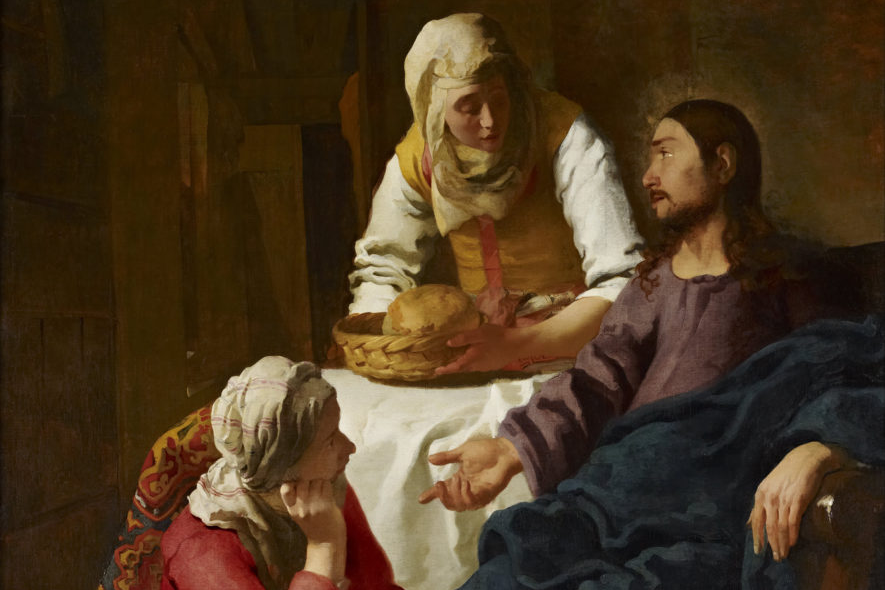
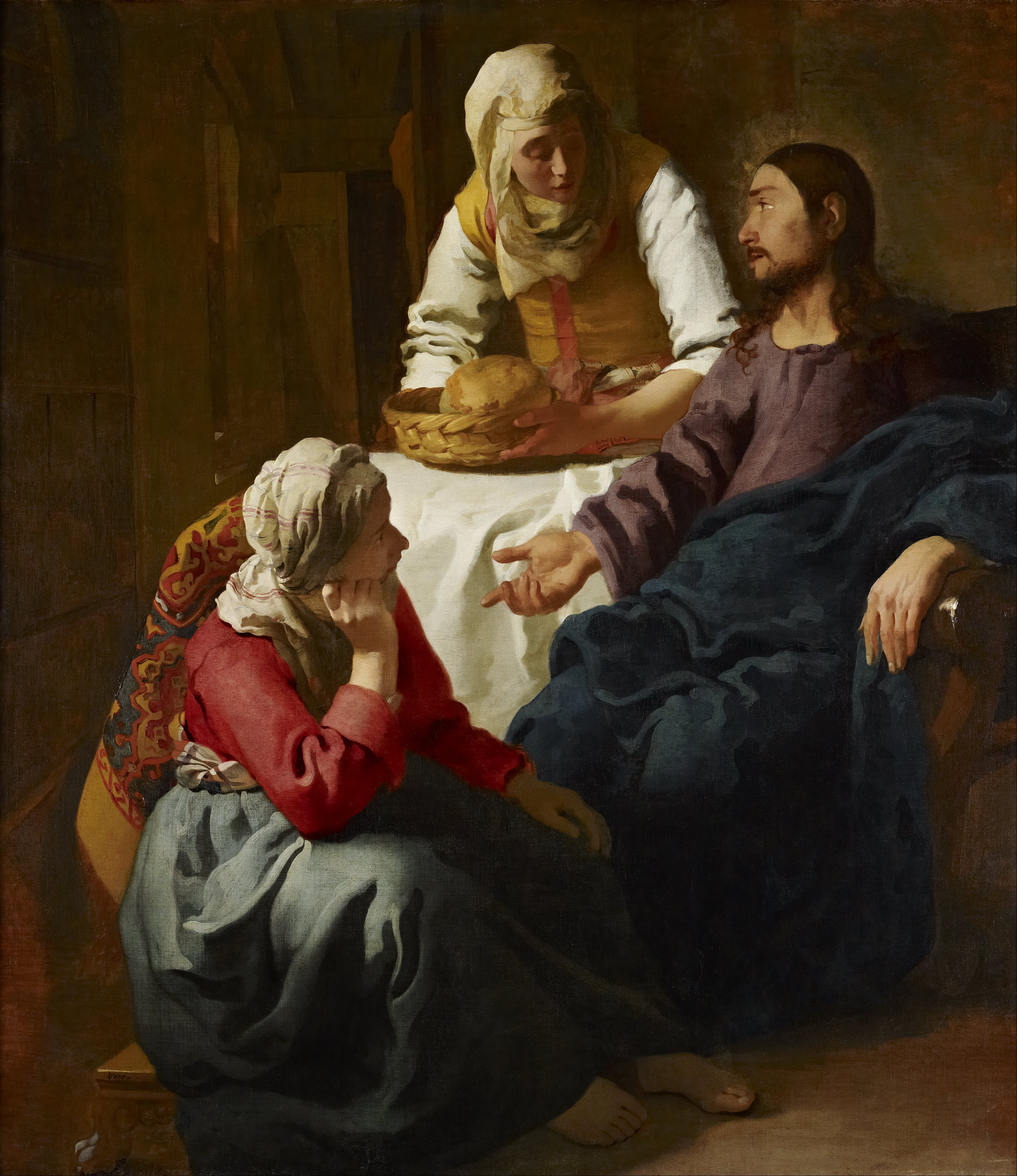
mary-and-marthaToday’s Gospel is the very familiar one of Martha and Mary. Martha is the anxious worker seeking to please the Lord with a good meal and hospitality; Mary sits quietly at His feet and listens. One has come to be the image of work, the other of prayer.

Misinterpreted? In my lifetime I have heard many a sermon that interpreted this Gospel passage as a call for a proper balance between work and prayer. Some have gone on to state that we all need a little of Martha and Mary in us, and that the Church needs both Marthas and Marys.

But in the end it seems that such a conclusion misses the central point of this passage. Jesus does not conclude by saying, “Martha, now go do your thing and let Mary do hers.” Rather, He describes Mary as not only choosing the better part but also as doing the “one thing necessary.” This does not amount to a call for “proper balance” but instead underscores the radical priority and primacy of prayer. This, it would seem, is the proper interpretation of what is being taught here. Many other passages of the Scripture do set forth the need to be rich in works of charity, but this is not one of them.

With that in mind let’s take a look at the details of the Lord’s teaching today on the priority of personal prayer.

I. PROMISING PRELUDE Jesus entered a village where a woman whose name was Martha welcomed him. The story begins by showing Martha in a very favorable light. She opens her door (her life, if you will) and welcomes Jesus. This is at the heart of faith: a welcoming of Jesus into the home of our heart and life. Surely Revelation 3:20 comes to mind here: Behold I stand at the door and knock. If any one hears my voice and opens the door I will come in and eat with him and he with me.

While we acknowledge this promising prelude we ought also to underscore the fact that the initiative is that of Jesus. The text says that Jesus entered a village. In the call of faith, the initiative is always with God. It was not you who chose me, it was I who chose you (Jn 15:16). Hence, while we must welcome Him, God leads. Martha hears the Lord’s call and responds. So far, so good.

What happens next isn’t exactly clear, but the impression given is that Martha goes right to work. There is no evidence that Jesus asked for a meal from her. The text from Revelation quoted above does suggest that the Lord seeks to dine with us, but it implies that it is He who will provide the meal. Surely the Eucharistic context of our faith emphasizes that it is the Lord who feeds us with His Word and with His Body and Blood.

At any rate, Martha seems to have told the Lord to make Himself comfortable and has gone off to work in preparing a meal. That she later experiences it to be such a burden is evidence that her idea emerged more from her flesh than from the Spirit.

II. PORTRAIT OF PRAYER She had a sister named Mary who sat beside the Lord at his feet listening to him speak. Now here is a beautiful portrait of prayer: sitting at the Lord’s feet, listening.

Many people think of prayer as something that is said. But prayer is better understood as a conversation, and conversations include both speaking and listening. Vocal prayer, intercessory prayer, and the like are all noble and important, but the prayer of listening is too often neglected.

Prayer is not just telling God what we want, it is discovering what He wills. We have to sit humbly and listen. We must learn to listen, and we must listen in order to learn. We listen by slowly and devoutly considering Scripture (lectio divina), and by pondering how God is speaking in the events and people in our life, how God is whispering in our conscience and soul.

As we shall see, Jesus calls this kind of prayer “the one thing necessary.” What Mary models and Martha forgets is that we must first come (to Jesus) and then go (and do what He says), that we must first receive before we can achieve, that we must first be blessed before we can do our best, that we must first listen before we leap into action.

III. PERTURBED and PRESUMPTUOUS Martha, burdened with much serving, came to him and said, “Lord, do you not care that my sister has left me by myself to do the serving? Tell her to help me.” Martha, who is laboring in the flesh but not likely in the Spirit and in accord with the Lord’s wishes, is now experiencing the whole thing as a burden. She blames her sister for all this but the Lord’s response will make it clear that this is not Mary’s issue.

One sign that we are not in God’s will is experiencing what we are doing as a burden. We are all limited and human and will experience ordinary fatigue. It is one thing to be weary in the work but it is another to be weary of the work.

A lot of people run off to do something they think is a good idea. And maybe it is a fine thing in itself. But often, they never asked God about it. God might have said, “Fine.” But He might have said, “Not now, later.” Or He might have said, “Not you, but someone else.” Or he might have just said, “No.” But instead of asking they often just go off and do it, and then when things don’t work out will often blame God: “Why don’t you help me more?”

And so Martha is burdened. First she blames her sister. Then she presumes that the Lord does not care about what is (to her) an obvious injustice. Then she takes presumption one step further and presumes to tell the Lord what to do: “Tell her to help me.”

This is what happens when we try to serve the Lord in the flesh. Instead of being true servants who listen to the Lord’s wishes and carry them out by His grace, we end up angry and mildly (or more) dictatorial. She here is Martha, with her one hand on her hip and her index finger in the air . Jesus will be kind to her, but firm.

IV. PRESCRIBED PRIORITY Martha, Martha, you are anxious and worried about many things. There is need of only one thing. Mary has chosen the better part and it will not be taken from her. Now don’t let the Lord have to call you by your name twice! It is clear that the Lord wants Martha’s attention and that she has made a fatal mistake (that we all can easily make): she leapt before she listened.

The Lord observes her and comments that she is anxious about many things. Anxiety about many things comes from neglect of the one thing most necessary: sitting at the feet of the Lord and listening to him.

The Lord will surely have things for us to do in our lives but they need to come from Him. This is why prayer is the “one thing” necessary and the better part: because work flows from it and is subordinate to it.

Discernment is not easy, but it is necessary. An awful lot of very noble ideas have floundered in the field of the flesh because they were never really brought before God and were not therefore a work of grace.

Jesus does not mean that all we are to do is to pray. There are too many other Gospels that summon us to labor in the vineyard to make that conclusion. But what Jesus is very clear to say is that prayer and discernment have absolute priority. Otherwise expect to be anxious about many things and have little to show for it.

Scripture makes it clear that God must be the author and initiator of our works: For by grace you have been saved through faith, and this is not from you; it is the gift of God; it is not from works, so no one may boast. For we are his handiwork, created in Christ Jesus for the good works that God has prepared in advance, that we should walk in them (Eph 2:8-10).

And old prayer from the Roman Ritual also makes this plain:

Actiones nostras, quaesumus Domine, aspirando praeveni et adiuvando prosequere: ut cuncta nostra oratio et operatio a te semper incipiat, et per te coepta finiatur. Per Christum Dominum nostrum

(Direct we beseech Thee, O Lord, our prayers and our actions by Thy holy inspirations and carry them on by Thy gracious assistance, so that every work of ours may always begin with Thee, and through Thee be ended.)

This song reminds us that when we really are working in the Lord’s will, as the fruit of prayer we love what we do and do so with joy. This song says, “I keep so busy working for the Kingdom I ain’t got time to die!”

Love Lightens Every Load – A Homily for the 15th Sunday of the Year

blog.adw.org-july9One could easily reduce today’s Gospel to trite moralisms: Help people in trouble; Be kind to strangers; etc. While these are certainly good thoughts, I would argue that it is about far deeper things than human kindness or ethics. This is a Gospel about the transformative power of God’s love and our need to receive it. It is not a Gospel that can be understood as a demand of the flesh.

Let’s look at the Gospel in three stages.

I. The Radical Requirements of Love – As the Gospel opens, there is a discussion between Jesus and a scholar of the law as to a basic summation of the law. The text says, There was a scholar of the law who stood up to test him and said, “Teacher, what must I do to inherit eternal life?” Jesus said to him, “What is written in the law? How do you read it?” He said in reply, “You shall love the Lord, your God, with all your heart, with all your being, with all your strength, and with all your mind, and your neighbor as yourself.”

The Shema, a summary of the law known to every Jew, is quoted by the scholar. Note how often the word “all” occurs. There is a radical nature to the call of love that cannot be avoided. When it comes to love, the requirement is not to give what is reasonable, to give a little, or perhaps to give a tithe. No, the call is to give God all our heart, mind, being, and strength, and to love our neighbor as though he were our very self.

As we shall see in a moment, our flesh recoils at this sort of open demand; immediately we want to qualify it and quantify it somehow. The flesh seeks refuge in law, asking, “What is the minimum I can do while still meeting the requirements?”

But love is by its very nature open-ended and generous. Love is extravagant; it wants to do more. Love wants to please the beloved. A young man in love does not say to himself, “What is the cheapest gift I can get her for her birthday?” No, he will see an opportunity to show his love; he may even spend too much. Love does not think, “What is the least I can do?” Love thinks, “What more can I do?” Love is expansive and extravagant.

And thus the great Shema speaks to the open-ended and extravagant quality of love.

But the flesh, that fallen and sin-soaked part of our nature, recoils at such expansive talk and brings out the lawyer in us, negotiating for lesser terms.

II. The Reductionism that Resists Love After giving the beautiful answer about love, the lawyer (and there is a lawyer in all of us) now reverts to form and speaks out of his flesh. The text continues, But because he wished to justify himself, he said to Jesus, “And who is my neighbor?”

In other words, he wants to say, “Look, if I have to love my neighbor, let’s make this category as small and manageable as possible.”

Note how quickly he has retreated into a kind of fearful reaction to the broad expanse of love. His fear is likely rooted in the fact that he has reduced the Shema into a moralism, as if he could pull the whole thing off out of his own power. And so he recoils and demands more favorable terms of surrender. Because he thinks he has to do it all, he needs to get its scope into the range of something he can manage on his own. Perhaps he is willing to consider the people on his block to be his neighbors, but those two or three blocks away? That’s just too much.

The fearful lawyer in him has started negotiating a kind of “debt relief.” He seeks to “define down” the category “neighbor.” But the Lord is not buying it; He will expand the concept even further than the Jewish notions of the day.

To be fair to the lawyer in this passage, there is a lawyer in all of us, negotiating for favorable terms. And while it is not wrong for us to ask for some guidance in specifying the law, we all know that the lawyer in us is really trying more to evade the demands than to fulfill them.

In a way we are all like the typical teenager. Every teenager is a natural lawyer. Give a teenager a rule and he will parse every nuance of it in order to evade its demands or to water it down.

Some years ago I was teaching 7th grade religion in our parish’s Catholic school. I told the kids, “Do your work … and no talking!” Within moments, a young lady started singing. Interestingly, her name was Carmen (which means song in Latin). When I rebuked her for breaking the rule she replied, “I wasn’t talking; I was singing … and you didn’t say anything about singing.”  Yes, she was a natural born lawyer.

I remember my thoughts when I was in high school: I couldn’t break the 6th Commandment (forbidding adultery) because I wasn’t married and certainly wouldn’t be intimate with a married woman since they were all “old.” Yes, the lawyer was at work in me, but was answered by Jesus in Matthew 5:27-30.

This is how we are in our rebellious, fearful, and resentful flesh. Hearing a law, we go to work at once and seek to over-specify it, to parse every word, to seek every nuance so as to evade its intent in every way possible. If we are going to follow it at all, we’re going to try to find a way that involves the minimum effort on our part.

So often Catholics and other Christians talk more like lawyers than lovers: “Do I have to go to confession? How often? Do I have to pray? How long? Do I have to give to the poor? How much? Why can’t I do that? It’s not so bad; besides, everyone else is doing it.”

Sometimes, too, we seek to reduce holiness to perfunctory religious observance. Look, I go to Mass; I put something in the collection basket; I say my prayers. What more do you want? Perhaps we think that if we do certain ritual observances (which are good in themselves) we have bought God off and do not need to look at other matters in our life. Because I go to Mass and say a few prayers, I can put a check mark in the “God box” and don’t really need to look at my lack of forgiveness, my harsh tongue, or my lack of generosity.

This is reductionism. It is the lawyer in us at work, seeking to avoid the extravagance of love by hiding behind legal minimalism. It emerges from a kind of fear generated by the notion that I must be able to do everything on my own, by the power of my own flesh. But that’s not possible. You can’t pull it off on your own. But God can, and that is why He commands it of us.

Our fleshly notions have to die. Our spirit must come alive with the virtue of hope that relies trustingly on God’s grace to bring out a vigorous and loving response in us. Law and the flesh say, “What are the minimum requirements?” Love says, “What more can I do?” This is the gift of a loving heart that we must seek.

III. The Response that Reflects Love  The Lord then paints a picture of what his love and grace can do in someone: Jesus replied, “A man fell victim to robbers as he went down from Jerusalem to Jericho. They stripped and beat him and went off leaving him half-dead. A priest happened to be going down that road, but when he saw him, he passed by on the opposite side. Likewise, a Levite came to the place, and when he saw him, he passed by on the opposite side. But a Samaritan traveler who came upon him was moved with compassion at the sight. He approached the victim, poured oil and wine over his wounds and bandaged them. Then he lifted him up on his own animal, took him to an inn, and cared for him. The next day he took out two silver coins and gave them to the innkeeper with the instruction, ‘Take care of him. If you spend more than what I have given you, I shall repay you on my way back.’ Which of these three, in your opinion, was neighbor to the robbers’ victim?” He answered, “The one who treated him with mercy.” Jesus said to him, “Go and do likewise.”

There is a very important phrase that must not be missed, for it gives the key to the Samaritan man’s actions: “[he] was moved.” Note that the verb “was moved” is in the passive voice. That is to say it was not so much that he acted, but that he was acted upon.

More specifically, love and grace have moved within him and are moving him. The Greek verb here is ἐσπλαγχνίσθη (esplagchnisthe), a third person singular passive verb meaning “to be deeply moved” or “to be moved to compassion.” The verb is also in the aorist tense, signifying that something has happened but also that it has a kind of ongoing

Why is this phrase “was moved” so important? Because it indicates for us the power of the gift of grace. So many of our fears about what God asks and what love demands are rooted in the idea that we must accomplish them out of our own flesh. No, that is not the Gospel. In the New Covenant the keeping of the Law is received, not achieved. The keeping of the commandments is a work of God within us to which we yield. To keep the commandments and to fulfill the law is the result of love, not the cause of it.

We do not know the Samaritan’s history; the Lord does not supply it. And because this is only a story, the Samaritan is only a literary figure.

But for us the teaching must be clearly understood: Our receiving and experiencing of love is and must be the basis of our keeping of the law. Experiencing and receiving God’s love for us equips, empowers, and enables us to respond extravagantly as joyful lovers rather than as fearful lawyers.

Love lightens every load. When we love God and love other people, we want to do what love requires. Even if there are difficulties that must be overcome, love makes us eager to respond anyway.

When I was in the 7th grade, I found myself quite taken by a pretty girl named Shelly. I was quite “in love.” One day she was walking down the hall trying to carry a pile of books to the library; I saw my chance! I offered to carry those books at once. Now I was skinny as a rail with no muscles at all, and in those days the books were heavy. But I was glad to do it despite the effort. Love does that; it lightens every load and makes us eager to help, even at great cost.

Perhaps it’s just a silly story of an awkward teenager, but it demonstrates what love does. It “moves” us to be generous, kind, merciful, patient, and even extravagant. We don’t do what we do because we have to, but because we want to.

The Samaritan in this story, was “moved” with and by love to overcome race, nation, fear, and danger. He generously gave his time and money to save a brother and fellow traveler.

Let love lift you. Let it empower you, equip you, and enable you! Go to the Lord and pray for a deeper experience of His love. Open the door of your heart and let the love of God in. Go to the foot of the cross and remember what the Lord has done for you. Let what He has done be so present in your mind and heart that you are grateful and different. Let God’s love come alive in you.

As a witness, I promise you that love lightens every load and makes us eager to keep the commandments, to help others, to forgive, to show mercy, to be patient and kind, and to courageously speak the truth in love to others. Yes, I am a witness that love can and does change us. I’m not what I want to be, but I am not what I used to be. Love has lifted me and lightened every load of mine.

Again, today’s Gospel is not a mere moralism. The main point is that we must let the Lord’s love into our heart. If we do, we will do what love does and we will do it extravagantly—not because we have to, but because we want to.

The grace of love lightens every load and equips us for every good work.

This song says, “More of his saving fullness see, more of his love who died for me.

Practical Principles for Proclaiming the Kingdom

July2-blogIn the Gospel today, Jesus gives a number of practical principles for those who would proclaim the Kingdom. Let’s look at each of them in turn.

I. Serious – The text says, At that time the Lord appointed seventy-two others whom he sent ahead of him in pairs to every town and place he intended to visit. He said to them, “The harvest is abundant but the laborers are few; so ask the master of the harvest to send out laborers for his harvest.”

The Lord describes here a very serious situation. There is an abundant harvest, but there are few willing to work at it. Consider the harvest in our own day. Look at the whole human race and think about how many don’t yet know the Lord. There are over 7 billion people on the planet; 1.1 billion are Catholics (many of them lukewarm) and about 750 million are other Christians. This means that more than 2/3 of people on this planet don’t know and worship the Lord Jesus. Here in the U.S., 75% of Catholics don’t even go to Mass.

There are many people today who shrug at this, presuming it’s no big deal because nearly everyone will be saved anyway. Never mind that Jesus said the opposite quite explicitly: many if not most are heading down the road of loss and damnation (e.g. Matt 7:13; Luke 13:24). This myopic presumption and false optimism is unbiblical and, frankly, slothful.

The Second Vatican Council has this to say:

Those can attain to salvation who through no fault of their own do not know the Gospel of Christ or His Church, yet sincerely seek God and moved by grace strive by their deeds to do His will as it is known to them through the dictates of conscience. Nor does Divine Providence deny the helps necessary for salvation to those who, without blame on their part, have not yet arrived at an explicit knowledge of God and with His grace strive to live a good life. Whatever good or truth is found amongst them is looked upon by the Church as a preparation for the Gospel. She knows that it is given by Him who enlightens all men so that they may finally have life. But very often men, deceived by the Evil One, have become vain in their reasoning and have exchanged the truth of God for a lie, serving the creature rather than the Creator. Wherefore to promote the glory of God and procure the salvation of all of these, and mindful of the command of the Lord, “Preach the Gospel to every creature”, the Church fosters the missions with care and attention (Lumen Gentium 16).

Note that the council Fathers say that very often people are deceived by the Evil One. Did you notice those words, “very often”? The great mass of “ignorant” humanity is not walking into Heaven. Rather, they are deceived and have let themselves be deceived.

Jesus himself said, This is the judgment: Light has come into the world, but people loved darkness instead of light because their deeds were evil (John 3:19).

Yes, the need is urgent. We need to be serious about this. There are many even among our own families and friends who have left the practice of the faith and who are somewhere on the continuum from indifference to outright hostility toward the Holy Faith. We must work to restore them to the Church and to the Lord; otherwise, they are likely to be lost.

Scripture also speaks of many who walk in the futility of their thinking. They are darkened in their understanding and separated from the life of God because of the ignorance that is in them due to the hardening of their hearts. Having lost all sensitivity, they have given themselves over to sensuality so as to indulge in every kind of impurity, and they are full of greed (Eph 4:17-19).

There is work to do, and we must get serious about it. Sadly, too many have not. The decline of the West has happened on our watch. Too many have thought that evangelization is a job for someone else. Welcome to what the silence of the saints has produced.

Note, too, that while this translation says, ask the Lord of the Harvest, the Greek is more emphatic and personal. The Greek word is δεήθητε (deethete, from deomai), which means to beg as if binding oneself. In other words, we are so urgent in this request that we are willing to involve our very self in the solution. This is not a problem just for the Lord or for other people; it is so serious that I am willing to go myself! Do you feel this way about evangelization? It’s time to get serious; many are being lost!

II. Sobriety – The text says, Go on your way; behold, I am sending you like lambs among wolves.

We must be cognizant that we are being sent into a word that is hostile to the faith. We should not despair or be dismissive of this hostility; we must be sober and clear about it.

Yes, there is an enemy. He is organized, influential, and powerful. Nevertheless, we are not counseled to fear, but to sobriety. We must be aware, but unafraid. Scripture says,

  1. And this is that spirit of antichrist, whereof ye have heard that it should come; and even now already is it in the world.  Ye are of God, little children, and have overcome them: because greater is he that is in you, than he that is in the world (1 John 4:3 -4).
  2. Though I walk through the valley of the shadow of death, I will fear no evil: for thou art with me; thy rod and thy staff they comfort me.  Thou preparest a table before me in the presence of mine enemies: thou anointest my head with oil; my cup runneth over (Ps 23:4-5).
  3. But before all this they will lay their hands on you and persecute you, delivering you up to the synagogues and prisons, and you will be brought before kings and governors for my name’s sake. This will be a time for you to bear testimony. Settle it therefore in your minds, not to meditate beforehand how to answer; for I will give you a mouth and wisdom, which none of your adversaries will be able to withstand or contradict (Luke 21:12-15).
  4. For the accuser (Satan) of our brethren is cast down, which accused them before our God day and night (Rev 12:10).

Therefore, we must be sober without being afraid or discouraged. There is an enemy and the conflict is real, but the victory is already ours.

And old song says,

Harder yet may be the fight,
Right may often yield to might,
Wickedness awhile may reign,
Satan’s cause may seem to gain;
There is a God that rules above,
With hand of power and heart of love,
If I am right He’ll fight my battle,
I shall have peace some day.

III. Serenity – The text says, Into whatever house you enter, first say, “Peace to this household.” If a peaceful person lives there, your peace will rest on him; but if not, it will return to you. … Whatever town you enter and they do not receive you, go out into the streets and say, “The dust of your town that clings to our feet, even that we shake off against you.” Yet know this: the kingdom of God is at hand. I tell you, it will be more tolerable for Sodom on that day than for that town.

Note how the Lord counsels us to shake off the dust in the face of rejection. We ought not to take it personally. We ought to remember that it is Jesus they are rejecting, not us. Further, we ought to be serene in the knowledge that just because someone is angry at us, it does not mean that we have done anything wrong.

Yes, we are to be serene and secure in the truth of the message and not consumed with how people react. We need not be strident or argumentative, we don’t have to raise our voices, we don’t need to be fearful, angry, or resentful. All we need to do is to preach the truth serenely and leave the judgment up to God.

IV. Simplicity – The text says, Carry no money bag, no sack, no sandals; and greet no one along the way.

One of the things that keeps many of us from fully preaching the Kingdom is that we are encumber by so many things and so many activities. The Lord tells us to travel light, for then we shall be unencumbered, available, and free. Too often today, spiritual truths are neglected and crowded out by worldly concerns. Parents will make sure to get their kids to the soccer game, but Sunday school and Mass are neglected. Likewise, many of us are too wealthy, too invested in this world. As a result, we are not free to preach because we feel we have too much to lose.

The Lord calls us to simplicity in three areas:

  1. Purse – The Lord says to carry no moneybag. Riches root us in this world and make us slaves of its ways. Riches are bondage; poverty (freedom from greed) is a kind of freedom, because those who are poorer have less to lose. Scripture says, But those who desire to be rich fall into temptation, into a snare, into many senseless and hurtful desires that plunge men into ruin and destruction. For the love of money is the root of all evils; it is through this craving that some have wandered away from the faith and pierced their hearts with many pangs (1 Timothy 6:9-10).
  2. Possessions – The Lord says to carry no sack, no extra sandals. We are encouraged to resist the tendency to accumulate possessions. These things weigh us down. On account of them we are forever caught up with acquiring the latest fashions, the most recent upgrades, and the most deluxe models. And then all this stuff requires insurance and maintenance. Too much stuff roots us in the world and distracts us from more essential things. Too much stuff, will wear you out. Don’t carry around too much stuff. The Lord advises: travel light; simplify. Scripture says, Better is a little with the fear of the LORD than great treasure and trouble with it (Proverbs 15:16).
  3. People – The text says to greet no one along the way. We have to admit that some folks in our life do not help us in our Christian walk or duty. Instead, they hinder us, tempt us, or simply get us to focus on foolish and passing things. In the Gospel passage, the Lord has something for the seventy-two to do and He wants them to get there and do it. This is not a time to stop along the way and chat with every passerby. The same is true for us. We ought to be careful of the company we keep and ponder if our friends and acquaintances help us or hinder us in our task of proclaiming the Kingdom. Scripture warns, Do not be deceived: “Bad company ruins good morals” (1 Cor 15:33). And again, I wrote to you in my letter not to associate with immoral men … I wrote to you not to associate with any one who bears the name of brother if he is guilty of immorality or greed, or is an idolater, reviler, drunkard, or robber—not even to eat with such a one (1 Cor 5:9).

Thus the Lord counsels us to travel light, to simplify. Our many possessions weigh us down and make life difficult. Look at the opulence of today, yet notice all the stress. Simplify; travel light. Also, avoid complicating and compromising relationships.

V. Stability – The Lord says, Stay in the same house and eat and drink what is offered to you, for the laborer deserves his payment. Do not move about from one house to another.

In other words, find out where home is, where the Lord wants you, and then stay there. Stop all this modern running around. Develop in-depth relationships and stability. In the old days, long-term relationships served as the basis for the communication of the truths of the faith, not just between individuals, but across generations and in close-knit communities.  In today’s mobile society, things tend to be more shallow.

The Lord counsels that we stay close to home, that we frequent holy places. We ought to do everything we can to find stability and roots. It is in stable contexts and deep roots, deep relationships, that the Gospel is best preached. Many parents today seldom have dinner with their children. Indeed, with all the running around there is little time left to teach or preach the faith!

Scripture warns,

  1. She is loud and wayward, for her feet do not stay at home; now in the street, now in the market (Proverbs 7:11-12).
  2. Like a bird that strays from its nest, is a man who strays from his home (Proverbs 27:8).
  3. Sensitivity – Jesus says, Whatever town you enter and they welcome you, eat what is set before you, cure the sick in it and say to them, “The kingdom of God is at hand for you.”

Be gracious and kind. Simple human kindness and a gracious demeanor go a long way toward opening doors for the Gospel. Eat what is set before you. In other words, wherever possible reverence the local culture; build on common ground; find and affirm what is right. Don’t just be the critic. Even a broken clock is right twice a day. Sure there are ways we can be gracious. Little kindnesses are long remembered and pave the way for trust and openness.

That the sick should be cured is clear in itself. But in a more extended sense, we see how kindness, patience, and understanding are also healing. We must speak the truth, but we must learn to speak it in love, not merely in confrontation or harsh criticism.

Simple kindness and sensitivity are counseled here: eat what is set before you.

VII. Soul Saving Joy – The text says, The seventy-two returned rejoicing, and said, “Lord, even the demons are subject to us because of your name.” Jesus said, “I have observed Satan fall like lightning from the sky. Behold, I have given you the power to ‘tread upon serpents’ and scorpions and upon the full force of the enemy and nothing will harm you. Nevertheless, do not rejoice because the spirits are subject to you, but rejoice because your names are written in heaven.”

They have the joy of success that day. There will be other days of rejection and even martyrdom. That’s why Jesus counsels us to have a deeper source of joy: merely that they have been called and have their names written in Heaven.

There is no greater evidence to the truth of our faith than joyful and transformed Christians. Mother Theresa said, “Joy is a net of love by which you can catch souls.”

Thus the Lord counsels that we cultivate joy at what He is doing for us, how He is delivering us and giving us power over the demons in our life. There is no greater joy than to remember what the Lord has done for us, that He has saved us and written our names in Heaven. Yes, remember! Have so present in your mind and heart what the Lord has done for you so that you are grateful, joyful, and different! This is soul-saving joy, a joy that will save your soul and the souls of others as well.

Here, then, are seven principles for proclaiming the Kingdom. Now let’s get serious; there’s work to be done; many are being lost. It’s time to cast our nets!

Five Disciplines of Discipleship – A Homily for the 13th Sunday of the Year

Blog-06-25The Gospel today portrays for us some disciplines that are important for disciples. They are portrayed in the life of Jesus, but are to be applied in our lives. Let’s look at each of them in turn.

I. Purposefulness – The text says, When the days for Jesus’ being taken up were fulfilled, he resolutely determined to journey to Jerusalem, and he sent messengers ahead of him.

Note that Jesus was resolute. He was heading to Jerusalem to suffer, die, and rise, just as He announced in last week’s Gospel. He is heading there to undertake the great battle, and the great mission entrusted to Him. Everything He did was to be oriented toward this goal.

What about us? Are we as resolute in our determination to seek Christ and head for His Kingdom? Is our direction clear? Have we set our sights resolutely, or do we meander about chasing butterflies? Are we on the highway to Heaven, or do we make easy compromises with this passing world, seeking to serve two masters? Notice how easily we take exits for sin city, vicious village, and injustice junction.

Our goal is to set our face like flint and pursue the Jerusalem of Heaven, as Jesus set His face toward the Jerusalem of this earth to accomplish His mission.

Scripture speaks often of developing a firm and unequivocal resolve, of being purposeful and single-hearted in our determination to follow Jesus and set our sights on Heaven.

This one thing I do, forgetting those things which are behind, and reaching forth unto those things which are before, I press toward the mark for the prize of the high calling of God in Christ Jesus (Phil 3:13).

A double minded man is unstable in all his ways (James 1:4).

No one can serve two masters; for either he will hate the one and love the other, or he will be devoted to the one and despise the other. You cannot serve God and mammon (Mat 6:24).

There is one thing I ask of the LORD, this alone I seek: that I may dwell in the house of the LORD all the days of my life and gaze upon the beauty of the LORD (Ps 27:4).

Are you focused? Purposeful? What is the one thing you do? Concentration is the secret of power. Water over a large area is a stagnant pond, but in a narrow channel it is a powerful river.

The first discipline of discipleship is to be purposeful, determined, single-hearted, and focused in our pursuit of the Lord and His kingdom.

II. Perseverance – The text says, On the way they entered a Samaritan village to prepare for his reception there, but they would not welcome him because the destination of his journey was Jerusalem. When the disciples James and John saw this they asked, “Lord, do you want us to call down fire from heaven to consume them?” Jesus turned and rebuked them, and they journeyed to another village.

Note that James and John are angry and discouraged at the rejection of Jesus and the values of the Kingdom. But Jesus rebukes their desire for retaliation.

Notice how Jesus stays focused on His task. Rejected here, He moves forward. He does not let the devil distract Him or His disciples from the task of persistently proclaiming the Word, in season or out of season, popular or unpopular, whether accepted or rejected. Just persevere. Keep preaching; keep plowing; keep walking. Do not give up; do not grow angry; just keep working. Leave judgment to God. For now, just preach, teach, instruct, warn, and admonish.

Scripture says,

And if any one will not receive you or listen to your words, shake off the dust from your feet as you leave that house or town. Truly, I say to you, it shall be more tolerable on the day of judgment for the land of Sodom and Gomorrah than for that town. … and you will be hated by all for my name’s sake. But he who endures to the end will be saved. When they persecute you in one town, flee to the next (Matt 10:14, 22).

Yes, persevere! Remember, we’re called to be faithful, not successful. We need to persevere not just in the face of rejection, but in the face of trials, temptations, setbacks, sorrows, hurts, hardships, failures, and frustrations. Preach, teach, and be tenacious. And remember to trust in Jesus. They killed Him, but He rose.

Many have announced the end of faith. Many have sworn that they will bury the Church. But the Church has buried every one of her would-be undertakers. They dug our grave, but fell into it themselves. Yes, we read the funeral rite over them instead. We have outlived every opponent.

No weapon waged against us will prevail. Long after the current confusion and pride of the decadent West is gone, the Church will still exist, preaching Christ and Him crucified. Persevere! It is a critical discipline of discipleship.

III. Poverty – The text says, As they were proceeding on their journey someone said to him, “I will follow you wherever you go.” Jesus answered him, “Foxes have dens and birds of the sky have nests, but the Son of Man has nowhere to rest his head.”

Here is another critical discipline of discipleship: following Jesus even if worldly gain not only eludes us, but is outright taken from us. Do you love the consolations of God or the God of all consolation? Do you seek the gifts of God, or the Giver of every good and perfect gift? What if following Jesus gives you no earthly gain? What if, in fact, being a disciple brings you ridicule, loss, prison, or even death? Would you still follow Him? Would you still be a disciple?

In this verse Jesus’ potential disciple seems to have had power, prestige, or worldly gain in mind. Perhaps he saw Jesus as a political messiah and wanted to get on the “inside track.” So Jesus warns him that this is not what discipleship is about. The Son of Man’s kingdom is not of this world.

We need to heed Jesus’ warning. Riches are actually a great danger. Not only can riches not help us in what we really need, they can actually hinder us! Poverty is the not the worst thing. There’s a risk in riches, a peril in prosperity, and a worry in wealth.

The Lord Jesus points to poverty and powerlessness (in worldly matters) when it come to being disciples. Frankly, this is not merely a remote possibility or an abstraction. If we live as true disciples, we are going to find that piles of wealth are seldom our lot. Why? Well, our lack of wealth comes from the fact that if we are true disciples, we won’t make easy compromises with sin or evil. We won’t take just any job. We won’t be ruthless in the workplace or deal with people unscrupulously. We won’t lie on our resumes, cheat on our taxes, or take easy and sinful short cuts. We will observe the Sabbath, be generous to the poor, pay a just wage, provide necessary benefits to workers, and observe the tithe. The world hands out (temporary) rewards if we do these sorts of things, but true disciples refuse such compromises with evil. In so doing, they reject the temporary rewards of this earth and may thus have a less opulent place to lay their head. They may not get every promotion and they may not become powerful.

And thus “poverty” is a discipline of discipleship. What is “poverty”? It is freedom from the snares of power, popularity, and possessions.

Jesus had nowhere to rest his head. Now that’s poor. But it also means being free of the many duties, obligations, and compromises that come with wealth. If you’re poor no one can steal from you, or threaten take away your stuff. You’re free; you have nothing to lose.

Most of us have too much to lose and so we are not free; our discipleship is hindered.

Poverty is an important discipline of discipleship.

IV. Promptness (readiness) The text says, And to another he said, “Follow me.” But he replied, “Lord, let me go first and bury my father.” But he answered him, “Let the dead bury their dead. But you, go and proclaim the kingdom of God.”

The Lord seems harsh here. However, note that the Greek text can be understood in the following way: “My Father is getting older. I want to wait until he dies and then I will really be able to devote myself to being a disciple!”

Jesus’ point is that if the man didn’t have this excuse, he’d have some other one. He does not have a prompt or willing spirit. We can always find some reason that we can’t follow wholeheartedly today because we have to get a few things resolved first.

It’s the familiar problem: I’ll do tomorrow!

There is a peril in procrastination. Too many people always look to tomorrow. But tomorrow is not promised. In the Scriptures there is one word that jumps out over and over again; it’s the word now.

Come now, and let us reason together, saith the LORD (Isaiah 1:18).

behold, now is the day of salvation (2 Cor 6:2).

Today if ye will hear his voice, Harden not your heart (Ps 95:7).

Boast not thyself of tomorrow; for you know not what a day may bring forth (Prov 27:1).

That’s right, tomorrow is not promised! You’d better choose the Lord today, because tomorrow might very well be too late. Now is the day of salvation.

There were three demons who told Satan about their plan to destroy a certain man. The first demon said, “I am going to tell him that there is no Hell.” But Satan said, “People know that there is a Hell and most have already visited here.” The second demon said, “I am going to tell him that there is no God.” But Satan said, “Despite atheism being fashionable of late, most people know, deep down, that there is a God, for he has written his name in their hearts.” The third demon said, “I am not going to tell them that there is no Hell or that there is no God; I am going to tell them that there is no hurry.” And Satan said, “You’re the man! That’s the plan!”

Yes, promptness is a discipline of discipleship. It is a great gift to be sought from God. It is the gift to joyfully run to what God promises without delay.

V. Permanence – The text says, And another said, “I will follow you, Lord, but first let me say farewell to my family at home.” To him Jesus said, “No one who sets a hand to the plow and looks to what was left behind is fit for the kingdom of God.”

When we accepted Christ, we set our hand to the gospel plow and we left certain things behind. We are not to return to those things, things like harmful habits, ruinous relationships, soul-killing sinfulness, and perilous pleasures.

Yes, there are some things that we used to do that we have no business doing now. We need to give up our former ways and not look back.

Scripture says,

Now this I affirm and testify in the Lord, that you must no longer live as the Gentiles do, in the futility of their minds; they are darkened in their understanding, alienated from the life of God because of the ignorance that is in them, due to their hardness of heart; they have become callous and have given themselves up to licentiousness, greedy to practice every kind of uncleanness. You did not so learn Christ, assuming that you have heard about him and were taught in him, as the truth is in Jesus. Put off your old nature which belongs to your former manner of life and is corrupt through deceitful lusts, and be renewed in the spirit of your minds, and put on the new nature, created after the likeness of God in true righteousness and holiness (Eph 4:17-23).

Therefore, brothers, make every effort to make permanent your calling and election, because if you do these things you will never stumble (2 Peter 1:10).

An old spiritual says,

Hold on, Hold on! If you want to get to heaven let me tell you how, keep your hands on the Gospel plow! Keep your hands on the plow and hold on! Hold on. When you plow that field don’t lose your track, Can’t plow straight and keep a-lookin’ back. Keep your hands on the plow and hold on, Hold on!

Persevere, hold on, don’t let go. Keep a-inchin’ along like a poor old inchworm. Stay, hold, keep walkin’, and don’t look back!

Perseverance is a discipline of discipleship.

Here then are five disciplines of discipleship. Learn about them and seek them from the Lord. Without them we will surely perish.

Always Remember – A Homily for the 11th Sunday of the Year

Francken_Feast_in_the_house_of_SimonEvery now and then some will suggest that the Church should speak less of sin and instead emphasize positive things. After all, it is said that one can attract more flies with honey than with vinegar. In that vein, we in the Church have been collectively de-emphasizing sin to a large degree for more than forty years. And in spite of the saying, our churches have been getting emptier and emptier. Maybe this is because people are just a little more complicated than the flies in the old saying.

In today’s Gospel, Jesus provides the reason our churches are getting emptier. Simply put, there is less love. He says, But the one to whom little is forgiven loves little. (Luke 7:47)

Why is this? As Jesus says, we love little because we have little appreciation for what the Lord has done for us and for the debt He paid on our behalf. And why is that? Because debt for sin is no longer preached the way it should be and thus we are less aware of just how grave our condition is. This in turn diminishes love, and a lack of love leads to absence and neglect.

Understanding sin is essential for us to be able to fully comprehend what the Lord has done for us. Remembering what the Lord has done for us brings gratitude and love. Again, to those who want the Church to de-emphasize sin, Jesus provides this warning: But the one to whom little is forgiven, loves little (Luke 7:47).

That was the short version of my sermon, the “TV Mass” version, if you will. If you wish to ponder more, here is further commentary:

I. Rich Love – The Gospel today opens with a sign of extravagant love. The text says, A Pharisee invited Jesus to dine with him, and he entered the Pharisee’s house and reclined at table. Now there was a sinful woman in the city who learned that he was at table in the house of the Pharisee. Bringing an alabaster flask of ointment, she stood behind him at his feet weeping and began to bathe his feet with her tears. Then she wiped them with her hair, kissed them, and anointed them with the ointment.

There is disagreement as to the value of the ointment referred to in this passage. Some opine that the woman is wealthy on account of prostitution, and could thus afford an expensive ointment. That could be, but her tears were far more costly than any ointment. Her tears are the costliest thing in her life, born out of great pain and sorrow.

While many of her sorrows are likely the result of her own foolishness, that does not decrease her pain; rather, it increases it. Yes, the costliest thing with which she anoints the Lord’s feet is her tears. There is nothing more precious to the Lord than the love of His faithful, turning to Him in sorrow and repentance for their sins—no greater gift.

In Jesus’ day people ate a formal dinner while reclining on the floor, on a mat, on their left side. Their feet were behind them and they ate with their right hand. This explains the ability of the woman to approach Jesus’ feet from behind.

In this sense the woman is able to “surprise” Jesus with her love. Perhaps she is not ready to look upon His face and behold His holy countenance. She begins with His feet, the lowliest aspect of His sacred humanity. She humbles herself to serve the part of Him that most engages with our lowly earth. On his feet, even the Son of God has calluses, perhaps even a wound or two. Yes, there she sees reflected her own humility, sees her own calluses and wounds. There she discovers the first wounds that Our Savior endured for us, wounds that reflect that He knows what this world can do to a person.

She loves, sharing the incalculable gift of her sorrows: sorrow for her own sin and sorrow on account of others who have sinned against her. She finds a friend in Jesus, who, though sinless Himself, has suffered mightily on account of the sins of others and would suffer more.

Such love, such relief! And, as we shall see, her love is rooted in an experience of mercy. And her experience of mercy is rooted in a deep knowledge of her sinfulness. That experience has led her to deep gratitude for the love that the Lord had shown her. As we shall also see, her experience of the depths of God’s mercy is something we must all experience.

We, too, are called to go to the Lord in sorrow and love. What is the first thing we see when we look up from the foot of the cross? His feet. There, like the woman, we are called to love, to weep for our sins, and to remember His mercy for us.

II. Rebuke When the Pharisee who had invited him saw this he said to himself, “If this man were a prophet, he would know who and what sort of woman this is who is touching him, that she is a sinner.”

This is a dangerous comparison. The Pharisee accounts himself and others to be better or more holy than she. He seems to have no idea that he is also in need of grace and mercy.

There is a great risk in thinking that we can get to Heaven merely by being better than someone else. That is not the standard. The standard to reach Heaven is to be like Jesus. If we truly internalize that, it’s obvious that we are all going to need a lot of grace and mercy to even stand a chance! Yes, to this Pharisee and to some of us, the cry must go out, “Danger (Will Robinson)!”

The danger for us is one that prevents us from experiencing God’s grace, mercy, and love. The danger is our prideful presumption that we are less needy than others who are more sinful.

While it is true that on a strictly human level some have sins that are more serious than those of others, from the divine standpoint we are all poor beggars who don’t stand a chance in comparison to God, who is perfection and pure holiness. Even if I were to have $500 while you had only $50, the true value necessary to be able to endure God’s holiness would be closer to $500 trillion! Any differences that may exist between you and me are nothing in comparison to the boatloads of grace and mercy we will each need to ever hope to see God.

The Pharisee’s exasperation is born out of blindness to his own sin. Being blind in this way, his heart is ill-equipped to love or even to experience love. He has no sense at all that he even needs it! His sense is that he has earned God’s love and that God somehow owes him. But God does not owe him. The Pharisee’s only hope is grace, love, and mercy from God.

Having no sense of his sin, the Pharisee smugly dismisses the woman’s action as reprehensible. He even considers Jesus naïve and of no account for accepting her love. Jesus is not naïve; the Pharisee ought to be rather more careful, since the measure with which he measures will be measured back to him. The Pharisee’s lack of mercy for the woman brings a standard of strict justice on him. He is badly misled, because he cannot endure this sort of justice.

III. RejoinderJesus said to him in reply, “Simon, I have something to say to you.” “Tell me, teacher,” he said. “Two people were in debt to a certain creditor; one owed five hundred days’ wages and the other owed fifty. Since they were unable to repay the debt, he forgave it for both. Which of them will love him more?” Simon said in reply, “The one, I suppose, whose larger debt was forgiven.” He said to him, “You have judged rightly.”

This is the central point of this Gospel, a point we have too widely set aside today: to appreciate the glory of the good news we must first lay hold of the bad news. We must grasp the depths of our sinfulness in order to appreciate the height of God’s love and mercy.

In this modern age, which minimizes sins and says, in effect, “I’m OK; you’re OK,” there is little understanding of the enormity of sin. And thus there is little appreciation for the glory of God’s steadfast love and mercy.

Jesus could not be clearer. Until we recognize the “bill” for our sins and grasp that we cannot even come close to paying it, we will make light of mercy and consider the gift of salvation that was earned for us with His blood as of little or no account.

How tragic it is, then, that many in the Church have stopped preaching about sin. The effect, as was mentioned above, has been to minimize love and to empty our churches. Knowledge of our sin, if such knowledge is of the Holy Spirit, leads to love. In this Gospel, Jesus points to the woman as a picture of what is necessary.

IV. Remembrance – Jesus points to the woman and says, “Do you see this woman? When I entered your house, you did not give me water for my feet, but she has bathed them with her tears and wiped them with her hair. You did not give me a kiss, but she has not ceased kissing my feet since the time I entered. You did not anoint my head with oil, but she anointed my feet with ointment. So I tell you, her many sins have been forgiven because she has shown great love. But the one to whom little is forgiven, loves little.”

Yes, behold her love, a love that is the fruit of a recognition of what the Lord has done for her. She knows and remembers that she has been forgiven much. What the Lord has done for her is fixed in her mind, and she is grateful and different because of it.

This is the heart of what it means to remember. Has not the Lord told us to remember what He has done for us? Indeed, He says it at every Mass: “Do this in remembrance of me.” What does it mean to remember? It means to have so present in your mind and heart what the Lord has done for you that you are grateful and different because of it.

This woman cannot forget what Jesus has done for her. She remembers, she is grateful, and she is different.

We, too, must be willing to go to the foot of the cross and to let it dawn on us what the Lord has done for us, to let it dawn on us so that we are grateful and different, so that we are moved to love for the Lord and for others.

Go with me to the foot of the cross and pray:

Foul and festering are my sores,
at the face of my own foolishness.
I am stooped and turned deeply inward
And I walk about, all the day in sorrow.

I am afflicted and deeply humiliated
I groan in the weeping of my heart.

Before you O Lord are all my desires,
And my weeping is not hid from you.
My hearts shudders, my strength forsakes me,
And the very light itself has gone from my eyes (Psalm 38).

It is there, at the foot of the cross, that we can begin to comprehend His mercy. It is there in the shadow of our own sins that the power of His mercy breaks through our broken and humbled hearts.

I Love the Lord for he has heard
The voice of my lamentation.
For he turned his ear to me
On the day I called to him!

The lines of death had surrounded me,
And the anguish of Hell had found me.
In my tribulation and sorrow I called on the Lord,
“O Lord save my soul!”

Ah, The Lord is merciful and just,
Our God has had mercy!
The Lord guards his little ones.
I was humbled and he saved me!

Be turned back my soul to your rest,
My eyes, from tears, and my feet from slipping!
For I will walk in the presence of the Lord,
In the land of the living (Psalm 116).

Always remember what the Lord has done for you. Go to the foot of the cross. Let the Lord show you what he Has done for you. Always remember; never forget. If you do, you will be grateful and different.

Yes, remember what the Lord has done for you. That is, let what the Lord has done for you be so present in your mind and heart that you are grateful and you are different.

Always remember.

Jesus Wants to Feed You! Corpus Christi

corpus-christiOn the Feast of Corpus Christi, we do well to mediate on the desire of the Lord to feed His people and the shocking indifference many have to this fact. This indifference is not just on the part of those who do not come to Mass; it is also found among those in the pews, many of whom don’t seem to care that so many people no longer attend. We should recognize the passionate concern the Lord has to feed all His people—yes even your wayward spouse or child.

Let’s consider today’s Gospel in three ways.

I. Desire that is Discerned  – Jesus has been teaching the crowds all day by the lake. The text says, As the day was drawing to a close, the Twelve approached him and said, “Dismiss the crowd so that they can go to the surrounding villages and farms and find lodging and provisions; for we are in a deserted place here.”

The diagnosis here is that the crowd is hungry. And this is a diagnosis of the human condition in general: we are hungry.

How are we hungry? Let us count the ways. We are a veritable sea of desires. We desire food, drink, life, health, honor, respect, popularity, intimacy, family, security, goodness, beauty, truth, serenity, justice, and so much more. Yes, we have so many desires; we are hungry. And herein lies an insight for evangelization. For Somehow amidst all this hunger, God is calling us. We are like the woman at the well, who came thirsty for the water of this world but was shown by the Lord that she actually desired Him, and that it was only He who could satisfy her.

It is sad that while every advertiser on Madison Avenue knows how to tap into people’s desire and draw forth loyalty, we Christians have so little insight. For the people of this world are more shrewd in dealing with their own kind than are the people of the light (Lk 16:8).

And thus we are like the Apostles, irritated and clueless that people have needs. In effect we say, “You are needy. Go away,” rather than “You are needy. Wow, have I got an answer for you! You want what is good, true, and beautiful? You want what satisfies? Wow, have I got a meal for you!”

So the diagnosis is clear: the crowd is hungry. Sadly, though, the Apostles in that moment were “out to lunch.” They were out of ideas. This could describe us today as well.

II. Directive for the Disciples  – Note that the Lord has a deep desire to feed these people. He said to them, “Give them some food yourselves.” The Apostles, of course, can only protest the impracticality of such a thing. They are staring right in the face of Jesus Christ yet think it impossible to feed this crowd. They see only five loaves and two fishes; they can’t see Jesus. They don’t know Jesus! Do you see their lack of faith? What about yours?

Yes, this is also a picture of many in the Church today, who think that nothing can possibly be done to reverse the cultural decline or bring people back to the Church. They see only our meager five loaves and two fishes and forget that we have Jesus, who is still in the business of working miracles.

Jesus will not allow all their negativity crush His desire. Yes, the Lord insists; He has a deep desire to feed them. All this foolishness about being unable to do so does not impress Him. Jesus says,

“Have them sit down in groups of about fifty.” They did so and made them all sit down. In effect, the Lord says, “Enough of all this negativity! I’m in charge here. Let’s get to work now.”

What is this about “groups of fifty”? The answer is debatable, but I believe it points to what we have come to call the “parish system.” That is, the whole world is divided up into small, manageable units (parishes) in which a pastor and his flock are responsible for ensuring that all people in that territory are invited to the wedding feast of the Lamb. The Lord desires to feed every person in every parish. He says to me and my parish, “Give them something to eat yourselves.” In other words, “Draw them to the Eucharistic table! Draw them to me!”

Yes, the Lord has a deep desire to feed us. Consider the following: What loving parents, noticing that their child had stopped eating, would not move Heaven and Earth to find out why and to get them back to eating saving food? Yes, they would go emergency rooms and doctors’ offices until their child began eating again.

Why is this not so with our Eucharistic food? Clearly the Lord deeply wants to feed us. So then why aren’t we as desirous to be sure that others, especially our children and family, are receiving the Lord?

To all this the Lords says, “Give them something to eat.” He is not talking to the person next to you; He is talking to you: “Bring them to me; give them something to eat.”

And it is so easy for us to reply, “But I have so little, just five loaves and two fishes. I’m not eloquent. I haven’t studied the faith enough. I don’t have an answer to everyone’s questions!” Still, the Lord says, “Give me what you have and then have them sit down. Work on the fifty I have assigned to you and your parish.”

III. Determination to Deliver  – The text says the following of the disciples: They did so and made them all sit down. Then taking the five loaves and the two fish, and looking up to heaven, he said the blessing over them, broke them, and gave them to the disciples to set before the crowd. They all ate and were satisfied. And when the leftover fragments were picked up, they filled twelve wicker baskets.

Note well that the Lord is determined to feed these people; and He insists that His disciples help him to do it. They are expected to gather the faithful and make them sit down in groups of fifty. Then the Lord—the Lord Himself—blesses and multiplies the food. But once again, He has the disciples help. He gives the food to His apostles, but they set it before the crowd.

And this is the Church. Jesus is the Great High Priest of every Liturgy. It is He who takes our meager offerings and then multiples and transubstantiates them. But He works this ministry through His priests, and in an extended sense, through the whole Church. The Lord feeds His people, but He does so through others. It is the role of the Church to take what Jesus sets before us and then see that it is distributed to others in due season.

On the Feast of Corpus Christi, we acknowledge that the Lord feeds us through His Body and Blood, but does so through the ministry of His priests and through His Church. Do we see this as central to our mission? Is the Liturgy really at the heart of our parish life or are liturgies hurried so that we can get to our next activity on time? What is our highest priority? Is it the same priority of Jesus rooted in the deep desire he has to feed his people?

The Gospel today says that they all ate and were satisfied. Does this describe the Liturgy at your parish? Are people fed? Do they experience an abundance at the Lord’s Banquet? Or is Mass merely something to be endured, something more akin to a flu shot, which is hoped to be as quick and painless as possible?

Of course the Liturgy should be satisfying to God’s people. During the Liturgy, people should be instructed in God’s Word and then have that Word cause their hearts to catch fire with joy, inspiration, and, yes, conviction on the need for repentance. The faithful should expect and experience a great transformation on account of the Eucharist. How can someone fruitfully receive the Body of Christ and not experience great change and be satisfied?

Yet, sadly, most people put more faith in Tylenol than they do in the Eucharist. When they take Tylenol, they expect something to happen: the pain to go away or the swelling to go down. Do people expect this of the Eucharist? If not, why not?

On this Feast of Corpus Christi, please understand that the Lord wants to feed you and your loved ones. He wants to do this in order to save you and to satisfy you. Do you care about this? Is this a reality or just a ritual? Why not ask the Lord to engender within you the same desire that He has to feed others, and to make you a magnet to draw people to Him? Who are the “fifty” the Lord has put in your charge? Gather them and have them seated at Mass next Sunday.


One and One and One Are One – A Homily for Trinity Sunday

trinity-sundayThere is an old spiritual that says, “My God is so high you can’t get over Him. He’s so low you can’t get under Him. He’s so wide you can’t get around Him. You must come in, by and through the Lamb.”

It’s not a bad way of saying that God is “other.” He is beyond what human words can describe, beyond what human thoughts can conjure. And on the Feast of the Most Holy Trinity, we do well to remember that we are pondering a mystery that cannot fit in our minds.

A mystery, though, is not something wholly unknown. In the Christian tradition, the word “mystery” refers (among other things) to something that is partially revealed, something much more of which remains hidden. Thus, as we ponder the Trinity, consider that although there are some things we can know by revelation, much more is beyond our understanding.

Let’s ponder the Trinity by exploring it, seeing how it is exhibited in Scripture, and observing how we, who are made in God’s image, experience it.

I. The Teaching on the Trinity Explored – Perhaps we do best to begin by quoting the Catechism, which says, The Trinity is One. We do not confess three Gods, but one God in three persons: [Father, Son, and Holy Spirit] … The divine persons do not share the one divinity among themselves but each of them is God, whole and entire (Catechism, 253).

So there is one God, and each of the three persons of the Trinity possesses the one divine nature fully. The Father is God; He is not one-third of God. Likewise, the Son, Jesus, is God; He is not one-third of God. And the Holy Spirit is God, not merely one-third of God.

It is our human experience that if there is only one of something and someone possesses it fully, then there is nothing left for anyone else. Yet, mysteriously, each of the three persons of the Trinity fully possesses the one and only divine nature, while remaining a distinct person.

One of the great masterpieces of the Latin Liturgy is the preface for Trinity Sunday. It compactly and clearly sets forth the Christian teaching on the Trinity. The following translation of the Latin is my own:

It is truly fitting and just, right and helpful unto salvation that we should always and everywhere give thanks to you O Holy Lord, Father almighty and eternal God: who, with your only begotten Son and the Holy Spirit are one God, one Lord: not in the oneness of a single person, but in a Trinity of one substance. For that which we believe from your revelation concerning your glory, we acknowledge of your Son and the Holy Spirit without difference or distinction. Thus, in the confession of the true and eternal Godhead there is adored a distinctness of persons, a oneness in essence, and an equality in majesty, whom the angels and archangels, the Cherubim also and the Seraphim, do not cease to daily cry out with one voice saying, Holy, Holy, Holy

Wow! A careful and clear masterpiece, but one that baffles the mind. So deep is this mystery that we had to “invent” a paradoxical word to summarize it: triune (or Trinity). Triune literally means, “three-one” (tri + unus) and “Trinity is a conflation of “Tri-unity,” meaning the “three-oneness” of God.

If all this baffles you, good! If you were to say that you fully understood all this, I would have to call you a likely heretic. For the teaching on the Trinity, while not contrary to reason per se, does transcend it and it is surely beyond human understanding.

And now a final image before we leave our exploration stage. The picture at the upper right is from an experiment I remember doing when I was in high school. We took three projectors, each of which projected a circle: one red, one green, and one blue (the three primary colors). At the intersection of the three circles the color white appeared (see above). Mysteriously, the three primary colors are present in the color white, but only one shows forth. The analogy is not perfect (no analogy is or it wouldn’t be an analogy) for Father, Son, and Spirit do not “blend” to make God. But the analogy does manifest a mysterious “three-oneness” of the color white. Somehow in the one, three are present. (By the way, this experiment only works with light; don’t try it with paint!)

II. The Teaching on the Trinity Exhibited – Scripture also presents images of the Trinity. Interestingly enough, most of the pictures I want to present are from the Old Testament.

I’d like to point out as a disclaimer that Scripture scholars debate the meaning of the texts I am about to present; that’s what they get paid the big bucks to do. I am reading these texts as a New Testament Christian and seeing in them a doctrine that later became clear. I am not getting into a time machine and trying to understand them as a Jew from the 8th century B.C. might have. Why should I? That’s not what I am. I am reading these texts as a Christian in the light of the New Testament, as I have a perfect right to do. You, of course, are free to decide whether you think these texts really are images or hints of the Trinity. Here they are:

  1. Then God said, “Let us make man in our image, after our likeness …” (Gen 1:26)

God speaks of himself in the plural: “Let us … our …” Some claim that this is just an instance of the “royal we” being used. Perhaps, but I see an image of the Trinity. There is one (“God said”) but there is also a plural (us, our). Right at the very beginning in Genesis there is already a hint that God is not all by himself, but rather is in a communion of love.

  1. Elohim

In the passage above, the word used for God is אֱלֹהִ֔ים (Elohim). It is interesting to note that this word is in the plural form. From a grammatical standpoint, Elohim actually means “Gods,” but the Jewish people understood the sense of the word to be singular. This is a much debated point, however; you can read more about it from a Jewish perspective here: Elohim as Plural yet Singular.

(We have certain words like this in English, words that are plural in form but singular in meaning: news, mathematics, acoustics, etc.) My point here is not to try to understand it as a Jew from the 8th century B.C. or even as a present day Jew. Rather, I am observing with interest that one of the main words for God in the Old Testament is plural yet singular, singular yet plural. God is one yet three. I say this as a Christian observing this about one of the main titles of God. I see an image of the Trinity.

  1. And the LORD appeared to [Abram] by the oaks of Mamre, as he sat at the door of his tent in the heat of the day. He lifted up his eyes and looked, and behold, three men stood in front of him. When he saw them, he ran from the tent door to meet them, and bowed himself to the earth, and said, “My Lord, if I have found favor in your sight, do not pass by your servant. Let a little water be brought, and wash your feet, and rest yourselves under the tree, while I fetch a morsel of bread, that you may refresh yourselves, and after that you may pass on—since you have come to your servant.” So they said, “Do as you have said (Gen 18:1-5).

From a purely grammatical standpoint this is a very difficult passage because it switches back and forth between singular and plural references. The Lord (singular) appears to Abram, yet Abram sees three men (some have said that this is just God and two angels, but I think it is the Trinity). And then when Abram addresses “them” he says, “My Lord” (singular). The tortured grammar continues as Abram suggests that the Lord (singular) rest “yourselves” (plural) under the tree. The same thing happens in the next sentence, in which Abram wants to fetch bread so that you may refresh “yourselves” (plural) In the end, the Lord (singular) answers, but it is rendered as “So they said.” Plural, singular … which is it? Both. God is one; God is three. For me as a Christian, this is a picture of the Trinity. Because the reality of God cannot be reduced to mere words, we have here a grammatically difficult passage. But I can “see” what is going on: God is one and God is three; He is singular and He is plural.

  1. Having come down in a cloud, the Lord stood with Moses there and proclaimed his Name, “Lord.” Thus the Lord passed before him and cried out, “The Lord, the Lord, a merciful and gracious God, slow to anger and rich in kindness and fidelity” (Exodus 34:5).

When God announces His name, He does so in a threefold way: Lord! … The Lord, the Lord. There is implicit a threefold introduction or announcement of God. Is it a coincidence or is it significant? You decide.

  1. In the year that King Uzziah died I saw the Lord sitting upon a throne, high and lifted up; and his train filled the temple. Above him stood the Seraphim; each had six wings: with two he covered his face, and with two he covered his feet, and with two he flew. And one called to another and said: “Holy, holy, holy is the Lord of hosts; the whole earth is full of his glory” (Is 6:1-3).

God is Holy, Holy, and yet again, Holy. Some say that this is just a Jewish way of saying “very Holy,” but as Christian I see more. I see a reference to each of the three persons of the Trinity. Perfect praise here requires three “holys.” Why? Omni Trinum Perfectum (all things are perfect in threes). But why? As a Christian, I see the angels praising each of the three persons of the Trinity. God is three (Holy, holy, holy …) and yet God is one (holy is the Lord …). There are three declarations of the word “Holy.” Is it a coincidence or is it significant? You decide.

  1. Here are three (of many) references to the Trinity in the New Testament:
    1. Jesus says, The Father and I are one (Jn 10:30).
    2. Jesus also says, To have seen me is to have seen the Father (Jn 14:9).
    3. Have you ever noticed that in the baptismal formula, Jesus uses “bad” grammar? He says, Baptize them in the name (not names (plural)) of the Father and of the Son and of the Holy Spirit (Matt 28:19). God is one (name) and God is three (Father, Son, and Holy Spirit).

Thus Scripture exhibits the teaching of the Trinity, going back even to the beginning.

III. The Teaching of the Trinity Experienced – We who are made in the image and likeness of God ought to experience something of the mystery of the Trinity within us. And sure enough, we do.

  • It is clear that we are all distinct individuals. I am not you; you are not I. Yet it is also true that we are made for communion. We humans cannot exist apart from one another. Obviously we depend on our parents, through whom God made us, but even beyond that we need one another for completion.
  • Despite what the Paul Simon song says, no man is a rock or an island. There is no such thing as a self-made man. Even the private business owner needs customers, suppliers, shippers, and other middle men. He uses roads he did not build, has electricity supplied to him over lines he did not string, and speaks a language to his customers that he did not create. Further, the product he makes was likely the result of technologies and processes he did not invent. The list could go on and on.
  • We are individual, but we are social. We are one, but we are linked to many. Clearly we do not possess the kind of unity that God does, but the “three-oneness” of God echoes in us. We are one, yet we are many.
  • We have entered into perilous times where our interdependence and communal influence are under-appreciated. That attitude that prevails today is a rather extreme individualism wherein “I can do as I please.” There is a reduced sense at how our individual choices affect the whole of the community, Church or nation. That I am an individual is true, but it is also true that I live in communion with others and must respect that dimension of who I am. I exist not only for me, but for others. And what I do affects others, for good or ill.
  • The attitude that it’s none of my business what others do needs some attention. Privacy and discretion have important places in our life, but so does concern for what others think and do, the choices they make, and the effects that such things have on others. A common moral and religious vision is an important thing to cultivate. It is ultimately quite important what others think and do. We should care about fundamental things like respect for life, love, care for the poor, education, marriage, and family. Indeed, marriage and family are fundamental to community, nation, and the Church. I am one, but I am also in communion with others and they with me.
  • Finally, there is a rather remarkable conclusion that some have drawn: the best image of God in us is not a man alone, or a woman alone, but, rather, a man and a woman together in lasting a fruitful relationship we call marriage. For when God said, “Let us make man in our image” (Genesis 1:26), the text goes on to say, “Male and female he created them” (Genesis 1:27). And God says to them, “Be fruitful and multiply” (Gen 1:28). So the image of God (as God sets it forth most perfectly) is the married and fruitful couple.

We must be careful to understand that what we humans manifest sexually, God manifests spiritually. For God is neither male nor female in His essence. Thus, we may say, The First Person loves the Second Person and the Second Person loves the First Person. And so real is that love, that it bears fruit in the Third Person. In this way the married couple images God, for the husband and wife love each other and their love bears fruit in their children [1].

So today, as we extol the great mystery of the Trinity, we look not merely outward and upward so as to understand, but also inward to discover that mystery at work in us, who are made in the image and likeness of God.

The Spirit of the Lord Filled the Earth – A Homily for Pentecost

PentecostWhat a wondrous and challenging feast we celebrate at Pentecost! A feast like this challenges us because it puts to the lie a lazy, sleepy, hidden, and tepid Christian life. The Lord Jesus said to Apostles, and still says to us, I have come to cast a fire on the earth (Luke 12:49). This is a feast about fire, a transformative, refining, purifying fire that the Lord wants to kindle in us and in this world. It is about a necessary fire. For as the Lord first judged the world by fire, the present heavens and the earth are reserved for fire. Because it is going to be the fire next time, we need the tongues of Pentecost fire to fall on us to set us on fire and bring us up to the temperature of glory.

The readings today speak to us of the Holy Spirit in three ways: the portraits of the Spirit, the proclamation of the Spirit, and the propagation by the Spirit.

I. The Portraits of the Spirit – The reading today speaks of the Holy Spirit using two images: rushing wind and tongues of fire. These two images recall Psalm 50, which says, Our God comes, he does not keep silence, before him is a devouring fire, round about him a mighty tempest.

Rushing Wind – Notice how the text from Acts opens: When the time for Pentecost was fulfilled, they were all in one place together. And suddenly there came from the sky a noise like a strong driving wind, and it filled the entire house in which they were.

This text brings us to the very root meaning of the word “spirit.” Spirit refers to breath. This is preserved in the word “respiration,” which is the act of breathing. So, the Spirit of God is the breath of God, the Ruah Adonai (the Spirit, the breath of God).

Genesis 1:2 speaks of this, saying, the Spirit of God was moving over the face of the waters. And Genesis 2:7 speaks even more remarkably of something God did only for man (not the animals): then the LORD God formed man of dust from the ground, and breathed into his nostrils the breath of life; and man became a living soul.

So the very Spirit of God was breathed into Adam! But, as we know, Adam lost this gift and died spiritually when he sinned.

Thus we see in this passage from Acts an amazing and wonderful resuscitation of the human person, as these first Christians experience the rushing wind of God’s Spirit breathing spiritual life back into them. God does C.P.R. and brings humanity, dead in sin, back to life! The Holy Spirit comes to dwell in us once again as in a temple (cf 1 Cor 3:16). It has been said that Christmas is the feast of God with us, Good Friday is the Feast of God for us, but Pentecost is the Feast of God in us.

Tongues of Fire – The text from Acts then says, Then there appeared to them tongues as of fire, which parted and came to rest on each one of them.

The Bible often speaks of God as fire or in fiery terms. Moses saw God as a burning bush. God led the people out of Egypt through the desert as a pillar of fire. Moses went up onto a fiery Mt. Sinai where God was. Psalm 97 says,

The LORD reigns; let the earth rejoice; let the many coastlands be glad! Clouds and thick darkness are round about him; righteousness and justice are the foundation of his throne. Fire goes before him, and burns up his adversaries round about. His lightnings lighten the world; the earth sees and trembles. The mountains melt like wax before the LORD, before the Lord of all the earth. The heavens proclaim his righteousness; and all the peoples behold his glory.

Scriptures also call God a Holy fire, a consuming fire (cf Heb 12:29) and a refining fire (cf Is. 48:10; Jer 9:7; Zec 13:9; & Mal 3:3).

And so it is that our God, who is a Holy Fire, comes to dwell in us through His Holy Spirit. And as a Holy Fire, He refines us by burning away our sins and purifying us. As Job once said, But he knows the way that I take; when he has tested me, I will come forth as gold (Job 23:10).

God is also preparing us for judgment, for if He is a Holy Fire, then who may endure the day of His coming or of going to Him? What can endure the presence of Fire Himself? Only that which is already fire. Thus we must be set afire by God’s love.

So, in the coming of the Holy Spirit, God sets us on fire to make us a kind of fire. In so doing, He purifies us and prepares us to meet Him one day, to meet Him who is a Holy Fire.

II. The Proclamation of the Spirit – You will notice that the Spirit came on them like “tongues” of fire. And the reference to tongues is no accident. For notice how the Holy Spirit moves them to speak and ultimately to witness. The text says, And they were all filled with the Holy Spirit and began to speak in different tongues, as the Spirit enabled them to proclaim. Now there were devout Jews from every nation under heaven staying in Jerusalem. At this sound, they gathered in a large crowd, but they were confused because each one heard them speaking in his own language. They were astounded, and in amazement they asked, “Are not all these people who are speaking Galileans? Then how does each of us hear them in his native language? We are Parthians, Medes, and Elamites, inhabitants of Mesopotamia, Judea and Cappadocia, Pontus and Asia, Phrygia and Pamphylia, Egypt and the districts of Libya near Cyrene, as well as travelers from Rome, both Jews and converts to Judaism, Cretans and Arabs, yet we hear them speaking in our own tongues of the mighty acts of God.”

So behold how the Holy Spirit moves them to proclaim, not just within the safety of the upper room, but also in holy boldness before the crowds who have gathered.

Notice the transformation! Moments ago these were frightened men who gathered in secrecy, only behind locked doors. They were huddled together in fear. But now they go forth to the crowds and boldly proclaim Christ. They have gone from fear to faith, from cowardice to courage, from terror to testimony!

What about us? Too many Christians are silent, overcome by fear. Perhaps they fear being called names, or being unpopular. Perhaps they are anxious about being laughed at, or resisted, or of being asked questions they don’t feel capable of answering. Some Christians are able to gather in the “upper room” of the parish and to be active, even to be leaders. But once outside the safe confines of the “upper room” they slip into undercover mode. They become secret agent Christians.

Well, the Holy Spirit wants to change that. To the degree that we have really met Jesus Christ and experienced His Holy Spirit, we are less able to keep silent. An old Gospel song says, “I thought I wasn’t gonna testify, but I couldn’t keep it to myself, what the Lord has done for me.” The Holy Spirit, if authentically received, wants to give us zeal and joy, to burn away our fear so that testifying and witnessing come naturally to us.

Note also how the Spirit “translates” for the apostles. The people in the crowd before them spoke different languages yet each heard Peter and the others speak in his own language. The Spirit, therefore, assists not only us but also those who hear us. My testimony is not dependent on my eloquence alone but also on the grace of the Holy Spirit, who casts out deafness and opens hearts. Every Christian should remember this. Some of our most doubtful encounters with others can still bear great fruit on account of the work of the Holy Spirit, who “translates” for us and overcomes many obstacles we might think insurmountable. 

III. The Propagation by the Spirit – In the great commission, the Lord said, Go, therefore, and make disciples of all nations, baptizing them in the name of the Father, and of the Son, and of the Holy Spirit, teaching them to observe all that I have commanded you. And behold, I am with you always, until the end of the age (Matt 28:19ff). He also said, I have come to cast a fire on the earth and How I wish the blaze were already ignited (Luke 12:49).

How is the Lord going to do this?

Perhaps a picture will help to illustrate. My parish church is dedicated to the Holy Spirit under the title Holy Comforter. Above the high altar is the following Latin inscription: Spiritus Domini, replevit orbem terrarum (The Spirit of the Lord, filled the orb of the earth). (See the photo above of our high altar.)

The walls of my parish Church answer the question. The clerestory walls are painted Spanish red, and upon this great canvas are also painted the stories of the lives of twenty saints, surrounding us like a great cloud of witnesses (cf Heb 12:1). (See also the video below.) And over the head of every saint is a tongue of fire.

This is how the Spirit of the Lord fills the earth. It is not via “magic fairy dust.” It is in the fiery transformation of every Christian going forth to bring warmth and light to a cold, dark world. This is how the Lord casts fire on the earth. This is how the Spirit of the Lord fills the orb of the earth—in the lives of saints (and in your life)!

In the end, the Great Commission (Matt 28) is our first and most important job. No matter what else we do, we are supposed to do this. Parishes do not deserve to exist if they do not do this. As individual Christians, we are a disgrace and not worthy of the name if we fail to win souls for Jesus Christ. The Spirit of the Lord is going to fill the orb of the earth, but only through us. The spread of the Gospel has been placed in your hands. It’s scary, isn’t it!

In my short time on this planet, I have seen it. Parishes that were once big and booming (and frankly, arrogant) are now in decline and some are near closure. It happens to the best if they do not evangelize, if they do not accomplish “job one” The Lord wants to light a fire. Why not become fire? Let the Spirit propagate the Church through you. (I’m not talking about the person next to you; I am talking to you.)

Happy feast of Pentecost! But don’t forget that the basic image is very challenging, for it means getting out of the “upper room,” opening the doors, and proclaiming Christ to the world. Let the Holy Spirit light a fire in you. Then you can’t help but spread light and heat to a dark, cold world.

Let the evangelization of the whole world begin with you.

This video features details from the clerestory of my parish, Holy Comforter in Washington, D.C. Notice the tongue of fire above each saint. The paintings show how the Spirit of the Lord fills the orb of the earth through the lives of the lives of the saints (and through you, too). It is not magic; it is grace, working in your life, through your gifts and your relationships, so that the Lord will reach each soul. The witnesses on the walls of my Church say, “You are the way that He will fill the earth and set it on fire.” Let the blaze be ignited in you!

The song says, “We are surrounded by a great cloud of witnesses, looking on, encouraging us to do the will of the Lord. Let us stand worthy and be faithful to God’s call … We must not grow weary …!”

erant omnes pariter dicentes, alleluia,
et subito factus est sonus de coelo, alleluia,
tamquam spiritus vehementis,
et replevit totam domum, alleluia.

When the Day of Pentecost had fully come,
they were all with one accord in one place, saying, alleluia.
And suddenly there came a sound from heaven, alleluia.