
Love Lifted Me – A Homily for the Ascension of the Lord

In more dioceses than not, the Feast of the Ascension is celebrated this Sunday. The liturgist in me regrets the move from Thursday, but here we are any way. Let’s ascend with the Lord, three days late!

This marvelous feast is not merely about something that took place two thousand years ago, for though Christ our head has ascended, we the members of His body are ascending with Him. Because He was ascended, we, too, have ascended. In my own life as a Christian, I am brought higher every year by the Lord, who is drawing me up with Him. This is not some mere slogan, but something I am actually experiencing. An old song says, “I was sinking deep in sin, far from the peaceful shore. Very deeply stained with sin, sinking to rise no more. But the master of the sea, heard my despairing cry. And from the waters lifted me. Now safe am I. Love Lifted me when nothing else could help. Love lifted me!”

If we are faithful, the feast of the Lord’s Ascension is our feast, too. Let’s look at it from three perspectives.

I. The Fact of the Ascension – The readings today describe a wondrous event witnessed by the Apostles. By His own power, the Lord is taken to Heaven. In so doing, He opens a path for us, too. The gates of paradise swing open again. Lift up your heads, O gates! and be lifted up, O ancient doors! that the King of glory may come in! (Psalm 24:7) In Christ, man returns to God. Consider three things about the Ascension:

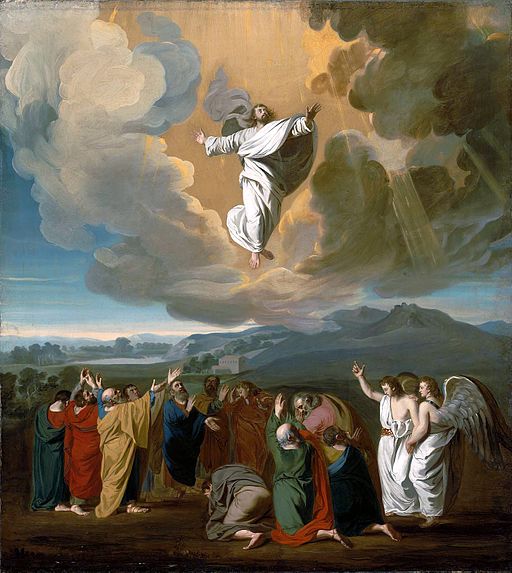
A. The Reality – Imagine the glory of this moment! Scripture says, As they were looking on, he was lifted up and cloud took him from their sight … they were looking intently in the sky as he was going (Acts 1:9). So impressive was the sight that the angels had to beckon them to get along to Jerusalem as the Lord had said, “Men of Galilee,” they said, “why do you stand here looking into the sky? This same Jesus, who has been taken from you into heaven, will come back in the same way you have seen him go into heaven” (Acts 1:11). Yes, it was glorious. Jesus had once said as a summons to faith, What if you were to see the Son of Man ascending to where he was before? (John 6:62) He had also encouraged them saying, Truly, truly, I say to you, you will see heaven opened, and the angels of God ascending and descending upon the Son of man (John 1:51). So here is a glorious reality and a fulfillment of what Jesus had said.

B.The Rescue – In the Ascension, it does not seem that the Lord entered Heaven alone. As we have remarked, in His mystical body we also ascend with Him. Consider this remarkable text that affirms that: Therefore it is said, When he ascended on high he led a host of captives, and he gave gifts to men. In saying, “He ascended,” what does it mean but that he had also descended into the lower parts of the earth? He who descended is he who also ascended far above all the heavens, that he might fill all things (Eph 4:8ff). Yes, the Lord had earlier (just after his death) descended to Sheol, awakened the dead, and preached the Gospel to them (cf 1 Peter 4:6). Now for those He had justified came the moment to ascend, with Jesus as a “host,” as an army of former captives now set free. Behold the great procession that enters behind Christ through the now-opened gates of Heaven: Adam and Eve, Noah, Abraham, Sarah, Isaac, Jacob, Rachel, Judith, Deborah, David, Samuel, Isaiah, Jeremiah, Ezekiel, Malachi, John the Baptist, … and, one day, you! Yes, this is a great rescue. Adam and his descendants have not simply been restored to some paradise-like garden; they have entered Heaven.

C.The Rejoicing – Consider how this once captive train sings exultantly as they follow Christ upward to Heaven. The liturgy today puts before us a likely song they sang: God mounts his throne to shouts of Joy! The Lord amid trumpet blasts. All you peoples clap your hands, shout to God with cries of gladness, for the Lord the most high, the awesome is the great king over all the earth. God reigns over the nations, God sits upon his holy throne (Psalm 47:6-7). I also have it on the best of authority that they were singing this old gospel song: “I’m so glad Jesus lifted me!” as well as this old Motown song: “Your love is lifting me higher than I’ve ever been lifted before!”

II. The Fellowship of the Ascension – We have already remarked that, when Christ ascends, we ascend. Why and how? Scripture says, Now you are the body of Christ and individually members of it (1 Cor 12:27). It also says, All of us who were baptized into Christ Jesus were baptized into his death. By baptism we were buried together with him so that just as Christ was raised from the dead by the glory of God the Father, we too might live a new and glorious life. For if we have been united with him by likeness to his death we shall be united with him by likeness to his resurrection (Rom 6:3ff). When Christ died, we died. When Christ rose, we rose. When He ascends, we ascend.

But, you may say, He is in glory while I am still here. How is it that I am ascended or ascending? Consider a humorous example using our physical bodies. When I get on an elevator and press the button for the top floor, the top of my head gets there before the soles of my feet, but the whole body will get there unless some strange loss of integrity or tragic dismemberment takes place. In an analogous way, so it is with Jesus’ mystical body. In Christ, our Head, we are already in glory. Some members of His Body have already gotten there. We who come later will get there too, provided we remain members of His Body. Yes, we are already ascended in Christ, our Head. We are already enthroned in glory with Him, if we hold fast and stay a member of His Body. This is the fellowship of the Ascension.

III. The Fruitfulness of the Ascension – Jesus does not return to Heaven to abandon us. He is more present to us than we are to ourselves. He is with us always to the end of the age (cf Matt 28:20). In ascending, without abandoning us, He goes to procure some very important things. Consider four of them:

A. Holy Ghost power – Jesus teaches very clearly that He is ascending in order to send us the Holy Spirit. Nevertheless, I tell you the truth: it is to your advantage that I go away, for if I do not go away, the Counselor will not come to you; but if I go, I will send him to you (Jn 16:7ff). He also says, These things I have spoken to you, while I am still with you. But the Counselor, the Holy Spirit, whom the Father will send in my name, he will teach you all things, and bring to your remembrance all that I have said to you (Jn 14:25ff). I still have many things to say to you, but you cannot bear them now. When the Spirit of truth comes, he will guide you into all the truth, for he will not speak on his own authority, but whatever he hears he will speak, and he will declare to you the things that are to come (Jn 16:13-14). So the Lord goes in order that with the Father, He might send the Holy Spirit to live within us as in a temple. In this way, and through the Eucharist, He will dwell with us even more intimately than when He walked this earth.

B. Harvest – Jesus says, And I, if I be lifted up from the earth, will draw all men unto me (John 12:32). While the immediate context of this verse is the crucifixion, the wonder of John’s gospel is that he often intends double meanings. Clearly Christ’s glorification is His crucifixion, but it also includes His resurrection and ascension. So, from His place in glory, Christ is drawing all people to Himself. He is also bestowing grace on us from His Father’s right hand to be His co-workers in the harvest: But you shall receive power when the Holy Spirit has come upon you; and you shall be my witnesses in Jerusalem and in all Judea and Samaria and to the end of the earth (Acts 1:8). Yes, from His place in glory, Christ is bringing in a great harvest. As He said in Scripture, Do you not say, “Four months more and then the harvest”? I tell you, open your eyes and look at the fields! They are ripe for harvest. Even now the reaper draws his wages, even now he harvests the crop for eternal life, so that the sower and the reaper may be glad together. Thus the saying “One sows and another reaps” is true. I sent you to reap what you have not worked for. Others have done the hard work, and you have reaped the benefits of their labor (Jn 4:35-38). Harvest! It is the Lord’s work from Heaven in which we participate.

C. Help – At the Father’s right hand, Jesus intercedes for us. Scripture says, Consequently he is able, for all time, to save those who draw near to God through him, since he lives always to make intercession for them (Heb 7:25). The Lord links his ascension to an unleashing of special power: Amen, amen, I say to you, he who believes in me will also do the works that I do; and greater works than these will he do, because I go to the Father. Whatever you ask in my name, I will do it, that the Father may be glorified in the Son (Jn 14:12).

We must not understand asking in the name of Jesus as a mere incantation, for to ask in His name means to ask in accord with His will. Yet we must come to experience the power of Jesus to draw us up to great and wondrous things in His sight. Despite the mystery of iniquity all about us, we trust that Christ is conquering, even in the puzzling and apparent victories of this world’s rebellion. In putting everything under him, God left nothing that is not subject to him. Though, at present we do not see everything subject to him, yet we see Jesus, who was made a little lower than the angels, now crowned with glory and honor … so that by his death he might destroy him who holds the power of death—that is, the devil—and free those who all their lives were held in slavery by their fear of death (Heb 2:8-9; 14-15). Thus, from Heaven we have the help of the Lord’s grace which, if we will accept it, is an ever-present help unto our salvation.

D. Habitation – Jesus indicates that in going to Heaven, He is preparing a place for us: In my Father’s house are many mansions: if it were not so, I would have told you. I go to prepare a place for you. And if I go and prepare a place for you, I will come again, and receive you unto myself; that where I am, there ye may be also (Jn 14:2ff). Yes, Jesus has the blueprints out and the hard hat on. He is overseeing the construction of a mansion for each of us that we may dwell with Him, the Father, and the Spirit forever.

Here, then, are the ways that Christ, by His love, is lifting us higher than we’ve ever been lifted before. Yes, love lifted me when nothing else could help; love lifted me.

Here’s a modernized version of the hymn:


Living the Lessons of Love – A Homily for the 6th Sunday of Easter

In the Gospel for today’s Mass, Jesus gives us three lessons on love meant to prepare us for the coming of the Holy Spirit at Pentecost. They also go a long way in describing the normal Christian life.

Too many Christians see the Faith more as a set of rules to keep than as a love that transforms—if we accept it. Let’s take a look at the revolutionary life of love and grace that the Lord is offering us in three stages: the power of love, the person of love, and the proof of love.

1.The Power of Love“If you love me, you will keep my commandments … Whoever has my commandments and observes them is the one who loves me.”

We must be very careful how we hear this, for it is possible to think that the Lord is saying, in effect, “If you love me, prove it by keeping my commandments.” This understanding reduces the Christian faith to a moral maxim: do good, avoid evil, and thus prove that you love God. Loving God, then, becomes a human achievement.

Understanding this text from the standpoint of grace, however, yields a different—and I would argue, more properunderstanding. Loving God is not a human work; it is the gift of God. The text should be read to say, in effect, “If you love me, then by this love I have given you, you will keep my commandments.” Thus, the keeping of the commandments is the fruit of the love, not the cause of it. Love comes first. When love is received and experienced, we begin, by the power of that love, to keep the commandments. Love is the power by which we keep the commandments.

It is possible to keep the commandments to some extent out of fear and by the power of the flesh, but obedience based on fear tends not to last and brings with it many resentments. Further, attempting to keep the commandments through our own power brings not only exhaustion and frustration, but also the prideful delusion that somehow we have placed God in our debt because we obey.

It is far better to keep the commandments by the grace of God’s love at work within us. Consider the following qualities of love:

A. Love is extravagant – The flesh is minimalist and asks, “Do I really have to do this?” Love, however, is extravagant and wants to do more than the minimum. Consider a young man who loves a young woman. It is unlikely that he would say, “Your birthday is coming soon and I must engage in the wearisome tradition of buying you a gift. So, what is the cheapest and quickest gift I can get you?” Of course he would not say this! Love does not ask questions like this. Love is extravagant; it goes beyond the minimal requirements and even lavishes gifts on the beloved, eagerly. Love has the power to overrule the selfishness of the flesh. No young man would say to his beloved, “What is the least amount of time I must spend with you?” Love doesn’t talk or think like this. Love wants to spend time with the beloved. Love has the power to transform our desires from our own selfish ends, toward the beloved.

While these examples might seem obvious, it is apparently not so obvious to many Christians, who say they love God but then ask such things as, “Do I have to go to church?” “Do I have to pray, and if so, how often and for how long? “Do I have to go to confession, and if so, how frequently? “What’s the least amount I can put in the collection plate or give to the poor in order to be in compliance?” Asking for guidelines may not be wrong, but too often the question amounts to a version of “What’s the least I can do?” or “What’s the bare minimum?”

Love is extravagant and excited to do and to give, to please the beloved. Love is its own answer, its own power.

B. Love Expands – When we really love someone we also learn to love whom and what he or she loves.

During high school, I dated a girl who liked square dancing. At first I thought it was hokey, but since she liked it, I started to like it. Over time, I even came to enjoy it a great deal. Love expanded my horizons.

I have lived, served, and loved in the Black community for most of my priesthood. In those years, I have come to love and respect gospel music and the spirituals. I have also come to respect and learn from the Black experience of spirituality, and have done extensive study on the history of the African-American experience. This is all because I love the people I serve. When you love people, you begin to love and appreciate what they do. Love expands our horizons.

What if we really begin to love God? The more His love takes root in us, the more we love the things and the people He loves. We begin to have God’s priorities. We start to love justice, mercy, chastity, and all the people He loves—even our enemies. Love expands our hearts.

The saints say, “If God wants it, I want it. If God doesn’t want it, I don’t want it.” Too many Christians say, “How come I can’t have it? It’s not so bad. Besides, everyone else is doing it.” Love does not speak this way.

As God’s love grows in us it has the power to change our hearts, minds, desires, and vision. The more we love God, the more we love His commands and share the vision He offers for our lives. Love expands our hearts and minds.

C. Love excites – Imagine again a young man who loves a young woman. Now suppose she asks him to drive her to work one day because her car is in the shop. He does this gladly and sees it as an opportunity to be with her and to help her. He is excited to do so and is glad that she asked. This is true even if he has to go miles out of his way. Love stirs us to fulfill the wishes and desires of the beloved.

In the first Letter of John we read, “For this is the love of God, that we keep his commandments. And his commandments are not burdensome” (1 John 5:3). Yes, love lightens every load. As we grow in love for God, we are excited to please Him. We keep His commandments, not because we have to, but because we want to. Even if His commandments involve significant changes, we do it with the same kind of gladness that fills a young man who drives miles out of his way to take his beloved to work. Love excites in us a desire to keep God’s law, to fulfill His wishes for us.

2.The Person of Love “And I will ask the Father, and he will give you another Advocate to be with you always, the Spirit of truth, whom the world cannot accept, because it neither sees nor knows him. But you know him, because he remains with you, and will be in you.”

In this text, Jesus tells us that the power to change us is not an impersonal power like “The Force” in Star Wars. Rather, what changes us is not a “what” at all but a “who.” The Third Person of the Blessed Trinity, living in us as in a temple, will change us and stir us to love. He who is Love will love God in us. Love is not our work; it is the work of God. “We love, because He first loved us” (1 John 4:10). God the Holy Spirit enables us to love God the Father and God the Son, and this love is the power in us that equips, empowers, and enables us to keep God’s law. He, the Holy Spirit, is the one who enables us to love extravagantly and in a way that expands and excites.

The Lord says that He, the Holy Spirit, remains in us. Are you aware of His presence? Too often our minds and hearts are dulled and distracted by the world and we are unaware of the power of love available to us. The Holy Spirit of Jesus and the Father is gentle and awaits the open doors we provide (cf Rev 3:20). As we open them, a power from His Person becomes more and more available to us and we see our lives being transformed. We keep the commandments; we become more loving, confident, joyful, chaste, forgiving, merciful, and holy. I am a witness! Are you?

3.The Proof of God’s Love“I will not leave you orphans; I will come to you. In a little while the world will no longer see me, but you will see me, because I live and you will live. On that day you will realize that I am in my Father and you are in me and I in you.”

The key phrases here are “You will live” and “You will realize,” for the Lord says that He will not leave us as orphans, that He will come to us and remain with us.

How do you know that these are more than just slogans? Simply put, you and I know this because of the new life we are receiving, which causes us to realize that Jesus lives, is in the Father, and is in us.

To “know” in the Bible is more than intellectual knowing. To “know” in the Bible is to “have intimate and personal experience of the thing or person known.” I know Jesus is alive and in me through His Holy Spirit because I am experiencing my life changing. I am seeing sins put to death and graces coming alive! I am a new creation in Christ (2 Cor 5:17). This is what Jesus means when He says, “You will realize that I am in the Father and in you.” To “realize” means to experience something as real.

I am proof of God’s love and its power to transform, my life is proof! In the laboratory of my own life I have tested God’s word and His promises, and I can report to you that they are true. I have come to experience as real (i.e., “realized”) that Jesus lives, that through His Holy Spirit I have a power available to me to keep the commandments and to embrace the new life, the new creation they both describe and offer to me.

I am a witness; are you?

This song says, “He changed my life and now I’m free …”


Are You Smarter than a Sheep?

The Fourth Sunday of Easter is traditionally called Good Shepherd Sunday, for the readings focus on how our risen Lord Jesus is our shepherd, who leads us to eternal life. Of course the flip side is that we are sheep. We sometimes miss the humor of the Lord calling us sheep. He could have said we are strong and swift as horses, beautiful as gazelles, or brave as lions; instead, He said we are like sheep. I guess I’ve been called worse, but it’s a little humbling and embarrassing, really. Yet sheep are worthwhile animals and they have a certain quality that makes them pretty smart. Are you smarter than a sheep? Well, let’s look and see how we stack up as we look at this Gospel in three stages.

I. The Situation of the Sheep In this Gospel the Lord is speaking to Pharisees and almost trying to reassure them that He is not like other false shepherds, false messiahs who have led many astray. Jesus says, Amen, amen, I say to you, whoever does not enter a sheepfold through the gate but climbs over elsewhere is a thief and a robber. … All who came before me are thieves and robbers, but the sheep did not listen to them … A thief comes only to steal and slaughter and destroy.

The times in which Jesus lived were ones of social unrest and political turmoil. There were heightened expectations of a coming messiah who would liberate Israel from its Roman and Herodian oppressors. Given the climate of the times, most had emphasized the role of the messiah as a political and economic liberator who would come and wage war and victoriously reestablish the Davidic Monarchy in all its worldly glory.

Josephus, a Jewish historian of the time, may have exaggerated (but only a little) when he spoke of 10,000 insurrections in the years leading up to the Jewish War with the Romans (66 – 70 A.D.). Even as early as Jesus’ lifetime there had been conflicts and bloody uprisings led by numerous false messiahs. It is most likely these whom Jesus refers to as thieves and robbers. It is also likely why Jesus resisted being called Messiah except in very specific circumstances (Matt 16:16,20; Mk 8:30; Mk 14:62).

Jesus also warned that after He ascended, false messiahs would continue to plague the land:

For false Christs and false prophets will appear and perform great signs and miracles to deceive even the elect—if that were possible. See, I have told you ahead of time. “So if anyone tells you, ‘There he is, out in the desert,’ do not go out; or, ‘Here he is, in the inner rooms,’ do not believe it’” (Matt 24:24-26).

Ultimately these false Christs did arise and mislead many; the results were horrible. Josephus wrote that 1.2 million Jewish people lost their lives in the Jewish War with the Romans.

So this is the situation of the sheep. Jesus speaks of the dangers of false saviors, unambiguously denouncing them as thieves and robbers. We, too, are in a world in which erroneous philosophies and false messiahs seek to claim our loyalties and engage us in error.

Perhaps it is the false claims of materialism, which says the right combination of wealth and power can bring meaning and happiness. Sadly, many of the “prosperity Gospel” preachers compound this by their silence about the cross and sin.

Perhaps it is the error of secularism, which exalts the State and the culture, putting their importance above God. Many in the Church and in the Protestant denominations (both clergy and lay) follow false shepherds and call others to do so. They seek to more closely align their faith with politics, instead of their politics with faith; they show more allegiance to the “party” than to the Faith; they do not prophetically address the errors associated with their political point of view; they see their political leaders as shepherds than they do their bishops or priests. Many also follow the false shepherds of culture, looking to them for moral leadership rather than to God, the Scriptures, or the Church. If Miley Cyrus says it, it must be so, but if the Church says something, there are protests and anger. Yes, false messiahs are all around us in the secular culture. Sadly, many Catholics and Christians follow them like sheep to the slaughter.

Perhaps it is the arrogance of modern times, which claims a special enlightenment over previous eras (such as the biblical era), which were “less enlightened and tolerant.” Here, too, many false shepherds in the clothing of trendy preachers and theologians have sought to engage God’s people in this sort of arrogance: that we moderns have “come of age” and may safely ignore the wisdom of the past in the Scriptures and sacred Tradition.

Perhaps it is the promiscuity of this age, which claims sexual liberty for itself but never counts the cost in broken lives, broken families, STDs, AIDS, high divorce rates, teenage pregnancy, abortion, and so on. Sadly, many so-called preachers and supposedly Christian denominations now bless homosexual unions and ordain clergy who are practicing the homosexual “lifestyle.” Many also support abortion and contraception, while saying little or nothing about premarital sex.

Yes, the sheep are still afflicted; false philosophies and messiahs abound. Jesus calls them thieves and marauders (robbers) because they want to steal from us what the Lord has given and harm us by leading us astray. Their wish is ultimately to slaughter and destroy.

Do not be misled by the soft focus of these wolves in sheep’s clothing, with their message of “tolerance” and humanitarian concern. A simple look at the death toll in the 20th century from such ideologies shows the wolf lurking behind these foolish and evil trends that have misled the flock.

As to these false shepherds, remember that not one of them ever died for you; only Jesus did that.

II. The Shepherd and His Sheep – Having rejected false shepherds, Jesus now goes on to describe Himself as the true Shepherd:

But whoever enters through the gate is the shepherd of the sheep. The gatekeeper opens it for him, and the sheep hear his voice, as the shepherd calls his own sheep by name and leads them out. When he has driven out all his own, he walks ahead of them, and the sheep follow him, because they recognize his voice. But they will not follow a stranger; they will run away from him, because they do not recognize the voice of strangers.

This passage tells us not only of the true Shepherd, but also his true sheep. The true Shepherd is sent by the Father, who is the gatekeeper and has opened the way for the Son and true Shepherd. The Father has confirmed the Son by signs and wonders and by the fulfillment of prophesies in abundance.

Of the true sheep, the Lord says that they not only recognize His voice, but also that they will run from a stranger because they do not recognize his voice.

In shepherding areas, flocks belonging to different shepherds are often brought together in fenced-off areas for the night, especially during the cooler months. One may wonder how shepherds can tell which sheep belong to which shepherd. Ultimately the sheep sort themselves out. In the morning a shepherd will go to the gate and summon his sheep with a chant-like like call. Those that recognize his voice will run to him; those that do not will recoil in fear. Now that’s pretty smart, actually. Sheep may not know how to go to the moon and back, but they do know their master’s voice.

So the question for each of us is this: are you smarter than a sheep? Sheep have the remarkable ability to know their master’s voice and instinctively fear any other voice, fleeing from it.

In this way, it would seem that sheep are smarter than most of us are! We do not flee voices contrary to Christ; instead, we draw close and say, “Tell me more.” In fact, we spend a lot of time and money to listen to other voices. We spend buy big televisions so that the enemy’s voice can influence us and our children. We spend a lot of time watching television, listening to the radio, and surfing the Internet. We are drawn so easily to the enemy’s voice.

Not only do we not flee it, we feast on it. Instead of rebuking it, we rebuke the voice of God. We put His Word on trial instead of putting the world on trial.

The goal for us is to be more wary, like sheep, to recognize only one voice, that of the Lord speaking though His Church, fleeing every other voice.

III. The Salvation of the Sheep – The text says, Amen, amen, I say to you, I am the gate for the sheep. I am the gate. Whoever enters through me will be saved, and will come in and go out and find pasture. … I came so that they might have life and have it more abundantly.

Here, then, is the description of the Christian life: acceptance, access, and abundance.

Acceptance – The text says that we must enter through the gate, and the gate is Christ. We are invited to accept the offer of being baptized into Christ Jesus. In today’s first reading from Acts, Peter and the other apostles are asked by the repentant and chastened crowd, “What are we to do, my brothers?” Peter said to them, “Repent and be baptized, every one of you, in the name of Jesus Christ for the forgiveness of your sins; and you will receive the gift of the Holy Spirit …. “Save yourselves from this corrupt generation.” Those who accepted his message were baptized, and about three thousand persons were added that day. Yes, we are invited to enter through the gate, to be baptized into Christ Jesus. He is the gate and the way to the Father.

Access – In accepting baptism, we enter through the gate and have access to the wide, green pastures. Jesus describes this entry as “being saved.” Most of us tend to think of salvation rather abstractly, as if it is the result of a legal process through which one goes from being guilty to having the charges dismissed. That, however, is only a very partial understanding of salvation. The Greek word σωθήσεται (sothesetai) more fully means to be safe, rescued, delivered out of danger and into safety. In the New Testament it is used principally of God rescuing believers from the penalty and power of sin—bringing them into his into His safety and grace. Being saved is much more than changing legal categories; it is new life! It is power over sin; it is being kept from the poison of sin and its terrible enslaving effects. Salvation is also related to the concept of health (salus = health and well being). For the believer who accepts Christ’s offer, there is access to the protected pasture; there is supply or provision of grazing land as well. The Lord feeds His faithful and brings them strength. Yes, there is access to God’s many gifts.

Abundance – The Lord concludes by saying that He came so that we might have life more abundantly. This is the fundamental purpose of all he did. Abundant life is really what is meant by eternal life. Eternal does not refer merely to the length of life, but even more so its fullness. And while we will not enjoy this fully until Heaven, it does begin now. We, through Christ our good shepherd, gradually become more fully alive. I am more than fifty years old and my body in some physical sense is less alive, but my soul is more alive than ever! I have more joy, more confidence, more peace, and more contentment. There are many sins with which I now struggle less. I have a greater capacity to love and to forgive. The Lord has granted this by giving me access to His grace and His pasture, and feeding me there. I am more abundantly alive today than I ever was in my twenties. Yes, the Lord came that we might have life more abundantly; I am a witness of this. Eternal life has already begun in me and is growing day by day.

So, are you smarter than a sheep? If you are, then run to Jesus. Flee every other voice. Enter the sheepfold and let Him give you life.

Here is a portion of a performance of Handel’s Pastoral Symphony of the Messiah:

Just a Little Talk with Jesus Makes It Right – A Homily for the Third Sunday of Lent

As we examine the Gospel for this weekend’s Mass we do well to understand that is about human desires and how the Lord reaches us through them. Prior to examining the text in detail, let’s consider a few things:

  1. What it is that really makes you happy? We desire so many things: food, water, shelter, clothing, and creature comforts. We long for affection, peace, and a sense of belonging. Sometimes we want stability and simplicity, at others we yearn for change and variety. Our hearts are a sea of desires, wishes, and longings. Today’s Gospel says that a woman went to the well to draw water. She represents each one of us and her desire for water is symbolic of all our desires.
  2. In reality, your desires are infinite. Can you remember a time when you were ever entirely satisfied, when you wanted absolutely nothing else? Even if you can recall such a time, I’ll bet it didn’t last long. That is because our desires are without limit.
  3. The well in today’s Gospel symbolizes this world. Jesus says to the woman, Everyone who drinks of this water will thirst again. The world cannot provide what we are really looking for. No matter how much it offers us, it will never suffice, for the world is finite while our desires are infinite. In this way our heart teaches us something very important about ourselves: We were not made for this world; we were made for something, someone, who is infinite, who alone can satisfy us. We were made for God.
  4. The water offered is the Holy Spirit. Jesus said elsewhere, “If any one thirst, let him come to me and drink. He who believes in me, as the scripture has said, ‘Out of his heart shall flow rivers of living water.’” Now this he said about the Spirit, which those who believed in him were to receive (Jn. 7:37-39).
  5. The Catechism of the Catholic Church has this to say about the meanings of our longings:

The desire for God is written in the human heart, because man is created by God and for God; and God never ceases to draw man to himself. Only in God will he find the truth and happiness he never stops searching for. … With his longings for the infinite and for happiness, man questions himself about God’s existence. In all this he discerns signs of his spiritual soul. The soul, the seed of eternity we bear in ourselves, irreducible to the merely material, can have its origin only in God (Catechism # 27, 33).

  1. Scripture speaks to us about our desires: Of You my heart has spoken: “Seek His face.” It is your face O Lord that I seek; hide not your face! (Psalm 27:8-9). Only in God will my soul be at rest, he is my hope, my salvation (Psalm 62:1).
  2. Augustine wrote these classic words to describe our truest longing: “Thou hast made us for Thyself, O Lord, and our hearts are restless till they rest in Thee” (Confessions 1,1).

With these in mind, let’s look at the journey that this woman makes to Jesus. Things start out rough, but in the end she discovers her heart’s truest desire. The journey is made in stages.

Rendezvous – Notice that Jesus is the one who takes the initiative here. As the Lord teaches elsewhere, It was not you who chose me, It was I who chose you (John 15:16). Jesus encounters a woman from Samaria at Jacob’s well. She desires water, but Jesus knows that her desire is for far more than water or in fact anything that the world gives. Her desire has brought her face to face with Jesus. It is a holy and fortunate rendezvous. Jesus begins a discussion with her about her heart’s truest longing.

Request – The discussion begins with a request. The text says, It was about noon. A woman of Samaria came to draw water. Jesus said to her, “Give me a drink.” Imagine, God asking you for anything; what a stunning thing! What can she or anyone really give God? The answer is simply this: the gift of our very self. God has put a threshold before our heart that even He will not cross unless we first say yes to Him. Jesus’ request initiates a discussion, a dialogue of two hearts. As we shall see, the woman struggles with this dialogue. To be sure, it is a delicate, even painful process for us to accept the Lord’s invitation to self-giving. Something within us makes us draw back in fear. Scripture says, It is an awesome thing to fall into the hands of living God (Heb 10:31).

Rebuke – Sure enough, she draws back with fear and anger. She says, “How can you, a Jew, ask me, a Samaritan woman, for a drink?”—For Jews use nothing in common with Samaritans. In our journey to God, we do not always trust or understand Him at first. Some are afraid to relate to God because they think they will lose their freedom or that they will have to change too much. Others loathe the commandments or fear that they cannot keep them. Still others are angry at the unexpected twists and turns of life and do not want to trust a God who doesn’t always give them what they want. The woman’s anger is not really at Jesus; it is at “the Jews,” with whom the Samaritans have a hostile relationship. This is sometimes the case with God as well. It is not always the Lord Jesus, or God the Father, whom people hate or distrust; rather, it is Christians. Some have been hurt by the Church or by Christians; others have prejudiced opinions influenced by a hostile media and world.

Repetition – Jesus repeats His offer for a relationship. He says, “If you knew the gift of God and who is saying to you, ‘Give me a drink,’ you would have asked him and he would have given you living water.” I don’t know about you, but I am mighty glad that the Lord does not merely write us off when we say no to Him. Jesus stays in the conversation and even sweetens the deal by making an offer to give her fresh, living water. The Lord does the same for us. First He gave the Law, then He gave the prophets; now He gives His Son. It just keeps getting better. First He gave water, then He changed it to wine, and then He changed it to His blood. Despite our often harsh rejection of God, He keeps the dialogue going.

Ridicule – The woman is still hostile and now even ridicules Jesus: “Sir, you do not even have a bucket and the cistern is deep; where then can you get this living water? Are you greater than our father Jacob, who gave us this cistern and drank from it himself with his children and his flocks?” To the world, the teachings of God often appear to be foolishness. People often dismiss religious faith as fanciful and unrealistic.

Reminder – Jesus now re-frames the question by reminding the woman of the obvious: Everyone who drinks this water will be thirsty again. What she is relying on can’t come through for her. The world’s water does not satisfy us; the world’s delights are transitory. They promise ultimate satisfaction, but soon we are thirsty again. The world is the gift that keeps on taking; it takes our money, loyalty, freedom, and time, while giving us only temporary—and ultimately unsatisfying pleasures—in return. It’s a bad deal. Every one who drinks from this well be thirsty again.

Re-upping the offer – Jesus says, “… but whoever drinks the water I shall give will never thirst; the water I shall give will become in him a spring of water welling up to eternal life.” Here the Lord speaks of happiness and satisfaction that he will give, that grows in us and makes us more and more alive. The “water” he offers (as noted above) is the gift of the Holy Spirit. As the Holy Spirit lives in us and transforms us, we become more and more content with what we have. As the life of God grows in us, we become more alive in God and joyful in what He is doing for us. This is what the Lord offers us: the gift of a new and transformed life, the gift to become fully alive in God. I am a witness of this. How about you?

Result – The woman has moved toward Jesus; she has warmed to His offer. She says, “Sir, give me this water, so that I may not be thirsty or have to keep coming here to draw water.” Here is the result of the Lord’s persistence. Thank God that He does not give up on us. He keeps calling, even when we say no, even when we sin; He just keeps call our name!

Requirement – Jesus wants to give this gift, but first He must help her to make room for it. For the truth is that she has unrepented sin. A cup that is filled with sand cannot be filled with water. The sand must first be emptied out and then the cup cleansed. Thus Jesus says, “Go call your husband and come back.” The woman answered and said to him, “I do not have a husband.” Jesus answered her, “You are right in saying, ‘I do not have a husband.’ For you have had five husbands, and the one you have now is not your husband. What you have said is true.” Now she does what most of us do when we are in an uncomfortable spot: she changes the subject. She attempts to engage in a discussion about where to worship. Jesus is patient and answers her, but ultimately draws her back to the subject at hand: her heart and what her desires are really all about.

Reconciliation – At this point the conversation gets private; we are not permitted to listen in. It is just between her and Jesus. But whatever it was, she is elated and will later declare, “He told me everything I ever did.” There is no sense in her tone that Jesus was merely accusatory. Rather, it would seem that Jesus helped her to understand her heart and her struggle. An old song says, “I once was lost in sin but Jesus took me in and then a little light from heaven filled my soul. He bathed my heart in love and he wrote my name above and just a little talk with Jesus made me whole.” Here, Jesus reconciles her with God and with her own self.

RejoicingThe woman left her water jar and went into the town and said to the people, “Come see a man who told me everything I have done. Could he possibly be the Christ?” They went out of the town and came to him.” Do not miss that little detail: she left her water jar. She left behind the very thing she was depending on to collect the things of the world. What is your “water jar”? What do you use to gain access to the world and to collect its offerings? For most of us, it is money. Scripture says, For the love of money is a root of all kinds of evil. Some people, eager for money, have wandered from the faith and pierced themselves with many griefs (1 Tim 6:10). At any rate, the woman is joyfully empowered to leave this enslaving water jar behind. Freed from its load, she is able to run to town and declare Jesus to others. Her joy must have been infectious, for soon enough they are following her out to meet the Lord!

This is the journey of a woman who represents each one of us. This is our journey, out of dependence, out of an enslaving attachment to the world. It is our journey unto Jesus, who alone can set us free. Here is our journey to understand that our desires are ultimately about God.

You can listen to this homily here: Just a Little Talk With Jesus.

I have it on the best of authority that as the woman joyfully journeyed back to town, she was singing this gospel song:

Triumph in Temptation – A Homily for the First Sunday of Lent

The Gospel today says that Jesus was tempted by the devil in the desert. Hebrews 4:15 also affirms, For we do not have a high priest who cannot sympathize with our weaknesses, but one who has been tempted in all things as we are, yet without sin.

How exactly a divine person, with a sinless human nature, experiences temptation is somewhat mysterious, and yet the text affirms that He does. A Lenten antiphon from the Breviary teaches that He did this, or allowed this, for our sake: Come, let us worship Christ the Lord, who for our sake endured temptation and suffering (Invitatory Antiphon for Lent). Hence, even without pondering too deeply the mystery of how He was tempted or experienced it, we can still learn what Jesus teaches us about how to endure temptation and be victorious over it. (More on the question of how Christ was tempted is available here.)

Before we look at each temptation, we might learn a few general aspects of what the Lord teaches us in electing to endure temptation.

  1. Temptation and Sin – The fact that the Lord is tempted yet did not sin tells us that there is a distinction to be made between temptation and sin. Too often the very experience of temptation makes us feel sinful, as if we have already sinned, but that is not necessarily the case. Jesus, who never sinned, experienced temptation. Therefore, experiencing temptation is not to be equated with sin. One of the tactics of the devil is to discourage us into thinking that way. Some of our past sins may influence the degree to which we feel tempted, but we need not conclude that we have already sinned, or newly sinned, merely because we are tempted. Rather than to feel shame and run from God, we ought to run to Him with confidence and seek his Help.
  2. Temptation and Scripture – Notice that Jesus responds to every temptation with Scripture. This is not to be equated with proof-texting or pronouncing biblical slogans. Rather, it indicates that Jesus was deeply rooted in Scripture, in the wisdom of the Biblical vision. In rebuking temptation in this way, Jesus is teaching us to do the same. It will not be enough for us to know a few biblical sayings, but to the degree that we are deeply rooted in the wisdom of God’s truth available to us through Scripture and the teachings of the Church, we are able to strongly rebuke unholy, worldly, or fleshly thinking. Half the battle in defeating temptation is knowing instinctively its erroneous vision. Having our minds transformed by the teachings of Scripture and the Church is essential in fighting temptation. Scripture says, Do not be conformed to this world, but be transformed by the renewal of your mind, that by testing you may discern what is the will of God, what is good and acceptable and perfect (Romans 12:2). Ephesian 6:17 speaks of the Word of God as the sword of the Spirit, with which we are properly armed for spiritual warfare. Thus, we are taught here by the Lord to be deeply rooted in His Word.
  3. Temptation and Strength – Jesus is tempted three times, after which the devil leaves Him. In a certain way, the spiritual life is like the physical life, in that we grow stronger through repeated action. After lifting weights repeatedly, our physical strength increases and we are able to overcome increasingly difficult challenges. It is the same with the spiritual life. An old gospel song says, “Yield not to temptation, for yielding is sin. Each victory will help you, some other to win.” Scripture says, Resist the devil and he will flee (James 4:7). We need not conclude from this that Jesus needed to be strengthened (He did not) in order to understand that He is still teaching us what we need to do. The battle against temptation is not a “one and you’re done” scenario, but an ongoing battle in which each victory makes us stronger and the devil more discouraged. As we grow stronger, the devil eventually stops wasting his time tempting us in certain areas. At times the battle may weary us, but in the long run, it strengthens us. Jesus illustrates this with his three-fold battle with Satan.

Having review a few general principles, let’s look at the three temptation scenes.

Scene I: The Temptation of PassionsAt that time Jesus was led by the Spirit into the desert to be tempted by the devil. He fasted for forty days and forty nights, and afterwards he was hungry. The tempter approached and said to him, “If you are the Son of God, command that these stones become loaves of bread.” He said in reply, “It is written: One does not live on bread alone, but on every word that comes forth from the mouth of God.”

Hunger, as a desire, is a passion. It is not evil per se, for without it we would perish. The same is true of other natural desires for things like life, drink, and procreation (sexuality). We have other sorts of passions such as anger, love, joy, aversion, hatred, hope, despair, fear, and courage. Of themselves, these passions are neither good nor bad. Passions become bad only in relation to their object or insofar as we allow them to become inordinate.

Hence there is nothing wrong with Jesus as He experiences hunger. What the devil tries to do is to draw Jesus into the sin of yielding to His hunger and using His power inappropriately. Remember, Jesus had been led into the desert by the Spirit in order to fast and pray. This is His call. His hunger is real and without sin, but now He is tempted to set aside His call and to yield to His hunger in an inappropriate way, by rejecting his call to fast. Jesus is tempted to serve Himself. He obviously has the power to turn stones into bread, so a second temptation is to use His power inappropriately, to gratify and serve Himself rather than to glorify His Father.

What about us? We have passions, too. They are not wrong in themselves, but we can allow them to become inordinate or gratify them in unlawful ways. Remember that we, like Jesus, are called to fast. Our fast is from things like sin, injustice, unrighteousness, sexual impurity, unlawful pleasures, and excessive indulgence. We have it have it in our power to choose to reject our fast and to gratify our desires by rejecting our call to serve God. The devil tempts us to reject our call and to use our power to gratify our passions by lying, cheating, stealing, venting our anger, fornicating, and being gluttonous or greedy.

Jesus has recourse to God’s Word: Man does not live on bread alone, but on every Word that comes from the mouth of God. Jesus tells Satan that He would rather live and be sustained by the Word than by food; His food is doing the will of His Father.

What about us? Can we say, Neither have I gone back from the commandment of his lips; I have esteemed the words of his mouth more than my necessary food (Job 23:12)? Can we say that God’s Word is more important to us than my desires for satisfaction, sex, self-preservation, popularity, worldly joys, power, prestige, or possessions? Can we say that our strongest desire is for God and the things awaiting us in Heaven and that we will gladly forsake everything for it?

Scene II. The Temptation of PresumptionThen the devil took him to the holy city, and made him stand on the parapet of the temple, and said to him, “If you are the Son of God, throw yourself down. For it is written: He will command his angels concerning you and with their hands they will support you, lest you dash your foot against a stone.” Jesus answered him, “Again it is written, You shall not put the Lord, your God, to the test.”

It is important to trust God, but this is not an invitation to act recklessly. There will come a time when Jesus will throw himself down on the cross with the complete assurance that the Father will raise Him. He has this command from His Father. But now is not that time and Jesus must act to preserve and protect His life so that he can accomplish His full mission.

Presumption is a terrible problem today. Too many people think that they can go on sinning and that there will be, or should be, no consequences. This is true in both worldly and spiritual ways. Too many engage in risky and ruinous behavior and think, “I’ll be OK. I’ll escape. I won’t be a statistic. I won’t get caught. I won’t lose my job.” Many think, “I can use drugs without becoming addicted. I can have evil friends and still stay good and live morally. I can skip school and still get good grades. I can be promiscuous and won’t get a disease or become pregnant. I can drive recklessly and won’t have an accident. I can be disrespectful and still command respect.” In all this people are simply “cruisin’ for a bruisin’.”

Regarding the moral presumptiveness of thinking that no matter what we do, Heaven will still be the result, the Lord warns,

  1. Say not I have sinned, yet what has befallen me? For the Lord bides his time. But of forgiveness be not overconfident adding sin upon sin. … Delay not your conversion to the Lord, put it not off from day to day for mercy and justice are alike with him (Sirach 5:4).
  2. Do not be deceived; God is not mocked, for whatever a man sows, that he will also reap. For he who sows to his own flesh will from the flesh reap corruption; but he who sows to the Spirit will from the Spirit reap eternal life. And let us not grow weary in well‑doing, for in due season we shall reap, if we do not lose heart (Gal 6:7).
  3. For they have sown the wind, and they shall reap the whirlwind. (Hosea 8:7).
  4. But my people would not listen to me; Israel would not submit to me. So I gave them over to their stubborn hearts to follow their own devices. If my people would but listen to me, if Israel would follow my ways, how quickly would I subdue their enemies and turn my hand against their foes! (Psalm 81:11)

God clearly warns us that sin sets us on a path that hardens our heart and makes our final conversion increasingly unlikely. In this Lenten season, He is pleading with us to be serious about sin and its consequences. Sin renders us not only unfit for Heaven, but incapable of entering it.

A bad idea – Presuming that everything will be fine is not only a poor strategy, it is a snare of the devil, who seeks to cloud our mind with false hope and unreasonable expectations. Jesus has a very clear message for the devil and for any of us who would engage in presumption: Don’t you dare put the Lord your God to the test in this way. Obey Him out of love, but do not put Him to the test. Yes, presumption is a very foolish idea.

Scene III. The Temptation of Possessions Then the devil took him up to a very high mountain, and showed him all the kingdoms of the world in their magnificence, and he said to him, “All these I shall give to you, if you will prostrate yourself and worship me.” At this, Jesus said to him, “Get away, Satan! It is written: The Lord, your God, shall you worship and him alone shall you serve.”

Here is the obvious temptation of worldly possessions. Everything, everything, is offered to Jesus in exchange for a little worship of the devil. Tt may seem strange to us that having an abundance of things would be linked to worshiping the devil and forsaking God, but Scripture attests to this connection elsewhere:

  1. Adulterous people! Do you not know that friendship with the world is hatred toward God? Whoever therefore wants to be a friend of the world makes himself an enemy of God (James 4:4).
  2. Do not love the world or anything in the world. If anyone loves the world, the love of the Father is not in him (1 John 2:15).
  3. No one can serve two masters. Either he will hate the one and love the other, or he will be devoted to the one and despise the other. You cannot serve both God and Money (Matt 6:24).

This is all pretty blunt. We want to have both, but the Lord is clear in rebuking this temptation by insisting that we must serve God alone, adore God alone. The inordinate love of this world causes us to hate God more and more and to bow before Satan in order to get it. Don’t kid yourself. If this position seems extreme to you then you are calling God an extremist. The Lord is warning us that there is a major conflict here that steals our heart. For where a man’s treasure is, there is his heart (Matt 6:21). It is not wrong to desire what we really need to live, but our wants get us into trouble. The desire for riches ruins us and makes God seem as a thief rather than a savior. This is a very severe temptation and Jesus rebukes it forcefully. Him along shall you serve.

We need to beg God for single-hearted devotion to him. The Book of Proverbs has a nice prayer in this regard: Give me neither poverty nor riches, lest in my poverty I steal or in my riches I say “Who is the Lord?” (Prov 30:8-9, gloss)

In the end, temptations are real; we either accept God’s grace to fight them or we are going down. The Lord wants to teach us today about the reality of temptation and how to fight it, by His grace. Remember, the battle is the Lord’s and no weapon waged against us will prosper if we cling to His grace. In the end, the choice is clear: either tackle temptation (by God’s grace) or risk ruination (by Satan’s “ministrations”).

This song says,

“Yield not to temptation, for yielding is sin. Each victory will help you, some other to win. Fight valiantly onward. Evil passions subdue. Look ever to Jesus, He will carry you through. Ask the Savior to help you, comfort strengthen and keep you; He is willing to aid you, He will carry you through.”

Advice from the Lord in Overcoming Anxiety – A Sermon for the 8th Sunday of the Year

When we read today’s Gospel (from the Sermon on the Mount) we must be careful not to misinterpret its basic vision. Jesus is not telling us what to do, but rather is offering us something to receive. The wrong way to interpret this Gospel is to think that Jesus is just saying, “Stop worrying.” We all get this advice from people every day and it isn’t very helpful. This is not what Jesus is saying, for remember that in the Sermon on the Mount He is describing the transformed human person. What He is teaching us here is that as He begins to live His life in us, many of our anxieties will diminish and go away.

The transformed human person trusts God and is able to see God’s hand even in the difficulties of life. It is this trust growing in us by God’s grace that diminishes and ultimately removes fear. Trust God and fear lessens. This is the gift that Jesus offers in this Gospel.

We can distinguish three particular aspects of anxiety that Jesus sets forth: possessions, paternity, and priority. Let’s examine each and see how the Lord wants to free us from them.

I The Problem of Possessions – The text says, No one can serve two masters. He will either hate one and love the other, or be devoted to one and despise the other. You cannot serve God and mammon. Mammon is variously understood as riches, greed, or possessions. In an extended sense it can refer to the agenda of the world, which is focused essentially on material things, and which ties our dignity to only those things.

Whose slave are you? The Lord is clear that we cannot serve mammon if we wish to serve Him. The Greek word translated here as “serve” is δουλεύειν (douleuein), which more specifically means to “serve as a slave.” We miss the strength of the text when we fail to notice the slavery aspect. It may happen in our culture that one works at a job, yet after work hours goes home and is free from obligations. Hence we tend to believe that we can serve both God and mammon. But the Greek word used here describes a slave, not a servant. A slave is wholly given over to the will of his master. The Greek word is thus more intense than the English translation.

The Lord is saying, “You’re either going to be a slave of the Lord or a slave of the world.” The honest truth is that most people are slaves of the world, of mammon; slaves to riches, greed, and the agendas associated with them. These worldly things tend to completely consume us so that when we hear of some demand from God, we feel overwhelmed—even angry—that something “more” is required of us. Our anger at God is a sign that we are slaves to mammon.

We are usually too proud to admit that we are slaves of the world, but most of us are, to a large extent. The world and its demands press on us, taking up nearly all the oxygen in our life. It is this terrible slavery that is a huge source of our anxiety and from which the Lord offers to free us. The Lord describes the anxieties that flow from slavery to mammon; to the world, its riches, and its agenda:

I tell you, do not worry about your life, what you will eat or drink, or about your body, what you will wear …. Why are you anxious about clothes? Do not worry and say, “What are we to eat?” or “What are we to drink?” or “What are we to wear?”

Still anxious! For us who live in the Western world, the anxiety about merely having such things has receded a bit. In general, we are well-supplied and may not worry about whether we will have clothes or food. But even though we have them in abundance, still we worry about them obsessively. For example, we may worry about whether we have the right clothes, if they are fashionable, if they look good on us. We worry about whether we have too much fat or salt in our diet. Many people are obsessed with what they eat. We have never lived so long and been so healthy, yet we have never been more anxious about our health! We have plenty of food and still we worry about it! Worry, worry, worry. Anxiety about these things is a sign that we are slaves to them. Scripture says, but as for the rich, their abundance permits them no sleep (Eccles 5:12).

The Lord offers to live His life in us so that we will not be slaves to mammon, but rather slaves to Him. We may not like the image of slavery, but I have news for you: we are so small and powerless that we are going to be slaves of someone; it might as well be the Lord! Being wholly devoted to the Lord and what pleases Him breaks our obsession with the world, money, possessions, popularity, and fashion.

As the Lord’s life and His will begin to replace our own life and will, our obsession with the world’s demands diminishes and its power over us is broken. As we grow into a deeper relationship with the Lord, our ties with the world and concerns about worldly agendas fade. As the ties are loosened, our anxiety diminishes.

You and I, in our flesh, are not going to stop worrying, but the Lord, living His life in us, isn’t worried at all. As His power and influence over us grows, the worries lessen, and the anxiety goes away.

This is the gift that the Lord is offering us if we but let Him take greater possession of our hearts. How do we do this? Through the medicine of prayer, the sacraments, Scripture, and spiritual reading. Gradually the Lord’s heart, mind, and will transform our heart, mind, and will to be like His.

II The Problem of Paternity Jesus wants to draw us to a deeper relationship with His Father. A common spiritual problem, even among those who develop something of a relationship with Jesus, is finding the Eternal Father to be distant or remote. To many, the Father is a stranger. They have surely heard of Him and read of Him in the Scriptures, but He is a stranger. Some even have a sort of fear of Him. This may be because they think of certain Old Testament texts, or perhaps because their earthly father was stern or remote. Whatever the problem, the Lord Jesus wants to lead us to His Father. Note that the phrase, “your heavenly Father” occurs twice in this passage and four times in Chapter 6 overall. There are two other references to the Father as “God” in today’s Gospel, and it is in Chapter 6 of Matthew that Jesus teaches us the “Our Father.”

All of these references to the Father, in close proximity to the invitation “Do not worry,” cannot be overlooked. Having a closer relationship with the Heavenly Father is an antidote to anxiety. Our Heavenly Father knows what we need. He cares for birds, flowers, and countless other things. Thus He is willing and able to care for us. To embrace and experience His love for us is to experience a lessening of our anxiety.

Perhaps an illustration will help: When I was six years old, I had a fear that someone would break into our home, or that something bad would happen during the night. When my Father was home I didn’t worry. In 1968, he left for Vietnam and was gone for a year. During that year I had an extended bout of this fear; Daddy was gone and I felt unsafe. In 1969, he returned and my fears went away. I didn’t cause them to go away; it was not an act of the will on my part. It was simply this: Daddy was home.

You and I may not be able to dismiss our fears and anxieties by a simple act of the will, but to the degree that our “Daddy-God” is near and we feel His presence, our fears just go away.

This is a critical gift that Jesus wants to give us: a deep experience of, and love for, His Father. It is our perceived distance from the Father that causes our anxiety. When we truly experience that our Heavenly Father “knows what we need,” we find our fears melting away.

Seek this gift from Jesus: that you know and love His Father and that His presence will be close at hand. Then watch your fears dissipate. The Lord Jesus can do this for us. Read the Parable of the Prodigal Son (Luke 15) slowly. Understand that the parable is really about the Father more than it is about the sons. Jesus is saying, “This is what my Father is like.”

III The Problem of Priority. The text says, But seek first the kingdom of God and his righteousness, and all these things will be given you besides. One of our greatest struggles is to have proper priorities, and in the end, to do just one thing. This third matter (priority) is similar to the first (possessions), but it is more about choices and direction rather than things and allegiances.

The simple truth is that we have a lot of trouble deciding what is most important and learning to make good decisions. This causes a lot of grief and anxiety for us. We want too many things. We want to please too many people. We are too easily distracted from our goal. In many ways we have not even fully clarified our goal.

What is it that you want? What is the one thing that guides every other thing that you do? You may say, “God,” or “the world,” or maybe “my career.” But the fact is, a lot of people don’t really have a clear answer. They want a lot of things and have never really sat down and determined the one overarching goal of their life. Because of this, they run about chasing this thing and that, and experiencing lots of anxiety along the way.

Imagine a man driving north to New York from Philadelphia. He knows that Philadelphia is his destination. Along the way he sees lots of signs, but is quickly able to determine which ones pertain to his journey and which ones can be ignored. If he sees an upcoming fork in the road with a sign that says, “95 South Baltimore,” he ignores it and continues on his way, experiencing no anxiety at all about doing so.

But now imagine another man, one who is not sure where he is going; it may be New York or it may be somewhere else. Frankly, he hasn’t thought about it all that much; he just lets life happen to him. Now this man sees that sign for “95 South Richmond.” He struggles to know whether he should take that fork or not. The sign makes him anxious. Should he or shouldn’t he? Then when he makes the choice, he wonders whether he did the right thing. His anxiety is even greater now. He keeps looking back, second-guessing himself, and wondering. He is anxious because he did not first determine his real destination.

Many people live this way. They have no real priority, no firm choice. Even if they have some vague direction (e.g., “I want to be happy”) they have little idea what it really takes to get there. And frankly, they don’t want to know the specifics all that much. Commitments and decisions are eschewed. Strangely, though, in trying to avoid a decision or commitment, they are not any less anxious; in fact, they are more anxious. Every intersection is bewildering to them. “What should I do?” “Which way should I go?”

The Lord wants to save us from all this anxiety. He offers us the grace to become clear about what we want and where we are going. As He begins to live His life more fully in us, our mind gets clearer; our heart desires with greater clarity. When Jesus’ own life begins to replace our own, we want what He wants. He wants the Kingdom and its values. He loves His Father and everyone and everything that His Father loves.

And so do we. By grace and by degrees, the Lord begins to change us, to clarify things for us. Increasingly, our life becomes about only one thing: “I want to die and leave this world loving God and His kingdom; I want to be with him forever.”

Received, not achieved – In all three of these areas please remember that the Lord is not merely saying to us that through our own power we must serve only God, experience Him as Father (Abba), and seek first the Kingdom of God. If it depended on us, we would never be able to do it!

No, what the Lord is doing here is painting a picture of the transformed human person. He is showing us what we will experience if we let Him live His life in us and transform us. This work begins in us and continues when we get down on our knees and beg the Lord to do it. It begins and continues when we are serious about having a steady diet of prayer, Scripture, Church teaching, the sacraments, Holy Mass, and holy fellowship.

Now if you want to stay anxious and fretful, fine; but if you seek serenity, then invite the Lord into your life every day. Stay faithful to spiritual practices. If you do, I promise (I am a witness) that you will see your anxieties lessen, your fears abate, your serenity grow, and your confidence strengthen. The choice is yours.

The clip below, from the movie City Slickers, speaks of doing just one thing. (Please pardon the slight profanity.)

The Cycle of Hatred and Retribution Ends with Me – A Homily for the 7th Sunday of the Year

In today’s Gospel the Lord is teaching us, by His grace, to break the cycle of hatred and retribution. When someone harms me I may well become angry, and in my anger seek to get back at the offender. If I do that, though, then Satan has earned a second victory and brought the anger and retribution to a higher level. Most likely, the one who originally harmed me will then take exception to my retribution and try to inflict more harm on me. And so the cycle continues and escalates. Satan loves this.

Break the cycle. The Lord has dispatched us onto the field to turn the game around and break this cycle of retribution and hatred. The “play” He wants us to execute is the “it ends with me” play.

Don’t play on Satan’s team. To hate those who hate me, to get back at those who harm me, is to work for Satan, to play on his team. Why do that?

To advance the ball for Jesus is to break the cycle of retribution and hatred by taking the hit and not returning it. By loving our enemy, we break the cycle of hate. By refusing retribution, we rob Satan of a double victory.

Recall the words of Dr. Martin Luther King, Jr.:

Darkness cannot drive out darkness; only light can do that. Hate cannot drive out hate; only love can do that. Hate multiplies hate, violence multiplies violence, and toughness multiplies toughness in a descending spiral of destruction. … The chain reaction of evil—hate begetting hate, wars producing more wars—must be broken, or we shall be plunged into the dark abyss of annihilation (From Strength to Love, 1963).

Christ, living in us, wants to break the cycle.

The Necessity of Grace – Recall as well a point made in last Sunday’s reflection: that the antitheses contained in chapter 5 of the Gospel of Matthew are pictures of the transformed human person. Jesus is describing here what happens to a person in whom He has begun to live through the Holy Spirit. The verses are a description more so than a prescription. Jesus is not merely telling us to stop being so thin-skinned, easily offended, and retaliatory. He’s not just telling us to stop hating people. If that were the case, it would be easy for us to get discouraged or to write them off as some impossible ideal. No, the Lord is doing something far greater than just giving us a set of rules. He is describing what will happen to us more and more as His grace transforms us.

With this in mind, let’s look at the particulars in three sections.

I. Regarding Retaliation – The first of the antitheses reads as follows:

You have heard that it was said, “An eye for an eye and a tooth for a tooth.” But I say to you, offer no resistance to one who is evil. When someone strikes you on the right cheek, turn the other one to him as well. If anyone wants to go to law with you over your tunic, hand him your cloak as well. Should anyone press you into service for one mile, go with him for two miles. Give to the one who asks of you, and do not turn your back on one who wants to borrow.

Behind this text is the gift from the Lord of a generous heart. Psalm 118 says, In the ways of your precepts I run O Lord for you have enlarged my heart. It takes a large heart not to retaliate, to go the extra mile, to give alms. The transformed mind and heart that Jesus gives us is like this. It is a big heart, able to endure personal slights and attacks, refuse retaliation, and let go of personal possessions in pursuit of a higher goal.

That said, there are surely many questions that arise out of these sayings of Jesus’. Most of them, however, come from seeing Jesus’ words as a legalistic prescription rather than as a descriptive example. Nevertheless, they are important questions.

  • What does it mean to offer no resistance to injury?
  • Does it mean that there is no place for a criminal justice system?
  • Should police forces be banned?
  • It there no place for national defense or armed forces?
  • Should all punishment be banned?
  • Should bad behavior never be rebuked?
  • Am I required to relinquish anything anyone asks me for?
  • Must I always give money to beggars?
  • Is it always wise to give someone whatever he asks for?
  • Should I agree to accept every task that is asked of me?

To answer some of these questions, we do well to recall that the Lord is speaking to us as individuals. The state, which has an obligation to protect the innocent from enemies within and without, may be required to use force to repel threats. Further, it has an obligation to secure basic justice and may therefore be required to impose punishment on those who commit crimes. This has been the most common Catholic understanding of this passage. The New Testament seems to accept that the state does have punitive powers, to be used for the common good.

But don’t miss Jesus’ main point, which is directed to us as individuals. He testifies that, to the degree that we are transformed, we will not seek to retaliate or avenge personal injuries. Rather, due to our relationship with God the Father, we will be content to leave such matters to God. As Scripture testifies, Beloved, never avenge yourselves, but leave it to the wrath of God; for it is written, “Vengeance is mine, I will repay, says the Lord” (Rom 12:19). Further and even more important, to the degree that Jesus lives in us, we will be less easily offended. This is because our sense of our dignity is rooted in Him, not in what some mere mortal thinks, says, or does.

Jesus goes on to give four examples of what He means by us becoming less vengeful and retaliatory.

  1. When someone strikes you on the right cheek, turn the other one to him as well. In ancient times, striking someone in this manner was a sign of disrespect, just as it would be today. There is an intended humiliation when someone strikes another on the cheek. By turning the other cheek, one would then be struck with the back side of the striker’s hand. This was an even greater indignity in the ancient world! But as a Christian in whom Christ is really living, who can really dishonor me? God is the source of my dignity; no one can take it from me. By this grace, I can let any slight pass, because I have not been stripped of my dignity. The world did not give me my dignity and the world cannot take it away. From this perspective, Jesus is not offering us merely the grace to endure indignity, but the grace not to suffer or experience indignity at all.
  2. If anyone wants to go to the law with you over your tunic, hand him your cloak as well. In ancient times, it was forbidden to take someone’s tunic in pledge for a loan. Thus Jesus would seem to be using this example as a symbol of our rights. There are some people who are forever demanding and clinging to their rights. They clutch their privileges and will not let them go even if the common good would require it. They will go to the law rather than suffer any infringement upon their rights. The true Christian thinks more in terms of duties than rights, more of responsibilities than privileges. All this
    “personal honor” stuff is unimportant when Christ lives in us. To be sure, there are some rights necessary for the completion of our duties or for meeting our basic needs. It is unlikely that Jesus has in mind to forbid this. But as a general rule, Jesus is indicating that we can be freed of obsession over our “rights,” “dignity,” and also our personal possessions. Increasingly, we can be freed of the anger that can arise when someone might even think of touching anything that is “ours.” The more we are detached from earthly possessions, the less we get anxious or angry when these things are somehow threatened or used without our permission, or when our precious “rights” are trampled upon.
  3. Should anyone press you into service for one mile, go with him for two miles. It was legal for a Roman solider to press a person into service for one mile to carry things. Some might be bent out of shape over such indignities. Jesus offers us a generous heart that will go the extra mile. Jesus came as the servant of all; He came to serve rather than to be served. To the degree that He lives in us, we will willingly serve and not feel slighted when someone asks us to do something. Neither will we cop the “Why me?” attitude that commonly afflicts the ungenerous soul. The key gift here is a generous heart, even in situations in which others do not assign work to us fairly or appreciate our efforts sufficiently. This is of little concern for us, because we work for God.
  4. Give to the one who asks of you, and do not turn your back on one who wants to borrow. Many questions arise related to indiscriminate giving. In some cases, it may not be wise thing to give money simply because someone asks. But don’t miss the main point here: when Jesus lives in us, we will be more generous. We will give cheerfully and assist others gladly. We will not get bent out of shape when someone asks us for help. We may not always be able to help, but our generous heart will not begrudge the beggar; we will remain cheerful and treat him or her with respect.

Here, then, is a description of a transformation of the mind and heart. We will view things differently. We will not be so easily bent out of shape, retaliatory, or vengeful. We will be more patient, more generous, less grasping, and more giving. This is what happens when we live in a transformative relationship with Jesus.

II. Radical Requirement – Love your enemy.

You have heard that it was said, “You shall love your neighbor and hate your enemy.” But I say to you, love your enemies, and pray for those who persecute you, that you may be children of your heavenly Father, for he makes his sun rise on the bad and the good, and causes rain to fall on the just and the unjust. For if you love those who love you, what recompense will you have? Do not the tax collectors do the same? And if you greet your brothers only, what is unusual about that? Do not the pagans do the same?

This is the acid test, the hallmark of a true Christian: love of one’s enemy. Note that the Lord links this to being a true child of God. Why? Because God loves everyone and gives gifts of sun and rain to all. If we are a “chip off the old block,” we will do the same. It’s easy to love those who love us, but a Christian is called to fulfill the Law and exceed it.

If Christ lives in us, then we will love even our enemy. Recall that Jesus loved us even when we hated Him and killed Him. Jesus said, Father, forgive them; for they know not what they do (Luke 23:34). Elsewhere in Scripture is written, While we were his enemies we were reconciled to God by the death of his Son (Rom 5:10).

We should be careful not to make love an abstraction. The Lord is talking about a real transformation of our hearts. Sometimes we say silly things like this: You don’t have to like everyone but you have to love them. This turns love into something of an abstraction. God doesn’t just love me; he even likes me. The Lord is talking about a deep love that wills good things for our enemy and even works toward them.

We are called to have compassion, understanding, and even affection for those who hate us and will us evil. We may wonder how this can happen in us. How can we have affection for those who hate us? It can be so when Christ lives His life in us. We will good and do good to them who hate us, just as Jesus did.

It is also important not to sentimentalize this love. Jesus loved His enemies but did not coddle them. He spoke the truth to the Scribes and Pharisees of His day, often forcefully and uncompromisingly. We are called to a strong love, one which wants the truth for everyone, but we must give this testimony with understanding and true (not fake or false) compassion.

III. Remarkable Recapitulation – Finally, the Lord says,

So be perfect, just as your heavenly Father is perfect.

Here is the fundamental summary, the recapitulation: God-like perfection! Nothing less will do. How could there be anything less when Christ lives His life in us? To the degree that He lives in us and the old Adam dies, we become perfect. This is the state of the saints in Heaven: they have been made perfect. Christ’s work in them is complete. The Greek word used here is τέλειός (teleios) which means complete or perfect. Thus, the emphasis is on the completion of a work in us more so than mere excellence in performance. Paul writes to the Philippians, And I am sure that he who began a good work in you will bring it to completion at the day of Jesus Christ (Phil 1:6).

This sentence also serves as an open-ended conclusion to the antitheses today’s Gospel. It’s almost as if Jesus says, “I’ve only given you a few examples here. The point is to be perfect, complete in every way, totally transformed in your mind, heart, and behavior.”

And thus we return to the original theme: it ends with me. In these final two antitheses the Lord wants to break the cycle of anger, retribution, and violence. He wants the downward spiral of hatred and vengeance to end with me. When, on account of His grace, I do not retaliate, I break the cycle. When I do not escalate the bitterness or return the spite, when I refuse to allow hate to take possession of me, the cycle ends with me. Only God can do this for me.

But He does do it. I promise you in the Lord Jesus Christ that He can deliver us from anger, wrath, vengefulness, and pettiness. I can promise you because He is doing it in me. I do not boast; I am only telling you what the Lord has done. For the most part, I have been delivered from my anger, something that was once a major struggle for me. It is not any longer. I did not deliver myself—Jesus did. The promise of the Lord here is true. Only God can do it. He has said it and He will do it—if we let Him.

This song says, “I Look to you. After all my strength is gone, in you I can be strong. I look to you!”

King of Thieves and King of the Universe – A Homily for the Solemnity of Christ the King

nov19Jesus Christ is King of Thieves, though He never stole. He is savior of sinners, though He never sinned.

Today’s Gospel chosen presents Jesus as reigning from the cross. Nothing could be more paradoxical. Let’s look at it from four perspectives: 

I. Vision Today’s Gospel presents a vision or image of the Church. We like to think of more pleasant images: the Church is the Bride of Christ or the Body of Christ. Today’s image is more humbling to be sure: the Church is Christ, crucified between two thieves. 

Yes, this is the Church too. In a way, we are all thieves. We are all sinners and have used the gifts and things that belong to God in a way contrary to His will. To misuse things that belong to others is a form of theft.

Consider some of the things we claim as our own and how easily we misuse them: our bodies, our time, our talents, our money, the gift of our speech, and the gift of our freedom. We call them ours but they really belong to God, and if we use them in ways contrary to His intention we are guilty of a form of theft.

II. Variance Consider, also, that the two thieves were very different. In the Church we have saints and sinners, and in the world there are those who will turn to Christ and be saved and others who will turn away and be lost.

  1. One thief (the “bad thief”) derides Jesus and makes demands of Him. Are you not the Christ? Save yourself and us! The text says that this thief “reviles” Jesus, treating him with contempt.
  2. The other thief (the “good thief”) reverences Christ and rebukes the other, saying, Have you no fear of God? The good thief recognizes his guilt: We have been condemned justly. He asks, Jesus remember me when you come into your kingdom, but he leaves the terms of it up to Christ. He acknowledges that he is a thief and now places his life under the authority of Christ the King. 

Christ came to call sinners—thieves, if you will. Yes, we are all thieves, but pray God that we are the good thief, the repentant thief, the thief who is now ready to submit himself to the authority of Christ, who is King of all creation.

Heaven is a real steal, something we don’t deserve; it is only accessed through repentance and faith. The bad thief wants relief but will not open the door of his heart so that Jesus can save him. Mercy is offered and available to him, but it is accessed only through repentance and faith. The good thief does open the door of his heart and thereby is saved.

III. Veracity Is Christ really your king? A King has authority, so another way of posing this question is, “Does Christ have authority in your life?” Consider whether you acknowledge that everything you call your own really belongs to God and think about how well you use those gifts.

  1. How do you use our time?
  2. Are you committed to pray and to attend Mass every Sunday without fail?
  3. Do you use enough of your time to serve God and others, or merely for selfish pursuits?
  4. Do you use the gift of your speech to witness and evangelize, or merely for small talk and gossip?
  5. Do you exhibit proper care for your body?
  6. Are you chaste?
  7. Do you observe proper safety or are you sometimes reckless?
  8. Do you reverence life?
  9. Are you faithful to the Lord’s command to tithe?
  10. Do you spend wisely?
  11. Do you pay your debts in a timely way?
  12. Are you generous enough to the poor and needy?
  13. Do you love the poor and help them to sustain their lives?

It is one thing to call Christ our King, but it is another to be truly under His authority. The Lord is clear enough in telling us that he expects our obedience: Why do you call me, “Lord, Lord,” but do not do what I tell you? (Luke 6:46)

Is Christ your King? Which thief are you, really?

IV. Victory – The thief who asked Jesus to remember him manifested repentance, faith, and a kind of baptism of desire. In so doing, he moved into the victor’s column. Jesus’s words, Today you shall be with me in paradise, indicate a dramatic shift in the thief’s fortunes.


To be with Jesus—wherever He is—is paradise and victory. Soon enough, the heavens will be opened, but the victory is now and paradise begins now.


Thus the good thief claims the victory through his choice for Jesus Christ. Will you have the victory? That depends on whether you choose the prince of this world or the King of the Universe, Jesus. Some think that they can tread some middle path, choosing neither Jesus nor Satan. But if you do that, you’ve actually chosen the prince of this world, who loves compromise. Jesus says, Whoever is not with me is against me, and whoever does not gather with me scatters (Matt 12:30).


As for me, I’ve decided to make Jesus my choice. I pray that he will truly be my King in all things and that my choice will be more than mere lip service. Come, Jesus, reign in my heart. Let me begin to experience victory and paradise, even now!