The Practices of Prayer – A Homily for the 29th Sunday of the Year

The readings today speak to us of the power of persistent prayer. In particular the first reading from Exodus pictures prayer powerfully:

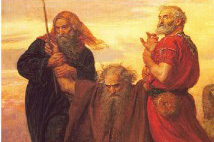
In those days, Amalek came and waged war against Israel. Moses, therefore, said to Joshua, “Pick out certain men, and tomorrow go out and engage Amalek in battle. I will be standing on top of the hill with the staff of God in my hand.” So Joshua did as Moses told him: he engaged Amalek in battle after Moses had climbed to the top of the hill with Aaron and Hur. As long as Moses kept his hands raised up, Israel had the better of the fight, but when he let his hands rest, Amalek had the better of the fight. Moses’hands, however, grew tired; so they put a rock in place for him to sit on. Meanwhile Aaron and Hur supported his hands, one on one side and one on the other, so that his hands remained steady till sunset. And Joshua mowed down Amalek and his people with the edge of the sword. (Ex 17:-8-13)

We can notice here six practices related to prayer, six fundamental teachings on prayer:

I. The Problem for Prayer. In those days, Amalek came and waged war against Israel. None of us like problems, but one thing about problems is that they help to keep us praying. Israel is at war and their enemies are strong. It was time to pray.

In the Gospel for this weekend’s Mass, a widow is troubled about something and it keeps her coming back to the judge. Sometimes God allows us problems to keep us praying. Problems also keep us humble and remind us of our need for God and others.

Problems aren’t the only reason we pray but they are one important motivator. It shouldn’t be necessary that problems would cause us to pray. But if we’re honest, we’ll probably admit that problems have a way of summoning prayer from us.

II. The Priority of Prayer. Moses, therefore, said to Joshua, “Pick out certain men, and tomorrow go out and engage Amalek in battle. I will be standing on top of the hill with the staff of God in my hand.” So Joshua did as Moses told him: he engaged Amalek in battle after Moses had climbed to the top of the hill with Aaron and Hur.

Notice that Joshua and the army did not go forth until after Moses took up his prayer place. Prayer ought to precede any major work or decision.

Too often we rush into life without praying. Each day should begin with prayer. Important decisions are a time for prayer. Prayer needs to precede, it has a priority over and before action.

Too many people use prayer as a kind of rear-guard action wherein they ask God to clean up the messes they have made by bad decisions. We end up doing a lot of things we shouldn’t because we don’t pray first. We also end up doing a lot of things poorly that prayer might have clarified or enriched.

And prayer isn’t just about praying for this or that specific thing. Prayer involves an on-going relationship with God in which we gradually begin to receive a new mind and heart, where our priorities and vision are clarified and purified. This new mind and heart we get from prayer and study of our faith are an essential part of the prayer that precedes decisions and actions.

III. The Power of Prayer. As long as Moses kept his hands raised up, Israel had the better of the fight, but when he let his hands rest, Amalek had the better of the fight.

As long as Moses prayed, Israel got the best of the battle. But when fatigue caused his prayer to diminish Israel began to lose.

The fact is, prayer changes things. We may never fully know here how our prayer helped to change world history but I am sure that one of the joys of heaven will be to see what a real difference our prayers, even the distracted and poor ones, made. We’ll tell stories in heaven of prayer’s power and appreciate what difference it made for us and what a difference we made for others. For now, much of this is hid from our eyes. But, one day, by and by, we will see with a glorious vision what prayer did.

I suppose too that one of the pangs of purgatory might be to see how our failure to pray also had negative effects and how only God’s mercy could over-rule our laziness and failure to pray.

Moses is struggling to pray here in this story. So do we. But remembering prayer’s power is an important motivator to keep us on our knees and at our beads. Pray!

IV. The Partnership of Prayer. Moses’ hands, however, grew tired; so they put a rock in place for him to sit on. Meanwhile Aaron and Hur supported his hands, one on one side and one on the other.

Moses, because of his fatigue, knows he needs to get Aaron and Hur to assist him in praying. As a team they pray together and, once again, Israel is strengthened and begins to win through.

Prayer is not supposed to be a merely “lone-ranger” experience. It is true that personal prayer is important but so is communal and group prayer. The Lord says, Where two or three are gathered in my name, there am I in the midst of them (Matt 18:20). Likewise he says, Again, I tell you that if two of you on earth agree about anything you ask for, it will be done for you by my Father in heaven(Matt 18:19).

Hence, we are taught to gather in prayer liturgically and also to find partners for prayer. Since prayer is so essential and we are individually weak, we ought not have it all depend on us. We need our own Aaron and Hur to support us in prayer and make up for our weakness.

Do you have some spiritual friends who help you not only to pray but also to walk uprightly? Scripture says, Woe to the solitary man! For if he should fall, he has no one to lift him up….where a lone man may be overcome, two together can resist. A three-ply cord is not easily broken. (Ecclesiastes 4:10,12)

Do not pray or journey alone. Find some good spiritual friends to accompany you on your journey and to pray along with you.

V. The Persistence of Prayer. so that [Moses] hands remained steady till sunset.

The text says that, with Aaron and Hur to help him, Moses prayed right through to sunset. They prayed right until the end and so must we. There is a mystery as to why God sometimes makes us wait. But pray on anyway. We may at times get frustrated by the delay, pray on anyway. We may get fatigued or even lose heart, but pray on anyway.

Like Moses, get some friends to help you, but pray on anyway. Pray, pray, pray.

Be like the woman in today’s Gospel who just kept coming to that old judge until he rendered justice for her. Pray until the sunset of your life. I have brought people into the Church long after their spouse or mother who prayed for them has died. Just keep praying till sunset.

VI. The Product of Prayer. And Joshua mowed down Amalek and his people with the edge of the sword.

The text says that the enemies of Israel were utterly defeated. This is the product and the power of persistent prayer. This is what prayer does.

We have already discussed above that we may not fully see prayer’s power and product on this side of the veil. But one day we will on glory’s side. We may not need God to mow down a foreign enemy. But how about the enemies like fear, poverty, illness, and sin? Yes, we have enemies and God still answers prayers. Pray and wait for the product of prayer.

So there it is, six practices and teachings on prayer.

This song says, “I Can Go To God in Prayer”

This song says, Somebody prayed for me. Had me on their mind, took the time and prayed for me. I’m so glad they prayed for me!

How to Give God Perfect Thanks – A Homily for the 28th Sunday of the Year

One of the great human inadequacies is our inability to give proper and adequate thanks to God. Perhaps the biggest problem is that we don’t even realize the vast majority of what He does for us; it is hidden from our eyes.

A further problem is that in our fallen condition we seem to be wired to magnify our problems and minimize or discount the enormous blessings of each moment. God sustains every fiber of our being and every atom of creation. God’s blessings are countless and yet we get angry if our iPhone malfunctions or if a few of His myriad blessings are withdrawn.

An old gospel song says it well:

 I’ve got so much to thank God for; So many wonderful blessings and so many open doors. A brand new mercy along with each new day. That’s why I praise You and for this I give You praise. For waking me up this morning, For starting me on my way, For letting me see the sunshine, of a brand new day. That’s why I praise You and for this I give You praise. So many times You´ve met my needs, So many times You rescued me. That’s why I praise You.

For every mountain You brought me over, For every trial you’ve seen me through, For every blessing, For this I give You praise.

 Fundamental Question – The question at the heart of this Sunday’s Gospel is best expressed in the Book of Psalms: What return shall I make to the Lord for all the good he has done for me? The same psalm goes on to answer the question in this way: The cup of salvation I will take up and call on the name of the Lord (Psalm 116:12).

The Mass is signified – Indeed, how can I possibly thank the Lord for all the good He has done for me? Notice that the psalm points to the Eucharist in saying, The cup of salvation I will take up …. As you know, the word Eucharist is a Greek word meaning “thanksgiving.” We cannot thank God our Father adequately, but Jesus can. In every Mass, we join our meager thanksgiving to His perfect one. At every Mass, Jesus takes up the cup of salvation through the priest and shows it to us. This is the perfect and superabundant thanks to the Father that only Jesus can offer. In every Mass, Jesus joins us to His perfect sacrifice of thanks. That is how we give thanks in a way commensurate with the manifold blessings we have received.

Hidden Mass – The Gospel for this day makes the point that the Mass is the perfect offering of thanks to the Father in a remarkable and almost hidden way. But for Catholics, it is right there for us to see if we have eyes to see it. The Gospel contains all the essential elements of Holy Mass. It is about giving thanks and reminds us once again that it is the Mass that is the perfect thanksgiving, the perfect “Eucharist.”

Let’s look and see how it is a Mass:

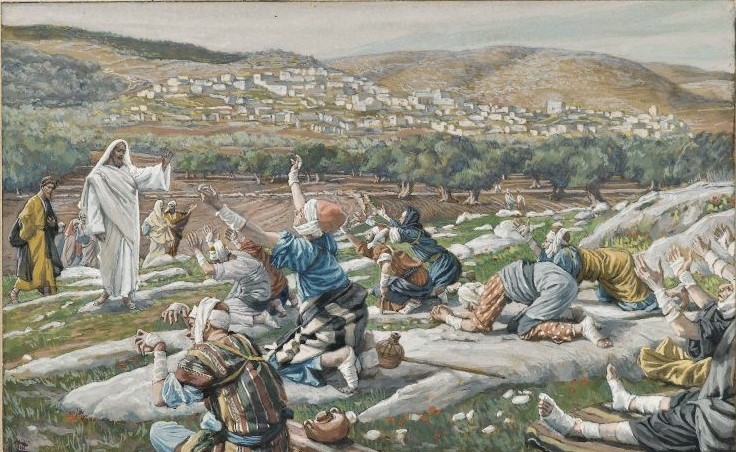
1.  Gathering – Ten lepers (symbolizing us) have gathered and Jesus comes near as He passes on His way. We do this in every Mass: we gather and the Lord draws near. In the person of the priest, who is the sacrament, the sign of His presence, Jesus walks the aisle of our church just as He walked those ancient roads.

2.  Kyrie – The lepers cry out for mercy, just as we do at every Mass. Lord, have mercy! Jesus, Master, have pity on us!

3.  Liturgy of the Word – Jesus quotes Scripture and then applies it to their lives, just as He does for us at every Mass. (In saying, “Go show yourselves to the priests,” Jesus is referencing Leviticus 13, which gives detailed instructions on how the priests of old were to diagnose leprosy or its having been cured.) Yes, this is what we do at every Mass: we listen to the Lord Jesus, through the priest or deacon, proclaiming God’s Word and then applying it to our lives.

4.  Liturgy of the Eucharist – The Gospel relates that one of them fell at the feet of Jesus and thanked him. This is what we do during the Eucharistic prayer: we kneel and thank Jesus, and along with Him, give thanks to the Father. As we have noted, the word “Eucharist” comes from the Greek and means “thanksgiving.” Here is the perfect thanks rendered to the Father. Those who claim that they can stay home and give adequate thanks to God should be rebuked for being prideful. Only Jesus can give perfect thanks to the Father, and we can only give adequate thanks by following Jesus’ command to “Do this in memory of me.” We have to be at Mass.

5.  Ite, missa est – Finally, Jesus sends the thankful leper on his way, saying, Stand up and go; your faith has saved you. We, too, are sent forth by Jesus at the end of every Mass, when He speaks through the priest or deacon: “The Mass is ended, go in peace.”

So, there it is. Within this Gospel, which very clearly instructs us to give thanks to God, is the very structure of the Mass. If you want to give proper thanks to God, the right place to do it is at Mass. Only at Mass is perfect and proper thanks given to God.

It was all prefigured in the psalm long ago: What return shall I make to the Lord for all the good he has done for me? The cup of salvation I will take up and call on the name of the Lord (Psalm 116:12). Yes, it is the very cup of salvation, the chalice containing Christ’s blood, that is held up at every Mass. It is the perfect sacrifice of thanks. It is the prescribed sacrifice of praise. It is the proper sacrifice of praise.

Five Fundamentals for a Firm Faith – A Homily for the 27th Sunday of the Year

The readings for this Sunday’s Mass richly describe some essential qualities of faith and living in this world as a Christian. There are five fundamentals that can be seen:

Wanting The apostles said to the Lord, “Increase our faith” (Luke 17:5-6).

There’s an old saying that what you want, you get. Many doubt this, thinking that they have wanted many things that they did not get. The reason for this, however, is usually because they didn’t want it enough. When we really want something (provided it is not an impossibility) we usually get it, because we have a passion for it and work at it.

Many people who say that they don’t have time to pray or to go to Mass still find time to golf and watch TV television. They find the time because they want to do these things. They don’t find time to pray or to go to Mass because they do not want to do these things enough.

When the apostles ask the Lord to increase their faith, they are asking for a deeper desire to know Him. Too often we miss a step in our prayer. We might ask the Lord to help us to pray when we really should be asking Him to give us the desire to pray. When we want to pray, we will pray. When we want to be holy, we will naturally strive for holy practices. It is about what we truly desire. Ask the Lord to help you want Him and His kingdom. Ask the Lord for a new heart that has proper wants and desires. Ask the Lord for a new mind that has the proper priorities and prefers to think about what is good, true, and beautiful. What you want, you get.

Waiting – The first reading speaks of our need to wait for the Lord’s action: How long, O LORD? I cry for help, but you do not listen! I cry out to you, “Violence!” but you do not intervene. Why do you let me see ruin; why must I look at misery? Destruction and violence are before me; there is strife, and clamorous discord. … Then the LORD answered me and said, Write down the vision clearly upon the tablets, so that one can read it readily. For the vision still has its time, presses on to fulfillment, and will not disappoint; if it delays, wait for it, it will surely come, it will not be late. The rash one has no integrity (Hab 1:2-3; 2:2-4).

Waiting is one of the great mysteries of the Christian life. It is not always clear why God makes us wait. Perhaps He is trying to strengthen our faith. Perhaps He is helping us to clarify or confirm our desires. Scripture consistently tells us that we must learn to wait for the Lord and that there are blessings for those of us who do. Here are some examples:

        • Fret not yourself; it tends only to evil … those who wait for the LORD shall possess the land (Ps 37:8).
        • Those who wait for me shall not be put to shame (Is 49:23).
        • The LORD is good to those who wait for him, to the soul that seeks him. It is good that one should wait quietly for the salvation of the LORD (Lam 3:25).
        • But they who wait for the LORD shall renew their strength, they shall mount up with wings like eagles, they shall run and not be weary, they shall walk and not faint (Is 40:31).

Waiting is a fundamental of firm faith. Gospel music is replete with waiting themes. One song says, “You can’t hurry God, you just have to wait, trust, and never doubt him, no matter how long it takes. He may not come when you want him but he’s always right on time.” Another song says, “Weeping may endure for a night, but joy will come with the morning light.” Other songs counsel that we must hold on and hold out:

        • “I promised the Lord that I would hold out, he said he’d meet me in Galilee.”
        • “Hold on just a little while longer, everything’s gonna be all right.”
        • “Keep your hand on the plow. Hold on!”
        • “Lord help me to hold out until my change comes!”

The reading from Habakkuk above warns that the rash man has no integrity. That is another way of saying that waiting is integral to the Christian life; it is a fundamental of faith. To have integrity means to have all the necessary parts that make up the whole. To lack patience, then, is to lack integrity, to lack a fundamental of the Christian faith.

Withstanding – The second reading counsels us, God did not give us a spirit of cowardice but rather of power and love and self-control. So do not be ashamed of your testimony to our Lord, nor of me, a prisoner for his sake; but bear your share of hardship for the gospel with the strength that comes from God (2 Tim 1:6-8).

This passage tells us that life has difficulties and challenges. Becoming a Christian does not necessarily make things easier. In fact, things often get harder, because we must endure the hatred and ridicule of the world. A fundamental of the Christian Faith is that being able to withstand such trials with courage.

Notice that this courage, power, and love come from God, not from us. Hence, it is grace that is being described here. This is not a moral slogan. Withstanding means that God is “standing with” us, and we with Him. Such withstanding is only possible by the relationship with God that comes by faith. In this way, we discover the power, the capacity, to withstand, to live the Christian faith courageously in a hostile world.

Working – The Gospel teaches, Who among you would say to your servant who has just come in from plowing or tending sheep in the field, “Come here immediately and take your place at table”? Would he not rather say to him, “Prepare something for me to eat. Put on your apron and wait on me while I eat and drink. You may eat and drink when I am finished”? Is he grateful to that servant because he did what was commanded? So should it be with you. When you have done all you have been commanded, say, “We are unprofitable servants; we have done what we were obliged to do” (Luke 17:6-10).

This teaching of the Lord’s can irritate us and even seem hurtful if we misunderstand grace and seek to understand this text by the flesh. Our flesh is self-centered and thinks we deserve praise and good things from God in return for the good things we do. The flesh expects—even demands—rewards, but God can never be indebted to us, never. Our good works are not our gift to God; they are His gift to us.

All our works of charity and faith, for which our flesh wants credit, are God’s work and His gift. This is made clear in this passage from the Letter to the Ephesians:

For by grace you have been saved through faith; and this is not your own doing, it is the gift of God– not because of works, lest any man should boast. For we are his workmanship, created in Christ Jesus for good works, which God prepared beforehand, that we should walk in them (Eph 2:8-10).

If I think that I did something deserving of praise and reward, I am thinking in terms of the flesh, not the Spirit. When I have done something good all I can really do is to say, “Thank you” to God. His grace alone permitted me to do it. God may speak elsewhere of rewarding us, but that is His business. He is not indebted to us in any way. When we have done everything we ought, our one disposition should be gratitude. We are useless servants in the sense that we can do nothing without God’s grace. We can only do what He enables us to do.

That said, it is clear that work is a pillar of faith. The text from today’s Gospel and the text from Ephesians above both make clear that work is something God has for us. So faith by itself, if it has no works, is dead (James 2:17). Likewise, Jesus says, “It was not you who chose me. It was I who chose you that you should go and bear fruit that will last” (Jn 15:16). Yes, work is a fundamental of faith.

Winning – We conclude with a reference back to the first reading: For the vision still has its time, it presses on to fulfillment and it will not disappoint. If it delays, wait for it, it will surely come, it will not be late (Hab 2:3).

See what the end shall be! It is true that we must want, wait, withstand, and work, but we do not do so for no reason. We have a cross to carry, but if we carry it with the Lord, we carry it to glory. There is an old gospel song with these lyrics:

Harder yet may be the fight, Right may often yield to might, Wickedness awhile may reign, Satan’s cause may seem to gain, There is a God that rules above, With hand of power and heart of love, If I am right, He’ll fight my battle, I shall have peace some day. I do not know how long ’twill be, nor what the future holds for me. But this I know, if Jesus leads me, I shall get home someday.

This is just what Habakkuk describes: we will win with Jesus. He describes a victory that is

        • Future – the vision still has its time; it presses on to fulfillment
        • Fantastic – it will not disappoint
        • Firm – it will surely come
        • Fixed – it will not be late

For all those who walk with Jesus on the way of the cross, there is victory ahead. Even here in this life we already enjoy the fruits of crosses past. Our withstanding in the past has given us strength for today. Our waiting in the past has had its fulfillment and provides the hope that our current waiting will also be fruitful. Our past work, by God’s grace, has already granted benefits to us and to others.

These are but a small foretaste of a greater glory to come, the glory that waits for us in Heaven. Yes, if we want, wait, withstand, and work, we will win! I promise it to you in the Lord Jesus Christ.

On Being Faithful in a Few Things before Being Ruler over Many Things – A Homily for the 25th Sunday of the Year

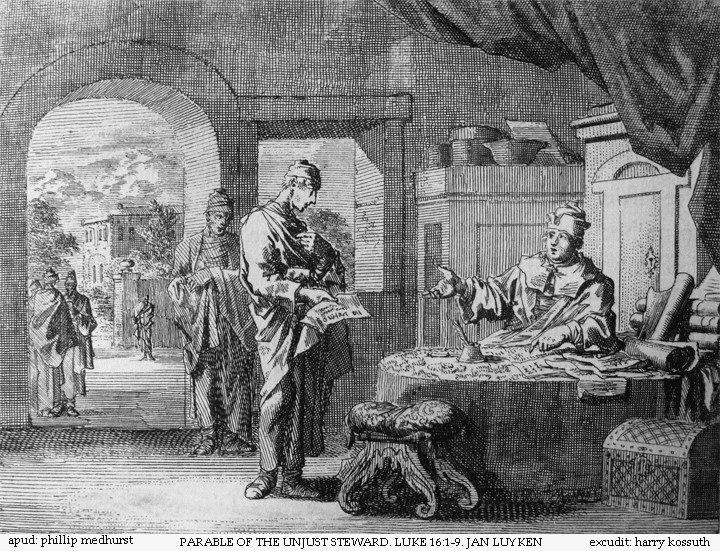
https://commons.wikimedia.org/wiki/File:Teachings_of_Jesus_31_of_40._parable_of_the_unjust_steward._Jan_Luyken_etching._Bowyer_Bible.gif

In this Sunday’s Gospel, the Lord Jesus gives a penetrating analysis of the state of the sinner and some very sobering advice to us would-be saints. Let’s look at the Gospel in two stages:

I. ANALYSIS OF THE SINNER – In the opening lines of the Gospel, Jesus describes a sinful steward.

DELUSION (of the sinner) Jesus said to his disciples, “A rich man had a steward …”

 Notice that the man is referred to as a steward rather than an owner. God is the owner of everything; we are but stewards. A steward must deal with the goods of another according to that person’s will. We may have ownership in relation to other human beings, but before God we own nothing, absolutely nothing.

Part of the essence of sin is behaving as though we are the owner. We develop the arrogant attitude that what we have is ours to do with as we please: “It’s mine; I can do what I want with it.” “It’s my body, and I can do with it as I please.” But in fact, everything belongs to God.

Scripture affirms, The earth is the LORD’S and the fullness thereof; the world, and they that dwell therein (Ps. 24:1). Even of our bodies, which we like to think of as our own, Scripture says, You are not your own; you were bought with a price. So glorify God in your body (1 Cor 6:19). There’s a song that says, “God and God alone created all these things we call our own. From the mighty to the small, the glory in them all is God’s and God’s alone.” The Lord compares the sinner to a steward who acts as if he were the owner.

DISSIPATION (of the sinner) “… who was reported to him for squandering his property.”

The Lord here describes the essence of many of our sins: we squander His gifts. We waste the gifts we have received and use them for sinful ends.

For example, in greed we hoard the gifts He gave us. Instead of using them to help others, as God intended, we store them up for ourselves. Yet all the goods of the world belong to all the people of the world, and they ought to be shared to the extent that we are able.

Other examples of squandering the things of God are these: in gossip, lying, and cursing, wherein we misuse the gift of speech; in laziness, wherein we misuse the gift of time; in all sin, wherein we abuse the gift of our freedom. This is the dissipation, the squandering, of God’s goods.

God has given us many good things, but instead of using them to build the Kingdom, we squander them and dissipate it.

DEATH (of the sinner)“He summoned him and said, ‘What is this I hear about you? Prepare a full account of your stewardship, because you can no longer be my steward.’”

Here the Lord reminds us that someday our stewardship will end, and we will be called to account. Scripture reminds us, So whether we are at home or away, we make it our aim to please him. For we must all appear before the judgment seat of Christ, so that each one may receive good or evil, according to what he has done in the body (2 Cor 5:9).

We have an appointed time to exercise our stewardship, but at some point, our stewardship will end, and the books will be opened. Scripture says, And books were opened. Another book was opened, which is the book of life. The dead were judged according to what they had done as recorded in the books (Rev 20:11).

Although many pay little heed to the fact of judgment, Scripture warns, Say not, “I have sinned, yet what has befallen me?” For the Lord bides his time. Of forgiveness be not over-confident, adding sin upon sin. Say not, “Great is his mercy, my many sins he will forgive.” For mercy and anger are alike with him; upon the wicked alights his wrath. Delay not your conversion to the Lord, put it not off from day to day. For suddenly his wrath flames forth; at the time of vengeance you will be destroyed (Sirach 5:4).

Every steward (each of us) will die. Our stewardship will end and we will be called to render an account. Therefore, we ought to listen to the Lord’s advice.

II. ADVICE TO THE SAINTS After analyzing the sinner, the Lord has some advice for those of us sinners who want to be saints. He lays out four principles we ought to follow:

1. Principle of INTENSITY – The text says, the steward said to himself, ‘What shall I do, now that my master is taking the position of steward away from me? I am not strong enough to dig and I am ashamed to beg. I know what I shall do so that, when I am removed from the stewardship, they may welcome me into their homes.’ He called in his master’s debtors one by one. To the first he said, ‘How much do you owe my master?’ He replied, ‘One hundred measures of olive oil.’ He said to him, ‘Here is your promissory note. Sit down and quickly write one for fifty.’ Then to another the steward said, ‘And you, how much do you owe?’ He replied, ‘One hundred kors of wheat.’ The steward said to him, ‘Here is your promissory note; write one for eighty.’ And the master commended that dishonest steward for acting shrewdly. For the children of this world are more shrewd in dealing with their own generation than are the children of light.

The Lord is telling us here that many of the worldly are craftier in what matters to them than are the spiritually minded in what (supposedly) matters to them.

Many people are dedicated and intense in worldly matters. They spend years in college, preparing for their career. They work hard to climb the company ladder. They develop (worldly) skills and become knowledgeable in their profession. In earning money and holding down a job, many display great discipline: getting up early to go to work, working late, going the extra mile to please the boss.

When it comes to faith, however, many of these same people display only a rudimentary knowledge of things spiritual and show little interest in praying or advancing in the faith. They will expend effort to please the boss, to please other people, but not to please God. Parents will fight for scholarships for their children to get into the “best” schools but not quite so dedicated to ensuring they learn the saving truth; the pews are empty, and Sunday School is poorly attended.

The Lord says to us here that the spiritually minded ought to show the same intensity, organization, dedication, and craftiness that the worldly show in their pursuits. We ought to be zealous for the truth, for prayer, and for opportunities to sharpen our spiritual skills and increase our holiness. We ought to be as zealous to be rich in grace as we are to be rich in money.

2. Principle of INVESTMENT I tell you, make friends for yourselves with dishonest wealth, so that when it fails, you will be welcomed into eternal dwellings.

(Read here for more information on what the Lord means by “dishonest wealth”: What Does the Lord Mean by “Unrighteous Mammon”?.)

The Lord tells of how the dishonest steward made use of the money at his disposal to make friends who would help him in the next stage of his life. How about us? Are we willing to use our money and resources to bless others (especially the poor, who can bless us in the next stage of our life)?

On the day of your judgment, will the poor and needy be able to speak up on your behalf? Will they be among the angels and saints who welcome you to eternal dwellings? I don’t know about you, but I’m going to want the poor to pray and to speak to God on my behalf! Scripture says that the Lord hears the cry of the poor and needy. In this world, the poor need us but in the next world we’re going to need them. In this world, those with money and power are heard; in the Kingdom, it’s the poor and suffering who are heard. It’s a wise investment to bless the poor and needy.

In effect, the Lord Jesus tells us to be wise in our use of worldly wealth. The world tells us to take our money and invest it so that it will reap future rewards; so too does the Lord. How? By storing our wealth up in Heaven. And how do we do that? By giving it away! Then it will really be ours.

You can’t take it with you, but you can send it on ahead. Scripture elaborates on this idea: Command those who are rich in this present world not to be arrogant nor to put their hope in wealth, which is so uncertain, but to put their hope in God, who richly provides us with everything for our enjoyment. Command them to do good, to be rich in good deeds, and to be generous and willing to share. In this way they will lay up treasure for themselves as a firm foundation for the coming age, so that they may take hold of the life that is truly life (1 Tim 6:17). Notice that the passage says that through their generosity in this world, the rich store up treasure for themselves in Heaven.

This is the scriptural principle and the great paradox in the Kingdom of God: we keep something for eternity only by giving it away. We save our life by losing it. By giving away our treasure, we keep it and store it in Heaven.

So, invest, my friends. Invest wisely! Store up for yourselves treasures in heaven, where moth and rust do not destroy, and where thieves do not break in and steal (Matt 6:20).

3. Principle of INCREASEThe person who is trustworthy in very small matters is also trustworthy in great ones; and the person who is dishonest in very small matters is also dishonest in great ones. If, therefore, you are not trustworthy with dishonest wealth, who will trust you with true wealth? If you are not trustworthy with what belongs to another, who will give you what is yours?

What is the “small matter” of which the Lord speaks and in which we can prove trustworthy? The small matter is money. Most people make money the most important thing in life, but spiritual matters are far more important.

Scripture attests to this clearly. The Book of 1st Peter says that our faith is more precious than fire-tried gold. The Book of Psalms (19:10) says, The words of the Lord are more precious than gold, than much pure gold; they are sweeter than honey, than honey from the comb.

So, God says, let’s see how you are in the small but significant matter of money; then I’ll decide if you’re able to able to handle bigger blessings. Do you think you can handle Heaven and the spiritual blessings of holiness? If you’re trustworthy with worldly wealth, God will give you true wealth. If you’re trustworthy in what belongs to God, He’ll give one day what is yours.

Do you want more? Then use well what you’ve already received. Only then will God know that He can trust you with more. There’s a gospel song that says, “You must be faithful over a few things to be ruler over many things. Be faithful unto death, and God will give you a crown of life.”

4. Principle of INDIVISIBILITYNo servant can serve two masters. He will either hate one and love the other, or be devoted to one and despise the other. You cannot serve both God and mammon.

Pay attention! To serve means to obey. Most people obey money and affluence; they worship a high standard of living before they obey God. They meet their world obligations first and then give God what is left over.

We are called to obey God alone, to have an undivided heart. The wording here is strong. You cannot obey the world (money) and think that you’re also going to obey God. You must choose which will be more important.

Now don’t tell me we don’t need a lot of grace and mercy! Money and the lure of the world are very powerful. It’s time to get on our knees and pray for the miracle of preferring God to the world.

Four Depictions of Discipleship – A Homily for the 23rd Sunday of the Year

In Sunday’s Gospel, Jesus defines four demands of discipleship. Let’s look at them one by one.

I. The CONTEXT of discipleship – The text says that large crowds were following Jesus and so He turned to address them. Just about any time you find mention of a big crowd in the Bible, fasten your seat belt and prepare for a hard teaching. Jesus didn’t trust large crowds, who were often merely after what they could get out of Him. They were looking for miracles, for multiplied (and free) bread, for physical healing, and for a fiery sermon.

So, upon sensing a large crowd of people, Jesus turned to address them. He then gives a series of hard teachings, which almost seem designed to thin the ranks and distinguish true disciples from ones who are merely giving “lip service.”

Before discussing what Jesus says to them, let’s examine some other incidents in the Gospels that also illustrate His tendency to distrust big crowds:

        • Enter by the narrow gate; for the gate is wide and the way is easy, that leads to destruction, and those who enter by it are many. For the gate is narrow and the way is hard, that leads to life, and those who find it are few (Matt 7:13).
        • For many are called, but few are chosen (Matt 22:14).
        • Woe to you, when all men speak well of you, for so their fathers did to the false prophets (Luke 6:26).

Often the mention of a large crowd is followed by a hard teaching:

        • When Jesus had finished saying these things, he left Galilee and went into the region of Judea to the other side of the Jordan. Large crowds followed him, and he healed them there. Some Pharisees came to him to test him. They asked, “Is it lawful for a man to divorce his wife for any and every reason?” “Haven’t you read,” he replied, “that at the beginning the Creator ‘made them male and female,’ and said, ‘For this reason a man will leave his father and mother and be united to his wife, and the two will become one flesh’? So they are no longer two, but one. Therefore, what God has joined together, let man not separate” (Matt 19:1-6; Mark 10).
        • As the crowds increased, Jesus said, “This is a wicked generation. It asks for a miraculous sign, but none will be given it except the sign of Jonah” (Luke 11:29).
        • Large crowds were traveling with Jesus and turning to them he said: “If anyone comes to me and does not hate his father and mother, his wife and children, his brothers and sisters—yes, even his own life—he cannot be my disciple. And anyone who does not carry his cross and follow me cannot be my disciple” (Luke 14:26-27).
        • … and a great crowd of people followed him because they saw the miraculous signs he had performed on the sick … and He said to them, “I am the living bread come down from heaven” … the crowds murmured (John 6:2).

So, the context of discipleship is not usually with the crowd. Though many are called—indeed, all are called—few make the cut and become true disciples. There is a kind of remnant theology at work here, to be sure, but it is a common pattern that Jesus thins the ranks and distinguishes the many who are called from the few who are chosen.

This is not just a fact in the Scriptures; the Lord has often had to prune His Church. Even now we are seeing a large falling away, a pruning, as many who are not able to accept the hard sayings of Jesus and the Scriptures (about sexuality, forgiveness, love of one’s enemies, heroic charity, and generosity) depart. The context of discipleship is with the few rather than the many.

This insight about the context is also important today because there are many who argue that the Church should “get with the times,” that she should listen to the people, that she should give them what they want, that she should reflect the views of the faithful. The role of the Church is not to reflect the views of its members, as if it were some political party. Rather, it is to reflect the views of its Founder, Jesus Christ, who handed on His teachings through the apostles and evangelists. More often than not, these teachings will not be in lockstep with what is popular or current.

The context of discipleship is often at odds with great crowds of people. We see this when Jesus turns on them. The first reading today reminds us: For the deliberations of mortals are timid, and unsure are our plans. For the corruptible body burdens the soul and the earthen shelter weighs down the mind that has many concerns. And scarce do we guess the things on earth, and what is within our grasp we find with difficulty (Wisdom 9:13-16).

II. The CENTRALITY of discipleship – Jesus indicates that if we are going to be His disciples, we can love no one more than we love Him. This extends even to our family relationships: If anyone comes to me without hating his father and mother, wife and children, brothers and sisters, and even his own life, he cannot be my disciple.

The use of the word “hate” here does not mean that we are to have contempt for others or to nourish unrighteous anger toward them. Rather, this is a Jewish idiom. For some reason, the Hebrew language has very few comparative words such as more/less and greater/ fewer. If one preferred vanilla ice cream to chocolate, one would say (in ancient Hebrew), “I love vanilla but hate chocolate.” This would mean that I prefer vanilla to chocolate, not that I actually hate chocolate.

So, what Jesus means is that we cannot prefer anyone or anything to Him. He is first; He is number one. Jesus says that He must have absolute priority over even the closest human relationships in your life.

If there’s anyone in your life who can talk you out of obeying God, forget ’em! Anyone who keeps you away from God has too much power. Anyone who can keep you from your Christian walk has too much power. Anyone who can pull you into unrighteousness has too much power.

If your boss instructs you to do something immoral, just say, “Sorry, Boss.” If your accountant advises you to save money by paying unjust wages or cutting necessary benefits, say “Sorry, no.” If your boyfriend or girlfriend pressures you to have sex, say, “Sorry, Dear.” If your “friend” pressures you to use drugs, abuse alcohol, skip school, or steal, say, “Sorry, Buddy.” If your spouse calls you away from teaching your children the ways of faith, tell him/her “Sorry, Honey.” If your child pressures you to give him something unwise or sinful, say, “Sorry, child of mine.”

Do you get it? No one is to have priority over Jesus Christ and what He teaches. The word “hate” here may not be meant literally, but if Jesus really does have priority in our life it may cause some people to say to us, “You’re so devoted to Him that I think you hate me!”

We need to attend to this, because too many of our human relationships cause us to compromise our walk with Jesus. Some people have too much power over us, a power that belongs to the Lord.

III. The CROSS of discipleship – Jesus says, Whoever does not carry his own cross and come after me cannot be my disciple. If we want to be a disciple, we must be willing to carry the cross.

The cross comes in many forms, but in the end, being a disciple does not mean that we are in any way exempt from the troubles and trials of this world. Jesus indicates that we will be hated (cf Jn 15:20), persecuted, and sorely tempted by the world. If we hold out, though, victory will be ours.

It is a simple rule: No cross, no crown. There are some who want to preach a prosperity gospel. There are others who demand a gospel stripped of its moral imperatives. Still others demand an updated faith that tickles their ears and affirms their sinful behavior.

Jesus points to the cross not to torture us but because it is the only way to glory. In the world ye shall have tribulation: but be of good cheer; I have overcome the world (John 16:33). Now, for a little while you may have to suffer various trials (1 Peter 1:6). This wisdom is already evident if we consider that even in this world, all of what we value most (family, talents, career, achievements) comes at the cost of sacrifice. Sacrifices bring blessings. Jesus is not into pain for its own sake but because sacrifice brings blessings.

IV. The COST of discipleship Which of you wishing to construct a tower does not first sit down and calculate the cost to see if there is enough for its completion? Otherwise, after laying the foundation and finding himself unable to finish the work the onlookers should laugh at him and say, “This one began to build but did not have the resources to finish.” Or what king marching into battle would not first sit down and decide whether with ten thousand troops he can successfully oppose another king advancing upon him with twenty thousand troops? But if not, while he is still far away, he will send a delegation to ask for peace terms. In the same way, anyone of you who does not renounce all his possessions cannot be my disciple.

In this teaching, Jesus asks us to count the cost. Discipleship is costly. Jesus gives the images of someone building a tower and of a king going into battle. These examples may seem distant to us, so Jesus “brings it home” by saying, anyone of you who does not renounce all his possessions cannot be my disciple.

The Greek word ἀποτάσσω (apotasso), translated here as “renounce,” also means “to say farewell.” The Lord is reminding us that Heaven costs everything. Ultimately, we must say farewell to everyone and everything we consider precious in this world in order to inherit Heaven. This is not something that happens all at once when we die.

On one level, we give back everything to God little by little as we go through life. We have all given back loved ones. Perhaps we have already given back our youthful physique, strength, or good health. Ultimately, though, we will give it all back.

On another level, the Lord is saying that we must be willing to part now with anything that hinders discipleship. Many things attach us to this world and make discipleship difficult. Are we willing to simplify our life and focus on being a disciple? Or will we continue setting down roots here and amassing a worldly kingdom?

What’s it going to be: the world or the Kingdom? Count the cost. See what it costs and then decide. In the end, Heaven costs everything—but you’re going to lose it all anyway. It is a wise man who gives away what he cannot keep in order to gain what he could never buy.

What Jesus is looking for are disciples who, having counted the cost and realistically assessed it, are nonetheless ready to be His disciples. Tag-alongs, lip-service Christians, and fair-weather friends need not apply. In today’s Gospel Jesus is teaching a big crowd in a way that is meant to distinguish true disciples from those merely giving lip service. We are asked to ponder in which category we fall.

Three Teachings from the Lord on Prayer – A Homily on the Gospel of the 17th Sunday of the Year

072713Last week’s Gospel featured the Lord insisting that prayer was the “one thing necessary.” In this week’s gospel we see, then, the request by the disciples that the Lord teach them on prayer. In answer the Lord gives us three basic teachings or prescriptions for prayer.

Lets look at these three prescriptions he gives.

I. Pattern of Prayer – The Gospel opens: Jesus was praying in a certain place, and when he had finished, one of his disciples said to him,”Lord, teach us to pray just as John taught his disciples.” He said to them, “When you pray, say: Father, hallowed be your name, your kingdom come. Give us each day our daily bread and forgive us our sins for we ourselves forgive everyone in debt to us, and do not subject us to the final test.”

In giving the “Our Father” we must be careful to understand that the Lord Jesus is not simply giving us words to say. More than this, he is giving us a pattern for prayer. He is “teaching us to pray.” He does this in response to the disciples, who did not ask to be given words to say, but to taught how to pray.

Thus, while the words of the Our Father are precious, it is also important to look at the underlying structure implicit in the prayer so as to learn “how to pray.” Jesus is illustrating by these words what ought to be going on in us interiorly, in our mind and heart as we pray: Here is what the mind and heart of a person of prayer is like.

Let’s consider then, five basic disciplines, taught by Jesus in the Our Father that form a kind of pattern or structure for prayer. I use here the Mattean version of the prayer only because it is more familar, but all the basic elements are the same:

1. RELATE – Our Father who art in heaven – Here begins true spirituality: Relate to the Father! Relate to him with family intimacy, affection, reverence and love. We are not merely praying the “the deity” or the “Godhead.” We are praying to our Father who loves us, who provides for us and, who sent his only Son to die for us and save us. When Jesus lives his life in us and His Spirit dwells in us we begin to experience God as our Abba, (Father).

As developed in other New Testament texts, the deeper Christian word Abba underlies the prayer. Abba is the family word for the more generic and formal word “father.” When my Father was alive I did not call him “Father” I called him “Dad.” This is really what the word Abba is getting at. It is the family word for Father. It indicates family ties, intimacy, close bonds. Why the word Abba is not used here in the Our Father is uncertain. St. Paul develops the theme here: For you did not receive the spirit of slavery to fall back into fear, but you have received the spirit of sonship. When we cry, “Abba! Father!” (Rom 8:15 ) and here: And because you are sons, God has sent the Spirit of his Son into our hearts, crying, “Abba! Father!”(Gal 4:6).

Ask God for the gift to experience him as Abba. At the heart of our worship and prayer is a deep and personal experience of God’s love and fatherly care for us. The first discipline or practice of the Spiritual life is to RELATE to God as to a Father who loves us and to experience him as Abba.

2. REJOICE – hallowed by thy name! The praise and love of God is the essential discipline and element of our spiritual lives. He is the giver of every good and perfect gift and to Him our praise is due. Praise and thanksgiving make us people of hope and joy. It is for this that we were made. God created us, so that we…might live for his praise and glory (Eph 1:12).

Our prayer life should feature much joyful praise. Take a psalm of praise and pray it joyfully. Take the Gloria of the Mass and pray it with gusto! Rejoice in God, praise his name. Give glory to him who rides above the clouds.

There may be times when, due to some sadness or difficulty, we do not feel emotionally like praising God. Praise the Lord anyhow! Scripture says, I will bless the LORD at all times: his praise shall continually be in my mouth (Psalm 34:1). Praise is to be a regular discipline of prayer, rooted even more in the will, than just the feelings. God is worthy our praise.

Ultimately praise is a refreshing way to pray, since we were made to praise God, and when we do what we were made to do, we experience a kind of satisfaction and a sense of fulfillment. The second element and discipline of the spiritual life is a life of vigorous praise: REJOICE!

3. RECEIVE – thy kingdom come, thy will be done on earth as it is in heaven – At the heart of this petition is an openness to God’s will, to his word of instruction, to his plan for us and for this world. When Jesus lives in us we hunger for God’s word and strive to know his will and have it operative in our life.

A basic component and discipline of the prayer and the spiritual life, is to receive the Word and instruction of God, so that his will might be manifest to us, and we can obey. We ought to pray the Scriptures (lectio divina). We ought to study the faith through the Catechism or other means. These are ways that we become open to God’s will that his Kingdom might be manifest in our lives.

The Third element and discipline of prayer and the spiritual life is an openness to to God’s teachings through the Church and Scriptures: RECEIVE!

4. REQUEST – Give us today our daily bread – Intercessory prayer is at the heart of the Christian life. Allow “bread,” in this case, to be a symbol of all our needs. Our greatest need of course is to be fed by God, and thus bread also points to the faithful reception of the Eucharist.

Intercessory prayer is the prayer of asking for God’s help in every need. Take every opportunity to pray for others. When watching the news or reading the newspaper, pray the news. Much of the news contains many things for which to pray: victims of crime, disaster or war, the jobless, homeless and afflicted. Many are locked in sin and bad behavior, corruption, confusion, bad priorities and the like. Many are away from the sacraments and no longer seek their Eucharistic bread who is Christ. Pray, pray, pray.

There are also good things we hear of and we should be grateful and ask that solutions be lasting. This intercessory prayer flows from our love and solidarity with others. We see the world with the compassion of Christ and pray. The fourth element and discipline of prayer and the spiritual life is to INTERCEDE for ourselves and others.

5. REPENT – and forgive us our trespasses, as we forgive those who trespass against us, and lead us not into temptation but deliver us from evil. – Sin is understood at two levels here: 1: sin – (lowercase) our personal sins and trespasses, also referred to as our “trespasses.” 2. Sin (upper case) – referring to the whole climate of sin, the structures of sin that reinforce and underlie our own sins. Referred to here as “evil.”

An essential element of our spiritual life is that we come to recognize the sins, and deep drives of sins, in our own life, to beg deliverance from them as well as mercy.

It is also true that we live in a sin soaked world were the powers and principalities of evil have great influence. We cannot fail to recognize this and pray that it’s power will be curbed.

Then too, we must also pray for the grace to show mercy to others. For it often happens that sin escalates through resentments, and retribution rooted in unforgiving attitudes. We must pray to be delivered from these hurts and resentments so as to be able to break the cycle of violence and revenge that keeps sin multiplying.

But in the end we must pray for the Lord’s grace and mercy to end evil in our own lives and that the whole world. The Fifth element and discipline of prayer and the spiritual life is to REPENT of evil.

So here then is a structure for our prayer and spiritual life contained in the Our Father. Jesus teaches us to pray, and gives us a basic structure for prayer. Some may use this an actual structure for daily prayer. Hence,  if they are going to spend 25 minutes praying, they spend about five minutes on each aspect. Others may use this structure for an over all reference for their spiritual life in general. Hence, one might ask if these aspects and disciplines are reflected well in their overall prayer life.

Thus the first teaching of the Lord is to give us a patten for prayer. We now go on to the next preisciption.

II. The Persistence of Prayer – Jesus goes on to say, “Suppose one of you has a friend to whom he goes at midnight and says, ‘Friend, lend me three loaves of bread, for a friend of mine has arrived at my house from a journey and I have nothing to offer him,’ and he says in reply from within, ‘Do not bother me; the door has already been locked and my children and I are already in bed. I cannot get up to give you anything.’ I tell you, if he does not get up to give the visitor the loaves because of their friendship, he will get up to give him whatever he needs because of his persistence. “And I tell you, ask and you will receive; seek and you will find; knock and the door will be opened to you. For everyone who asks, receives; and the one who seeks, finds; and to the one who knocks, the door will be opened.

Jesus tells a similar parable in Luke 18 of an unjust judge and a persistent widow. Finally the judge gives her justice because of her demanding persistence.

The upshot of both of these parables is that if even a grouchy neighbor and an unjust judge will respond to persistence, how much more will God the Father who is neither unjust or grouchy respond to those who call out to him day and night.

The teaching that we persist in prayer is something of a mystery. God is not deaf, he is not forgetful, he is not stubborn. But yet, he teaches in many places that we are to persevere, even pester him, in our prayer.

Why he teaches this cannot be for his sake, it must be for ours. Perhaps he seeks to help us clarify what we really want, perhaps he wants to strengthen our faith, perhaps he wants to instill appreciation in us for the finally answered prayer. What ever it may be there is something of a mystery here as to the exact reason. But persistent prayer is taught and insisted upon by Jesus, here and elsewhere.

Some may ponder as to why our prayers are not always effective. Some of the usual explanations from Scripture are:

  1. Our faith is not strong enough – Jesus said: “If you believe, you will receive whatever you ask for in prayer.” (Matthew 21:22) And the Book of James says, But when he asks, he must believe and not doubt, because he who doubts is like a wave of the sea, blown and tossed by the wind. That man should not think he will receive anything from the Lord; (James 1:6-7)  There is also the sad fact of Nazareth where the Lord could work few miracles so much did their lack of faith disturb him (Matt 13:58)
  2. We ask for improper things or with wrong motives – The Book of James says : “When you ask, you do not receive, because you ask with wrong motives, that you may spend what you get on your pleasures
  3. Unrepented sin sets up a barrier between us and God so that our prayer is blocked –  “Surely the arm of the Lord is not too short to save, nor His ear too dull to hear. But your iniquities (sins) have separated you from God; your sins have hidden his face from you so that He will not hear” (Isaiah 59:1-2).
  4. We have not been generous with the requests and needs of others – “If a man shuts his ears to the cry of the poor, he too will cry out and not be answered” (Proverbs 21:13)
  5. God cannot trust us with blessings for we are not conformed to his word or trustworthy with lesser things – If you remain in me and my word remains in you, ask whatever you wish and it will be given to you” (John 15:7) and Again: So if you have not been trustworthy in handling worldly wealth, who will trust you with true riches? And if you have not been trustworthy with someone else’s property, who will give you property of your own? (Lk 16:11-12)

Now all these explanations are fine. But even if none of them apply God often delays anyway.

A man one day prayed to God and asked: “How long is a million years to you?” And said, “About a minute.”  And the man said, “How much is a million dollars to you?”  And God said, “About a penny.”  The man said, “Can I have a penny?” And God said, “In a minute.”

God’s “delay” and our need to persist and persevere in prayer are mysterious aspects of God’s providence but they are taught, there is no doubt about that.

Pray, Pray Pray – The insistence on persistence is taught to us all, not only to the sinful and weak in faith. The Lord says here quite simply: pray, pray, pray pray, pray. Realize that this is part of what is required of the Christian. Prayer is about more than “calling and hauling” or “naming and claiming.” It is also about persevering, about persisting. Monica prayed thirty years, it would seem, for Augustine to accept the Faith. Some of us have prayed even longer for loved ones. In the end God seems to require persistence for some things and we dare not give up or become discouraged. We just have to keep praying: Pray, pray, pray.

Note that the two of the three images for persistent prayer given by Jesus involve an on-going action. We are to ask, seek and knock. Asking can be done only once, but can be repeated. But seeking implies an on-going even lengthy search. Knocking involves a persistent and repeated rapping at the the door. One does not simply give a single pulse, they usually give sever rapid and repeated pulses. When there is no answer the pattern is repeated a few times.

Prescription two for prayer is to persist, to persevere.

III. The Point of Prayer – Jesus then concludes: What father among you would hand his son a snake when he asks for a fish? Or hand him a scorpion when he asks for an egg? If you then, who are wicked, know how to give good gifts to your children, how much more will the Father in heaven give the Holy Spirit to those who ask him?

The rhythm of the Lord’s analogy seems a bit odd here. If and earthly father knows how to “give good gifts” to his son, then we expect Jesus to say that the Heavenly Father also knows how to give “good gifts” to those who ask. But Jesus does not say “good gifts.” He says, the Father gives “The Holy Spirit.”

Why is this? Because it is the highest gift that contains all others. To receive the Holy Spirit is to receive the love of God, the Glory of God, the life of God, the Wisdom of God. It is to receive God Himself, who comes to live in us as in a temple. And with this gift comes every other gift and consolation. For, by the Holy Spirit we begin to think and see more as God does. We attain to his priorities and desire what he desires. We see sins and worldly attachments begin to go away. And thus the word loses its hold on us and can no longer vex us.

Jesus says elsewhere, Seek first his kingdom and his righteousness, and all these things will be given to you as well (Matt 6:33). Yes, to receive the gift of God the Holy Spirit, it to receive all things besides for nothing more can disturb us. St Thomas Aquinas one day sense the Lord asking what he would like. St Thomas replied nil nisi te, Domine, (Nothing except you O Lord).  And for those who love God and have progressed in prayer, that really is all that is wanted. God can give cars and new jobs, and financial blessings, and for some, such things are well needed. But why not aim for the highest and best gift too? Ask for the Gift of the Holy Spirit. Nil nisi te Domine!

Ultimately the point of all prayer is deep communion with the Lord. This is our high calling, to be in communion with the Lord, here and one day fully in the glory of heaven. Don’t miss the ultimate point of prayer.

Sweet hour of prayer! sweet hour of prayer!
Thy wings shall my petition bear
To Him whose truth and faithfulness
Engage the waiting soul to bless.
And since He bids me seek His face,
Believe His Word and trust His grace,
I’ll cast on Him my every care,
And wait for thee, sweet hour of prayer!

The Priority of Personal Prayer – A Meditation on the Gospel of the 16th Sunday of the Year

Today’s Gospel at Mass is the very familiar one of Martha and Mary. Martha is the anxious worker seeking to please the Lord with a good meal and hospitality. Mary sits quietly at his feet and listens. One has come to be the image of work, the other of prayer.

Misinterpreted? In my fifty-two years I have heard many a sermon that interpreted this Gospel passage as a call for a proper balance between work and prayer. Some have gone on to state that we all need a little of Martha and Mary in us and that the Church needs both Marthas and Marys.

But in the end it seems that such a conclusion misses the central point of this passage. Jesus does not conclude by saying, “Martha, Now do your thing and let Mary do hers.” He describes Mary as not only choosing the better part but also as doing the “one thing necessary.” This does not amount to a call for “proper balance” but instead underscores the radical priority and primacy of prayer. This, it would seem is the proper interpretive key for what is being taught here. Many other passages of the Scripture do set forth the need to be rich in works of charity but this is not one of them.

With that in mind let’s take a look at the details of the Lord’s teaching today on the  Priority of Personal Prayer.

I. PROMISING PRELUDE – Jesus entered a village where a woman whose name was Martha welcomed him. Our story begins by showing Martha in a very favorable light. She opens her door, her life, if you will, and welcomes Jesus. This is at the heart of faith, a welcoming of Jesus into the home of our heart and life. Surely Revelation 3:20 comes to mind here: Behold I stand at the door and knock. If any one hears my voice and opens the door I will come in and eat with him and he with me.

While we acknowledge this promising prelude we ought also to underscore the fact that the initiative is that of Jesus. The text says Jesus entered a village…. In the call of faith the initiative is always with God. It was not you who chose me, it was I who chose you (Jn 15:16) Hence, while we must welcome Him, God leads. Martha hears the Lord’s call and responds. So far so good.

What happens next isn’t exactly clear but the impression is that Martha goes right to work. There is no evidence that Jesus asked for a meal from her, large or small. The text from Revelation just quoted does suggest that the Lord seeks to dine with us, but implies that it is he who will provide the meal. Surely the Eucharistic context of our faith emphasizes that it is the Lord who feeds us with his Word and with his Body and Blood.

At any rate, Martha seems to have told the Lord to make himself comfortable and has gone off to work in preparing a meal of her own. That she later experiences it to be such a burden is evidence that her idea emerged more from her flesh than the Spirit.

II. PORTRAIT OF PRAYER She had a sister named Mary who sat beside the Lord at his feet listening to him speak. Now here is a beautiful portrait of prayer: to sit at the Lord’s feet and listen.

Many people think of prayer as something that is said. But prayer is better understood as a conversation, and conversations include listening. Vocal prayer, intercessory prayer and the like are all noble and important but the prayer of listening is too often neglected.

Prayer is not just telling God what we want, it is discovering what He wills. We have to sit humbly and listen. We must learn to listen, and listen to learn. We listen by devoutly and slowing considering scripture (lectio divina), and by pondering how God is speaking in the events and people in our life, how God is whispering in our conscience and soul.

Jesus calls this kind of prayer “the one thing necessary” as we shall see. What Mary models and Martha forgets is that we must first come (to Jesus) then go (and do what he says)….that we must first receive, before we can achieve…..that we must first be blessed before we can do our best……that we must listen before we leap into action.

III. PERTURBED and PRESUMPTUOUS Martha, burdened with much serving, came to him and said, “Lord, do you not care that my sister has left me by myself to do the serving? Tell her to help me.” – And so, sure enough Martha who is laboring in the flesh, but not likely in the Spirit and in accord with the Lord’s wishes, is now experiencing the whole thing as a burden. She blames her sister for all this but the Lord’s response will make it clear that this is not Mary’s issue.

One sign that we are not in God’s will is the experiencing of what we are doing as a burden. We are all limited and human and will experience ordinary fatigue. It is one thing to be weary in the work but it is another thing to be weary of the work.

A lot of people run off to do something they think is a good idea. And maybe it is a fine thing in itself. But they never asked God. God might have said, “Fine.” or He might have said, “Not now, but later.” Or He might have said, “Not you but some one else.” Or he might have just plain said, “No.” But instead of asking they just go off and do it and then when things don’t work out will often times blame God: “Why don’t you help me more!”

And so Martha is burdened. She first blames her sister. Then she presumes the Lord does not care about what is (to her) an obvious injustice. Then she takes presumption one step further and presumes to tell the Lord what to do: “Tell her to help me.”

This is what happens when we try to serve the Lord in the flesh. Instead of being true servants who listen to the Lord’s wishes and carry them out by his grace, we end up as angry and mildly (or not) dictatorial. She here is Martha, with her one hand on her hip and her index finger in the air 🙂 Jesus will be kind with her but firm.

IV. PRESCRIBED PRIORITY Martha, Martha, you are anxious and worried about many things. There is need of only one thing. Mary has chosen the better part and it will not be taken from her. Now don’t let the Lord have to call you by your name twice! But it is clear the Lord wants her attention and that she has stumbled on a fatal mistake that we all can too easily make. She lept before she listened.

The Lord observes and says that she is anxious about many things. Anxiety about many things comes from neglect of the one thing most necessary: to sit at the feet of the Lord and listen to him.

In life, the Lord will surely have things for us to do but they need to come from him. This is why prayer is the “one thing” necessary and the better part: because work flows from it and is subordinate to it.

Discernment is not easy but it is necessary. An awful lot of very noble ideas have floundered in the field of the flesh because they were never really brought before God and were not therefore a work of grace.

Jesus does not mean that ALL we are to do is pray. There are too many other Gospels that summon us to labor in the vineyard to say that. But what Jesus is very clear to say is that prayer and discernment have absolute priority. Otherwise expect to be anxious about many things and have little to show for it.

Scripture makes it clear that God must be the author and initiator of our works: For by grace you have been saved through faith, and this is not from you; it is the gift of God; it is not from works, so no one may boast. For we are his handiwork, created in Christ Jesus for the good works that God has prepared in advance, that we should walk in them (Eph 2:8-10).

And old prayer from the Roman Ritual also makes this plain: Actiones nostras, quaesumus Domine, aspirando praeveni et adiuvando prosequere: ut cuncta nostra oratio et operatio a te semper incipiat, et per te coepta finiatur. Per Christum Dominum nostrum (Direct we beseech Thee, O Lord, our prayers and our actions by Thy holy inspirations and carry them on by Thy gracious assistance, so that every work of ours may always begin with Thee, and through Thee be ended). Amen

This song reminds that when we really ARE working in the Lord’s will and as the fruit of prayer we love what we do and do so with joy. This song says, “I keep so busy working for the Kingdom I ain’t got time to die!”

Love Lightens Every Load – A Homily for the 15th Sunday of the Year

One could easily reduce this Sunday’s Gospel to trite moral advice such as this: Help people in trouble; be kind to strangers. While these are certainly good thoughts, I would argue that it is about far deeper things than human kindness or ethics. This is a Gospel about the transformative power of God’s love and our need to receive it. It is not a Gospel that can be understood as a demand of the flesh.

Let’s look at the Gospel in three stages.

I. The Radical Requirements of Love – As the Gospel opens, there is a discussion between Jesus and a scholar of the law as to a basic summation of the law. The text says, There was a scholar of the law who stood up to test him and said, “Teacher, what must I do to inherit eternal life?” Jesus said to him, “What is written in the law? How do you read it?” He said in reply, “You shall love the Lord, your God, with all your heart, with all your being, with all your strength, and with all your mind, and your neighbor as yourself.”

The scholar quotes the Shema, a summary of the law known to every Jew. Notice how often the word “all” occurs. There is a radical nature to the call of love that cannot be avoided. When it comes to love, the requirement is not to give what is reasonable, to give a little, or perhaps to give a tithe. No, the call is to give God all our heart, mind, being, and strength, and to love our neighbor as though he were our very self.

Our flesh recoils at this sort of open demand; immediately we want to qualify it and quantify it somehow. The flesh seeks refuge in law, asking, “What is the minimum I can do while still meeting the requirements?”

Love, however, is by its very nature open-ended and generous. Love is extravagant; it wants to do more. Love wants to please the beloved. A young man in love does not say to himself, “What is the cheapest gift I can get her for her birthday?” No, he will see an opportunity to show his love; he may even spend too much. Love does not think, “What is the least I can do?” Love thinks, “What more can I do?” Love is expansive and extravagant.

The flesh, that fallen and sin-soaked part of our nature, blanches at such expansive talk and brings out the lawyer in us, negotiating for lesser terms.

II. The Reductionism that Resists Love After giving the beautiful answer about love, the scholar of the law (and there is a lawyer in all of us) reverts to form and speaks out of his flesh. The text continues, But because he wished to justify himself, he said to Jesus, “And who is my neighbor?”

In other words, he wants to say, “If I have to love my neighbor, let’s make this ‘neighbor’ category as small and manageable as possible.”

Note how quickly he has retreated into a kind of fearful reaction to the broad expanse of love. His fear is likely rooted in the fact that he has reduced the Shema into a moral platitude, as if he could pull the whole thing off out of his own power. He recoils and demands more favorable terms of surrender. Because he thinks he has to do it all on his own, he tries to reduce the scope to something manageable. Perhaps he is willing to consider the people on his block to be his neighbors, but those two or three blocks away? That’s just too much.

The fearful lawyer in him has started negotiating a kind of debt relief. He seeks to narrow down this “neighbor” category. The Lord isn’t buying it; He will expand the concept even further than the Jewish notions of the day.

To be fair, there is a lawyer in all of us, always negotiating for more favorable terms. And while it is not wrong to ask for some guidance in understanding the law, we all know that the lawyer in us is trying more to evade the terms than fulfill them.

In a way each of us is like the typical teenager. Every teenager seems to be a natural-born lawyer. Give a teenager a rule and he will parse every nuance of it in order to escape its demands or water down the terms.

Some years ago, I was teaching 7th grade religion in our parish’s Catholic school. I told the kids, “Do your work … and no talking!” Within moments, a young lady started singing. Interestingly, her name was Carmen (which means song in Latin). When I rebuked her for breaking the rule, she replied, “I wasn’t talking; I was singing … and you didn’t say anything about singing.”

I remember my thoughts when I was in high school: I couldn’t break the 6th commandment (forbidding adultery) because I wasn’t married and certainly wouldn’t be intimate with a married woman since they were all “old.” Yes, the lawyer in me was at work.

This is how we are in our rebellious, fearful, and resentful flesh. Hearing a law, we go to work at once, parsing every word, examining every nuance so as to evade its intent in every way possible. If we are going to follow the law at all, we’re going to try to find a way that involves the least possible effort.

So often Catholics and other Christians talk more like lawyers than lovers: Do I have to go to confession? How often? Do I have to pray? How long? Do I have to give to the poor? How much? Why can’t I do that? It’s not so bad; besides, everyone else is doing it.

Sometimes, too, we seek to reduce holiness to perfunctory religious observance. Look, I go to Mass; I put something in the collection basket; I say my prayers. What more do you want? Perhaps we think that if we do certain ritual observances (which are good in themselves) we have bought God off and do not need to look at other matters in our life. Because I go to Mass and say a few prayers, I can put a check mark in the “God box” and don’t really need to look at my lack of forgiveness, my harsh tongue, or my lack of generosity.

This is reductionism. It is the lawyer in us at work, seeking to avoid the extravagance of love by hiding behind legal minimalism. It emerges from a kind of fear generated by the notion that we must be able to do everything on our own, by the power of our own flesh. But that’s not possible. You can’t pull it off on your own. But God can, and that is why He commands it of us.

Our fleshly notions have to die. Our spirit must come alive with the virtue of hope that relies trustingly on God’s grace to bring out a vigorous and loving response in us. Law and the flesh say, “What are the minimum requirements?” Love says, “What more can I do?” This is the gift of a loving heart that we must seek.

III. The Response that Reflects Love The Lord then paints a picture of what His love and grace can accomplish in someone: Jesus replied, “A man fell victim to robbers as he went down from Jerusalem to Jericho. They stripped and beat him and went off leaving him half-dead. A priest happened to be going down that road, but when he saw him, he passed by on the opposite side. Likewise, a Levite came to the place, and when he saw him, he passed by on the opposite side. But a Samaritan traveler who came upon him was moved with compassion at the sight. He approached the victim, poured oil and wine over his wounds and bandaged them. Then he lifted him up on his own animal, took him to an inn, and cared for him. The next day he took out two silver coins and gave them to the innkeeper with the instruction, ‘Take care of him. If you spend more than what I have given you, I shall repay you on my way back.’ Which of these three, in your opinion, was neighbor to the robbers’ victim?” He answered, “The one who treated him with mercy.” Jesus said to him, “Go and do likewise.”

There is a very important phrase that must not be missed, for it gives the key to the Samaritan man’s actions: “… [he] was moved with compassion ….” Note that the sentence uses the passive voice (“was moved”). That is to say, it was not so much that the Samaritan acted, but that he was acted upon.

More specifically, love and grace have moved within him and are moving him. The Greek verb used here is ἐσπλαγχνίσθη (esplagchnisthe), a third-person singular passive verb meaning “to be deeply moved” or “to be moved to compassion.” The verb is also in the aorist tense, signifying that something has happened but also that it has a kind of ongoing dimension to it.

Why is this phrase “was moved” so important? Because it indicates the power of the gift of grace. So many of our fears about what God asks and what love demands are rooted in the idea that we must accomplish them out of our own flesh—that is not the message of this Gospel. In the New Covenant, the keeping of the Law is received, not achieved. The keeping of the commandments is a work of God within us to which we yield. Keeping the commandments and fulfilling the law are the results of love, not the causes of it.

We do not know the Samaritan’s history; the Lord does not provide it to us. He is telling a story and the Samaritan is only a literary character in it.

We must clearly understand the teaching of today’s Gospel: Our receiving and experiencing of love is and must be the basis of our keeping of the law. Experiencing and receiving God’s love for us equips, empowers, and enables us to respond extravagantly as joyful lovers rather than as fearful lawyers.

Love lightens every load. When we love God and love other people, we want to do what love requires. Even if there are difficulties that must be overcome, love makes us eager to respond anyway.

When I was in the 7th grade, I found myself quite taken by a pretty girl named Shelly. I was “in love.” One day she was walking down the hall struggling to carry a pile of books to the library; I saw my chance! I jumped in and offered to carry her books. Mind you, I was skinny as a rail with no muscles at all, and those textbooks were heavy—but I was glad to do it despite the effort. Love does that; it lightens every load and makes us eager to help, even at great cost.

Perhaps it’s just a silly story of an awkward teenager, but it demonstrates what love does. It “moves” us to be generous, kind, merciful, patient, and even extravagant. We don’t do what we do because we have to, but because we want to.

The Samaritan in this story, was “moved” with and by love to overcome race, nationality, fear, and danger. He generously gave his time and money to save a fellow traveler.

Let love lift you. Let it empower you, equip you, and enable you! Go to the Lord and pray for a deeper experience of His love. Open the door of your heart and let the love of God in. Go to the foot of the cross and remember what the Lord has done for you. Let what He has done be so present in your mind and heart that you are grateful and different. Let God’s love come alive in you.

As a witness, I promise you that love lightens every load and makes us eager to keep the commandments, to help others, to forgive, to show mercy, to be patient, to be kind, and to speak the truth in love to others. Yes, I am a witness that love can and does change us. I’m not what I want to be, but I’m not what I used to be. Love has lifted me and lightened every load of mine.

Again, today’s Gospel is not mere moral advice. The main point is that we must let the Lord’s love into our heart. If we do, we will do what love does and we will do it extravagantly—not because we have to but because we want to.

The grace of love lightens every load and equips us for every good work.