The Battle of Anger in God’s Prophets

Jeremiah, by Lorenzo Monaco (1407)

We recently read a passage from the Book of the Jeremiah in daily Mass (Wednesday of the 17th Week of the Year) that provides an important teaching on righteous anger and the need for meekness. Meekness is the virtue that moderates anger; it is a form of temperance that controls resentment.

The biblical prophets were people too, and one of the human passions that most drove and affected them was anger. The focus in the passage is on “righteous anger,” not the sinful anger rooted in ego, vanity, and/or desire to have everything on our terms. Righteous anger is our response to sin and injustice. Seeing injustice and observing the sinful behaviors of the very people who should have exemplified holiness, provoked the prophets to anger, to disappointment, and to rebuke rooted in love for God and His people. Of itself, anger is neither sin nor virtue. It is simply a response in the face of perceived danger or injustice. Sometimes we have to get angry enough to do something about a problem and work at it until it is resolved.

Even righteous anger is difficult to balance and navigate well. There is a difference between being creatively angry and simply being angry. At its best, anger alerts us to a problem and then supplies the creative energy and resolve to correct it. At its worst, anger is too easily vented in destructive and unhelpful ways or is carried about like a heavy weight. Anger turned inward is depression and sullenness. Anger vented is often mere wrath and/or vengeance.

In the following passage we see a description of Jeremiah’s struggle with anger and of God’s call for him to engage in an internal battle with his own anger so that he can engage in the external battle for righteousness among God’s people. As the passage opens we see a sullen and depressed Jeremiah:

Woe to me, mother, that you gave me birth!
a man of strife and contention to all the land!
I neither borrow nor lend,
yet all curse me.

Why is my pain continuous,
my wound incurable, refusing to be healed?
You have indeed become for me a treacherous brook,
whose waters do not abide!
(Jer 15:10ff)

Jeremiah is weary of the weight of his anger. He has contended for righteousness among God’s people but has encountered much resistance. (Welcome to the life of a prophet!) Based on the limited information in the passage, it would seem that Jeremiah’s anger has turned inward and become depression.

One error in the face of anger is to vent it. Often this involves fits of temper, invective, and lashing out that misses the target and causes a good bit of collateral damage. Vented anger brings more heat than light, more tense reaction than true reform.

Jeremiah, however, seems to suffer from the other error in the face of anger: he suppresses it or turns it inward. One definition of depression is this: anger turned inward. When we do this, we begin to carry our anger like a heavy weight. We ruminate and feel blue. This is especially the case when we experience resistance or feel powerless to effect the change our anger energizes us to address. The desired outcome of our anger seems too distant, but instead of redirecting the energy of our anger (e.g., prayer, fasting, educating God’s people in first principles of justice and holiness), we carry the anger as a kind of bitterness and defeat that we take personally.

Jeremiah describes his life as one of woe, so much so that he wishes he had never been born. He sees all as strife and takes personally the fact that all curse him. He is weighed down with this suppressed anger and feels it continuously. He is stuck in his anger and depression.

To some degree, his sorrow is multiplied by his memory of the joy that God’s righteousness inspired in him. God’s word gave him a joyful idealism wherein he could live God’s ways and call others to do the same:

When I found your words, I devoured them;
they became my joy and the happiness of my heart,
Because I bore your name,
O LORD, God of hosts.
I did not sit celebrating
in the circle of merrymakers;
Under the weight of your hand I sat alone
because you filled me with indignation.

In the early stages, Jeremiah’s anger was like an energy that supplied a resolve for him to do what was right, even if it cost him some of the carnal pleasures and the relationships that preoccupy most people. He was content with the joy of God’s teaching and perhaps that God was preparing him to draw others to that joy.

When results are lacking, though, joy can turn to sorrow. The soul can cry out, why do others not see and desire the joy I have found? Why do they prefer vain and sinful things? Where is the harvest of justice and righteousness that God has promised?

It has been said that expectations are premeditated resentments. The joy and hopeful expectations of Jeremiah have not come to fruition. Given the intensity of the joy and zeal, the disappointment is all the more deep and dark. Jeremiah’s anger has turned dark and inward; it is experienced as a heavy weight and brings him weariness and depression.

Therefore, the Lord speaks to Jeremiah in the following way:

Thus the LORD answered me:
If you repent, so that I restore you,
in my presence you shall stand;
If you bring forth the precious without the vile,
you shall be my mouthpiece.

Then it shall be they who turn to you,
and you shall not turn to them;
And I will make you toward this people
a solid wall of brass.
Though they fight against you,
they shall not prevail,
For I am with you,
to deliver and rescue you, says the LORD.
I will free you from the hand of the wicked,
and rescue you from the grasp of the violent
.

God counsels Jeremiah to repent of this unhelpful use of his anger. God has supplied him with righteous anger to give him resolve, fortitude, patience, a steady dependence on Him, and a confident expectation of ultimate victory. The battle will be long; there will be no quick resolution here. The people are stiff-necked and resistant. Jeremiah must learn to bring forth the precious truth without the negative aspects of anger: wrath, vengeance, arrogance, impatience, and the thin-skinned quality that comes from forgetting that the battle is the Lord’s not his.

Many of us who have worked for justice and respect for life in this increasingly selfish and greedy culture know Jeremiah’s struggle. Sometimes in our zeal we vent our anger and say hateful or unhelpful things. At other times we grow weary and carry our anger around like an anchor rather than channeling it to creative ends.

The virtue that controls anger is meekness. Meekness is not weakness; it does not mean being easily manipulated or free from all anger. It is the virtue that gives us authority over our anger. It is the proper middle ground between too much anger and not enough. The meek are in fact strong because they have authority over perhaps the strongest and most unruly of the passions. Jesus says in the beatitudes that the meek will inherit the earth. Why? Because it is they who will consistently work to build a better world; it is they who will use their anger like a creative energy to establish a more just and holy order.

Another beatitude that applies to anger is this one: Blessed are those who mourn for they will be comforted. Who are those who mourn? It is those who see the awful state of God’s people, that they are often lost and searching for meaning in vain things. Seeing this, they mourn, but it is not the mourning of depression. It is a creative mourning. It is a grief, an anger, that motivates them to pray and to try to reach as many of God’s people as possible. God comforts them (more literally he strengthens them) to channel their grief and anger to resolve, patience, and persistence.

Jeremiah, though a great prophet, was flesh and blood like us; he had his struggles and dark moments. In speaking to him, God also speaks to us:

Stay close to me in daily repentance and realize that your strengths and struggles are very closely related. Your anger and resolve are gifts I offer you to strengthen you and summon you to battle. Make sure that you fight the right battle against the right foe. Satan and his unjust vision are the enemy, not the people I send you to correct, nor your very self. Neither vent your anger at the wrong foe nor turn it inward to depression. Receive my gift of meekness to have authority over your anger. Receive the comfort and strength I offer to those who mourn the state of my people. The battle is mine and I have already won the final victory.

Be angry, but sin not.

The song below is from the Carmina Burana. The man in the poem laments that his anger is based in sinful rootlessness and indulgence of his passions. This is wholly different from “righteous anger” because its source is carnal and sinful drives rather than sorrow at injustice. Here is the English translation of the Latin text:

Burning inwardly with strong anger, in my bitterness I speak to my soul; created out of matter, ashes of the earth, I am like a leaf with which the winds play.

Whereas it is proper for a wise man to place his foundations on rock, I, in my folly, am like a flowing river, never staying on the same course.

I am borne along like a ship without a sailor, just as a wandering bird is carried along paths of air; chains do not keep me nor does a key; I seek men like myself, and I am joined with rogues.

For me a serious heart is too serious a matter; a joke is pleasant and sweeter than honeycombs; whatever Venus orders is pleasant toil; she never dwells in faint hearts.

I go on the broad way after the manner of youth; and I entangle myself in vice, forgetful of virtue; greedy for pleasure more than for salvation, I, dead in my soul, attend to the needs of my flesh.

Mortal or Not, Sin Always Causes Harm

For several generations, the Church has used a kind of shorthand in referring to mortal sin, for example, “X is a mortal sin.” The problem is that this general statement is an oversimplification. In order for the individual committing a particular act to be guilty of a mortal sin, three conditions are necessary: grave matter (the act must be intrinsically evil), full knowledge, and deliberate consent (CCC 1857).

It is important to emphasize that even if a particular sinful act does not rise to the level of mortal sin, it is still a sin. No sinful action, even if committed “innocently” will bring a blessing or become good in itself. To sin is always to veer off course and it causes some sort of wound. This is true even if the person is not guilty of committing a mortal sin.

Let’s consider a couple of specific cases of potentially mortal sin and look at the three conditions required to determine that it represents a mortal sin in a particular situation.

Case 1: Skipping Mass on Sunday

Grave Matter

Missing Mass on Sunday is a grave matter because we fail to render fitting thanks and praise to God for His goodness. We sin against justice and charity by failing to gather with God’s people at Mass to do so. In addition, at Mass we are instructed by God and fed with the Body and Blood of the Lord. Jesus says, Unless you eat the flesh of the Son of Man and drink his Blood you do not have life within you (Jn 6:53). Therefore, Mass is necessary for us. Skipping Mass is also a direct violation of the Third Commandment and does harm to the First Commandment. Thus, it is grave matter.

Full Knowledge

Many Catholics today have been poorly instructed and have very few cultural moorings that dispose them to be at Mass each Sunday. Many do not even know that missing Mass is a grave matter. Even if they know that going to Mass is a good thing—surely better than just sleeping in or going shopping—they may not appreciate the seriousness of missing Mass nor understand that the Eucharist is our necessary food. Depending on how responsible they are for this ignorance, their culpability may be reduced, rendering the sin less than mortal.

Deliberate Consent

It is important to consider how thoughtfully a person decides to do something. In some situations, a person may make an impulsive decision, giving little to no thought to the matter. At others, there may be more extensive deliberation. Blameworthiness will center on questions such as these:

  • How long could the person reasonably have deliberated and formed an intention based on the circumstances? Did he take advantage of the available time to deliberate and do so by applying good moral standards?
  • Could the situation have been anticipated or did it arise so suddenly that there was little change to form a careful intention?

So, a person who chooses to miss mass due to a last-minute occurrence (e.g., an old friend calls and is in town only for the day) may be less blameworthy than a person who had time to make other arrangements but chose to miss Mass after careful deliberation of the options.

We live in a culture that makes more peripheral demands on people than was the case forty or more years ago. As more and more businesses are open seven days a week, more people are required to work on Sundays. Other activities such as youth sports leagues put pressure on families on the weekend and make scheduling chaotic. Many people travel on weekends, sometimes for pleasure but also for business. These sorts of things make it difficult to keep a regular, consistent schedule. “Juggling” the schedules of various family members is quite common today.

Unusual circumstances can impede the ability to attend Mass, such as one’s own serious illness or the need to care for someone who is seriously ill. Dangerous weather conditions can prevent attendance or make it ill advised. Emergencies, last-minute transportation problems, and the like can all limit the freedom or ability to get to Mass. If one’s freedom is eroded, culpability may be reduced, rendering the sin of missing Mass less than mortal on a particular occasion. It is always deleterious to miss Mass because one misses Holy Communion, fellowship, and instruction, but to the degree that freedom is eroded, one’s blameworthiness may be reduced, even to a minimum.

Hence, to say, “Skipping Mass on Sunday is a mortal sin,” only refers to the fact that it is a grave matter. It is not possible to speak to every possible circumstance that may legitimately excuse a person from Mass. Neither can it speak to how well formed a person’s conscience is, the quality of his deliberation, or the degree of freedom with which he acts.

There are other sins, grave in nature, where the question of freedom is more subtle. This is a common issue with the sin of drunkenness. It is a grave sin to drink to the point that we are impaired, but there are often compulsions and addictions related to alcohol that may limit the full consent of the will.

Case 2: Masturbation

Grave Matter

The Catechism sets forth why masturbation is grave matter:

Both the Magisterium of the Church, in the course of a constant tradition, and the moral sense of the faithful have been in no doubt and have firmly maintained that masturbation is an intrinsically and gravely disordered action. The deliberate use of the sexual faculty, for whatever reason, outside of marriage is essentially contrary to its purpose. For here sexual pleasure is sought outside of the sexual relationship which is demanded by the moral order and in which the total meaning of mutual self-giving and human procreation in the context of true love is achieved (CCC 2352).

Because human sexuality is a great good and is ordered by the Sixth Commandment, the violation of it is grave matter. It amounts to a turning inward, to misusing that very thing which is meant to relate us intimately to another in marriage and for procreation.

Full Knowledge

Society used to take a rather dim view of masturbation. Today it is widely accepted and even promoted to children. The Catholic Church’s position has not wavered, yet it’s unclear how many Catholics today understand the seriousness of the sin.

Deliberate Consent

The Catechism goes on to say:

To form an equitable judgment about the subjects’ moral responsibility and to guide pastoral action, one must take into account the affective immaturity, force of acquired habit, conditions of anxiety or other psychological or social factors that lessen, if not even reduce to a minimum, moral culpability (Ibid).

Hence, what is a grave matter may not always rise to the level of a mortal sin if the required freedom is lacking to some degree. The affective maturity and other psychological and social factors must be assessed by a confessor working realistically and honestly with the penitent. The confessor should neither disregard a person’s freedom and the possibility for growth, nor should he presume that acts of masturbation always proceed from malice or an utterly selfish desire to turn away from the marital and procreative purposes of sexual intimacy.

However, even if a particular penitent may not be guilty of mortal sin, masturbation is sinful. Engaging in it misconstrues the purpose of sex, indulges in fantasy, and feeds distorted notions of sexuality. It also becomes a growing habit and impedes the self-mastery needed for the gift of oneself to one’s spouse. It is a poor way to prepare for marriage and often hinders the maturity needed for marriage, in which one’s spouse is not always what the perfect fantasy describes. It feeds disappointment in one spouse and feelings of inadequacy in the other.

Thus, masturbation is a sin, even if not always a mortal one. No lack of freedom or extenuating circumstances can make a bad thing good. Masturbation should still be confessed, and one should not determine alone whether it rises to the level of mortal sin. A confessor can and should be consulted and a regular schedule of confession should be determined by the confessor based on the penitent’s struggle. The goal is to become ever freer by growing in self-mastery.

Excursus

The topic of divorce and remarriage requires more attention than I can give here but suffice it to say that whatever personal culpability may or may not accrue in a given situation, divorce and remarriage represents an ongoing situation that cannot admit to a firm purpose of amendment or improvement. The couple may not reasonably be able to make the commitment to live chastely. In addition, the fact that they are in a second “marriage” is typically clear if not to the general public, at least to family and friends. Hence, the common good most often demands that public acts be treated by public remedies. As a result, the Church has long held that couples in this situation cannot receive Holy Communion. (In contrast, a person who misses Mass or struggles with masturbation can make some purpose of amendment; furthermore, his sin is not usually public knowledge.)

Some today would like to hold that individual priests are free to offer Communion to such couples in particular situations. Some even go so far as to say that all couples in second (or third, or fourth, …) marriages can partake of Holy Communion. Even Jesus’ plain words to the contrary fail to convince them.

I understand that there are pastorally complex situations, but Jesus understood this as well and yet did not offer concessions or alternative policies. I would simply say to any priest who permits the reception of Holy Communion in these cases that he will answer to God for it and will have to explain to Jesus why His words did not apply. I will not be the judge. I only ask that he alone bear the burden of his advice and not ask the wider Church to prop him up or change her doctrine to suit his pastoral decisions. Let him carry his own practices to the judgment seat and not ask me or others to be complicit in his views or decisions. Indeed, it ill-behooves the Church to make general policies, norms, or laws out of complex and unique situations; no changes to Canon Law ought to be made.

Conclusion:

The statement “X is a mortal sin” is a simplification. It is only stating that a certain act is grave, intrinsically evil. The warning that some sins are grave ex genere suo (by their nature), ought not be dismissed. However, there are other factors to be considered when determining whether mortal culpability accrues to a certain individual in a certain set or circumstances.

Even if the determination in a particular situation is that all of the ingredients that render an act a mortal sin were not present, this should not be taken to mean that no sin was committed. An act that is objectively sinful cannot become good simply because one commits it in ignorance or out of diminished freedom.

Even if a person means well or acts in ignorance, a sin can never bring a blessing. It brings only harm and wounds. Even if I unknowingly ingest rat poison or if am forced by an enemy to do it, I will not get any benefit from rat poison. It is poison of its nature and it will still cause terrible things. I may not be condemned for ingesting rat poison ignorantly or by force, but I will surely suffer.

Rat poison is bad and causes harm. Sin is bad and causes harm. Don’t seek refuge in ignorance or insufficient freedom; just avoid it altogether!

A Brief Reflection on Mortal Sin

The Catechism of the Catholic Church teaches,

[M]ortal sin destroys charity in the heart of man by a grave violation of God’s law; it turns man away from God, who is his ultimate end and his beatitude, by preferring an inferior good to him. In mortal sin the will sets itself upon something that is of its nature incompatible with the charity that orients man toward his ultimate end. As such, the sin is mortal by its very object whether it contradicts the love of God, such as blasphemy or perjury, or the love of neighbor, such as homicide or adultery (Catechism of the Catholic Church # 1855-1856).

Many people today scoff at the idea that mortal sin is a turning away from God. They doubt that people directly intend to turn away from God, as if the fornicator or the murder or the thief would say, “I hate God and so I am going to turn away from Him by sinning.”

That is not what catechism says, however. Rather, it says that our preference for an inferior good to God by a grave violation of His law is what turns us away from Him.

It says that in mortal sin we set our will upon something we know to be incompatible with our ultimate end. Although our first thought may not be that we are rejecting God, we set our will on something incompatible with God. In so doing, we are preferring something or someone to God.

This poisons our heart if we do not repent because we feed a desire in our heart for what is not God and we starve our heart from Him and what He offers. Soon enough we prefer the darkness to the light. We prefer the trinkets of this world to God and come to regard Him as a thief who comes to take what we want and keeps us from doing what we want to do. God becomes our enemy.

If we die in this state, the warmth of God and Heaven seem overwhelming, wrathful, and like a consuming fire. We cannot endure and so we turn away finally and permanently to a place that we strangely prefer, but which is hellacious because it is not that for which we were made. It lacks the one thing necessary: God.

And this is the judgment: the light has come into the world, and people loved the darkness rather than the light because their works were evil. Everyone who does evil hates the Light and does not come into the Light (John 3:19-20).

In mortal sin it is not that we directly turn from God — at least not at first — but that we turn to the lesser things of the darkness and come to hate Him who is the Light.

Seeing More as God Does

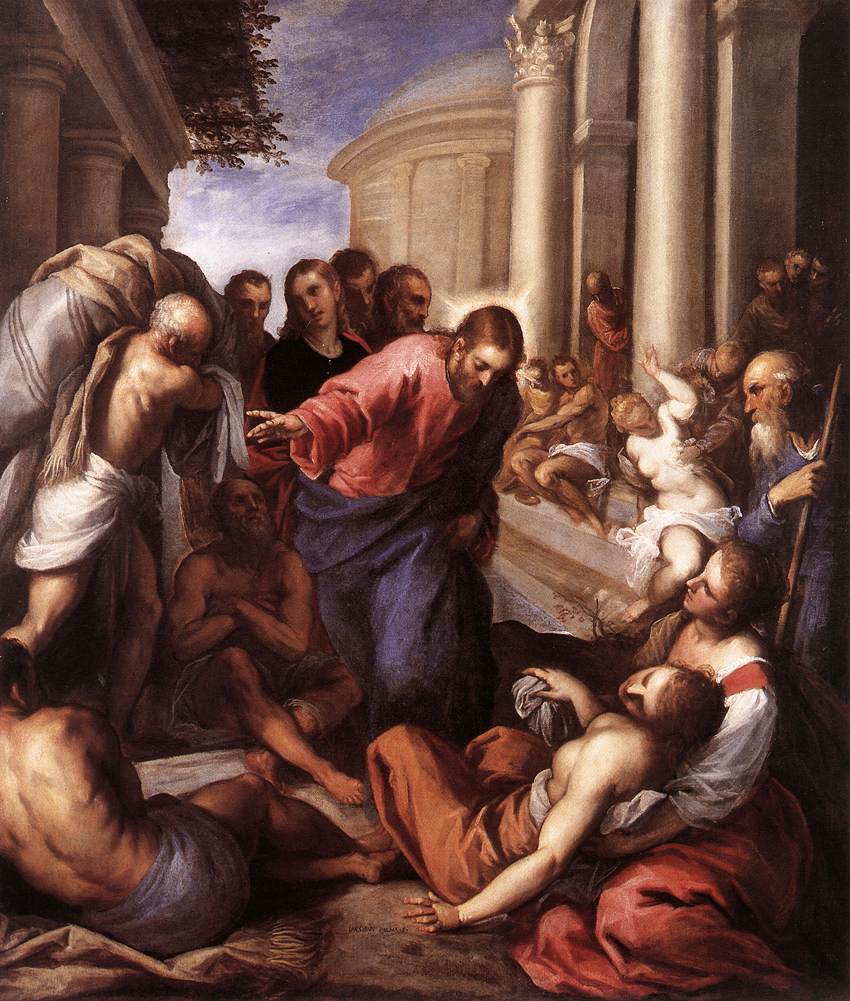
Today I’d like to reflect further on the Gospel reading from today’s Mass (Thursday of the 13th week of the year). It tells the story of the paralyzed man whom Jesus tells to have courage because his sins are forgiven.

In one sense this is a rather peculiar response to a paralyzed man: Jesus looks at him and says, “Courage, child, your sins are forgiven.” Now we might be tempted to tap Jesus on the shoulder and say, “Excuse me, Lord, but this man is paralyzed. His problem is paralysis; that’s what he needs healing for!” (The Pharisees and scribes get all worked up for a different reason: they don’t think that Jesus has the authority to forgive sins.)

Of course, Jesus is neither blind nor lacking in intelligence. Unlike us, however, when Jesus looks at the man he does not consider paralysis to be the most serious problem. To Jesus, the man’s biggest issue is his sin.

Living as we do in this world, most of us have the world’s priorities. The Lord sees something more serious than paralysis, while we wonder what could possibly be more serious than paralysis! But not as man sees does God see. For God, the most serious problem we have is our sin. We don’t think like this even if we are told we should think like this.

Influenced by the flesh as we are, most of us are far more devastated by the thought of losing our health, or our money, or our job, than we are by the fact that we have sin. Threaten our health, well-being, or finances, and we’re on our knees begging God for help. Yet most people are far less concerned for their spiritual well-being. Most of us are not nearly so devastated by our sin (which can deprive us of eternal life) as we are by the loss of our health or some worldly possession.

Even many of us who have some sense of the spiritual life still struggle with this obtuseness and with misplaced priorities. Even in our so-called spiritual life, our prayers are often dominated by requests that God fix our health, improve our finances, or help us to find a job. It is not wrong to pray for these things, but how often do we pray to be freed of our sins? Do we earnestly pray to grow in holiness and to be prepared to see God face-to-face? Sometimes it almost sounds as if we are asking God to make this world more comfortable so that we can just stay here forever. This attitude is an affront to the truer gifts that God offers us.

So it is that Jesus, looking at the paralyzed man, says to him, Your sins are forgiven. In so doing, Jesus addresses the man’s most serious problem first. Only secondarily does He speak to the man’s paralysis, which He almost seems to have overlooked in comparison to the issue of his sin.

We have much to learn about how God sees and about what are the most crucial issues in our life.

Joseph and Mary were told to call the child “Jesus” because He would save the people from their sins. In his book Jesus of Nazareth: The Infancy Narratives, Pope Benedict XVI writes,

Joseph is entrusted with a further task: “Mary will bear a son, and you shall call his name Jesus, for he will save his people from their sins” (Matthew 1:21). … On the one hand, a lofty theological task is assigned to the child, for only God can forgive sins. So this child is immediately associated with God, directly linked with God’s holy and saving power. On the other hand, though, this definition of the Messiah’s mission could appear disappointing. The prevailing expectations of salvation were primarily focused upon Israel’s concrete sufferings—on the reestablishment of the kingdom of David, on Israel’s freedom and independence, and naturally that included material prosperity for this largely impoverished people. The promise of forgiveness of sins seems both too little and too much: too much, because it trespasses upon God’s exclusive sphere; too little, because there seems to be no thought of Israel’s concrete suffering or its true need for salvation.

Benedict then cites the story of the paralytic and comments,

Jesus responded [to the presence of the paralyzed man] in a way that was quite contrary to the expectation of the bearers and the sick man himself, saying: “My son, your sins are forgiven” (Mark 2:5). This was the last thing anyone was expecting; this was the last thing they were concerned about.

The Pope Emeritus concludes,

Man is a relational being. And if his first, fundamental relationship is disturbed—his relationship with God—then nothing else can be truly in order. This is where the priority lies in Jesus’ message and ministry: before all else he wants to point man toward the essence of his malady.

Yes, God sees things rather differently than we do. There is much to ponder about the fact that Jesus said to the paralyzed man, Your sins are forgiven.

>

Unmoored Freedom is No Freedom – A Reflection on the 4th of July

To most modern minds, freedom is a very detached concept; it is an abstraction of sorts, a free-floating power unmoored from any limits or defining standards. Freedom today is often viewed as personal and self-referential, with little consideration as to how one’s “freedom” might affect that of someone else. A healthy sense of the common good suffers mightily in a world of deeply conflicting personal freedoms.

I have written before on the paradoxes of freedom and will not repeat all of that here, but one point to reiterate is that for us (who are limited and contingent beings) the only true and healthy freedom is a limited one.

I was free to write this column and you are free to read it, but for shared communication to occur, we must each limit our respective personal freedom by following certain rules. I had to post the article in the expected place and you had to go there to read it. I had to follow many grammatical and linguistic rules in order to be intelligible, and you must apply similar norms in order to understand. As soon as either of us starts to cop an attitude and say, “I won’t be told what to do; I’ll do whatever I please,” communication suffers. Therefore, each of us limits his freedom in order to communicate.

Another example can be found in the realm of sports. Rules, in a sense, make the game. The players and spectators limit their freedom by accepting that a given game has a specific goal. Further, there are boundaries and rules of play. If some or all of these limits were removed, there would be no framework. Players would start moving aimlessly about the field and teams would break apart. Spectators would argue about everything and even forget why they were in the stadium to begin with. All order on the field and in the stands would break down; even the distinction between the field and the stands would start to lose meaning. Chaos and conflict would result.

To some degree this picture describes our modern age. Cultures, like the microcosm of a sports event, need agreed upon goals and rules of play in order to function properly. In the modern Western world, we are currently engaged in a misguided experiment as to whether a culture can exist without a shared cultus.

Obviously, the word cultus is at the heart of the word culture. In Latin, a cultus is something for which we care or about which we are concerned; it is something of worth, something considered valuable. It describes the most central, fundamental values of a group. In later Latin, cultus came to describe the worth or value we attribute to God, who is our truest goal.

Remove the cultus from culture and you get the breakdown we are seeing today. While pluralism and diversity have value, they must exist within a framework that is shared and agreed upon. Otherwise pluralism and diversity are unmoored and become like ships crashing about in a stormy bay.

In order for a culture to exist, there must be a shared cultus, a shared focus on what is good, true, beautiful, and sacred. Our modern experiment shows the failure of trying to have a culture without this.

Bishop Robert Barron, himself commenting on Pope Benedict’s analysis, writes the following:

The setting aside of God can take place both explicitly (as in the musings of the atheists) or implicitly (as in so much of the secular world where “practical” atheism holds sway). In either case the result is a shutting down of the natural human drive toward the transcendent and, even more dangerously, the elevation of self-determining freedom to a position of unchallenged primacy.

[Pope Benedict elaborates] here a theme that was dear to his predecessor, namely, the breakdown of the connection between freedom and truth. On the typically modern reading, truth is construed as an enemy to freedom—which explains precisely why we find such a hostility to truth in the contemporary culture. Indeed, anyone who claims to have the truth—especially in regard to moral matters—is automatically accused of arrogance and intolerance.

Society will be restored to balance and sanity, Benedict argued, only when the natural link between freedom and truth—especially the Truth which is God—is reestablished. … Behind all our arguments about particular moral and political issues is a fundamental argument about the centrality of God [Vibrant Paradoxes, pp. 217-218].

Thus, freedom cannot be an abstraction. It cannot be unmoored. It is not an unlimited concept. Freedom can only exist in a healthy and productive way when it is in reference to the truth—and truth is rooted in God and what He has revealed in creation, Sacred Scripture, and Tradition. This is the cultus necessary for every culture. True and healthy freedom is the capacity to obey God. Anything that departs from this necessary framework is a deformed freedom, on its way to chaos and slavery.

The more one does what is good, the freer one becomes. There is no true freedom except in the service of what is good and just. The choice to disobey and do evil is an abuse of freedom and leads to “the slavery of sin” (Catechism of the Catholic Church, 1733).

>

Two Stories About Detachment

It is common to think of detachment as something the poor easily have and the rich seldom have. Whatever the statistics on detachment as related to wealth, it is certainly true that there are some poor folks who are greedy attached to this world’s riches, while there are some rich people who are quite generous and unattached to the possessions their wealth affords.

Two stories come to mind. I do not recall the sources, and I have likely adapted them over the years. They speak to the difficulty of maintaining a healthy detachment from material wealth regardless of one’s financial health.

A wandering monk moved about preaching. He owned only the clothing on his back and, strangely, a golden begging bowl, gifted to him by a benefactor who was also his disciple. One night as he was about to lie down among the ruins of an ancient monastery he spied a thief, lurking among the columns. “Here, take this,” he said, handing the golden begging bowl to the thief. “That way you won’t disturb me once I have fallen asleep.” The thief eagerly took the bowl and ran off. But the next morning he returned, saying, “You have made me feel poor, giving me the bowl so freely. Teach me to acquire the riches that make this sort of lighthearted detachment possible.”

* * * * * * * * * * * * * * * * * * * * * *

Among the wandering shepherds was a leader who lived in riches, with luxurious tents, surrounded by servants. So lavish was his wealth that his tent pegs, driven in the ground, were made of solid gold. A poorer shepherd came by one day with his wooden begging bowl, cracked and warped. Seeing such wealth, he begged from the wealthy man but also upbraided him for such conspicuous wealth. Nevertheless, the wealthy man welcomed him, served him a fine meal, and permitted him to rest in his expansive tents. Early the next day the wealthy man said to the poorer one, “Come, let us go up to Jerusalem.” Staff in hand, the wealthy man left his wealth and luxury behind without a thought or care. A short way into the journey the poor man realized that he had left his wooden begging bowl behind and wanted to go back and get it. But the rich man said, “I left all my wealth behind without care or worry. Yet you are so attached to a cup of little or no worth that you cannot go up to Jerusalem without it. You upbraided me for my wealth, but I want to assure you, the golden tent pegs to which you objected were driven into the earth, not into my heart.”

Yes, detachment is ultimately a matter of the heart. It is not wrong to enjoy the good things of life, but too often they possess us, and we come rely on them so heavily that we cannot imagine living without them. We who live in these times of widespread comfort sometimes discover that we lack the freedom to live without them. Further, though surrounded by abundance, we see to be more fearful, not less. Though this age is filled with luxuries and creature comforts, we seem more anxious than ever; we just have too much to lose. The tent pegs that belong in the earth are so often driven into our heart.

St. Paul describes the grace we should seek:

I have learned to be content regardless of my circumstances. I know how to live humbly, and I know how to abound. I am accustomed to any and every situation—to being filled and being hungry, to having plenty and having need. I can do all things through Christ who gives me strength (Phil 4:11-13).

Without this grace, it is clear how quickly our hearts enter bondage and we go astray. Help us, Lord, to enjoy what you have given but not so much that it becomes a substitute for you. May trust and gratitude be our guide to detachment.


Two Teachings on Discipleship from Jesus

In the Gospel for today (Monday of the 13thWeek of the Year) Jesus gives two teachings on discipleship. They are not easy, and they challenge us—especially those of us who live in the affluent West.

Poverty– The text says, As they were proceeding on their journey someone said to him, “I will follow you wherever you go.” Jesus answered him, “Foxes have dens and birds of the sky have nests, but the Son of Man has nowhere to rest his head.”

Here is a critical discipline of discipleship: following Jesus even if worldly gain not only eludes us but is outright taken from us.Do you love the consolations of God or the God of all consolation? Do you seek the gifts of God, or the Giver of every good and perfect gift? What if following Jesus gives you no earthly gain? What if being a disciple brings you ridicule, loss, prison, or even death? Would you still follow Him? Would you still be a disciple?

In this verse, the potential disciple of Jesus seems to have had power, prestige, or worldly gain in mind. Perhaps he saw Jesus as a political messiah and wanted to get on the “inside track.” Jesus warns him that this is not what discipleship is about. The Son of Man’s kingdom is not of this world.

We need to heed Jesus’ warning. Riches are actually a great danger. Not only do they not help us in what we really need, they can actually hinder us! Poverty is the not the worst thing. There’s a risk in riches, a peril in prosperity, and a worry in wealth.

The Lord Jesus points to poverty and powerlessness (in worldly matters) when it comes to being disciples. This is not merely a remote possibility or an abstraction. If we live as true disciples, we are going to find that piles of wealth are seldom our lot. Why? Well, our lack of wealth comes from the fact that if we are true disciples, we won’t make easy compromises with sin or evil. We won’t take just any job. We won’t be ruthless in the workplace or deal with people unscrupulously. We won’t lie on our resumes, cheat on our taxes, or take easy and sinful shortcuts. We will observe the Sabbath, be generous to the poor, pay a just wage, provide necessary benefits to workers, and observe the tithe. The world hands out (temporary) rewards if we do these sorts of things, but true disciples refuse such compromises with evil. In so doing, they reject the temporary rewards of this earth and may thus have a less comfortable place to lay their head. They may not get every promotion and they may not become powerful.

Thus “poverty” is a discipline of discipleship.What is “poverty”? It is freedom from the snares of power, popularity, and possessions.

Jesus had nowhere to rest his head. Now that is poor. However, it also means being free of the many obligations and compromises that come with wealth. If you’re poor no one can steal from you or threaten take away your possessions. You’re free; you have nothing to lose.

Most of us have too much to lose and so we are not free; our discipleship is hindered. Yes, poverty is an important discipline of discipleship.

Promptness (readiness)The text says, And to another he said, “Follow me.” But he replied, “Lord, let me go first and bury my father.” But he answered him, “Let the dead bury their dead. But you, go and proclaim the kingdom of God.”

The Lord seems harsh here. However, note that the Greek text can be understood in the following way: “My Father is getting older. I want to wait until he dies and then I will really be able to devote myself to being a disciple!”

Jesus’ point is that if the man didn’t have this excuse, he’d have some other one. He does not have a prompt or willing spirit. We can always find some reason that we can’t follow wholeheartedly today because. There are always a few things resolved first.

It’s the familiar refrain: I’ll do tomorrow!

There is peril in procrastination. Too many people always look to tomorrow. But remember that tomorrow is not promised. In Scripture there is one word that jumps out repeatedly; it’s the word now. There are many references to the importance of now or today rather than tomorrow:

  • Come now, and let us reason together, saith the LORD (Isaiah 1:18).
  • behold, now is the day of salvation (2 Cor 6:2).
  • Today if ye will hear his voice, Harden not your heart (Ps 95:7).
  • Boast not thyself of tomorrow; for you know not what a day may bring forth (Prov 27:1).

That’s right, tomorrow is not promised! You’d better choose the Lord today because tomorrow might very well be too late. Now is the day of salvation.

There is an old preacher’s story about delay: There were three demons who told Satan about their plan to destroy a certain man.The first demon said, “I’m going to tell him that there is no Hell.” But Satan said, “People know that there’s a Hell and most have already visited here.” The second demon said, “I’m going to tell him that there is no God.” But Satan said, “Despite atheism being fashionable of late, most people know, deep down, that there is a God, for He has written His name in their hearts.” The third demon said, “I’m not going to tell them that there’s no Hell or that there’s no God; I’m going to tell them that there’s no hurry.” And Satan said, “You’re the man! That’s the plan!”

Yes, promptness is a discipline of discipleship. It is a great gift to be sought from God. It is the gift to run joyfully and without delay to what God promises.

Here are two disciplines of discipleship. They are not easy, but the Lord only commands what truly blesses. There is freedom in poverty and joy in quickly following the Lord!

<p class=”videowrapper”><iframe width=”560″ height=”315″ src=”https://www.youtube.com/embed/kgM1Df76S5c” frameborder=”0″ allow=”autoplay; encrypted-media” allowfullscreen></iframe></p>

Pondering Isaiah’s Advice to Close Our Eyes Lest We “Look on Evil”

In this age of nearly instantaneous communication, there is an overwhelming amount of news and information available to us. There is nothing wrong with news and information, but each of us must decide how much exposure, in terms of time and content, is good for us. Not all “Breaking News!” is really that urgent. Too much news can distract us, overwhelm us, and provoke anxiety and anger. Further, the “news” is heavily filtered to feature what is bad, strange, unusual, violent, and dangerous. It does not represent the reality most of us live in nor is it something on which we should be focused. Frankly, most of us lead routine and “boring” lives. This doesn’t make for riveting news, but it is more representative of our lives.

In such an environment, we do well to hear and heed an admonition of Isaiah, who describes the just person in this way:

He who practices virtue and speaks honestly,
who spurns what is gained by oppression,
brushing his hands
free of contact with a bribe,
stopping his ears lest he hear of bloodshed,
closing his eyes lest he look on evil.

He shall dwell on the heights,
his stronghold shall be the rocky fastness,
his food and drink
in steady supply
(Isaiah 33: 14-16).

Note especially this part: stopping his ears lest he hear of bloodshed, closing his eyes lest he look on evil. While it is not possible to avoid all exposure to bloodshed and evil, it is surely advisable to avoid unnecessary exposure to it lest we become desensitized to it or unnerved by it.

Obviously, we should avoid movies and video games with gratuitous violence, but we should also limit our exposure to a steady stream of news that emphasizes violence, conflict, controversy, excess, and aberration. Many news programs today feature panels who engage in endless debate, even to the point of yelling, and who say more and more about less and less.

There is also a lot of sinful curiosity and voyeurism involved. Everyone has personal struggles—even tragedies—but the cameras don’t need to be rolling and public displays made of them. Talk shows traffic in this sort of material; people are invited on to share what should remain private, and viewers, indulging in a kind of sinful curiosity, willingly consume the sad display.

Sadly, this bleeds over into news coverage as well, where every sort of strange psychological, addictive, compulsive, and dysfunctional behavior is trotted out for our consumption. The overall effect is to normalize bad or dysfunctional behavior, exaggerate its extent in the population, and make a public spectacle of it. All of this serves to desensitize us to its sinful, even tragic, roots.

We have gradually shifted from being informed to “look[ing] on evil” and “hear[ing] of bloodshed.” The loss of life implied by bloodshed is more than physical death; there is a great deal of spiritual death in our culture as well.

If viewing this public spectacle of sin, confusion, and death led us to deeper prayer and a commitment to working harder to speak the truth in love, perhaps it would be a more tolerable change. Unfortunately, there is little evidence of this even among committed Christians.

Therefore, the advice of Isaiah should be heeded. We should we actively limit our exposure to this spectacle, closing our eyes lest we “look on evil” and stopping our ears lest we “hear of bloodshed.”

There is some need to stay informed, but we should limit our exposure. Reading the news may be better than viewing it; one can skim the headlines and read further only if necessary. We don’t need to know as many details as we think we do. Staying informed at a general level is adequate for most of us.

Stepping back from the spectacle and from the steady diet of the dysfunctional and the tragic will give us greater serenity so that we can pray, which is a better gift to the world than our being merely informed.

St. Paul give the following advice:

Finally, brothers, whatever is true, whatever is honorable, whatever is right, whatever is pure, whatever is lovely, whatever is admirable—if anything is excellent or praiseworthy—think on these things. Whatever you have learned and received and heard from me, and seen in me, put these things into practice. And the God of peace will be with you (Phil 4:8-9).

Being serenely at peace, connected to God, able to pray, and growing in virtue are much better solutions for the problems of our day than is knowing all the gory details. Be careful what you read and listen to each day. There is a place and time to close our eyes lest we look on evil and stop our ears lest we hear of bloodshed.