I Wonder If We Forgot Something Important

I was busy Saturday….A wedding and later another Mass….So I didn’t get to see wall to wall coverage of the funeral for Senator Edward Kennedy. So… I may have missed something and you will correct me if I’m wrong. But here is my question: Did we pray for the happy reposeof his soul? As I went back and forth preparing this and that I saw parts of the funeral on TV. Surely I heard lots of praise for Mr. Kennedy. But did we pray or merely praise? Particularly alarming were the intercessory prayers of the congregation where the congregation prays for the deceased. They were directed not to Mr. Kennedy’s reposeor to the dead in general but rather to praise of his vision and the prayers for various causes. Not wrong per se but out of place at a funeral Mass at the very time we should be praying for the happy repose of of the deceased. Did we pray?

When I die please promise me that you’ll pray for me. You see, I’ll  have a journey to make. I have an appointment to keep. The scriptures all say it but we like to ignore it:

  1. Therefore, we aspire to please him, whether we are at home or away. For we must all appear before the judgment seat of Christ, so that each one may receive recompense, according to what he did in the body, whether good or evil.  (2 Cor 5:10-11)
  2. For we shall all stand before the judgment seat of God; for it is written: “As I live, says the Lord, every knee shall bend before me, and every tongue shall give praise to God.” So then each of us shall give an account of himself to God. (Rom 14:10-11)

So when we die we are judged. We ought to pray a lot for those who have died. It is an awesome thing to go to God and to render and account. We who remain behind ought to offer heartfelt prayers for the faithful departed. And so I must indicate so frustration with many Catholic Funerals I have observed, both televised and not. Too often there are bold proclamations of how the deceased is in heaven now, in a better place, etc. Confidence in God’s mercy is good, but to completely ignore the  judgment that Scripture promises and make no mention of it is poor pastoral practice and robs the dead of the prayers they are due.

Consider this, what if I were to say at a funeral “John Jones is in Hell and there’s no use praying for him.” Now you would be rightfully angry and tell me that I was “judging him.” And you would be right. I would be making a judgement I had no right to make. But don’t you see, if I say “John Jones is in heaven now” and do not ask you to pray, that I am sitting in the very same judgement seat and making a judgment that is NOT mine to make?

“But Father, but Father….What about confidence in God’s mercy and joy?”  These are fine and have their place but they should be balanced with a sober appreciation that the dead can use our prayers. AND I actually HAVE God’s mercy in mind when I say we ought to pray for the dead who go to judgement. Remember, God has made a promise to us that when he was finished with us that we would be perfect as the heavenly father is perfect (Matt 5:48) Now are you there yet? What if you died today? Do you think the Lord will leave his work undone in you? That’s not very merciful. St. Paul wrote to the Philippians, “May God who has begun the good work in you bring it to completion.” (Phil 1:6) God is faithful to the promises he has made and he will not leave anything undone in us. But again let me ask you, if you died today are you perfect yet? You know you’re not. We all fall short of the glory of God (Rom 3:23). All of us are carrying things in us that we cannot bring to heaven. Not just our sins, but also sorrows, regrets, painful memories and hurts. You know you can’t bring this stuff to heaven, it wouldn’t be heaven! So the Lord has to purge these things from us.  Maybe that is what Scripture means when it says of the dead that Jesus will wipe every tear from their eyes (Rev 21:4).

Hence, when we die we are judged by God. But the judgement is not just between heaven and hell but as to whether Jesus’ work is complete in us yet. If it is not he will see that it is brought to completion. Here is the Catholic Dogma of Purgatory. It is purgatory where we let go of things for the last time, where we have tears wiped from our eyes and we have false notions corrected and where we shed the final vestiges of the world. Does it take tiem? How long? I don’t know. What is time even like after we leave this world and if there is the passage of time there, how does it square up with our assage of time? I don’t know. Just pray. Our beloved dead can use our prayers.

So, when I die, will you pray for me? Don’t talk too much at my funeral about what a great guy I was, only God is good. Don’t make silly statements about how I’m up there leading the music in heaven. Just pray because I’m probably, off to purgatory and could use your prayers. If I died today (not planning on it) I know I’d  have some tears to be wiped from my eyes, some rough edges to my personality that need smoothing, some intellectual misunderstandings to be set right, some attachments to be freed of. I cannot judge myself, but applying Catholic doctrine to my situation it’s looks like I’d be bound for purgatory. So pray.

Finally let me ask you again, in the funeral rites yesterday for Senator Kennedy did you pray? Did WE pray? Oh, I know we said the usual prayers in the ritual. But honestly, things seemed more than a little out of balance to me. Celebrate what is good? Sure. But Edward M Kennedy shares the human condition and we all fall short of what God has in store. I am not his judge, but I can pray. If he is like me, purgation may well be necessary. I don’t know what sins or hurts he brought to the grave with him. But he did go to judgement and we ought to pray. And yes, I’ll mention the unmentionable: he was wrong on abortion and several other Catholic Moral teachings. Where we are wrong, the Lord needs to set us right. Mr. Kennedy was right on other moral issues and the Lord can grant reward for that as well.  But just pray. Pray for him and all your beloved dead. Our modern understanding  of death needs to come back to a proper focus: hope and confidence in God’s mercy? Yes! But balanced with a sober appreciation of judgment that awaits us all.


Love doesn’t die!

images

Last week, I was riding METRO with nothing to read and so I found myself listening in on the conversations around me. One conversation caught my attention immediately. Two young adults were discussing the practice of building shrines in the family home to honor ancestors. One friend asked the other if he would do this in his home and he said “no, because I don’t  believe in any kind of life after death. ” His friend responded,” how can you not believe in life after death, you have to believe that!”

The young man asked, “Do you believe in something like heaven because you think you have to or because you really believe?”

Do you think you have to believe?

This is such a great question. We grow in our faith, we experience deeper conversion when we continue to ask ourselves not only what we believe but why we believe.  My experience in sharing my faith is that people are really interested in knowing why we believe even more than what we believe.  Do we have good answers for the difference what we believe makes in our own lives?  I was stopped in my tracks one night at RCIA when a woman asked me to share from my own experience why I believe the Eucharist is really the body of Christ. She even said “don’t use any of your theological words, just tell me why you believe it is!”

Back to my story

So, the friend, when confronted with the question about why she believes in life after death said, “I think there is life after death because love doesn’t die.” I thought to myself, well, that is exactly what God thinks!

Seeing is NOT Believing

Some people say that if they could see they would believe. But seeing is not believing, seeing is only seeing.

Consider the video just below. It looks like a miracle before your very eyes. Is it a miracle or just some fancy illusion. Most people even upon seeing what looks like it can only be a miracle usually conclude that it is a trick or that there is “some way they do that.”

Now remove these magicians in the video and go with me back in time as Jesus works a miracle. Presume for a moment that you’ve never met Jesus or heard of him. Yet watch him cast out blindness or enable a paralyzed man to walk. Is it a miracle, or is it a clever trick? Should you really beleive his claims to be from God and to be God based on these wonderful works? Has Jesus staged this well or is he really the Son of God? You see? It still takes faith doesn’t it? You just can’t substitute for faith, it is an absolute requirement to accept who Jesus is. Miracles can help but seeing is not believing, it’s only seeing. In the end you have to decide: fancy trick or real miracle? Son of God or just a skilled illusionist?

Watch this video and see what look like real miracles before your very eyes. But pay attention to what your mind does and how quickly you can dismiss the visual evidence. Seeing even fantastic things just isn’t enough. In this case they likely are not miracles, just very well done illusions. But many saw  Jesus work wonders which relly were miracles and it was not enough. You have to have faith. In other words, some people think if only God would work miracles in their life, they could believe. But miracles alone cannot bring faith because seeing is not believing it is only seeing.

Cumulative evidence can bring us to accept God’s existence as a reasonable proposition but only faith can really lead us to believe all that God has said. Pray for faith and you will see miracles, and more!

Faith is the realization of what is hoped for and evidence  of things not seen (Hebrews 11:1)

Why are you Cheering?

so-you-think-you-can-danceLast week I watched the finale of So You Think You Can Dance which my sister had recorded for me. Explosive. Extraordinary. And a bit disturbing.

I’m speaking of Mia Michaels’ dance to Sara Bareilles’ song “Gravity” which displays a man physically and sexually abusing a woman: throwing her on the ground, seizing her body, and even strangling her.

http://www.youtube.com/watch?v=ikOQFplkmCU

Now someone might say, “Wait Laura, Mia Michaels intended it to be about addiction, not abuse.” To this I would respond in the words of the great choreographer George Balanchine who said, “You put a man and woman onstage together, and it’s already a story.” While she may have intended a piece about addiction, what we saw was physical and sexual abuse.

I wasn’t disturbed so much by the dance itself (I can appreciate realism in art), but by the audience’s reaction to it. The audience erupted into applause and cheering both in the middle of the piece (at a point where sexual abuse was most strongly implied) and at the end of the piece.

Certainly the dancers did a phenomenal job and are to be commended for their discipline and artistry. But I want to contrast this to Tyce Diorio’s dance about a woman with breast cancer. This dance elicited tears from audience and judges alike because of the personal subject matter and tragedy of losing a life to breast cancer.

But isn’t the subject matter in Mia Michaels’ dance just as personal, and isn’t losing a life to abuse (or addiction) just as tragic? Why did his dance elicit tears while hers elicited applause and cheering?

What’s my point?

My point is to ask ourselves, How do we respond when we are shown images of abuse against women and men who are made in the image and likeness of God? How do we respond to art that portrays abuse? How to we respond to degrading comments or crude jokes? How do we respond when we start to suspect that a friend is in an abusive relationship?

Let’s take a moment to pray for those in abusive relationships as well as for those suffering from addictions.

I am in pain and distress; may your salvation, O God, protect me. Psalm 69:29

Having a Diversity of Friendships

business_diversity_469779This is a second excerpt from Dr. Katherine Yohe’s lecture at the Office of Young Adult Ministry’s Relationship Speaker and Discussion Series. The first may be found here: What is Christian Friendship?

Occasionally I have read authors who have stressed similarity as part of their definitions of friendship (namely, Cicero and Aristotle). If two people are very similar, friendships can form quicker and are easier to maintain. The very ease of these friendships make them a great gift in our lives. But Christians can still be friends when such natural similarities are lacking.

I was recently reading Tom Rath’s book, Vital Friendships, where the author argued that we should never expect any one friend, including a spouse, to meet all our needs. Rather, we should look to build many friendships with people having different temperaments, perspectives, abilities, and talents. For example, some friends will be better at encouraging and motivating us, others at challenging us and opening our minds to see things differently, and others at working along side us. These friendships take longer to form, but can be very enriching as we explore new areas of study, have our assumptions challenged, gain new insights, and enjoy new types of music, art, movies, or food.

St. Paul’s description of the Body of Christ points in a similar direction. While friends in Christ need to have some things in common – such as their commitment to Christ and Christian morals and values – there is plenty of room for diversity. The Spirit unites people of different incomes, places in the social strata, cultures, nationalities, and ages. The Spirit gives different gifts to different members so that together they make up the full body of Christ (Rom. 12:1-8). St. Catherine of Sienna even thought that God gave different people different chief virtues so that we would we need to be in relationship with each other in order to develop all the virtues.

Because Christian friendships are soldered together in the Spirit, anything we do to draw closer to God will in turn strengthen our friendships. Pray for strength, wisdom, and patience. Study Scripture to learn the character of Christ and how he related to his friends. Make use of sacramental graces to unite with Christ and be transformed by Him. The more our friendships are formed by the Spirit, the more these friendships will help us unite even more deeply with God who is Love.

What virtue in one of your friends do you most want to develop? How can your friendship support this development?

Rediscovering the Presence of God

The times in which we live are often described as “secular.”  This word comes from the Latin “saecula” meaning “world.” Hence our modern age is quite worldly. We may think it has always been so but such is not the case. To be sure, it IS the human condition to be a little preoccupied with ourselves. But previous times have featured a much more religious focus than our own. The Middle Ages were especially known for way in which faith permeated the culture and daily experience. The Rose window to the right presents a typically Medieval Notion: Christ (the Lamb of God) at the center and everything surrounding Him. In those days the holidays were the HOLYdays and one’s understanding of the calendar and the time of year centered around the Church’s calendar of saints and feasts. It wasn’t Winter it was advent, and then Christmastide. Even the word Christmas was ChristMASS. Halloween was the “Een (evening before) all Hallows (All Saints Day). Three times every day the Church bells rang the “Angelus” calling Catholics to a moment of prayer in honor of the incarnation. The Bells also rang summoning Catholics to Mass and vespers. In a previous article in this blog (By Their Buildings You Will Know Them) it was noted that even the architecture of the Middle Ages placed a large church at the center of every town: Those days were not perfect days but they were more spiritual and the Christians everywhere were constantly reminded of the presence of God by the culture in which they lived. Seldom so today. Many people today almost never hear of God on a day to day basis.  

But the truth is, God is everywhere. He indwells his creation and sustains every aspect of it. The Scriptures say that Jesus hold all creation together in himself (Col 1:17). Most people think of creation as a sort of machine or closed system in which we live. But that is not the case. Creation is a revelation of and experience of God’s love and providence. Not one leaf falls to the ground without God leading it there. Not one hair of our head is unknown and provided for by God. We are enveloped by God, caught up into his presence.

It is especially sad for young people today. Some of us who are a bit older remember a time when God was more recognized. I remember that we prayed every day in my PUBLIC school until I was in 6th grade. I remember my 4th grade teacher often reminding me when I got out of line: “God is Watching!” I remember when Christmas (not “winter holidays”)  in School was actually celebrated and that we sang religious songs even in public school well into my High School years. I remember our public high school choir singing “O Come All Ye Faithful” and many songs with religious subjects. Can you imagine a public school choir singing today “O let us adore Him, Christ the Lord”  ?  Gone are the days.

But we need to teach and help our young people get in touch with God’s presence.  The culture today will seldom help them. Deacon Curtis in the post below has encouraged us to return to “public displays of affection” for God along with other things such as grace at meals. It is essential, as our world becomes even more secular,  to intentionally “put”  God in our day. There is a website  LIFE AFTER SUNDAY that is dedicated to assisting in this very thing. I recommend it to your attention.

Here too is a video for young people reminding them that God is near, not far. It’s a toe-tapper with a message:

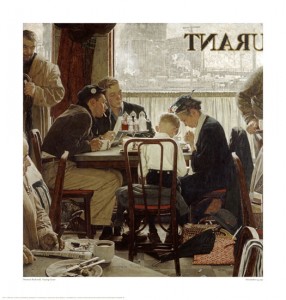
The sign of the cross and other”public displays of affection”

saying-grace

The greatest commandment

Christ said that the greatest commandment is, “You shall love the Lord, your God, with all your heart, all your soul and all your mind.” (Matthew 22:36)  One of the ways we express our love for anyone or anything is with public displays of affection.

Examples of Catholic public displays of affection

As Catholics, our church’s tradition has been blessed with several ways for others to know we are disciples of Christ. The crucifix, the image of the suffering Christ, is decidedly Catholic.  Hanging it in our home or in our office is a public display of affection for God. Certainly our honoring of Mary, the Mother of God, in our prayer life, our jewelry and even for some of us, body art, is a visible sign of our discipleship in Christ. In ecumenical groups, others know that we are Catholic Christians because we visibly remind ourselves, and others, of our common baptism through the sign of the cross.

We have greetings that are in common – “The Lord be with you – And also with you.” We can go almost anywhere in the world and know that we are among fellow Catholics through our public displays of affection for God and his only son, Jesus Christ.

Don’t be afraid, be proud

I submit to you that Catholics have built into our religious culture a strong desire to let everyone know that we are disciples of Christ. But at times, we suppress that part of our religious culture. And this is a shame. It is the shared traditions that I described above that invite us to love one another.

How many of us say grace regularly at home yet, feel self-conscience about praying at a restaurant? And if we pray, do we omit a visible sign of the cross for fear of drawing attention to ourselves? If so, why?
We are taught by polite society that public displays of affection are at times inappropriate. But, I submit to you that a public display of affection for our God and for our fellow Christians is always appropriate!

How else will people know that we are disciples of Christ!  They will know us by our love and affection for God!

Sharing your faith in common conversations


“I am blessed and highly favored!”

I have a very close friend who is very friendly and outgoing. She is often the first to say hello to a stranger and greets all who come into her presence with a smile and maybe even a hug. However, she gets easily frustrated by what she calls, “mediocre Christian responses” to her greetings. I have learned to share in this frustration because its source should be obvious.  However, it is subtle and hidden.

Here is an example of a mediocre Christian response: When asked, “How are you doing today?” it is common for us to reply, “I am OK” or “hanging in there.” That is a mediocre Christian response. If we are made in the image and likeness of God, then we have to be doing better than “OK.” The Evangelist Matthew tells us that God cares even for the sparrow and therefore, he is deeply concerned for us. (Matthew 10:29). So, we have to be doing better than “Hanging in there.”

My close friend is so deeply bothered by these mediocre Christian responses that she refuses to give any herself. In fact, when asked, “How are you doing?’ she most often says, “Blessed and highly favored!” Even if she is having a bad day, she is blessed and highly favored by God and does not mind saying so.

Last fall during a homily, I challenged members of my parish to avoid mediocre Christian responses. I challenged them to respond to a greeting from each other and even those outside of church with a proclamation of God’s goodness and love. When asked, “How’s it going?” try saying something like, “God loves me, so it’s going great.” I challenged my brothers and sisters to do this because, I had already given this a try and I found, it really works. I tried it at my school. I tried it with my family and neighbors. I even tried it in the grocery store at the check-out counter. Each and every time, my answer was received with a least a smile if not a reciprocal affirmation of faith.

Even at the end of a conversation, rather than saying “good-bye” or “see you later”  we said, “God bless!” To date, no one has reported a negative response. No one got offended and no one rejected our good will. In fact, we often get a sincere, heart felt “Thank you” or “God bless you too!”

Brothers and sisters, Christ is everywhere and it is our calling to bring His presence and His grace to the attention of others. I challenge you, just as I challenged my parish, to avoid mediocre Christian responses and to remind yourself and others that you are indeed, “Blessed and highly favored!”

See you later – I mean – God Bless!