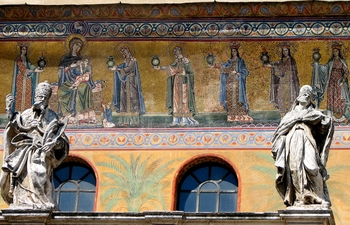
This is the screen saver on my computer at work. It is the facade of the Church of Santa Maria in Trastevere, in the Trastevere neighborhood in Rome. It depicts the women from Matthew’s Gospel and the story of the wise and foolish virgins (Matthew 25). The church sits in the middle of a bustling piazza and so it looks as if the women are carrying is right into the middle of life in the piazza. The Gospel story has an Advent feel to it because it reminds us that we know not the day or hour when our Lord will return and so we need to be alert and ready, looking for to walk right into the midst of our lives–here and now!
Limits and Promise
A few years ago I came across this poem by someone called T.J. O’Gorman of whom I know nothing other than this work which is an Advent favorite of mine.
What is it that really hold us in bondage? What is it that is truly the source of our problem, our sins, our selfishness, our anger, our lust and pride? Original Sin? Yes but where does the wound of sin really set up shop in us and stay open for business? What does it tap into for its strength? Scripture has an interesting answer to this question:
Since the children have flesh and blood, he too shared in their humanity so that by his death he might destroy him who holds the power of death—that is, the devil— 15and free those who all their lives were held in slavery by their fear of death. (Heb 2:14-15)
Now this passage is clear enough that the first origin of sin is the devil. But it also teaches that the devil’s hold on us is the “fear of death.” This is what he exploits to keep us in bondage. When I explore this teaching with people I find that it is difficult for many to understand at first. For many, especially the young, death is kind of theoretical. It is not something many people fear on a conscious level. Every now and then something may shake us out of our complacency (perhaps a brush with death) but as a general rule the fear of death is not something that seems to dominate the thoughts of many. So what is meant by the “fear of death” and how does it hold us in bondage?
Well, what if we were to replace the word “death” with “diminishment”? This can help us to see what this text is getting at. It doesn’t take long to realize that each diminishment we experience is a kind of “little death.” Diminishments make us feel smaller, less powerful, less glorious.
What are some examples of diminishments we might experience? At one level, a diminishment is anything that makes us feel less adequate than others. Maybe we think others are smarter, or more popular. Perhaps we do not feel handsome enough, pretty enough, we’re too tall, too short, too fat, wrong color hair. Maybe we hate that others are richer, more powerful, better spoken, better looking. Maybe we are older and wish we were younger and stronger, thinner and more energetic again. Maybe we are younger and wish were older, wiser, richer and more settled. Maybe we feel diminished because we think others have a better marriage, nicer home, better kids, or live in a better neighborhood. Maybe we compare ourselves to a brother or sister who did better financially or socially than we did.
Perhaps you can see how the fear of diminishment (the fear that we don’t compare well to others) sets up a thousand sins. It plugs right into envy and jealousy. Pride comes along for the ride too since we seek to compensate our fear of inadequacy by finding people whom we feel superior to. We thus indulge our pride or we seek to build up our ego in unhealthy ways. Perhaps we run to the cosmetic surgeon or torture ourselves with unhealthy diets. Perhaps we ignore our own gifts and try to be someone we really are not. Perhaps we spend money we really don’t have trying to impress people so we feel less adequate. And think of the countless sins we commit trying to be popular and fit in. Young people, and older ones too, give in to peer pressure and do sometimes terrible things. Young people will join gangs, use drugs, skip school, have sex before marriage, pierce and tattoo their bodies, use foul language, gossip etc. Adults too have many of these things on their list. All these things in a quest to be popular and to fit in. And fitting in is about not feeling diminished. And diminishment is about the fear of death because every experience of diminishment is like a mini death.
Advertisers too know how to exploit the fear of death (diminishment) in effectively marketing their product. I remember studying this in the Business School at George Mason University. What advertisers do to exploit our fear of diminishment is to actually diminish us. The logic goes something like this: you are not pretty enough, happy enough, adequate enough, comfortable enough, you don’t look young enough, you have some chronic illness (depression, asthma, E. D. diabetes) , etc. So use our product and you will be adequate again, you won’t be so pathetic, incomplete and basically diminished. If you drink this beer you’ll be happy, have good times and friends will surround you. If you use this toothpaste or soap or cosmetics, beautiful people will be around you and sex will be more available to you. If you drive this car people will turn their heads and so impressed with you. Message: you are not adequate now, you do not measure up, you are not perfect (you are diminished) but our product will get you there! You will be younger, happier, healthier and more alive. Perhaps you can see how all this appeal plugs into greed, pride, materialism, worldliness, and the lie that these things will actually solve our problem. They will not. In fact appeals like this actually feed our fear of diminishment and death even more because they feed the notion that we have to measure up to all these false or unrealistic standards.
OK, got the point? Fear of Death (diminishment) is the fundamental drive that keeps us in bondage. Now the text above says that Jesus died to free us from all this. So if freedom is available where do I find it? Let me recommend the following steps:
Recognize the demon, name it: “Fear of Death” or if it helps “Fear of Diminishment.” Learn its moves, tactics, hidden appeals (like we discussed above). And when you see the ugly little demon rebuke him in the name of Jesus.
Ask the Lord for the gift of gratitude; the gift to be grateful for what he has given you, how he has made you, the talents and abilities he equipped you with, the home, family and life he has granted.
Beg for the grace to experience that you are mightily loved by God. That you are unique and irreplaceable.
Watch less TV, draw back more from popular culture. Draw deeply from the font of Scripture and Catholic Tradition, read time-tested classics and edifying materials (like this blog ( 🙂 ).
Accept that there are people who have gifts you do not have. Pray for the gift to rejoice in their gifts and that the Lord can bless you through the gifts and talents of others. Realize that you have gifts others do not have and bless them with these gifts too.
Remember that we can only see the outward appearance of things. Often when we size other people up as having a wonderful life we don’t really know what we are talking about. Many people have hidden sorrows, sins and setback of which we know little.
Realize that you are going to die. But realize too that if we die in Jesus we are not diminished, we gain everything. Allow this understanding of physical death to be vision you have of every true diminishment, large or small. It is not ultimately death, it is humility. And without humility we will never get to heaven.
Perhaps you’ve read that something horrible happened in Washington State early Sunday Morning. Here is a brief press release:
PARKLAND, WA (KPLU) – A gunman killed four police officers at a Parkland area coffee shop Sunday morning. A massive manhunt is underway in Pierce County to find the shooter. The shooting happened at 8:15 a.m. at Forza Coffee on Steele Street South, near McChord Air Force Base. The four officers were with the Lakewood Police Department. They have been identified as Sergeant Mark Renninger and Officers Ronald Owens, Tina Griswold, and Greg Richards. The four were in full uniform, wearing bullet-proof vests. They were working on their laptops, beginning their day shifts, when the gunman entered the coffee shop and shot them at close range.
Police are seeking Maurice Clemmons, age 37, in connection with this case. Though there is little doubt that he is the killer, even if he is not it is still stunning that a man like this is walking our streets. Here is a brief summary of his criminal record:
Sentenced to 5 years for robbery in Pulaski County, Aug. 3, 1989.
Sentenced to 8 years for burglary, theft and probation revocation in Pulaski County, Sept. 9, 1989
Sentenced to an indeterminate amount for aggravated robbery and theft in Pulaski County, Nov. 15, 1989
Sentenced to 20 years each for burglary and theft of property in Pulaski County, Feb. 23, 1990.
Sentenced to 6 years for firearm possession in Pulaski County, Nov. 19, 1990.
Some sentences were concurrent and some consecutive. But the total effect of all these sentences was a sentence of 108 years.
On May 3, 2000, Gov. Mike Huckabee commuted Clemmons’ sentence to 47 years, 5 months and 19 days, which made him eligible for parole that day. The Parole Board granted his parole July 13, 2000. He was released Aug. 1, 2000.
Clemmons then returned to prison for a July 13, 2001 conviction for robbery in Ouachita County, for which he received a 10-year sentence. He was paroled March 18, 2004.
In May of 2009 Clemmons punched a sheriff’s deputy in the face, according to court records. The Officer was responding to a domestic violence call. As part of that incident, he was charged with seven counts of assault and malicious mischief.
Most recently Clemmons had been in jail in Pierce County for the past several months on a pending charge of second-degree rape of a child. He was released from custody just six days ago, even though he was facing at seven additional felony charges in Washington state. Clemmons posted $15,000 Bond for release.
So there you have it, 13 felony convictions, including aggravated robbery and theft, third-degree assault, and second-degree rape of a child.
Even should he be found not connected with this horrible murder, there are many questions. What is Maurice Clemmons doing walking the streets? How could Governor Huckabee have paroled him? How did he obtain release from prison so shortly after offending again in 2001? Yet again he evaded serious assault charges and, most grievous of all, he was released from custody after raping a child! Can it really be true that $15,000 is all it takes to walk free after raping a child? Should Maurice Clemmons be walking our streets? Surely not.
So, What does this have to do with a Catholic blog? Simply this. I want to raise with you a consideration of justice and well ordered love. In considering questions of justice it has been most common in the past 40 years to have the emphasis fall on the rights and needs of the individual. There is clearly a place for such considerations. Justice cannot always be merely what the majority thinks. But neither can the common good be wholly set aside. This is especially true in matters of public safety. The record above shows that a very dangerous man is currently walking our streets. This is neither just nor is it sensible. We may all want to show some leniency from time to time. Severe justice for first time offenders may not always be warranted. But there comes a time when greater charity and justice has to be shown to the public and the common good must outweigh any personal charity we may wish to extend.
The current record of our Criminal Justice System is that we simply do not seem to have the will to keep even very dangerous criminals locked up. They walk away from lengthy sentences after very short times. They usually offend again and we still let them go early from subsequent sentences. In the popular mind social justice is usually equated with the rights of prisoners. But true social justice cannot forget the common good and must weigh it in the balance with prisoner rights.
The Catechism of the Catholic Church has this to say:
Legitimate defense can be not only a right but a grave duty for one who is responsible for the lives of others. The defense of the common good requires that an unjust aggressor be rendered unable to cause harm. ….The efforts of the state to curb the spread of behavior harmful to people’s rights and to the basic rules of civil society correspond to the requirement of safeguarding the common good. Legitimate public authority has the right and duty to inflict punishment proportionate to the gravity of the offense. Punishment has the primary aim of redressing the disorder introduced by the offense. When it is willingly accepted by the guilty party, it assumes the value of expiation. Punishment then, in addition to defending public order and protecting people’s safety, has a medicinal purpose: as far as possible, it must contribute to the correction of the guilty party. (CCC # 2265-2266)
It is therefore clear that we do not detain and/or punish to exact revenge. Rather we do so for a twofold purpose: to protect the common good by ending the disorder caused by wrongdoers. And, secondly for the medicinal purpose of correcting the guilty party insofar as possible.
Somewhere it seems we have lost balance. Too often the common good is neglected, even wholly set aside in decisions related to criminal justice. Public authority must discover anew its grave duty to the common good and particularly to the lives of others. Good intentions are not enough. Real people get harmed and killed when we get the balance wrong. Ask the families of the four police officers killed. Ask the many people who were held up at gun point by Mr. Clemmons. Ask the child who was raped by him.
From 2000-2007 I was pastor in a very rough part of town here in DC. We just called it the “hood.” Every week there were shootings. At least once a month a murder took place on our streets. Two of the murders took place right on Church grounds, one during the school day when our school was in session. In every case, the perpetrators of these murders had rap sheets a mile long: armed robbery, car theft, selling and possession, attempted murder, actual murder. But they walked our streets. Arrested on very serious charges they were out in days. When trial finally came, sometimes years later, they had already offended in other ways. When sentence was passed they served only tiny portions of their sentence and were back out. Nothing, it seemed, would cause a re-evaluation of this revolving door “justice.” And in the hood we lived with fear we should have had. We experienced crime we shouldn’t have.
The common good is not some abstraction. It is about real people. We cannot simply toss the rights of prisoners and accused to the winds. But neither can we simply disregard the common good. The murder of these fine police officers is just as much a matter of justice as poor prison conditions or overly severe sentencing guidelines. True justice is about balance. Individual rights? Yes. The Common Good? Yes again.
Pray for these brave officers and their families: Sergeant Mark Renninger and Officers Ronald Owens, Tina Griswold, and Greg Richards. Requiescant in Pace.
We live is an age of demanded secularism. If a religious utterance is made by the State or Government officials the cry goes up from a small minority and there are the usual platitudes about “Separation of Church and State,” a phrase that does not occur in the Constitution. It is well true that the First Amendment requires that the State shall pass no law establishing an official state religion. That same amendment requires that the State not prohibit the free exercise of religion. But this second pillar, protecting religious expression is eroding. Increasing demands are made (even in the comments of this blog) that religious bodies (especially the Catholic Church) have no right to attempt any influence in the legislative process. They must “stay out” of meetings with elected officials, testifying at hearings and seeking to influence public policy decisions. But this of course limits our ability to freely exercise our faith, a major pillar of which tells us to take it to the streets, to evangelize, to be a light to the world, to testify to the truth.
Many secularists argue that the Founding Fathers wanted it this way and that a wall of separation pleased them since most of them were either irreligious or deists. But what is interesting is a all the founding Fathers spoke freely of God and included appeals to God and God’s will in their remarks. This is true even of Thomas Jefferson. Any visit to the Jefferson Memorial will demonstrate that. A number of his writings and speeches are chiseled on the walls, most of them referring to God. Most of these Founding Fathers who, according to modern secularists, want this dramatic separation of Church and State, were involved in drafting the Constitution. Most secularists love to point out that God is never mentioned in the Constitution. But actually He is, specifically Jesus is mentioned. The final line of the Constitution reads thus:
Done in Convention by the Unanimous Consent of the States present the Seventeenth Day of September in the Year of our Lord one thousand seven hundred and Eighty seven and of the Independence of the United States of America the Twelfth. In Witness whereof We have hereunto subscribed our Names:
In the year of our Lord?! Oops! Where did that come from? I guess the drafters of the Constitution never got the memo that God is unmentionable in Government documents or functions. The Lord referred to is none other than Jesus Christ for the year corresponds to the years since his birth.
Now the first Signature on the Constitution is George Washington. Apparently he too never got the memo about keeping God and religion out of things governmental because he mentions God not a little in his writings and talks. Since it is Thanksgiving I thought I might show a decree he published declaring that the U.S. should have a Day of Thanksgiving in 1789. The document is filled with references to God. In fact, if you read it with some enthusiasm you’d swear you’re listening to a Baptist preacher! Read and enjoy this Declaration of the First Official Thanksgiving. Secularist beware! This is NOT a religion free zone 🙂
Whereas it is the duty of all nations to acknowledge the providence of Almighty God, to obey His will, to be grateful for His benefits, and humbly to implore His protection and favor; and Whereas both Houses of Congress have, by their joint committee, requested me to “recommend to the people of the United States a day of public thanksgiving and prayer, to be observed by acknowledging with grateful hearts the many and signal favors of Almighty God, especially by affording them an opportunity peaceably to establish a form of government for their safety and happiness:”
Now, therefore, I do recommend and assign Thursday, the 26th day of November next, to be devoted by the people of these States to the service of that great and glorious Being who is the beneficent author of all the good that was, that is, or that will be; that we may then all unite in rendering unto Him our sincere and humble thanks for His kind care and protection of the people of this country previous to their becoming a nation; for the signal and manifold mercies and the favorable interpositions of His providence in the course and conclusion of the late war; for the great degree of tranquility, union, and plenty which we have since enjoyed; for the peaceable and rational manner in which we have been enable to establish constitutions of government for our safety and happiness, and particularly the national one now lately instituted for the civil and religious liberty with which we are blessed, and the means we have of acquiring and diffusing useful knowledge; and, in general, for all the great and various favors which He has been pleased to confer upon us.
And also that we may then unite in most humbly offering our prayers and supplications to the great Lord and Ruler of Nations and beseech Him to pardon our national and other transgressions; to enable us all, whether in public or private stations, to perform our several and relative duties properly and punctually; to render our National Government a blessing to all the people by constantly being a Government of wise, just, and constitutional laws, discreetly and faithfully executed and obeyed; to protect and guide all sovereigns and nations (especially such as have shown kindness to us), and to bless them with good governments, peace, and concord; to promote the knowledge and practice of true religion and virtue, and the increase of science among them and us; and, generally to grant unto all mankind such a degree of temporal prosperity as He alone knows to be best. Given under my hand, at the city of New York, the 3d day of October, A.D. 1789.
D.C.’s same-sex marriage bill: Finding the right balance
By [Archbishop] Donald W. Wuerl
Washington
One year ago, I stood with city leaders on a hill in Northeast as we broke ground for affordable housing in the District. When the St. Martin’s Apartments are completed, nearly 200 low-income families and individuals will get a fresh start on life in a wonderful example of the type of effective public-private partnerships the residents of our nation’s capital need.
St. Martin’s is being developed by Catholic Charities, on land owned by the Catholic Church and with funding sources that include the District of Columbia.
Catholic Charities and the Archdiocese of Washington are committed to continuing to serve the people of the District as we have for many decades. That includes partnerships such as St. Martin’s. Unfortunately, the D.C. Council is considering legislation that could end these kinds of partnerships.
It doesn’t need to be that way. While we do not agree with the council on redefining marriage, we recognize that it is firmly committed to opening marriage to homosexual couples. We are asking that new language be developed that more fairly balances different interests — those of the city to redefine marriage and those of faith groups so that they can continue to provide services without compromising their deeply held religious teachings and beliefs. The Archdiocese is not alone in this request. Other groups, including the American Civil Liberties Union, the InterFaith Conference of Metropolitan Washington and nationally recognized legal scholars all called for stronger protections for religious freedom in their testimony on the bill.
For the Archdiocese and Catholic Charities, two core tenets of our faith are at the heart of our concerns: our understanding of the nature of marriage and our commitment to expressing Christ’s love through service to others. Under the legislative language before the D.C. Council, the Archdiocese would be forced to choose between these two principles. The archdiocese has long made clear that all people have equal dignity, regardless of sexual orientation. But marriage is reserved for husband and wife because of its essential connection with the creation of children.
The proposed legislation offers little protection for religious beliefs, including no protections for individuals, as is required under the federal Religious Freedom Restoration Act. Under the bill, religious organizations would be exempt from participating in ceremonies or from teaching about same-sex marriage in religion classes and retreats in accord with their faith beliefs, but they would be required to recognize and promote same-sex marriage everywhere else, including in employment policies, and adoption and foster-care policies, against their beliefs.
So what does this mean?
The Archdiocese and Catholic Charities are committed to continuing to provide services in the District. Despite the headlines, there has been no threat or ultimatum to end services, just a simple recognition that the new requirements by the city for religious organizations to recognize same-sex marriages in their policies could restrict our ability to provide the same level of services as we do now. This is so because the District requires Catholic Charities to certify its compliance with city laws when applying for contracts and grants. This includes contracts for homeless services, mental health services, foster care and more. Since Catholic Charities cannot comply with city mandates to recognize and promote same-sex marriages, the city would withhold contracts and licenses.
Each year, 68,000 people in the District rely on Catholic Charities for shelter, nutrition, medical and legal care, job training, immigration assistance, and more. This assistance is offered to whoever needs it, regardless of race, religion, gender, nationality or sexual orientation. Many of the programs are offered in partnership with the city, which turns to Catholic Charities and other ministries when it cannot provide social services on its own. Catholic Charities has a proven track record of high-quality service, supported through caring, qualified staff, thousands of dedicated volunteers and millions of dollars in financial support from parishioners all over the region. This legislation won’t end Catholic Charities’ services, but it would reduce unnecessarily the resources available for outreach.
We recognize that the council is likely to legalize same-sex marriage. It is the hope of the Archdiocese and Catholic Charities that council members will work with us to find a way to better balance interests so religious organizations that have served this city well for many decades may continue to provide services without compromising the tenets of their faith.
OK Y’all, there’s been some heavy weather here on the blog of late and it’s time for a little humor. The following video is a little glimpse into the humorous culture of Catholicism.
I want to say that I sometimes feel like the Deacon salesman in this video as I try to get people back to sacraments and regular Church attendance! I also remember that, some years ago, in the Catholic Standard, our Archdiocesan Newspaper, a certain Deacon who was also a car dealer used to advertise each week. He loved to point out that he was a permanent Deacon at such-and-so a parish. There was more than a hint in his add that he had a special deal for practicing Catholics: An outrageously low price for a new or used car! Just bring a Church Bulletin and get the discount! Hey, why not. I think if I’d been in the market for a car I might of just paid him a visit!
Anyway, enjoy this rather humorous and well done video.
In many discussions of Catholic Social Justice Teaching, the principles of solidarity and subsidiarity are often prominent. Solidarity is the principle wherein I am my brother’s keeper and I cannot simply ignore the needs of others or injustices experienced by them. When others suffer I suffer too. When others are treated unjustly so am I. Hence I am compelled to act on behalf of others who suffer actual injustice or who experience poverty. Subsidiarity is the principle wherein we ought to solve these social ills and injustices at the lowest level possible. Making everything a “federal case” is not wise and can lead to worse injustices and to a loss of legitimate freedom. Further “biggie-wow” solutions are often impersonal and often ill suited to the particular needs of a given community. Some problems do require federal Government solutions but others are better suited to state, local, church or family based solutions.
But a third principle in the Catechism is almost never mentioned and that is the principle of the “Universal Desintation of Goods.” The Catechism treats of this principle under its analysis of the 7th Commandment not to steal. Here is what it has to say:
In the beginning God entrusted the earth and its resources to the common stewardship of mankind to take care of them, master them by labor, and enjoy their fruits. The goods of creation are destined for the whole human race. … The appropriation of property is legitimate for guaranteeing the freedom and dignity of persons and for helping each of them to meet his basic needs and the needs of those in his charge. It should allow for a natural solidarity to develop between men. [But] the right to private property, acquired or received in a just way, does not do away with the original gift of the earth to the whole of mankind. The universal destination of goods remains primordial, even if the promotion of the common good requires respect for the right to private property and its exercise. [Hence] in his use of things man should regard the external goods he legitimately owns not merely as exclusive to himself but common to others also, in the sense that they can benefit others as well as himself.”The ownership of any property makes its holder a steward of Providence, with the task of making it fruitful and communicating its benefits to others, first of all his family. (CCC # 2402-2404)
So in effect, all the goods of this earth belong to all the people of this earth. We need to uphold the concept of private property which is an efficient way to deploy the goods of this earth and link them to to an enlightened self-interest. But we cannot allow private property to overrule the more basic truth that everything belongs to God and it is his will that his property benefit all. Hence, whatever I have I ought to use to benefit others, beginning with my family but not ending there. Maybe it is raw capital or entrepreneurial opportunities that I can turn into job opportunities for others. Maybe it is savings that I consistently set aside for my kids college one day, maybe it is simply the fact that I have money to spend which then enters the economy and creates markets which create jobs and incomes for others. But the bottom line is that my money is not simply my money. My talents are not simply my talents. My gifts are not simply mine. All these are given to me not only for me but for others. If I have two coats, perhaps one belongs to the poor. If I have excess money perhaps it can benefit others. This need not be in a simplistic sort of way which merely gives it away indiscriminately. Perhaps I can invest in way that helps it grow so that, down the line even more can benefit. But the bottom line is that I should be thinking that this money, or these talents, or these things are not just mine. How can I use them to benefit others and to create greater opportunities?
Now here comes the tough point. To fail significantly in any of these regards is a form of theft! First of all we rob God. All the things we have really belong to him. Now if I use his stuff in ways that he doesn’t approve, in ways that are against his will, I am stealing from him. Suppose you loan me your car to go to the store nearby. Fine, no theft there. But now suppose I took your car and started drag racing with it. Or suppose I decided to use it to go off to California for a trip. Now this would be theft since you did not give me your car to use with any of this in mind. To use your things against your will is a form of theft. Well, if God gives us his creation to use then it is clear if I start hoarding it, or refuse to use it for the good of others in some way then it is clear I am using his things against his will. I am stealing.
Further, I am stealing from the poor who have a rightful claim to some of what I have. Wait a minute you say, they didn’t earn it! Well, what the Catechism says is that it belongs to them in the first place since God gave all the good of the earth for all the people of the earth. It is true that we should be able to benefit from the work we do and that there is such a thing as earning and enjoying the fruits of our labor. This is just but it cannot ultimately cancel the fact that everything I have belongs to God and that he intends for everyone to enjoy the fruits of this world. If I have two coats, one of them belongs to the poor and I ought to generously return it to its owner.
Please understand neither I nor the Catechism is denying personal property rights. But what the principle of the universal destination of all goods does is to balance, not cancel, personal property rights. No one, especially the government, ought to be able to come and merely take your stuff. It’s yours viz a viz them. However, we ought to be more mindful that what I have is not absolutely mine. It is all God’s and he intends for the poor and needy to be blessed as well.
So, when was the last time you thought that everything you “have” really belongs to God. When have you thought to ponder what God might have you do with all “your stuff?” When was the last time you looked into your closet and thought, “A lot of this stuff really belongs to the poor?”
Think about it. Remember its about balance. It’s not communism, or socialism or that the State should control things. It’s NOT about there being no such thing as private property. There is private property. But it is about balance, like most things orthodox. Its about remembering to balance the concept of “my stuff” with the concept that it’s really God’s stuff and that some of it belongs to the poor by God’s will who gave everything for all.
Fr. Barron does a pretty good job of sorting all this out as he reviews the latest (crazy) Michael Moore movie.
What would happen if Hollywood got hold of salvation history? The following video is meant to be funny and it is. But consider that it unwittingly makes a very important point. You see, Hollywood loves the happy ending and notions like the cross are quite foreign there. Hence, in this clip the Terminator, (Arnold!) won’t let Jesus die! According to Hollywood Jesus, our hero has to live. Now if Hollywood with its worldly perspective got its way we’d still be dead in our sins. An old Gospel song says, “He would not come down from that Cross just to save himself. He decided to die just to save me.”
So now that you’ve permitted me to be serious for just a moment, enjoy a rather silly video, though please overlook the “cartoonish” violence that is part of the shtick.
I’m in the Holy Land this week until November 8th. I have scheduled blogs that will appear each day while I’m away so stay tuned! My participation in the comments however may be a little light since my time with the internet will be sporadic. Comments will be moderated by someone else on the team and I’ll participate when I can. – Msgr Pope.