The Journey of Faith – A Homily for the Feast of Epiphany

epiphany2017There are so many wonderful details in the Epiphany story: the call of the Gentiles, their enthusiastic response, the significance of the star they seek, the gifts they bring, the dramatic interaction with Herod, and their ultimate rejection of Herod in favor of Christ.

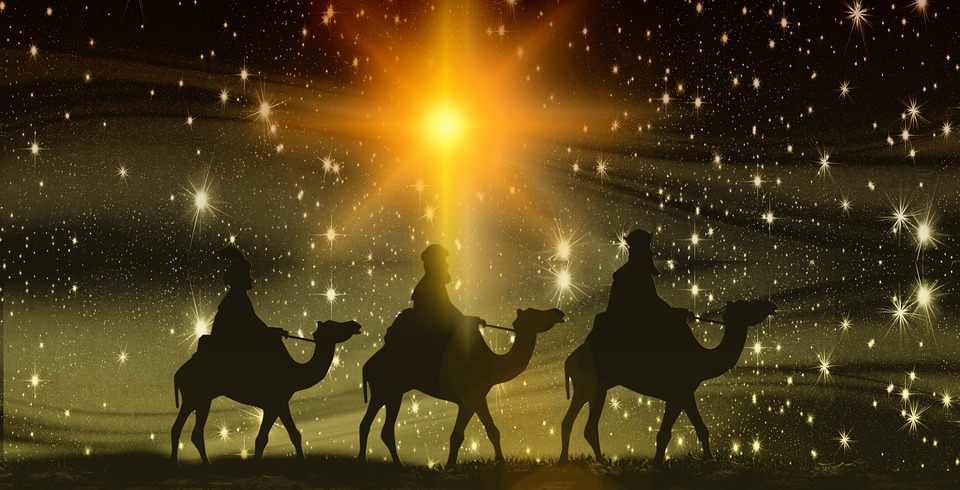
In this meditation, I would like to follow these Magi in their journey of faith to become “Wise Men.” As magi, they followed the faint stars, distant points of light; as wise men, they follow Jesus, who is the ever glorious Light from Light, true God from true God.

We can observe how they journey in stages from the light of a star to the bright and glorious Light of Jesus Christ. And, of course, to authentically encounter the Lord is to experience conversion. All the elements of this story ultimately serve to cause them to “return to their country by another route.” Let’s look at the stages of their journey from being mere magi to becoming, by God’s grace, wise men.

Stage 1: The CALL that COMPLETES – The text says, When Jesus was born in Bethlehem of Judea, in the days of King Herod, behold, magi from the east arrived in Jerusalem, saying, “Where is the newborn king of the Jews? We saw his star at its rising and have come to do him homage.”

Notice the identity of these individuals: they are labeled magi (μάγοι (magoi) in Greek) and are from the East.

Exactly what “magi” are is not clear. Perhaps they are learned men; perhaps they are ancient astronomers. We often think of them as kings, though the text of this passage does not call them that. It also seems likely that Herod would have been far more anxious had they been actual potentates from an Eastern kingdom. We often think of them as kings because Psalm 72 (read in today’s Mass) speaks of kings coming from the East bearing gifts of gold and frankincense. However, for the record, the text in today’s Gospel does not call them kings, but rather “magi.”

Yet here is their key identity: they are Gentiles who have been called. Up until this point in the Christmas story, only Jews had found their way to Bethlehem. This detail cannot be overlooked, for it is clear that the Gospel is going out to all the world. This call completes the Church, which needs both Jews and Gentiles.

In today’s second reading, St. Paul rejoices in this fact, saying, the Gentiles are coheirs, members of the same body, and co-partners in the promise in Christ Jesus through the gospel (Eph 3:6). Because most of us are not Jewish by ancestry we ought to rejoice, for the call of these Magi prefigures our call.

Notice that God calls them through something in the natural world: a star. God uses something in creation to call out to them.

We do well to wonder what is the “star” that God uses to call each of us? Perhaps it is Scripture, but more typically God uses someone in our life in order to reach us: a parent, a family member, a friend, a priest, a religious sister, or a devoted lay person. Who are the stars in your life through whom God called you?

God can also use inanimate creation, as he did for these Magi. Perhaps it was a magnificent church, or a beautiful painting, or an inspirational song that reached you. Through something or someone, God calls each of us; He puts a star in our sky. These Wise Men, these Magi, followed the call of God and began their journey to Jesus.

Stage 2: The CONSTANCY that CONQUERS – Upon arriving in Jerusalem, the Magi find a rather confusing and perhaps discouraging situation. The reigning king, Herod, knows nothing of the birth of this new King. The Magi likely assumed that the newborn King would be related to the current king, so Herod’s surprise may have confused them. And Herod seems more than surprised; he seems threatened and agitated.

Even more puzzling, Herod calls in religious leaders to get further information about this new King. They open the sacred writings and the Magi hear of a promised King. Ah, so the birth of this King has religious significance! How interesting!

But these religious leaders seem unenthusiastic about the newborn King, and after providing the location of His birth, make no effort to follow the Magi. There is no rejoicing, no summoning of the people to tell them that a longed-for King has finally been born, not even further inquiry!

So the wicked (Herod and his court) are wakeful while the saints are sleepy. How odd this must have seemed to the Magi! Perhaps they even thought about abandoning their search. After all, the actual king knew nothing of this new King’s birth, and those people who did know about it seemed rather uninterested.

Ah, but praise the Lord, they persevered in their search; they did not give up!

Thanks be to God, too, that many today have found their way to Christ despite the fact that parents, clergy, and others who should have led them to Jesus were either asleep, ignorant, or just plain lazy. I am often amazed at some of the conversion stories I have heard: people who found their way to Christ and His Church despite some pretty daunting obstacles (e.g., poor religious upbringing, scandalous clergy, and poor role models). God sometimes allows our faith and call to be tested, but Those who persevere to the end will be saved (Matt 24:13).

To persevere is to open the door to wisdom, which often must be sought in spite of obstacles. This constancy is often what it takes to overcome the darkness and discouragements of the world.

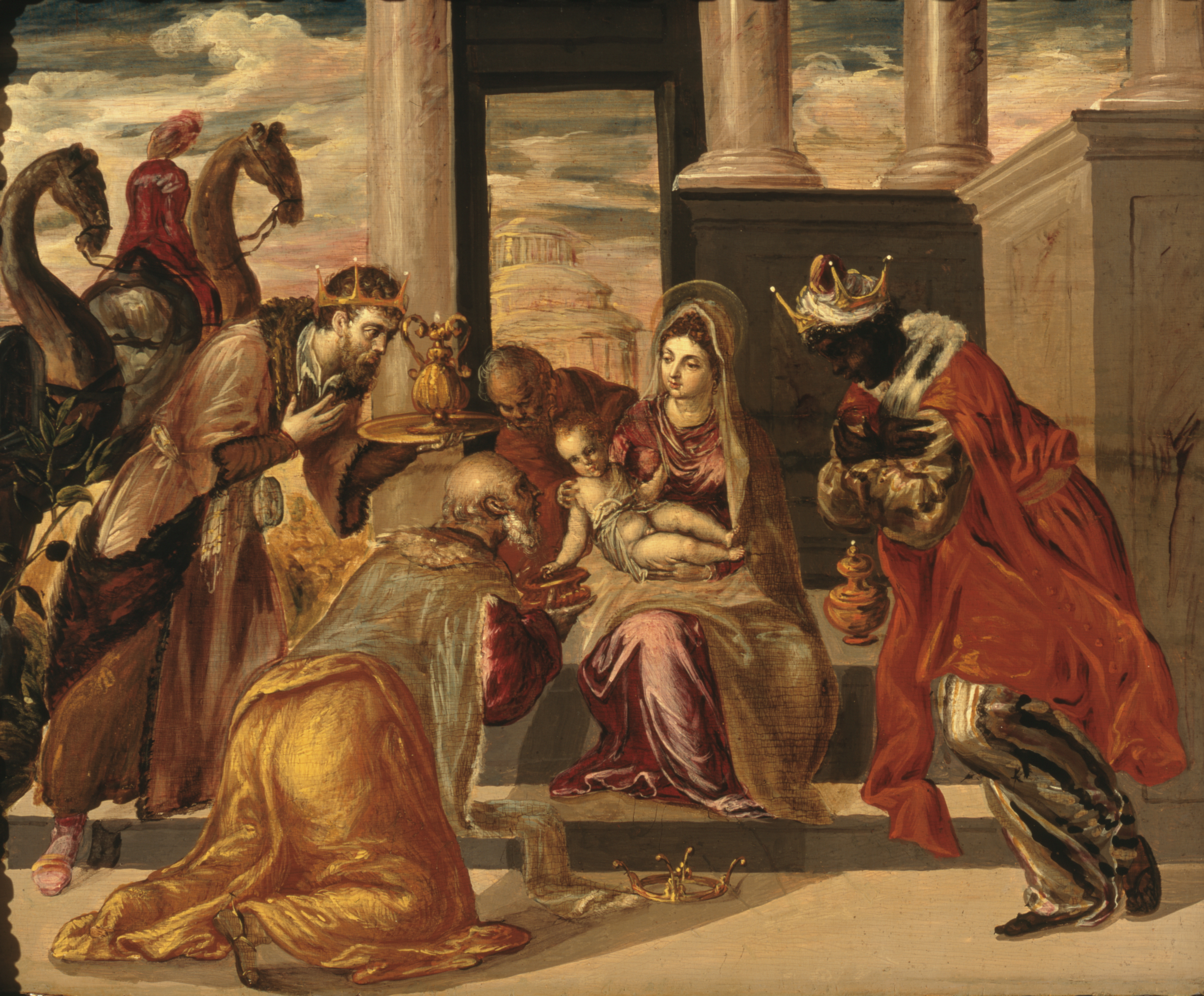
Stage 3: The CONDESCENSION that CONFESSES – The text says, After their audience with the king they set out. And behold, the star that they had seen at its rising preceded them, until it came and stopped over the place where the child was. They were overjoyed at seeing the star, and on entering the house they saw the child with Mary his mother. They prostrated themselves and did him homage.

With what little information they have, the Magi set out and continue to follow the call of God through the star.

Note that they enter a “house.” We often think of the Magi as coming that same Christmas night to the cave or stable, but it seems not; Mary, Joseph, and Jesus are now in a house. Apparently they have been able to find decent lodging. Has it been days or weeks since Jesus’ birth? Regardless, it is likely not Christmas Day itself.

Notice, too, that they “prostrate” themselves before Jesus. The Greek word used is προσεκύνησαν (prosekunēsan), which means “to fall down in worship” or “to give adoration.” This word is used twelve times in the New Testament and each time it is clear that religious worship is the reason for the prostration.

This is no minor act of homage or sign of respect to an earthly king; this is religious worship. It is a confession of faith. The Magi manifest faith! The beginning of wisdom is the fear of the Lord. And these Magi are well on their way from being mere magi to being wise men!

But is their faith a real faith or just a perfunctory observance? It is not enough to answer an altar call or to get baptized. Faith is never alone; it is a transformative relationship with Jesus Christ. So let’s look for the effects of a real and saving faith.

Stage 4: The COST that COMES – There is a cost to discipleship. The Magi are moved to give three symbolic gifts that show some of what true faith includes. They are costly gifts.

Gold symbolizes all of our possessions. In laying this gift before Jesus, they and we are saying, “I acknowledge that everything I have is yours. I put all my resources and wealth under your authority and will use them only according to your will.” A conversion that has not reached the wallet is not complete.

Frankincense is a resin used in incense and symbolizes the gift of worship. In the Bible, incense is a symbol of prayer and worship (e.g., Psalm 141). In laying down this gift, we promise to pray and worship God all the days of our life, to be in His holy house each Sunday, to render Him the praise and worship He is due, to listen to His word and consent to be fed the Eucharist by Him, to worship Him worthily by frequent confession, and to praise Him at all times.

Myrrh is a strange gift for an infant; it is usually understood as a burial ointment. Surely this prefigures Jesus’ death, but it also symbolizes our own. In laying this gift before Jesus we are saying, “My life is yours. I want to die so that you may live your life in me. May you increase and may I decrease. Use me and my life as you will.”

Yes, these three gifts are highly symbolic.

The Magi manifest more than a little homage to Jesus. They are showing forth the fruits of saving faith. And if we can give these gifts, so are we.

In their holy reverence for God is wisdom in its initial stage!

Stage 5: The CONVERSION that is CLEAR – The text says, And having been warned in a dream not to return to Herod, they departed for their country by another way.

Here, then, is essential evidence for faith: conversion. It is not enough to get “happy” in Church; we have to obey. These Wise Men are walking differently now. They are not going home by the same way they came. They’ve changed direction; they’ve turned around (conversio). They are now willing to walk the straight and narrow path that leads to life rather than the wide road that leads to damnation. They are going to obey Christ. They are going to exhibit what St. Paul calls the “obedience of faith” (Rom 1:5; 16:26). They have not just engaged in perfunctory worship; they are showing signs of a true and saving faith. They are not just calling out to Jesus, “Lord, Lord!” They are doing what He tells them (cf Luke 6:46).

No longer mere magi, they are now wise men!

So there it is. Through careful stages, the Lord has brought the Gentiles (this means you and me) to conversion. He called these Magi to wisdom. They remained constant, confessed Him to be Lord, accepted the cost of discipleship, and manifested conversion. Have you? Have I?

Walk in the ways of these Wise Men! Wise men still seek Him; even wiser ones listen to and obey Him. Are we willing to go back to our country by another route? Is ongoing conversion part of our journey home to Heaven? Epiphany means “manifestation.” How is our faith made manifest in our deeds and conversion?

I have it on the best of authority that as the (now) Wise Men went home by another route, they were singing this gospel song:

It’s a highway to heaven!
None can walk up there
but the pure in heart.
I am walking up the King’s highway.
If you’re not walking,
start while I’m talking.
There’ll be a blessing
you’ll be possessing,
walking up the King’s highway.
Incarnation and the First Letter of John

In the weekday Masses following the Christmas octave we celebrate the Word becoming flesh. We read from the First Letter of John, which emphasizes the Incarnation of Jesus and demands that we experience the Word becoming Flesh in a practical way in our own lives.

Fundamentally, the Incarnation, the Second Person of the Trinity becoming flesh, means that our faith is about things that are real and tangible. As human beings, we have bodies. We have a soul that is spiritual, but it is joined with a body that is physical and material. Hence it is never enough for our faith to be about only thoughts, philosophies, concepts, or historical facts. Their truth must also touch the physical part of who we are. Our faith must become flesh; it has to influence our behavior. If that is not the case, then the Holy Spirit, speaking through John, has something to call us: liars.

God’s love for us in not just a theory or idea. It is a flesh and blood reality that can be seen, heard, and touched. The challenge of the Christmas season is for us to allow the same thing to happen to our faith. The Word of God and our faith cannot simply remain on the pages of a book or in the recesses of our intellect. They must become flesh in our life. Our faith has to leap off the pages of the Bible and the Catechism and become flesh in the way we live our life, the decisions we make, and the way we use our body, mind, intellect, and will.

Consider this passage read at Mass during the Christmas season. This excerpt is fairly representative of the tone of entire First Letter of John.

The way we may be sure that we know Jesus is to keep his commandments. Whoever says, “I know him,” but does not keep his commandments is a liar, and the truth is not in him. But whoever keeps his word, the love of God is truly perfected in him. This is the way we may know that we are in union with him: whoever claims to abide in him ought to walk just as he walked (1 John 2:3ff).

Note some teachings that follow from it:

1. Faith is incarnational. What a practical man John is! Faith is not an abstraction; it is not merely about theories and words on a page. It cannot be reduced to slogans or pious sayings. It is about a transformed life; it is about truly loving God and making His Commandments manifest in the way we live. It is about the loving of my neighbor. True faith is incarnational, that is to say, it takes on flesh in my very “body.”

Human beings are not pure spirit. We are not just intellect and will; we are also flesh and blood. What we are cannot remain merely immaterial. What we are must also be reflected in our bodies, in what we physically do.

Many people spout this phrase too often: “I’ll be with you in spirit.” Perhaps an occasional physical absence is understandable, but after a while the phrase rings hollow. Showing up physically and doing what we say is an essential demonstration of our sincerity. Our faith must include a physical, flesh-and-blood dimension.

2. A sure sign – John said, The way we may be sure that we know Jesus is to keep his commandments. Now be careful of the logic here. The keeping of the commandments is not the cause of faith; it is more the fruit of it. It is not the cause of love; it is the fruit of it.

In Scripture, “knowing” refers to knowing on more than an intellectual level. It refers to deep, intimate, personal experience of the thing or person. It is one thing to know about God, it is another thing to “know the Lord.”

John is saying here that in order to be sure we have deep, intimate, personal experience of God, it must change the way we live. An authentic faith, an authentic knowing of the Lord, will change our behavior in such a way that we keep the commandments as a fruit of that authentic faith and relationship with the Lord. It means that our faith becomes flesh in us. Theory becomes practice and experience. It changes the way we live and move and have our being.

For a human being, faith cannot be a mere abstraction; in order to be authentic, it has to become flesh and blood. In a later passage, John uses the image of walking: This is the way we may know that we are in union with him: whoever claims to abide in him ought to walk just as he walked (1 John 2:6). Now walking is a physical activity, but it is also symbolic. The very place we take our body is physical, but it is also indicative of what we value, what we think.

3. Liar? – John went on to say, Whoever says, “I know him,” but does not keep his commandments is a liar. This is strong language. Either we believe and thus keep the commandments, or we are lying about really knowing the Lord and we fail to keep the commandments.

Don’t all of us struggle to keep the commandments fully? John seems so “all or nothing” in his words. His math is clear, though. To know the Lord fully is never to sin (cf 1 John 3:9). To know Him imperfectly is still to experience sin. Hence, the more we know Him (remember the definition of “know”) the less we sin. If we still sin, it is a sign that we do not know Him enough.

It is not really John who speaks too absolutely. It is we who do so. We say, “I have faith. I am a believer. I love the Lord. I know the Lord.” Perhaps we would be better saying, “I am growing in faith. I am striving to be a better believer. I am learning to love and know the Lord better and better.” Otherwise, we risk lying. Faith is something we grow in.

Many in the Protestant tradition have a tendency to reduce faith to an event: answering an altar call, or accepting the Lord as “personal Lord and savior.” But we Catholics do it, too. Many Catholics think that all they have to do is be baptized; they don’t bother to attend Mass faithfully later. Others claim to be “loyal” or even “devout” Catholics, yet dissent from important Church teachings. Faith is about more than membership. It is about the way we walk, the decisions we make. Without this harmony between faith and action, we live a lie. We lie to ourselves and to others. The bottom line if we really come to know the Lord more and more perfectly, we will grow in holiness, keep the commandments, and be of the mind of Christ. We will walk just as Jesus walked and our claim to faith will be the truth and not a lie.

4. Uh oh, is this salvation by works? No, but it is a reminder that we cannot separate faith and works. The keeping of the commandments is not the cause of saving or of real faith. Properly understood, the keeping of the commandments is the result of saving faith actively present and at work within us. It indicates that the Lord is saving us from sin and its effects.

The Protestant tradition erred in dividing faith and works. In the 16th century, the cry when up from Protestants that we are saved by “faith alone.” But faith is never alone; it always brings effects with it.

Our brains can get in the way here and tempt us to think that just because we can distinguish or divide something in our mind we can do so in reality. But this is not always the case.

Consider, for a moment, a flame. It has the qualities of heat and light. We can separate the two in our mind, but not in reality. I could never take a knife and divide the heat of the flame from the light of the flame. They are so interrelated as to be one reality. Yes, heat and light in a flame are distinguishable theoretically, but they are always together in reality.

This is how it is with faith and works. Faith and works are distinguishable theoretically, but the works of true faith and faith itself are always together in reality. We are not saved by works alone, or by alone. They are together. Faith without works is dead (James 2:14). In other words, faith without works is a nonexistent concept; it is not a saving or living faith. Rather, as John teaches here, to know the Lord by living faith is always accompanied by keeping the commandments and walking as Jesus did.

So faith is incarnational. The Word became flesh and dwelt among us, really and physically. So, too, our own faith must become flesh in us, in our actual behavior.

Below are the words to a Christmas carol that is unknown to most Americans (unless you happen to be very familiar with Renaissance music). It is an early Spanish carol by an unknown 16th century composer. The gist of the carol is that the Word (Jesus) has shown His love for us by becoming flesh. Mary, who has real faith, would do anything for Jesus, but has nowhere even to lay Him down. The song rebukes this rich world for its lack of faith manifested in love and cries out, in effect, “Won’t you at least offer some swaddling clothes to the one you have forced to be born in a stable?” The world’s true faith must be made manifest by its acts of love. Here are the original words and the English translation of this incarnational Christmas carol:

Verbum caro factum est                      (The Word was made flesh)

Porque todos hos salveis.                   (for the salvation of you all.)

Y la Virgen le dezia:                            (And the Virgin said unto him:)

‘Vida de la vida mia,                           (‘Life of my life,)

Hijo mio, ¿que os haria,                     (what would I [not] do for you, my Son?)

Que no tengo en que os echeis?’         (Yet I have nothing on which to lay you down’)

O riquezas terrenales,                                    (O wordly riches,)

¿No dareis unos pañales                    (will you not give some swaddling clothes)

A Jesu que entre animals                    (to Jesus, who is born among the animals)

Es nasçido segun veis?                       (as you can see?)


The Value of Silence Before the Great Mystery of the Incarnation

blog-12-tnSomething at Christmas urges me (a man of many words) to write of holy silence. Perhaps it is due to one of the great Christmas antiphons, which speaks of the birth of Christ as a magnum mysterium (a great mystery). During Mass recently, the words of Zechariah came to my mind:

Sing and rejoice, O daughter of Zion, for behold, I come and I will dwell in your midst, declares the Lord … Be silent, all flesh, before the Lord, for he has roused himself from his holy dwelling (Zechariah 2:11, 13).

There is a common idiom: “Words fail me.” It is in this context that we can best understand God’s call to fall silent before the mystery of the Lord’s incarnation. Notice in the passage above that the call to silence follows the call to “sing and rejoice.”

Is there a difference between singing and rejoice and just plain speaking? Of course there is! By adding the inscrutable sighs we call “song” (a deeply mysterious emanation from our souls) to the words, singing is declaring that “words fail.”

To be sure words, are a “necessary evil” for us, but in using words we indicate more what a thing is not than what it is. For example, if I say to you, “I am a man,” I have really told you more what I am not than what I am. I have told you I am not a woman, nor a chair, nor a lion, nor a rock. But I have not told what it means to be a man. I have not told you myriad other things about myself that I could: I am a priest; my father was a lawyer and Navy veteran; my mother was a teacher; I am descended from Irish, German, and English immigrants. I have not told you about my gifts, or my talents, or my struggles, or numerous other aspects that make me who I am. And even if I spent several paragraphs relating my curriculum vitae to you, there would still be vastly more left unsaid than was said. Words fail.

Further, words are not the reality they (often poorly) attempt to convey. They are symbols of what they indicate. If you see a sign, “Washington” you don’t stop there and take a picture of the sign. The sign itself is not Washington; it merely points to the reality that is Washington. You pass the sign and enter into a reality far bigger than the metal sign and begin to experience it. Words fail.

Many words are also more unlike the reality they describe than like it. My philosophy teacher once asked us how we would describe the color green to a man born blind. We struggled with the task but were able to come up with some analogies: green is like the taste of cool mint; green is like the feel of dew-covered grass. To some extent green is like these things, but the color green is more unlike these things than like them. Green, as a reality, is so much richer than the taste of cool mint or the feel of dew-covered grass. Words fail.

And if this be so in the case of mere earthly things, how much more so in the case of heavenly and Godly matters! The Lord therefore commands a holy silence of us as a kind of reminder that words fail. Silence is proper reverence for the mystery of the incarnation and of God. Words are necessary; without them orthodoxy could not be set forth and truth could not be conveyed. But, especially regarding God and the truths of faith, there comes this salutary reminder from St. Thomas Aquinas: “Now, because we cannot know what it God is, but rather what he is not, we have no means for considering how God is, but rather how he is not” (Prima pars, q. 3, prologue).

Therefore, fellow Catholics, as the mysteries of the incarnation unfold for us liturgically, Let all mortal flesh keep silence, and with fear and trembling stand, Christ our God to earth descendeth, bearing blessings in his hand (from the hymn, “Let All Mortal Flesh Keep Silence”).

The Reality of Christmas as an Antidote to Unreal Times

1228blogAt Christmas we celebrate the birth of the Word made flesh. All the Gospel writers (especially St. John) emphasize the reality of God present among us in a very tangible, physical way. This is a critical truth because one of the dangers is reducing our faith to a mere collection of ideas, setting aside the actual Jesus who took up our full nature, lived among us, and summoned us to a real encounter.

These Christmas themes are more important than ever for us who live in a post-nominalist, post-Cartesian, neo-Gnostic world. The effect of this is that many of us live increasingly “up in our heads.” More and more we are out of touch with reality. What matters is what we think, how we feel, what our opinion is. Such things increasingly overrule even obvious realities.

In such an environment can come the notion that someone can say he is a female trapped in a male body. Never mind that his body is clearly male right down to its X and Y chromosomes. No, what matters is what he thinks and feels. Physical reality has nothing to do with his assertion and he feels quite justified in ignoring it.

How did we get here? It likely started with the rise of nominalism in the 14th century. But what supercharged the problem is sometimes called the “Cartesian divide.” The ideas of philosopher René Descartes are said to divide the more ancient trust in reality and the senses from the modern world, which is marked by increasing skepticism and doubt that we can actually encounter reality at all.

René Descartes lived in the Dutch Republic during the first half of the 17th century. He is widely held to be the father of modern philosophy.

Descartes used a method of fundamental doubt wherein he rejected any ideas that could be doubted, and then tried to re-establish them in what he considered a firm foundation for knowing them as actual or genuine.

This led Descartes ultimately to only a single “provable” principle: that thought exists. He stated this in his treatise, “Discourse on the Method and Principles of Philosophy.” This is the source of the well-known phrase cogito ergo sum (I think therefore I am). In other words, because I doubt, something or someone must be doing the doubting. The fact that I doubt proves my existence.

Thus, doubt and skepticism moved to the center. Descartes considered the senses unreliable. He went on to construct a system of knowledge that largely discarded perception as unreliable and admitted only deductive reasoning as a method for thinking or knowing.

Descartes later seemed to back away from the radical skepticism his rationalism implied. He argued that because sensory perceptions came to him involuntarily, apart from his willing them, this was evidence of the existence of something outside of his mind, and thus, of an external world.

Despite his attempts to back away from his radical doubt, by failing to clearly resolve it he left us with a legacy of Cartesian disconnectedness from reality and retreat into the mind.

1. The retreat into the mind and loss of connection with reality. In radically distrusting his senses, Descartes disconnected himself (and us) from the world of reality. What is real is only what is in my mind. The actual “is-ness” of things is no longer the basis of reality. Now, it is just my thoughts that are real. Reality is not “out there” but it is only in my mind. It is what I think that matters.

This leads to a lot of the absurdity of modern times where we tend to overlook reality and reduce everything to opinion. We often think of things abstractly as “issues.”

For example, for many people abortion is an “issue” rather than the dismemberment of a human baby. Many tend to think of abortion abstractly and repackage “it” as choice, or a woman’s right. But abortion is not an abstraction. There is something actually happening “out there” in the real world. An actual child is being dismembered and suctioned into a jar. But the post-Cartesian retreat into the mind allows many to continue to think of abortion abstractly as an “issue.” Detached from reality, the mind can do some pretty awful rationalizing. Showing actual pictures of abortion seems to have little effect on those who have retreated into their minds and think of abortion abstractly as an issue rather than as a real thing.

The same is true for the issue of homosexuality. Any even rudimentary look into the biology and design of the body makes it clear that something is disordered with homosexual activity. The man is for the woman, not for another man; the biology is clear. But with the post-Cartesian retreat into the mind, the body no longer has anything to say to many people. Many ask, “What does the body have to do with it?” All that seems to matter is what they think. It is opinion, not reality, that is important. Thought overrules the body, dismisses the external reality. Here again is the Cartesian flight from the real world into the mind.

And the same holds true for just about every moral issue today. It is my thoughts and intentions that matter, not what I am actually doing.

2. Reality is no longer revelatory. The revelation that comes simply from the way things are is “not reliable.” It is mere opinion in this Cartesian world we have inherited. Scripture and the Natural Law tradition hold that creation and the way things are provide revelation for us. St. Paul said, For what can be known about God is evident to them, because God made it evident to them. Ever since the creation of the world, his invisible attributes of eternal power and divinity have been able to be understood and perceived in what he has made (Romans 1:18-19). There was a confidence in the Scriptures and Natural Law Tradition that the created world, reality, provided a reliable guide to what was right and true. We had only to study the “is-ness” of things to learn. But this was all jettisoned. In the post-Cartesian world, we are skeptical that we can really know or reliably perceive the “there” out there.

3. The Cartesian worldview is unrealistic in insisting upon “absolute” proof. To insist that we, who are contingent and limited beings, can prove or know something absolutely is both arrogant and unrealistic. In the Christian worldview there remains a mystery to all things, a hiddenness that we come to accept. The fact that there is mystery does not mean that we know nothing. We are clearly able to perceive and come to know what God reveals. But mystery is the Christian acceptance of the fact that things are only partially revealed; much more lies hidden and unseen.

For example, every human being is a mystery. We are surely able to perceive many things about people, particularly the ones we know well. We see their physical presence and know many things about them. But there is also a glorious hiddenness to all people, which is related to their inner life and their place in God’s plan. This is mystery: things are revealed, but at the same time, much lies hidden.

Hence the absolute proof demanded by the Cartesian world is unrealistic. A balance is required such that we can be confident about what we do know and honest about what we do not know. Some degree of doubt or uncertainty is part of the human experience. Yes, we can actually know things, though not as absolutely as demanded by the Cartesian world.

4. And this unrealistic notion of needing absolute proof to know things is what leads to the “Cartesian anxiety” of our times and causes us to set up intellectual idols. We tend in our culture to worship science and the scientific method. I would argue that we do this out of Cartesian anxiety. We seem desperate for absolute proof and so we entertain the notion that science can provide it. Of course scientific theories change all the time, but in our anxious search for absolute proof we’re willing to overlook facts like that. “Perhaps older theories have given way, but now we really know; this is ‘settled science.’ We’ve proved it.” Or so we think.

But this is anxiety; it is not reality. Science will continue to change with new data, as it must. And science does not know or prove many things absolutely. We know a lot, but there is a lot we do not know. Good scientists know this and freely admit it. Science alone cannot be the elixir for the radical doubt that troubles us.

And so, here we are. The Cartesian world is in full flower, but it is not a lovely flower. It has led us to an imbalance. On the one hand we distrust reality and have retreated into our minds. Yet, paradoxically we seem desperate to prove some things absolutely in order to overcome the anxiety that extreme doubt produces. Our confidence in reality as a reliable guide was set aside as we have increasingly retreated into our minds. But without reality as a reliable guide, we have sought something to soothe the anxiety that uncertainty causes. And so we trot out science, anoint experts, and entertain the fiction that they can give the absolute proof our Cartesian anxiety demands.

And thus the Christmas message rings ever true: The Word became flesh and dwelt among us. The tangible reality of God’s presence among us remains the Christmas call, the Christian call. God calls us to seek Him in what is. And yet there is also the mystery of something and someone ever deeper and more real than we could imagine. He is real, but our appreciation must grow ever deeper. The truth of what is real unfolds because it is real and not merely an idea or a passing thought.

One day the real Jesus, the Word made flesh, heard two disciples say, “Rabbi! Where do you stay?” And He said, “Come and see” (Jn 1:39).

Paradoxes of Christmas

j-and-m-and-jIn the ancient Church and up until rather recently, one genuflected at the two references to the Incarnation during the Mass: during the Creed and in the Last Gospel (John 1). Why was this done? It was explained to me that the mystery of the Incarnation is so deep, one can only fall in silent reverence.

There are many paradoxes and seeming impossibilities in the Incarnation. They cannot be fully solved, so they claim our reverence. We genuflected in the past, and today we bow at the mention of the Incarnation in the Creed, for it is a deep mystery.

As we continue to celebrate Christmas I would like to list some of the paradoxes of Christmas. I want to say as little about them as possible—just enough to make the paradox clear. This paucity of words (not common with me) is in reverence for the mystery and also to invite your reflection.

  1. The Infinite One becomes an infant.
  2. An antiphon for the Christmas season says, How can we find words to praise your dignity O Virgin Mary, for he whom the very heavens cannot contain, you carried in your womb.
  3. An old Latin carol (in Dulci Jublio) says, Alpha et O, Matris in Gremio (Alpha and Omega, sitting in Mommy’s lap).
  4. He who looks down on all creation looks up to see His Mother. The most high looks up from a cradle. Of this moment, even the pagans wrote with longing and tenderness: Incipe, parve puer, risu cognoscere matrem … ipsa tibi blandos fundent cunabula flores, occidet et serpens, et fallax herba veneni occidet (Begin, little boy, to recognize the face of your mother with a smile … for you, your own cradle will bear delightful flowers; the serpent will die and the plant that hides its venom) – Virgil 4th Eclogue.
  5. He who indwells all creation is born in homelessness, no place to dwell.
  6. He, to whom all things in Heaven and on earth belong, is born in poverty and neediness.
  7. He is the mighty Word through whom all things were made. He is the very utterance of God, the Voice which summons all creation into existence. Of this Word, this Utterance, this Voice, Scripture says, The voice of the LORD is upon the waters; the God of glory thunders, the LORD, upon many waters. The voice of the LORD is powerful, the voice of the LORD is full of majesty … The voice of the LORD flashes forth flames of fire. The voice of the LORD shakes the wilderness … The voice of the LORD makes the oaks to whirl, and strips the forests bare; and in his temple all cry, “Glory!” (Ps. 29) Yet this voice is now heard as the cooing and crying of an infant.
  8. His infant hand squeezes His mother’s finger. From that infant hand, the universe tumbled into existence. That same hand is steering the stars in their courses.
  9. He who holds all creation together in Himself (Col 1:17) is now held by His Mother.
  10. He who is the Bread of Life is born in Bethlehem (House of Bread) and lies in a feeding trough (manger).
  11. He who is our sustainer and our food is now hungry and fed by His Mother.
  12. Angels and Archangels may have gathered there, Cherubim and Seraphim thronged the air! But only his mother in her maiden bliss, could worship the beloved with a kiss (Christina Rosetti “In the Bleak Midwinter”).

Each of these is meant to be a meditation on the great mystery of the Incarnation. Please chime in with your additions to this list!

A paradox is something that defies intuition or challenges the common way of thinking. It unsettles us or startles us into thinking more deeply. The word paradox comes from the Greek para (beside, off to the side, or above) and dokein (to think or to seem). Hence a paradox is something “off to the side” of the usual way of seeing or thinking about things. If you’re going to relate to God you’re going to deal with a lot of paradox, because God’s ways and His thinking often defy those of humans. God is not irrational but He often acts in ways that do not conform to worldly expectations.

This Christmas, consider these paradoxes and learn from them. Remember, though, that mysteries are to be lived more so than solved. Reverence is a more proper response to mystery than is excessive curiosity. More is learned in silence than by many words.

Humility Lessons from the Nativity – A Homily for Christmas

Feature-122413The Christmas Gospel from Luke provides us with many teachings. One thing that surely stands out, however, is the permeating theme of humility. Throughout the account, God confounds our prideful expectations and insists on being found in the lowest of places.

The newborn Christ is not found where we expect Him to be nor does His birth conform to any script we would design. Right from the start, He gives us many lessons in humility and begins His saving work of healing our wound of pride. Let’s look at these lessons in four stages.

I. The Procession to the Place In those days, a decree went out from Caesar Augustus that the whole world should be enrolled. This was the first enrollment, when Quirinius was governor of Syria. So, all went to be enrolled, each to his own town. And Joseph too went up from Galilee from the town of Nazareth to Judea, to the city of David that is called Bethlehem, because he was of the house and family of David, to be enrolled with Mary, his betrothed, who was with child.

There is a sort of “cast of thousands” that leads Mary, Joseph, and Jesus to be in Bethlehem. The distant Caesar Augustus sends out a decree affecting millions. He wants a census taken in order to update his tax rolls. He also likely wants to measure his power and may have military deployments and a draft in mind. Soon enough, dozens of governors deploy thousands of troops to enforce the edict. Even in the small town of Nazareth, a town of barely 300 people, Roman troops enforce the decree. Mary is nine months pregnant, but there will be no exceptions.

For many of us, this offends our sense of what should justly happen. Jesus, who is Lord and Savior, should be born in comfort; Mary should be surrounded by loving family and in the care of midwives.

The first lesson in humility is our surprise and even indignation at the events surrounding Jesus’ birth.

God, however, is neither surprised nor stymied. All this fits into His plan to get Jesus, Mary, Joseph, and all of us to the place of blessing. Whatever evil the Emperor intends, God intends it for good (see Genesis 50:20). The Messiah, it was prophesied, would be called a Nazarene (Matt 2:23), be born in Bethlehem (Micah 5:2), and die in Jerusalem (Lk 13:33). God is setting things in place for the blessing.

And here is the second lesson in humility: Your life is not just about you. You and I are part of something far larger. Just as millions were set on the move at the birth of Christ, so you and I are part of the larger plan and providence of God involving billions of people now living, countless others who have lived, and still others who will live in the future. God sees the bigger picture, yet not one detail is lost to Him. Humility! God has more in mind than our comfort and personal agendas. We are part of something bigger as well.

The third lesson in humility is that God must get us to certain places in order to bless us. And they may be strange places, ones we would not choose. Getting us there may involve hardship for us: disappointment that our own plans have not come through, and the painful loss of places, things, and people we love. Yes, God has blessings waiting for us in strange places, involving circumstances we never imagined.

For Joseph and Mary, the procession to the place called Bethlehem involved hardship. But this procession is necessary for them and for us. Bethlehem was where the blessing would be found—there and no other place. And the same is true for us in so many ways.

God has been good to me and blessed me in ways and in places I never expected or planned. God must get us to certain places in order to bless us. I am and have been blessed; I am a witness.

Don’t miss the procession to the place that opens this Gospel. It is a paradigm for our lives. Where is your Bethlehem? Where does God need to get you in order to unlock your blessings? Are you humble and teachable enough to go there?

Remain humble and don’t quickly despair when the surprises and vicissitudes of life emerge. God may be up to something. He can make a way out of no way and write straight with crooked lines.

II. The Paradox of His PovertyWhile they were there, the time came for her to have her child, and she gave birth to her firstborn son. She wrapped him in swaddling clothes and laid him in a manger, because there was no room for them in the inn.

Don’t miss the poverty that is manifest here—it is a chosen poverty. St. John Chrysostom said,

Surely if [the Lord] had so willed it, He might have come moving the heavens, making the earth to shake, and shooting forth His thunderbolts; but such was not the way of His going forth; His desire was not to destroy, but to save… And, to trample upon human pride from its very birth, therefore He is not only man, but a poor man, and has chosen a poor mother, who had not even a cradle where she might lay her new born Child; as it follows, and she laid him in the manger (Quoted in the Catena Aurea – Lection 2 ad Luc 2:6).

The paradox of poverty is the fourth lesson in humility! We who are worldly think that poverty is the worst thing, but it is not—pride is the worst thing. And thus the Lord teaches us from the start that greatness and blessings are not found merely in what is high, mighty, pleasant, or pleasing. Blessings are often found in unusual ways and under unexpected circumstances.

The greatest blessing ever bestowed is not found in a palace, or in Bloomindales, or on beachfront property; He is not even found in a cheap Bethlehem inn. He is found in a lowly manger underneath an inn. It is poor and smelly and He rests in a feeding trough. But there He is, in the least expected place, the lowest imaginable circumstances. In this way He confounds our pride and our values.

Are we humble enough to admit this and to stop being so resentful and crestfallen when things don’t measure up exactly to our standards?

He chooses this poverty. Whatever its unpleasant realities, poverty brings a sort of freedom if it is embraced. The poor have less to lose and thus the world has less of a hold on them. What does a poor man have to lose by leaving everything and following Jesus? Wealth has many spiritual risks. It is hard for the rich to inherit the Kingdom of Heaven. Wealth is too easily distracting and enslaving. And even knowing all this, we still want it. In choosing poverty, Jesus confounds our pride, greed, lust, and gluttony.

The Lord does not just confound us; He also chooses this to bless us. St. Paul said,

For you know the grace of our Lord Jesus Christ, that though he was rich, yet for your sake he became poor, so that by his poverty you might become rich (2 Cor 8:9).

He also said,

Christ Jesus, though he was in the form of God, did not count equality with God a thing to be clung to, but emptied himself, taking the form of a servant, being born in the likeness of men. And being found in human form he humbled himself and became obedient unto death, even death on a cross (Phil 2:5).

Bede, the 7th century Church Father, wrote,

He who sits at His Father’s right hand, finds no room in an inn, that He might prepare for us in His Father’s house many mansions; He is born not in His Father’s house, but [under] an inn and by the way side, because through the mystery of the incarnation He was made the way [for us back to our Father’s House] [Catena, Ibidem].

Thank you, Jesus, for the paradoxical perfection of your poverty. Through it you confound our human ways and bless us more richly than we could ever expect! Thank for this lesson in humility.

III. Proclamation to the People Now there were shepherds in that region living in the fields and keeping the night watch over their flock. The angel of the Lord appeared to them and the glory of the Lord shone around them, and they were struck with great fear. The angel said to them, “Do not be afraid; for behold, I proclaim to you good news of great joy that will be for all the people. For today in the city of David a savior has been born for you who is Christ and Lord. And this will be a sign for you: you will find an infant wrapped in swaddling clothes and lying in a manger.”

The fifth lesson in humility throws into question our overemphasis on politics and worldly power. This section of the nativity narrative serves to strongly remind us that our salvation is not to be found in the statehouse, the courthouse, or the White House. We are not to put our trust in princes. Our salvation is in Jesus, only in Jesus. Are we humble enough to admit this and stop exalting worldly power?

Note that in this Gospel, lots of “emperor words” are used to describe this newborn infant, Jesus. Yet here He is in a lowly manger!

Emperors had heralds that preceded their arrival and summoned their subjects. The infant Jesus has the angel of the Lord to announce Him. Later, this heralding angel will be joined by a “host” of angels. The Emperor Augustus has his Legions, but Jesus has His myriad angels.

The angel also uses words appropriate for an emperor. He says, “I proclaim to you good news of great joy that will be for all the people.” This is how the declarations of emperors began. The Greek text makes this even clearer: the angel uses the word εὐαγγελίζομαι (evaggelizomai), which means “I evangelize you,” “I announce good or life changing news.” This word for “evangelize” was associated especially with an edict or announcement from the Emperor. But what the emperors questionably claimed for their edicts is really true with Jesus!

The emperors also claimed the titles “savior” and “lord.” The angel calls Jesus Savior (σωτὴρ – Soter) and Lord (κύριος – Kyrios), and He alone deserves these titles.

Here is the irony that we must humbly accept: this true Lord and Savior, this God of Armies with plenary authority, is not in some palace drinking from goblets and being fanned by slaves. He is lying in a lowly feed box, attended to by animals.

It is a divine comedy. One can almost imagine the shepherds wrinkling their noses or scratching their heads as they hear this great announcement of a King, Savior, Lord and Messiah, and then hearing that He is to be found in a stable, lying in a feeding trough. Perhaps one shepherd said to the other, “Did that angel say ‘manger’?” And another replying, “Yup, a feeding trough.”

It’s a bit anticlimactic! But thank the Lord, they humbly accept the procession that they must now make to the place of true blessing. It is an unexpected place to be sure, but that is where He is to be found. He is King and Lord to be sure, but He is humble and comes to serve and to save. He will wash the feet of the worst sinners and die for the love of them.

Humility!

IV. Praise that is Perfect And suddenly there was a multitude of the heavenly host with the angel, praising God and saying: “Glory to God in the highest and on earth peace to those on whom his favor rests.”

Note the praises of the angels! Who or what could ever match them? They are a multitude. They are perfected in their glory and acclaim God’s praises more gloriously than any human choir could ever hope to do.

Yet even here there is a humility to consider. For the Lord has taken a human nature to Himself, not an angelic one. In the order of creation, angels are far higher and more noble than we are. Their mere appearance overwhelms us and strikes fear in us. Yet to none of these did God ever say, “You are my Son. This day I have begotten you” (See Hebrews 1:5).

God humbly takes up our human nature and bestows on us an astonishing dignity that comes only from Him. It is due to His choice, not our merits. And though the angels can surely praise the Lord in far more glorious way than we, they cannot say, “One of us is God.”

And glorious though the angel’s praise is, there is a perfect praise that only we can give to God. It was beautifully expressed by the poet Christina Rossetti:

Angels and Archangels may have gathered there.
Cherubim and Seraphim thronged the air.
But only his mother in her maiden bliss
could worship the beloved with a kiss.

And thus, our final lesson in humility is to accept that it is our lowliness which the Lord embraced. We have no glory to give that is even close to what the Lord deserves, but a simple kiss will do, a simple act of love. It is our lowly and sinful hearts that the Lord seeks, so as to heal and exalt them. Our palaces, honors, and titles are of no interest or value to Him. It is our humility that pleases Him most, and He desires to meet us there.

Humility!

No One Goes Away from Jesus Unchanged

blog1223The video below is a 2008 Coca-Cola commercial that takes up the theme of the star of Christmas.

Let us review the impact that the star of Christmas had on the wise men, the Magi.

  1. The star moved them to seek meaning outside themselves; it made them look out and up.
  2. The star called them beyond what was familiar in their own country and world and expanded their horizons toward Christ and His Kingdom.
  3. The star summoned them to seek Christ, and when they found Him, to worship Him.
  4. The star drew them to be generous to a poor family in Bethlehem; they made sacrifices as they lay costly gifts of gold, frankincense, and myrrh before the Lord.
  5. The star roused them to conversion; they “returned to their country by another route,” following the straight and narrow path rather than the wide and destructive one.

Yes, no one encounters Jesus Christ and goes away unchanged. A blind man went away able to see, the deaf to hear, the lame to walk. The hungry went away satisfied, the ignorant instructed, the guilty forgiven, sinners converted.

The call of the nations to change and to new life began with a star. The light of the star opens the way to the Light of World, Jesus. The star of my life is Jesus.

In the commercial below we see Santa (a name that means “Holy One”) sending forth a star, one that touches people and radiates a light that transforms them.

  1. A woman sees the light of that star and is able to forgive her husband and be reconciled with him.
  2. A young soccer player sees the light of that star, surrenders his pride, and steps aside to let another share in and get a shot at glory.
  3. A young girl sees the light of that star and, giving up some of her own beauty, seeks to beautify a public park for others.
  4. A museum guard sees the light of that star and shows mercy to the guard dog with him (this was a silly one).
  5. A father sees the light of that star and allows his son a moment of growth.

Yes, there is something about that star that changes everyone who looks at it. They become more forgiving, more gracious, more aware of others, more connected to others, more loving. The light of the star, and the light of the world, is Jesus. His light is meant to have that same effect—and more besides.

In the background of the commercial an old Elvis song plays: “Wise men say only fools rush in, but I can’t help falling in love with you. Shall I stay? Would it be a sin if I can’t help falling in love with you?”

Of course the love that is symbolized by the star is not the romantic love of the song but the brotherly and agape love that Christ gives. Like the Magi who found Christ by the star, no one sees the star of Jesus and encounters Him and then goes away unchanged. Indeed, if we authentically encounter Christ, we are equipped to love, just as the people in this commercial are. We are equipped to forgive, to bring healing, to help others find strength and glory in the truth, and to come to full maturity in Christ. A person who knows Jesus and has encountered Him cannot help loving others, not in some merely sentimental way, but with a strong and vigorous love rooted in the truth. This is the same love that Jesus has for us all.

At the end of the commercial is an exhortation in Spanish that translates as follows: “Give the world the best of you.” The best of me is Jesus.

Who Is My Neighbor? Answered by a Touching Christmas Commercial

dec16-blogIn these days of nearly instant information availability, we think we know a lot about people, things, and issues. Truth be told, we may know more in a quantitative sense but less in a qualitative sense. Too much information can make us less discerning.

The Christmas commercial below is touching and enlightening at the same time. Basically, it plays off the Scrooge/Grinch theme. The commercial shows a grouchy fellow who is touched and converted by the Christmas kindness of some children. That’s the obvious message.

But I wonder if there isn’t another way to see this commercial. Perhaps it is the children (and we whom they represent) who need to add some depth to their perception of the man. He does come across as lonely and rather private, but that doesn’t necessarily mean he’s a grouch or that he should be feared. Perhaps he’s just shy. Maybe his wife died recently. Perhaps his age has limited him.

At any rate, the man returns the kind gesture of the children, multiplied. And while this might mean that he experienced a miraculous conversion, it more likely means that he wasn’t really as grumpy and cold as they thought.

A while back, someone wrote to me saying that in my writing I come across as grouchy and generally displeased with things. The person continued on to say that hearing the sound of my voice and my laughter on the radio revealed another side of me, such that my writings no longer seem so severe.

Well praise the Lord! We can’t avoid perceptions, but we do well to consider them provisional until we have more information. To seem is not to be.

Who is your neighbor? This isn’t really a request for a list of names; it’s an invitation to ponder more deeply who our neighbor really is.

Enjoy the commercial!