A Christmas Like No Other

For many this fateful year, Christmas will be like no other. In previous years many of us would be asked, “Are you going somewhere for Christmas? Will you gather with family?” We often had many and rich answers to those questions. This year many of us will answer, “No, I am not going anywhere and will try to connect “virtually” with family. Some are even warned and scorned by public officials not to yield to the natural instinct to gather with family or go to church.

It is in this climate that we do well to meditate this Christmas on the astonishing gift of God’s presence among us. The Book of Hebrews wondrously describes this gift:

In many and in varied ways God spoke unto our fathers by the prophets. But now, in these last days He has spoken unto us through his Son, whom he has appointed heir of all things, and by whom also he made the world. (Hebrews 1:1-2)

And St. John says,

The Word was God… and the Word became flesh and dwelt among us. (John 1:1,14)

In Jesus, the Lord does not simply speak to us through creation or Scripture or the Prophets. No, he comes to us personally and is present to us. In Christ, God is made visible, tangible, and present. In Jesus we can see the face of God, hear his voice and touch him. He is emphatically, physically present to us. There is nothing “virtual” or online here, nothing televised or remote. He is truly present.

Yes, he who the very heavens cannot contain, now becomes a little infant held in the arms of his Mary. From his hands, now the hands of a little infant, the galaxies and the very universe tumbled forth. From his voice, now like that of an infant, reality was commanded into existence. He who looks down upon all creation, now looks up from a cradle. It is a very great mystery and an astonishing humility that we behold. Our God is made visible and approachable; he is present to us. Some lines from old Christmas Carols come to mind that illustrate the tenderness and joy of God’s presence among us:

Angels and archangels, may have gathered there.
Cherubim and Seraphim, thronged the air.
But only his mother, in her maiden bliss,
Could worship the beloved, with a kiss.

Another sing saysm

Alpha et O (Alpha and Omega)
Matris in gremio (is sitting in mommy’s lap).

So, Christ, the Lord, the Eternal Word and Second Person of the Blessed Trinity became physically present at the Annunciation and visible to us at Christmas. Alpha and Omega is indeed sitting in mommy’s lap! It is an astonishing gift that our minds can barely comprehend.

For human beings this gift is important since we, though having spiritual souls, also have physical bodies. We are used to experiencing things through our five senses. The Lord in his mercy extended this gift of his presence in the Nativity and his public ministry. And even now, though he has ascended, we still encounter Him in the Liturgy and the Sacraments, most especially in Holy Communion where he is present: really, truly and substantially.

In this Christmas like no other, some have said, “It’s OK that we can’t all gather at Church, we can watch the live-stream.” Although for some this may be necessary it is not “OK.” It is very sad and unfortunate. This is because we are not disembodied spirits. We all experience disappointment when someone says, “I can’t join you, but I’ll be with you in spirit.” This is disappointing because we all know that physical presence is important and strongly preferred. Truly being together involves a bodily presence. Further, we can’t receive sacraments virtually or over the internet. All of the Sacraments touch our body in some way: by the pouring of water, anointing with sacred oils, the laying on of hands, and most excellently by the reception of Holy Communion where Christ touches and feeds us with his very self. We can’t do this over the Internet. Praying for an end to this pandemic and the return of all of God’s faithful is critically important. While virtual options are helpful, it is not the same as being at Mass.

It is interesting, the word “virtual” has come to mean something we do on the computer. But “virtual” originally meant, “sort of like, but not really,” as in, “He virtually went crazy.” In other words he isn’t crazy but was “sort of” like that for a time. So virtual has its parameters but it lacks the essential metrics  of the real thing.  

Perhaps for Protestants, whose services are less sacramental and resemble a bible study, virtual, online or streamed services make sense, but for Catholics whose faith is incarnational and involve Sacraments and realities meant to touch the body and thereby the soul, virtual cannot long remain an option.

At Christmas we celebrate a savior who actually, physically, comes among us and can be touched, even held! The Catholic Church has combined a wonderful intellectual tradition that is carefully blended with an incarnate worship that touches the soul AND the body. There is incense, candles, an audible word proclaimed, priestly actions, and the actual touching of the body through Sacraments, especially Holy Communion.

Allow me to make this personal. I miss many of you! Knowing that you are out there and seeing our televised Masses is a consolation. But it will not equal the joy of being with you here again where I can see you, hug you, and, above all, offer you the very Body and Blood, Soul and Divinity of the Lord. Currently only 30% of our congregation has returned to Church. This is the average, nationwide. I cannot decide for you when it is right to return. Some of you have immune systems and other conditions such as age that make returning now inadvisable. But know this, I love you and miss you and look for the day when I can offer you Jesus once again, in the most Holy and Blessed Sacrament. Some of you have permitted me to come to your homes. Others have indicated that no visitors are permitted. I understand. But never forget that Jesus ultimately wants to feed us with his very Body and Blood. Whatever you think is necessary for you to feel safe, I will comply and come to you, when you are ready. This is very important.

At Christmas we celebrate the actual physical presence of Jesus among us. In the sacraments and the sacred Liturgy he left us his real, true and substantial presence. Nothing compares to this presence. Prudence has its place, but never cease longing for this presence of the Lord available only in the Mass and celebrations of other sacraments. If you have not been able to return, pray and long for the day when you can. Remember too that we take many precautions to keep you safe! Going to Church is not just going to a building or a pew, it is to be drawn into the presence of Him who is born this Christmas to be among us, really, truly, physically and tangibly.

A blessed Christmas to all

A Late Advent Message From the Lord

The Prophet Isaiah, by Lorenzo Monaco (1405-10)

As the end of Advent approaches, the Office of Readings features some final admonitions from the Book of the Prophet Isaiah. On the one hand they console; on the other, they challenge us to remain firm.

Isaiah addressed a people in exile who still awaited the first coming of the Lord. Today, these texts speak to us in difficult times when, exiled from Heaven, we await His magnificent Second Coming.

Let’s look at these admonitions from the Lord (Isaiah 46:3-13), which were addressed to three different groups in ancient Israel. However, let’s apply them to three groups in our own times: the faithful remnant, the foolish rebels, and the fainthearted at risk.

To the Faithful RemnantHear me, O house of Jacob, all who remain of the house of Israel, my burden since your birth, whom I have carried from your infancy. Even to your old age I am the same, even when your hair is gray I will bear you; It is I who have done this, I who will continue, and I who will carry you to safety.

This is directed to the devoted, to the remnant, to those who remain after the cultural revolution in our times, to those sometimes discouraged and sorrowful over the infidelity of loved ones and of the world around them. To these (often the elderly among us who remember a more faithful even if imperfect time) the Lord first speaks.

In effect, He says, Blessed are those who mourn, for they shall be comforted. Who are the mournful? They are those who see the awful state of God’s people: not glorifying the Lord in their lives, not knowing why they were made, spending themselves on what neither matters nor satisfies. Yes, those who mourn shall be strengthened, and, as their sorrow has motivated them to pray and work for the kingdom, they shall be borne to safety.

Such as these, the faithful remnant, should never forget that God has carried them from the beginning, even in the strength of their prime. Now, reduced by age, they are still carried by the Lord. He has never forgotten them and will carry them to safety; their faith in difficult times will be rewarded.

To The Foolish Rebels Remember this and bear it well in mind, you rebels; remember the former things, those long ago: I am God, there is no other; I am God, there is none like me. Whom would you compare me with, as an equal, or match me against, as though we were alike? There are those who pour out gold from a purse and weigh out silver on the scales; Then they hire a goldsmith to make it into a god before which they fall down in worship. They lift it to their shoulders to carry; when they set it in place again, it stays, and does not move from the spot. Although they cry out to it, it cannot answer; it delivers no one from distress.

The word “rebel” is from the Latin re (again) + bellum (war). In this context it refers to those who are forever at war with God and His plan for their lives. They foolishly forget His saving deeds. They imagine vain things: that there are other gods or entities that could save them. Even more foolishly, they craft other “gods” that they have to lift upon their shoulders to carry.

Many in our day act in the same way: always at war with God, His Church, and His plan. As G.K. Chesterton once noted, when people stop believing in God, it is not that they will believe in nothing but that they will believe in anything. Chesterton also wrote that when we break God’s big laws, we don’t get liberty; we get small laws. We transfer our trust away from God to false, crafted gods like government, or science, or the market. We hope that they will carry us, but we end up carrying the weight of these gods on our own shoulders. We carry this weight in the form of taxes, debt, and anxiety about everything in our health or environment (demanded by the increasingly politicized scientific and medical communities).

Science, the market, and government are not intrinsically evil, but they are not gods, either. They cannot deliver us from ourselves; only God can do that. To the many who rebelliously and foolishly persist with their “non-gods,” He says, “I am God; there is no other.”

To the Fainthearted at Risk Listen to me, you fainthearted, you who seem far from the victory of justice: I am bringing on my justice, it is not far off, my salvation shall not tarry; I will put salvation within Zion, and give to Israel my glory. At the beginning I foretell the outcome; in advance, things not yet done. I say that my plan shall stand, I accomplish my every purpose. I call from the east a bird of prey, from a distant land, one to carry out my plan. Yes, I have spoken, I will accomplish it; I have planned it, and I will do it.

Among the faithful there are some who are at risk, who are nearly ready to give up. God encourages them, but also warns that His plan will stand whether or not they endure. Thus there is an implicit warning from Jesus here (and an explicit warning elsewhere) that we must persevere. Jesus says that because lawlessness is increased, most people’s love will grow cold. But the one who endures to the end, he will be saved (Matt 24:12-13).

St. Augustine wrote, [God has] devised a plan, a great and wonderful plan … All this had therefore to be prophesied, foretold, and impressed on us as an event in the future, in order that we might wait for it in faith, and not find it as a sudden and dreadful reality (From a discourse on the psalms by Saint Augustine, bishop (In ps. 109, 1-3: CCL 40, 1601-1603)).

God’s plan will stand whether or not we do. We must stand as well, even when we want to faint or fall back. Our love must not grow cold nor our strength fail. God has triumphed and Satan has lost. We must choose with whom we will stand.

The evidence of the present age does not seem to show this, but as Scripture reminds us,

Therefore, we do not lose heart … So we fix our eyes not on what is seen, but on what is unseen, since what is seen is temporary, but what is unseen is eternal (2 Cor 4:16-17).

For all that is in the world, the lust of the flesh and the lust of the eyes and the boastful pride of life, is not from the Father, but is from the world. The world is passing away, and also its lusts; but the one who does the will of God lives forever (1 Jn 2:16-17).

Here, then, are some final instructions from the Lord this Advent, instructions for us who wait for Him: be faithful; the plan will come to pass. Do not be a foolish rebel, nor one of the at-risk fainthearted. Rather, be part of the faithful remnant. St. Paul says, Isaiah cries out concerning Israel: “Though the number of the Israelites be like the sand by the sea, only the remnant will be saved” (Romans 9:27).

The song performed in the clip below is entitled “Lord Help Me to Hold Out.”

See What the End Shall Be – A Homily for the 4th Sunday of Advent

In the Gospel for this Fourth Sunday of Advent, we step back nine months to March 25th, the feast of the Annunciation, an all-but-hidden event that changed the world. God, whose focal presence departed the Temple just prior to the Babylonian invasion (cf Ez 10:18) and the loss of the Ark of the Covenant, now returns to the ark of Mary’s womb. The glorious presence of God returns now to His people, in an obscure town of fewer than three hundred, a town so small that no road led to it.

We are reading here of a pivotal moment in the history of mankind. God not only returns to His people but also becomes one with them in the Incarnation.

We do well to consider four aspects of this crucial moment. As we do so, we consider not only Mary’s glories but ours as well (in a subordinate yet real way). Mary is the perfect disciple and her glories typify in a most excellent way the glories that God wishes to bestow upon us, though in a different but still substantial way. Let’s look at four aspects of this Gospel.

I. The RESPECT of God – The text says, The angel Gabriel was sent from God to a town of Galilee called Nazareth, to a virgin betrothed to a man name Joseph and the virgin’s name was Mary … Mary said “Behold, I am the handmaid of the Lord. May it be done to me according to your word.”

Note that God asks Mary for her cooperation. Although the angel Gabriel’s words are not delivered in the form of a question, it is clear from Mary’s response that she considers this to be a request from God. She says yes, understanding it as a request rather than merely a statement of what shall be.

Here we see an important indicator of God’s respect for Mary’s freedom. Surely He has prepared her and equipped her with every good grace to say yes, but in the end her freely offered yes is significant. It is something that God seeks and respects. Otherwise, why would He bother to send an angel at all? Why would He come through Mary at all? Why not simply appear suddenly as a full-grown man and start to work? As it is, God wills to come through Mary (cf Gen 3:15) and seeks her yes in the place of Eve’s no.

God’s respect for Mary’s freely offered yes also extends to us. Indeed, we can see here how God’s respect is in direct contrast to the behavior of the devil, who provokes, shouts, and intrudes. Through cultural noise and other avenues, Satan tempts and provokes us. God, however, whispers and respectfully invites. He does not force a decision on us but rather summons us in love and then patiently awaits our answer.

In Scripture we read this of Jesus: Behold, I stand at the door and knock; if any one hears my voice and opens the door, I will come in to him and eat with him, and he with me (Rev 3:20). Hence, although all-powerful and able to coerce, God does not do so; He does not act violently or impose His will. He respects the freedom He Himself gave us and invites us to cooperate in His plan for us.

God respects Mary’s and our freedom; He “needs” us to open the door for Him to go to work.

II. The Revelation of God – Note the great love, appreciation, and regard that God extends to Mary through the angel. The text says, Hail, Full of grace! The Lord is with you … Do not be afraid, Mary, for you have found favor with God.

Gabriel reveals Mary’s sinless state. Mary is surely God’s masterpiece, the result of His grace and work. She is sinless by being “full of grace.” Filled with grace, she has no room in her for sin.

In his greeting, Gabriel speaks to Mary’s dignity and perfection: Χαιρε κεχαριτωμενη (Chaire, Kecharitomene) (Hail, full of grace). Kecharitomene (full of grace) is a perfect, passive participle indicating an action completed (perfected) in the past but still operative in the present. Thus Gabriel salutes her not by her name, “Mary,” but in a different way: “Hail to her who was perfectly graced and is so now!” Mary had been freed of all sin in the past. She was and is perfectly, fully graced. Gabriel greets Mary and regards respectfully the work of God in her.

In a less perfect (but still true) way, God also loves us and loves in us the perfection we will one day attain by His grace and mercy. A couple of texts come to mind:

    • I have loved you with an everlasting love; I have drawn you with loving kindness (Jer 31:3).
    • Fear not, for I have redeemed you; I have summoned you by name; you are mine. For I am the LORD, your God, the Holy One of Israel, your Savior … you are precious and honored in my sight, and … I love you (Isaiah 43:1-3).

God does not love us because we are good. Rather, God loves us and then if we accept His love we are good. Mary was, by a singular grace, wholly open to God’s love and perfection. If we are faithful, each of us will one day become the man or woman God has always intended us to be.

God shows great regard for Mary (through Gabriel) and also knows the glory we will one day share.

III. The RIDDLE in the middle – There remains Mary’s mysterious question: “How will this be since I do not know man?” Had she been thinking in biological terms she would have known the obvious answer to the question: she and Joseph would conceive. But her question implies that she had other notions about her future than regular marital relations.

Some contend that the question does not really come from Mary, but rather is a rhetorical question or literary device  placed here by Luke so that the angel can inform us, the readers, that God alone is the true Father of the Son. Such a notion seems more like the concoction of nervous moderns attempting to solve the mystery. Reducing a pivotal question like this to a mere literary device seems unbecoming.

A better solution is to explore the ancient tradition that there is a backstory supplied to us in the Protoevangelium of James. This is  a brief text from the early Second Century that focuses on the infancy and early years of both Mary and Jesus. While not a book of scripture, the text provides an important historical of how the early Church and Christians understood these early events. It also helps to solve the “riddle” of Mary’s question “How shall this be since I know not man?” The text explains that Joseph was an older widower and appointed by the High Priest as a kind of guardian for Mary who was a consecrated virgin who had lived and worked in the Temple. Here are some verses:  

And Anna said: As the Lord my God lives, if I beget either male or female, I will bring it as a gift to the Lord my God; and it shall minister to Him in holy things all the days of its life….And her months were fulfilled, and in the ninth month Anna brought forth. And she said to the midwife: What have I brought forth? And she said: A girl….and [Anna] called her name Mary….And the child was three years old…she, [with Joachim and Anna] went up into the temple of the Lord. And the priest received her, and kissed her, and blessed her, saying: The Lord has magnified your name in all generations. In you, on the last of the days, the Lord will manifest His redemption to the sons of Israel. And he set her down upon the third step of the altar, and the Lord God sent grace upon her; and she danced with her feet, and all the house of Israel loved her….And Mary was in the temple of the Lord as if she were a dove that dwelt there, and she received food from the hand of an angel. And when she was twelve years old there was held a council of the priests, saying: Behold, Mary has reached the age of twelve years in the temple of the Lord. What then shall we do with her? And they said to the high priest: You stand by the altar of the Lord; go in, and pray concerning her; and whatever the Lord shall manifest unto you, that also will we do.

And behold an angel of the Lord stood by him, saying unto him: Zacharias, Zacharias, go out and assemble the widowers of the people, and let them bring each his rod; and to whomsoever the Lord shall show a sign, his wife shall she be. And the heralds went out through all the circuit of Judæa, and the trumpet of the Lord sounded, and all ran.

And Joseph, throwing away his axe, went out to meet them; and when they had assembled, they went away to the high priest, taking with them their rods. And he, taking the rods of all of them, entered into the temple, and prayed; and having ended his prayer, he took the rods and came out, and gave them to them: but there was no sign in them, and Joseph took his rod last; and, behold, a dove came out of the rod, and flew upon Joseph’s head. And the priest said to Joseph, You have been chosen by lot to take into your keeping the virgin of the Lord. But Joseph refused, saying: I have children, and I am an old man, and she is a young girl. I am afraid… [But the high priest said], “And now fear the Lord, O Joseph…And Joseph took her into his keeping. (Protoevangelium 8-10) 

This back-story provides a context for Mary’s unusual question. Catholic tradition sees evidence in her question of the doctrine of Mary’s perpetual virginity. 

In the end, Mary’s question seems to point to some expectation on her part that she would “not know man” going forward. We are not going to be able to completely satisfy our curiosity in this matter and ultimately it is none of our business.

One thing is sure: the Church teaches, without ambiguity, that Mary remained ever-virgin. It seems reasonable to conclude that Mary’s question indicates that she was clear on this. There remains also an element of mystery that we must respect.

Protestants and others who deny Mary’s perpetual virginity have some thinking to do. Mary’s question is neither meaningless nor naïve. Ancient Christianity as evidenced by the Protoevangelium of James already had an understanding of Mary’s perpetual status as a consecrated virgin and saw Mary’s question as a true question with a true context and it ought to be respected as at least pointing to her virginity even if it does not prove it.

IV. The REASSURANCE of God – Mary is in the presence of an archangel. This alone is frightening enough, but in addition her world is shifting dramatically. Hence, her fear and anxiety are understandable. Gabriel gives Mary a number of reassurances: Do not be afraid Mary, for you have found favor with God … Behold you will conceive in your womb and bear a son and you shall name him Jesus. He will be great and will be called the Son of the most high, and the Lord God will give him the throne of David his father, and he will rule over the house of Jacob forever, and of his Kingdom there will be no end …

In effect, Gabriel is telling Mary that however the details unfold, there will be total victory in the end; she is to bear a son, who is the Son of the most High God and who will have a kingdom that will never end or be conquered. In spite of any concerns she has, this will all lead to victory.

Mary will need this reassurance for there are some difficult days ahead: homelessness at the time of Jesus’ birth, the flight to Egypt, Simeon’s prophecy that a sword would pierce her heart, and the actual thrusting of that sword while she is at the foot of the cross. This knowledge of ultimate victory is an important reassurance for her to hold close.

It is an important reassurance for us as well. We, too, have some difficult valleys to cross, some arduous hills to climb. We must constantly keep in mind the end of the story: Jesus is the victor. Even if we might think that we are losing, total victory belongs to Jesus in the end and to us if we stay with Him. The conclusion of the story is already declared: Jesus wins, overwhelmingly. All of His enemies will be placed under His feet (e.g., Rev 20-22; 1 Cor 15:25-26; John 16:33 inter al).

Consider this magnificent passage from Isaiah:

I am God there is no other. At the beginning I foretell the outcome; in advance, things not yet done. I say that my plan shall stand. I accomplish my every purpose. Yes, I have spoken, I will accomplish it; I have planned it and I will do it. Listen to me you fainthearted, you who seem far from the victory of justice: I am bringing on my justice, it is not far off, my salvation shall not tarry; I will put salvation within Zion, and give my glory to Israel (Isaiah 46:12ff).

If we were to memorize and internalize this passage, so many of our fears and anxieties would flee; our trust would build and we would live victorious lives. At times it may seem that evil has the upper hand, but God has the ultimate victory. No matter how dark it may appear at any given time, God has already won; it’s just that the news has not yet leaked out.

This truth and reassurance must be emblazoned on our hearts, for like Mary, we have difficult days in our future. All the more reason that God’s reassurance is essential for us. It got Mary through the cross and it will get us through our trials.

Hence, we have here a pivotal moment in history, when God’s presence returns to the human family. And it all happens so quietly, in Nazareth, a town so small that there was not even a road that led to it. Quietly, but clearly and powerfully, He has thrust the first blow at Satan’s realm. God’s Victory is certain.

Advent Hymn: Rorate Caeli Desuper

On Wednesday of this third week of Advent we read from the scriptures that supply the roots of one of the least well-known, yet most theologically important, Advent hymns is “Rorate Caeli Desuper.” Some congregations know it under its English title: “Drop Down Ye Heavens from Above.” One of the reasons for its lack of popularity is that it is chant-like rather than metrical and thus harder for a congregation to sing. It is in the form of an antiphon and verses. The text of the antiphon is from Isaiah 45:8, and the verses are drawn largely from Isaiah 63-64. The hymn as a whole gives exquisite poetical expression to the longings of patriarchs and prophets, and symbolically of the Church, for the coming of the Messiah. The verses point to the Babylonian captivity of the Jewish people. The antiphon plaintively seeks a savior:

Rorate caeli desuper et nubes pluant justum

Drop down dew, you heavens from above, and let the clouds rain down the Just One

An extended version of the antiphon is found in the Divine Office:

Rorate caeli desuper et nubes pluant justum
Aperiatur terra et germinent Salvatorem

Drop down dew, you heavens from above, and let the clouds rain down the Just One
Let the earth be opened and bring forth the Savior.

In this version, there is an echo of Isaiah 55:

As the rain and the snow come down from heaven, and do not return to it without watering the earth and making it bud and flourish, so that it yields seed for the sower and bread for the eater, so is my word that goes out from my mouth: It will not return to me empty, but will accomplish what I desire and achieve the purpose for which I sent it(Isaiah 55:10-1).

In this post we will focus on the hymn version.As a hymn, it is usually paired with a series of Scripture verses, drawn from a desperate period in Jewish history, which summoned a powerful cry for a savior:

Latin English
Roráte caéli désuper,
et núbes plúant jústum.
Drop down dew, ye heavens, from above,
and let the clouds rain down the Just One.
Ne irascáris Dómine,
ne ultra memíneris iniquitátis:
ecce cívitas Sáncti fácta est desérta:
Síon desérta fácta est, Jerúsalem desoláta est:
dómus sanctificatiónis túæ et glóriæ túæ,
ubi laudavérunt te pátres nóstri. (Is 64:9-10)
Be not angry O Lord,
and longer remember our iniquity:
Behold your holy city is made a wilderness,
Sion is a deserted, Jerusalem is desolate:
The house of your holiness and glory,
where our fathers praised you.
Peccávimus,

et fácti súmus tamquam immúndus nos,
et cecídimus quasi fólium univérsi:
et iniquitátes nóstræ quasi véntus

abstulérunt nos:
abscondísti faciem túam a nóbis,
et allisísti nos in mánu iniquitátis nóstræ. (Is 64:6-7)

We have sinned,

and are as an unclean thing,
and we all fall as a leaf:
and our iniquities, like the wind,

have taken us away:
thou hast hid thy face from us:
and hast consumed us, because of our iniquities.

Víde Dómine afflictiónem pópuli túi,
et mítte quem missúrus es:
emítte Agnum dominatórem térræ,
de Pétra desérti ad móntem fíliæ Síon: (Is 16:1)
ut áuferat ípse júgum captivitátis nóstræ.
Behold, O Lord, the affliction of your people,
and send forth him whom you will send;
send forth the Lamb, the ruler of the earth,
from Petra of the desert to the mount of the daughter of Sion: that he may take away the yoke of our captivity.
Consolámini, consolámini, pópule méus:
cito véniet sálus túa:
quare mæróre consúmeris,
quia innovávit te dólor?
Salvábo te, nóli timére,
égo enim sum Dóminus Déus túus,
Sánctus Israël, Redémptor túus.
Comfort ye, comfort ye my people;
For your salvation will suddenly come:
why are you consumed with sadness?
why hath sorrow seized you?
I will save you: do not be afraid.
For I am the Lord your God,
the Holy One of Israel, your Redeemer.

The plaintive verses come from the Book of the Prophet Isaiah, which was written in a terrible period of Israel’s history.Isaiah lived between two tumultuous events: the destruction of the Northern Kingdom by Assyrians in 721 B.C. and the destruction of the Southern Kingdom of Judah by the Babylonians in 587 B.C. Though Isaiah died long before the fateful events of 587 B.C., the third part of his book prophesies it (though some scholars argue that the third section was appended by a later author). Let’s review this calamitous event.

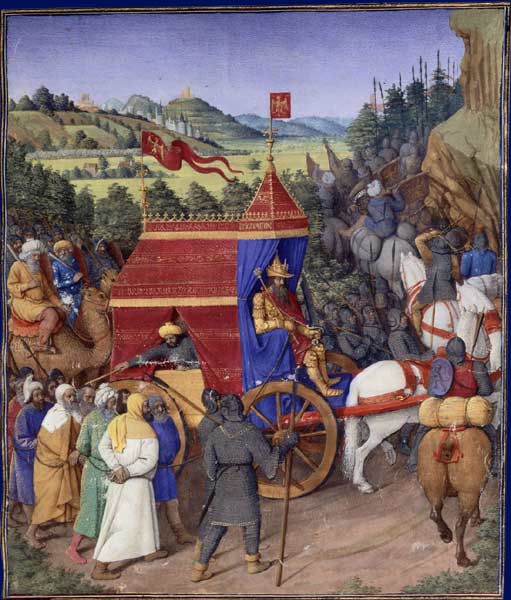
The conquest of Judah and the siege of Jerusalemwas a military campaign carried out by Nebuchadnezzar II, king of Babylon in 587 B.C. He had defeated Egyptian forces in 595 B.C. and subsequently invaded Judah. King Jehoiakim of Judah resisted Babylonian rule, but to avoid the destruction of Jerusalem he shifted allegiance from Egypt to Babylon and paid tribute from the treasury in Jerusalem. In 591 B.C., during the fourth year of his reign, Nebuchadnezzar suffered military losses against the Egyptians and this perceived weakness led to numerous rebellions among the states of the Levant, which owed allegiance to Babylon, including Judah. King Jehoiakim stopped paying tribute to Nebuchadnezzar and adopted a pro-Egyptian position.

Nebuchadnezzar dealt severely with this rebellion,laying siege to Jerusalem. King Jehoiakim died during the siege, possibly on December 10 588 B.C., and the city eventually fell on 2 Adar (March 16) 587 B.C. Nebuchadnezzar pillaged the city and the Temple. Much of the surviving Jewish population of Judah, numbering about 10,000, was deported to Babylon. None remained except the very poorest (who eventually became the Samaritans). Also taken to Babylon were the treasures and furnishings of the Temple, including golden vessels dedicated by King Solomon. Jerusalem lay a burning ruin.

According to the Book of Second Kings,

Surely this happened to Judah at the LORD’s command, to remove them from His presence because of the sins of Manasseh and all that he had done, and also for the innocent blood he had shed. For he had filled Jerusalem with innocent blood, and the LORD was unwilling to forgive(2 Kings 24:3-4).

Jeremiah had warned,

From the thirteenth year of Josiah son of Amon king of Judah until this very day—twenty-three years—the word of the LORD has come to me, and I have spoken to you again and again, but you have not listened. And the LORD has sent all His servants the prophets to you again and again but you have not listened or inclined your ear to hear. The prophets told you, ‘Turn now, each of you, from your evil ways and evil deeds, and you can dwell in the land that the LORD has given to you and your fathers forever and ever. Do not follow other gods to serve and worship them, and do not provoke Me to anger with the works of your hands. Then I will do you no harm. But to your own harm, you have not listened to Me,’ declares the LORD, ‘so you have provoked Me to anger with the works of your hands.’ Therefore this is what the LORD of Hosts says: ‘Because you have not obeyed My words, behold, I will summon all the families of the north,’ declares the LORD, ‘and I will send for My servant Nebuchadnezzar king of Babylon, whom I will bring against this land, against its residents.’

These verses of this hymn are no less than a cry of desperation. The Jews had staggered hundreds of miles to Babylon and now had to live apart from the land, the Temple, and the culture God had given them. Weeping and lamenting, they said, By the rivers of Babylon we sat and wept when we remembered Zion. There on the poplars we hung our harps, for there our captors requested a song; our tormentors demanded songs of joy “Sing us a song of Zion.” How can we sing a song of the LORD in a foreign land? If I forget you, O Jerusalem, may my right hand cease to function(Ps 137:1-5).

It was dreadful. Most people had lost a substantial number of family members as well as everything they owned; as they were driven into exile, the last thing they saw was the destroyed city and the smoldering ruin of the Temple. Isaiah 63and 64, along with the Lamentations of Jeremiah the Prophet, capture well this devastating moment for the Jewish people.

Hence, perhaps as no other Advent Hymn, Rorate Caeli Desuper powerfully illustrates the desperate need that ancient Judah had for a savior to rend the heavens and come down. The plaintive verses, drawn mainly from Isaiah’s prophetic lament, draw us into the desperate situation of God’s people, who have lost everything due to their sin and now seek salvation through repentance.

Advent has rather lost its penitential character today, but as this song illustrates, there was once a more somber and sober sense of the ancient need for a savior and our ongoing need for His graces. As the first three verses indicate, we tend to stray and thus are afflicted by the weight and destruction of our sins. Our passions blow us about like leaves in the wind and we lose our way. Up goes the cry in the third verse:

Behold, O Lord, the affliction of your people,
and send forth him whom you will send;
send forth the Lamb, the ruler of the earth,
from Petra of the desert to the mount of the daughter of Sion:
that he may take away the yoke of our captivity.

In the final verse comes the Lord’s merciful answer:

Comfort ye, comfort ye my people;
For your salvation will suddenly come:
why are you consumed with sadness?
why hath sorrow seized you?
I will save you: do not be afraid.
For I am the Lord your God,
the Holy One of Israel, your Redeemer.

Therefore, let the Advent cry go up:

Rorate caeli desuper et nubes pluant justum
Aperiatur terra et germinent Salvatorem

Heavens drop dew from above and the clouds rain down the Just One
The earth shall be opened and bring forth the Savior.

Here is the hymn sung in Latin Chant; its sober tones capture well a time that was cloudy and dark and when the cry for a Savior pierced the clouds:

And here is a beautiful polyphonic rendering of the Ne Irascaris(verse 1) by William Byrd, who wrote it in lament for the destruction of the Catholic Church in England of the 16thcentury:


Being in Church is Essential, Governor. Virtual is Not the Same as Real.

Many of us have heard expressed the formulaic regret by someone declining to attend an event: “Though I can’t be there, I’ll be there with you in spirit!” Two reactions usually occur to us who receive such a reply:

1 That’s unfortunate.

2 Whatever the phrase “there in spirit” means, they probably won’t be present in spirit either.

We human beings are body and soul. It is our dignity to combine the two orders of creation: matter and spirit. Angels are pure spirit, animals are matter, but the human person gloriously unites both orders in our one person.

For the human person, physical presence is important because we are not disembodied energy and while absences are sometimes necessary, it is usually thought of as less than ideal when we “phone it in” or go virtual.

Many people forget that the word “virtual” originally meant, “sort of like, but not really.” So, we might say, “He’s virtually a genius.” This is a form of hyperbole where we speak of his qualities that are like a genius though he’s not actually one in the full sense of the word. Lately “virtual” has simply come to mean “electronic” or “online” communication. But we ought not lose the original insight that computer (“zoom”) meetings are sort of like meetings but not really. They lack important aspects and subtleties when people share a room together and are physically present. There’s usually more buy-in in actual meetings. Interaction is livelier and people can’t get away with some of the multitasking going on in the background of virtual meetings. There is also something about being away from your usual desk or location with all its distractions and being in a room that is both neutral and designed for meetings.

To be sure, some meetings work well online, especially those that are brief and to the point. Travel time is often saved as well. Zoom and other platforms have been a great help in this time of plague. But recent studies have shown that online classes are terrible for students, especially the younger ones. Others too are wearied by all the online time that has been asked of us. And while I have given many online talks in recent pandemic months, I miss the dynamic of being in the room with people where I draw energy and get subtle feedback by their postures and expressions. Obviously masks also hinder this feedback greatly.

But of all meetings where physical presence is most required, the Sacred Liturgy is most important. One cannot receive sacraments virtually. You simply have to be there. How discouraging it was to hear the Governor of Virginia seek to school religious leaders and their congregants recently on where and how they should experience God:

Worship outside or worship online is still worship….  You don’t have to sit in the church pew for God to hear your prayers,” ….Is it the worship or the building? For me, God is wherever you are. [*]

It is more than annoying for this radical pro-choice governor to play theologian and liturgist. He certainly shows little knowledge when it comes to Catholic Sacraments, all of which require physical presence to be conferred. You can’t get baptized online, receive Holy Communion online, or even absolution. Physical presence is required. All the sacraments touch the body in some way, whether through the laying on of hands, pouring of water, anointing with oil, or reception of Communion. The Christian faith is incarnational. Christ did not come among us as a ghost, a meme, or a Zoom host. He does not simply livestream and is not merely an idea. The Catholic Mass and Sacraments touch and interact with the body. Presence is crucial.

Even for most Protestants whose belief in sacraments is minimal and whose services are more apt for livestreaming, they still see fellowship as important. You can’t get real fellowship online, you just have to be there for one another.

Christ has a mystical body and it is essential that the members of his Body gather every Sunday: Christ the head, and his members together. In the Catholic Liturgy we experience the presence of Christ in the faithful gathered, and in the priest through whom Christ ministers. We hear his voice in the Word proclaimed and are fed by his Body and Blood in the Holy Eucharist.

I do not expect the Governor to know all this. But, all the more reason for him to act with care and not speak so publicly of things he knows not. Catholics and other Christians are not frivolous in our need to gather. Our souls are just as important, if not more so, than our bodies. Sacraments and Sacred worship ARE essential in our lives, despite what some other governors and mayors have asserted. We should be expected to engage in prudent precautions like anyone who goes anywhere else. But government officials should not under-estimate our need to assemble for Sacred Worship even if they do not personally understand or share our beliefs. Our beliefs and practices far outdate this pandemic, this Country, and this culture. We will be here when all these things pass, as worldly things do. But the Word of the Lord remains forever.

Sweet, Beautiful, Soul-Saving Joy – A Homily for the Third Sunday of Advent

This Sunday is traditionally called Gaudete Sunday, based on the Introit for the day: Gaudete in Domino semper, iterum dico, Gaudete (Phil 4:4) (Rejoice in the Lord always, again I say, Rejoice). Today, this theme is developed most fully in the 2nd reading, which is from 1 Thessalonians. It also begins with the salutation and imperative, “Rejoice always.”

Let’s take a closer look at that reading and what is meant by the admonition to “rejoice.”

The text begins, Rejoice always. The Greek word translated as “rejoice” is χαίρετε (chairete). However, more is intended than merely rousing ourselves to some sort of the emotional state of joy or happiness. Note that the root word charis (within chariete) refers to grace. Hence chairete means to delight joyfully in and by God’s grace, to experience God’s favor (grace), to be conscious of and glad for His grace.

Because it is a work of grace, this sort of joy is more fully understood as serene, confident, and stable, a joy not rooted merely in the passing moods of our fallen human state.

The text continues further to identify three basic ways that our joy can become both stable and deeply rooted in our personality and psyche. In effect, the text does not merely instruct us to rejoice always, but tells us how this can be done. Let’s look at these three ways.

I. PERSEVERANCE IN PRAISE – The text says, Pray without ceasing. In all circumstances give thanks, for this is the will of God for you in Christ Jesus. Do not quench the Spirit. Hence we see the first three foundations for rejoicing always. Let’s take them a little out of order.

Grateful (In all circumstances give thanks) Thanksgiving is an important discipline that trains our mind to focus on reality. We tend to be negative, perhaps due to our fallen nature, but the reality is that every day trillions of things go right while only a few go wrong. Now you may think that’s an exaggeration, but it’s not. Consider all the things that have to go right with every cell in your body. Add to that all the many things on this earth—indeed in the whole universe—that must be perfectly balanced in order for you and me to even be here at all, alive and flourishing. Trillions is not an exaggeration.

However, if we are not careful, we focus on the handful of things that go wrong each day. Mind you, some of them may feel serious at times (although usually they are not). Nevertheless, even the truly serious mishaps cannot negate the reality of the trillions of things that have gone right.

Giving thanks disciplines our mind to focus on our countless blessings. Some of the mishaps of a day can even be blessings in disguise.

Hence we are told to give thanks in all circumstances. Daily thanksgiving disciplines our mind to focus on the astonishing number of blessings. What you feed grows, so if the negative is fed, it will grow; but if the positive is fed, it will grow and become an important basis of stable joy in our life. Yes, give thanks in all circumstances.

Prayerful (Pray without ceasing) – Prayer is also a discipline of the mind. Paul does not mean to say that we should stay in a chapel all day long. He means that we should lay hold of the normal Christian life, which is to be living in conscious contact with God at every moment of our day. To the degree that we are consciously aware of God’s presence and in a dialogue of love with Him all day, our joy is deeper and becomes more stable. Thus we are able, by this ongoing sense of His presence, to “rejoice always.”

Spirit-filled (Do not quench the Spirit) – That such gifts (ongoing prayer and thanksgiving) are “God’s will for us,” means that God wants to give us these gifts. Hence, we should not quench the Spirit, which bids us to seek these things. Rather, we should heed His promptings and seek these gifts, even pester God for them. Too often we quench the Spirit by not taking seriously the promises He offers us in Christ Jesus. We are not convinced that the Spirit can give us a whole new life and can deepen our prayer and gratitude, so we don’t even ask. We also quench the Spirit by cluttering our lives with endless distractions, never sitting still long enough to listen to the small, still voice of God. If we fan into flame the gifts of God’s love, God the Holy Spirit will kindle a fire in us that will never die away. As the gifts of His love (including deeper prayer and constant thankfulness) take hold, our joy deepens and we can “rejoice always.”

II. PERSPECTIVE THROUGH PROPHECY – The text says, Do not despise prophetic utterances. Test everything; retain what is good.

First, the phrase “prophetic utterances” refers to Scripture itself. Scripture is a prophetic interpretation of reality. It describes the world as it truly is and sets forth a clear vision. It is an antidote to the muddled and murky suppositions of worldly thinking that at best grope in the darkness and at worst are deceitful and erroneous. We ought not to despise God’s Word in any way, but rather should accept it wholeheartedly. To the degree that we do so, we are assured of the ultimate victory of God, His truth, and His Kingdom. Our own victory is also set forth in the paschal mystery of God’s Word, wherein every cross, faithfully carried, produces for us a weight of glory beyond all compare (cf 2 Cor 4:17). This vision, this prophetic interpretation of reality, produces in us a serene joy that allows us to “rejoice always.”

“Prophetic utterances” also refers to the teachings of the Church, the words of the Fathers of the Church, and the teachings of the saints down through the ages. There is a great deposit of faith that has been carefully collected and lovingly handed down from apostolic times. The dogmas and doctrines of the faith are like the precious fragments gathered up by the apostles at the multiplication of the loaves and fishes. For the Lord had told them that nothing was to go to waste. We, too, ought to seek out every instruction prophetically uttered by Mother Church, allowing nothing to fall to the ground.

The Fathers as well as the saints have left us wondrous testimony that we should neither despise nor ignore. They, along with the Church, utter wisdom and announce victory to every believer. In the laboratory of their own lives, they have tested the Word of God and found it to be true. Added to this number are many trustworthy people in our own time who teach us the Word of God. They include parents, priests, religious, and holy men and women who have inspired us. To the degree that we will let the Church and the saints teach us, along with trustworthy souls of our own time, to the degree that we do not despise these prophetic utterances, the foundation of our joy becomes surer and we can rejoice always.

III. PROGRESS TOWARD PERFECTION – The text says, Refrain from every kind of evil. May the God of peace make you perfectly holy and may you entirely, spirit, soul, and body, be preserved blameless for the coming of our Lord Jesus Christ. The one who calls you is faithful, and he will also accomplish it.

The greatest source of sorrow in our life, the biggest killer of joy, is our sin. To the degree that we indulge it, our joy is sapped, but to the extent that we allow the Lord to deliver us from sin and make us more and more holy, our joy becomes deeper and more lasting. The words “holy” and “whole” are not far removed from each other. As we become more whole, more perfected, freer from sin, more holy and blameless, our joy deepens and we can increasingly “rejoice always.” God will do this for us if we are willing and if we ask Him.

Thus we see that the mandate, the exhortation, to “rejoice always” is far more than a command to whip ourselves up to an emotional high. Rather, it is a call to stable and serene joy rooted in prayerful gratitude, to a mind transformed by God’s truth and a growing holiness. Allow the promise of the Lord to be fulfilled in you. For He has said,

Now remain in my love. If you obey my commands, you will remain in my love, just as I have obeyed my Father’s commands and remain in his love. I have told you this so that my joy may be in you and that your joy may be complete (Jn 15:9-11).

This song says, “Joy, Joy, God’s great joy! Joy, Joy, down in my soul. Sweet, beautiful soul-saving joy. Oh Joy! Joy in my soul!”

Nearly Indecipherable! Exploring a Gospel Passage that is Difficult but Rich in Blessings

There is a passage read at yesterday’s Mass (Thursday of the Second Week of Advent) that is complex, to say the least. A footnote in the Ignatius Study Bible calls a phrase in it, “nearly indecipherable.” So, let’s wade into the text and see what we find. 

For the record, the brief passage is, as follows: 

Jesus said to the crowds:
“Amen, I say to you,
among those born of women
there has been none greater than John the Baptist;
yet the least in the Kingdom of heaven is greater than he.
From the days of John the Baptist until now,
the Kingdom of heaven suffers violence,
and the violent are taking it by force.
All the prophets and the law prophesied up to the time of John.
And if you are willing to accept it,
he is Elijah, the one who is to come.
Whoever has ears ought to hear.” (Matt 11:11-14) 

At the center of this reading is St. John the Baptist and the setting forth of his role by Jesus. The first difficulty in the text is most easily overcome, namely that Jesus seems to offer faint praise for John the Baptist. On the one hand he says no one born of woman was greater than John. But then, he indicates that the least born into the Kingdom is greater than John. There are several explanations that can be taken together to explain this remark. 

  1. While St. John the Baptist possessed every sort of human and natural virtue to the most excellent degree, the baptized Christian acquires supernatural virtues such as Faith, Hope and Charity. Even the natural virtues of prudence, justice, temperance and fortitude are perfected by grace and attain to a kind of supernatural quality to the degree that we cooperate with God’s work. 
  2. The Christian acquires sanctifying grace, a supernatural virtue that makes us pleasing to God. Prior to this we were dead in our sins (Col 2:13) and subject to the wrath to come (1 Thes 1:10). In other words, we were incapable of approaching God since the light of his truth is too bright and the fire of his love too much to endure. Only by Sanctifying Grace and on-going purification can we hope to enter God’s glory. 
  3. The Christian acquires all the blessings of God and heaven. Before Christ and his sanctifying and redeeming work, no one could enter heaven. St. Augustine hints at this: ..The kingdom of heaven is something which we had not yet received, [but] of which [Jesus] speaks, Come, ye blessed of my Father, receive the kingdom, (Mat. 25:34). (Quoted in the Catena Aurea) 
  4. St. John Chrysostom says, That the abundance of the praise [of St. John the Baptist] might not beget a wrong inclination in the Jews to set John above Christ, he corrects this, saying, He that is least in the kingdom of heaven is greater than he. (Quoted in the Catena Aurea) 

Hence, many blessings accrue to those baptized into Christ Jesus that even the greatest and most virtuous apart from Him could never receive except by grace. Some argue that St. John the Baptist was sanctified in his mother’s womb (when he leaped with joy). But St. John received this gift antecedently on account of Christ and hence the teaching on grace must hold. John’s truest is greatness is not what he received being born of woman, but what he received being born of grace. 

However the next difficulty is harder to resolve. Jesus says, 

From the days of John the Baptist until now,
the Kingdom of heaven suffers violence,
and the violent are taking it by force.

What is this violence? Most ordinary readers think it refers simply to persecution endured by the Church. But this is not likely the case. The text does say that the Kingdom of Heaven “suffers violence.” The Greek verb is, βιάζεται (biazetai) meaning to forcibly seize, or lay hold of something with aggressiveness. It is in the passive voice (though some argue for the middle voice). And thus the widely held translation is that the Kingdom suffers violence or aggressiveness. 

However, the next verse says that the violent take it by force. But those who persecute the Church seek not to possess it, but to destroy it. 

So our surface interpretation of persecution needs some reconsideration. These antagonists seem to want the Kingdom, but want it by force or to aggressively lay hold of it. Who are they? Two theories emerge: 

  1. They are the perpetrators of pseudo-messianism, the many false messiahs of First Century and their followers who sought to usher in the Kingdom by initiating a violent uprising and war against the Roman oppressors. Jesus warned elsewhere of false Messiahs (e.g. Mat 24:24) and not to follow them. He sought rather a way of peace and desired the Church to convert the Romans, not kill them. 
  2. A second theory sees this group as the large and often aggressive crowds that sought and demanded Jesus’ attention. They are “violent” in the sense of being eager and filled with impetuous zeal. They grasp at the spoils of the kingdom of heaven— i.e. the physical healings of Jesus, his pardon and preaching, with a zeal that is intense but not deep. They like to hear of healings and experience them but ignore the demands of the gospel such as the cross, or the moral life. 

Speaking for myself, I prefer this second theory for its pastoral application. Jesus was often assailed by crowds. That is good in itself. But what did they (we) seek? Was it repentance and the new life of grace, or merely free bread and fish, healings and good sermons. Jesus did not trust large crowds. Whenever there is a mention of a large crowd, let the reader beware, a hard saying is coming —  teachings about the Cross, teachings the absolute primacy of Jesus, teachings against divorce, teachings about the Eucharist. Hence Jesus was often battling those who sought to grab at the Kingdom on their own terms and murmured or went away when Jesus did not meet their expectations (c.f. John 6:60ff; John 8:30ff) 

St. Jerome echoes this view: 

Because John the Baptist was the first who preached repentance to the people, saying, Repent ye, for the kingdom of heaven is at hand: rightly therefore from that day forth it may be said, that the kingdom of heaven suffereth violence, and the violent take it by force. For great indeed is the violence, when we who are born of earth, seek an abode in heaven, and to obtain …what we have not by nature. (Quoted in the Catena Aurea) 

As a final clue, in this mysterious and difficult text, Jesus links St. John the Baptist mission to that of the Elijah figure who would appear before the day of the Lord: And if you are willing to accept it, he is Elijah, the one who is to come. Note the following description of the work of this Elijah figure: 

Lo, I will send you Elijah the prophet before the coming of the great and awesome  Day of the LORD. And he will turn the hearts of the fathers to their children, and the hearts of the children to their fathers. Otherwise, I will come and strike the land with doom.” (Malachi 4:5-6) 

Note, therefore, that to those who would seek merely the blessings of the Kingdom such as miracles and healings, and who even forcefully insist on the Kingdom on their own terms, Jesus points to John’s (Elijah’s) message: repentance and mutual forgiveness. We do not take the Kingdom of Heaven by force or on our terms, we take it by grace granted through repentance and mutual love. 

A difficult passage indeed, notoriously obscure! And yet, with a couple of premises accepted, the pastoral message is clear and helpful: Accept the Kingdom of Heaven on God’s terms, do not demand a kingdom of your own imagining. God is found in his real Kingdom, not a fake or imaginary one. 

Jesus concludes: “Whoever has ears ought to hear.”

A Mid-Advent Picture of What Our Savior Offers

jesus-heals-the-paralyticThe Gospel for last Monday’s Mass (Monday of the Second Week of Advent) is the well-known story of the paralytic. There are many wonderful details that I could discuss (e.g., the four friends who bring him to Jesus—talk about great friends!), but I’d like to focus today on Jesus’ command: “Rise, take up your stretcher, and go home.” It is a small picture of the grace unto salvation offered to us by the Lord. Here is a man who is powerless to help or heal himself, so the Lord helps and heals him. Though “dead in his sins,” he now rises and lays hold of a whole new life.

This is a mid-Advent picture of why we need a Savior, and what He offers. Note three aspects of what Jesus says to the paralytic:

Rise – In other words, receive new life, new capacities. No longer be weighed down by weakness. Be set free. Rise to new life! When Jesus called Lazarus from the tomb, he said to the bystanders, “Untie him and let him go free.” St. Paul says of us, “You were dead in your sins … but made alive through Christ” (Col 2:13). And thus the paralyzed man, once powerless to move or take control, is now strong and free. His paralysis represents our weakness, our spiritual palsy, our inability to walk uprightly and in justice. To all this, Jesus says, “Rise!” He bids us no longer to be in bondage to sin, Satan, the world, and the flesh.

Rule – The Lord tells the paralytic man to take up his stretcher. He wants him to take authority over that on which he once depended. Whatever crutch you once leaned on, be strong enough now to carry it; don’t lean on it any longer. If you once depended on sin for happiness, take authority over it now. If you once needed alcohol to calm your nerves, take authority over it now; don’t lean on it anymore. If you once depended on gossip and detraction to feel important, take authority over it. Don’t be dependent on any sin. By being healed, have the power to carry it off like a trophy of victory. While it is true that we will always need some help in this life, no longer should we be wholly dependent on anything or anyone in this world. The Lord has authority in our life and He grants us increasing authority over our passions, desires, struggles, and gifts. He tells us to take up the authority He has rightly granted us and command our soul in justice and truth.

Return – The Lord says to him, “Go home.” In other words, make your journey back to God, back to your true home in the heart of the Father. Sin had separated us from God and driven a wedge between us. But now the veil in the Temple has been torn from top to bottom. Through Jesus, we have access to the Father. Like prodigal sons, we are now heading home. Look off in the distance! It is the Father, running to us to greet us! By offering forgiveness for our sins, Jesus has opened the gates of Heaven and restored us to a right and just relationship with His Father. If we will accept this gift and celebrate it regularly, our return is well underway; it is just over the next hill (Calvary). And just beyond is the heavenly Zion. “I rejoiced when I heard them say, ‘Let us go up to the House of the Lord!’”