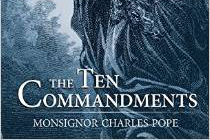
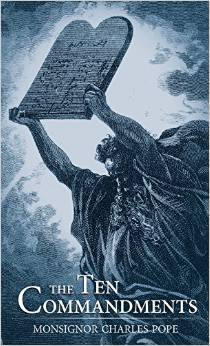
I am the proud father of a new book entitled simply The Ten Commandments (see at right). And you’ll be surprised, knowing me, at how brief it is—just 104 pages. But I wanted to keep it short, readable, connected to the catechism, and very practically related to living the Commandments on a daily basis. You can get it at the usual booksellers and there is also a Kindle version. I hope many will find it helpful, and it even fits neatly in your coat pocket.
A couple of thoughts on moral law, which is a very precious gift to us from God.
1. The moral life is not a burden; it is a precious gift. One of the dangers in trying to understand the Christian moral life is seeing it as simply a list of dos and don’ts. In addition, many Christians tend the think of the moral life in terms of something they must accomplish out of their own flesh and through their own will. This turns the great moral vision of God into a kind of heavy burden rather than a freeing transformation that God works through His grace.
But the Christian moral vision begins with grace; it is something we receive more so than something we achieve. The Christian moral life, then, is the life that Christ died to give us. It is a life in which, increasingly, we are freed from deep and sinful drives such as anger, greed, lust, pride, vengefulness, bitterness, and so forth. Christ died and rose to free us from such things and the Christian moral vision describes what the redeemed human person is like.
And thus the moral section of the Catechism of the Catholic Church is entitled “Life in Christ.” In effect, the title teaches us that the moral life is the result of us living in closer union with Jesus Christ. As Christ lives His life in us, we are increasingly changed and transformed. The Christian moral vision thus answers the questions, “What is the transformed human being like?”, “How does he behave?”, “What is his thought life like?”, “What are his priorities?”, and so forth.
In the incredible Sermon on the Mount (Matt 5-7), Jesus’ moral treatise, He paints a kind of picture of the transformed human person. He is saying, in effect, here is what happens to you if you let me begin to live my life in you. You will be poor to the deceptive riches of this world but rich in the things of God. You will long for holiness and proclaim the gospel even if it costs you. You will have authority over your anger and have tender love for your spouse and children. Purity and chastity will endow your sexuality and your thought life. You will love your enemy and not seek revenge. You will speak the truth in love and trust God more, calling Him your Father, and be less concerned about garnering the approval of the world or worrying about the things it says you must.
It is a rich picture of a person transformed by grace and living with increasing freedom and joy. It is among God’s most precious gifts; it is the gift of new life; it is the effect of His Love; it is the advance of the freedom that is His gift to his children. (Somebody say, “Thank you Lord!”)
2. By grace, the law is fulfilled and its “burden” lifted.In setting forth His vision of the law, Jesus says, Think not that I have come to abolish the law and the prophets; I have come not to abolish them but to fulfill them (Mat 5:17). To fulfill the law means to “fill it full.” In other words, we are called to observe the law not just in its narrowest legal meaning, but in its fullest sense, as a language of love and trusting fidelity. Lovers do not ask, “What is the least I can do to please my beloved?” Lovers ask, “What more can I do to please?” Love is, by its very nature, extravagant.
A young man who loves a young woman does not say to her, “Your birthday is coming and there is this silly custom that I am supposed to observe: I must buy you a gift. So, beloved one, what is the cheapest gift I can buy you to satisfy my obligation and not lose your affection?” This is not the language of love! The young man, if he truly loves the young woman, will be delighted to celebrate her birthday and will, if possible, buy her a gift that goes beyond minimal expectations.
And this is how it is with grace. The Holy Spirit sets our hearts on fire with love for God and trust in His goodness. Thus when God’s will or commandments are made known to us we are not angry or sorrowful, rather we are delighted and instinctively seek to know all the implications of what God asks.
For example, see how Jesus treats the Fifth Commandment and shows what it means to fulfill it:
You have heard that it was said to the men of old, ‘You shall not kill; and whoever kills shall be liable to judgment.’ But I say to you that every one who is angry with his brother shall be liable to judgment; whoever insults his brother shall be liable to the council, and whoever says, ‘You fool!’ shall be liable to the hell of fire. So if you are offering your gift at the altar, and there remember that your brother has something against you, leave your gift there before the altar and go; first be reconciled to your brother, and then come and offer your gift (Mt 5:21-24).
Most of us can get through the day without killing someone. In a strict, legal sense we have “kept” the commandment. But Jesus calls us to the love that seeks to fulfill this commandment. Thus we must see that clinging to bitter anger, seeking revenge, using intentionally hurtful language, and refusing to be reconciled to others are all ways that we fail in observing the full implications of what God teaches in this commandment.
It is evident that in one sense Jesus’ understanding of the law is far more demanding than previous interpretations of it. Yet it is less burdensome because of the power of His love within us! Those who love undertake even supposedly burdensome tasks with joy.
Again, consider an example. Suppose there is a young man who seeks to win the affection of a young woman. Suppose further that she asks his assistance with some major project she is trying to accomplish. He will be delighted that she has asked, even if it involves a significant amount of time and energy on his part. Even if he has to cancel some of his own plans, he will do so with joy. If even imperfect human love can lighten burdens and transform them into joys, how much more so will the love of God transform the weight of law into fulfilling joy?
God’s Law is a gift, as those who love him know. Whatever its challenges, its gifts are far greater.
I hope you might consider my book. It is a modest beginning of taking forward some of the work we have done here together on the blog. I hope to publish more soon.
Many troubles today within the Church, and also among Christians in general, come down to a problem of mistaken or false ecclesiology. “Ecclesiology” refers to the nature of the Church. What is the Church? What is the fundamental mission of the Church? How essential is the Church in the life of every believer? What authority does the Church have in our life? Who has the authority in the Church to speak for Jesus Christ and teach in His name? What is the Church’s relationship to Holy Scripture and the sacred deposit of faith? Is there but one Church, or many? And so forth. These are questions dealt with in the branch of sacred theology known as ecclesiology.
Many people today, including many Catholics, have come to accept a badly flawed ecclesiology. Many see the Church simply as a human institution. The kind of cynicism and scorn commonly directed in our culture toward institutions is therefore also aimed at the Church. But while the Church does have institutional elements and human members, the Church is not a mere human institution.
The Catholic Church is the continuing presence of Jesus Christ in the world—it is the Body of Christ. And this is not just a figurative way of speaking about the Church. Sacred Scripture gives this description a real, quite literal though mystical (i.e., beyond our full sight) sense. The Catholic Church is both visible and spiritual. It is structured hierarchically, like any body, yet is Spirit-led. It has human members yet is also the divine presence of Christ in the world today. The Church, as the Body of Christ, teaches in His name, sanctifies with His grace and Sacraments, and leads with His authority. Jesus still walks this earth, preaches, heals, teaches, forgives, feeds, and summons us.
Because the Church is the Body of Christ—we His members, He the Head of the Body—there cannot be many “Churches” any more than there can be many “Christs.” Jesus has one Body. The Church is not some ethereal, invisible reality. Rather, like any body, it is visible and has identifying marks and attributes. As with a body that has parts, organs, and “members” with different functions, the Church has members. But not all members have the same function or role.
These descriptions set aside many popular misconceptions about the Church.
The Church is not a club made up of people who gather for some specific goal or purpose of their own. Such clubs are fine in their own way, and often have a noble purpose, but the Church exists to bring forth Jesus’ stated goals and purposes, to proclaim His vision, His way, and His truth.
The Church is not a political party. Political parties reflect human preferences and opinion, and are organized to carry forth human goals and projects. This is all well and good, but the Church transcends passing political views and goals, and cannot simply fit into the self-defined boxes of political parties and movements. The Body of Christ cannot be reduced to or perfectly defined by any specific political philosophy or party.
The Church exists to proclaim what Christ has taught, whether it is popular or not.
Now this point is critical and too easily forgotten today by many who issue insistent demands that the Church “update” her teachings and conform to current notions and mores. Many cry out, for example, “Doesn’t the Church leadership know that most Catholics reject its teaching on contraception, or the priesthood?”
Many, because of a flawed ecclesiology think that our failure to conform to modern notions is not only odd, but downright unjust, wrong, or even sinful. This is because of the mistaken idea that the Church is supposed to reflect the views of its members and represent them and what they think.
But the Church does not exist to reflect the views of its members, but rather the views and teachings of its head and founder, Jesus Christ. It is His teachings that are to unite the members of the body and be the principle of our unity. Jesus entrusted His teachings to His apostles, who handed them down to us in Sacred Scripture and Sacred Tradition.
On this point we must be clear. The defined doctrines, to include the moral teachings of the Church, are not going to change despite even the strident protests of the world. Because of the highly sexualized culture in which we live, most of the demands that we change center around issues of sexuality and the family. But no matter how many secular news reports you have read in the past year or so speculating that “a change in doctrine is being signaled” (whether about divorce and remarriage (as we approach the Synod on the Family in October), or homosexual acts, or sexual intercourse outside of marriage, or abortion, or women being priests, or euthanasia), be assured that these teachings cannot change. There are just some things that the Church cannot do, no matter how heavy the pressure to do so. These doctrinal teachings are not going to change because Jesus, who spoke through his apostles, is not going to change. Jesus Christ is the same yesterday and today and for ever. Do not be led away by diverse and strange teachings (Heb 13:8-9).
Opinion polls are not the source of our teaching, Jesus is. And just as Jesus was rejected by many of His time, the Catholic Church, His body, is often destined to be a sign of contradiction in the world. The same gospel must be preached, in season or out of season.
A proper ecclesiology can save us from needless fears and also from the mistaken notion that the faith revealed by Christ can ever fundamentally change. Courage, the Cross, consistency, clarity, and charity—in all things, Christ! At the end of the day, even with the likes of me and you, that’s what the Church is: Christ. And though crucified, He rose and His truth will prevail.
We live in times in which there is a widespread notion that to correct sinners is to “judge” them. Never mind that it is sin that we judge, not the sinner. Never mind that in accusing us of judging, the worldly-minded are themselves doing the very judging they condemn. Never mind any of that; the point of the charge is to seek to shame us into silence. And despite the fact that Scripture consistently directs us to correct the sinner, many Catholics have bought into the notion that correcting the sinner is “judging” him. In this, the devil, who orchestrates the “correcting is judging” campaign, rejoices; for if he can keep us from correcting one another, sin can and does flourish.
Today’s gospel is an important reminder and instruction on why and how we should correct the sinner and be open to correction ourselves. Let’s look at in four steps.
I. PRESCRIPTION – The text says, Jesus said to his disciples: “If your brother sins (against you), go and tell him.” I placed “against you” in parentheses because many ancient manuscripts do not contain this phrase, while others do. While some may want to limit this gospel to commanding correction only when someone sins “against you,” none of the other texts we will review contain this restriction and so the phrase seems superfluous. For the purpose of this reflection, I will favor those manuscripts that do not include the phrase “against you.”
Now, therefore, observe the brief but clear advice that when we see someone in sin, we ought to talk with him or her about it. Many prefer, probably due to sloth, to say, “It’s none of my business what other people do.” But Jesus clearly teaches otherwise.
In teaching this way, Jesus is obviously speaking to the general situation. Some distinctions are helpful and admissible in specific situations. For example, one is generally more obliged to correct people in grave matters than in less serious ones. One is more compelled to correct those who are younger than those who are older. One is more obligated to correct subordinates, less so superiors. Parents are strongly duty-bound to correct their children, but children are seldom obligated to correct their parents. And so on. But the general rule remains: all other things being equal, there is an obligation to engage in Christian correction. Jesus says, “If your brother sins, talk to him about it.”
There are many other scriptures that also advise and even oblige us to correct the sinner. Some of the texts also speak to the way in which we should correct.
James 5:19My brothers, if one of you should wander from the truth and someone should bring him back, remember this: Whoever turns a sinner from the error of his way will save him from death and cover over a multitude of sins. Gal 6:1Brethren, if a man is overtaken in any sin, you who are spiritual should recall him in a spirit of gentleness. Look to yourself, lest you too be tempted. Bear one another’s burdens, and so fulfill the law of Christ. Col 3:16 Let the word of Christ dwell in you richly, teach and admonish one another in all wisdom. 1 Thess 5:14And we exhort you, brethren, admonish the unruly, encourage the fainthearted, help the weak, be patient with them all. Lev 19:17 Thou shalt not hate thy brother in thine heart: thou shalt in any wise rebuke thy neighbor, and not suffer sin upon him. Ez 3:17Son of man, I have made you a watchman for the house of Israel; whenever you hear a word from my mouth, you shall give them warning from me. If I say to the wicked, ‘You shall surely die,’ and you give him no warning, nor speak to warn the wicked from his wicked way, in order to save his life, that wicked man shall die in his iniquity; but his blood I will require at your hand.
Hence, we have an obligation in charity to correct someone who has gone over into sin. In correcting we ought to be gentle but clear. Further, we ought to correct with humility and not fall into the temptation of acting “superior” and such. Our goal is to limit sin’s effects and to apply necessary medicine to the problem of sin.
We will see more “correction texts” in a moment. But for now, let the first point be repeated: if your brother sins, talk with him about it.
II. PURPOSE – If he listens to you, you have won over your brother.Here, let us just briefly note that the point of this correction is to win a brother or sister back to the Lord. The point is not to win an argument or to show superiority. The point is to contend with Satan, by God’s grace, and win the person, who is in Satan’s grasp, back for God.
III. PROCESS – The Lord next sets forth a process for fraternal correction. It would seem that the process here is generally for more serious matters and that all these steps might not be necessary for lesser ones. For addressing the general situation in which a brother or sister is in a state of more serious and unrepentant sin, the following process is set forth:
1. Go and tell him his fault between you and him alone. – This first stage is often omitted in our fallen, gossip-prone, human condition. If one is in sin, it is too frequently the case that we will talk to everyone except the actual sinner. This is usually not helpful and in fact merely compounds the sin. The sinner goes uncorrected and sin multiplies through gossip. Satan gets a high return on his investment, often netting dozens of sinners for the price of one.
Jesus is clear: speak to the sinner himself, FIRST. There may be situations in which we need to seek advice from someone we trust about how best to approach the sinner. And sometimes we may need to check a few facts first. But in the end, such lateral discussions ought to be few and only with trusted individuals. The Lord is clear: step one is to go first to the sinner himself.
2. If he does not listen, take one or two others along with you, so that ‘‘every fact may be established on the testimony of two or three witnesses.” – This sort of option may seem rare today in our large cosmopolitan settings, but such things do occur in the right circumstances. Often these sorts of team efforts are called “interventions” and they are frequently done in the cases of addicts who are resisting treatment. Sometimes, too, it is used when a certain family member is engaging in hurtful practices such as severe anger, or the refusal to forgive, or causing division within the family. Such interventions are usually conducted by several family members that the person trusts and they often receive training of some sort before doing so. Depending on the gravity of the matter, these interventions are both necessary and counseled by the Lord as part of a method to end destructive and sinful behaviors.
3. If he refuses to listen to them, tell the Church. – Here, too, note the presupposition that the Church is experienced in a personal way and that the individual is somehow connected to a body of believers who matter to him in some way. The presumption is that these are people he knows (pastors, parish leaders, etc.). This is not always the case in modern parishes, which can be large and impersonal and where many can attend yet stay only on the fringes. Rather than simply dismissing this step of Jesus’ as unrealistic in most cases today, we ought to see it as setting forth an ideal of what parishes ought to be. I hope to work with this vision in a post later this week.
Nevertheless, for those who have some relationship to the Church, this step needs to be considered in cases of grave sin. As a pastor, I have sometimes been asked to speak to a family member in serious sin. Presuming other measures have been taken, I often do speak to him or her to warn about such things as fornication, shacking up, abortion, drug use, anger issues, disrespect for parents, and so forth.
But to be honest, unless the individual has more than a superficial membership in the parish, such talks are of limited effectiveness. Further, “Church” here should not be seen merely as meaning clergy. Sometimes there are others in the Church who ought to be engaged, leaders of organizations to which the person belongs, older men and women (to speak to younger ones), and so forth. I have often engaged a team to speak, especially to younger people.
4. If he refuses to listen even to the church, then treat him as you would a Gentile or a tax collector. – And here we come to a matter of some controversy: that of excommunication. Treating someone as tax collector or Gentile is a Jewish way of saying, “Have nothing more to do with such a one; let him be expelled from the community.”
Some today object to the use of excommunication and often suggest, with some superiority, that “Jesus would never do such a thing.” Yet Jesus himself is teaching us here to do this very thing. As we shall again remark, excommunication is not a punishment to be inflicted upon someone simply to be rid of him or her, but rather as a medicine to bring forth repentance. As we can see, too, excommunication only comes at the end of a long process and is not something that the Church rushes to do. But it IS taught here and elsewhere in Scripture. Consider some of the following examples:
2 Thess 3:6We instruct you, brethren, in the name of our Lord Jesus Christ, to shun any brother who walks in a disorderly way and not according to the tradition they received from us. 2 Thess 3:14If any one refuses to obey what we say in this letter, note that man, and have nothing to do with him, that he may be ashamed. Do not look on him as an enemy, but warn him as a brother. 1 Cor 5:1It is actually reported that there is immorality among you, and of a kind that is not found even among pagans; for a man is living with his father’s wife. And you are arrogant! Ought you not rather to mourn? Let him who has done this be removed from among you. For though absent in body I am present in spirit, and as if present, I have already pronounced judgment in the name of the Lord Jesus on the man who has done such a thing. When you are assembled, and my spirit is present, with the power of our Lord Jesus, you are to deliver this man to Satan for the destruction of the flesh, that his spirit may be saved in the day of the Lord Jesus. 1 Cor 15:33Do not be deceived: “Bad company ruins good morals.” Come to your right mind, and sin no more. For some have no knowledge of God. I say this to your shame. 1 Cor 5:11But rather I wrote to you not to associate with anyone who bears the name of brother if he is guilty of immorality or greed, or is an idolater, reviler, drunkard, or robber — not even to eat with such a one. Is it not those inside the church whom you are to judge?
So a fairly strong and clear biblical mandate exists from both Jesus and St. Paul that excommunication may at times have to be used. It would seem from the texts we have surveyed that the purpose of excommunication is two-fold: to protect the community from the influence of serious sinners, and to be a medicine to urge the wayward Christian unto saving repentance.
And if any doubt the seriousness of excommunication or think nothing of the Church’s solemn declaration of it, note that Jesus indicates that he will in fact recognize the Church’s authoritative declaration. For He says, Whatever you bind on earth shall be bound in heaven, and whatever you loose on earth shall be loosed in heaven. Thus, let no one make light of the Church’s solemn declaration in such matters.
In our times there is increasing demand for bishops to use this measure more often, especially for those who openly support and help fund abortion. It seems clear from the Scriptures we have surveyed that such a measure can, and at times should, be used at the end of a process like Jesus describes. If one is directly involved in abortion, either by having one, performing one, paying for one directly, or directly assisting someone to have one, he or she is automatically (self) excommunicated.
What of “Catholic” politicians and jurists who advance the availability of abortion and vote funding for it? Most (but not all) bishops have made a prudential decision not to make use of this measure for “Catholic” politicians who support abortion or same sex “marriage,” etc. Most of them say they have concerns that the matter would be perceived as a partisan political act rather than a moral shepherding of these wayward souls. And since it would be misread and falsely portrayed by the media, they consider it unwise in these circumstances to excommunicate.
Bare minimum – It is not my role as a priest to critique bishops on whether or not they choose to excommunicate. There are prudential judgments bishops must make. But at a bare minimum I would surely hope that every Catholic (politician or not) who even comes close to procuring an abortion or advancing its availability, has been privately instructed and warned by his pastor (or bishop in prominent cases) that if he does not change, and dies unrepentant, he will almost certainly go to Hell. Likewise those of any prominence who help advance other serious moral evils should be strongly admonished by pastors to return to the truth.
It is simply too serious a situation to leave a sinner of this magnitude uninstructed, unrebuked, or in any way unclear as to the gravity of the matter. The sinner should be instructed—yes, warned vividly—to repent at once and to refrain from Holy Communion until confession can be celebrated following true repentance.
IV. POWER – Again, amen, I say to you, if two of you agree on earth about anything for which they are to pray, it shall be granted to them by my heavenly Father
The Lord is showing here how our unity will bring strength. But how can we have unity in the Church when there is not agreement on basic moral principles and behavior. Thus fraternal correction not only helps the sinner, it helps the Church by helping to preserve our unity in the truth of the Gospel. Surely central to the truth that unites us is the moral law of Christ and his Church. Thus fraternal correction increases our unity and makes us and our prayer stronger.
Sadly today it is evident that our unity and the power of our prayer as a Church is greatly diminished by the disunity among us and the way in which many go on too long never being corrected in and by the Church. We are not a force for change since we are divided on the very truth that is supposed to unite us. Much of our division is further rooted in our failure to teach with clarity and correct the sinner.
Much work and pray is necessary today to unlock the power here of which the Lord speaks.
The Lord sometimes comes in unexpected ways and in unexpected packages. The Jews of Jesus’ time were expecting a Messiah who would ride in on a warhorse, and after a bath of blood, reestablish an earthly kingdom of David in all its glory with economic prosperity and military superiority. But Jesus defied their expectations and asked them to risk the unexpected. He came not in might, but humbly, riding on a donkey. He spoke with a rural “hick” accent common to Galilee and hailed from a town so lowly that only a footpath went to it. Even one of His apostles wondered what good could ever come from Nazareth. He ended his earthly ministry dying on a cross.
Yet to those who risked the ride, the Lord reappeared gloriously resurrected, with might and power in His hand. St. John, who saw Him in His glory, said, I heard behind me a loud voice like a trumpet and in the midst of the lampstands one like a son of man … and his voice was like the sound of many waters (Rev 1:10,15). So He came in humility and mercy, but when He returns you’d better be ready, by His grace, for He comes in judgment. And the mighty shall be cast down and the lowly raised.
Some of this occurred to me as I watched this KIA commercial the other day.
It is filled with unexpected things. A rather well-heeled couple comes to the valet to get their luxury car. And yet a strange Christ-figure meets them and challenges to take the risk of a different ride. He tells them that the world of luxury has blinded them from the world of true luxury. (Pay attention, Christian!) He offers them a blood-red key (that brings to mind the Cross) to a different ride than their worldly luxury car.
At some point the couple is led to a KIA car—not exactly the first luxury car that would likely occur to this couple, that is clearly more used to a Rolls, or a Mercedes, or maybe even a Bentley. To them it must have seemed as meek and humble as riding on a donkey. What kind of luxury is this?
But entering the car with the strange, Christ-like figure they are surprised. Interestingly, after being handed their blood-red key, they are in a car with a resurrection-white interior. Driving past, they are grateful that no one outside seems to notice or be impressed. But they are, and the Christ-figure tells them that this is what true luxury is like.
And then in the most unexpected twist of all he lets out a voice “like a trumpet blast and the rush of many waters!” And the unimpressed, unbelieving world outside is literally blown away. Judgment day! This world cannot endure the war cry, the shout of Jesus, who shall come to judge the living and the dead and the world by fire.
Enjoy the commercial and pay heed, fellow Christian. Christ asks humility and a forsaking of the lies of this world. But only to usher in a greater glory!
Many of you have expressed concern about a blog post I wrote on the St. Patrick’s Day Parade, which was removed. I am grateful for your concern about this and all the issues we discuss here. I removed the post upon further reflection due to the strong nature of the language I had used in parts of it. I apologize if the language I used caused offense.
I remain concerned about the central point of the article, namely, how we as Catholics can effectively engage a culture that increasingly requires us to affirm what we cannot reasonably affirm. There are many prudential decisions involved in the answer to this question, and my intent is not to directly criticize any bishop or diocese. But this is an issue we must all collectively wrestle with as our culture and our faith reach deeper differences.
I am grateful to the Archdiocese of Washington, which has generously sponsored our conversation on this site for five years. I am also grateful to all of you who read and comment. I ask mutual charity and understanding for all parties involved. The beautiful motto of James Cardinal Hickey, who ordained me, rings just now in my heart: Veritatem in Caritate (the truth in charity).
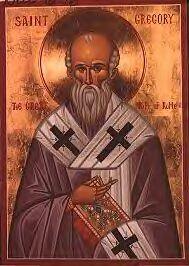
Yesterday’s feast of St. Gregory provided rich reflections from the great Doctor of the Church. And I supplemented my readings as well by looking over some of his homilies. Frankly, St. Gregory the Great was tough on himself and on preachers and he spoke of the office in lofty and demanding terms. For example he taught,
The lips of the priest are to preserve knowledge, and men shall look to him for the law, for he is the messenger of the Lord of hosts … That is also the reason why the Lord warns us through Isaiah: Cry out and be not still; raise your voice in a trumpet call. Anyone ordained a priest undertakes the task of preaching, so that with a loud cry he may go on ahead of the terrible judge who follows (Pope Gregory Pastoral Guide).
For yesterday’s Office he also says, Note that a man whom the Lord sends forth as a preacher is called a watchman. A watchman always stands on a height so that he can see from afar what is coming … must stand on a height for all his life to help the people by his foresight (Homily on Ezekiel, 1.11).
I was privileged for the past four days to be with the priests of Burlington, VT, and to be the presenter at their presbyteral days. Among the things we reflected on were these words from Gregory on his feast day.
Another teaching of Pope St. Gregory that struck me is his assertion that the preacher goes ahead of the Lord, announcing him as it were, and the Lord comes behind to “close the deal.” It is an important insight that can also help the preacher avoid both pride and also an exaggerated sense of responsibility. I’ll say more of this in a moment, but for now listen to St. Gregory:
Beloved brothers, our Lord and Savior … sends his disciples out to preach two by two …
Rightly is it said that he sent them ahead of him into every city and place where he himself was to go. For the Lord follows after the preachers, because preaching goes ahead to prepare the way, and then when the words of exhortation have gone ahead and established truth in our minds, the Lord comes to live within us. To those who preach Isaiah says: Prepare the way of the Lord, make straight the paths of our God. And the psalmist tells them: Make a way for him who rises above the sunset … Therefore, we make a way for him who rises above the sunset when we preach his glory to you, so that when he himself follows after us, he may illumine you with his love.
Think over, my beloved brothers, think over his words: Pray the Lord of the harvest to send laborers into his harvest. Pray for us so that we may be able to labor worthily on your behalf, that our tongue may not grow weary of exhortation, that after we have taken up the office of preaching our silence may not bring us condemnation from the just judge.
From a homily on the gospels by Saint Gregory the Great, Pope (Hom 17, 1-3: PL 76, 1139).
It is a powerful and helpful insight that the preacher goes before the Lord, who then follows after to quicken the Word that is planted.
And here is a remedy, first of all for pride. For the preacher is not the Lord. And, though it is the Lord’s own Word he preaches, mere human eloquence cannot completely express what God alone, who is love, can effect in the human heart. The preacher can but sow the seed of the Word; only God can bring forth the harvest. As St. Paul wrote,
I planted, Apollos watered, but God gave the increase. So neither he who plants nor he who waters is anything, but only God, who makes things grow (1 Cor 3:6-7).
The preacher can propose, but the Lord must come after to “close the deal.” The Samaritan woman was rather abruptly but truthfully told this by the townsfolk.
We no longer believe just because of what you said; now we have heard for ourselves, and we know that this man really is the Savior of the world” (Jn 4:42).
And every preacher should delight to hear this. It is a valuable lesson for the preacher to remember his place. He goes before to announce the presence of the One who alone can heal and bring in the truest harvest by His grace.
The preacher is like the best man in an ancient Jewish wedding, to whom St. John the Baptist equated himself:
He who has the bride is the bridegroom; but the friend of the bridegroom, who stands and hears him, rejoices greatly because of the bridegroom’s voice. So this joy of mine has been made full. He must increase, but I must decrease (Jn 3:29-30).
St. Gregory’s insight also helps the preacher to avoid an exaggerated sense of responsibility. For it sometimes happens that a preacher may think too much rests on him, on his eloquence, and on finding just the right analogy or formulae. He may also lament his flaws. And while it is true that every preacher must work to hone his skills, it also remains true that Unless the LORD builds the house, its builders labor in vain (Ps 127:1).
Thus the preacher can help lay a foundation, but it is the Lord who must build the house. It is freeing and helpful for the preacher to remember that he merely goes before the Lord, and that the Lord will follow after, with every good grace. The preacher must do his part in proclaiming the authentic word of God, but only the Lord can perfect the message in every soul. He must preserve knowledge and prepare the way for the Lord, who will judge the living and the dead, but who also comes in the meantime to the faithful and causes the seed to grow in their hearts.
This is freeing and reassuring. And most of us who preach realize this from time to time when someone tells us something we have said, but recounts it in a way that surprises us. And this shows how the Lord helps them to hear what our feeble words only suggested.
In the end every preacher must trust the Lord, who comes after him to complete what is lacking and to bring forth the fruits that the preacher can only point to. The Lord causes His truth to shine forth in consolation for the faithful and in judgement for the wicked. The battle is the Lord’s. So is the victory and the harvest.
How have we gotten into this mess wherein we have set aside reality in favor of what we think reality is? No longer do we go out to meet reality and accept the obligation of conforming to reality; now we sit back and claim the right to posit our own reality, to project reality and define it on our own terms. How did we get here?
Look to the nominalists, my friends.
A rather informative, though challenging, book on this matter is Journey to Modernity by Louis Dupré. In it he traces the medieval synthesis and rise of nominalism in the late 15th century, which in turn gave way to the Cartesian Revolution in the 17th century.
The nominalist revolution introduced the concept by insisting that we do not go out and discover reality so much as we simply create it by categorizing it with “names” (nomina –> names –> nominalism). The names we assign are not a recognizing of reality; they are a “making” of it. We assign meaning rather than discover it.
Welcome to the modern dark ages—dark, and getting darker. Welcome to the age of nominalism, invented in the late 15th Century and now a weed that has been allowed to flourish and is more widespread than ever.
The old version of nominalism denies the existence of universals: qualities or characteristics that can be illustrated or exemplified by many particular things. At least this version of nominalism was debatable. Is there a universal “chair-ness” that all chairs exemplify, or is this just a human abstraction? Here a legitimate debate can be had.
The modern and more lazy version of nominalism, which I will call here “neo-nominalism,” holds that words (nomen = word) are simply arbitrary sounds we assign to things that reflect us, more so than anything we call reality. In a more sweeping way, whole categories are also dismissed.
Thus, for example, words and categories such as male, female, marriage, abortion, euthanasia, etc. are just words we assign; they are mere human “constructs” that do not exist in reality. So, many claim the right today to move beyond these human words and categories. They also claim the right to assign new words to describe these realties. Abortion becomes “choice,” “reproductive freedom,” or “women’s healthcare.” Unnatural sexual acts are called “gay” (a word that used to mean happy) and anal sex is celebrated as an “expression of love.” Same-sex “pseudo-gamy” is called “marriage.” Suicide or killing of the aged or imperfect is called “euthanasia” (a word that means “good death” in Greek). Sexual identity is now called “gender” (a grammatical classification of nouns found in nearly one-fourth of the world’s languages, not a word for human sexual differentiation).
Neo-nominalism claims the right to define new reality and scoffs at the more humble proposition that we ought to discover reality and conform to it. Neo-nominalism casts aside such humility and claims the right to define reality by inventing new words and thoughts and then imposing them on what really is. And thus we get endless absurdities such as LGBTQ (and Lord knows what letter will be added next). We have bizarre notions such as being “transgendered,” a concept that denies human distinctions that could not be more obvious and are literally inscribed in our bodies. But the neo-nominalists will not be troubled with reality.
The next and even more absurd “edge universe” for many of them is the so called “trans-human” movement in which even the reality of being human is dismissed as a mere “construct.” People will claim the right to start calling themselves other species and (presumably) the right to consort in all sorts of bizarre ways with animals, the “right” to develop cross-cloning, etc. For after all, who is to say what is “human” to these neo-nominalist iconoclasts?
For them, there is no reality, per se, just human constructs that are fungible. So-called “reality” is merely to be toyed with and defined according to the latest whim and need for self-justification through the re-describing of what is actually happening.
Neo-nominalism gets very dark and very absurd very quickly, as we are observing every day in our increasingly indecipherable “anti-culture.”
In effect, for them nothing is real; everything is just names, sounds, and abstractions. Reality is not something to go out and meet; it is not something to discover. There is no reality, just constructs that we invent and publish.
Welcome to the world of tyranny, where the powerful, the richly endowed, and those who have access get to say what reality is, rather then reality itself and those who have the intelligence and common sense to recognize it. Welcome to deep and gloomy darkness.
Rebel by insisting on reality, common sense, and the obvious. Refuse the lies and the rationalizations. Point unceasingly to reality. And remember this: facts are stubborn things and in the end reality will befriend you and win the day. The nominalists currently have the power, but reality cannot be on holiday forever. People who live in this fantasy world will eventually either die in their sleep or awaken to the strange nightmare of reality. It will come; stay at your post. Do not forsake reality!
The singer in this song asks you to guess his name. Who do you think he is? Remember, regardless of what you’d like to call him, he is what he is. We don’t define him, and if we think we do, he defines us.
I first wrote on the topic of religious persecution over two years ago and since then things have only gotten worse. Clearly the situation in Iraq is awful. But here in the U.S. as well, the threats against religious liberty have continued.
Indeed, here in the States it is rare that a respected segment of American life would become vilified and hated overnight. The usual transformation from respect to vilification progresses in stages that grow in intensity. And thus the Catholic Church, once a respected aspect of American life (along with the Protestant denominations), has become increasingly marginalized and even hated by many. It may help us to review these stages of persecution since it would seem that things are going to get more difficult for the Church in the years ahead. Generally there are five basic stages of persecution.
By way of giving due credit, I want to say that these stages were introduced to me by Johnette Benkovic, of Women of GraceEWTN. She spoke at a fundraiser here in DC for WMET 1160 AM, our Catholic radio station in the Guadalupe Radio Network. She gave a wonderful talk and a summons to courage. Among the things she set forth was a sober vision of how we have arrived at this current place where the culture is increasingly hostile to Christians, and to Catholics in particular. The stages are from her talk; the commentary is my own.
Here, then, are the five stages:
I. Stereotyping the targeted group – To stereotype means to repeat without variation, to take a quality or observation of a limited number and generalize it to describe the whole group. It involves a simplified and standardized conception or view of a group based on the observation of a limited sample.
And thus as the 1960s and 1970s progressed, Catholics and Bible-believing Christians were often caricatured in the media as “Bible thumpers,” simpletons, haters of science, hypocrites, and as self-righteous, old-fashioned, and backwards.
Catholics, in particular, were also accused of having neurotic guilt and a hatred of or aversion to sexuality. We were denounced as a sexist institution filled with clergy who were sexually repressed, homosexuals, or pedophiles. We were labeled an authoritarian institution stuck in the past, one with too many restrictive rules.
Basically, as the stereotype goes, Catholics and Bible-believing Christians are a sad, angry, boring, backward, repressed lot. To many who accept the stereotype, we are a laughable—even tragic—group caught in a superstitious past, incapable of throwing off the “shackles” of faith.
To be sure, not everyone engages in this stereotyping to the same degree, but those are the basic refrains. And the general climate of this sort of stereotyping sets the foundation for the next stage.
II. Vilifying the targeted group for alleged crimes or misconduct – As the stereotyping grew in intensity, Catholics and Christians who did not toe the line in the cultural revolution were described as close-minded, harmful to human dignity and freedom, intolerant, hateful, bigoted, unfair, homophobic, reactionary, and just plain mean and basically bad people.
The history of the Church is also described myopically as little more than a litany of bad and repressive behavior as we conducted crusades and inquisitions, and hated Galileo and all of science. Never mind that there might be a little more to the story: that the Church founded universities and hospitals, was a patron of the arts, and preached a gospel that brought order and civilization to divided and barbaric times in the aftermath of the Roman Empire. The critics won’t hear any of that, or if they do, will give the credit to anyone or anything except the Church and the faith.
In writing this, I fully expect to get a bevy of comments saying, in effect, that this is exactly what we are. And not only will they feel justified in saying this, but even righteous, so ingrained has this vilifying become in the wider culture.
As with any large group, individual Christians and Catholics will manifest some negative traits, but stereotyping, vilifying, and crudely and indiscriminately presuming the negative traits of a few to be common to all is unjust.
Yet all of this has the effect of creating a self-righteous indignation toward believers and of making anti-Catholic and anti-Christian attitudes a permissible bigotry for many today.
III. Marginalizing the targeted group’s role in society – Having established the (false) premise that the Church and the faith are very bad and even harmful to human dignity and freedom, the critics proceed in the next stage to relegate the role of the Church to the margins of society.
To many in secularized culture, religion is seen as something that must go. They will perhaps let us have our hymns, etc. within the four walls of our churches, but the faith must be banished from the public square.
In this stage it becomes increasingly unacceptable and intolerable that anyone should mention God, pray publicly, or in any way bring his or her Christian faith to bear on matters of public policy. Nativity sets must go; out with Christmas trees. Even the colors red and green during the “Holiday Season” are forbidden in many public schools!
Do not even think of mentioning Jesus or of publicly thanking him in your valedictory address; you could very well have a judge forbid you to do so under penalty of law. You may thank Madonna the singer, but not the Madonna.
The LGBT club is welcome to set up shop and pass out rainbow-colored condoms at the local high school, but Christians had better hit the road; no Bibles or pamphlets had better see the light of day anywhere in the school building … separation of Church and State, you know…
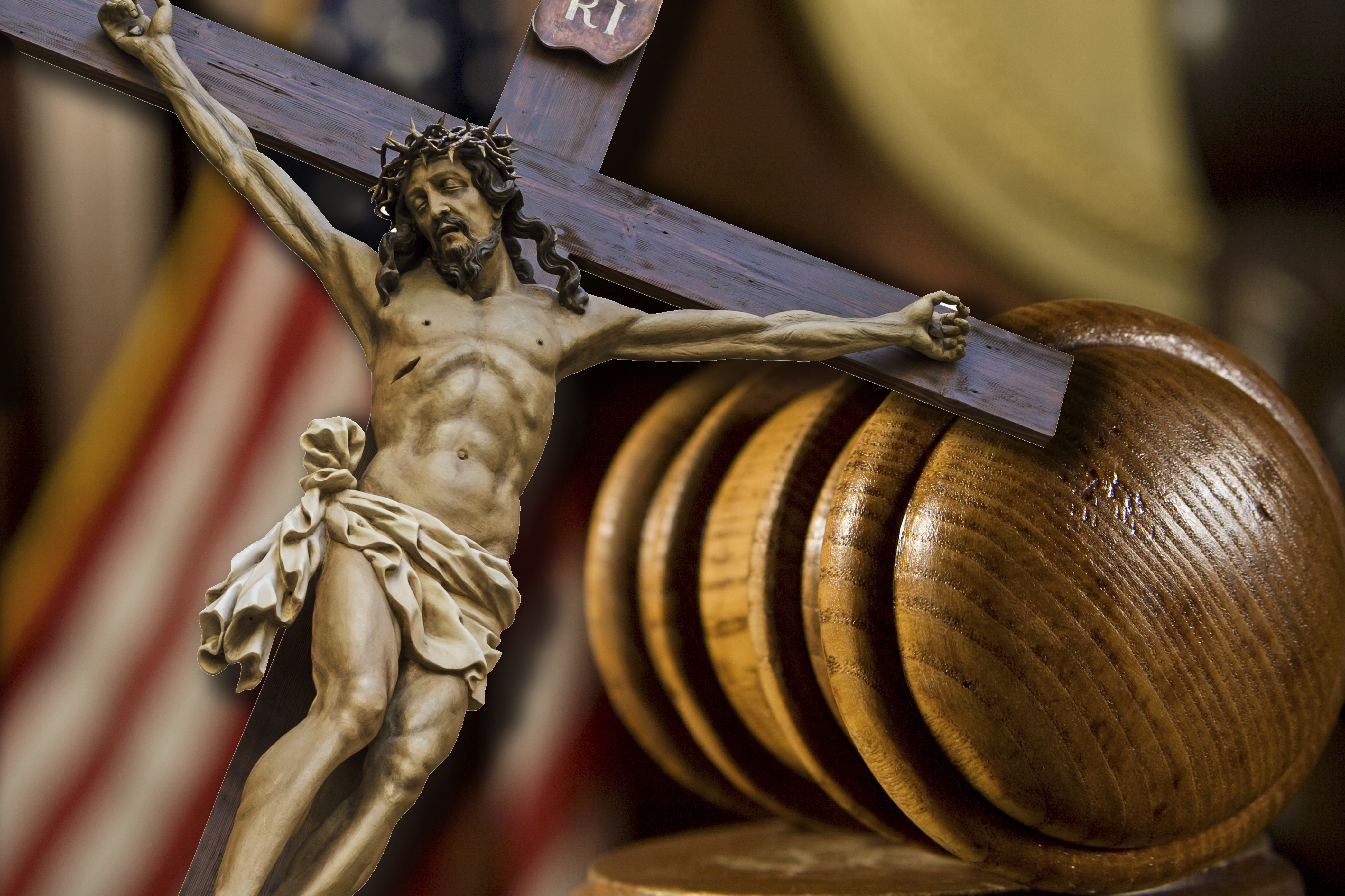
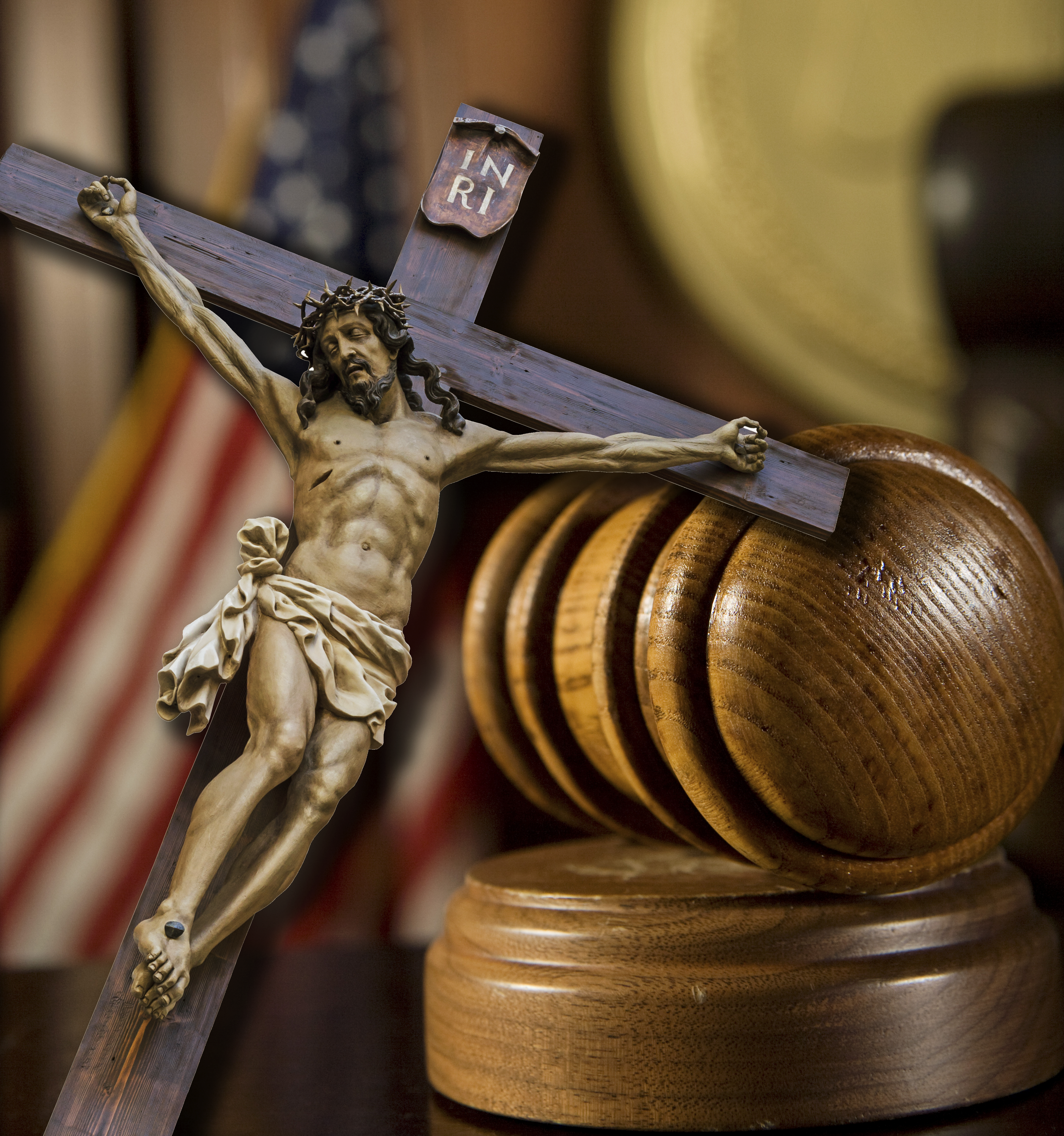
IV. Criminalizing the targeted group or its works – Can someone say HHS mandate?
But even prior to this egregious attempt to violate our religious liberty there have been many other times we have had to go to court to fight for our right to practice our faith openly. An increasing amount of litigation is being directed against the Church and other Christians for daring to live out our faith.
Some jurisdictions have sought to compel Catholic hospitals and pro-life clinics to provide information about or referrals for abortion and to provide “emergency contraception” (i.e., the abortifacient known as the morning-after pill). Several branches of Catholic Charities have been de-certified from doing adoption work because they will not place children with gay couples. In 2009, the State of Connecticut sought to regulate the structure, organization, and running of Catholic parishes. And recently a number of Christian valedictorians in various states have suffered legal injunctions when it was discovered that they planned to mention God and/or Jesus in their addresses. (More details can be found HERE.)
Many of these attempts to criminalize the faith have been successfully rebuffed in the courts, but the number and frequency of the lawsuits, and the time and cost involved with fighting them impose a huge burden. It is clear that attempts to criminalize Christian behavior is a growth sector in this culture and it signals the beginning of the steady erosion of religious liberty.
Many indeed feel quite righteous, quite politically correct in their work to separate the practice of the faith from the public square.
V. Persecuting the targeted group outright – If current trends continue, Christians, especially religious leaders, may not be far from facing heavy fines and/or incarceration.
Already in Canada and in parts of Europe, Catholic clergy have been arrested and charged with “hate crimes” for preaching Catholic doctrine on homosexual activity.
In this country there are greater provisions for free speech, but as we have seen, there is a steady erosion of our religious liberty and many Catholic dioceses are very familiar with having to spend long periods in court defending basic religious liberty. The trajectory points to suffering, lawsuits, fines, and ultimately jail.
Unlikely you say? Alarmist? Well, stages one through four are pretty well in place. One may wish to “whistle past the graveyard,” but it looks like we’re pretty well set for stage five. You decide.
Maybe a heavy post requires a light video. Here, Paul and Silas land in jail. It’s so bad its good: 🙂

 I am the proud father of a new book entitled simply The Ten Commandments (see at right). And you’ll be surprised, knowing me, at how brief it is—just 104 pages. But I wanted to keep it short, readable, connected to the catechism, and very practically related to living the Commandments on a daily basis. You can get it at the usual booksellers and there is also a Kindle version. I hope many will find it helpful, and it even fits neatly in your coat pocket.