 The past two Sundays have featured feasts (All Souls and the Feast of St John Lateran) that stepped out of the usual Sunday cycle. Thus, especially last week, we missed the November theme of the Last Things: death, judgment, Heaven, and Hell. Nevertheless, here on the 33rd Sunday, we are back to the last things and are reminded that we will one day be called to account for our use of the gifts and resources God has given us.
But today’s readings do more than tell us we will have to account. They also set forth a virtue or counsel that helps us to use God’s gifts well. That virtue is the Fear of the Lord. It is a foundational disposition of the wise as opposed to one of the foolish. Scripture says, The fear of the Lord is the beginning of wisdom (Psalm 9:10).
In today’s first reading, we hear, Charm is deceitful, beauty is fleeting, but the woman who fears the Lord is to be praised (Prov 23). And today’s Psalm says, Blessed are you who fear the Lord (Psalm 128:1).
The “Fear of the Lord” can be understood in a perfect and an imperfect way, but both are important. The imperfect fear (which most us us begin with and still need from time to time) is the fear of punishment and the loss of Heaven that comes to impenitent sinners. Jesus often appeals to this sort of fear in His preaching when He warns in vivid terms of the punishments that come to sinners both here and ultimately in Hell. This sort of fear, while imperfect, is necessary, especially for the spiritually immature (and all of us have our areas of immaturity). It is somewhat like the situation with a small child who needs punishment and threats of punishment in order to learn discipline and the consequences of bad behavior. But hopefully as children mature, we can begin to appeal to their reason and to their love for others as better and deeper motives for good behavior. Good preaching and teaching should not wholly neglect the appeal to imperfect fear since congregations contain people at many different stages. Jesus did not neglect this sort of appeal and neither should we.
However, just as we hope that we can appeal to higher motives in a child as he or she grows, so too in the spiritual life we hope to move toward a more perfect “Fear of the Lord.” To fear the Lord in this more mature sense does not mean merely to cringe with servile fear, with the fear of being crushed or destroyed. Rather, to fear the Lord in the more mature sense is to hold Him in awe, to reverence Him with a deep and abiding love and appreciation of Him as the source of all that we are and all that we have. It is a “fear,” a reverence, an awe rooted in love and appreciation. Since I love God and He is Abba to me, I fear offending Him by sin. I fear severing my relationship to Him by refusing His grace. Out of love, reverence, and a sense of awe, I fear giving any offense to Him who is Holy, is God, and is deserving of all my love.
With this background, we can look to a deeper teaching in the Gospel for today. At one level, the teaching is plain enough: we will all have to account for our use of the talents and resources God has given us. But on a deeper level, we are also taught the importance of attaining a mature fear of the Lord as the essential way of bearing the fruit that will be sought. There is a danger in remaining in only imperfect fear (which has its place and time in our life) since we risk developing resentment and avoidance if we refuse to grow toward a more perfect fear.
Let’s look at it with this perspective in mind and discover the differences between the two kinds of fear.
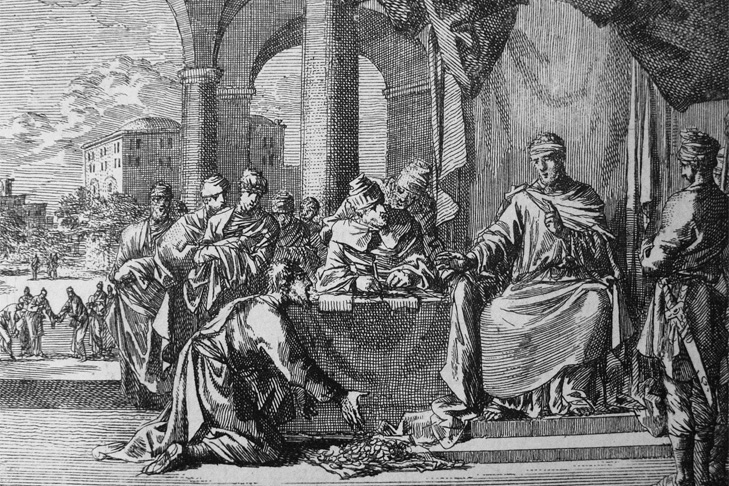
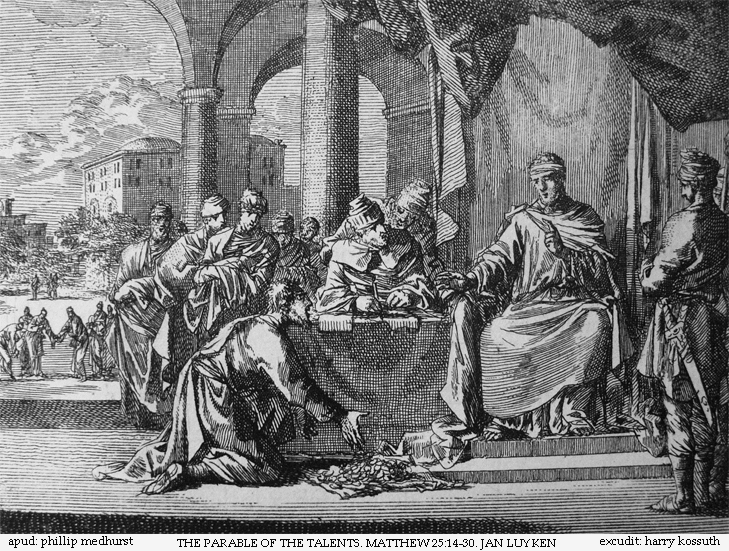
A man going on a journey called in his servants and entrusted his possessions to them. To one he gave five talents; to another, two; to a third, one– to each according to his ability. Then he went away. Immediately the one who received five talents went and traded with them, and made another five. Likewise, the one who received two made another two. But the man who received one went off and dug a hole in the ground and buried his master’s money.
Three men are given resources to use. Two succeed; one fails. Why the difference? Ultimately it is the difference between holy fear, love, and confidence on the one hand, and unholy fear and resentment on the other.
Consider the plan of the first two men, who succeed. They
- Receive Riches – One gets five Talents, the other two Talents, each according to his ability. While the “inequity” may offend modern notions, we can simply note the commentary in the Scripture itself. Each man had different abilities. And while some in our modern world may sniff at the different amounts, it is rather doubtful that any of these “enlightened” people, if they ran a business, would not give more resources to an industrious employee than to an average one. The fact is, God blesses some more abundantly than others due to their good use of gifts. The Lord teaches later and gives a fundamental rule: we must prove faithful in a few things to be ruler over many (Matt 25:23).
- Risk Reinvestment -Something in these two men makes them free to risk reinvesting the money. It is likely their relationship with the master. Implicitly, they see him as a reasonable man, someone who would applaud their industriousness. Though there is risk in reinvesting the money, they seem to see their master as reasonable and patient enough that, even if there were to be losses, he would not deal with them unmercifully. Thus they seem to experience the freedom and courage to step out and make use of the Talents entrusted to them. Notice the text says that they “immediately” went out and traded. Thus they are eager to work for their master and take risks on his behalf in order to please him.
- Render a Report – Upon the master’s return, they are called to render an account. The text depicts a kind of joy on their part as they report. He said, “Master, you gave me five (two) talents. See, I have made five (two) more.” There is a sensible enthusiasm for the opportunity and a joy for the harvest.
- Rise in the Ranks. And note that their presumptions of the master as a fair and reasonable man are affirmed in his response. Well done, my good and faithful servant. Since you were faithful in small matters, I will give you great responsibilities. Come, share your master’s joy. Hence we see that the master is joyful and wants to share his joy with the servants. Further, he is willing to give them greater access to share in his blessings and joy based on their openness to trusting him and on having proved themselves trustworthy.
Thus at some level the two successful servants see the owner of the riches as a man they can deal with. They have a healthy respect for him but not an immature fear. They receive the funds gladly, and with that gratitude they set to work, motivated and enthusiastic.
Allow them to be portrait of a holy and more perfect “Fear of The Lord.” With this sort of Holy Fear, we love God and are enthusiastic to work for Him. We realize that He shares His blessings and is both reasonable and generous. Confident of His mercy (though not presumptive of it), we go to work in His vineyard. It is true that there are risks and temptation in the vineyard. But if we stumble or fail, we do not make light of our sin; we repent of it and are confident of God’s mercy. A mature fear of the Lord does not box us in or paralyze us. Rather, it reminds us of our boundaries and keeps us away from truly dangerous things that erode our talents. But because we love God, respecting His boundaries is a joyful thing for us and protects us from “unsafe investments.” Within the designated boundaries, there is both room to maneuver and safety from the thickets of sin. The mature fear of the Lord is joyful and encouraging, not something to cause cringing or hiding from God. Choose the fear of the Lord.
But the man who fails follows a different plan, a plan by which he
- is Fruitless – for he buries the treasure
- is Furious – for he says, I knew you were a demanding person, harvesting where you did not plant and gathering where you did not scatter, so out of fear I went off and buried your talent in the ground. He considers the owner a hard man. He also sees him as unjust by having others do his planting, etc. While the other two men in the parable see their work as an opportunity, he sees his work as slavery. Notice, too, the following subtlety: this man describes the talent as “your talent” whereas the other men say, “You gave me five (two) talents.” He sees himself as a slave while the other two see themselves as stewards.
- is Fearful – for he says he buried it out of fear. In this case, we see a cringing and servile fear, an immature and imperfect fear of the Lord, as distinguished from the more mature fear of the Lord toward which we must move to bear fruit. Note, too, that it is his image of the master that drives his fear.
- Forfeits – for it is clear that he wants nothing to do with the master. The owner therefore says, in effect, “Fine, if you don’t want to deal with me you don’t have to. I will take your talent and given it to the one with ten. And as for you, if you do not wish to be in my presence or deal with me, then consider yourself dismissed.”
So we see how the failed servant gives way to anger and resentment and indulges his immature fear that the owner is “out to get him,” that the deck is stacked against him. He is not grateful for the opportunity afforded him by the owner. But notice that these thoughts he has generate his feelings and actions. But are his thoughts true and unassailable? It is clear that the other two men do not see the master in this way. And we see, through their example, that the thoughts of the failed servant are in fact not true. The master is decent, just, and joyful. The failed servant should not necessarily believe everything he thinks; he should test his thoughts against reality.
To fear the Lord more perfectly is to hold him awe, rejoicing in His power and wisdom, accepting His authority as saving and helpful. And thus we yield an abundant harvest with His gifts.
Now look; if imperfect fear is all you have, go with it! Sadly, with today’s rampant secularism, there are many who live their lives as though they will never be called to account. They go on sinning, dismissive that they should have any fear of a judgment day. They are going to be surprised and unprepared for what they face.
So if you have even an imperfect fear of the Lord rooted in punishment, don’t cast it away! But for growth, seek more perfect fear, rooted in love and awe of God’s majesty and goodness. For if we remain in an imperfect fear that does not seek to grow in love, we risk falling into resentment and aversion and will not bear all the fruits the Lord seeks for us. This call for growth is what the Lord means when He teaches us through St. John,
There is no fear in love, but perfect love casts out fear. For fear has to do with punishment, and he who fears is not perfected in love (1 Jn 4:18).
The fear counseled against cannot be the perfect and mature fear of the Lord, which Scripture counsels frequently. Rather, it is the immature fear, the fear of punishment, that we are counseled to grow out of through deepening love of God.
Thus, the deeper teaching here is to grow in love, maturing in your fear of the Lord and reaping the abundant riches of a faithful servant and son or daughter of God.