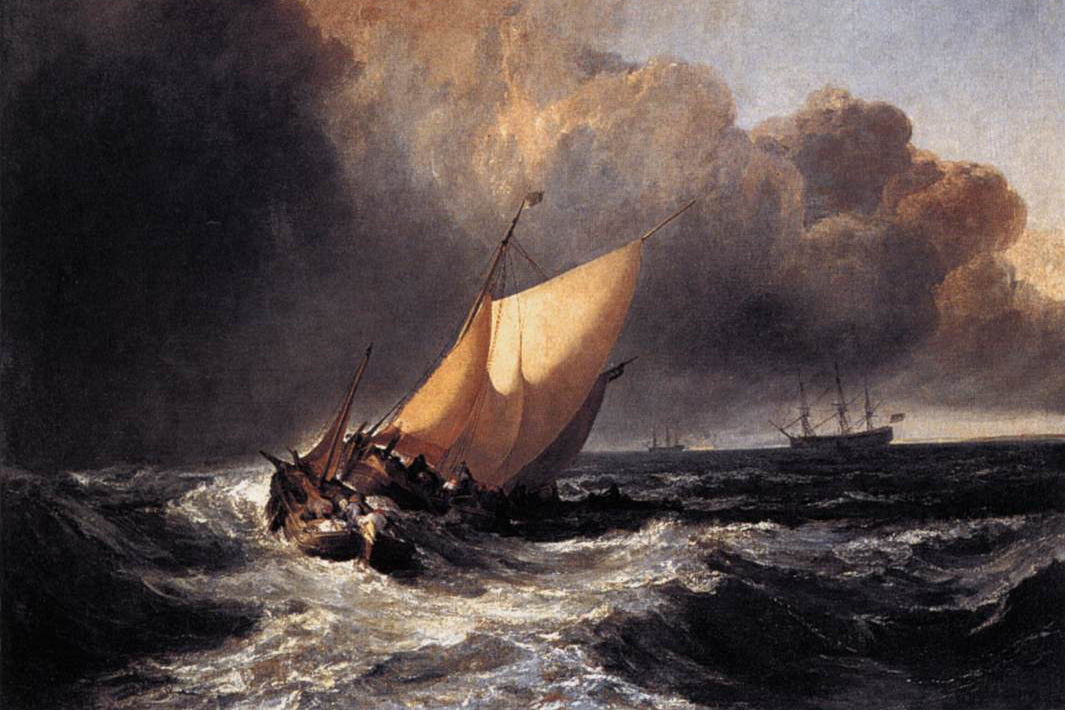
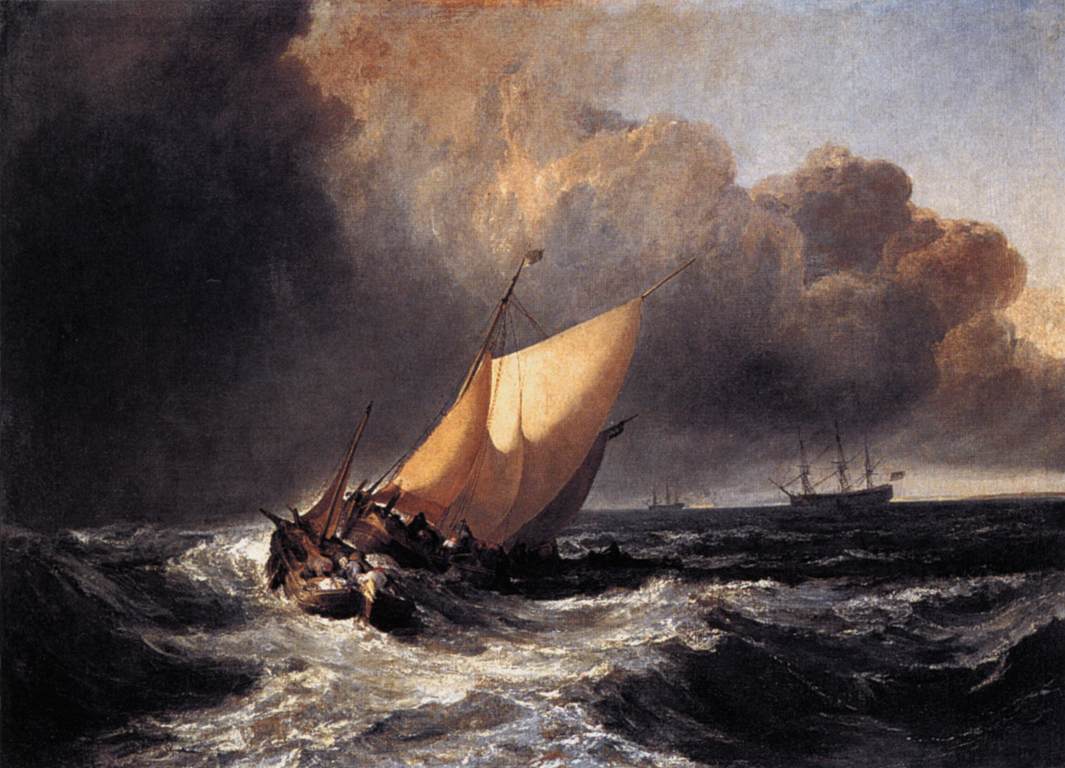
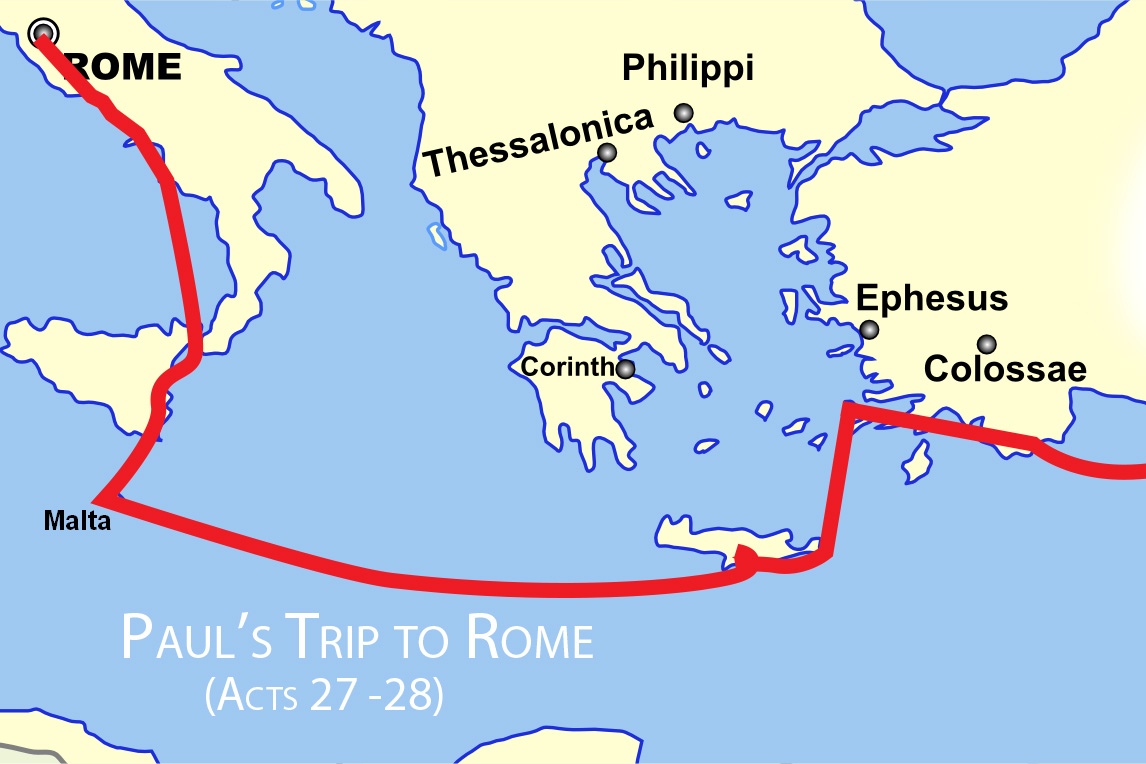
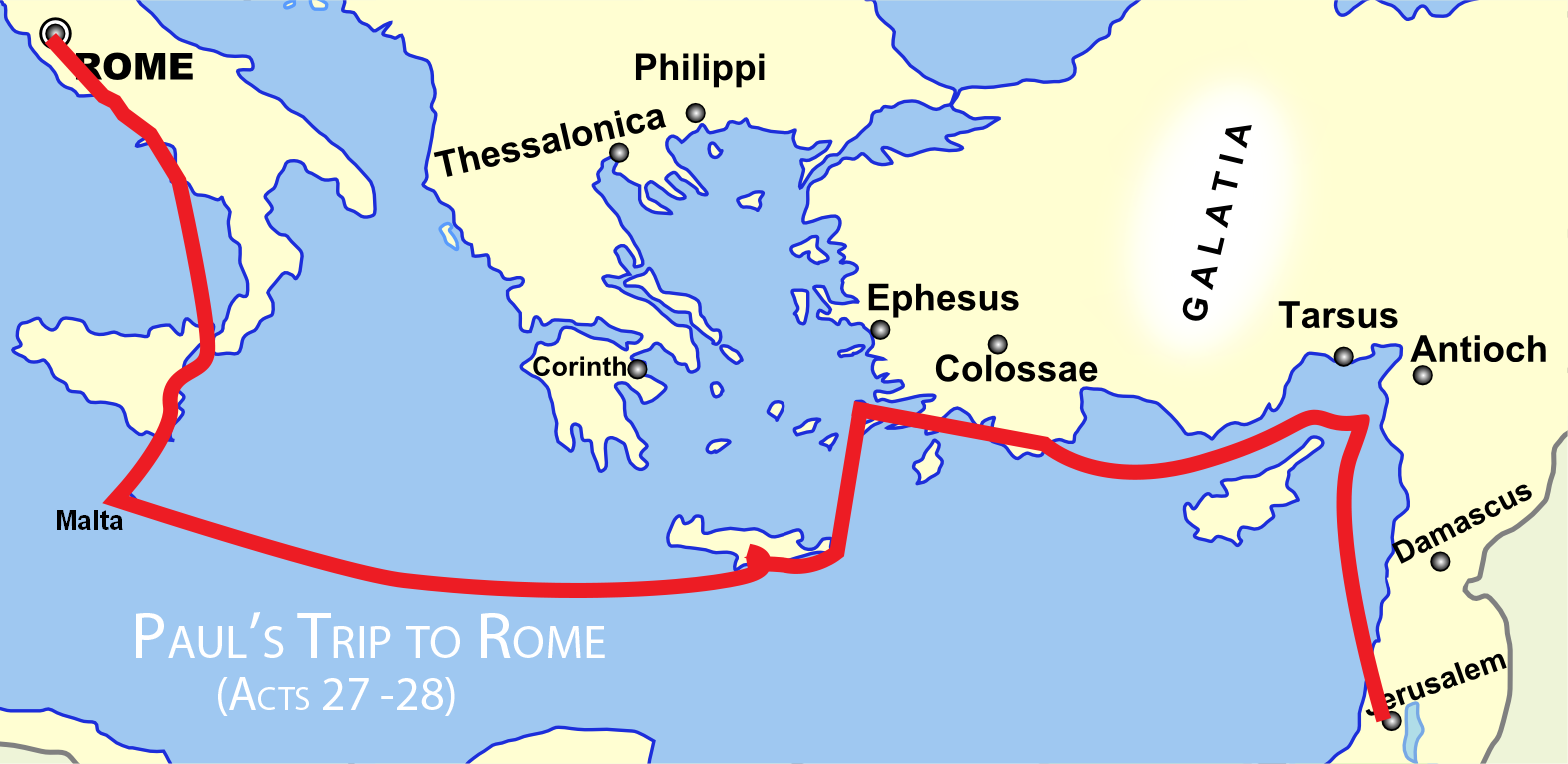
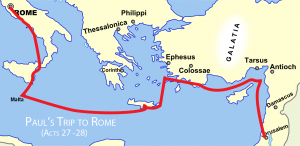
 It is interesting that St. Luke devotes an entire chapter of Acts (27) to describing a storm at sea that St. Paul endured. The level of detail is high and thus we are signaled that such details are important. The Holy Spirit has something to teach us here about how we get into trouble and how we can get out of it.
Storms in life often come to us out of our control. Perhaps they come from nature and the sudden vicissitudes of this world. Sometimes God permits storms to test and strengthen us. Sometimes, too, others drag us into storms and we suffer on account of the poor decisions made by family members or community and cultural leaders. And some storms do come from our own stupidity and poor choices.
In the story we are about to examine, St. Paul is dragged into a storm by the stupidity and poor choices of a military official and a ship’s crew. Paul was under arrest and being sent to Rome for trial before Caesar. As such, he was in the custody of a military officer. Of all the people in this storm, St. Paul is the only one who is innocent of the foolishness that made them endure this storm. At the end, only he can show the proper way out of this fool’s errand. The storm we are about to study shows in great detail what can happen to us as individuals and as an overall culture when we defiantly and proudly resist God’s will and common sense. This is a storm that has a lot to teach us about ourselves. So let’s look at a storm that Scripture calls a Euroclydon (a Noreaster). You can read the full text here (Acts-27).
I. The Coming Danger – God sends many warnings from the natural order, from the Church, and in our own consciences. Note how often these are systematically ignored.
A. Whys and Wherefores – And when it was decided that we should sail for Italy, they delivered Paul and some other prisoners to a centurion of the Augustan Cohort, named Julius. 2 And embarking in a ship of Adramyttium, which was about to sail to the ports along the coast of Asia, we put to sea, accompanied by Aristarchus, a Macedonian from Thessalonica. 3 The next day we put in at Sidon; and Julius treated Paul kindly, and gave him leave to go to his friends and be cared for.
St. Paul was under arrest and had appealed his case to Rome. He was put in the custody of a Roman centurion named Julius, who seemed a decent enough man but was a poor judge of both weather and the professional qualities of a ship’s captain. This appeal to Rome was his right as a Roman citizen and God had told him that he would testify in Rome and to have courage. Such words would be necessary for him to cling to, for he was about to be dragged into a very foolish journey by those who simply wouldn’t see the danger despite warning after warning. If perhaps this sounds familiar, it is of course our human condition: that many act foolishly and recklessly and refuse to see the danger. It is also an unfortunate characteristic of our Western culture, that has steered into a great oncoming storm and refuses to see the danger.
B. Warnings – 4 And putting to sea from there we sailed under the lee of Cyprus, because the winds were against us. 5 And when we had sailed across the sea which is off Cilicia and Pamphylia, we came to Myra in Lycia. 6 There the centurion found a ship of Alexandria sailing for Italy, and put us on board.
So here are the initial signals of danger: the wind against them, a poor time of year to sail, chancy conditions at best. It was common in the winter months to stay off the Mediterranean and remain at port and to make longer journeys by land. The sea was very dangerous at this time of year and whatever sailing did take place was done very near the coast. But despite the danger signals, there seems little alarm by the centurion, who seems determined to get the task done.
C. Worsening – 7 We sailed slowly for a number of days, and arrived with difficulty off Cnidus, and as the wind did not allow us to go on, we sailed under the lee of Crete off Salmone. 8 Coasting along it with difficulty, we came to a place called Fair Havens, near which was the city of Lasea.
More danger signals! But now the centurion’s determination becomes defiance. And here, too, is a portrait of many a sinner who sees the danger signals, the wind against him, the journey fraught with difficulties, but decides that he will not be just another statistic; he will escape the usual dangers. Cultures think this way too. Defiance is the sad result of hearts that are growing hard and wills that are growing stubborn. With necks of iron and foreheads of brass, sinners sally forth and cultures set out on campaigns of self destruction.
II. The Continued Defiance – In the verses that follow, we have quite a list of the elements of a poor and rash decision. Let’s see what Scripture teaches us about the diagnosis of a a bad decision. Together, these elements contribute to a foolish defiance and a failure to heed the warnings already given. There are five elements listed:
A. Precipitousness – As much time had been lost, and the voyage was already dangerous because the fast had already gone by
In other words, they are at a critical time, when the window for safe sailing, if it even still exists, is closing fast. It’s now or never! But hasty decisions—made more out of concern for time than what is wise or right—are usually poor ones. And in our culture we have a lot of this. Urgency seems to permeate most things. News crews love to create a sense of crisis and urgency. Suddenly everyone has opinions on what must be done, and quickly. Sob stories and other emblematic but highly selective crisis situations are put before us by the media and politically savvy organizations. Swift and draconian decisions are often demanded. Sometimes unhappy mobs are protesting and legislators make hasty fixes to what are complex problems. Careful deliberation is underappreciated. There is a failure to recognize that rushing often leads to the development of poor “solutions.” But in our culture, most people follow the priority of the urgent more so than the priority of the important.
B. Preferring worldly wisdom – Paul advised them, 10 saying, “Sirs, I perceive that the voyage will be with injury and much loss, not only of the cargo and the ship, but also of our lives.” 11 But the centurion paid more attention to the captain and to the owner of the ship than to what Paul said.
Yes, what does this religious zealot know about sailing or weather? Never mind that Paul had sailed before and had known rough seas and shipwreck. What does this preacher have to offer? The captain and the owner of the ship are the experts. Yes, today many say that the Church has nothing to offer; neither can priests speak to marriage or family life or sexuality. Only scientists, doctors, and other professionals can really be relied upon to have anything worthy to offer. To be sure, all these experts have much to offer, but it is dangerous to rely on them alone to set a course for this world. Worldly wisdom can still, at best, procure for us a worldly grave. But true wisdom pierces the heavens and seeks the voice of God, who alone can save us. To disregard the voice of faith is perilous indeed.
C. Passions Preferred – 12 And because the harbor was not suitable to winter in
Now here is a serious issue as well. Too often we allow our passions to trump our better judgment. They want to risk the storm to get to a “nicer” port. They want to spend the winter in comfort and so they take foolish risks. Here, too, in an age dominated by an excessive need for comfort, many are willing to take terrible risks, make foolish decisions, go into debt, risk disease, and even act illegally. Some are willing to steal, use drugs, enter dangerous relationships, and the like. All for the hope of the comfort that such things might—just might—provide. Yes, our passions, individually and collectively, inspire a lot of bad decisions and lock us in defiant attitudes that refuse to recognize the obvious.
D. Populism – the majority advised to put to sea from there, on the chance that somehow they could reach Phoenix, a harbor of Crete, looking northeast and southeast, and winter there.
Yet another common problem is thinking that a poll will always render the right decision. No, it will not. It will tell you what is popular, but not often what is right. Very often the crowds are wrong and they are not pooling their wisdom; they are pooling their ignorance. Jesus warns, “Woe to you when all speak well of you. For thus their fathers treated the false prophets.” Today there is almost a religious demand that polls should direct all things. Many are almost indignant that the Catholic Church’s teachings do not reflect the views of the “majority” of Roman Catholics. But the Church does not exist to reflect the views of her members. The Church exists to reflect the views of her head and founder, Jesus Christ. At the end of the day, what is popular is not always right, and what is right is not always popular. Polls and votes are usually poor ways to discover what is right. And as we shall see, it is certainly a poor way to predict the weather!
E. Presumption – 13 And when the south wind blew gently, supposing that they had obtained their purpose, they weighed anchor and sailed along Crete, close inshore.
Very often, because there are not immediate negative consequences to a bad choice, people leap to the conclusion that they have decided well. Note that in this instance, despite repeated warnings (from St. Paul) and the difficulties of sailing at a bad time of year (e.g., contrary winds and little progress possible), one mere breeze from the south is magnified and causes them to presume that there will be no consequences. Presumption is a sin against hope. Hope is a confident expectation of God’s help in attaining eternal life. But as the word presumption implies, to presume is take something up ahead of time (Pre– before + sumere– to take up). But who hopes for what he already has? Hence presumption tosses hope away on the pretext that one can get what one wants now, on one’s own terms. Those guilty of presumption think that no harm will ever befall them. The speeding teenager thinks he will never crash, but some of them wake up paralyzed. The drunk driver thinks he will never be caught, but then sees the red flashing lights in his rearview mirror. The sexually promiscuous person boasts of having “safe-sex,” but then contracts an STD. As we shall see, just because consequences do not always happen immediately, doesn’t mean that presumption is a good idea.
III. The Cost of Disobedience – Sin and disobedience are very costly. Satan promises ease, comfort, and pleasure today, but the bill comes due tomorrow! Let’s see what this storm teaches about the cost of sin. Five descriptions of the cost are given:
A. Control Lost – 14 But soon a tempestuous wind, called the northeaster, struck down from the land; 15 and when the ship was caught and could not face the wind, we gave way to it and were driven.
St. Augustine famously taught regarding sin, For out of the perverse will came lust, and the service of lust ended in habit, and habit, not resisted, became necessity (Conf 8.5). Habitual sin leads to bondage, to a loss of control, to being driven. The first cost of sin and disobedience is the increasing loss of control, the increasing loss of freedom.
B. Crushing Labors – 16 And running under the lee of a small island called Cauda, we managed with difficulty to secure the boat; 17 they took measures to pass ropes under the ship to hold it together; then, fearing that they should run on the Syrtis (sands of North Africa), they lowered the anchor, but were still driven.
We see that their defiant pride has now humbled them with heavy work, not just the work of sailing, but of even holding the boat together. Sin leads to heavy burdens. Consider the man who has been promiscuous and now sees his income dissipated by child support to children he has fathered by three different women. Consider the glutton who has easily gained 100 pounds and must now work for months, even years, to lose the weight. Consider the spendthrift who has run up the debt on his credit card and must now work for years to pay it off. Sin makes for crushing, burdensome work.
C. Compounding Losses – 18 As we were violently storm-tossed, they began next day to throw the cargo overboard; 19 and the third day they cast out with their own hands the tackle of the ship.
As already stated, sin and disobedience inevitably lead to dissipation. So now they are throwing their precious cargo overboard. Suddenly the riches of the world are not enough; they’re now even part of the problem! Perhaps with us it is our money that is dissipated, or maybe our strength, or health, or family. But when you stay in sin and disobedience, expect the losses to compound.
D. Ceding Lights – 20 And when neither sun nor stars appeared for many a day, and no small tempest lay on us, all hope of our being saved was at last abandoned. … And fearing that we might run on the rocks, they let out four anchors from the stern, and prayed for day to come.
The ancients steered by the stars and the sun. But this self-inflicted storm has darkened the lights. All the navigation points are lost, and the way back (out of sin) is difficult to find. Sin clouds our intellect and makes it difficult to see our errors, let alone the way back. Many people are in such darkness that they actually celebrate what God calls sin. How do some of us get so blind and confused? Some have lost their way and the light of their intellect has been clouded. Yet another cost of sin and disobedience is a darkened intellect. St. Paul says, they became futile in their thinking, and their foolish minds were darkened (Romans 1:21).
E. Cowardly Leaping – 30 And as the sailors were seeking to escape from the ship, and had lowered the boat into the sea, under pretense of laying out anchors from the bow, 31 Paul said to the centurion and the soldiers, “Unless these men stay in the ship, you cannot be saved.”
So much for all the expert sailors, the captain, and the centurion, all of whom ignored Paul and the obvious warnings of a coming storm! Now they are seeking to jump ship, to escape in lifeboats and leave the passengers behind. And so it is with many sinners today, who seek to escape the consequences of their acts. Some escape to drugs and alcohol; some just hide or blame others. Rarer indeed are the sinners who admit their fault and take responsibility for what they have chosen and done. In a therapeutic culture it is easier to blame others: “It’s not my fault; my mother dropped me on my head when I was two. … I’m not depraved; I’m deprived.” A lot of this amounts to escaping in lifeboats and leaving the rest back on the boat to pay the bills and experience the disaster. And where are the “experts” who gave us such awful advice during the sexual and cultural revolution? Most of them headed for the boats and left the rest of us (who were foolish enough to listen to them) back on the boat to go down with the ship.
The cost of sin and disobedience is high.
This storm really has a lot to teach us. It shows how easily we ignore the coming danger and continue, in defiance, to make bad decisions. And then it counts the costs of our foolishness. Life really is a lot easier when we obey God.
But the storm is not done teaching us yet. For God has put a teacher in the storm to instruct us and call us to discipleship. More on what Paul teaches tomorrow …

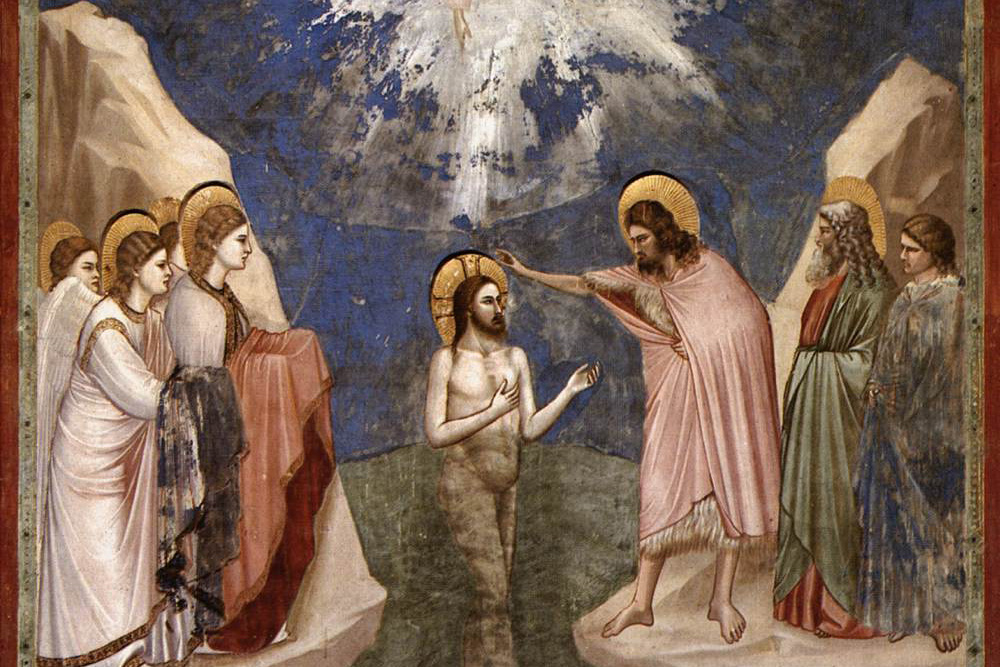
 Today’s feast of the Baptism of the Lord provides a moment to reflect not only on the Lord’s baptism, but also on our own. For in an extended sense, when Christ is baptized, so are we, for we are members of His body. As Christ enters the water, He makes holy the water that will baptize us. He enters the water and we follow. And in these waters He acquires gifts to give us, as we shall see below.