Most pastors and confessors are aware that in any parish there are going to be a few who are scrupulous, even in times like like these. Some have a kind of scrupulosity that is mild and almost admirable. A sensitive conscience is a beautiful thing and bespeaks a kind of innocence that is rare today.
Some others have a more unhealthy form of scrupulosity, rooted too much in cringing fear of a God who is seen more as a punishing adversary than a delivering Father who wants to help us overcome our sin.
But saddest of all are the large majority who have very little compunction (sorrow) for sin. Most Catholics have lived so long in a culture that dismisses, excuses, or makes light of sin that they have very little notion of just how serious sin can be. That God had to send His only Son to die in order rescue us from our sins shows just how serious they are; weeping for our sins is not some “extreme” reaction.
Indeed, a worthy Lenten practice is going to the foot of the Cross and allowing the Lord to anoint us, so that we see both how serious our sins are and at the same time how deep His love for us is. When it finally begins to dawn on us that the Son of God died for us, our heart breaks open, light pours in, and we can begin to weep for our sins and in gratitude for His love.
Consider that Jesus looked at a paralyzed man and, “not noticing” his paralysis, said to him, “Courageson, Your sins are forgiven” (Mat 9:2). In a sense, He saw the man’s sins as more serious than his paralysis. Jesus says elsewhere,
I tell you that anyone who looks at a woman lustfully has already committed adultery with her in his heart. If your right eye causes you to stumble, gouge it out and throw it away. It is better for you to lose one part of your body than for your whole body to be thrown into hell. And if your right hand causes you to stumble, cut it off and throw it away. It is better for you to lose one part of your body than for your whole body to go into hell (Matt 5:28-30).
Now the Lord does not mean literally to gouge out eyes and cut off appendages. But what He is saying is that it is more serious to sin (in this case through lust) than to lose our eye, hand, or foot.
Now we don’t usually think like this, but we should. Sin is much more serious than most of us imagine. It is our most serious problem. It is more serious than lack of money or poor physical health. Sin is our most serious problem; whatever is in second place isn’t even close.
In times like these, when self-esteem is overemphasized, personal responsibility is minimized, and excuses abound, we do well to ask for the gift of tears. We do well to ask for a profound and healthy grief for our sins.
More than ever, this is a gift to be sought. Note that these tears are not meant to be tears of depression, discouragement, or self-loathing. The tears to be sought here are tears of what St. Paul calls “godly sorrow.” Godly sorrow causes us to have sorrow for our sins but in a such a way that it draws us to God and to great love, gratitude, and appreciation for His mercy. St. Paul writes,
Even if I caused you sorrow by my letter, I do not regret it. Though I did regret it—I see that my letter hurt you, but only for a little while—yet now I am happy, not because you were made sorry, but because your sorrow led you to repentance. For you became sorrowful as God intended and so were not harmed in any way by us. Godly sorrow brings repentance that leads to salvation and leaves no regret, but worldly sorrow brings death. See what this godly sorrow has produced in you: what earnestness, what eagerness to clear yourselves, what indignation [at sin], what alarm, what longing, what concern, what readiness to see justice done (2 Cor 7:8-11).
With all this in mind, consider that in the current (2011) Roman Missal there is a beautiful “Mass for the Forgiveness of Sins (B).” In the old Missal (1962), it is called the Missa ad Petendam Compunctionem Cordis (Mass Requesting Compunction (sorrow) of Heart). It is known more colloquially as the “Mass for the Gift of Tears.”
Consider these beautiful prayers from the Roman Missal (both the 1962 and current (2011) versions). I post here the English translation from the current (2011) Missal:
Collect:
Almighty and most gentle God,
who brought forth from the rock
a fountain of living water for your thirsty people,
bring forth we pray,
from the hardness of our heart, tears of sorrow,
that we may lament our sins
and merit forgiveness from your mercy.
Through our Lord Jesus Christ your Son,
who lives and reigns with you
in the unity of the Holy Spirit,
one God forever and ever.
Prayer over the gifts:
Look mercifully, O Lord, upon this oblation,
which we offer to your majesty, for our sins,
and grant, we pray, that the sacrifice
from which forgiveness springs forth for the human race,
may bestow on us the grace of the Holy Spirit,
to shed tears for our offenses.
Through Christ our Lord.
After Communion:
May the reverent reception of your Sacrament O Lord,
Lead us to wash away the stains of our sins
with sighs and tears, and in your generosity
grant that the pardon we seek may have its effect on us.
Through Christ our Lord.
So beautiful, scriptural, and spiritual. Pray these prayers. Ask your priest to celebrate this votive Mass often. We need the gift of tears today.
Here is the Lacrimosa from the Mozart Requiem. The text says, “Day of tears that day when from the ashes man arises and goes to his judge. Spare O God then, O sweet Jesus, Grant them eternal rest.
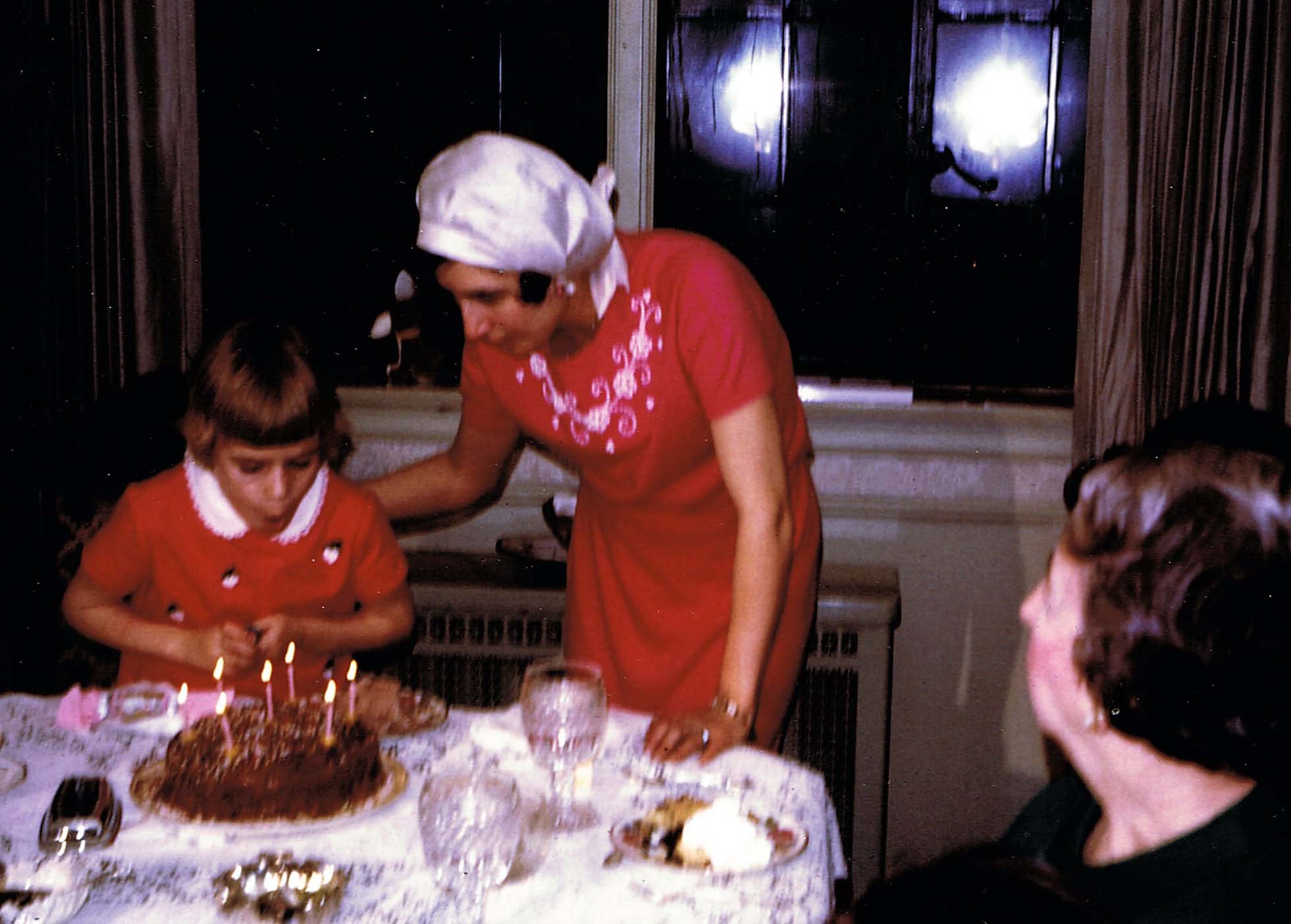
Maryanne Pope (7th Birthday) Nancy Pope Nancy Geiman in 1967
At Ash Wednesday Masses we heard the ancient acclamation, as ashes are imposed, Remember that you are dust, and unto dust you shall return.
The beginning of the Lenten season puts before us an urgent plea that we should be sober and watchful of our soul and its condition, for the form of this world is passing away (1 Cor 7:31).
Simply put, we are going to die and we need to be made ready to meet our God. Recall some of the urgency present in the readings:
Even now, says the LORD, return to me with your whole heart …
Sound the trumpet in Zion!
We implore you on behalf of Christ, be reconciled to God!
Behold, now is the day of salvation.
Yes, now, not later. There is an urgency announced that we must hear and heed.
What’s in a picture? The picture at the upper right was taken April 2, 1967. It was my sister, Mary Anne’s 7th birthday. On Ash Wednesday morning, the picture appeared on my screen-saver slideshow and I thought, “There it is; a picture of passing things.” For as you look at the picture know this, there is absolutely nothing and no one in the picture that is still here in this world today. My sister, who is blowing out the candles, died tragically in a fire in 1991. My mother, who is leaning over her, died in 2005 (also tragically). My maternal grandmother, who is sitting, died of cancer in the late 1970s. But that is not all. The building in which the picture was taken was demolished 8 years ago. My father, who is taking the picture, died in 2007. The Polaroid camera with which he took the photo is long gone as well. There is simply nothing in this picture that any longer exists in this world, and there is no one in the photo who still walks this earth. Yes, the form of this world is passing away. Remember that you are dust, and unto dust you shall return.
The Church’s reminder to us is a strong rejoinder to most of our priorities. Most of the things we think are so important are not really all that important in the long run. Most of the things that claim our attention are not all that critical either. Like Martha of the Bible, we are anxious about many things. We worry about our money, our house, our car, our physical health, how we look, what people think of us, and so forth. But none of this really matters all that much in the end. All these things pass.
But what about what really does matter? What of our soul and its well-being? What of our direction? Is it heavenward? What are we doing with our life? Where are we headed? Do we know, love, and serve God? Are our eyes on the prize of God and Heaven? These things garner little attention in most people’s lives. The unessential and fleeting things are our passion, while the most essential things are all but ignored.
During Lent, the Church says, “Stop.” Be thoughtful and earnest. You are going to die. What are you doing to get ready to meet God? Your body and the things of this world are but dust, a mere passing reality. But what of your soul? Are you caring for your soul? Is it nourished on God’s Word and Holy Communion? Are the medicines of prayer, Scripture, Sacraments, and holy fellowship (cf Acts 2:24) being applied so that your soul stands a chance?
Remember … REMEMBER … you are dust; you are going to die. Get ready. Now is the time; be earnest about it. Be thoughtful; reflect, considering carefully what your decisions amount to, where you are headed, and what your life means. Too many people live unreflected lives, never thinking much on these things. But not you. You have heard the trumpet sound in Zion and the Church has implored you. Will you listen? Will I? Where are you going? Where will you be when the last trumpet sounds?
Immutemur habitu in cinere et cilicio; jejunemus, et ploremus ante Dominum, quia multum misericors est dimittere peccata nostra Deus noster.
Let us change our garments for ashes and sackcloth; let us fast and lament before the Lord, for our God is plenteous in mercy to forgive our sins.
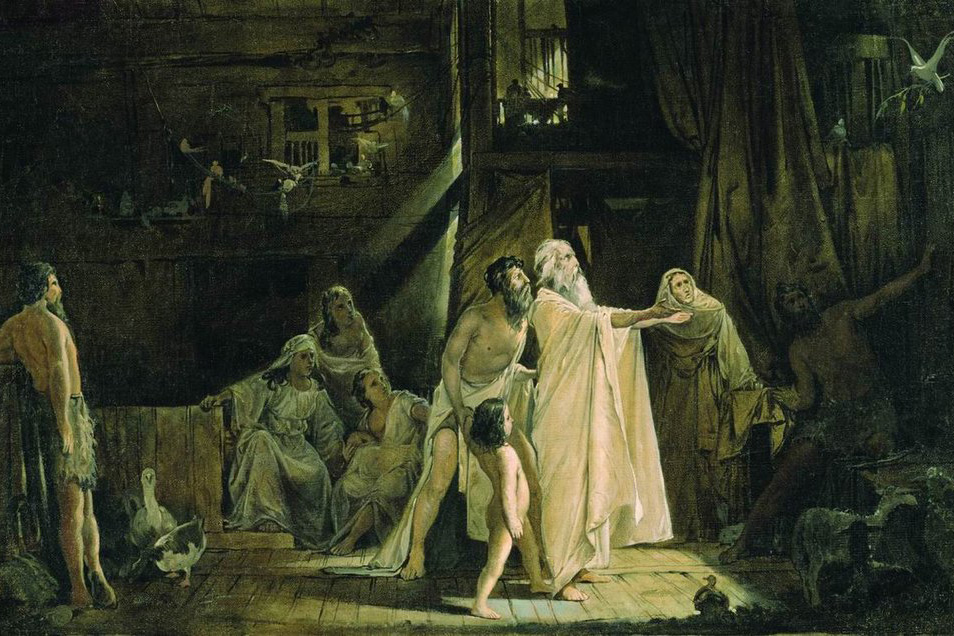
To the modern mind, the story of Noah and the flood is a dark tale and one that is hard to equate with the “loving God” (i.e., the “kind” God of our notions). Why would God regret what He had done and want to kill everything He had made?
Now never mind that we do this all the time when we harvest a field, or prune our roses or slaughter animals to feed ourselves, etc. When we do these things, we understand why we do them and so we give ourselves credit for doing what is right and good. But when God prunes, or plows under one culture to bring forth another, or ends life here to nourish life there, we call Him despotic. The atheists like to call Him wrathful and vengeful.
But the Church has always understood the flood in terms of the language of baptism. God ends one life to begin another. In every baptism, even to this day, one life ends so that another can begin. The baptismal font is both tomb and womb. It is a tomb because the old Adam dies in us, and it is a womb because the new Adam (Jesus) is birthed in us. St. Paul says,
Do you not know that all of us who have been baptized into Christ Jesus were baptized into his death? We were buried therefore with him by baptism into death, in order that, just as Christ was raised from the dead by the glory of the Father, we too might walk in newness of life. For if we have been united with him in a death like his, we shall certainly be united with him in a resurrection like his. We know that our old self was crucified with him in order that the body of sin might be brought to nothing, so that we would no longer be enslaved to sin … So you also must consider yourselves dead to sin and alive to God in Christ Jesus (Rom 6:3ff).
This may not seem like the flood, but it is. We are overwhelmed in the flood of baptismal water and lose our old life. But a new life is set forth in us. This is just as in the old flood, which ended the regime of sin and sowed the seed of new life on a washed-out world. It is an allegory of baptism, not the reality itself but pointing to the reality.
The Catechism references the blessing of Easter water, in which the Church speaks of the flood: The waters of the great flood you made a sign of the waters of Baptism, that make an end of sin and a new beginning of goodness.
Thus, in terms of baptismal theology, the flood was not a disaster, but a new beginning.
“But Father, but Father, so many died!” True, but we will all die and God decides when that will be. Further, He does not simply have my good or your good in mind, but also the common good. So God must sometimes end certain human projects, epochs, and empires so that others may emerge. He knows why He acts; we do not. We may think we are the “bee’s knees,” but God knows something better. So He ended antediluvian (before the flood) culture to bring forth something different. Do you judge Him for this? And if you do, on what basis do you do so? Is the Roman Empire better than what came later? Is “Western Culture” better than what might come next? How do you know? Can you see the future? Are you sure of your judgments? Are they better than God’s?
In November, I pruned my roses from eight feet down to just one foot. Do you judge me for this? Today they poke through the snow awaiting the coming of spring. Have I done well, or was I just violent and nasty? Well, wait until spring and you might have a different perspective. My Crape Myrtle is also protesting and calling me a despot, for I pruned it severely. But wait until May before you condemn me. You might be surprised as vigorous growth bursts forth.
Well, I hope you get the point. We have often judged God based on very little evidence. He knows why He does what He does; we do not. If a flood or the collapse of a culture is needed, He knows; we have no idea.
Floods and other dramatic steps are sometimes needed. And we who protest such actions are not much different than rose bushes that protest pruning. We know not whereof we speak.
Let God be God. If floods are needed He knows. If lesser measures are adequate He knows. If more is needed He knows. Floods are “in his pay grade,” not in ours. He knows. Do not judge God. If you do, I am going to ask you why we kills tens of thousand of animals, or rip healthy ears of corn from their plants to feed ourselves. I am going to ask you why we prune roses. I am going to ask you why we wield scalpels to cut cancerous tumors from people and then throw those tumors in the trash.
If you will judge God, please answer first the prosecutorial questions I ask you. Is a flood too strong a response to sin? Well, is reducing my roses by 7/8ths during pruning season too much? Is putting people to sleep so they can’t defend themselves and slicing open their bodies and forcefully removing tumors too extreme? Is wielding the sickle and harvesting grapes to feed the poor too much? Is it evil to take the eggs of chickens or to kill mature chickens to feed the hungry?
OK, the flood happened. Are you ready to sit in judgment of God as you munch on your Chicken McNuggets?
Who will judge the flood or the God who sent it? If you will, then never, EVER again plow under your summer marigolds to plant autumn mums. Otherwise, I will call you evil, despotic, and just plain mean. I realize that people are more valuable than mums or marigolds. But God has every right to decide that the season for marigolds is over and mums are now needed. Do you doubt His judgment? If you do, then never again pull weeds from your garden, mow your grass, swat a fly, or seek the repel the devourers of your crops.
Otherwise, let God be God and do not call Him to account for things you do not understand.
The flood was necessary. Do you deny it? Show that you know better than God and cease your own husbandry. Allow rats to infest your home and flies to devour your food stock. Indeed, you should never harvest at all; you devour plants and animals and follow your own designs, designs that those plants and animals cannot discern. How dare you, you devourer, you sender of floods, you user of oxygen. How dare you use precious resources the animals could use, you interceptor of natural processes!
You stand accused with God! How do you answer? Will you still prosecute God for the flood?
This song says,
Away way back in the ages dark Old man Noah built a sea-going ark Old man Noah had his nervous spells, When he had to listen to the animals’ yells, But when anything was doing he was there with bells, He was a grand old sailor.
CHORUS: Old man Noah knew a thing or two, He made them all play ball, Old man Noah knew a thing or two, Because he knew a thing or two, he thought he knew it all, Some say he was an also ran, He was the original sailor man, Old man Noah knew a thing or two, He was a grand old man.
Said old man Noah to his wife one day There’s a big storm comin’ on the first of May So he gathered all his family and made this remark: The sky’s getting cloudy and it’s getting rather dark, So gather all the animals, and beat it to the ark, It’s gonna rain tomorrow!
The rain came down in showers cryin’ The ark made it out on a scheduled time And every day at half past three, Noah played poker with the chimpanzee, Cried the ring-tailed monkey, I sadly agree, Noah’s got a full house up his sleeve!
When Noah got the animals out to sea, They organized a regular jubilee In the middle of the night the elephant said, There’s a couple of snakes crawled into my bed, Shut up, said Noah, you’re drunk instead, Now I’m gonna lose my license!
Recent and persistent attacks by radical Muslims, especially the most recent beheadings of 21 Egyptian Christians, have many asking what can or should be done to end such atrocities. Military actions by numerous countries, including our own, are already underway. Most feel quite justified in these actions and many are calling for more concerted efforts to eliminate ISIS and related zealots who seem to know no pity, no reason, and no limits. I do not write here to opine on the need for or limits on military action. I only point to the “just war” teaching of the Church as a guide for such actions. Obviously, there is a clear and present threat that needs to be repulsed, even with force.
But perhaps, too, given our present experiences, we should not be so quick to condemn the similar outrage and calls for action that came from Christians of the Middle Ages, who also suffered widespread atrocities. The Crusades were a reaction to something very awful and threatening, something that needed to be forcefully repulsed. Many if not most of the great saints from that period called for Crusades, preaching them and supporting them. This includes the likes of St. Bernard, St. Catherine of Sienna, and St. Francis of Assisi.
Seldom are historical events identical to present realities. But our current experiences give us a small taste of what Christians, from the 8th century through the Middle Ages, experienced. Their response need not be seen as sinless or wholly proper. Armed conflict seldom ends without atrocities, a good reason to set it as the very last recourse. Most popular presentations of the Crusades are arguably more influenced by anti-Catholic bigotry than historical fact.
With all this in mind, I’d like to look at the Crusades using excerpts from an article by Paul Crawford, published a few years back at First Principles, entitled, Four Myths About the Crusades. In the excerpts that follow, his text is in bold, black italics, while my comments are in plain red text. The full text of his excellent, though lengthy article can be read by clicking the link above.
For a longer treatment of this subject, please see Steve Weidenkopf’s book The Glory of the Crusades, recently published at Catholic Answers.
For now, let’s examine Crawford’s article and detail four myths of the Crusades:
Myth #1: The crusades represented an unprovoked attack by Western Christians on the Muslim world.
Nothing could be further from the truth, and even a cursory chronological review makes that clear. In a.d. 632, Egypt, Palestine, Syria, Asia Minor, North Africa, Spain, France, Italy, and the islands of Sicily, Sardinia, and Corsica were all Christian territories. Inside the boundaries of the Roman Empire, which was still fully functional in the eastern Mediterranean, orthodox Christianity was the official, and overwhelmingly majority, religion. Outside those boundaries were other large Christian communities—not necessarily orthodox and Catholic, but still Christian. Most of the Christian population of Persia, for example, was Nestorian. Certainly there were many Christian communities in Arabia.
By a.d. 732, a century later, Christians had lost Egypt, Palestine, Syria, North Africa, Spain, most of Asia Minor, and southern France. Italy and her associated islands were under threat, and the islands would come under Muslim rule in the next century. The Christian communities of Arabia were entirely destroyed in or shortly after 633, when Jews and Christians alike were expelled from the peninsula. Those in Persia were under severe pressure. Two-thirds of the formerly Roman Christian world was now ruled by Muslims.
What had happened? … The answer is the rise of Islam. Every one of the listed regions was taken, within the space of a hundred years, from Christian control by violence, in the course of military campaigns deliberately designed to expand Muslim territory. … Nor did this conclude Islam’s program of conquest. … Charlemagne blocked the Muslim advance in far western Europe in about a.d. 800, but Islamic forces simply shifted their focus … toward Italy and the French coast, attacking the Italian mainland by 837. A confused struggle for control of southern and central Italy continued for the rest of the ninth century and into the tenth. … [A]ttacks on the deep inland were launched. Desperate to protect victimized Christians, popes became involved in the tenth and early eleventh centuries in directing the defense of the territory around them. … The Byzantines took a long time to gain the strength to fight back. By the mid-ninth century, they mounted a counterattack. … Sharp Muslim counterattacks followed …
In 1009, a mentally deranged Muslim ruler destroyed the Church of the Holy Sepulchre in Jerusalem and mounted major persecutions of Christians and Jews. … Pilgrimages became increasingly difficult and dangerous, and western pilgrims began banding together and carrying weapons to protect themselves as they tried to make their way to Christianity’s holiest sites in Palestine.
Desperate, the Byzantines sent appeals for help westward, directing these appeals primarily at the person they saw as the chief western authority: the pope, who, as we have seen, had already been directing Christian resistance to Muslim attacks. … finally, in 1095, Pope Urban II realized Pope Gregory VII’s desire, in what turned into the First Crusade.
Far from being unprovoked, then, the crusades actually represent the first great western Christian counterattack against Muslim attacks which had taken place continually from the inception of Islam until the eleventh century, and which continued on thereafter, mostly unabated. Three of Christianity’s five primary episcopal sees (Jerusalem, Antioch, and Alexandria) had been captured in the seventh century; both of the others (Rome and Constantinople) had been attacked in the centuries before the crusades. The latter would be captured in 1453, leaving only one of the five (Rome) in Christian hands by 1500. Rome was again threatened in the sixteenth century. This is not the absence of provocation; rather, it is a deadly and persistent threat, and one which had to be answered by forceful defense if Christendom were to survive.
It is difficult to underestimate the losses suffered by the Church in the waves of Muslim conquest. All of North Africa, once teeming with Christians, was conquered. There were once 500 bishops in North Africa. Today, the Christian Church there exists only in ruins buried beneath the sand and with titular but non-residential bishops. All of Asia Minor, so lovingly evangelized by St. Paul, was lost. Much of Southern Europe was almost lost as well. It is hard to imagine any alternative to decisive military action in order to turn back waves of Muslim attack and conquest.
Myth #2: Western Christians went on crusade because their greed led them to plunder Muslims in order to get rich.
Again, not true. Few crusaders had sufficient cash both to pay their obligations at home and to support themselves decently on a crusade. From the very beginning, financial considerations played a major role in crusade planning. The early crusaders sold off so many of their possessions to finance their expeditions that they caused widespread inflation. Although later crusaders took this into account and began saving money long before they set out, the expense was still nearly prohibitive.
One of the chief reasons for the foundering of the Fourth Crusade, and its diversion to Constantinople, was the fact that it ran out of money before it had gotten properly started, and was so indebted to the Venetians that it found itself unable to keep control of its own destiny. Louis IX’s Seventh Crusade in the mid-thirteenth century cost more than six times the annual revenue of the crown.
The popes resorted to ever more desperate ploys to raise money to finance crusades, from instituting the first income tax in the early thirteenth century to making a series of adjustments in the way that indulgences were handled that eventually led to the abuses condemned by Martin Luther.
In short: very few people became rich by crusading, and their numbers were dwarfed by those who were bankrupted. Most medieval people were quite well aware of this, and did not consider crusading a way to improve their financial situations.
Crawford states elsewhere that plunder was often allowed or overlooked when Christian armies conquered, in order that some bills could be paid. Sadly, plunder was commonly permitted in ancient times, but it was not unique to Christians. Here again, we may wish that Christian sentiments would have meant no plunder at all, but war is seldom orderly, and the motives of every individual solider cannot be perfectly controlled.
The bottom line remains that conducting a crusade was a lousy way to get rich or to raise any money at all.
Myth #3: Crusaders were a cynical lot who did not really believe their own religious propaganda; rather, they had ulterior, materialistic motives.
This has been a very popular argument, at least from Voltaire on. It seems credible and even compelling to modern people, steeped as they are in materialist worldviews. And certainly there were cynics and hypocrites in the Middle Ages—medieval people were just as human as we are, and subject to the same failings.
However, like the first two myths, this statement is generally untrue, and demonstrably so. For one thing, the casualty rates on the crusades were usually very high, and many if not most crusaders left expecting not to return. At least one military historian has estimated the casualty rate for the First Crusade at an appalling 75 percent, for example.
But this assertion is also revealed to be false when we consider the way in which the crusades were preached. Crusaders were not drafted. Participation was voluntary, and participants had to be persuaded to go. The primary means of persuasion was the crusade sermon. Crusade sermons were replete with warnings that crusading brought deprivation, suffering, and often death … would disrupt their lives, possibly impoverish and even kill or maim them, and inconvenience their families.
So why did the preaching work? It worked because crusading was appealing precisely because it was a known and significant hardship, and because undertaking a crusade with the right motives was understood as an acceptable penance for sin … valuable for one’s soul. The willing acceptance of difficulty and suffering was viewed as a useful way to purify one’s soul.
Related to the concept of penance is the concept of crusading as an act of selfless love, of “laying down one’s life for one’s friends.”
As difficult as it may be for modern people to believe, the evidence strongly suggests that most crusaders were motivated by a desire to please God, expiate their sins, and put their lives at the service of their “neighbors,” understood in the Christian sense.
Yes, such concepts ARE difficult for modern Westerners to believe. Since we are so secular and cynical, the thought of spiritual motives strikes us as implausible. But a great Cartesian divide, with its materialist reductionism, separates the Modern West from the Middle Ages and Christian antiquity. Those were days when life in this world was brutal and short. Life here was “a valley of tears” to be endured as a time of purification preparing us to meet God. Spiritual principles held much more sway than they do today.
Myth #4: The crusades taught Muslims to hate and attack Christians.
Muslims had been attacking Christians for more than 450 years before Pope Urban declared the First Crusade. They needed no incentive to continue doing so. But there is a more complicated answer here, as well.
The first Muslim crusade history did not [even] appear until 1899. By that time, the Muslim world was rediscovering the crusades—but it was rediscovering them with a twist learned from Westerners. In the modern period, there were two main European schools of thought about the crusades. One school, epitomized by people like Voltaire, Gibbon, and Sir Walter Scott, and in the twentieth century Sir Steven Runciman, saw the crusaders as crude, greedy, aggressive barbarians who attacked civilized, peace-loving Muslims to improve their own lot. The other school, more romantic, saw the crusades as a glorious episode in a long-standing struggle in which Christian chivalry had driven back Muslim hordes.
So it was not the crusades that taught Islam to attack and hate Christians. … Rather, it was the West which taught Islam to hate the crusades.
Yes, this is the strange, self-loathing tendency of the dying West to supply our detractors and would-be destroyers with ample reason to detest us.
I am interested in your thoughts. I don’t think it is necessary to defend the Church’s and the Christian West’s series of Crusades vehemently. There are many regrettable things that accompany any war. But fair is fair; there is more to the picture than many, with anti-Church agendas of their own, wish to admit.
And to those secularists and atheists who love to point out “how many have died as a result of religious wars and violence,” I say, “Recall how many died in the 20th century for secular ideological reasons.” English historian Paul Johnson, in his book Modern Times, places the number at 1oo million.
Does this excuse even one person dying as the result of religious war? No. But violence, war, conquest, and territorial disputes are human problems not necessarily or only religious ones. Our current sufferings at the hands of radical Muslims show the problem with simply doing nothing. Life is complex; not all decisions are perfect or precisely carried out. Lord, help us, and by miracle convert our enemies.
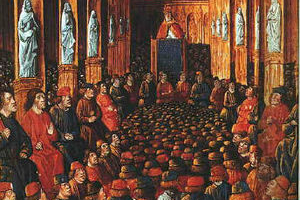
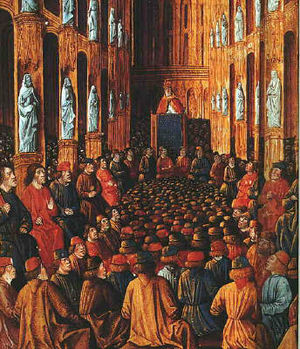
Painting: The Preaching of the Crusades from Wikipedia Commons
This video shows some of the Christian ruins in North Africa, including the See of St Cyprian of Carthage.
True sanctity does not easily fit into our notions of being merely nice or humble. The lives of the actual saints of the Church exude joy and can bring great encouragement to many around them. But it is also true that the great saints were irksome and unsettling to many. Most of the great saints had encountered the holiness of God and wanted to see that holiness be like a fire cast on the earth. When you really want to please God rather than men, you’re not going to be easily silenced in the face of sin and injustice, nor will you be engaging in pleasantries that merely cover over sin.
Catharine Benincasa was such a soul. We know her as St. Catherine of Siena. And though renowned for her love, generosity, and humility, as well as her power to heal, console, and cast out demons, she was no shrinking violet. If she saw something in your soul that was unholy, you were going to hear about it. And it didn’t matter who you were.
St Catherine would meet with anyone from the poorest beggars to kings, governors, bishops, and popes, and none of them were denied her love and encouragement. Neither were they spared the hard truths that God gave her to say. Only God was to be pleased, not man. Spiritual truths were to be extolled over every temporal matter like safety, comfort, and pleasing the powers-that-be.
She loved the Church but remained gravely concerned with the condition of the beloved Bride of Christ. Particularly egregious to her was the condition of so many clergy, right on up the ranks. Even the popes of her time, whom she acknowledged as the sweet Vicars of Christ, and her beloved father (“Babbo” in her native Tuscan) could not escape her expressions of grave disappointment and her calls to conversion.
Of special significance for our time is her exchange of letters with Pope Gregory XI. Though he himself led an exemplary life in many respects, he was a weak, shy, even cowardly man. He was deeply compromised by his temporal ties to power, wealth, and protection, without which he feared he and the papacy could not survive. Nepotism was also a terrible problem, as his own family members kept him wound around their fingers.
Most of the early popes died as martyrs. But by the time of the Avignon Papacy, the popes had become very tied to the world and had “too much to lose.” Instead of facing their opponents boldly, preaching the gospel, and refusing to be afraid, they had fled to Avignon and had been in residence there for decades, living behind fortified walls, protected by armies, and compromised by alliances with secular rulers. It had to stop.
Gregory XI was the last of the Avignon popes, but he only returned to Rome at the prodding of a young woman, not yet thirty, who told him, in effect, to “man up.” Perhaps most disconcerting to him was the fact that she seemed to know of a secret vow he had made to God that if he were to be elected Pope he would bring the papacy back to Rome. How could she know? But she did. Yet after all, was that not why he sought her advice? She knew God, and fearful though her words were, they were compelling, for he knew that God was speaking to him through her. In 1377, after much delay and fretting, he left for Rome.
I want to produce here some excerpts from a letter she wrote to Gregory XI just prior to 1377. I think her words speak to the clergy of today. The specific issues that beset clergy today are somewhat different, but not that different. The Church no longer commands extensive temporal power or rule. But too many (though not all) clergy still exhibit a need to “man up” when it comes to teaching with clarity and authority. And too many clergy, pastors in parishes, and bishops in dioceses, are unwilling to maintain holy discipline or enforce canonical penalties, ever.
St. Catherine confronts this tendency in her letter and does not, to put it mildly, regard this favorably. She sees it as mired in self-love and in the refusal to suffer with the Lord, who died for us at our hands rather than lie to us. She uses the image of a wound that needs to be cauterized with hot irons rather than soothed with oil. But the weak clergy who do not want to hear the cries of protest use only oil to soothe, even though this does not heal and in fact only leads the wound to get worse and in the end cause death. Such malpractice is rooted in self-love, not true zeal to heal and prevent spiritual death.
Well, I have already said too much; I will let Saint Catherine speak for herself. If you think my blogs are long, try reading St. Catherine’s letters! I present here only excerpts of a much longer letter to Pope Gregory; she wrote several others, too. The translation I am using here is from Letters of Catherine Benincasa
In the Name of Jesus Christ crucified and of sweet Mary: To you, most reverend and beloved father in Christ Jesus, your unworthy, poor, miserable daughter Catherine, servant and slave of the servants of Jesus Christ, writes in His precious Blood … the soul is constrained to love what God loves and to hate what He hates. Oh, sweet and true knowledge, which dost carry with thee the knife of hate, and dost stretch out the hand of holy desire … [But if a prelate] sees his subjects commit faults and sins, and pretends not to see them and fails to correct them; or if he does correct them, he does it with such coldness and lukewarmness that he does not accomplish anything, but plasters vice over; and he is always afraid of giving displeasure or of getting into a quarrel. All this is because he loves himself. Sometimes men like this want to get along with purely peaceful means.
I say that this is the very worst cruelty which can be shown. If a wound when necessary is not cauterized or cut out with steel, but simply covered with ointment, not only does it fail to heal, but it infects everything, and many a time death follows from it.
Oh me, oh me, sweetest “Babbo” [a term of affection in her native Tuscan which translates roughly as “Papa”] mine! This is the reason that all the subjects are corrupted by impurity and iniquity.
Oh me, weeping I say it! How dangerous is that worm [of self-love] we spoke of! For not only does it give death to the shepherd, but all the rest fall into sickness and death through it.
Why does that shepherd go on using so much ointment? Because he does not suffer in consequence! For no displeasure visits one and no ill will, from spreading ointment over the sick; since one does nothing contrary to their will; they wanted ointment, and so ointment is given them.
Oh, human wretchedness! Blind is the sick man who does not know his own need, and blind the shepherd-physician, who has regard to nothing but pleasing, and his own advantage—since, not to forfeit it, he refrains from using the knife of justice or the fire of ardent charity! But such men do as Christ says: for if one blind man guide the other, both fall into the ditch. Sick man and physician fall into hell.
Such a man is a hireling shepherd, for, far from dragging his sheep from the hands of the wolf, he devours them himself. The cause of all this is, that he loves himself apart from God: so he does not follow sweet Jesus, the true Shepherd, who has given His life for His sheep.
Truly, then, this perverse love is perilous for one’s self and for others, and truly to be shunned, since it works too much harm to every generation of people.
I hope by the goodness of God, venerable father mine, that you will quench this in yourself, and will not love yourself for yourself, nor your neighbor for yourself, nor God; but will love Him because He is highest and eternal Goodness, and worthy of being loved …
O “Babbo” mine, sweet Christ on earth, follow that sweet Gregory (the Great)! For all will be possible to you as to him; for he was not of other flesh than you; and that God is now who was then: we lack nothing save virtue, and hunger for the salvation of souls.
… Let no more note be given to friends or parents or one’s temporal needs, but only to virtue and the exaltation of things spiritual … have that glorious hunger which these holy and true shepherds of the past … hungered and famished for the savor of souls.
… Following Christ, whose vicar you are, like a strong man … Fear not; for divine aid is near. Have a care for spiritual things alone, for good shepherds, good rulers, in your cities—since on account of bad shepherds and rulers you have encountered rebellion.
Give us, then, a remedy … Press on, and fulfill with true zeal and holy what you have begun with a holy resolve, concerning your return, and the holy and sweet crusade. And delay no longer, for many difficulties have occurred through delay, and the devil has risen up to prevent these things being done, because he perceives his own loss.
Up, then, father, and no more negligence! Raise the gonfalon of the most holy Cross, for with the fragrance of the Cross you shall win peace.
We await you with eager and loving desire. Pardon me, father, that I have said so many words to you. You know that through the abundance of the heart the mouth speaketh … I beg you to do what you have to do manfully and in the fear of God … Remain in the sweet and holy grace of God. I ask you humbly for your blessing. Pardon my presumption, that I presume to write to you. Sweet Jesus, Jesus Love [Letter to Gregory XI, quoted in Letters of Catherine Benincasa pp. 49-51].
Such words still ring true in our day! For too many today in the Church would use the “oil” of accommodation to the culture today, a culture filled with sexual confusion, in which disposable marriages and easy grace without repentance are demanded. To heal such wounds, the cauterizing of the hot iron of truth is needed. Applying the oil of consolation may meet with fewer protests from those who are sick from lies, but in the end this does not help heal the putrefying wounds. Despite the protests, only the hot iron will do.
It’s time for clergy to man up and apply the more difficult medicines. May the upcoming synod show forth the vigor and courage to which St. Catherine summons us.
Thank you, Mother Catherine. May you, who converted the heart of Gregory XI and summoned him to courageous manhood, now imbue us, the clergy of today, with that same fortitude and determination to do what really heals, even if the current age protests.
In today’s Gospel, we see the healing of a leper (this means you and me). Leprosy in Scripture is more than just a physical illness, it is also a metaphor for sin. Leprosy itself is not sin, but it resembles sin and what sin does to us spiritually. For sin, like leprosy, disfigures us; it deteriorates us; it distances us (for lepers had to live apart from the community) and brings death if it is not checked. Yes, sin is a lot like leprosy.
Psalm 38 can be seen as comparing sin to leprosy:
There is no soundness in my flesh because of thy indignation; there is no health in my bones because of my sin. For my iniquities have gone over my head; they weigh like a burden too heavy for me. My wounds grow foul and fester because of my foolishness, I am utterly bowed down and prostrate; all the day I go about mourning … there is no soundness in my flesh … My friends and companions stand aloof from my plague, and my kinsmen stand far off.
Perhaps a brief description of leprosy might be in order, so that we can further appreciate both the physical illness and also, by analogy, how sin devastates us in stages. I have compiled this description from several sources, among them, William Barclay’s Commentary on Mark. In reading this, you will see how Psalm 38 above quite vividly compares sin to leprosy:
Leprosy begins with an unaccountable lethargy and pains in the joints. Then there appear on the body, especially on the back, symmetrical discolored patches with pink and brown nodules and the skin becomes thickened. Gradually the symptoms move to the face and the nodules gather especially in the folds of the cheek, the nose, the lips, and the forehead. The whole appearance of the face is changed till a person loses his human appearance and looks more like a lion. The nodules grow larger and larger and they begin to ulcerate, and from them comes a foul discharge of pus. The eyebrows fall out and the eyes become staring. The voice becomes hoarse and the breath wheezes because of the ulceration of the vocal cords. Eventually the whole body becomes involved. Discolored patches and blisters appear everywhere. The muscles waste away; the tendons contract until the hands look more like claws. Next comes the progressive loss of fingers and toes until a whole hand or foot may drop off. It is a kind of a terrible and slow, progressive death of the body.
The disease may last from ten to thirty years and ends in mental decay, coma, then finally death.
Yet this was not all. The lepers had to bear not only the physical torment of the disease, but also the mental anguish and heartache of being completely banished from society. They were forced to live outside of town in leper areas. Everyone they knew and loved was lost to them and could only be seen from a distance.
In the middle ages, when people were diagnosed with leprosy, they were brought to the Church and the priest read the burial service over them, for in effect they were already dead, though still alive.
This description of leprosy shows how the illness develops, disfiguring, deteriorating, and distancing the leper, until ultimately there is death. As we shall see, not every diagnosis of leprosy was accurate. Many skin ailments (e.g., psoriasis) can resemble leprosy in the early stages. Later on, if the skin cleared up or remained stable, the supposed leper could be readmitted to the community.
But what of us, spiritual lepers? How are we to lose our leprosy and find healing? The Gospel suggests four steps to find healing from the spiritual leprosy of sin.
I. Step One – Admit the Reality – The text says, A leper came to Jesus, and kneeling down, begged him and said, “If you wish you can make me clean.” Notice that he knows he is a leper; he knows he needs healing. He humbles himself, kneeling, and pleads for cleansing.
But what of us? Do we know our sin? Do we know we need healing? Are we willing to ask? We live in times in which sin is often made light of; confessional lines are short. Too easily, we excuse our faults by blaming others (“It’s not my fault; my mother dropped me on my head when I was two.”). Or perhaps we point to some other sinner, apparently “worse,” and think, “Well, at least I’m not like him.”
The fact is, we are loaded with sin. Too easily, we are thinned-skinned, egotistical, unforgiving, unloving, unkind, mean-spirited, selfish, greedy, lustful, jealous, envious, bitter, ungrateful, smug, superior, vengeful, angry, aggressive, unspiritual, unprayerful, stingy, and just plain mean. And even if all the things on the list don’t apply to you, many of them do. In addition, frankly, the list is incomplete. We are sinners with a capital ‘S’ and we need serious help.
Like the leper in the Gospel, we must start with step one: admitting the reality of our sin and humbly asking the Lord for help.
II. Step Two – Accept the Relationship – Notice two things.
First, the leper calls on the Lord Jesus. In effect he seeks a relationship with Jesus, knowing that it can heal him.
Second, note how the Lord responds. The text says that Jesus is moved with pity and touches him. The Greek word translated here as “pity” is σπλαγχνισθεὶς (splagchnistheis) and is from splanxna, meaning “the inward parts,” especially the nobler organs (the heart, lungs, liver, and kidneys). These gradually came to denote the seat of the affections.
Hence the Lord is moved with a tender love for this man. The English word “pity,” though often considered a condescending word today, is rooted in the Latin pietas, referring to family love. So Jesus sees this man as a brother and reaches out to him. Jesus’ touching of the leper was an unthinkable action at that time. No one would touch a leper, or even come close to one. Lepers were required to live outside of town in nearby caves. But Jesus is God, and He loves this man. In His humanity, Christ sees this leper as a brother. Scripture says,
For he who sanctifies and those who are sanctified have all one origin. That is why HE IS NOT ASHAMED TO CALL THEM BRETHREN, saying, “I will proclaim thy name to my brethren, in the midst of the congregation I will praise thee” (Heb 2:11).
It is in our relationship with the Lord, a relationship established by faith, that we are justified, transformed, healed, and ultimately saved. If we want to be free of the leprosy of our sin we must accept the saving relationship with Jesus and let Him touch us.
III. Step Three – Apply the Remedy – Having healed the leper, Jesus instructs him to follow through in the following manner: See that you tell no one anything, but go, show yourself to the priest and offer for your cleansing what Moses prescribed; that will be proof for them.
Among the ancient Jews it was the priests who were trained and empowered to recognize leprosy and its healing. For, as already stated, leprosy in its early stages can resemble other skin ailments. Perhaps it was leprosy, but perhaps it was just dermatitis, or psoriasis, or eczema. Priests were trained to make observations and then either banish the person or readmit him to the community. For sometimes, out of an abundance of caution, a person was dismissed on suspicion of leprosy, but the condition cleared up or remained stable. It was the priest who made the decision for the community.
And, of course, we have here a metaphor for sacramental confession. For what does the priest do in confession? He assesses a person’s spiritual condition, and, having seen God’s healing mercy at work in a person’s repentance, reconciles him, or, in the case of serious sinners, readmits him into the full communion of the Church. It is God who forgives, but the Lord ministers through the priest.
And thus to us spiritual lepers, the Lord gives the same instruction: “Go show yourself to the priest.” In other words, “Go to confession!” And the Lord adds, “Offer for your cleansing what is prescribed.” That is to say, “Offer your penance.”
But someone might ask, why should the leper bother to do that? The Lord has already healed him. To this we can only answer, “Just do what Jesus says: Show yourself to the priest; offer your penance.” It is true that God can forgive directly, but it is clear enough from this passage that confession is to be a part of the believer’s life, especially in the case of serious sin. To those who balk, the simple answer must be, “Just DO what Jesus says.”
So, having admitted the reality, accepted the relationship, and applied the remedy, there still remains a fourth step.
IV. Step Four – Announce the Result – When God heals you, you have to tell somebody. There’s just something about joy. It can’t be hidden. And people notice when you’ve been changed.
That said, there are perplexities about this part of the Gospel. For, as the text says, Jesus “sternly warns him” NOT to tell a soul other than the priest. The Greek text is even stronger, for it says Jesus warned him ἐμβριμησάμενος (embrimēsamenos). This means to snort with anger, to exert someone with the notion of coercion, springing out of displeasure, anger, indignation, or antagonism. It means to express indignant displeasure with someone, and to thus charge him sternly. So we see a very strong and negative command of Jesus. There is nothing ambiguous about the fact that he angrily warns this man to remain silent.
That this (and other passages wherein the Lord issues similar commands) is puzzling is an understatement. And yet the reason is supplied: Jesus did not want His mission turned into a circus act at which people gathered to watch miracles and see “signs and wonders.” Clearly, this man’s inability to remain silent means that Jesus can no longer enter a place quietly, and that many will seek him for secondary reasons.
But commands to remain silent cannot remain true for us who are under standing order number one: Go therefore and make disciples of all nations, baptizing them in the name of the Father and of the Son and of the Holy Spirit, and teaching them to obey everything I have commanded you. And surely I am with you always, to the very end of the age (Matt 28:19).
Hence it is clear that we NEED to shout what the Lord has done for us and give Him all the glory. And, honestly, when God acts in your life, there is joy, and joy cannot be hidden or suppressed. If our healing is real, we can’t stay silent. To quote Jesus at a later stage (when the Temple leaders told him to silence his disciples), I tell you, if they keep quiet, the very rocks will cry out (Lk 19:40).
At the heart of evangelization is announcing what the Lord has done for us. An old Gospel song says, “I thought I wasn’t gonna testify … but I couldn’t keep it to myself, what the Lord has done for me!”
Yes, tell somebody what the Lord has done. If the healing is real, you can’t keep silent.
The word honesty comes from the Latin honestas meaning an honor received from others, a kind of “standing in honor” before others (honor + stas (to stand)). It’s interesting that most people are willing to be a little phony in order to get vague appreciation or to be thought well of. (The whole cosmetics industry is based on this.) But when one is actually “honored” in a formal way by others, there is an elevated sense that we need to truthfully deserve the honor. And thus honor calls forth honesty.
A similar concept is sincerity. The word sincerity comes from the Latin as well: sine (without) + cera (wax). It seems that sculptors in the ancient world often used a hard, resin-like wax to hide their errors. But every now and then there was the perfect carving, with no wax needed, nothing phony about it, no cover-ups.
I thought about these words as I saw this commercial. In the ad, the “honor” of engagement draws forth honesty and sincerity. The honesty of one person brings forth the honesty of the other and they both end up more relaxed.
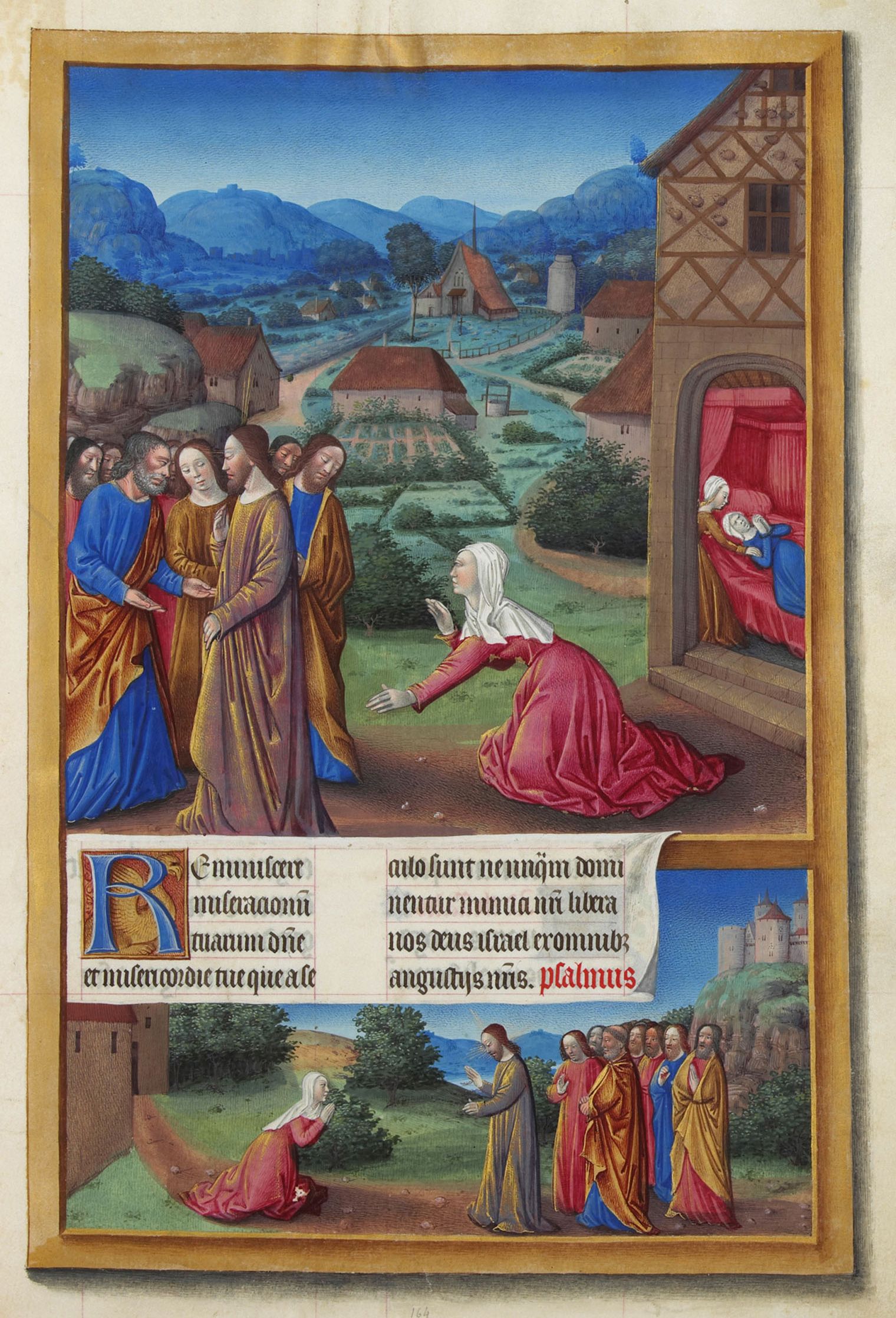
The Gospel for today’s Mass shocks most modern readers and perhaps a few ancient ones as well. It is the story of the Syrophoenician woman who begs Jesus to heal her daughter. But Jesus ignores and then rebuffs her. Our shock says perhaps more about our poor understanding of love than about Jesus’ terse response.
For review, here is the well known passage:
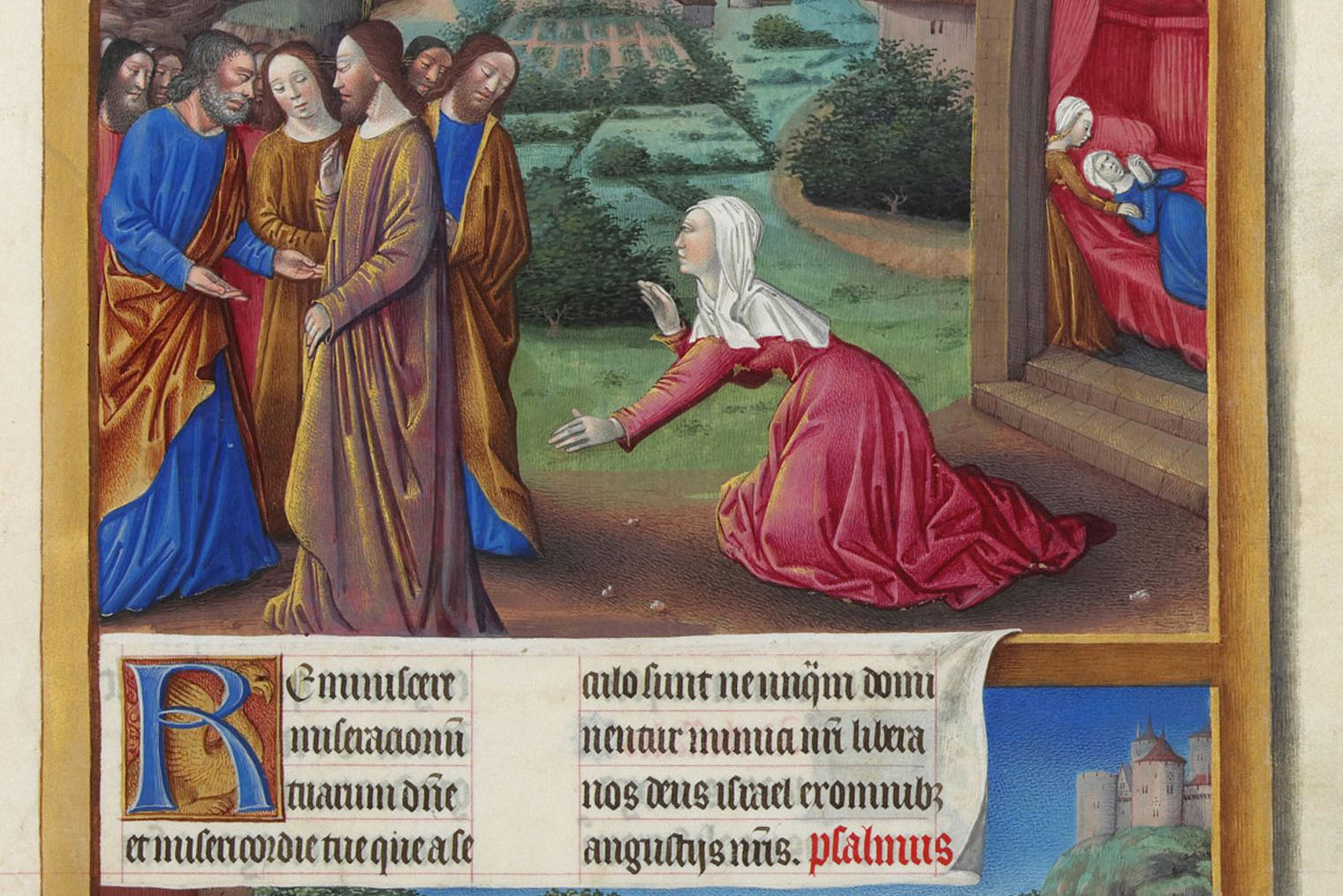
Jesus went to the district of Tyre. He entered a house and wanted no one to know about it, but he could not escape notice. Soon a woman whose daughter had an unclean spirit heard about him. She came and fell at his feet. The woman was a Greek, a Syrophoenician by birth, and she begged him to drive the demon out of her daughter. He said to her, “Let the children be fed first. For it is not right to take the food of the children and throw it to the dogs.” She replied and said to him, “Lord, even the dogs under the table eat the children’s scraps.” Then he said to her, “For saying this, you may go. The demon has gone out of your daughter.” When the woman went home, she found the child lying in bed and the demon gone (Mk 7:24-30).
While I have commented on other theories of this story elsewhere (Do Not Pass me By), in this post I want to briefly explore what our shock reveals about our own attitudes.
Briefly said, we tend to equate kindness with love; this is a mistake. Kindness is an aspect of love, but so is rebuke and so is punishment. Mercy and patience are aspects of love, but so are insisting on what is right and setting limits. Very often, true love requires us to be firm and insistent. Sometimes being kind is rather unloving, since that can assist or enable people in doing things that bring them great harm.
In today’s Gospel, Jesus, who is God and therefore is love, is for a moment “unkind” to the woman who seeks help for her daughter. He has His reasons for this. And while neither your nor I can read her heart, Jesus can. And it seems that Jesus sees a need to exact greater faith and trust from her. His rebuke challenges her, and challenges met have a way of increasing faith. She could have gone away angry or discouraged. With Jesus’ rebuke, her faith in His goodness is challenged. By staying in the conversation and refusing to give up her hope or faith, both these virtues grow. There is an old expression, “Things do by opposition grow,” and we see that here.
Why would her faith need to grow? I cannot speak for her, but I can speak for myself and from my experiences with others. Many people merely want relief, not healing. Healing is hard; it takes time and effort. Healing usually means that one must reexamine one’s life, thoughts, priorities, and so forth. Healing usually means making changes, some of them significant. It sometimes means giving up pleasures and ending unhealthy relationships.
Do we have the kind of faith that is willing to make the changes that healing often requires, or do we just want relief? I have found that people who have come to me over the years seeking deliverance and help often want a simple blessing or prayer to suffice. They are seeking relief and they want it fast. Some have made the longer journey toward healing, but others have gone away sad, angry, or discouraged.
In my own struggle during my mid-thirties, I think I started just wanting a quick solution to my anxieties; I wanted relief. But I came to discover that it was going to be a long journey to healing. It meant I was going to have to grow in trust by examining some of my controlling tendencies and changing the way I thought and lived.
Many years later, I can say that the healing has come. But it was a long and often difficult journey, during which I felt the way the Syrophoenician woman must have. In my own case, I was shocked by the Lord’s silence. And when I did hear His voice, it seemed only to challenge me. Was the Lord being unkind? Back then, I would have said, “yes.” But I have come to discover that the Lord was doing what was loving, even if at the time it seemed unkind and distant. The Lord was insisting that I come to trust Him more, for my own sake, and He wasn’t just going to keep sending me bromides for relief. His goal was to heal me. That was the loving thing to do.
Kindness has its place, but so does rebuke and so does the refusal to enable us in our sinful and wounded tendencies.
And so it was that a certain Syrophoenician woman experienced a moment of unkindness from Jesus. But she did not fail to receive His love. And while her story is told in a rather quick, focal way, our own stories may extend over a longer period. If we, like her, refuse to give up our hope and faith, if we stay with the Lord allowing Him to work and grow our faith in His work, we, too, will hear those marvelous words of the Lord: For saying this, you may go. The demon has gone out.

 Most pastors and confessors are aware that in any parish there are going to be a few who are scrupulous, even in times like like these. Some have a kind of scrupulosity that is mild and almost admirable. A sensitive conscience is a beautiful thing and bespeaks a kind of innocence that is rare today.