Though I wrote last week of holy silence, something urges me (a man of many words) to write of it again. During Mass today, the words of Zechariah came to my mind:
Sing and rejoice, O daughter of Zion, for behold, I come and I will dwell in your midst, declares the Lord … Be silent, all flesh, before the Lord, for he has roused himself from his holy dwelling (Zechariah 2:11, 13).
There is a common idiom: “Words fail me.” It is in this context that we can best understand God’s call to fall silent before the mystery of the Lord’s incarnation. Notice in the passage above that the call to silence follows the call to “sing and rejoice.”
Is there a difference between singing and rejoice, and just speaking? Of course there is! Singing, by adding the inscrutable sighs we call “song” (a deeply mysterious emanation from our souls) to the words, is declaring that “words fail.”
To be sure words, are a “necessary evil” for us. But honestly, in using words we indicate more what a thing or reality isnot than what it is. For example, if I say to you, “I am a man,” I have really told you more what I am not than what I am. I have told you I am not a woman, nor a chair, nor a lion, nor a rock. But I have not told what it means to be a man. I have not told you myriad other things about myself that I could: I am a priest; my father was a lawyer and Navy veteran; my mother was a teacher; I am descended from Irish, German, and English immigrants. I have not told you about my gifts, or my talents, or my struggles, or numerous other aspects that make me who I am. And even if I spent several paragraphs relating my curriculum vitae to you, there would still be vastly more left unsaid than was said. Words fail.
Further, words are not the reality they (often poorly) attempt to convey. They are symbols of what they indicate. If you see a sign, “Washington” you don’t park there and take a picture of the sign. The sign itself is not Washington; it merely points to the reality that is Washington. You pass the sign and enter into a reality far bigger than the metal sign and begin to experience it. Words fail.
Many words are also more unlike the reality they describe than like it. My philosophy teacher once asked us how we would describe the color green to a man born blind. We struggled with the task but were able to come up with some analogies: green is like the taste of cool mint; green is like the feel of dew-covered grass. To some extent green is like these things, but the color green is more unlike these things than like them. Green, as a reality, is so much richer than the taste of cool mint or the feel of dew-covered grass. Words fail.
And if this be so in the case of mere earthly things, how much more so in the case of heavenly and Godly matters. The Lord therefore commands a holy silence of us as a kind of reminder that words fail. Silence is a proper reverence for the mysteries of the incarnation and of God. Words are necessary; without them orthodoxy could not be set forth and truth could not be conveyed. But, especially as regards God and the truths of faith, there comes this salutary reminder from St. Thomas Aquinas: “Now, because we cannot know what it God is, but rather what he is not, we have no means for considering how God is, but rather how he is not” (Prima pars, q. 3, prologue).
Therefore, fellow Catholics, as the mysteries of the incarnation unfold for us liturgically, Let all mortal flesh keep silence, and with fear and trembling stand, Christ our God to earth descendeth, bearing blessings in his hand (from the hymn, “Let All Mortal Flesh Keep Silence”).
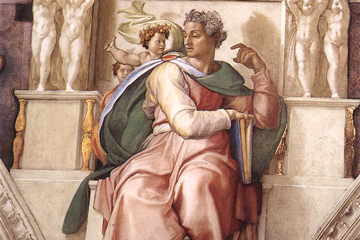
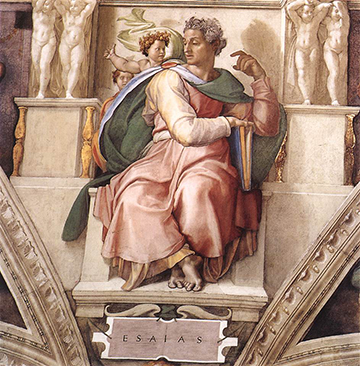
As Advent approaches its end, the Office of Readings features some final admonitions for us from the Book of the Prophet Isaiah. On the one hand they console; on the other hand they challenge us to remain firm.
Isaiah addressed a people in exile who still awaited the first coming of the Lord. These texts now speak to us in difficult days when, exiled from Heaven, we await the His great second coming.
Let’s look at these admonitions of the Lord’s (from Isaiah 46:1-13) that were addressed to three different groups in ancient Israel, three groups still present in our time: the faithful remnant, the foolish rebels, and the at-risk fainthearted.
To the Faithful Remnant – Hear me, O house of Jacob, all who remain of the house of Israel, My burden since your birth, whom I have carried from your infancy. Even to your old age I am the same, even when your hair is gray I will bear you; It is I who have done this, I who will continue, and I who will carry you to safety.
Yes, this is directed to the devoted, to the remnant, to those who remain after the cultural revolution, to those sometimes discouraged and sorrowed over the infidelity of loved ones and the world around them. To these, often the elderly among us who remember a more faithful even if imperfect time, to these the Lord first speaks.
Blessed are those who mourn, for they shall be comforted. Who are the mournful? They are those who see the awful state of God’s people: not glorifying the Lord in their lives, not knowing why they were made, spending themselves on what neither matters nor satisfies. Yes, those who mourn shall be strengthened, and, as their sorrow has motivated them to pray and work for the kingdom, they shall be borne to safety.
Such as these, the faithful remnant, should never forget that God has carried them from the beginning, even in the strength of their prime. And now, reduced by age, the Lord still carries them. He has never forgotten them and will carry them to safety; their faith in difficult times will be rewarded.
To The Foolish Rebels – Remember this and bear it well in mind, you rebels; remember the former things, those long ago: I am God, there is no other; I am God, there is none like me. Whom would you compare me with, as an equal, or match me against, as though we were alike? There are those who pour out gold from a purse and weigh out silver on the scales; Then they hire a goldsmith to make it into a god before which they fall down in worship. They lift it to their shoulders to carry; when they set it in place again, it stays, and does not move from the spot. Although they cry out to it, it cannot answer; it delivers no one from distress.
The word “rebel” is from the Latinre (again) + bellum (war). In this context it refers to those who are forever at war against God and His plan for their lives. They foolishly forget His saving deeds of the past. They imagine vain things: that there are other gods or entities that could save them. Even more foolishly, they craft other “gods” that they have to lift to their shoulders to carry.
Many in our day act in the same way: always at war with God, His Church, and His plan. As G.K. Chesterton once noted, when people stop believing in God, it is not that they will believe in nothing but that they will believe in anything. Chesterton also wrote that when we reject God’s big laws, we get ten thousand little laws. We transfer our trust away from God to false, crafted gods like government, or science, or the market. We hope that they will carry us, but we end up carrying the weight of these gods on our shoulders. We carry this weight in the form of taxes, debt, and anxiety about everything in our health or environment (demanded by the increasingly politicized scientific and medical communities).
Science, the market, and government are not intrinsically evil, but they are not gods either and cannot deliver us from ourselves. Only God can do this. But to the many who rebelliously and foolishly persist with their “non-gods,” God says, “I am God; there is no other.”
To the Fainthearted at Risk – Listen to me, you fainthearted, you who seem far from the victory of justice: I am bringing on my justice, it is not far off, my salvation shall not tarry; I will put salvation within Zion, and give to Israel my glory. At the beginning I foretell the outcome; in advance, things not yet done. I say that my plan shall stand, I accomplish my every purpose. I call from the east a bird of prey, from a distant land, one to carry out my plan. Yes, I have spoken, I will accomplish it; I have planned it, and I will do it.
Among the faithful there are some who are at risk, who are close to giving up. God encourages them, but also warns that His plan will stand whether or not they endure. Thus there is an implicit warning from Jesus here, and an explicit warning elsewhere, that we must persevere. Jesus says that because lawlessness is increased, most people’s love will grow cold. But the one who endures to the end, he will be saved (Matt 24:12-13).
St. Augustine also wrote,[God has] devised a plan, a great and wonderful plan … All this had therefore to be prophesied, foretold, and impressed on us as an event in the future, in order that we might wait for it in faith, and not find it as a sudden and dreadful reality (From a discourse on the psalms by Saint Augustine, bishop (In ps. 109, 1-3: CCL 40, 1601-1603)).
God’s plan will stand whether or not we do. We must stand as well, even when we would faint or fall back. Our love must not grow cold nor our strength fail. God has triumphed and Satan has lost. We must choose with whom we will stand.
The evidence of the present time does not seem to show this, but as Scripture reminds us,
Therefore we do not lose heart … So we fix our eyes not on what is seen, but on what is unseen, since what is seen is temporary, but what is unseen is eternal (2 Cor 4:16-17)
For all that is in the world, the lust of the flesh and the lust of the eyes and the boastful pride of life, is not from the Father, but is from the world. The world is passing away, and also its lusts; but the one who does the will of God lives forever (1 Jn 2:16-17)
Here, then, are some final instructions from the Lord for us this Advent, instructions for us who wait for Him: be faithful; the plan will come to pass. Do not be a foolish rebel, nor one of the at-risk fainthearted. Rather, be part of the faithful remnant. For St. Paul says,Isaiah cries out concerning Israel: “Though the number of the Israelites be like the sand by the sea, only the remnant will be saved” (Romans 9:27).
The song performed in the clip below is entitled “Lord Help Me to Hold Out.”
Here on the Fourth Sunday of Advent we are close to the unfolding of the great mystery of the Word made flesh. It is easy for us to look right past it, but we do well to pause and ponder what is taught to us today about the salvation that is to unfold. One significant way we can do this is by reflecting upon the first reading today from the prophet Micah. In four short verses, we are presented with a kind of summary of our salvation, a snapshot of what ails us and how God heals us. Let’s see what the Lord and the Church have to teach us.
I. Our Humility – The text begins, And you, Bethlehem-Ephrathah, too small to be among the clans of Judah, from you shall come forth for me one who is to be ruler in Israel.
Of all the towns and villages in the land of Judah, one of the lowliest was Bethlehem. Though not far from the great city of Jerusalem—a matter of a few miles—it was little more than a rundown, frontier village with little to recommend itself. It was a place by which one passed quickly on the way to nearby Jerusalem.
Even today, despite all that happened there, Bethlehem remains a troubled and rundown little city, impoverished and crowded. Its steep, hilly streets feature little that is pleasant to the eyes. There is a great sorrow that hangs over it. It is hemmed in by guard towers and walls covered with razor wire. These are signs of a great standoff between Israel and the Palestinians. Largely isolated economically, the city suffers from poverty and unemployment.
The ancient Church of the Nativity at the top of the hill looks every bit of its 1500 years in age. It is dingy, covered in soot, and largely in a state of poor repair, due to a standoff among the Orthodox factions that oversee the building. The tension is palpable as one enters the church and nervous tour guides engage in delicate negotiations to ensure a quick visit to the cave of the Nativity beneath the altar.
Yes, Bethlehem remains lowly, troubled, and very humble. And yet it is here that our Savior chose to be born. He did not choose nearby Jerusalem, distant Rome, or any great imperial city. Not in a palace was He is born, but in a cave. And even in this humble and lowly city, one has to get mighty low to find the place where Christ was born. One descends down steep, narrow steps into a cave. And even inside this cave, one must stoop lower still, even kneeling on the floor, to touch the place where Christ was born.
A lowly place in a lowly village—this is where Christ was born. See how the Lord esteems humility? God hates pride; He just can’t stand it. Pride is our greatest enemy, it is at the root of every sin we commit. That is why the Lord teaches us that humility is one of our greatest gifts.
The story also reminds us of something that took place in Bethlehem 1000 years before. The prophet Samuel was sent to anoint a new king to replace Saul. Having been sent to lowly Bethlehem, Samuel surveyed the sons of Jesse. Samuel was impressed by the seven strong young men he saw before him, but none of these were the king he was sent to anoint. There was one other son, so young and insignificant that Jesse had not even thought to include him. It was little David, who was out in the field tending the sheep. Yes, the lowliest one, he was the one whom God chose. Humility won the day (cf 1 Sam 16).
And so it is that Bethlehem shows forth the humility, the lowliness that alone opens the door to God. Bethlehem is a name that means “house of bread,” not “house of caviar,” not “house of fine wine,” rather, the house of ordinary bread. Humility ushers in our God.
II. Our Hardship – The text goes on to speak of our condition prior to the coming of Jesus: Therefore, the Lord will give them up, until the time when she will is to give birth has borne.
For indeed, our condition without Christ is grave. We are given up, given over to sin and to our own fruitless and self-destructive tendencies. And thus we learn of the gravity of our condition: that we cannot save ourselves. The prophet Isaiah had cried out, Oh, that you would rend the heavens and come down, that the mountains would tremble before you! … All of us have become like one who is unclean, and all our righteous acts are like filthy rags; we all shrivel up like a leaf and like the wind our sins sweep us away. No one calls on your name or strives to lay hold of you; for you have hidden your face from us and made us waste away because of our sins (Is 64:1,6-7).
Yes, our condition apart from Christ is hard and quite hopeless. In the age of the Law and the prophets, we learned the hard way that no matter how hard we try we cannot save ourselves. Our wounds are too deep, our pride too great, our hearts too dull, and our minds too dark. We are lost without God. How often have deluded men sought to create utopia only to discover ruins? We have only to consider the utopian notions of the last bloody century.
Yes, the age of the Law and the Prophets in the Old Testament shouts to us that we cannot save ourselves. We must rely on God; we must turn to Him. We don’t just need an angel—we need a savior. And until she who was to give birth has borne the son, the only way to describe the human family is just the way this text from Micah does: we had been given up, given over to our own sins so as to discover humility and our need for a Savior.
Isaiah wrote,All we like sheep have gone astray, every one to his own way (Is 53:6). St. Paul would later write of the time before Christ, we were dead in our sins (Eph 2:1), given over to our transgressions and iniquity.
So here is our hardship. We are wandering, lost and in need of a Savior.
III. Our Head – The text goes on to speak of our Savior, our shepherd, our ruler, and our head: Whose origin is from of old, from ancient times. He shall stand firm and shepherd his flock by the strength of the Lord, in the majestic name of the Lord, his God.
And thus we see that our Savior will be both God and man. He is God, for His origin is from of old, from ancient times (cf also Hebrews 7:3). He also saves us by the strength of the Lord. And yet He is also one of us, for the text speaks of Him as acting in the name of the Lord, His God.
He must be God in order to have the power to save us, and yet He must also be one of us in order to speak and act on our behalf. As God, He cannot obey God, for there is only one divine will. But as man, having a human will, He is able to obey the Father. Thus it makes sense that our Savior must be both God and man.
It is said that He will shepherd His flock. Shepherds feed, lead, and protect their flocks. And all this the Lord does for us. It is a trait of sheep to be wayward; sheep tend to stray. They need the watchful care of a shepherd. Similarly, even after saving us from our sins, the Lord must continue to feed us, lead us, and protect us. Otherwise, having been snatched from the wolf, we might run into a bear. Or, having been saved from the edge of a cliff, we might wander into a thicket.
Thus Christ, our shepherd and head, must go before us, showing us and opening the way. He must also walk behind us to guard us and to observe our every action. And he must walk beside us to keep our paths straight. We need a Savior, not just on Good Friday, but every hour of every day.
IV. Our Healing – The text goes on to say, and the rest of his kindred shall return to the children of Israel and they shall remain, for now his greatness shall reach to the ends of the earth; he shall be peace.
And thus we see that Jesus’ essential task in healing us is not simply a personal healing for me alone or for you alone. It is also healing that removes the divisions within and among us. One of the chief sources of our suffering in this world is division. Nation is divided against nation; races and ethnic groups are in competition; there is conflict and crushing hatred.
At the time of Jesus, Jews and Gentiles (largely Romans and Greeks) were in major conflict. The Jews of Jesus’ time were taught to love their neighbor and their fellow Jews, but to hate their enemy. Jesus taught that we must love and forgive our enemies and began the process of establishing a universal Church, a Catholic Church. He gave the apostles standing orders to preach the gospel to every nation and to unite everyone under the common title of disciple, of Christian. The dignity of baptism and of being a child of God was to be offered to all. As this text of Micah prophesies, the Lord’s salvation and greatness shall reach to the ends of the earth.
The text goes on to say, He shall be our peace. Note that this is not a “can we all just get along” sort of peace. It means that He shall be our peace. That is to say, the Lord Jesus Christ and the truth He proclaims are to be the source of our unity. In sending the apostles forth to proclaim the Gospel to every nation, Jesus said that they should teach the people to observe everything that He commanded, and should draw them into the life of the church through baptism (cf Matt 28:19). He is our peace. Jesus and His teachings are what are meant to unite us. Every other form of peace is not a true or lasting peace.
Thus Jesus initiated a process that was not meant to conquer the world politically. Rather, it was a process whereby His truth and grace would be proclaimed and those who accept these gifts would be able to come to greater and more lasting peace.
This peace must begin in the heart and mind of every individual believer who, by the grace of Jesus Christ, experiences an inner healing of the many conflicts and destructive drives caused by sin. Then, by drawing others to that same healing through evangelization to a life-changing, transformative relationship with Jesus Christ, this peace is meant to spread throughout the world. This will put an end to division; bring together the children of God; and show forth God’s greatness, truth, and salvation to the ends of the earth.
He is our peace. Jesus is our healing.
Today’s first reading, just prior to the Christmas reality, presents us with a summary of our salvation. It stresses our need for humility, describes our hardship, announces our Head (a Shepherd), and sets forth the basis for our healing. In a word, the basis for our healing is the Word made flesh, Jesus.
This song says,
We need to hear from you We need a word from you If we don’t hear from you What will we do Wanting you more each day Show us your perfect way There is no other way That we can live.
Destruction is now is now in view Seems the world has forgotten all about you Children are crying and people are dying They’re lost without you, so lost without you But you said if we seek Lord if we seek your face And turn from our wicked, our wicked ways You promised to heal our land Father you can
Here is a brief video that needs little commentary from me. It is Canadian Tire’s Christmas commercial. It reminds us that the most important things at Christmas aren’t things at all.
For my money, the best Advent hymn ever is Veni Redemptor Gentium (Come Redeemer of the Nations), written by St. Ambrose in the 4th century. It is known more widely by the title “Come Thou Redeemer of the Earth.” Sadly, it is not widely sung in Catholic parishes. Most Catholics I’ve asked have never even heard of it.
One of the beautiful things about the ancient Latin hymns is how richly theological they are. Not content to merely describe an event, they give sweeping theological vision and delve into its more hidden mysteries.
So here we are in Advent, and Jesus is coming. Get ready! Well, yes, but He’s not just coming; He’s redeeming, dying, rising, ascending, and reigning at the Father’s right hand! But how can you get all that into an Advent hymn? Well, just below you can read the text and see.
Full vision – For now, ponder the theological point that hymns like this make: no act of God can be reduced merely to the act in itself. Everything God does is part of a sweeping master plan to restore all things in Christ, to take back what the devil stole from us! Too often we see the events of our redemption in a disconnected sort of way. But it is all really one thing and the best theology connects the dots. It is not wrong for us to focus on one thing or another, but we must not forget that it is all one thing in the end.
Without this reminder, we can develop a kind of myopia that overemphasizes one aspect of redemption at the expense of others. In the 1970s and 1980s it was “all resurrection all the time,” but no passion or death.
Christmas, too, has its hazards. We get rather sentimental about the “baby Jesus” but miss other important aspects of his incarnation. The passion and death are present in His birth in homeless poverty, the swaddling clothes, the flight into Egypt, and so forth. The Eucharist is evident in His birth at Bethlehem (House of Bread) and His being laid in a manger (a feed box for animals). His glory as God and His ultimate triumph are manifested in the star overhead and the angels’ declaration of glory! You see, it is all tied together, and the best theology connects the dots.
So with that in mind I present this wonderful Advent hymn, so seldom sung in our Catholic parishes. It can be sung to any Long Meter (LM) tune but is usually sung to its own melody (“Puer Natus”). I provide below only the English translation, but both the Latin and the English are available in this document: Veni Redemptor Gentium. I think the poetic translation reprinted below is a minor masterpiece of English literature and hope you’ll agree. Enjoy this sweeping theological vision of the mystery of Advent caught up into the grand and fuller vision of redemption.
Among the theological truths treated in this brief hymn are these: His title as Redeemer, His birth to a virgin, His inclusion of the Gentiles, His sinlessness, His two natures in one person, His incarnation at conception, His passion, His death, His descent into Hell, His ascension, His seat at the Father’s right hand, His divinity and equality with the Father, His healing and sanctification of our humanity so wounded by sin, His granting us freedom and eternal life, His renewing of our minds through the light of faith, and His opening of Heaven to us.
Not bad for seven verses! St. Ambrose, pray for us!
Come, thou Redeemer of the earth, Come manifest thy virgin birth: All lands admire, all times applaud: Such is the birth that fits our God.
Forth from his chamber goeth he, That royal home of purity, A giant in twofold substance one, Rejoicing now his course to run.
The Virgin’s womb that glory gained, Its virgin honor is still unstained. The banners there of virtue glow; God in his temple dwells below.
From God the Father he proceeds, To God the Father back he speeds; Runs out his course to death and hell, Returns on God’s high throne to dwell.
O Equal to thy Father, thou! Gird on thy fleshly mantle now; The weakness of our mortal state With deathless might invigorate.
Thy cradle here shall glitter bright,
And darkness breathe a newer light,
Where endless faith shall shine serene,
And twilight never intervene.
All laud, eternal Son, to thee Whose advent sets thy people free, Whom with the Father we adore, And Holy Ghost, for evermore.
This video gives you an idea of what the tune for Veni Redemptor Gentium sounds like. The words in this version are slightly different from what is shown above, but the hymn tune is perfect. Just try not to dance as it is sung! You can find the melody for this hymn tune, “Puer Natus,” in the index of most hymnals. The words to the hymn, however, can be sung to any Long Meter (LM) hymn tune.
One of the great cries of Advent is for God to rend the heavens and come down (Is 64:1), for Him to stir up his mighty power and come to save us (Ps 80:2). But what is it that we really seek? Is it armies with thunder and lightning? Is it vindication and peace on our terms? In a way, it is a dangerous cry if we mean it that way, for who of us can say that no wrath should come to us but only to those other people who deserve it? If God should come in thunderous judgement, are you and I really so sure we could endure and be numbered among the just?
It is clear that we need the Lord to save us, but is that salvation seen only in earthly terms where salvation is from my enemies and I myself remain largely unharmed?
In the final essay of volume 11 of his collected works (which I just finished reading), Joseph Ratzinger (Pope Emeritus Benedict) ponders a similar Advent theme. I’d like to present his reflections, and add a few of my own. In a sermon from December 2003, Joseph Cardinal Ratzinger taught,
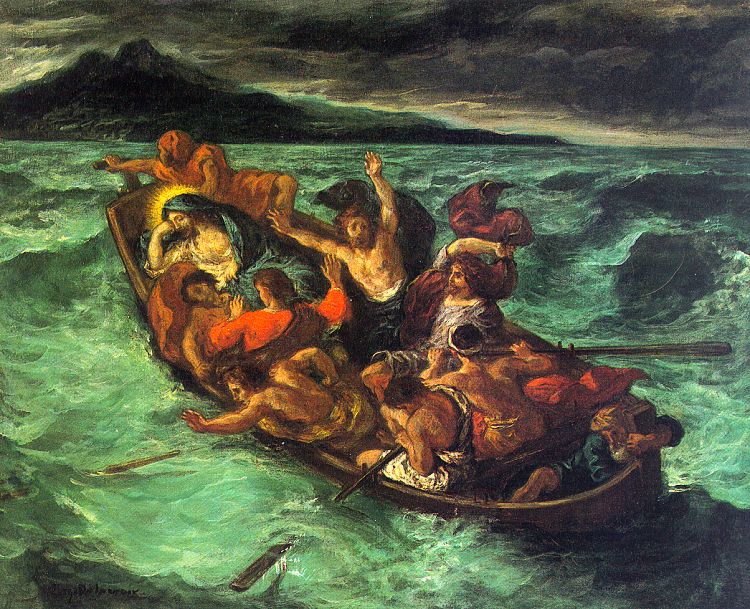
Stir up your might O Lord and come! This was the cry of Israel in exile … this was the cry of the disciples on the Sea of Galilee [in the storm] “Wake up O Lord and help us!” … And throughout all of history, the little bark of the Church travels in stormy waters … Stir up your might and come!
… What really is this might of God that seems to be asleep and must be wakened? St. Paul gives the answer in 1 Corinthians when he says that Christ the Crucified One, who is foolishness and weakness to men, is the wisdom and power of God.
Therefore, when we ask for this real power of God, we are not asking for more money for the Church, for more buildings, for more structures, for more political influence. We are praying for this special, entirely different power of God. We are praying with the awareness that he comes in a powerful way that seems to the world to be weakness and foolishness (Joseph Ratzinger, Collected Works, Vol 11: 595-596).
Yes, here is the paradox of God’s power: He defeats Satan’s pride by the humility of His Son; disobedience and the refusal to be under any authority are defeated by the obedience and submission of Jesus.
Once stirred, God’s power will not always—or even often—manifest itself in thunder and lightning or in armies that shatter and destroy. Rather, His “strong and outstretched arm” is often found nailed and bloody on the cross. Yet here, and in this way, he defeats Satan. How? Darkness cannot drive out darkness; only light can do that. Hatred cannot drive out hatred; only love can do that. And pride cannot drive out pride; only humility can do that.
And thus the Lord defeats Satan; not by the becoming a bigger, fiercer, more vengeful version of Satan, but by canceling Satan’s grievous stance with its opposite. It is the Lord’s refusal to meet Satan’s terms, to become anything like him or in any way enter his world. In this way, the Lord conquers pride with humility and hate with love. I am mindful of some of the words from an old hymn, “When I Survey the Wondrous Cross.”
See from His head, His hands, His feet,
Sorrow and love flow mingled down!
Did e’er such love and sorrow meet,
Or thorns compose so rich a crown?
The hymn concludes with these words:
Love so amazing, so divine,
Demands my soul, my life, my all.
Cardinal Ratzinger continues his essay as follows:
He does not come with military divisions; he comes instead with a wounded heart that apparently has nothing more to say, yet then proves to be the true and wholly other power and might of God.
This paradox should challenge us mightily, because it means that God’s help will often not be on our terms. We would like to have every foe vanquished and every harmful sorrow of our life removed. No cross at all; just stir up your power Lord and take it all away. But that is not usually how God’s power stirs in this “paradise lost,” which we chose by our own ratification of Adam and Eve’s sinful choice. We preferred a tree and its fruit to God and He does not cancel our choice. Instead, He plants the tree of the Cross and saves us by the very suffering and death we chose in the ancient Garden of Eden.
Here is God’s true power at work in this sin-soaked and rebellious world: the power of Cross. And if you didn’t know what you were asking for when praying, “Stir up your power, Lord, and come to save us,” now you do. We might prefer that God save us on our terms, by the mere vanquishing of our foes and the removal of our suffering, but (as St. Paul teaches) power is made perfect in weakness; it is when we are weak that we are strong, for then the power of God rests on us (cf 2 Cor 12:9-10).
Cardinal Ratzinger then sets forth the challenge of this prayer for us:
[Hence our true declaration is] “Lord wake us up from our drowsiness in which we are incapable of perceiving you, in which we conceal and impede the coming of your holy power.
… Christianity is not a moral system in which we may merely roll up our sleeves and change the world. We see in the movements that have promised us a better world how badly that turns out!
… But [on the other hand] Christians are not merely spectators … rather [the Lord] involves us; he desires to be efficacious in and through us … And so the in this cry we pray to him for ourselves and allow our own hearts to be touched: Your power is in us, rouse it and help us not to be an obstacle to it, but, rather, its witnesses [to its] vital strength.
That may well mean suffering, martyrdom, and loss. It may not, and often does not, mean that God will simply vanquish our foes and remove all our suffering. In this world the saving remedy is the Cross; not just for others but for us, too. On Good Friday, Christ looked like a “loser.” Satan and the world danced. But on Sunday, the Lord got up. Friday was first, Saturday lingered, and then came Sunday. As for Christ, so also for us: always carrying in our body the death of Jesus, so that also the life of Jesus may be manifested in us (2 Cor 4:10). The victory will come but it comes through the paradoxical power of the Cross.
Does this Advent reflection sound too much like Lent for you? Why do you think we are wearing purple?
Now pray with me (but be sure to understand what you are asking): Stir up your power, Lord, and come to save us!
Here is the common Psalm for Advent: Lord make us turn to you, let us see your face and we shall be saved.
As we move toward the conclusion of the Advent season, we ponder the events surrounding Christ’s birth. The penultimate focus is the events leading up to the birth of St. John the Baptist, and in particular, the narrative of Zechariah and Elizabeth. While there are certainly many teachings to be drawn from this passage, there is value in pondering the imposition of silence upon Zechariah. This aspect of the story is particularly applicable to us because we live in an age marked by a lack of reflection and silence, of often stridently expressed opinions, and of opposition to the hidden things of God.
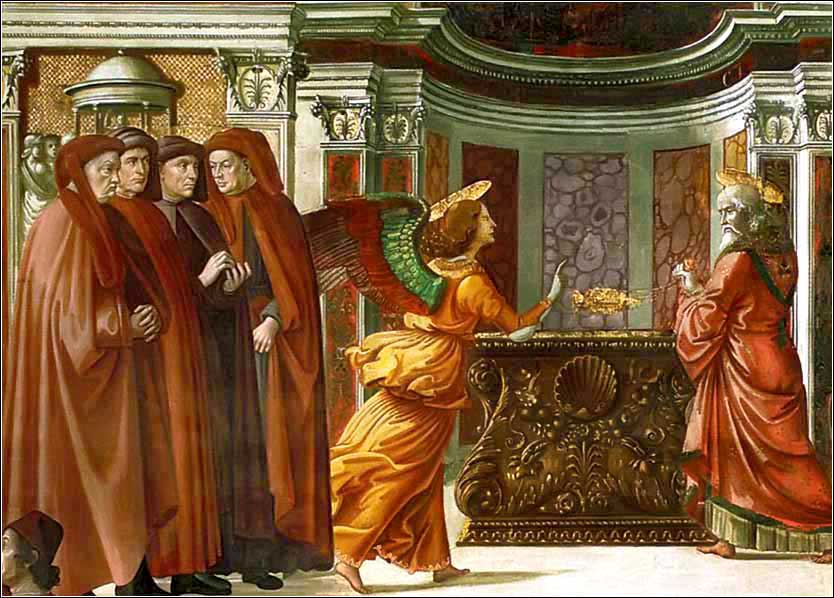
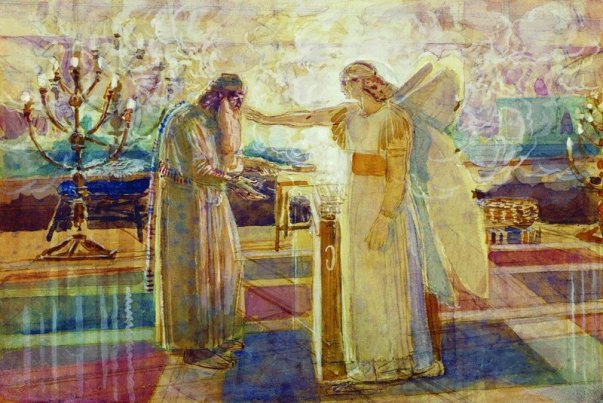
The Gospel opens with a description of Zechariah and Elizabeth as devout observers of the Law who have reached their later years without having children. Zechariah, in his priestly ministry, is selected to enter the Temple and offer incense at the designated hour. There, he encounters the Archangel Gabriel, who announces the birth of John the Baptist. Zechariah wonders,
How shall I know this? For I am an old man, and my wife is advanced in years.
For this question, he is rebuked by Gabriel for his lack of faith:
You will be silent and unable to talk until the day these things take place, because you did not believe my words, which will be fulfilled at their proper time (Luke 1:19).
This rebuke causes some bewilderment on our part because Zechariah’s response is not unlike that of the Blessed Mother, who said, How will this be, since I know not man? (Lk 1:34) In our puzzlement, we must remember that we have before us only a written text. We cannot hear the tone of voice that was used or see other clues that might indicate the attitude of Zechariah as he expresses this wonder. There must have been differences, for Mary’s question brings reassurance from Gabriel, while Zechariah’s question is met with rebuke.
Whatever the reason, let us ponder the punishment declared by the Archangel Gabriel.
It seems a mistake to regard Gabriel’s reaction as merely punitive. Rather, we ought also to see it as a kind of remedy. In effect, The Archangel draws Zechariah into a kind of holy silence in the face of the great mystery of John the Baptist’s conception. This silence will give him time to reflect without speaking.
There is a human tendency to be analytical. Our intellect is central to our glory and we have well used it to master nature and unlock many aspects of the created world. And yet glorious though our intellect is, it is also something over which we tend to stumble. There is a time to become quiet and ponder in reverent silence the fact that there are many mysteries beyond our ability to analyze or dissect.
For many who think merely in the flesh, mysteries are something to be solved, something to be conquered. We moderns, especially, presume that anything we do not currently understand, anything currently mysterious, we will one day fully understand; it is just a matter of time.
But the Christian tradition speaks more cautiously about mystery. Mystery is something that commands reverence. Mysteries are often something meant to be appreciated and respected, not merely to be set upon in order to be solved or unraveled. This is especially true with mysteries related to God, and to some extent those related to the human person.
Consider, for example, the mystery of your own person. Although you know much about yourself, much lies hidden. Many things about us defy simple analysis or categorization. In the face of this mystery, silence and reverence are essential. And while our insights about our inner self grow deeper with the passing years, we can never really say that we have conquered the mystery. Scripture says,
More tortuous than all else is the human heart, and beyond cure. Who can understand it? “I the Lord search the heart and examine the mind (Jer 17:9-10).
And if we are to have this reverence for our very self, we must also have it for one another. We must reverence the mystery of one another, never demanding to know things that are not ours to know. And we must never arrogantly presume that we have someone “figured out.” To claim this trivializes the human person.
Using an a fortiori argument, then, if reverence and a holy silence are appropriate before human mysteries, how much more so toward the mysteries of God and His ways? In many places, Scripture commands us to a holy silence before the mystery of God:
Silence, all people, in the presence of the LORD, who stirs forth from his holy dwelling (Zechariah 2:17).
Be silent before the Sovereign LORD, for the day of the LORD is near (Zephaniah 1:7).
Be still, and know that I am God; I will be exalted among the nations, I will be exalted in the earth (Psalm 46:10).
Then Job answered the Lord: “I am unworthy—how can I reply to you? I put my hand over my mouth. I spoke once, but I have no answer—twice, but I will say no more” (Job 40:4-6).
And thus we see in today’s Gospel that Zechariah has imposed upon him a holy silence in order that he might reflect more deeply and reverently on the mysteries of God. He is not to speak; he is to be still and silent before the Lord, who stirs from His holy dwelling. Words reduce mystery and seek to capture it. Zechariah is to ponder in reverent silence. Not one word will he utter until it all comes to pass.
Zechariah also manifests another common human tendency: the tendency to scoff at things we do not understand. Rather than drawing back and seeking to learn in holy silence and docility, we scoff at how unlikely or uncertain things are. Because we cannot understand something, we declare that it cannot possibly be so. Never mind that with God all things are possible or that over time our sciences have shown us things we never dreamed possible, discoveries of processes in nature that boggle the mind.
Yes, there is a time to speak, a time to ask, and a time to open our mouth in teaching. But there is also a time to sit quietly, to listen, to learn, and to ponder in silence. There is a time to reverence mystery in quiet, wordless admiration. There is a time to accept humbly that there are many things beyond our ability to know or understand.
In this reverent silence there comes forth a kind of holy wisdom, a wisdom not easily reduced to words. It is the wisdom that appreciates that the acceptance of mystery is itself an insight. It is a silence that opens us upward and outward, away from the tinier world of things that we have “all figured out.”
Zechariah is reduced by Gabriel to silence, a holy and reflective silence before the mysterious and merciful work of God.
And what of us who are approaching the mystery of the incarnation and who live in a world steeped in mystery? Do we scoff at what we do not understand? Do we rush to open our mouth in doubt or ridicule, or do we silently ponder and listen, seeking to be taught? Do we accept that humility both opens the door to wisdom and is a kind of wisdom itself?
Find silence before Christmas. God stirs from His holy dwelling.
He is one of the more curious figures of the Bible; the details of his life and story are caught up in textual complexities in the Book of Numbers. Though a prophet, he was not even an Israelite. He wrote no book and is not counted among Israel’s prophets. And yet a prophet he was, for he spoke the oracles of God and brought blessings to Israel at a critical time in its history.
His story appeared briefly in the readings for daily Mass today (Monday of the 3rd week of Advent). Perhaps in honor of this we should consider him and his story.
Perhaps no prophet spoke so eloquently of the glory that would come from Israel:like a star rising in the East, and a king who shall rise higher and whose abode shall endure. Yes a star would rise from Jacob! (Num 24)
Yes, no prophet spoke more highly or more purely. Though he was paid to curse, he would only bless, not counting the cost; he would only say what God commanded and revealed.
And yet arguably no prophet fell more mightily or caused more harm in Israel. So egregious was his crime that his act merited special condemnation from Jesus himself. Great was his glory and mighty his fall.
Who was this prophet? Balaam, son of Beor. Strangely enough, his name means “devourer.” Though he was sent to curse, this devourer could only bless and thus build up. But eventually Balaam lived up to his name.
Balaam’s fame was widespread among the many nations that stretched from Mesopotamia to the modern-day Holy Land. His home was far off to the east in northern Mesopotamia, near the Euphrates River. As we shall see, his journey from being a false prophet of false gods to becoming (for a time) a true prophet of the one true God was an odd one, often marked by comic interlude.
The story begins in the 22nd chapter of the Book of Numbers. King Balak of Moab was confronted with the arrival of the Israelites, who had begun their entrance into the Promised Land. Unsettled by their vast numbers and unnerved by their power and the blessing of God that they seemed to possess, Balak sent for the famed Balaam, asking him to curse the Israelites so that the Moabites could defeat them. The King said with great trust, For I know that whoever you bless is blessed, and whoever you curse is cursed (Num 22:7).
To his credit, despite being offered a large sum of money, Balaam refused to go with the men who were sent to fetch him. Balaam prayed to the Lord, who warned him not to go. Now Balaam had never even heard of the Israelites, but God said, Do not go with these men and do not curse the people they fear, for they are blessed (Num 22:13). Despite more entreaties from the officials, and an even higher sum of money that was offered, Balaam responded, Even if Balak gave me his house full of gold and silver, I could not do anything, small or great, contrary to the command the Lord my God (Num 22:19).
It is a remarkable testimony to Balaam that he so quickly learned of the True God and was willing to obey Him!
But Balaam’s faith, though growing quickly, still needed to be purified. The next day, God came to Balaam and said to him, If these men have come to you, you may go with them; but only on the condition that you do exactly as I tell you (Num 22:21).
And so Balaam went forth with the men who had summoned him. But God, who knows the secrets of the heart, knew that as Balaam went forth he actually had the intention of cursing this nation as had been requested. Perhaps Balaam feared the king’s emissaries. Perhaps he was enticed by the rich profit he was offered. We do not know the reason. God had only given him permission to go with these men if he agreed to do exactly as the Lord instructed. Balaam did not have permission to curse Israel. And so the anger of the Lord flared against him as he seemingly violated his vow of obedience.
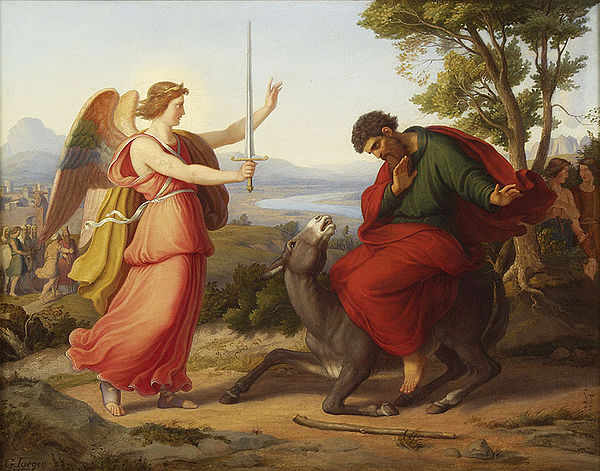
In a comic turn of events, God sent an angel to block the way. But this “seer” (a word that literally means “one who sees”) could not see the angel. Yet the donkey upon which Balaam rode was able see the angel! And, seeing the angel, the donkey stubbornly refused to proceed.
When the frustrated Balaam began to beat the animal, comic paradoxes ensued. Balaam, a prophet who supposedly spoke for God, was now spoken to by God through his donkey! The donkey rebuked Balaam: What have I done to you that you should beat me these three times? Am I not your own beast, and have you not always ridden upon me until now? Have I been in the habit of treating you this way before? (Num 22:30). Not only was the donkey more reasonable than Balaam, not only did he rebuke him rightly, but he even seemed to psychoanalyze him! It is rich in comedy and dripping in paradox.
Finally, the angel of the Lord revealed himself to Balaam. Balaam fell to his knees, admitted he had sinned, and promised to return home immediately. But through the angel, God, who purifies our hearts, bid him to go forward anyway, but with this warning: you may say only what I tell you (Num 22:35).
In this way, God warns every prophet, including you and me, who are prophets through our baptism. As prophets, we are to say only what God tells us to say: what God teaches us through His Scriptures and through the holy teachings of the Church.
Pay attention, fellow prophet—if you won’t speak rightly, God can speak to you through a donkey! But He shouldn’t have to. If you don’t praise Him, the very rocks will cry out. But they shouldn’t have to. Never let it be said that donkeys and rocks are smarter and more useful to God than you are! Yes, God can raise up children for the kingdom from the very rocks (cf Luke 3:8). But He shouldn’t have to.
Upon seeing Balaam, Balak ran to him, relieved. Balak wanted him to go right to work, cursing the Israelites. But Balaam, now properly chastised and having made the journey from a false prophet of false gods to a true prophet of the true God, said this profound, yet simple, thing to the powerful king: But what power have I to say anything? I can speak only what God puts in my mouth … I will tell you whatever he lets me see (Num 22:38; 23:3).
Still confident that Balaam would curse the Israelites, Balak ordered many rituals and sacrifices. Then, perhaps presuming Balaam would give way to greed and accept the bribe, or give way to fear, Balak orders him to utter the cursing oracle.
Yet out of Balaam’s mouth came not a curse but resounding blessings on Israel! Enraged, King Balak ordered a new and “correct” oracle that would send curses on Israel. Again from Balaam’s mouth proceeded only another even more powerful blessing that foretold of Israel’s eventual triumph over its enemies, including Moab!
Then Balak ordered a third oracle, and then a fourth. But the result was always the same: a profound blessing rather than a curse. Only the words of the true God could come forth from Balaam’s mouth!
Yes, Balaam’s transformation was at its peak; he was now a true prophet of the true God. Balaam gave perhaps the most profound declaration that any prophet has ever given. To a king who promised him riches and favor, and could also destroy him, Balaam would only declare, I can speak only what God puts into my mouth.
Pay attention, fellow prophet by baptism—is it true that nothing can come forth from your mouth except what God has put there? Really?
So here was Balaam at his zenith, at the time he was most conformed to God! He uttered blessings that were critical to Israel as she prepared to enter the Promised Land. It is astonishing that God would use a pagan “prophet” to utter His blessings. But I suppose that if God can use a donkey, he can use Balaam—he can even use me.
After this, mighty and steep was Balaam’s fall from grace and away from his duty to speak only that which God told him to speak. His crime is not explicitly recorded in Numbers, but it is described elsewhere. It is Jesus Himself who best summarized what Balaam did. He mentioned it in his rebuke of the Church at Pergamum:
Nevertheless, I have a few things against you: There are some among you who hold to the teaching of Balaam, who taught Balak to entice the Israelites to sin so that they ate food sacrificed to idols and committed sexual immorality (Rev 2:14).
And so it would seem that although Balaam would not curse Israel, he encouraged Balak to insinuate Moabite women into Israel in order to seduce the men there to false worship and fornication. Since he could not weaken them from without, perhaps Balak could weaken them from within, or so Balaam taught and advised.
The result was a grave falling away from the faith such that 24,000 men were killed to purge the evil within Israel (cf Num 25).
Why did Balaam do it? It is not clear. One text from the New Testament suggests it was greed:
With eyes full of adultery, [these wicked men] never stop sinning; they seduce the unstable; they are experts in greed—an accursed brood! They have left the straight way and wandered off to follow the way of Balaam son of Bezer, who loved the wages of wickedness (2 Peter 2:14-15).
Another text ascribes it to envy:
Woe to them! For they have gone the way of Cain, and for pay they have rushed headlong into the error of Balaam (Jude 1:11).
Whatever the cause, the wound in Israel was deep and never forgotten. When Israel finally conquered the Moabites, they sought out Balaam and executed him. Thus the one who blessed them so profoundly, and who could only obey God, now lay dead; a traitor to his office and an enemy to God’s people. Corruptio optime pessima (the corruption of the best is the worst).
And yet, good reader and fellow prophet, lest we think Balaam’s fate unique to him, we ought to take heed so that we do not fall.
Consider a brief incident in today’s Gospel (Monday of the 3rd week of Advent). It is a classic and memorable exchange between Jesus and some of the religious leaders of his day.
When Jesus had come into the temple area, the chief priests and the elders of the people approached him as he was teaching and said, “By what authority are you doing these things? And who gave you this authority?” Jesus said to them in reply, “I shall ask you one question, and if you answer it for me, then I shall tell you by what authority I do these things. Where was John’s baptism from? Was it of heavenly or of human origin?” They discussed this among themselves and said, “If we say ‘Of heavenly origin,’ he will say to us, ‘Then why did you not believe him?’ But if we say, ‘Of human origin,’ we fear the crowd, for they all regard John as a prophet.” So they said to Jesus in reply, “We do not know.” He himself said to them, “Neither shall I tell you by what authority I do these things” (Matt 21:23-27).
They are such a sad and pathetic lot. Note that Jesus catches them in the classic trap that ensnares all false prophets: preferring their own safety and benefit to the truth that they are bound to proclaim.
See how different they are from Balaam at his best? Balaam stood before a powerful king, who had the power to bless or curse him, and yet feared God more than man and loved the truth more than his own life. Balaam spoke the truth, whatever the cost. For at least that brief moment, Balaam risked everything for the truth that God had revealed.
And lest we scorn these religious leaders who were compromised so easily before Jesus, we ought to know well that this is a very common human struggle. Most of us face a very grave temptation to navigate life in such a way that we avoid trouble, and maximize our blessings and access to money and power. Most human beings are more than willing to compromise the truth—even wholly set it aside—in order to take this path.
It is a great human struggle to avoid deciding that the truth just “costs too much.”
Pray for bishops, priests, and deacons, who have the first obligation to speak God’s truth. Too easily we seek to avoid difficulties and maximize personal blessings at the cost of compromising the gospel message. Too easily we avoid controversy, challenging texts, and confronting sin. Too easily we fear man more than God, for whom we should speak.
Pray, too, for parents and family leaders, who often do these same things, sometimes by silence, sometimes by tolerating sinful and bad behavior, sometimes by teaching that which is popular but contrary to God’s will.
Yes, too often all of us seek to navigate life in such a way as to avoid trouble and maximize blessings or access. But in doing so we are scorning the prophetic office to which we have been called by baptism.
Thanks be to God for those who have spoken the truth to us whatever the cost. For indeed many suffered in order to hand on the Faith to us. Some even made the ultimate sacrifice to summon us to the repentance that we did not, and often do not, want to hear.
Yes, you and I are to be willing to suffer and to preach the truth, whatever the cost.
The tragic story of Balaam reminds us that we must keep constant vigil over our weak and fearful nature. For even if at one moment we stand strong in the face of evil and proclaim the truth, too easily in the next do we fall back into fear and compromise.
It is not clear what led Balaam back into the darkness, but let that be a warning to us. For in any number of ways we, too, can be compromised. Our only refuge can be to beg God for His grace and mercy: Lord make me strong and keep me strong. Give me courage and keep me courageous. Let my zeal be for your whole law and not just part of it. Let there be no openings that divide or compromise my heart, or my zeal for you and your kingdom.

 Though I wrote last week of holy silence, something urges me (a man of many words) to write of it again. During Mass today, the words of Zechariah came to my mind: