Most pastors and confessors are aware that in any parish there are going to be a few who are scrupulous, even in times like these. Some have a mild scrupulosity that is almost admirable. A sensitive conscience is a beautiful thing and bespeaks a kind of innocence that is rare today.
Others have a more unhealthy form of scrupulosity, rooted too much in cringing fear of a God who is seen more as a punishing adversary than a delivering Father who wants to help us to overcome our sin.
But saddest of all are the large number of people who have very little compunction for their sins. Most Catholics have lived for so long in a culture that dismisses, excuses, or even makes light of sin that they have very little notion of its seriousness. That God had to send His only Son to die in order save us from our sins shows just how serious they are; weeping for our sins is not some extreme reaction.
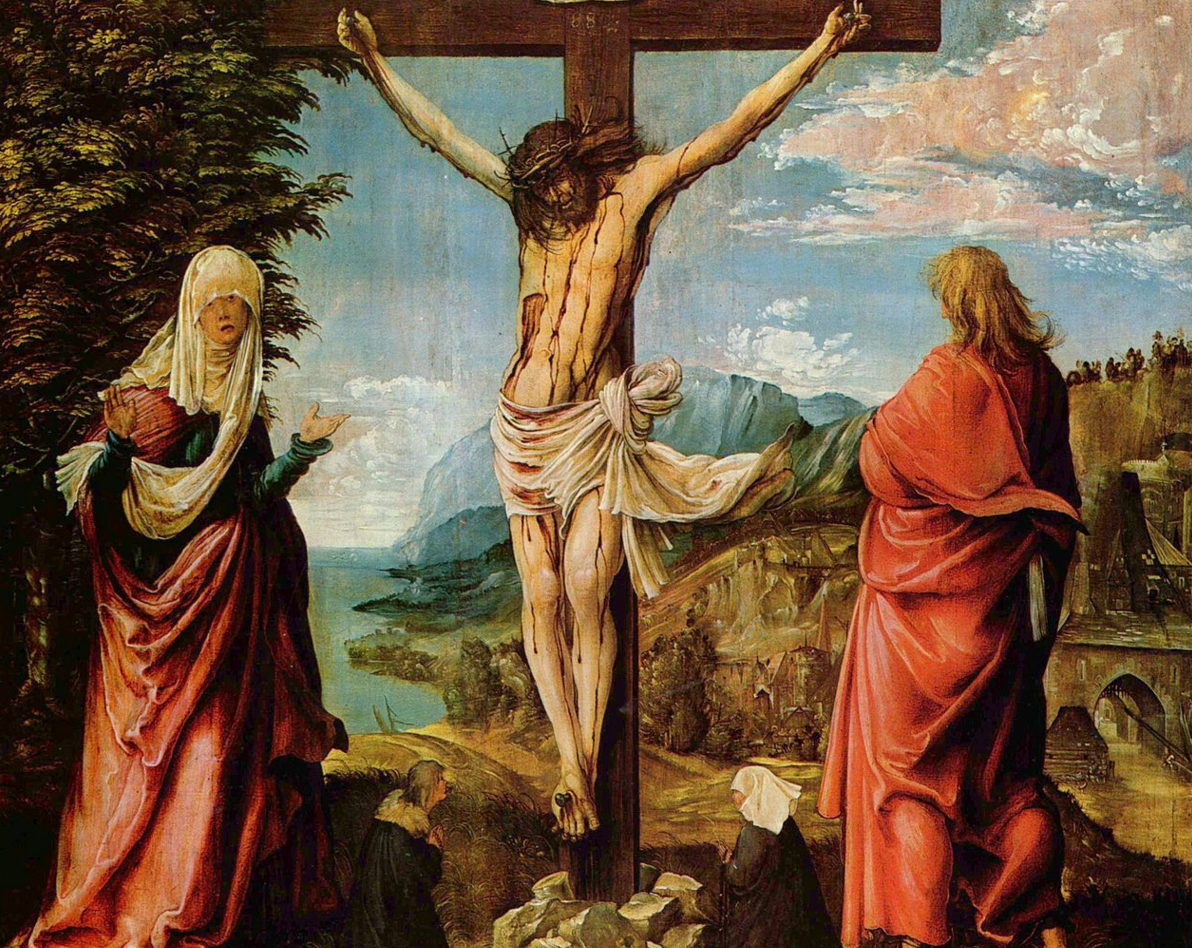
Indeed, a worthy Lenten practice is going to the foot of the Cross and allowing the Lord to anoint us, so that we see both how serious our sins are and at the same time how deep His love for us is. When we finally start to realize that the Son of God died for us, our heart breaks open, light pours in, and we can begin to weep for our sins and in gratitude for His love.
Consider that Jesus looked at a paralyzed man and, seeming not to notice his paralysis, said to him, “Courage, son, your sins are forgiven” (Mat 9:2). In a sense, He saw the man’s sins as more serious than his paralysis. Jesus also said,
I tell you that anyone who looks at a woman lustfully has already committed adultery with her in his heart. If your right eye causes you to stumble, gouge it out and throw it away. It is better for you to lose one part of your body than for your whole body to be thrown into hell. And if your right hand causes you to stumble, cut it off and throw it away. It is better for you to lose one part of your body than for your whole body to go into hell (Matt 5:28-30).
Now the Lord does not mean that we should literally gouge out our eyes or cut off appendages. What He is saying is that it is more serious to sin (in this case through lust) than to lose an eye, hand, or foot.
We don’t usually think this way but we should. Sin is much more serious than most of us imagine; in fact it is our most serious problem. It is more serious than poor physical heath or lack of money. Sin is our most serious problem and whatever is in second place isn’t even close.
In times like these, when self-esteem is overemphasized, personal responsibility is minimized, and excuses abound, we do well to ask for the gift of tears. We do well to ask for a profound and healthy grief for our sins.
More than ever, this is a gift to be sought. Note that these tears are not meant to be tears of depression, discouragement, or self-loathing. The tears to be sought here are tears of what St. Paul calls “godly sorrow.” Godly sorrow causes us to have sorrow for our sins but in such a way that it draws us to God and to great love, gratitude, and appreciation for His mercy. St. Paul writes,
Even if I caused you sorrow by my letter, I do not regret it. Though I did regret it—I see that my letter hurt you, but only for a little while—yet now I am happy, not because you were made sorry, but because your sorrow led you to repentance. For you became sorrowful as God intended and so were not harmed in any way by us. Godly sorrow brings repentance that leads to salvation and leaves no regret, but worldly sorrow brings death. See what this godly sorrow has produced in you: what earnestness, what eagerness to clear yourselves, what indignation [at sin], what alarm, what longing, what concern, what readiness to see justice done (2 Cor 7:8-11).
With all this in mind, consider that in the current (2011) Roman Missal there is a beautiful “Mass for the Forgiveness of Sins (B).” In the old Roman Missal (1962) it is called the Missa ad Petendam Compunctionem Cordis (Mass Requesting Compunction of Heart). It is known more colloquially as the “Mass for the Gift of Tears.”
Consider these beautiful prayers from the Roman Missal (both the 1962 and 2011 versions). I post here the English translation from the 2011 version:
Collect:
Almighty and most gentle God,
who brought forth from the rock
a fountain of living water for your thirsty people,
bring forth we pray,
from the hardness of our heart, tears of sorrow,
that we may lament our sins
and merit forgiveness from your mercy.
Through our Lord Jesus Christ your Son,
who lives and reigns with you
in the unity of the Holy Spirit,
one God forever and ever.
Prayer over the gifts:
Look mercifully, O Lord, upon this oblation,
which we offer to your majesty, for our sins,
and grant, we pray, that the sacrifice
from which forgiveness springs forth for the human race,
may bestow on us the grace of the Holy Spirit,
to shed tears for our offenses.
Through Christ our Lord.
Prayer after Communion:
May the reverent reception of your Sacrament O Lord,
Lead us to wash away the stains of our sins
with sighs and tears, and in your generosity
grant that the pardon we seek may have its effect on us.
Through Christ our Lord.
So beautiful, scriptural, and spiritual! Pray these prayers. Ask your priest to celebrate this votive Mass often. We need the gift of tears today.
Here is the Lacrimosa from the Mozart Requiem. The text says, “Day of tears that day when from the ashes man arises and goes to his judge. Spare O God then, O sweet Jesus, Grant them eternal rest.”
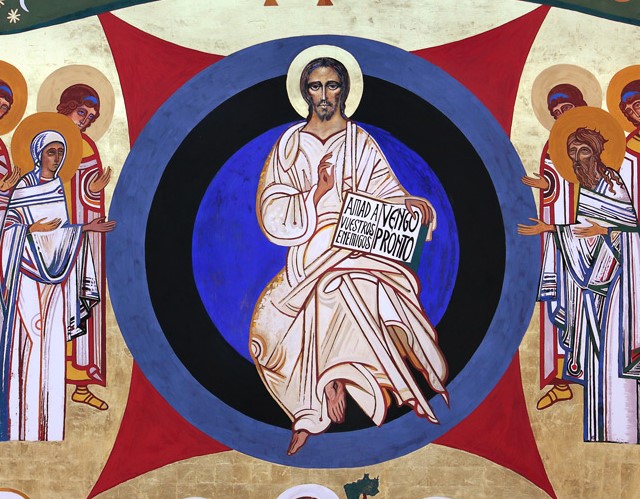
There is a specific depiction of Christ known as Christ Pantocrator. It was widespread in the ancient world and still is today. The title “Pantocrator” is most often translated into English as “The Almighty One” or “The Omnipotent One.” It comes from the Greek words παντός (pantos, meaning all) and κράτος (kratos, meaning strength, might, or power).
In the particular image at right, Christ is seated (as a sign of authority). In many of the specific images he holds a book, sometimes open and sometimes closed. If the book is open, there can be a few of many different texts displayed. In some of the images there is an interesting juxtaposition of texts meant to provoke thought and lead to both catechesis and repentance.
Among the more interesting and provocative juxtapositions of texts is the one commonly used in the Neocatechumenal communities (see above right). On the left-hand page of the open book is the Scripture passage in which Jesus says, “Love your enemies” (Matt 5:44), and on the right is the one in which Jesus says, “I am coming soon” (Rev. 22:7).
Provocative indeed, and a sober call repentance! It is hard to see how we could hope to enter Heaven with hatred or vengeful anger for our enemies in our heart. With that eating at our heart it wouldn’t be Heaven! Therefore we should consider our final end and beg for the grace to love our enemies by praying for them, working for their conversion, and supplying their basic human needs (cf Rom 12:20; Prov. 25:21). Our goal is to be at one with them in Heaven, and even here in this life if it be possible and rooted in the truth.
Jesus sets apart the love of one’s enemies as the “acid test” for Christians:
Love your enemies and pray for those who persecute you, so that you may be sons of your Father who is in heaven. For he makes his sun rise on the evil and on the good, and sends rain on the just and on the unjust. For if you love those who love you, what reward do you have? Do not even the tax collectors do the same? And if you greet only your brothers, what more are you doing than others? Do not even the Gentiles do the same? You therefore must be perfect, as your heavenly Father is perfect (Matt 5:44-48).
There’s nothing like a passage such as this one to get us on our knees asking for grace and mercy! Indeed, we will surely fail if we seek to love our enemies only through the power of our own flesh or from our fallen nature.
Jesus is coming soon and He will look for this fruit in us. All the more reason, then, to ask it of Him:
Good Jesus, who alone can save me from my hard heart, grant me the grace to love my enemies and pray for those that persecute me. I am weak and too self-centered and thin-skinned to do it on my own. I consent, good and merciful Jesus, to this work of yours in me. Accomplish this, Lord, by your grace!
There was a discussion a few years ago on my Facebook page about Church music. My parish, Holy Comforter-St. Cyprian in Washington, D.C., was featured on EWTN’s nightly news (see video below); the discussion centered on that report.
Among the many forms of music we use here at my parish, gospel music is predominant at our 11:00 AM Mass. While many of the comments on the Facebook page were encouraging and supportive of this music, there were still a significant minority that spoke of gospel music as being inappropriate for Catholic liturgy and of it not being sacred. Chant, polyphony, and traditional hymns were held up as sacred, while gospel and some modern forms of music were labeled “not sacred,” and/or inappropriate for Catholic worship.
While everyone is certainly entitled to his personal preferences, is there really a definitive answer to the question, what is sacred music and how is it that some forms have come to be more widely regarded as sacred than others?
The answer to this question is a little more complex than most people realize. With the exception of chant, almost every form of music that is today regarded as sacred initially had a stormy reception in the Church before being admitted to the ranks of music commonly called “sacred.”
That music is controversial in the Church is nothing new, as we shall see in this modest survey that I make of the history of music in Catholic liturgy. Some of my sources are listed at the end of this post, but it is really the product of many years of reading and studying.
On some level, I hope to provide some perspective on the claim that is often made today that certain modern forms of music are inadmissible because they are not “sacred.” In no way do I intend to approve of all forms of modern music nor to encourage the admission of all of them into the liturgy. But it is worth appreciating that the definition of “sacred music” has changed over time. New forms have been admitted— sometimes reluctantly—to the exalted class we refer to as “sacred music.”
Here, then, is a brief look at the history of Church music in terms of what has been considered sacred and what has not.
I. The early, pre-Constantine period: Chant reigns supreme – While little if any music survives in written form from the earliest days of the Church, it seems clear (as Johannes Quasten records) that the leaders of the early Church (the Fathers and bishops) preferred monophonic music. This seems largely due to the association of harmony with the excesses of the pagan world and pagan worship.
Frankly, there was in the early Church a very persistent theme that music itself was problematic. Many ancient bishops and Fathers of the Church barely tolerated it, sought to limit its influence, and/or were deeply suspicious of any singing at all.
In his essay “On the Theological Basis of Church Music,” Cardinal Ratzinger; drawing from sources such as Pope Gregory the Great, St. Jerome, Gratian, and even as recent as St. Thomas Aquinas; describes the rather negative opinion in the early Church of any music involving instruments, harmony, or anything deemed “theatrical.” He writes,
Instrumental music, understood as a Judaizing element, simply disappeared from the early liturgy without any discussion; the instrumental music of the Jewish temple is dismissed as a mere concession to the hardness of heart and sensuality of the people at that time. What the Old Testament said about music and worship could no longer be applied directly, it had to be read by them allegorically, it had to be spiritualized (Ratzinger, “On the Theological Basis of Church Music,” quoted from Collected Works Vol XI, pp 425-432).
Summarizing the views he had received from the earlier Church, St. Thomas writes, “In the praise of God, the Church does not employ musical instruments … lest she appear to be falling back into Jewish ways” (Summa Theologica II, IIae, q. 91 a 2 ad 3).
Cardinal Ratzinger continues,
Analyzing the texts, not infrequent in the Fathers, which are critical of music or even openly hostile to it, one can clearly identify two constant and governing factors:
A. In the first place there is the one-sidedly “spiritual” understanding of the relationship between the Old and New Testaments … [So] Christian liturgy … took on a more or less Puritan form. … The idea that God can only really be praised in the heart means that no status can be accorded to music … In Christian worship … music must be relegated to a secondary level. Augustine is a splendid example of this. His sensitivity to music causes him much torment because his mind is dominated by a spiritualizing theology that ascribes the senses to the Old Testament, the old world; he is afraid of “sinning grievously” when he is “moved more by the music then by the reality to which the singing refers” … and would prefer “not to hear singing at all.” Fortunately his rigorism is dampened when he recalls the profound stirring his soul experienced when he first heard Church music in Milan. [He thus adopted a view of music later stated by St. Thomas, which held that among the reasons for Church music was that] “Thus the minds of the weak be more effectively summoned to piety.”
B. The second group of ideas that stood in the way of a positive the valuation of Church music … is put in a nutshell in Thomas’ fundamental article on the praise of God, where he says that vocal worship is necessary, not for God’s sake, but for the sake of the worshiper (Ibid).
Cardinal Ratzinger argues in the essay that this tended to lead to a utilitarian view of Church music as necessary to some degree, but somehow less than ideal. He reflects that this created a barrier to any satisfactory theology, not only of Church music, but of all prayer whatsoever.
He also adds (in a later essay) another reason for the restrictive notions about music in the early Church:
To the extent that it distanced itself from the Semitic world, the development of Christological art songs [also] threatened more and more to turn into an acute Hellenization of Christianity … The fascination of Greek music and Greek thinking [now excluded] … so that the new music rapidly became the domain of Gnosticism … For this reason [too] the Church immediately and rigorously rejected the poetical and musical innovation and reduced Church music to the psalter … This limitation of liturgical singing which gradually began asserting itself from the second century … led to a forbiddance of private song compositions and noncanonical writings in liturgical services. The singing of the psalms also came to be restricted to the choir whereas others “should not sing in church” (See canon 59 of the Synod of Laodicea 364 AD) (Ratzinger, Ibid, p. 505).
Thus music in general, given its Semitic and pagan associations, was widely resisted in the early Church and tolerated only in limited ways. Music with any harmony was altogether excluded and would not reappear until the Late Middle Ages.
Another reason that the early Church seems to have favored non-harmonic singing was somewhat rooted in the cosmology of the time, wherein there was an emphasis on the unity of all things. Whatever diversity was discovered was viewed as coming from the one hand of God. Monophonic music seemed to better express this unity, at least to the ancient Christian mind.
This cosmology of unity still finds its expression in the way that most Prefaces in the Mass are ended. The Latin text speaks of the multitude of the choirs of angels, joining with the voices of the many saints (cum Angelis, et archangelis, cum Thronis, et Domininationes … et òmnibus Sanctis). And yet despite the vast multitude of voices, at the end of the preface it says that they all sing “as with one voice saying” (una voce dicentes), “Holy, Holy, Holy, Lord God of hosts.”
And so at the earliest stage, sacredness was associated with what we today call chant. To the ancient Church, harmony was widely considered to be secular, even pagan.
II. The Church after Persecution: Chant develops – The earliest chants were quite simple and largely syllabic (one note per syllable); there were few elaborations. However, after the Edict of Constantine (321 A.D.) as the Church came out of a more hidden worship, the use of large, cavernous buildings started to influence the singing. Cantors began to elaborate on the chant, making full use of the echoes in the larger, basilica-like buildings. Vocals became increasingly melismatic (multiple notes per syllable) rather than syllabic, especially during festival seasons. Syllables (such as those in the word “Alleluia”) began to be extended longer with more and more notes.
Singers also “yielded to the spirit,” and the long melismata became a kind of ecstatic “singing in tongues.” Though at first any elaboration was resisted, certain chants did begin to develop in some areas. As these melodies became increasingly complex, they were written down and collected by Pope St. Gregory (among others), hence the modern name, “Gregorian chant.”
As these chants became more and more elaborate, their sacredness was only gradually conceded. In fact they became so complicated that the faithful in the congregation, who were already being discouraged from singing at all, had great difficulty joining in most of the chants. For this reason, special choirs called scholas were formed.
III. The High Middle Ages: Harmony enters – The next major development in Church music took place during the High Middle Ages, generally speaking in the 13th century. The first developments of harmony occurred in the musical schools in France, particularly around Paris. It was here that we saw the first widespread introduction of harmony into Church music.
Several factors influenced the introduction of harmony. First, there was the reintroduction of Greek philosophy and some of its views back into the Western world through scholasticism.
Among the Greek notions there was a cosmology that spoke of the planets orbiting the sun in perfect circles, each of them ringing out a different tone and creating a beautiful celestial harmony in the heavens as they did so. This was the “music of the spheres” and the idea of a great and beautiful harmonic sound in the heavens. Thus the association of harmony with the sacred began to seem more plausible in the minds of Christians.
The first experimentation with harmony seems to have been singing the Gregorian melodies and adding a hollow harmony of a fourth or fifth. Sometimes this involved several singers singing the words in those harmonies. Other times the harmonizers simply “droned” in the background, somewhat like bagpipe drones.
Architecture was another factor that influenced the harmonies. The soaring new cathedrals with their vaulted ceilings that began to dot the landscape of Western Europe seemed to demand more soaring music. These cathedrals were the skyscrapers of their day.
As harmony began to sound more pleasing to the ears, scholars worked to study it using, of all things, the Pythagorean Theorem to mathematically set forth the harmonic scale. Thus mathematics and music came together to quantify a kind of music theory. Gradually, as the years just prior to the 16th century ticked by, we came to have what we know of today as the 12-tone scale.
The introduction of harmony (as with most things musical) in the Church was not always without controversy. Some thought that it made the words harder to understand, a complaint that would plague polyphonic music in its early stages.
Nevertheless, as a general rule, the new harmonies from the Paris school swept through Europe to widespread acclaim. People flocked to the cathedrals to hear this splendid new music.
IV. Late Middle Ages to Renaissance: Musical revolution and growing crisis for polyphony – It is hard to describe what took place in music from the late 1300s to 1500 as anything less than revolutionary. The modern harmonic scale as we now know it came into full realization. Harmony went from two-part, to three-part, and then to four and more parts, amazing listeners everywhere.
The incredible development of music during this period paralleled the remarkable developments in painting: increasing use of shadow, light, perspective, and depth. By the early 1500s, Renaissance polyphony was in all of its glory. Composers such as Isaac, Lassus, Palestrina, Victoria, Tallis, and Byrd brought this art form to an amazing richness.
But the music was not without controversy. There were two main problems with this new style called polyphony.
The first problem was the intelligibility of the text. With multiple harmonies being sung, the Latin text, often staggered across many parts and voices, became harder and harder to understand. Clergy in particular complained of this, arguing that the sacred text was taking a backseat to musical flourishes. In addition, the “theatrical showiness” seemed secular to many.
The second troubling issue was that many of the composers of the day drew from secular melodies that were often heard in taverns, in theaters, and on the streets. They would often take these recognizable melodies and set them as a cantus firmus (musical theme or foundation) of sacred compositions, including the parts of the Mass.
Heinrich Isaac, as early as the 1400s in his Missa Carminum, drew from many of these tavern songs. But perhaps the most egregious example of this, and something that almost caused polyphony to be banned completely from the Catholic Church, was a Mass composed by Orlande de Lassus.
The Mass in question was his Missa Entre Vous Filles. The main melody of both the Kyrie and the Gloria came from a secular piece by the French composer Jacob Clemens non Papa, the words of which bordered on the pornographic. As the Mass grew widely popular (for it is a lovely melody), Church authorities discovered its source and a great uproar ensued.
This controversy took place during the years of the Council of Trent, and though some scholars are dubious of all the details, it is reported that there were Council Fathers who were serious about seeing that sacred polyphony was forever banned from the Catholic liturgy.
Among those who came to the rescue, I am happy to report, was my patron saint, St. Charles Borromeo. He assembled some increasingly dubious bishops and cardinals who were attending the sessions of the Council of Trent so that they could hear the Pope Marcellus Mass by Palestrina. This particular Mass seems to have been specifically composed to address some of the critiques about the intelligibility of the text and the secular origins of many melodies. The presentation calmed some of the fears regarding this new music and the crisis largely passed.
This incident demonstrates that what many today consider a very sacred sound (namely Renaissance polyphony) was quite controversial in its day. It was only thought of as sacred in a widespread way later on. After surviving this first crisis, polyphony became less “florid” and gave greater emphasis to the intelligibility of the text. Secular melodies were also excluded. For these reasons, later works by Palestrina are more austere than those from his earlier period.
Thus we see how the definition of what makes for sacred music had already passed through two major periods. In the first, harmonies were considered too secular; in the second, harmony was introduced but only slowly accepted as sacred in nature.
V. The Renaissance to the Baroque: New controversies, old problems – In the period of the middle Renaissance a new cosmology began to replace the idea that the planets revolved around the sun in perfect circles. Astronomy started to reveal that most of the planets revolved around the sun in elliptical orbits, some of them quite elongated. The notion of the circular orbits of the planets, symbolized by the “music of the spheres” and imitated by Renaissance polyphony, began to give way to the understanding of the mathematical progression of elliptical orbits—a kind of Bach fugue in the sky. This change in cosmology helped to usher in the rather more elaborate, yet mathematical, music of the Baroque period.
In this period we find the wonderful and mathematically precise music of Bach, Vivaldi, Handel, Mozart, Gabrieli, Schubert, Scarlatti, and many others. Perhaps the fugue best exemplifies the kind of mathematical cosmology of the time. In a fugue, mastered by Bach but not wholly unique to him, a musical theme is set forth. For example, quarter notes may announce the theme of the fugue. This theme is then repeated in the left hand and then in the feet (of the organist). It also progresses mathematically: into eighth notes, then into sixteenth and even 32nd notes. Math meets music! Other musical forms like canons emerged similarly. Symphonies also grew to have movements, which were often named for their tempo (e.g., allegro, adagio, presto).
The classical and baroque periods brought the great orchestral or “Classical” Masses, by composers such as Mozart, Schubert, Scarlatti, and many others. Even Bach and Beethoven set the Catholic Mass in great symphonic and orchestral renderings.
Much controversy accompanied these newer forms. Once again, the principle concerns was the intelligibility of the text. Another concern was the length of many of these Masses; in some, the Glorias and Credos could go on for twenty minutes or more.
Some complained that these musical settings of the Mass made it sound more like being at the opera than Church. Indeed, they often broke the sacred text into movements sprinkled with soprano or tenor solos and duets, grand choral sections, and often with a full symphonic accompaniment. It was quite a feast for the ears! These Masses were generally so elaborate that they could only be performed in the larger, well-endowed, city churches.
The controversy concerning these kinds of Masses continued for many years. Even as liturgical reforms began in the early 1900s, Pope Pius X frowned on their usage, referring to these orchestral Masses as “theatrical” (see Tra Le Sollecitudini # 6). This led to a de facto banishing of the form from the Catholic liturgy at that time. Only after the Second Vatican Council was this form rehabilitated in a small way.
Here, too, we see that what many Catholics today consider unquestionably sacred (e.g., a great Mozart Mass) had to survive much controversy and even a kind of banishment. What is thought of as sacred today has not always enjoyed that rarefied distinction!
VI. The Modern Era: New musical forms, new controversies – This leads us to the modern era. As we have seen, those who think that debates about what constitutes sacred music are new are sadly mistaken. These disputes have been quite a consist part of Church life almost from the beginning. To simply place them at the feet of the Second Vatican Council is to lack historical perspective.
It is true that two documents of the Second Vatican Council (Musicam Sacram and Sacrosanctum Concilium) opened the door to newer forms with a greater freedom toward inculturation (e.g., MS # 18, 63), but they also reasserted the special accord to be given to chant (# 50a), polyphony, and the pipe organ (# 4a).
Although debate continues about newer forms of music and whether or not they are sacred, such tensions have long existed. Some newer forms have already been tried and found wanting (e.g., Polka Masses). Other forms such as “folk” or contemporary music, with adaptions over time, have remained.
Finally, let me say a few things about gospel music, the debate about which occasioned this rather lengthy post.
Simply stating that gospel music is not sacred or that it is inappropriate for Catholic liturgy does not make it true. As we have seen, the judgment about what is sacred often takes time to be worked out. The notion of what sounds or seems sacred also changes; there are forms that were once considered improper that have since been admitted to the ranks of the sacred.
Gospel music, unlike many other modern forms (e.g., polka, mariachi), has sacred roots. It emerged from the spirituals and hymns of the antebellum period and the early 20th century. And while gospel music is not strictly Catholic in origin, that fact does not disallow it per se from Catholic liturgy.
One virtue of gospel music is its focus on God. Too many contemporary “worship songs” speak more of us and the “gathered community” than of God. Not so gospel, which is centered almost entirely on God.
Like almost any form of music, gospel can have its excesses, but this does not mean that the whole form is flawed—only that certain rational limits should be observed. This was the case with early polyphony and the Classical Masses, and it is also true of gospel.
Many complain that gospel looks too “performed.” Generally, however, most “outsiders” confuse the exuberance of the congregation and the singers with performance. Clapping is also not for the performer per se but is directed to God and is in gratitude for this manifestation of the Spirit.
If one does not “prefer” or even like gospel music, he is free to stay away from it. But mere preference or taste does not mean that gospel is intrinsically lacking in sacred qualities. Similar things can be said about the use of hymnody. To my mind, the use of metrical hymnody is a good way to once again engage the faithful in the singing of sacred texts in ways that are melodic, memorable, appropriate, and easily learned. But for others, the Protestant origins of this form and most of its repertoire are a sticking point. Over the years, many of these hymns have found a solid place in Catholic liturgy.
Summation: Historically, no form of music currently considered sacred achieved that status without controversy. Indeed, music itself was controversial in the early Church and was barely tolerated by many of the Church Fathers. Time ultimately proves where wisdom lies and ultimately mediates for us what is sacred in a way that transcends mere passing tastes or preferences. Music has made several revolutionary leaps during the age of the Church. Provided necessary rational limits are applied, there is no need to rush to exclude every newer form. If we were to do so, only chant would exist in the Church and we would be deprived of a great treasury of music from the era of polyphony and the classical period.
In saying this I do not mean to indicate that all music is just fine, or that all modern forms are here to stay, or that newer forms should be unquestioned. It is clear that some forms are wholly inimical to the Sacred Liturgy. Rather, I seek to remind people that what we call “sacred music” is historically quite complex. It is the result of long and vigorous discussions, refinements, and other factors as diverse as cosmology, architecture, mathematics, and culture.
We do well to let some of the conversations and controversies work themselves out, lest in too quickly ending them by judicial fiat we impoverish ourselves and block what might bless others and even our very selves.
These are just a few of my sources for the above article:
In the Gospel of the Samaritan Woman from this past Sunday that was read in some parishes, Jesus gives an important teaching on sowing seeds and reaping harvests. The teaching has special importance for us who live in a modern, technological age that is so insistent on instant results. So easily we become resentful and discouraged when our efforts not yield quick fruits or when solutions take time.
We often take these attitudes with our spiritual life as well. Perhaps we think our progress is too slow. Perhaps we are frustrated because we have prayed for years for someone’s conversion and think that little or nothing has come of it. Yes, too often we fail to remember that there is a delay between the sowing of the seed and the reaping of the harvest. Indeed, there are usually many months that pass between them.
In our technological, instant-update, instant-download, Internet-infused culture we have lost the patient insight of the farmer. Thus, we do well to listen carefully to what Jesus teaches us about sowing and reaping.
This particular teaching comes after an interaction that Jesus has with a Samaritan woman at a well. Having had her desires clarified and having been called to conversion by Jesus, she has begun to experience the living waters that result from the dialogue and the journey she has made with Him. She leaves her water jar and runs to town joyfully to bring others to the Lord Jesus. Prior to this, Jesus’ disciples had gone into town to buy food. While Jesus was still speaking to the woman, though, the disciples return and are puzzled because it was quite uncommon for a Jewish man to talk to a Samaritan woman in that modest, segregated culture. After the woman leaves, the disciples say nothing of the encounter but instead urge Jesus to have something to eat. In answer to their concerns about food, Jesus speaks about the harvest, reaping and sowing, and the need to appreciate both aspects of life:
Do you not say, ‘In four months the harvest will be here’? I tell you, look up and see the fields ripe for the harvest (John 4:35).
Thus begins Jesus’ teaching on sowing and reaping. He reminds them of the delay between the sowing of the seed and the reaping of the harvest. And although Jesus is overjoyed to see the quick harvest (the Samaritans walking across the field toward Him), He is quick to remind the disciples of the delay between sowing and reaping.
Yes, Jesus is about to enjoy the harvest. But perhaps His mind also goes back to His many years preparing for ministry, living and working humbly in Nazareth. Perhaps He thinks of His forty days in the desert, or of His many difficult days walking throughout Galilee preaching, calling disciples, and naming apostles. Perhaps He also recalls the months of toil and difficulty, the misunderstandings and hostility of others, the slowness of the apostles to understand, the arduous journey to Samaria, and the long conversation with the Samaritan woman in the heat of the day.
The sowing of the seed was but the beginning. Great labor and time were required for the harvest to be realized.
But now the harvest is here, and how glorious it looks as the Samaritans in their white robes come across the field toward Him!
Jesus goes on to say,
For here the saying is verified that “One sows and another reaps.” I sent you to reap what you have not worked for; others have done the work, and you are sharing the fruits of their work (Jn 4:37-38).
This is another very important lesson about sowing and reaping. We often sow seeds that we ourselves will not be able to reap—others will. Conversely, we sometimes reap the harvests of the seeds that others have sown and tended.
As a priest, I most often walk into buildings that I did not build and minister to congregations that I did not found; others have done this work, and I am grateful for everything I harvest as a result of their hard work. In my last assignment, I built a 5.5 million dollar building for young people. No sooner was the paint dry than I was transferred. Now others are yielding the harvest in that building that I struggled to build. But praise the Lord, it is bearing fruit!
At the rectory, it is not uncommon for the doorbell to ring and for someone I do not know to ask to speak to me. Some years ago, an older man came to the rectory in just that way and told me that his wife of 47 years had recently died. She had always prayed for him to be baptized, but he had always refused. Now that she was dead, somehow he knew it was finally time for him to be baptized. He asked me to prepare him. I joyfully reaped the harvest of seeds I did not sow. His wife had sowed those seeds and watered them with her tears. She did not live to see the harvest in this world, but in fact this was the harvest she had prayed and worked for. Shortly after his baptism, the man died. And now they both enjoy the harvest.
Never give up. Harvests come, but there is time between the sowing of the seeds and the reaping of the harvest. Too many today are easily discouraged by any delay, any separation in time between the sowing and the harvesting. But we must learn to accept this delay; any harvest takes time.
Many also do not like the hard work of planting seeds. They prefer only to reap harvests. But of course life does not work that way. Scripture says, A man will only reap what he sows. Whoever sows sparingly will also reap sparingly, and whoever sows generously will also reap generously (2 Cor 9:6). Scripture also speaks of the difficulty in sowing seeds: Going they went and wept, casting their seeds. But the same verse says this of the harvest: they shall come with joyfulness, carrying their sheaves (Ps 126:6).
In this Gospel, the Lord teaches us not to be discouraged. There is some delay between the sowing of the season and the reaping of the harvest. While Jesus refers to it as a delay of four months, we all know that it is sometimes much longer. The point is that there is some delay. Indeed, we may not even live to see the fruits of some of the seeds we sow. But we must also realize that we often reap the harvests of those before us who did not live to see the fruits of the seeds they sowed.
Scripture says, And let us not be weary in well doing: for in due season we shall reap, if we faint not (Gal 6:9). Another passage says, I planted, Apollos watered, but God gave the growth.So neither he who plants nor he who waters is anything, but only God who gives the growth (1 Cor 3:6-8).
Do your work; leave the harvest to God and the one to whom He assigns it.
This section of the movie The Color Purple is an allegory of the Samaritan woman bringing the townsfolk to see Jesus:
I have written a good bit over the years about what is known as the “Rare Earth” Hypothesis. A recent blog on discovermagazine.com ponders how high the odds are against the existence of another Earth-like planet. More on that in a moment. But first let’s review some of the basics of the Rare Earth Hypothesis.
While most people, including most scientists, believe that there may be billions of inhabitable planets out there a capable of sustaining complex life, the Rare Earth Hypothesis suggests that such a large number is overstated.
This is because there are not just a few things that come together to support life here on Earth, there are many. Here are some:
Earth is at just the right distance from the Sun so that water is warm enough to melt, but not so hot as to boil and steam away into space. Water is also able, in this habitable zone (the so-called “Goldilocks” region), to both evaporate and condense at lower levels in the atmosphere, thus permitting a more even distribution of water, and the cycle of water over dry land known as precipitation.
For suns to spawn Earth-like planets they must have sufficient “metallicity,” which is necessary for the formation of terrestrials rather than gaseous planets.
Earth is in a “habitable zone” within the galaxy as well. Closer to the center of galaxies, radiation and the presence of wandering planetoids make life there unlikely.
Earth exists in a disk-shaped spiral galaxy (the Milky Way) rather than in an elliptical (spheroid) galaxy. Spiral galaxies are thought to be the only type capable of supporting life.
Earth’s orbit around the sun is an almost perfect circle rather than the more common “eccentric” (elongated) ellipse. Steep elliptical orbits take a planet relatively close to and then relatively far from the sun, with great consequences for warmth and light. Earth’s stable, nearly circular orbit around the sun keeps our distance from it relatively constant, and hence the amount heat and light does not vary tremendously.
Two nearby “gas giants” (Jupiter and Saturn) attract and catch many wandering asteroids and comets and generally keep them from hitting Earth. The asteroid belts also keep a lot of flying rock in a stable orbit and away from us.
Our molten core creates a magnetic field that holds the Van Allen radiation belts in place. These belts protect Earth from the most harmful rays of the sun.
Earth’s volcanism plays a role in generating our atmosphere and in cycling rich minerals widely.
Our sun is just the right kind of star, putting out a fairly steady amount of energy. Other types of stars are more variable in their output and this variance can utterly destroy life or cause it to be unsustainable due to the extremes caused.
Earth’s fairly rapid rotation reduces the daily variation in temperature. It also makes photosynthesis viable because there is enough sunlight all over the planet.
Earth’s axis is tilted just enough relative to its orbital plane to allow seasonal variations that help complex life but not so tilted as to make those variations too extreme.
Our moon also has a good effect by causing tides that are just strong enough to permit tidal zones (a great breeding ground for diverse life) but not so severe as to destroy life by extreme tides.
There are many more items on the list (see the first video below), but let these suffice. The conditions that come together on this planet such that it is capable of sustaining complex life are complicated, remarkable, and some argue rare in the universe. The ability to support life here is the balance of many fascinating things. We cannot but be amazed at the complexity of life and the intricacies it takes in order for it to flourish here. It would appear that for complex life to be sustained, many factors must come together in just the right way. The sheer number of these factors sharply decreases the number of possible Earth-like planets, despite the many billions of galaxies and stars.
All this background information leads us back to the recent blog at discovermagazine.com: Earth-is-a-1-in-700 quintillion kind of place. (700 quintillion is 7 followed by 20 zeros). The blog references a study by Astrophysicist Erik Zackrisson from Uppsala University in Sweden.
Here are some excerpts:
Zackrisson’s work suggests an alternative to the commonly held assumption that planets similar to Earth must exist, based on the sheer number of planets out there …. Current estimates hold that there are some 100 billion galaxies in the universe containing about 10^18 stars, or a billion trillion …. Probability seems to dictate that Earth-twins are out there somewhere.
But according to Zackrisson … Earth’s existence presents a mild statistical anomaly in the multiplicity of planets …. Most of the worlds predicted … orbit stars with different compositions—an important factor in determining a planet’s characteristics. His research indicates that, from a purely statistical standpoint, Earth perhaps shouldn’t exist …. Researchers are confident in the broader implications of their model: Earth is more than your garden-variety planet.
I write on this topic more in wonder and awe than anything else. There is no necessary requirement of our faith that we must believe ourselves alone in the whole universe. God can, and even might have, created intelligent beings on other planets, beings with whom He interacts and whom He loves.
But neither should we too quickly assume that Earth is not a rare jewel. Statistically, it would seem that there is good evidence that we and Earth are rare jewels. Humble amazement at all that it takes to sustain life on our planet is a proper stance at this stage of the evidence. The more we learn, the more it seems that the convergence of all the factors we enjoy on Earth is rare rather than commonplace. Consider well all that God and nature, sustained by God, have done so that you and I can exist. Be amazed; be very amazed!
There’s an old Johnny Cash song (God’s Gonna Cut You Down) that is rooted in today’s Gospel:
You can run on for a long time … Sooner or later God’ll cut you down … Go tell that long tongue liar, Go and tell that midnight rider, Tell the rambler, the gambler, the backbiter, Tell ’em that God’s gonna cut ’em down.
These verses go directly to the end point (judgment), but there is more to the story. First there is mercy offered, and then patience; finally in the end there is judgment.
Many today are either dismissive of judgment entirely, or they believe that judgment will result in instant entrance to glory.
Today’s gospel contains a necessary balance. It speaks of God’s patience and care now, but also of the day of reckoning, the Day of Judgment. On that day, our “case” will be adjudicated by God; the decision is final; there is no turning back.
Let’s look at this Gospel in two main parts:
I. The Proclamation of the Problem – The Gospel opens with the following lines:
Some people told Jesus about the Galileans whose blood Pilate had mingled with the blood of their sacrifices. Jesus said to them in reply, “Do you think that because these Galileans suffered in this way they were greater sinners than all other Galileans? By no means! But I tell you, if you do not repent, you will all perish as they did! Or those eighteen people who were killed when the tower at Siloam fell on them—do you think they were more guilty than everyone else who lived in Jerusalem? By no means! But I tell you, if you do not repent, you will all perish as they did!”
What Jesus is saying is that is so easy for us to focus on the sins of others and fail to discern our own need for repentance and mercy. Before God we are all beggars; all of us have sinned and fallen short of the glory of God (cf Romans 3:23). Every one of us is in need of boatloads of grace and mercy. And while we may rightly distinguish that there is a difference here on earth between the sanctity of a Mother Theresa and the wretchedness of a Hitler, before God we all fall far short of His glory and holiness; we are all beggars.
Sin surely does affect the lives of others and we are not asked to be blind to that. It is important to learn from the example of others, both good and bad. The point is to learn! We miss the point if all we do when we see someone suffer the effects of sin is to say, “My, my, God don’t like ugly!” What about the ugly in us? What about our own sin?
And so to our all-too-eager question, “What about them, Lord?” Jesus replies, “What about you? Stay in your own lane; work on your own issues and leave their final fate to me. Punishment doesn’t just come to others; if you don’t watch out it will come to you as well.” And just to make sure we get it the Lord adds, “[And] I tell you, if you do not repent, you will all perish as they did!”
In effect, the Lord tells us to get serious about our sin and about what it can do to us. The most serious problem in life is not the fact that we die or the manner of our death. The most serious problem we face is not Pilate or any political misfortune; it is not falling towers or any physical threat. It is not financial setback, or suffering, or losing our job, or losing our possessions. The most serious problem we face is our sin.
Now we don’t think like this. We minimize the maximum and maximize the minimum. We get all worked up about lesser things while often completely ignoring greater things. We are forever worrying about passing things like health and money, but give little heed to the things of eternity and to getting ready to meet God. Let our physical health be threatened we are instantly on our knees begging God for deliverance. But let our sins pile up and sinful drives be eating at our very soul and we take little notice. We don’t seem to care about being delivered from things that are far more serious than mere cancer.
The Lord says, If your right hand causes you to sin cut it off and throw it away. It is better to lose one of your members than to have your whole body cast into hell (Matt 5:30). Pay attention, the Lord is saying that it is more serious to sin than to lose your right hand!
Again, we don’t think like this. I think that if I were to lose my right hand today I would lament this day for the rest of my life. The very thought of losing my hand gives me stabbing grief. Why don’t we think of our sin this way? Do you see how obtuse we are? Do you see how distorted our priorities are?
One day the Lord looked at a paralyzed man and decided to cure his most serious problem. He said to the quadriplegic, “Your sins are forgiven.” Could the man’s sins have been more serious than his paralysis? Yes!
And thus the Lord warns us that we ought to be more serious about our sins lest we perish, not merely losing our earthly life but our eternal life. The very fact that the solution to our problem required the death of the Son of God indicates that we are evidently in far worse shape than we think. Without our repentance and the magnificent mercy of God, something far worse than having a tower fall on us, or our enemies kill us might happen. Elsewhere in Scripture the Lord says, I tell you, my friends, do not be afraid of those who kill the body and after that can do no more. But I will show you whom you should fear: Fear him who, after the killing of the body, has power to throw you into hell. Yes, I tell you, fear him (Lk 12:4-5). The Lord is not counseling here a cringing and avoidant fear, but rather a respectful fear such that we are serious about judgment day and realize that the result on that day will be eternal, unlike the passing quality of any earthly encounter.
Having portrayed the problem and underscored its seriousness, the Lord then reminds us that He is willing to help us, with His grace and mercy, to get ready. He sets forth a process in which we must cooperate, for the Day of Judgment will surely come. Let’s look at the process.
II. The Portrayal of the Process – The Lord tells a parable that sets forth the process in which we are currently engaged: a process of patience and mercy that leads ultimately to the finality of judgment. Note the following steps:
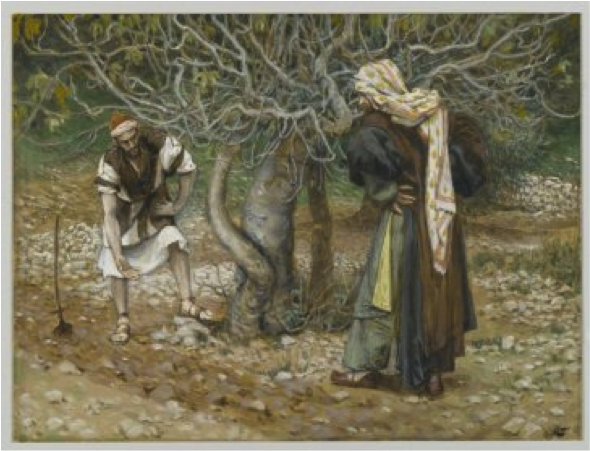
1. ASSESSMENT – There was once a person who had a fig tree planted in his orchard and when he came in search of fruit on it and found none said to the gardener, “For three years now I have come in search of fruit on this tree and have found none. So cut it down. Why should it exhaust the soil?”
Faith is a fruit-bearing tree. It is to bear the fruits of love, justice, and the keeping of the commandments. The Lord looks for these fruits and often, through our conscience and by His Word, assesses if such fruits are present.
Many claim to have faith; they claim to be fruitful in what the Lord seeks. But as owner of the field, it is He who sets the terms. We are not the judge in our own case. It is the Lord’s ongoing work to assess our progress and fruitfulness. He determines whether the necessary fruits are present.
Yet many today claim the right to assess their own status. They make bold proclamations that God would not “dare” to find them to be lacking in anything substantial. In presumption, many declare themselves to be safe, fruitful, and righteous.
But this is not for us to say. In the parable it is the owner, the Lord, who makes the assessment. And note that in this parable he proposes that something significant is lacking.
And yet some interlocutor, here called the gardener but let’s call her the Church, asks for mercy and time. And as we shall see such mercy and time is granted, along with necessary supplies (grace) to help accomplish what is sought, namely the fruit of faith. This leads us to stage two in the process.
2. ASSISTANCE – The text goes on to describe the prayers and requests of the gardener (in this case Mother Church): Sir leave it for this year also. I shall cultivate the ground around it and fertilize it. It may bear fruit in the future.
The Lord, the owner of the garden, not only grants the request but will also be the one to supply the necessary help to draw forth the fruits patiently awaited.
Indeed, the Lord sends us help and graces in so many ways:
He speaks in our conscience. He has written His law in our heart.
He gave us the law.
He sent us prophets.
He punishes our wrongdoings in order to bring us to repentance.
Before I was afflicted I strayed. But now I have kept your word (Ps 119:67).
But God disciplines us for our good, that we may share his holiness. For the moment all discipline seems painful rather than pleasant; later it yields the peaceful fruit of righteousness to those who have been trained by it (Heb 12:10).
He sent us His Son,
Who established the Church,
and gave us grace and the Sacraments.
It was he who gave some to be apostles, some to be prophets, some to be evangelists, and some to be pastors and teachers, to prepare God’s people for works of service, so that the body of Christ may be built up until we all reach unity in the faith and in the knowledge of the Son of God and become mature, attaining to the whole measure of the fullness of Christ. [That we be] no longer be infants, tossed back and forth by the waves, and blown here and there by every wind of teaching and by the cunning and craftiness of men in their deceitful scheming. Instead, speaking the truth in love, in all things grow up into him who is the Head, that is, Christ (Eph 4: 11-17).
Do you see how much God has done for us? He has graced us in every way. He has entrusted to the Church, in answer to her pleas, every necessary grace to bear fruit. And now He patiently awaits. He looks to return again to seek the fruits that are necessary for those who claim to have saving faith, fruits that are necessary to be able to endure the day of His coming, fruits that are necessary for us to have the holiness without which no one will see the Lord (Heb 12:14). Indeed we cannot see or endure His presence without the fruit of holiness by His grace. For as Scripture says, Who may ascend the mountain of the Lord? Or Who may stand in his holy place? Only he who has clean hands and a pure heart (Ps 24:3-4). Only God can accomplish this. But He who made us without us will not save us without us. Thus we must, by His grace, renounce our sin and accept His grace.
3. ACCEPTANCE – The parable ends very simply with this line: If not you can cut it down.
I’ve chosen to use the word “acceptance” carefully. Judgment is not so much God’s decision as it His acceptance of our decision to bear fruit or to refuse to do so; to accept or refuse His offer of the fruits of faith such as chastity, mercy, forgiveness, reconciliation, love of the poor, and appreciation of the truth.
The Day of Judgment amounts to the day on which God accepts our final choice. It is not so much the passing of sentence as it is the final recognition of the absolute choice that we have made. On this day it is no longer possible for us to change. What we are remains fixed forever.
As we get older we notice that it is harder and harder to change. We are like concrete that sets, becoming ever harder. We are like pottery, which begins moist and malleable but whose shape is forever fixed when subjected to the fire.
And thus the Lord teaches us to be serious about sin and about the Day of Judgment. For now there is mercy and every grace available to us (thank you, Jesus!). But there comes a day when our decision is finally accepted and forever fixed.
The Gospel today teaches beautifully of God’s patience, but also of our need for mercy (we are all beggars before God). It warns us that our decision will finally be accepted. Yes, there is a Day of Judgment and it closes in on us all.
Talking about how often we sang Kumbaya My Lord will not suffice.
In today’s second reading, St. Paul warns us against presumption and trying to serve as judge in our own case:
Our ancestors were all under the cloud and all passed through the sea, and all of them were baptized into Moses in the cloud and in the sea. All ate the same spiritual food, and all drank the same spiritual drink, for they drank from a spiritual rock that followed them, and the rock was the Christ. Yet God was not pleased with most of them, for they were struck down in the desert. These things happened as examples for us, so that we might not desire evil things, as they did. Do not grumble as some of them did, and suffered death by the destroyer. These things happened to them as an example, and they have been written down as a warning to us, upon whom the end of the ages has come. Therefore, whoever thinks he is standing secure should take care not to fall (1 Cor 10:1:ff).
For now there is mercy! But there comes a day of ratification, of judgment, a day when the question is asked and the final answer supplied, not so much by God as by us.
“Be careful,” your flesh says, “No worries.” But the Lord says, “Repent!”
Here are more of the lyrics from the Johnny Cash song God’s Gonna Cut You Down:
You can run on for a long time Run on for a long time Run on for a long time Sooner or later God’ll cut you down
Sooner or later God’ll cut you down
Well, you may throw your rock and hide your hand and hide your hand Workin’ in the dark against your fellow man But as sure as God made black and white What’s down in the dark will be brought to the light.
You can run on for a long time Run on for a long time Run on for a long time Sooner or later God’ll cut you down
Sooner or later God’ll cut you down
Go tell that long tongue liar Go and tell that midnight rider Tell the rambler, the gambler,the backbiter Tell ‘em that God’s gonna cut you down Tell ‘em that God’s gonna cut you down Tell ‘em that God’s gonna cut you down
I have often observed that music seems unique to the human soul. Animals appear to be largely unaffected by music other than to respond with fear to a sudden or loud change. I have seen a few birds (e.g., cockatoos) that respond to music that has a heavy beat by synchronizing with it.
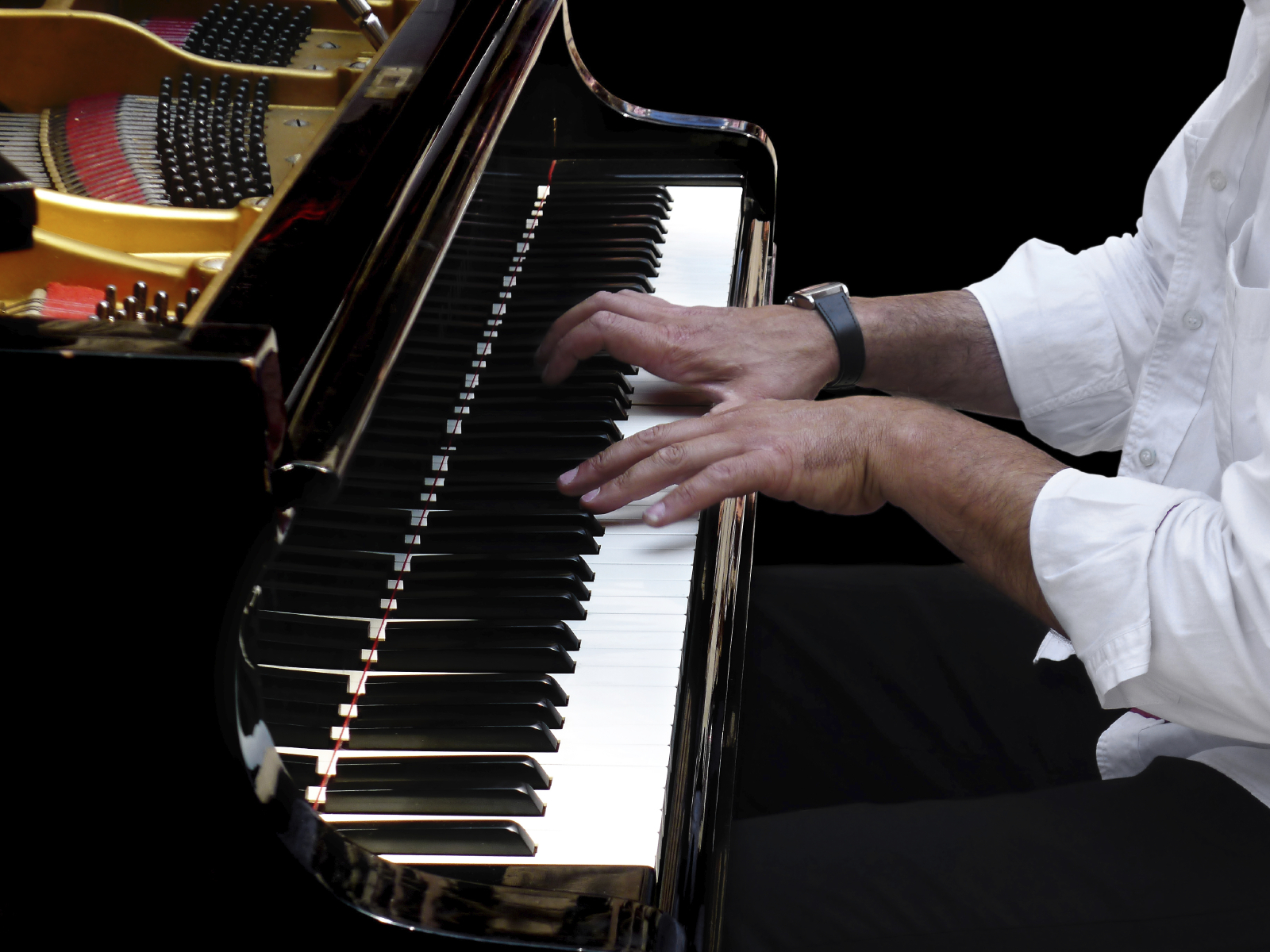
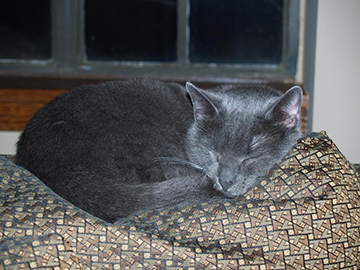
But in general, animals seem quite unmoved and unaffected by music that we humans find moving or inspiring. I can play a particularly stirring piece and my cat, Daniel, just lies there. I can play the most mystical Church polyphony, an exquisite Mozart sonata, or an inspiring choral movement from Handel’s Messiah, and little Daniel still just lies there (see photo at right).
Yes, it seems that although music can stir our physical nature, it requires a rational soul for this to happen. Non-rational beings just don’t “get it.” And even those of us who have rational souls need some training in order to appreciate higher forms of music. I am aware that many people do not appreciate a Bach fugue the way I do. It takes something of a trained ear (a trained mind, really) to relish the mathematical progressions of his magnificent pieces. And it is the same for many other types of music, whether ancient or modern, that exhibit subtlety or specialty.
So it would seem that music, while speaking to many aspects of our person, requires a rational soul, an intellect, to unlock its meaning and beauty. Music is a language of the soul; it is a way for one human soul to reach out to other human souls with a wordless but powerful message.
All that is to say that I enjoyed the commercial below, which features singing sheep. It’s a weird commercial. Of course it’s weird; sheep don’t sing (unless, as the commercial suggests, they’re hiding something from us). It’s using absurdity in order to get our attention. So enjoy it, but let it also remind you that music is a gift of God that is unique to the human person.
One of the strong traditions of Scripture is of the great reversal that will one day come for many. I have been sobered by it when I consider how blessed I have been in this life; I have been consoled by it when I struggle to understand why some people seem to suffer so much more than I or others do.
Life seems a very uneven proposition if we only look at our side of the equation. Only God sees the whole picture. To some extent, though, He has revealed that those who suffer much in this life will be rewarded in the life to come; there will be a great reversal.
The theme of the great reversal is most fully developed in the New Testament where the understanding of the life to come is also most developed.
Consider the following texts:
[Jesus said], “But many who are first will be last, and the last will be first” (Matt 19:30, 20:16; Mark 10:31).
[Mary said], “He has cast down the mighty from their thrones but has lifted up the lowly. The hungry he has filled with good things; but the rich he has sent away empty” (Lk 1:52-53).
Abraham replied [to the rich man], “My child, remember that you received what was good during your lifetime while Lazarus likewise received what was bad; but now he is comforted here, whereas you are tormented” (Luke 16:25).
Blessed are you who are now hungry, for you will be satisfied. Blessed are you who are now weeping, for you will laugh. Blessed are you when people hate you, and when they exclude and insult you, and denounce your name as evil on account of the Son of Man. Rejoice and leap for joy on that day! Behold, your reward will be great in heaven. For their ancestors treated the prophets in the same way. But woe to you who are rich, for you have received your consolation. But woe to you who are filled now, for you will be hungry. Woe to you who laugh now, for you will grieve and weep. Woe to you when all speak well of you, for their ancestors treated the false prophets in this way (Luke 6:21-26).
Much will be required of the person entrusted with much, and still more will be demanded of the person entrusted with more (Luke 12:48).
I consider that the sufferings of this present time are as nothing compared with the glory to be revealed for us (Rom 8:18).
For this momentary light affliction is producing for us an eternal weight of glory beyond all comparison, as we look not to what is seen but to what is unseen; for what is seen is transitory, but what is unseen is eternal (2 Cor 4:17-18).
While less prominent in the Old Testament, the notion of the great reversal is set forth there as well. Here is one example:
The bows of the mighty are broken, while the tottering gird on strength. The well-fed hire themselves out for bread, while the hungry batten on spoil. The barren wife bears seven sons, while the mother of many languishes. The Lord puts to death and gives life; he casts down to the nether world; he raises up again. The Lord makes poor and makes rich, he humbles, he also exalts. He raises the needy from the dust; from the ash heap he lifts up the poor… He will guard the footsteps of his faithful ones, but the wicked shall perish in the darkness. For not by strength does man prevail; the Lord’s foes shall be shattered (1 Sam 2:3-8).
As I have said, I am both challenged and consoled by these texts.
I am consoled because I, like others, have suffered and experienced setbacks in this life. The Lord promises that sufferings and setbacks, if endured with faith, ultimately produce profit, not loss. Much of this profit may wait until Heaven, but sufferings endured with faith are like treasure stored up in Heaven. First comes the cross, but then the crown. Hallelujah!
I am also consoled on behalf of others. I, like you, know people who have suffered far more than seems fair. Loss after loss mounts up, grief after grief. My humanity recoils and I often cry to God on behalf of those who seem to suffer so much more than others. Lost health, lost jobs, lost home, lost family members. Why, O Lord?
I often think of my poor sister who was mentally ill and horribly afflicted by demons and voices that spoke to her, haunted her, and increasingly robbed her of any touch with reality. Ultimately her life ended tragically when she died in a fire. She was surely among the “last” in this life. But she loved God and wanted desperately to get well. The day after she died I offered Mass for her and I heard her speak to me in the depth of my heart. She said, “I’m OK now, Charlie.” And somehow I knew that God was taking care of her, purifying and clearing her mind.
I also knew, because she was among the last, but believed, that I would one day see her among the first in the glory of Heaven (pray God I get there). I suspect that she will be close to the throne and that I, who have been among the first here in this world, will have a “mansion” far less spacious than hers.
I am consoled for my sister’s sake as well as the sake of those who, unlike me, live in great poverty in other parts of the world. The bounty of American living is but a dream to them. Perhaps there is war, or famine, or natural disaster. Perhaps they are victims of despotic and corrupt governments. They are less free, less blessed, under greater stress, and often in desperate need. They are among the “last” in this world. But if they have faith they will be blessed to be among the first in the great reversal that is coming when the Kingdom fully breaks in. Faith is essential. Jesus did not say that all the last shall be first, but rather that many who are last shall be first. I am sure that it is living faith that makes the difference.
But I am also challenged. I am among those who are first. What will happen to me in the great reversal that is coming upon this world? I have good health. I enjoy bountiful blessings. I am more blessed than I deserve. I live in the greatest, richest, and most powerful country in the world. My needs are largely provided for. I sit here in my air-conditioned room with time enough to write and ponder things. I am far beyond mere subsistence. I am surely among the first, the rich. Even the poorest in this country are blessed compared to many others in the world.
Where shall I be when the first trumpet sounds, when the great reversal sets in?
Indeed, not everything is as it appears. We crave wealth, power, and access and call it a blessing. We want to be first. But God warns that this may well be a curse:
Those who want to be rich are falling into temptation and into a trap and into many foolish and harmful desires, which plunge them into ruin and destruction. For the love of money is the root of all evils, and some people in their desire for it have strayed from the faith and have pierced themselves with many pains (1 Tim 6:9-10).
Despite being familiar with this text and other like it, we still want to be rich, on top, first. We are very obtuse!
And so I am challenged. I am not, however, defeated or fatalistic. God has not utterly forsaken the “first.” He has left us a way. He has given us instruction on how to avoid the “curse” of our wealth and good fortune. Simply put, we must use our status as “first” to bless others. Our many gifts should be placed at the service of the human family. A few texts come to mind:
[Jesus said], “I tell you, make friends for yourselves with deceitful wealth, so that when it fails, they [likely the poor whom we befriended] will welcome you into eternal dwellings” (Luke 16:9).
Tell the rich in the present age not to be proud and not to rely on so uncertain a thing as wealth but rather on God, who richly provides us with all things for our enjoyment. Tell them to do good, to be rich in good works, to be generous, ready to share, thus accumulating as treasure a good foundation for the future, so as to win the life that is true life (1 Tim 6:17-19).
And so it is that the Lord instructs us who are “cursed” to be first, to store up our true treasure in Heaven (Matt 6:19). Of course we do not store up our treasure in Heaven by putting it in a balloon or a rocket. Rather, we store it up by generously dispensing it to the poor and needy. Perhaps it is by a simple gift, or by providing jobs and economic opportunity for others. Perhaps it is by sharing our gifts of knowledge, time, or other talents. In so doing, perhaps the curse of being among the first will be overcome and the challenge will be met.
The great reversal is coming! Where will I be when the first trumpet sounds?
This chant of the funeral Mass refers to the great reversal, but prays that the deceased will be found with Lazarus, who once was poor. The text says, In paradisum deducant te Angeli; in tuo adventu suscipiant te martyres, et perducant te in civitatem sanctam Ierusalem. Chorus angelorum te suscipiat, et cum Lazaro quondam paupere æternam habeas requiem. (May the angels lead you to paradise and at your coming may the martyrs receive you and may they lead you into the Holy City Jerusalem. May a choir of angels receive you and with Lazarus, who once was poor, may you have eternal rest.)

 Most pastors and confessors are aware that in any parish there are going to be a few who are scrupulous, even in times like these. Some have a mild scrupulosity that is almost admirable. A sensitive conscience is a beautiful thing and bespeaks a kind of innocence that is rare today.