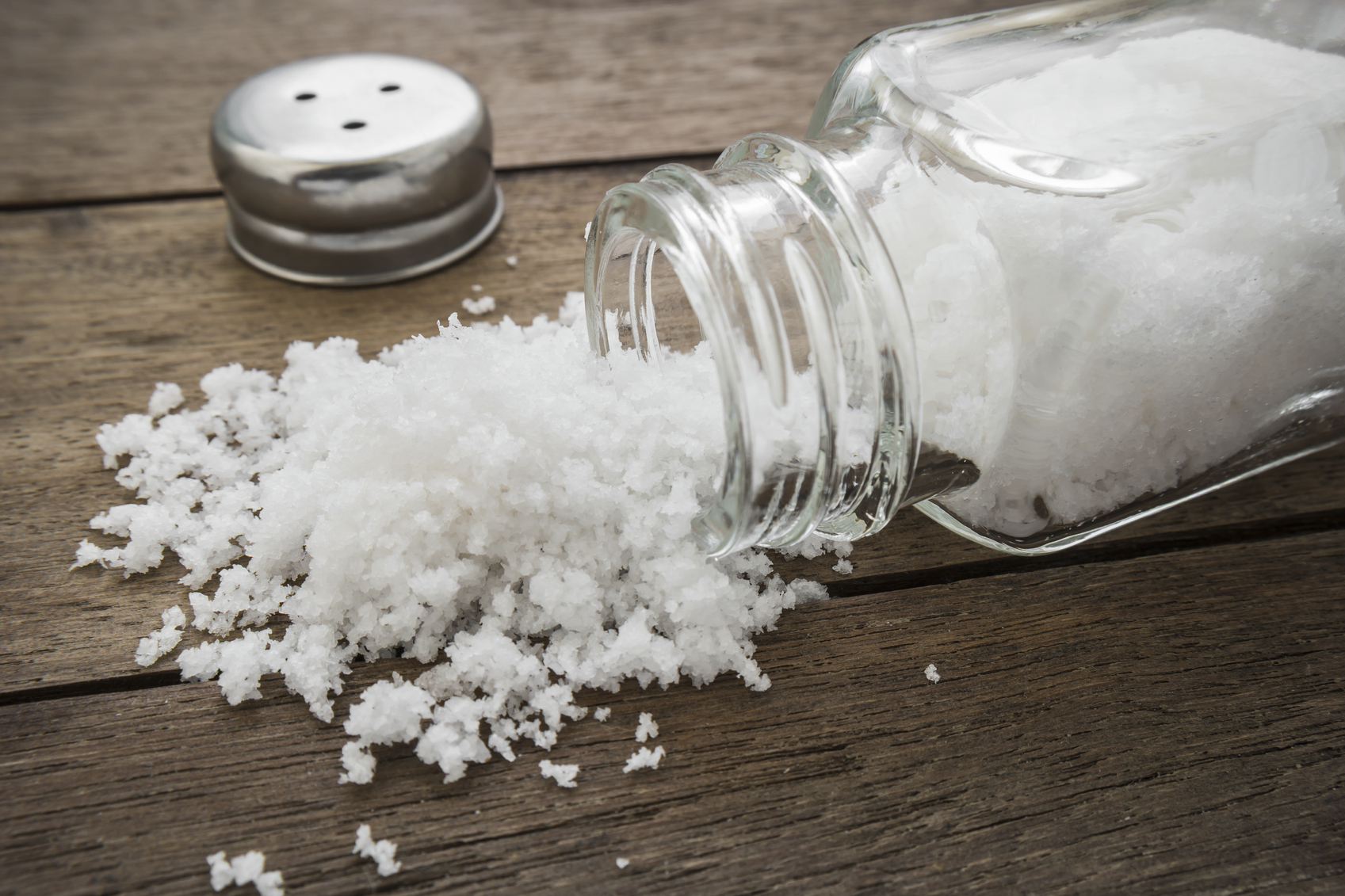
I was recently asked (through my Our Sunday Visitor column) about one of Jesus’ lesser known sayings. I would go into a little more detail in today’s post. Here is the passage:
Everyone will be salted with fire. Salt is good, but if salt becomes insipid, with what will you restore its flavor? Keep salt in yourselves and you will have peace with one another (Mark 9:49-50).
Some argue that these were separate sayings that were just stitched together, but I think otherwise. The logic of the saying seems cogent and unified to me. I will begin with a few observations about salt in those times.
- Salt was valuable. Some people were even paid with salt (which is where we get the word “salary”).
- Salt was connected with healing and purity. Saltwater was applied to infections and wounds (it helps heal afflictions of the skin). Newborn babies were washed with saltwater.
- Salt was connected with preservation. In the years before refrigeration, salt was one of the most common ways of preserving meat and fish.
- Salt was connected with flavor. Salt adds spice to life; it brings out the flavor in food.
- Salt was an image for wisdom. Gregory the Great said, “Now by salt is denoted the word of wisdom. Let him therefore who strives to speak wisely, fear greatly” (Pastoral Rule 4.12).
- Salt was connected with worship and covenant. Scripture says, Season all your grain offerings with salt. Do not leave the salt of the covenant of your God out of your grain offerings; add salt to all your offerings (Lev 2:13). So the use of salt was ordered first for the meal offerings, and afterwards for “all” offerings, including the “burnt offering.”
- Scripture speaks elsewhere of a “covenant of salt.” For example, Don’t you know that the LORD, the God of Israel, has given the kingship of Israel to David and his descendants forever by a covenant of salt? (2 Chron 13:5) The covenant of salt refers to the imperishable and irrevocable quality of the engagement made between the two parties to the covenant.
- The use of salt to signify and ratify what was sacred was widespread. There is a Latin saying attributed to Pliny the Elder (and Virgil, too), Nulla sacra conficiuntur sine mola salsa (Sacred things are not made without salted meal).
All of these things are caught up in Jesus’ use of salt as an image. Sadly, salt (a necessary ingredient for life) is today treated almost as a poison. But such thinking was not operative in ancient minds.
To apply the image of salt to the Christian life, we should see that the Christian is to purify, sanctify, and preserve this wounded and decaying world by being salt to it. The Christian is called to bring flavor to life in a world that is so often filled with despair and meaninglessness.
And now we turn to Jesus’ words from Mark:
1. Everyone will be salted with fire. Two images of salt and fire come together here, but the result is the same: purification. We have already seen how salt purifies. Fire does the same thing through the refining process. Precious metals come from the ground admixed with iron and many other metals. Subjecting them to fire purifies the gold or silver, separating it from the iron and other metals.
Both salt and fire purify by burning, each in its own way. Hence the Lord marvelously brings those two images together, telling us that we will all be “salted with fire.”
Indeed, it must be so. We must all be purified. Scripture says of Heaven, nothing impure will ever enter it (Rev 21:27). St. Paul speaks of purgatorial fire as effecting whatever purification has not taken place here on earth:
If anyone builds on this foundation [of Christ] using gold, silver, costly stones, wood, hay or straw, their work will be shown for what it is, because the Day will bring it to light. It will be revealed with fire, and the fire will test the quality of each person’s work. If what has been built survives, the builder will receive a reward. If it is burned up, the builder will suffer loss but yet will be saved—yet as one escaping through the flames (1 Cor 3:15-15).
The Book of Malachi also reminds us of our need to be purified, to be “salted with fire.”
But who can endure the day of his coming? Who can stand when he appears? For he will be like a refiner’s fire or a launderer’s soap. He will sit as a refiner and purifier of silver; he will purify the Levites and refine them like gold and silver (Mal 3:2-3).
Yes, we must all be salted with fire. We must be purified, both here, and if necessary (as it likely will be), in Purgatory.
2. Salt is good, but if salt becomes insipid, with what will you restore its flavor? In other words, we have to let the salt of God’s grace have its effect or else we, who are to be salt for others, become flat, tasteless, and good for nothing but to be thrown out and trampled underfoot (cf Matt 5:13).
What does it mean for salt to become tasteless? Today, we are not used to salt going flat, but salt in the ancient world was frequently less pure. It came from the sea and was admixed with other things. As it broke down, the salt could go flat or become bitter. In that case it was useless except as pavement.
The image is a powerful portrait of a Christian who has become debased, flat. The fall is steep: from a worthy, esteemed, necessary, and helpful place (like good salt) to ignoble pavement, trampled and unappreciated beneath the feet of people who should have been blessed with its flavor. Jesus says elsewhere, if salt loses its saltiness, how can it be made salty again? It is no longer good for anything, except to be thrown out and trampled underfoot (Matt 5:13).
Alas, consider the sad condition of this world, made so because so many Catholics stepped back from being salt and light. Increasingly, the world is therefore hell bound and sin-soaked as never before.
The current contempt of the world for Christians—Catholics in particular—has indeed reduced us to less than pavement dust. We can lament the lack of appreciation for our faith, but a lot of it is due to our lack of saltiness. Salt gone flat is good for nothing, nothing but to be thrown out and trampled underfoot. Right or wrong, fair or unfair, this world thinks of us as flat and bitter to the taste.
We have a lot of work to do to recapture our role of adding spice and flavor to life. The good, the true, and the beautiful must be reintegrated into the lives of Catholics, who have too easily cast them aside.
Bishop Robert Barron speaks of 70s Catholicism as the era of “beige Catholicism,” when all the zest, color, edginess, and zeal of the Catholic faith was painted over and Catholics sought to blend in—even disappear. Today we are seeing the results of salt-gone-flat Catholicism. Little by little, we must recover our salt, our zest, our pep, and even our stinging quality. Flat Catholics are good for nothing.
If the salt will not be salt, there is no substitute for it. Jesus asks rhetorically, if salt becomes insipid, with what will you restore its flavor? There is no substitute for Christians. If we will not be light, then the world will be in darkness. If we will not be salt, then the world will not be purified, preserved, or have anything good or tasty about it at all. The decay of Western culture has happened on our watch, when we collectively decided to stop being salt and light.
3. Keep salt in yourselves and you will have peace with one another. In other words, allow the salt, the purification, to have its effect. Only if we do this will we have peace with one another.
Our divisions and lack of peace are caused by our sins. Thus, to accept the purification of being salted with fire is our only true hope for peace. When the Lord burns away my envy, I no longer resent your gifts; I rejoice in them and come to appreciate that I need you to complete me. In this way there is peace. When the Lord burns away my jealously and greed and helps me to be grateful for what I have, I no longer desire to take what is rightly yours nor do I resent you for having it. In this way there is peace. When the Lord burns away my bitter memories of past hurts and gives me the grace to forgive, an enormous amount of poison goes out of my soul and I am equipped to love and to be kind, generous, and patient. In this way there is peace.
Yes, allowing ourselves to be salted with fire is a source of peace for us. And while we may resist the pain of fire and salt, just as with any stinging medicine we must learn that although it is painful it is good for us. Yes, it brings peace; it ushers in shalom.
Everyone will be (must be) salted with fire!