The Pope’s recent remarks about the obsession with having the perfect body were intended as a commentary on the rejection by some of the dignity and quality of life of the disabled. I will be writing more on that topic tomorrow. Today, however, permit me some musings on the obsession that many of us have with achieving the perfect body ourselves.
Let me start by saying (with all the good humor I can summon) that I do not have a perfect body. In fact, I have become increasingly dissatisfied with my appearance over the years as I gain weight, lose hair, and watch the gray eclipse the dark brown of what hair I do have left. Fatigue and sore joints are also increasingly my lot.
Yes, I am well aware that my body is far from perfect and is steadily “heading south.” Like many of you, I do my fair share of exercising, watching what I eat, etc. But trying to be something that I am not (a 21-year-old with a 28-inch waist and dark rich hair) is increasingly a losing battle. The fact is, I look just like my father, who looked just like his father. Genetics, body type, and age tend to win, and the energy required to try to overcome these is increasingly disproportionate to the results and to my other duties.
I do want to say that I love being 55. I would never want to be 25 again; I have learned too much in those 30 years. God has done important work in my spiritual life during that time—thank you, Lord! Spiritually, I am now younger, more confident, and stronger, even as my body ages—thank you, Lord. And Lord, please spare me from the obsession with having the perfect body.
Our culture’s obsession with the perfect body has terrible effects upon those who are younger as well. There are many young women today whom I regard as quite beautiful, who nevertheless struggle with low self-image; they are extremely anxious about any perceived imperfection in their hair, complexion, or body shape, no matter how minor. In our hyper-sexualized and visual culture, ordinary women often compare themselves unfavorably to famous women, many of whom look the way they do by spending thousands of dollars and countless hours on personal trainers, makeup specialists, and cosmetic surgery. And with the pervasiveness of photo-editing software, many women today are actually competing with the images of women who don’t even exist; they are “Photoshopped” (see video below).
Men are not immune to this either. Most men care more about their appearance than they will admit. I remember being obsessed for years with the gap between my two front teeth. It made it awkward for me to smile and I was very self-conscious about it. And yet when I asked people about it or admitted my embarrassment, most told me that they hadn’t even noticed it. Weight gain is now my primary irritant. My slash-and-burn Lenten diet merited only a 10 lb. loss, which stopped midway through Lent. A few extra laps around the park just doesn’t seem to do the trick anymore.
At the end of the day, the older body just seems designed to carry extra weight. We should ask the Lord for the proper balance in order to legitimately moderate our caloric intake and to watch our health without the preoccupation with the perfect body.
Part of the obsession for the perfect body is a result of our culture’s preoccupation with youth. Healthier cultures esteem the wisdom of age and look to elders for answers, but ours disdains its older members as “old,” “out-of-touch,” and with little to offer. Meanwhile, the young are considered “hip” and “relevant,” and are presented as the ones who really know what is going on and whose views are both glamorous and cutting edge. Young = good, old = bad.
Thus, younger bodies have become the image of perfection. And even when we leave youth behind, we are still obsessed with looking young. If we don’t, we are perceived as having “lost our edge.” Never mind that we may have reached the peak of our life intellectually, emotionally, spiritually, professionally, etc. If you don’t look young, you’re no good; you’re washed up. This is a foolish preoccupation with mere externals that dismisses the hoary crown of wisdom. Older bodies are rounder, grayer, and less agile. But perhaps God intends this, as we hopefully become more graceful, wise, and mindful in our walk, and as our personality becomes more “well-rounded.”
I have often mused that God built in a certain protection for us as we grow older: as we age and become “less attractive,” our eyesight worsens so that we don’t notice it so much! But then we go ahead and cancel that out by putting on glasses J. With corrective lenses, our artificially “young” eyes can’t bear the sight of our actually older bodies.
These are just some of my thoughts on today’s obsession with having the perfect body.
Help us, Lord! Keep us grateful for what you are doing in our souls even if our bodies are “heading south.” Help us to remember that every passing day here puts us one day closer to being with you. Keep us faithful so that we do not fear aging or the reminder of approaching death it may bring. One day, Lord, we will be in your presence, forever young before you, the Ancient of Days.
Following up on Sunday’s Gospel, I would like to propose the following reflection. There was a woman who was so moved by Jesus’ mercy that she wept for joy and showed extravagant, grateful love. Are we that way? Too often we are not. And as Jesus pointed out, a big reason for that is that we do not understand the magnitude of our sin. We miss the greatness of God’s mercy; we lack gratitude for what He has done for us and thus our love is lukewarm.
There is an old saying, “If you don’t know the bad news, the good news is no news.” Not knowing or being only vaguely aware of how serious our sin is, we are out of touch with the bad news. Therefore, the good news of salvation and forgiveness of sin has little effect on us; it barely moves us. Because of this we are less grateful and less loving.
In order to unlock the good news, let’s spend some time on the bad news.
I’d like to begin by saying that your condition is grave—so is mine. There’s some serious stuff wrong with us; you might say we have a few issues!
Yes, I’ve got your spiritual “medical chart” (and mine) open, and I’m looking at the test results; the numbers don’t look good.
The tests say we tend toward being dishonest, egotistical, undisciplined, weak, immature, arrogant, self-centered, pompous, insincere, unchaste, grasping, judgmental, impatient, and shallow.
We’ve tested positive for being inconsistent, unfaithful, immoral, ungrateful, disobedient, selfish, lukewarm, slothful, unloving, uncommitted, and just plain sinful.
Further tests indicate the presence of fear, indifference, contempt, impurity, hatred, laziness, cowardice, and anger.
Test results indicate the presence of greed, jealousy, revenge fullness, disobedience, hardheartedness, pride, envy, stinginess, selfishness, pettiness, spite, self-indulgence, lust, careless neglect, and prejudice.
Our spiritual “medical history” indicates that we have sinned against justice, modesty, purity, and the truth. We’ve committed sins against the human person: children, the innocent and trusting, the frail and elderly, the unborn, the weak and powerless, immigrants and strangers, and the disadvantaged.
Further test results indicate the absence of important key indicators: failure to give witness to Christ, failure to join our will to God, failure to provide a good example to others, failure to seek God above all things, failure to act justly, failure to show mercy, failure to repent of our sins, failure to obey the commandments, failure to curb our earthly desires, failure to lead a holy life, failure to speak the truth, failure to pray for others, failure to assist those in need, and failure to console the grieving.
Well, you can see that we’re in bad shape! And though you might think that I’m exaggerating, I suspect that if you’re honest with yourself you’ll admit that you’ve committed many if not most of these sins.
Yes, without a lot of grace and mercy from God, we’re doomed!
But here’s the good news: the doctor, Jesus, is in! And the doctor has a prescription to cure us:
daily prayer,
daily reading of Scripture,
reception of Holy Communion every Sunday (and Holy Day of Obligation),
frequent Confession (at least four times a year—more often if mortal sin is a problem),
frequent doses of the Catechism, the lives of the saints, and devotions such as the rosary and novenas,
keeping good company, and
custody of the eyes and ears.
Yes, we need help; we’ve got some stuff going on that will kill us eternally. But Jesus has a hospital (the Church) and medicine (the sacraments). There is spiritual “medical” advice available: from the Word of God, from sermons, from the teachings of the Church, and from encouraging “doctors” and “nurses” such as priests, religious, and fellow Catholics.
Whether we care to admit it or not we need regular check-ups and serious medicine. Jesus is guiding His Church in giving skillful advice and distributing powerful medicine.
Do you think of the sacraments as medicine? Many think of them simply as rituals. But the truth is that they are powerful medicine. I’m a witness to this. After more than twenty-five years of seeing the doctor, Jesus, and letting Him minister to me through sacraments, His Word, and His Church, a wonderful change has come over me. I’m not what I want to be, but I’m not what I used to be.
We’ve got it bad and that ain’t good. But the doctor is in (and you know you need Him)! Whatever your struggles, reach out for Him. He’s waiting to minister to you, especially in the liturgy and the sacraments. You can’t do it alone. Join us every Sunday at the “holy hospital,” the Church. Yes, the doctor is in! As you heal, your gratitude will increase. And grateful people are different people; they are more joyful, generous, forgiving, and loving.
Here’s a humorous little video that I created, which demonstrates that sometimes the doctor can give us a surprising diagnosis. For it’s often the case that we claim that everyone else has a problem, while in reality the problem is in us—and so is the solution. Please pardon the video; I have a face for radio!
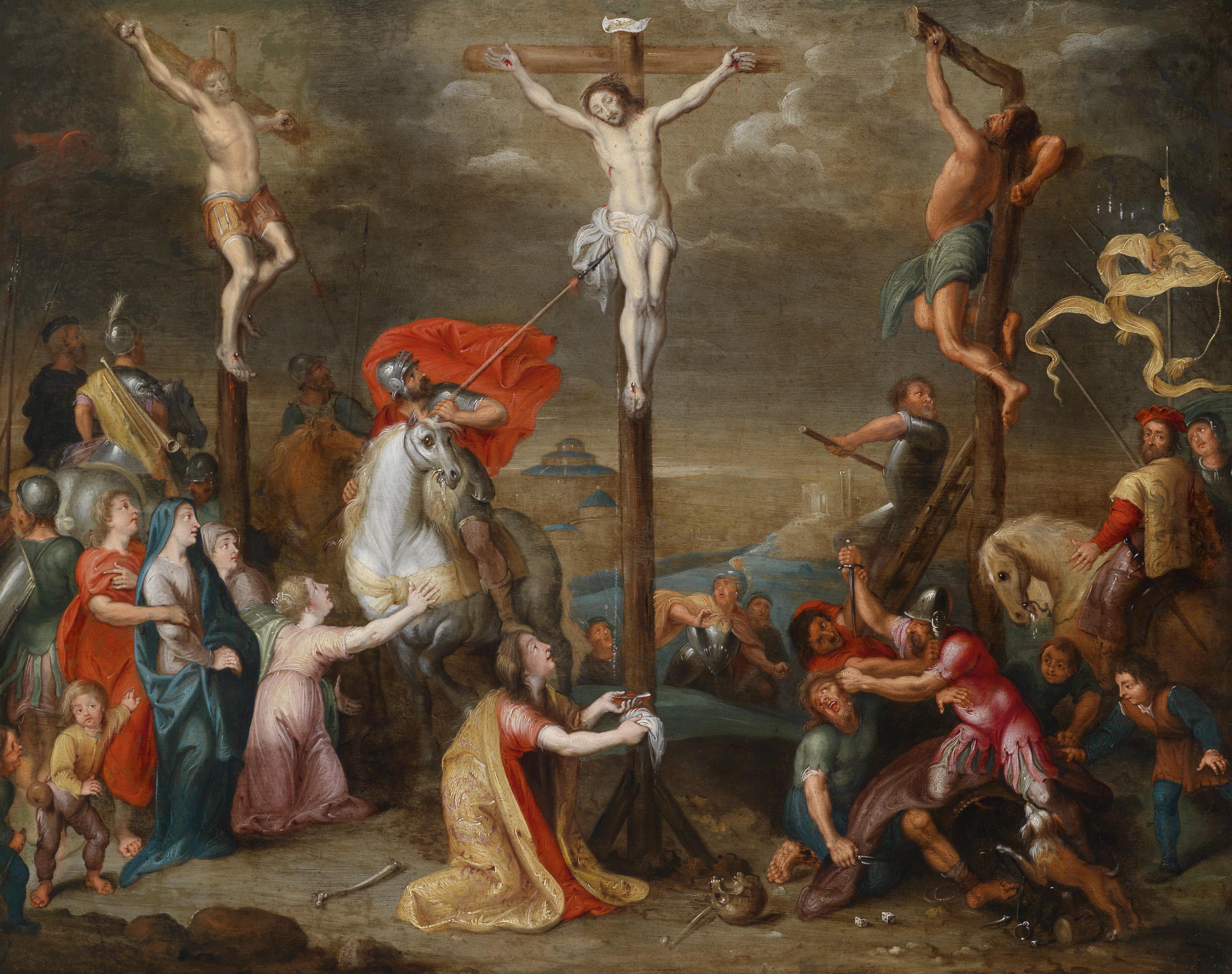
There is a bit of puzzlement at the following question: Why was Christ crucified between two thieves? It might make one wonder why one would ask this question at all. Perhaps one could also ask why the Passion was on a Friday, or, why Jesus died at 3:00 PM instead of 4:00 PM. These sorts of questions could go on forever.
Nevertheless, some of the best insights come from pondering seemingly insignificant questions. Seldom do the Gospel writers and the Holy Spirit provide a detail in the accounts that they do not want us to wonder about, or that is not in the text for a good reason.
So then why was Christ crucified between two thieves? Was it just an historical accident? One can hardly imagine that God permitted any detail of the most pivotal moment in salvation history to occur merely by accident.
St. Thomas Aquinas proposes a number of answers. The first is the one with which I am most familiar. Referencing St. Jerome, St. Thomas writes,
As Christ became accursed of the cross for us, so for our salvation He was crucified as a guilty one among the guilty (Comm. xxxiii in Matth) (Summa Theologica III, 46, 11).
In other words, Jesus bore our guilt and our shame, though He Himself was sinless (see 1 Peter 2:24 and Isaiah 53:4). He was assigned a grave with the wicked, and with the rich in his death, though he had done no violence, nor was any deceit in his mouth (Is 53:9). And thus Christ took up and endured the reproaches we deserved.
The second and more interesting answer from St. Thomas is this:
As Pope Leo observes (Serm. iv de Passione): “Two thieves were crucified, one on His right hand and one on His left, to set forth by the very appearance of the gibbet that separation of all men which shall be made in His hour of judgment.” And Augustine on John 7:36: “The very cross, if thou mark it well, was a judgment-seat: for the judge being set in the midst, the one who believed was delivered, the other who mocked Him was condemned. Already He has signified what He shall do to the quick and the dead; some He will set on His right, others on His left hand.” … because of the cleavage between believers and unbelievers, the multitude is divided into right and left, those on the right being saved by the justification of faith (Summa Theologica III, 46, 11).
Thus this moment points to the final judgment, when Christ, seated on His throne as Judge of the World and Lord of all, will have some to His right and others to His left; some will be the sheep and others the goats; some will be the wise virgins and others the foolish ones. Those on His right will hear, Come, you who are blessed by my Father, inherit the kingdom prepared for you from the foundation of the world (Matt 25:34). Those on his left will hear, Depart from me, you cursed, into the eternal fire prepared for the devil and his angels (Matt 25:41).
St. Thomas also addresses an expected objection that in Matthew’s version both thieves reviled him:
As Augustine says (De Consensu Evang. iii): We can understand Matthew “as putting the plural for the singular” when he said, “the thieves reproached Him.” Or it may be said, with Jerome, that “at first both blasphemed Him, but afterwards one Believed in Him on witnessing the wonders” (Ibid, ad 3).
It is a remarkable image of the crucifixion: Christ is seated on the throne of His cross. His arms are extended in mercy, offering mercy to the very end. But only the repentant thief accepted the offer. Thus he heard, “Today you will be with me in paradise.”
This vision of Christ on the cross as depicting His role as judge presents Christ as a judge who poses a question to the thieves more so than as one who merely passes sentence on them. There is no recounting of the sins and crimes of the thieves, no lengthy weighing of the evidence. There is the offer of mercy and the awaiting of a response.
For these men, and one day for us, this is the final moment. The responses are given and are final. The one thief repents and receives paradise; mysteriously, the other curses and condemns himself to living apart from mercy in Hell. The rejection of God’s offer always remains deeply mysterious; it must, it would seem, proceed from a heart that is obtuse and hardened.
Jesus laments the fact that many, not few, end by rejecting Him and His offer: For the gate is wide and the way is easy that leads to destruction, and those who enter by it are many. For the gate is narrow, and the way is hard, that leads to life, and those who find it are few (Matthew 7:13-14). In this passage He gives a partial explanation for their rejection: it is because “the way is hard.”
The third answer by St. Thomas as to why Jesus was crucified between two thieves is this:
Bede says on Mark 15:27: “The thieves crucified with our Lord denote those who, believing in and confessing Christ, either endure the conflict of martyrdom or keep the institutes of stricter observance. But those who do the like for the sake of everlasting glory are denoted by the faith of the thief on the right; while others who do so for the sake of human applause copy the mind and behavior of the one on the left.”
Yes, to follow Christ on this earth involves suffering and rejection. It also involves a stricter observance, which postpones certain passing pleasures in order to inherit greater and lasting ones, which rejects apparent goods in order to receives true goods. There are some who are willing to endure this and others who are not.
The bad thief wanted to be taken down, not to go up. The good thief was willing to endure the cross to go up to paradise.
There are some powerful insights here.
Thank you, Lord, for being counted among the wicked, though innocent, in order to save us. Thank you for your offer of mercy. Help us to remember that the decision is ultimately ours and that we access your mercy through the repentance manifested by the good thief. Help us, Lord, to endure and be taken up, rather than to insist on being taken down.
Every now and then some will suggest that the Church should speak less of sin and instead emphasize positive things. After all, it is said that one can attract more flies with honey than with vinegar. In that vein, we in the Church have been collectively de-emphasizing sin to a large degree for more than forty years. And in spite of the saying, our churches have been getting emptier and emptier. Maybe this is because people are just a little more complicated than the flies in the old saying.
In today’s Gospel, Jesus provides the reason our churches are getting emptier. Simply put, there is less love. He says, But the one to whom little is forgiven loves little. (Luke 7:47)
Why is this? As Jesus says, we love little because we have little appreciation for what the Lord has done for us and for the debt He paid on our behalf. And why is that? Because debt for sin is no longer preached the way it should be and thus we are less aware of just how grave our condition is. This in turn diminishes love, and a lack of love leads to absence and neglect.
Understanding sin is essential for us to be able to fully comprehend what the Lord has done for us. Remembering what the Lord has done for us brings gratitude and love. Again, to those who want the Church to de-emphasize sin, Jesus provides this warning: But the one to whom little is forgiven, loves little (Luke 7:47).
That was the short version of my sermon, the “TV Mass” version, if you will. If you wish to ponder more, here is further commentary:
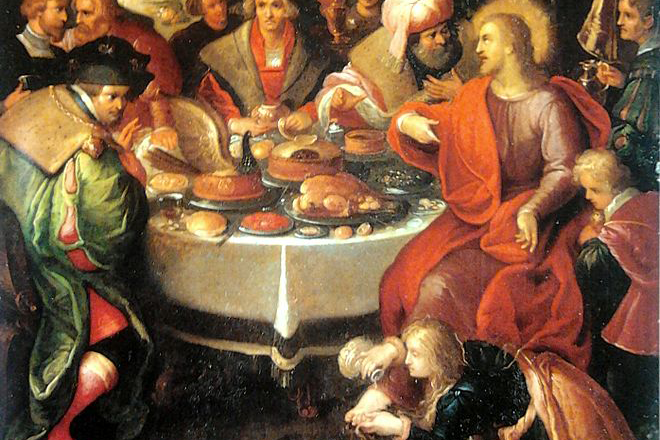
I. Rich Love – The Gospel today opens with a sign of extravagant love. The text says, A Pharisee invited Jesus to dine with him, and he entered the Pharisee’s house and reclined at table. Now there was a sinful woman in the city who learned that he was at table in the house of the Pharisee. Bringing an alabaster flask of ointment, she stood behind him at his feet weeping and began to bathe his feet with her tears. Then she wiped them with her hair, kissed them, and anointed them with the ointment.
There is disagreement as to the value of the ointment referred to in this passage. Some opine that the woman is wealthy on account of prostitution, and could thus afford an expensive ointment. That could be, but her tears were far more costly than any ointment. Her tears are the costliest thing in her life, born out of great pain and sorrow.
While many of her sorrows are likely the result of her own foolishness, that does not decrease her pain; rather, it increases it. Yes, the costliest thing with which she anoints the Lord’s feet is her tears. There is nothing more precious to the Lord than the love of His faithful, turning to Him in sorrow and repentance for their sins—no greater gift.
In Jesus’ day people ate a formal dinner while reclining on the floor, on a mat, on their left side. Their feet were behind them and they ate with their right hand. This explains the ability of the woman to approach Jesus’ feet from behind.
In this sense the woman is able to “surprise” Jesus with her love. Perhaps she is not ready to look upon His face and behold His holy countenance. She begins with His feet, the lowliest aspect of His sacred humanity. She humbles herself to serve the part of Him that most engages with our lowly earth. On his feet, even the Son of God has calluses, perhaps even a wound or two. Yes, there she sees reflected her own humility, sees her own calluses and wounds. There she discovers the first wounds that Our Savior endured for us, wounds that reflect that He knows what this world can do to a person.
She loves, sharing the incalculable gift of her sorrows: sorrow for her own sin and sorrow on account of others who have sinned against her. She finds a friend in Jesus, who, though sinless Himself, has suffered mightily on account of the sins of others and would suffer more.
Such love, such relief! And, as we shall see, her love is rooted in an experience of mercy. And her experience of mercy is rooted in a deep knowledge of her sinfulness. That experience has led her to deep gratitude for the love that the Lord had shown her. As we shall also see, her experience of the depths of God’s mercy is something we must all experience.
We, too, are called to go to the Lord in sorrow and love. What is the first thing we see when we look up from the foot of the cross? His feet. There, like the woman, we are called to love, to weep for our sins, and to remember His mercy for us.
II. Rebuke –When the Pharisee who had invited him saw this he said to himself, “If this man were a prophet, he would know who and what sort of woman this is who is touching him, that she is a sinner.”
This is a dangerous comparison. The Pharisee accounts himself and others to be better or more holy than she. He seems to have no idea that he is also in need of grace and mercy.
There is a great risk in thinking that we can get to Heaven merely by being better than someone else. That is not the standard. The standard to reach Heaven is to be like Jesus. If we truly internalize that, it’s obvious that we are all going to need a lot of grace and mercy to even stand a chance! Yes, to this Pharisee and to some of us, the cry must go out, “Danger (Will Robinson)!”
The danger for us is one that prevents us from experiencing God’s grace, mercy, and love. The danger is our prideful presumption that we are less needy than others who are more sinful.
While it is true that on a strictly human level some have sins that are more serious than those of others, from the divine standpoint we are all poor beggars who don’t stand a chance in comparison to God, who is perfection and pure holiness. Even if I were to have $500 while you had only $50, the true value necessary to be able to endure God’s holiness would be closer to $500 trillion! Any differences that may exist between you and me are nothing in comparison to the boatloads of grace and mercy we will each need to ever hope to see God.
The Pharisee’s exasperation is born out of blindness to his own sin. Being blind in this way, his heart is ill-equipped to love or even to experience love. He has no sense at all that he even needs it! His sense is that he has earned God’s love and that God somehow owes him. But God does not owe him. The Pharisee’s only hope is grace, love, and mercy from God.
Having no sense of his sin, the Pharisee smugly dismisses the woman’s action as reprehensible. He even considers Jesus naïve and of no account for accepting her love. Jesus is not naïve; the Pharisee ought to be rather more careful, since the measure with which he measures will be measured back to him. The Pharisee’s lack of mercy for the woman brings a standard of strict justice on him. He is badly misled, because he cannot endure this sort of justice.
III. Rejoinder – Jesus said to him in reply, “Simon, I have something to say to you.” “Tell me, teacher,” he said. “Two people were in debt to a certain creditor; one owed five hundred days’ wages and the other owed fifty. Since they were unable to repay the debt, he forgave it for both.Which of them will love him more?” Simon said in reply, “The one, I suppose, whose larger debt was forgiven.” He said to him, “You have judged rightly.”
This is the central point of this Gospel, a point we have too widely set aside today: to appreciate the glory of the good news we must first lay hold of the bad news. We must grasp the depths of our sinfulness in order to appreciate the height of God’s love and mercy.
In this modern age, which minimizes sins and says, in effect, “I’m OK; you’re OK,” there is little understanding of the enormity of sin. And thus there is little appreciation for the glory of God’s steadfast love and mercy.
Jesus could not be clearer. Until we recognize the “bill” for our sins and grasp that we cannot even come close to paying it, we will make light of mercy and consider the gift of salvation that was earned for us with His blood as of little or no account.
How tragic it is, then, that many in the Church have stopped preaching about sin. The effect, as was mentioned above, has been to minimize love and to empty our churches. Knowledge of our sin, if such knowledge is of the Holy Spirit, leads to love. In this Gospel, Jesus points to the woman as a picture of what is necessary.
IV. Remembrance – Jesus points to the woman and says, “Do you see this woman? When I entered your house, you did not give me water for my feet, but she has bathed them with her tears and wiped them with her hair. You did not give me a kiss, but she has not ceased kissing my feet since the time I entered. You did not anoint my head with oil, but she anointed my feet with ointment. So I tell you, her many sins have been forgiven because she has shown great love. But the one to whom little is forgiven, loves little.”
Yes, behold her love, a love that is the fruit of a recognition of what the Lord has done for her. She knows and remembers that she has been forgiven much. What the Lord has done for her is fixed in her mind, and she is grateful and different because of it.
This is the heart of what it means to remember. Has not the Lord told us to remember what He has done for us? Indeed, He says it at every Mass: “Do this in remembrance of me.” What does it mean to remember? It means to have so present in your mind and heart what the Lord has done for you that you are grateful and different because of it.
This woman cannot forget what Jesus has done for her. She remembers, she is grateful, and she is different.
We, too, must be willing to go to the foot of the cross and to let it dawn on us what the Lord has done for us, to let it dawn on us so that we are grateful and different, so that we are moved to love for the Lord and for others.
Go with me to the foot of the cross and pray:
Foul and festering are my sores, at the face of my own foolishness. I am stooped and turned deeply inward And I walk about, all the day in sorrow.
I am afflicted and deeply humiliated I groan in the weeping of my heart.
Before you O Lord are all my desires, And my weeping is not hid from you. My hearts shudders, my strength forsakes me, And the very light itself has gone from my eyes (Psalm 38).
It is there, at the foot of the cross, that we can begin to comprehend His mercy. It is there in the shadow of our own sins that the power of His mercy breaks through our broken and humbled hearts.
I Love the Lord for he has heard The voice of my lamentation. For he turned his ear to me On the day I called to him!
The lines of death had surrounded me, And the anguish of Hell had found me. In my tribulation and sorrow I called on the Lord, “O Lord save my soul!”
Ah, The Lord is merciful and just, Our God has had mercy! The Lord guards his little ones. I was humbled and he saved me!
Be turned back my soul to your rest, My eyes, from tears, and my feet from slipping! For I will walk in the presence of the Lord, In the land of the living (Psalm 116).
Always remember what the Lord has done for you. Go to the foot of the cross. Let the Lord show you what he Has done for you. Always remember; never forget. If you do, you will be grateful and different.
Yes, remember what the Lord has done for you. That is, let what the Lord has done for you be so present in your mind and heart that you are grateful and you are different.
If you ask me (and even if you don’t ask me) something in the video below is amiss. Twenty years ago a father would have filled the role depicted in it. Watch it and see what you think. In making my observation I am not blaming women/mothers. But if any video could demonstrate that we have a crisis of fatherhood and “missing man syndrome,” this is it. There should be a father—a man—in this video, but he is absent. But the video reflects reality does it not? What will you and I do to change this?
I sometimes get questions about the remarkably long lives of the patriarchs who lived before the great flood. Consider some of their reported ages when they died:
Adam 930
Seth 912
Enosh 905
Jared 962
Methuselah 969
Noah 600
Shem 600
Eber 464
Abraham 175
Moses 120
David 70
How should we understand these references? There are many theories that have tried to explain the claimed longevity. Some propose a mathematical corrective, but this leads to other inconsistencies such as certain patriarchs apparently begetting children while still children themselves. Another theory is that the ages of the patriarchs are actually just indications of their influence or family line, but then things don’t add up chronologically when considering eras and family trees.
Personally, I think we need to take the stated ages of the patriarchs at face value and just accept it as a mystery: for some reason the ancient patriarchs lived far longer we do today. I cannot prove that the patriarchs actually lived that long, but neither is there strong evidence that they did not. Frankly, I have little stake in insisting that they did in fact live that long. I think it is best just to accept that they did.
Many scoff when I articulate this solution. They almost seem to be offended. The reply usually sounds something like this: “That’s crazy. There’s no way they lived that long. The texts must be wrong.” To which I generally reply, “Why do you think it’s crazy or impossible?” The answers usually range from the glib to the more serious, but here are some common ones:
They didn’t know how to tell time the way we do today. Actually, they were pretty good at keeping time, in some ways better than we are today. The ancients were keen observers of the Sun, the Moon, and the stars. They had to be, otherwise they would have starved. It was crucial to know when to plant, when to harvest, and when to hunt (e.g., by the migratory and/or hibernation patterns of animals through the seasons). The ancients may not have had timepieces that were accurate to the minute, but they were much more in sync with the rhythms of the cosmos than most of us are. They certainly knew what a day, month, and year were by the cycles of the Sun, the Moon, and the stars.
They couldn’t have lived that long because they didn’t have the medicines we do today. Perhaps, but it is also possible that they didn’t have the diseases we do. Perhaps they ate and lived in healthier ways than we do. Perhaps the gene pool later became corrupted in a way that it was not back then. There are just a lot of things we cannot possibly know. The claim about our advanced technology (medicine) also shows the modern tendency to think that no one in the world has ever been smarter or healthier than we are. We surely do have advanced technologies today, but we also have things that potentially make us more susceptible to disease: stress, anxiety, overly rich diets, pollutants, promiscuity, drug use, and hormonal contraceptives. There are many ways in which we live out of sync with the natural world.
Those long years just symbolize wisdom or influence. OK, fine, but what is the scale? Does Adam living to the age of 930 mean that he attained great wisdom? But wait, David wasn’t any slouch and he only made it to 70. And if Seth was so influential (living to 912) where are the books recording his influence such as we have for Moses, who lived to be only 120. In other words, we can’t just propose a nebulous scale indicating influence or wisdom without some further definition of what the numbers actually mean.
Sorry, people just don’t live that long. Well, today they don’t. But why is something automatically assumed to be false simply because it doesn’t comport with lived experience today? It is not physically impossible in an absolute sense for a human being to live for hundreds of years. Most humans today die before the age of 100, but some live longer. Certain closely related mammals like dogs and cats live only 15 to 20 years. Why is there such a large difference in life expectancy between humans and other similar animals? There is obviously some mysterious clock that winds down more quickly for some animals than for others. So there is a mystery to the varying longevities of living things, even those that are closely related. Perhaps the ancients had what amounts to preternatural gifts. (A preternatural gift is one that is not supernatural (i.e., completely above and beyond our nature or ability) but rather builds on our nature and extends its capabilities beyond what is normally or currently experienced.)
So I think we’re back to where we started: just accepting the long life spans of the early patriarchs at face value.
There is perhaps a theological truth hidden in the shrinking lifespans over the course of time in the Old Testament. Scripture links sin and death. The day they ate of the forbidden fruit of the Tree of the Knowledge of Good and Evil, Adam and Eve were warned that they would die (Gen 2:17). Yet they did not drop dead immediately. And although they died spiritually in an instant, the clock of death for their bodies wound down much later. As can be seen in the list of lifespans of the patriarchs (see above), as sin increased, lifespans dropped precipitously, especially after the flood.
Prior to the flood, lifespans remained in the vicinity of 900 years. Immediately afterward, they dropped by about a third (Noah and Shem only lived to be 600), and from there the numbers plummeted even further. Neither Abraham nor Moses even reached the age of 200, and by the time of King David, he would write, Our years are seventy, or eighty for those who are strong (Ps 90:10).
Scripture says, For the wages of sin is death (Rom 6:23). Indeed they are, especially in terms of lifespan. Perhaps that’s why I’m not too anxious to try to disprove the long lifespans of the patriarchs. What we know theologically is borne out in our human experience: sin is life-destroying. And this truth is surely writ large in the declining lifespan of the human family.
Does this prove that Adam actually lived to be more than 900 years old? No. It only shows that declining lifespans are something we fittingly discover in a world of sin. Since God teaches that sin brings death, why should we be shocked that our lifespan has decreased from 900 to 85 years? It is what it is. It’s a sad truth that God warned us about. Thanks be to God our Father, who in Jesus now offers us eternal life if we will have faith and obey His Son!
How or even whether the patriarchs lived to be more than 900 years old is not clear. But what is theologically clear is that we don’t live that long today because of the collective effect of sin upon us.
In the Gospel yesterday (Tuesday of the 10th week) the Lord describes what a Christian is and what He expects of us. He uses two different metaphors: salt and light. Yesterday’s post considered the metaphor of salt.
Today let’s consider the metaphor of light. The Lord says,
You are the light of the world. A city set on a mountain cannot be hidden. Nor do they light a lamp and then put it under a bushel basket; it is set on a lampstand, where it gives light to all in the house.
Much that can be said about salt can also be said about light. You don’t light light. It is the darkness that needs the light. Light is meant to be seen. There are too many undercover Christians, secret agent saints, and hidden holy ones. Jesus didn’t light our light to have it hidden under a basket out of fear or secrecy. He wants the Church to shine; he wants you and me to shine. He wants every Christian to be a light so that it’s like a city on a hill! He wants us to shine so that we can’t be hidden.
If we don’t shine, then the world is dark. This is because we are not just a light, we are (in Christ) the light. If you want to know why the world is in darkness, you don’t need to look very far. We often like to think that things are a mess because the wrong party is in power, or Hollywood is too secular, etc. But if we are the light of the world, then the world is dark because we are not shining the light of Christ. Light scatters darkness; it does not blame the darkness. This darkness has happened on our watch. As a Church we have been too content to hide our light under a basket. This is why the world is dark. If we collectively do our work, the darkness does not stand a chance. But too many—clergy and lay—are fearfully silent while the purveyors of darkness are loud and proud.
To all of this Jesus simply says, “You are the light of the world.”
Let’s look at some details of the light. Jesus goes on to say, Let your light shine before others, that they may see your good deeds and glorify your heavenly Father. Notice four things about this light:
The CAUSE – Notice that little word “let.” We are to yield to Christ, to allow him to shine through us. He is the cause of our light. Let your light shine. There’s an old Gospel song that says, “When you see me trying to do good, trying to live as a Christian should, it’s just Jesus, Jesus in me.”
The COST – The purpose of light is to shine, but there is no shining without burning. Shining costs us something. It may be Christ’s light but He shines through us. This means sacrifice on our part. It means letting him use us. It means not always sleeping when we want to. It means not just sitting at home and saying “Ain’t it awful.” It means getting out and getting involved. It means being “out there” and risking a few things. It means being targeted and visible. It means being identified with someone (Jesus) who is hated by many. And in a world that prefers the darkness to light (cf John 3:19-21) it means being called harsh, out-of-touch, and hateful. There is no shining without burning.
The CONCRETENESS – Letting our light shine is no abstract thing. Jesus speaks of deeds. It involves concrete behavior. Your light shines by the way you live, the choices you make, the behavior you exhibit. The light shines when Christians get married and stay married, stay faithful to their commitments, and are people of their word. Our light shines when we tell the truth instead of lying, live chastely instead of fornicating, and behave courteously and respectfully. It shines when we respect life; it shines when we stop our reckless behavior. Our light shines when we clean up our language, give to the poor, and work for justice. Our light shines when we refuse to view pornographic, violent or degrading materials. Our light shines when we love instead of hate, when we seek reconciliation and pray for our enemies instead of seeking vengeance. Our light shines when we walk uprightly and speak the truth in love, without compromise. That’s when our light shines.
The CONSEQUENCE – God is glorified when our light shines. We do not act or get involved merely to satisfy our own anger or to fight for our own sake. We are light so as to glorify God. It is not about our winning, it is about God shining and being glorified. Too often when we do get involved we merely seek to win an argument rather than to glorify God. We can get involved in order to be praised rather than to have God glorified. We need to pray for good intentions, for it is possible to do the right thing for the wrong reason. The desire result is God’s glory not our glory.
Pass the salt and turn on the lights! It’s time to shine or it’ll be over soon. It’s zero-dark-thirty. Are you ready to shine?
In the Gospel today (Tuesday of the 10th week) the Lord describes metaphorically what a Christian is and what He expects of us.
You are the salt of the earth … You are the light of the World … But if salt goes flat it is good for nothing … No one lights a lamp and puts it under a basket.
Note the metaphor of salt: You are either salt, or you are nothing—in fact, good for nothing. It’s very much an all-or-nothing scenario. Jesus says that if you’ve decided to be my disciple you’re either going to do that or be nothing. You may go on to be a doctor, lawyer, teacher, laborer, or social worker. But the Lord has plenty of those (and so does the devil). Your first and only mission is to be a true and uncompromised Christian; everything else is commentary. You may be a great doctor, but if you don’t do it as a clear and visible Christian you’re nothing. You may be a skilled social worker, but if you don’t do it as a Christian, you’re good for nothing. Any non-believer can be socially useful as a doctor, actor, lawyer, or social worker. But only a Christian can be a Christian. If you don’t do “job one,” you’re nothing. If you buy your kids every good thing, send them off to college (paid in full), but don’t bring them to Christ by being a Christian witness to them, you’re good for nothing. Parents can give their kids material things, but only Christians can give them Christ. Got it? You’re either salt (a true Christian) or you’re nothing.
The text speaks of salt going “flat.” What this meant historically is rooted in the fact that salt at that time was typically less pure than it is today. Impurities often interacted with the salt, and over time it became bitter in taste. It was then good for nothing except to become pavement. But what does it mean to be salt?
Let’s consider some of the properties of salt:
Salt seasons. Christians are called to add spice to life; to bring beauty, joy, and hope to the world. Joy is the surest sign of a Christian. Even our keeping of the commandments is a source of joy as we experience God’s power to put sin to death in us and to bring forth order, self-discipline, and holiness. Hope, too, ought to distinguish us from a world that is often cynical and thinks that sin is inevitable. To this world we are not only to declare that keeping the commandments is possible and brings joy, but we are to demonstrate it in our very lives. We are to be zesty, passionate, alive, and free from sin in Christ. Yet, sadly, we Christians are known more for what we are against. Too many Christians are not spicy; they do not really add flavor; they are more like bored believers, depressed disciples, fearful faithful, and frozen chosen. In our best moments, though, look what spicy things the faith has contributed: art, music, churches, hospitals, universities, the scholastic and scientific methods, and holidays (a mispronunciation of Holy Days). Note how our tradition and our scriptural teachings of justice mercy, love, and the dignity of the human person have blessed the world. Do you bring spice to the lives of others? Do you bring hope and joy? Scripture says, Always be prepared to make a defense to anyone who calls you to account for the hope that is in you (1 Peter 3:15). Well that means that people must notice a hope in you! Do they? How?
Salt preserves. Before refrigeration, people often used salt to cure or preserve meat. The salt killed the bacteria and other microorganisms that caused rot and decay. As Christians, we are called to prevent further decay in this sin-soaked world. The truth that we proclaim is meant to preserve people from the decay of sin and overindulgence. Chastity, justice, generosity, the proclamation of the truth, etc. are like salt that preserves the world from decay. We must be salt; if we are not then nothing else is. You are the salt.
Salt heals. In the ancient world, salt was used on wounds. It helped to stop bleeding; it killed bacteria and prevented further infection. So, too, the Christian faith. Through our doctrinal and moral teaching—and our living of it—we are called to bring healing to this world, which is wounded by sin, strife, war, jealousy, anger, bitterness, retribution, promiscuity, unfaithfulness, greed, and countless other errors. The Word of God and His plan are healing medicine for what ails this world.
Salt burns. Yes, salt stings when applied to wounds. We Christians aren’t just sugar and spice and everything nice. When salt is applied to wounds it burns and often causes loud protest. The truth stings, and the truth of the Gospel can be irritating to a world that is wounded by sin. But despite the protests of the world, the sting is a healing one. It is driving out the bacteria and disease of the world and preventing further infection. Just because people protest the Church and howl in complaint at the truth of the Gospel does not mean that we have done anything wrong. The protests often mean we are doing exactly what we must.
Note finally that the Lord says you are the salt of the earth. He did not say you are the salt of the Church. For salt to be effective it has to get out of the shaker! Too many Christians are bold in the pew but cowardly out in the world. They will speak of the faith in the relative security of the Church and among certain friends. But don’t ask them to preach to their spouse or co-worker, or even to their children. That’s too scary. And don’t even think about asking them to knock on doors, or go to the local mall and witness, or stand in front of an abortion clinic.
Salt in the shaker is useless. It has to come out of the shaker to make any difference. You don’t salt salt. Witnessing to fellow Christians may have a limited benefit, but it is not really the true destination of salt. The salt has to go forth. When the priest or deacon says that the Mass is ended and to go in peace, he might as well be holding up a salt shaker and shaking it.
In tomorrow’s post, we’ll consider the Lord’s image of light.


 The Pope’s recent remarks about the obsession with having the perfect body were intended as a commentary on the rejection by some of the dignity and quality of life of the disabled. I will be writing more on that topic tomorrow. Today, however, permit me some musings on the obsession that many of us have with achieving the perfect body ourselves.