 The three parables in today’s lengthy Gospel challenge conventional thinking. They describe people doing things that we most likely would not do. All three of them— especially the first two—seem crazy. Who would ever do what the shepherd of the lost sheep does or what the woman with the lost coin does? Probably no one. Likewise, the father in the Prodigal Son parable breaks all the rules of “tough love.” His forgiveness has an almost reckless quality to it. No father in Jesus’ time would ever have tolerated such insolence from his sons. So all three of these parables, on one level, are just plain crazy.
But that is one of the most fundamental points Jesus seems to be making here: The Heavenly Father’s love for us is just plain “crazy.” By that I do not mean that it is irrational, but that it stretches the limits of human thinking.
I also intend no irreverence in my use of the word. Please permit me a bit of hyperbole in trying to describe the astonishing quality of God’s love and mercy. Permit, too, my stepping away from the normal interpretation of these parables. The normal approach is to strive to make sense of the images through certain presumptions. But I wonder if that approach does not miss the truer intent of the Lord here: presenting God’s love for us as mysterious and to some degree unexplainable in human terms. Who really understands unlimited and unconditional love? Who can really grasp the depths of God’s mercy? His grace is “amazing” in that it goes completely beyond our ability to comprehend. It transcends human concepts. Thank God! If God were like us we’d all be in trouble; frankly, we’d all be in Hell.
Let’s look at each parable. (Today’s Gospel is too lengthy to reproduce in this post; you can read the entirety of it here: Luke 15.)
I. The Parable of the Lost Sheep – The Lord speaks of a shepherd who leaves ninety-nine sheep to search for one that is lost. Would a shepherd do this? Probably not! The passage drips with irony, even absurdity. If he knew the lost sheep were nearby, a shepherd might venture over the next hill, but it would be more likely that he would cut his losses and stay with the ninety-nine. Some of us might even consider it irresponsible to leave the ninety-nine to search for the one.
Many scholars and Church Fathers make sense of this parable by appealing to possible shepherding practices of the first century. Some of the Fathers ponder that the ninty-nine are the angels and the Lord left them to pursue us, the one who strayed. Perhaps, but there is really nothing in the parable that suggests that. And while theories abound, I wonder if trying to explain the parable does not miss the point: God’s love is extravagant, personal, and puzzling. In the end, it would seem that God loves us for “no good reason.” He seems to love us even more when we stray. He intensifies His focus on the one who strays. To us this is not only crazy, it is dangerous—possibly enabling. God’s love for us is extravagant beyond what is humanly reasonable or explainable. Don’t try to figure it out. Don’t try to analyze it too much. Just be astonished; be amazed. Yes, this is crazy. That God loves us is crazy, unexplainable.
II. The Parable of the Lost Coin – A woman loses a drachma. It’s a small coin, worth perhaps one day’s wages for an agricultural worker. In modern terms it would equate to less than $100. Not an insignificant amount, but not a huge amount either. She sweeps the floor diligently looking for it. So far, her reaction seems reasonable. I’d probably look around a while for a missing “Benjamin”!
Things get crazy, though, when she finds it. She rejoices to such an extent that she spends most (if not all) of it on a party celebrating the found coin! Crazy!
But that is exactly the point. God doesn’t count the cost. He doesn’t weigh his love for us in terms of if it is “worth it.” Some of the Fathers and commentators try to explain the craziness by suggesting that perhaps the coin had sentimental value as part of her dowry or ceremonial head-dress of ten coins. But here too, the parable does not supply that fact, and over-analyzing and trying to explain or make sense of it may well miss the point.
This woman is crazy because God is “crazy.” His love for us is extravagant beyond what is humanly reasonable or explainable. Don’t try to figure it out. Don’t try to analyze it too much. Just be astonished; be amazed. Yes, this is crazy. That God loves us is crazy, unexplainable.
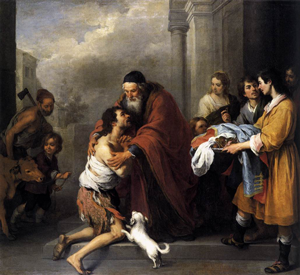
III. The Parable of the Prodigal Son – A young man, entitled by law to a third of his father’s estate, essentially tells his father to “drop dead.” He wants his inheritance now and the old man isn’t dying fast enough. Incredibly, the father gives it to him!
Crazy! The father is a nobleman (land owner) and could hand his son over for serious punishment for such dishonor. Inheritance in hand, the son leaves his father and goes off to “a distant land,” where he sinks so low that he ends up looking up to pigs. He comes to his senses and returns to his father, daring only to hope to become one of his father’s hired workers.
But then it gets even crazier! The father sees his son from a long way off (meaning that he was looking for him), and then does something a nobleman would never do: he runs. Running was considered beneath the dignity of a nobleman because it would imply that he was either a slave on an errand or a fugitive. Further, in order for a man to run in the ancient world, he first had to “hike up” his long flowing robe. Otherwise, his legs would get tangled up in the garment and he would likely trip and fall. For a nobleman to show his legs was considered an indignity.
Do you get the picture? This nobleman, this father, is debasing himself, humbling himself. He is running and his legs are showing. This is crazy! Do you know what this son has done? Does he deserve this humble love? No! The father is crazy!
Exactly! The heavenly Father is “crazy” too. He actually loves us and humbles Himself for us. He even sent His own Son for us. Do you and I understand what we have done? Do we deserve this? No! It’s crazy!
The second son is also a handful. When he hears of the party being given for his wayward brother he refuses to come in. Again, it would have been unthinkable in the ancient world for a son to refuse to come when summoned by his father. And what does the father do? He comes out and pleads with him to enter!
Again, it’s crazy! It’s unthinkable. No father in the ancient world would ever have permitted his son to speak to him in this way. The son basically calls him a slave-driver who issues orders; he refuses to enter the party that his father is hosting, saying that he’d rather celebrate with his friends than with his father. But (pay attention here) the goal in life is not celebrate with your friends; it is to celebrate with the Father in Heaven.
This father is crazy. He is crazy because God the Father is crazy. Do you know what it means to refuse to do what God says? And yet we do it every time we sin! Our heavenly Father should not have to tolerate this. He is God and we are His creatures. If He wanted to, He could squash us like bugs! But He does not. The father in this parable is almost “dangerously” merciful. Shouldn’t his sons be taught a lesson? Shouldn’t he punish them both for their insolence? All our human thinking kicks in when we hear this parable.
But God is God, not man. There are other Scriptures that speak of God’s punishments. But in the end, none of us get what we really deserve. Jesus’ point in the parable is that God is merciful and His love is crazy; it makes no human sense. His love for us is extravagant beyond what is humanly reasonable or explainable. Don’t try to figure it out. Don’t try to analyze it too much. Just be astonished; be amazed. Yes, this is crazy. That God loves us is crazy, unexplainable.
Crazy!