Most of us have those handheld “devices.” The antiquated cell phone has become a multifunction unit. It’s an internet portal, camera, computer, emailer, texting device, music and game center, GPS unit, and advisor (“Hey Siri!”). You might even use it to make a phone call! Devices, can’t live with them, can’t live without them.
But we can learn to set proper boundaries and avoid the rudeness that can accompany their use. Too often, we allow the virtual to eclipse the actual and we pay insufficient attention to those physically present with us.
The word “device” comes from the Old French word, devis, meaning division or separation. Without doubt, our hand-held devices divide our attention, separating us from the people with whom we should be interacting.
In a typical meeting, many in attendance are gazing down frequently at their little units. Soon enough, thumbs are typing away and attention is waning. The same is often the case during conversations, walks, meals, movies, and car rides. We are often divided from those with whom we should be present and unified.
Our devices also drive a sense of urgency, a feeling that information has to be shared at once. This is especially true with texting. There is a general expectation that a text will elicit a quick reply. When this doesn’t happen we’re often either irritated or anxious: “I hope he’s all right; I texted him and he didn’t answer!” Never mind that the person might be busy; there’s still the expectation that he’ll reply quickly regardless of what he’s doing.
Do you remember the old “busy signal”? If you called someone who was on the phone with someone else you got the busy signal, which in effect said, “I can’t talk to you right now, I’m busy talking to someone else.” Imagine that!
Then came “call waiting,” that irritating clicking sound indicating that someone is trying to reach you. This created distraction, stress, and even the expectation that you should interrupt your current conversation and multitask or break away from the current caller entirely in order to talk to someone more deserving of your attention.
Today it seems that nothing can or should wait. Everyone needs your immediate attention, or such is the prevailing expectation. Resentment can follow quickly when expectations are not met.
In addition, many people have developed a kind of obsession with staying informed and connected. Not only are there the personal messages, but also the constant alerts indicating “breaking news” or something else of which you must be immediately aware.
Group text messages can be especially obnoxious, with dozens of replies and replies to replies back and forth between all the recipients. In short order, the text message queue is filled with long threads of often extraneous commentary.
The demand for instant information and quick response can cause a number of other problems such as impatience, imprudence, rash judgment, and becoming gossips and busybodies.
Somehow we have to get back to a more reasonable pace in our life. Many things can wait. Most interruptions we accept as necessary are not. It really is possible to go to a meeting or to Mass with your device turned off; you don’t need to be checking your messages or emails constantly. Your presence and your undivided attention is a great gift to those you are with.
Here are some New Year’s resolutions you might want to consider:
Be less anxious or angry if someone doesn’t text or email you back right away. Remember, he or she might be busy.
Don’t feel the need to apologize so much for not getting back to someone right away. Nearly instant access to people is a fairly new concept; not so long ago we managed to survive just fine without it.
Turn off some or all of the sounds that signal a new text, e-mail, or the availability of some other information. Do this permanently if possible, or at least with enough frequency that you can break the obsession with always knowing what is going on.
Check for text and email messages a reasonable number of times each day, but not when you are in meetings, in conversations with others, at lunch with friends, etc.
Take out those earbuds as often as you can and just walk the old fashioned way: greet people, make eye contact, give some indication to people you pass by that you care that they exist, rediscover background noises or the sounds of nature, maybe even enjoy a little silence.
Designate an occasional day when you completely unplug from your device and just “chill.”
Make use of the “do not disturb” feature on your device. Most devices allow you to specify a limited set of people/circumstances under which the device will alert you to incoming calls or notifications. Carefully consider who belongs on the list and let the rest of the messages wait.
Sometimes less is more. We ought to consider pacing our day, having times when we gather information, times when we do our work without a lot of distraction, and times when we rest. It is too easy to allow the urgent to eclipse the important.
Consider making a resolution to do a little more triage. Many things that seem urgent or requiring immediate attention can in fact wait. Although God could solve everything all at once with the snap of His fingers, He does not do so; He has His reasons. Learn from God; let things have their time. Waiting and silence are key concepts in the spiritual life and in God’s world.
Last week at Christmas we celebrated an event that was both pivotal and hidden. The conception and birth of Jesus Christ were events that changed human history. It was a daring, hidden raid by the Kingdom of Light into the kingdom of darkness, an incursion behind enemy lines, into enemy territory. Only some shepherds in Bethlehem and a few magi from distant lands were witnesses to this event, one which began the undoing of the long reign of sin.
St. Paul hints at this drama in today’s second reading:When the fullness of time had come, God sent his Son, born of a woman (Gal 4:4). Yes, all time meets here. The long reign of sin is ending; Our Savior stealthily emerges to begin His work of giving us a way out. The wall has been breached and will one day wholly crumble.
Even Satan, to whom we often attribute exaggerated powers, seems unaware. The later visit of the Magi makes him suspicious, but even with that, his knowledge is lacking. Through his agent, Herod, he stabs wildly, searching for the interloper, but he misses the mark. Jesus eludes him for another thirty years, preparing for a final showdown that will seal Satan’s fate as the great loser.
Something happened that quiet Christmas night, enormous in its implications but mostly hidden and unnoticed. A ray of light flashes in a darkened world, just long enough to be remembered by a few. It is like a seed that is sown; it remains hidden for a time, but later yields a harvest that will undermine the world of darkness.
I offer all of this as a prelude to a year that I think will be significant for the Church and for the world. The Year of Our Lord 2017 may seem to many to be an insignificant one; we tend to favor years that end in 0s or 5s. The year 2000 seemed to carry great weight, but it passed quietly.
Why should 2017 be significant? I offer several reasons for your consideration. I do this in all humility, reminding those who read this that official and public revelation ended with the death of the last Apostle. No Catholic is required to give any credence to the disclosures or private revelations of apparitions or to the writings and warnings of mystics and saints; you are free to accept or reject these prophecies. While the Church commends approved apparitions to our consideration, she does not command our acceptance of them.
Yet Scripture does say, Surely the Sovereign Lord does nothing without revealing his plan to his servants the prophets (Amos 3:7). Jesus’ birth in Bethlehem had long been prophesied, as were most of the central truths of His ministry and Paschal mystery. And while much of this was seen most clearly in the rear-view mirror, God does signal His people of His plans, lest we be caught off guard or think that He acts whimsically.
I would argue that we today are being called by God to special prayer. This summons is always at work, but certain prophecies indicate that 2017 will be significant. Consider, then, the following indications that 2017 will require special prayer of us.
It is the 100th anniversary of the apparitions at Fatima.These apparitions are unique in that they have been affirmed by a miracle and by historical fulfilment.
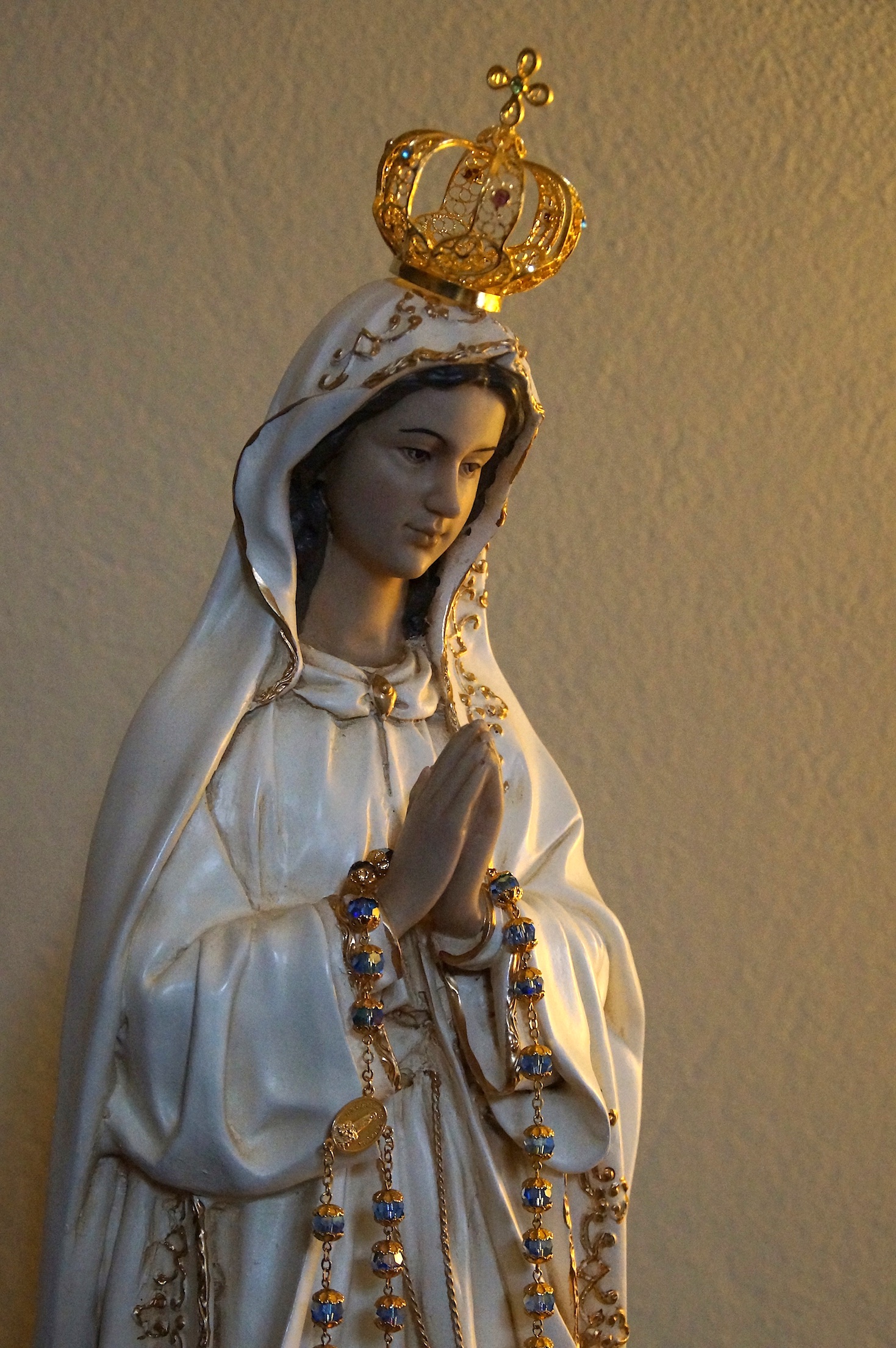
Three young children, Jacinta, Francisco, and Lucia, were visited by the Mother of Jesus six times in the region of Fatima, Portugal between May 13th and October 13th, 1917. At that time, the First World War was ending and the Western world was torn asunder by bloody violence.
At the time, the appearances of Our Lady generated both controversy and fascination. Our Lady’s message was fundamentally one of peace, but she warned of serious consequences if people did not turn more wholeheartedly to her Son, repent of their sins, and pray for peace.
She explained that war is a punishment for sin and warned that without our repentance, God would further castigate the world for its disobedience. She indicated that we would experience the wretched fruits of our sins through war, hunger, and the persecution of the Church, the Holy Father, and the Catholic faithful. The Blessed Mother prophesied that although the First World War was ending, without our repentance, a second and worse war would arise and that Russia would be God’s chosen instrument of chastisement, spreading the “errors” of atheism and materialism across the earth, fomenting wars, annihilating nations, and persecuting the faithful everywhere.
She further prophesied that a final warning would be given before the outbreak of a new war:When you see a night illumined by an unknown light, know that this is the great sign given you by God that he is about to punish the world for its crimes. Indeed, a large display of the Northern Lights occurred in January 1938 throughout the Northern Hemisphere and reaching into the Southern Hemisphere, making headlines internationally. Shortly thereafter, the Second World War was underway. Germany occupied Czechoslovakia in 1938 and invaded Poland in 1939.
As a verification of her appearances, Our Lady promised a miracle at the final apparition. With as many as 70,000 people in attendance, the miracle of the sun took place on October 13, 1917. Those gathered both marveled and feared as the sun danced and moved about in the sky on what had been a rainy day.
Recall that this was prophesied in 1917, long before the Second World War and Russia’s rise to power. Most could not have imagined a more devastating war than World War I, nor that Russia, a poor and largely Christian nation, could or would do such a thing. Yet all these prophecies were fulfilled.
The third prophecy of Fatima, kept secret until the year 2000, spoke of a great period of suffering for the Church, including the martyrdom of the Pope. A bishop dressed in white climbs a mountain near a ruined city toward a cross. He passes the corpses of many martyrs and many others who have suffered. At the top of the mountain, near the cross, he himself is killed by armies. In releasing this third part, the Vatican commented,
The history of an entire century can be seen represented in this image. Just as the places of the earth are synthetically described in the two images of the mountain and the city, and are directed towards the cross, so too time is presented in a compressed way. In the vision we can recognize the last century as a century of martyrs, a century of suffering and persecution for the Church, a century of World Wars and the many local wars which filled the last fifty years and have inflicted unprecedented forms of cruelty. In the “mirror” of this vision we see passing before us the witnesses of the faith decade by decade. Here it would be appropriate to mention a phrase from the letter which Sister Lucia wrote to the Holy Father on 12 May 1982: “The third part of the ‘secret’ refers to Our Lady’s words: ‘If not, [Russia] will spread her errors throughout the world, causing wars and persecutions of the Church. The good will be martyred; the Holy Father will have much to suffer; various nations will be annihilated.’”
Pope John Paul II saw his near-assassination in 1981 as the fulfillment of this prophecy and indicated that he only escaped death as a merciful intervention by Our Lady in response to prayer.
One additional aspect of the Fatima apparitions was given in 1981. Sister Lucia, the lone surviving visionary, wrote to Monsignor (now Cardinal) Carlo Caffara at the Vatican of something she heard from Our Lady: The final battle between the Lord and the reign of Satan will be about marriage and the family. Don’t be afraid … anyone who works for the sanctity of marriage and the family will always be fought and opposed in every way, because this is the decisive issue. … however, Our Lady has already crushed its head. (This letter is now in the archives of the John Paul II Institute on Marriage and Family.)
And here we are in modern times, desperately confused about the nature of marriage, sexuality, and the family. Many who stand up for what has always been taught and believed are called intolerant, backward, and/or bigoted.
According to the Fatima apparitions and this later addition from 1981, we are in the endgame, the final showdown, of this modern attack on the Church by Satan.
Another vision, less well-known, was said to have appeared to Pope Leo XIII on October 13, 1884 (33 years to the day before the final apparition at Fatima). It was revealed to him that a period of 100 years was coming during which the Church would be sorely tempted and tested, likely in order to purify us. Pope Leo was so troubled by this vision that he penned the well-known Prayer to St. Michael the Archangel and asked the faithful to recite it; until about 1970 it was traditionally recited after Mass.
When did that 100 years begin? It is not certain, but something tells me that it began in 1917 and thus will end in 2017. I do not think it likely that it will end suddenly, but Heaven knows. Clearly the Church has been sorely oppressed; we have lost large numbers. There has been a persecution, a pruning. There has been internal turmoil over doctrine and liturgy, a breakdown in discipline, and a great exodus of priests and religious. We have been reduced to be sure, but not destroyed. We have been prepared for something … but what?
I cannot answer all these questions, but I do know this: we are called to profound prayer this year. Although this is our perennial call, this year’s call is special.
In this parish, I will be scheduling special times of prayer and adoration. I will provide more details in the weeks ahead (prior to Lent), but this much is certain: Beginning in March, I want to observe the First Saturday devotions that were requested by our Lady at Fatima. This includes going to confession, attending Mass, and reciting the Holy Rosary on five consecutive Saturdays. We will pray for the conversion of sinners (starting with ourselves), for peace in this world, and for special graces for unity and growth of faith in the Church. Prior to that time, I intend to provide further catechesis in order to prepare us.
What exactly will happen in 2017? Will it be like the first Christmas, a hidden event with later consequences? Or will it be a dramatic event that brings about widespread, sudden conversion and an end to the persecution? I do not know; I only know that we need to pray. 2017 will be no ordinary year.
On this feast of Our Lady, we need, like Jesus, to stay close to her. We need to hear her call to pray and to obey all that her Son Jesus taught. Pray with me this year, one that will likely be very significant.
One of the more poorly translated (into English) verses of the Bible is this one: If you love me, keep my commandments (John 14:15). This gives the impression that the commandments are an imposition on us and that we prove our love for the Lord by keeping them through our own human effort. The verse thus translated could be interpreted to mean this: “If you really love me, prove it by keeping my commandments.”
But the verb translated here as the imperative “keep” is not an imperative in the Greek text. The Greek word used is τηρήσετε (tērēsete), a future active indicative verb form, better translated as “you will keep.” A more literal translation of the verse would be this: “If you love me, you will keep my commandments.”
This changes the tone of the verse and helps to show that the keeping of the commandments is the fruit of love rather than evidence that we are proving our love through human effort. In effect, the verse can mean this: “If you love me, you will keep my commandments with a joy and enthusiasm because lovers like to please their beloved.”
Love can take a difficult task and make it joyful for us because we know that our beloved is pleased. We are happy to please people whom we love.
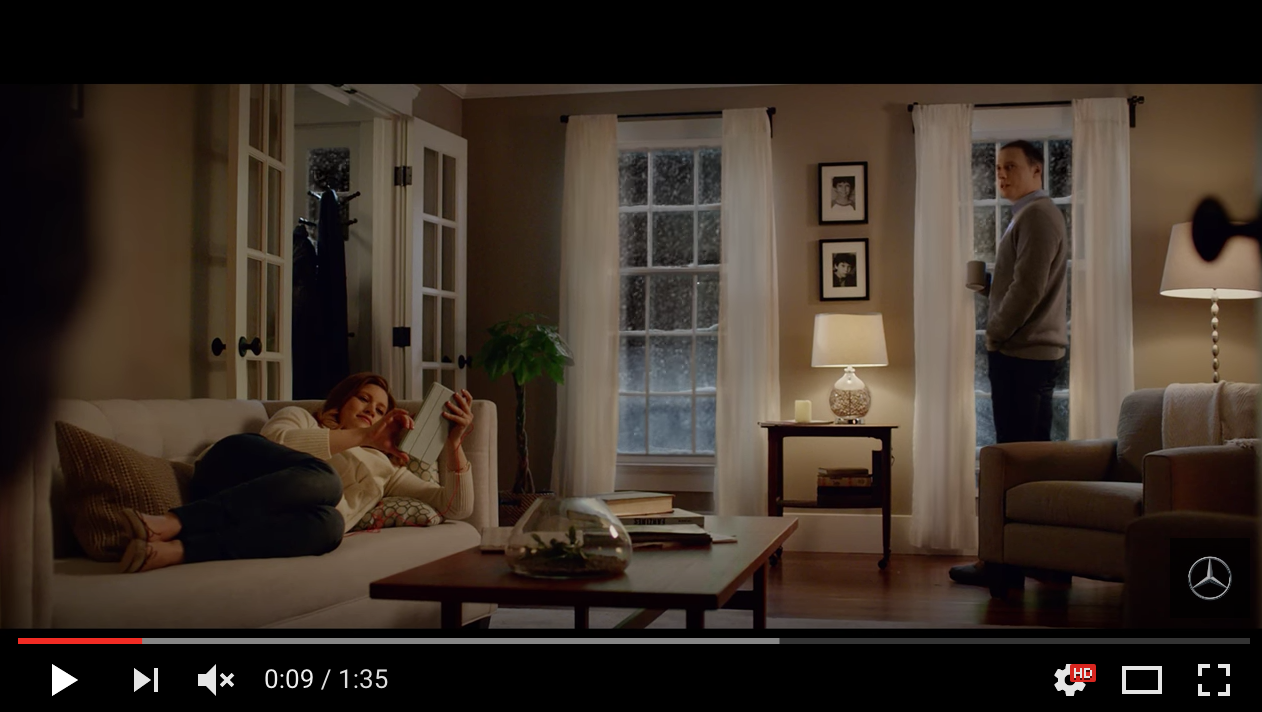
This commercial shows the draw of love even when the task is difficult. Love empowers us to overcome obstacles to be with our beloved. Are we this way with prayer, or getting to Mass, or keeping the commandments? There may be times when we are reasonably hindered from such things, but overall, do we resist distractions and difficulties or do we just give up? Do lovers give up easily or does love find a way?
Something at Christmas urges me (a man of many words) to write of holy silence. Perhaps it is due to one of the great Christmas antiphons, which speaks of the birth of Christ as a magnum mysterium (a great mystery). During Mass recently, the words of Zechariah came to my mind:
Sing and rejoice, O daughter of Zion, for behold, I come and I will dwell in your midst, declares the Lord … Be silent, all flesh, before the Lord, for he has roused himself from his holy dwelling (Zechariah 2:11, 13).
There is a common idiom: “Words fail me.” It is in this context that we can best understand God’s call to fall silent before the mystery of the Lord’s incarnation. Notice in the passage above that the call to silence follows the call to “sing and rejoice.”
Is there a difference between singing and rejoice and just plain speaking? Of course there is! By adding the inscrutable sighs we call “song” (a deeply mysterious emanation from our souls) to the words, singing is declaring that “words fail.”
To be sure words, are a “necessary evil” for us, but in using words we indicate more what a thing isnot than what it is. For example, if I say to you, “I am a man,” I have really told you more what I am not than what I am. I have told you I am not a woman, nor a chair, nor a lion, nor a rock. But I have not told what it means to be a man. I have not told you myriad other things about myself that I could: I am a priest; my father was a lawyer and Navy veteran; my mother was a teacher; I am descended from Irish, German, and English immigrants. I have not told you about my gifts, or my talents, or my struggles, or numerous other aspects that make me who I am. And even if I spent several paragraphs relating my curriculum vitae to you, there would still be vastly more left unsaid than was said. Words fail.
Further, words are not the reality they (often poorly) attempt to convey. They are symbols of what they indicate. If you see a sign, “Washington” you don’t stop there and take a picture of the sign. The sign itself is not Washington; it merely points to the reality that is Washington. You pass the sign and enter into a reality far bigger than the metal sign and begin to experience it. Words fail.
Many words are also more unlike the reality they describe than like it. My philosophy teacher once asked us how we would describe the color green to a man born blind. We struggled with the task but were able to come up with some analogies: green is like the taste of cool mint; green is like the feel of dew-covered grass. To some extent green is like these things, but the color green is more unlike these things than like them. Green, as a reality, is so much richer than the taste of cool mint or the feel of dew-covered grass. Words fail.
And if this be so in the case of mere earthly things, how much more so in the case of heavenly and Godly matters! The Lord therefore commands a holy silence of us as a kind of reminder that words fail. Silence is proper reverence for the mystery of the incarnation and of God. Words are necessary; without them orthodoxy could not be set forth and truth could not be conveyed. But, especially regarding God and the truths of faith, there comes this salutary reminder from St. Thomas Aquinas: “Now, because we cannot know what it God is, but rather what he is not, we have no means for considering how God is, but rather how he is not” (Prima pars, q. 3, prologue).
Therefore, fellow Catholics, as the mysteries of the incarnation unfold for us liturgically, Let all mortal flesh keep silence, and with fear and trembling stand, Christ our God to earth descendeth, bearing blessings in his hand (from the hymn, “Let All Mortal Flesh Keep Silence”).
At Christmas we celebrate the birth of the Word made flesh. All the Gospel writers (especially St. John) emphasize the reality of God present among us in a very tangible, physical way. This is a critical truth because one of the dangers is reducing our faith to a mere collection of ideas, setting aside the actual Jesus who took up our full nature, lived among us, and summoned us to a real encounter.
These Christmas themes are more important than ever for us who live in a post-nominalist, post-Cartesian, neo-Gnostic world. The effect of this is that many of us live increasingly “up in our heads.” More and more we are out of touch with reality. What matters is what we think, how we feel, what our opinion is. Such things increasingly overrule even obvious realities.
In such an environment can come the notion that someone can say he is a female trapped in a male body. Never mind that his body is clearly male right down to its X and Y chromosomes. No, what matters is what he thinks and feels. Physical reality has nothing to do with his assertion and he feels quite justified in ignoring it.
How did we get here? It likely started with the rise of nominalism in the 14th century. But what supercharged the problem is sometimes called the “Cartesian divide.” The ideas of philosopher René Descartes are said to divide the more ancient trust in reality and the senses from the modern world, which is marked by increasing skepticism and doubt that we can actually encounter reality at all.
René Descartes lived in the Dutch Republic during the first half of the 17th century. He is widely held to be the father of modern philosophy.
Descartes used a method of fundamental doubt wherein he rejected any ideas that could be doubted, and then tried to re-establish them in what he considered a firm foundation for knowing them as actual or genuine.
This led Descartes ultimately to only a single “provable” principle: that thought exists. He stated this in his treatise, “Discourse on the Method and Principles of Philosophy.” This is the source of the well-known phrase cogito ergo sum (I think therefore I am). In other words, because I doubt, something or someone must be doing the doubting. The fact that I doubt proves my existence.
Thus, doubt and skepticism moved to the center. Descartes considered the senses unreliable. He went on to construct a system of knowledge that largely discarded perception as unreliable and admitted only deductive reasoning as a method for thinking or knowing.
Descartes later seemed to back away from the radical skepticism his rationalism implied. He argued that because sensory perceptions came to him involuntarily, apart from his willing them, this was evidence of the existence of something outside of his mind, and thus, of an external world.
Despite his attempts to back away from his radical doubt, by failing to clearly resolve it he left us with a legacy of Cartesian disconnectedness from reality and retreat into the mind.
1. The retreat into the mind and loss of connection with reality. In radically distrusting his senses, Descartes disconnected himself (and us) from the world of reality. What is real is only what is in my mind. The actual “is-ness” of things is no longer the basis of reality. Now, it is just my thoughts that are real. Reality is not “out there” but it is only in my mind. It is what I think that matters.
This leads to a lot of the absurdity of modern times where we tend to overlook reality and reduce everything to opinion. We often think of things abstractly as “issues.”
For example, for many people abortion is an “issue” rather than the dismemberment of a human baby. Many tend to think of abortion abstractly and repackage “it” as choice, or a woman’s right. But abortion is not an abstraction. There is something actually happening “out there” in the real world. An actual child is being dismembered and suctioned into a jar. But the post-Cartesian retreat into the mind allows many to continue to think of abortion abstractly as an “issue.” Detached from reality, the mind can do some pretty awful rationalizing. Showing actual pictures of abortion seems to have little effect on those who have retreated into their minds and think of abortion abstractly as an issue rather than as a real thing.
The same is true for the issue of homosexuality. Any even rudimentary look into the biology and design of the body makes it clear that something is disordered with homosexual activity. The man is for the woman, not for another man; the biology is clear. But with the post-Cartesian retreat into the mind, the body no longer has anything to say to many people. Many ask, “What does the body have to do with it?” All that seems to matter is what they think. It is opinion, not reality, that is important. Thought overrules the body, dismisses the external reality. Here again is the Cartesian flight from the real world into the mind.
And the same holds true for just about every moral issue today. It is my thoughts and intentions that matter, not what I am actually doing.
2. Reality is no longer revelatory. The revelation that comes simply from the way things are is “not reliable.” It is mere opinion in this Cartesian world we have inherited. Scripture and the Natural Law tradition hold that creation and the way things are provide revelation for us. St. Paul said, For what can be known about God is evident to them, because God made it evident to them. Ever since the creation of the world, his invisible attributes of eternal power and divinity have been able to be understood and perceived in what he has made (Romans 1:18-19). There was a confidence in the Scriptures and Natural Law Tradition that the created world, reality, provided a reliable guide to what was right and true. We had only to study the “is-ness” of things to learn. But this was all jettisoned. In the post-Cartesian world, we are skeptical that we can really know or reliably perceive the “there” out there.
3. The Cartesian worldview is unrealistic in insisting upon “absolute” proof.To insist that we, who are contingent and limited beings, can prove or know something absolutely is both arrogant and unrealistic. In the Christian worldview there remains a mystery to all things, a hiddenness that we come to accept. The fact that there is mystery does not mean that we know nothing. We are clearly able to perceive and come to know what God reveals. But mystery is the Christian acceptance of the fact that things are only partially revealed; much more lies hidden and unseen.
For example, every human being is a mystery. We are surely able to perceive many things about people, particularly the ones we know well. We see their physical presence and know many things about them. But there is also a glorious hiddenness to all people, which is related to their inner life and their place in God’s plan. This is mystery: things are revealed, but at the same time, much lies hidden.
Hence the absolute proof demanded by the Cartesian world is unrealistic. A balance is required such that we can be confident about what we do know and honest about what we do not know. Some degree of doubt or uncertainty is part of the human experience. Yes, we can actually know things, though not as absolutely as demanded by the Cartesian world.
4. And this unrealistic notion of needing absolute proof to know things is what leads to the “Cartesian anxiety” of our times and causes us to set up intellectual idols. We tend in our culture to worship science and the scientific method. I would argue that we do this out of Cartesian anxiety. We seem desperate for absolute proof and so we entertain the notion that science can provide it. Of course scientific theories change all the time, but in our anxious search for absolute proof we’re willing to overlook facts like that. “Perhaps older theories have given way, but now we really know; this is ‘settled science.’ We’ve proved it.” Or so we think.
But this is anxiety; it is not reality. Science will continue to change with new data, as it must. And science does not know or prove many things absolutely. We know a lot, but there is a lot we do not know. Good scientists know this and freely admit it. Science alone cannot be the elixir for the radical doubt that troubles us.
And so, here we are. The Cartesian world is in full flower, but it is not a lovely flower. It has led us to an imbalance. On the one hand we distrust reality and have retreated into our minds. Yet, paradoxically we seem desperate to prove some things absolutely in order to overcome the anxiety that extreme doubt produces. Our confidence in reality as a reliable guide was set aside as we have increasingly retreated into our minds. But without reality as a reliable guide, we have sought something to soothe the anxiety that uncertainty causes. And so we trot out science, anoint experts, and entertain the fiction that they can give the absolute proof our Cartesian anxiety demands.
And thus the Christmas message rings ever true: The Word became flesh and dwelt among us. The tangible reality of God’s presence among us remains the Christmas call, the Christian call. God calls us to seek Him in what is. And yet there is also the mystery of something and someone ever deeper and more real than we could imagine. He is real, but our appreciation must grow ever deeper. The truth of what is real unfolds because it is real and not merely an idea or a passing thought.
One day the real Jesus, the Word made flesh, heard two disciples say, “Rabbi! Where do you stay?” And He said, “Come and see” (Jn 1:39).
O Holy night! Yes, a silent night! And it came upon a midnight clear! Christmas, it would seem, is a festival of the middle of the night. Jesus is born when it is dark, dark midnight. We are sure of it. And why shouldn’t we be?
Even though we are not told the exact hour of His birth, we are sure it must have been at night. Scripture does say that the Shepherds who heard the glad tidings were keeping watch over their flock “by night” (cf Luke 2:9). Further, the Magi sought Him by the light of a star, and stars are seen at night, deep midnight. None of this is evidence that Jesus was born at 12:00 midnight but it sets our clocks for night, deep midnight.
Add to this the fact that Christmas is celebrated at the winter solstice, the very darkest time of the year in the northern hemisphere. More specifically, Christmas comes when light is just beginning its subtle return. The darkest and shortest days of the year occur around December 21st and 22nd. But by December 23rd and 24th we notice a definite but subtle trend: the days are getting longer; the light is returning! It’s time to celebrate the return of the light. It’s going to be all right!
How fitting it is to celebrate the birth of Jesus, the true Light of the World, in deep and dark December. Jesus our light kindles a fire that never dies away. Indeed, in the dark hours of December, we notice a trend: the light is returning; the darkness is abating; the days are beginning to grow longer. It is subtle right now, but it will grow. And with the return of light, we celebrate our True Light: Jesus.
But light is best appreciated in contrast. We appreciate most the glory of light when the darkness assails us. There’s just something about Christmas Eve. As the time approaches through December and the darkness grows, we light lights. Yes, all through December we light Advent candles, more candles as it grows darker. Even the secular among us string up lights, in malls, on their houses, in their workplace. It’s as if to say, the darkness cannot win; the light conquers!
Lights show their true glory when contrasted with darkness. Who sees the stars in the middle of the day? Who appreciates the full beauty of light until he has experienced darkness? Yes, Christmas is a feast of the light. We confront the darkness of December and declare to it, “Your deepest days are over. The light is returning.” And we of faith say to a world in ever deeper darkness, “Your darkness cannot prevail. It will be overcome and replaced.” For although darkness has its season, it is always conquered by the light.
An atheist recently scoffed at me in the comments of this blog that our day is over; the world has rejected faith. Sorry, dear atheist friend, the light always wins. On December 22nd, the darkness begins to recede and the light begins to return. The light returns subtly at first, but it always does; the darkness cannot last.
Light has a way of simply replacing the darkness. In three months the equinox occurs and in six months the summer solstice, when we have the most light. Then the darkness will once again seek to conquer. But it always loses! The light will return. Jesus is always born at the hour of darkness’ greatest moment. Just when the darkness is celebrating most, its hour is over; the light dawns again.
We celebrate after sundown on December 24th, in accordance with a tradition going back to Jewish times (feasts begin at sundown the night before). Christmas morning is almost an afterthought. Most pastors know that the majority of their people come to Mass the “night before.” In a deep and dark December, a light comes forth. A star shines in the heavens.
We gather together in and on a dark night. We smile. We are moved by the cry of a small infant, by whose voice the heavens were made. His little cry lights up the night. The darkness must go; the light has come; day is at hand.
We celebrate at night so as to bid farewell to the darkness. It cannot prevail. It is destined to be scattered by a Light far more powerful than it is, a Light it must obey, a Light that overwhelms and replaces it. Farewell to darkness; the Light of the World has come!
Jesus is the Light of the World.
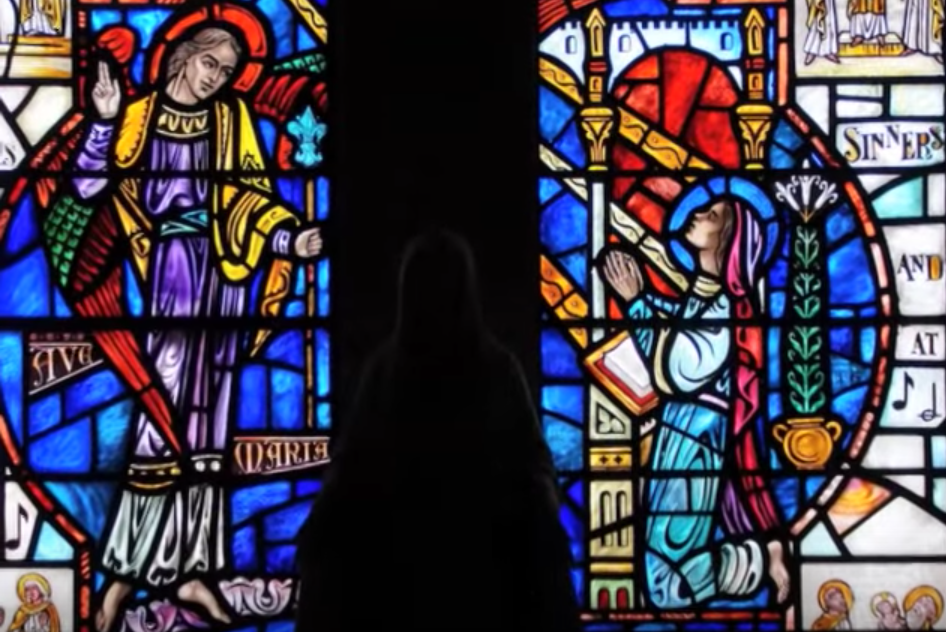
The video below is a celebration of light. As a Christmas gift to myself I took the afternoon of December 22nd (the darkest day of the year) off so that I could photograph the triumph of light over darkness. I went to a mausoleum, a place where thousands are buried in the walls. But also in those walls are windows, glorious windows where light breaks through and Christ shines forth. Some of the most beautiful stained glass in the city of Washington, D.C. resides in that place of death and darkness. The light breaks through and it speaks of Christ.
This video shows only some of those stained glass windows (I am putting together a video of other windows to be shown later). The text of the music in this video is from Taizé, and it says, Christe lux mundi, qui sequitur te, habebit lumen vitae, lumen vitae (Christ, Light of the World, who follows you has the light of life, the light of life).
As you view this video depicting the Life of Christ, ponder that although stained glass begins as opaque sand, when subjected to and purified by fire it radiates the glory of the light which can now shine through it. So it is for us. Born in darkness but purified by Christ and the fire of the Spirit, we begin to radiate His many splendored Light shining through us to a dark world.
In the ancient Church and up until rather recently, one genuflected at the two references to the Incarnation during the Mass: during the Creed and in the Last Gospel (John 1). Why was this done? It was explained to me that the mystery of the Incarnation is so deep, one can only fall in silent reverence.
There are many paradoxes and seeming impossibilities in the Incarnation. They cannot be fully solved, so they claim our reverence. We genuflected in the past, and today we bow at the mention of the Incarnation in the Creed, for it is a deep mystery.
As we continue to celebrate Christmas I would like to list some of the paradoxes of Christmas. I want to say as little about them as possible—just enough to make the paradox clear. This paucity of words (not common with me) is in reverence for the mystery and also to invite your reflection.
The Infinite One becomes an infant.
An antiphon for the Christmas season says, How can we find words to praise your dignity O Virgin Mary, for he whom the very heavens cannot contain, you carried in your womb.
An old Latin carol (in Dulci Jublio) says, Alpha et O, Matris in Gremio (Alpha and Omega, sitting in Mommy’s lap).
He who looks down on all creation looks up to see His Mother. The most high looks up from a cradle. Of this moment, even the pagans wrote with longing and tenderness: Incipe, parve puer, risu cognoscere matrem … ipsa tibi blandos fundent cunabula flores, occidet et serpens, et fallax herba veneni occidet (Begin, little boy, to recognize the face of your mother with a smile … for you, your own cradle will bear delightful flowers; the serpent will die and the plant that hides its venom) – Virgil 4th Eclogue.
He who indwells all creation is born in homelessness, no place to dwell.
He, to whom all things in Heaven and on earth belong, is born in poverty and neediness.
He is the mighty Word through whom all things were made. He is the very utterance of God, the Voice which summons all creation into existence. Of this Word, this Utterance, this Voice, Scripture says, The voice of the LORD is upon the waters; the God of glory thunders, the LORD, upon many waters. The voice of the LORD is powerful, the voice of the LORD is full of majesty … The voice of the LORD flashes forth flames of fire. The voice of the LORD shakes the wilderness … The voice of the LORD makes the oaks to whirl, and strips the forests bare; and in his temple all cry, “Glory!” (Ps. 29) Yet this voice is now heard as the cooing and crying of an infant.
His infant hand squeezes His mother’s finger. From that infant hand, the universe tumbled into existence. That same hand is steering the stars in their courses.
He who holds all creation together in Himself (Col 1:17) is now held by His Mother.
He who is the Bread of Life is born in Bethlehem (House of Bread) and lies in a feeding trough (manger).
He who is our sustainer and our food is now hungry and fed by His Mother.
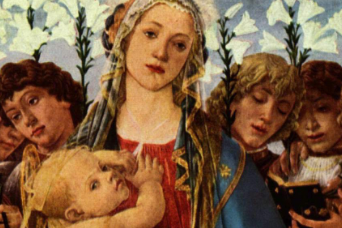
Angels and Archangels may have gathered there, Cherubim and Seraphim thronged the air! But only his mother in her maiden bliss, could worship the beloved with a kiss (Christina Rosetti “In the Bleak Midwinter”).
Each of these is meant to be a meditation on the great mystery of the Incarnation. Please chime in with your additions to this list!
A paradox is something that defies intuition or challenges the common way of thinking. It unsettles us or startles us into thinking more deeply. The word paradox comes from the Greek para (beside, off to the side, or above) and dokein (to think or to seem). Hence a paradox is something “off to the side” of the usual way of seeing or thinking about things. If you’re going to relate to God you’re going to deal with a lot of paradox, because God’s ways and His thinking often defy those of humans. God is not irrational but He often acts in ways that do not conform to worldly expectations.
This Christmas, consider these paradoxes and learn from them. Remember, though, that mysteries are to be lived more so than solved. Reverence is a more proper response to mystery than is excessive curiosity. More is learned in silence than by many words.
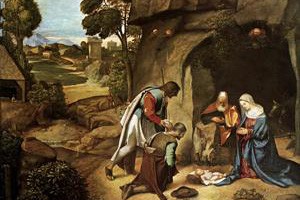
The Christmas Gospel from Luke provides us with many teachings. One thing that surely stands out, however, is the permeating theme of humility. Throughout the account, God confounds our prideful expectations and insists on being found in the lowest of places.
The newborn Christ is not found where we expect Him to be nor does His birth conform to any script we would design. Right from the start, He gives us many lessons in humility and begins His saving work of healing our wound of pride. Let’s look at these lessons in four stages.
I. The Procession to the Place – In those days, a decree went out from Caesar Augustus that the whole world should be enrolled. This was the first enrollment, when Quirinius was governor of Syria. So, all went to be enrolled, each to his own town. And Joseph too went up from Galilee from the town of Nazareth to Judea, to the city of David that is called Bethlehem, because he was of the house and family of David, to be enrolled with Mary, his betrothed, who was with child.
There is a sort of “cast of thousands” that leads Mary, Joseph, and Jesus to be in Bethlehem. The distant Caesar Augustus sends out a decree affecting millions. He wants a census taken in order to update his tax rolls. He also likely wants to measure his power and may have military deployments and a draft in mind. Soon enough, dozens of governors deploy thousands of troops to enforce the edict. Even in the small town of Nazareth, a town of barely 300 people, Roman troops enforce the decree. Mary is nine months pregnant, but there will be no exceptions.
For many of us, this offends our sense of what should justly happen. Jesus, who is Lord and Savior, should be born in comfort; Mary should be surrounded by loving family and in the care of midwives.
The first lesson in humility is our surprise and even indignation at the events surrounding Jesus’ birth.
God, however, is neither surprised nor stymied. All this fits into His plan to get Jesus, Mary, Joseph, and all of us to the place of blessing. Whatever evil the Emperor intends, God intends it for good (see Genesis 50:20). The Messiah, it was prophesied, would be called a Nazarene (Matt 2:23), be born in Bethlehem (Micah 5:2), and die in Jerusalem (Lk 13:33). God is setting things in place for the blessing.
And here is the second lesson in humility: Your life is not just about you. You and I are part of something far larger. Just as millions were set on the move at the birth of Christ, so you and I are part of the larger plan and providence of God involving billions of people now living, countless others who have lived, and still others who will live in the future. God sees the bigger picture, yet not one detail is lost to Him. Humility! God has more in mind than our comfort and personal agendas. We are part of something bigger as well.
The third lesson in humility is that God must get us to certain places in order to bless us. And they may be strange places, ones we would not choose. Getting us there may involve hardship for us: disappointment that our own plans have not come through, and the painful loss of places, things, and people we love. Yes, God has blessings waiting for us in strange places, involving circumstances we never imagined.
For Joseph and Mary, the procession to the place called Bethlehem involved hardship. But this procession is necessary for them and for us. Bethlehem was where the blessing would be found—there and no other place. And the same is true for us in so many ways.
God has been good to me and blessed me in ways and in places I never expected or planned. God must get us to certain places in order to bless us. I am and have been blessed; I am a witness.
Don’t miss the procession to the place that opens this Gospel. It is a paradigm for our lives. Where is your Bethlehem? Where does God need to get you in order to unlock your blessings? Are you humble and teachable enough to go there?
Remain humble and don’t quickly despair when the surprises and vicissitudes of life emerge. God may be up to something. He can make a way out of no way and write straight with crooked lines.
II. The Paradox of His Poverty – While they were there, the time came for her to have her child, and she gave birth to her firstborn son. She wrapped him in swaddling clothes and laid him in a manger, because there was no room for them in the inn.
Don’t miss the poverty that is manifest here—it is a chosen poverty. St. John Chrysostom said,
Surely if [the Lord] had so willed it, He might have come moving the heavens, making the earth to shake, and shooting forth His thunderbolts; but such was not the way of His going forth; His desire was not to destroy, but to save… And, to trample upon human pride from its very birth, therefore He is not only man, but a poor man, and has chosen a poor mother, who had not even a cradle where she might lay her new born Child; as it follows, and she laid him in the manger (Quoted in the Catena Aurea – Lection 2 ad Luc 2:6).
The paradox of poverty is the fourth lesson in humility! We who are worldly think that poverty is the worst thing, but it is not—pride is the worst thing. And thus the Lord teaches us from the start that greatness and blessings are not found merely in what is high, mighty, pleasant, or pleasing. Blessings are often found in unusual ways and under unexpected circumstances.
The greatest blessing ever bestowed is not found in a palace, or in Bloomindales, or on beachfront property; He is not even found in a cheap Bethlehem inn. He is found in a lowly manger underneath an inn. It is poor and smelly and He rests in a feeding trough. But there He is, in the least expected place, the lowest imaginable circumstances. In this way He confounds our pride and our values.
Are we humble enough to admit this and to stop being so resentful and crestfallen when things don’t measure up exactly to our standards?
He chooses this poverty. Whatever its unpleasant realities, poverty brings a sort of freedom if it is embraced. The poor have less to lose and thus the world has less of a hold on them. What does a poor man have to lose by leaving everything and following Jesus? Wealth has many spiritual risks. It is hard for the rich to inherit the Kingdom of Heaven. Wealth is too easily distracting and enslaving. And even knowing all this, we still want it. In choosing poverty, Jesus confounds our pride, greed, lust, and gluttony.
The Lord does not just confound us; He also chooses this to bless us. St. Paul said,
For you know the grace of our Lord Jesus Christ, that though he was rich, yet for your sake he became poor, so that by his poverty you might become rich (2 Cor 8:9).
He also said,
Christ Jesus, though he was in the form of God, did not count equality with God a thing to be clung to, but emptied himself, taking the form of a servant, being born in the likeness of men. And being found in human form he humbled himself and became obedient unto death, even death on a cross (Phil 2:5).
Bede, the 7th century Church Father, wrote,
He who sits at His Father’s right hand, finds no room in an inn, that He might prepare for us in His Father’s house many mansions; He is born not in His Father’s house, but [under] an inn and by the way side, because through the mystery of the incarnation He was made the way [for us back to our Father’s House] [Catena, Ibidem].
Thank you, Jesus, for the paradoxical perfection of your poverty. Through it you confound our human ways and bless us more richly than we could ever expect! Thank for this lesson in humility.
III. Proclamation to the People –Now there were shepherds in that region living in the fields and keeping the night watch over their flock. The angel of the Lord appeared to them and the glory of the Lord shone around them, and they were struck with great fear. The angel said to them, “Do not be afraid; for behold, I proclaim to you good news of great joy that will be for all the people. For today in the city of David a savior has been born for you who is Christ and Lord. And this will be a sign for you: you will find an infant wrapped in swaddling clothes and lying in a manger.”
The fifth lesson in humility throws into question our overemphasis on politics and worldly power. This section of the nativity narrative serves to strongly remind us that our salvation is not to be found in the statehouse, the courthouse, or the White House. We are not to put our trust in princes. Our salvation is in Jesus, only in Jesus. Are we humble enough to admit this and stop exalting worldly power?
Note that in this Gospel, lots of “emperor words” are used to describe this newborn infant, Jesus. Yet here He is in a lowly manger!
Emperors had heralds that preceded their arrival and summoned their subjects. The infant Jesus has the angel of the Lord to announce Him. Later, this heralding angel will be joined by a “host” of angels. The Emperor Augustus has his Legions, but Jesus has His myriad angels.
The angel also uses words appropriate for an emperor. He says, “I proclaim to you good news of great joy that will be for all the people.” This is how the declarations of emperors began. The Greek text makes this even clearer: the angel uses the word εὐαγγελίζομαι (evaggelizomai), which means “I evangelize you,” “I announce good or life changing news.” This word for “evangelize” was associated especially with an edict or announcement from the Emperor. But what the emperors questionably claimed for their edicts is really true with Jesus!
The emperors also claimed the titles “savior” and “lord.” The angel calls Jesus Savior (σωτὴρ – Soter) and Lord (κύριος – Kyrios), and He alone deserves these titles.
Here is the irony that we must humbly accept: this true Lord and Savior, this God of Armies with plenary authority, is not in some palace drinking from goblets and being fanned by slaves. He is lying in a lowly feed box, attended to by animals.
It is a divine comedy. One can almost imagine the shepherds wrinkling their noses or scratching their heads as they hear this great announcement of a King, Savior, Lord and Messiah, and then hearing that He is to be found in a stable, lying in a feeding trough. Perhaps one shepherd said to the other, “Did that angel say ‘manger’?” And another replying, “Yup, a feeding trough.”
It’s a bit anticlimactic! But thank the Lord, they humbly accept the procession that they must now make to the place of true blessing. It is an unexpected place to be sure, but that is where He is to be found. He is King and Lord to be sure, but He is humble and comes to serve and to save. He will wash the feet of the worst sinners and die for the love of them.
Humility!
IV. Praise that is Perfect–And suddenly there was a multitude of the heavenly host with the angel, praising God and saying: “Glory to God in the highest and on earth peace to those on whom his favor rests.”
Note the praises of the angels! Who or what could ever match them? They are a multitude. They are perfected in their glory and acclaim God’s praises more gloriously than any human choir could ever hope to do.
Yet even here there is a humility to consider. For the Lord has taken a human nature to Himself, not an angelic one. In the order of creation, angels are far higher and more noble than we are. Their mere appearance overwhelms us and strikes fear in us. Yet to none of these did God ever say, “You are my Son. This day I have begotten you” (See Hebrews 1:5).
God humbly takes up our human nature and bestows on us an astonishing dignity that comes only from Him. It is due to His choice, not our merits. And though the angels can surely praise the Lord in far more glorious way than we, they cannot say, “One of us is God.”
And glorious though the angel’s praise is, there is a perfect praise that only we can give to God. It was beautifully expressed by the poet Christina Rossetti:
Angels and Archangels may have gathered there. Cherubim and Seraphim thronged the air. But only his mother in her maiden bliss could worship the beloved with a kiss.
And thus, our final lesson in humility is to accept that it is our lowliness which the Lord embraced. We have no glory to give that is even close to what the Lord deserves, but a simple kiss will do, a simple act of love. It is our lowly and sinful hearts that the Lord seeks, so as to heal and exalt them. Our palaces, honors, and titles are of no interest or value to Him. It is our humility that pleases Him most, and He desires to meet us there.

 Most of us have those handheld “devices.” The antiquated cell phone has become a multifunction unit. It’s an internet portal, camera, computer, emailer, texting device, music and game center, GPS unit, and advisor (“Hey Siri!”). You might even use it to make a phone call! Devices, can’t live with them, can’t live without them.