 In the world of evangelization, the concept of curiosity is almost never discussed. If anything, evangelizers are encouraged to quickly satisfy any curiosity by supplying all sorts of answers to questions that arise about the faith. Apologetical tracts, books, catechisms, and videos abound. Curiosity, it would seem, is something to be quashed or at least overcome quickly. Allowing a person to wonder why for any length of time seems almost dangerous, especially in a “search-engine” culture. Quick answers, please!
How different this is from the more mysterious and “parabolic” way Jesus handled questions. Ask him a question and you might get another question back from Him. “Are you a King?” asked Pilate. Jesus, on trial for his life replied, “Are you saying this on your own or have others been talking about me?” (Jn 18:33-35) Sometimes Jesus answered obliquely. As Jesus was walking by, Andrew asked Him, “Rabbi, where do you stay?” Jesus just kept on walking and said, “Come and see” (Jn 1:38-39). On other occasions Jesus answered questions or supplied information through enigmatic stories, called “parables” because they do not provide straight answers but are more “parabolic.” They are full of twists and turns, paradoxes and puzzles.
Curious indeed! Come on, Jesus; the people want to know; let’s have some straight answers here! But Jesus, the Master Evangelist and Lord, has something to teach us. Curiosity is important and should not be crushed too soon with lots of stiff or overwhelming answers.
To her great credit, Sherri Waddell in her book Forming Intentional Disciples devotes an entire chapter to this topic. She ranks it as the second threshold to conversion (after trust and before openness). I’d like to combine her insights with some of my own and consider curiosity under four headings:
I. Premises Related to Curiosity
II. Problems Regarding Curiosity
III. Pictures Reinforcing Curiosity
IV. Personal Requirement of Curiosity
Given the length of my reflections, I will cover them in two separate posts. Are you curious yet? Let’s begin!
I. Premises Related to Curiosity
What is curiosity? At its heart, curiosity is a response to an encounter with mystery. The Latin root of curiosity is cur, meaning “why.” Having encountered mystery, we ask questions such as “Why?”, “What is this?”, “What does this mean?”, “Who are you?”, or “Why are you this way?” Mystery engenders curiosity. This analysis of curiosity raises another question:
What is mystery? At its heart, mystery refers to something we see only partially, something that is mostly hidden from us. Almost no person, thing, or event is entirely devoid of mystery. Even something as simple as a tree elicits questions. Why is this tree here? Who planted it and why? Why this kind of tree and not another? Is the tree healthy inside or rotted? Isn’t it amazing that trees breathe our expelled carbon dioxide and give us back the oxygen we need! How has this remarkable symbiosis come about? Yes, even a simple tree has mysteries that pique our curiosity. There is almost always more than meets the eye.
Far deeper are the mysteries related to the people and complex human interactions. Fr. John Le Croix gives the following definition of mystery: Mystery is that which opens temporality and gives it depth. It [also] introduces a vertical dimension and makes of it a time of revelation.
While this definition may seem complex, a simple example might help. Suppose you and I are at a gathering. Smith enters the room and immediately walks up to Jones, enthusiastically shaking his hand. I comment, “Wow!” You say, “What’s the big deal? People shake hands all the time.” I reply, “Smith and Jones have been enemies for thirty years.” The handshake between the two men has a mysterious dimension, one that the eyes cannot see. Yet that mystery is still real, giving the physical handshake both a depth of meaning and a vertical dimension of revelation.
Mystery is rich, fascinating. It can bestow an aura of wonder and awe upon even ordinary things, people, interactions, and events.
Yes, mystery is wonderful. Mystery attracts! It is mystery that generates curiosity, the desire to know more and experience the depths and heights of what is.
Because mystery is important, so is the curiosity that arises as a response to it. It deserves more attention than it usually gets in our theological and pastoral reflections.
II. Problems Regarding Curiosity
Although mystery attracts, we live in times in which there are many factors diminishing its appreciation and the consequent curiosity. This is especially true when mysteries are not quickly “solved” and curiosity cannot be satisfied quickly. There are a number of factors to mention.
First, there is the notion that a mystery is something merely to be solved rather than savored. When we hear the word mystery today we tend to think of crime novels or police shows on television. A crime is committed; the mystery is who did it and for what reason. The “hero” must get to the bottom of this!
While this may be the case for a crime, the mysterious depths of the human person, the significance of human events, and the truths of our faith, are not things to be figured out or solved.
When it comes to the truths of our faith, there are many mysteries that cannot simply be solved. For example, how can Jesus be God and Man? God, of His nature, is eternal and omnipresent and cannot “fit” in space and time. Yet Jesus, as man, is in time and in space. This is not a mystery we can solve. We must savor it. The early Church knew this and the faithful fell to their knees at the words in the creed that announced the incarnation. Wonder and awe are natural reactions to mystery.
Second, we live in an age of empiricism and rationalism. We often demand that everything be explained, that everything be understood within our categories and on our terms. But not all mystery can be explained or understood in this way, which many find irritating and unsettling. Often, the questions raised by mysteries—especially those not easily answered—are brushed aside with the nebulous statement that “science will eventually be able to explain this.”
But of course the physical sciences cannot really address metaphysical realities; or the moral, historical, or emotional significance of things; or why something is meaningful, beautiful, or upright, or even exists at all.
In an age of rationalism, materialism, empiricism, and reductionism, mystery is often underappreciated—seen as a problem when it is not. Deep down, we are more fascinated with mystery than we like to admit, even in times like these.
Third, we live in an age that demands quick satisfaction and instant answers. In the past, we often had to ponder and research things at length; today we “Google it” and are immediately presented with numerous resources and answers. Reflection suffers because of this; we often fail to ponder the deeper aspects of our questions.
Information gathering is not the same as study and reflection. Quick answers often stifle deeper scrutiny and discernment. As a result, we often miss the more mysterious and deeper dimensions of people, places, events, and life itself.
Similarly, in the Church, if all we do is provide quick answers to questions in an inquiry class, or we engage in cursory apologetics, we miss the depths of Jesus’ reply to Andrew’s question: “Rabbi where do you stay?” Jesus did not give Andrew an address or map coordinates. He extended the mystery and deepened Andrew’s curiosity by saying, “Come and see.”
Apologetics has its place, but the true desire driving every question is not merely information, but a transformation in Christ. “Come and see” is not an invitation that can be forever put off by one-off answers.
Fourth, we live in immodest times. Modesty is reverence for mystery. We live in times of overexposure. This is a broader concept than clothing. Many people both demand and provide too much information. They discuss private matters on national television. What should be discreet is shared indiscriminately. There are constant demands for “transparency.” The people’s “right to know” has very few limits today. While curiosity is a good thing in itself, excessive curiosity is sinful.
Mystery is attractive. Modesty is a virtue that governs access to and protects a great gift. The curiosity incited by it should be satisfied at appropriate times and in appropriate ways. Yes, mystery is a gift to be savored, not merely a problem to be solved or a hidden thing to be exposed willy-nilly.
I wonder if, in the Church, we have not overly exposed our sacred liturgies and other mysteries. Who can deny the evangelical power of televised masses and other expositions of our faith and liturgies?
Yet is there nothing left of the disciplina arcanis (discipline of the secret) of the ancient Church? Until relatively recently, our liturgies were conducted in Latin while facing east. These days, little that is secret or even discreet remains. Everything is casual, in the vernacular, and intentionally ordinary. The sacred mysteries seem almost washed out in the light of scrutiny and overexposure. There is nearly an obsession with explaining all mystery; if there is any curiosity at all, it is seen as a failure in catechesis.
With little appreciation for the mystery we truly celebrate at Mass; curiosity, interest, and attendance have dropped. Few dress up for Mass anymore; little seems special about it. All the more reason to re-emphasize the true mysteries we celebrate.
Mystery is attractive! Curiosity is the natural response to mystery. If we try to make everything understandable (which is impossible), we lose our way.
To be continued tomorrow …

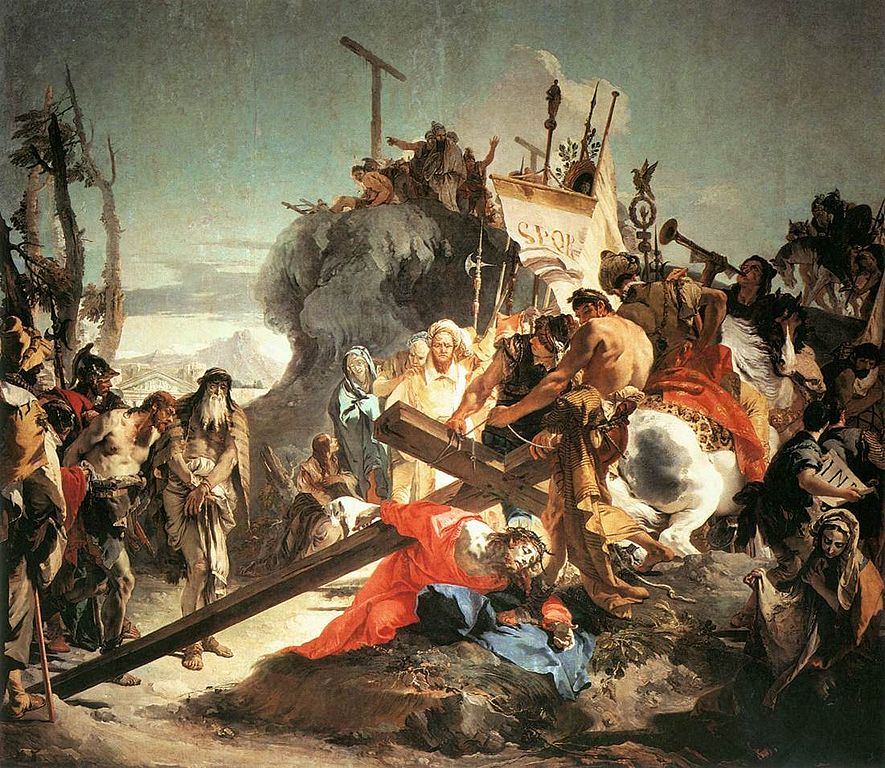 Why did Christ die in his early thirties rather than as an older man? This would have permitted Him more time to teach and to set forth His Church. St. Thomas Aquinas answered the question in the following way: