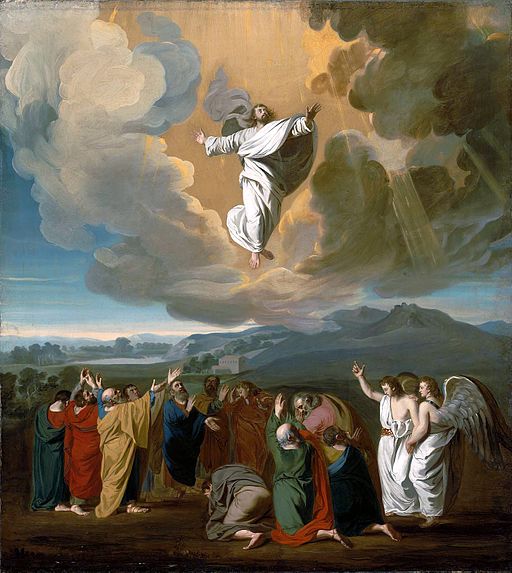
In more dioceses than not, the Feast of the Ascension is celebrated this Sunday. The liturgist in me regrets the move from Thursday, but here we are any way. Let’s ascend with the Lord, three days late!
This marvelous feast is not merely about something that took place two thousand years ago, for though Christ our head has ascended, we the members of His body are ascending with Him. Because He was ascended, we, too, have ascended. In my own life as a Christian, I am brought higher every year by the Lord, who is drawing me up with Him. This is not some mere slogan, but something I am actually experiencing. An old song says, “I was sinking deep in sin, far from the peaceful shore. Very deeply stained with sin, sinking to rise no more. But the master of the sea, heard my despairing cry. And from the waters lifted me. Now safe am I. Love Lifted me when nothing else could help. Love lifted me!”
If we are faithful, the feast of the Lord’s Ascension is our feast, too. Let’s look at it from three perspectives.
I. The Fact of the Ascension – The readings today describe a wondrous event witnessed by the Apostles. By His own power, the Lord is taken to Heaven. In so doing, He opens a path for us, too. The gates of paradise swing open again. Lift up your heads, O gates! and be lifted up, O ancient doors! that the King of glory may come in! (Psalm 24:7) In Christ, man returns to God. Consider three things about the Ascension:
A. The Reality– Imagine the glory of this moment! Scripture says, As they were looking on, he was lifted up and cloud took him from their sight … they were looking intently in the sky as he was going (Acts 1:9). So impressive was the sight that the angels had to beckon them to get along to Jerusalem as the Lord had said, “Men of Galilee,” they said, “why do you stand here looking into the sky? This same Jesus, who has been taken from you into heaven, will come back in the same way you have seen him go into heaven” (Acts 1:11). Yes, it was glorious. Jesus had once said as a summons to faith, What if you were to see the Son of Man ascending to where he was before? (John 6:62) He had also encouraged them saying, Truly, truly, I say to you, you will see heaven opened, and the angels of God ascending and descending upon the Son of man (John 1:51). So here is a glorious reality and a fulfillment of what Jesus had said.
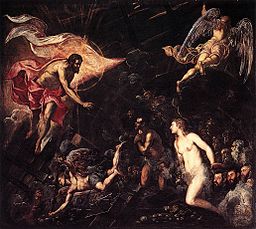
B.The Rescue – In the Ascension, it does not seem that the Lord entered Heaven alone. As we have remarked, in His mystical body we also ascend with Him. Consider this remarkable text that affirms that: Therefore it is said, When he ascended on high he led a host of captives, and he gave gifts to men. In saying, “He ascended,” what does it mean but that he had also descended into the lower parts of the earth? He who descended is he who also ascended far above all the heavens, that he might fill all things (Eph 4:8ff). Yes, the Lord had earlier (just after his death) descended to Sheol, awakened the dead, and preached the Gospel to them (cf 1 Peter 4:6). Now for those He had justified came the moment to ascend, with Jesus as a “host,” as an army of former captives now set free. Behold the great procession that enters behind Christ through the now-opened gates of Heaven: Adam and Eve, Noah, Abraham, Sarah, Isaac, Jacob, Rachel, Judith, Deborah, David, Samuel, Isaiah, Jeremiah, Ezekiel, Malachi, John the Baptist, … and, one day, you! Yes, this is a great rescue. Adam and his descendants have not simply been restored to some paradise-like garden; they have entered Heaven.
C.The Rejoicing – Consider how this once captive train sings exultantly as they follow Christ upward to Heaven. The liturgy today puts before us a likely song they sang: God mounts his throne to shouts of Joy! The Lord amid trumpet blasts. All you peoples clap your hands, shout to God with cries of gladness, for the Lord the most high, the awesome is the great king over all the earth. God reigns over the nations, God sits upon his holy throne (Psalm 47:6-7). I also have it on the best of authority that they were singing this old gospel song: “I’m so glad Jesus lifted me!” as well as this old Motown song: “Your love is lifting me higher than I’ve ever been lifted before!”
II. The Fellowship of the Ascension – We have already remarked that, when Christ ascends, we ascend. Why and how? Scripture says, Now you are the body of Christ and individually members of it (1 Cor 12:27). It also says, All of us who were baptized into Christ Jesus were baptized into his death. By baptism we were buried together with him so that just as Christ was raised from the dead by the glory of God the Father, we too might live a new and glorious life. For if we have been united with him by likeness to his death we shall be united with him by likeness to his resurrection (Rom 6:3ff). When Christ died, we died. When Christ rose, we rose. When He ascends, we ascend.
But, you may say, He is in glory while I am still here. How is it that I am ascended or ascending? Consider a humorous example using our physical bodies. When I get on an elevator and press the button for the top floor, the top of my head gets there before the soles of my feet, but the whole body will get there unless some strange loss of integrity or tragic dismemberment takes place. In an analogous way, so it is with Jesus’ mystical body. In Christ, our Head, we are already in glory. Some members of His Body have already gotten there. We who come later will get there too, provided we remain members of His Body. Yes, we are already ascended in Christ, our Head. We are already enthroned in glory with Him, if we hold fast and stay a member of His Body. This is the fellowship of the Ascension.
III. The Fruitfulness of the Ascension – Jesus does not return to Heaven to abandon us. He is more present to us than we are to ourselves. He is with us always to the end of the age (cf Matt 28:20). In ascending, without abandoning us, He goes to procure some very important things. Consider four of them:
A. Holy Ghost power– Jesus teaches very clearly that He is ascending in order to send us the Holy Spirit. Nevertheless, I tell you the truth: it is to your advantage that I go away, for if I do not go away, the Counselor will not come to you; but if I go, I will send him to you (Jn 16:7ff). He also says, These things I have spoken to you, while I am still with you. But the Counselor, the Holy Spirit, whom the Father will send in my name, he will teach you all things, and bring to your remembrance all that I have said to you (Jn 14:25ff). I still have many things to say to you, but you cannot bear them now. When the Spirit of truth comes, he will guide you into all the truth, for he will not speak on his own authority, but whatever he hears he will speak, and he will declare to you the things that are to come (Jn 16:13-14). So the Lord goes in order that with the Father, He might send the Holy Spirit to live within us as in a temple. In this way, and through the Eucharist, He will dwell with us even more intimately than when He walked this earth.
B. Harvest – Jesus says, And I, if I be lifted up from the earth, will draw all men unto me (John 12:32). While the immediate context of this verse is the crucifixion, the wonder of John’s gospel is that he often intends double meanings. Clearly Christ’s glorification is His crucifixion, but it also includes His resurrection and ascension. So, from His place in glory, Christ is drawing all people to Himself. He is also bestowing grace on us from His Father’s right hand to be His co-workers in the harvest: But you shall receive power when the Holy Spirit has come upon you; and you shall be my witnesses in Jerusalem and in all Judea and Samaria and to the end of the earth (Acts 1:8). Yes, from His place in glory, Christ is bringing in a great harvest. As He said in Scripture, Do you not say, “Four months more and then the harvest”? I tell you, open your eyes and look at the fields! They are ripe for harvest. Even now the reaper draws his wages, even now he harvests the crop for eternal life, so that the sower and the reaper may be glad together. Thus the saying “One sows and another reaps” is true. I sent you to reap what you have not worked for. Others have done the hard work, and you have reaped the benefits of their labor (Jn 4:35-38). Harvest! It is the Lord’s work from Heaven in which we participate.
C. Help – At the Father’s right hand, Jesus intercedes for us. Scripture says, Consequently he is able, for all time, to save those who draw near to God through him, since he lives always to make intercession for them (Heb 7:25). The Lord links his ascension to an unleashing of special power: Amen, amen, I say to you, he who believes in me will also do the works that I do; and greater works than these will he do, because I go to the Father. Whatever you ask in my name, I will do it, that the Father may be glorified in the Son (Jn 14:12).
We must not understand asking in the name of Jesus as a mere incantation, for to ask in His name means to ask in accord with His will. Yet we must come to experience the power of Jesus to draw us up to great and wondrous things in His sight. Despite the mystery of iniquity all about us, we trust that Christ is conquering, even in the puzzling and apparent victories of this world’s rebellion. In putting everything under him, God left nothing that is not subject to him. Though, at present we do not see everything subject to him, yet we see Jesus, who was made a little lower than the angels, now crowned with glory and honor … so that by his death he might destroy him who holds the power of death—that is, the devil—and free those who all their lives were held in slavery by their fear of death (Heb 2:8-9; 14-15). Thus, from Heaven we have the help of the Lord’s grace which, if we will accept it, is an ever-present help unto our salvation.
D. Habitation – Jesus indicates that in going to Heaven, He is preparing a place for us: In my Father’s house are many mansions: if it were not so, I would have told you. I go to prepare a place for you. And if I go and prepare a place for you, I will come again, and receive you unto myself; that where I am, there ye may be also (Jn 14:2ff). Yes, Jesus has the blueprints out and the hard hat on. He is overseeing the construction of a mansion for each of us that we may dwell with Him, the Father, and the Spirit forever.
Here, then, are the ways that Christ, by His love, is lifting us higher than we’ve ever been lifted before. Yes, love lifted me when nothing else could help; love lifted me.
There is a line from Scripture that says, Woe to the solitary man. If he falls he has no one to lift him up (Ecclesiastes 4:10).
Scripture also says, And let us consider how to stir up one another to love and good works, not neglecting to meet together, as is the habit of some, but encouraging one another, and all the more as you see the Day drawing near (Heb 10:24-25). The teaching is clear: we must come together each week for Mass and learn to live in deep communion with one another. We are not meant to make this journey alone. We need encouragement and exhortation, food for the journey, and companionship and protection.
In the days of Jesus, it was almost unthinkable for a person to make a lengthy journey alone. Once a person left the relative safety of the town, the journey got dangerous. There were robbers lying in wait along the roads just looking for vulnerable targets. For this reason, people almost always made journeys in groups.
This is a good image for the spiritual journey we all must make. Alone, we are easy targets. We are vulnerable and without help when spiritual demons attack.
Yet another insight says, “Feuding brothers reconcile when there is a maniac at the door.”
Somehow I thought of all this when I saw these two videos. They are clever and make the point of partner or perish, love or lose, hang together or hang separately. Yes, woe to the solitary man. How necessary the protection of the flock! How necessary it is to stay together!
Something about today’s Gospel (Friday of the 6th Week of Easter) reminds me of an incident on the front lines of the battle to end abortion.
Amen, amen, I say to you, you will weep and mourn,
while the world rejoices;
you will grieve, but your grief will become joy.
When a woman is in labor, she is in anguish because her hour has arrived;
but when she has given birth to a child,
she no longer remembers the pain because of her joy
that a child has been born into the world.
So you also are now in anguish.
But I will see you again, and your hearts will rejoice,
and no one will take your joy away from you (John 16:20-23).
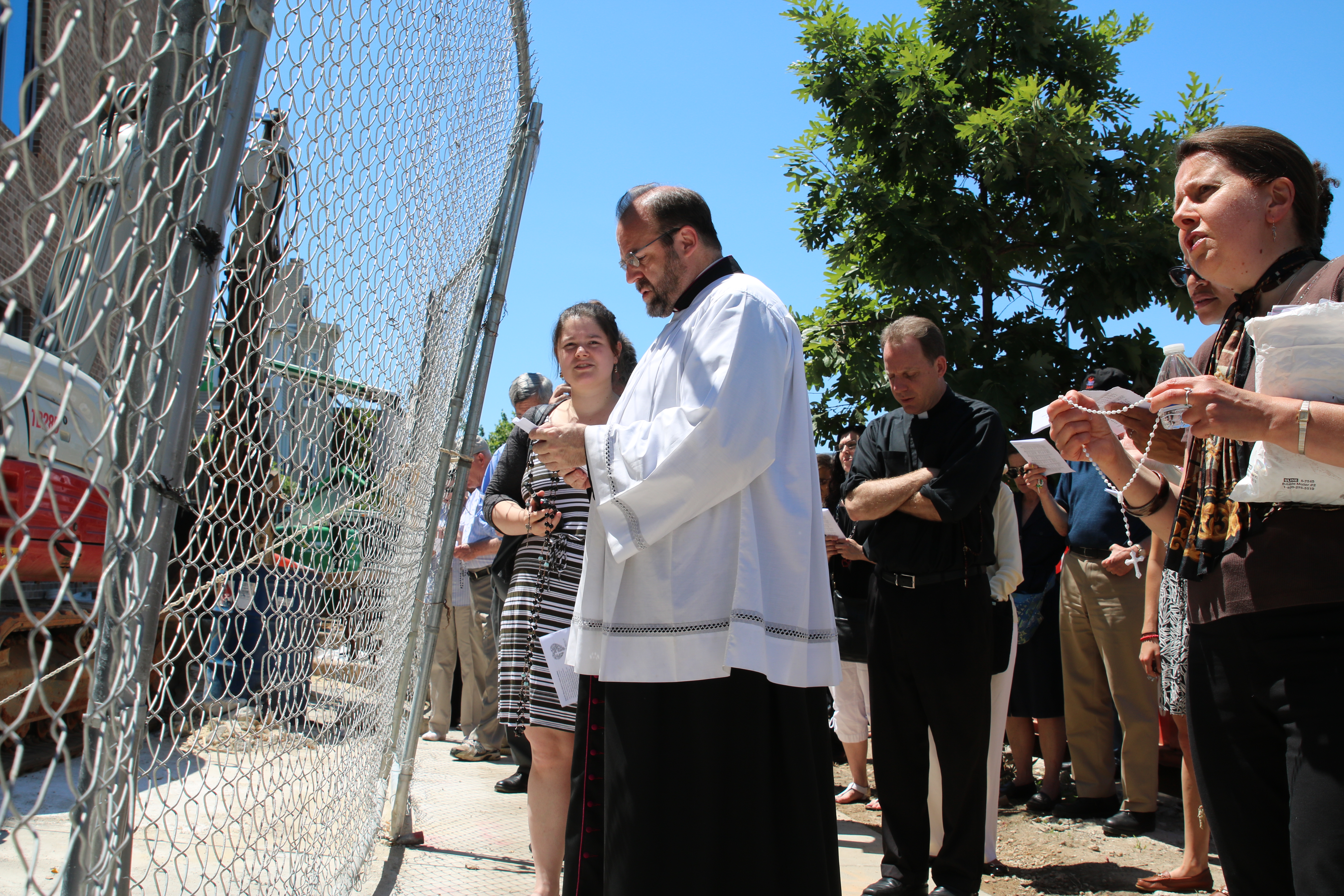
It was a mild spring day in front of the Planned “Parenthood” facility here in Washington, D.C. Twenty of us were gathered to pray the rosary and the Divine Mercy chaplet. The weather was fine, but as always the mood was heavy, knowing of the toll of life exacted at this facility and the outright confusion of those who think themselves righteous for advocating the death of innocent human beings.
Two sidewalk counselors were courageously at work, seeking a last-minute change of heart from the downcast women (often accompanied by boyfriends or parents) who entered. We supported the sidewalk counselors with our prayers.
Five escorts in orange vests tried to shield the entering clients from us who would shine the light of truth on what was really happening inside.
Keep praying, I thought, for indeed, some among our group were converts to the pro-life cause thanks to the prayers of others.
A low moment came when a few joyful “clinic” escorts shared the news among themselves that a certain woman emerging from the center had “successfully aborted.” Smiles among the escorts, a high five between two of them, and a gloating look over at us from another one brought Jesus’ words painfully alive:
You will weep and mourn, while the world rejoices.
Yes, the hardest part of being on the front lines of the pro-life movement is hearing an abortion called a success and seeing some even joyfully announcing victory.
I gathered close to my fellow prayer warriors and encouraged them between the decades by quoting these words of Jesus’: You will weep and mourn, while the world rejoices. Yet we should also remember that He went on to say, you will grieve, but your grief will become joy … [You] are now in anguish. But I will see you again, and your hearts will rejoice, and no one will take your joy away from you.
It was not enough that we should grieve; we should also offer our sorrow for the ones who were now rejoicing. We must offer our grief for their conversion. For Jesus says,
Woe to you who laugh now, for you will mourn and weep (Luke 6:25).
Indeed, if they are not converted now, they will answer one day to God. Pray for conversion prior to judgement! It gave me the strength to go to each escort, look him or her in the eye, and say, “Think about it now. You know deep in your heart that this is wrong, that this is murder.” It was interesting to me that not a single one of them said anything in reply.
In the distance, I saw one of our sidewalk counselors urgently waving for me to come over. She had not been able to dissuade a certain young woman from entering, but her boyfriend had listened, taken it to heart, and was now asking for confession! He had tried to bring his girlfriend out to join him, but she refused. Now sorrowful and contrite, moved by the words of the sidewalk counselor and the signs our group held, he sought mercy. The counselor said to me, “He’s ready for you Father; he’s ready for mercy.”
Thank you, Jesus. We could not save everyone that day, but at least we saved one. Sorrow was turned to joy. I pray only, Lord, that our joy may one day be complete.
“Keep praying, witnessing, and working.” was all I heard.
Many people today put Hell in opposition to the love of God, but Jesus combines them. Here is an important truth: No one loves you more than Jesus Christ, yet no one spoke of or taught on Hell and Judgment more than He did. He gave warning after warning and told parable after parable, practically shouting about judgment and the reality of Hell.
No “heresy” of our day is more widespread or pernicious than the denial of hell, its existence, and its sad frequency. I use quotes around the word only because I, as a simple priest, do not have the power to declare formal heresy. However, “heresy” in a broader, more descriptive sense simply means picking and choosing among revealed truth. Confronted with truths that are in some tension (such as God’s justice vs. His mercy or human freedom vs. God’s sovereignty) the “heretic” chooses one and throws out the other in order to resolve the tension. Orthodoxy says “both” but “heresy” picks one and discards the other.
With respect to the teaching on Hell and judgment, the “heretic” cannot reconcile God’s love and mercy with the reality of Hell and eternal separation from Him.
Yet the Lord of Love, Jesus, spoke of these more than did anyone else. The problem is in us, not in Jesus and not in the Father.
We simply refuse to obey what is taught and to accept that because we have free will, the choices we make ultimately matter. We have been bewitched by the fairy tale ending that everyone “lived happily ever after.” We deny that the sum of our choices constitute our character, and that our character ushers in our chosen destiny. We refuse to take responsibility for the fact that we make choices that build over time and which we will one day never be able to renounce. Instead we blame God and call Him (who sent His own Son to save us) the bad one; we say that He is responsible for whether we go to Hell or not.
Meanwhile God is pleading, “Come to me. Come to me before it is finally time to rise and close the door!”
Bottom line: either God is love and we are free to choose Him or not in our own act of love, or God is a slave driver and no matter what we go to His Heaven and live with Him forever. In other words, freedom means choice and choice permits us to say “no” to God. Therefore, there is Hell.
We need to be sober about this; Jesus certainly was. He warned and warned and warned; He pleaded and pleaded and pleaded. He knows whereof we are made; He knows how stubborn and stiff-necked we are, that we don’t like being told what to do. Yes, Jesus sadly observed that many—indeed “most”—prefer Hell to serving in Heaven (cf Matt 7:13 inter al).
We must overcome our smug presumption that salvation is a done deal and hear the pleading of our Messiah and Lord, Jesus. We must allow Him to warn us in love, we must allow Him to ignite in us a holy, even servile, fear in order to sober us and draw us to be serious about the work necessary to save us.
In service of this plea, I’d like to present a collection of “warning texts” as a sort of antidote to this “heresy” of modern times. Note that these are only some of the passages I could have used. Please feel free to use the comments section to add to my list. I will publish a final version once I’ve finished collecting any input. As I hope this compilation will show, those who deny Hell or its possibility must reject a huge number of biblical texts in order to do so.
Let us all realize this basic truth: No one loves you more than Jesus does, yet no one warned of Judgment and Hell more than He did, no one. Allow the Lord to wed these ideas in your mind. Softly and tenderly Jesus is calling, calling, O Sinner, come home! Do not buy into the modern “heresy” of universal salvation. Jesus did not teach this; neither did the Apostles, His appointed spokesmen and successors in ministry. Do not try to overrule or correct Jesus. Just accept what He taught and listen in love and faith. Hell is real. We need a savior, but He needs our “yes.”
Here then are many texts that warn of Hell; most of them are right from the mouth of Jesus. These quotes are available in PDF format here: Texts on Hell and Judgment.
Texts on Hell and Judgment
The first two passages are from the Old Testament, and exemplify the prophetic tradition into which Jesus will draw.
Is 35:8And a highway will be there; it will be called the Way of Holiness; it will be for those who walk on that Way. The unclean will not journey on it; wicked fools will not go about on it.
Is 66:24And they will go out and look on the dead bodies of those who rebelled against me; the worms that eat them will not die, the fire that burns them will not be quenched, and they will be loathsome to all mankind.
Matt 3:12His winnowing fork is in his hand, and he will clear his threshing floor, gathering his wheat into the barn and burning up the chaff with unquenchable fire.John the Baptist speaks here.
Matt 5:22But I tell you that anyone who is angry with a brother or sister will be subject to judgment. Again, anyone who says to a brother or sister, “Raca,” is answerable to the court. And anyone who says, “You fool!” will be in danger of the fire of hell. Even unrighteous anger, unrepented of, can bring forth Hell. We tend to justify our anger; God does not. He warns that we cannot cling to it and still walk into Heaven.
Matt 5:29If your right eye causes you to stumble, gouge it out and throw it away. It is better for you to lose one part of your body than for your whole body to be thrown into hell.We make light of sin, but the Lord does not. He is not saying that we should mutilate ourselves, but rather that it is more serious to sin than to lose our eye, foot, or hand. We do not think this way, but God does. He warns us that our most serious problem is not our physical health or finances or any other passing problem; our most serious problem is our sin.
Matt 6:14-15For if you forgive other people when they sin against you, your heavenly Father will also forgive you. But if you do not forgive others their sins, your Father will not forgive your sins.This is a pretty clear warning that we must allow God to give us the gift of mercy and forgiveness or else we cannot enter Heaven. Blessed are the merciful, for (only) they will obtain mercy.
Matt 7: 13Jesus said, “Enter through the narrow gate. For wide is the gate and broad is the road that leads to destruction, and many enter through it. But small is the gate and narrow the road that leads to life, and only a few find it.”Do you understand this? More are lost than are saved. This is a mysterious text in terms of its sweeping quality. Why would God permit this? But it is a text whose meaning is clear: most are lost. Hear Jesus’ pleading and be sober about how stubborn and stiff-necked we can be.
Matt 10:28Do not be afraid of those who kill the body but cannot kill the soul. Rather, be afraid of the One who can destroy both soul and body in hell.Jesus is talking about Himself and calling us to a holy fear.
Matt 11:23And you, Capernaum! You won’t be lifted up to heaven, will you? You’ll go down to Hell! Because if the miracles that happened in you had taken place in Sodom, it would have remained to this day.Don’t think that just because you’re a member of “the club,” you’ve got it made, you’re in. Indeed, for those who have heard and seen, more is required, not less.
Matt 12:36But I tell you that everyone will have to give account on the day of judgment for every empty word they have spoken. For by your words you will be acquitted, and by your words you will be condemned. Yes, we will have to give an account even for the gossip we make light of. Lord, have mercy!
Matt 13: 24-30Jesus told them another parable: “The kingdom of heaven is like a man who sowed good seed in his field. But while everyone was sleeping, his enemy came and sowed weeds among the wheat, and went away. When the wheat sprouted and formed heads, then the weeds also appeared. The owner’s servants came to him and said, ‘Sir, didn’t you sow good seed in your field? Where then did the weeds come from?’ ‘An enemy did this,’ he replied. The servants asked him, ‘Do you want us to go and pull them up?’ ‘No,’ he answered, ‘because while you are pulling the weeds, you may uproot the wheat with them. Let both grow together until the harvest. At that time, I will tell the harvesters, ‘First, collect the weeds and tie them in bundles to be burned; then gather the wheat and bring it into my barn.’”So there is a day of judgment; not now, but it will come.
Matt 22:1-14 (Parable of the Wedding Banquet)Jesus spoke to them again in parables, saying, “The kingdom of heaven is like a king who prepared a wedding banquet for his son. He sent his servants to those who had been invited to the banquet to tell them to come, but they refused to come. Then he sent some more servants and said, ‘Tell those who have been invited that I have prepared my dinner: My oxen and fattened cattle have been butchered, and everything is ready. Come to the wedding banquet.’ But they paid no attention and went off—one to his field, another to his business. The rest seized his servants, mistreated them and killed them. The king was enraged. He sent his army and destroyed those murderers and burned their city. Then he said to his servants, ‘The wedding banquet is ready, but those I invited did not deserve to come. So go to the street corners and invite to the banquet anyone you find.’ So the servants went out into the streets and gathered all the people they could find, the bad as well as the good, and the wedding hall was filled with guests. But when the king came in to see the guests, he noticed a man there who was not wearing wedding clothes. He asked, ‘How did you get in here without wedding clothes, friend?’ The man was speechless. Then the king told the attendants, ‘Tie him hand and foot, and throw him outside, into the darkness, where there will be weeping and gnashing of teeth.’ For many are invited, but few are chosen.”It is the shocking parable of a king who, in the end, accepts the “no” of the invited guests. As for the wedding garment, remember that it is provided by God (cf Rev 19:8). The refusal to wear the robe of righteousness is on us, not on God.
Matt 23:33You serpents, you brood of vipers, how will you escape the sentence of hell?
Matt 24:36-51 (The Day and Hour Unknown)But about that day or hour no one knows, not even the angels in heaven, nor the Son, but only the Father. As it was in the days of Noah, so it will be at the coming of the Son of Man. For in the days before the flood, people were eating and drinking, marrying and giving in marriage, up to the day Noah entered the ark; and they knew nothing about what would happen until the flood came and took them all away. That is how it will be at the coming of the Son of Man. Two men will be in the field; one will be taken and the other left. Two women will be grinding with a hand mill; one will be taken and the other left. Therefore, keep watch, because you do not know on what day your Lord will come. But understand this: If the owner of the house had known at what time of night the thief was coming, he would have kept watch and would not have let his house be broken into. So you also must be ready, because the Son of Man will come at an hour when you do not expect him. Who then is the faithful and wise servant, whom the master has put in charge of the servants in his household to give them their food at the proper time? It will be good for that servant whose master finds him doing so when he returns. Truly I tell you, he will put him in charge of all his possessions. But suppose that servant is wicked and says to himself, “My master is staying away a long time,” and he then begins to beat his fellow servants and to eat and drink with drunkards. The master of that servant will come on a day when he does not expect him and at an hour he is not aware of. He will cut him to pieces and assign him a place with the hypocrites, where there will be weeping and gnashing of teeth. Beware of presumption and making light of sin!
Matt 25:1-13 (Parable of the Ten Virgins)At that time the kingdom of heaven will be like ten virgins who took their lamps and went out to meet the bridegroom. Five of them were foolish and five were wise. The foolish ones took their lamps but did not take any oil with them. The wise ones, however, took oil in jars along with their lamps. The bridegroom was a long time in coming, and they all became drowsy and fell asleep. At midnight the cry rang out, “Here’s the bridegroom! Come out to meet him!” Then all the virgins woke up and trimmed their lamps. The foolish ones said to the wise, “Give us some of your oil; our lamps are going out.” “No,” they replied, “there may not be enough for both us and you. Instead, go to those who sell oil and buy some for yourselves.” But while they were on their way to buy the oil, the bridegroom arrived. The virgins who were ready went in with him to the wedding banquet. And the door was shut. Later the others also came. “Lord, Lord,” they said, “open the door for us!” But he replied, “Truly I tell you, I don’t know you.” Therefore, keep watch, because you do not know the day or the hour.The groom delays, but not forever!
Matt 25:26-30 (Parable of the Talents (conclusion))His master replied, “You wicked, lazy servant! So you knew that I harvest where I have not sown and gather where I have not scattered seed? Well then, you should have put my money on deposit with the bankers, so that when I returned I would have received it back with interest. Take the bag of gold from him and give it to the one who has ten bags. For whoever has will be given more, and they will have an abundance. Whoever does not have, even what they have will be taken from them. And throw that worthless servant outside, into the darkness, where there will be weeping and gnashing of teeth.”We will have to reckon for what we have done and what we have failed to do with our gifts.
Matt 25:41-46 (Sheep and Goats (conclusion))Then he will say to those on his left, “Depart from me, you who are cursed, into the eternal fire prepared for the devil and his angels. For I was hungry and you gave me nothing to eat, I was thirsty and you gave me nothing to drink, I was a stranger and you did not invite me in, I needed clothes and you did not clothe me, I was sick and in prison and you did not look after me.” They also will answer, “Lord, when did we see you hungry or thirsty or a stranger or needing clothes or sick or in prison, and did not help you?” He will reply, “Truly I tell you, whatever you did not do for one of the least of these, you did not do for me.” Then they will go away to eternal punishment, but the righteous to eternal life.Reward or loss, you decide.
Mark 9:42–48 (Giving Scandal)If anyone causes one of these little ones—those who believe in me—to stumble, it would be better for them if a large millstone were hung around their neck and they were thrown into the sea. If your hand causes you to stumble, cut it off. It is better for you to enter life maimed than with two hands to go into hell, where the fire never goes out. And if your foot causes you to stumble, cut it off. It is better for you to enter life crippled than to have two feet and be thrown into hell. And if your eye causes you to stumble, pluck it out. It is better for you to enter the kingdom of God with one eye than to have two eyes and be thrown into hell, where “the worms that eat them do not die, and the fire is not quenched.”Those who lead others to sin are going to have to answer to Jesus for what they have done. Do not doubt this. Pray that all repent prior to the day of reckoning!
Luke 8:17For there is nothing hidden that will not be disclosed, and nothing concealed that will not be known or brought out into the open. You cannot hide from God.
Luke 12:42 (The Day and Hour Unknown)Who then is the faithful and wise manager, whom the master puts in charge of his servants to give them their food allowance at the proper time? It will be good for that servant whom the master finds doing so when he returns. I tell you, he will put him in charge of all his possessions. But suppose the servant says to himself, “My master is taking a long time in coming,” and he then begins to beat the other servants, both men and women, and to eat and drink and get drunk. The master of that servant will come on a day when he does not expect him and at an hour he is not aware of. He will cut him to pieces and assign him a place with the unbelievers. This is a warning against presumption.
Luke 13:22-30Then Jesus went through the towns and villages, teaching as he made his way to Jerusalem. Someone asked him, “Lord, are only a few people going to be saved?” He said to them, “Make every effort to enter through the narrow door, because many, I tell you, will try to enter and will not be able to. Once the owner of the house gets up and closes the door, you will stand outside knocking and pleading, ‘Sir, open the door for us.’ “But he will answer, ‘I don’t know you or where you come from.’ “Then you will say, ‘We ate and drank with you, and you taught in our streets.’ “But he will reply, ‘I don’t know you or where you come from. Away from me, all you evildoers!’ “There will be weeping there, and gnashing of teeth, when you see Abraham, Isaac and Jacob and all the prophets in the kingdom of God, but you yourselves thrown out. People will come from east and west and north and south, and will take their places at the feast in the kingdom of God. Indeed, there are those who are last who will be first, and first who will be last.”Hell and exclusion are quite real. Jesus is pointing to fear here. Some call fear “unhealthy,” but Jesus is willing to use it if it will bring forth repentance.
Luke 16:19-31 (Lazarus and Dives)There was a rich man who was dressed in purple and fine linen and lived in luxury every day. At his gate was laid a beggar named Lazarus, covered with sores and longing to eat what fell from the rich man’s table. Even the dogs came and licked his sores. The time came when the beggar died and the angels carried him to Abraham’s side. The rich man also died and was buried. In Hell, where he was in torment, he looked up and saw Abraham far away, with Lazarus by his side. So he called to him, “Father Abraham, have pity on me and send Lazarus to dip the tip of his finger in water and cool my tongue, because I am in agony in this fire.” But Abraham replied, “Son, remember that in your lifetime you received your good things, while Lazarus received bad things, but now he is comforted here and you are in agony. And besides all this, between us and you a great chasm has been set in place, so that those who want to go from here to you cannot, nor can anyone cross over from there to us.” He answered, “Then I beg you, father, send Lazarus to my family, for I have five brothers. Let him warn them, so that they will not also come to this place of torment.” Abraham replied, “They have Moses and the Prophets; let them listen to them.” “No, father Abraham,” he said, “but if someone from the dead goes to them, they will repent.” He said to him, “If they do not listen to Moses and the Prophets, they will not be convinced even if someone rises from the dead.”Contempt and indifference toward the poor is a damnable sin. Note, too, that the rich man does not change after death. He is locked into his patterns. He does not ask to come to Heaven; he wants Lazarus sent to Hell. He still does not recognize Lazarus’ dignity; he still sees him as an errand boy. After death, the rich man is miserable, but he cannot and will not change. This teaching on our fixed character after death explains why Hell is eternal: because we will never change.
John 12:48-50If anyone hears my words but does not keep them, I do not judge that person. For I did not come to judge the world, but to save the world. There is a judge for the one who rejects me and does not accept my words; the very words I have spoken will condemn them at the last day. For I did not speak on my own, but the Father who sent me commanded me to say all that I have spoken. I know that his command leads to eternal life. So whatever I say is just what the Father has told me to say. In effect, we bring judgment upon ourselves. We might wish to blame God, but at the end of the day, we show by our own disposition that we are not fit for heaven and would not be happy there because it is the full realization of many things we either detest or scoff at (e.g., love of the poor, forgiveness of our enemies, chastity, worship of God).
Rev 22:12-16“Look, I am coming soon!” says the Lord. “My reward is with me, and I will give to each person according to what they have done. I am the Alpha and the Omega, the First and the Last, the Beginning and the End. Blessed are those who wash their robes, that they may have the right to the tree of life and may go through the gates into the city. Outside are the dogs, those who practice magic arts, the sexually immoral, the murderers, the idolaters and everyone who loves and practices falsehood. I, Jesus, have sent my angel to give you this testimony for the churches. I am the Root and the Offspring of David, and the bright Morning Star.” Jesus speaks here in vivid terms of sinners as dogs and cowards. Pay attention: the “Mister Rogers” version of Jesus is not the Jesus of Scripture.
Jesus commissioned the Apostles to preach, teach, govern, and sanctify in His name. Therefore, in hearing them in the following texts, we hear the voice of Jesus.
Heb 12:14Strive for peace with everyone, and for the holiness without which no one will see the Lord.Only those open to God making them holy can endure the bright lights of the Kingdom of God.
Heb 13:4Marriage should be honored by all, and the marriage bed kept pure, for God will judge the adulterer and all the sexually immoral.Pay attention, modern age, which has shredded marriage at every turn.
James 2:12-13Speak and act as those who are going to be judged by the law that gives freedom, because judgment without mercy will be shown to anyone who has not been merciful. Mercy triumphs over judgment. Help us to show mercy, Lord, for the measure we measure to others will be measured back to us.
Romans 2:3-11Do you think you will escape God’s judgment? Or do you show contempt for the riches of his kindness, forbearance and patience, not realizing that God’s kindness is intended to lead you to repentance? But because of your stubbornness and your unrepentant heart, you are storing up wrath against yourself for the day of God’s wrath, when his righteous judgment will be revealed. God will repay each person according to what they have done. To those who by persistence in doing good seek glory, honor and immortality, he will give eternal life. But for those who are self-seeking and who reject the truth and follow evil, there will be wrath and anger. There will be trouble and distress for every human being who does evil: first for the Jew, then for the Gentile; but glory, honor and peace for everyone who does good: first for the Jew, then for the Gentile. For God does not show favoritism.We are judged by deeds, not by prerogatives or by being “better” than someone else.
1 Cor 6:9Or do you not know that wrongdoers will not inherit the kingdom of God? Do not be deceived: Neither the sexually immoral nor idolaters nor adulterers nor men who have sex with men. Although the modern world makes light of sexual sins, God does not. He warns that these sins render us incapable of enduring the bright lights of Heaven because we “prefer the darkness” (cf John 3:18).
1 Cor 9: 26-27Therefore I do not run like someone running aimlessly; I do not fight like a boxer beating the air. No, I strike a blow to my body and make it my slave so that after I have preached to others, I myself will not be disqualified for the prize. If even Paul realized he had to be sober, why not us?
Phil 2:12Therefore, my dear friends, as you have always obeyed—not only in my presence, but now much more in my absence—continue to work out your salvation with fear and trembling. Some call fear unhealthy, but God is willing to appeal to it.
Gal 5:19-21The acts of the flesh are obvious: sexual immorality, impurity and debauchery; idolatry and witchcraft; hatred, discord, jealousy, fits of rage, selfish ambition, dissensions, factions and envy; drunkenness, orgies, and the like. I warn you, as I did before, that those who live like this will not inherit the kingdom of God. Not inheriting Heaven means going to Hell.
Eph 5:3-7But among you there must not be even a hint of sexual immorality, or of any kind of impurity, or of greed, because these are improper for God’s holy people. Nor should there be obscenity, foolish talk or coarse joking, which are out of place, but rather thanksgiving. For of this you can be sure: No immoral, impure or greedy person—such a person is an idolater—has any inheritance in the kingdom of Christ and of God. Let no one deceive you with empty words, for because of such things God’s wrath comes on those who are disobedient. Therefore, do not be partners with them. Once again, God says that sexual sin excludes us from the Kingdom of God. We go to Hell if we die unrepentant, because it shows that we prefer the darkness and cannot stand the light.
Fear is a complex passion. On the one hand, there are things that we ought to fear such as grave physical and spiritual dangers. The fear of being near the edge of a cliff might well save our life. The fear of serious sin and the punishment we might experience or the offense to God (who loves us) is both appropriate and holy. Sadly, more people lack this holy fear rooted in the possible loss of what is most precious to us: our eternal life with God.
There are also things we fear that we should not, and things that we fear more than we should. These sorts of fears are usually rooted in our disordered and inordinate affections.
A disordered affection is a love for something that is sinful. We ought not to love it at all, but we do; this causes us to fear anyone or anything that interferes with accessing and enjoying what is fundamentally sinful.
An inordinate affection is a love for something that is good in itself, but the love we have for it is too great. Loving it too much causes us to fear the loss of it more than we should. Many things in this world are lawful pleasures, but we come to love them too much. We love things more than people, and both things and people more than God. This is all out of order. We are to use things, love people, and worship God. Too often, though, we use people, love things, and forget about God.
There is also the great struggle that many have called the “sin of human respect,” wherein we fear people more than we fear God and seek to please people more than to please God. When we fall prey to this, we are willing to do sinful things in order to ingratiate ourselves to other human beings, fearing and revering them more than we do God.
Fear is a necessary passion for us, but too often our fears are misplaced and inordinate. Our fears are easily manipulated by Satan and the world.
A major area for spiritual growth is knowing what and whom to fear. Apart from God we will seldom get this answer right. We are easy prey for the devil and the world to draw us into all sorts of inordinate and even foolish fears.
Because a story can often have an impact that mere discourse cannot, I would like to illustrate this teaching with a well-known children’s story.
The story is the basis for two phrases in common use. Most are familiar with them, but some have never read (or have forgotten) the story from which they come. The first is “The sky is falling!” and the second is “Chicken Little” (used as a description of a person).
Both these phrases come from the children’s story Chicken Little. It is a story that speaks to the need to be careful about what we fear and what we do not fear. For indeed, one of the traps of Satan is to get us to focus on what we ought not to fear, or on what is secondary, so that we do not focus on what we should fear, or on what is more important. Aristotle, citing Socrates, said that courage is the virtue of knowing what to fear and what not to fear.
Please take the time to read this story completely. It may seem tedious to us modern folks with limited attention spans, but its conclusion is made more powerful by the litany of details. Please share it with your children as well.
Chicken Little was in the woods one day when an acorn fell on her head. It scared her so much she trembled all over. She shook so hard, half her feathers fell out. “Help! Help!” she cried. “The sky is falling! I must go tell the king!” So she ran in great fright to tell the king.
Along the way she met Henny Penny. “Where are you going, Chicken Little?” Henny Penny asked.
“Oh, help!” Chicken Little cried. “The sky is falling!” “How do you know?” asked Henny Penny. “Oh! I saw it with my own eyes, and heard it with my own ears, and part of it fell on my head!” “This is terrible, just terrible!” Henny Penny clucked. “We’d better run.”
So they both ran away as fast as they could. Soon they met Ducky Lucky. “Where are you going, Chicken Little and Henny Penny?” he asked. “The sky is falling! The sky is falling! We’re going to tell the king!” they cried. “How do you know?” asked Ducky Lucky. “I saw it with my own eyes, and heard it with my own ears, and part of it fell on my head,” Chicken Little said. “Oh dear, oh dear!” Ducky Lucky quacked. “We’d better run!” So they all ran down the road as fast as they could.
Soon they met Goosey Loosey waddling along the roadside. “Hello there, Chicken Little, Henny Penny, and Ducky Lucky,” called Goosey Loosey. “Where are you all going in such a hurry?” “We’re running for our lives!” cried Chicken Little. “The sky is falling!” clucked Henny Penny. “And we’re running to tell the king!” quacked Ducky Lucky. “How do you know the sky is falling?” asked Goosey Loosey. “I saw it with my own eyes, and heard it with my own ears, and part of it fell on my head,” Chicken Little said. “Goodness!” squawked Goosey Loosey. “Then I’d better run with you.”
And they all ran in a great fright across a meadow. Before long they met Turkey Lurkey strutting back and forth. “Hello there, Chicken Little, Henny Penny, Ducky Lucky, and Goosey Loosey,” he called. “Where are you all going in such a hurry?” “Help! Help!” cried Chicken Little. “We’re running for our lives!” clucked Henny Penny. “The sky is falling!” quacked Ducky Lucky. “And we’re running to tell the king!” squawked Goosey Loosey. “How do you know the sky is falling?” asked Turkey Lurkey. “I saw it with my own eyes, and heard it with my own ears, and part of it fell on my head,” Chicken Little said.“Oh dear! I always suspected the sky would fall someday,” Turkey Lurkey gobbled. “I’d better run with you.”
So they all ran with all their might, until they met the fox, Foxy Loxy. “Well, well,” said Foxy Loxy. “Where are you rushing on such a fine day?” “Help! Help!” cried Chicken Little, Henny Penny, Ducky Lucky, Goosey Loosey, and Turkey Lurkey. “It’s not a fine day at all. The sky is falling, and we’re running to tell the king!” “How do you know the sky is falling?” said Foxy Loxy. “I saw it with my own eyes, and heard it with my own ears, and part of it fell on my head,” Chicken Little said.“I see,” said Foxy Loxy. “Well then, follow me, and I’ll show you the way to the king.”
So Foxy Loxy led Chicken Little, Henny Penny, Ducky Lucky, Goosey Loosey, and Turkey Lurkey across a field and through the woods. He led them straight to his den, and they never saw the king to tell him the sky was falling.
Notice how fearing the wrong thing, and fearing it to excess, blinded them to what was more truly to be feared, what was more truly a threat. Here lies a doorway for the devil. He incites us to fear lesser things like unpopularity, loss of money, poor health, the loss of worldly trinkets, the next election, global warming, persecution, and worldly setbacks, so that we do not fear Judgment Day and the possibility of Hell.
The day of destiny is closing in, but never mind that! The sky is falling: the wrong political party is in power; the planet is overheating; the economy is about to collapse. You might lose your home to a storm; people might not think you are pretty enough, tall enough, or thin enough. Be afraid; be very afraid! You don’t have time to pray and ask God to get you ready for Judgment Day because you are too busy being afraid that eating food X may cause cancer, or that people may be laughing at you because of the five or ten pounds you gained last Christmas, or that the Yellowstone Caldera may blow at any time.
I will not tell you that the aforementioned concerns have no merit, only that they have less merit than what most people never think about or fear: where they are going to spend eternity. Chicken Little and her friends were easy prey for Foxy Loxy because they were obsessed with lesser things and ignored more dangerous (and obvious in this case) things like a fox!
Yes, “Foxy Loxy” has you worried about smaller and passing things. Now you are easy prey. It will take but a moment for him to lead you astray and have you for dinner!
Make sure you fear the right thing. God has a plan to simplify our lives. We are to fear Him and be sober about getting ready, with His help, for the certain-to-come Day of Judgment. If we fear Him, we don’t need to fear anyone or anything else.
Bishop Robert Barron has observed that the three tallest buildings in Chicago are insurance buildings. Fear “looms large” in our culture, but no insurance company can insure you against the only certain threat you face: Judgment Day. Only God can do that.
The sky may or may not be falling. (Personally, I doubt 80% of the media’s fearmongering.) But Judgment Day surely is looming. Foxy Loxy (Satan) is waiting for you. Will he get you? Will your fear of the Lord help you to avoid falling prey to his deceptions?
Courage is fearing the right thing and the right one.
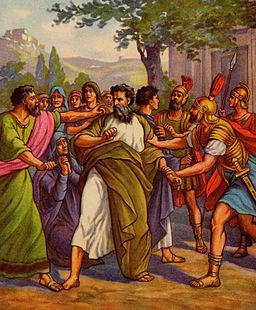
At daily Mass, we are reading the story of St. Paul’s arrest, beating, and imprisonment at Philippi. It serves as a kind of metaphor for the radical nature of true Christianity and why it so perturbs many in this world. The Christian faith, its message, and the transformation it can effect can be very unsettling to a world that literally and figuratively “banks on” sin. Let’s consider this lesser- known story and see what it ought to mean for us if we take our Christian faith seriously and do not try to “tame” it.
Philippi was the first “European” city that Paul evangelized when he came across from Asia Minor. Arriving at the port of Philippi in Macedonia, Paul and Silas went right to work evangelizing. One of their first converts was Lydia, a wealthy woman from Thyatira who was a dealer in purple cloth; other converts followed.
Once when we were going to the place of prayer, we were met by a slave girl who had a spirit by which she predicted the future. She earned a great deal of money for her owners by fortune-telling. This girl followed Paul and the rest of us, shouting, “These men are servants of the Most High God, who are telling you the way to be saved.” She kept this up for many days. Finally, Paul became so troubled that he turned around and said to the spirit, “In the name of Jesus Christ I command you to come out of her!” At that moment the spirit left her.
When the owners of the slave girl realized that their hope of making money was gone, they seized Paul and Silas and dragged them into the marketplace to face the authorities. They brought them before the magistrates and said, “These men are Jews, and are throwing our city into an uproar by advocating customs unlawful for us Romans to accept or practice.”
The crowd joined in the attack against Paul and Silas, and the magistrates ordered them to be stripped and beaten. After they had been severely flogged, they were thrown into prison, and the jailer was commanded to guard them carefully. Upon receiving such orders, he put them in the inner cell and fastened their feet in the stocks (Acts 16:16-24).
Note the heart of the problem: St. Paul, in setting the slave girl free of her demon has deprived her “owners” of the income they derived from her sad state. They were banking on her bad condition and profiting from her trouble. In the name and power of Jesus Christ, St. Paul sets her free. His action draws deep anger from the “owners.” He has rocked their world; he has touched their pocketbooks. They find the Christian message, for it is revolutionary, to be disconcerting, threatening, and deeply unsettling.
It is a threat not only to profit but to power. In having Paul and Silas arrested, they stir up the hatred and fear of others as well, accusing them not only of preaching some strange new religion but of advocating customs forbidden to Romans. The word translated here as “customs” is ἐθη (ethe) in Greek, and refers to “religious rites or forms of worship.” In De Legibus, ii. 8, Cicero wrote, “No person shall have any separate gods, or new ones; nor shall he privately worship any strange gods, unless they be publicly allowed.” While the Romans often overlooked the private worship of unapproved gods, publicly proclaiming new and unapproved deities was an occasion for dissension and controversy and was strictly forbidden.
Frankly, the charges against Paul and Silas are true enough. In the healing they brought about, they have hindered profit. Further, they were openly proclaiming that Jesus was Lord. To our ears that is a religious proclamation, but to Roman ears it was a provocative and revolutionary statement. It was directly contrary to their proclamation that Caesar was Lord. Yes, Paul, Silas, Luke, and the others were shaking the ground in Philippi! While they were not advocating the overthrow of any government, they were announcing a power greater than Caesar, a higher King who demanded our first loyalty.
This is not the “tame” proclamation of the faith so common today. This is not a faith that is adjusted to fit into worldly categories. This is not a faith tucked in after political, philosophical, and moral preferences. This is a faith that shakes the world and brings a revolutionary challenge to its priorities. Yes, Paul and Silas pose a serious threat.
What of us today? We have gone through a long period during which we have lived the faith quietly; it generally fit quite well into the world in which we lived. Harmony and “getting along” were highly prized. Particularly here in America, Catholics wanted to reassure the general populace that our faith in no way hindered us from being full participants in the American scene and that we could fit right in and be just like everyone else. With the election of the first Catholic president back in 1960, we could say that we had made it and had been fully accepted. Finally, we fit in.
Of course the culture was not in such disrepair in those days. There was still a fairly wide moral consensus rooted in the Judeo-Christian vision. Having finally “made it,” though, we have assumed room temperature; the fire of our distinctively Catholic culture seems to have faded away. At the same time, Western culture has also largely died. (Is that really a coincidence?)
In recent years, so-called Catholic universities and other Catholic institutions have begun caving in: giving marriage benefits to same-sex bedfellows and succumbing to the HHS mandates to provide contraceptives and abortifacients. It is sad, pathetic, wrong, and cowardly—hardly the revolutionary faith that got Paul arrested.
Now we are coming full circle. We must rediscover how revolutionary our Catholic faith truly is to this world gone mad. As we proclaim healing and an allegiance to something other than this world, however, we will become increasingly obnoxious to the world around us.
Let’s consider more thoroughly the two offenses for which Paul and Silas were beaten and imprisoned:
They ate away at profit – Paul drove a terrible demon out of a slave girl, a demon that afflicted her but profited her “owners.” There is a great deal of trafficking in sin and addiction today. Terrible demons afflict many people in the areas of sexuality, drugs, and alcohol. There’s a lot of money to be made peddling pornography; sex sells. Hollywood movie producers, purveyors of contraceptives, pimps, escort services, abortionists, and even traffickers in the sex slave industry also feed at the trough. Drugs and alcohol are big money makers as well. Huge numbers of products are sold using the demon of fear that says, “You’re not pretty enough,” “You’re not healthy enough,” “You’re getting old,” “You don’t drive the right car,” “You don’t wear the right clothes.” The demons of fear, low self-esteem, and greed all work together.
What would happen if the Church were to start effectively preaching unabridged Christianity? What if we started saying, “You don’t need to be afraid of your health, your age, or what people think of you. You can find serenity in Christ so that you won’t feel you need for those drugs. You can be set free from your enslavement to sex, take authority over your passions, and discover the beauty of traditional marriage.” What if we got back in the business of driving out demons?
Well, of course the answer is that we, like Paul, would be under attack. In fact, we are under attack. We are especially hated by the sex industry and the abortionists because that that issue has so much focus these days. To them we are public enemy number one. We threaten the vision, the addiction, and the despair that fills their coffers. If we are too successful (and for now our successes are meager) their profits might dry up. Yes, we must be dealt with.
We will only be effective if we preach the unabridged faith, not a faith that is adjusted, not a faith that is subordinated to worldly priorities, not a faith that insists on being “realistic,” not a faith that apologizes to the world no matter how much we water things down. The true faith is revolutionary in the freedom it offers from sin and demons.
Paul and Silas didn’t wind up in prison by preaching a watered-down, domesticated moral vision. They unabashedly drove out a demon that was afflicting a girl; in so doing they engaged in a revolutionary threat to a world that profits handsomely from sin.
2. They threatened power – Calling Jesus “Lord” was a revolutionary threat to the incumbent power that demanded first and full loyalty. Today, many try to make Catholics fit into tidy political categories. Both Republicans and Democrats want the Church to march in lockstep with their party platform. Even many Catholics in those parties want the Church to conform. Many Catholics in fact are more loyal to their party than to the Church; they are more passionate about their political views than their faith. If there is a conflict between Church teaching and the party line, guess which one usually gives way!
In the end, the Church will not just fit into some neat political category. The true faith is too revolutionary to fit into some worldly box.
Thus there is a lot of hatred and anger directed at the Church. Republicans say we’re too liberal; Democrats say we’re too conservative. More and more we are being shown the door, kicked to the curb; our very right to religious liberty is being threatened. Religious exemptions to increasingly pernicious laws are slowly being removed and lawsuits against Catholic institutions are increasing. It will surely get worse as secular systems demand increasing loyalty. The Church must refuse to give that loyalty.
Jesus (not the federal, state or local government) is Lord. Jesus is not Republican or Democrat, conservative or liberal. He is God, and the faith He announces cannot be watered down or compromised to fit into a friendship with the world.
No domesticated Christianity will change the world. When Paul preached, the people rioted. Modern preaching too often incites only yawns and indifference.
What should we learn from St. Paul’s arrest at Philippi? That the true faith is revolutionary and threatens the world right where it hurts: in the profit and power centers. As the world becomes increasingly secular, the revolutionary aspect of the faith will become more evident.
One of the parts of the Ordinary Form of the Mass that was “restored” from antiquity is the Prayer of the Faithful. In my mind, however, there is a certain disappointing quality to the intentions as they are used today. They are either overly particular and ideological or, at the other end of the spectrum, perfunctory and flat. Peter Kwasniewski, in an article at New Liturgical Movement.org (here), summarizes the problem very well.
It is surely no exaggeration to say that throughout the world the quality of these intercessions has tended to be deplorable, ranging from trite and saccharine sentiments to political propaganda, from progressivist daydreams to downright heretical propositions to which no one could assent without offending God. Even when the content is doctrinally unobjectionable, all too often the literary style is dull, flaccid, rambling, or vague. … [There is] problematic content, poor writing, and [a] monotonous manner of delivery.
Additional problems occur when there are people of many different nationalities present and it is felt necessary to have the petitions read in multiple languages. The impression is given that the intentions are directed more to the congregation than to God, who knows all languages and thoughts. I have been at Mass in the Basilica here in Washington, D.C. when as many as nine different languages were used in the Prayer of the Faithful, despite the fact that the vast majority of those present spoke English and/or Spanish. I seriously doubt that there were more than five people in attendance who could speak only German, Mandarin, or one of the other languages used. It quickly gets very tedious as a line of people traipse back and forth to the microphone.
It is all so different in the Eastern Liturgies, in which the Great Litany is so artfully woven into the liturgical experience and beautifully sung as well. I have memorized the Great Litany from the Liturgy of St. John Chrysostom (see video below).
In his article (here), Mr. Kwasniewski offers a variety of intercessions, and download links are provided. I have done so for my own use and you might wish to do the same.
I would also like to add that St. Peter Canisius composed intercessions for use in his time. Saints are certainly reputable sources of such things! Here is an article by Mark Woodruff (with a tip of the hat to Rev. James Bradley) that details those prayers.
The point is that much can be done to improve the quality of the Prayer of the Faithful, which has remained an amateur outing at best and an ideological hornet’s nest at worst.
Perhaps some benefit can be obtained from reviewing the norms and the history of this portion of the Mass.
The General Instruction in the Roman Missal (GIRM) has this to say about the Prayer of the Faithful:
In the Prayer of the Faithful, the people respond in a certain way to the word of God which they have welcomed in faith and, exercising the office of their baptismal priesthood, offer prayers to God for the salvation of all. It is fitting that such a prayer be included, as a rule, in Masses celebrated with a congregation, so that petitions will be offered for the holy Church, for civil authorities, for those weighed down by various needs, for all men and women, and for the salvation of the whole world. As a rule, the series of intentions is to be
For the needs of the Church;
2. For public authorities and the salvation of the whole world;
3. For those burdened by any kind of difficulty;
4. For the local community.
Nevertheless, in a particular celebration, such as Confirmation, Marriage, or a Funeral, the series of intentions may reflect more closely the particular occasion.
It is for the priest celebrant to direct this prayer from the chair. He himself begins it with a brief introduction, by which he invites the faithful to pray, and likewise he concludes it with a prayer. The intentions announced should be sober, be composed freely but prudently, and be succinct, and they should express the prayer of the entire community (GIRM 69-71).
History – These intentions were very common in the early Church, occurring at about the same point in the Mass as today. They followed the Homily (note that in earlier days the Creed was typically not said). All of the Fathers of the Church make mention of them. In the beginning, this prayer was recited antiphonally by the priest and the assembly. Over time, the deacon assumed a more prominent role; he announced all the intentions and then the faithful responded with Kyrie eleison or some other acclamation. You can read the Kyrie Litany of Pope Gelasius here.
These intercessions endured until about the 9th century, well past the close of the patristic period. Their disappearance seems to coincide with their evolution into a Kyrie litany and their transfer to the beginning of the Mass. They eventually came to be regarded as an unnecessary appendage and were phased out. In the West they were used only on Good Friday, though they endured for longer in certain particular areas. In the East they were never dropped. Today they have been restored to their original place in the Mass.
Further pastoral reflections – One reason that they are called “general intercessions” is that they extend beyond the needs and concerns of the local assembly. Please note that they are not called the particular intercessions. What sometimes happens in more extemporaneous settings is that certain very specific needs are expressed; the list can become quite long. It is not appropriate here to pray, “for my Aunt Sue’s friend, who is recovering from hip surgery and having a hard time due to her diabetes.” It is more appropriate to pray, “for all who are sick or struggling in at this time.” The point is to keep it general; this is not the time for a full medical update on everyone’s relatives or friends.
Calling it the “Prayer of the Faithful” has some historical merit because catechumens and others were dismissed before the proclaiming of the intentions. Another reason it is also common to call them “general intercessions” is that the whole Mass is really the prayer of the faithful. Through his opening prayer, the priest may link the intercessions to the reading, and through his closing prayer he may summarize them. This can help to place them in a clear context. Singing the intercessions is a beautiful option and is surely of ancient practice (cf Music in Catholic Worship # 74).
In the end, I think these intentions deserve better than we have given them. I realize that enthusiasts of the Traditional Latin Mass (of which I am one) may say, “Just get rid of them entirely,” but that is not realistic. They are here to stay, at least in our lifetime. Maybe we can try to do better by making use of multiple sources: ancient, Eastern, and modern yet elegant. I am interested in your thoughts and also any references to good additional sources.
In the Gospel for today’s Mass, Jesus gives us three lessons on love meant to prepare us for the coming of the Holy Spirit at Pentecost. They also go a long way in describing the normal Christian life.
Too many Christians see the Faith more as a set of rules to keep than as a love that transforms—if we accept it. Let’s take a look at the revolutionary life of love and grace that the Lord is offering us in three stages: the power of love, the person of love, and the proof of love.
1.The Power of Love – “If you love me, you will keep my commandments … Whoever has my commandments and observes them is the one who loves me.”
We must be very careful how we hear this, for it is possible to think that the Lord is saying, in effect, “If you love me, prove it by keeping my commandments.” This understanding reduces the Christian faith to a moral maxim: do good, avoid evil, and thus prove that you love God. Loving God, then, becomes a human achievement.
Understanding this text from the standpoint of grace, however, yields a different—and I would argue, more proper—understanding. Loving God is not a human work; it is the gift of God. The text should be read to say, in effect, “If you love me, then by this love I have given you, you will keep my commandments.” Thus, the keeping of the commandments is the fruit of the love, not the cause of it. Love comes first. When love is received and experienced, we begin, by the power of that love, to keep the commandments. Love is the power by which we keep the commandments.
It is possible to keep the commandments to some extent out of fear and by the power of the flesh, but obedience based on fear tends not to last and brings with it many resentments. Further, attempting to keep the commandments through our own power brings not only exhaustion and frustration, but also the prideful delusion that somehow we have placed God in our debt because we obey.
It is far better to keep the commandments by the grace of God’s love at work within us. Consider the following qualities of love:
A. Love is extravagant – The flesh is minimalist and asks, “Do I really have to do this?” Love, however, is extravagant and wants to do more than the minimum. Consider a young man who loves a young woman. It is unlikely that he would say, “Your birthday is coming soon and I must engage in the wearisome tradition of buying you a gift. So, what is the cheapest and quickest gift I can get you?” Of course he would not say this! Love does not ask questions like this. Love is extravagant; it goes beyond the minimal requirements and even lavishes gifts on the beloved, eagerly. Love has the power to overrule the selfishness of the flesh. No young man would say to his beloved, “What is the least amount of time I must spend with you?” Love doesn’t talk or think like this. Love wants to spend time with the beloved. Love has the power to transform our desires from our own selfish ends, toward the beloved.
While these examples might seem obvious, it is apparently not so obvious to many Christians, who say they love God but then ask such things as, “Do I have to go to church?” “Do I have to pray, and if so, how often and for how long? “Do I have to go to confession, and if so, how frequently? “What’s the least amount I can put in the collection plate or give to the poor in order to be in compliance?” Asking for guidelines may not be wrong, but too often the question amounts to a version of “What’s the least I can do?” or “What’s the bare minimum?”
Love is extravagant and excited to do and to give, to please the beloved. Love is its own answer, its own power.
B. Love Expands – When we really love someone we also learn to love whom and what he or she loves.
During high school, I dated a girl who liked square dancing. At first I thought it was hokey, but since she liked it, I started to like it. Over time, I even came to enjoy it a great deal. Love expanded my horizons.
I have lived, served, and loved in the Black community for most of my priesthood. In those years, I have come to love and respect gospel music and the spirituals. I have also come to respect and learn from the Black experience of spirituality, and have done extensive study on the history of the African-American experience. This is all because I love the people I serve. When you love people, you begin to love and appreciate what they do. Love expands our horizons.
What if we really begin to love God? The more His love takes root in us, the more we love the things and the people He loves. We begin to have God’s priorities. We start to love justice, mercy, chastity, and all the people He loves—even our enemies. Love expands our hearts.
The saints say, “If God wants it, I want it. If God doesn’t want it, I don’t want it.” Too many Christians say, “How come I can’t have it? It’s not so bad. Besides, everyone else is doing it.” Love does not speak this way.
As God’s love grows in us it has the power to change our hearts, minds, desires, and vision. The more we love God, the more we love His commands and share the vision He offers for our lives. Love expands our hearts and minds.
C. Love excites – Imagine again a young man who loves a young woman. Now suppose she asks him to drive her to work one day because her car is in the shop. He does this gladly and sees it as an opportunity to be with her and to help her. He is excited to do so and is glad that she asked. This is true even if he has to go miles out of his way. Love stirs us to fulfill the wishes and desires of the beloved.
In the first Letter of John we read, “For this is the love of God, that we keep his commandments. And his commandments are not burdensome” (1 John 5:3). Yes, love lightens every load. As we grow in love for God, we are excited to please Him. We keep His commandments, not because we have to, but because we want to. Even if His commandments involve significant changes, we do it with the same kind of gladness that fills a young man who drives miles out of his way to take his beloved to work. Love excites in us a desire to keep God’s law, to fulfill His wishes for us.
2.The Person of Love – “And I will ask the Father, and he will give you another Advocate to be with you always, the Spirit of truth, whom the world cannot accept, because it neither sees nor knows him. But you know him, because he remains with you, and will be in you.”
In this text, Jesus tells us that the power to change us is not an impersonal power like “The Force” in Star Wars. Rather, what changes us is not a “what” at all but a “who.” The Third Person of the Blessed Trinity, living in us as in a temple, will change us and stir us to love. He who is Love will love God in us. Love is not our work; it is the work of God. “We love, because He first loved us” (1 John 4:10). God the Holy Spirit enables us to love God the Father and God the Son, and this love is the power in us that equips, empowers, and enables us to keep God’s law. He, the Holy Spirit, is the one who enables us to love extravagantly and in a way that expands and excites.
The Lord says that He, the Holy Spirit, remains in us. Are you aware of His presence? Too often our minds and hearts are dulled and distracted by the world and we are unaware of the power of love available to us. The Holy Spirit of Jesus and the Father is gentle and awaits the open doors we provide (cf Rev 3:20). As we open them, a power from His Person becomes more and more available to us and we see our lives being transformed. We keep the commandments; we become more loving, confident, joyful, chaste, forgiving, merciful, and holy. I am a witness! Are you?
3.The Proof of God’s Love – “I will not leave you orphans; I will come to you. In a little while the world will no longer see me, but you will see me, because I live and you will live. On that day you will realize that I am in my Father and you are in me and I in you.”
The key phrases here are “You will live” and “You will realize,” for the Lord says that He will not leave us as orphans, that He will come to us and remain with us.
How do you know that these are more than just slogans? Simply put, you and I know this because of the new life we are receiving, which causes us to realize that Jesus lives, is in the Father, and is in us.
To “know” in the Bible is more than intellectual knowing. To “know” in the Bible is to “have intimate and personal experience of the thing or person known.” I know Jesus is alive and in me through His Holy Spirit because I am experiencing my life changing. I am seeing sins put to death and graces coming alive! I am a new creation in Christ (2 Cor 5:17). This is what Jesus means when He says, “You will realize that I am in the Father and in you.” To “realize” means to experience something as real.
I am proof of God’s love and its power to transform, mylife is proof! In the laboratory of my own life I have tested God’s word and His promises, and I can report to you that they are true. I have come to experience as real (i.e., “realized”) that Jesus lives, that through His Holy Spirit I have a power available to me to keep the commandments and to embrace the new life, the new creation they both describe and offer to me.
I am a witness; are you?
This song says, “He changed my life and now I’m free …”

 In more dioceses than not, the Feast of the Ascension is celebrated this Sunday. The liturgist in me regrets the move from Thursday, but here we are any way. Let’s ascend with the Lord, three days late!