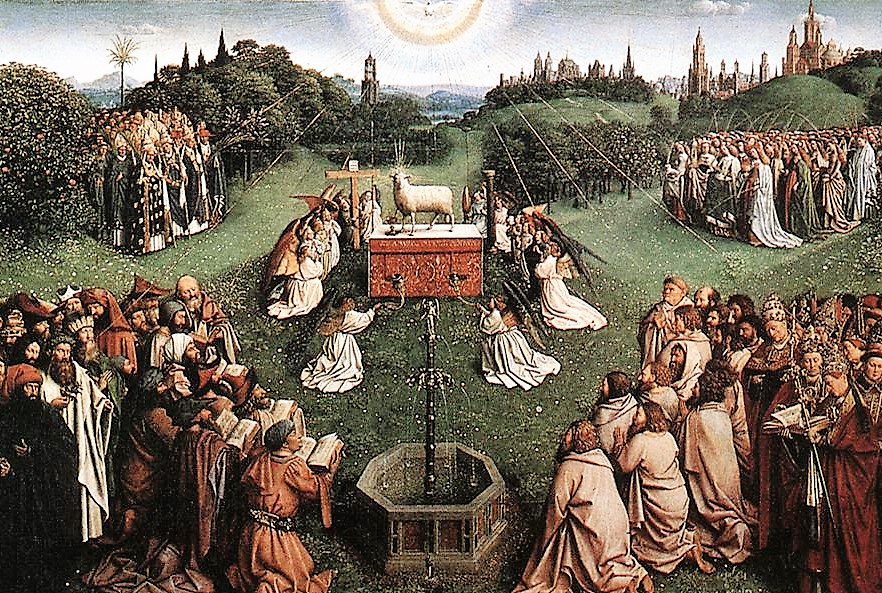
There is a tendency today to forget that Heaven is an acquired taste; not everyone wants what God offers. While everyone wants to be happy, often happiness is conceived of in an egocentric way. Heaven is thought of as a personally designed paradise where we will be happy on our own terms.
But that is not what Heaven is. Heaven is the Kingdom of God in all its fullness. Its values and qualities are manifold but include many things that are not immediately desirable to those who live with hearts and minds that are worldly and sinful. The Kingdom of God features ideas that are often unpopular: love of one’s enemies, generosity, love of the poor, and chastity. Heaven features God and His teachings at the center, not me and what I think. Yes, Heaven is a place where every aspect of God’s law is perfectly manifested. Yet many find some of these things not only undesirable but downright obnoxious; some even call them hateful and intolerant. To those in darkness, the light seems harsh.
Yes, Heaven is an acquired taste. This helps to explain that the existence of Hell is not due to a “mean” God trying to remove people whom He doesn’t like from His presence. It is a respectful acceptance by God of the free decision made by those who do not want what He is offering. They do not want to think differently or even be told what to think. They do not want to give up their favorite sins or have their hearts purified of unruly or disordered appetites. In the end, God will not force us to love what and whom He loves. He will not force us to live in His Kingdom.
In his book The Great Divorce, C.S. Lewis makes this very point. In it, many people come to “tour” Heaven, some of whom do not like what they find. Some struggle to adjust, others are resentful and say, in effect, “No thanks.” If you have not read it, I strongly encourage you to do so; it is an important book to read and ponder.
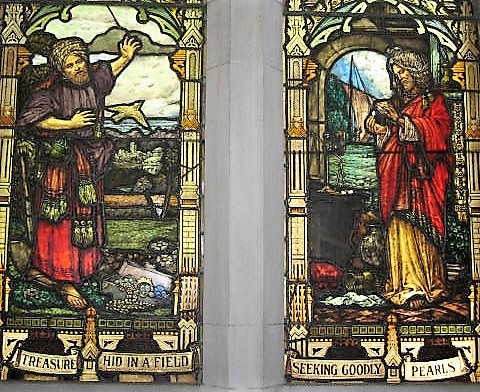
In yesterday’s Gospel, the Lord inquires after our hearts by giving us the images of buried treasure and a pearl of great price. The one who finds them goes and sells all he has in order to obtain them. Does this describe your heart? Does it describe the hearts of our family, friends, and compatriots? Often, the answer is no. Most people are not will to give up everything for the Kingdom of Heaven. Our hearts are disordered. We easily desire things that are sinful and harmful, and not so much those that are good, holy, and lasting. We prefer apparent goods to true goods. If we are faithful, the Lord can get us to that disposition of heart—but it takes time. At least grant Him your willingness to get to that place!
In yesterday’s Gospel the Lord also speaks of a dragnet. While he uses it as an image for the final judgment, that final judgement ultimately depends on the myriad judgments we make in our daily life. As you haul the net of your life ashore, what do you keep, finding it valuable, and what do you discard? Do you value what God is offering and retain it or do you more highly value other things in the net? What do you keep and what do you discard? The answers to questions like these points to your place in the net at the last judgment. God will gather into His Kingdom those who have desired it, not those who have rejected it.
Give the Lord your heart. Open when He knocks. Let Him create a desire in you for the very things He is offering. In the end, Heaven is an acquired taste, more so than we commonly imagine. Let God give you a taste for better and higher things.
This song says, “I’m trying to make heaven my home!”
The Gospel today asks a fundamental question: “What is it that you value most?” In other words, He’s asking us what we want most. We tend to answer questions like this the way we think we should, rather than genuinely. When we’re with the doctor (and Jesus is our doctor) our best bet is to answer honestly so that we can begin a true healing process. The fact is, we all need a heart transplant; we need a new heart, one that desires God and the things awaiting us in Heaven more so than any earthly thing.
Let’s take a look at this Gospel, which sets forth in three fundamental movements the picture and price of the Kingdom of God along with a peril that reminds us that we must make a choice.
I. The Picture – The Gospel uses three images for the kingdom, two of which we will look at here (a buried treasure and a pearl), and the third of which (a net) we will examine later. Both the treasure and pearl symbols are used elsewhere in Scripture. Studying those other passages can be helpful in fine-tuning our understanding of the gift of the Kingdom, which Jesus is discussing in today’s Gospel.
Buried Treasure – The concept of treasure (buried in the case of today’s Gospel) is mentioned elsewhere by Jesus:
Do not store up for yourselves treasures on earth, where moth and rust destroy, and where thieves break in and steal. But store up for yourselves treasures in heaven, where moth and rust do not destroy, and where thieves do not break in and steal. For where your treasure is, there your heart will be also (Matt 6:19-21).
Although we tend to think of treasure as a bunch of “stuff,” the image of treasure that Jesus uses in today’s Gospel is more a symbol for the heart and for our deepest desires, because our treasure is linked to our heart. One of the greatest gifts that God offers us is the gift a new heart, one that values most what He offers: holiness and Himself. One of the most fundamental prophetic texts of the Old Testament announces what Jesus has fulfilled:
Oh, my people, I will sprinkle clean water on you, and you will be clean; I will cleanse you from all your impurities and from all your idols. I will give you a new heart and put a new spirit in you; I will remove from you your heart of stone and give you a heart of flesh. And I will put my Spirit in you and move you to follow my decrees and be careful to keep my laws (Ezekiel 36:25-27).
The great treasure of the Kingdom of God gives us a new heart, by choosing it our heart is changed. To have a new heart is to experience our desires changing. We become less focused on passing, worldly things and more interested in the lasting treasure of the Kingdom of Heaven. We begin to love what and whom God loves. We begin to love holiness, justice, chastity, goodness, righteousness, and truth. We begin to love our spouse, family, the poor, and even our enemies the way God loves them. Our heart becomes alive with joy and zeal for the Kingdom of God and an evangelical spirit impels us to speak what we know to be true.
Yes, the buried, hidden treasure of the Kingdom of God unlocks our heart, bringing new life coursing through our veins, through our very soul. In choosing this treasure we get a new heart, for where our treasure is, there also will be our heart.
A Pearl – The second image comes from the Wisdom tradition, in which holy Wisdom is likened to a pearl. Here, too, is described one of the most precious gifts of the Kingdom of God: a new mind through holy Wisdom. What is this new mind? It is one that begins to think more and more as God does, one that shares His priorities and vision, one that sees as He does; it is the mind of Christ (cf 1 Cor 2:16). With this new mind we see through and reject worldly thinking, priorities, and agendas. We come to rejoice in God’s truth and to grasp more deeply its beauty and sensibility. What a precious gift the new mind is, thinking with God and having the mind of Christ!
So here are two precious manifestations of the Kingdom of God: a new heart and a new mind, which is really another way of saying, “a whole new self.” God is offering us a new life, a new self, a complete transformation.
II. The Price – What are these offerings of the Kingdom worth and what do they ultimately cost? The answer is clear in today’s Gospel: they cost, and are worth, everything. Regarding the hidden treasure and the pearl, the text says that both men went and sold all they had for them. They were willing to forsake everything for these precious items.
Be careful not to reduce this Gospel to a moralism. Notice that these men were eager to go and sell, to forsake, everything else. They did this not so much because they had to, but because they wanted to. They wanted to pay the price and did so with eagerness because they were so enamored of the glory they had found. Here is the gift to seek from the Lord: a willing and eager heart for the Kingdom of God, so eager that we are willing to forsake anything and everything for it.
For ultimately the Kingdom of God does cost everything and we will not fully inherit it until we are fully done with this world and its claims on our heart.
The gift to seek from the Lord is not that we forsake the world with sullen faces and depressed spirits, as if we were paying taxes. No! The gift to seek is that we, like these men, be so taken by the glory of God and His kingdom that we are more than willing to set aside anything that gets in our way, that we are so eager for the things of the Kingdom that loss of the world’s intoxicating trinkets means almost nothing.
Do you see? This is the gift: a heart that appreciates the true worth of the Kingdom of God such that no price is too high. Scripture says elsewhere,
•What is more, I consider everything a loss compared to the surpassing greatness of knowing Christ Jesus my Lord, for whose sake I have lost all things. I consider them rubbish, that I may gain Christ (Phil 3:8).
•For this light momentary affliction is preparing for us an eternal weight of glory beyond all comparison (2 Cor 4:17).
•I consider that our present sufferings are not worth comparing with the glory that will be revealed in us (Rom 8:18).
•No eye has seen, no ear has heard, no mind has conceived what God has prepared for those who love him (1 Cor 2:9).
•But one thing I do: Forgetting what is behind and straining toward what is ahead, I press on toward the goal to win the prize for which God has called me heavenward in Christ Jesus (Phil 3:13-14).
Yes, the Kingdom of God is more than worth any price we must pay, and ultimately we will pay all for it. Pray for an eager and willing spirit that comes from appreciating the unsurpassed worth of the Kingdom!
III. The Peril – The final movement contains a warning about our upcoming judgment. Ultimately, we either want the Kingdom of God or we don’t. Hence the Lord speaks of a net that captures everything (referring to our summons to the judgment). Those who want the Kingdom and have accepted its value and price will be gathered in; those who do not want the Kingdom of God and do not accept its value will be cast aside.
There are clearly some who do not value the Kingdom. They may desire “heaven,” but it is one of their own making, not the real Heaven. The true Heaven is the Kingdom of God in all its fullness. The Kingdom of God includes things like forgiveness, mercy, justice, chastity, love of the poor, love of one’s enemies, and the celebration of what is good, true, and beautiful. The Kingdom of God has God, not man, at its center.
Yes, there are many who neither want nor value some or even most of these things. When the net is drawn in, our decision is made final. Though we may wish for a fairy tale ending, one in which opponents of the Kingdom suddenly love it, God quite clearly says that at the judgment one’s decision for or against the Kingdom becomes final; it is fixed forever.
An old song says, “Better choose the Lord today, for tomorrow very well might be too late.” Thus we are warned that the judgment looms and that we ought to be earnest in seeking a heart from the Lord that eagerly desires the Kingdom and appreciates its worth above all people and all things. In the end, we get what we want. Either we will have chosen the Kingdom or not.
Pray for a new heart, one that values the Kingdom of Heaven above all else. We ought to consider ourselves warned.
The Gospel today is about what we truly value, and is presented in three movements.
This song says, “You can have all this world, just give me Jesus.”
This animated short contrasts the consuming quality of envy, anger, and hate with the overwhelming power of love and forgiveness. It also depicts the possibility of repentance upon recognizing the damage caused.
In the video, a little girl’s written resentments of her older sister spring forth from her diary to wreak their havoc. Witnessing the frightening result and trying to halt the damage, the young girl tears the passages from her journal. She then attempts to create a repentant, loving message from the shredded remnants. It is a very creative illustration of how God puts our sins behind Him and remembers them no more. Enjoy!
We are often told to trust in God, and many of us have counseled others who are anxious or downcast to do so. But what does that mean?
In some cases, when people give this counsel they mean this: Don’t worry, God will eventually give you what want. God will come around to your way of thinking at some point. Hang in there and wait for God to answer (your way). He’ll take care of things (in a way that pleases you).
This is not trust.
To trust is to move to the stable conviction that whatever God decides to do is the right thing. It means being at peace with what He does, what He decides. It is to accept that God often acts in paradoxical ways, in ways that are different from, or even contrary to, our notions of what is best. God often permits evils for some greater good, even if this greater good is hidden from us.
At the foot of the cross, we realize that even a total disaster can produce immense good. We call that terrible day “Good Friday” for a reason. The apparent “total loss” of that day ushered in the New Covenant and made more than enough grace and mercy available to save the entire human race—if we but ask.
Many of us have experienced difficulties that were quite devastating to us at the time. In some cases, we have subsequently come to understand why God permitted them. We can see how we grew from the experience or how new opportunities were opened to us that, while not our preference at the time, were in fact best. In other cases, however, what went through still make little sense to us. But if we have learned to trust God, we can be at peace with His apparent “No” to our desired outcome. Trust says, “It is well with my soul.”
An old hymn with that title says,
When peace, like a river, attendeth my way,
when sorrows like sea billows roll;
whatever my lot, thou hast taught me to say,
It is well, it is well with my soul.
That is trust: the ability to say, “Whatever my lot, it is well with my soul.” It is not wrong to present our wants and wishes to God, but trusting Him means being at peace with His answer, not resenting it.
We are forever asking God to bless what we are doing, but when do we ever seek what God is blessing and then do that?
Trusting God doesn’t mean thinking that He’ll eventually give me what I want. Trusting God means being at peace with whatever He wants; knowing that He wants it is enough for me; there is peace and it is well with my soul.
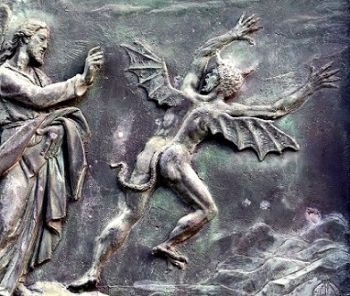
The video at the bottom of this post is of Archbishop Fulton J. Sheen. It is a fascinating excerpt from a longer presentation he did. In it, he analyzes the diabolic (anything of or relating to the Devil) from several different perspectives. Archbishop Sheen identifies three characteristics of the diabolic by examining the story of the Gerasene demoniac, which is presented in the synoptic Gospels. Here is the beginning of the story as it appears in the Gospel of Luke:
They sailed to the region of the Gerasenes, which is across the lake from Galilee. When Jesus stepped ashore, he was met by a demon-possessed man from the town. For a long time, this man had not worn clothes or lived in a house, but had lived in the tombs. When he saw Jesus, he cried out and fell at his feet, shouting at the top of his voice, “What do you want with me, Jesus, Son of the Most High God? I beg you, don’t torture me!” For Jesus had commanded the evil spirit to come out of the man. Many times it had seized him, and though he was chained hand and foot and kept under guard, he had broken his chains and had been driven by the demon into solitary places. Jesus asked him, “What is your name?” “Legion,” he replied, because many demons had gone into him (Luke 8:26-30).
Following this, Jesus drove the demon(s) out the man and into the herd of swine.
From this story, and also based on an insight from Dr. Rollo May, a psychologist of his time (the talk was given in the mid-1970s), Archbishop Sheen sets forth these three characteristics of the diabolic:
Love of Nudity – For a long time this man had not worn clothes.
Violence – … though he was chained hand and foot and kept under guard, he had broken his chains. The version of the story in Mark’s Gospel has more vivid detail: For he had often been chained hand and foot, but he tore the chains apart and broke the irons on his feet. No one was strong enough to subdue him.
Division (split personalities, disjointed minds) – … many demons had gone into him. In Mark’s version, the demoniac replies, My name is Legion, for we are many (Mk 5:9). All of the versions say that the demoniac lived apart from others or in solitary places.
It does not take much effort to recognize that these three characteristics of the diabolic are alive and flourishing in the modern world, at least in the West. Let’s examine the evidence we can see all around us today:
1. Love of Nudity – This is obvious in the modern world on several levels. First, there is the widespread tendency toward immodest dress. We have discussed modesty here before on this blog, noting that the words “modesty” and “moderation” come from the word “mode,” which refers to the most commonly occurring value in a set of data. Hence, while we want to avoid oppressively puritanical notions about dress that impose heavy burdens (especially on women) and regard the body as somewhat evil, we must also critique many modern forms of dress that are at the other extreme. These “fashions” reveal more than is reasonable and are generally intended to draw attention to aspects of the body that are private and reserved for sexual union within marriage. Too many in our culture see no problem with parading about in various stages of undress, wearing clothing that seems intended to call attention to, rather than conceal, the private areas of the body. This love of disclosure and titillation is surely an aspect of the Evil One’s love of nudity.
Pornography, though nothing new in this fallen world, has surely reached epidemic proportions thanks to the Internet. Any psychotherapist, counselor, or priest will tell you that addiction to pornography is a huge problem today. Millions of Americans are viewing enormous amounts of pornography and the “industry” appears to be growing rapidly. What once required a visit to a hidden-away adult bookstore is now available in one’s home with just a click of the mouse. And the thought that browsing habits are easily discoverable matters little to the addicts of this latest form of slavery. Many are on a steep slope downward into ever-more-deviant forms of pornography. Some end up at illegal sites and before know what’s happened, the FBI is knocking on their door. Yes, Satan’s love of nudity has possessed many!
The overall sexualization of our culture also ties in to Satan’s love of nudity. We sexualize women in order to sell products. We even sexualize children. Our sitcoms feature endless immature chatter about sex. Collectively, we act like oversexed teenagers obsessed with something we don’t really understand. Yes, Satan loves nudity and everything that goes with it.
Then of course there is the utter confusion that celebrates homosexual activity. What Scripture calls gravely sinful, disordered, and contrary to nature (παρὰ φύσιν – para physin – Rom 1:26), is openly celebrated by many in our culture. Those afflicted with such desires openly and proudly identify themselves with what tempts them. Rather than lamenting the trials faced by those with such an affliction, and offering love, support, and the truth that they should live celibately (as all the unmarried are called to do), our sex-saturated culture, blinded and darkened by its own wild lust, affirms and even encourages them to indulge in what can only bring further harm to them and others. They have exchanged the truth of God for a lie … (Rom 1:25). It is no surprise that as a result of this celebration of darkness and confusion, the even more deeply confused notion of “transgenderism” has taken root.
Thus, the love of the nudity and the related obsession with (and confusion about) sex is manifest in our culture. It is surely a sign of the diabolic.
2. Violence – Collectively, have turned violence into a form of entertainment. Adventure movies and video games turn violent retribution into fun and death into a “solution.” Recent popes have warned us of the culture of death, a culture in which death is put forward as the solution to problems. Violence begins in the womb as the innocent are attacked as we defend “choice” and “rights.” The embrace of death continues to pervade the culture through contraception, gang activity, frequent recourse to war, and capital punishment. The past century was perhaps the bloodiest ever known on this planet: two world wars, hundreds of regional wars and conflicts, starvation campaigns, and genocides. Paul Johnson, in his book Modern Times estimates that over 100 million people died violently in just the first 50 years of the 20th century. With every death, Satan did his “Snoopy dance.” Satan loves violence; he loves to set fires and then watch us blame one another as we all burn.
3. Division – Satan loves to divide. Archbishop Sheen says that the word “diabolic” comes from two Greek words, dia and ballein, meaning “to tear apart.” Most literally, dia means “through” or “between” and ballein means “to throw or to cast.” Satan “casts things between us” in order to divide and distract us. Thus, we see our families, the Church, and our country divided. These divisions occur in almost every facet of our lives: race, sex, religion, politics, economics. We are divided on the basis of age, region, blue vs. red states, the coasts vs. the heartland, liturgy, music, language, and more trivialities.
Our families are broken. Divorce is rampant. Commitments of any sort are rejected as too difficult or even impossible. The Church is broken, divided into factions. Though we once we agreed on the essentials, now even appeals to shared truth are called intolerant.
Inwardly, we struggle with many divisive drives, with figurative and literal schizophrenia. We are drawn to what is good, true, and beautiful and yet at the same time to what is base, false, and evil. We know what is good, but desire what is evil; we seek love, but indulge in hate and revenge. We admire innocence but often revel in destroying it or at least in replacing it with cynicism.
Three characteristics of the diabolic: love of nudity, violence, and division. What do you think? Is the prince of this world working his agenda? Even more important, are we conniving with him? The first step in overcoming the enemy’s agenda is to recognize his tactics, name them, and then rebuke them in the name of Jesus.
Thank you, Archbishop Sheen. Your wisdom — God’s wisdom — never ages.
Pay attention to what the good archbishop has to say!
Writing as I am on the Feast of Saint James, likely the first Apostle to be martyred, I’d like to ponder the kinds of sufferings the Apostles endured in order to announce the Gospel and win souls for Christ. In the “softer” Church of the declining West, it is hard for us even to imagine. How many Catholics today can barely rouse themselves to get to an hour-long Mass on Sunday? How many of us clergy will not risk so much as a raised eyebrow in order to speak the truth?
Yet all but one of the first Apostles suffered martyrdom as well as countless other sufferings before their lives were brutally ended. Arguably, 30 of the first 33 popes died as martyrs. Two others died in exile. Only one died in his bed.
We should never fail to thank God for the heroic ministry of the early Christians, clergy and laity alike, who risked everything to believe and to announce the Gospel. Having encountered Christ, they were so transfixed by His truth and His very person, that they could not remain silent. Even in the face of persecution and death, the Apostles declared, simply and forcefully, we cannot stop speaking about what we have seen and heard (Acts 4:20).
In tribute to them and to the early Church I want to present a kind of catalogue of the sufferings of St. Paul. Of him we know the most, but surely many others suffered as he did. As you read of what Paul endured, remember the many others as well, and when discomfited by a mere inconvenience or minor persecution, consider the price that others paid so that we could know Christ and be saved.
In this first passage, Paul’s sufferings were announced by God to Ananias:
• Acts 9:15-16 – For he is a chosen vessel of mine to bear My name before Gentiles, kings, and the children of Israel. I will show him how many things he must suffer for My name’s sake (Acts 9:15-16).
Here are some of Paul’s own descriptions of what he endured:
• 2 Corinthians 4:8-12 – We are perplexed, but not in despair; persecuted, but not forsaken; struck down, but not destroyed — always carrying about in the body the dying of the Lord Jesus, that the life of Jesus also may be manifested in our body. For we who live are always manifesting the death of Jesus’ sake, that the life of Jesus also may be manifested in our mortal flesh. So then death is working in us, but life in you. • 2 Corinthians 11:23-27 – … in labors more abundant, in stripes above measure, in prisons more frequently, in deaths often. From the Jews five times I received forty stripes minus one. Three times I was beaten with rods; once I was stoned; three times I was shipwrecked; a night and a day I have been in the deep; in journeys often, in perils of waters, in perils of robbers, in perils of my own countrymen, in perils of the Gentiles, in perils in the city, in perils in the wilderness, in perils in the sea, in perils among false brethren; in weariness and toil, in sleeplessness often, in hunger and thirst, in fasting often, in cold and nakedness—besides the other things, what comes upon me daily: my deep concern for all the churches. • 2 Corinthians 6:3-20 – … in much patience, in tribulations, in needs, in distresses, in stripes, in imprisonments, in tumults, in labors, in sleeplessness, in fasting; by purity, by knowledge, by longsuffering, by kindness, by the Holy Spirit, by sincere love, by the word of truth, by the power of God, by the armor of righteousness on the right hand and on the left, by honor and dishonor, by evil report and good report; as deceivers, and yet true; as unknown, and yet well known; as dying, and behold we live; as chastened, and yet not killed; as sorrowful, yet always rejoicing; as poor, yet making many rich; as having nothing, and yet possessing all things. • Galatians 5:11 – Why do I still suffer persecution? [For, if not] the offense of the cross has ceased. • 2 Corinthians 12:10 – Therefore I take pleasure in infirmities, in reproaches, in needs, in persecutions, in distresses, for Christ’s sake. For when I am weak, then I am strong. • 2 Timothy 3:10-11 – … my doctrine, my manner of life, purpose, faith, longsuffering, love, perseverance, persecutions, afflictions, which happened to me at Antioch, at Iconium, at Lystra—what persecutions I endured. And out of them all the Lord delivered me. • 1 Corinthians 15:30-32 – And why do we stand in jeopardy every hour? I affirm, by the boasting in you which I have in Christ Jesus our Lord, I die daily …. [Indeed] I have fought with beasts at Ephesus. • 2 Corinthians 12:7-10 – And lest I should be exalted above measure by the abundance of the revelations, a thorn in the flesh was given to me, a messenger of Satan to buffet me, lest I be exalted above measure. Concerning this thing I pleaded with the Lord three times that it might depart from me. And He said to me, “My grace is sufficient for you, for My strength is made perfect in weakness.” Therefore, most gladly I will rather boast in my infirmities, that the power of Christ may rest upon me. Therefore, I take pleasure in infirmities, in reproaches, in needs, in persecutions, in distresses, for Christ’s sake. For when I am weak, then I am strong. • Galatians 4:13 – You know that because of physical infirmity I preached the gospel to you at the first …. • Galatians 6:7 – From now on let no one trouble me, for I bear in my body the brandmarks of the Lord Jesus. • Romans 9:1-2 – I tell the truth in Christ, I am not lying, my conscience also bearing me witness in the Holy Spirit, that I have great sorrow and continual grief in my heart. • 2 Timothy 4:10-17 Demas, in love with this present world, has deserted me and gone to Thessalonica. Crescens has gone to Galatia, Titus to Dalmatia. Luke alone is with me …. Tychicus I have sent to Ephesus …. Alexander the coppersmith did me great harm; the Lord will repay him according to his deeds. Beware of him yourself, for he strongly opposed our message. At my first defense [in Jerusalem] no one came to stand by me, but all deserted me. May it not be charged against them! But the Lord stood by me and strengthened me, so that through me the message might be fully proclaimed and all the Gentiles might hear it. So I was rescued from the lion’s mouth. • 2 Timothy 4:6-8 – For I am already being poured out as a drink offering, and the time of my departure is at hand. I have fought the good fight, I have finished the race, I have kept the faith. Finally, there is laid up for me the crown of righteousness, which the Lord, the righteous Judge, will give to me on that Day, and not to me only but also to all who have longed for His appearing.
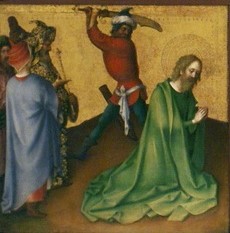
Death of St. Paul by Stefan Lochner
And lest we think that St. Paul may have exaggerated his sufferings, consider the following occurrences documented by Luke in the Acts of the Apostles:
• Acts 9:23 – Fellow Jews plot to kill him in Damascus, must be lowered in a basket from city walls to escape • Acts 9:29 – Hellenists seek to kill him in Jerusalem, must flee to Caesarea • Acts 13:15 – Persecuted and run out of Antioch in Pisidia • Acts 14:5 – Facing likely arrest and stoning at Iconium, flees to Lystra and Derbe • Acts 14:19 – Stoned, dragged out of Lystra and left for dead • Acts 15:11 – Opposed by elders and others in Jerusalem • Acts 16:23 – Arrested as a disturber of the peace, beaten with rods, and imprisoned at Philippi • Acts 16:39 – Ordered by Roman officials to leave Philippi • Acts 17:5-7, 10 – Attacked where he lodged in Thessalonica, must be secreted away to Beroea • Acts 17:13-15 – Forced out of Beroea, must flee to Athens • Acts 17:32 – Mocked in Athens for teaching about the resurrection • Acts 18:12 – Apprehended by fellow Jews and taken before the judgment seat of Gallio in Corinth • Acts 19:23-41 – Opposed by the silversmiths in Ephesus, who riot against him • Acts 20:3 – Plotted against by the Jews in Greece • Acts 21:27-30 – Apprehended by the mob in Jerusalem • Acts 22:24 – Arrested and detained by the Romans • Acts 22:24-29 – Barely escaped being scourged • Acts 23:1-10 – Rescued from the Sanhedrin and Pharisees during their violent uprising in Jerusalem • Acts 23:12-22 – Assassination plots made against him by fellow Jews, who swear an oath to find and kill him • Acts 23:33-27:2 – Two-year imprisonment in Caesarea • Acts 27:41-28:1 – Shipwrecked on the island of Malta • Acts 28:3-5 – Suffered a snakebite • Acts 28:16-31 – Imprisoned in the Rome
Paul was executed by decapitation ca. 68 A.D.
Never forget the price that others have paid in order that we may come to saving faith. Each Sunday, remember that the Creed was written in the blood of martyrs.
Warning: the following video graphically depicts the sufferings of the early martyrs in the arena:
One of the more difficult biblical themes to understand is that of God hardening the hearts and minds of certain people. The most memorable case is that of Pharaoh. Before sending Moses to him, God said that He would “harden Pharaoh’s heart” (Ex 4:21). There are other instances in which biblical texts speak of God hardening the hearts of sinners, even from among His own people.
Jesus hinted at such a theme in Matthew 13, when He said that He spoke in parables (here understood more as riddles) so as to affirm that the hearts of most people “outside the house” were hardened. He quotes Isaiah 6:9-10 as He does so. Jesus’ own apostles wondered why He spoke plainly only to them and a close company of disciples, but in riddle-like parables to the crowds outside. In His answer we are left to wonder if Jesus has not perchance written off the crowds and left them in the hardness of their hearts. To be fair, Jesus’ remark is ambiguous and open to interpretation.
What are we to make of texts like these which explicitly or implicitly speak of God hardening the hearts of people? How can God, who does no evil, be the source of a sinful mind or hard heart? Why would God do such a thing when Scripture also says this:
• As surely as I live, declares the Sovereign LORD, I take no pleasure in the death of the wicked, but rather that they turn from their ways and live. Turn! Turn from your evil ways! Why will you die, O house of Israel? (Ez 33:11)
• God our Savior … wants all men to be saved and to come to a knowledge of the truth (1 Tim 2:4).
To be sure, these questions involve very deep mysteries, about the interaction between God’s sovereignty and our freedom, about time, and about causality. The question of God hardening hearts cannot be resolved simply. Greater minds than mine have pondered these things and it would be foolish to think that an easy resolution will be found in a blog post.
Some distinctions can and should be made and some context supplied. We do not want to understand the “hardening texts” simplistically or in ways that use one truth to cancel out others that balance it.
I propose that we examine these texts along four lines:
The Context of Connivance
The Mystery of Time
The Mystery of Primary Causality
The Necessity of Humility
To begin, it is important simply to list some of the hardening texts. These will be referred to as we examine each of the four points above. The following are not the only hardening texts, but they provide a wide enough sample to use in our discussion:
• The LORD said to Moses, “When you return to Egypt, see that you perform before Pharaoh all the wonders I have given you the power to do. But I will harden his heart so that he will not let the people go” (Ex 4:21).
• Moses and Aaron performed all these wonders before Pharaoh, but the LORD hardened Pharaoh’s heart, and he would not let the Israelites go out of his country (Ex 11:10).
• Why, O LORD, do you make us wander from your ways and harden our hearts so we do not revere you? Return for the sake of your servants, the tribes that are your inheritance (Is 63:17).
• He [God] has blinded their eyes and deadened their hearts, so they can neither see with their eyes, nor understand with their hearts, nor turn–and I would heal them (Jesus quoting Isaiah 6:9-10, in John 12:40).
• They perish because they refused to love the truth and so be saved. For this reason, God sends them a powerful delusion so that they will believe the lie, so that all will be condemned who have not believed the truth but have delighted in wickedness (2 Thess 2:10-12).
• Therefore, God gave them over in the sinful desires of their hearts to sexual impurity for the degrading of their bodies with one another. … Furthermore, since they did not think it worthwhile to retain the knowledge of God, he gave them over to a depraved mind, to do what ought not to be done (Rom 1:24, 28).
Point I: The Context of Connivance – In properly assessing texts like these we should first consider the contexts in which they were made and written. Generally speaking, most of these declarations that God hardens the heart come after a significant period of disobedience on the part of those whose hearts were hardened. In a way, God “cements the deal” and gives them what they really want. Seeing that they have hardened their own hearts to Him, God determines that their disposition is to be a permanent one. In a sovereign exercise of His will (for nothing can happen without God’s allowance), He declares and permits their hearts to be hardened in a definitive kind of way. In this sense there is a judgment of God upon the individual that recognizes the person’s definitive decision against Him. Hence this hardening can be understood as voluntary on the part of the one hardened, for God hardens in such a way that He uses the person’s own will for the executing of His judgment. God accepts that the individual’s will against Him is definitive.
In the case of Pharaoh, although God indicated to Moses that He would harden Pharaoh’s heart, the actual working out of this is a bit more complicated. We see in the first five plagues that it is Pharaoh who hardens his own heart (Ex 7:13; 7:22; 8:11; 8:28; 9:7). It is only after this repeated hardening by Pharaoh of his own heart that the Exodus text speaks of God as the one who hardens (Ex 9:12; 9:34; 10:1; 10:20; 10:27). Hence the hardening here is not without Pharaoh’s repeated demonstration of his own hardness. God does this as a kind of sovereign judgment on Pharaoh.
The Isaiah texts (many in number) that speak of a hardening being visited upon Israel by God (e.g., #3 and #4 above) are also the culmination of a long testimony by Isaiah of Israel’s hardness. At the beginning of Isaiah’s ministry, God describes (through Isaiah) Israel’s hardness as being of their own doing: For the LORD has spoken: “I reared children and brought them up, but they have rebelled against me. The ox knows his master, the donkey his owner’s manger, but Israel does not know, my people do not understand.” Ah, sinful nation, a people loaded with guilt, a brood of evildoers, children given to corruption! They have forsaken the LORD; they have spurned the Holy One of Israel and turned their backs on him (Is 1:2-4). There follows a long list of their crimes, their hardness, and their refusal to repent.
St. John Chrysostom: Of the numerous texts later in Isaiah (and also referenced by Jesus (e.g., Jn 12:40)) that speak of Israel as being hardened by God (and having their eyes shut by Him), St. John Chrysostom wrote, That the saying of Isaiah might be fulfilled: that here is expressive not of the cause, but of the event. They did not disbelieve because Isaiah said they would; but because they would disbelieve, Isaiah said they would … For He does not leave us, except we wish Him … Whereby it is plain that we begin to forsake first, and are the cause of our own perdition. For as it is not the fault of the sun, that it hurts weak eyes, so neither is God to blame for punishing those who do not attend to His words (on a gloss of Is. 6:9-10 at Jn 12:40, quoted in the Catena Aurea).
St Augustine: This is not said to be the devil’s doing, but God’s. Yet if any ask why they could not believe, I answer, because they would not … But the Prophet, you say, mentions another cause, not their will; but that God had blinded their eyes, and hardened their heart. But I answer, that they well deserved this. For God hardens and blinds a man, by forsaking and not supporting him; and this He makes by a secret sentence, for by an unjust one He cannot (quoted in the Catena Aurea at Jn 12:40).
In the passage from 2 Thessalonians, while the text speaks of God as having sent the delusion, the verses before and after make clear the sinful role of the punished.
Of this text St. Augustine wrote,From a hidden judgment of God comes perversity of heart, so that the refusal to hear the truth leads to the commission of sin, and this sin is itself a punishment for the preceding sin [of refusing to hear the truth] (Against Julian 5.3.12).
St. John Damascus:[God does this] so that all may be condemned who did not believe the truth but had pleasure in unrighteousness (The Orthodox Faith 4.26).
The passages from Romans speak of God handing them over only after they have suppressed the truth (1:18), persevered in their wickedness (1:18), and preferred idolatry (1:23). Hence, as a just judgment, God hands them over to sexual confusion (homosexuality) and countless other destructive drives. So although it is said that God hands them over, it is really not that simple. They do not want to serve Him and so He, knowing their definitive decision, gives them what they want.
Thus our first point of distinction in understanding the hardening texts is that the context of connivance is important in assessing them. Scripture does not assert that God takes a reasonably righteous man and, out of the blue, hardens his heart, confuses his mind, or causes him (against his will) to become obstinate. The texts are usually presented as a kind of prevenient judgment by God, that the state of the person’s hardness has now become permanent. They refuse and so God “causes” them to walk in their own sinful ways since they have insisted on doing so.
Point II: The Mystery of Time – In understanding these hardening texts (which we have seen are akin to judgment texts) we must recall that God does not live in time in the same way that we do. Scripture speaks often of God’s knowledge and vision of time as being comprehensive rather than speculative or serial (e.g., Ex 3:14; Ps 90:2-4; Ps 93:2; Is 43:13; Ps 139; 2 Peter 3:8; James 1:17).
To say that God is eternal and lives in eternity is to say that He lives in the fullness of time. For God, past, present, and future are all the same. God is not wondering what I will do tomorrow; neither is He waiting for it to happen. For Him, my tomorrow has always been present. All of my days were written in His book before one of them ever came to be (Ps 139:16). Whether and how long I live has always been known to Him. Before He ever formed me in my mother’s womb He knew me (Jer 1:4). My final destiny is already known and present to Him.
Hence, when we strive to understand God’s judgments in the form of hardening the hearts of certain people, we must be careful not to think He lives in time the way we do. It is not as though God is watching my life like a movie. He already knows the choices I will make. Thus, when God hardens the hearts of some, it is not as though He is trying to negatively influence the outcome and trip certain people up. He already knows the outcome and has always known it; He knows the destiny that they have chosen.
Be very careful with this insight, for it is a mystery to us. We cannot really know what it is like to live in eternity, in the fullness of time, where the future is just as present as the past. Even if you think you know, you really don’t. What is essential for us to realize is that God does not live in time the way we do. If we try too hard to solve the mystery (rather than merely accepting and respecting it) we risk falling into the denial of human freedom, double predestination, or other misguided notions that sacrifice one truth for another rather than holding them in balance. That God knows what I will do tomorrow does not destroy my freedom to actually do it. How this all works out is mysterious, but we are free and God holds us accountable for our choices. Further, even though God knows our destiny already, this does not mean that He is revealing anything about that to us, so that we should look for signs and seek to call ourselves saved or lost. We ought to work out our salvation in reverential fear and trembling (Phil 2:12).
The key point here is mystery. How, why, and when God hardens the heart of anyone is caught up in the mysterious fact that He lives outside of time and knows all things before they happen. Thus He acts with comprehensive knowledge of all outcomes.
Point III: The Mystery of Causality – One of the major differences between the ancient and the modern world is that the ancient world was much more comfortable dealing with something known as primary causality.
Up until the Renaissance, God was at the center of all things and people instinctively saw the hand of God in everything, even terrible things. Job said, The LORD gave and the LORD has taken away; may the name of the LORD be praised … if we have received good things at the hand of God, why should we not receive evil? (Job 1:21; 2:10) The ancients would commonly attribute everything as coming from the hand of God, for He was the first cause of everything that happened. This is what is meant by primary causality. The ancients were thus much more comfortable attributing things to God, even things that we are not. In speaking like this, they were not engaging in superstitious or primitive thinking; rather, they were emphasizing that God was sovereign, omnipotent, and omnipresent, and that nothing happened apart from His sovereign will. God is the primary cause of all that is.
Of this ancient and scriptural way of thinking the Catechism says, And so we see the Holy Spirit, the principal author of Sacred Scripture, often attributing actions to God without mentioning any secondary causes [e.g., human or natural]. This is not a “primitive mode of speech,” but a profound way of recalling God’s primacy and absolute Lordship over history and the world, and so of educating his people to trust in him (CCC # 304).
The key point here is understanding that the ancient biblical texts, while often speaking of God as hardening the hearts of sinners, did not mean to say that man had no role, no responsibility. Neither did the texts mean to say that God acted in a merely arbitrary way. Rather, the emphasis was on God’s sovereign power as the first cause of all that is. Hence, He is often called the cause of all things and His hand is seen in everything. We moderns are uncomfortable speaking in this way.
After the Renaissance, man moved himself to the center and God was gradually relegated to the periphery. Man’s manner of thinking and speaking began to shift to secondary causes (causes related to man and nature). If something happens we look to natural causes, or in human situations, to the humans who caused it. These are secondary causes because I cannot cause something to happen unless God causes me. Yet increasingly the modern mind struggles to maintain a balance between the two mysteries: our freedom and responsibility, and God’s sovereignty and omnipotence.
In effect primary causality has largely been thrown overboard as a category. Even modern believers unconsciously do this and thus exhibit three related issues:
1. We fail to maintain the proper balance between two mysteries: God’s sovereignty and our freedom.
2. We exhibit shock at things like the “hardening texts” of the Bible because we understand them poorly.
3. We try to resolve the shock by favoring one truth over the other. Maybe we just brush aside the ancient biblical texts as a “primitive mode of speech,” inappropriately concluding that God didn’t have anything to do with this or that. Or we go to the other extreme and become fatalistic, denying human freedom, denying secondary causality (our part), and accusing God of everything (as if He were the only cause and shouldered the sole blame for everything). We either read the hardening texts with a clumsy literalism or we dismiss them as misguided notions from an immature, primitive, pre-scientific age.
The point here is that we have to balance the mysteries of primary and secondary causality. We cannot fully understand how they interrelate, but they do. Both mysteries need to be held. The ancients were more sophisticated than we are in holding these mysteries in the proper balance. We handle causality very clumsily and do not appreciate the distinctions between primary causality (God’s part) and secondary causality (our own and nature’s part). We try to resolve the mystery rather than holding it in balance and speaking to both realities. In doing so, we become poor interpreters of the hardening texts.
Point IV: The Necessity of Humility – By now it is clear that we are dealing with the mysterious interrelationship between God and Man, between God’s sovereignty and our freedom, between primary and secondary causality. In the face of such mysteries we have to be very humble. We ought not to think more of the details than is proper, because they are largely hidden from us. Too many moderns either dismiss the hardening texts or accept them and then sit in harsh judgment over God (as if we could do such a thing). Neither approach bespeaks humility. Consider a shocking but very humbling text in which Paul warns us in this very matter:
What then shall we say? Is God unjust? Not at all! For he says to Moses, “I will have mercy on whom I have mercy, and I will have compassion on whom I have compassion.” It does not, therefore, depend on man’s desire or effort, but on God’s mercy. For the Scripture says to Pharaoh: “I raised you up for this very purpose, that I might display my power in you and that my name might be proclaimed in all the earth.” Therefore, God has mercy on whom he wants to have mercy, and he hardens whom he wants to harden. One of you will say to me: “Then why does God still blame us? For who resists his will?” But who are you, O man, to talk back to God? “Shall what is formed say to him who formed it, ‘Why did you make me like this?’” (Romans 9:14-20)
None of us can demand an absolute account from God for what He does. Even if He were to tell us, could our small and worldly minds ever really comprehend it? My thoughts are not your thoughts, and my ways are not your ways, says the Lord (Is 55:8).
SUMMARY – In this (rather too long) post, we have considered the “hardening texts,” in which it seems that God hardens the hearts of certain people and groups—and so He does. But texts like these must be approached carefully, humbly, and with proper understanding of the scriptural and historical context. At work here are profound mysteries: God’s sovereignty, our freedom, His mercy, and His justice.
We should be careful to admit the limits of our knowledge when it comes to such texts. As the Catechism so beautifully states, when it comes to texts like these they are to be appreciated as a profound way of recalling God’s primacy and absolute Lordship over history and the world, and so of educating his people to trust in him (CCC # 304). This song says, “Be not angry any longer Lord and no more remember our iniquities. Behold and regard us; we are all your people!
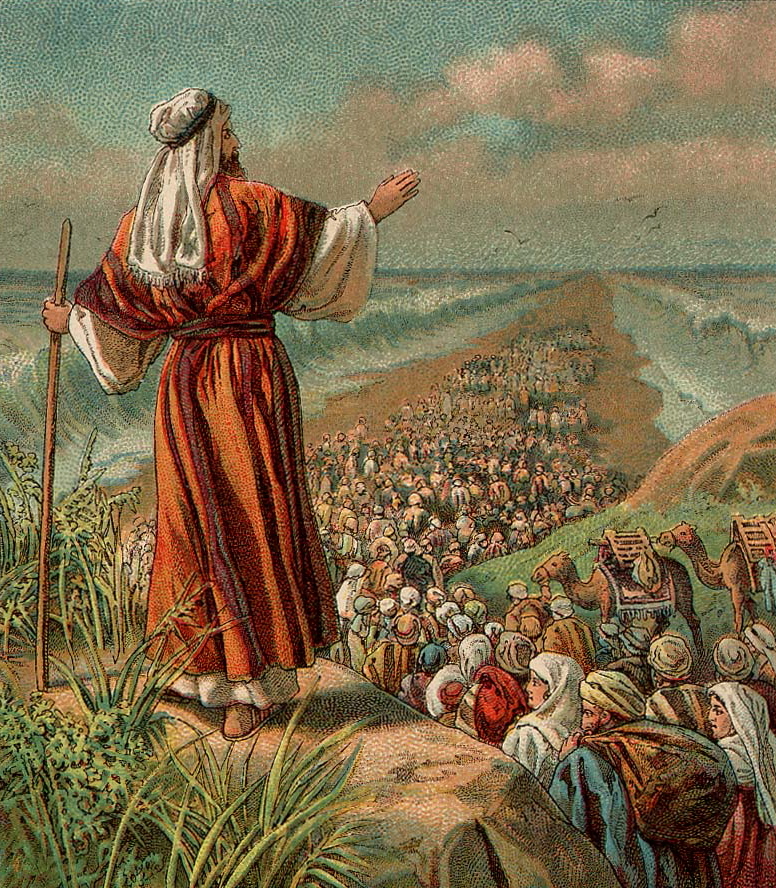
In daily Masses this week we are reading largely from the Book of Exodus, specifically the familiar story of the parting of the Red Sea by God, working through Moses. Unfortunately, Tuesday’s Feast of the St. James, good though it is, interrupts the story and we miss the critical passage in which the water is parted and the people of Israel escape through the sea, dry-shod.
Let’s review the passage:
Then Moses stretched out his hand over the sea, and the LORD drove the sea back by a strong east wind all night and made the sea dry land, and the waters were divided. And the people of Israel went into the midst of the sea on dry ground, the waters being a wall to them on their right hand and on their left (Exodus 14:21-22).
When a story is so familiar to us it is easy to overlook the details. Note that the sea is standing up like a wall on both sides. Though the height is not mentioned, let’s just imagine that the walls of water are thirty feet high.
Imagine the courage of the people entering into the midst of sea while the water is being miraculously held back! If you saw walls of water like that, would you have ventured out into the middle? While it may have “helped” that they had an army pursing them from behind, do not minimize the fear they must have felt and the courage and trust it took for them to go forward in faith.
St. Paul would later say that the passage through the Red Sea is an image of baptism: They were all baptized into Moses (1 Cor 10:2). Note how faith and baptism are joined. Though the Sacrament of Baptism confers the theological virtue of faith, there is (at least in adult baptism) a kind of prevenient faith wherein one is prompted to trust God and what He has revealed. In receiving people into the faith, I have been amazed by the courage shown by many of them. There have been those who faced the dismay of and even persecution by their family members. Others overcame personal obstacles, doubts, and uncertainties. They stepped forth in faith and went through the waters.
Even after baptism, all of us are asked to continue living its implications. The increasing scorn and derision of our faith and the teachings of our Lord by the world may seem like walls of water that we must, in trust, ignore. We must continue in the renewal of our baptismal promises and journey through to the other side. We must also journey, trusting the Lord’s promise to deliver us from the pursuing army of the prince of this world.
Yes, living our baptism requires courage.
You might object to my calling the people of Israel courageous, saying that the Egyptian army also pushed forward into the middle of the parted walls of water. Yes, but their doing so was not the result of courage. Rather, it was the excess of courage we call rashness, folly, or foolhardiness. Why? Because they did not have the promises of God. It is virtuous to step out in faith, trusting the promises of God, but prideful to go forth trusting in one’s own strength. The prideful cannot stand before God, only the humble can.
The Egyptians pursued and went in after them into the midst of the sea, all Pharaoh’s horses, his chariots, and his horsemen. And in the morning watch the LORD in the pillar of fire and of cloud looked down on the Egyptian forces and cast a glance and threw the Egyptian forces into a panic, clogging their chariot wheels so that they drove heavily. And the Egyptians said, “Let us flee from before Israel, for the LORD fights for them against the Egyptians” (Exodus 14:23-25).
Faith delivers. Pride brings only destruction. A simple glance from the Lord destroys pride and all its foolish dreams.

 There is a tendency today to forget that Heaven is an acquired taste; not everyone wants what God offers. While everyone wants to be happy, often happiness is conceived of in an egocentric way. Heaven is thought of as a personally designed paradise where we will be happy on our own terms.