On this “World Day of Creation” we ponder the glory and power of God in what he has made. One of the painful paradoxes of our time is that our scientific insights have increased unbelief rather than belief. Perhaps as never before we have come to know the astonishing interplay of creation at every level. From the smallest parts of atoms to the farthest reaches of space, from the complex interactions within cells to the almost perfect sweep of earth’s orbit, everything seems gloriously orchestrated so that we can live and grow. Even in the upheavals of storms, such as we have recently experienced, and other natural disasters, God and creation are often up to something good.
Just a simple thing like photosynthesis silently serves life. Plants take in the carbon dioxide we exhale and return the oxygen we need. Beneath us, the earth is a cauldron that occasionally shakes or erupts, but those very eruptions release gases that help sustain our atmosphere. Earth’s orbit is nearly circular; the distance between the Earth and the Sun differs only by about 3 percent between its closest and farthest points. This relatively constant position moderates our temperature. This is in contrast to the other planets in our solar system, whose elliptical orbits are far more eccentric. The moon beautifully regulates our tides. The asteroid belt keeps the dangerous chunks from regularly raining down on our planet; Jupiter and Saturn are catching comets as well. I could go on, but at every level—inner space, the ecosystem, and outer space—everything works together in a beautiful symphony.
There is an old spiritual that says, “Over my head I hear music in the air, there must be a God somewhere.”
The whole universe shouts, I was designed and I am governed!
Recently I put together a video for use in a Bible study I was conducting. The song that is used speaks beautifully to the testimony of creation to its Creator:
The spacious firmament on high,
with all the blue ethereal sky,
and spangled heavens, a shining frame,
their great Original proclaim.
The unwearied sun from day to day
does his Creator’s power display,
and publishes to every land
the work of an almighty hand.
Soon as the evening shades prevail
the moon takes up the wondrous tale,
and nightly to the listening earth
repeats the story of her birth;
whilst all the stars that round her burn,
and all the planets in their turn,
confirm the tidings, as they roll,
and spread the truth from pole to pole.
What though in solemn silence all
move round the dark terrestrial ball;
what though nor real voice nor sound
amid their radiant orbs be found;
in reason’s ear they all rejoice,
and utter forth a glorious voice,
forever singing as they shine,
“The hand that made us is divine.”
It’s the end of August; not so long ago this was still a lazy time to enjoy the last few days of summer. It used to be that Labor Day marked the unofficial end of summer — not so any more.
The erosion of summer is driven mainly by the start of school. I have watched with sadness as the school year seems to begin earlier and earlier and earlier. In the Washington, D.C. area, some schools have been open for more than a week already. College classes start even earlier, early August in some cases; and new students who need an “orientation” generally arrive on campus even before the general student population.
What’s the big rush? Why are some people in such a big hurry to get back to the grind? Families have so little time to spend time together as it is! I hope that the concerns I express today will be seen as having spiritual components and not just as the complaints of an old curmudgeon.
The purpose of rest, both the Sabbath rest and vacation, is to enjoy the fruit of our labors. We should work to live; many today live to work. What is the point of having a livelihood if we never get the time to enjoy life? God commanded the Sabbath for many reasons, but among them was justice. He set forth a particular day of the week (Saturday) as well as other times (feasts) when work was forbidden so that all could rest. Without the collective agreement and commandment (under pain of sin), the rich get time off but the poor must still work to facilitate the leisure of the rich. God set forth a system that sought to prevent that injustice. All, including slaves and even beasts of burden, were to refrain from all but the most necessary work.
In our culture, Sunday has been the day of rest. Most who have better paying jobs get that day off. Before 1970, even the poor typically had Sundays off because most retail establishments were closed. Today, for our convenience, lower-paid store workers and restaurant staff must work.
It is the same with holidays and holy days. It used to be that days like Christmas, Good Friday, and Thanksgiving were days off for just about everyone. Non-essential operations were generally closed.
Today almost nothing — no day, no time — is sacred. Market demand and the need to get ahead of the competition drive this. Work, work, work; compete and strive to win. It is usually the poorest among us, however, who pay the greatest price for this.
Families also suffer; time together has steadily eroded over the years. The tradition of eating evening and weekend meals is all but gone. Sunday and holiday gatherings seem to be shorter and more perfunctory—if they occur at all. Summer itself is now on the chopping block. Churches are affected because the window in which we have to conduct summer festivals and Vacation Bible school is more limited.
I have been given numerous explanations as to why schools are champing at the bit to begin the year.
School officials (in both secular and Catholic schools) tell me that many parents are delighted that their children are back in school earlier, thus freeing them to do other things rather than minding the children. But what does that tell you about the vision of family life today? Shouldn’t families want extended time to vacation together and to engage in other local activities, Church offerings, and so forth? Shouldn’t parents enjoy spending time with their children? Shouldn’t they want to use the extra time in the summer to form them? Do parents have children merely to send them off to school, happy to be rid of them for a few hours? I hope not. I know that we all get a little tired, but I find it alarming that parents would be as eager for school to start as school officials insist is the case.
I am told that teachers require more days for professional development, thus forcing schools to open earlier in the year and/or close later in order to meet the required minimum number of days of student instruction. But professional days and ongoing certification have always been necessary. My mother was a teacher for over twenty years and teachers had professional days and took certification courses (mainly in the summer) back then. Teachers already have two and a half months away from classes. That’s a lot more vacation than most of the rest of us have. Is there a reason that teachers could not have most of June and July off and then return at the beginning of August for these sorts of things? If schools opened after Labor Day that would still give them more than a month for these activities.
Further I would argue that the impact of such a system is not a good one. It sets up a “death by a thousand cuts” throughout the school year as half-days, teacher in-service days, and professional days seem to eat into most weeks of the school year. In some school systems nearly every Friday is a half day for one reason or another. Working parents must juggle schedules all year long, not just in the summer when vacations are already common. Schools even collect a lot extra money running “aftercare” programs on those half-days of classes. Parents are not only deprived of time with their children, but they are pressured financially as well.
The school system is supposed to serve children, parents, and families, but it seems instead that the school systems have started ruling our lives and dictating our schedules. Even in Catholic and other private schools, parents who are already struggling just to afford the tuition must now also pay for additional childcare on those days when school is not in session or closes early.
My final concern is that school schedules carving away more and more of the summer from family time means that the formation of children shifts from the families to the schools. Is that really what we want? I would hope that parents would want to play the most significant role in forming their children. Parents should ask themselves if they want to raise their children or increasingly hand that task over to strangers. Sadly, as we all can see, many schools have become less and less places of teaching basic academic skills and more and more places of indoctrination into values that are often inimical to Catholic and biblical teachings. Although there are exceptions, the infiltration of secular and immoral ideologies into the curriculum has made major inroads in public schools.
I recommend we attack this problem by starting simply. Can we at least have the month of August back? How about an agreement not begin school until the Tuesday after Labor Day? It’s just a little thing, but the steady erosion of rest, family time, Church time, and “downtime” has taken a toll on our society in many ways. Here’s to summer … all of it!
The tragic Gospel passage about the death of St. John Baptist (which we read in daily Mass on Tuesday) is a study in two common sins that afflict most of us. While the results of these sinful tendencies may not always be this dire, the damage wrought is often significant. Let’s take a look at each in turn.
The sin of human respect – This is a sin wherein we fear human beings and their opinions of us more than we fear God and what He thinks of us.
John had said to Herod, “It is not lawful for you to have your brother’s wife.” Herodias harbored a grudge against him and wanted to kill him but she was unable to do so. Herod feared John, knowing him to be a righteous and holy man, and kept him in custody. When he heard him speak he was very much perplexed, yet he liked to listen to him. She had an opportunity one day when Herod, on his birthday, gave a banquet for his courtiers, his military officers, and the leading men of Galilee. Herodias’ own daughter came in and performed a dance that delighted Herod and his guests. The king said to the girl, “Ask of me whatever you wish and I will grant it to you.” He even swore many things to her, “I will grant you whatever you ask of me, even to half of my kingdom.” … She replied … “I want you to give me at once on a platter the head of John the Baptist.” The king was deeply distressed, but because of his oaths and the guests he did not wish to break his word to her. So he promptly dispatched an executioner with orders to bring back his head (Mark 6:18-27).
The key insight from this passage is that Herod Antipas (not Herod the Great, who was dead by this time), knew in his conscience that he was wrong and that what John the Baptist had said was right. He was living in an adulterous and legally incestuous relationship with Herodias, his “wife” but who was actually the wife of his brother Philip. Herod was disturbed by what John had said to him and John’s words also harmonized with the voice of God deep within him. Herod’s first sin was fearing Herodias’ wrath more than God’s righteous judgement. Because of this, he imprisoned John.
Herod then made things worse at a critical moment when his “wife,” through her daughter, demanded an evil thing: murder. Herod was deeply troubled by the request, knowing it to be wrong. But again, because he feared the opinion of his guests, Herodias, and her daughter, Herod consented to this evil act and had John beheaded. Herod feared man (his guests, Herodias, her daughter) more than God. This is the sin of human respect.
I have written more on that sin here: What Is the Sin of Human Respect?For today’s reflection, however, simply note that this is a widespread human problem. It is amazing how afraid we are. Our fear is not so much of physical danger, but rather of being ridiculed, scorned, or rejected by others. Many people will do almost anything to be liked, to be esteemed, and to “belong.” A great many of our sins spring from this desperate “need” to please and to be respected by others. Meanwhile, we marginalize the Lord; His truth is suppressed or ignored and the reality that He alone will judge us one day is conveniently forgotten. This is the sin of human respect.
One might think that Herod, a powerful king, would not have been very concerned by what people thought of him. But how did he rise to such a position? Most likely by making compromises, ingratiating himself to others, and conforming to what was politic and prudent in a cunning and worldly way. One who spends his life doing such things does not suddenly find a spine. So Herod heard the voice of God in his conscience, but feared human beings even more.
The sin of “harboring a grudge”
John had said to Herod, “It is not lawful for you to have your brother’s wife.” And so, Herodias harbored a grudge against him and wanted to kill him but was unable to do so (Mk 6:18-19).
Sadly, harboring grudges is a common problem for us. If not addressed, a grudge (which is a form of hatred or wrath) grows like a cancer.
The Greek text describes Herodias as ἐνεῖχεν αὐτῷ (eneichen auto). The Greek root enecho means “to hold in.” Auto is an intensifying pronoun. Thus, a rather literal translation is that Herodias “held in, within her deepest self” an anger against John. A Latin expression for having a grudge is estuans interius ira vehementi, which means “to be seething inside with destructive anger.”
Yes, Herodias was harboring a grudge, nursing wrath until the day when she could exact her revenge. Her simmering wrath grew until it burst forth in a murderous rage.
We have all harbored grudges against others, often as a response to having been hurt. Many stifle their rage just beneath the surface and continue to feed it. Though it robs them of internal peace, they somehow feel righteous in doing so, thinking that it honors the pain they have experienced in some strange way. In nursing this grudge, they encourage it to grow and draw energy from other more profitable human activity. They lie in wait for an opportunity to wound the one who hurt them, whether in small or large ways. It can even lead to wishing the other dead or to violent acts. Communities, families, races, and nations harbor grudges, too. The horrifying effects are seen in hatred, violence, war, and genocide.
Sometimes we are the victims of grudges. Others seem to hate us without cause. What was an unintentional offense, a misunderstanding, or a simple disagreement is wrathfully held by another who will not let go. No amount of clarification or even an apology will suffice.
Identity politics and the sharp political and ideological divisions of our time also contribute to a “take no prisoners” mentality, rooted in grudges and exceptionally harsh criticism.
One of the solutions to this tendency is to strive to cast our cares on God. If we have been hurt in some way, especially if we think it undeserved, God asks us to give it to Him. In effect He says, “I saw everything that happened. Give me your pain. I promise that if the person who hurt you dies unrepentant, he will answer to me for what he has done. Lay down your anger now and give it to me. I will carry it. I know where the truth lies” (see Rom 12:19, inter al).
Therefore, we should neither harbor grudges nor be too angry with those who harbor grudges against us. Give it all to God. Be free of the wrath of holding a grudge. Harboring a grudge or being unforgiving is like drinking poison and expecting the other person to die.
In the Gospel for Wednesday of the 21st week of the year, we see Jesus make some pretty angry denunciations of the religious leaders of His day. In fact, throughout the Gospels Jesus manifests quite a lot of anger and issues many denunciations, often accompanied by the phrase, “Woe to you!” In this way, He spoke in much the same way as did all the prophets before Him.
We live in a culture that tends to be shocked by anger; it is almost reflexively rejected as counterproductive and usually sinful. But is anger always a sin?
The simple answer is no. In fact, in some situations anger is the appropriate response. Jesus displays quite a lot of anger in the Gospels, so we should be a bit more thoughtful about anger and make some distinctions.
Let’s begin with some of those distinctions.
The internal experience or feeling of anger must be distinguished from its external manifestation. The internal experience of anger as a response to some external stimulus is not sinful because we cannot typically control the arising of feelings or passions. Anger usually arises out of some sense of threat. It signals to us that something is wrong, threatening, or inappropriate. Sometimes our perceptions are incorrect, but often they are not. In this sense, anger is not only sinless, but necessary, as it alerts us to the need to respond to something and gives us the energy to address it. It is a passion and an energy to set things right or to address a threatening situation.
Anger can arise from less than holy reasons. Some of the things we fear we should not. Some of our fears are rooted in pride or an inordinate need for status and affirmation; some come from misplaced priorities. For example, we may be excessively concerned with money, property, popularity, or material things; this triggers inordinate fears about things that should not matter so much. This fear gives rise to feeling threatened with loss or diminishment. This in turn triggers anger, because we sense that something is wrong or threatening. But we ought not to be so concerned with such things because they are rooted in pride, vanity, and materialism. In this case, the anger may have a sinful dimension. The sin, though, is more rooted in the inordinate drives than in the anger itself. Even when anger arises from poor motives, it is still not an entirely voluntary response.
External manifestations of anger can and do sometimes have a sinful dimension, particularly when they are beyond what is reasonable. If we express anger by hurling insults or physically injuring someone, we may well have sinned. Even here, though, there can be exceptions. For example, it is appropriate at times to physically defend oneself. However, it remains true that we live in thin-skinned times and people often take offense when they should not. Jesus did not often hesitate to describe his opponents in rather “vivid” ways.
Hence, of itself, anger is not a sin. The Scriptures say, Be angry but sin not (Ps 4:4). So anger is not the sin, but the expression of anger may be. Further, it is possible that some of our anger springs from less than holy sources.
When is the external manifestation of anger appropriate? Most simply put, when its object is appropriate and reasonable.
For example, it is appropriate to be angry when we see injustice. Dr. Martin Luther King, Jr. harnessed the appropriate anger of Americans toward the injustice of racism. He elicited it and focused its energy in productive ways. However, he was very careful to teach against violence and revenge. Anger did not give the civil rights protesters the right to hate. What Dr. King did was to bring out a just anger in many Americans. This anger in turn gave them the motivation to act creatively and energetically to resist injustice and effect change through non-violence. This sort of angry response was appropriate, reasonable, and even holy. The tradition of non-violent resistance to injustice remains strong in those who protest abortion and other sins, crimes, and social injustices. It is the anger that motivates within us the desire to speak out and the zeal to take action to rectify injustice.
There are, however, also those persons today who sadly respond to injustice with violent protests, and express hatred. In such protests, anger is no longer a creative energy that summons one to prophetically call for change and justice. Rather, it is vented as violent anger that manifests hate and often ends in destruction of property, harm to and even the death of other human beings. This is not worthy of any Christian notion of appropriate anger.
Anger is also appropriate and even necessary in some forms of fraternal correction. To fail to manifest some level of anger may lead to the false conclusion that the offense in question is not really all that significant. For example, if a child punches his brother in the mouth and knocks out a tooth, a parent ought to display an appropriate amount of anger in order to make it very clear that this behavior is unacceptable. Gently correcting the child in a smooth and dispassionate voice might lead to the impression that this action really wasn’t so bad. Proper anger has a way of bringing the point home and making a lasting impression. The display of anger should be at the proper level, neither excessively strong nor too weak. This of course requires a good bit of self-mastery.
Meekness – This is an important beatitude and fruit of the Holy Spirit that helps us to master anger. Today, we think of a meek person as one who is a bit of a pushover, easily taken advantage of. But the original meaning of meekness describes the vigorous virtue through which one gains authority over his anger. Aristotle defined meekness (πραΰτης) as the mean between being too angry and not being angry enough. The meek person has authority over their anger and is thus able to summon its energy but control its extremes. The meek are far from weak; in fact, they show their strength in their ability to control their anger. St. John Chrysostom said this regarding anger: He who is not angry when he has cause to be, sins. For unreasonable patience is a hotbed of many vices (Homily 11). St Thomas Aquinas said, Consequently, lack of the passion of anger is also a vice, [for it is] a lack of movement in the will directed to punishment by the judgment of reason (Summa Theologica II, IIae 158.8).
What, then, should we make of Jesus’ manifestation of anger? On the one hand Jesus seems to have taught very strongly against anger:
You have heard that it was said to the people long ago, ‘Do not murder, and anyone who murders will be subject to judgment.’ But I tell you that anyone who is angry with his brother will be subject to judgment. Again, anyone who says to his brother, ‘Raca,’ is answerable to the Sanhedrin. But anyone who says, ‘You fool!’ will be in danger of the fire of hell (Matt 5:21-22).
Taking the passage at face value, it would seem that Jesus condemns anger without exception. However, if that is the case then Jesus clearly broke his own rule because as we know He exhibited a lot of anger in the Gospels. What Jesus does clearly condemn here is unrighteous and wrathful anger. The two examples in this passage show the kind of anger He means. The first example is use of the term Raca, an epithet that displayed utter contempt for the recipient. Notice that Jesus links this kind of anger to murder because by using the term, the other person is so stripped of any human dignity that to murder him would be no different than killing an ox or mule. This sort of anger depersonalizes the other and disregards him as a child of God. Using the term fool has a similar, though less egregious, purpose. Hence, it would seem that the Lord is not condemning all anger but rather the anger of contempt and depersonalization. To absolutize Jesus’ teaching here to include any anger would seem unreasonable given Jesus’ own example, which included not a little anger.
Most people are familiar with Jesus’ display of anger in the cleansing of the temple, but there were other times when He also manifested significant anger. Today’s Gospel is certainly an example.
Jesus said, “Woe to you, teachers of the law and Pharisees, you hypocrites! You build tombs for the prophets and decorate the graves of the righteous. And you say, ‘If we had lived in the days of our forefathers, we would not have taken part with them in shedding the blood of the prophets.’ So you testify against yourselves that you are the descendants of those who murdered the prophets. Fill up, then, the measure of the sin of your forefathers! You snakes! You brood of vipers! How will you escape being condemned to hell?” (Matt 23:29-33)
On many other occasions Jesus said similar things. Here is another:
Jesus said, “You belong to your father, the devil, and you want to carry out your father’s desire! He was a murderer from the beginning, not holding to the truth, for there is no truth in him. When he lies, he speaks his native language, for he is a liar and the father of lies. Yet because I tell the truth, you do not believe me! Can any of you prove me guilty of sin? If I am telling the truth, why don’t you believe me? He who belongs to God hears what God says. The reason you do not hear is that you do not belong to God!” (John 8:44-47)
Passages like these do not exhibit the “Mr. Rogers” kind of Jesus that is common in the modern imagination; Jesus was no Caspar Milquetoast.
What should we make of these angry displays?
They are not sinful. Clearly they are not sinful displays of anger because Scripture assures us that Jesus never sinned (e.g., Heb 4:15).
The culture in Jesus’ time was different than it is today. In the culture of the ancient Jews there seems to have been a wider acceptance of the expression of anger than there is in American society today. Even within the United States there is a wide variance in the acceptance of anger. When I was in college, I dated an Italian girl; she and her mother could really set to it—lots of loud shouting in Italian! But then a moment later it was over and they were on to the next topic. In their family, strong expressions of anger were much more accepted than I was used to. The cleansing of the Temple by Jesus was also an expression more acceptable in the culture of that time than it would be today. Turning over tables was a “prophetic action.” Prophets did things like this in those days. Even we find a place for civil disobedience today. We may not always like it, but we respect that it has a place.
Jesus was clearly angry. He was grieved at the hard-heartedness of His opponents. His strong tone was an authoritative summons to repent. A soft, lowered voice might not have conveyed the urgency of the situation. These were hardened men who needed pointed, passionate denunciation. Jesus’ anger was righteous anger.
We ought to be careful, however, before simply using Jesus’ angry tone ourselves. There are two reasons for this: First, Jesus was able to see into their hearts and determine the appropriate tactics; we may not always be able to do this. Second, the wider Western culture in which many of us live may not be as prepared to accept such an angry tone; it may be less effective in our setting. Prudential judgment is a necessary precursor to using such tactics.
In the end, anger is not sinful or wrong per se. It is sometimes the proper and necessary response. We do well to be careful with our anger, however, for it is an unruly passion. Above all we ought to seek the fruit of the Spirit that is meekness and to ask the Lord to give us authority over our anger and prudence in its use.
These videos show some displays of Jesus’ anger. In one it is more obvious; in the other it is more subtle:
Luke gives a summation of the preaching of St. John the Baptist with a rather surprising and funny conclusion.
Then John said to the crowds coming out to be baptized by him, “You brood of vipers, who warned you to flee from the coming wrath? Therefore, produce fruit worthy of repentance. And do not begin to say to yourselves, ‘We have Abraham as our father.’ For I tell you that out of these stones God can raise up children for Abraham. The ax lies ready at the root of the trees, and every tree that does not produce good fruit will be cut down and thrown into the fire.” … As the people were in expectation, and all were questioning in their hearts concerning John, whether he might be the Christ, John answered them all, saying, “I baptize you with water, but he who is mightier than I is coming, the strap of whose sandals I am not worthy to untie. He will baptize you with the Holy Spirit and fire. His winnowing fork is in his hand, to clear his threshing floor and to gather the wheat into his barn, but the chaff he will burn with unquenchable fire.” So with many other exhortations he preached good news to the people (Luke 3:7-9; 15-18).
It is Luke’s calling this “good news” that many people today would find surprising. Summoning people to repentance, calling them a brood of vipers, warning them of blazing fires of judgment, and speaking of axes ready at the roots of trees does not strike many of us as “good news.”
Indeed, St. John the Baptist seems to have missed the evangelization seminars in which we are told to be cheerful and “welcoming,” and advised that honey attracts more than does vinegar. He never heard that we are supposed to be nice and steer clear of unpleasant topics like sin; no, doing that might upset or alienate people.
Perhaps I exaggerate—but just a little. Frankly, we live in thin-skinned times. St. John the Baptist broke all the modern rules about effective evangelization (and so did Jesus). But note that crowds were going out into the desert to listen to him, while we, despite all our “niceness,” are seeing our churches grow emptier. Merely inviting people to a “welcoming community” isn’t going to get us very far. The local bar, lodge, and bowling league are also “welcoming communities.” Some of them do a better job of welcoming than we do. What we are supposed to do is to summon people to repentance and announce the soul-saving message of Jesus, who through word and sacrament is the only one who can save us from this present evil age and from the day of judgment.
Rather than engage in a lengthy discussion about how best to evangelize in our times, let’s simply note that St. Luke describes St. John’s approach as preaching the “good news.” Here are two brief observations about his description:
If you don’t know the bad news, the good news is no news. St. John lays out the bad news that sin has taken its toll and that we stand in desperate need of conversion, because a day of reckoning is coming for all sinners. However, he lays the foundation for the good news to shine forth even more brightly and with a sense of joy and relief. The good news is that the Messiah is coming who will baptize (wash) us with the Holy Spirit and purifying fire. Praise God! In effect St John says, “There is a doctor is the house and His name is Jesus. He has the power and will to save us; if we will give our lives over to Him, He can get us ready for the great judgment and lead us to God in righteousness. St. John the Baptist’s message is balanced; it supplies the bad or painful news that sets the stage for the good news to be really good!
Much of this eludes us (clergy and laity alike) in the modern Church; we seem afraid to lay out what ails people and to show that the cure is exciting and joyful news. Why bother taking the medicine of repentance, prayer and sacraments, if there is no proclaimed sense that I need them? We fail to make the case that sin is a false and unsatisfying lie; we allow others to live on in their denial. Evangelical efforts flounder because if we don’t know the bad news, the good news is no news.
The term “good news” (or gospel) used by St. Luke needs to be understood. For us today the term “gospel” needs to rescued from incomplete notions. The Greek word at the root of this phrase is Evangelion. As Pope Benedict XVI points out in his scriptural commentary Jesus of Nazareth, “good news” is an incomplete understanding of this Greek word. Evangelion, originally referred to proclamations of the emperor; the main point was not that they were necessarily good news, but that the utterances of the emperor were life-changing. Maybe he was going to pave a road, call for a census, or summon the people to war; but when the emperor issued a proclamation your life was going to change in some way. The news wasn’t always positive, but it was good to know what was going on.
This historical insight is important because when interpret the term “gospel” as simply meaning “good news,” it is easy to think of the gospel as only saying happy, pleasant things. Too easily the work of evangelization (proclaiming the gospel) is reduced to wearing a yellow smiley-face button or a name tag that says “All are welcome.”
What makes the gospel the gospel is that it is a life-changing message with plenary authority, not merely that it is pleasant or happy. Translating “gospel” (evangelion) as merely “good news” misses the main point. It is only good news if it can rescue us from the mess we’re in and can bring us out of darkness and confusion into light and truth.
That is what St. John the Baptist is doing here. He sets forth the gospel, a word of plenary authority that both gives the diagnosis and announces the cure: be baptized into Christ Jesus and allow Him to have authority in your life. Not everything St. John says is happy, pleasant, or affirming, but the Holy Spirit, writing through St. Luke, says of St. John: with many other exhortations he preached good news to the people.
We have a lot to learn from Luke’s brief description of true evangelization.
For a book-length treatment of the problem described here, I recommend reading The Old Evangelization, by Eric Sammons.
Most Catholics have heard the critique from non-Catholics that it is wrong to call priests “Father.” It is a rather tired old charge, which basically goes as follows:
Jesus says, “Call no man on earth your father.”
But Catholics call their priests “Father.”
Therefore, the Catholic Church is wrong to espouse this and is likely wrong in many other things as well.
The problem stems from a rather absolute and literal reading of Jesus’ words. At daily Mass on Saturday, we read this passage:
As for you, do not be called ‘Rabbi.’ You have but one teacher, and you are all brothers. Call no one on earth your father; you have but one Father in heaven. Do not be called ‘Master’; you have but one master, the Christ. The greatest among you must be your servant. Whoever exalts himself will be humbled; but whoever humbles himself will be exalted (Matt 23:10-11).
The problem with reading the text literally (and thereby absolutely) is that it amounts to a complete banishing of the word “father.” Jesus says, “Call no one on earth your father.” The phrase “no one on earth,” if interpreted literally, is about as absolute a forbiddance as could be imagined. In effect, the term “father” must never be uttered in reference to any earthly, human male, ever!
If that be the case, though, then none of the New Testament authors seem to have gotten the message. In the New Testament there are nearly 200 occurrences of the word “father” in reference to earthly males. Most “egregiously,” St Paul wrote, For though you have countless guides in Christ, you do not have many fathers. For I became your father in Christ Jesus through the gospel (1 Cor 4:15). Didn’t St. Paul (and the Holy Spirit who inspired him) know that Jesus forbade the use of the word except to refer to the Father in Heaven?
In fact, Jesus didn’t even appear to get his own memo; either that or He somehow forgot!
I have compiled a list of all of these “violations” here: New Testament verses using the term “father”. It is quite a long list and many of the verses came directly from the mouth of Jesus.
Obviously, then, Jesus does not mean to forbid or eliminate the use of the term or title. Getting into a tedious debate about the linguistics misses the whole point of Jesus’ teaching—and it is a very important one.
The central point that Jesus makes is that no one on this earth should have more authority in one’s life than God.No teacher, no matter how eloquent or convincing; no master, no matter how many advanced degrees; no expert, no matter how many letters come after his name; has the authority to overrule or set aside God’s teaching. None of them should have a greater prominence or influence on us than the Lord. Everything they say should be tested in the light of God’s revealed truth.
Sadly, this is too often not the case. We so easily allow worldly thinking and the views of “experts” or cultural icons to eclipse God’s teaching and His authority in our life.
St. Paul says,
Test everything; hold fast what is good. Abstain from every form of evil (1 Thess 4:21-22).
Is this what we do in practice? When a popular musician comes out with a song celebrating fornication, many say, “I know, I know, but it is a pretty song.” They’ll even play it at Catholic wedding receptions and school dances. When an eloquent spokesperson for any number of sinful practices contrary to God’s law and teaching comes along, too many Christians fall for the false notions of compassion and tolerance. Do we really “test everything” with the measuring rod of God’s teaching? Sadly, often we do not. More often it is God’s teachings that go on trial, to be judged by worldly standards.
St. Paul laments,
For the time is coming when people will not endure sound doctrine, but having itching ears they will accumulate for themselves teachers to suit their own passions, and will turn away from listening to the truth and wander off into myths (2 Tim 4:3-4).
This leads us back to Jesus true concern: no one, be it a teacher, a rabbi, an expert, a scientist, a parent, or a clergyman, should have more authority in one’s life than God does. In effect, Jesus says, “If even your earthly father, whom you should otherwise honor, asks you to do evil or seeks your assent to teachings contrary to what my Father and I have taught, disregard his request and refuse to cooperate.”
Jesus is not focused here on titles, as some erroneously think; He is focused on truth. He is not removing words from our dictionary; He is requiring the truth that He teaches to be the measure by which we test everything else. No one should have a higher authority in our mind than God. We should have no greater devotion in our heart than to the Lord. Too easily we miss Jesus’ crucial point by debating the details.
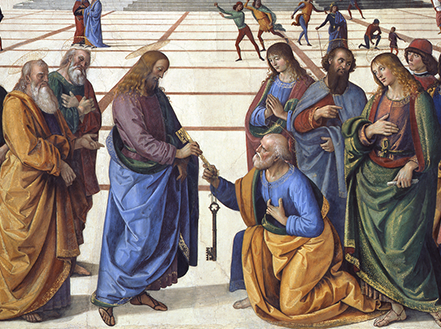
Christ Giving the Keys to St. Peter, Perugino, Sistine Chapel
The Gospel today sets forth the biblical basis for the Office of Peter, the Office of the Papacy, for Peter’s successors are the Popes. The word “pope” is simply an English version (via Anglo-Saxon and Germanic tongues) of the word “papa.” The Pope is affectionately called “Papa” in Italian and Spanish as an affectionate indication that he is the father of the family, the Church.
Let’s look at the basic establishment of the Office of Peter in three steps.
I. The Inquiry that Illustrates – The text says, Jesus went into the region of Caesarea Philippi and he asked his disciples, “Who do people say that the Son of Man is?” They replied, “Some say John the Baptist, others Elijah, still others Jeremiah or one of the prophets.” He said to them, “But who do you say that I am?”
In asking these questions, Jesus is not merely being curious about what people think of Him. He seems, rather, to be using these questions as a vehicle through which to teach the apostles (and us) about how the truth is adequately revealed and guaranteed.
Jesus’ first two questions reveal the inadequacy of two common methods:
1. The Poll – Jesus asks who the crowds say that He is. In modern times, we love to take polls; many put a lot of weight on the results. Many people—Catholics among them—like to point out that x% of Catholics think this or that about certain moral teachings, doctrines, or disciplines. Their position is that if more than 50% of Catholics believe something then it must be true; and therefore the Church should change her teaching.
As today’s Gospel makes clear, taking a poll doesn’t necessarily yield the truth. In fact, in this case all of the assertions of the crowd were wrong. Jesus is not John the Baptist, Elijah, Jeremiah, or one of the prophets redivivus. So, running the Church by poll-taking does not seem be a model that works.
2. The Panel – Jesus now turns to a panel of experts, a “blue ribbon committee,” if you will. He asks the twelve, “Who do you say that I am?” Jesus is met with silence. Perhaps they were looking around like nervous students in a classroom, not wanting to answer lest they appear foolish. The politics on the panel leads not to truth, but to a kind of self-serving, politically correct silence.
Peter finally speaks up, but as Jesus will point out, he does not do so because he is a member of the panel, but for another reason entirely.
Hence the blue ribbon panel, the committee of experts, is not adequate in setting forth the religious truth of who Jesus is.
Through this line of questioning, Jesus instructs through inquiry. Polls and panels are not adequate in yielding the firm truth as to His identity. All we have are opinions, or politically correct silence. Having set forth this inadequacy, the Gospel now presses forth to describe the plan of God in adequately setting forth the truths of faith.
II. The Individual that is Inspired – The text says, Simon Peter said in reply, “You are the Christ, the Son of the living God.” Jesus said to him in reply, “Blessed are you, Simon son of Jonah. For flesh and blood has not revealed this to you, but my heavenly Father.”
We are taught here not merely that Peter spoke, but also how he came to know the truth. Jesus is very clear to teach us that Peter spoke rightly not because he was the smartest (he probably wasn’t), or because someone else told him (Jesus is clear that flesh and blood did not reveal this to him), or because he guessed and just happened to get the right answer. Jesus teaches that Peter came to know the truth and speak it because God the Father revealed it to him. God the Father inspired Peter. There is a kind of anointing at work here.
God’s methodology, when it comes to adequately revealing and guaranteeing the truths of the faith, is to anoint Peter.
It is not polls or panels that God uses; it is Peter.
While truths may emerge in the wider Church reflecting what is revealed, it is only Peter and his successors who can definitively set forth views whose truth is adequately guaranteed. Thus, the other apostles are not bypassed by God, but He anoints Peter to unite them and give solemn declaration to what they have seen and heard.
The Catechism says this of Peter and his successors, the popes:
When Christ instituted the Twelve, he constituted [them] in the form of a college or permanent assembly, at the head of which he placed Peter, chosen from among them …. The Lord made Simon alone, whom he named Peter, the “rock” of his Church. He gave him the keys of his Church and instituted him shepherd of the whole flock. The office of binding and loosing which was given to Peter was also assigned to the college of apostles united to its head. This pastoral office of Peter and the other apostles belongs to the Church’s very foundation and is continued by the bishops under the primacy of the Pope.
The Pope, Bishop of Rome and Peter’s successor, is the perpetual and visible source and foundation of the unity both of the bishops and of the whole company of the faithful. For the Roman Pontiff, by reason of his office as Vicar of Christ, and as pastor of the entire Church has full, supreme, and universal power over the whole Church, a power which he can always exercise unhindered.
The college or body of bishops has no authority unless united with the Roman Pontiff, Peter’s successor, as its head. As such, this college has supreme and full authority over the universal Church; but this power cannot be exercised without the agreement of the Roman Pontiff. The college of bishops exercises power over the universal Church in a solemn manner in an ecumenical council. But there never is an ecumenical council which is not confirmed or at least recognized as such by Peter’s successor (Catechism of the Catholic Church, 880-884 selected).
All of these truths point back to the moment described in today’s Gospel, when we see how God Himself chooses to operate.
Note, too, the dimension of faith we are called to have. We are to assent to the pope’s teaching and leadership not merely because we think he is smarter, or because he might have the power, riches, or other worldly means to impress us or compel our assent. No, we assent to the pope’s teaching because, by faith, we believe he is inspired by God. It is not flesh and blood in which we put our trust; it is God Himself. We believe that God has acted on our behalf by anointing someone to affirm the truth and adequately guarantee that truth to be revealed by Him.
III. The Installation that is Initiated – The text says, And so I say to you, you are Peter, and upon this rock I will build my Church, and the gates of the hell shall not prevail against it. I will give you the keys to the kingdom of heaven. Whatever you bind on earth shall be bound in heaven; and whatever you loose on earth shall be loosed in heaven.
Jesus does not merely praise Simon for a moment of charismatic insight. He goes further, declaring that He will build His very Church upon Simon, whom He names Peter (rock). Jesus does not merely mean this is a personal gift or recognition that will die with Peter. In giving him the keys, He is establishing an office. He is not merely giving Peter a personal promotion. This will be God’s way of strengthening and uniting the Church. In Luke’s Gospel Jesus says more of this:
Simon, Simon, behold, Satan demanded to have you, all that he might sift you all like wheat, but I have prayed for thee, Peter, that thy faith may not fail; and when thou hast turned again, strengthen thy brethren (Luke 22:31).
This makes clear once again that God’s plan for the Church is to strengthen one man, Peter (and his successors in the future), so that in turn the whole Church may be strengthened and united. Thus the Lord Jesus establishes not only Peter, but also his office. This is God’s vision and plan for His Church.
Many have objected to this teaching. There is no time here to provide a complete response to every objection, but frankly most of them amount to a kind of wishful thinking by those who want this text to mean something other than what it plainly does. Nothing could be clearer than the fact that Jesus is establishing Peter and an office, which will serve as a foundation for the unity and strength of His Church.
It is also true that we are living in times that have tested many Catholics who have traditionally been the biggest supporters of the papacy. For many, our current pope has been a source of controversy rather than unity. And yet the office endures; it remains our duty to pray for and respect him, and to seek to maintain unity. Concerns for some of his statements should be expressed with charity and manifest good will. Although St. Paul saw fit to express his dismay over some of St. Peter’s prudential decisions (see Gal 2:11), we should remember that St. Paul was a bishop and apostle. Thus Catholics who have concerns today would do well to work with bishops to express their concerns, whether their own bishop or one they know they can approach.
Truth be told, “If no one is pope, everyone is pope.” Without a visible head, there is no principle on earth for unity in the Church. The Protestant experiment tried to replace the pope with Scripture, giving it sole authority. Yet Protestants cannot agree on what Scripture says and have no earthly way to resolve their conflicts. While they say that authority resides in Scripture alone, in claiming the anointing of the Holy Spirit and thus the ability to properly interpret Scripture, they really place the locus of authority within themselves, in effect becoming the very pope they denounce.
I have read that some objectors think Catholics arrogant in asserting that we have a pope whom we trust to be anointed by God to teach us without error on faith and morals. But which is more arrogant, to claim that there is a pope or to in fact act like one myself?
In the end, the Protestant experiment is a failed one. Estimates place the number of Protestant denominations as high as 30,000. I think that this figure is exaggerated, but not by much. They all claim the Scriptures as their source of truth but differ on many essential matters: the necessity of baptism, “once saved, always saved,” sexual morality, and authority. When they cannot resolve things they simply subdivide.
Jesus has installed an individual in this role to manifest his office of rock and head: Peter and his successors.
The animated short below is a dramatization (sort of) of the story of Samson and Delilah as well as a commentary on lust and power. (If you would like to review the story of Samson and Delilah, clickhere.)
As the video opens, two superheroes are summoned to an emergency. They rush to the scene, but do so recklessly; a great crash occurs. This is symbolic of our pride, for too often we rush headlong into solving problems without considering other problems that might be created in the process. For example, the quest to “end poverty in our time” has led to the demise of the family; the quest to liberate the world from tyranny (through violence, drone strikes, and war) has more often led to even more violence and the rise of new villainies.
The superheroes try to blame each other for the accident. This is symbolic of our tendency to shift blame and avoid personal responsibility. We speak endlessly of our rights and our freedom to do as we please, but we want none of the responsibility; and of course any consequences are someone else’s fault.
Each of them then tries to take control of the situation. This is an image of our desire for power over others. This only serves to usher in a struggle that ultimately no one can win. Rather, all suffer devastating loss. Even victory is fleeting because the cycle of violence soon begins again.
At first, our male superhero (let’s call him Samson) seems to have the upper hand; but the female superhero (let’s call her Delilah) is not to be undone. Delilah tries to overcome Samson through her feminine charms. This symbolizes our lust. Whatever his strengths, Samson has a fatal flaw, one that destroys many men: lust. Many men (and women) and have ruined their lives due to lust. This has resulted in poverty, STDs, abortion, teenage pregnancy, shattered dreams, broken families, and broken hearts.
The end of both of these superheroes is death and destruction. Pride, irresponsibility, unrestrained power, and lust unleash only devastation, destruction, and death—both individually and collectively.
In the biblical story of Samson and Delilah, Delilah only “won” for a brief moment. So it is with every worldly victory; it is temporary at best. Only heavenly victory and treasure stored up there will prevail. The wages of sin is death (Romans 6:23).

 On this “World Day of Creation” we ponder the glory and power of God in what he has made. One of the painful paradoxes of our time is that our scientific insights have increased unbelief rather than belief. Perhaps as never before we have come to know the astonishing interplay of creation at every level. From the smallest parts of atoms to the farthest reaches of space, from the complex interactions within cells to the almost perfect sweep of earth’s orbit, everything seems gloriously orchestrated so that we can live and grow. Even in the upheavals of storms, such as we have recently experienced, and other natural disasters, God and creation are often up to something good.