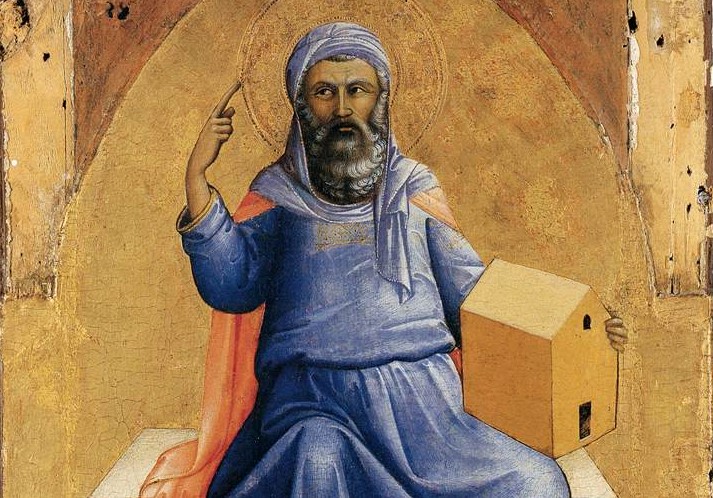
I occasionally get questions about the remarkably long lives of the patriarchs who lived before the great flood. Consider the ages at which these figures purportedly died:
Adam – 930
Seth – 912
Enosh – 905
Jared – 962
Methuselah – 969
Noah – 950
Shem – 600
Eber – 464
Abraham – 175
Moses – 120
David – 70
How should we understand these references? Many theories have been proposed to explain the claimed longevity. Some use a mathematical corrective, but this leads to other pitfalls such as certain patriarchs apparently begetting children while still children themselves. Another theory proposes that the purported life spans of the patriarchs are just indications of their influence or family line, but then things don’t add up chronologically with eras and family trees.
Personally, I think we need to take the stated life spans of the patriarchs at face value and just accept it as a mystery: for some reason, the ancient patriarchs lived far longer than we do in the modern era. I cannot prove that they actually lived that long, but neither is there strong evidence that they did not. Frankly, I have little stake in insisting that they did in fact live to be that old. But if you ask me, I think it is best just to accept that they did.
This solution, when I articulate it, causes many to scoff. They almost seem to be offended. The reply usually sounds something like this: “That’s crazy. There’s no way they lived that long. The texts must be wrong.” To which I generally reply, “Why do you think it’s crazy or impossible?” The answers usually range from the glib to the more serious, but here are some common replies:
People didn’t know how to tell time accurately back then. Well, actually, they were pretty good at keeping time, in some ways better than we are today. The ancients were keen observers of the sun, the moon, and the stars. They had to be, otherwise they would have starved. It was crucial to know when to plant, when to harvest, and when to hunt (e.g., the migratory and/or hibernation patterns of animals through the seasons). They may not have had timepieces that were accurate to the minute, but they were much more in sync with the rhythms of the cosmos than most of us are today. They certainly knew what a day, a month, and a year were by the cycles of the sun, moon, and stars.
They couldn’t have lived that long because they didn’t have the medicines we do today. Perhaps, but it is also possible that they didn’t have the diseases we do. Perhaps they ate and lived in more healthy ways than we do today. Perhaps the gene pool later became corrupted in a way that it was not back then. There are many things we cannot possibly know. The claim about our advanced technology (medicine) also shows a tendency of us moderns to think that no one in the world has ever been smarter than we are. While we surely do have advanced technologies, we also have things that make us more susceptible to disease: stress, anxiety, overly rich diets, pollutants, promiscuity, drug use, and hormonal contraceptives. There are many ways in which we live out of sync with the natural world. It is also quite possible that the strains of disease and viral attacks have become more virulent over time.
Those long life spans just symbolize wisdom or influence. OK fine, but what is the scale? Does Adam living to 930 mean that he attained great wisdom? But wait, David wasn’t any slouch and he only made it to 70. And if Seth was so influential (living to 912), where are the books recording his influence such as we have for Moses, who lived to be a mere 120? In other words, we can’t just propose a scale indicating influence or wisdom without some further definition of what the numbers actually mean.
Sorry, people just don’t live that long. Well, today they don’t, but why is something automatically false simply because it doesn’t comport with today’s experience? To live to be 900 is preternatural, not supernatural. (Something preternatural is extremely extraordinary, well outside the normal, but not impossible.) In other words, it is not physically impossible in an absolute sense for a human being to live for hundreds of years. Most people today die short of 100 years of age, but some live longer. Certain closely related mammals like dogs and cats live only 15 to 20 years. Why is there such a large difference in life expectancy between humans and other similar animals? There is obviously some mysterious clock that winds down more quickly for some animals than for others. So there is a mystery to the longevity of various living things, even those that are closely related. Perhaps the ancients had what amounted to preternatural gifts.
So I think we’re back to where we started: just taking the long life spans of the early patriarchs at face value.
There is perhaps a theological truth hidden in the shrinking lifespans of the Old Testament. The Scriptures link sin and death. Adam and Eve were warned that the day they ate of the forbidden fruit of the Tree of the Knowledge of Good and Evil, they would die (Gen 2:17), but they did not drop dead immediately. Although they died spiritually in an instant, the clock of death for their bodies wound down much later. As the age listing above shows, as sin increased, lifespans dropped precipitously, especially after the flood.
Prior to the flood, lifespans remained in the vicinity of 900 years, but right afterward they dropped by about a third (Shem only lived to 600), and then the numbers plummeted even further. Neither Abraham nor Moses even reached 200, and by the time of King David, he would write, Our years are seventy, or eighty for those who are strong (Ps 90:10).
Scripture says, For the wages of sin is death (Rom 6:23). Indeed they are, especially in terms of lifespan. Perhaps that is why I am not too anxious to try to disprove the long life spans of the patriarchs, for what we know theologically is borne out in our human experience: sin is life-destroying. This truth is surely made clear by the declining lifespan of the human family.
Does this prove that Adam actually lived to be more than 900 years old? No, it only shows that declining life spans are something we fittingly discover in a world of sin. God teaches that sin brings death, so why should we be shocked that our life span has decreased from 900 years to about 85? It is what it is. It’s a sad truth about which God warned us. Thanks be to God our Father, who in Jesus now offers us eternal life, if we will have faith and obey His Son!
How or even whether the patriarchs lived to such advanced ages is not clear, but what is theologically clear is that we don’t live that long today because of the collective effect of sin upon us.
Here’s an old glee club song titled “Old Man Noah”
OLD MAN NOAH
Away way back in the ages dark
(away back in the ages dark),
Old man Noah built a sea-going ark
(old man Noah built a sea-going ark),
Old man Noah had his nervous spells,
When he had to listen to the animals’ yells,
But when anything was doing he was there with bells,
He was a grand old sailor.
Chorus
Old man Noah knew a thing or two,
He made them all play ball,
Old man Noah knew a thing or two,
Because he knew a thing or two, he thought he knew it all,
Some say he was an also ran,
He was the original sailor man,
Old man Noah knew a thing or two,
He was a grand old man.
Said old man Noah to his wife one day
(said old man Noah to his wife one day),
There’s a big storm comin’ on the first of May
(there’s a big storm comin’ on the first of May),
So he gathered all his family and made this remark:
The sky’s getting cloudy and it’s getting rather dark,
So gather all the animals, and beat it to the ark,
It’s gonna rain tomorrow,
The rain came down in showers cryin’
(the rain came down in showers cryin’),
The ark made it out on a scheduled time
(the ark made it out on a scheduled time),
And every day at half past three,
Noah played poker with the chimpanzee,
Cried the ring-tailed monkey, I sadly agree,
Noah’s got a full house up his sleeve,
When Noah got the animals out to sea
(when Noah got the animals out to sea),
They organized a regular jubilee
(they organized a regular jubilee),
In the middle of the night the elephant said,
There’s a couple of snakes crawled into my bed,
Shut up, said Noah, you’re drunk instead,
Now I’m gonna lose my license!
In the Gospel today the Lord describes metaphorically what a Christian is and what He expects of us. Note five things about what God says:
I. The Definitiveness of His Proclamation– The text says, You are the Salt of the earth. … You are the light of the World. … But if salt goes flat it is good for nothing. … No one lights a lamp and puts it under a basket.
The Lord is definitive in two ways. First,He says, “You.” He is not talking just to people long ago or to the person next to you. He is not merely talking to your pastor or the Saints. He is talking to you. Youare salt. Youare light. You. It’s too easy to say, “Look at what the Lord is saying to those people long ago near the lakeside.” It’s not long ago; it’s now. It’s you.
The second way that the Lord is definitive isin saying that bothimages depend on us; if we are not salt and light then no one else will be and we will have utterly voided our worth.
The metaphor of salt: You are either salt or you are nothing; in fact, you are good for nothing. As Christians, we have signed up to be specialists. This means is that if we go off and do something else instead, we arenothing and are good for nothing. It’s an all-or-nothing scenario. Jesus says that if you have decided to be His disciple you are either going to do that or else be nothing. You may go on to be a doctor, lawyer, teacher, laborer, or social worker, but the Lord has plenty of those (and so does the devil). Your first and only mission is to be a true and uncompromised Christian; everything else is mere commentary. You may be a great doctor, but if you don’t do it as a clear and visible Christian you are nothing. You may be a skilled social worker, but if you don’t do it as a Christian you are good for nothing. Any non-believer can be socially useful as a doctor or social worker, but only a Christian can be a Christian. If you don’t do “job one,” you are nothing. If you supply your children with every good thing, but do not act as a Christian witness to them and bring them to Christ, you are good for nothing. Any parent can provide his children with material things, but only a Christian can give them Christ. Got it? You’re either salt (a true Christian) or you are nothing.
The metaphor of light: The Lord says that you are thelight of the world, not merely alight. What this means is that if we do not shine, the world is darker; no one can take our place. If we don’t shine by living our faith and proclaiming it, the world is in darkness. Buddha can’t help. Mohamed can’t pull it off. Science and humanism can’t substitute. Either we are light or there is none. Some may call this arrogant, but I just call it Scripture. The Lord said it, not us. We are either light or else the world is dark. And if the world is getting darker, whose fault is that? We need not go far. Too many Christians fulfill Isaiah 56:10, which says, Israel’s watchmen are blind, they all lack knowledge; they are all dumb dogs, they cannot bark; they lie around and dream, they love to sleep. You may be an exception, but too many Christians are not.
Therefore, notice the definitive pronouncement the Lord makes here. We Christians are either with the Lord or we’re nothing. We’re either light or the world is in darkness.
II. The Dynamics of Salt– When Jesus says that we are the salt of the earth, what are some of the lessons we can learn? Consider these four things:
Salt seasons.Christians are called to add spice to life, to bring beauty, joy, and hope to the world. Joy is the surest sign of a Christian. Even our keeping of the Commandments is a source of joy, as we experience God’s power to put sin to death in us and bring forth order, self-discipline, and holiness. Hope, too, ought to distinguish us from a world that is often cynical and thinks sin is inevitable. To this world we are not only to declare that the Commandments are possible and bring joy, but to demonstrate it in our lives. We are to be zesty, passionate, alive, and free from sin in Christ. Yet, sadly, we Christians are known more for what we are against. Too many Christians are not spicy; they do not really add flavor. They are more like bored believers, depressed disciples, fearful faithful, and frozen chosen. In our best moments, look what spicy things the faith has contributed: Art, music, churches, hospitals, universities, the scholastic and scientific methods, and holidays (a mispronunciation of Holy Days). Our tradition and Scriptural teaching of justice, mercy, love, and the dignity of the human person has blessed the world. Do you bring spice to the lives of others? Do you bring hope and joy? Scripture says, Always be prepared to make a defense to anyone who calls you to account for the hope that is in you(1 Peter 3:15). That means that people notice hope in you! Do they? How?
Salt preserves. Before refrigeration, people often used salt to cure or preserve meat. The salt killed bacteria and other microorganisms that caused rot and decay. As Christians, we are called to prevent further decay in this sin-soaked world. The truth that we proclaim is meant to preserve people from the decay of sin and overindulgence. Chastity, justice, generosity, and the proclamation of the truth, are like salt that preserves this world from decay. We must be salt. If we are not, nothing else is. Youare the salt.
Salt heals. In the ancient world, salt was used on wounds. It helped to stop bleeding, killed bacteria, and prevented further infection. So, too, the Christian faith. Through our doctrinal and moral teaching, and our living of it, we are called to bring healing to this world, which is wounded by sin, strife, war, jealousy, anger, bitterness, retribution, promiscuity, unfaithfulness, greed, and countless other errors. The Word of God and His plan is a healing medicine for what ails this world.
Salt burns. Yes, salt stings when applied to wounds. We Christians aren’t just sugar and spice and everything nice. When salt is applied to wounds it burns and often brings out loud protest. The truth stings, too. The truth of the Gospel can be irritating to a world that is wounded by sin. But despite the protests of the world, the sting is a healing one. It is driving out the disease of the world and preventing further infection. Just because people protest the Church and howl in complaint at the truth of the Gospel does not mean we have done anything wrong. In fact, protests often show that we are doing exactly what we must.
III. The Destination of Salt– The Lord says that you are the salt of the earth. He did not say that you are the salt of the Church. For salt to be effective it has to get out of the shaker! Too many Christians are bold in the pew but cowards in the world. They will speak of the faith in the relative security of the Church and among certain friends, but don’t ask them to preach to their spouse, their co-worker, or even their children; that’s too scary. And don’t even thinkabout asking them to knock on doors, or to go to the local mall and witness, or to stand in front of an abortion clinic.
Salt in the shaker is useless. It has to come out of the shaker in order to make any difference. You don’t salt salt. Witnessing to fellow Christians may have a limited benefit, but it is not really the true destination of salt. The salt has to go forth. When the priest or deacon says “The Mass is ended go in peace,” he might as well be holding up a salt shaker and shaking it!
It’s long past time for the salt (you and me) to go forth. Consider these observations about life in our country today:
In the last fifty years there has been an increase of more than a 500% in violent crime.
There are more than half a million abortions each year.
Since 1970, the divorce rate has quadrupled. The overall number of divorces may have declined recently, but it is due more to people not getting married in the first place.
More than 40% of children today do not live with both their biological parents. Since the 1970s, the percentage of children living in single-parent homes has tripled.
As the family has broken down, here is what has been happening to our young:
a quadrupling in juvenile arrests,
a 400% increase in births outside of wedlock,
one million teenage pregnancies annually,
three million teenagers treated annually for sexually transmitted diseases,
a 200% increase in the rate of teenage suicide,
a drop in average SAT scores,
two-thirds of high school students have experimented with illegal drugs.
In the schools, one cannot pray or mention religion, yet condoms are freely available and all sorts of aberrant and alternative lifestyles and philosophies are openly promoted.
Parental consent is required for a child to go on a field trip or to get an aspirin, but in many states abortion referrals can be made without parental consent.
Our neighborhoods are devastated by poverty, injustice, crime, and despair.
All of this has happened on our watch. It’s time for the salt to work. The world needs the salt to get out of the shaker and do its work of seasoning, purifying, and preserving.
The Designation of Pure light– You are the light of the world. A city set on a mountain cannot be hidden. Nor do they light a lamp and then put it under a bushel basket; it is set on a lampstand, where it gives light to all in the house.You don’t light light; it is the darkness that needs the light. Light is meant to be seen. There are too many undercover Christians, secret agent saints, and hidden holy ones. Jesus didn’t light our light so that we could hide it under a basket out of fear. He wants the Church, you and me, to shine. The Lord wants every Christian to be a light so that it’s like a city on a hill! He wants us to shine so that we can’t be hidden.
The Details of Light– Jesus goes on to say, Let your light shine before others, that they may see your good deeds and glorify your heavenly Father. Let’s consider four things about this light:
The CAUSE of the light – Notice that little word: “Let.” We are to yield to Christ, to allow Him to shine through us. He is the cause of our light. Let your light shine. There’s an old gospel song that says, “When you see me trying to do good, trying to live as a Christian should, it’s just Jesus, Jesus in me.”
The COST of the light– The light is to shine, but there is no shining without burning. Shining costs us something. It may be Christ’s light, but it shines through us. This means sacrifice. It means letting Him use you. It means not always sleeping when you want to. It means not just sitting at home and saying, “Ain’t it awful.” It means getting out and getting involved. It means getting “out there” and risking a few things. It means being visible, targeted, and identified with someone (Jesus) who is hated by many. And in a world that prefers the darkness to light (cf.John 3:19-21), it means being called harsh, out-of-touch, and hateful. There is no shining without burning.
The CONCRETENESS of the light –Letting our light shine is no mere abstraction. Jesus speaks of deeds. Shining involves concrete behavior. Your light shines by the way you live, the choices you make, the behavior you exhibit. It shines when Christians get married and stay married, stay faithful to their commitments, and are people of their word. Our light shines when we tell the truth instead of lying, live chastely instead of fornicating, are courteous and respectful instead of rude. It shines when we respect life, drive safely, and shun reckless and risky behavior. Our light shines when we clean up our language, give to the poor, and work for justice. It shines when we refuse to purchase pornographic, violent, or other degrading materials. Our light shines when we love instead of hate, seek reconciliation instead of revenge, and pray for our enemies instead of cursing them. It shines when we walk uprightly and speak the truth in love, without compromise. That’s when our light begins to shine.
The CONSEQUENCE of the light– God is glorified when our light shines. We do not act or get involved merely to vent our own anger or to fight for our own sake. We are light to glorify God. It is not about our winning, it is about God shining and being glorified. When we do get involved, too often we seek merely to win the argument rather than to glorify God. Often we act in order to garner praise rather than to have God glorified. We need to pray for good intentions, for it is possible to do the right thing for the wrong reason. The desired result is God’s glory not our glory.
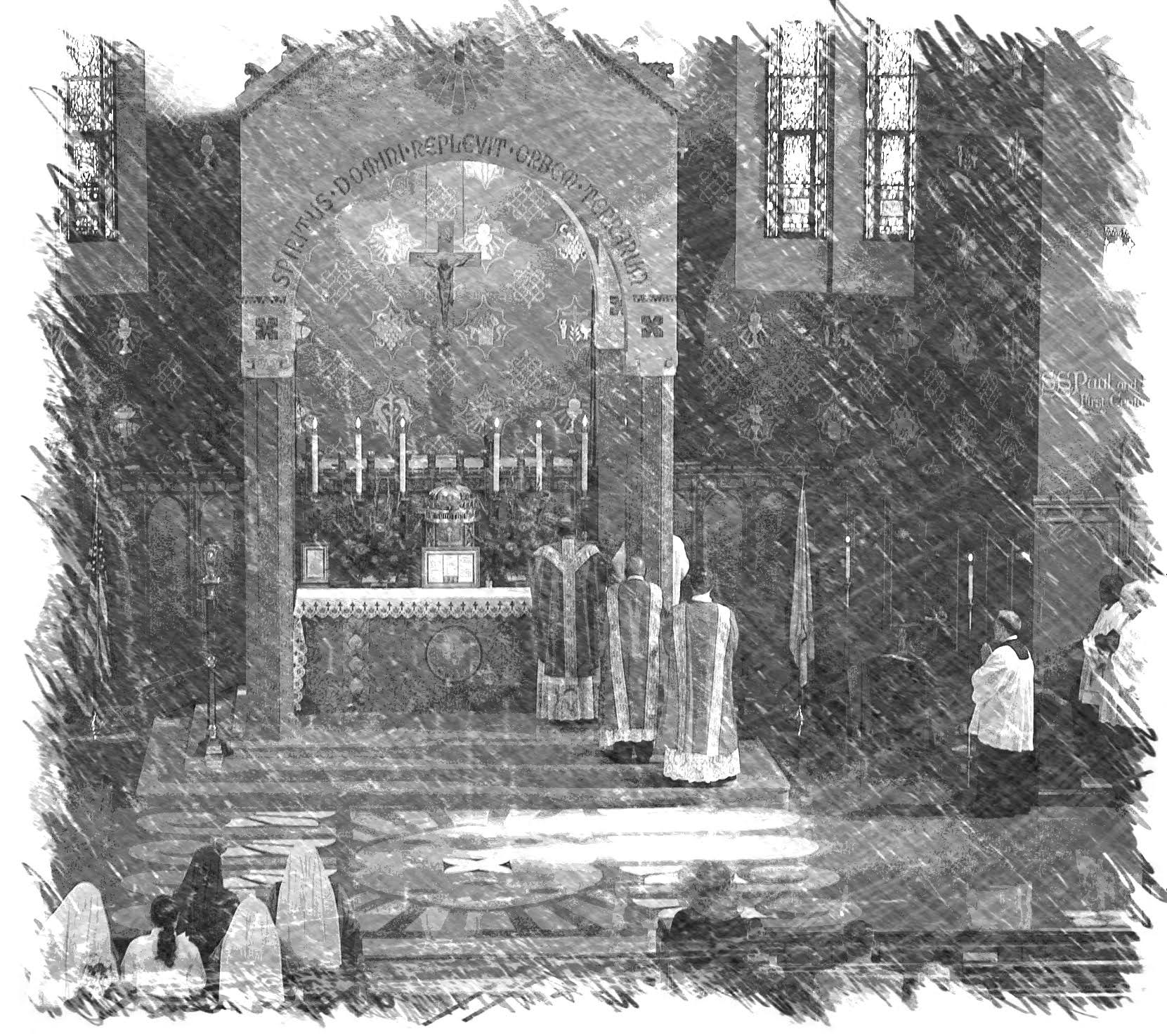
I have said the Traditional Latin Mass for all of my many years of priesthood. Back in the late 1980s, only a few priests were “permitted” to do so and there were few resources available to learn it. About the only visual help was the Fulton Sheen film from the 1940s describing the Mass. So, I trained under a few older priests during my seminary years. I moved from being part of the schola in the choir loft, to serving as sub-deacon, then deacon, and finally as priest-celebrant. Solemn High Mass was my specialty; I only learned the low Mass later. Most of us who celebrate the traditional Latin Mass exhibit great care in observing the rubrics and norms and have great esteem for its beauty.
During my training, I asked the older priests why they and their generation got rid of such a beautiful form of the Mass. They often replied that though they came to lament its loss later, at the time it was not always celebrated so beautifully; they spoke of hurried masses, cursory gestures, and mumbled Latin. They indicated that the Solemn High Mass (the form with a priest, a deacon, a sub-deacon, and a bevy of acolytes) was quite rare in Washington, D.C. Even the Missa Cantata (in which some of the parts are sung by the celebrant, but without the deacon and sub-deacon) was limited to one Mass, and many places didn’t even have that. Homilies at weekday Masses were rare and even a good number of Sunday Masses had minimal preaching.
With all the horrifying abuses associated with Masses after the liturgical changes, these problems may seem mild, but in any case, things were not as ideal as I had imagined—at least that was picture these older priests painted for me.
I recently came across a letter from the 1920s in our parish archive that confirms this generally perfunctory quality. It is a lament on this situation from Archbishop Michael J. Curley of Baltimore and is directed to his priests.
At that time, the Archdiocese of Washington was still part of the Archdiocese of Baltimore. Thus, the Archdiocese of Baltimore covered a very large area, stretching from the Delaware border in the east, through Washington, all the way to the western panhandle of Maryland. It contained large city parishes from Baltimore and Washington, a growing number of suburban parishes, and numerous small ones from the large expanses of rural territory.
Regarding the city parishes, remember that the immigrant Church of that period was expanding rapidly and vast numbers of newly immigrated Catholics from all over Europe were filling the pews. One of the needs was thus to schedule numerous Masses to accommodate the numbers. In addition, in those days all Masses had to be finished before noon. All of this led to a hurried morning schedule in which some of the liturgical principles suffered as a result.
And now we proceed to the letter itself. It is hard to imagine a bishop of our times being so informal and blunt, yet those were days in which many bishops and local pastors were known for their large, colorful personalities. Enjoy some excerpts of this colorfully blunt letter, which focused on encouraging priests to be more liturgically minded. I include some brief remarks of my own in red text.
July 9, 1929
Reverend and Dear Father,
Confusion worse confounded has arisen during the past few years in the matter of our Sunday services. An inter-parochial competitive system has ended in chaos and not a little distant disedification. We must now return to sane normal conditions. Hence the following mandatory regulations will be effective Sunday, October 6.
The High Mass (Solemn or Missa Cantata) must be the last of the parish masses and may not be an hour later than eleven. Every church in Baltimore, Washington, and Cumberland is expected to have a High Mass. The same is expected of all parishes outside the above cities where a choir is possible. The choir does not have to be an adult choir. It may be composed of school children. In country parishes where heretofore there has been no High Mass, I desire the pastors to work towards a High Mass. The Missa parochialis must be kept in its honorable place. … Let the well-prepared sermon be short and practical; let the music be strictly liturgical and let the liturgy be carried out with dignity and correctly.
We see that in certain areas, the low Mass (recited and whispered) had come to be the only type celebrated. High Mass, with the priest and choir singing significant portions, was becoming too rare. This afforded less possibility for the faithful to interact with the Liturgy. Further, it excluded a vast repertoire of chant, polyphony, and classical music from the Mass. In response, the Archbishop insisted that at least one parish Mass should open this treasure to God’s people.
The epistle and gospel should be read at all the masses. … A short discourse (of even five-minutes duration) should be given at each mass. The work of instruction should be supplemented by the recommendation of pamphlets as reading matter. No parish church should be without a pamphlet rack.
A significant problem in that era was that the readings were proclaimed in Latin by the priest at the altar. Because few if any of the laity knew Latin, the proclamation of the Word mostly fell on deaf ears. A common solution was that the priest would go to the pulpit and repeat the readings in the vernacular, but this lengthened the Mass. Some priests evidently skipped this altogether and merely continued on with the Mass. Some even skipped a sermon of any sort at certain masses. The Archbishop was surely not pleased and insisted that teaching the faith was an essential purpose of any liturgy.
Some of our younger parish clergy read their sermons. This should not be done except for some very special reason. The priest who is not capable of preparing and delivering a brief, clear instruction on Catholic teaching to his people is not fit to be in parish work. The people as a rule do not want to listen to a sermon reader. The reader is usually a poor one and his matter many times is poorer. We do not expect every priest to be a Lacordaire or a Bossuet. We do expect every priest however to be a teacher of God’s word, an intelligent and intelligible one. We have heard splendid eloquence on the subject of card parties, bazaars, church support, etc. and then mental confusion in many cases when the time came for the sermon. Our work as preachers of the gospel of Jesus Christ is of infinite importance. It ought to be done with prayerful preparation. The sermon should be delivered in such a manner that our people can hear, understand, and take away with them a better knowledge of their faith and at the same time feel moved to live that faith and more practical way. If the priests of a parish wish to hold her people’s loyalty to their parish church, they cannot do it by competition in the matter of late hours for masses, unbecoming a hurry in the celebration of divine mysteries, or curtailment of devotional church practices.
Tough, but well said.
In some parishes of the cities there is no evening service. The reason given is that the people will not come. If the pastor will only give the people a chance to come, they will come in sufficient numbers to Rosary and Benediction of the Blessed Sacrament. They will come gladly to hear a course of sermons during Advent, Lent, novenas, etc. They will not come to hear the rosary and litany recited in a marathon style. They leave their parish church and go to one where there is devotion in the sanctuary.
We have completed our building program. The brick-and-mortar work is almost over. Let us now apply ourselves to the more important work of gathering our people around the sanctuary in order that we may build Christ our Blessed Lord into their hearts and lives. We have, thank God, many parishes where liturgical functions are carried out with inspiring dignity, order, correctness, and consequent impressiveness. … But where there is a tendency to starve the people spiritually, the priest soon realizes a reaction that, to say the least, is neither healthy nor pleasant.
Beautifully said.
Let us then in God’s name begin with enthusiasm a new era of order in matters liturgical October 6th.
Sincerely, + Michael Curley Archbishop of Baltimore
I hope this provides you with a little picture of liturgy and parish life form the late 1920s. The problems of that time are nothing compared with the disorder often evident from the 1970s through today, but surely the human condition will always require that we battle the perfunctory observance of the sacred liturgy.
This video clip from the beginning of the movie True Confessions shows a beautiful depiction of the Traditional Latin Mass. I first saw it in 1981 and was amazed at the beauty of the Mass. I set about learning this form of the Mass well before it was more widely allowed. Although Solemn High Mass was not unknown in larger city parishes, its celebration complete with all the details was rarer than I thought. Low mass, recited and whispered, was more the norm. This situation led to Archbishop Curley’s request that at least one high Mass be sung in every parish each Sunday. Amen, Archbishop!
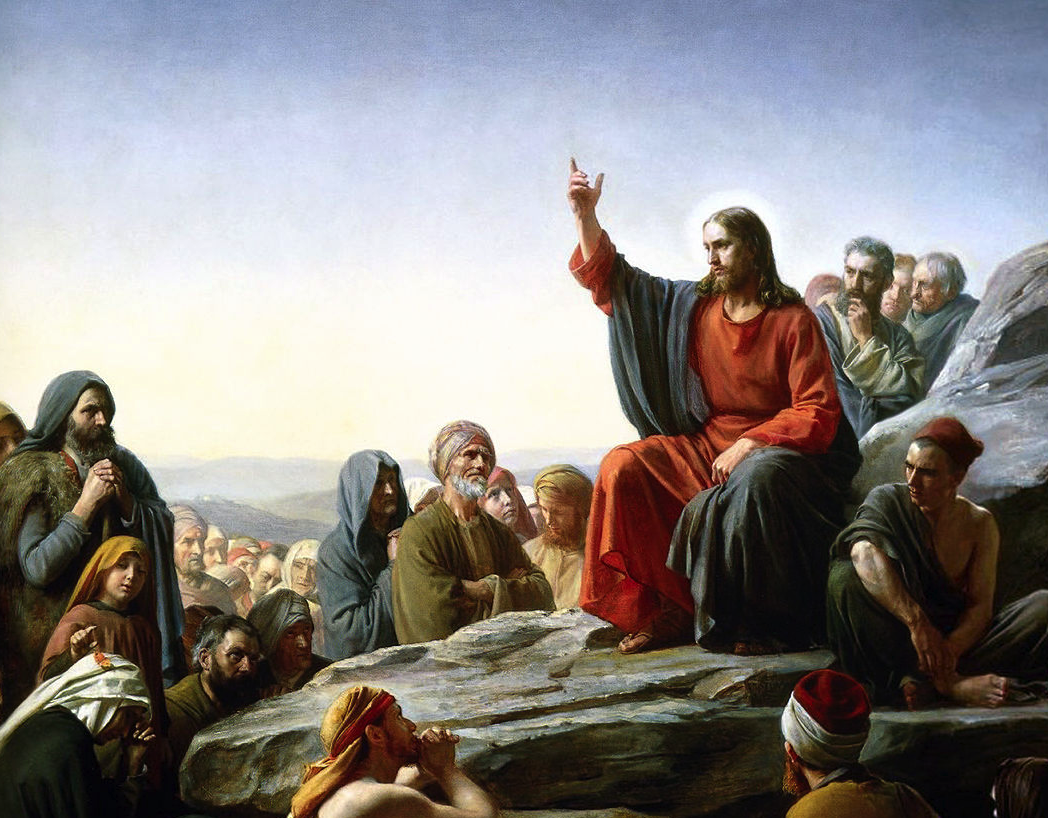
The Gospel passage on the Beatitudes is one of the most familiar. Yet the Beatitudes are difficult to understand because many of them are paradoxical. We do not usually refer to the poor as blessed, but rather the well-off; we do not typically call those who mourn blessed, but rather the joyful.
The word “beatitude” itself means “supreme blessedness.”
First, it is critical to understand that beatitude is not something we achieve; rather it is something we receive. The Beatitudes declare an objective reality as the result of a divine act. The use of the indicative mood in the passage should be taken seriously; we should not transform it into an imperative. In other words, the Beatitudes are more of a description than a prescription. Jesus is not saying that we should be poor or meek and then God will bless us. Rather, He is saying that this is what the transformed human person is like; that this is what happens to us when He begins to live His life in us and transform us; that this is what our life is like when His grace and the power of His cross bring about in us a greater meekness and poverty of spirit; that we will experience being blessed.
Beatitude is a work of God and it results when we yield to His saving work in us.
With this understanding we can see the Beatitudes not as a prescription of what we must do, but a description of what a human being is like who is being transformed by Jesus Christ.
Second, we should consider the Hebrew roots. The Greek word makarioi in today’s text is rendered as “blessed,” but it also corresponds to the Hebrew word asher, which is more of an exclamation. It could easily be translated, “O, the blessedness of ….” When translated this way, it emphasizes that something is being described rather than prescribed.
Third, we must examine the Greek linguistic roots.Makarioi, (blessed) literally means “to make long or large.” We are enlarged or enhanced as a result of God’s blessings. Thus, the term “blessed” as used here describes a kind of stable, serene, confident joy that one receives because of God’s blessings.
Fourth, we should look at the Greek cultural roots. In pagan times, makarioi (blessed) referred especially to the happiness of the gods. They had achieved a state of happiness and contentment in life that was beyond all cares, labors, and even death. They lived in some other world away from the worries and problems of ordinary people. In taking up this term to translate the Hebrew asher, the New Testament teaches on the stability of beatitude, if it is from God. To a large degree it is a stable, deep, and serene beatitude not greatly affected by the vicissitudes of this world; because the world does not give it, it cannot take it away.
There is an old saying that happiness is an “inside job.” Too many people try to find happiness in the world, which is fickle and unstable. The Lord wants to confer on us an inner beatitude that is deeply rooted, stable, and not easily swept away by worldly conditions. In the Beatitudes, the Lord paints a picture of this state of blessedness.
This helps to explain the paradox of some of the Beatitudes. We are still blessed even when poor, mourning, or persecuted. Further, we are confirmed in blessedness by such realities, because they serve as reminders that we are not at home in this world and that God and His kingdom are our preoccupation and the source of our true beatitude.
Let’s explore the Beatitudes and remember that Jesus is saying, “When I begin to live my life in you and put the sinful flesh to death, you will experience the following blessings.”
Blessed are the poor in spirit for the kingdom of God is theirs.
Who are the poor in spirit? They are those who, by God’s grace, have their true treasure increasingly in Heaven rather than earth. They are poor to this world but rich to God. They have learned to depend on God.
All of us are dependent on God, but we may not realize it. The poor in spirit are those who have come to peace in the knowledge that they depend on God for every beat of their heart, for every good thing they have. Humans strongly resist any such sense of dependence or lack of control. Many strive to acquire wealth, power, and resources in order to create the illusion that they are in control—they are not. Ultimately this whole system will fail. It is a recipe for frustration and unhappiness.
Further, control is like an addictive drug. The more we get, the more we need in order to feel less anxious. Our modern age illustrates this. Consider, for example, modern medicine, through which we can control things we never could before: are all our fears gone as a result? No. Humans have never lived so long and been so healthy, yet, we have never been so anxious about our health. Our medicine cabinets are filled with prescriptions and over-the-counter medications. And still we worry! Control is an illusion, an addiction all its own. In the end, it seems we can never have enough of it to feel sufficiently “safe.”
How blessed are those who delight to depend on God, who realize that every beat of their heart is His gift and that everything they have is from Him and belongs to Him! Not only do they realize this; they delight in it. They are blessed because they are free of the countless fears that flow from the endless quest for illusory control.
Now Matthew adds “in spirit” to “the poor” because not all who are materially poor are thereby freed of the obsession with wealth, power, and the need to control. To be poor is not necessarily a measure of what is in my wallet, but what is in my heart.
This world is not the Kingdom, but Heaven is. How blessed are those who delight to know and experience that there is a Heaven! They may be poor in the eyes of this world, but who needs most of it? They already have the Kingdom by faith and that Kingdom is growing for them. The kingdom of this world, however, is passing away.
Blessed are those who mourn, for they will be comforted.
Who are those who mourn? They are those who, delighting in the Kingdom of Heaven, see the awful state of most of God’s people. They see that so many do not know God or why they were created. They see others willfully locked in sin and darkness. They see still others who are victims of the sins of injustice and oppression. And because of this they mourn, and moan, and pray. This beatitude is the basis of intercessory prayer and deepening love for sinners. Because I mourn, I pray for the world.
The object of this beatitude is rooted in the Kingdom of God and its values, not the passing values of this world. If my car gets scratched or the stock market goes down and I may mourn, but that’s not the type of mourning referred to here.
How blessed are those who mourn over what really matters and who pray! God will console, strengthen, and encourage them. He will cause their mourning to bear fruit in prayer and action for others. To mourn is this way is to be blessed. It is a grief that “hurts so good,” because we know that it brings abundant blessings for the world as it intensifies our prayer and our own commitment to God and His Kingdom.
Blessed are the meek, for they shall inherit the earth.
Anger is a difficult passion. It can be frustrating, but it is a necessary zeal for what is right. Aristotle spoke of meekness (praotes) as the proper balance between too much anger and not enough. Sometimes we merely vent our anger, but at other times we fail to be angry enough, allowing evil and injustice to go unaddressed and un-resisted. How blessed are those who, by God’s grace, have authority over their anger! They do not vent their anger unnecessarily or excessively. They have the zeal and courage to stand up for what is right and to express righteous indignation at sin and injustice.
The meek have authority over their anger and other passions and thus will inherit the earth. Self-control conserves resources, using them appropriately; unrestricted passions dissipate resources, squandering the gifts of God.
Blessed are those who hunger and thirst for righteousness, for they will be satisfied.
Many fight God and ridicule the values of His kingdom. Chastity, forgiveness, and mercy are objects of particularly derision today. Many hunger for anything but God; wealth, power, popularity, the latest fad—anything but God.
How blessed are those who hunger and thirst for the righteousness and justice of God and the values of His Kingdom! God will satisfy them with the joy of living under His law and they will rejoice to see the wisdom of His ways. They hunger for God’s word and devour it when they find it. They rejoice to see God put sin to death in them and bring about virtue. They are excited and satisfied at what God is doing in their life. They are blessed indeed.
Blessed are the Merciful for they shall obtain mercy.
We live in a world that often prizes revenge and the destruction of one’s enemies, but Scripture teaches that the measure that we measure to others will be measured back to us (Matt 7:2). We are also taught that if we do not forgive others we will not be forgiven (Matt 6:15), and that merciless is the judgment on the one who has shown no mercy (James 2:12). It is misguided and just a bad idea to go around condemning others and “throwing the book” at everyone.
How blessed are those who, by God’s grace, have experienced His mercy and share it with others! They are able to leave most vengeance to God. Though they correct the sinner, they do not feel the need to exact revenge. By showing mercy, they will experience mercy from God. They are blessed indeed.
Blessed are the pure of heart for they shall see God.
The Greek here is better translated as “single-hearted.” It is so easy for feel torn by contrary drives and wishes. The Book of James says that the man of two minds is unstable in all his ways (James 1:8).
Blessed are those who can say, with St. Paul, [T]his one thing I do. … I press on to the prize marked out for me in Christ Jesus (Phil 3:13), or to say with the psalmist, There is only one thing I ask of the Lord: to dwell in the courts of the Lord and behold his face (Psalm 27:4). How blessed to be single-hearted, to be centered on one thing, to have but one purpose, to be undivided and uncompromised!
Blessed are the peacemakers for they shall be called the sons of God.
Everyone loves peace but only some are really working for it. True peace can only be based on the truth. Being a peacemaker is more than being a nice guy and overlooking things. True peacemakers announce the Kingdom and bring souls to Christ; they strive for righteousness and justice and announce its demands. How blessed are those whom God inspires with a dedication to such work! They are indeed sons of God.
Blessed are those who are persecuted for righteousness sake for theirs is the Kingdom of God.
In life we are going to suffer, so it might as well be for something decent and noble. How blessed are those who, because they love God and His kingdom, are hated by this world! At least they share a common lot with Jesus. They know that only false prophets are loved by all (Lk 6:26). There is a paradoxical serenity that comes from this sort of persecution because it is a sign that we are no longer of this world, that the world has lost its hold on us and thus hates us (Jn 15:19). Forsaking this world and hated by it, they are blessed because the Kingdom of God is theirs in abundance.
In all these ways, the Lord paints a kind of picture for us of the transformed human person. He says, “This is what begins to happen to you as I live my life in you.”
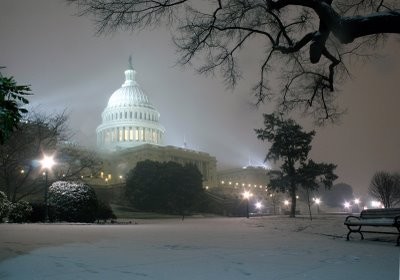
It’s snowing in Washington and just about everwhere else! While everyone can lament what snow does to travel schedules But, it is midwinter and no one can deny that the falling snow has a magnificent and hypnotic effect. It also creates a winter wonderland.
Indeed, though not every one likes snow it is an amazing work of God. He takes a barren winter landscape and creates it anew. I can almost hear the Lord saying, “Behold, I make all things new!”
In the modern world we often walk past the glory of God and hardly notice the gifts that God daily provides. I am mindful of the movie, “The Color Purple” when the main character “Ceilie” admits she is angry with God. Her friend “Shug” says, “I think God gets mad at us when we walk through a field and miss the color purple.”
These midwinter days, don’t miss God’s gift. It is true, it comes at the price of weather related hardships. But MAYBE just maybe, God can get a few of us to stop, for just a minute and rest a while, and behold his glory. Getting “snowed in” is a wonderful chance to become reacquainted with our family and even our very selves. And just looking out the window and marveling at the snow as it falls with a hypnotic and calming steadiness can be a prayer if we think of God who sends it. Where ever you are on this planet, don’t walk through life and miss the glory of God!
In the Book of Sirach there is a beautiful and poetic description of God and the majestic work he creates even in the “dead” of Winter. Enjoy this excerpt from Sirach and spiritually reflect on the glory of God in winter.
God in Winter:
A word from God drives on the north wind.
He scatters frost like so much salt;
It shines like blossoms on the thornbush.
Cold northern blasts he sends that turn the ponds to lumps of ice.
He freezes over every body of water,
And clothes each pool with a coat of mail.
He sprinkles the snow like fluttering birds.
Its shining whiteness blinds the eyes,
The mind is baffled by its steady fall.
Sirach 43, selected verses
Enjoy this video that recalls for us the joy and wonder of a snowfall that many of experienced when we were young:
In these early weeks of “ordinary” time, we are being introduced to Jesus and the beginnings of His public ministry. Matthew’s Gospel today describes how Jesus began His public ministry in the wake of the arrest of John the Baptist. Matthew tells us four things about Jesus’ ministry: its context, its content, its call, and its comprehensiveness. Let’s look at each in turn.
The CONTEXT –When Jesus heard that John had been arrested, he withdrew to Galilee. He left Nazareth and went to live in Capernaum by the sea, in the region of Zebulun and Naphtali, that what had been said through Isaiah the prophet might be fulfilled: Land of Zebulun and land of Naphtali, the way to the sea, beyond the Jordan, Galilee of the Gentiles, the people who sit in darkness have seen a great light, on those dwelling in a land overshadowed by death light has arisen.
The relocation of Jesus northward from Judea up to Galilee coveys some important truths. First, it tells us of the hostility of the southern regions to the message of John the Baptist and Jesus. The area in and around Judea (which included, principally, Jerusalem) was controlled by a sort of religious ruling class (the Sadducees, especially, and to a lesser extent, the Pharisees). Because they were in strong but often controversial control in these areas, they were far less open to ideas that in any way threatened their leadership or questioned the rituals related to the Temple.
And so Jesus moved north to more fertile territory in order to begin His public ministry; the Jewish people in Galilee were less hostile. In fact, the people of Jerusalem often looked down upon them for their simple, agrarian ways and their “rural accent.” But it was more fertile ground for Jesus to begin His work.
There is an important lesson in this: While we must carefully preserve Christian orthodoxy and only accept doctrinal development that is organic and faithful to the received Apostolic Tradition, we can sometimes inadvertently stifle the Holy Spirit, who speaks to us through unexpected people and in unexpected ways.
The Pharisee leaders simply rejected the notion that any prophet could come from Galilee.When Nicodemus encouraged them to give Jesus a hearing they scoffed, Are you from Galilee too? Search and see that no prophet arises from Galilee (Jn 7:52). Sometimes we can insist upon a single position in matters in which Christians are allowed freedom. For example, there are various degrees of expression permitted in the liturgy; there are also different schools of theological thought that are allowed by the Church.
Balance is required of us.We may prefer Thomistic formulations, Carmelite spirituality, charismatic worship, or the traditional Latin Mass. Such things are legitimate matters for discussion; we ought not to feel threatened by what the Church currently deems to be legitimate diversity. Discovering the range and limits of diversity is an ongoing matter for the Church; we should not permit the field of our own soul to be hostile to Jesus and His ministry, which may come to us in more diverse ways than we would prefer.
How tragic it wasfor Judea that Jesus thought He had to move on to more fertile territory, and what a blessing it was for Galilee that He moved there. But for Galilee there was this boon:The people who walked in darkness have seen a great light; those who dwelt in a land of deep darkness, on them has light shined (Is 9:2).
The CONTENT–From that time on, Jesus began to preach and say, “Repent, for the kingdom of heaven is at hand.”
We have discussed before the careful balance of Jesus’ preaching. He is willing to challenge and so to say, “Repent.” But He also declares the good news that the Kingdom of Heaven is at hand. Accepting the ministry of Jesus requires that we avoid the two extremes of presumption and despair.
To those who make light of sin and their condition as sinners, Jesus says, “Repent.”It is wrong to presume that we do not need continual healing power from the Lord in order to overcome our sin. Perhaps our greatest sin is our blindness to it. Most do not seem to comprehend how serious their condition is.
The word translated here as “repent” is μετανοεῖτε (metanoeite), which means more literally “to come to a new mind,” or “to come to a new way of thinking.” In our sin-soaked world, a world in which sin is so pervasive as to almost go unnoticed, Jesus says, “Come to a new mind. Understand your condition and your need for mercy and grace. Come to understand that without the rescue that only God can provide, you are lost.” And hence we are told to reject presumption.
But we are also told to reject despair, for the Kingdom of God is at hand. In other words, the grace and mercy of God are available to rescue us from this present evil age and from our carnal condition. Through Christ we are granted admittance to the Kingdom. The Spirit of God can overcome our carnal, sinful nature and bring us to true holiness.
The proper balance between presumption and despair is the theological virtue of hope. By hope we confidently expect God’s help in attaining eternal life. By proper metanoia(repentance) we know that we need that help; by hope we confidently reach for it.
In our own proclamation of the Kingdom we also need the proper balanceexhibited by Jesus. Consider that if children hear nothing but criticism they become discouraged (they despair), but if all they hear is praise they become spoiled and prideful, presuming that everything should be just as they want it.
For the Church, too, balance is necessary.Many people expect the Church only to affirm and “be positive.” This leads to a selfish and incorrigible world and to the presumption that nothing matters (as we can plainly see today). Thus the Church must announce the call to repentance, but must also offer hope and mercy to sinners. She must offer grace though the Sacraments and her preaching, which, with God’s power, makes the Kingdom of God to be “at hand.”
The CALL– As he was walking by the Sea of Galilee, he saw two brothers, Simon who is called Peter, and his brother Andrew, casting a net into the sea; they were fishermen. He said to them, “Come after me, and I will make you fishers of men.” At once they left their nets and followed him. He walked along from there and saw two other brothers, James, the son of Zebedee, and his brother John. They were in a boat, with their father Zebedee, mending their nets. He called them, and immediately they left their boat and their father and followed him.
In building His Kingdom, Jesus summons men to follow Him.He will train them to be the leaders of His Church as Apostles. The Kingdom of God is not just concerned with calling disciples, but also with developing leaders to provide order and authority in the Church.
Even the most “democratic” of organizations requires authorityand leadership. Without these there is anarchy and a battle of wills. Hence, in the early stages of His public ministry, the Lord calls disciples and also grooms leaders. Consider three things about the Lord’s call.
HisARTICULATENESS– He says to these apostles, Come, Follow me.His announcement is unambiguous. Good leaders make clear what they ask, indeed, what they demand. Jesus is clear to set the course and point the way; Heis that way.
His APPEAL –Jesus must have had tremendous personal appeal and exuded a strong, reassuring authority. His appeal to them was personal: “Come, follow Me.” He did not merely say come and “learn my doctrine,” or “accept my vision.” He said, “FollowMe.” So, as we hand on the faith to our children and others, we cannot simply say, “Here is the Catechism; follow it.” Each of us must also take the next step and tell them to follow the Lord with me. We cannot simply parrot what a book says, correct though that book might be. Ultimately we must be able to say, “I am a personal witness to the fact that God is real and that the truth He has given to the Church is authentic and is changing my life.” Our appeal must include the personal testimony that what we proclaim is real and is changing our life: “Come, and go with me to my Father’s house.”
His APPROACH–Note that the Lord builds on something they know: fishing. He starts with the familiar in order to draw them to the less familiar. In a way, He is saying that the gifts they are currently using are just the ones they need to use as leaders in God’s Kingdom. Fishermen are
Patient– They often wait long hours for the fish to bite. Apostles and bishops must also be patient and have the ability to wait for long periods before there is a catch for the Lord.
Perceptive– They learn to know the fish, their behavior, and what attracts them. Apostles and clergy must learn about their people and what will attract them to Christ.
Persevering– They must go through many days in which they catch very little; only through perseverance is there real gain in fishing. So it is with the work of the clergy, who may go long stretches with little to show for it. The Gospel may go “out of season,” even for decades in certain cultures (like our own). The good leader will persevere, will stay at the task.
The COMPREHENSIVENESS– He went around all of Galilee, teaching in their synagogues, proclaiming the gospel of the kingdom, and curing every disease and illness among the people.
Note that all of Galilee was His mission field and He covered it comprehensively.He also cured people of every disease and illness. And thus the Church is catholic, and must address every part of the world, providing a comprehensive vision for life. We may not have the power to solve every problem, but we can provide the vision of the Paschal mystery, which sheds light and brings spiritual healing to every affliction. If we are suffering and dying, we must remember that Jesus did as well, but only to rise and be glorified on account of his fidelity and obedience.
For the Church and for the Christian, the comprehensive answer to every affliction isthat we are always carrying about in our bodies the dying of Christ so that the rising of Christ may also be manifest in us(2 Cor 4:10). We seek to bring healing to everyone we can, and where physical remedies are not possible, the truth of the Gospel reassures us that every Friday, faithfully endured, brings forth an Easter Sunday.
Here, then, are four crucial insights from the beginning of Jesus’ public ministry. They are important for us to acknowledge and to imitate.
Journey with me back to 1971 (a year of funny hair, to be sure) and listen to this old classic: “Come and Go with Me to My Father’s House.”
Note to readers: The following article is long (3500 words). This is because I have been adding to it over the years as my research has continued. I am by avocation a church musician. Before my ordination, I was a Choir director and an organist. Like most of you, I have my preferences in the area of Church music, but we must be careful not merely to dogmatize them. If we are going to talk intelligently about Church music, knowledge of history is important. It would certainly be incorrect to think that the debates about music in the liturgy began in 1965. In fact, such debates go back to the very beginning of the Church. In order to provide some historical perspective (and a context for the reflection on what is and is not appropriate music) I have been writing and expanding upon this essay for several years. Since it is long, I want to provide a PDF, which you may find here, so that you can print the article out and read it at your leisure. If you do not have the time or the interest to read this full article, you can get the gist of it in the summation at the end.
With the exception of chant, almost every form of music that is today regarded as sacred initially had a stormy reception in the Church before being admitted to the ranks of music commonly called “sacred.”
That music is controversial in the Church is nothing new, as we shall see in this modest survey of the history of music in Catholic liturgy. Some of my sources are listed at the end of this post, but it is really the product of many years of reading and studying.
On some level, I hope to provide some perspective on the claim that is often made today that certain modern forms of music are inadmissible because they are not “sacred.” In no way do I intend to approve of all forms of modern music nor to encourage the admission of all of them into the liturgy, but it is worth appreciating that the definition of “sacred music” has changed over time. New forms have been admitted— sometimes reluctantly—to the exalted class we refer to as “sacred music.”
Here, then, is a brief look at the history of Church music in terms of what has been considered sacred and what has not.
I. The early, pre-Constantine period: Chant reigns supreme – While little if any music survives in written form from the earliest days of the Church, it seems clear (as Johannes Quasten records) that the leaders of the early Church (the Fathers and bishops) preferred monophonic music. This seems largely due to the association of harmony with the excesses of the pagan world and pagan worship.
Frankly, there was in the early Church a very persistent theme that music itself was problematic. Many ancient bishops and Fathers of the Church barely tolerated it, sought to limit its influence, and/or were deeply suspicious of any singing at all.
In his essay “On the Theological Basis of Church Music,” Cardinal Ratzinger (drawing from sources such as Pope Gregory the Great, St. Jerome, Gratian, and even as recent as St. Thomas Aquinas) describes the rather negative opinion in the early Church of any music involving instruments, harmony, or anything deemed “theatrical.” He writes,
Instrumental music, understood as a Judaizing element, simply disappeared from the early liturgy without any discussion; the instrumental music of the Jewish temple is dismissed as a mere concession to the hardness of heart and sensuality of the people at that time. What the Old Testament said about music and worship could no longer be applied directly; it had to be read by them allegorically; it had to be spiritualized
(Ratzinger, “On the Theological Basis of Church Music,” quoted from Collected Works Vol XI, pp 425-432).
Summarizing the views he had received from the earlier Church, St. Thomas wrote, “In the praise of God, the Church does not employ musical instruments … lest she appear to be falling back into Jewish ways” (Summa Theologica II, IIae, q. 91 a 2 ad 3).
Cardinal Ratzinger continues,
Analyzing the texts, not infrequent in the Fathers, which are critical of music or even openly hostile to it, one can clearly identify two constant and governing factors:
A. In the first place there is the one-sidedly “spiritual” understanding of the relationship between the Old and New Testaments … [So] Christian liturgy … took on a more or less Puritan form. … The idea that God can only really be praised in the heart means that no status can be accorded to music … In Christian worship … music must be relegated to a secondary level. Augustine is a splendid example of this. His sensitivity to music causes him much torment because his mind is dominated by a spiritualizing theology that ascribes the senses to the Old Testament, the old world; he is afraid of “sinning grievously” when he is “moved more by the music then by the reality to which the singing refers” … and would prefer “not to hear singing at all.” Fortunately, his rigorism is dampened when he recalls the profound stirring his soul experienced when he first heard Church music in Milan. [He thus adopted a view of music later stated by St. Thomas, which held that among the reasons for Church music was that] “Thus the minds of the weak be more effectively summoned to piety.”
B. The second group of ideas that stood in the way of a positive the valuation of Church music … is put in a nutshell in Thomas’ fundamental article on the praise of God, where he says that vocal worship is necessary, not for God’s sake, but for the sake of the worshiper (Ibid).
Cardinal Ratzinger argues in the essay that this tended to lead to a utilitarian view of Church music: necessary to some degree, but somehow less than ideal. He reflects that this created a barrier to any satisfactory theology, not only of Church music, but of all prayer whatsoever.
He also adds (in a later essay) another reason for the restrictive notions about music in the early Church:
To the extent that it distanced itself from the Semitic world, the development of Christological art songs [also] threatened more and more to turn into an acute Hellenization of Christianity … The fascination of Greek music and Greek thinking [now excluded] … so that the new music rapidly became the domain of Gnosticism … For this reason [too] the Church immediately and rigorously rejected the poetical and musical innovation and reduced Church music to the psalter … This limitation of liturgical singing which gradually began asserting itself from the second century … led to a forbiddance of private song compositions and noncanonical writings in liturgical services. The singing of the psalms also came to be restricted to the choir whereas others “should not sing in church” (See canon 59 of the Synod of Laodicea 364 AD) (Ratzinger, Ibid, p. 505).
Thus music in general, given its Semitic and pagan associations, was widely resisted in the early Church and tolerated only in limited ways. Music with any harmony was altogether excluded and would not reappear until the Late Middle Ages.
As a final sample of the Patristic skepticism of music or demonstrative worship, consider St. Cyprian, who wrote the following early in the 3rd century:
When we pray, our words should be calm, modest and disciplined. Let us reflect that we are standing before God. We should please him both by our bodily posture and the manner of our speech. It is characteristic of the vulgar to shout and make a noise, not those who are modest. On the contrary, they should employ a quiet tone in their prayer ….
When we gather to celebrate the divine mysteries with God’s priest, we should not express our prayer in unruly words; the petition that should be made to God with moderation is not to be shouted out noisily and verbosely. For God hears our heart not our voice. He sees our thoughts; he is not to be shouted at …
(Treatise on the Lord’s Prayer by Saint Cyprian, bishop and martyr (Nn. 4-6: CSEL 3, 268-270)).
So much, it would seem, for demonstrative prayer and exuberant singing.
Another reason that the early Church seems to have favored non-harmonic singing was somewhat rooted in the cosmology of the time, wherein there was an emphasis on the unity of all things. Whatever diversity was discovered was viewed as coming from the one hand of God. Monophonic music seemed to better express this unity, at least to the ancient Christian mind.
This cosmology of unity still finds its expression in the way that most Prefaces in the Mass are concluded. The Latin text speaks of the multitude of the choirs of angels, joining with the voices of the many saints (cum Angelis, et archangelis, cum Thronis, et Domininationes … et òmnibus Sanctis). Yet despite the vast multitude of voices, at the end of the Preface it says that they all sing “as with one voice, saying” (una voce dicentes), “Holy, Holy, Holy, Lord God of hosts.”
And so at the earliest stage, music was limited, and to the degree it was it was largely what we today call chant. To the ancient Church, harmony was widely considered to be secular, even pagan.
II. The Church after Persecution: Chant develops – The earliest chants were quite simple and largely syllabic (one note per syllable); there were few elaborations. However, after the Edict of Constantine (321 A.D.) as the Church came out of a more hidden worship, the use of large, cavernous buildings started to influence the singing.
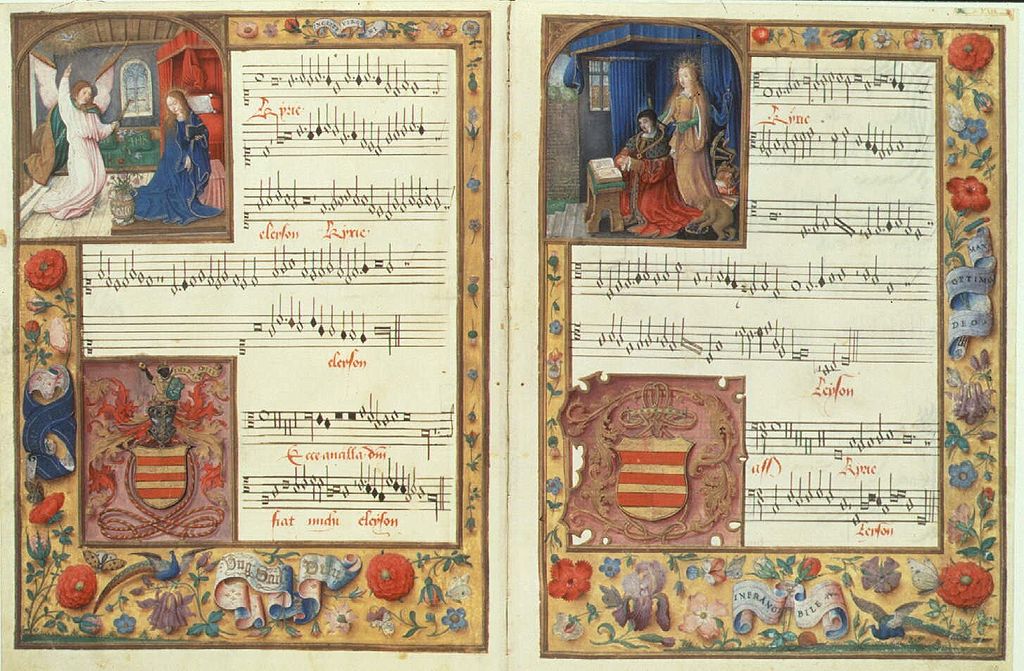
Cantors began to elaborate on the chant, making full use of the echoes in the larger, basilica-like buildings. Vocals became increasingly melismatic (multiple notes per syllable) rather than syllabic, especially during festival seasons. Syllables (such as those in the word “Alleluia”) began to be extended over more and more notes.
Singers also “yielded to the spirit,” and the long melismata became a kind of ecstatic “singing in tongues.” Though at first any elaboration was resisted, certain chants did begin to develop in some areas. As these melodies became increasingly complex, they were written down and collected by Pope St. Gregory (among others), hence the modern name, “Gregorian chant.”
As these chants became more and more elaborate, their sacredness was only gradually conceded. In fact, they became so complicated that the faithful in the congregation, who were already being discouraged from singing at all, had great difficulty joining in most of the chants. For this reason, special choirs called “scholas” were formed.
III. The High Middle Ages: Harmony enters – The next major development in Church music took place during the High Middle Ages, generally speaking in the 13th century. The first developments of harmony occurred in the musical schools in France, particularly around Paris. It was here that we saw the first widespread introduction of harmony into Church music.
Several factors influenced the introduction of harmony. First, there was the reintroduction of Greek philosophy and some of its views back into the Western world through scholasticism.
Among the Greek notions was a cosmology that spoke of the planets orbiting the sun in perfect circles, each of them ringing out a different tone and creating a beautiful celestial harmony in the heavens as they did so. This was the “music of the spheres” and the idea of a great and beautiful harmonic sound in the heavens. Thus the association of harmony with the sacred began to seem more plausible in the minds of Christians.
The first experimentation with harmony seems to have been singing the Gregorian melodies and adding a hollow harmony of a fourth or fifth. Sometimes this involved several singers singing the words in those harmonies. Other times the harmonizers simply “droned” in the background, somewhat like bagpipe drones.
Architecture was another factor that influenced the harmonies. The soaring new cathedrals with their vaulted ceilings that began to dot the landscape of Western Europe seemed to demand more soaring music. These cathedrals were the skyscrapers of their day.
As harmony began to sound more pleasing to the ears, scholars worked to study it using, of all things, the Pythagorean Theorem, to mathematically set forth the harmonic scale. Thus mathematics and music came together to quantify a kind of music theory. Gradually, as the years just prior to the 16th century ticked by, we came to have what we know of today as the 12-tone scale.
The introduction of harmony in the Church (as with most things musical) was not always without controversy. Some thought that it made the words harder to understand, a complaint that would plague polyphonic music in its early stages.
Nevertheless, as a general rule, the new harmonies from the Paris school swept through Europe to widespread acclaim. People flocked to the cathedrals to hear this splendid new music.
IV. Late Middle Ages to Renaissance: Musical revolution and a growing crisis for polyphony – It is hard to describe what took place in music from the late 1300s to 1500 as anything less than revolutionary. The modern harmonic scale as we now know it came into full realization. Harmony went from two-part, to three-part, and then to four and more parts, amazing listeners everywhere.
The incredible development of music during this period paralleled the remarkable developments in painting: increasing use of shadow, light, perspective, and depth. By the early 1500s, Renaissance polyphony was in all of its glory. Composers such as Isaac, Lassus, Palestrina, Victoria, Tallis, and Byrd brought this art form to an amazing richness.
But the music was not without controversy. There were two main problems with this new style called polyphony.
The first problem was the intelligibility of the text. With multiple harmonies being sung, the Latin text, often staggered across many parts and voices, became harder and harder to understand. Clergy in particular complained of this, arguing that the sacred text was taking a backseat to musical flourishes. In addition, the “theatrical showiness” seemed secular to many.
The second troubling issue was that many of the composers of the day drew from secular melodies that were often heard in taverns, in theaters, and on the streets. They would often take these recognizable melodies and set them as a cantus firmus (musical theme or foundation) of sacred compositions, including the parts of the Mass.
Heinrich Isaac, as early as the 1400s in his Missa Carminum, drew from many of these tavern songs. But perhaps the most egregious example of this, and something that almost caused polyphony to be banned completely from the Catholic Church, was a Mass composed by Orlandus de Lassus.
The Mass in question was his Missa Entre Vous Filles. The main melody of both the Kyrie and the Gloria came from a secular piece by the French composer Jacob Clemens non Papa, the words of which bordered on the pornographic. As the Mass grew widely popular (for it is a lovely melody), Church authorities discovered its source and a great uproar ensued.
This controversy took place during the years of the Council of Trent, and though some scholars are dubious of all the details, it is reported that there were Council Fathers who were serious about seeing that sacred polyphony was forever banned from the Catholic liturgy.
Among those who came to the rescue, I am happy to report, was my patron saint, Charles Borromeo. He assembled some increasingly dubious bishops and cardinals who were attending the sessions of the Council of Trent so that they could hear the Pope Marcellus Mass by Palestrina. This particular Mass seems to have been specifically composed to address some of the critiques about the intelligibility of the text and the secular origins of many melodies. The presentation calmed some of the fears regarding this new music and the crisis largely passed.
This incident demonstrates that what many today consider a very sacred sound (namely Renaissance polyphony) was actually quite controversial in its day. It was only thought of as sacred in a widespread way later on. After surviving this first crisis, polyphony became less “florid” and gave greater emphasis to the intelligibility of the text. Secular melodies were also excluded. For these reasons, later works by Palestrina are more austere than those from his earlier period.
Thus we see how the definition of what makes for sacred music had already passed through two major periods. In the first, harmonies were considered too secular; in the second, harmony was introduced but only slowly accepted as sacred in nature.
V. The Renaissance to the Baroque: New controversies, old problems – In the period of the middle Renaissance, a new cosmology began to replace the idea that the planets revolved around the sun in perfect circles. Astronomy started to reveal that most of the planets revolved around the sun in elliptical orbits, some of them quite elongated. The notion of the circular orbits of the planets, symbolized by the “music of the spheres” and imitated by Renaissance polyphony, began to give way to the understanding of the mathematical progression of elliptical orbits—a kind of Bach fugue in the sky. This change in cosmology helped to usher in the rather more elaborate, yet mathematical, music of the Baroque period.
In this period, we find the wonderful and mathematically precise music of Bach, Vivaldi, Handel, Mozart, Gabrieli, Schubert, Scarlatti, and many others. Perhaps the fugue best exemplifies the kind of mathematical cosmology of the time. In a fugue, mastered by Bach but not wholly unique to him, a musical theme is set forth. For example, quarter notes may announce the theme of the fugue. This theme is then repeated in the left hand and then in the feet (of the organist). It also progresses mathematically: into eighth notes, then into sixteenth and even 32nd notes. Math meets music! Other musical forms like canons emerged similarly. Symphonies also grew to have movements, which were often named for their tempo (e.g., allegro, adagio, presto).
The classical and baroque periods brought the great orchestral or “Classical” Masses, by composers such as Mozart, Schubert, and Scarlatti. Even Bach and Beethoven set the Catholic Mass in great symphonic and orchestral renderings.
Much controversy accompanied these newer forms. Once again, the principle concern was the intelligibility of the text. Another concern was the length of many of these Masses; in some, the Glorias and Credos could go on for twenty minutes or longer.
Some complained that these musical settings of the Mass made it sound more like being at the opera than at Mass. Indeed, they often broke the sacred text into movements sprinkled with soprano or tenor solos and duets, grand choral sections, and often with full symphonic accompaniment. It was quite a feast for the ears! These Masses were generally so elaborate that they could only be performed in the larger, well-endowed, city churches.
The controversy concerning these kinds of Masses continued for many years. Even as liturgical reforms began in the early 1900s, Pope Pius X frowned on their usage, referring to these orchestral Masses as “theatrical” (see Tra Le Sollecitudini # 6). This led to a de facto banishing of the form from the Catholic liturgy at that time. Only after the Second Vatican Council was this form rehabilitated in a small way.
Here, too, we see that what many Catholics today consider unquestionably sacred (e.g., a great Mozart Mass) had to survive much controversy and even a kind of banishment. What is thought of as sacred today has not always enjoyed that rarefied distinction!
VI. The Modern Era: New musical forms, new controversies– This leads us to the modern era. As we have seen, those who think that debates about what constitutes sacred music are new are simply mistaken. These disputes have been quite a constant part of Church life almost from the beginning. To place them at the feet of the Second Vatican Council is to lack historical perspective.
It is true that two documents of the Second Vatican Council (Musicam Sacram and Sacrosanctum Concilium) opened the door to newer forms with a greater freedom toward enculturation (e.g., MS # 18, 63), but they also reasserted the special accord to be given to chant (# 50a), polyphony, and the pipe organ (# 4a).
Although debate continues about newer forms of music and whether or not they are sacred, such tensions have long existed. Some newer forms have already been tried and found wanting (e.g., Polka Masses). Other forms such as “folk,” gospel, or contemporary music, with adaptions over time, have remained.
Summation:
Historically, no form of music currently considered sacred achieved that status without controversy.
Indeed, music itself was controversial in the early Church and was barely tolerated by many of the Church Fathers.
Time ultimately proves where wisdom lies and ultimately mediates for us what is sacred in a way that transcends mere passing tastes or preferences.
Music has made several revolutionary leaps during the age of the Church.
Provided necessary rational limits are applied, there is no need to rush to exclude every newer form.
If we were to do so, only chant would exist in the Church, and we would be deprived of a great treasury of music from the era of polyphony and the classical period.
In saying this I do not mean to indicate that all music is just fine, or that all modern forms are here to stay, or that newer forms should not be questioned; it is clear that some forms are wholly inimical to the Sacred Liturgy. Rather, I seek to remind people that what is called “sacred music” is historically quite complex. It is the result of long and vigorous discussions, refinements, and other factors as diverse as cosmology, architecture, mathematics, and culture.
We do well to let some of the conversations and controversies work themselves out, lest in too quickly ending them by judicial fiat we impoverish ourselves and block what might bless others and even our very selves.
These are just a few of my sources for the above article:
Here are the Kyrie and Gloria from the Missa Entre Vous Filles by Orlando de Lassus, the polyphonic Mass setting that almost torpedoed polyphonic music in the Church. To our “distant” ears it is delightful and melodic. At the time, however, it engendered great outrage as nearly pornographic, because it drew from the melody of a “racy” song of the time.
As Ordinary Time (tempus per annum) opens up, the lectionary continues to “introduce” Christ to us. The Christmas cycle now done, we must ask, “Who is Jesus Christ? Who is this savior who has been born for us?”
In today’s Gospel, John the Baptist elaborates on this. John’s words are brief, but they are packed with Christological teaching. In this Gospel we learn at least five things about Jesus. We learn that He is prefigured, preexistent, preeminent, powerful, and is the presence of God. Let’s look at each one.
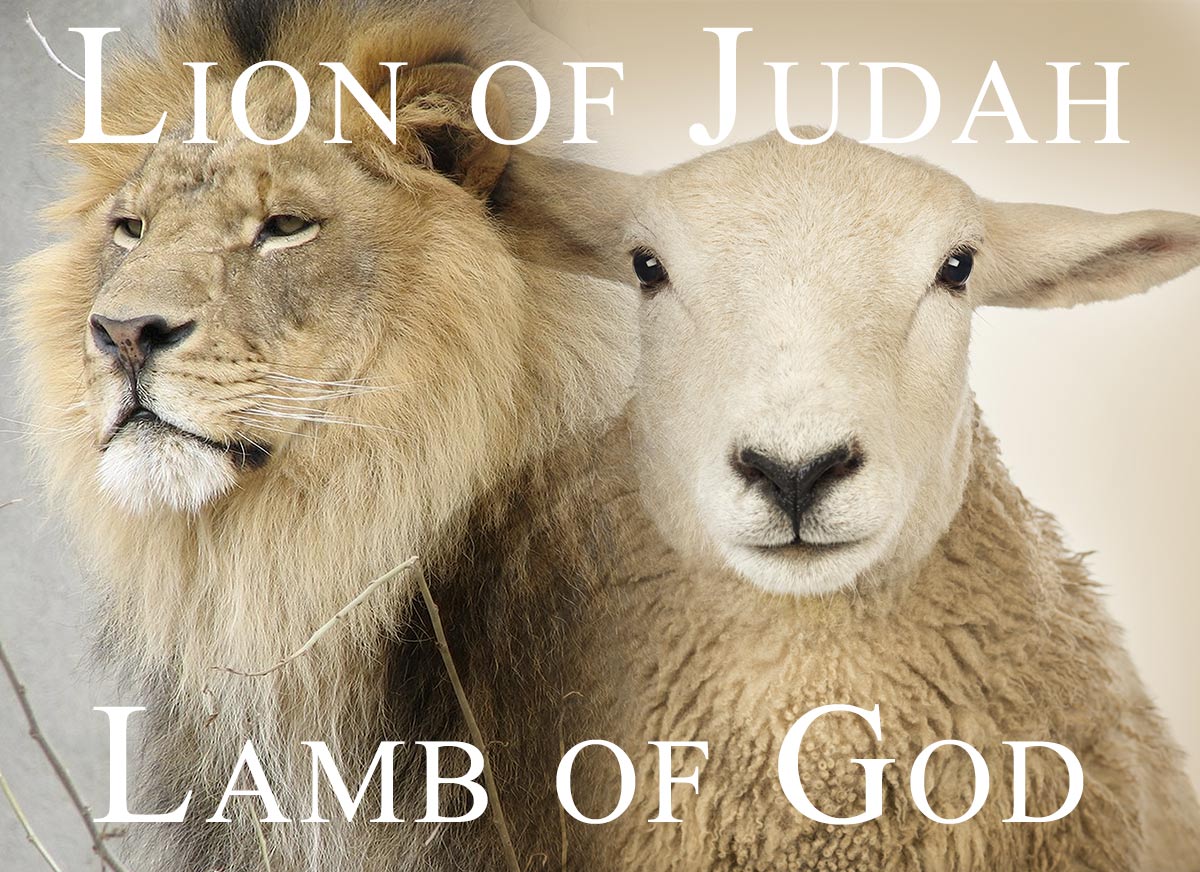
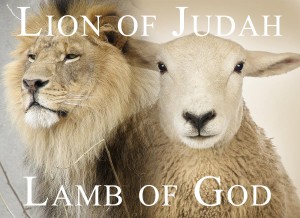
I Prefigured – John the Baptist saw Jesus coming toward him and said, “Behold, the Lamb of God, who takes away the sin of the world.” Unless you know the history of this moment, it seems a little odd.
But for those who know Scripture, it is clear that John is really answering a question that was asked by Isaac some 1800 years prior to this event. Abraham had received from God a strange and terrible command: that he take his son to Mt. Moriah (present day Jerusalem) and there offer him in sacrifice.
And Abraham took the wood of the burnt offering, and laid it on Isaac his son; and he took in his hand the fire and the knife. So they went both of them together. And Isaac said to his father Abraham, “My father!” And he said, “Here am I, my son.” He said, “Behold, the fire and the wood; but where is the lamb for a burnt offering?” Abraham said, “God will provide himself the lamb for a burnt offering, my son.” So they went both of them together (Gen 22:6ff).
Do you get it? A promised son had wood laid upon his shoulder and was made to carry it up a hillside, the same hillside where Golgotha would one day be found. There, on the top of that hill he was to be laid on the wood and killed. Sound familiar? Of course Isaac is a prefigurement of Christ. Things were starting to look grim for Isaac, who got nervous and asked his father, “Where is the Lamb?” You know the rest of the story. It is true that God provided a ram caught in the thicket that day, but that ram pointed to Christ.
And so the question “Where is the Lamb?” wafted up on the breeze and was repeated down through the generations. Some five hundred years later, at the end of the period of slavery in Egypt, the blood of the lamb also protected Isaac’s descendants from death. Every Passover the question was still asked, “Where is the Lamb?” referring to the Passover lamb. Here, too, the Passover lamb was but a symbol, a prefigurement of Christ.
Now, standing on the banks of the Jordan, John the Baptist answers Isaac’s question, the question repeated down through the centuries: “Where is the Lamb?” John answers, “Behold the Lamb of God.” So the first thing we learn of Christ is that He was prefigured, here and in many other places in the Old Testament.
II Preexistent– He is the one of whom I said, “A man is coming after me who ranks ahead of me because he existed before me.” Now this, too, is a strange thing for a man to say about his younger cousin. Jesus was born six months after John the Baptist, yet John says that Jesus existed before him. John is clearly teaching us here of Christ’s pre-existence. Before assuming a human nature, Jesus existed eternally with the Father.
There never was a time when Jesus the Son was not. He is eternally begotten by the Father; He existed before all ages. Scripture says the following of Him:
For in him all things were created, in heaven and on earth, visible and invisible, whether thrones or dominions or principalities or authorities—all things were created through him and for him. He is before all things, and in him all things hold together (Col 1:16).
In the beginning was the Word, and the Word was with God, and the Word was God. He was in the beginning with God; all things were made through him, and without him was not anything made that was made (John 1:1).
Your father Abraham rejoiced that he was to see my day; he saw it and was glad. The Jews then said to him, “You are not yet fifty years old, and you have seen Abraham?” Jesus said to them, “Truly, truly, I say to you, before Abraham was, I am” (John 8:56).
III. Preeminent –I did not know him, but the reason why I came baptizing with water was that he might be made known to Israel. In effect, John is saying, “I exist for Him. My purpose is to reveal Him.” He must increase, but I must decrease (John 3:30). Jesus is greater than John or any prophet or world leader. Jesus is the Groom; John is but the best man.
IV Powerful –John testified further, saying, “I saw the Spirit come down like a dove from heaven and remain upon him. I did not know him, but the one who sent me to baptize with water told me, ‘On whomever you see the Spirit come down and remain, he is the one who will baptize with the Holy Spirit.’”
The baptism of John could only announce repentance and call for it. It could not truly wash away sins; the Baptism of Jesus can.
Even more, not only does Jesus’ Baptism take away sins; it confers the Holy Spirit. In Baptism, we are given a whole new life. Sin is taken away and in its place grace upon grace is given: grace to restore us, renew us, and refashion us; grace that equips, empowers, and enables us; grace that sanctifies, gives sonship, and seals us with the Holy Spirit.
All this is in fulfillment of this passage from Ezekeiel:
I will sprinkle clean water upon you, and you shall be clean from all your uncleannesses, and from all your idols I will cleanse you. A new heart I will give you, and a new spirit I will put within you; and I will take out of your flesh the heart of stone and give you a heart of flesh. And I will put my spirit within you, and cause you to walk in my statutes and be careful to observe my ordinances (Ezekiel 36:25ff).
Scripture also says, But to all who received him, who believed in his name, he gave power to become the children of God (Jn 1:12).
V. Presence of God– Now I have seen and testified that he is the Son of God. Jesus would say elsewhere, To see me is to have seen the Father; the Father and I are one (John 14:9). As the Son of God, He manifests the Father; He is the presence of God in this world. He shares fully in the one divine essence and as Son, shows us the Father. He is the presence of God among us.
So a brief passage from the Gospel of John contains five important teachings about Jesus Christ. He has existed forever. He was prefigured in the Old Testament. He has priority above and beyond anyone we know or think important. He has the power not only to save us from sin but to give us the very life of God. And as Son of God, He is God, and thus is God’s very presence among us. Jesus is not just the man from Galilee; He is very God from Heaven.