We live in times of great ingenuity; we have a lot of smarts. We’ve been to the moon and back. Our computers can do more and more amazing things, even as we are able to make them smaller and smaller. We can see farther than ever into outer space and look more deeply than ever into “inner space,” doing microsurgery and studying the human genome.
Yet although we have become technological giants, at the same time we’ve become moral midgets. Though able to solve complex technical problems, we can’t figure how to stay faithful to our commitments or keep our families together. The churches that once dominated our skylines are now dwarfed by buildings dedicated to banking, insurance, and other passing worldly affairs.
Our houses, with their great rooms, cathedral ceilings, and granite countertops, are monuments to our wealth. But inside, these houses are not homes; they are often filled with division and sterility.
Despite all our monetary wealth there is little wisdom; despite all our power there is little prudence.
From an eternal perspective our smarts amount to sandcastles on the beach that are sure to be washed away. Ultimately they cannot stand any more than can we.
Scripture warns of the human tendency to maximize the minimum and minimize the maximum. We are smart, but about the wrong things. Our priorities are misguided.
Woe to you, teachers of the law and Pharisees, you hypocrites! You give a tenth of your spices—mint, dill and cumin. But you have neglected the more important matters of the law—justice, mercy and faithfulness. You should have practiced the latter, without neglecting the former. You blind guides! You strain out a gnat but swallow a camel (Matt 23:22-24).
But God said to [the rich man who built barns], “You fool! This very night your soul is required of you; and now who will own what you have prepared?” So is the man who stores up treasure for himself, and is not rich in what matters to God (Luke 12:20-21).
For the people of this world are more shrewd in dealing with their own kind than are the people of the light (Lk 16:8).
For everyone looks out for their own interests, not those of Jesus Christ (Phil 2:21).
But mark this: There will be terrible times in the last days. People will be lovers of themselves, lovers of money, boastful, proud, abusive, disobedient to their parents, ungrateful, unholy, without love, unforgiving, slanderous, without self-control, brutal, not lovers of the good, treacherous, rash, conceited, lovers of pleasure rather than lovers of God— having a form of godliness but denying its power. Have nothing to do with such people (2 Tim 3:1-5).
How prosperous Israel is—a luxuriant vine loaded with fruit. But the richer the people get, the more pagan altars they build. The more bountiful their harvests, the more elaborate their pagan pillars. Their heart is false; now they must bear their guilt. The LORD will break down their altars and destroy their pillars (Hosea 10:1-2).
A discerning person keeps wisdom in view, but a fool’s eyes wander to the ends of the earth (Proverbs 17:24).
They are ingenious in their wickedness (Romans 1:30).
In other words, we humans tend to get smartest about the least important things, and are foolishly forgetful of eternal things—the things that matter most. Yes, we maximize the minimum and minimize the maximum. There are some who know everything there is to know about football, or who’s who in Hollywood or politics, but are at a loss when it comes to the most basic spiritual concepts, biblical stories, or moral teachings. Hours are consumed by sports, television, and politics, but there is no time for prayer.
Well, you get the point. We are smart, but about the wrong things. Meanwhile we remain foolishly out of touch with the things that matter to God and that last unto life eternal.
I thought of all this when I saw the following commercial, which appeared recently in my YouTube queue. It features men who have developed every talent imaginable related to beer.
Now I have nothing against beer in moderation. But allow the beer to represent the things of this world. And thus we see humorously illustrated our tendency and capacity to become very talented in worldly things. But at the end of the day, it’s just beer; it’s just the world, a world that is passing away.
Are we as talented and ingenious about spiritual things?
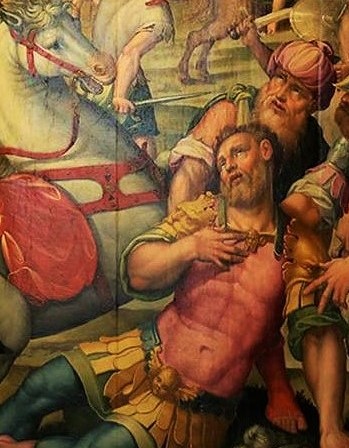
Today in daily Mass we read the well-known story of St. Paul’s conversion. There is a detail in the story that I have often pondered. Although I am speculating on the specifics, I think it ought not to be overlooked. Even my choice of the words “speculating” and “overlooked” (both of which refer to the eyes) indicate that we ought to “give an eye” to St. Paul’s eyes.
As you probably recall, St. Paul was not just struck down on the road to Damascus—he was blinded as well.
Saul got up from the ground, but when he opened his eyes he could see nothing; so they led him by the hand and brought him to Damascus. For three days he was unable to see, and he neither ate nor drank (Acts 9:8-10).
Having persecuted the Lord, Paul was now confronted with the darkness of sin and unbelief. It is as though the Lord wanted nothing to distract Paul as he pondered his experience, neither the delights of food and drink nor the delights of the eye. It was a kind of dying and being with Christ for three days in the tomb before rising. Like the dead, Paul was unable to eat and was enveloped in complete darkness of blindness. He could do little during that time but think and pray.
And pray he did!
[The Lord said to Ananias,]“Get up and go to the street called Straight and ask at the house of Judas for a man from Tarsus named Saul. He is there praying, and in a vision he has seen a man named Ananias come in and lay his hands on him, that he may regain his sight.”
… Ananias went and entered the house; laying his hands on him, he said, “Saul, my brother, the Lord has sent me, Jesus who appeared to you on the way by which you came, that you may regain your sight and be filled with the Holy Spirit.” Immediately things like scales fell from his eyes and he regained his sight. He got up and was baptized, and when he had eaten, he recovered his strength.
Through Word and Sacrament, Paul’s eyes were healed—or were they? Surely they were, for in the years that would follow, Paul saw well enough to travel the world speaking of Christ.
I’m convinced that some vestige of blindness, some physical memory remained in Paul’s eyes for his entire life, something to remind him of his need for mercy and to keep him humbly mindful of how that mercy was extended.
As background, we do well to recall the story of Jacob, who wrestled with God one night. Jacob proved strong in that great contest, so strong that God gave him a new name, Israel, which means “he wrestles (or struggles) with God.” God also left Jacob with a permanent memory of that nighttime battle. Scripture says that God knocked out Jacob’s sciatic muscle (Genesis 32:32), such that he would walk with a limp for the rest of his life, leaning on a staff. It was a reminder to Jacob that he was always to lean on the Lord (Heb 11:21).
So, too, perhaps, for St. Paul. Although he persevered through three dark days with God and although his eyesight was restored, it would seem that some weakness remained in his eyes. Later, St. Paul would speak of an ailment, a mysterious thorn in his flesh (2 Cor 12:7). Three times he begged God to remove it but the Lord told him to endure it for the sake of humility.
What was it? What was this mysterious physical affliction? I’m convinced that it had something to do with his eyes. Paul told the Galatians,
As you know, it was because of an illness that I first preached the gospel to you, and even though my illness was a trial to you, you did not treat me with contempt or scorn. Instead, you welcomed me as if I were an angel of God, as if I were Christ Jesus himself. Where, then, is your blessing of me now? I can testify that, if you could have done so, you would have torn out your eyes and given them to me (Gal 4:13-15).
While I am speculating, it seems to me that Paul had something to akin to conjunctivitis (pink eye), an affliction that make the eyes fill with a sticky yellowish discharge and become red. It can be extremely contagious and is often repulsive to others. Indeed, it was quite difficult to endure in the era before modern medicine.
Whatever his actual affliction, it seems (if the Galatians text is acknowledged as descriptive) to have involved Paul’s eyes, the same eyes that had been healed but perhaps with a reminder left in them of the need for humility and for remembrance of how God saved him.
What is your thorn? What is your limp? What is your conjunctivitis? All of us have things that keep us humble. They remind us of our need to lean on God and to look to Him, not with haughty eyes, but with eyes that are humble, respectful, and grateful.
This song says, “Nobody knows the trouble I’ve seen. Nobody knows but Jesus”
God speaks to us through many experiences and images. Sometimes there are differing layers of meaning and we must carefully and prudently discern what God is saying to us. Prudence is not the same as caution. Rather, it is the virtue that bids us, in each situation, to keep in mind our deeper call and final goal.
Consider the following story:
A man, walking through the forest saw a fox that had lost its legs, and wondered how it lived. Then he saw a tiger come up with game in its mouth. The tiger ate its fill and left the rest of the meat for the fox. The next day God fed the fox by means of the same tiger.
The man began to wonder at God’s greatness and said to himself, “I too shall just rest in a corner with full trust in the Lord and He will provide me with all I need.”
He did this for many days, but nothing happened, and he was almost at death’s door when he heard a voice say, “O you who are in the path of error, open your eyes to the truth! Stop imitating the disabled fox and follow the example of the tiger” (The Spirituality of Imperfection, p. 93).
This story illustrates the need for discernment and prudence. Growing in trust is a good thing of itself, but not if done so in a selfish or reckless way. Like any virtue, trust is not detached; it exists in real-life situations and the virtue of prudence must direct its application. This is true of all the virtues. St. Thomas and others called prudence the “charioteer of the virtues” because its role is to direct them properly in accordance with our final goal.
In the case of the story above, magnanimity and generosity were the true call; the man in the story sinned against hope. We ought never to despair that when we are truly in need God will supply us with the essentials needed for eternal life, but neither should we presume that He will rescue us from every one of our sins or poor decisions. Like any virtue, hope stands in the middle, warding off both despair and presumption; it gives us the confident expectation of God’s help, but not the kind that reduces Him to a sort of divine butler. Prudence also directs us to remember that our first instinct should be to serve rather than to be served (see Mark 10:45).
All of us ponder why God permits suffering. By faith we acknowledge that God never permits it except that a greater good may come from it. Perhaps He permits that we suffer loss in order to bestow some new gift in its place. Even beautiful relationships may hinder some new growth that God wants to bestow. For example, the death of a loved ones creates a space for the new and different while not canceling the gifts of the one who passed.
Suffering brings sobriety by reminding us that this world is not Heaven and its joys can neither last nor ultimately satisfy.
In addition, in the crucible of suffering we are tested and our faith can be strengthened and purified.
Suffering brings wisdom, which differs from mere human knowledge or experience in that it is from God. Wisdom sees past the apparent and is as much a “sense” or “disposition” as it is a body of knowledge. There is something about wisdom, so often acquired in pain, that enables us to embrace the paradoxes and riddles of life in this perplexing world, a long way from our eternal home. In wisdom we cling to God and grow more silent; we avoid simple explanations and do not demand exact answers. It is enough that God knows and that He will reveal to us only as much as we can endure now.
Yes, suffering is painful; it is a fearsome grace of God but it is a grace.
For now, the Spirit tells me that I’ve said enough, except to indicate what drew forth this meditation: an ancient maxim, an utterance of truth from ancient Greece.
He who learns must suffer.
And even in our sleep, pain that cannot
forget falls drop by drop upon the heart,
and in our own despair, against our will,
comes wisdom to us by the awful grace of God. – Aeschylus, c.a. 500 B.C.
This past Sunday, we read St. Paul’s almost ominous words about our need to break free from attachments to this world:
I tell you, brothers, the time is running out.
From now on, let those having wives act as not having them,
those weeping as not weeping,
those rejoicing as not rejoicing,
those buying as not owning,
those using the world as not using it fully.
For the world in its present form is passing away (1 Cor 7:29-31).
In this passage St. Paul speaks about what is, for most of us, the struggle that most hinders our spiritual growth. The great majority of the spiritual life is a battle about desire, worldly attachments, and the answer to this fundamental question: “What do you want most, the world and its pleasures or God and His Kingdom?” This world gets its hooks into us so and we easily become attached to it. It is hard to break free from inordinate desires.
But what are attachments and what are they not? Are there ways we can distinguish attachments from ordinary and proper desires? What are the signs that we are too attached to someone or something?
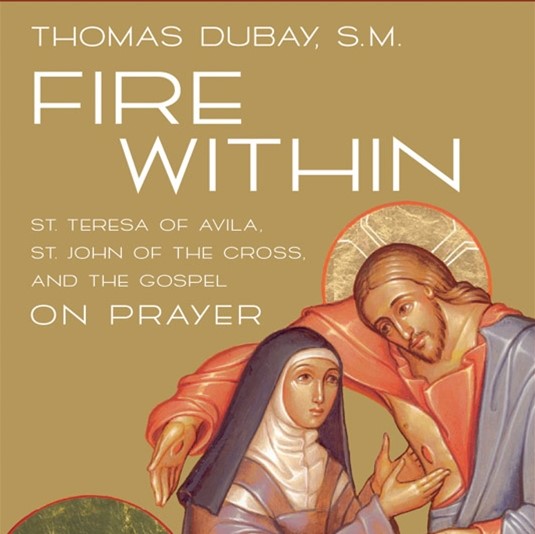
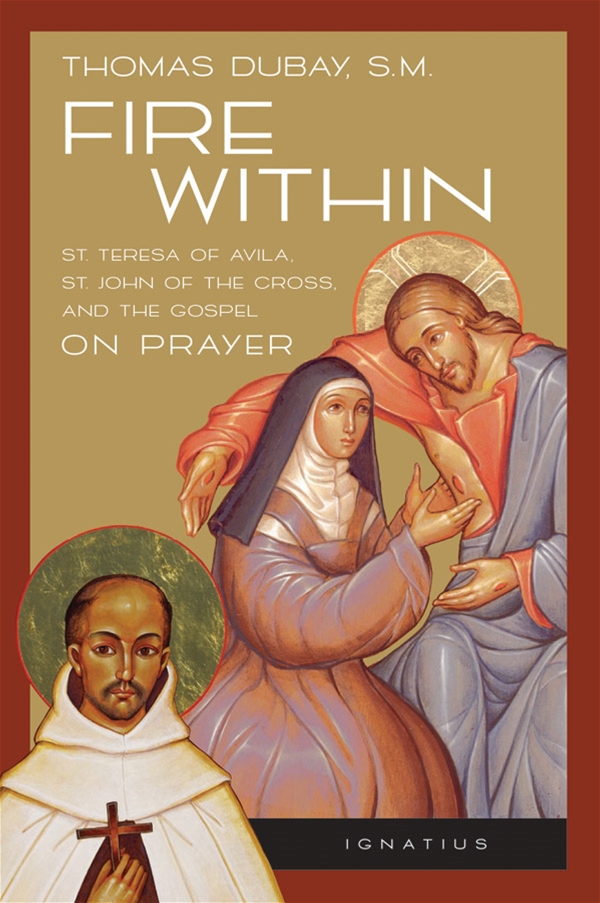
To address questions like these I turn to a great teacher of mine in matters spiritual, Fr. Thomas Dubay. Fr. Dubay died more than seven years ago but left a great legacy of teaching through his books, audio recordings, and programs at EWTN. I would like to summarize what he teaches in his spiritual classic, Fire Within, a book in which he expounds on the teachings of St. Teresa of Avila and St. John of the Cross.
Here then are some excerpts (pp. 133-135). Fr. Dubay’s teaching is shown in bold, black italics, while my lesser remarks are presented in plain red text.
I. WHAT ATTACHMENT IS NOT:
Sometimes it is easier to say what a thing is not than what it is. In doing this Fr. Dubay disabuses us of incorrect and sometimes puritanical notions that are neither biblical nor Catholic because they reject as bad what God has made as good. Scripture says, God created [things] to be received with thanksgiving by those who believe and who know the truth. For everything God created is good, and nothing is to be rejected if it is received with thanksgiving (1 Tim 4:3-4).
First of all, attachment is not the experiencing of pleasure in things, not even keen, intense pleasure. The complete avoidance of pleasure is neither possible nor advisable in human life … There is no doubt that the pleasures of the five senses easily lead to a selfish clinging to them for their own sakes, but nonetheless, the pleasures themselves are not blameworthy. God made them, and they are good.
The remarks here are very balanced. Of itself, taking pleasure in what God has made is a kind of thanksgiving and surely an appreciation of what God has created and given.
Yet, due to our fallen nature, we must be cautious that our experience of pleasure, like all our passions, does not become unruly, improperly directed, and/or take on a life of its own. If we are not mindful, pleasures can divert our attention from the giver (and His purpose) to the gift.
Consider that a husband properly enjoys intense pleasure in his intimate experiences with his wife. Correctly understood, there is little way he can fail to enjoy this, other things being equal. These intimate moments, however, have a meaning beyond themselves: They summon him to greater appreciation and love for his wife, and ultimately for the God who created her. Further, they draw him to share his love and appreciation through an openness to the fruit this love will bear in his children.
The gift of intimacy is wonderful and to be enjoyed to the fullest, but it is not an end in itself. When it becomes its own end and exists in our mind only for its own sake, we are on the way to attachment and idolatry.
Nor is possessing or using things an attachment to them.
We must all make use of things in this world to accomplish what God has given us to do. God is surely pleased to equip us with what we need to do His will: to build the Kingdom and to be of help to others.
Nor is being attracted, even mightily attracted, to a beautiful object or person an unhealthy attachment. As a matter of fact, we should be drawn to the splendors of creation, for that is a compliment to the supreme Artist. Saints were and are strongly attracted to the glories of the divine handiwork and especially to holy men and women, the pinnacles of visible creation.
We should pray for the gift of wonder and awe, wherein we appreciate and are joyful in God’s glory displayed in the smallest and most hidden things as well as in the greatest and most visible things. We are also summoned to a deep love of, appreciation for, and attraction to the beauty, humor, and even quirkiness of each person.
Here, too, these things are meant to point to God; they are not ends in themselves. Sometimes that we fail to connect the dots, as St. Augustine classically describes, Late have I loved you, O Beauty, so ancient, and yet so new! Too late did I love You! For behold, You were within, and I without, and there did I seek You; I, unlovely, rushed heedlessly among the things of beauty You made. You were with me, but I was not with You. Those things kept me far from You, which, unless they were in You, would not exist” (Confessions 10.27).
So once again, to be attracted by beauty is of itself good, but it is not an end. It is a sign pointing to the even greater beauty of God and His higher gifts.
II. WHAT ATTACHMENT IS: St John of the Cross [observes] that if anyone is serious about loving God totally, he must willingly entertain no self-centered pursuit of finite things sought for themselves, that is, devoid of honest direction to God, our sole end and purpose. St. Paul makes exactly the same point when he tells the Corinthians that whatever they eat or drink, or whatever else they do they are to do all for the glory of God … (1 Cor 10:31)
St John of the Cross explicitly states that he is speaking of voluntary desires and not natural ones‚ for the latter are little or no hindrance to advanced prayer as long as the will does not intervene with a selfish clinging. By natural desires the saint has in mind, for example, a felt need for water when we are thirsty, for food when hungry, for rest when fatigued. There is no necessary disorder in experiencing these needs … to eradicate these natural inclinations and to mortify them entirely is impossible in this life.
Of course even natural desires can become unruly and exaggerated to the point that we seek to satisfy them too much and they become ends in themselves. St. Paul laments that there are some people whose god is their belly and who have their mind set only on worldly things (cf Phil 3:19).
[More problematic and] especially damaging to normal development are what John calls, “habitual appetites,” that is, repeated and willed clinging to things less than God for their own sake.
Here we come to some critical distinctions.
[W]e may ask when a desire becomes inordinate and therefore harmful. I would offer three clear signs.
The first is that the activity or thing is diverted from the purpose God intends for it.
This is common today with sex, food, drink and with many diversions.
The second sign is excess in use. As soon as we go too far in eating, drinking, recreating, speaking, or working, we show that there is something disordered in our activity. We cannot honestly direct to the glory of God what is in excess of what He wills. Hence, a person who buys more clothes than needed is attached to clothing. One who overeats is clinging selfishly to food.
A couple of beers is gratitude; ten is a betrayal. God certainly gives in abundance, but He does so more so that we can share with the poor than that we should cling to it selfishly as though it existed as an end of itself.
Sharing spreads God’s glory. St Paul says, All this is for your benefit, so that the grace that is reaching more and more people may cause thanksgiving to overflow to the glory of God (2 Cor 4:15). You will be made rich in every way so that you can be generous on every occasion, and through us your generosity will result in thanksgiving to God (2 Cor 9:11). Thus the abundance of God is directed to the spreading of His glory and to an increase in thanksgiving, not as an end itself that we should hoard. God’s gifts point back to Himself.
The third sign of attachment is making means into ends. We have one sole purpose in life: the ultimate, enthralling vision of the Trinity in glory, in our risen body. Everything else is meant in the divine plan to bring us and others to this final embrace with Beauty and Love … As soon as honesty requires us to admit that this eating or that travel, this television viewing or that purchase is not directly or indirectly aimed at Father, Son, and Spirit, we have made ourselves into an idol. We are clearly clinging to something created for our own self-centered sake.
This is often the hardest of the three signs to discern, but the main difference between a thing becoming an end rather than a means is the question of gratitude. How consciously grateful are we to God for the things and pleasures we enjoy? Do they intensify our gratitude or do they merely distract us from thinking about God? Further, do they help us in our journey upward to God or do they merely root us more deeply in this passing world?
Another scary question is this one: How easily could we give a particular thing up if it was hindering us from God or if God no longer wanted it in our life? This is difficult because we really enjoy certain things and situations, but the important thing is not that we enjoy them but that they lead us to God. We must be honest in answering this question, avoiding puritanical notions as well as self-justifying ones.
An important gift to seek from God is not merely the strength to give things up (while displaying a sour face and poor attitude) but to begin to prefer good things in moderation to distracting things in excess. If we let God go to work in us, the good begins to crowd out the bad in an incremental way.
[Therefore:] an attachment is a willed seeking of something finite for its own sake. It is an unreal pursuit, an illusory desire. Nothing exists except for the sake of God who made all things for Himself. Any other use is a distortion.
A final observation I would add about attachments is that they are a complex aspect of self-mastery. We are not easily rid of them, especially in certain areas. The areas that are difficult vary from person to person. We do well to ask God for help humbly A particularly clear sign of an attachment is excessive worry about the loss of particular things, persons, or situations. In such cases, we must run to God like a child and cast such cares on Him, trusting that He can restore us to a proper and free joy in His gifts, a joy increasingly free of the fear of loss.
Grant us, O Lord, to rejoice in your gifts free from the possessiveness that incites the fear of loss. We cry to you, for only you, O Lord, can heal our wounded hearts. Amen.
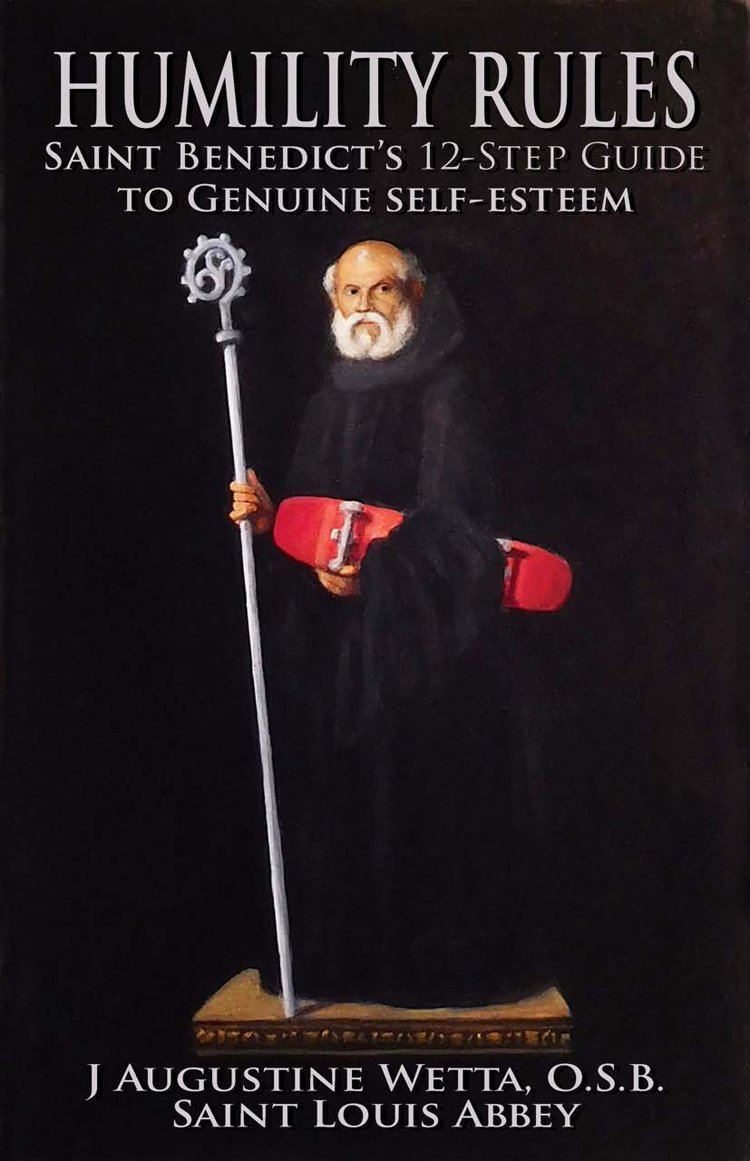
In his book Humility Rules (which I think should be read as Humility Rules!), Fr. J. Augustine Wetta, O.S.B. offers some insight into the humility of patience, forgiveness, and mercy.
Fr. Wetta recalls a situation in which he was asked to preach at the wedding of his best friend. As a monk, he was not accustomed to in preaching in parish settings and so sought the advice of an older monk:
I went looking for Fr. Luke. He is the founder of our community and has seen pretty much everything a monk can see. I found him asleep in a chair in the calefactory [a warmed sitting room in a monastery]. “Wake up, Father,” I said, “I need something wise to say at my buddy’s wedding.”
Fr. Luke opened his eyes, look around the room for a moment, and then said, “Tell them that there will come a day when he will want the window open and she will want the window closed.” Then he went back to sleep.
Fr. Wetta observes,
So, true love is more about endurance than it is about chocolates and teddy bears. We prove our love at precisely those moments when the people we love test our patience, put a strain on our kindness, and tempt us to anger. Love is truly love—and not just infatuation—when it proves itself in the crucible of suffering (Humility Rules, pp. 59-60).
Humility Rules is a wonderful book, well worth reading for its humor, wisdom, and whimsical art. The advice offered is not all that different from what I offer to pre-Cana couples, but Fr. Wetta presents it with more humor.
Patience, magnanimity, and mercy are essential for any relationship, let alone marriage.
Married couples give each other many gifts. Some of them come wrapped in obvious packages such as companionship, intimacy, and completion. Others come in strange packages.
Indeed, a spouse can give his/her partner many opportunities to know what it means to forgive. This is a gift, however strange its package, because Jesus teaches that if we forgive we will be forgiven but if we do not then we may go to Hell.
For if you forgive others their trespasses, your Heavenly Father will also forgive you. But if you do not forgive others their trespasses, neither will your Father forgive yours (Matt 6:14-15).
Without forgiveness, it is pretty hard to enter glory; with it we stand a good chance.
It is the same with mercy. Jesus says,
Blessed are the merciful, for they will be shown mercy (Mat 5:7).
James warns,
Judgment without mercy will be shown to anyone who has not been merciful (James 2:13).
As anyone who has been married for any length of time knows, spouses give each other ample opportunities to practice mercy. Indeed, the debate about the window that Fr. Luke described above may well occur in the limousine ride from the church to the reception hall! This, too, is a gift in strange package. If I show mercy then I will be shown mercy on judgment day—and we’re all going to need mercy then, lots of it!
Even the difficult parts of marriage, the gifts in strange packages, help to sanctify the husband and wife. St. Paul reminds us, And we know that, for those who love God, all things work together for good (Romans 8:28).
Indeed they do. Don’t forget the gifts in strange packages.
The readings of “Ordinary Time” (Tempus per annum in Latin) focus on the call to discipleship and the living of the Christian Faith. The readings for today’s Mass are no exception, as they present us with a number of disciplines for disciples. These disciplines free us to serve Christ and His Kingdom joyfully, energetically, and wholeheartedly. We can group these disciplines into three broad areas; discipleship is undefiant, unfettered, and untiring. Let’s consider each area of discipline as reflected in the readings.
I. Undefiant – The first reading today covers the ministry of the reluctant prophet, Jonah. In today’s reading we hear only the end of the story, but as most of us know, Jonah was not merely reluctant in accepting his mission as a prophet, he was downright defiant. Recall his story:
Refusal – The word of the Lord came to Jonah son of Amittai, “Go to the great city of Nineveh and preach against it …” But Jonah ran away from the Lord and headed for Tarshish (1:1-3). Jonah defiantly runs from God; he refuses the mission.
Running – Nineveh was 550 miles east of Israel. Tarshish was 2500 miles west of Israel. Do you get the picture? Jonah was doing some serious running! Rather than go 550 miles to do God’s will, he was ready to travel 2500 miles to get away from God’s will. It’s always a longer trip when you defy God.
Resistance – As Jonah runs away from God, great storms arise at sea. The storms of defiance rage, but Jonah sleeps—and the storms affect not only him but those who sail with him as well. Yes, our moral decisions do affect others around us despite our egocentric notion that what we do is no one else’s business. Thus, for some of us, there can be great storms that come into our lives. Has it ever occurred to you that some of the storms in your life may be related to a situation in which God said, “This way,” but you defied him and said, “No, that way”? Maybe we all need to wake up and say, “What does this storm mean?”
Return – Swallowed by the great fish, Jonah is brought back to the very place (Joppa) where he sailed away from God. In effect, God says, “Let’s try this all over again.” So Jonah makes ready and goes to Nineveh, according to the LORD’s bidding. Yes, Jonah was smart this time.
The point is that disciples (we) must learn to be undefiant. God wants to “save us some mileage.” Obedience to His will is always easier than disobedience.
Consider, too, how undefiant the Ninevites are as they hear and heed Jonah’s message and notice how this saves them from destruction.
It’s always easier to follow God. I did not say that it’s easy, just that it’s easier. Sin may be more pleasurable and easier in the moment, but it brings a world of difficulties and complications in its wake. If you do not think this is so, just read a newspaper and consider how many of our difficulties are directly tied to our sinful attitudes and choices. The vast majority of this world’s suffering is directly attributable to the rebellious sinfulness of humanity.
The first discipline of discipleship is undefiance. With this discipline we remain teachable and open to God’s wisdom and are thereby spared many difficulties.
II. Unfettered– To be unfettered means to be unchained, unshackled, free to move about. The second reading today presents a vivid and sober portrait of what being unfettered and detached looks like:
I tell you, brothers and sisters, the time is running out. From now on, let those having wives act as not having them, those weeping as not weeping, those rejoicing as not rejoicing, those buying as not owning, those using the world, as not using it fully. For the world in its present form is passing away (1 Cor 7:29ff).
This passage does not mean that we have no recourse at all to these things and people but rather that we live “as” not having them. In other words, we must seek the gift to realize that nothing in this passing world remains. Nothing here, not even marriage, is the sole reason for our existence or the sole source of meaning for us. God and God alone is the source of meaning and the lasting goal of our life. All else will pass.
For most of us, detachment form this world is the battle, the central struggle we face. Our attachment to this world hinders us from freely following Christ. A couple of passages come to mind:
Jesus, said [to the rich young man], “If you would be perfect, go and sell all that you have, (and you will have treasure in heaven) and then come and follow me.” At that saying his countenance fell, and he went away sorrowful; for he had great possessions. And Jesus looked around and said to his disciples, “How hard it will be for those who have riches to enter the kingdom of God!” And the disciples were amazed at his words. But Jesus said to them again, “Children, how hard it is to enter the kingdom of God! It is easier for a camel to go through the eye of a needle than for a rich man to enter the kingdom of God” (Mark 10:22 ff).
No one can serve two masters. Either he will hate the one and love the other, or he will be devoted to the one and despise the other. You cannot serve both God and Money … So do not worry, saying, “What shall we eat?” or “What shall we drink?” or “What shall we wear?” For the pagans run after all these things, and your heavenly Father knows that you need them. But seek first his kingdom and his righteousness, and all these things will be given to you as well (Matthew 6:24).
The world has a thousand hooks in us. We are chained and fettered; our freedom to follow Christ is severely compromised.
The battle to be free and unfettered is a process. God can give us this freedom but it requires time and obedience from us. Little by little, God breaks the shackles of this world; all its treasures come to seem as of little value to us. Slowly we come to what St. Paul said:
But whatever was to my profit I now consider loss for the sake of Christ. What is more, I consider everything a loss compared to the surpassing greatness of knowing Christ Jesus my Lord, for whose sake I have lost all things. I consider them rubbish, that I may gain Christ (Phil 3:7-8).
III. Untiring – Consider that among Jesus’ first followers were several fishermen. The text of the Gospel today says, Jesus came to Galilee proclaiming the gospel of God: “This is the time of fulfillment. The kingdom of God is at hand. Repent, and believe in the gospel.” As he passed by the Sea of Galilee, he saw Simon and his brother Andrew casting their nets into the sea; they were fishermen. Jesus said to them, “Come after me, and I will make you fishers of men.”
Is there some meaning in the fact that fishermen were among His first and most prominent disciples? Perhaps so.
Consider that fishermen have some important qualities that are helpful for discipleship. Fishermen are:
Patient – Fishermen often need to wait for many hours, even days, for a catch. Disciples need patience, as do evangelizers.
Professional – Fishermen need to spend time learning about the types of fish and their behaviors, learning to observe the water and navigate, learning the right time of day and the right season to fish. They need to know the right bait and the proper use of the net. All of these traits are good for disciples and are especially helpful in evangelization, which is “job one” for the disciple. Through growing in practical knowledge we come to know our faith and learn effective ways to be fishers of men.
Purposeful – When fishermen are out fishing they are entirely focused on their endeavor. That’s all they do; everything is centered on the main task. They are single-minded. Disciples surely need more of this attitude. The Book of James says, The double-minded man is unstable in all his ways (James 1:8). St. Paul says, But this one thing I do, forgetting those things which are behind, and reaching forth unto those things which are before, I press on toward the goal to win the prize for which God has called me heavenward in Christ Jesus (Phil 3:13-14). Every disciple needs to be more single-minded.
Pursuing – Note that they simply go to the fish. Too many Catholic parishes merely open the doors and hope that people will come to them—that is not evangelization. The key word for disciples and evangelizers is this: go.
Partnered – Fishermen work in teams. Jesus sends the disciples out, two by two.
Persistent – If fishermen don’t make a catch one day, they’re back out the next. Disciples surely need to persist, both in their own journey and in making disciples of others.
In today’s readings there are a number of disciplines of discipleship. The green vestments of Ordinary Time remind us of growth, both our own and that of the Church. Ultimately, a free heart is a joyful heart. It is a heart that is not easily tired because it is not divided by serving two masters. It is a heart that ungrudgingly serves the Kingdom.
Here is a song that speaks of patient, purposeful, and persistent action on behalf of God’s Kingdom. It is a song that can only come from a heart that is undefiant, unfettered, and untiring; from a heart that says, “I keep so busy workin’ for the Kingdom, I ain’t got time to die!”
It is a post Roe world, but still we march. Too many are still unconvinced that life in the womb is precious, a human person and given by God the right to life.
One common “moral” standard that many apply today, especially regarding sexual matters, goes something like this: “Two consenting adults should be able do what they please as long as nobody gets hurt.” Of course the sinners who talk like this think that they get to determine whether anyone gets hurt. Generally, their notions are egocentric, mostly considering only themselves, and in addition their conception of what constitutes getting hurt are often misguided.
Today, we march with many who tried to give a voice to the at least 60 million who didn’t just get hurt by the behavior of certain “consenting adults” — they got killed.
Consider the fact that 85 percent of abortions are performed on single women. That means that fornication (premarital sex) is the single largest contributing cause to abortion. Many of these couples went into their dalliances insisting that nobody would get hurt, but the babies they aborted would beg to differ. They were hurt and then they were killed.
The claim that no one is getting hurt is a lie.
Here are some others who are hurt by sexual immorality:
Those who grow up in single parent homes – Thank God they survived at all — most don’t. Their “parents” had sex but didn’t have the commitment or maturity to say, “Now that there’s another life involved we’d better grow up, be less focused on our own happiness, and think of someone else.” Some others made a poor choice for one night or for a brief time and to get married would have made little sense, but the result is that a child is raised without one of his parents (typically the father). Thankfully those babies were not killed, but they are still hurt because they deserved a complete home with a mother and father there to love them.
Our culture, our nation, and the Church – None of these three sectors is as strong if the traditional family is not strong. Fornicators, adulterers, and those engaging in homosexual activity all weaken the family, and the family is the basic foundation of everything. It is hard to find a culture or nation that can survive the loss of family structure and loyalty or the loss of sexual self-control. The “as long as nobody gets hurt” people think that they can go on taking the prerogatives of marriage (e.g., sexual intimacy and parenthood) and not harm the culture. They are wrong; history, common sense, and current statistics show that we are all harmed — exceedingly — by the “as long as nobody gets hurt” crowd. The number of abortions has skyrocketed as has the number of teenage pregnancies and single mothers, while the number of marriages has plummeted. This is not healthy for any culture or for any child raised in such a “culture.”
The “nobody gets hurt” crowd hurt themselves – After enough of their behavior, they often have sexually transmitted diseases, “unwanted” pregnancies, broken hearts, and quite end up feeling used and discarded. They start out claiming that no one is getting hurt; they end up hurt, bitter, diseased, pregnant, post-abortive, alone, and unfulfilled. Did I mention alone? Alone — very alone in terms of support — but bearing many burdens.
Those who claim that “nobody gets hurt” cannot truthfully say that, nor can they give any assurance that no one is getting hurt or will be hurt. How can they possibly know that no one will get hurt? Experience and common sense (which isn’t so common today) indicate otherwise.
Today, we marched for the more than 50 million who were hurt and then killed as well as for the many mothers whose lives are now shattered, who felt “driven” to abort because they were either pressured or alone. Any counselor or Catholic priest will tell you that post-abortion trauma is real. Sadly, the damage is deep and does not go away easily. Abortion is an act of violence perpetrated not only on the baby but also on the mother. Few who come away from this act can honestly describe it as anything other than violent and traumatic.
Many people are getting hurt! Enough of this “Consenting adults should be able to do what they please as long as nobody gets hurt” lie.
And lest we who believe forget, let us remember that Jesus got hurt for what we have done. Every sin ever committed added to His pain and suffering on Calvary.
There is a lot of hurt. Anyone who says otherwise is deceived and the truth is not in him.

 We live in times of great ingenuity; we have a lot of smarts. We’ve been to the moon and back. Our computers can do more and more amazing things, even as we are able to make them smaller and smaller. We can see farther than ever into outer space and look more deeply than ever into “inner space,” doing microsurgery and studying the human genome.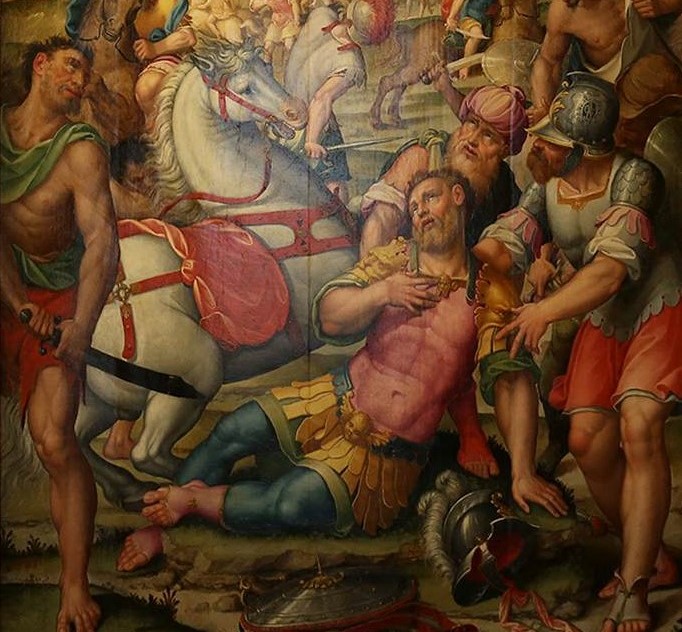


.jpg)