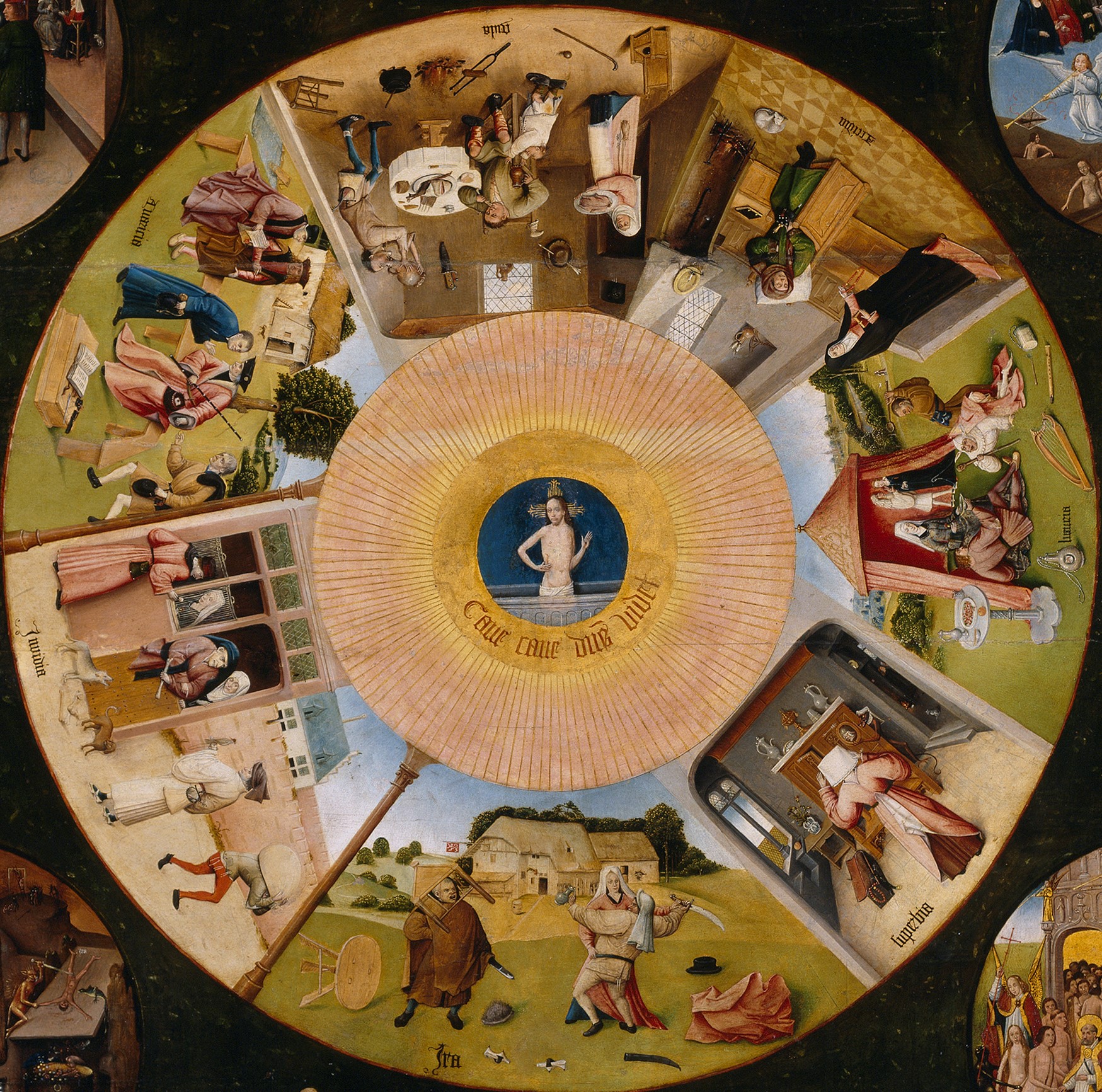
Do you know what the Seven Deadly Sins are? It is valuable to name and begin to understand these deep drives of sin within us because the more we do so the more we can grow in self-knowledge. Further, it helps us to “know their moves” and gain mastery over them. As they stir deep within us we can recognize evidence of this and begin to take greater authority over them.
Too many Christians know little about twisted nature of sin. They just know they’re a little (or very!) messed up and can’t seem to figure out why. Have you ever gone to the doctor, not knowing what was wrong with you, and left feeling better just because you finally knew that what ailed you had a name and a cure? Being able to name our demons is an essential part of growth and healing.
Here are the Seven Deadly Sins, with a brief description of each:
Pride – the quality of loving and esteeming oneself more than is proper and at the same time denigrating the goodness of others
Pride also stirs us to reject the lawful authority of others, including God, over us and to refuse appropriate submission.
Greed – excessive desire for wealth and possessions
It is not wrong to desire what we need, but through greed we acquire far beyond what is reasonable and fail to be generous. Through greed we can also come to see the things of this world as more precious than the things of Heaven. Greed has been well described as the insatiable desire for more.
Lust – excessive or inappropriate desires or thoughts of a sexual nature
It is not wrong to experience sexual desire per se but Lust moves this to become excessive (all that matters), or for the object of it to be inappropriate (g. sexually fantasizing about someone other than a spouse). More broadly, lust is thought of as an excessive love of others that makes the love of God secondary.
Anger – inordinate and uncontrolled feelings of hatred and wrath
It is not always wrong to experience anger, especially in the presence of injustice. But anger here is understood as a deep drive which we indulge and wherein we excessively cling to angry and hateful feelings for others. This kind of anger most often seeks revenge.
Gluttony – overindulgence in or overconsumption of anything to the point of waste.
We usually think of gluttony in terms of food and drink, but it can extend to other areas as well. This sin usually leads to a kind of laziness and self-satisfaction that allows little room for God and the spiritual life. It may also cause us to be less able to help the poor.
Envy – sorrow or sadness at the goodness or excellence of another person because one believes it makes him appear to be less so.
If I envy someone I want to diminish or undermine his excellence. Note that envy is not the same as jealousy. If I am jealous of you I want what you have. In contrast, if I am envious of you, I want to diminish or destroy what is good or excellent in you. St. Augustine called envy the diabolical sin because of the way it seeks to eliminate excellence and goodness in others.
Sloth – sorrow or sadness at the good things God wants to do in one’s life
Most people think of sloth as laziness, but it is really an avoidance of God. In sloth, I avoid God because I fear or dislike what He can do for me. Some people avoid God through laziness, but others avoid Him by becoming workaholics, claiming that they are too busy to pray, to attend Mass, or to think about spiritual things.
In the days and weeks ahead, I will be devoting a separate article to each of them, but for today I wanted to offer just a quick definition.
The Baltimore Catechism asked the question Where is God? The answer given was God is everywhere. While this is certainly true, it is even more true that God is beyond the concept of “where.” Everywhere is too limiting to contain God, for He transcends His creation and cannot be contained even by the “everywhere” of it.
C.S. Lewis had an interesting analogy:
Looking for God by exploring space is a bit like reading or seeing all Shakespeare’s plays in the hope that you will find Shakespeare …. Shakespeare is, in one sense, present at every moment of the play, but he is never present in the same way … but to look for him as one item within the framework he himself invented is nonsensical [The Business of Heaven, p. 47].
So, just as Shakespeare is far more than and far beyond even the sum total of all his writings, even more is God far beyond the “everywhere” of this world. God is not this or that thing. He is not here or over there. He is existence itself, the very definition of “to be” (ipsum esse).
Yet unlike Shakespeare, God is not merely bigger than and outside what He has made. God is no mere writer or creator who left an impression of himself in what he made. No, God is at the same time both transcendent and immanent. He is inside what He created, sustaining everything He made from moment to moment.
C.S. Lewis continues,
[And so with God] mere movement in space will not bring you any nearer to him or farther from him that you are at this very moment. You can neither reach him, nor avoid him by travelling to … other galaxies [ibid].
This of course raises the question: Why do we attribute a special presence to Christ in the Eucharist or the tabernacles of our churches? Like the ancient Jews, who found a special presence of God in the Ark of the Covenant in the Temple, we do not lack sophistication. We understand that God is not merely in this place or that one, but we do accept by His own revelation that He is uniquely and powerfully present in certain places and in certain ways designated by Him to confer that special presence. Thus, while God speaks in and through His creation, He speaks even more clearly and powerfully in his revealed Word. And while He is everywhere immanently present, He is profoundly present in a special way in the Eucharist and in certain holy places.
In the end, God is everywhere, but he is also “beyond where,” “beneath where,” and “above where.” He is God, who said, “Before there ever was an everywhere, I AM.”
We live in a secular age. Religious utterances by government officials are greeted with surprise or even indignation by some. While the primary role of civil leaders is not a religious one, insisting that never express religious sentiment is a form of extremism rooted in exaggerated conception of the idea of the separation of Church and State. In fact, “separation of Church and State” appears nowhere in the United States Constitution.
On Presidents’ Day we do well to look to history to clarify that these extreme, modern concerns were not shared by Washington, Lincoln, and many other leaders.
Religion and the First Amendment
Congress shall make no law respecting an establishment of religion, or prohibiting the free exercise thereof; or abridging the freedom of speech, or of the press; or the right of the people peaceably to assemble, and to petition the Government for a redress of grievances.
While the First Amendment prohibits Congress from passing a law respecting an establishment of religion (the “Establishment Clause”), but it also specifies that it shall pass no law prohibiting the free exercise of religion (the “Free Exercise Clause”). This second pillar, protecting the free exercise of religion, has been eroding over the years, with the definition of “exercise” ever-narrowing. Increasingly, the claim is made that religious bodies (especially the Catholic Church, it seems) are seen to have no right to attempt any influence in the legislative process. This, of course, would limit our ability to freely exercise our faith, a major tenet of which is that we should evangelize, be a light to the world, and testify to the truth. More and more, secularists are proposing that the only acceptable place for religious expression of any kind is within the four walls of a church building.
Many argue that America’s founding fathers wanted it this way, that they wanted a “wall of separation” because most of them were either irreligious or deists. It is interesting to note that despite this most of them spoke freely of God, including appeals to Him and His will in their remarks. This is true even of Thomas Jefferson (who famously referred to a “wall of separation between Church and State” in a letter). Of the five inscriptions on the walls of the Jefferson Memorial, culled from his writings, three refer God and one to the Creator. Most of the founding fathers (who purportedly wanted this dramatic separation of Church and State) were involved in drafting the Constitution.
Many people love to point out that God is never mentioned in the Constitution. Oh, but He is! The final line of the Constitution reads as follows:
Done in Convention by the Unanimous Consent of the States present the Seventeenth Day of September in the Year of our Lord one thousand seven hundred and Eighty-seven and of the Independence of the United States of America the Twelfth. In Witness whereof, We have hereunto subscribed our Names
“In the year of our Lord …” where did that come from? I guess the drafters of the Constitution never got the memo that God is not to be mentioned in government documents or at government functions. The Lord referenced here is none other than Jesus Christ, for the year corresponds to the number of years since His birth.
The first signature on the Constitution is that of George Washington. Apparently he also never got the memo about keeping God and religion out of all things governmental because he mentioned God frequently in his writings and speeches. Below are just three examples. The first speaks of our obligation to give thanks to God; it is a decree declaring a Day of Thanksgiving in the United States on November 26, 1789. The second is from a speech to an assembly of Delaware Indian Chiefs in 1779 (it would be considered highly politically incorrect today). The third is from his last speech to the U.S. Legislature.
Whereas it is the duty of all nations to acknowledge the providence of Almighty God, to obey His will, to be grateful for His benefits, and humbly to implore His protection and favor; and Whereas both Houses of Congress have, by their joint committee, requested me to “recommend to the people of the United States a day of public thanksgiving and prayer, to be observed by acknowledging with grateful hearts the many and signal favors of Almighty God, especially by affording them an opportunity peaceably to establish a form of government for their safety and happiness:” Now, therefore, I do recommend and assign Thursday, the 26th day of November next, to be devoted by the people of these States to the service of that great and glorious Being who is the beneficent author of all the good that was, that is, or that will be; that we may then all unite in rendering unto Him our sincere and humble thanks for His kind care and protection of the people of this country previous to their becoming a nation; for the signal and manifold mercies and the favorable interpositions of His providence in the course and conclusion of the late war; for the great degree of tranquility, union, and plenty which we have since enjoyed; for the peaceable and rational manner in which we have been enabled to establish constitutions of government for our safety and happiness, and particularly the national one now lately instituted for the civil and religious liberty with which we are blessed, and the means we have of acquiring and diffusing useful knowledge; and, in general, for all the great and various favors which He has been pleased to confer upon us. And also that we may then unite in most humbly offering our prayers and supplications to the great Lord and Ruler of Nations and beseech Him to pardon our national and other transgressions; to enable us all, whether in public or private stations, to perform our several and relative duties properly and punctually; to render our National Government a blessing to all the people by constantly being a Government of wise, just, and constitutional laws, discreetly and faithfully executed and obeyed; to protect and guide all sovereigns and nations (especially such as have shown kindness to us), and to bless them with good governments, peace, and concord; to promote the knowledge and practice of true religion and virtue, and the increase of science among them and us; and, generally to grant unto all mankind such a degree of temporal prosperity as He alone knows to be best. Given under my hand, at the city of New York, the 3d day of October, A.D. 1789 George Washington, President.
You do well to wish to learn our arts and ways of life, and above all, the religion of Jesus Christ. These will make you a greater and happier people than you are (Speech to the Delaware Indian Chiefs on May 12, 1779).
I now make it my earnest prayer that God would … most graciously be pleased to dispose us all to do justice, to love mercy, and to demean ourselves with that charity, humility, and pacific temper of the mind which were the characteristics of the Divine Author of our blessed religion (Last Official Address of George Washington to the Legislature of the United States).
Abraham Lincoln also often referred to God and faith:
On Faith as among the civic virtues – Intelligence, patriotism, Christianity, and a firm reliance on Him, who has never yet forsaken this favored land, are still competent to adjust, in the best way, all our present difficulty (First Inaugural Address, March 4, 1861).
On Divine Providence – In the very responsible position in which I happen to be placed, being a humble instrument in the hands of our Heavenly Father, as I am, and as we all are, to work out his great purposes, I have desired that all my works and acts may be according to his will, and that it might be so, I have sought his aid—but if after endeavoring to do my best in the light which he affords me, I find my efforts fail, I must believe that for some purpose unknown to me, He wills it otherwise. If I had had my way, this war would never have been commenced; If I had been allowed my way this war would have been ended before this, but we find it still continues; and we must believe that He permits it for some wise purpose of his own, mysterious and unknown to us; and though with our limited understandings we may not be able to comprehend it, yet we cannot but believe, that he who made the world still governs it (Letter to Eliza Gurney, October 26, 1862).
On Religious Liberty – But I must add that the U.S. government must not, as by this order, undertake to run the churches. When an individual, in a church or out of it, becomes dangerous to the public interest, he must be checked; but let the churches, as such take care of themselves. It will not do for the U.S. to appoint Trustees, Supervisors, or other agents for the churches (Letter to Samuel Curtis, January 2, 1863).
On the Justice of God – Fondly do we hope—fervently do we pray—that this mighty scourge of war may speedily pass away. Yet, if God wills that it continue, until all the wealth piled by the bond-man’s two hundred and fifty years of unrequited toil shall be sunk, and until every drop of blood drawn with the lash, shall be paid by another drawn with the sword, as was said three thousand years ago, so still it must be said “the judgments of the Lord, are true and righteous altogether” (Second Inaugural Address, March 4, 1865).
These are just a few samples showing that the aversion to any religious reference is relatively new and is a disposition largely unknown to our founding fathers as well as to those of Lincoln’s era. These quotes do not “prove” that Presidents Washington and Lincoln were perfect Christians or that they were never critical of any aspects of religion, but they do indicate that they both understood the importance of religious faith to our country and were quite comfortable articulating both the need for faith and its benefits.
Extremism – Recent attempts to completely ban any religious expression, any spoken appreciation for religion, or any encouragement of its practice, would surely seem extreme to these men—extreme and far removed from the embrace our country has historically extended to faith.
Washington and Lincoln did not hesitate to invoke God, ask His blessings, and exhort their fellow citizens to prayer. Let us pray for our country and for all of our leaders. Happy Presidents’ Day!
On the first Sunday of Lent the readings have a baptismal theme. This makes sense, for it is common that on this day the catechumens report to the Bishop for the Rite of Election, who officially recognizes them as the elect of God in these final weeks before their baptism.
In today’s readings there are actually many themes; they seem to form the spokes of a wagon wheel, with baptism being the central hub from which they emanate. Arching over it all is the image of the rainbow in the sky, the great sign of God’s love and mercy upon us all. Even during Lent, as we take heed of our sins, we can never forget that though we have been unrighteous, unholy, unkind, undisciplined, and at times unreachable, we have never been unloved. Yes, God put a rainbow in the sky.
Let’s look at the baptismal theme of these readings from two perspectives:
The PORTRAIT of Baptism – Both the first and second readings today make mention of Noah and the ark in which he and his family were delivered from the flood. The second reading says, God patiently waited in the days of Noah during the building of the ark, in which a few persons, eight in all, were saved through water. This prefigured baptism, which saves you now (1 Peter 3:19-20).
While we quickly associate water with baptism, the image is really a double one: wood and water. If it were not for the wood of the ark, the waters would have overwhelmed them. So, too for us: the waters of our baptism are rendered effective by Jesus on the wood of the cross.
Indeed, by God’s plan we might be so bold as to say, “Wood and water work wonders!” There are numerous places in the Scriptures where wood and water—not just water alone—manifest God’s saving love. Here are five of them:
Cleansing Flood – We begin with today’s image, one of the most terrifying stories of the ancient world: the great flood. The world had grown so wicked and sin had so multiplied that God concluded He had to literally wash it clean. And you thought it was bad in the 21st century! God went to a man named Noah, telling him that He was going to trouble the waters and that Noah should get ready. Build an ark of gopher wood, Noah! This was no small project. The ark was to be the length of one-and-one-half football fields (150 yards), 75 feet wide, and 45 feet tall. Then Noah was to gather the animals: 2 pairs of unclean animals, 7 pairs of clean animals. You have to really trust God to put in all that work! Finally, God troubled the waters; the flood waters put an end to wickedness and made a new beginning of goodness. From troubled waters came a blessing, but first Noah had to wade in. Through water and the wood of the ark, God worked wonders (cf Gen 6-9).
Trouble at the Red Sea – Many centuries later, Pharaoh had relented and the people were leaving Egypt after 400 years of slavery. Then fickle Pharaoh changed his mind and pursued them. With the Red Sea before them and Pharaoh behind them the people were struck with fear, but God would win through for them. How? By troubling the waters. God told Moses to take up the wooden staff and to trouble the waters with these words: And you lift up your staff and with hand outstretched over the sea, split the sea in two … So Moses stretched out his hand over the sea; and the LORD drove the sea back by a strong east wind all night, and made the sea dry land, and the waters were divided (Ex 14:16, 21). You and I know the end of the story but the people on that day did not. With water like two walls on either side them, they had to go forth; they had to wade in the waters. They had to trust God that the walls of water would hold. God brought them through and they were delivered out of slavery and into freedom. Are you noticing a pattern? With God, wood and water work wonders. The wooden staff and the troubled waters brought forth freedom.
Trouble in the Desert – It is a fine thing to be free but thirst has a way of making itself known. When they came to Marah, they could not drink the water of Marah because it was bitter; therefore, it was named Marah. And the people murmured against Moses, saying, “What shall we drink?” And he cried to the LORD; and the LORD showed him a tree, and he threw it into the water, and the water became sweet (Ex 15:23). Once again, with God, wood and water work wonders. The wood of the tree and the troubled waters of that spring brought the blessing of survival.
More Trouble in the Desert – As they journeyed further, there was more thirst. God said to Moses, Go over in front of the people holding in your hand as you go the staff with which you struck the sea, … Strike the rock and the water will flow from it for the people to drink (Ex 17:5-6). From troubled waters came forth blessing. With God, wood and water work wonders. The wood of the staff troubled those waters and they came forth with the blessing that preserved life in the desert.
At the River Jordan– After forty years of wandering in the desert, the Israelites were finally ready to enter the promised land, but the Jordan was in flood stage, impossible to cross. Once again God had a plan; He was going to trouble those waters. God instructed Joshua to have the priests place the ark on their shoulders and wade into the water. Now the ark was a box made of acacia wood and covered in gold. In it were the tables of the Law, the staff of Aaron, and a ciborium of the manna. They knew that the very presence of God was carried in that ancient wooden box, just as it is in our tabernacles today. The text says, And when those who bore the ark had come to the Jordan, and the feet of the priests bearing the ark were dipped in the brink of the water the waters coming down from above stood and rose up in a heap far off people passed over opposite Jericho (Joshua 3:15) So again, with God, wood and water work wonders! The wooden box of the ark troubled the waters and they parted, bringing the blessing of the promised land.
These Old Testament prefigurements bring us to the wood of the true cross. On that wooden cross the waters of our baptism come forth from the side of Christ. With Jesus our Lord and God, wood and water work the wonder of eternal salvation. We’re not being freed from an army, or from thirst, or from a flood; we’re being freed from sin and offered eternal salvation. The waters of our baptism are given the power to save by our Lord Jesus through what He did on the wood of the cross. You might as well say it, “With God, wood and water work wonders!”
The POWER of Baptism – Here we encounter more of the spokes of the wagon wheel radiating out from the hub, which is baptism. These spokes come largely from the second reading (1 Peter 3:17-22). The spokes speak of the power and the gifts that radiate from baptism. Let’s look at them.
Salvation – The text says, baptism … saves you now. The Greek word translated here as “saves” is σώζει (sozei); it means to be delivered from present danger. Yes, we have been snatched from the raging flood waters of this sin-soaked world and from Satan, who seeks to devour us.
If the Lord had not been on our side when men attacked us, when their anger flared against us, they would have swallowed us alive; the flood would have engulfed us, the torrent would have swept over us, the raging waters would have swept us away. Praise be to the Lord, who has not let us be torn by their teeth. We have escaped like a bird out of the fowler’s snare; the snare has been broken, and we have escaped (Psalm 124).
St. Paul says this of Jesus: He rescued us from the present evil age, according to the will of our God and Father (Gal 1:4).
An old gospel hymn has these lyrics: “I was sinking deep in sin, far from the peaceful shore. Very deeply stained within, sinking to rise no more. But the master of the sea heard my despairing cry, and from the waters lifted me, now safe am I. Love lifted me! When nothing else could help, love lifted me!”
Yes, through baptism and the faith it confers on us, we have been saved by the outstretched arm of our God. If we hold to God’s unchanging hand, Heaven will be ours.
Sonship – The text says, Christ suffered for sins once, the righteous for the sake of the unrighteous, that he might lead you to God. Yes, Jesus has opened the way to the Father. He has reconciled us to God the Father by His precious blood.
In baptism we become the children of God. Isaiah says, For we like sheep had gone astray, every one to his own way (Is 53:6).
We were angry and fearful of God, unable to endure His presence and His love, but Jesus the Good Shepherd has gathered us and restored us to grace.
One of the great gifts baptism gives us is the grace to experience a tender affection for God the Father and experience Him as Abba (cf Gal 4:6, Rom 8). As we grow in the grace of our baptism, so does our tender love and affection for the Father.
Through baptism and the indwelling Holy Spirit, Jesus causes us to experience increasing trust in the Father and to obey Him out of deep love rather than servile fear.
Serenity – The text says baptism….is not a removal of dirt from the body but an appeal to God for a clear conscience. While baptism touches the body, its current goal is the soul, the inner man or woman. In effect, this text speaks to us of the new mind and heart that Jesus confers on us through baptism.
In today’s Gospel Jesus refers to this new mind when he says “Repent!” The Greek word translated as “repent” is μετανοεῖτε (metanoeite), which means more literally “to come to a change of mind.”
Yes, the Lord offers us a new mind and heart, a whole new way of thinking—new priorities, new visions, new understandings, and new goals.
So much of the battle we face involves our mind. “Mind” here does not refer to the brain but to that deepest inner part of us where we “live,” where we deliberate and are alone with our self and our God. Through baptism the Lord begins a process that renews this inner self, day by day.
As our mind gets clearer and our heart grows purer, our whole life is gradually transformed. This leads to inner peace, to a serene conscience, confident and loving before God.
Spirit – The text says of Jesus, Put to death in the flesh, he was brought to life in the Spirit. As God, Jesus did not need or acquire the Holy Spirit; He was always one with the Holy Spirit. As man, though, He does acquire the Holy Spirit for us.
Who is the Holy Spirit? The Holy Spirit is the very life of God, the love of God, the joy of God, the holiness of God! To receive the Holy Spirit is to come to a totally new and transformed life.
When Jesus rose it was not merely that His corpse was resuscitated. It was truly His body that rose, but He took up a wholly transformed human life and offers this to us.
In baptism we die with Him and rise to this new life. If we are faithful to our baptismal commitments, we become ever more fully alive; sins are put to death and innumerable graces come forth. Yes, new life, Life in the Spirit, comes to those who are baptized and remain faithful to their baptismal life.
Long before the rainbow was co-opted by groups within our culture for an unbiblical agenda, it was a beautiful image of God’s covenantal love for us.
Do you know what a rainbow is? It is a combination of fire and water. Yes, there it is: the water of our baptism and the fire of God’s loving Spirit shining through that very water, form the rainbow in the sky. It is the sign of God’s fiery love and the water of our salvation.
This song says, “When it looked like the sun wasn’t gonna shine no more, God put a rainbow in the sky.”
It is my usual Friday routine to feature a video (often a commercial) and draw some biblical or spiritual principle from it. The video below is no commercial; it is post-war footage from Berlin in July of 1945. Interestingly it is in color, but it can only be described as eerie. People walk about among the ruins in something of a daze. Not a word is said throughout. The people appear to be trying to get back to “normal” life in the middle of a city that has been reduced to rubble. Some have injuries: one man is missing a leg, another an eye. A bucket brigade works to clear away some of the rubble. Throughout, silence and sadness permeate the footage. The Berlin gate is still open, but already there are British and Russian sectors defined. An Iron Curtain will drop and a wall be built in the near future.
Scripture says, For here we have no lasting city, but we seek the city that is to come (Heb 13:14). Berlin was eventually rebuilt, but not so many other great cities such as Ephesus and Carthage. Their once great, colonnaded streets and palatial buildings are merely impressive ruins today. Sic transit gloria mundi (thus passes the glory of the world).
On Ash Wednesday we were reminded that we are dust and unto dust we shall return. Each of us is going to die, and we don’t get to say when or how. On account of Jesus, our death will usher in new life if we are faithful.
Keep us faithful, Lord, unto our certain death and let no worldly thing so impress us that we forget that its time is limited.
I was explaining to a new Catholic recently that the color purple (violet) used during Lent symbolizes its penitential quality. Ash Wednesday and Good Friday are days of fasting and abstinence, and all Fridays of Lent are days of abstinence. These remind us that during Lent we are to give special attention to our sins and our need for salvation.
Long gone are the days of a forty-day fast beginning on Ash Wednesday, but we still delight in the carnival of Fat Tuesday! Carnival literally means “farewell to meat” (carnis + vale)). Mardi Gras (Fat Tuesday) was so named because the last of the fat was to be used up before the fast began the next day.
The fasting and abstinence in those days were far more than the token observances common today. In most places, all animal products were strictly forbidden during the entirety of Lent. The rest of the details varied by region. While most areas permitted fish, others permitted fish and fowl. Some prohibited fruit and eggs. In some places (like monasteries) little more than bread was eaten. On Fridays during Lent, some areas observed a complete fast; in others believers ate only a single mean; in most places, however, the practice was to abstain from eating until evening, at which time a small meal without vegetables or alcohol was eaten.
Yes, those were the day of the giants — when fasting and abstinence were real sacrifices.
Our token fast on just two days during Lent really isn’t much of a fast at all: two small meals and one regular meal — is that even a fast at all? And we abstain from meat only on the Fridays of Lent instead of all forty days.
What is most remarkable to me is that the fasts of old were undertaken by men, women, and children who had a lot less to eat than we do. Not only was there less food, but it was far more seasonal and its supply less predictable. Further, famines and food shortages were more a fact of life than they are today. Yet despite all this people were able to fast and abstain for forty days. Further, there were ember days sporadically through the year, when a day-long fast was enjoined. And Advent back then had a more penitential nature than it does today.
Frankly, I doubt that we moderns could pull off the fast of the ancients or even the elders of more recent centuries. Can you imagine the bellyaching (pun intended) if we were obligated to follow the strict norms of even 100 or 200 years ago? I’m sure we would hear that such demands were “unrealistic” or even unhealthy.
Perhaps this is a good illustration of how our abundance enslaves us. The more we get the more we want; the more we want the more we think we can’t live without. We are so easily owned by what we claim to own. We are enslaved by our abundance and experience little freedom to go without.
I look back to the Catholics of 100 years ago and before and to me they seem like giants compared to us. They had so little compared to what we have yet they seem to have been so much freer. They could fast. Though poor, they built grand churches and had large families. They crowded into homes and lived and worked in conditions few of us would tolerate. Sacrifice seemed more “normal” to them. I have not read of any huge outcries from that time that the “mean, nasty Church” imposed fasting and abstinence during Lent and Advent. Nor have I read of complaints about the required fasting from midnight until receiving Holy Communion. Somehow, they accepted these sacrifices and for the most part were able to undertake them. They had a freedom that I think many of us lack.
Imagine the joy when, for a day, the fast was lifted: Feast of the Immaculate Conception, Gaudete Sunday, Feast of the Annunciation, St. Joseph’s Feast day, and Laetare Sunday. For us, the pink candle of Guadete Sunday just makes us wondering, “Rejoice? Over what?” For them these were literally “feast days.”
I admit I am a man of my time. The fasting and abstinence described above seems nearly “impossible” to me. I do undertake certain Lenten practices, but when I look back to these “giants” of old, my sacrifices feel pretty small.
A brief observation of the first two days in Lent reveals militaristic, even violent imagery in the battle against sin and the unruly passions of the flesh. The Collect (opening prayer) of Ash Wednesday provides an image of troops mustering for battle:
Grant, O Lord, that we may begin with holy fasting
this campaign of Christian service,
so that, as we take up battle against spiritual evils,
we may be armed with weapons of self-restraint.
Through our Lord Jesus Christ, your Son,
who lives and reigns with you in the unity of the Holy Spirit,
one God, for ever and ever.
“Battle,” “weapons,” and “armed” all clearly have military connotations, but so does the phrase “campaign of Christian service” if we look at the Latin text: praesidia miltiae Christianae. The service or action (praesidia) is one of Christian battle or militancy (militiae). This refers to the Church Militant—the Church here on earth—waging war against sin and the kingdom of darkness.
Thus the opening prayer on Ash Wednesday announced and summoned us to a battle that is engaged by the Church with special intensity during Lent.
The Gospel for Thursday after Ash Wednesday also has a battle theme. Jesus says,
If anyone wishes to come after me, he must deny himself
and take up his cross daily and follow me.
For whoever wishes to save his life will lose it,
but whoever loses his life for my sake will save it (Luke 9:23-25).
The battle theme is particularly apparent if one looks at the Greek text. The word translated as “lose” in English does not capture the vigor of the Greek word ἀπόλλυμι (apollumi). Apollumi comes from the root apó, meaning away from, with the intensifier ollymi, “to destroy.” Thus apollumi means to fully destroy, cutting off entirely. It implies permanent or absolute destruction.
So when Jesus says we must “lose” our life, it is really far stronger than the English translation captures. Losing our life involves a kind of violent overthrow of our worldly notions and the deep drives of sin. We must lose. That is, we must see utterly destroyed and cut off all things worldly, fleshly, and of the devil. This is war and it is going to involve more than a mumbled, half-hearted prayer on our part. Scripture says, In your struggle against sin, you have not yet resisted to the point of shedding your blood (Heb 12:4).
So behold the militaristic imagery as Lent begins. To arms!
The idea of such a battle might overwhelm us if we thought it must all be done in one day. Jesus says that we should take up our cross daily. Our daily cross is vital to our success. It’s not our weekly cross, or our monthly cross, or our yearly cross. We ought to do each day what we should do. If we put off or postpone the daily cross, the problems pile up. A monthly cross can seem overwhelming, and a yearly cross might seem impossible. Everyday discipline is crucial. Soon enough, the daily discipline becomes virtue; it becomes a good habit that one accomplishes fairly easily. To take up our cross daily is to endure short-term pain for long-term gain.
The battle is engaged! Fight it daily. Fight it with the Lord. Understand that it is battle, but in Jesus (and only in Jesus) the victory is won. Stay on the winning side and fight daily to the end.
As a boy, I remember wondering why so many people liked to rush to Church to get ashes smudged on their foreheads. Frankly, I had some revulsion at the idea. I didn’t like it at all and would secretly rub them off when no one was looking. Today, though I’ll admit I still don’t like it too much, I behave myself and don’t rub them off!
I pray that this doesn’t seem impious, but I still marvel at how many people pack into the church to get ashes on their foreheads. Sadder still, some who come don’t seem to want Holy Communion nearly as much. In fact, in some of the parishes where I served in the past, significant numbers walked out the door after receiving ashes and did not even stay for Communion.
Of course most people who come to Mass are faithful and have their priorities straight, but it still interests me how large the numbers are for something that seems to me so unappealing and challenging.
Indeed, the sign of ashes is quite challenging if understand what it really means. We are saying some pretty powerful stuff and making some extensive promises of a sort.
What do ashes signify? Perhaps a brief tour of Scripture is in order:
Humility – Job said, “You [Oh Lord] asked, ‘Who is this that obscures my counsel without knowledge?’ Surely I spoke of things I did not understand, things too wonderful for me to know. You said, ‘Listen now, and I will speak; I will question you, and you shall answer me.’ My ears had heard of you but now my eyes have seen you. Therefore, I despise myself and repent in dust and ashes” (Job 42:3-6).
Notice that Job does not merely repent in a general sense. Rather, having encountered God, he realizes that God is God, and that he, Jacob, is a creature, mere dust and ashes in the presence of God, who is being itself, who is all in all. Yes, Jacob is a son in the presence of a Father; he is not God’s equal that he might question Him or put Him on trial.
Hence in this case the ashes represent not only repentance but humility as well. The Church’s liturgy echoes this theme of humility in quoting Gen 3:19: “Remember, you are dust and unto dust you shall return” as the ashes are placed on the individual’s forehead.
A reminder of death and a call to wisdom – After Adam sinned, God told him, By the sweat of your brow you shall eat bread, till you return to the ground, for out of it you were taken; for you are dust, and to dust you shall return (Gen 3:19).
As he imposes the ashes, the priest usually recites some form of this passage. And memorable though it is, consider an even blunter form: “You are going to die.”
This is a salient and sobering reminder that we often get worked up and anxious about passing things, while at the same time being unmindful of the certain and most important thing, for which we really must be ready. We tend to maximize the minimum and minimize the maximum. Sadly, like the man in one of the Lord’s parables, we can amass worldly things and forget the final things. To him the Lord said, “You fool! This very night your soul is required of you; and now who will own what you have prepared?” So is the man who stores up treasure for himself, and is not rich toward God. (Luke 12:21-22).
Thus, to consider our final end is wise; to fail to do so is foolishness defined.
Ashes are a sacramental that points to the Sacrament – The Old Testament declared, You shall gather up the ashes of the heifer and put them in a ceremonially clean place outside the camp. They shall be kept by the Israelite community for use in the water of cleansing; it is for purification from sin … For the unclean person, put some ashes from the burned purification offering into a jar and pour fresh water over them. Then a man who is ceremonially clean is to take some hyssop, dip it in the water and sprinkle the tent and all the furnishings and the people who were there (Numbers 19:9, 17).
This text shows ashes obtained from a burned sin offering and mixed with sprinkled water as a cleansing ritual. In the Old Testament, this ritual could not actually take away sin (cf Heb 9:9-13), but it did provide for ritual purity. It also symbolized repentance and a desire to be free from sin.
In the same way, ashes on Ash Wednesday (mixed with holy water) cannot take away sin. They are a sacramental, not a sacrament.
To receive ashes on Ash Wednesday and then not go to confession some time during Lent is really to miss the point. If one really desires to repent and to be cleansed and free of sin, then from the sacramental of ashes one goes to the Sacrament of Confession. Otherwise the ritual of Ash Wednesday is pointless.
A sign of a true change – Scripture says, When the news [of Nineveh’s possible destruction in forty days] reached the king of Nineveh, he rose from his throne, took off his royal robes, covered himself with sackcloth and sat down in the dust (Jonah 3:6).
Here, too, repentance is symbolized, but the symbol alone is not enough—actual repentance is required. The king does not just “get ashes”; he issues a decree calling for fasting, prayer, and true reform: Do not let any man or beast, herd or flock, taste anything; do not let them eat or drink. But let man and beast be covered with sackcloth. Let everyone call urgently on God. Let them give up their evil ways and their violence. Who knows? God may yet relent and with compassion turn from his fierce anger so that we will not perish (Jonah 3:7-9).
Hence another option for the priest to say as he applies the ashes is, “Turn away from sin and be faithful to the Gospel.”
It is not enough to get a sooty forehead. True repentance is called for, an actual intent to change. Otherwise the ashes are a false sign.
A summons to faith and a new mind – Jesus said, Woe to you, Korazin! Woe to you, Bethsaida! If the miracles that were performed in you had been performed in Tyre and Sidon, they would have repented long ago in sackcloth and ashes (Matt 11:21).
Jesus rebukes ancient towns for their lack of faith. It is good to recall that the Greek word translated here as “repented” is μετενόησαν (metenoesan), which more literally means “to come to a new mind or way of thinking.”
There are many ways that we think about things that are more of the world than of God. Our ongoing challenge is to come to a new mind and to think more as God thinks. This is only possible by His grace, working through Scripture and Church teaching.
It is significant that the ashes are smeared on the forehead or sprinkled on the head—we are called to a faith that transforms our mind. We are called to be transformed by the renewal of our minds (Romans 12:2).
Hence yet another option for the priest is to say, “Repent and believe the Good News” as he imposes the ashes.
How real are your ashes? Do you intend the things described above as you go forth? Or is it just a ritual, something to do because it’s “sorta neat”? Pray and reflect on the deeper meaning of the ashes.