When I was about 10 years old I took some sailing lessons and then did so again when I was in my early 30s. Sailing involves a kind of romancing of the wind, wherein one observes it and then adapts to it, wooing it, learning its moves, its vicissitudes, its often subtle and changing signs.
Oh, for the great times when the wind was with us! Catching the wind, the boat would speed along making a slick sound in the water. Oh, too, for those daring and thrilling times when the spinnaker was put out. The boat would almost strain as the proud winds filled her arcing sail.
There were also difficult days, too, days when the winds were contrary and there was the hard work of tacking, beating, and jibing.
Sailing is an image of receptivity. One cannot control the wind, but must simply accept it, taking it as it is. Yes, the sailor must adjust to what is, to learn to accept and work with what is given, to live in the world as it is rather than wishing for the world as it ought to be.
The sailor must simply accept the wind’s biddings and blessings, the way in which it would have us go: this way and that, sometimes quickly and unexpectedly. The good sailor accepts that a good strong breeze can suddenly grow calm only to stir again moments later. This is especially the case in the sultry days of summer, when the prevailing winds are less evident and their strength and direction can be local and subtle.
Yes, it is all very mysterious. Indeed, Jesus used the wind as an image for mystery when He said to Nicodemus, The wind blows wherever it pleases. You hear its sound, but you cannot tell where it comes from or where it is going. So it is with everyone born of the Spirit (Jn 3:8).
Thus the wind and sailing become symbolic of the soul interacting with God. We cannot control God nor should we try. Our role is to sense His direction and put out our sails accordingly. We are to “romance the wind” by growing deeper in our love and trust of God. We are to discover the serenity of accepting what is, of following His lead or receiving what is offered rather than seeking to control or manipulate the outcome.
Sometimes God’s Ruah, His Spirit and breath, is a strong and refreshing wind, as at Pentecost when Scripture says, And suddenly there came from heaven a sound like a mighty rushing wind, and it filled the entire house where they were (Acts 2:4). At other times, God speaks in a whispering breeze: And after the fire came a gentle whisper. When Elijah heard it, he pulled his cloak over his face and went out and stood at the mouth of the cave. Then a voice said to him, “What are you doing here, Elijah?” (1 Kings 19:12-13)
Yes, allow the wind to represent the movements of God’s Ruah. God is looking for some good sailors, ones who know the subtleties of the wind’s movements and can adjust accordingly.
Now because the wind cannot be controlled and must simply be accepted for what it is, many people prefer motorboats. How much nicer it is to feel empowered from within and to be able to resolutely set one’s own course, no matter the wind! With a motorboat, there is little to no threat of being at the mercy of the winds. There is no need to relate to, nor to be in relationship with, the wind; there is no need of romancing the winds here! No, with a motorboat there is only the need to drive forward with a powerful motor, following one’s own designs.
This is control; this is power. Here is the sailor alone with his own will, dependent on little and certainly on no other person. It is one man alone against the elements.
Motorboats are a mixed blessing, though. They require a good bit of gas, can be noisy, need maintenance, may suffer breakdowns, and can be downright dangerous to other things and people around them.
This is another image of our soul interacting with God. There are many who prefer to be under their own power, dependent upon no one but themselves, acting and operating independently. They prefer not to have to sense the direction of the winds, to watch for other signs, or to consider other factors.
Just as there are dangers with a motorboat, there are dangers associated with this sort of controlling person. Indeed, such individuals can be noisy “gas-guzzlers,” prone to breakdowns, and potentially hazardous to things and people around them. In their perceived power they often barrel through life, missing or ignoring its subtleties, and frequently causing harm to themselves and/or others. “Breakdowns” are almost predictable with this sort of person.
Most people prefer a motorboat, but God is more in the sailboat business. He’s looking for some good souls to sense the breeze of His Spirit, hoist their sails, and follow where He leads.
Each of us is invited to be more like a sailor, following the Spirit’s lead—yes, like a sailor, trusting in and yielding to a Godly breeze.
Do you prefer a motorboat or a sailboat? Are you a boater or a sailor?
Here is a remarkable video, not of a sailor at sea, but of a “land sailor,” a kite flier. Note the beautiful interaction as this man romances the wind, working with its subtleties and rejoicing in its moves as in a great dance.
We continue today in our discussion of the ancient Jewish people’s grumbling against Moses and God.
Lesson 4: Grumbling Can Greatly Harm Others
Grumbling affects more than the one who grumbles. Through it, infectious negativity is set loose. Even if only a small number grumble, it can still incite fear, negativity, and anger in others.
One of the sadder effects the grumblings in the desert was the heavy toll it took on Moses. The people nearly wore him out. At a particularly low moment, when the people were complaining about the quality of the food, Moses lamented to God,
Why have you dealt ill with your servant? And why have I not found favor in your sight, that you lay the burden of all this people on me? Did I conceive all this people? Did I give them birth, that you should say to me, ‘Carry them in your bosom, as a nurse carries a nursing child,’ to the land that you swore to give their fathers? … I am not able to carry all this people alone; the burden is too heavy for me. If you will treat me like this, kill me at once, if I find favor in your sight, that I may not see my wretchedness. (Numbers 11:11-15).
Yes, Moses was so dispirited that he preferred to die rather than to carry on. In his weariness he spoke rashly and sinned. As a result, God would exclude him from entering the Promised Land:
Now there was no water for the congregation. And they assembled themselves together against Moses and against Aaron. And the people quarreled with Moses and said, “Would that we had perished when our brothers perished before the Lord! Why have you brought the assembly of the Lord into this wilderness, that we should die here, both we and our cattle? And why have you made us come up out of Egypt to bring us to this evil place?…
And the Lord spoke to Moses, saying, “Take the staff, and assemble the congregation, you and Aaron your brother, and tell the rock before their eyes to yield its water. So you shall bring water out of the rock for them and give drink to the congregation and their cattle.”
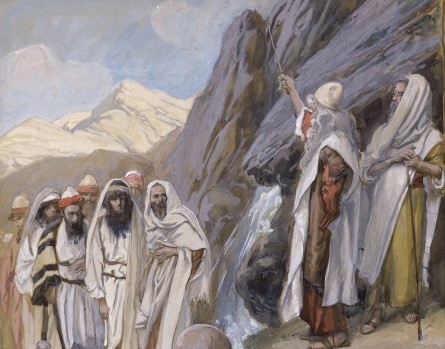
And Moses took the staff from before the Lord, as he commanded him. Then Moses and Aaron gathered the assembly together before the rock, and he said to them, “Hear now, you rebels: shall we bring water for you out of this rock?” And Moses lifted up his hand and struck the rock with his staff twice, and water came out abundantly, and the congregation drank, and their livestock.
And the Lord said to Moses and Aaron, “Because you did not believe in me, to uphold me as holy in the eyes of the people of Israel, therefore you shall not bring this assembly into the land that I have given them” (Numbers 20:2-14).
Many have pondered the exact nature of Moses’ sin and why the punishment for it was so severe. There are a few explanations posited for the nature of Moses’ sin:
Moses sinned by not following the Lord’s instruction: The Lord instructed Moses to take his staff in hand and bid the rock to bring forth water. He was told to speak to the rock, but instead he struck it—twice. The striking of the rock, while not directed according to the passage in Numbers, does not seem particularly egregious because in another description of this event (seeExodus 17:6)God instructs Moses to strike it. Hence, this explanation may not get to the heart of the matter. The Fathers of the Church (e.g., Jerome) did not see sin in this, even mystically interpreting the double striking of the rock as a sign of the two bars of the cross.
Moses exhibited sinful pride: Moses, having assembled the people, reviles them saying, “Hear now, you rebels.” In a possible flash of pride, he then continues, “Shall we bring water for you out of this rock?” Of course, it is not Moses or Aaron who bring forth the water; it is God. Some of the Fathers of the Church interpreted this not as pride on Moses’ part, but rather an indication of Moses’ wavering faith.
Moses sinned by speaking harshly and rashly: Psalm 106 seems to favor this interpretation. They angered the Lord at the waters of Meribah, and it went ill with Moses on their account, for they made his spirit bitter, and he spoke rashly with his lips (Psalm 106:32-33).
This third explanation leads us back to the heart of our meditation: that grumbling causes great harm, not only to those who grumble but also to others, because it sows seeds of negativity and can incite bitterness and anger. Moses was worn out; as Psalm 106 says, his heart grew bitter. He spoke rashly and reviled the people and he may have yielded to a flash of angry pride.
That God punished him so severely is mysterious to us. Basil the Great used it as an object lesson to us all: “If the just man is scarcely saved, where shall the ungodly and sinner appear?” (Preface on the Judgment of God)
Whatever the case, behold what grumbling does. It is a bitter thing and makes others bitter. Be very careful, fellow Christians; we can all exhibit the ugly tendency to draw others into our anger, doubts, dissatisfaction, and fears. Misery loves company. Sharing concerns with a friend is good and necessary, but spreading complaints, grumbling, and murmuring can lead others to fear, doubt, despair, anger, and bitterness. A steady diet of grumbling is deflating for everyone and usually brings more heat than light.
Grumbling seems to be everywhere today. In our Western affluence, we often expect and even demand comfort and perfection. This quickly leads to grumbling and complaining. We are very particular and want things solved quickly and without any real demands being placed on us.
Moses was worn down by the consistent grumbling all around him. Be cognizant of the toll that grumbling takes on others. Practice gratitude, an important antidote to the poison spread by grumbling.
We have been surveying several incidents in which the ancient Jewish people grumbled against Moses and God. We have done so not merely to survey their sins but to learn of our own tendencies to do the same. What makes grumbling so obnoxious is that it comes so soon after astonishing blessings and demonstrations of God’s love for us and His will and power to save us. Trust, it would seem, is something very difficult for us to learn.
Lesson 3: They Grumbled against the Very Rewards of God in the Promised Land.
Today we look at the grumbling that sentenced the ancient Jews to wander in the wilderness for forty years. They forfeited the very blessing they left Egypt to obtain. God had promised them a land of their own, a Promised Land flowing with milk and honey. At the critical moment when God was prepared to deliver it into their hands, they balked; they doubted. In their fear, they grumbled that taking the land might require effort or involve risk. You would never know that God had just delivered them, parting the Red Sea, feeding them with miraculous food, and supplying them with water and even quail. All of this was forgotten in a moment and they doubted God could deliver on His promise.
Let’s recall the incident:
God brought them near the borders of Canaan and through Moses instructed them to survey the land in preparation for taking it. Moses gathered twelve men, one from each tribe, and said to them,
Go up into the Negeb and go up into the hill country, and see what the land is, and whether the people who dwell in it are strong or weak, whether they are few or many, and whether the land that they dwell in is good or bad, and whether the cities that they dwell in are camps or strongholds, and whether the land is rich or poor, and whether there are trees in it or not. Be of good courage and bring some of the fruit of the land. (Numbers 13:17-20).
They returned with magnificent fruits, but gave this discouraging report:
“We came to the land to which you sent us. It flows with milk and honey, and this is its fruit. However, the people who dwell in the land are strong, and the cities are fortified and very large. And besides, we saw the descendants of Anak there. The Amalekites dwell in the land of the Negeb. The Hittites, the Jebusites, and the Amorites dwell in the hill country. And the Canaanites dwell by the sea, and along the Jordan” (Numbers 13:27-29).
Only Joshua and Caleb displayed trusting faith.
Caleb said,
“Let us go up at once and occupy it, for we are well able to overcome it” (Numbers 13:30).
And Joshua said,
The land, which we passed through to spy it out, is an exceedingly good land. If the Lord delights in us, he will bring us into this land and give it to us, a land that flows with milk and honey. Only do not rebel against the Lord. And do not fear the people of the land, for they are bread for us. Their protection is removed from them, and the Lord is with us; do not fear them (Numbers 14: 8-10).
Sadly, the reaction of the group was predictable:
Then all the congregation raised a loud cry, and the people wept that night. And all the people of Israel grumbled against Moses and Aaron. The whole congregation said to them, “Would that we had died in the land of Egypt! Or would that we had died in this wilderness! Why is the Lord bringing us into this land, to fall by the sword? Our wives and our little ones will become a prey. Would it not be better for us to go back to Egypt?” And they said to one another, “Let us choose a leader and go back to Egypt” (Numbers 14:1-4).
They want to go back to Egypt? Really? Cannot the God who parted the Red Sea deliver the Promised Land? Apparently they don’t think so. We may be shocked at their unbelief but we should recognize that we too are of little faith despite innumerable blessings and signs of God’s love and will to save us. We fret and fear at a moment’s notice when challenges beset us. We wonder, can God come through? We sing hymns of faith at Mass and we recall His deliverances past and present, but any bad news can send us to dark places where we fear and then grumble that God permits any test of us at all.
At this point God has had enough. He says to Moses,
How long will this people despise me? And how long will they not believe in me, in spite of all the signs that I have done among them? I will strike them with the pestilence and disinherit them, and I will make of you a nation greater and mightier than they” (Numbers 14:11-12).
Moses intercedes and God “relents” in the most severe of his plans, but God tells him, in essence, that the people are not ready to enjoy His promises.
I have pardoned, according to your word. But truly, as I live … none of the men who have seen my glory and my signs that I did in Egypt and in the wilderness, and yet have put me to the test these ten times and have not obeyed my voice, shall see the land that I swore to give to their fathers. And none of those who despised me shall see it.
But my servant Caleb, because he has a different spirit and has followed me fully, I will bring into the land into which he went, and his descendants shall possess it.
Now, since the Amalekites and the Canaanites dwell in the valleys, turn tomorrow and set out for the wilderness by the way to the Red Sea (Numbers 14:20-25).
In effect God says, “If you don’t want what I offer, you don’t have to have it. If you consider the cost too high or the effort too great, then don’t bother. Go on living in the desert and fleeing your enemies. If you don’t want my help or what I offer, then enjoy the wilderness; it’s all yours. By the way, I see that the Amalekites and the Canaanites are nearby, You’d better start running. Retreat to the Red Sea!”
If we refuse to trust in God, our fears will rule us. The only remedy to the enslaving effects of fear is trust and abandonment to God’s will. Our sinful flesh wants control, not trust. It wants to be confident on its own terms, not God’s.
For many today, the spiritual warfare necessary to obtain Heaven is altogether too much effort. Perhaps we instinctively know that it will involve giving up some of our favorite sins or confronting our fears and sinful drives. Instead of zeal for the sake of the joy of Heaven before us, we yield to sloth (sorrow or aversion to the good things God is offering us). The battle seems too costly, the price too high. We begin to prefer the desert of this world to what God offers. We do this even knowing that this world is a sorrowful exile, a valley of tears. Heaven seems to be just too much trouble and our passions too strong to conquer. Never mind that God promises sufficient grace to win the spiritual battle. In fear, we doubt His power despite the evidence of countless saints who have overcome.
Here, too, God is in essence saying, “If you don’t want what I’m offering, you don’t have to have it. You want the desert? It’s all yours.” Our response is often to grumble saying that God is not fair or that He should not challenge us or demand any effort of us. We claim that our fears are His fault due to the challenges involved, rather than our fault due to our lack of trust.
Thus our grumbling leads to fumbling and to forfeiting our blessings—all because we will not trust God. Scripture warns,
Today, if you hear his voice, do not harden your hearts, as at Meribah, as on the day at Massah in the wilderness, when your fathers put me to the test though they had seen my works. Forty years I endured that generation and said, “They are a people whose hearts go astray and they do not know my ways.” Therefore, I swore in my anger, “They shall not enter my rest” (Psalm 95:7-11).
Truth be told, we who would put God to the test are ourselves being tested: are we cowardly or courageous? Will we engage the battle or just sue for peace with the world? Only the courageous will inherit the Promised Land; the cowards are condemned to die in and with the world they love more than Heaven.
St. Paul also warns,
For I do not want you to be unaware, brothers, that our fathers were all under the cloud, and all passed through the sea, and all were baptized into Moses in the cloud and in the sea, and all ate the same spiritual food, and all drank the same spiritual drink. For they drank from the spiritual Rock that followed them, and the Rock was Christ. Nevertheless, with most of them God was not pleased, for they were overthrown in the wilderness.
Now these things took place as examples for us, that we might not desire evil as they did. Do not be idolaters as some of them were; as it is written, “The people sat down to eat and drink and rose up to play.” We must not indulge in sexual immorality as some of them did, and twenty-three thousand fell in a single day. We must not put Christ to the test, as some of them did and were destroyed by serpents, nor grumble, as some of them did and were destroyed by the Destroyer. Now these things happened to them as an example, but they were written down for our instruction, on whom the end of the ages has come. Therefore, let anyone who thinks that he stands take heed lest he fall. 13No temptation has overtaken you that is not common to man. God is faithful, and he will not let you be tempted beyond your ability, but with the temptation he will also provide the way of escape, that you may be able to endure it (1 Cor 10: 1-13).
So do not grumble. Do not fear. Engage the battle! God’s arm is not shortened; His grace is sufficient. Trust Him who is able to save. The choice is yours, but if you do not, your lot will be to live in the desert constantly fleeing from your enemies. It is clear: to grumble is to fumble. To be negative is to negate our faith; it is to block our blessings.
In yesterday’s post we pondered how the Jewish people, despite having witnessed signs and wonders during the plagues in Egypt, failed to trust in God and to call upon Him confidently when they saw the Egyptian army in pursuit. Today we consider how they grumbled about the food that God provided for their sustenance.
Lesson 2: They Grumbled against the Very Food of Salvation
The Hebrew word often translated as grumbling or murmuring islō·nū or liyn. Its root meaning is simply “to stop by” (usually overnight). More fully, it means to overstay or wear out one’s welcome by complaining (all night). It means to be obstinate and demanding, like a thankless guest who feels entitled and complains about the accommodations he has been freely offered. Whatever the host has generously provided is never enough; it is the wrong sort of food or the wrong kind of room. The basic picture is that of an annoying guest who wears out his host with complaint after complaint.
We see a lot of this in the grumbling we will focus on today. The ancient Jews had just been delivered by God in the most astonishing way. He had parted the Red Sea and led them through while the waters stood like a wall to their right and left. In the morning watch, the Lord, from the pillar of fire, cast a glance on the stubbornly pursuing Egyptian army and threw them into confusion as the waters came back upon them (see Exodus 14). Complete victory and deliverance was theirs! A hymn of praise broke out among them. One would think they would never have doubted God again.
Within three days, though, they seem to have completely forgotten. They wear Moses out with their complaints: Where is our water? Where is our food? Can God feed us in this desert? Did you lead us out here to die? We don’t like this food.
God, too, is “worn out” by their complaints, and “grieved” by their lack of faith.
This is not merely an attack on the ancient Jewish people. We do this today frequently, especially those of us who live in the affluent West. It is hard to argue that God has not blessed us with amazing abundance and comfort. Instead of being profoundly grateful and trusting, though, we can turn on a dime and yield to fear and grumbling, often about the littlest of things. Our problems are often “First World” ones: my cellphone is on the blink, my taxes are too high, I’m having a hard time paying off my credit card bill. We do suffer, and some of our sorrows can be crushing, but hasn’t God consistently and abundantly blessed us? Yet we who have the most are so often the least grateful, the quickest to complain; we are frequently fearful and anxious.
Let’s look at the details of some of the grumbling of the ancient Jews so as to learn more about our own. We begin a mere three days after the miracle at the Red Sea:
Then Moses led Israel from the Red Sea, and they went out into the wilderness of Shur; and they went three days in the wilderness and found no water. When they came to Marah, they could not drink the waters of Marah, for they were bitter; therefore, it was named Marah. So the people grumbled at Moses, saying, “What shall we drink?” Then he cried out to the LORD, and the LORD showed him a tree; and he threw it into the waters, and the waters became sweet (Exodus 15:22-25).
Just three days after the miracle of miracles they doubt. In their fear they grumble. Why do they fear? They have seen how God can deliver, but still they doubt.
Instead of crying out in trust, they grumbled against Him. It is one thing to say, “Lord, we trust you. You have blessed us in the past and so in confidence we cry out to you, knowing that you will hear us.” But the text says that they grumbled. In other words, they were petulant, doubtful, and demanding.
The Book of James says, You have not because you ask not (James 4:2). It does not say, “You have not, so go ahead and grumble, doubt, and complain like an obnoxious, presumptuous, demanding guest.” No, call out to God, who loves you and has shown his solicitude a thousand times over. Ask him for what you need, confidently and humbly.
Next, regarding the food, they sink even lower. Remember that they were given a miraculous food to sustain them. In their continuing lack of faith, they grumbled against Moses and the Lord. The Scriptures report,
Then they set out from Elim, and all the congregation of the sons of Israel came to the wilderness of Sin, which is between Elim and Sinai, on the fifteenth day of the second month after their departure from the land of Egypt. The whole congregation of the sons of Israel grumbled against Moses and Aaron in the wilderness. The sons of Israel said to them, “Would that we had died by the LORD’S hand in the land of Egypt, when we sat by the pots of meat, when we ate bread to the full; for you have brought us out into the wilderness to kill this whole assembly with hunger” (Exodus 16:1-3).
What more can we say about their lack of trust? They steadfastly refuse to trust that God, who saved them, will sustain them. But God, who is ever merciful, does not forsake or reject them. He says to Moses,
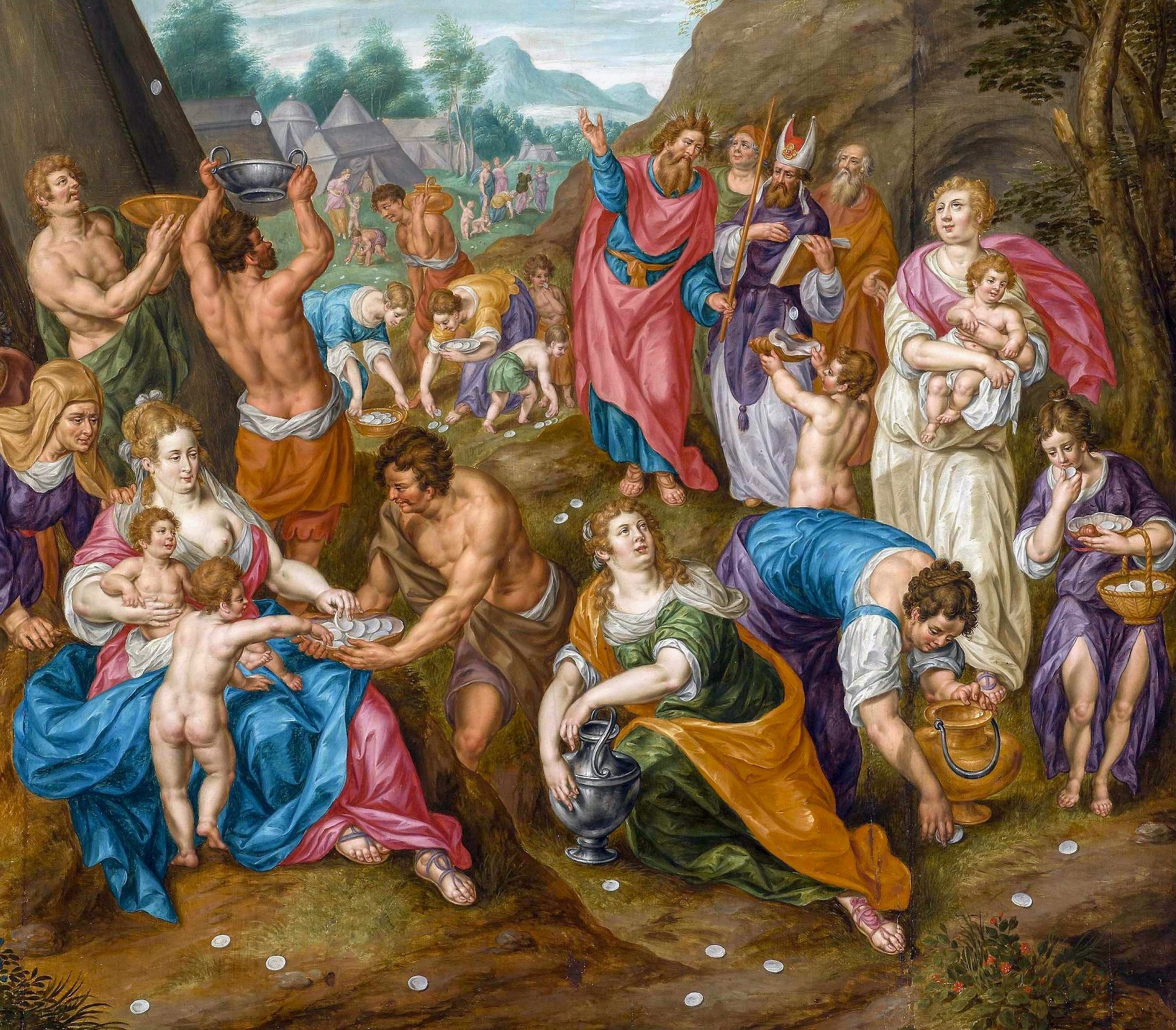
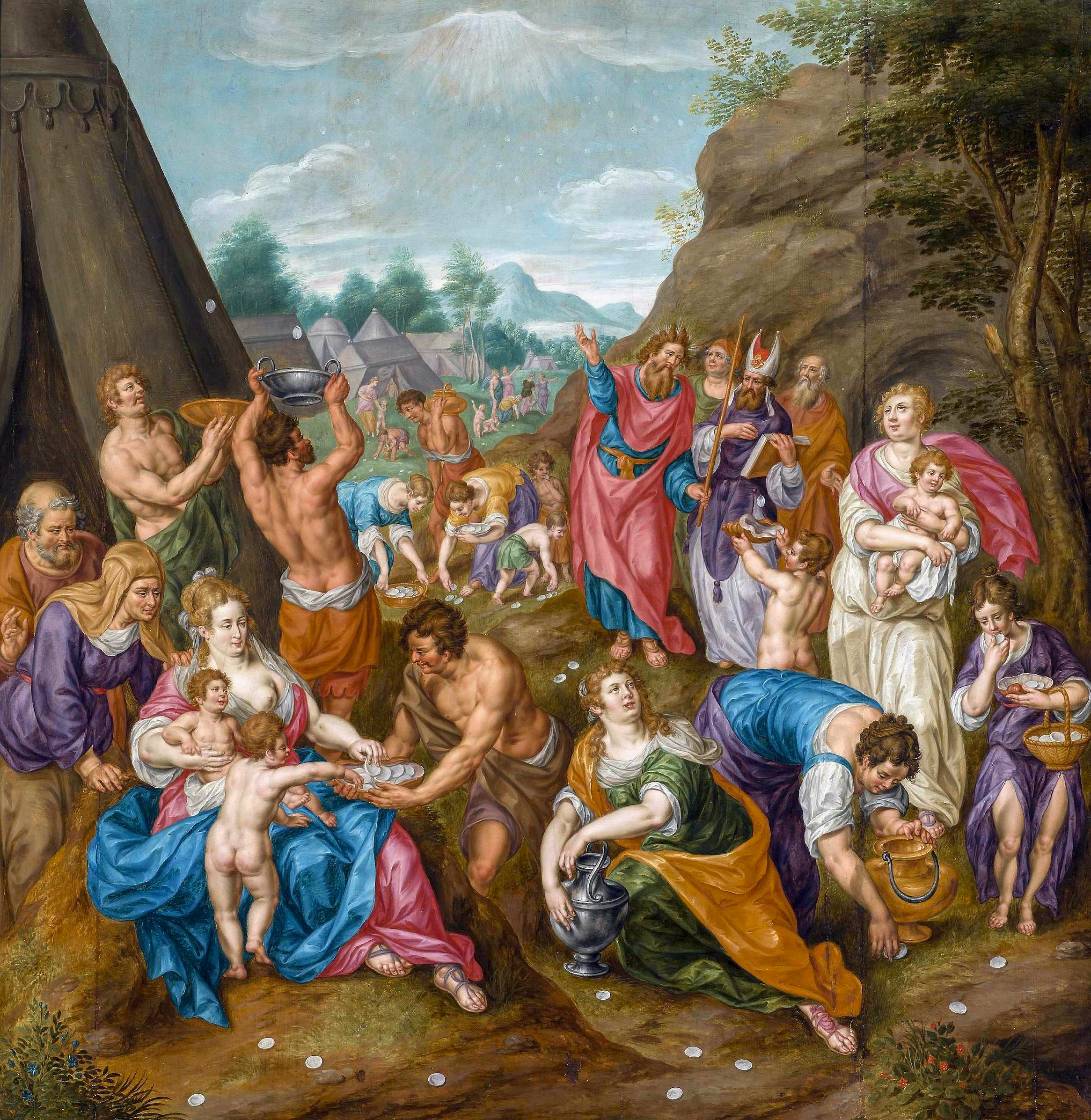
And when the dew had gone up, there was on the face of the wilderness a fine, flake-like thing, fine as frost on the ground. When the people of Israel saw it, they said to one another, “What is it?” For they did not know what it was. And Moses said to them, “It is the bread that the Lord has given you to eat. This is what the Lord has commanded: ‘Gather of it, each one of you, as much as he can eat. You shall each take an omer, according to the number of the persons that each of you has in his tent.’” And the people of Israel did so. They gathered, some more, some less. But when they measured it with an omer, whoever gathered much had nothing left over, and whoever gathered little had no lack. Each of them gathered as much as he could eat. And Moses said to them, “Let no one leave any of it over till the morning.” But they did not listen to Moses. Some left part of it till the morning, and it bred worms and stank. And Moses was angry with them. Morning by morning they gathered it, each as much as he could eat; but when the sun grew hot, it melted …. The people of Israel ate the manna forty years, till they came to a habitable land. They ate the manna till they came to the border of the land of Canaan (Num 11:1 ff).
Here is a miraculous food from Heaven. They called it “manna,” which does not mean “bread” but rather “what is it?” This name attests to it mysterious character. It was also called the “bread of Heaven” and the “bread of angels.” The point is, it is miraculous. It is like bread. It can be kneaded and baked like bread, but it is not mere bread—it is something more. It points to the Eucharist. Without this bread they will perish. With it, they will be sustained unto the Promised Land. So too for us and the Eucharist!
Yet despite this miracle they grumble. They consider ordinary what God has chosen to save them. They prefer the worldly food of slaves to the miraculous food of God’s own children! The text says,
The rabble who were among them had greedy desires; and also the sons of Israel wept again and said, “Who will give us meat to eat? “We remember the fish which we used to eat free in Egypt, the cucumbers and the melons and the leeks and the onions and the garlic, but now our appetite is gone. There is nothing at all to look at except this wretched manna” (Numbers 11:4-6).
This is a horrible insult and a rejection of God’s great gift, the heavenly bread. It alone can sustain them for their journey through the desert to the Promised Land. They prefer satisfying their palates to what their soul requires. They want what is tasty not what is necessary. They prefer melons, leeks, cucumbers, and stews to what is necessary and is most able to sustain them. They will even long for slavery so as to be able to please their palates. They will forsake the freedom of the Children of God, sell their very birthright, for a mess of pottage.
I have written more on this topic here: Melons and Leeks or the Bread From Heaven? To summarize, does this not sadly resemble the many Catholics who will forsake the Bread of Life in the Eucharist to run to some denomination with a plexiglass pulpit, a potted plant in front of it, a charismatic preacher, and a contemporary Christian rock band? Granted, we should work hard to ensure our preaching is more anointed and our liturgy more understood, but nothing—nothing—is more valuable than the Bread come down from Heaven, who presents Himself to us in the humblest and most imperfect of settings.
Too many today say, “I am not being fed in the way I like. I am not being entertained. I do not find nourishing or relevant the liturgy that sustained the ancients.” In other words, “I want the melons and leeks of popular culture. Take that wretched manna out of here.”
God was so displeased with this rejection and with the grumbling against His manna that He sent punishments to them:
And the people became impatient and grumbled on the way. And the people spoke against God and against Moses, “Why have you brought us up out of Egypt to die in the wilderness? For there is no food and no water, and we loathe this wretched manna Then the Lord sent fiery serpents among the people, and they bit the people, so that many people of Israel died. And the people came to Moses and said, “We have sinned, for we have spoken against the Lord and against you. Pray to the Lord, that he take away the serpents from us.” So Moses prayed for the people (Num 21:4-6).
Pay attention, fellow Catholics. God is not pleased with our demands to make His manna more pleasing to our palates. He does not accept our demands that liturgy should conform to modern standards of entertainment. Our most necessary food is not that which merely pleases our palates; it is that which our souls most need. The best medicines are, at times, hard to swallow, but they are the best, for they are God’s medicine.
Are we listening? These ancient grumblings are too easily ours! Let God feed you in the way He sees fit. It is not for you, the patient, to say to the doctor, “Here is the medicine that pleases me.” Take the medicine offered. Acknowledge that the Doctor knows more than you do.
Grumbling leads to stumbling and to foolish falls. Take the manna; take your medicine. If it seems ordinary, fine; God works in humble ways to save us.
Stop grumbling. Stop insisting. Submit to God and He will save you, but it will be on His terms not yours.
More tomorrow on the grumbling that may cost us the promised land of Heaven itself!
Here in the last full week of Lent prior to Holy Week we do well to ponder the grumblings of the ancient Hebrew people in the desert, for their grumblings are often ours as well. We are reading these passages in the Office of Readings just now, so it is the mind of the Church that we should meditate on them. The ancient Hebrews grumbled in many ways, and it will take us several days to consider them. We should note that fear and a lack of trust are at the heart of most of their grumbling.
Lesson 1: They Grumbled in the Very Midst of a Miracle – Yes, they grumbled even while leaving Egypt. As they fearfully beheld the Egyptian army in pursuit of them they complained to Moses:
Is it because there were no graves in Egypt that you have taken us away to die in the wilderness? Why have you dealt with us in this way, bringing us out of Egypt? Is this not the word that we spoke to you in Egypt, saying, “Leave us alone that we may serve the Egyptians”? For it would have been better for us to serve the Egyptians than to die in the wilderness (Exodus 14:11-12).
Recall that God had worked signs and wonders for them in Egypt through the plagues He inflicted on their captors. Remember also the miracle of Passover. Finally, recall the astonishing truth that Pharaoh not only let them go but the Egyptians paid them to leave, giving them a great deal gold and silver prior to their departure (see Ex 3:21).
So here they are in the midst of a miraculous deliverance and yet they grumble. Things have not changed, my friends. We, too, are blessed over and over again but will grumble at the slightest thing.
Their fear and ours is not without sin, a sin rooted in a lack of trusting faith. God has shown over and over a will to save them and a capacity to deliver them. In their fear, though, they grumble and vent their anger at Moses. Despite countless blessings, we, too, often grumble at the slightest inconvenience or setback. Fear is at the root of most of this unjust anger, and at the root of most of this fear is a failure to trust God.
Surely God has not brought them this far just to leave them, but they are not convinced. So easily do we fear despite how good God has been to us. We who are Christians are clearly told that even our suffering is a gift, albeit in a strange package: All things work together for good, for those who love God and are called according to his purpose (Rom 8:28).
In their grumbling they declare that they would rather live as slaves than die as free children of God. This is a slap in face of God, who has offered them the astonishing gift of deliverance. It would seem that they seek relief, not true healing. Healing takes guts and requires courageous change.
We also often seek cheap grace—relief rather than courageous healing and the responsibilities that come with being free children of God. In the face of persecution or loss, we too easily prefer to be a slave to worldly notions and demands rather than freely and manfully resisting, trusting that God will deliver us even at the cost of our livelihood or our very life.
The martyrs and confessors of the faith rose to testify against such grumbling, fear, and despair. They courageously, even joyfully, died for Christ knowing that a greater blessing would be theirs. They endured unspeakable tortures and yet we can barely endure being laughed at, disapproved of, or scorned.
Finally, to all of us whose trust in God flags even after centuries under His care, to all of us who cry out to God even after a lifetime of blessings, He asks this piercing question: “Why do you cry out to me?” (Ex 14:15) Through Moses, God says to us, “The Lord will fight for you; you need only to be still” (Exodus 14:14).
After calming a storm at sea, Jesus posed a similar question: Why are you so afraid? Do you still have no faith? (Mark 4:40)
When God asks a question, we ought to answer it, carefully and prayerfully. St. Paul warned: Do not grumble, as some of them did (1 Cor 10:10). No, prayerfully ponder this question: “Why are you so afraid?” God has something to teach us.
I do believe Lord, help my unbelief (Mk 9:24).
Tomorrow we will ponder more of the grumblings in the wilderness.
To the world and to those what are perishing, Sunday’s Gospel is utter madness, utter foolishness. Christ in effect declares that dying (to this world) is the only way to true life. While the world’s so-called wisdom holds that the way to life is through power, prestige, possessions, and popularity, Jesus says that in order to find true life, one must die to all that. This seems to be a paradox. The true gospel (not a watered down, compromised one) is a real insult to the world.
Indeed, most of us struggle to understand and accept what the Lord is saying, but He can give us a heart for what really matters, a heart for Him, for love, and for the things awaiting us in Heaven. The way to this new life is through the cross. Jesus had to go to the cross and die to give us this new life. We, too, must go to His cross and die with Him to this world’s agenda in order to rise to new life.
To those who would scoff at this way of the cross, there is only one thing to say, “The cross wins. It always wins.”
Let’s examine the Lord’s paradoxical plan to save us and bring us to new life.
I The Plan of Salvation that is acclaimed– As the Gospel opens we find a rather strange incident. The text says, Some Greeks who had come to worship at the Passover Feast came to Philip, who was from Bethsaida in Galilee, and asked him, “Sir, we would like to see Jesus.” Philip went and told Andrew; then Andrew and Philip went and told Jesus. Jesus answered them, “The hour has come for the Son of Man to be glorified.”
What is odd is Jesus’ apparent overreaction to the simple fact that some Greeks wish to speak to Him. From this seemingly simple and unremarkable (to us) fact, Jesus senses that His “hour” has now come. Yes, the time has come for His glorification, that is, His suffering, death, and resurrection. He goes on later to say, “I am troubled now. Yet what should I say? ‘Father, save me from this hour’? But it was for this purpose that I came to this hour. Now is the time of judgment on this world; now the ruler of this world will be driven out. And when I am lifted up from the earth, I will draw everyone to myself.” He said this indicating the kind of death he would die.
Yes, all this because certain Greeks (i.e., certain Gentiles) want to talk to Him.
Even more remarkable is that nothing in the text indicates that Jesus actually goes over to speak to them. Having given this stunning soliloquy and announced that the drama was to unfold, Jesus does not appear to have gone over to the Greeks to evangelize them. We will see why this in a moment.
First, let us examine why this simple request kicks off the unfolding of Holy Week. In effect, the arrival of the Gentiles fulfills a critical prophecy about the Messiah, wherein He would gather the nations unto Himself and make of fractured humanity one nation, one family. Consider two prophesies:
I come to gather nation of every language; they shall come and see my glory. just as the Israelites bring their offering to the house of the Lord in clean vessels. Some of these I will take as priests and Levites says the Lord …. All mankind shall come to worship before me says the Lord (Is 66:18, 23).
And the foreigners who join themselves to the LORD, to minister to him, to love the name of the LORD, and to be his servants, every one who keeps the Sabbath, and does not profane it, and holds fast my covenant—these I will bring to my holy mountain, and make them joyful in my house of prayer; their burnt offerings and their sacrifices will be accepted on my altar; for my house shall be called a house of prayer for all peoples (Is 56:6-7).
Thus we see that one of the principle missions of the Messiah would be to save not only the Jews but all people and to draw them into right worship and unity in the one Lord. Jesus explicitly states elsewhere His intention to gather the Gentiles:
I am the good shepherd; I know my own and my own know me, as the Father knows me and I know the Father; and I lay down my life for the sheep. And I have other sheep, that are not of this fold; I must bring them also, and they will heed my voice. So there shall be one flock, one shepherd (John 10:14).
So it is that this apparently simple request of the Greeks (Gentiles) to see Jesus, the Jewish Messiah, carries such significance.
Why did Jesus not run and greet them at once? Simply put, the call and salvation of the Gentiles must wait for His death and resurrection to be accomplished. It will be His atoning death that will reunite us with the Father and with one another. A simple sermon or slogan like “Can’t we all just get along” isn’t going to accomplish the deeper unity necessary. Only the blood of Jesus can bring true Shalom with the Father and with one another; only the blood of Jesus can save us.
Consider this text from Ephesians:
But now in Christ Jesus you [Gentiles] who once were far off have been brought near in the blood of Christ. For he is our peace, who has made us both {Jews and Gentiles] one, and has broken down the dividing wall of hostility, by abolishing in his flesh the law of commandments and ordinances, that he might create in himself one new man in place of the two, so making peace, and might reconcile us both to God in one body through the cross, thereby bringing the hostility to an end. And he came and preached peace to you who were far off and peace to those who were near; for through him we both have access in one Spirit to the Father. (Eph 2:13ff)
Thus, nothing but the blood of Jesus can make us whole, can save us, or can make us one with the Father or with one another. There is no true unity apart from Christ, and He secures it by His blood and the power of His cross. Only by baptism into the paschal mystery do we become members of the Body of Christ and find lasting unity, salvation, and true peace.
The door has opened from the Gentiles’ side, but Jesus knows that the way through the door goes by way the cross. His apparent delay in rushing to greet the Gentiles makes sense in this light. Only after His resurrection will He say, Go therefore and make disciples of all nations (Matt 28:19). Now there is the power through baptism to make all one in Christ. The price of our salvation, our new life, our peace with one another and the Father, is the death and resurrection of Jesus. Thank the Lord that Jesus paid that price. The old hymn “At Calvary” says, “Oh, the love that drew salvation’s plan! Oh, the grace that brought it down to man! Oh, the mighty gulf that God did span! At Calvary!”
II. The Plan of Salvation applied – Jesus goes on to say, Amen, amen, I say to you, unless a grain of wheat falls to the ground and dies, it remains just a grain of wheat; but if it dies, it produces much fruit. Whoever serves me must follow me, and where I am, there also will my servant be. The Father will honor whoever serves me.
Now while it is true that Jesus pays the price for our peace and our unity with the Father and with one another, it is also true that He sets forth a pattern for us and applies it. Note that Jesus says, “Amen, amen I say to you …. He also says, “Whoever serves me must follow me.”
Thus the pattern of His dying and rising to new life must also be applied to the pattern of our life. If we seek unity and peace and want to enjoy this new life with the Father, we must die so as to rise again. We must follow in the footsteps of Jesus. If we want peace we have to be willing to accept the pattern of dying for it and rising to it.
How must we die for this? We have to die to:
our ego
our desire for revenge
our hurts from the past
our desire to control everything
our sinful and unbiblical agendas
our irrational fears rooted in ego and exaggerated notions
our hatreds
our unrealistic expectations
our stubbornness
our inflexibility
our impatience
our unreasonable demands
our greed
our worldliness
Yes, we have to be willing to experience some sacrifices for unity and to obtain new life. We have to let the Lord put a lot of sinful and unhealthy drives to death in us. New life does not just happen; peace and unity do not just happen. We have to journey to them through Calvary. We must allow the Lord to crucify our sinful desires and thereby rise to new life.
But remember, the cross wins; it always wins.
III. The Plan of Salvation at day’s end – Jesus speaks of a great promise of new life but presents it in a very paradoxical way. He says, Whoever loves his life loses it, and whoever hates his life in this world will preserve it for eternal life.
In other words, if we are not willing to follow the pattern He sets forth of dying to ourselves and to this world, we cannot truly live. If we go on clinging to our worldly notions of life, if we live only for ourselves, if we live only for power, possessions, popularity, and prestige, we are already dead. Indeed, if we live only for the things of this world (and many do), ours will be a cruel fate, for we will die and lose all.
If we allow the Lord to help us die to this world’s agenda and to its pathetic charms, then and only then can we pass increasingly to real life, to true unity with the Father and to deeper unity with one another in Christ. Only then does a newer, deeper life dawn upon us. Only then do we see our lives dramatically transformed day to day.
Jesus had to die to give this to us. In order to have it bestowed on us we must be configured to Christ’s death to this world so that we can live in Him and find this new life. We die to a sinful and overrated world so as to live in a whole new way in a life open to something richer than we could ever imagine.
Note that Jesus calls this new life “eternal life.” Eternal life means far more than living forever. While not excluding the notion of endless length, eternal life at a deeper level has more to do with its fullness.
For those who know Christ, this process has already begun. Now that I am well past age fifty, my bodily life has suffered setbacks, but spiritually I am more alive than I ever was at twenty. Just wait until I’m eighty! Our bodies may be declining, but if we love and trust Christ, our souls are growing younger and more vibrant, more fully alive. Yes, I am more joyful, more serene, more confident, less sinful, less angry, less anxious, more compassionate, more patient, and more alive!
All of this comes from dying to this world little by little and thereby having more room for the life Christ offers.
What is the price of our peace and our new life? Everything! We shall only attain to it by dying to this world. While our final physical death will seal the deal, there are the thousand little deaths that usher in this new life even now. Our physical death is but the final stage of a lifelong journey in Christ. For those who know Christ, the promise then will be full. For those who rejected Him, the loss will be total.
Again from the hymn “At Calvary”: “Now I’ve given Jesus everything, Now I gladly own Him as my King, Now my raptured soul can only sing of Calvary!”
Yes, the promise is real, but it is paradoxically obtained. The world calls all this foolishness. You must decide. Choose either the “wisdom” of this world or the “folly” of Christ. You may call me a fool, but make sure you add that I was a fool for Christ. I don’t mind. The cross wins; it always wins.
One of the most commonly committed—yet least often confessed—sins, is that of rash judgment. The commercial below humorously depicts the sin and how wrong we can sometimes be.
In reality, the sin is not often humorous and can lead us to some very dark places. On account of rash judgments, we may harbor grudges, resentments, fears, and unjust anger. We may allow it to foster pride, feeling ourselves superior to others. We may even seek revenge based on misinformation or as a result of misinterpretation of others’ actions. And gossip is usually the daughter (or son) of rash judgment.
St. Thomas speaks of rash judgment in this way:When the human intellect lacks certainty, as when a person, without any solid motive, forms a negative judgment on some doubtful or hidden matter, it is called judgment by suspicion or rash judgment (Summa Theologica, Quest. 60, art 2).
Fr. John Hardon defines it in this way: Rash judgment is unquestioning conviction about another person’s bad conduct without adequate grounds for the judgment. The sinfulness of rash judgment lies in the hasty imprudence with which the critical appraisal is made, and in the loss of reputation that a person suffers in the eyes of the one who judges adversely (Modern Catholic Dictionary, John A. Hardon, S.J.).
The Catechism places rash judgment in the context of our obligation to preserve the good reputation of others:
Respect for the reputation of persons forbids every attitude and word likely to cause them unjust injury. He becomes guilty
– of rash judgment who, even tacitly, assumes as true, without sufficient foundation, the moral fault of a neighbor;
– of detraction who, without objectively valid reason, discloses another’s faults and failings to persons who did not know them;
– of calumny who, by remarks contrary to the truth, harms the reputation of others and gives occasion for false judgments concerning them.
To avoid rash judgment, everyone should be careful to interpret insofar as possible his neighbor’s thoughts, words, and deeds in a favorable way (CCC 2477-2478).
All this said, rash judgment is often committed out of weakness. Our minds are weak and we often lack the patience or determination to carefully discern the whole truth. Sometimes we commit this sin because of past hurts or the general climate of cynicism that permeates our culture.
On account of these roots in weakness, the necessary antidote is humility and an understanding that in most cases we do not have all the facts at our disposal immediately. In fact, there are many situations in which we may never have all the facts. In humility, we should presume benign intent in uncertain matters unless and until the facts indicate otherwise.
In today’s world of 24/7 information at our fingertips, we are encouraged to make quick judgments. News outlets often rush to provide “analysis” before many of the facts are known. When “experts” speak from the anchor’s desk, their statements can seem quite credible when, in fact, they are often little more than rash judgments.
Be very careful. Rash judgment, especially when shared with others, can do a lot of damage. It is not a sin to be taken lightly, even if it is often committed in weakness.
Perhaps, then, a little humor will make the point. In this commercial, a man with all the best of intentions appears to be guilty of the worst intentions. Enjoy.
When I was young and throughout my seminary years, I usually contemplated the crucifix and Jesus’ suffering on the Cross somberly. It was my sin that had put Him there, that had made Him suffer. The Cross was something that compelled a silent reverence in me, and suggested that I meditate deeply on what Jesus had to endure. I would often think of John, Mary, and the other women beneath the Cross, mournfully beholding Jesus’ slow, painful death.
These were heavy and somber notes, but deeply moving themes.
In addition, the crucifix made me think about the fact that I would have to carry a cross and go through the Fridays of my life. I needed to learn the meaning of sacrifice.
Liturgically, I saw the crucifix as a way of restoring greater reverence in the Mass. Through the 1970s and 1980s, most parishes had removed crucifixes, quite often replacing them with “resurrection crosses,” or just an image of Jesus floating in mid-air. I used to call this image “touchdown Jesus” since it so closely resembled a football referee indicating a score. In those years we had moved away from the understanding of the Mass as a sacrifice; we were more into “meal theology.” The removal of the crucifix from the sanctuary was a powerful indicator of this shift. Many priests and liturgists saw the Cross as too somber a theme for their vision of a new and more welcoming Church, upbeat and positive.
This Cross-less Christianity often led to what I thought was a rather silly, celebratory style of Mass in those years, and I came to see the restoration of the crucifix as necessary to bring back proper balance. I was delighted when, through the mid-1980s and later, the Vatican began insisting in new liturgical norms that a crucifix (not just a cross) be prominent in the sanctuary and visible to all, and further, that the processional cross had to bear the image of the crucified.
Balance Restored – I was (and still am) very happy about these new norms because they restore the proper balance. The Mass is a making-present of the once-for-all, perfect sacrifice of Jesus on the Cross; it is also a sacred meal, whose power comes from that sacrifice. I also believed that such a move would help restore proper solemnity to the Mass, and to some extent that has occurred.
All of this background is just to say that I saw the cross — the crucifix — in somber, serious tones. The theme was meant to instill solemnity and encourage meditation on the awful reality of sin and on our need to repent.
But the Lord wasn’t finished with me yet; He wanted me to see another understanding of the Cross.
He wanted me to also experience the “good” in Good Friday, for the Cross is also a place of victory and love, of God’s faithfulness and our deliverance. There’s a lot to celebrate at the foot of the Cross.
It happened one Sunday during Lent of 1994, one of my first in an African-American Catholic parish. It being Lent, I expected the typically celebratory quality of Mass in the parish to be scaled back a bit. Much to my surprise, though, the opening song began with an upbeat, toe-tapping gospel riff. At first I frowned, but then the choir began to sing:
Down at the Cross where my Savior died,
Down where for cleansing from sin I cried, There to my heart was the blood applied; Glory to His name!
Ah, so this was a Lenten theme! It was odd to me to hear the Cross being sung of so joyfully.
This was quite new for me. Perhaps it shouldn’t have been, but it was. The Catholicism of the 1970s and 1980s with which I was familiar found it necessary to remove the cross in order to celebrate, but here was celebration with and in the Cross!
The choir continued,
I am so wondrously saved from sin,
Jesus so sweetly abides within; There at the Cross where He took me in; Glory to His name!
The congregation and choir were stepping in time and clapping, rejoicing in the Cross, seeing it in the Resurrection light of its saving power and as a glorious reflection of God’s love for us. Up the aisle the procession wound. The last verse was transposed a half-step up to an even brighter key:
Oh, precious fountain that saves from sin,
I am so glad I have entered in; There Jesus saves me and keeps me clean; Glory to His name!
Yes, indeed, glory to His name! A lot of dots were connected for me that day. The Cross indeed was a place of great pain, but also of great love. There was grief, but there was also glory; there was suffering, but there was also victory.
Please do not misunderstand my point. There is a place and time for quiet, somber reflection at the foot of the Cross, but one of the glories of the human person is that we can have more than one feeling at a time, even conflicting ones.
Balance – Some in the Church of the 1970s and 1980s rejected the Cross as too somber a theme, too negative. They wanted to be more upbeat, less focused on sin; and so, out went the Cross. There was no need to do this, and it was an overreaction. At the Cross, the vertical, upward pillar of man’s pride and sin is transected by the horizontal, outstretched arms of God’s love. With strong hand and outstretched arms, the Lord has won the victory for us: there at the Cross where he took me in, glory to his name!
The balance is both for the individual and for the Church. Some prefer a more somber meditation on the Cross to prevail, while others feel moved by the Spirit to celebrate joyfully at the foot of the Cross. The Church needs both. I suppose we all need some of both experiences. Yes, it is right to weep at the Cross, to behold the awful reality of sin, to remember Christ’s sacrifice; but we should rejoice, too, for the Lord has won the victory for us, right there: Down at the Cross. There’s a lot of good in Good Friday.
Here is the song I heard that Sunday in 1994, sung in very much the style I remember.

 When I was about 10 years old I took some sailing lessons and then did so again when I was in my early 30s. Sailing involves a kind of romancing of the wind, wherein one observes it and then adapts to it, wooing it, learning its moves, its vicissitudes, its often subtle and changing signs.