In the car commercial below every imaginable attack is waged on the driver by various nefarious figures, but the driver just keeps on driving. Similarly, we must just keep on preaching and teaching no matter what foolish or evil things assail us, no matter the obstacles. St. Paul reminds us,
I charge you in the presence of God and of Christ Jesus, who is to judge the living and the dead, and by his appearing and his kingdom: preach the word; be ready in season and out of season; reprove, rebuke, and exhort, with complete patience and teaching. For the time is coming when people will not endure sound teaching but having itching ears they will accumulate for themselves teachers to suit their own passions and will turn away from listening to the truth and wander off into myths. As for you, always be sober-minded, endure suffering, do the work of an evangelist, fulfill your ministry (2 Timothy 4:1-5).
I’m not quite sure what to make of the woman at the end of the commercial. Let’s just call her Mother Church. Christ and His bride will win! The wicked will wage their war, but in the end, they will turn on one another. Evil cannot endure. Jesus and His bride win! Viva Cristo Rey!
A new study has been issued from Oxford University that casts doubt on the notion that there is “intelligent” life in abundance elsewhere in the universe. More on that study in a moment.
Meanwhile, I have written from time to time on the question of whether there is other intelligent life in the universe. As a Catholic, I have no need for the answer to be yes or no; the Church does not teach on this one way or another. Neither do the Scriptures address the point directly or make any scientific declaration.
Generally, however, my own conclusion is that intelligent life and highly developed civilizations, like or more advanced than our own, are rare and perhaps even non-existent. I based this on past study of the matter.
Some have balked at my conclusion; and that is fine, it is only my conclusion, and provisional at best. I would easily abandon the conclusion if new evidence presented itself. But I have also discovered that many people who assume that intelligent and highly organized civilizations are out there, hold their view for largely or merely statistical premises. The thinking goes: in a universe of a billion trillion stars, chances are high, almost certain, that such life is out there.
But statistics are a funny thing. Simply looking at the number of stars and galaxies, sounds expansive in terms of possibilities. But statistics can cut both ways. For it is not just one or two things that make life possible on earth; there are hundreds, even thousands of factors which make life, and especially developed and diverse life, stably possible on earth to the degree that complex and technological civilizations could emerge. Multiplying these many factors together brings the statistical possibilities of advanced life substantially down.
I have written more on these factors (sometimes called “Rare Earth” Hypothesis) here: Earth is a Rare Jewel. But the essential point of the theory is that there are many factors that have made life possible on earth by providing a stable setting for life to arise and develop. Here are just some of the many:
Earth is at just the right distance from the Sun so that it is warm enough for ice to melt, but not so hot as to boil and steam away. Water is also able, in this habitable zone (the so-called “Goldilocks” region), to both evaporate and condense at lower levels in the atmosphere, thus permitting a more even distribution of water and the cycle of water over dry land known as precipitation.
For suns to spawn Earth-like planets they must have sufficient “metallicity,” which is necessary for the formation of terrestrial rather than gaseous planets.
Earth is in a “habitable zone” within the galaxy as well. Closer to the center of galaxies, radiation and the presence of wandering planetoids make life there unlikely.
Earth exists in a disk-shaped spiral galaxy (the Milky Way) rather than in an elliptical (spheroid) galaxy. Spiral galaxies are thought to be the only type capable of supporting life.
Earth’s orbit around the sun is an almost perfect circle rather than the more common “eccentric” (elongated) ellipse. Steep elliptical orbits take a planet relatively close to and then relatively far from the sun, with great consequences for warmth and light. Earth’s stable, nearly circular orbit around the sun keeps our distance from it relatively constant, and hence the amount of heat and light does not vary tremendously.
Two nearby “gas giants” (Jupiter and Saturn) attract and catch many wandering asteroids and comets and generally keep them from hitting Earth. The asteroid belts also keep a lot of flying rock in a stable orbit and away from us.
Our molten core creates a magnetic field that holds the Van Allen radiation belts in place. These belts protect Earth from the most harmful rays of the sun.
Earth’s volcanism plays a role in generating our atmosphere and in cycling rich minerals widely.
Our sun is just the right kind of star, putting out a fairly steady amount of energy. Other types of stars are more variable in their output and this variance can utterly destroy life or cause it to be unsustainable due to the extremes.
Earth’s fairly rapid rotation reduces the daily variation in temperature. It also makes photosynthesis viable because there is enough sunlight all over the planet.
Earth’s axis is tilted just enough relative to its orbital plane to allow seasonal variations that help complex life, but not so tilted as to make those variations too extreme.
Our moon causes tides that are just strong enough to permit tidal zones (a great breeding ground for diverse life) but not so severe as to destroy life.
It would appear that for complex life to be sustained, many factors must come together in just the right way.
In June, a team of researchers at the University of Oxford released a paper that casts doubts (but does not rule out) that intelligent life is “out there” in abundance. Here is a recently published summary of their research:
In 1950, while working at Los Alamos National Laboratory, physicist Enrico Fermi famously exclaimed to his colleagues over lunch: “Where is everybody?”
He had been pondering the surprising lack of evidence of other life outside of our planet. In a universe that had been around for some 14 billion years, and in that time developed more than a billion trillion stars, Fermi reasoned there simply must be other intelligent civilizations out there. So where are they?
We still don’t know, and the Fermi paradox has only strengthened with time. Since the 1950s, humans have walked on the moon, sent a probe beyond our solar system, and even sent an electric sports car into orbit around the sun for fun. If we can go from rudimentary wooden tools to these feats of engineering in under a million years, surely there would have been ample opportunity in our 13.8 billion-year-old-universe for other civilizations to have progressed to a similar level—and far beyond—already?
And then, surely there would be some lingering radio signals or visual clues of their expansion reaching our telescopes. …
Now, a team of researchers at the University of Oxford brings a new perspective to this conundrum. In early June, Anders Sandberg, Eric Drexler, and Toby Ord of the Future of Humanity Institute (FHI) released a paper on the Fermi paradox—the discrepancy between our expected existence of alien signals and the universe’s apparent lack of them—once and for all.
Using fresh statistical methods, the paper re-asks the question “Are we alone?” and draws some groundbreaking conclusions: We Earthlings are not only likely to be the sole intelligence in the Milky Way, but there is about a 50 percent chance we are alone in the entire observable universe. …
Space is a large place, and the task of accurately estimating the likelihood of little green men isn’t exactly easy.
In 1961, astronomer Frank Drake proposed a formula that multiplied seven “parameters” together to estimate the number of detectable civilizations, N, we should expect within our galaxy at a given moment in time. …
The Drake equation was only intended as a rough tool to stimulate scientific discussion around the probability of extraterrestrial life. However, in the absence of any reasonable alternatives, it has remained astronomers’ only method of calculating the probability of extraterrestrial intelligence. This is problematic because while some parameters … are relatively well-known, others remain hugely uncertain. …
This enormous uncertainty leaves the Drake equation ultimately vulnerable to the optimism or pessimism of whoever wields it. And this is reflected in previous scientific papers whose results give values of N ranging anywhere from 10 to many billions. …
Sincere attempts to overcome this vulnerability have previously been made via selecting a handful of conservative, medium, and bullish best estimates for each parameter value and then taking an average across them.
In their new paper, titled “Dissolving the Fermi Paradox,” the FHI researchers dispute this method by demonstrating how this technique typically produces a value of N far higher than it should, creating the illusion of a paradox. …
[The researchers proposed a complex two-stage process of evaluating the Drake equation that] produced striking results: Based upon the current state of astrobiological knowledge, there’s a 53 to 99.6 percent chance we are the only civilization in this galaxy and a 39 to 85 percent chance we are the only one in the observable universe [*].
As you may imagine, there are many who find the conclusion of the authors problematic. I, too, wonder if their conclusion is too strong given the scientific method used. However, I still thing that Earth is a rare jewel! Indeed, there is something almost enchanted about our world.
Of this much I am happy: we are moving beyond simplistic theories that simply rely on the large size of the universe and its trillions of stars and looking more to the complex interactions required for life on Earth to exist as we know it. These are part of the statistical analysis we need to make as well, and they add a sober appreciation to what has made us what and who we are.
From a religious standpoint, my response to the details that make life on Earth what it is, are wonder and awe. The more we learn, the more we should be amazed; life is indeed a great mystery! As a believer, I am grateful to God and amazed at the subtle complexity of what He does. Our life here is not a common thing. It appears to be carefully, subtly, and consistently fostered and guarded. Earth is not common. It is quite special—perhaps even unique.
Many years ago, I saw the movie True Confessions (1981), which was about an ambitious priest who discovered the truer meaning of the priesthood. Although the film was seedy in places, the outcome for the main character, Monsignor Spellacy, was salutary.
Robert DeNiro (who was more discreet and refined in those days) starred as Msgr. Spellacy. It was well acted, but it was the liturgical scenes that were especially noteworthy: they were beautiful, meticulous, and accurate. The movie was set in the 1940s and so the older Latin Mass was depicted in all its solemn, high glory (see the movie clip at the end of the post).
The church itself was gorgeous as well. Over the years I could never identify the church, despite asking many people. No one seemed to know. The movie credits made no mention of the parish where the Mass scenes were filmed. Even people I knew from the Los Angeles area (where the move was filmed) did not recognize the church. This was well before the Internet was in common use, so there was not the ability to pose a question far and wide. Until a few months ago, there just seemed to be no information available.
Mystery Solved – I finally stumbled upon the answer, completely by accident, about a month ago when I read about a fire that had destroyed St. Joseph Church in downtown Los Angeles in 1983.
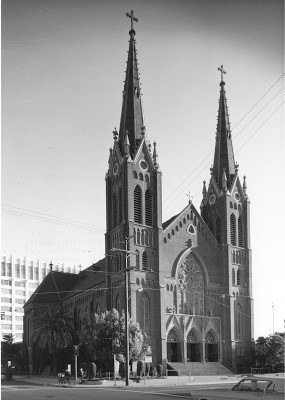
The article mentioned that St. Joseph had been seen in several TV shows and movies, including True Confessions. The cause was said to have been an electrical fire. The roof collapsed, and only the towers and some of the brick walls remained. What a loss! A smaller, modern church was subsequently built on the site to replace the older one.
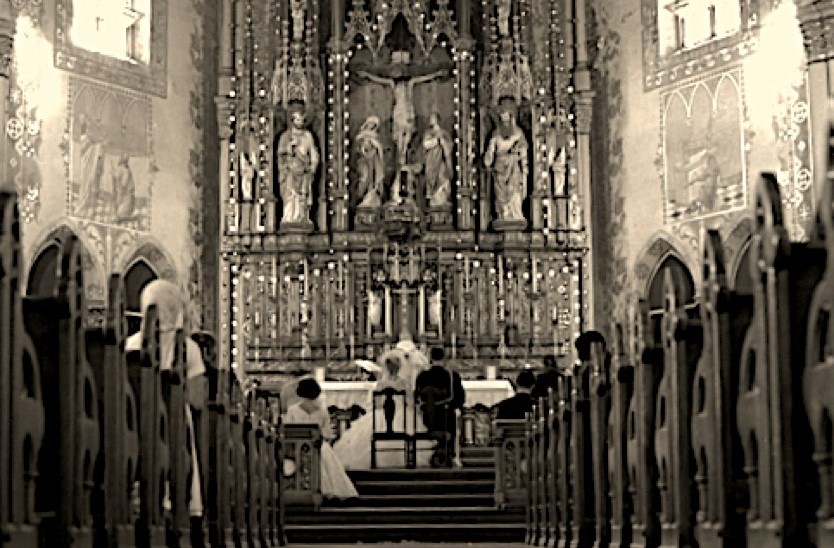
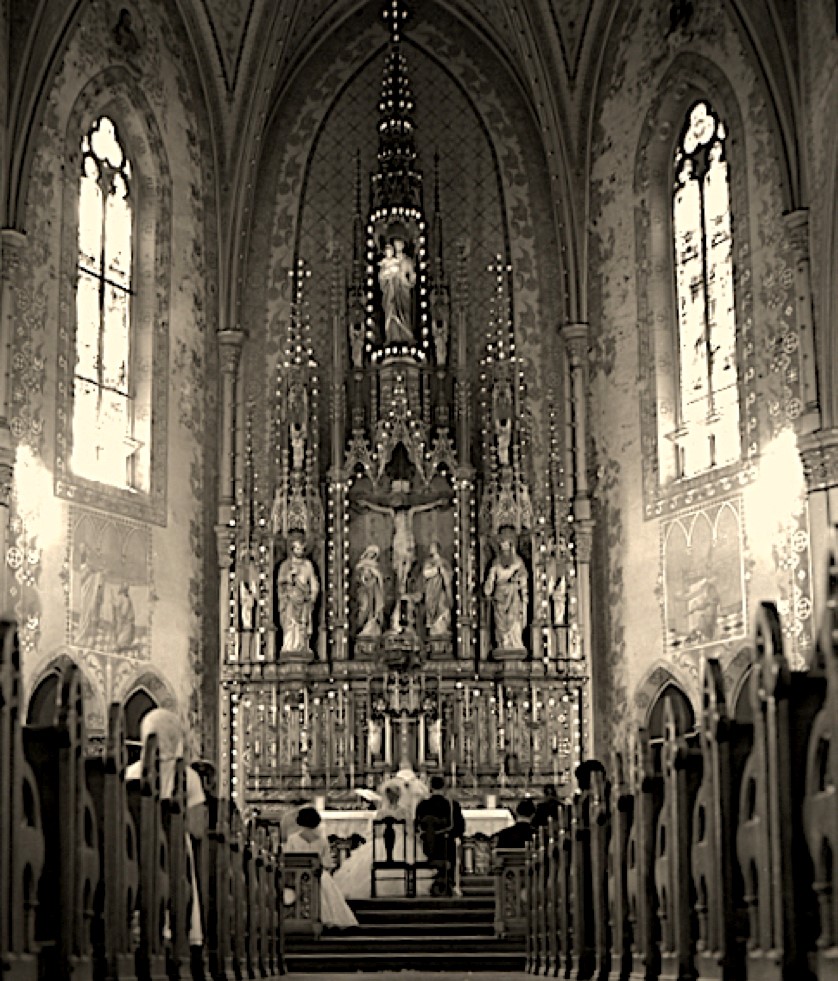
The exterior of the old St. Joseph Church is seen above. It was a truly magnificent German Gothic structure. Its interior is seen in the photo on the left, from 1960.
The following description of its beautiful interior was made upon its opening in 1903:
In the vast interiors of the great church … one may discover a wondrous work of gilt, and the deep tones of reds, greens, blues and yellows assembled with an artist’s touch into a magnificent whole.
This extensive fresco work [is] said to be the finest on the Coast. … For almost three months these men have toiled on the extensive work at St. Joseph’s sometimes far into the night…. … [I]t is said there will be no finer church edifice on the Pacific Coast. The whole building is to cost $100,000, and aside from this the furnishings make no small item.
Seven beautiful altars will be placed in the new building. These have been made in Munich. They are of white walnut and finished in white and gold. The main altar, of pure Gothic design, is forty-seven feet high, and the side altars are thirty and twenty-eight feet high.
The communion rail is also to be of polished walnut, with marble top; and the pews will be of white oak.
Most of the large windows are memorials, and they are to be of the richest colors in cathedral glass. These alone will cost about $6000. The Stations of the Cross are in bas-relief and set in alcoves in the walls. These are also products of Munich artists.
The main body of the church is 150 x 66 feet, and the transept is ninety-six feet wide. Back of this are the sacristy and rooms for altar boys, etc. The building has a large basement, fitted up for a hall, Sunday-school rooms, etc. Attached to the church on the east is the house of the Franciscan Fathers, which they now occupy.
All of this succumbed to the fire of Sunday morning, September 4, 1983; it was indeed a tragic loss. The current structure, though not ugly, is unremarkable. I have included additional pictures of the old and new churches here: The Church Where True Confessions Was Filmed.
I have written before about the sad fate of St. Vibiana, the former cathedral Church of Los Angeles (My Father’s House Has Become a Marketplace). I do not suppose that we can save all our beautiful structures, especially given the decline in the practice of the faith among Catholics, and although the damage to souls from this decline is far worse, the loss of these beautiful works that faith once produced is still lamentable. Accidents such as fire will cause losses as well, but they are still losses.
Below is some footage from the movie True Confessions, showing St. Joseph Church less than two years before its total destruction by fire.
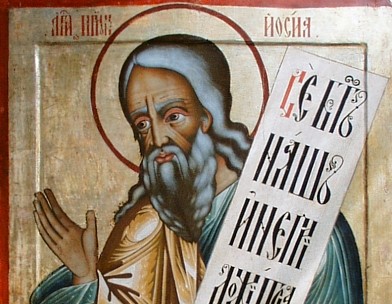
We are currently reading from the Book of the Prophet Hosea at daily Mass. The story of the Prophet Hosea’s troubled marriage is a powerful testimony to two things: our own tendency to be unfaithful to God, but also of God’s passionate love for us. We do well to recall the story, especially given the “great debate” among some in the Church today over the question of divorce and remarriage. And while there are many painful stories of what some have had to endure in difficult marriages, remember that God is in a very painful marriage with His people—yes, very painful! God knows the pain of a difficult marriage and a difficult spouse. The story of Hosea depicts some of God’s grief and what He chooses to do about it.
The precise details of Hosea’s troubled marriage are sketchy; we are left to fill in some of the details with our imagination. But here are the basic facts along with some “fill in”:
Hosea receives an unusual instruction from God:Go, take a harlot wife and harlot’s children, for the land gives itself to harlotry, turning away from the LORD. So he went and took Gomer, the daughter of Diblaim (Hosea 1:2).
Together they have three children, each with a symbolic name: Jezreel (for God is about to humble Israel in the Jezreel valley), Lo-Ruhama (not pitied), and Lo-Ammi (not my people). It is also possible that these children were not of Hosea but rather of Gomer’s various lovers, for although they are born during the marriage, God later refers to them as children of harlotry.
At some point, though the text does not specify when or under what circumstances, Gomer leaves Hosea for another lover and enters into an adulterous relationship. We can only imagine Hosea’s pain and anger at this rejection. The text remains silent as to Hosea’s reaction, but as we shall see, God’s reaction is well-documented.
Hosea takes her back. After an unspecified period of time, God instructs Hosea, Give your love to a woman beloved of a paramour, an adulteress; Even as the LORD loves the people of Israel, though they turn to other gods and are fond of raisin cakes (Hosea 3:1). Now while the quoted text does not clearly specify that this is the same woman he is to love, the overall context of chapters 1-3 of Hosea demand that this is the same unfaithful wife, Gomer. God tells Hosea to redeem, to buy back, Gomer and re-establish his marital bonds with her.
Hosea has to pay a rather hefty price indeed to purchase Gomer back from her paramour: So I bought her for fifteen pieces of silver and a homer and a lethech of barley (Hosea 3:2). The willingness of her paramour to “sell her back” indicates quite poetically that the apparent love of the world and of all false lovers is not real love at all. It is for sale to the highest bidder.
Prior to restoring her to any intimacy, a period of purification and testing will be necessary:Then I said to her: “Many days you shall wait for me; you shall not play the harlot Or belong to any man; I in turn will wait for you” (Hosea 3:3).
This story is both difficult and beautiful. Its purpose, as you likely know, is not merely to tell us of the troubled and painful marriage of Hosea. Its truer purpose is to show forth the troubled marriage of the Lord, who has a bride—a people—who are unfaithful to Him. We, both collectively and individually, have entered into a (marital) covenant with God. Our vows were pronounced at our baptism and we renewed them on many other occasions.
But all too often we casually “sleep with” other gods and worldly paramours. Perhaps it is money, popularity, possessions, or power. Perhaps we have forsaken God for our careers, politics, philosophies, or arts and sciences. Some have outright left God; others keep two or more beds, still speaking of their love for God but involved with many other dalliances as well. Yes, this is a troubled marriage, not on God’s part, but surely on ours.
And through it all, what does God decide to do? In the end, as Hosea’s story illustrates, God chooses to redeem, to buy back, his bride—and at quite a cost: For you know that it was not with perishable things such as silver or gold that you were redeemed from the empty way of life handed down to you from your forefathers, but with the precious blood of Christ, a lamb without blemish or defect (1 Peter 3:19-20). Yes, God paid dearly to draw us back to Him. And yet still we stray and often show little appreciation of His love. An old Gospel song says, “Oh Lord I’ve sinned but you’re still calling my name.”
A deeper look into the story of Hosea reveals a view into the grieving heart of God. Reading these Old Testament passages requires a bit of sophistication. The text we are about to look at describes God as grieving, angry, and weighing out His options; but it also shows Him as loving and almost romantic. On one level, we must remember that these attributes are applied to God in an analogical and metaphorical sense. Although God is said to be like this, He is not angry the way we are angry. He does not grieve the way we do; He is not romantic the way we are. Although we see these texts in terms of analogy and metaphor, we cannot wholly set them aside as having no meaning. In some sense, God is grieving, angry, loving, and even “romantic” in response to our wanderings. Exactly how He experiences these is mysterious to us but He does choose to use these metaphors to describe Himself to us.
With this balanced caution, let’s take a look at excerpts from the second chapter of Hosea, in which God decodes the story of Hosea and applies it to us. He describes to us His grieving heart as well as His plan of action to win back His lover and bride.
Thoughts of Divorce!Protest against your mother, protest! for she is not my wife, and I am not her husband.The text suggests that God is weighing His options. But perhaps the better explanation is that this line is for us readers, so that we will consider that God could rightfully divorce us. But as we will see, He will not do that. For although we break the covenant, He will not. Though we are unfaithful, God will not be unfaithful.If we are unfaithful he remains faithful, for he cannot deny himself (2 Tim 2:13).
The bitter charge against her – Let her remove her harlotry from before her, her adultery from between her breasts … “I will go after my lovers,” she said, “who give me my bread and my water, my wool and my flax, my oil and my drink.” Since she has not known that it was I who gave her the grain, the wine, and the oil, And her abundance of silver, and of gold, which they used for Baal.God’s charge here is not merely that we are unfaithful but also that we are ungrateful. God is the giver of every good thing. But so often we do not thank Him. We run after the world and after the powerful, thinking it is they who provide our wealth. They do not—it is God who does so. But instead we love the world and forget about God. We “sleep with” the world. We give credit to medicine, science, and human ingenuity, but do not acknowledge or thank God. Our ingratitude contributes to our harlotry, for we are enamored of secondary causes and not of God, who is the cause of all. So we get into bed with the world and its agenda, and adulterously unite ourselves with it. God is distressed by our ingratitude and adultery and is presented here as a wounded and jealous lover. Is God a wounded and jealous lover? Remember these things are said by way of analogy and metaphor. God is neither hurt nor angered by the way we are. And yet we cannot wholly dismiss these words as having no meaning. God has inspired this text and wants us to understand that although He is not passionate as we are, neither is He indifferent to our infidelity.
Grief-stricken but issuing purifying punishment – I will strip her naked, leaving her as on the day of her birth; I will make her like the desert, reduce her to an arid land, and slay her with thirst. I will have no pity on her children, for they are the children of harlotry. Yes, their mother has played the harlot; she that conceived them has acted shamefully. … I will lay bare her shame before the eyes of her lovers. … I will bring an end to all her joy, her feasts, her new moons, her sabbaths, and all her solemnities. … I will punish her for the days of the Baals, for whom she burnt incense. … If she runs after her lovers, she shall not overtake them; if she looks for them she shall not find them. This text could be seen as describing God in a jealous rage. But as we shall see, God has a result in mind. He does not punish as some uncontrolled despot exacting revenge. He punishes as medicine. He punishes as one who loves and seeks to restore. We are not sinners in the hands of an angry God; we are sinners in the hands of a loving God who seeks reunion.
The hoped-for result – Then she shall say, “I will go back to my first husband, for it was better with me then than now.”God’s intent was to bring His bride back to sanity, to bring her to a place where she is ready to seek union once again. For without this union she will perish, but with it she will be united with the only one who ever loved her and who can save her.
Passionate lover – So I will allure her; I will lead her into the desert and speak to her heart. From there I will give her the vineyards she had, and the valley of Achor as a door of hope. She shall respond there as in the days of her youth, when she came up from the land of Egypt. On that day, says the LORD, She shall call me “My husband,” and never again “My baal.” Then will I remove from her mouth the names of the Baals, so that they shall no longer be invoked.See how God wants to get alone with His bride and woo her once again! God will speak lovingly to her heart and declare again His love for her in a kind of Marriage Encounter She, now repentant and devoted, will renew her love as well. There is also an image of purgatory or purgation here. It is likely that when we die we will still have some attachments to “former lovers” in this world: creature comforts, power, pride, misplaced priorities, and the like. So as we die, God lures us into the desert of purgatory, speaks to our heart, and cleanses us of our final attachments. After this He restores to us the vineyards of paradise that once were ours.
Renewed Covenant – I will make a covenant for them on that day. … I will espouse you to me forever: I will espouse you in right and in justice, in love and in mercy; I will espouse you in fidelity, and you shall know the LORD. … and I will have pity on Lo-ruhama. I will say to Lo-ammi, “You are my people,” and he shall say, “My God!”God renews the marriage bond with us, both corporately in the Church and individually!
Here, then, is the astonishing, undying, and pursuing love of God for His bride, the Church, and for each of us individually. After all our whoring and infidelity, we do not deserve it. But God is a passionate lover. As He commanded Hosea to buy back his adulterous wife, so too did God buy us back at a high price. Now to be sure, God did not pay Satan. Rather, the payment He rendered was an indication of the high sacrifice He had to make to win back our hearts. We had wandered far and He had to journey far and then carry us back.
I am not here to render a personal judgment on those who have struggled to save a marriage but were unable to do so. Rather, my purpose is to reach those who are currently struggling, striving to persevere, so that you realize that God knows your pain—he too experiences it from us, time and time again. Yet each day He renews His covenant with us and offers us mercy. If it helps to realize that God knows your pain, please understand that He does. In the words of the old spiritual, “Nobody knows the trouble I’ve seen, nobody knows but Jesus.”
In setting forth her teaching, I have substantially reworked the order of her reflections. St. Teresa was able to see the “whole rose” of the topic, jumping from petal to petal without effort. I, being of a vastly inferior intellect and of far less purity of soul, must look to the individual petals in a certain order to understand. If you wish to read the passage in its original order, it is available here: St Teresa on Humility in Prayer.
Following is my presentation of her teaching as best I am able. In effect, St. Teresa summons us to trust in the Lord’s answer to our prayers rather than insisting on our own preferred outcomes and worldly measures of success.
Let’s look at her teaching in five stages. St. Teresa’s teaching is presented in italics while my remarks are shown in plain red text. The passages below are taken from the book The Way of Perfection by Saint Teresa of Avila, virgin (Obras de la gloriosa madre Sta Teresa de Jesus, Tomo 1, Madrid, 1752: 30:1-4 pp. 526-528).
The Prayer Plan –Therefore, the good Jesus bids us repeat these words, this prayer for his kingdom to come in us: Hallowed be your name, your kingdom come. See how wise our Master is! Our good Jesus placed these two petitions side by side … But what do we mean when we pray for this kingdom? … It seems to me that this point deserves serious attention.
Many conceive of prayer as a time to tell God what we need. Intercessory prayer surely has its place, but it ought not to dominate. As St. Teresa reminds us and the Our Father teaches, we ought to acknowledge more consistently the holiness and wisdom of God and seek His kingdom and will in our lives.
Hence, prayer is seeking God’s will, not announcing our own. We all have our preferences in life. We would rather be healthy than ill, financially well off than destitute, in peace than at war. Our ultimate goal, though, is to trust that what God wills or allows is what is best.
Is God holy for us, or is he just a butler who should fetch what we want? Do we love the God of all consolation or merely the consolations of God? To pray, then, is to disclose our heart and seek to conform it to the Kingdom and to the will of God.
The Perfect Picture – O Eternal Wisdom, between you and your Father that was enough; that was how you prayed in the garden. You expressed your desire and fear but surrendered yourself to his will.
St. Teresa points to Jesus Himself as the perfect picture. His human preference is for the cup of suffering to be taken away, but His deepest desire is to be conformed to His Father’s will:
And going a little farther he fell on his face and prayed, saying, “My Father, if it be possible, let this cup pass from me; nevertheless, not as I will, but as you will” (Matt 26:39).
We are saved by the human decision of a divine person. To be freed from suffering is appealing to Jesus, but not so appealing as to cause Him to violate His Father’s will. Nothing could do that.
Jesus is the ideal picture of prayer. His heart is perfectly united to the Father and His lesser human desire to avoid suffering is subjugated to His ultimate desire: to do whatever the Father wants. It is for us to journey toward this perfect picture. As we grow in the grace and love of God, we increasingly want what He wants, even if it is challenging, even if it leads us to martyrdom.
The Persistent Problem –But as for us, my Lord, you know that we are less submissive to the will of your Father …. You see, the gift our Lord intends for us may be by far the best, but if it is not what we wanted we are quite capable of flinging it back in his face. That is the kind of people we are; ready cash is the only wealth we understand.
Nothing plainer or more accurate could be said. It is normal to have certain preferred outcomes in life and in general it is not wrong to petition God for these things, but we are often very particular about what we want and so quick to become crestfallen and resentful if we do not get what we want, when we want it, and in just the manner. In addition, our desires are too easily worldly and vain.
So often our Lord must repeat what He said to James and John: “You do not know what you are asking” (Mt 20:22). St. Paul also reminds us, For we do not know how we ought to pray, but the Spirit Himself intercedes for us with groans too deep for words. (Rom 8:26).
Thus, we must ask humbly, realizing that God knows what is best. He sees a more complete picture and understands that simply giving us what we want often leads to troublesome results. Despite our momentary disappointments, we often come to realize that some of God’s greatest gifts have been the times when he said no or gave us something other than what we sought. It is interesting, for example, that no matter how many times God warns about wealth in the Scriptures, most of us still want to be wealthy. Our desires can be obtuse and close us in on worldly and fleshly things.
Recall the words of Jesus to the crowds who wanted another free meal after He multiplied the loaves and fishes: Do not work for the food that perishes, but for the food that endures to eternal life, which the Son of Man will give to you (Jn 6:27). Jesus was speaking of the Eucharist, His very self, but they just wanted ordinary bread. They were behaving like the ancient Jews, who tired of the miraculous manna, calling it wretched (Num 21:5), and pining for the melons and leeks of their slave years in Egypt (Num 11:5).
Yes, indeed, all we understand is “ready cash,” as St Teresa observes. How we must wear God out!
The Particular Petition – My Lord, could you not have included all in one word by saying “Father, give us whatever is good for us?” After all, to one who understands everything so perfectly, what need is there to say more?
For our prayer to grow, and our desires to be purified, a simple and filial trust of the Father is the key:
Whatever you want, O Heavenly Father, I want it too. I know it will be best. Even if my first emotional response is less than happy, I know that my truest happiness will be in whatever you will for me.
While the Lord Jesus directs us to present our needs to Him and to persevere in our prayers, it does not follow that we should give God detailed instructions. Doing so would be controlling, not trusting. It is enough to say, “Here are my needs, my concerns. I know that you will do whatever is best. Whatever you want, Lord, I will be fine knowing that you have heard and answered in your own way.
Indeed, there is no safer or better place in the world than inside the will of God. St. Teresa reminds us that humility in prayer comes finally to this: “Father give us whatever is good for us.”
Of course, whatever is good for us is that which will best lead us to Heaven. Hence, St. Teresa concludes with a vision that should always be before us.
The Palliative Perception – Of the many joys that are found in the kingdom of heaven, the greatest seems to me to be the sense of tranquility and well-being that we shall experience when we are free from all concern for earthly things …. Loving him is the soul’s one concern. Indeed it cannot help but love him, for it knows him. Here below our love must necessarily fall short of that perfection and constancy, but even so how different it would be, how much more like that of heaven, if we really knew our Lord!
I use the word palliative here to mean healing. We must look to Heaven to see our prayers and desires healed. There is an old saying, “The end is the beginning.” If we know our destination, then every other decision we make is directed toward that destination.
For example, if I am driving from Washington, D.C. to New York City, I can freely disregard signs for roads that lead south or west, knowing that they will not help me to get there. Even if I have to wait in heavy traffic, drive through heavy storms, or pay tolls, I am not overwhelmed because I know that every mile north and east gets me closer.
In our spiritual journey, we must meditate often on our destiny. Our goal is to be with the Lord forever. Our destination is Heaven, that beautiful place beyond description or imagination, where we are at peace in the presence of our God, lost in wonder and awe, and caught up into the great trinitarian dance of love. Looking into the beautiful face of God for which our soul yearns, all our lesser and often petty desires of this world will be gone.
As St. Teresa notes, however, all this doesn’t have to wait for Heaven. Even here in this world, as we grow to know the Lord more deeply our desires become purer and our prayer more humble. Increasingly, we come to be able to say what St. Thomas Aquinas did when asked by the Lord what he wanted: Nil nisi Te, Domine, nil nisi Te (nothing but You, O Lord, nothing but You). St. Teresa adds her hearty amen.
Physical hunger is a serious problem; We are obliged to assist the starving and malnourished. But even more prevalent these days is spiritual hunger, if not outright starvation. As is the case with physical hunger, the source of spiritual hunger is not God, who has given us abundant grace and truth; it is we who are the source. It is a strange starvation to be sure, for it is largely self-inflicted. Further, it seems to be at an advanced stage.
I am told that as physical starvation advances there comes a time when a kind of lethargy sets in. Although a person knows he is hungry, he lacks the mental acuity to want to do much about it. This seems to be the stage of spiritual starvation at which many Westerners find themselves today. Most people know they are spiritually hungry and are longing for something, but through a kind of lethargy and mental boredom, they don’t seem inclined to do much about it.
I’d like to look at the progressive stages of physical starvation (gleaned from several medical sources) and then speak of their spiritual equivalents. Please understand that when I use the pronoun “we” I am not necessarily talking about you, but rather about a large number, perhaps even a majority, of people in our culture today.
Weakness – In our time of spiritual starvation, a great moral weakness is evident. Self-control in the realm of sexuality and self-discipline in general seem increasingly lacking in our culture today. Many are too weak to keep the commitments they have made to marriage, religious life, or the priesthood. Addiction is a significant issue as well: addiction to alcohol, drugs, and pornography. In addition, we seem consumed by greed; we are obsessed with accumulating possessions, and the more we have the more we seem unable to live without them. Increasingly, people declare that they are not responsible for what they do and/or cannot help themselves. There is a general attitude that it is unreasonable to expect people to live out ordinary biblical morality, to have to suffer or endure the cross. All of these demonstrate weakness and a lack of courage, signaling the onset of spiritual starvation.
Confusion – As spiritual starvation sets in, the mind gets cloudy; thinking becomes distorted. There is a lot of confusion today about even the most basic moral issues. How could we get so confused as to think that killing unborn babies is OK? Sexual confusion is also rampant, so that what is contrary to nature (e.g., homosexual acts) is approved and what is destructive to the family (e.g., illicit heterosexual behavior) is widely accepted as well. Confusion is also deep about how to properly and effectively raise, train, discipline, and educate our children.
Irritability – As spiritual starvation progresses, a great deal of anger is directed at the Church whenever she addresses the malaise of our times. In addition, there is growing resistance to lawful authority and a loss of respect for elders and for tradition. St. Paul describes well the general irritability of a culture that has suppressed the truth about God and is spiritually starving: They are full of envy, murder, strife, deceit and malice. They are gossips, slanderers, God-haters, insolent, arrogant and boastful; they invent ways of doing evil; they disobey their parents; they have no understanding, no fidelity, no love, no mercy (Romans 1:29-31). Because we are starved of the common meal of God’s Word and revealed truth and because we have rejected natural law, we have been reduced to shouting matches and power struggles. We no longer agree on the essentials that the “food” of God’s truth provides. Having refused this sustenance, we have become irritable and strident.
Immune deficiency – As our spiritual starvation grows we cannot ward off the increasing attacks of the disease of sin. We more easily give way to temptation. Deeper and deeper bondage is increasingly evident in our sin-soaked culture. Things once thought to be indecent are now done openly and even celebrated. Many consider any suggested resistance to sin to be unreasonable, even impossible. Sexually transmitted diseases, teenage pregnancy, abortion, the consumption of internet pornography, divorce, and cohabitation are becoming widespread. Like disease, sin spreads because we are less capable of fighting it off.
The body begins to feed on its own muscle tissue (after fat cells are depleted) – In our spiritual starvation, we start to feed on our very own. We kill our children inutero; we use embryos for research. We euthanize our elderly. Young people kill other young people in gang violence. We see strife, power struggles, and wars increase. In tight economic times, we who have depleted the fat cells of public funds and amassed enormous debt fight with one another over the scraps that are left and refuse to give up any of our own entitlements, instead of restraining our spending and re-examining our priorities. Starving people can be desperate, and desperate people often turn on others. In the end, we as a body are consuming our very self.
Internal organs begin to shut down – In the spiritually starving Western world, many of our institutions are becoming dysfunctional and shutting down. Our families are in the throes of a major crisis. Almost of half of all children today no longer live with both parents. Schools are in serious decline. Most public-school systems have been a disgrace for years. America, once at the top of worldwide academic performance, now lags far behind. Churches and parochial schools also struggle as Mass attendance has dropped in the self-inflicted spiritual starvation of our times. Government, too, is becoming increasingly dysfunctional; strident differences paralyze it, and scandals plague the public sector. As we go through the stages of starvation, important organs of our culture and our nation are shutting down.
Hallucinations – St. Paul spoke of the spiritually starved Gentiles of his day and said, their thinking became futile and their senseless minds were darkened. Although they claimed to be wise, they became fools … Furthermore, just as they did not think it worthwhile to retain the knowledge of God, so God gave them over to a depraved mind (Romans 1:21-22,28). As we in the West spiritually starve, our thinking becomes increasingly bizarre, distorted, fanciful, silly, vain, and often lacking in common sense. Since our soul is starving, we hallucinate.
Convulsions and muscle spasms – Violence and turmoil run through our culture as basic social structures shut down and become dysfunctional. The breakdown of the family leads to many confused, incorrigible, and violent children. This is not just in the inner cities; violence, shootings, and gangs are in the suburbs as well. Even non-violent children have short attention spans and are often difficult to control and discipline. Although ADHD may well be over-diagnosed, overstimulated children with short attention spans are a real problem today. Adults, too, manifest a lot of convulsive and spasmodic behaviors, short attention spans, and mercurial temperaments. As we reach the advanced stages of spiritual starvation in our culture, convulsive and spasmodic behavior are an increasing problem.
Irregular heartbeat – In the spiritually starving West, it is not as though we lack all goodness. Our heart still beats, but it is irregular and inconsistent. We can manifest great compassion when natural disasters strike, yet still be coarse and insensitive at other times. We seem to have a concern for the poor, but abort our babies and advocate killing our sick elderly. Our starving culture’s heartbeat is irregular and inconsistent, another sign of spiritual starvation.
Sleepy, comatose state – Our starving culture is sleepy and often unreflective. The progress of our terrible fall eludes many, who seem oblivious to the symptoms of our spiritual starvation. St Paul says, So then, let us not be like others, who are asleep, but let us be alert and self-controlled (1 Thes 5:6). He also says, And do this, understanding the present time. The hour has come for you to wake up from your slumber, because our salvation is nearer now than when we first believed (Rom 13:11). Jesus speaks of the starvation that leads to sleepiness in this way: Be careful, or your hearts will be weighed down with dissipation, drunkenness, and the anxieties of life, and that day will close on you unexpectedly like a trap (Luke 21:34).
Death – Spiritual death is the final result of starvation. We become dead in our sins. Pope Francis remarked that the lights are going out in Europe. As Europe has forsaken its spiritual heritage and embarked upon a self-imposed spiritual starvation, its birthrates have declined steeply. It is quite possible that during the lifetime of some of the younger readers of this post, Europe as we have known it will cease to exist. Western liberal democracies that have starved themselves to death will be replaced by Muslim theocratic states. This is what happens when we starve ourselves: death eventually comes. America’s fate is less obvious. There are many on a spiritual starvation diet, but also many who still believe; there are signs of revival in the Church here. Pray God that the reversal will continue! Pray, too, that it is not too late for Europe.
Thus, while we know little of physical starvation in the affluent West, spiritual starvation and its symptoms are manifest. Mother Teresa once spoke of the West as the poorest part of the world she had encountered. That is because she saw things spiritually, not materially. Some years back, Cassidy Bugos, a student from Christendom College in Virginia, spent a few weeks working among the poor in Mexico with Mother Teresa’s Missionaries of Charity. Recounting a conversation with one of the nuns there, Miss Bugos wrote,
In the East [India], the soul is different. It is stronger, as she put it, and solid. Whether a person is Christian, or Hindu, or Muslim, or Buddhist, he is a solid Christian, a solid Hindu, Muslim, or Buddhist. He will not lose faith because he is hungry, or because he is well-fed. And in India, if people are hungry, they are still happy. The poorest people on the streets, she said, are the happiest. If they have food today, they are happy; they do not wonder if they will have food tomorrow. Their joy, she insisted, is something unlike anything you see on any face in the West …
Here in the West, she said, it is different. Here most poor people have enough [materially], even though they don’t understand how little “enough” is. But they are unhappy, she said. … They are unhappy, because they have no God. That is the real poverty. The farther North you go in America, she added, the more wealth you see, and the less joy you find. Those people … the depressed, and the sad people “with no God and a great big house”, are the poorest of the poor. That’s what Mother Teresa meant. It is hard, she added with a sigh, to find Christ in them. … We must put Him there. …
More than that, she wanted us to understand whom we were serving, when we served anyone’s spiritual or material needs. We were serving Christ. When one of “the Grandmas,” blind and deaf, cried out from her wheelchair, “Agua, por favor,” on the wall over her head we were bound to see a crucifix and beside it the motto of the Missionaries of Charity, the two words, tengo sed. “I thirst.” [1]
Be well-fed spiritually! Spiritual starvation is an awful thing; it is the worst thing.
This post has been a bit heavy, so I hope you won’t mind if I inject a little humor in the form of the video below. Though humorous, it makes an important point: you’re not you when you’re hungry. Spiritual starvation can rob us of our identity as joyful children of God, meant to be fully alive and fully functioning. Ultimately, we are meant to be Christ, to become what we eat in Holy Communion. When we do not eat, we are “not ourselves.” This video is trying sell Snickers bars, but please understand that I am talking about Jesus. If you’re hungry, you’re not yourself.
The gospel today portrays the Lord Jesus as preacher and prophet, but even the greatest preacher in the world, Jesus, can find His powerful and precious words falling lifeless on the rock-hard surface of many a soul. Yes, even His words can meet with resistance and hostility, indifference and ridicule. Indeed, the gospel today shows the ruinous result of rejection.
My formal homily notes begin with the red text below, but first I’d like to provide some background reflections that may prove helpful.
We sometimes think that if only Catholic priests were better preachers, all would be well, but that is only halfthe battle. The Catholic faithful must also have ears to hear and hearts that are open and eager to receive the truth. A well-known preacher and fine Protestant teacher, William Barclay, has this to say:
There can be no preaching in the wrong atmosphere. Our churches would be different places if congregations would only remember that they preach far more than half the sermon. In an atmosphere of expectancy, the poorest effort can catch fire. In an atmosphere of critical coldness or bland indifference the most spirit-packed utterance can fall lifeless to the earth (Commentary on Mark, p. 140).
Yes, of this I am a witness. I have preached before congregations that were expectant and supportive, and saw my feeble words catch fire. I have also preached in settings where “I couldn’t hear nobody pray.” And oh, the difference!
I have been blessed to serve most of my priesthood in African-American parishes, where there is a deep appreciation that the preaching moment is a shared one, with shared responsibilities. The congregation does not consider itself a passive recipient of the Word, but rather an active sharer in the proclamation.
There is an air of expectancy as the faithful gather and listen and begin to sing and pray. This air of expectancy is sometimes called “the hum.” During the reading of the Word and the sermon there are nods. Hands may go up, a foot may stomp, and an acclamation or two fill the air: Amen! Yes, Lord! Go on now! Take your time! Make it plain, preacher! You don’t need to tell me! My, my, my!
As a preacher, I too can call for help: Are you praying with me Church? Somebody ought to say, Amen! Come on, can I get a witness? It’s kinda quiet in here today; can I get an Amen? Yes, together we craft the message, as inspired by the Holy Spirit. While it belongs to the priest to craft the content, it belongs to the congregation to affirm the truth and acknowledge the Spirit through prayerful attention and support.
The preaching task is both precious and necessary, but it involves more than just the preacher.
Before delving into the text of today’s gospel, I’d like to share a few more insights from Pope St. Gregory the Great.
First, on the obligation of the preacher and the solemnity of his task:
Pastors who lack foresight hesitate to say openly what is right because they fear losing the favor of men. As the voice of truth tells us, such leaders are not zealous pastors who protect their flocks, rather they are like mercenaries who flee by taking refuge in silence when the wolf appears.The Lord reproaches them through the prophet: “They are dumb dogs that cannot bark.” On another occasion he complains, “You did not advance against the foe or set up a wall in front of the house of Israel, so that you might stand fast in battle on the day of the Lord.” To advance against the foe involves a bold resistance to the powers of this world in defense of the flock. To stand fast in battle on the day of the Lord means to oppose the wicked enemy out of love for what is right.
When a pastor has been afraid to assert what is right, has he not turned his back and fled by remaining silent? Whereas if he intervenes on behalf of the flock, he sets up a wall against the enemy in front of the house of Israel. … [But] they [who] are afraid to reproach men for their faults … thereby lull the evildoer with an empty promise of safety. Because [such preachers] fear reproach, they keep silent and fail to point out the sinner’s wrongdoing.
The word of reproach is a key that unlocks a door, because reproach reveals a fault of which the evildoer is himself often unaware. That is why Paul says of the bishop, He must be able to encourage men in sound doctrine and refute those who oppose it. For the same reason God tells us through Malachi, The lips of the priest are to preserve knowledge, and men shall look to him for the law, for he is the messenger of the Lord of hosts. Finally, that is also the reason why the Lord warns us through Isaiah, Cry out and be not still; raise your voice in a trumpet call.
Anyone ordained a priest undertakes the task of preaching, so that with a loud cry he may go on ahead of the terrible judge who follows. If, then, a priest does not know how to preach, what kind of cry can such a dumb herald utter? It was to bring this home that the Holy Spirit descended in the form of tongues on the first pastors, for he causes those whom he has filled, to speak out spontaneously [Gregory the Great, Pastoral Guide].
Second, on the reason for poor preaching:
Beloved brothers, consider what has been said: Pray the Lord of the harvest to send laborers into his harvest.Pray for us so that we may have the strength to work on your behalf, that our tongue may not grow weary of exhortation, and that after we have accepted the office of preaching, our silence may not condemn us before the just judge.
For frequently the preacher’s tongue is bound fast on account of his own wickedness; while on the other hand it sometimes happens that because of the people’s sins, the word of preaching is withdrawn from those who preside over the assembly.
With reference to the wickedness of the preacher, the psalmist says: But God asks the sinner: Why do you recite my commandments? And with reference to the latter, the Lord tells Ezekiel: I will make your tongue cleave to the roof of your mouth, so that you shall be dumb and unable to reprove them, for they are a rebellious house. He clearly means this: the word of preaching will be taken away from you because as long as this people irritates me by their deeds, they are unworthy to hear the exhortation of truth.It is not easy to know for whose sinfulness the preacher’s word is withheld, but it is indisputable that the shepherd’s silence while often injurious to himself will always harm his flock [Ibid].
Note well, then, the shared responsibility of the preacher and the people. Let these texts serve as a worthy background to what is now to come in today’s gospel, which we can see in three stages.
I. Real Rejoicing – The text says, Jesus departed from there and came to his native place, accompanied by his disciples. When the sabbath came he began to teach in the synagogue, and many who heard him were astonished. They said, “Where did this man get all this? What kind of wisdom has been given him? What mighty deeds are wrought by his hands!”
Thus, the initial reaction of Jesus’ hometown crowd is positive. They are filled with amazement and joy. The text sets forth two sources of their joy:
His wise words – Many who heard him were astonished. They said, “Where did this man get all this? What kind of wisdom has been given him?” Yes, what a blessing it must have been to hear Jesus preach. And boy, could Jesus preach! Scripture says of His preaching,
And when Jesus finished these sayings, the crowds were astonished at his teaching, for he taught them as one who had authority, and not as their scribes (Mat 7:28).
Sent to arrest him the temple guard returned empty handed saying: No one ever spoke like that man (Jn 7:46).
And all spoke well of him, and wondered at the gracious words which proceeded out of his mouth (Luke 4:22).
And the common people heard him gladly (Mark 12:37).
His wonderful works – They also say, “What mighty deeds are wrought by his hands!” Yes, Jesus had worked many miracles up to this point. He had
cast out demons,
turned water to wine,
raised up paralytics,
cured the man with a withered hand,
cast out blindness,
healed deafness,
multiplied loaves and fishes,
calmed storms, and
raised up Jairus’ daughter from the dead.
And so we see that the initial reaction to Jesus preaching is good. Their remarks and rejoicing are a sign that the Spirit is working and prompting them to belief.
Things are about to turn sour, however. The Word of God can fall on the rocky soil of hearts, where it springs up but soon withers because the soil is so shallow. Or His Word can be sown on the paths of hearts where the birds of the sky come and carry it off. Or the Word of the Lord can fall on divided hearts, where the thorns of worldliness and the anxieties of the world choke it off. And sometimes it falls on good soil, where it yields thirty, sixty, or a hundred-fold (cf Matt 13:1-9).
II. Rude Rejection– The text says, [But some began to say] Is he not the carpenter, the son of Mary, and the brother of James and Joses and Judas and Simon? And are not his sisters here with us?” And they took offense at him.
Notice how sudden their change is. There is an old spiritual that says, “Some go to church for to sing and shout, before six months they’s all turned out!”
They harden their hearts. Yes, the tide mysteriously and suddenly turns against Jesus. Sin has set in and hearts have hardened; the joy has been jettisoned. Though the Holy Spirit prompts them to faith and to call Jesus, “Lord,” they harden their hearts. It is a grim and tragic sin.
They also exhibit a kind of prejudice or unjust discrimination, dismissing Jesus as a mere carpenter and a “hometown boy.” It is odd that the poor and oppressed sometimes take up the voice of the oppressor. Thus, these simple people from a small town of only 300 take up the voice of the Jerusalemites, who regarded Galileans as “poor backwoods clowns” and as unlettered people. Yes, Jesus’ own townsfolk take up the voice of the oppressor and say to Him, in effect, “Stay in your place. You have no business being smart, talented, wise, or great. You’re just one of us and should amount to nothing.” It is the same sort of tragic rebuke that sometimes takes place among minority students who excel in school, when some of their fellow minority students accuse them of “going white.” It’s tragic.
They also exhibit the sin of envy. Envy is sadness or anger at the goodness or excellence of another person because we take it as diminishing our own. The text says, And they took offense at him. St. Augustine called envy the diabolical sin. This is because it seeks not to possess the good of another (as jealousy does), but rather to destroy what is good in others so that the destroyer can look better.
The result of these sins was that Nazareth was not a place where excellence was known, even among its own! Indeed, John 1:46 records Nathanael saying of Nazareth, “Nazareth! Can anything good come from there?” It would seem that even the townsfolk of Nazareth would agree! (But Philip, who surrendered his prejudice, said to Nathanael, “Come and see.”)
But an even more awful result of these sins ensues.
III. Ruinous Result– The text says, Jesus said to them, “A prophet is not without honor except in his native place and among his own kin and in his own house.” So he was not able to perform any mighty deed there, apart from curing a few sick people by laying hands on them. He was amazed at their lack of faith.
Because they judge Him to be nothing, they get nothing. They have blocked their blessings.
Jesus says, He who receives a prophet because he is a prophet shall receive a prophet’s reward, and he who receives a righteous man because he is a righteous man shall receive a righteous man’s reward (Mat 10:41). When we banish or discredit God, however, we should not expect to see many of His works. These things come only from faith.
Miracles are the result of faith, not the cause of it. Thus, the text says, So [Jesus] was not able to perform any mighty deed there … He was amazed at their lack of faith.
There are some things that even God can’t do, not because He lacks the power but because He respects our choices. Pay attention. The Lord is offering us salvation and the Kingdom of Heaven. Either we reach out to take it or we don’t, but the choice is ours. If we take it, He’ll go to work, but if we refuse, He respects our freedom and will “not be able” to perform any mighty deeds.
What a ruinous result for Nazareth and for all who reject the prophetic utterances of our Lord and His saving help. Scripture says,
I am the LORD your God, who brought you up out of the land of Egypt. Open your mouth wide, and I will fill it. “But my people did not listen to my voice; Israel would have none of me. So I gave them over to their stubborn hearts, to follow their own counsels. O that my people would listen to me, that Israel would walk in my ways! I would soon subdue their enemies, and turn my hand against their foes. Those who hate the LORD would cringe toward him, and their fate would last for ever. I would feed you with the finest of the wheat, and with honey from the rock I would satisfy you” (Psalm 81:10-16).
Either we accept God’s word and yield to its healing and saving power or we can expect little or nothing but ultimate ruin. It is as if we are in a raging stream heading toward the falls and almost certain death, but then a hand is stretched out to save us—the hand of Jesus. Mysteriously, we reject that hand and ridicule its power. The ruinous result of our hideous and foolish rejection is our death. The text says, He was amazed at their lack of faith.
Pay attention! God is preaching the Word to you every Sunday—every day, in fact. Will you heed and be healed? Will you receive and be rescued? Or will you reject and be ruined? Will the Lord be able to do mighty deeds for you? Or will He be amazed at your lack of faith? The choice is yours; it is all yours.
What of our nation, once steeped in the Word of God? The Founding Fathers once wove Scripture freely into their discourse, but in recent decades a hostile secularism has insisted on marginalizing all references to God and scoffing at biblical morality. They talk “tolerance” yet file lawsuits against those who would dare speak of God, display a nativity, or call something a sin. There is no room in this post to present statistics that show our blessings ebbing away, but it is clear that as our families disintegrate, a nation that once led the world in almost every respect is now well back in the pack and fading fast. To forsake the preaching of Christ though His Scripture and His Church is to forfeit blessings. He can work no miracles here because of our lack of faith.
Even Jesus can have a bad day in the pulpit, but it is not really His bad day—it is ours. If we sinfully reject the Word of God, it is we who will forfeit blessings and miracles because of our lack of faith.
Below is a touching video of a hearing-impaired infant who, after being fitted with a hearing aid, hears the voices of his parents for the very first time. Initially, the child fidgets, afraid of what is happening. But as the voices of his parents reach his soul, a smile of joy and recognition blossoms on his face.
In the Fourth Eclogue of Virgil is a beautiful line regarding an infant’s first recognition of his mother. In this case it refers to seeing, but the same could be said of hearing.
Incipe, parve puer, risu cognoscere matrem.
Begin, little boy, to recognize the face of your mother with a smile.
Spiritually, this video speaks to those of us who may have fidgeted as we were introduced to the voice of our Heavenly Father and Holy Mother Church. At first, we objected to the voice of truth and resisted those who sought to help us to hear. But, prayerfully (and I am a witness), many of us adjusted and began to smile at the beautiful voice of truth.
Faith comes from hearing, and hearing comes through the Word of Christ (Romans 10:17).

 In the car commercial below every imaginable attack is waged on the driver by various nefarious figures, but the driver just keeps on driving. Similarly, we must just keep on preaching and teaching no matter what foolish or evil things assail us, no matter the obstacles. St. Paul reminds us,