In daily Mass we have recently been reading from the Book of Revelation. It is commonly read at this, the end of the liturgical year, because it speaks to the passing quality of the things of this world and to the end of the world itself.
It is also a book of glory, depicting the ultimate victory of our Lord Jesus Christ after a long conflict between the kingdom of this world and the Kingdom of Christ. In this context the Book of Revelation is not a mere tour guide to the last days but a reminder that Christ has already sealed the victory.
Most modern scholars estimate that the Book of Revelation was composed sometime between 90 and 110 A.D., likely toward the end of the reign of Domitian (Roman emperor from 81-96 A.D.). They believe that the “harlot city” referred to in Revelation is Rome and that this oppressive city-date persecuting Christians at the time of its writing will one day, in God’s good time, come under His wrathful judgment and be destroyed. Many of them project that this fulfillment is still to come and see it as symbolic of the end of the world.
There are good reasons for this dating of the Book of Revelation, not the least of which is the testimony of several Fathers of the Church. Irenaeus places the work in about 96 A.D. Victorinus places the writing in the context of the persecution of Domitian, who banished John to the island of Patmos. Jerome and Eusebius say the same. This range of dates (90-110 A.D.) also fits in well with modern theories of biblical dating, which as a general rule tend to favor later dates.
There is a minority view, however, that the Book of Revelation was composed prior to 70 A.D., during the persecution of the Church by Nero (Roman emperor from 54-68 A.D.). (Nero’s persecution of the Church was, up to that point, the worst of the first century.) This view holds that the “harlot city” of Revelation is Jerusalem and that the Book of Revelation is prophesying that the destruction of Jerusalem will take place “soon.” This destruction did in fact occur in short order, in 70 A.D, when the Romans destroyed Jerusalem and the Temple. In this view, Revelation is warning Christians of the signs that will precede the destruction so that they can flee before Jerusalem’s doom is sealed. The historical context of the Book of Revelation put forward in this minority view is the persecution of Christians by unbelieving Jews (in partnership with Roman officials) and the subsequent destruction of the city of Jerusalem by the Lord in judgment of this unbelief and the persecution of those who did believe. Some of the proponents of this interpretation also see in this historical event a symbol of the end of the world.
We might wonder whether the specification of such an early date offends against the testimony of the Church Fathers. The most significant Father attesting to a later date (96 A.D.) was Irenaeus, and most of the others based their conclusions on his. Irenaeus has proved to be a bit unreliable in terms of dating; for example, he argued that Jesus was 50 years old when He was crucified. Further, the translation of the Greek sentence in which Irenaeus puts forth the date of 96 A.D. is somewhat unclear. It can be translated in one of two ways:
John had this vision, near the end of his life, during the reign of Domitian, or
John had this vision and lived on to the reign of Domitian.
Thus, the minority opinion does not necessarily disregard the testimony of the Fathers as to the time frame, but rather interprets it as being somewhat vague.
In today’s post I would like to present this minority view of the Book of Revelation, which I think better articulates its original context and provides important interpretive keys to understanding its fundamental message. Although the view is not widely held, it is gaining adherents.
Although it is a minority view, it is growing in acceptance and, I would argue, is compelling for the following reasons:
1. It links the Book of Revelation to the “mini-Apocalypse” of the Mount Olivet discourse (see, for example, Mat 24:1-44).
The Mount Olivet discourse is widely interpreted as prophesying the coming destruction of the Temple, which would occur in 70 A.D., not the destruction of Rome or of the world.
There are many similarities between the Gospel passages of the Mount Olivet discourse and the prophecies of Revelation. The parallels are too numerous to detail in this post, but I have described them more fully here: The Fourth Apocalypse. Many argue that the Book of Revelation is John’s theological presentation of the Mount Olivet discourse, which is present in the other three Gospels, but missing from John’s. Therefore, they say that the content of Revelation corresponds to the Mount Olivet discourse, which prophesies the destruction of Jerusalem and the Temple in 70 A.D.
2. It links the Book of Revelation to prophetic books of the Old Testament and maintains their historical meaning and focus.
Most of the Book of Revelation was drawn directly from Old Testament prophets such as Joel, Daniel, and Ezekiel. These prophets had as their historical context the destruction of Jerusalem and the temple in 587 B.C. If that was context of the texts from which John borrowed, then it seems likely that John is saying in Revelation that what happened then (in 587 B.C) will happen again unless there is Jewish repentance and faith. This is what the Old Testament passages meant and now John borrows them for the writing of the Book of Revelation just prior to 70 A.D., when the Temple and Jerusalem were prophesied to be destroyed again.
Thus, parallel events are being described in Revelation and in the books of the Old Testament prophets, and this points to the context in which John writes. The minority view fits nicely with this historical perspective.
3. It maintains the tradition of prophets in its interpretation of the word “harlot.”
In the Old Testament, Jerusalem and the people of Israel are called harlots because they have committed adultery, forsaken the Lord, and are sleeping with false gods. Nowhere in the Old Testament is Rome or any pagan city referred to as a harlot, yet Jerusalem repeatedly is.
It seems unlikely that Revelation would depart so suddenly and widely from biblical tradition and assign the title “harlot” to the pagan city, Rome, rather than to Jerusalem. Here are some examples of the use of the word from the prophets:
But if you refuse and rebel [O, Israel], you shall be devoured by the sword; for the mouth of the LORD has spoken. How the faithful city has become a harlot, she that was full of justice! Righteousness lodged in her, but now murderers (Is 1:20-21).
Your wickedness will chasten you, and your apostasy will reprove you. Know and see that it is evil and bitter for you to forsake the LORD your God; the fear of me is not in you, says the Lord GOD of hosts. For long ago you broke your yoke and burst your bonds; and you said, ‘I will not serve.’ Yea, upon every high hill and under every green tree you bowed down as a harlot (Jer 2:19-20).
For thus says the Lord GOD: Behold, I will deliver you into the hands of those whom you hate, into the hands of those from whom you turned in disgust; and they shall deal with you in hatred, and take away all the fruit of your labor, and leave you naked and bare, and the nakedness of your harlotry shall be uncovered. Your lewdness and your harlotry have brought this upon you, because you played the harlot with the nations, and polluted yourself with their idols (Ezek 23:28-30).
4. It agrees with the most direct references to the identity of the persecutors in the Book of Revelation.
In Revelation 2 and 3 there is reference to the persecutors as a “synagogue of Satan” and it is stated that they consider themselves Jews. Romans would surely not have considered themselves Jews. Hence, we ought to take the text at face value: the primary persecutors are Jews. However, Jews are not the only persecutors; Gentiles, responding to the complaints of Jews against the Christians, persecute as well. Here are a couple of texts that describe the persecutors of the Christians in very Jewish terms:
And to the angel of the church in Smyrna write this: “The words of the first and the last, who died and came to life says this: ‘I know your tribulation and your poverty (but you are rich) and the slander of those who say that they are Jews and are not, but are a synagogue of Satan’” (Rev 2:8-9).
Behold, I will make those of the synagogue of Satan who say that they are Jews and are not, but lie—behold, I will make them come and bow down before your feet and learn that I have loved you (Rev 3:9).
5. It takes the clearest identification of the “harlot city” in Revelation at face value.
In Revelation 11, the harlot city is clearly identified as Jerusalem, not Rome:
… and their dead bodies will lie in the street of the great city which is allegorically called Sodom and Egypt, where also their Lord was crucified (Rev 11:8).
The city described as the place where their Lord was crucified can be no other place than Jerusalem.
Later in the Book of Revelation the double enemy against the Christians is described as a twofold threat: a beast and a harlot. The minority view holds that the harlot city is Jerusalem, where Jerusalem symbolizes Jews, especially the leadership centered in the Temple (Remember that many Jews became Christians; Jerusalem here is understood to refer to those Jews who emphatically rejected the Messiah.)
6. Its placement of the writing of Revelation to pre-70 A.D. aligns with Nero, not Domitian, which agrees with the reference in Revelation to the number 666.
There is a famous verse in Revelation identifying the “beast” as having a name that corresponds to the number 666:
This calls for wisdom. If anyone has insight, let him calculate the number of the beast, for it is man’s number. His number is 666 (Rev 13:18).
There is little dispute today that 666 is a reference to Nero. Why would Nero (54-68 A.D) be referenced in a persecution taking place near 90 A.D. under the reign of Domitian (81-96 A.D.)? Thus, the minority view of Revelation as a prophecy of the destruction of Jerusalem (not Rome) in 70 A.D. seems more plausible.
7. The two beasts described in Revelation 13, one from “the land” and one from “the sea,” fit well into the historical context of the 70 A.D. time frame.
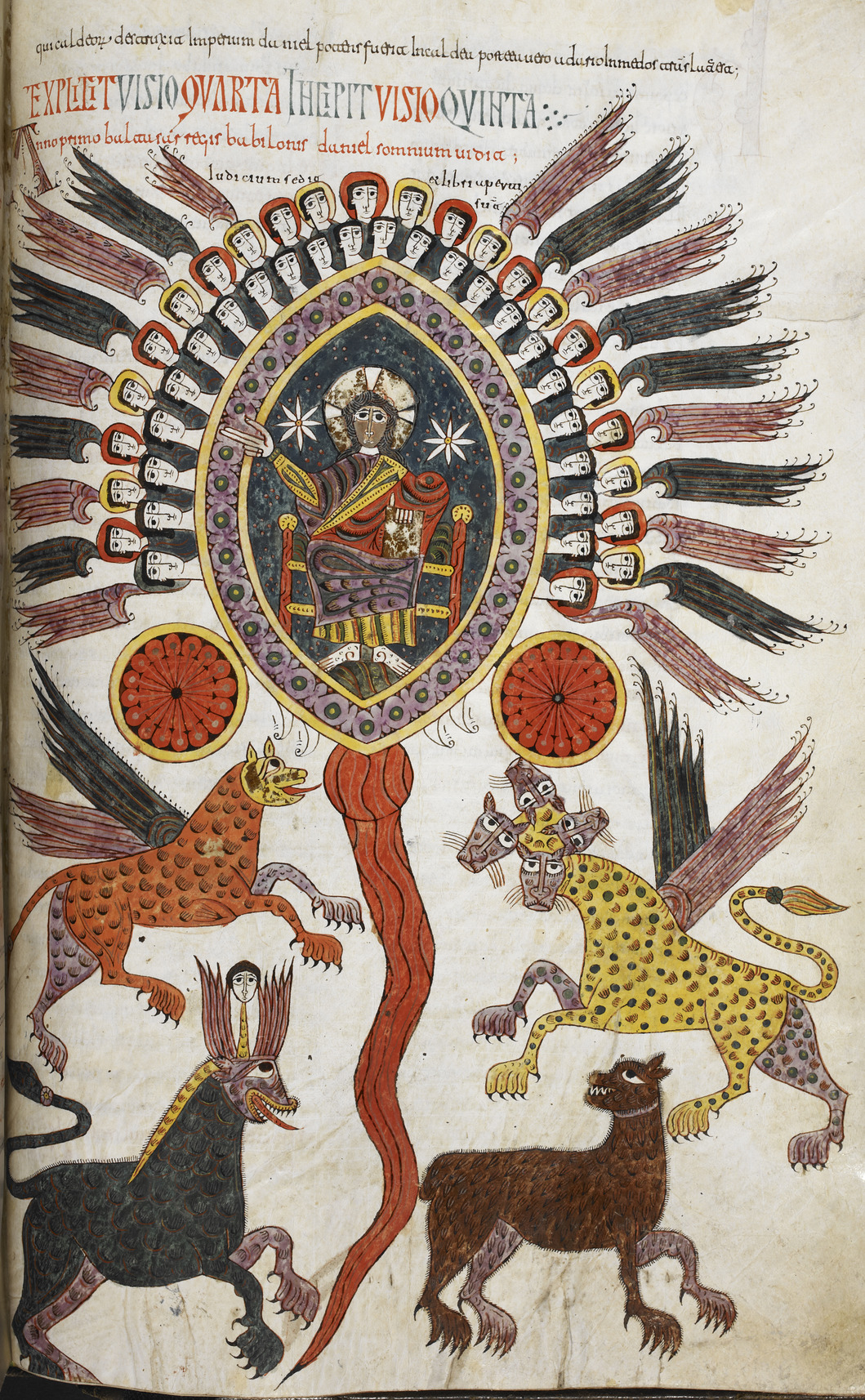
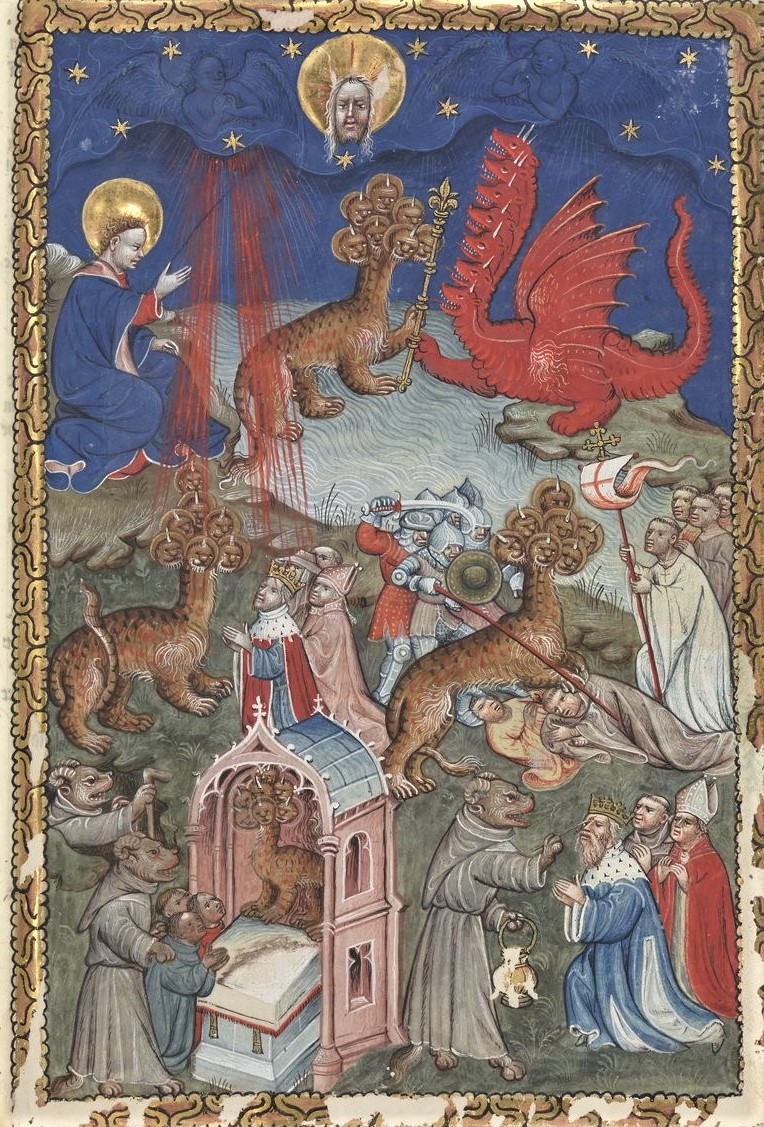
The Book of Revelation presents the primary antagonist as a horrible red dragon, which is clearly the devil. However, this red dragon gives birth to two beasts that persecute the Church, one from the land and one from the sea. The two beasts can be seen as the unbelieving Jews (the beast from the land (the Promised Land)) and Rome (the beast from the sea (a common symbol of the Gentiles)). This is the double threat experienced by the early Christians.
Both these beasts emerged from a “red dragon” with 7 heads (there were 7 Herods) and ten horns (there were ten Caesars who interacted with the 7 Herods). Thus, a complex, two-fold enemy seems to be described.
This lines up well with the the historical context of the time leading up to 70 A.D., when two enemies conspired against the early Church. Ultimately, as the Book of Revelation also describes, these two beasts turn on one another, and the harlot is destroyed.
In Revelation 17 the complex, two-fold enemy is described as a beast and a harlot. The harlot city rides upon the beast. The beast later turns and devours the harlot with fire and total destruction. This in fact happened when Rome (which had a partnership with Jerusalem through the Herodian dynasty) turned against Jerusalem.
The year 70 A.D. was a crucial one for the city of Jerusalem, for that marked the end of the war with the Romans. In this year, Jerusalem was sacked and burned, and the Temple was destroyed. Not one stone was left on another and the entire area (except for a few dwellings on Mt. Zion) was abandoned. Survivors were either carried into slavery or killed. According to the Jewish historian Josephus, 1.2 million Jews lost their lives.
Thus, the Book of Revelation seems to describe an enemy of the early Christians that is a complex combination of two enemies who conspire against the early Church and later turn on each other. This was historically the fact at the time of 70 A.D., when the Jews and Rome went to war against each other.
8. It flows well from the fuller context of the New Testament.
A central reason for leaning toward a date prior to 70 A.D. for the writing of Revelation is that such timing better fits into the context of the persecutions being endured by the Christians as described in other New Testament books. In those accounts, the persecution comes more from fellow Jews than it does from Romans alone.
This minority view seeks to integrate the Book of Revelation within the same conflict of other New Testament books such as the Epistles and the Acts of the Apostles—namely, a dispute between Christians and their Jewish opponents, who then engage the Roman officials for redress—rather than to set Revelation as a conflict merely between Christians and pagan Rome.
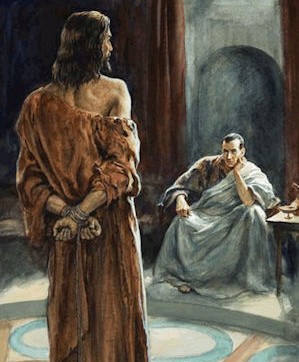
Jesus was put to death by the Romans (specifically, Pontius Pilate), but this was due in large part to their provocation by Jesus’ fellow Jews. Peter, John, and Paul all suffered as a result of similar behavior by their Jewish brethren, who incited the concern and hostility of Roman officials. The general context of the early New Testament period is that Jews who did not accept Christ stirred up trouble for the early Church and provoked the Roman authorities to arrest, punish, and even kill early Christians. The minority position sees this as the primary historical context of the persecutions described in the Book of Revelation.
Through the bulk of the New Testament the antagonists are fellow Jews who do not accept Christ as the Messiah. It is they who involve Roman authorities in exacting punishment on Christians. Although these Roman officials are often hesitant to become involved, they are not thereby absolved of responsibility any more than Pilate can be absolved for his actions. Notice the consistent biblical context of the double enemy face by Christians:
It was fellow Jews who handed Jesus over. In particular, it was Jews who had much invested in the Temple and its rituals who felt most threatened by Him who handed Him over. Pilate, though unjust in his final action, was reluctant and it was only when he perceived that the Jewish leaders would incite a riot that he relented and had Jesus put to death.
In the Acts of the Apostles, it is always fellow Jews who attack and pursue Paul. The Romans, far from being Paul’s enemy are in fact his protectors on more than a few occasions. Even when the Romans do arrest Paul, it is once again due to the insistence of Paul’s fellow Jews and the threat of civil unrest. The final arrest of Paul centered on a perceived defilement of the Temple that he supposedly committed. This was not in fact the case but was the pretext by which the Jewish leaders of Jerusalem handed him over.
In the Epistles of Paul, once again it is fellow Jews and Judaizers (so-called Christians who wanted to bring the whole of Jewish ceremonial law into the Church and make it binding on all Christians) who are the real enemies. Paul does not preach social unrest against Roman authority (nor did Jesus). In fact, Paul counsels respect for authority and prayers for all in authority. Likewise, Jesus strongly resists any attempts to be drawn into political zealotry and any conception of the Messiah that would understand Him as military savior.
None of this is to say that the New Testament is anti-Semitic. Remember, most of the early converts were Jews; Jewish Christians made up a sizable percentage of the early Church. This was not a matter of ethnic hatred but of a clear distinction between those who would accept Jesus as Lord and those who would not. The division was not a mere intellectual debate; it was a volatile clash between radically different answers to the basic questions, Who is God? Who is supreme? Who is to be worshiped?
It seems unlikely that the ongoing context of the New Testament would change radically in Revelation, its final book. All along, the context was of the passing away of the old order of the Law and the Temple and the passionate fear and hatred this caused. It seems much more probable that the final book of the Bible would prophesy the conclusion to this clash.
9. It takes the frequent use of the word “soon” in the Book of Revelation more literally.
Throughout the Book of Revelation, the events described are said to take place “soon.” For example,
The revelation of Jesus Christ, which God gave him to show to his servants what must soon take place; and he made it known by sending his angel to his servant John (Rev 1:1).
Blessed is he who reads aloud the words of the prophecy, and blessed are those who hear, and who keep what is written therein; for the time is near [i.e., soon] (Rev 1:3).
[To the church at Ephesus] Remember then from what you have fallen, repent and do the works you did at first. If not, I will come to you and remove your lampstand from its place, unless you repent (Rev 2:5).
Repent then. If not, I will come to you soon and war against them with the sword of my mouth (Rev 2:16).
I am coming soon; hold fast what you have, so that no one may seize your crown. He who conquers, I will make him a pillar in the temple of my God; never shall he go out of it, and I will write on him the name of my God, and the name of the city of my God, the new Jerusalem which comes down from my God out of heaven, and my own new name. (Rev 3:11).
Behold, I am coming soon, bringing my recompense, to repay every one for what he has done (Rev 22:12).
He who testifies to these things says, “Surely I am coming soon.” Amen! Come, Lord Jesus! (Rev 22:20)
“Soon” can certainly be understood from God’s perspective, one that sees a watch in the night (4 hours) as equivalent to “a thousand years,” but we ought not dismiss that the “soon” referred to in Revelation might also have had a more literal meaning. As Jesus said in the Mount Olivet discourse, There are some standing here today, who will not taste death until they see all these things take place. For the early Christians, “soon” may well have meant 70 A.D., rather than the 20 or more years later put forth in the more well-accepted view.
10. The presumption in the majority view that Rome is the harlot city is problematic because Rome was never destroyed.
Rome was sacked many centuries after biblical times (in the late 4th and early 5th centuries), but it was never burned or destroyed as depicted in Revelation. Jerusalem, however, was destroyed and burned in 70 A.D., corresponding to the prophecies of the Book of Revelation (e.g., Rev 18:18 inter al).
To summarize, the minority view holds that the Book of Revelation is describing the clash between Jews and Christians (which drew in the Romans) and caused the persecutions against the Church described therein. Revelation is not merely a book describing Roman persecutions.
The placement of the writing of Revelation at a time just prior to 70 A.D. under Nero seems more likely to me (than the context of circa 90 A.D. under Domitian). The warlike and apocryphal events described in Revelation agree well with the historical events that led up to the destruction of the Temple and the full establishment of the Church as the new locus of the worship of God. To me, this is the more likely and immediate context of the Book of Revelation.
For all these reasons, as well as others not set forth here, the minority view seems to me to be quite plausible.
This does not mean that there is no value in the majority opinion (namely, that the beast (harlot) is Rome and the context is a Roman persecution of the Church). It would be wrong to casually dismiss what is the majority view. What I have presented here is still described as a minority view.
I have come to appreciate that the minority view enables us to have a far richer understanding of the Book of Revelation, because it sees the Book of Revelation as an integral part of the whole Bible rather than as an apocalyptic work radically standing apart from the other biblical views.
Consider well the possibilities of the minority view of Revelation. Fundamentally, this view roots the Book of Revelation more solidly in the rest of biblical tradition and maintains the focus on the biblical city of Jerusalem and the context of faith, rather than on the pagan city of Rome to which the early Church looked with evangelical mission and a gleeful expectation of destruction.
Surely, as with any minority view, as you ponder it, you may be troubled by the fact that it unsettles what seems more familiar. I have come to believe that it is a more compelling interpretation than the more widely accepted one. What do you think?
By the way, David Chilton has written quite thoroughly on this theory of the Book of Revelation in his book Days of Vengeance. More information on the book is available here.