The video below is a 2008 Coca-Cola commercial that takes up the theme of the star of Christmas.
Let us review the impact that the star of Christmas had on the wise men, the Magi.
The star moved them to seek meaning outside themselves; it made them look out and up.
The star called them beyond what was familiar in their own country and world and expanded their horizons toward Christ and His Kingdom.
The star summoned them to seek Christ, and when they found Him, to worship Him.
The star drew them to be generous to a poor family in Bethlehem; they made sacrifices as they lay costly gifts of gold, frankincense, and myrrh before the Lord.
The star roused them to conversion; they “returned to their country by another route,” following the straight and narrow path rather than the wide and destructive one.
Yes, no one encounters Jesus Christ and goes away unchanged. A blind man went away able to see, the deaf to hear, the lame to walk. The hungry went away satisfied, the ignorant instructed, the guilty forgiven, sinners converted.
The call of the nations to change and to new life began with a star. The light of the star opens the way to the Light of World, Jesus. The star of my life is Jesus.
In the commercial below we see Santa (a name that means “Holy One”) sending forth a star, one that touches people and radiates a light that transforms them.
A woman sees the light of that star and is able to forgive her husband and be reconciled with him.
A young soccer player sees the light of that star, surrenders his pride, and steps aside to let another share in and get a shot at glory.
A young girl sees the light of that star and, giving up some of her own beauty, seeks to beautify a public park for others.
A museum guard sees the light of that star and shows mercy to the guard dog with him (this was a silly one).
A father sees the light of that star and allows his son a moment of growth.
Yes, there is something about that star that changes everyone who looks at it. They become more forgiving, more gracious, more aware of others, more connected to others, more loving. The light of the star, and the light of the world, is Jesus. His light is meant to have that same effect—and more besides.
In the background of the commercial an old Elvis song plays: “Wise men say only fools rush in, but I can’t help falling in love with you. Shall I stay? Would it be a sin if I can’t help falling in love with you?”
Of course the love that is symbolized by the star is not the romantic love of the song but the brotherly and agape love that Christ gives. Like the Magi who found Christ by the star, no one sees the star of Jesus and encounters Him and then goes away unchanged. Indeed, if we authentically encounter Christ, we are equipped to love, just as the people in this commercial are. We are equipped to forgive, to bring healing, to help others find strength and glory in the truth, and to come to full maturity in Christ. A person who knows Jesus and has encountered Him cannot help loving others, not in some merely sentimental way, but with a strong and vigorous love rooted in the truth. This is the same love that Jesus has for us all.
At the end of the commercial is an exhortation in Spanish that translates as follows: “Give the world the best of you.” The best of me is Jesus.
Anthony Esolen recently wrote a piece about the beauty of the older poetic and metrical hymns as compared to many modern asymmetrical and syncopated songs. I wrote a post about the beautiful hymn “Rorate Caeli Desuper” yesterday.
The hymn writers of old knew that in order to get a large congregation to sing together, a steady beat or meter was needed. Most modern church songs have complex, uneven rhythms. It is no wonder that many Catholics just stand there while cantors and choirs sing for them. For if the trumpet give an uncertain sound, who shall prepare himself to the battle? (1 Cor 14:8) The lyrics of most modern church songs are also far from noble or memorable; some of them are even theologically questionable.
In his article, Esolen provides excerpts of several beautiful older hymns, some well-known, others less so, but all magnificent.
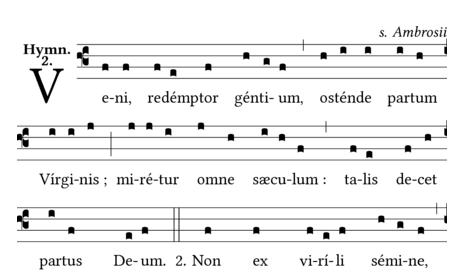
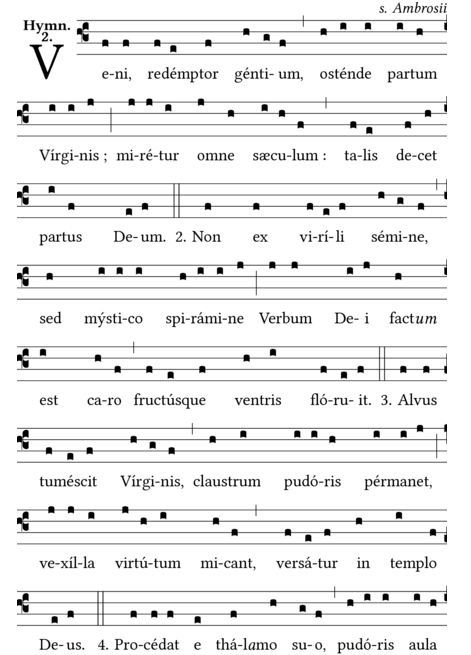
For my money, the best hymn ever composed from the standpoint of textual and theological value is Veni Redemptor Gentium (Come Redeemer of the Nations), written by St. Ambrose in the 4th century. It is more widely known by the title “Come Thou Redeemer of the Earth.” Although is from the Advent season, its sweep is the full soteriological drama of Christ’s work. Jesus is not just coming; He’s redeeming, dying, rising, ascending, and reigning at the Father’s right hand. How can you all of that be squeezed into an Advent hymn? Read the lyrics below and see.
One of the beautiful things about the ancient Latin hymns is how richly theological they are. Not content to merely describe an event, they give an extensive theological vision and delve into its more hidden mysteries. Too often, we see the events of our redemption in a disconnected sort of way, but it is all really one thing and the best theology connects the dots. It is not wrong for us to focus on one thing or another, but we must not forget that it is all one thing in the end.
Without this reminder, we can easily develop a kind of myopia that overemphasizes one aspect of redemption at the expense of others. In the 1970s and 1980s it was “all resurrection all the time,” but no passion or death.
Christmas, too, has its hazards. We get rather sentimental about the “baby Jesus” but miss other important aspects of his incarnation. The passion and death are present in His birth into homeless poverty, the swaddling clothes, the flight into Egypt, and so forth. The Eucharist is evident in His birth at Bethlehem (House of Bread) and His being laid in a manger (a feed box for animals). His glory as God and His ultimate triumph are manifested in the star overhead and the angels’ declaration of glory! You see, it is all tied together, and the best theology connects the dots.
With that in mind, I present this wonderful Advent hymn, my candidate for the best hymn ever written. It can be sung to any long meter (LM) tune but is usually sung to its own melody (Puer Natus). You can find this melody in the index of most hymnals. I provide below only the English translation, but both the Latin and the English are available in this document: Veni Redemptor Gentium. I think the poetic translation reprinted below is a minor masterpiece of English literature. Enjoy this sweeping theological vision of the mystery of Advent caught up into the grand and fuller vision of redemption.
Among the theological truths treated in this brief hymn are these: His title as Redeemer, His birth to a virgin, His inclusion of the Gentiles, His sinlessness, His two natures in one person, His incarnation at conception, His passion, His death, His descent into Hell, His ascension, His seat at the Father’s right hand, His divinity and equality with the Father, His healing and sanctification of our humanity so wounded by sin, His granting us freedom and eternal life, His renewing of our minds through the light of faith, and His opening of Heaven to us.
Not bad for a mere seven verses! St. Ambrose, pray for us!
Come, thou Redeemer of the earth,
Come manifest thy virgin birth:
All lands admire, all times applaud:
Such is the birth that fits our God.
Forth from his chamber goeth he,
That royal home of purity,
A giant in twofold substance one,
Rejoicing now his course to run.
The Virgin’s womb that glory gained,
Its virgin honor is still unstained.
The banners there of virtue glow;
God in his temple dwells below.
From God the Father he proceeds,
To God the Father back he speeds;
Runs out his course to death and hell,
Returns on God’s high throne to dwell.
O Equal to thy Father, thou!
Gird on thy fleshly mantle now;
The weakness of our mortal state
With deathless might invigorate.
Thy cradle here shall glitter bright,
And darkness breathe a newer light,
Where endless faith shall shine serene,
And twilight never intervene.
All laud, eternal Son, to thee
Whose advent sets thy people free,
Whom with the Father we adore,
And Holy Ghost, for evermore.
The video below gives you an idea of what the melody for Veni Redemptor Gentiumsounds like. The words in this version are slightly different from what is shown above, but the tune is perfect.
One of the less-well-known Advent hymns is “Rorate Caeli Desuper” (Heavens, drop dew from above). It is a plaintive hymn that recalls our desperate need for a savior and concludes with consolations from God, who has heard our cries and hastens to save us.
The refrain, which comes from Isaiah 45:8, is shown below in both Latin and English:
Roráte caéli désuper, (Heavens, drop dew from above) et núbes plúant jústum. (and let the clouds rain forth justice).
This is an image for the gentle work of the Holy Spirit. The Spirit works subtly like the dewfall and more boldly like rainfall to bring forth Him who is our justice. For indeed, dew and rain are symbols of life, vigor, and/or providence. Water is also a symbol of the Holy Spirit. The Archangel St. Gabriel told Mary, The Holy Spirit shall come upon you, and the power of the most High shall overshadow you. And therefore also the Holy which shall be born of thee shall be called the Son of God (Luke 1:35). Like a gentle dewfall, the Holy Spirit overshadows Mary and quietly she conceives; He who is our justice begins to dwell among us.
The rains that come forth from the clouds also are an image of God’s work in the Incarnation. Isaiah 45:8 continues by saying, Let the earth open up that salvation may sprout and righteousness spring up with it; I, the LORD, have created it. As God’s grace comes forth like rain from the clouds, truth shall spring up from the earth (see Psalm 85:11). Indeed, we are of the dust of this earth, and as the Lord tabernacles Himself in flesh in the womb of the Blessed Mother, justice and truth spring up from the earth as well. Both the quiet dewfall and the rain bring forth Him who is our justice and truth.
The need for this saving work of God is set forth in the verses that follow. (The Latin and English can be seen side by side here: Rorate Caeli Disuper.)
Be not angry, O Lord, and no longer remember our iniquity:
Behold, the holy city is made a wilderness,
Sion is deserted, Jerusalem a desolation:
the house of your holiness and your glory,
where our fathers praised thee.
The next verse says that our sins have caused this:
We have sinned, and are as an unclean thing,
and we fall as do all the leaves:
and our iniquities, like the wind, have taken us away:
thou hast hid thy face from us: and hast consumed us,
because of our iniquities.
We are fallen like the leaves and the winds carry us away. We cannot see the Lord because we are blinded, consumed, and withered by our sins.
In the next verse, we cry to God to send a savior and shepherd to rescue us:
Behold, O Lord, the affliction of thy people,
and send forth him whom thou wilt send;
send forth the Lamb, the ruler of the earth,
from Petra of the desert to the mount of daughter Sion:
that he may take away the yoke of our captivity.
God responds to our cries:
You are my witnesses, saith the Lord,
and my servant whom I have chosen;
that ye may know me and believe me:
I, even I, am the Lord,
and beside me there is no Savior:
and there is none that can deliver out of my hand.
Not only do I save you, says the Lord, but you shall then be my witnesses to draw others to me; I alone can save.
Then comes the great consolation and promise:
Comfort ye, comfort ye my people;
your salvation shall suddenly come:
why wilt thou waste away in sadness?
why hath sorrow seized thee?
Fear not, for I will save thee:
For I am the Lord thy God,
the Holy One of Israel, thy Redeemer.
Such a beautiful hymn, with its image of the dewfall and the rain symbolizing the Holy Spirit; with its image of Jesus our Savior as justice and truth springing forth from Mary’s womb and, by extension, from the earth! Such beautiful verses, setting fort our pitiful condition, giving voice to our cries, and ushering in the consolations and promises of our God!
Here is a simple, hauntingly beautiful version of the hymn in Gregorian Chant. (Note that the hymn tune is different from that of the antiphon for the Fourth Sunday of Advent.)
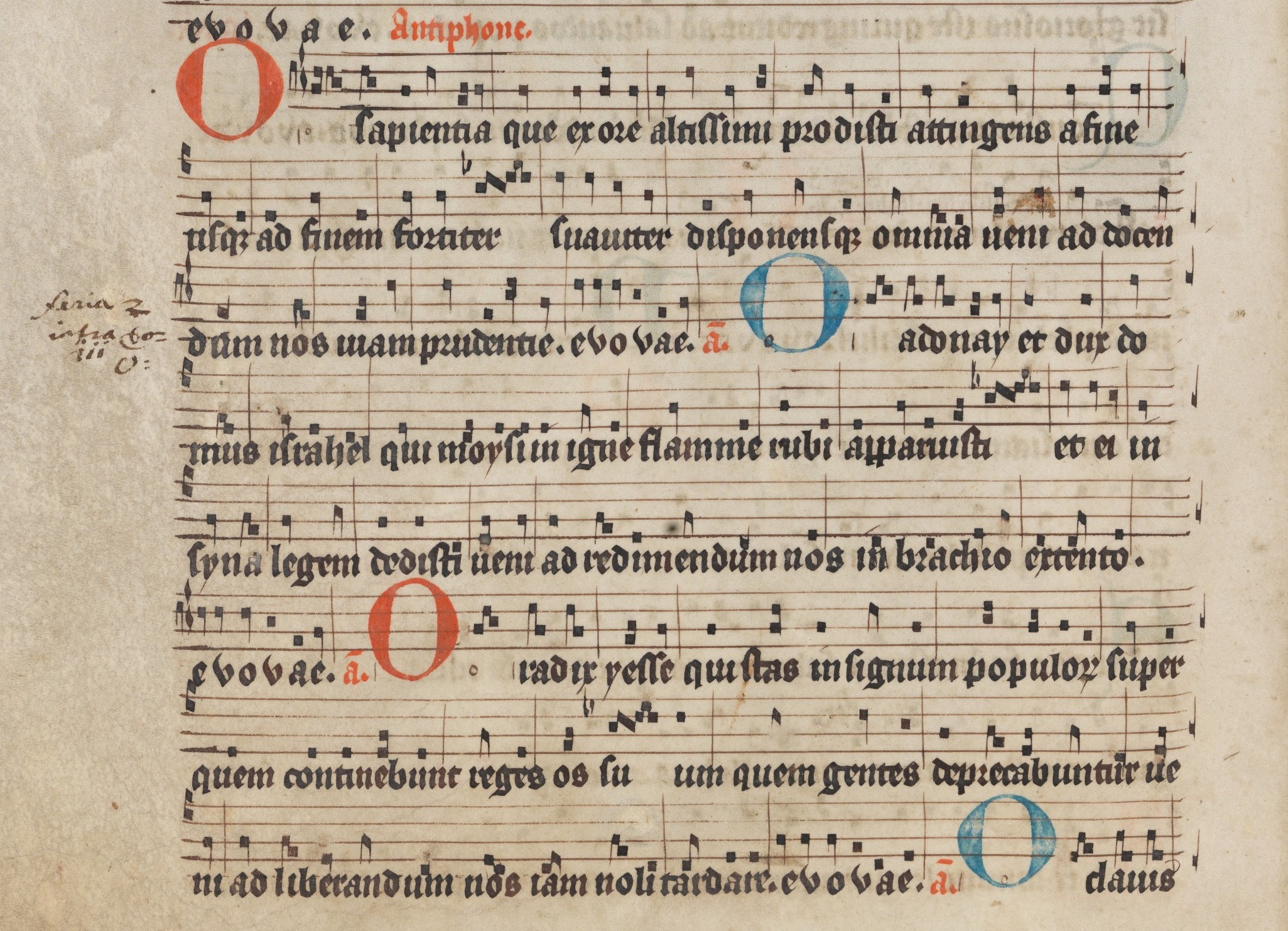
The Catholic Church has been singing the “O Antiphons” since about the 8th century. They were first composed as antiphons to accompany the singing of the Magnificat in Vespers of the Divine Office. They were composed for the last week of Advent, December 17th – 23rd.
They are a compact and beautiful theology that draws on biblical themes of the Old Testament. As such, they proclaim the coming Christ as the fulfillment of Old Testament prophecies and hopes. They also express current longings rooted in those themes. And although the prophecies are fulfilled, they remain an ever-longing aspect of all human hearts.
In these antiphons, note the repeated use of both the expression “O” and the word “come.”
These antiphons are memorably and poetically reworked in the beautiful and well-known hymn “O Come, O Come, Emmanuel,” which is included at the end of this post.
What follows here is less a scholarly presentation than a devotional reflection. Others have undertaken well the work of exploring the biblical roots and traditions. While I do not wholly ignore that, this is a modest and devotional meditation in joyful preparation for Christmas and in hopes of helping others to find joy and exhortation in these laconic and beautiful teachings. Let’s look at each of the antiphons in turn.
Dec 17: O Wisdom that comes out of the mouth of the Most High, that reaches from one end to another, and orders all things mightily and sweetly, come to teach us the way of prudence.
O Sapientia, quæ ex ore Altissimi prodiisti, attingens a fine usque ad finem, fortiter suaviterque disponens omnia: veni ad docendum nos viam prudentiæ.
The antiphon here is a brief summary of the wisdom tradition of the Bible. This wisdom, which comes forth from the mouth of God, orders all things mightily.
Notice that the antiphon says that wisdom orders all things. This refers to the obvious fact that there is an order in all of creation. Things work together intricately on many levels. The microscopic level of atoms, molecules, and cells is the foundational matter of an amazing interplay of delicately balanced realities that make possible complex systems of higher life and matter.
Our own bodies bespeak amazing organization in the interplay of the endocrine system, the nervous system, the lymphatic system, muscular and structural parts, and amazingly sophisticated organs such as the eyes and ears, not to mention the brain.
All around us are ecosystems that both support and enable life. There is photosynthesis, amazing weather patterns, and further above us, the Van Allen belts magnetically deflecting the harmful rays of the sun while letting in the helpful ones.
Add to this the beautiful balance of our solar system: the earth being just where it needs to be to permit enough warmth but not too much. Nearby, too, there are comet-catchers like Jupiter and Saturn in the asteroid belt keeping most of the asteroids at bay.
All of this magnificent interplay of systems, this balance and design, is what the wisdom tradition extols, and what the antiphon describes as coming forth from the mouth of God to order all things mightily and sweetly.
The book of Sirach, which announces the glory of God’s creation from 42:15 through 43:35, expressively says at its conclusion, Beyond these, many things lie hid; only a few of God’s works have we seen (Sirach 43:34).
St. Paul takes up the wisdom tradition when he says, For God’s invisible attributes, namely, his eternal power and divine nature, have been clearly perceived, ever since the creation of the world, in the things that have been made (Rom 1:20).
St. John takes it up when he writes in the prologue, In the beginning was the Word, and the Word was with God, and the Word was God … All things were made through him, and without him was not any thing made, that was made (Jn 1:1-3). And that word, the Logos, became flesh and dwelt among us. For indeed, God spoke all thinking to being through His word (e.g., Let there be light and there was light). And this Logos conveys a logic (logike) on and in all created things.
The hymn of the Letter to the Colossians says regarding Jesus, the Word made Flesh, For by him all things were created, in heaven and on earth, visible and invisible, whether thrones or dominions or rulers or authorities—all things were created through him and for him. And he is before all things, and in him all things hold together (Col 1:16-17).
This, then, is the great wisdom tradition so beautifully expressed in the antiphon.
Dec 18: O Adonai, and Ruler of the house of Israel, Who didst appear unto Moses in the burning bush, and gave him the law in Sinai, come to redeem us with an outstretched arm!
O Adonai, et Dux domus Israel, qui Moysi in igne flammæ rubi apparuisti, et ei in Sina legem dedisti: veni ad redimendum nos in brachio extento.
This antiphon speaks of Jesus as Lord and Ruler. We shall ponder him as ruler and king in another antiphon below.
But here, note the description of the Lord particularly in the aspect of fire. The first aspect of fire is explicit, in the burning bush that Moses encountered. The second image is less explicit, speaking of Moses up on the mountain receiving the law. The great theophany on Sinai’s heights was described in a fiery sort of way in Exodus 20:18-20 as being almost like a volcano. There are clouds, fire, lightning, and trumpet blasts as Moses goes up on the mountain. The people below are terrified; they instinctively realize that they cannot even touch the base of the mountain because they are not worthy or holy enough to be in God’s fiery presence.
Scripture speaks of God as a consuming fire (Heb 12:29, Psalm 18), a holy fire, and, most productively for us, as a refining fire (Mal. 3:2). As a refining fire, He shall burn away impurities so that we may one day be able to stand before Him with hands raised up praising Him who has redeemed us with strong hand and outstretched arm.
It is no accident that the Holy Spirit descended in the form of tongues of fire. The Holy Spirit enters us as fire to bring us up to the temperature of glory, burning away sinfulness, refining us as pure gold, enabling us to endure the blazing fire of God’s love.
Dec 19:O Root of Jesse, which stands for a sign over the people, at Whom the kings shall shut their mouths, Whom the Gentiles shall seek, come to deliver us, do not tarry.
O Radix Jesse, qui stas in signum populorum, super quem continebunt reges os suum, quem Gentes deprecabuntur: veni ad liberandum nos, jam noli tardare.
This antiphon stresses the historical roots of the Gospel in and among the Jewish people, whom God chose long ago to be the root, the vine, and eventually the very cradle of His saving love for all the nations.
The root of Jesse here (in accord with Isaiah 11) speaks of the Jewish people, of whom Jesus said and affirmed, “Salvation is from the Jews” (John 4:22).
And yet, as countless prophecies also disclosed, there would come a day when the Gentiles would also be joined to the saving plan of God and receive their Messiah from and through the Jewish people. In Romans 11:17 St. Paul speaks of the Gentiles as being like wild olive shoots grafted onto the olive tree, onto the vine of Israel. In this way all Israel will be saved, believing Jews and Gentiles together, grafted to the one vine, made members of the one Body of Christ. And Christ Himself joined the family of Jesse; He is a member of our own family tree!
This, then, is an antiphon that speaks to family ties and history. The Gospel is not located up in the skies; it is down-to-earth; it is among us by God’s grace. He is from us in His human roots and surely is also for us.
Dec 20: O Key of David, and Scepter of the house of Israel, that opens and no man shuts, and shuts and no man opens, come to liberate the prisoner from the prison, and them that sit in darkness.
O Clavis David, et sceptrum domus Israel; qui aperis, et nemo claudit; claudis, et nemo aperit: veni, et educ vinctum de domo carceris, sedentem in tenebris, et umbra mortis.
A key bespeaks access, and the one who holds the keys has the power to give or refuse admittance.
After original sin, we could no longer endure the presence of God; we were mercifully excluded from the garden, now guarded by an angel with the flaming sword (Gen 3:24). We could not, on our own, ever hope to regain access to the Father. There was no way for us, in our sinful state, to tolerate the holiness of God.
Thus the prophet Malachi memorably asked, But who may abide the day of his coming, and who shall stand when he appears? Malachi went on to answer that only when God acted as a refining fire could we be pure enough to endure or abide His presence (Mal 3:3ff). And this Jesus did for us on the cross, purifying us with His own blood, with the fire of His love.
Therefore, it is Jesus who holds the key to open so that no one can close, to close so that no one can open (Rev. 3:7). He alone restores us access to His Father. He opens the gates, not of some earthly paradise, but of Heaven itself. And how beautifully this is shown in the rending of the curtain in the sanctuary from top to bottom.
Yes, Jesus holds the keys to the kingdom. He alone can grant access to the heart of His Father.
Both the keys and the mention of His scepter are reminders of His authority. One day we will stand before Him who will judge us. He alone will grant access, opening so that no one can shut. He alone will deny access to those unfit and incapable of the kingdom, closing so that no one can open.
Dec 21: O Morning Star, Brightness of the everlasting light, and Sun of justice, come to give light to those sitting in darkness and in the shadow of death.
O Oriens, splendor lucis æternæ, et sol justitiæ: veni, et illumina sedentes in tenebris, et umbra mortis.
The Latin word used here, oriens, literally and most simply means “the East.” More politically and allegorically it can be translated “morning star,” “the dawn,” “Daystar,” “morning light,” “sunrise,” etc.
Christ is the light of the world. And He will come again from the East. Scripture says in numerous places that Christ will appear from the East:
For as the lightning comes from the east and shines as far as the west, so will be the coming of the Son of man (Mt 24:27–28).
Look toward the east, O Jerusalem, and see the joy that is coming to you from God! (Bar 4:36)
Afterward he brought me to the gate, the gate facing east. And behold, the glory of the God of Israel came from the east; and the sound of his coming was like the sound of many waters; and the earth shone with his glory. And the vision I saw was like the vision, which I had seen when he came to destroy the city, and like the vision, which I had seen by the river Chebar; and I fell upon my face. As the glory of the LORD entered the temple by the gate facing east, the Spirit lifted me up, and brought me into the inner court; and behold, the glory of the LORD filled the temple (Eze 43:1–5).
Sing to God, ye kingdoms of the earth: sing ye to the Lord: Sing to God, who mounts above the heaven of heavens, to the east. Behold he will give to his voice the voice of power: give ye glory to God for Israel, his magnificence, and his power is in the clouds! (Psalm 68:32-34)
Until relatively recently, the Church faced to the East to pray. Doing so is a way of turning toward God and looking for Him and to Him. Where the altar could not be situated facing East according to the compass, the crucifix became a kind of liturgical East. Everyone would face the same way to pray, especially during the Eucharistic prayer.
The Latin word oriens is also the root of the English word “orientation.” To be oriented means to be properly directed, to be facing in the correct direction.
To say the least, the modern practice of the priest facing the people to pray the Eucharistic prayer is historically flawed. It amounts to a departure from a centuries-old practice and instinct, going all the way back to Old Testament times. Increasingly in the Church today there is a desire by some to “re-orient” the liturgy, literally and figuratively, so that all face the liturgical East during the Eucharistic prayer. On altars that face the people, Pope Benedict encouraged the placement of the crucifix, and he encouraged the clergy to instruct the people that we are really gathered around the cross more so than facing one another. Our focus is to be on God at this moment not one another.
The antiphon goes on to speak of the Lord Jesus as the light of the world and begs Him to shed light on all of us who are in darkness and in the shadow of death. Indeed, Christ alone is the true light of the world and the lamp of the city of God!
The Lord wants His light to shine in this world! In the Sermon on the Mount, Jesus indicates that He wants His light to shine through us. In this way, in a subordinate sense, we are to be the light of the world (cf Matt 5:14) as Christ shines through us.
But O, the darkness, when Christians do not allow the light of Christ’s truth, His teachings, and His call to repentance and healing to shine through us! One may wonder how the world has become so dark today. The answer is not far away; look around. This is happened on our watch. Too many Christians have sheepishly hidden their light under a bushel basket.
O come Lord Jesus, O Daystar rising in the East, remove whatever hinders us from allowing your light to shine through us. Remove the fear. Remove the aversions. Cleanse us of our sins, which, like soot on glass, do not allow the light to go through. Come, Jesus, light of the world, shine in this world and through us.
Dec 22: O King of the Gentiles, and desire of them, Cornerstone, that makes of two one, come to save man, whom Thou hast made out of the dust of the earth!
O Rex Gentium, et desideratus earum, lapisque angularis, qui facis utraque unum: veni, et salva hominem, quem de limo formasti.
This antiphon calls Jesus “King.” Is He our king? Does He call the shots or is there someone else we obey? Do you and I obey Christ? Do we allow His thoughts to replace ours? Are His priorities, thoughts, and teachings ours as well?
Jesus Christ told Pontius Pilate that His kingship was about the fact that He came to bear witness to the truth, and that those who were of the truth would listen to His voice. See the connection between faith, kingship, and obedience to the truth that Christ, as King and teacher, proclaims to us!
The antiphon goes on to refer to Christ as the cornerstone. And while in our experience cornerstones tend to be more ceremonial, the cornerstone of a building is critical; the walls above rest on it. Therefore, a cornerstone has to be true, perfectly cut, reliable, sturdy, and firm. Jesus and His teachings are this for us; He is the cornerstone, the foundation on which we stand. And Peter is His vicar. Christ calls Peter the rock on which He will build His Church. Are you standing on the solid rock of Christ’s teachings or on the shifting sands of this world?
The antiphon also says that Christ is the desire of the nations. All of our desires that we think can be fulfilled by worldly things are really pointing to the Lord, who alone can fill the God-sized hole in our hearts. No one but the Lord can really and ultimately satisfy us. Sadly, though, we always think that just one more drink, just a little more money, just one more thing will fulfill us and make us happy. It will not. Christ really is your desire.
Are you and I in touch with this? Or do we think that just one more drink, just one more thing will do it?
Dec 23: O Emmanuel, our King and our Law-giver, Longing of the Gentiles, and their Savior, come to save us, O Lord our God!
O Emmanuel, Rex et legifer noster, exspectatio gentium, et Salvator earum: veni ad salvandum nos Domine Deus noster
This last antiphon is a great summation of most of the antiphons that have preceded it. The Lord Jesus is summoned as king, lawgiver, the desire of the nations, Savior—indeed, God Himself with us. Come, Lord Jesus. Come, you who are God among us; come and save your people.
VENI veni, Emmanuel captivum solve Israel, qui gemit in exsilio, privatus Dei Filio.
R: Gaude! Gaude! Emmanuel, nascetur pro te Israel!
O COME, O come, Emmanuel,
and ransom captive Israel,
that morns in lonely exile here
until the Son of God appear.
R: Rejoice! Rejoice! O Israel,
to thee shall come Emmanuel!
Veni, O Sapientia, quae hic disponis omnia, veni, viam prudentiae ut doceas et gloriae. R.
O come, Thou Wisdom, from on high,
and order all things far and nigh;
to us the path of knowledge show,
and teach us in her ways to go. R.
Veni, veni, Adonai, qui populo in Sinai legem dedisti vertice in maiestate gloriae. R.
O come, o come, Thou Lord of might,
who to thy tribes on Sinai’s height
in ancient times did give the law,
in cloud, and majesty, and awe. R.
Veni, O Iesse virgula, ex hostis tuos ungula, de spectu tuos tartari educ et antro barathri. R.
O come, Thou Rod of Jesse’s stem,
from ev’ry foe deliver them
that trust Thy mighty power to save,
and give them vict’ry o’er the grave. R.
Veni, Clavis Davidica, regna reclude caelica, fac iter tutum superum, et claude vias inferum. R.
O come, Thou Key of David, come,
and open wide our heav’nly home,
make safe the way that leads on high,
that we no more have cause to sigh. R.
Veni, veni O Oriens, solare nos adveniens, noctis depelle nebulas, dirasque mortis tenebras. R.
O come, Thou Dayspring from on high,
and cheer us by thy drawing nigh;
disperse the gloomy clouds of night
and death’s dark shadow put to flight. R.
Veni, veni, Rex Gentium, veni, Redemptor omnium, ut salvas tuos famulos peccati sibi conscios. R.
Veni, veni, Emmanuel captivum solve Israel, qui gemit in exsilio, privatus Dei Filio.
O come, Desire of the nations, bind
in one the hearts of all mankind;
bid every strife and quarrel cease
and fill the world with heaven’s peace. R.
O Come, O come, Emmanuel,
and ransom captive Israel,
that morns in lonely exile here
until the Son of God appear.
To say that something is “necessary” is to declare that it is so essential that to be without it causes grave if not deadly harm. The word comes from Latin: ne– (not) + cedere (to withdraw, go away, yield). The root sense is that what is necessary is something from which we cannot stray, something from which there is no withdrawal, something we cannot evade. There is an expression in Latin, sine qua non, which literally means “without which not.” Its fuller meaning expresses something so essential that without it, other required things cannot proceed.
Do you see prayer in this way, as necessary, as essential? Do you view at something without which other things cannot happen? Sadly, it would seem that many do not. Prayer is something easily postponed. It’s something to be done if the mood is just right, or if we have an urgent need. It is seldom scheduled and easily skipped in favor of almost any other activity. We seem to be able find time for everything else, but prayer is easily set aside—I’m busy; I’m tired; I forgot; something came up.
These sorts of issues arise because most people don’t really view prayer as necessary.
But prayer is necessary. St. Augustine said, “God who made us without us, will not save us without us.” Jesus stands at the door and knocks (see Rev 3:21), but we must open the door of our heart for him to enter and feed us. Prayer is our way answering, of opening the door. Little else will happen until we open the door each day to Him.
This brief column is not intended as an exhaustive exposition on prayer. Rather, it is intended to remind us that we should see prayer as a necessity. To that end, here are just a few quick thoughts underscoring the essential nature of prayer.
Jesus said, This sort of demon can only be driven out by prayer (Mk 9:29). Those who do not pray and are not prayed over may suffer intractable demonic attacks.
Jesus said, Watch and pray so that you will not fall into temptation (Matt 26:41). Deadly temptations will certainly assail us if we do not pray. How can we expect to avoid serious temptations and Hell if we do not pray?
Jesus said that we must always pray and not lose heart (Lk 18:1). We must pray, we mustnot give way to discouragement.
James said, You have not because you ask not (James 4:3). How many gifts are lacking for us and others because we do not pray? Some gifts are only unlocked and sent forth by prayer.
John Chrysostom said, “As the body without the soul is dead, so the soul is dead without prayer” (Homily lxxvii). We are dead without prayer!
Augustine said, “God gives, without prayer, the first graces such as the vocation to faith and to repentance; but all other graces, and particularly the gift of perseverance, he gives only to those who ask them” (De Dono Persev, xvi). Notice that it is only to those who ask!
Thomas Aquinas said, “Now after baptism man needs to pray continually, in order to enter heaven: for though sins are remitted through baptism, there still remain the fomes (tinder) of sin assailing us from within, and the world and the devils assailing us from without. And therefore it is said pointedly (Luke 3:21) that ‘Jesus being baptized and praying, heaven was opened’: because, to wit, the faithful after baptism stand in need of prayer” (Summa Theologica, III, q. 39 art. 5).
St Teresa of Avila reasoned, “Ask and you shall receive … then he who does not ask will not receive.” Now that is some straightforward wisdom!
Alphonsus said, “He who prays is certainly saved; he who does not pray is certainly lost” (Considerations on the Eternal Maxims 13.2). Prayer is necessary! It is the sinequanon.
Pray, my brethren; pray. Pray for the gift of prayer. Pray for the desire to pray. Pray! Prayer is necessary; it is essential.
We do not always know everything we should pray for; we do not always remember to pray for everything. God knows our weakness. But failing to pray as a general norm is deadly to our life and our salvation.
The weather in Washington, D.C. was dismal on Saturday: more than two inches of rain. 2018 has now surpassed 1889 to become the wettest year since records have been kept. So far, more than 62 inches of rain have fallen this year; the annual average is only about 40 inches.
On this cold, rainy December morning, a group of us stood in front of a Planned Parenthood clinic in northeast D.C, just as we do on many Saturdays throughout the year. We prayed the Rosary and the Divine Mercy Chaplet. We sang some Christmas carols. We engaged in some sidewalk counseling. We called the “escorts” to conversion. These escorts try to shield the women entering the facility from having to hear the truth we speak and our pleas to reconsider their plans to abort their children. The escorts are trained to keep their eyes fixed forward and to avoid making eye contact with us. I say to them, “One day you will stand with us. We are praying for your conversion and for an anointed realization of what abortion really is.”
Earlier in the day I read a psalm from the Office of Readings that contained God’s lament of how lost and corrupted His people and nation have become.
The psalm begins with a reminder of the blessings the Lord lavished on His people:
O give thanks to the Lord for he is good:
for his love endures forever.
Who can tell the Lord’s mighty deeds?
Who can recount all his praise?
… He threatened the Red Sea; it dried up
and he led them through the deep as through the desert.
He saved them from the hand of the foe;
he saved them from the grip of the enemy.
The waters covered their oppressors;
Then they believed in his words;
then they sang his praises (Psalm 106:1-2, 9-12).
In the United States, we too have been blessed and favored.
The psalm continues with the lament of God (through the psalmist):
But they soon forgot his deeds
and would not wait upon his will.
They yielded to their cravings in the desert.
… They fashioned a calf at Horeb
and worshiped an image of metal,
exchanging the God who was their glory
for the image of a bull that eats grass.
They forgot the God who was their savior,
who had done such great things in Egypt,
such portents in the land of Ham,
such marvels at the Red Sea.
… Then they scorned the land of promise:
they had no faith in his word.
They complained inside their tents
and would not listen to the voice of the Lord.
… They bowed before the Baal of Peor;
ate offerings made to lifeless gods.
They roused him to anger with their deeds
and a plague broke out among them (Psalm 106:13-14, 19-22, 24-25, 28-29).
In the next part of the psalm comes the greatest darkness of all:
… They worshiped the idols of the nations
and these became a snare to entrap them.
They even offered their own sons
and their daughters in sacrifice to demons.
They shed the blood of the innocent,
the blood of their sons and daughters
whom they offered to the idols of Canaan.
The land was polluted with blood.
So they defiled themselves by their deeds
and broke their marriage bond with the Lord (Psalm 106:36-39).
Yes, so evil did their hearts become that they sacrificed their own children on the altars of the pagan gods with whom they committed adultery. This is where we are today in the U.S. Some “celebrate” abortion and worship at the altar of “choice” and “sex without consequence,” even if others must die as a result.
I do not suppose that every patient who enters an abortion clinic fully understands the meaning of her plans or intends to worship Baal, but I believe that she will be traumatized as the life in her womb is either surgically removed or burned away through caustic chemicals. Perhaps she has been misled. Maybe she has been pressured by her parents or by the irresponsible “father” of the child. It is also possible that she coldly enters knowing full well what she does; that is for God to know. I only pray that when she does come to understand what she has done, she will not despair; the Church is still here for her through the Sacrament of Confession as well as Project Rachel and other support groups.
Collectively, we Americans know what we are doing. The science is clear that human life begins at the moment of conception. The Pro-life message is effective and clear. Our consciences are testifying to us. We know better and are better than this. We once forbade the killing of the innocent through abortion. This once Christian nation has forgotten the God who has blessed and saved us; we have scorned the promises of our own land.
God will not forever abide our rejection of His vision. The blood of the innocent cannot forever be silenced as they cry out to God from the soil of this blessed and rich land. One day soon God say to us,
What have you done? The voice of your brother’s blood is crying out to me from the ground (Gen 4:10).
In the Liturgy of the Hours each psalm has a New Testament verse to frame it. Psalm 106 is paired with this warning:
These things have been written for a warning for us, for we are living at the end of the ages (1 Corinthians 10:11).
Beware indeed; there will be a reckoning. Stand up now and choose sides. The Lord’s justice cannot be forever avoided. Perhaps He will delay, simply for the sake of the remnant who pray and witness against this killing, which is claimed the lives of more than 50 million children in the U.S. since the legalization of abortion in 1973.
Psalm 106 stood to warn an ungrateful and increasingly faithless people of the punishment that awaited them if they did not repent and end the infanticide as well irreligion and injustice within them. It can be no less for us, who have been even more blessed than they. God laments our condition more than we can know. In mercy He offers us time to convert, but injustice cannot forever continue. God will and must end this if we will not.
On a dreary, cold, rainy morning in D.C., both the weather and Psalm 106 speak ominously to our condition. What is the forecast for tomorrow? That depends on us.
In modern times, we tend to link our notions of happiness and inner well-being to external circumstances and happenstance. We think that happiness will be found when the things of this world are arranged in the way we like. If we can just accumulate enough money and creature comforts, we think we’ll be happy and have a better sense of mental well-being.
Yet many people can endure difficult external circumstances while remaining inwardly content, happy, and optimistic. Further, many who have much are still not content but rather are plagued by mental anguish, anxiety, and unhappiness. Ultimately, happiness is not about good fortune or circumstances; it is an “inside job.”
St. Paul wrote,
For I have learned to be content whatever the circumstances. I know what it is to be in need, and I know what it is to have plenty. I have learned the secret of being content in any and every situation, whether well fed or hungry, whether living in plenty or in want (Phil 4:11-12).
It is interesting to note that Paul wrote these words, as well as those of today’s second reading, from his jail cell! It’s not just a bunch of slogans.
In today’s second reading, Paul tells us the “secret” to his contentedness, to joy and mental well-being regardless of the circumstances. He gives us a plan that (if we work it) will set the stage for a deeper inner peace, a sense of mental well-being and contentedness that is not easily affected by external circumstances. Let’s review what St. Paul has to say as a kind of “five-point plan.” (I am indebted to Rev. Adrian Rogers for the alliterative list, though the substance is my own reflection.)
Here is the text of St. Paul’s “five-point plan” for better mental health:
Rejoice in the Lord always. I will say it again: Rejoice! Let your moderateness be evident to all. The Lord is near. Do not be anxious about anything, but in everything, by prayer and petition, with thanksgiving, present your requests to God. And the peace of God, which transcends all understanding, will guard your hearts and your minds in Christ Jesus. [Finally, brothers, whatever is true, whatever is noble, whatever is right, whatever is pure, whatever is lovely, whatever is admirable—if anything is excellent or praiseworthy—think about such things. Whatever you have learned or received or heard from me or seen in me—put it into practice. And the God of peace will be with you] (Phil 4:4-9).
Note that the final two sentences (shown above enclosed in [square brackets]) are not included in today’s liturgical proclamation, but I feel that they add to the overall picture so I include them here.
Step I. Rejoice in the Presence of the Lord – Rejoice in the Lord always. I will say it again: Rejoice! Let your moderateness be evident to all. The Lord is near.
Of supreme importance in the Christian life is requesting, receiving, and cultivating the gift of the Lord’s presence. We are too easily turned inward and become forgetful of God’s presence. To become more consciously and constantly aware of His presence is to be filled with joy and peace.
As an aside, note that the text mentions joy (χαίρω – chairoo) but also moderateness. The Greek word used is ἐπιεικὲς (epieikes), which means to be gentle, mild, forbearing, fair, reasonable, or moderate. Epieíkeia relaxes unnecessary strictness in favor of gentleness whenever possible. Such an attitude is common when one is joyful and unafraid. By contrast, an unbending and unyielding attitude often bespeaks fear.
There are of course times when one should not easily give way, but often there is room for some leeway and the assumption of good will. A serene mind and spirit, which are gifts of the presence of God, can often allow for this; there is an increasing ability to allow things to unfold rather than to insist on controlling outcomes and winning on every point.
The central point is that as we become more aware of God’s presence and thus more serene and less inwardly conflicted; we no longer need to shout others down or to win all the time. We can insist on what is true but can express ourselves more moderately and calmly. We are able to stay in the conversation, content to sow seeds rather than insisting on reaping every harvest of victory.
Cultivating a joyful sense of the presence of God and seeing the serenity and moderateness that are its fruits is a first step toward, and a sure sign of, better mental health and greater contentment.
Step II. Rely on the Power of the Lord– Do not be anxious about anything, but in everything, by prayer and petition … present your requests to God.
There are very few things as destructive to our mental health as worry. Worry is like sand in a machine. Not only does it hinder the workings of the machine, it damages it. Simply being told not to worry, though, isn’t very helpful. St. Paul is not simply saying, “Don’t worry.”
Paul has already laid groundwork for the diminishment of worry by telling us to cultivate a sense of the presence of God. When I was a young boy, my father left for the Vietnam War. During the year he was away, I spent many anxious nights worrying about a lot of things. As soon as my father returned, my fears went away. Daddy was home, and everything was all right.
To the degree that we really experience that God is near, many of our fears subside. My own experience is that as my awareness of God’s presence has grown, my anxieties have significantly diminished.
Paul also says that the power of God is only a prayer away. Here, too, I (and many others) can testify that God has a way of working things out. However, He may not always come when you want Him or handle things exactly as you want. When I reflect on my life, I can truly say that God has always made a way for me. None of my struggles and disappointments ever destroyed me; if anything, they strengthened me.
Whatever it is, take it to the Lord in prayer. Ponder deeply how He has delivered you in the past, how He has made a way out of no way, how He has drawn straight with crooked lines.
Let the Holy Spirit anoint your memory to make you aware of God’s saving power in your life and recall how God has delivered you. Because prayer is both effective and an ever-present source of power, these memories should provide serenity.
Prayer is the antidote. So much worry, which is a kind of mental illness, dissipates when we experience that God is present and that His power is only one prayer away.
So, the second step to better mental health is knowing by experience that God can and will make a way.
Step III. Remember the Provision of the Lord – … with thanksgiving …
Thanksgiving is a way of disciplining the mind to count our blessings. Why is this important? Because we become negative too easily. Every day billions of things go right while only a handful go wrong, but what do we tend to focus on? The few things that go wrong! This is a form of mental illness that feeds our anxiety and comes from our fallen nature.
Gratitude disciplines our mind to count our blessings. As we do this, we begin to become men and women of hope and confidence. Why? Because what you feed, grows. If you feed the negative, it will grow; if you feed the positive, it will grow. God richly blesses us every day; we need but open our eyes to see it.
Step three is disciplining our fallen mind to see the wider reality of our rich blessings. This heals us and gives us great peace and a serene mind.
Step IV. Rest in the Peace of the Lord – And the peace of God, which transcends all understanding, will guard your hearts and your minds in Christ Jesus.
As we begin to undertake these steps, our mental outlook and health improve. Gradually, serenity becomes a deeper and more stable reality for us. The text here says that this serenity will not only be present, it will “guard” (or as some translations say, “keep”) our hearts and minds in Christ Jesus. In other words, as this serenity grows it screens out the negativity of this world and the demons of discouragement. Having this peace allows us to see the Lord; seeing the Lord deepens that peace—and the cycle grows and continues!
It has been my experience that the profound anxiety and anger that beset my early years has not only gone away but is unlikely to return given the serenity I now increasingly enjoy. I am guarded and protected increasingly by the serenity God gives.
Step V. Reflect on the Plan of the Lord –Finally, brothers, whatever is true, whatever is noble, whatever is right, whatever is pure, whatever is lovely, whatever is admirable—if anything is excellent or praiseworthy—think about such things. Whatever you have learned or received or heard from me or seen in me—put it into practice.
A maintenance plan – As this serenity, this sense of well-being, comes to us, St. Paul advises a kind of maintenance plan wherein we intentionally and actively focus our thoughts and attention on what is godly, true, good, and beautiful.
What you feed, grows. While we may need to stay informed about the news of the world, beware a steady diet of the 24/7 news cycle. The media tend to focus on the bad news, on what is controversial and/or adversarial. If it bleeds, it leads. Too much exposure to that and you’re unsettled before you know it. Limit your portions of this and focus on the greater, better, and lasting things of God. Ponder His plan, His truth, His glory, and His priorities.
An old song says, “More about Jesus would I know, more of his saving mercy show, more of his saving fullness see, more of his love who died for me.”
Yes, more about Jesus and less about this world. How can we expect to maintain our mental health and serenity on a steady dose of insanity, misplaced priorities, adversity, darkness, chaos, and foolishness?
Do you want peace? Reflect on the Lord’s plan for you.
So, then, here are five steps to better mental health. It all begins with the practice of the presence of the Lord, calling on His power and being grateful for His providence, savoring His peace (which inevitably comes), and turning our attention more to the things of God and less to the things of this world.
Here’s to good mental health for us all! In times like these, we need to balance our sorrow with rejoicing in God’s ability to draw good from even the worst of circumstances.
The John Lewis Christmas commercial shown below has a surprise ending. We are led through a traditional story line about a child who can’t wait for Christmas, but there’s a twist at the end. You may wish to watch the ad before continuing, lest my comments ruin the surprise.
As I watched the commercial, I was first reminded of these Scripture passages:It is more blessed to give than to receive (Acts 20:34), and God loves a cheerful giver (2 Cor 9:7).
There is something more than a cheerful giver illustrated in this ad, though. Indeed, the young boy is an urgent giver, one who cannot wait to give the gift he has to offer. The hours and days creep by. When will he finally be able to give his gift? Finally, the day arrives, finally!
This seemed strangely familiar to me, that it was speaking to a biblical theme. Then it hit me. Yes! This was Jesus on His final journey to Jerusalem, urgent and eager to give us the gift of our salvation, to snatch us from the kingdom of darkness and translate us to the kingdom of light. Scripture has this to say about this almost impatient desire in Him:
As the time approached for him to be taken up to heaven, Jesus resolutely set out for Jerusalem (Luke 9:51).
Jesus exclaimed, “I have come to bring fire on the earth, and how I wish it were already kindled! But I have a baptism to undergo, and what constraint I am under until it is completed!(Luke 12:49)
Jesus said, “The hour has come for the Son of Man to be glorified. … Now my soul is troubled, yet what shall I say? ‘Father, save me from this hour’? No, it was for this very reason I came to this hour. Father, glorify your name!” … Now is the time for judgment on this world; now the prince of this world will be driven out. And I, when I am lifted up from the earth, will draw all people to myself.”(John 12:23, 27-28, 31-32).
Scripture says that as Jesus’ apostles followed Him up the road to Jerusalem for His final journey, they were “amazed and afraid” (cf Mk 10:32). Fearful of Jesus’ predictions of His own death, the disciples protested, But Rabbi … a short while ago the Jews there tried to stone you, and yet you are going there? (John 11:8) Finally, seeing Jesus’ determination, Thomas (likely in exasperation) said, Let us also go, that we may die with him (John 11:16).
Yes, Jesus set His face like flint as He journeyed toward Jerusalem, eager to give the gift of salvation. What distress, what impatience until He must have felt until He could give that gift! Resolutely, He went forth with fervor.
Think about these things as you watch this Christmas commercial.

 The video below is a 2008 Coca-Cola commercial that takes up the theme of the star of Christmas.