As Independence Day approaches, we do well to ponder some of the characteristics of true freedom, which is to be distinguished from the false notion of freedom espoused by many today. Today’s post is the first in a series of three on this topic.
Let’s begin by noting that most people in modern times speak of freedom in a detached sense. To them, freedom means the ability to do whatever they please with few if any limits. This libertine, often-licentious notion of freedom more often than not leads to addiction and oppression.
For many in the world, then, freedom is always from something, but for a Christian, freedom is always for something.
The Christian, biblical understanding of freedom is the capacity, the ability, to obey God. Pairing freedom and obedience seems paradoxical to many in the world!
Abusing our freedom by focusing it on sin leads to slavery and addiction to sin. Jesus said, Whoever sins is the slave of sin (Jn 8:34). Indeed, among the great struggles of this modern age is addiction. Freely indulging our desires to excess often leads to them becoming necessities that soon come to possess us.
Indulging sinful desires also facilitates a growing attitude that sin is inevitable and that the call to biblical morality is overly idealistic, even impossible. Yes, expecting people to moderate their passions and desires, to live soberly and chastely, and to uphold marriage vows or to live in perpetual continence if not married—all of which were a short time ago considered normal moral imperatives—is now seen as oppressive, triggering, bigoted, hateful, and sometimes even criminal.
This certainly doesn’t sound like freedom to me. Rather, these false notions put forth seem like they are coming from people who are trapped by their sinful drives. The language used bespeaks incapacity, sloth, and a kind of despair that demands that we define sin and deviancy down. In this way Jesus words are proved true: Whoever sins is a slave of sin (Jn 8:34).
St. Paul adds this:
So I tell you this, and insist on it in the Lord, that you must no longer walk as the Gentiles do, in the futility of their thinking. They are darkened in their understanding and alienated from the life of God because of the ignorance that is in them due to the hardness of their hearts. Despairing and having lost all sense of shame, they have given themselves over to sensuality for the practice of every kind of impurity, with a craving for more. But this is not the way you came to know Christ … Therefore each of you must put off falsehood and speak truthfully to his neighbor (Eph 4:17-19, 25).
This is why the Christian notion of liberty and freedom is so important for us to get right: True freedom is the capacity, the ability, to obey God. In obeying God, we are truly free because each of us becomes the man or woman He created us to be. The very nature He gave us is perfected by the freeing obedience of faith.
What the world calls freedom is actually a licentiousness that approves many sins. It becomes a slavery that says, “I can’t, and I won’t.” It is a false liberty because it implicitly protests its inability to live out even the most ordinary moral norms and truths. It is a wolf in the sheep’s clothing of tolerance, diversity, acceptance, and false compassion. Liberty was not found in the fields of Woodstock or on the streets of Haight-Ashbury. The “Summer of Love” ushered in innumerable crosses: sexually transmitted diseases, single mothers/absent fathers, abortion, the hyper-sexualization of children, and recently the many cries of sexual abuse and harassment from the #MeToo movement. There’s no freedom here, just a lot of out-of-control behavior leading to sorrow, alienation, and even death through the horror of abortion.
Does this sound like freedom? Not to me!
Jesus counsels the remedy:
“If you continue in My word, you are truly My disciples. Then you will know the truth, and the truth will set you free.”… So if the Son sets you free, you will be free indeed (Jn 8:31-32, 35).
True freedom is found in the paradox of obedience to the Lord, who is Truth. Beware the false freedom that enslaves. Come to Him; obey Him through grace and find the true and glorious freedom of the children of God.
This past Saturday was the Feast of Saints Peter and Paul. In the reading for the feast we sampled from Peter’s sufferings (Acts 12:1-11). In the passage Peter is in Jail for preaching the Gospel and an angel is sent to rescue him.
There is a certain level of detail in the angel’s instructions to Peter that serve as a kind of picture of the life of faith. In particular, the following words of the angel come to mind:
Suddenly the angel of the Lord stood by Peter in the jail, and a light shone in the cell. He tapped Peter on the side and awakened him, saying, “Get up quickly.” The chains fell from his wrists. The angel said to him, “Put on your belt and your sandals.” He did so. Then he said to him, “Put on your cloak and follow me.”
Note then five fundamentals for faith from the words of the Angel:
Rise –The angel says to Peter, “Get up”. This is a call to rise from death, to rise from despairing and doubt, to stand up! Every Christian must die to sin and rise, ready to walk with God.
The text also indicates that a bright light shown in the cell. Here is a symbol for our baptism which the Eastern Churches call “illumination.” In our baptism we arose and saw light.
The chains and dark prison symbolize our condition before baptism. But as Peter arises the chains fall from his wrists and his liberation from the darkness of the prison is at hand. And this symbolizes what arising in baptism has done for us.
Restrain –The angel then tells Peter to put on his belt (cincture), which is traditionally a sign of chastity and self-control. The Christian life cannot be riddled with unchasteness or other excesses of this world (e.g., greed, gluttony, intemperance). These hinder the journey; they weigh us down. And thus, we too are given the instruction to tighten our belt.
Ready – Peter is also told to put on his sandals. This is a symbol of readiness to make a journey. When I was a child, my mother would often signal me by saying, “Put on your shoes and get ready to go.” Christians must be ready to make the journey with their feet shod with the gospel of peace, with their shoes on and ready to set out on the great pilgrimage with Jesus to Heaven. The pilgrimage goes up over the hill of Calvary and into glory. Put on your shoes and get ready to go!
Righteous –Peter is then told to put on his cloak. In Scripture, the robe is often equated with righteousness. For example, the book of Revelation says that it was given to the bride to be clothed in fine linen. The text goes on to say that the linen robe is the righteousness of the saints (Rev 19:8). There is also the parable of the wedding guests, one of whom was not properly clothed, and was therefore thrown out (Mat 22:11). Thus the instruction of the angel reminds us that every Christian is to be clothed in righteousness, and is to be careful to keep this robe, given by God, unsoiled by the things of this world.
Run– Finally, the angel commands, “Follow me.” In other words, run the race of faith. Toward the end of his life, St. Paul said, “I have fought the good fight. I have finished the race. I have kept the faith” (2 Tim 4:7). Jesus told His disciples, simply, “Follow me.”
Here then are five fundamentals of faith, as taught by an angel.
This Sunday’s Gospel portrays through the life of Jesus some important disciplines for disciples. Let’s look at them and see how to apply them to our lives today.
I. Purposefulness – The text says, When the days for Jesus’ being taken up were fulfilled, he resolutely determined to journey to Jerusalem, and he sent messengers ahead of him.
Note that Jesus was resolute. He was heading to Jerusalem to suffer, die, and rise; to undertake the great battle and the great mission entrusted to Him. Everything He did was to be oriented toward this goal.
What about us? Are we as determined to seek Christ and head for His Kingdom? Is our direction clear? Have we set our sights resolutely, or do we meander about? Are we on the highway to Heaven, or do we make compromises with this passing world, seeking to serve two masters? Notice how easily we take exits for sin city, vicious village, and injustice junction.
Our goal is to set our face like flint and pursue the Jerusalem of Heaven, just as Jesus set His face toward the Jerusalem of this earth to accomplish His mission.
Scripture speaks often of developing a firm and unequivocal resolve, of being purposeful and single-hearted in our determination to follow Jesus and set our sights on Heaven.
This one thing I do, forgetting those things which are behind, and reaching forth unto those things which are before, I press toward the mark for the prize of the high calling of God in Christ Jesus (Phil 3:13).
A double minded man is unstable in all his ways (James 1:4).
No one can serve two masters; for either he will hate the one and love the other, or he will be devoted to the one and despise the other. You cannot serve God and mammon (Mat 6:24).
There is one thing I ask of the LORD, this alone I seek: that I may dwell in the house of the LORD all the days of my life and gaze upon the beauty of the LORD (Ps 27:4).
Are you focused? Purposeful? What is the one thing you do? Concentration is the secret of power. Water over a large area is a stagnant pond, but in a narrow channel it is a powerful river.
The first discipline of discipleship is to be purposeful, determined, single-hearted, and focused in our pursuit of the Lord and His kingdom.
II. Perseverance – The text says, On the way they entered a Samaritan village to prepare for his reception there, but they would not welcome him because the destination of his journey was Jerusalem. When the disciples James and John saw this they asked, “Lord, do you want us to call down fire from heaven to consume them?” Jesus turned and rebuked them, and they journeyed to another village.
James and John are angry at and discouraged by the rejection of Jesus and the values of the Kingdom, but He Jesus rebukes their desire for retaliation.
Notice how Jesus stays focused on His task. Rejected here, He moves forward. He does not let the devil distract Him or His disciples from the task of proclaiming the Word whether in season or out of season, popular or unpopular, accepted or rejected. Keep preaching; keep plowing; keep walking. Do not give up; do not grow angry; just keep working. Leave judgment to God. For now, just preach, teach, warn, and admonish.
Scripture says,
And if anyone will not receive you or listen to your words, shake off the dust from your feet as you leave that house or town. Truly, I say to you, it shall be more tolerable on the day of judgment for the land of Sodom and Gomorrah than for that town. … and you will be hated by all for my name’s sake. But he who endures to the end will be saved. When they persecute you in one town, flee to the next (Matt 10:14, 22).
Yes, persevere! Remember, we’re called to be faithful, not successful. We need to persevere not just in the face of rejection, but in the face of trials, temptations, setbacks, sorrows, hurts, hardships, failures, and frustrations. Preach, teach, and be tenacious. Remember to trust in Jesus. They killed Him, but He rose.
Many have announced the end of faith. Many have sworn that they will bury the Church, but she has buried every one of her would-be undertakers. They dug our grave but fell into it themselves. Yes, we read the funeral rites over them. We have outlived every opponent.
No weapon waged against us will prevail. Long after the current confusion and pride of the decadent West has gone, the Church will still exist, preaching Christ and Him crucified.
III. Poverty – The text says, As they were proceeding on their journey someone said to him, “I will follow you wherever you go.” Jesus answered him, “Foxes have dens and birds of the sky have nests, but the Son of Man has nowhere to rest his head.”
Here is another critical discipline of discipleship: following Jesus even if worldly gain not only eludes us but is outright taken from us. Do you love the consolations of God or the God of all consolation? Do you seek the gifts of God or the Giver of every good and perfect gift? What if following Jesus gives you no earthly gain? What if, in fact, being a disciple brings you ridicule, loss, prison, or even death? Would you still follow Him? Would you still be a disciple?
In this verse Jesus’ potential disciple seems to have power, prestige, or worldly gain in mind. Perhaps he sees Jesus as a political messiah and wants to get on the “inside track.” Jesus warns him that this is not what discipleship is about. The Son of Man’s Kingdom is not of this world.
We need to heed Jesus’ warning. Riches are actually a great danger. Not only can riches nothelp us in what we really need, they can actually hinder us! Poverty is the not the worst thing. There’s a risk in riches, a peril in prosperity, and a worry in wealth.
The Lord Jesus points to poverty and powerlessness (in worldly matters) when it comes to being disciples. This is not merely a remote possibility or an abstraction. If we live as true disciples, we are going to find that wealth is seldom our lot. Why is this? Well, our lack of wealth comes from the fact that if we are true disciples, we won’t make easy compromises with sin or evil. We won’t take just any job. We won’t be ruthless in the workplace or deal with people unscrupulously. We won’t lie on our resumes, cheat on our taxes, or take easy and sinful short cuts. We will observe the Sabbath, be generous to the poor, pay a just wage, provide necessary benefits to workers, and observe the tithe. The world hands out (temporary) rewards if we do these sorts of things, but true disciples refuse such compromises with evil. In so doing, they reject the temporary rewards of this earth and may thus have a less opulent place to lay their heads. They may not get every promotion and they may not become powerful.
Yes, poverty is a discipline of discipleship. What is “poverty”? It is freedom from the snares of power, popularity, and possessions.
Jesus had nowhere to rest his head. Now that’s poor! But it also means freedom from the many duties, obligations, and compromises that come with wealth. If you’re poor no one can steal from you or threaten take away your things. You’re free; you have nothing to lose.
Most of us have too much to lose and so we are not free; our discipleship is hindered.
IV. Promptness (readiness) – The text says, And to another he said, “Follow me.” But he replied, “Lord, let me go first and bury my father.” But he answered him, “Let the dead bury their dead. But you, go and proclaim the kingdom of God.”
The Lord seems harsh here. However, note that the Greek text can be understood in the following way: “My Father is getting older. I want to wait until he dies and then I will really be able to devote myself to being a disciple.”
Jesus’ point is that if the man didn’t have this excuse, he’d have some other one. He does not have a prompt or willing spirit. We can always find some reason that we can’t follow wholeheartedly today because we have to get a few things resolved first. It’s the familiar “I’ll do tomorrow.”
There is a peril in procrastination. Too many people always push things off to tomorrow, but tomorrow is not promised. In the Scriptures there is one word that jumps out over and over again; it’s the word now.
Come now, and let us reason together, saith the LORD (Isaiah 1:18).
… behold, now is the day of salvation (2 Cor 6:2).
Today if ye will hear his voice, Harden not your heart (Ps 95:7).
Boast not thyself of tomorrow; for you know not what a day may bring forth (Prov 27:1).
That’s right, tomorrow is not promised! You’d better choose the Lord today because tomorrow might very well be too late. Now is the day of salvation.
There were three demons who told Satan about their plan to destroy a certain man. The first demon said, “I’m going to tell him that there is no Hell.” But Satan said, “People know that there is a Hell; most have already visited here.” The second demon said, “I’m going to tell him that there is no God.” But Satan said, “Despite atheism being fashionable of late, most people know, deep down, that there is a God, for He has written His name in their hearts.” The third demon said, “I’m not going to tell them that there is no Hell or that there is no God; I’m going to tell them that there’s no hurry.” And Satan said, “Now that’s the plan!”
Yes, promptness is a great gift to be sought from God. It is the gift to run joyfully and without delay to what God promises.
V. Permanence – The text says, And another said, “I will follow you, Lord, but first let me say farewell to my family at home.” To him Jesus said, “No one who sets a hand to the plow and looks to what was left behind is fit for the kingdom of God.”
When we accepted Christ, we set our hand to the gospel plow and we left certain things behind. We are not to return to those things, things like harmful habits, ruinous relationships, soul-killing sinfulness, and perilous pleasures.
Yes, there are some things that we used to do that we have no business doing now. We need to give up our former ways and not look back.
Scripture says,
Now this I affirm and testify in the Lord, that you must no longer live as the Gentiles do, in the futility of their minds; they are darkened in their understanding, alienated from the life of God because of the ignorance that is in them, due to their hardness of heart; they have become callous and have given themselves up to licentiousness, greedy to practice every kind of uncleanness. You did not so learn Christ, assuming that you have heard about him and were taught in him, as the truth is in Jesus. Put off your old nature which belongs to your former manner of life and is corrupt through deceitful lusts, and be renewed in the spirit of your minds, and put on the new nature, created after the likeness of God in true righteousness and holiness (Eph 4:17-23).
Therefore, brothers, make every effort to make permanent your calling and election, because if you do these things you will never stumble (2 Peter 1:10).
An old spiritual says,
“Hold on, Hold on! If you want to get to heaven let me tell you how, keep your hands on the Gospel plow! Keep your hands on the plow and hold on! Hold on. When you plow that field don’t lose your track, can’t plow straight and keep a-lookin’ back. Keep your hands on the plow and hold on, hold on!”
Persevere. Hold on and don’t let go.
Here, then, are five disciplines of discipleship. Learn about them and seek them from the Lord. Without them we will surely perish.
There are many causes for our cultural meltdown, but given our directive to be Christ’s light to the world, we must admit that to some degree we are answerable for the current state of affairs.The cauldron in Europe resulted in two World Wars largely fought in “Christian” Europe. Further, the widespread abandonment of the Faith in Europe does not bode well for anyone. We in the West often point to cite disarray and corruption in places like Africa, but Europe has been the site of bloodbaths for thousands of years, the last two thousand of which happened in a supposedly Christian Europe. In the past several decades we have seen an utter moral rebellion in the wake of a century of European war. Yes, we who would preach Christ cannot absolve ourselves of responsibility for the condition the world.
When I saw the commercial below, I felt a twinge of guilt. The words of a poem by William Butler Yeats came to mind:
Things fall apart; the centre cannot hold; Mere anarchy is loosed upon the world, The blood-dimmed tide is loosed, and everywhere The ceremony of innocence is drowned; The best lack all conviction, while the worst Are full of passionate intensity.
Yes, something struck me. In the commercial, anarchy, destruction, injustice, violence, and pure chaos are shown. Yet all the while our superhero, with his “bat phone” screeching in the background signaling a call for help, is wholly distracted, mindlessly flipping through the channels unaware that the world around him is descending right into Hell. He is turned inward, focused on his own little world.
Is this what we’re doing? Are we the superhero slouching on the couch as the world and Western culture descend into a maelstrom? We see the things of which Yeats wrote: lost innocence, the blood-dimmed tide of the 20th century with perhaps more than 100 million people put to death in war and for ideological reasons, and moral anarchy swept in by the four horsemen of the apocalypse—relativism, secularism, individualism, and the sexual revolution.
While the wicked have been marching with passionate intensity, the good have largely been asleep, lacking the zeal for battle. All around us are divorce, abortion, teenage pregnancy, rampant sexually transmitted diseases, broken families, increasing lack of self-control and discipline, declining school test scores and graduation rates, the inability to live within our means, rising poverty rates for children, drug and alcohol addiction, plummeting Church attendance—the list could go on and on.
Where have we been as a Church—as Christians—in a world gone mad? Where, for example, was the Church in 1969, when “no-fault divorce” laws began to be passed? It would seem that we were inwardly focused: moving furniture around in our sanctuaries; tuning our guitars; and having endless debates about liturgy, Church authority, and why women can’t be ordained. These are not unimportant issues, but while we were so focused on them, we lost the culture.
Yes, it happened on our watch. I am old enough that I can no longer heap all the blame on the previous generation. Even during my relatively short lifetime, I have seen the world as I knew it largely swept away, especially in terms of family life. Now it is up to me to try to make a difference.
How about you? It will take courage and an increasing conviction to live the Catholic faith openly. No more of this “undercover Catholic” stuff; no more trying to fit in and be liked. It is long past midnight for our culture, our families, and our children.
There is something very wrong with the scenario in the commercial: the superhero ignores the cries for help. It’s time for our superhero to get off the couch, pick up the phone, re-engage, and get to work. It is interesting to note that the movie he is watching shows a wolf being set loose. Jesus says, Watch out for false prophets. They come to you in sheep’s clothing, but inwardly they are ferocious wolves (Matt 7:15). Indeed, many wolves preaching (false) tolerance and spouting other pleasantries have badly misled people and spread error, calling “good” what is sinful and misrepresenting biblical tradition.
Well, fellow superheroes, the last time I checked, we are supposed to be salt and light for the world. It’s time—long past time—to bring Christ’s power back to this world. It’s time for us to get off the couch, pick up the phone, re-engage, and get to work.
In my life, I have learned that music is extremely powerful, often doing what mere words alone cannot.
There have been several times in my life when my soul was asleep morally, and it was music that called me back. Although I joined the church choir when I was young in order to meet girls, it was through the music that the Lord showed me a deeper desire in my heart for goodness, beauty, and truth—indeed, my desire for God Himself. The music awoke my sleeping soul to God.
More recently, and in a particular way, music awakens my soul to the deeper meaning of Sacred Scripture. I hear or read a Scripture passage that in the past has had only a marginal impact on me, but then when the choir take it up in song it is pressed indelibly into my heart. Through the music, my heart and soul are awakened to the deeper meaning of a particular text.
With humility I have also learned that though I may preach boldly, it is often the choir’s sung response that makes the words catch fire. I have learned to link what I preach to what is sung and to work carefully with the musicians, for while the spoken word may inform and even energize, the sung word strikes even deeper, imprinting the message into the deepest parts of the heart.
The following is purported to be engraved on the outside of an opera house in Germany:
Bach gave us God’s Word, Mozart gave us God’s laughter, Beethoven gave us God’s fire. God gave us music that we might pray without words.
Scripture says that the Lord puts music in our hearts and that by it, many will be summoned to faith. The Lord set my feet on a rock and gave me a firm place to stand. He put a new song in my mouth, a hymn of praise to our God. Many will see and fear and put their trust in the LORD (Psalm 40:3-4).
Yes, music can often reach where mere words cannot.
The video below shows the amazing effect of music on an elderly man named Henry, who had become fairly solitary and incommunicative. His very posture illustrated well St. Augustine’s remarkable diagnosis of the human problem of incurvatus in se (turned inward on oneself).
Henry’s daughter remembers a lively, vivacious man who quite literally danced through life, but who in the last ten years has shut down and turned inward.
Then came a near miracle, through something ordinary yet mystical: music. Wait until you see how it awakens Henry! The difference in him is astonishing. Suddenly it is abundantly clear that there is still someone “alive” inside Henry’s aging body—alive indeed, the human soul is still deeply touched by the good, the true, and the beautiful.
Henry says that when he hears music, “I feel loved … the Lord came to me and made me a holy man … so he gave me these sounds.”
It’s the old Henry, the real Henry, alive and joyful. Where mere words fail, music speaks. Where therapy struggles, music soars.
I remember an elderly woman I used to visit, Ms. Lorena; she died some years back at the ripe old age of 104. When I’d visit, there wasn’t much she or I could say, but when I would start to sing one of the old hymns “… by and by … yes, we’ll understand it better by and by,” Ms. Lorena would light up and join in. She’d sit up straight in her chair and suddenly she was young once again.
There’s an old spiritual with these lyrics:Over my head, I hear music in the air, there must be a God somewhere. Yes, Mr. Henry knows. Yes, Ms. Lorena knows. There is a God somewhere! When words alone fail, He still calls through music.
Many Catholics are unaware that our traditional church buildings are based on designs given by God Himself. It goes all the way back to Mount Sinai, when God set forth the design for the sanctuary in the desert and for the tent of meeting. Many of the fundamental aspects of our layouts still follow that plan (and the stone version of it that became the Jewish Temple in Jerusalem). Traditional church buildings also have numerous references to the Book of Revelation and the Book of Hebrews, both of which describe the heavenly liturgy and Heaven itself.
The compelling effect of a traditional church is to say to the believer, you are in Heaven now.
In my own parish church (take a virtual tour here), the floors are the color of green jasper and the clerestory walls are red, symbolizing the fiery Love of the Holy Spirit. On the clerestory are painted the saints, gathered like a cloud of witnesses (Heb 12:1; Rev. 7:9). In the apse is the throne-like altar with Jesus at the center (Rev 5:6); the seven lamp stands are surrounding Him with seven candles (Rev 4:5). In the stained glass of the transept are the 12 Apostles joined with the 12 patriarchs (symbolized by 12 wooden pillars). Together they form the 24 elders who surround the throne in Heaven (Rev 4:4). Above the high altar, in the clerestory windows, are the four living creatures also said to surround the throne (Rev 4:6-7). Additionally, on the floor of the sanctuary (see photo above) is a symbolic representation of the of the exterior of the ancient Jewish Temple. There is the flaming altar and, on either side, the eight tables where the animals were sacrificed. (I have written about these in more detail here: On The Biblical Roots of Church Design).
Sadly, in churches built after the 1950s, these biblical roots were often cast aside in favor of a “meeting house” design. No longer was the thinking that our churches should reflect heavenly realities, teach the faith, and follow biblical plans. Rather, it was that the church simply provided a space for people to meet and conduct various liturgies.
In some cases, the liturgical space came to be considered fungible in that it could be reconfigured to suit various needs: Mass today, concert tomorrow, spaghetti dinner next Wednesday. This idea began to appear as early as the 1950s. Pews were often replaced by chairs, which could easily be moved to suit various functions. Even in parishes that did not go so far as to allow spaghetti dinners in the nave (mine did in the 1970s), the notion of the church as essentially a meeting space still prevailed.
Thus, churches began to look less like churches and more like meeting halls. The bare essentials such as an altar, pews or chairs, a pulpit, and very minimal statuary were still there, but the main point was simply to provide a place for people to come together. There was very little sense that the structure itself was to reflect Heaven or even remind us of it.
That is beginning to change as newer architects are returning more and more to sacred and biblical principles in church design. Further, many Catholics are becoming more educated on the function of church art to impart meaning rather than just to look pretty. They are coming to understand the rich symbolism of the art and architecture, which reveal the faith and express heavenly realities.
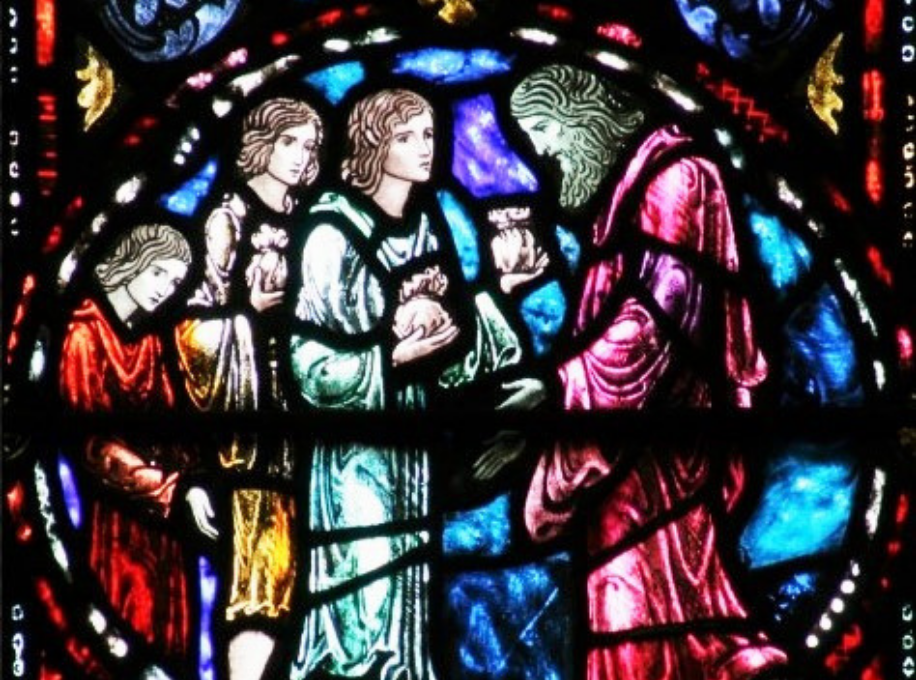
Take stained glass, for instance. Stained glass art is more than just pretty colors, pictures, and symbols. Stained glass was used for centuries to teach the faith through pictures and symbols. Until about 200 years ago, most people—even among the upper classes—could not read well if at all. How does the Church teach the faith in such a setting? Through preaching, art, passion plays, statues, and stained glass.
Stained glass in churches depicted biblical stories, saints, sacraments, and glimpses of Heaven. Over the centuries a rich shorthand of symbols also developed: crossed keys = St. Peter, a sword = St. Paul, a large boat = the Church, a shell = baptism, and so forth. Thus, the Church taught the faith through the exquisite art of stained glass.
Stained glass also served another purpose: to act as an image of the foundational walls of Heaven. Recall that traditional church architecture saw the church as an image of Heaven. Hence a church’s design was based on the descriptions of Heaven found in the Scriptures. In the Book of Revelation, Heaven is described as having high walls with rows of jewels embedded in their foundations:
One of the seven angels … showed me the Holy City, Jerusalem, coming down out of heaven from God. It shone with the glory of God, and its brilliance was like that of a very precious jewel, like a jasper, clear as crystal. It had a great, high wall with twelve gates … The foundations of the city walls were decorated with every kind of precious stone. The first foundation was jasper, the second sapphire, the third chalcedony, the fourth emerald, the fifth sardonyx, the sixth carnelian, the seventh chrysolite, the eighth beryl, the ninth topaz, the tenth chrysoprase, the eleventh jacinth, and the twelfth amethyst ... (Revelation 21:varia).
Thus, because Heaven had great, high walls, older churches almost always had a lot of verticality. The lower foundational walls gave way to the higher clerestory and above the clerestory the vaults of the ceiling rose even higher. In the lower sections of the walls, extending even as high as the clerestory, the jewel-like stained glass recalled the precious gemstones described in the lower walls of Heaven.
Yes, it is amazing! I stand in my church and hear its message: you are in Heaven when you enter here and celebrate the sacred mysteries. Sursum corda! (Hearts aloft!)
Here is a video I put together on stained glass. Enjoy these jewels of light that recall the lower walls of Heaven as you listen to the choir sing “Christe Lux mundi” (O Christ, you are the Light of the world).
One of the questionable, and unfortunately common, forms of moral reasoning today is the rather narcissistic notion that God wants each of us to be happy. Sometimes it is put in the form of a rhetorical question: God wants me to be happy, doesn’t He?
And this sort of reasoning (if you want to call it that) is used to justify just about anything. Thus, in pondering divorce, a spouse might point to his or her misery and conclude that God would approve of the split because God wants me to be happy, doesn’t He? Many seek to justify so-called same-sex marriage, and other illicit sexual notions in the same way.
Further, other responsibilities are often blithely set aside as too demanding, under the pretext that God would not make difficult demands because, after all, He wants me to be happy. Since getting to Mass is difficult for me, God will understand if I don’t go; He wants me to be happy, not burdened. Forgiving someone is hard and God does not ask hard things of us; He wants me to be happy. Refusing to cooperate with some evil at work would risk my income; surely God would not demand that I withstand it since He wants me to be happy, content, and financially secure.
The notion that God wants me to be happy thus becomes a kind of trump card, some sort of definitive declaration that obviates the need for any further moral reflection. Practically speaking, this means that I am now free to do as I please. Since I am happy, God is happy, and this is His will … or so the thinking goes.
There are, of course, multiple problems with the “God wants me to be happy” moral stance. In the first place, happiness is a complex matter that admits of many subjective criteria including personal development, temporal dimensions, and worldview. For example, a spiritually mature person can find happiness simply in knowing that he is pleasing God by follow His Commandments. On an interpersonal level, many are happy to make sacrifices for the people they love. To others who are less mature, even the smallest sacrifice can seem obnoxious and bring on unhappiness; pleasing God is not even on their radar, let alone something that would make them happy.
Happiness is also temporally variable. Most of us are well aware that happiness tomorrow is often contingent upon making certain sacrifices today. For example, the happiness one gets in taking a vacation is usually dependent upon having saved up some money beforehand. Making sacrifices today enables happiness tomorrow. If all I do is please myself in the moment, insist on being happy right now, my ability to be happy in the future will likely be seriously compromised. Setting no limits today might mean that I am broke tomorrow, or addicted, or unhealthily overweight, or afflicted with a sexually-transmitted disease. True, lasting, deep happiness in the future often requires some sacrifice today, some capacity to say “No” right now. Without any consideration of the future or of eternal life, “happiness” in the moment is vague, foolish, and meaningless, if not outright destructive. God desires our happiness, all right, but the happiness He wants for us is that of eternal life with Him forever. He has clearly indicated that this will often involve forsaking many of the passing pleasures and the “happiness” of this world.
More troubling still is the self-referential and narcissistic aspect contained in the simple little word “me.” God wants me to be happy.
Those who expresses this “me” notion might be surprised to discover that God has bigger things in mind. God actually cares about other people, too! He also cares about future generations and about the common good. Yes, there’s just a little more on God’s radar than you.
So the divorced man who might say, “God wants me to be happy” should consider that God might actually care about his children too; He might care about the culture that suffers due to rampant divorce; He might care about future generations that would inherit a culture shredded by destroyed families.
Wow, God might actually want others to be happy besides me! Even more shockingly, God might want me to sacrifice my happiness for them! He might actually want me to consider them and even regard them as more important that I am.
As a moral reference point, “me” is remarkably narrow and usually self-serving. And yet many today use this almost reflexively and authoritatively. “God wants me to be happy, so all discussions and further deliberations are over. God has spoken through my desires. He wants me to be happy. Who are you to dispute that? We’re done here; I will not be judged by you.”
“God wants me to be happy” is not a legitimate moral principle. It bespeaks a narcissism that is, sadly, too common today. Call it “Stuart Smalley theology.” You don’t know who Stuart Smalley is? This video shows it plainly enough. The bottom line is, don’t be Stuart Smalley.
Each year I concelebrate with hundreds of other priests in the ordination Mass of new priests. I find such Masses deeply spiritual. I have no role other than to quietly concelebrate, so the readings and the rites move me deeply. As I sit quietly, I ponder the mystery of my own priesthood.
When I was growing up, there was little to indicate that I would become a priest. I wasn’t a particularly spiritual child (at least not after age 7). I didn’t “play Mass.” In fact, I didn’t like church at all. At the end of Mass when the priest said, “The Mass is ended, go in peace,” I responded, “Thanks be to God!” much more vigorously than necessary.
My teenage years were marked by rebellion and pride. While I did join the parish youth choir, it was only so that I could meet girls. My intent wasn’t evil, but it wasn’t particularly spiritual, either. I did end up dating a few of those girls, two of them seriously.
Sometime during college, a strange and uncomfortable notion came over me that I was being called to the priesthood. It was an odd desire—one I could not explain.
By that time, I had become a Church musician, organist, cantor, and choir director, but again, I don’t think I was particularly spiritual. Music was something I enjoyed, but my involvement was more about leadership and impressing others—especially girls.
Yes, this growing desire to be a priest was inexplicable to me. At the time I was dating a real beauty queen, Denise. She was pretty, kind, and did not bring a heavy agenda to the relationship. Her greatest desire was just to get married and raise children. I was two years away from my college graduation, but already had a job lined up with the Army Corps of Engineers. My life seemed pretty well set. And now this? The priesthood? What a crazy idea!
It wasn’t just a fleeting thought, either; it was a desire that was only getting stronger. It was so mysterious, so strange, so unexpected. In my most honest moments, I knew that my desire for the priesthood was stronger than my wish to get married, but it seemed disloyal to Denise. I wasn’t going to break her heart—no way! Besides, I didn’t respect most of the priests I knew at that time. This was the late 70s-early 80s, the era of beige Catholicism, and the priests I knew seemed worse than irrelevant. I often fought with the pastor about music. He couldn’t think past Carey Landry and the St. Louis Jesuits, while I favored Palestrina, Bach, Mozart, and Victoria.
What on earth (or in Heaven?) was this thinking about being a priest? I just couldn’t make sense of it.
I will spare you all the details, but God eventually won. Denise had a change of heart, or maybe she sensed my growing ambivalence, and our dating ended. The troublesome pastor and I also parted ways (he later left the priesthood, by the way).
Two years later I entered the seminary. And now here I am, today, celebrating my 30th anniversary as a priest.
Sitting in the Basilica earlier this month and seeing ten new priests ordained was a great joy. I heard again those words that speak to the mystery of the call: Before I formed you in the womb, I knew you, before you were born I set you apart; I appointed you as a prophet (Jer 1:4). Yes, God’s call is a great mystery to me. Before I was born, He knew I would become a priest, but I didn’t know until long after my birth.
God has been good to me. For 30 years now I have prayed every day, celebrated the liturgy every day, read and studied God’s Word every day, and confessed every week. Through it all I’m a changed man. I’m not what I want to be, but I’m not what I used to be either. A wonderful change has come over me. I’m more confident and serene. I’ve seen sins put to death and graces come alive. I love God more than ever. I love to pray and to teach. I’ve come to love God’s people so much more.
I’m not the same man who entered the Basilica 30 years ago today—and thanks be to God for that. His Word is true. Attending to His Word and to the preaching, teaching, and celebration of the sacraments has had wondrous effects! I can’t wait to see what the next 30 years will bring, if God grants them. For now, I can only marvel at the mystery of my call and how it has unfolded over all these years.
I’d like to conclude with some words of encouragement that were give to me some years ago during a difficult time in my priesthood.
The holiness and humanness of the priest is the deepest source of his authority. The person of the priest is the “substantial bread” of the Sacrament of Holy Orders. Personal development and the personal quest for God make the priest credible in the sight of the faithful (Rev. Robert Schwartz).