
What Was the Lord Doing on Tuesday of Holy Week?

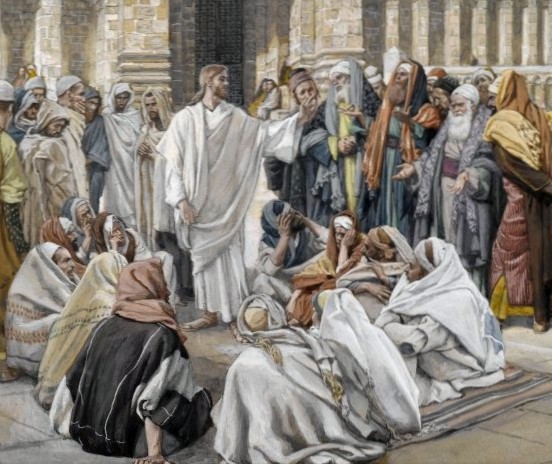
It is Tuesday of Holy Week. Jesus likely arises early, as did all the ancients. Days both ended and started early, at dusk and dawn, prior to the advent of electric lighting. They leave Bethany and head back to Jerusalem. Perhaps a few converts can be made before the transcendent events of the Passion begin.

It is only a couple of miles, mostly downhill, to Jerusalem. As they come down the steep hill they see the fig tree Jesus had cursed the day before.

As they were walking back in the morning, they saw the fig tree withered from its roots. Peter remembered it and said, “Look, Rabbi! The fig tree You cursed has withered.” (Mk 11:20-21).

Jesus had cursed the fig tree, a metaphor for the ancient chosen people, for lack of faith, justice, and charity, the expected fruits in its branches. (This was discussed in more detail in yesterday’s post.) The fig tree reminds us of the day of judgment. “Lip service” faith is easy, but Jesus is looking for real fruit in the branches.

The apostolic band walks on further with Jesus, and they eventually arrive at the Temple, where they are immediately confronted by the Temple leaders:

At their return to Jerusalem, Jesus was walking in the temple courts, and the chief priests, scribes, and elders came up to Him. “By what authority are You doing these things?” they asked. “And who gave You the authority to do them?” “I will ask you one question,” Jesus replied, “and if you answer Me, I will tell you by what authority I am doing these things. The baptism of John, was it from heaven or from men? Answer Me!” They deliberated among themselves what they should answer: “If we say, ‘From heaven,’ He will ask, ‘Why then did you not believe him?’ But if we say, ‘From men’…” they were afraid of the people, for they all held that John truly was a prophet. So they answered Him, “We do not know. And Jesus replied, “Neither will I tell you by what authority I am doing these things” (Mk 11:27-33).

Jesus questions their question with a question. He seems to engage in the Socratic method, making them examine their premises. In this dialogue the leaders are confronted with their own insincerity. They are asked to consider that their own “authority” is based not on truth, but on power and its trappings. They are asked to consider that they have “too much to lose” because they root their authority in the power and accolades of the people. They are not true leaders, for they do not seek the truth but rather only what confirms their power.

Do not scorn or laugh at them—many of us are in the same condition.

Jesus turns to them and others in the Temple area, teaching them in numerous parables (Mk 12:1). In these parables He lays bare their hearts and reminds them that although they are leaders they are refusing God’s offer of salvation and His invitation to the true feast to which their rituals point.

Jesus begins,

But what do you think? There was a man who had two sons. He went to the first and said, ‘Son, go and work today in the vineyard.’ ‘I will not,’ he replied. But later he changed his mind and went. Then the man went to the second son and told him the same thing. ‘I will, sir,’ he said. But he did not go. Which of the two did the will of his father? “The first,” they answered. Jesus said to them, “Truly I tell you, the tax collectors and prostitutes are entering the kingdom of God before you. For John came to you in a righteous way and you did not believe him, but the tax collectors and prostitutes did. And even after you saw this, you did not repent and believe him (Mat 21:28-32).

Lip service is not obedience. Their refusal to come to faith is disobedience to God. He desires obedience more than ritual observances and sacrifices (see Psalm 40:6).

Jesus warns them that their plots to kill Him will end badly:

A man planted a vineyard. He put a wall around it, dug a wine vat, and built a watchtower. Then he rented it out to some tenants and went away on a journey. At harvest time, he sent a servant to the tenants to collect his share of the fruit of the vineyard. But they seized the servant, beat him, and sent him away empty-handed. Then he sent them another servant, and they struck him over the head and treated him shamefully. He sent still another, and this one they killed. He sent many others; some they beat and others they killed. Finally, having one beloved son, he sent him to them. ‘They will respect my son,’ he said. But the tenants said to one another, ‘This is the heir; come, let us kill him, and the inheritance will be ours.’ So they seized the son, killed him, and threw him out of the vineyard. What then will the owner of the vineyard do? He will come and kill those tenants and give the vineyard to others. Have you never read this Scripture: ‘The stone the builders rejected has become the cornerstone. This is from the Lord, and it is marvelous in our eyes’?” (Mark 12:1-11)

At this, the leaders sought to arrest Jesus, for they knew that He had spoken this parable against them. Fearing the crowd, though, they left Him and went away (Mk 12:1-12). They will return shortly with other interrogators.

Matthew records that Jesus then told the following parable, likely to others in the Temple area. In it, He warns them of the urgency of the dramatic decision that is upon them. Do they want salvation in the way God offers? Do they desire the Kingdom of God and its values or do they prefer the present but passing desires of the world? Are they willing to be clothed in the garments of righteousness that God himself provides or do they prefer to wear the fashions of the world?

Once again, Jesus spoke to them in parables: “The kingdom of heaven is like a king who prepared a wedding banquet for his son. He sent his servants to call those he had invited to the banquet, but they refused to come. Again, he sent other servants and said, ‘Tell those who have been invited that I have prepared my dinner. My oxen and fatlings have been killed, and everything is ready. Come to the wedding banquet.’ But they paid no attention and went away, one to his field, and another to his business. The rest seized his servants, mistreated them, and killed them. The king was enraged. He sent his troops to destroy those murderers and burn their city. Then he said to his servants, ‘The wedding banquet is ready, but those I invited were not worthy. Go therefore to the crossroads and invite to the banquet as many as you can find.’ So the servants went out into the streets and gathered everyone they could find, both evil and good, and the wedding hall was filled with guests. But when the king came in to see the guests, he spotted a man who was not dressed in wedding clothes. ‘Friend,’ he asked, ‘how did you get in here without wedding clothes?’ But the man was speechless. Then the king told the servants, ‘Tie him hand and foot and throw him outside into the outer darkness, where there will be weeping and gnashing of teeth.’ For many are called, but few are chosen” (Matt 22:1-14).

Now come various interlocutors. Note that the Pharisees, Herodians, and Sadducees agreed on nothing but that Jesus had to go. They “teamed up” against the Lord! This indicates the depth of their fear: even enemies will be embraced to rid the city of this upstart preacher who so threatens their shared power.

Later, they sent some of the Pharisees and Herodians to catch Jesus in His words. “Teacher,” they said, “we know that You are honest and are swayed by no one. Indeed, You are impartial and teach the way of God in accordance with the truth. Now then, is it lawful to pay taxes to Caesar or not? Should we pay them or not?” But Jesus saw through their hypocrisy and said, “Why are you testing Me? Bring Me a denarius to inspect.” So, they brought it, and He asked them, “Whose likeness is this? And whose inscription?” “Caesar’s,” they answered. Then Jesus told them, “Give to Caesar what is Caesar’s, and to God what is God’s.” And they marveled at Him (Mk 12:13-17).

This is an attempt to draw Jesus into a cheap political debate and thereby cause division among His admiring crowd. Their concern about taxes is insincere because even those who dispute paying taxes to Caesar walk about with Caesar’s money. Jesus will not be called off message; He says to them, [Give] to God what is God’s.” In this case what they are to give to God is faith in the one whom He has sent, Jesus.

The next opponents of Jesus are the Sadducees, who deny that there is a resurrection of the dead and seek to ridicule belief in Heaven through a complex and unlikely scenario:

Then some Sadducees, who say there is no resurrection, came and questioned Him: “Teacher, Moses wrote for us that if a man’s brother dies and leaves a wife but no children, the man should marry the widow and raise up offspring for his brother. Now there were seven brothers. The first one married and died, leaving no children. Then the second one married the widow, but he also died and left no children. And the third did likewise. In this way, none of the seven left any children. And last of all, the woman died. In the resurrection, whose wife will she be? For all seven were married to her.” Jesus said to them, “Aren’t you mistaken because you do not know the Scriptures or the power of God? When the dead rise, they will neither marry nor be given in marriage. Instead, they will be like the angels in heaven. And regarding the dead rising, have you not read about the burning bush in the book of Moses, how God told him, ‘I am the God of Abraham, the God of Isaac, and the God of Jacob.’ He is not the God of the dead, but of the living. You are badly mistaken (Mk 12:18-27).

Yes, they are badly mistaken; they seek to understand heavenly realities using earthly notions. Because the Sadducees only accepted the first five books of the Old Testament, Jesus uses a passage from Exodus as well as their own logic against them. The Sadducees denied the resurrection by saying that God is a God of the living, not the dead. If that be so, though, why does the Lord call himself the God of Abraham, Isaac, and Jacob, all of whom have been dead for over four centuries? They must be alive to God! In this way, the Sadducees are set aside.

Finally, a scribe steps forth. Although he is likely seeking to refute Jesus, the conversation ends up being promising:

Now one of the scribes had come up and heard their debate. Noticing how well Jesus had answered them, he asked Him, “Which commandment is the most important of all?” Jesus replied, “This is the most important: ‘Hear O Israel, the Lord our God is One Lord, and you shall love the Lord your God with all your heart and with all your soul and with all your and and with all your strength.’ The second is this: ‘Love your neighbor as yourself.’ No other commandment is greater than these.” “Right, Teacher,” the scribe replied. “You have stated correctly that God is One and there is no other but Him, and to love Him with all your heart and with all your understanding and with all your strength, and to love your neighbor as yourself, which is more important than all burnt offerings and sacrifices.” When Jesus saw that the man had answered wisely, He said, “You are not far from the kingdom of God” (Mk 12:28-34).

Speaking to His claim to be Messiah and Lord, Jesus invokes the authority of Scripture, reminding them that in Psalm 110 (a messianic psalm) the Messiah is called “Lord,” not merely the Son of David.

While Jesus was teaching in the temple courts, He asked, “How can the scribes say that the Christ is the son of David? Speaking by the Holy Spirit, David himself declared: ‘The Lord said to my Lord, “Sit at My right hand until I put Your enemies under Your feet.”’ David himself calls Him Lord. So how can He be David’s son?” And the large crowd listened to Him with delight (Mk 12:35-37).

Matthew records Jesus delivering a series of woes directed against the leaders and teachers of that time. These are delivered in a lengthy passage, which is available here: Seven woes. It is quite severe and shows a strong indictment of those who “major in the minors,” who maximize the minimum and minimize the maximum. Jesus concludes by saying,

You snakes! You brood of vipers! How will you escape being condemned to hell? Therefore, I am sending you prophets and sages and teachers. Some of them you will kill and crucify; others you will flog in your synagogues and pursue from town to town. And so upon you will come all the righteous blood that has been shed on earth, from the blood of righteous Abel to the blood of Zechariah son of Berekiah, whom you murdered between the temple and the altar. Truly I tell you, all this will come on this generation.

“Jerusalem, Jerusalem, you who kill the prophets and stone those sent to you, how often I have longed to gather your children together, as a hen gathers her chicks under her wings, and you were not willing. Look, your house is left to you desolate. For I tell you, you will not see me again until you say, ‘Blessed is he who comes in the name of the Lord’ (Matthew 23:33-39).

To emphasize the contrast, Jesus notes a poor widow who gives a small amount but in reality far more generously than do those “leaders” with hardened hearts. Matthew then observes,

Jesus left the temple and was walking away when his disciples came up to him to call his attention to its buildings. “Do you see all these things?” he asked. “Truly I tell you, not one stone here will be left on another; every one will be thrown down” (Matthew 24:1-2).

They crossed the Kidron Valley and went up on to the Mount of Olives. Matthew records,

As Jesus was sitting on the Mount of Olives, the disciples came to him privately. “Tell us,” they said, “when will this happen, and what will be the sign of your coming and of the end of the age?” (Matthew 24: 3-4)

Sitting atop the Mount of Olives, with Jerusalem displayed before Him, Jesus gives the terrifying and yet exhilarating “Mount Olivet Discourse.” It is quite lengthy and is available here: Mt. Olivet Discourse. In it, Jesus describes the coming destruction of Jerusalem, which took place in 70 A.D., forty biblical years after His Ascension. The destruction was the result of a foolish war with the Romans. Had the Jewish zealots accepted Jesus’ call to preach the gospel to the nations, the Romans would have been seen as brothers to convert rather than as enemies to kill. Over a million Jewish people died in that terrible war.

According to Matthew, Jesus also tells the “Parable of the Sheep and Goats” and the “Parable of the Wise and Foolish Virgins.” Mark concludes with this: And no one dared to question Him any further (Mk 18:34).

It seems it was back to Bethany that Tuesday night, likely to stay at the house of Martha, Mary, and Lazarus, but perhaps with Simon the Leper. It has been a long day of parables and teaching and of engaging with hostile opponents.

Tune in tomorrow, when it is “Spy Wednesday.”
 

What Was the Lord Doing on Tuesday of Holy Week?

It is Tuesday of Holy Week. Jesus likely arises early, as did all the ancients. Days both ended and started early, at dusk and dawn, prior to the advent of electric lighting. They leave Bethany and head back to Jerusalem. Perhaps a few converts can be made before the transcendent events of the Passion begin.

It is only a couple of miles, mostly downhill, to Jerusalem. As they come down the steep hill they see the fig tree Jesus had cursed the day before.

As they were walking back in the morning, they saw the fig tree withered from its roots. Peter remembered it and said, “Look, Rabbi! The fig tree You cursed has withered.” (Mk 11:20-21).

Jesus had cursed the fig tree, a metaphor for the ancient chosen people, for lack of faith, justice, and charity, the expected fruits in its branches. (This was discussed in more detail in yesterday’s post.) The fig tree reminds us of the day of judgment. “Lip service” faith is easy, but Jesus is looking for real fruit in the branches.

The apostolic band walks on further with Jesus, and they eventually arrive at the Temple, where they are immediately confronted by the Temple leaders:

At their return to Jerusalem, Jesus was walking in the temple courts, and the chief priests, scribes, and elders came up to Him. “By what authority are You doing these things?” they asked. “And who gave You the authority to do them?” “I will ask you one question,” Jesus replied, “and if you answer Me, I will tell you by what authority I am doing these things. The baptism of John, was it from heaven or from men? Answer Me!” They deliberated among themselves what they should answer: “If we say, ‘From heaven,’ He will ask, ‘Why then did you not believe him?’ But if we say, ‘From men’…” they were afraid of the people, for they all held that John truly was a prophet. So they answered Him, “We do not know. And Jesus replied, “Neither will I tell you by what authority I am doing these things” (Mk 11:27-33).

Jesus questions their question with a question. He seems to engage in the Socratic method, making them examine their premises. In this dialogue the leaders are confronted with their own insincerity. They are asked to consider that their own “authority” is based not on truth, but on power and its trappings. They are asked to consider that they have “too much to lose” because they root their authority in the power and accolades of the people. They are not true leaders, for they do not seek the truth but rather only what confirms their power.

Do not scorn or laugh at them—many of us are in the same condition.

Jesus turns to them and others in the Temple area, teaching them in numerous parables (Mk 12:1). In these parables He lays bare their hearts and reminds them that although they are leaders they are refusing God’s offer of salvation and His invitation to the true feast to which their rituals point.

Jesus begins,

But what do you think? There was a man who had two sons. He went to the first and said, ‘Son, go and work today in the vineyard.’ ‘I will not,’ he replied. But later he changed his mind and went. Then the man went to the second son and told him the same thing. ‘I will, sir,’ he said. But he did not go. Which of the two did the will of his father? “The first,” they answered. Jesus said to them, “Truly I tell you, the tax collectors and prostitutes are entering the kingdom of God before you. For John came to you in a righteous way and you did not believe him, but the tax collectors and prostitutes did. And even after you saw this, you did not repent and believe him (Mat 21:28-32).

Lip service is not obedience. Their refusal to come to faith is disobedience to God. He desires obedience more than ritual observances and sacrifices (see Psalm 40:6).

Jesus warns them that their plots to kill Him will end badly:

A man planted a vineyard. He put a wall around it, dug a wine vat, and built a watchtower. Then he rented it out to some tenants and went away on a journey. At harvest time, he sent a servant to the tenants to collect his share of the fruit of the vineyard. But they seized the servant, beat him, and sent him away empty-handed. Then he sent them another servant, and they struck him over the head and treated him shamefully. He sent still another, and this one they killed. He sent many others; some they beat and others they killed. Finally, having one beloved son, he sent him to them. ‘They will respect my son,’ he said. But the tenants said to one another, ‘This is the heir; come, let us kill him, and the inheritance will be ours.’ So they seized the son, killed him, and threw him out of the vineyard. What then will the owner of the vineyard do? He will come and kill those tenants and give the vineyard to others. Have you never read this Scripture: ‘The stone the builders rejected has become the cornerstone. This is from the Lord, and it is marvelous in our eyes’?” (Mark 12:1-11)

At this, the leaders sought to arrest Jesus, for they knew that He had spoken this parable against them. Fearing the crowd, though, they left Him and went away (Mk 12:1-12). They will return shortly with other interrogators.

Matthew records that Jesus then told the following parable, likely to others in the Temple area. In it, He warns them of the urgency of the dramatic decision that is upon them. Do they want salvation in the way God offers? Do they desire the Kingdom of God and its values or do they prefer the present but passing desires of the world? Are they willing to be clothed in the garments of righteousness that God himself provides or do they prefer to wear the fashions of the world?

Once again, Jesus spoke to them in parables: “The kingdom of heaven is like a king who prepared a wedding banquet for his son. He sent his servants to call those he had invited to the banquet, but they refused to come. Again, he sent other servants and said, ‘Tell those who have been invited that I have prepared my dinner. My oxen and fatlings have been killed, and everything is ready. Come to the wedding banquet.’ But they paid no attention and went away, one to his field, and another to his business. The rest seized his servants, mistreated them, and killed them. The king was enraged. He sent his troops to destroy those murderers and burn their city. Then he said to his servants, ‘The wedding banquet is ready, but those I invited were not worthy. Go therefore to the crossroads and invite to the banquet as many as you can find.’ So the servants went out into the streets and gathered everyone they could find, both evil and good, and the wedding hall was filled with guests. But when the king came in to see the guests, he spotted a man who was not dressed in wedding clothes. ‘Friend,’ he asked, ‘how did you get in here without wedding clothes?’ But the man was speechless. Then the king told the servants, ‘Tie him hand and foot and throw him outside into the outer darkness, where there will be weeping and gnashing of teeth.’ For many are called, but few are chosen” (Matt 22:1-14).

Now come various interlocutors. Note that the Pharisees, Herodians, and Sadducees agreed on nothing but that Jesus had to go. They “teamed up” against the Lord! This indicates the depth of their fear: even enemies will be embraced to rid the city of this upstart preacher who so threatens their shared power.

Later, they sent some of the Pharisees and Herodians to catch Jesus in His words. “Teacher,” they said, “we know that You are honest and are swayed by no one. Indeed, You are impartial and teach the way of God in accordance with the truth. Now then, is it lawful to pay taxes to Caesar or not? Should we pay them or not?” But Jesus saw through their hypocrisy and said, “Why are you testing Me? Bring Me a denarius to inspect.” So, they brought it, and He asked them, “Whose likeness is this? And whose inscription?” “Caesar’s,” they answered. Then Jesus told them, “Give to Caesar what is Caesar’s, and to God what is God’s.” And they marveled at Him (Mk 12:13-17).

This is an attempt to draw Jesus into a cheap political debate and thereby cause division among His admiring crowd. Their concern about taxes is insincere because even those who dispute paying taxes to Caesar walk about with Caesar’s money. Jesus will not be called off message; He says to them, [Give] to God what is God’s.” In this case what they are to give to God is faith in the one whom He has sent, Jesus.

The next opponents of Jesus are the Sadducees, who deny that there is a resurrection of the dead and seek to ridicule belief in Heaven through a complex and unlikely scenario:

Then some Sadducees, who say there is no resurrection, came and questioned Him: “Teacher, Moses wrote for us that if a man’s brother dies and leaves a wife but no children, the man should marry the widow and raise up offspring for his brother. Now there were seven brothers. The first one married and died, leaving no children. Then the second one married the widow, but he also died and left no children. And the third did likewise. In this way, none of the seven left any children. And last of all, the woman died. In the resurrection, whose wife will she be? For all seven were married to her.” Jesus said to them, “Aren’t you mistaken because you do not know the Scriptures or the power of God? When the dead rise, they will neither marry nor be given in marriage. Instead, they will be like the angels in heaven. And regarding the dead rising, have you not read about the burning bush in the book of Moses, how God told him, ‘I am the God of Abraham, the God of Isaac, and the God of Jacob.’ He is not the God of the dead, but of the living. You are badly mistaken (Mk 12:18-27).

Yes, they are badly mistaken; they seek to understand heavenly realities using earthly notions. Because the Sadducees only accepted the first five books of the Old Testament, Jesus uses a passage from Exodus as well as their own logic against them. The Sadducees denied the resurrection by saying that God is a God of the living, not the dead. If that be so, though, why does the Lord call himself the God of Abraham, Isaac, and Jacob, all of whom have been dead for over four centuries? They must be alive to God! In this way, the Sadducees are set aside.

Finally, a scribe steps forth. Although he is likely seeking to refute Jesus, the conversation ends up being promising:

Now one of the scribes had come up and heard their debate. Noticing how well Jesus had answered them, he asked Him, “Which commandment is the most important of all?” Jesus replied, “This is the most important: ‘Hear O Israel, the Lord our God is One Lord, and you shall love the Lord your God with all your heart and with all your soul and with all your and and with all your strength.’ The second is this: ‘Love your neighbor as yourself.’ No other commandment is greater than these.” “Right, Teacher,” the scribe replied. “You have stated correctly that God is One and there is no other but Him, and to love Him with all your heart and with all your understanding and with all your strength, and to love your neighbor as yourself, which is more important than all burnt offerings and sacrifices.” When Jesus saw that the man had answered wisely, He said, “You are not far from the kingdom of God” (Mk 12:28-34).

Speaking to His claim to be Messiah and Lord, Jesus invokes the authority of Scripture, reminding them that in Psalm 110 (a messianic psalm) the Messiah is called “Lord,” not merely the Son of David.

While Jesus was teaching in the temple courts, He asked, “How can the scribes say that the Christ is the son of David? Speaking by the Holy Spirit, David himself declared: ‘The Lord said to my Lord, “Sit at My right hand until I put Your enemies under Your feet.”’ David himself calls Him Lord. So how can He be David’s son?” And the large crowd listened to Him with delight (Mk 12:35-37).

Matthew records Jesus delivering a series of woes directed against the leaders and teachers of that time. These are delivered in a lengthy passage, which is available here: Seven woes. It is quite severe and shows a strong indictment of those who “major in the minors,” who maximize the minimum and minimize the maximum. Jesus concludes by saying,

You snakes! You brood of vipers! How will you escape being condemned to hell? Therefore, I am sending you prophets and sages and teachers. Some of them you will kill and crucify; others you will flog in your synagogues and pursue from town to town. And so upon you will come all the righteous blood that has been shed on earth, from the blood of righteous Abel to the blood of Zechariah son of Berekiah, whom you murdered between the temple and the altar. Truly I tell you, all this will come on this generation.

“Jerusalem, Jerusalem, you who kill the prophets and stone those sent to you, how often I have longed to gather your children together, as a hen gathers her chicks under her wings, and you were not willing. Look, your house is left to you desolate. For I tell you, you will not see me again until you say, ‘Blessed is he who comes in the name of the Lord’ (Matthew 23:33-39).

To emphasize the contrast, Jesus notes a poor widow who gives a small amount but in reality far more generously than do those “leaders” with hardened hearts. Matthew then observes,

Jesus left the temple and was walking away when his disciples came up to him to call his attention to its buildings. “Do you see all these things?” he asked. “Truly I tell you, not one stone here will be left on another; every one will be thrown down” (Matthew 24:1-2).

They crossed the Kidron Valley and went up on to the Mount of Olives. Matthew records,

As Jesus was sitting on the Mount of Olives, the disciples came to him privately. “Tell us,” they said, “when will this happen, and what will be the sign of your coming and of the end of the age?” (Matthew 24: 3-4)

Sitting atop the Mount of Olives, with Jerusalem displayed before Him, Jesus gives the terrifying and yet exhilarating “Mount Olivet Discourse.” It is quite lengthy and is available here: Mt. Olivet Discourse. In it, Jesus describes the coming destruction of Jerusalem, which took place in 70 A.D., forty biblical years after His Ascension. The destruction was the result of a foolish war with the Romans. Had the Jewish zealots accepted Jesus’ call to preach the gospel to the nations, the Romans would have been seen as brothers to convert rather than as enemies to kill. Over a million Jewish people died in that terrible war.

According to Matthew, Jesus also tells the “Parable of the Sheep and Goats” and the “Parable of the Wise and Foolish Virgins.” Mark concludes with this: And no one dared to question Him any further (Mk 18:34).

It seems it was back to Bethany that Tuesday night, likely to stay at the house of Martha, Mary, and Lazarus, but perhaps with Simon the Leper. It has been a long day of parables and teaching and of engaging with hostile opponents.

Tune in tomorrow, when it is “Spy Wednesday.”


What Was the Lord Doing on Tuesday of Holy Week?

It is Tuesday of Holy Week. Jesus likely arises early, as did all the ancients. Days both ended and started early, at dusk and dawn, prior to the advent of electric lighting. They leave Bethany and head back to Jerusalem. Perhaps a few converts can be made before the transcendent events of the Passion begin.

It is only a couple of miles, mostly downhill, to Jerusalem. As they come down the steep hill they see the fig tree Jesus had cursed the day before.

As they were walking back in the morning, they saw the fig tree withered from its roots. Peter remembered it and said, “Look, Rabbi! The fig tree You cursed has withered.” (Mk 11:20-21).

Jesus had cursed the fig tree, a metaphor for the ancient chosen people, for lack of faith, justice, and charity, the expected fruits in its branches. (This was discussed in more detail in yesterday’s post.) The fig tree reminds us of the day of judgment. “Lip service” faith is easy, but Jesus is looking for real fruit in the branches.

The apostolic band walks on further with Jesus, and they eventually arrive at the Temple, where they are immediately confronted by the Temple leaders:

At their return to Jerusalem, Jesus was walking in the temple courts, and the chief priests, scribes, and elders came up to Him. “By what authority are You doing these things?” they asked. “And who gave You the authority to do them?” “I will ask you one question,” Jesus replied, “and if you answer Me, I will tell you by what authority I am doing these things. The baptism of John, was it from heaven or from men? Answer Me!” They deliberated among themselves what they should answer: “If we say, ‘From heaven,’ He will ask, ‘Why then did you not believe him?’ But if we say, ‘From men’…” they were afraid of the people, for they all held that John truly was a prophet. So they answered Him, “We do not know. And Jesus replied, “Neither will I tell you by what authority I am doing these things” (Mk 11:27-33).

Jesus questions their question with a question. He seems to engage in the Socratic method, making them examine their premises. In this dialogue the leaders are confronted with their own insincerity. They are asked to consider that their own “authority” is based not on truth, but on power and its trappings. They are asked to consider that they have “too much to lose” because they root their authority in the power and accolades of the people. They are not true leaders, for they do not seek the truth but rather only what confirms their power.

Do not scorn or laugh at them—many of us are in the same condition.

Jesus turns to them and others in the Temple area, teaching them in numerous parables (Mk 12:1). In these parables He lays bare their hearts and reminds them that although they are leaders they are refusing God’s offer of salvation and His invitation to the true feast to which their rituals point.

Jesus begins,

But what do you think? There was a man who had two sons. He went to the first and said, ‘Son, go and work today in the vineyard.’ ‘I will not,’ he replied. But later he changed his mind and went. Then the man went to the second son and told him the same thing. ‘I will, sir,’ he said. But he did not go. Which of the two did the will of his father? “The first,” they answered. Jesus said to them, “Truly I tell you, the tax collectors and prostitutes are entering the kingdom of God before you. For John came to you in a righteous way and you did not believe him, but the tax collectors and prostitutes did. And even after you saw this, you did not repent and believe him (Mat 21:28-32).

Lip service is not obedience. Their refusal to come to faith is disobedience to God. He desires obedience more than ritual observances and sacrifices (see Psalm 40:6).

Jesus warns them that their plots to kill Him will end badly:

A man planted a vineyard. He put a wall around it, dug a wine vat, and built a watchtower. Then he rented it out to some tenants and went away on a journey. At harvest time, he sent a servant to the tenants to collect his share of the fruit of the vineyard. But they seized the servant, beat him, and sent him away empty-handed. Then he sent them another servant, and they struck him over the head and treated him shamefully. He sent still another, and this one they killed. He sent many others; some they beat and others they killed. Finally, having one beloved son, he sent him to them. ‘They will respect my son,’ he said. But the tenants said to one another, ‘This is the heir; come, let us kill him, and the inheritance will be ours.’ So they seized the son, killed him, and threw him out of the vineyard. What then will the owner of the vineyard do? He will come and kill those tenants and give the vineyard to others. Have you never read this Scripture: ‘The stone the builders rejected has become the cornerstone. This is from the Lord, and it is marvelous in our eyes’?” (Mark 12:1-11)

At this, the leaders sought to arrest Jesus, for they knew that He had spoken this parable against them. Fearing the crowd, though, they left Him and went away (Mk 12:1-12). They will return shortly with other interrogators.

Matthew records that Jesus then told the following parable, likely to others in the Temple area. In it, He warns them of the urgency of the dramatic decision that is upon them. Do they want salvation in the way God offers? Do they desire the Kingdom of God and its values or do they prefer the present but passing desires of the world? Are they willing to be clothed in the garments of righteousness that God himself provides or do they prefer to wear the fashions of the world?

Once again, Jesus spoke to them in parables: “The kingdom of heaven is like a king who prepared a wedding banquet for his son. He sent his servants to call those he had invited to the banquet, but they refused to come. Again, he sent other servants and said, ‘Tell those who have been invited that I have prepared my dinner. My oxen and fatlings have been killed, and everything is ready. Come to the wedding banquet.’ But they paid no attention and went away, one to his field, and another to his business. The rest seized his servants, mistreated them, and killed them. The king was enraged. He sent his troops to destroy those murderers and burn their city. Then he said to his servants, ‘The wedding banquet is ready, but those I invited were not worthy. Go therefore to the crossroads and invite to the banquet as many as you can find.’ So the servants went out into the streets and gathered everyone they could find, both evil and good, and the wedding hall was filled with guests. But when the king came in to see the guests, he spotted a man who was not dressed in wedding clothes. ‘Friend,’ he asked, ‘how did you get in here without wedding clothes?’ But the man was speechless. Then the king told the servants, ‘Tie him hand and foot and throw him outside into the outer darkness, where there will be weeping and gnashing of teeth.’ For many are called, but few are chosen” (Matt 22:1-14).

Now come various interlocutors. Note that the Pharisees, Herodians, and Sadducees agreed on nothing but that Jesus had to go. They “teamed up” against the Lord! This indicates the depth of their fear: even enemies will be embraced to rid the city of this upstart preacher who so threatens their shared power.

Later, they sent some of the Pharisees and Herodians to catch Jesus in His words. “Teacher,” they said, “we know that You are honest and are swayed by no one. Indeed, You are impartial and teach the way of God in accordance with the truth. Now then, is it lawful to pay taxes to Caesar or not? Should we pay them or not?” But Jesus saw through their hypocrisy and said, “Why are you testing Me? Bring Me a denarius to inspect.” So, they brought it, and He asked them, “Whose likeness is this? And whose inscription?” “Caesar’s,” they answered. Then Jesus told them, “Give to Caesar what is Caesar’s, and to God what is God’s.” And they marveled at Him (Mk 12:13-17).

This is an attempt to draw Jesus into a cheap political debate and thereby cause division among His admiring crowd. Their concern about taxes is insincere because even those who dispute paying taxes to Caesar walk about with Caesar’s money. Jesus will not be called off message; He says to them, [Give] to God what is God’s.” In this case what they are to give to God is faith in the one whom He has sent, Jesus.

The next opponents of Jesus are the Sadducees, who deny that there is a resurrection of the dead and seek to ridicule belief in Heaven through a complex and unlikely scenario:

Then some Sadducees, who say there is no resurrection, came and questioned Him: “Teacher, Moses wrote for us that if a man’s brother dies and leaves a wife but no children, the man should marry the widow and raise up offspring for his brother. Now there were seven brothers. The first one married and died, leaving no children. Then the second one married the widow, but he also died and left no children. And the third did likewise. In this way, none of the seven left any children. And last of all, the woman died. In the resurrection, whose wife will she be? For all seven were married to her.” Jesus said to them, “Aren’t you mistaken because you do not know the Scriptures or the power of God? When the dead rise, they will neither marry nor be given in marriage. Instead, they will be like the angels in heaven. And regarding the dead rising, have you not read about the burning bush in the book of Moses, how God told him, ‘I am the God of Abraham, the God of Isaac, and the God of Jacob.’ He is not the God of the dead, but of the living. You are badly mistaken (Mk 12:18-27).

Yes, they are badly mistaken; they seek to understand heavenly realities using earthly notions. Because the Sadducees only accepted the first five books of the Old Testament, Jesus uses a passage from Exodus as well as their own logic against them. The Sadducees denied the resurrection by saying that God is a God of the living, not the dead. If that be so, though, why does the Lord call himself the God of Abraham, Isaac, and Jacob, all of whom have been dead for over four centuries? They must be alive to God! In this way, the Sadducees are set aside.

Finally, a scribe steps forth. Although he is likely seeking to refute Jesus, the conversation ends up being promising:

Now one of the scribes had come up and heard their debate. Noticing how well Jesus had answered them, he asked Him, “Which commandment is the most important of all?” Jesus replied, “This is the most important: ‘Hear O Israel, the Lord our God is One Lord, and you shall love the Lord your God with all your heart and with all your soul and with all your and and with all your strength.’ The second is this: ‘Love your neighbor as yourself.’ No other commandment is greater than these.” “Right, Teacher,” the scribe replied. “You have stated correctly that God is One and there is no other but Him, and to love Him with all your heart and with all your understanding and with all your strength, and to love your neighbor as yourself, which is more important than all burnt offerings and sacrifices.” When Jesus saw that the man had answered wisely, He said, “You are not far from the kingdom of God” (Mk 12:28-34).

Speaking to His claim to be Messiah and Lord, Jesus invokes the authority of Scripture, reminding them that in Psalm 110 (a messianic psalm) the Messiah is called “Lord,” not merely the Son of David.

While Jesus was teaching in the temple courts, He asked, “How can the scribes say that the Christ is the son of David? Speaking by the Holy Spirit, David himself declared: ‘The Lord said to my Lord, “Sit at My right hand until I put Your enemies under Your feet.”’ David himself calls Him Lord. So how can He be David’s son?” And the large crowd listened to Him with delight (Mk 12:35-37).

Matthew records Jesus delivering a series of woes directed against the leaders and teachers of that time. These are delivered in a lengthy passage, which is available here: Seven woes. It is quite severe and shows a strong indictment of those who “major in the minors,” who maximize the minimum and minimize the maximum. Jesus concludes by saying,

You snakes! You brood of vipers! How will you escape being condemned to hell? Therefore, I am sending you prophets and sages and teachers. Some of them you will kill and crucify; others you will flog in your synagogues and pursue from town to town. And so upon you will come all the righteous blood that has been shed on earth, from the blood of righteous Abel to the blood of Zechariah son of Berekiah, whom you murdered between the temple and the altar. Truly I tell you, all this will come on this generation.

“Jerusalem, Jerusalem, you who kill the prophets and stone those sent to you, how often I have longed to gather your children together, as a hen gathers her chicks under her wings, and you were not willing. Look, your house is left to you desolate. For I tell you, you will not see me again until you say, ‘Blessed is he who comes in the name of the Lord’ (Matthew 23:33-39).

To emphasize the contrast, Jesus notes a poor widow who gives a small amount but in reality far more generously than do those “leaders” with hardened hearts. Matthew then observes,

Jesus left the temple and was walking away when his disciples came up to him to call his attention to its buildings. “Do you see all these things?” he asked. “Truly I tell you, not one stone here will be left on another; every one will be thrown down” (Matthew 24:1-2).

They crossed the Kidron Valley and went up on to the Mount of Olives. Matthew records,

As Jesus was sitting on the Mount of Olives, the disciples came to him privately. “Tell us,” they said, “when will this happen, and what will be the sign of your coming and of the end of the age?” (Matthew 24: 3-4)

Sitting atop the Mount of Olives, with Jerusalem displayed before Him, Jesus gives the terrifying and yet exhilarating “Mount Olivet Discourse.” It is quite lengthy and is available here: Mt. Olivet Discourse. In it, Jesus describes the coming destruction of Jerusalem, which took place in 70 A.D., forty biblical years after His Ascension. The destruction was the result of a foolish war with the Romans. Had the Jewish zealots accepted Jesus’ call to preach the gospel to the nations, the Romans would have been seen as brothers to convert rather than as enemies to kill. Over a million Jewish people died in that terrible war.

According to Matthew, Jesus also tells the “Parable of the Sheep and Goats” and the “Parable of the Wise and Foolish Virgins.” Mark concludes with this: And no one dared to question Him any further (Mk 18:34).

It seems it was back to Bethany that Tuesday night, likely to stay at the house of Martha, Mary, and Lazarus, but perhaps with Simon the Leper. It has been a long day of parables and teaching and of engaging with hostile opponents.

Tune in tomorrow, when it is “Spy Wednesday.”


Trademarks of the True Messiah – A Homily for the 22nd Sunday of the Year

In Sunday’s Gospel the Lord firmly sets before us the need for the cross, not as an end in itself, but as the way to glory. Let’s consider the Gospel in three stages.

I.  The Pattern that is Announced – The text says, Jesus began to show his disciples that he must go to Jerusalem and suffer greatly from the elders, the chief priests, and the scribes, and be killed and on the third day be raised.

The Lord announces not only the Cross but also the Resurrection. In effect, He announces the pattern of the Christian life, which we have come to call the “Paschal Mystery.”

The expression “Paschal Mystery” refers to the suffering, death, resurrection, and glorification of Jesus as a whole. The word “Paschal” is related to the Hebrew word for Passover, “Pesach.” Just as the shed blood of a lamb saved the people from the angel of death and signaled their deliverance, so does Jesus’ death, his Blood, save us from death and deliver us from slavery to sin.

So He is announcing a pattern: the Cross leads somewhere; it accomplishes something. It is not an end in itself; it has a purpose; it is part of a pattern.

St. Paul articulates the pattern of the Paschal Mystery in this way: We always carry around in our body the death of Jesus, so that the life of Jesus may also be revealed in our body (2 Cor 4:10). It is like an upward spiral in which the cross brings blessings we enjoy. We often circle back to the crosses God permits, but then there come even greater blessings and higher capacities. Cross, growth, cross, growth—so the pattern continues until we reach the end, dying with Christ so as to live with Him.

This is the pattern of our life. We are dying to our old self, to this world, to our sins; but rising to new life, rising to the Kingdom of God and becoming victorious over sin. The cross brings life; it is a prelude to growth. We die in order to live more richly. An old spiritual says of this repeated pattern that “every round goes higher, higher.”

Do you see the pattern that Jesus announces? Neither the Lord not the Church announces the cross so as to burden us. No, the cross is part of a pattern that, if accepted with faith, brings blessing, new life, and greater strength.

II.  The Prevention that is Attempted – The text says, Then Peter took Jesus aside and began to rebuke him, “God forbid, Lord! No such thing shall ever happen to you.” He turned and said to Peter, “Get behind me, Satan! You are an obstacle to me. You are thinking not as God does, but as human beings do.”

Notice Peter’s exact wording: “No such thing shall ever happen to you.” We ought to ask, “What such thing?” Peter, in precluding that Jesus suffer and die, also implicitly blocks the rising and glorification of Jesus, for Christ cannot rise unless He dies.

Peter, of course, is not thinking this all the way through—but neither do we when we seek to avoid crosses for ourselves or to hinder others improperly from accepting their crosses. The cross brings glory and growth; we run the risk of depriving ourselves and others of these if we rush to eliminate all the demands and difficulties of life. We may do this through enabling behaviors or perhaps by spoiling our children.

We also hinder our own growth by refusing to accept the crosses of self-discipline, hard work, obedience, suffering, consequences, limits, and resistance of temptation. In rejecting the cross we also reject its fruits.

All of this serves to explain Jesus’ severe reaction to Peter’s words. He even goes so far as to call Peter, “Satan,” for it pertains to Satan to pretend to befriend us in protesting our crosses while really just wanting to thwart our blessings. Peter may not know what he is doing, but Satan does—he seeks to become an obstacle to Jesus’ work.

Jesus’ severe reaction is rooted in protecting our blessings.

III. The Prescription that is Awarding – Jesus goes on to teach further on the wisdom of and the need for the cross. The text says, Then Jesus said to his disciples, “Whoever wishes to come after me must deny himself, take up his cross, and follow me. For whoever wishes to save his life will lose it, but whoever loses his life for my sake will find it. What profit would there be for one to gain the whole world and forfeit his life? Or what can one give in exchange for his life? For the Son of Man will come with his angels in his Father’s glory, and then he will repay all according to his conduct.”

The heart of Jesus’ teaching here is the deep paradox that in order to find our life we must lose it. More specifically, in order to gain Heaven, we must die to this world. That dying is a process more so than just an event at the end of our physical life here. Although we cling to life in this world, it is really not life at all. It is a mere spark compared to the fire of love that God offers; it is a single note compared to the great symphony God directs.

Jesus instructs us to be willing to exchange this tiny, dying life for that which is true life. The Lord says that whatever small blessings come from clinging to this life and this world are really no benefit at all.

Of course what the world’s cheap trinkets offer is immediate gratification and evasion of the cross. We may feel relief for a moment, but our growth is stunted and those cheap little trinkets slip through our fingers. We gain the world (cheap little trinket that it is) but lose our souls. It’s a total loss, or to use a modern expression, it’s a FAIL!

Jesus’ final words, however, remind us that the choice is ours. The day will come when He will respond to our choice. Either we accept true life and win or we choose the passing, dying life of this world and lose.

This song speaks of life as a kind of spiraling climb between cross and glory. As the spiritual says, “Every round goes higher, higher, soldiers of the Cross.”


What Was the Lord Doing on Tuesday of Holy Week?

It is Tuesday of Holy Week. Jesus likely arises early, as did all the ancients. Days both ended and started early, at dusk and dawn, prior to the advent of electric lighting. They leave Bethany and head back to Jerusalem. Perhaps a few converts can be made before the transcendent events of the Passion begin.

It is only a couple of miles, mostly downhill, to Jerusalem. As they come down the steep hill they see the fig tree Jesus had cursed the day before.

As they were walking back in the morning, they saw the fig tree withered from its roots. Peter remembered it and said, “Look, Rabbi! The fig tree You cursed has withered.” (Mk 11:20-21).

Jesus had cursed the fig tree, a metaphor for the ancient chosen people, for lack of faith, justice, and charity, the expected fruits in its branches. (This was discussed in more detail in yesterday’s post.) The fig tree reminds us of the day of judgment. “Lip service” faith is easy, but Jesus is looking for real fruit in the branches.

The apostolic band walks on further with Jesus, and they eventually arrive at the Temple, where they are immediately confronted by the Temple leaders:

At their return to Jerusalem, Jesus was walking in the temple courts, and the chief priests, scribes, and elders came up to Him. “By what authority are You doing these things?” they asked. “And who gave You the authority to do them?” “I will ask you one question,” Jesus replied, “and if you answer Me, I will tell you by what authority I am doing these things. The baptism of John, was it from heaven or from men? Answer Me!” They deliberated among themselves what they should answer: “If we say, ‘From heaven,’ He will ask, ‘Why then did you not believe him?’ But if we say, ‘From men’…” they were afraid of the people, for they all held that John truly was a prophet. So they answered Him, “We do not know. And Jesus replied, “Neither will I tell you by what authority I am doing these things” (Mk 11:27-33).

Jesus questions their question with a question. He seems to engage in the Socratic method, making them examine their premises. In this dialogue the leaders are confronted with their own insincerity. They are asked to consider that their own “authority” is based not on truth, but on power and its trappings. They are asked to consider that they have “too much to lose” because they root their authority in the power and accolades of the people. They are not true leaders, for they do not seek the truth but rather only what confirms their power.

Do not scorn or laugh at them—many of us are in the same condition.

Jesus turns to them and others in the Temple area, teaching them in numerous parables (Mk 12:1). In these parables He lays bare their hearts and reminds them that although they are leaders they are refusing God’s offer of salvation and His invitation to the true feast to which their rituals point.

Jesus begins,

But what do you think? There was a man who had two sons. He went to the first and said, ‘Son, go and work today in the vineyard.’ ‘I will not,’ he replied. But later he changed his mind and went. Then the man went to the second son and told him the same thing. ‘I will, sir,’ he said. But he did not go. Which of the two did the will of his father? “The first,” they answered. Jesus said to them, “Truly I tell you, the tax collectors and prostitutes are entering the kingdom of God before you. For John came to you in a righteous way and you did not believe him, but the tax collectors and prostitutes did. And even after you saw this, you did not repent and believe him (Mat 21:28-32).

Lip service is not obedience. Their refusal to come to faith is disobedience to God. He desires obedience more than ritual observances and sacrifices (see Psalm 40:6).

Jesus warns them that their plots to kill Him will end badly:

A man planted a vineyard. He put a wall around it, dug a wine vat, and built a watchtower. Then he rented it out to some tenants and went away on a journey. At harvest time, he sent a servant to the tenants to collect his share of the fruit of the vineyard. But they seized the servant, beat him, and sent him away empty-handed. Then he sent them another servant, and they struck him over the head and treated him shamefully. He sent still another, and this one they killed. He sent many others; some they beat and others they killed. Finally, having one beloved son, he sent him to them. ‘They will respect my son,’ he said. But the tenants said to one another, ‘This is the heir; come, let us kill him, and the inheritance will be ours.’ So they seized the son, killed him, and threw him out of the vineyard. What then will the owner of the vineyard do? He will come and kill those tenants and give the vineyard to others. Have you never read this Scripture: ‘The stone the builders rejected has become the cornerstone. This is from the Lord, and it is marvelous in our eyes’?” (Mark 12:1-11)

At this, the leaders sought to arrest Jesus, for they knew that He had spoken this parable against them. Fearing the crowd, though, they left Him and went away (Mk 12:1-12). They will return shortly with other interrogators.

Matthew records that Jesus then told the following parable, likely to others in the Temple area. In it, He warns them of the urgency of the dramatic decision that is upon them. Do they want salvation in the way God offers? Do they desire the Kingdom of God and its values or do they prefer the present but passing desires of the world? Are they willing to be clothed in the garments of righteousness that God himself provides or do they prefer to wear the fashions of the world?

Once again, Jesus spoke to them in parables: “The kingdom of heaven is like a king who prepared a wedding banquet for his son. He sent his servants to call those he had invited to the banquet, but they refused to come. Again, he sent other servants and said, ‘Tell those who have been invited that I have prepared my dinner. My oxen and fatlings have been killed, and everything is ready. Come to the wedding banquet.’ But they paid no attention and went away, one to his field, and another to his business. The rest seized his servants, mistreated them, and killed them. The king was enraged. He sent his troops to destroy those murderers and burn their city. Then he said to his servants, ‘The wedding banquet is ready, but those I invited were not worthy. Go therefore to the crossroads and invite to the banquet as many as you can find.’ So the servants went out into the streets and gathered everyone they could find, both evil and good, and the wedding hall was filled with guests. But when the king came in to see the guests, he spotted a man who was not dressed in wedding clothes. ‘Friend,’ he asked, ‘how did you get in here without wedding clothes?’ But the man was speechless. Then the king told the servants, ‘Tie him hand and foot and throw him outside into the outer darkness, where there will be weeping and gnashing of teeth.’ For many are called, but few are chosen” (Matt 22:1-14).

Now come various interlocutors. Note that the Pharisees, Herodians, and Sadducees agreed on nothing but that Jesus had to go. They “teamed up” against the Lord! This indicates the depth of their fear: even enemies will be embraced to rid the city of this upstart preacher who so threatens their shared power.

Later, they sent some of the Pharisees and Herodians to catch Jesus in His words. “Teacher,” they said, “we know that You are honest and are swayed by no one. Indeed, You are impartial and teach the way of God in accordance with the truth. Now then, is it lawful to pay taxes to Caesar or not? Should we pay them or not?” But Jesus saw through their hypocrisy and said, “Why are you testing Me? Bring Me a denarius to inspect.” So, they brought it, and He asked them, “Whose likeness is this? And whose inscription?” “Caesar’s,” they answered. Then Jesus told them, “Give to Caesar what is Caesar’s, and to God what is God’s.” And they marveled at Him (Mk 12:13-17).

This is an attempt to draw Jesus into a cheap political debate and thereby cause division among His admiring crowd. Their concern about taxes is insincere because even those who dispute paying taxes to Caesar walk about with Caesar’s money. Jesus will not be called off message; He says to them, [Give] to God what is God’s.” In this case what they are to give to God is faith in the one whom He has sent, Jesus.

The next opponents of Jesus are the Sadducees, who deny that there is a resurrection of the dead and seek to ridicule belief in Heaven through a complex and unlikely scenario:

Then some Sadducees, who say there is no resurrection, came and questioned Him: “Teacher, Moses wrote for us that if a man’s brother dies and leaves a wife but no children, the man should marry the widow and raise up offspring for his brother. Now there were seven brothers. The first one married and died, leaving no children. Then the second one married the widow, but he also died and left no children. And the third did likewise. In this way, none of the seven left any children. And last of all, the woman died. In the resurrection, whose wife will she be? For all seven were married to her.” Jesus said to them, “Aren’t you mistaken because you do not know the Scriptures or the power of God? When the dead rise, they will neither marry nor be given in marriage. Instead, they will be like the angels in heaven. And regarding the dead rising, have you not read about the burning bush in the book of Moses, how God told him, ‘I am the God of Abraham, the God of Isaac, and the God of Jacob.’ He is not the God of the dead, but of the living. You are badly mistaken (Mk 12:18-27).

Yes, they are badly mistaken; they seek to understand heavenly realities using earthly notions. Because the Sadducees only accepted the first five books of the Old Testament, Jesus uses a passage from Exodus as well as their own logic against them. The Sadducees denied the resurrection by saying that God is a God of the living, not the dead. If that be so, though, why does the Lord call himself the God of Abraham, Isaac, and Jacob, all of whom have been dead for over four centuries? They must be alive to God! In this way, the Sadducees are set aside.

Finally, a scribe steps forth. Although he is likely seeking to refute Jesus, the conversation ends up being promising:

Now one of the scribes had come up and heard their debate. Noticing how well Jesus had answered them, he asked Him, “Which commandment is the most important of all?” Jesus replied, “This is the most important: ‘Hear O Israel, the Lord our God is One Lord, and you shall love the Lord your God with all your heart and with all your soul and with all your and and with all your strength.’ The second is this: ‘Love your neighbor as yourself.’ No other commandment is greater than these.” “Right, Teacher,” the scribe replied. “You have stated correctly that God is One and there is no other but Him, and to love Him with all your heart and with all your understanding and with all your strength, and to love your neighbor as yourself, which is more important than all burnt offerings and sacrifices.” When Jesus saw that the man had answered wisely, He said, “You are not far from the kingdom of God” (Mk 12:28-34).

Speaking to His claim to be Messiah and Lord, Jesus invokes the authority of Scripture, reminding them that in Psalm 110 (a messianic psalm) the Messiah is called “Lord,” not merely the Son of David.

While Jesus was teaching in the temple courts, He asked, “How can the scribes say that the Christ is the son of David? Speaking by the Holy Spirit, David himself declared: ‘The Lord said to my Lord, “Sit at My right hand until I put Your enemies under Your feet.”’ David himself calls Him Lord. So how can He be David’s son?” And the large crowd listened to Him with delight (Mk 12:35-37).

Matthew records Jesus delivering a series of woes directed against the leaders and teachers of that time. These are delivered in a lengthy passage, which is available here: Seven woes. It is quite severe and shows a strong indictment of those who “major in the minors,” who maximize the minimum and minimize the maximum. Jesus concludes by saying,

You snakes! You brood of vipers! How will you escape being condemned to hell? Therefore, I am sending you prophets and sages and teachers. Some of them you will kill and crucify; others you will flog in your synagogues and pursue from town to town. And so upon you will come all the righteous blood that has been shed on earth, from the blood of righteous Abel to the blood of Zechariah son of Berekiah, whom you murdered between the temple and the altar. Truly I tell you, all this will come on this generation.

“Jerusalem, Jerusalem, you who kill the prophets and stone those sent to you, how often I have longed to gather your children together, as a hen gathers her chicks under her wings, and you were not willing. Look, your house is left to you desolate. For I tell you, you will not see me again until you say, ‘Blessed is he who comes in the name of the Lord’ (Matthew 23:33-39).

To emphasize the contrast, Jesus notes a poor widow who gives a small amount but in reality far more generously than do those “leaders” with hardened hearts. Matthew then observes,

Jesus left the temple and was walking away when his disciples came up to him to call his attention to its buildings. “Do you see all these things?” he asked. “Truly I tell you, not one stone here will be left on another; every one will be thrown down” (Matthew 24:1-2).

They crossed the Kidron Valley and went up on to the Mount of Olives. Matthew records,

As Jesus was sitting on the Mount of Olives, the disciples came to him privately. “Tell us,” they said, “when will this happen, and what will be the sign of your coming and of the end of the age?” (Matthew 24: 3-4)

Sitting atop the Mount of Olives, with Jerusalem displayed before Him, Jesus gives the terrifying and yet exhilarating “Mount Olivet Discourse.” It is quite lengthy and is available here: Mt. Olivet Discourse. In it, Jesus describes the coming destruction of Jerusalem, which took place in 70 A.D., forty biblical years after His Ascension. The destruction was the result of a foolish war with the Romans. Had the Jewish zealots accepted Jesus’ call to preach the gospel to the nations, the Romans would have been seen as brothers to convert rather than as enemies to kill. Over a million Jewish people died in that terrible war.

According to Matthew, Jesus also tells the “Parable of the Sheep and Goats” and the “Parable of the Wise and Foolish Virgins.” Mark concludes with this: And no one dared to question Him any further (Mk 18:34).

It seems it was back to Bethany that Tuesday night, likely to stay at the house of Martha, Mary, and Lazarus, but perhaps with Simon the Leper. It has been a long day of parables and teaching and of engaging with hostile opponents.

Tune in tomorrow, when it is “Spy Wednesday.”


What Was the Lord Doing on Tuesday of Holy Week?

It is Tuesday of Holy Week. Jesus likely arises early, as did all the ancients. Days both ended and started early, at dusk and dawn, prior to the advent of electric lighting. They leave Bethany and head back to Jerusalem. Perhaps a few converts can be made before the transcendent events of the Passion begin.

It is only a couple of miles, mostly downhill, to Jerusalem. As they come down the steep hill they see the fig tree Jesus had cursed the day before.

As they were walking back in the morning, they saw the fig tree withered from its roots. Peter remembered it and said, “Look, Rabbi! The fig tree You cursed has withered.” (Mk 11:20-21).

Jesus had cursed the fig tree, a metaphor for the ancient chosen people, for lack of faith, justice, and charity, the expected fruits in its branches. (This was discussed in more detail in yesterday’s post.) The fig tree reminds us of the day of judgment. “Lip service” faith is easy, but Jesus is looking for real fruit in the branches.

The apostolic band walks on further with Jesus, and they eventually arrive at the Temple, where they are immediately confronted by the Temple leaders:

At their return to Jerusalem, Jesus was walking in the temple courts, and the chief priests, scribes, and elders came up to Him. “By what authority are You doing these things?” they asked. “And who gave You the authority to do them?” “I will ask you one question,” Jesus replied, “and if you answer Me, I will tell you by what authority I am doing these things. The baptism of John, was it from heaven or from men? Answer Me!” They deliberated among themselves what they should answer: “If we say, ‘From heaven,’ He will ask, ‘Why then did you not believe him?’ But if we say, ‘From men’…” they were afraid of the people, for they all held that John truly was a prophet. So they answered Him, “We do not know. And Jesus replied, “Neither will I tell you by what authority I am doing these things” (Mk 11:27-33).

Jesus questions their question with a question. He seems to engage in the Socratic method, making them examine their premises. In this dialogue the leaders are confronted with their own insincerity. They are asked to consider that their own “authority” is based not on truth, but on power and its trappings. They are asked to consider that they have “too much to lose” because they root their authority in the power and accolades of the people. They are not true leaders, for they do not seek the truth but rather only what confirms their power.

Do not scorn or laugh at them—many of us are in the same condition.

Jesus turns to them and others in the Temple area, teaching them in numerous parables (Mk 12:1). In these parables He lays bare their hearts and reminds them that although they are leaders they are refusing God’s offer of salvation and His invitation to the true feast to which their rituals point.

Jesus begins,

But what do you think? There was a man who had two sons. He went to the first and said, ‘Son, go and work today in the vineyard.’ ‘I will not,’ he replied. But later he changed his mind and went. Then the man went to the second son and told him the same thing. ‘I will, sir,’ he said. But he did not go. Which of the two did the will of his father? “The first,” they answered. Jesus said to them, “Truly I tell you, the tax collectors and prostitutes are entering the kingdom of God before you. For John came to you in a righteous way and you did not believe him, but the tax collectors and prostitutes did. And even after you saw this, you did not repent and believe him (Mat 21:28-32).

Lip service is not obedience. Their refusal to come to faith is disobedience to God. He desires obedience more than ritual observances and sacrifices (see Psalm 40:6).

Jesus warns them that their plots to kill Him will end badly:

A man planted a vineyard. He put a wall around it, dug a wine vat, and built a watchtower. Then he rented it out to some tenants and went away on a journey. At harvest time, he sent a servant to the tenants to collect his share of the fruit of the vineyard. But they seized the servant, beat him, and sent him away empty-handed. Then he sent them another servant, and they struck him over the head and treated him shamefully. He sent still another, and this one they killed. He sent many others; some they beat and others they killed. Finally, having one beloved son, he sent him to them. ‘They will respect my son,’ he said. But the tenants said to one another, ‘This is the heir; come, let us kill him, and the inheritance will be ours.’ So they seized the son, killed him, and threw him out of the vineyard. What then will the owner of the vineyard do? He will come and kill those tenants and give the vineyard to others. Have you never read this Scripture: ‘The stone the builders rejected has become the cornerstone. This is from the Lord, and it is marvelous in our eyes’?” (Mark 12:1-11)

At this, the leaders sought to arrest Jesus, for they knew that He had spoken this parable against them. Fearing the crowd, though, they left Him and went away (Mk 12:1-12). They will return shortly with other interrogators.

Matthew records that Jesus then told the following parable, likely to others in the Temple area. In it, He warns them of the urgency of the dramatic decision that is upon them. Do they want salvation in the way God offers? Do they desire the Kingdom of God and its values or do they prefer the present but passing desires of the world? Are they willing to be clothed in the garments of righteousness that God himself provides or do they prefer to wear the fashions of the world?

Once again, Jesus spoke to them in parables: “The kingdom of heaven is like a king who prepared a wedding banquet for his son. He sent his servants to call those he had invited to the banquet, but they refused to come. Again, he sent other servants and said, ‘Tell those who have been invited that I have prepared my dinner. My oxen and fatlings have been killed, and everything is ready. Come to the wedding banquet.’ But they paid no attention and went away, one to his field, and another to his business. The rest seized his servants, mistreated them, and killed them. The king was enraged. He sent his troops to destroy those murderers and burn their city. Then he said to his servants, ‘The wedding banquet is ready, but those I invited were not worthy. Go therefore to the crossroads and invite to the banquet as many as you can find.’ So the servants went out into the streets and gathered everyone they could find, both evil and good, and the wedding hall was filled with guests. But when the king came in to see the guests, he spotted a man who was not dressed in wedding clothes. ‘Friend,’ he asked, ‘how did you get in here without wedding clothes?’ But the man was speechless. Then the king told the servants, ‘Tie him hand and foot and throw him outside into the outer darkness, where there will be weeping and gnashing of teeth.’ For many are called, but few are chosen” (Matt 22:1-14).

Now come various interlocutors. Note that the Pharisees, Herodians, and Sadducees agreed on nothing but that Jesus had to go. They “teamed up” against the Lord! This indicates the depth of their fear: even enemies will be embraced to rid the city of this upstart preacher who so threatens their shared power.

Later, they sent some of the Pharisees and Herodians to catch Jesus in His words. “Teacher,” they said, “we know that You are honest and are swayed by no one. Indeed, You are impartial and teach the way of God in accordance with the truth. Now then, is it lawful to pay taxes to Caesar or not? Should we pay them or not?” But Jesus saw through their hypocrisy and said, “Why are you testing Me? Bring Me a denarius to inspect.” So, they brought it, and He asked them, “Whose likeness is this? And whose inscription?” “Caesar’s,” they answered. Then Jesus told them, “Give to Caesar what is Caesar’s, and to God what is God’s.” And they marveled at Him (Mk 12:13-17).

This is an attempt to draw Jesus into a cheap political debate and thereby cause division among His admiring crowd. Their concern about taxes is insincere because even those who dispute paying taxes to Caesar walk about with Caesar’s money. Jesus will not be called off message; He says to them, [Give] to God what is God’s.” In this case what they are to give to God is faith in the one whom He has sent, Jesus.

The next opponents of Jesus are the Sadducees, who deny that there is a resurrection of the dead and seek to ridicule belief in Heaven through a complex and unlikely scenario:

Then some Sadducees, who say there is no resurrection, came and questioned Him: “Teacher, Moses wrote for us that if a man’s brother dies and leaves a wife but no children, the man should marry the widow and raise up offspring for his brother. Now there were seven brothers. The first one married and died, leaving no children. Then the second one married the widow, but he also died and left no children. And the third did likewise. In this way, none of the seven left any children. And last of all, the woman died. In the resurrection, whose wife will she be? For all seven were married to her.” Jesus said to them, “Aren’t you mistaken because you do not know the Scriptures or the power of God? When the dead rise, they will neither marry nor be given in marriage. Instead, they will be like the angels in heaven. And regarding the dead rising, have you not read about the burning bush in the book of Moses, how God told him, ‘I am the God of Abraham, the God of Isaac, and the God of Jacob.’ He is not the God of the dead, but of the living. You are badly mistaken (Mk 12:18-27).

Yes, they are badly mistaken; they seek to understand heavenly realities using earthly notions. Because the Sadducees only accepted the first five books of the Old Testament, Jesus uses a passage from Exodus as well as their own logic against them. The Sadducees denied the resurrection by saying that God is a God of the living, not the dead. If that be so, though, why does the Lord call himself the God of Abraham, Isaac, and Jacob, all of whom have been dead for over four centuries? They must be alive to God! In this way, the Sadducees are set aside.

Finally, a scribe steps forth. Although he is likely seeking to refute Jesus, the conversation ends up being promising:

Now one of the scribes had come up and heard their debate. Noticing how well Jesus had answered them, he asked Him, “Which commandment is the most important of all?” Jesus replied, “This is the most important: ‘Hear O Israel, the Lord our God is One Lord, and you shall love the Lord your God with all your heart and with all your soul and with all your and and with all your strength.’ The second is this: ‘Love your neighbor as yourself.’ No other commandment is greater than these.” “Right, Teacher,” the scribe replied. “You have stated correctly that God is One and there is no other but Him, and to love Him with all your heart and with all your understanding and with all your strength, and to love your neighbor as yourself, which is more important than all burnt offerings and sacrifices.” When Jesus saw that the man had answered wisely, He said, “You are not far from the kingdom of God” (Mk 12:28-34).

Speaking to His claim to be Messiah and Lord, Jesus invokes the authority of Scripture, reminding them that in Psalm 110 (a messianic psalm) the Messiah is called “Lord,” not merely the Son of David.

While Jesus was teaching in the temple courts, He asked, “How can the scribes say that the Christ is the son of David? Speaking by the Holy Spirit, David himself declared: ‘The Lord said to my Lord, “Sit at My right hand until I put Your enemies under Your feet.”’ David himself calls Him Lord. So how can He be David’s son?” And the large crowd listened to Him with delight (Mk 12:35-37).

Matthew records Jesus delivering a series of woes directed against the leaders and teachers of that time. These are delivered in a lengthy passage, which is available here: Seven woes. It is quite severe and shows a strong indictment of those who “major in the minors,” who maximize the minimum and minimize the maximum. Jesus concludes by saying,

You snakes! You brood of vipers! How will you escape being condemned to hell? Therefore, I am sending you prophets and sages and teachers. Some of them you will kill and crucify; others you will flog in your synagogues and pursue from town to town. And so upon you will come all the righteous blood that has been shed on earth, from the blood of righteous Abel to the blood of Zechariah son of Berekiah, whom you murdered between the temple and the altar. Truly I tell you, all this will come on this generation.

“Jerusalem, Jerusalem, you who kill the prophets and stone those sent to you, how often I have longed to gather your children together, as a hen gathers her chicks under her wings, and you were not willing. Look, your house is left to you desolate. For I tell you, you will not see me again until you say, ‘Blessed is he who comes in the name of the Lord’ (Matthew 23:33-39).

To emphasize the contrast, Jesus notes a poor widow who gives a small amount but in reality far more generously than do those “leaders” with hardened hearts. Matthew then observes,

Jesus left the temple and was walking away when his disciples came up to him to call his attention to its buildings. “Do you see all these things?” he asked. “Truly I tell you, not one stone here will be left on another; every one will be thrown down” (Matthew 24:1-2).

They crossed the Kidron Valley and went up on to the Mount of Olives. Matthew records,

As Jesus was sitting on the Mount of Olives, the disciples came to him privately. “Tell us,” they said, “when will this happen, and what will be the sign of your coming and of the end of the age?” (Matthew 24: 3-4)

Sitting atop the Mount of Olives, with Jerusalem displayed before Him, Jesus gives the terrifying and yet exhilarating “Mount Olivet Discourse.” It is quite lengthy and is available here: Mt. Olivet Discourse. In it, Jesus describes the coming destruction of Jerusalem, which took place in 70 A.D., forty biblical years after His Ascension. The destruction was the result of a foolish war with the Romans. Had the Jewish zealots accepted Jesus’ call to preach the gospel to the nations, the Romans would have been seen as brothers to convert rather than as enemies to kill. Over a million Jewish people died in that terrible war.

According to Matthew, Jesus also tells the “Parable of the Sheep and Goats” and the “Parable of the Wise and Foolish Virgins.” Mark concludes with this: And no one dared to question Him any further (Mk 18:34).

It seems it was back to Bethany that Tuesday night, likely to stay at the house of Martha, Mary, and Lazarus, but perhaps with Simon the Leper. It has been a long day of parables and teaching and of engaging with hostile opponents.

Tune in tomorrow, when it is “Spy Wednesday.”


Trademarks of the True Messiah – A Homily for the 22nd Sunday of the Year

In Sunday’s Gospel the Lord firmly sets before us the need for the cross, not as an end in itself, but as the way to glory. Let’s consider the Gospel in three stages.

I.  The Pattern that is Announced – The text says, Jesus began to show his disciples that he must go to Jerusalem and suffer greatly from the elders, the chief priests, and the scribes, and be killed and on the third day be raised.

The Lord announces not only the Cross but also the Resurrection. In effect, He announces the pattern of the Christian life, which we have come to call the “Paschal Mystery.”

The expression “Paschal Mystery” refers to the suffering, death, resurrection, and glorification of Jesus as a whole. The word “Paschal” is related to the Hebrew word for Passover, “Pesach.” Just as the shed blood of a lamb saved the people from the angel of death and signaled their deliverance, so does Jesus’ death, his Blood, save us from death and deliver us from slavery to sin.

So He is announcing a pattern: the Cross leads somewhere; it accomplishes something. It is not an end in itself; it has a purpose; it is part of a pattern.

St. Paul articulates the pattern of the Paschal Mystery in this way: We always carry around in our body the death of Jesus, so that the life of Jesus may also be revealed in our body (2 Cor 4:10). It is like an upward spiral in which the cross brings blessings we enjoy. We often circle back to the crosses God permits, but then there come even greater blessings and higher capacities. Cross, growth, cross, growth—so the pattern continues until we reach the end, dying with Christ so as to live with Him.

This is the pattern of our life. We are dying to our old self, to this world, to our sins; but rising to new life, rising to the Kingdom of God and becoming victorious over sin. The cross brings life; it is a prelude to growth. We die in order to live more richly. An old spiritual says of this repeated pattern that “every round goes higher, higher.”

Do you see the pattern that Jesus announces? Neither the Lord not the Church announces the cross so as to burden us. No, the cross is part of a pattern that, if accepted with faith, brings blessing, new life, and greater strength.

II.  The Prevention that is Attempted – The text says, Then Peter took Jesus aside and began to rebuke him, “God forbid, Lord! No such thing shall ever happen to you.” He turned and said to Peter, “Get behind me, Satan! You are an obstacle to me. You are thinking not as God does, but as human beings do.”

Notice Peter’s exact wording: “No such thing shall ever happen to you.” We ought to ask, “What such thing?” Peter, in precluding that Jesus suffer and die, also implicitly blocks the rising and glorification of Jesus, for Christ cannot rise unless He dies.

Peter, of course, is not thinking this all the way through—but neither do we when we seek to avoid crosses for ourselves or to hinder others improperly from accepting their crosses. The cross brings glory and growth; we run the risk of depriving ourselves and others of these if we rush to eliminate all the demands and difficulties of life. We may do this through enabling behaviors or perhaps by spoiling our children.

We also hinder our own growth by refusing to accept the crosses of self-discipline, hard work, obedience, suffering, consequences, limits, and resistance of temptation. In rejecting the cross we also reject its fruits.

All of this serves to explain Jesus’ severe reaction to Peter’s words. He even goes so far as to call Peter, “Satan,” for it pertains to Satan to pretend to befriend us in protesting our crosses while really just wanting to thwart our blessings. Peter may not know what he is doing, but Satan does—he seeks to become an obstacle to Jesus’ work.

Jesus’ severe reaction is rooted in protecting our blessings.

III. The Prescription that is Awarding – Jesus goes on to teach further on the wisdom of and the need for the cross. The text says, Then Jesus said to his disciples, “Whoever wishes to come after me must deny himself, take up his cross, and follow me. For whoever wishes to save his life will lose it, but whoever loses his life for my sake will find it. What profit would there be for one to gain the whole world and forfeit his life? Or what can one give in exchange for his life? For the Son of Man will come with his angels in his Father’s glory, and then he will repay all according to his conduct.”

The heart of Jesus’ teaching here is the deep paradox that in order to find our life we must lose it. More specifically, in order to gain Heaven, we must die to this world. That dying is a process more so than just an event at the end of our physical life here. Although we cling to life in this world, it is really not life at all. It is a mere spark compared to the fire of love that God offers; it is a single note compared to the great symphony God directs.

Jesus instructs us to be willing to exchange this tiny, dying life for that which is true life. The Lord says that whatever small blessings come from clinging to this life and this world are really no benefit at all.

Of course what the world’s cheap trinkets offer is immediate gratification and evasion of the cross. We may feel relief for a moment, but our growth is stunted and those cheap little trinkets slip through our fingers. We gain the world (cheap little trinket that it is) but lose our souls. It’s a total loss, or to use a modern expression, it’s a FAIL!

Jesus’ final words, however, remind us that the choice is ours. The day will come when He will respond to our choice. Either we accept true life and win or we choose the passing, dying life of this world and lose.

This song speaks of life as a kind of spiraling climb between cross and glory. As the spiritual says, “Every round goes higher, higher, soldiers of the Cross.”


Passiontide Chronology: Tuesday of Holy Week

It is Tuesday of Holy Week. Jesus likely arises early, as did all the ancients. Days both ended and started early, at dusk and dawn, prior to the advent of electric lighting. They leave Bethany and head back to Jerusalem. Perhaps a few converts can be made before the transcendent events of the Passion begin.

It is only a couple of miles, mostly downhill, to Jerusalem. As they come down the steep hill they see the fig tree Jesus had cursed the day before.

As they were walking back in the morning, they saw the fig tree withered from its roots. Peter remembered it and said, “Look, Rabbi! The fig tree You cursed has withered.” (Mk 11:20-21).

Jesus had cursed the fig tree, a metaphor for the ancient chosen people, for lack of faith, justice, and charity, the expected fruits in its branches. (This was discussed in more detail in yesterday’s post.) The fig tree reminds us of the day of judgment. “Lip service” faith is easy, but Jesus is looking for real fruit in the branches.

The apostolic band walks on further with Jesus, and they eventually arrive at the Temple, where they are immediately confronted by the Temple leaders:

At their return to Jerusalem, Jesus was walking in the temple courts, and the chief priests, scribes, and elders came up to Him. “By what authority are You doing these things?” they asked. “And who gave You the authority to do them?” “I will ask you one question,” Jesus replied, “and if you answer Me, I will tell you by what authority I am doing these things. The baptism of John, was it from heaven or from men? Answer Me!” They deliberated among themselves what they should answer: “If we say, ‘From heaven,’ He will ask, ‘Why then did you not believe him?’ But if we say, ‘From men’…” they were afraid of the people, for they all held that John truly was a prophet. So they answered Him, “We do not know. And Jesus replied, “Neither will I tell you by what authority I am doing these things” (Mk 11:27-33).

Jesus questions their question with a question. He seems to engage in the Socratic method, making them examine their premises. In this dialogue the leaders are confronted with their own insincerity. They are asked to consider that their own “authority” is based not on truth, but on power and its trappings. They are asked to consider that they have “too much to lose” because they root their authority in the power and accolades of the people. They are not true leaders, for they do not seek the truth but rather only what confirms their power.

Do not scorn or laugh at them—many of us are in the same condition.

Jesus turns to them and others in the Temple area, teaching them in numerous parables (Mk 12:1). In these parables He lays bare their hearts and reminds them that although they are leaders they are refusing God’s offer of salvation and His invitation to the true feast to which their rituals point.

Jesus begins,

But what do you think? There was a man who had two sons. He went to the first and said, ‘Son, go and work today in the vineyard.’ ‘I will not,’ he replied. But later he changed his mind and went. Then the man went to the second son and told him the same thing. ‘I will, sir,’ he said. But he did not go. Which of the two did the will of his father? “The first,” they answered. Jesus said to them, “Truly I tell you, the tax collectors and prostitutes are entering the kingdom of God before you. For John came to you in a righteous way and you did not believe him, but the tax collectors and prostitutes did. And even after you saw this, you did not repent and believe him (Mat 21:28-32).

Lip service is not obedience. Their refusal to come to faith is disobedience to God. He desires obedience more than ritual observances and sacrifices (see Psalm 40:6).

Jesus warns them that their plots to kill Him will end badly:

A man planted a vineyard. He put a wall around it, dug a wine vat, and built a watchtower. Then he rented it out to some tenants and went away on a journey. At harvest time, he sent a servant to the tenants to collect his share of the fruit of the vineyard. But they seized the servant, beat him, and sent him away empty-handed. Then he sent them another servant, and they struck him over the head and treated him shamefully. He sent still another, and this one they killed. He sent many others; some they beat and others they killed. Finally, having one beloved son, he sent him to them. ‘They will respect my son,’ he said. But the tenants said to one another, ‘This is the heir; come, let us kill him, and the inheritance will be ours.’ So they seized the son, killed him, and threw him out of the vineyard. What then will the owner of the vineyard do? He will come and kill those tenants and give the vineyard to others. Have you never read this Scripture: ‘The stone the builders rejected has become the cornerstone. This is from the Lord, and it is marvelous in our eyes’?” (Mark 12:1-11)

At this, the leaders sought to arrest Jesus, for they knew that He had spoken this parable against them. Fearing the crowd, though, they left Him and went away (Mk 12:1-12). They will return shortly with other interrogators.

Matthew records that Jesus then told the following parable, likely to others in the Temple area. In it, He warns them of the urgency of the dramatic decision that is upon them. Do they want salvation in the way God offers? Do they desire the Kingdom of God and its values or do they prefer the present but passing desires of the world? Are they willing to be clothed in the garments of righteousness that God himself provides or do they prefer to wear the fashions of the world?

Once again, Jesus spoke to them in parables: “The kingdom of heaven is like a king who prepared a wedding banquet for his son. He sent his servants to call those he had invited to the banquet, but they refused to come. Again, he sent other servants and said, ‘Tell those who have been invited that I have prepared my dinner. My oxen and fatlings have been killed, and everything is ready. Come to the wedding banquet.’ But they paid no attention and went away, one to his field, and another to his business. The rest seized his servants, mistreated them, and killed them. The king was enraged. He sent his troops to destroy those murderers and burn their city. Then he said to his servants, ‘The wedding banquet is ready, but those I invited were not worthy. Go therefore to the crossroads and invite to the banquet as many as you can find.’ So the servants went out into the streets and gathered everyone they could find, both evil and good, and the wedding hall was filled with guests. But when the king came in to see the guests, he spotted a man who was not dressed in wedding clothes. ‘Friend,’ he asked, ‘how did you get in here without wedding clothes?’ But the man was speechless. Then the king told the servants, ‘Tie him hand and foot and throw him outside into the outer darkness, where there will be weeping and gnashing of teeth.’ For many are called, but few are chosen” (Matt 22:1-14).

Now come various interlocutors. Note that the Pharisees, Herodians, and Sadducees agreed on nothing but that Jesus had to go. They “teamed up” against the Lord! This indicates the depth of their fear: even enemies will be embraced to rid the city of this upstart preacher who so threatens their shared power.

Later, they sent some of the Pharisees and Herodians to catch Jesus in His words. “Teacher,” they said, “we know that You are honest and are swayed by no one. Indeed, You are impartial and teach the way of God in accordance with the truth. Now then, is it lawful to pay taxes to Caesar or not? Should we pay them or not?” But Jesus saw through their hypocrisy and said, “Why are you testing Me? Bring Me a denarius to inspect.” So, they brought it, and He asked them, “Whose likeness is this? And whose inscription?” “Caesar’s,” they answered. Then Jesus told them, “Give to Caesar what is Caesar’s, and to God what is God’s.” And they marveled at Him (Mk 12:13-17).

This is an attempt to draw Jesus into a cheap political debate and thereby cause division among His admiring crowd. Their concern about taxes is insincere because even those who dispute paying taxes to Caesar walk about with Caesar’s money. Jesus will not be called off message; He says to them, [Give] to God what is God’s.” In this case what they are to give to God is faith in the one whom He has sent, Jesus.

The next opponents of Jesus are the Sadducees, who deny that there is a resurrection of the dead and seek to ridicule belief in Heaven through a complex and unlikely scenario:

Then some Sadducees, who say there is no resurrection, came and questioned Him: “Teacher, Moses wrote for us that if a man’s brother dies and leaves a wife but no children, the man should marry the widow and raise up offspring for his brother. Now there were seven brothers. The first one married and died, leaving no children. Then the second one married the widow, but he also died and left no children. And the third did likewise. In this way, none of the seven left any children. And last of all, the woman died. In the resurrection, whose wife will she be? For all seven were married to her.” Jesus said to them, “Aren’t you mistaken because you do not know the Scriptures or the power of God? When the dead rise, they will neither marry nor be given in marriage. Instead, they will be like the angels in heaven. And regarding the dead rising, have you not read about the burning bush in the book of Moses, how God told him, ‘I am the God of Abraham, the God of Isaac, and the God of Jacob.’ He is not the God of the dead, but of the living. You are badly mistaken (Mk 12:18-27).

Yes, they are badly mistaken; they seek to understand heavenly realities using earthly notions. Because the Sadducees only accepted the first five books of the Old Testament, Jesus uses a passage from Exodus as well as their own logic against them. The Sadducees denied the resurrection by saying that God is a God of the living, not the dead. If that be so, though, why does the Lord call himself the God of Abraham, Isaac, and Jacob, all of whom have been dead for over four centuries? They must be alive to God! In this way, the Sadducees are set aside.

Finally, a scribe steps forth. Although he is likely seeking to refute Jesus, the conversation ends up being promising:

Now one of the scribes had come up and heard their debate. Noticing how well Jesus had answered them, he asked Him, “Which commandment is the most important of all?” Jesus replied, “This is the most important: ‘Hear O Israel, the Lord our God is One Lord, and you shall love the Lord your God with all your heart and with all your soul and with all your and and with all your strength.’ The second is this: ‘Love your neighbor as yourself.’ No other commandment is greater than these.” “Right, Teacher,” the scribe replied. “You have stated correctly that God is One and there is no other but Him, and to love Him with all your heart and with all your understanding and with all your strength, and to love your neighbor as yourself, which is more important than all burnt offerings and sacrifices.” When Jesus saw that the man had answered wisely, He said, “You are not far from the kingdom of God” (Mk 12:28-34).

Speaking to His claim to be Messiah and Lord, Jesus invokes the authority of Scripture, reminding them that in Psalm 110 (a messianic psalm) the Messiah is called “Lord,” not merely the Son of David.

While Jesus was teaching in the temple courts, He asked, “How can the scribes say that the Christ is the son of David? Speaking by the Holy Spirit, David himself declared: ‘The Lord said to my Lord, “Sit at My right hand until I put Your enemies under Your feet.”’ David himself calls Him Lord. So how can He be David’s son?” And the large crowd listened to Him with delight (Mk 12:35-37).

Matthew records Jesus delivering a series of woes directed against the leaders and teachers of that time. These are delivered in a lengthy passage, which is available here: Seven woes. It is quite severe and shows a strong indictment of those who “major in the minors,” who maximize the minimum and minimize the maximum. Jesus concludes by saying,

You snakes! You brood of vipers! How will you escape being condemned to hell? Therefore, I am sending you prophets and sages and teachers. Some of them you will kill and crucify; others you will flog in your synagogues and pursue from town to town. And so upon you will come all the righteous blood that has been shed on earth, from the blood of righteous Abel to the blood of Zechariah son of Berekiah, whom you murdered between the temple and the altar. Truly I tell you, all this will come on this generation.

“Jerusalem, Jerusalem, you who kill the prophets and stone those sent to you, how often I have longed to gather your children together, as a hen gathers her chicks under her wings, and you were not willing. Look, your house is left to you desolate. For I tell you, you will not see me again until you say, ‘Blessed is he who comes in the name of the Lord’ (Matthew 23:33-39).

To emphasize the contrast, Jesus notes a poor widow who gives a small amount but in reality far more generously than do those “leaders” with hardened hearts. Matthew then observes,

Jesus left the temple and was walking away when his disciples came up to him to call his attention to its buildings. “Do you see all these things?” he asked. “Truly I tell you, not one stone here will be left on another; every one will be thrown down” (Matthew 24:1-2).

They crossed the Kidron Valley and went up on to the Mount of Olives. Matthew records,

As Jesus was sitting on the Mount of Olives, the disciples came to him privately. “Tell us,” they said, “when will this happen, and what will be the sign of your coming and of the end of the age?” (Matthew 24: 3-4)

Sitting atop the Mount of Olives, with Jerusalem displayed before Him, Jesus gives the terrifying and yet exhilarating “Mount Olivet Discourse.” It is quite lengthy and is available here: Mt. Olivet Discourse. In it, Jesus describes the coming destruction of Jerusalem, which took place in 70 A.D., forty biblical years after His Ascension. The destruction was the result of a foolish war with the Romans. Had the Jewish zealots accepted Jesus’ call to preach the gospel to the nations, the Romans would have been seen as brothers to convert rather than as enemies to kill. Over a million Jewish people died in that terrible war.

According to Matthew, Jesus also tells the “Parable of the Sheep and Goats” and the “Parable of the Wise and Foolish Virgins.” Mark concludes with this: And no one dared to question Him any further (Mk 18:34).

It seems it was back to Bethany that Tuesday night, likely to stay at the house of Martha, Mary, and Lazarus, but perhaps with Simon the Leper. It has been a long day of parables and teaching and of engaging with hostile opponents.

Tune in tomorrow, when it is “Spy Wednesday.”