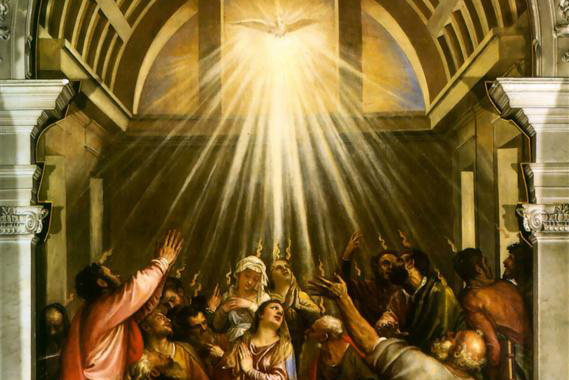
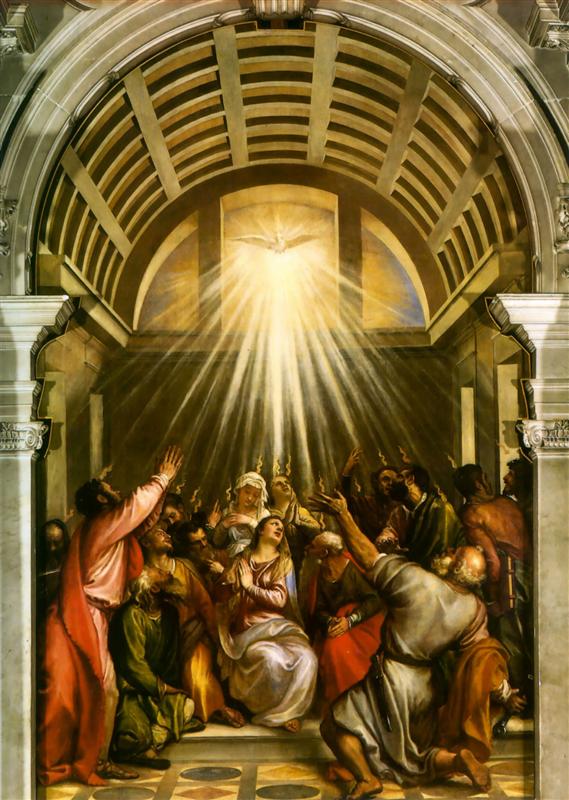
I have Come to Cast a Fire on the Earth – A Meditation on the Feast of Pentecost

051813What a wondrous and challenging feast we celebrate at Pentecost. A feast like this challenges us, because it puts to the lie a lazy, sleepy, hidden, and tepid Christian life. The Lord Jesus had said to Apostles, and still says to us: I have come to cast a fire on the earth! (Luke 12:49). This is a feast about fire, about a transformative, refining, and purifying fire that the Lord wants to kindle in us and in this world.

The Readings today speak to us of the Holy Spirit in three ways: The Portraits of the Spirit, the Proclamation of the Spirit and the Propagation by the Spirit. Let’s look at all three.

I. The Portraits of the Spirit – The Reading today speaks of the Holy Spirit using two images: rushing wind, and tongues of fire. These two images recall Psalm 50 which says, Our God comes, he does not keep silence, before him is a devouring fire, round about him a mighty tempest. (Psalm 50:3).

Rushing Wind – Notice how the text from Acts opens: When the time for Pentecost was fulfilled, they were all in one place together. And suddenly there came from the sky a noise like a strong driving wind, and it filled the entire house in which they were.

This text brings us to the very root meaning of the word “Spirit.” For “spirit” refers to “breath,” and we have this preserved in our word “respiration,” which means breathing. So, the Spirit of God is the breath of God, the Ruah Adonai (the Spirit, the breath of God).

Genesis 1:2 speaks of this saying the Spirit of God was moving over the face of the waters. And Genesis 2:7 speaks even more remarkably of something God did only for man, not the animals: then the LORD God formed man of dust from the ground, and breathed into his nostrils the breath of life; and man became a living soul (Gen 2:7).

So the very Spirit of God was breathed into Adam! But, as we know, Adam lost this gift and died spiritually when he sinned.

Thus we see in this passage from Acts an amazing and wonderful resuscitation of the human person as these first Christians (120 in all) experience the rushing wind of God’s Spirit breathing spiritual life back into them. God does C.P.R. and brings humanity, dead in sin, back to life! The Holy Spirit comes to dwell in us once again as in a temple (cf 1 Cor 3:16). It has been said that Christmas is the feast of God with us, Good Friday is the Feast of God for us, but Pentecost is the Feast of God in us.

Tongues of Fire – The text from Acts says, Then there appeared to them tongues as of fire, which parted and came to rest on each one of them.

The Bible often speaks of God as fire, or in fiery terms. Moses saw God as a burning bush. God led the people out of Egypt through the desert as a pillar of fire. Moses went up on to a fiery Mt. Sinai where God was. Psalm 97 says, The LORD reigns; let the earth rejoice; let the many coastlands be glad! Clouds and thick darkness are round about him; righteousness and justice are the foundation of his throne. Fire goes before him, and burns up his adversaries round about. His lightnings lighten the world; the earth sees and trembles. The mountains melt like wax before the LORD, before the Lord of all the earth. The heavens proclaim his righteousness; and all the peoples behold his glory. (Ps 97:1-6). Scriptures call God a Holy fire, a consuming fire (cf Heb 12:29) and a refining fire (cf Is. 48:10; Jer 9:7; Zec 13:9; & Mal 3:3).

And so it is that our God, who is a Holy Fire, comes to dwell in us through his Holy Spirit. And as a Holy Fire, He refines us by burning away our sins and purifying us. As Job once said, But he knows the way that I take; when he has tested me, I will come forth as gold (Job 23:10).

And he is also preparing us for judgement, for if God is a Holy Fire, then who may endure the day of his coming or of our going to Him? What can endure the presence of Fire Himself? Only that which is already fire. Thus we must be set afire by God’s love.

So, in the coming of the Holy Spirit God sets us on fire to make us a kind of fire. In so doing, he purifies and prepares us to meet him one, He who is a Holy Fire.

II. The Proclamation of the Spirit. – You will notice that the Spirit Came on them like “tongues” of Fire. And the reference to tongues is no mere accident. For notice how the Holy Spirit moves them to speak, and ultimately to witness. The text says: And they were all filled with the Holy Spirit and began to speak in different tongues, as the Spirit enabled them to proclaim. Now there were devout Jews from every nation under heaven staying in Jerusalem. At this sound, they gathered in a large crowd, but they were confused because each one heard them speaking in his own language. They were astounded, and in amazement they asked, “Are not all these people who are speaking Galileans? Then how does each of us hear them in his native language? We are Parthians, Medes, and Elamites, inhabitants of Mesopotamia, Judea and Cappadocia, Pontus and Asia, Phrygia and Pamphylia, Egypt and the districts of Libya near Cyrene, as well as travelers from Rome, both Jews and converts to Judaism, Cretans and Arabs, yet we hear them speaking in our own tongues of the mighty acts of God.”

So behold how the Holy Spirit moves them to proclaim, not just in the safety of the upper room, but also in holy boldness before the crowds who have gathered.

Notice the transformation! Moments ago these were frightened men who gathered only behind locked doors, in secrecy. They were huddled together in fear. But now they go forth to the crowds and boldly proclaim Christ. They have gone from fear to faith, from cowardice to courage, from terror to testimony!

And how about us? Too many Christians are silent, dominated by fear. Perhaps they fear being called names, or not being popular. Perhaps they are anxious about being laughed at, or resisted, or of being asked questions they don’t feel capable of answering. Some Christians are able to gather in the “upper room” of the parish and be active, even be leaders. But once outside the “upper room” they slip into undercover mode. They become secret agent Christians.

Well, the Holy Spirit wants to change that, and to the degree that we have really met Jesus Christ and experienced his Holy Spirit we are less “able” to keep silent. An old Gospel song says, I thought I wasn’t gonna testify, but I couldn’t keep it to myself, what the Lord has done for me. The Holy Spirit, if authentically received, wants to give us zeal and joy, and burn away our fear, so that testifying and witnessing are natural to us.

Note also how the Spirit “translates” for the apostles, for the crowd before them spoke different languages, but all heard Peter and the others in their own language. The Spirit therefore assists not only us, but also those who hear us. My testimony is not dependent only on my eloquence, but also on the grace of the Holy Spirit who casts out deafness and opens hearts. Every Christian should remember this. Some of our most doubtful encounters with others can still bear great fruit on account of the work of the Holy Spirit who “translates” for us and overcomes many obstacles that we might think insurmountable.

III. The Propagation by the Spirit – In the great commission the Lord said, Go, therefore, and make disciples of all nations, baptizing them in the name of the Father, and of the Son, and of the Holy Spirit, teaching them to observe all that I have commanded you. And behold, I am with you always, until the end of the age (Matt 28:19ff). He also said, as we have noted, I have come to cast a fire on the earth and How I wish the blaze were already ignited (Luke 12:49).

But how is the Lord going to do this?

Perhaps a picture will help. My parish church is dedicated to the Holy Spirit under the title: Holy Comforter. Above the high altar is the Latin inscription: Spiritus Domini, replevit orbem terrarum (The Spirit of the Lord, filled the orb of the earth). (See photo, above right, of our high altar).

And yet, we may wonder how He will do this.

But the walls of my parish Church answer the question. The clerestory walls are painted Spanish Red, and upon this great canvas are also painted the lives of 20 saints, surrounding us like a great cloud of witnesses (cf Heb 12:1). (See also, video below). And over the head of every saint is a tongue of fire.

THIS is how the Spirit of the Lord fills the earth. It is not “magic fairy dust,” it is in the fiery transformation of every Christian, going forth into the world to bring light and warmth to a dark and cold world. THIS is how the Lord casts fire on earth, THIS is how the Spirit of the Lord fills the orb of the earth: in the lives of saints, and, if you are prepared to accept it, in YOU.

In the end, the Great Commission (Matt 28) is “standing order No. 1.” No matter what else, we are supposed to do this. Parishes do not deserve to exist if they do not do this. We as individual Christians are a disgrace, and not worthy of the name, if we fail to win souls for Jesus Christ. The Spirit of the Lord is going to fill the orb of the earth, but only through us. The spread of the Gospel has been placed in your hands (scary isn’t it?).

In the Past two years, my own parish, after a year of training, stepped out into our neighborhood, and went door to door and into the local park. And we announced Jesus Christ, and invited people to discover him in our parish, and in the sacraments. And we were in the local park and the market last week doing sidewalk evangelization.

Before we count even a single convert, this is already success because we are obeying Jesus Christ who said, simply, “Go!” “Go make disciples.” And, truth be told, we ARE seeing an increase in my parish. Our Sunday attendance has grown from about 450 to 520, a 15% increase. We are growing, and our attendance, while average for a downtown city parish, is going in the right direction. God never fails. God is faithful.

Spread the news: it works if you work it, so work it because God is worth it. Go make disciples. Ignore what the pollsters tell you about a declining Church and let the Lord cast a fire on the earth through you! Fires have way of spreading! Why not start one today? The Spirit of God will not disappoint.

I know this, my parish has a future because we are obeying Jesus Christ, we are making disciples. How about you and yours? If parishes do not obey, they do not deserve to exist and can expect to close one day, no matter how big they are today. I, in my short 50 years on this planet, have seen it: parishes once big, booming, and, (frankly), arrogant, are now declining and some are near closure. It happens to the best, if they do not evangelize, if they do not accomplish “Job 1.” The Lord wants to light a fire. Why not become totally fire? Let the Spirit propagate the Church through you (I am not talking about the person next to you, I am talking to you).

Happy feast of Pentecost. But don’t forget that the basic image is very challenging, for it means getting out of the “upper room,” opening the doors, and proclaiming Christ to the world. Let the Holy Spirit light a fire in you, and then, you can’t help but spread light and heat to a cold and dark world.

Let the evangelization of the whole world begin with you.

This video features details from the clerestory (upper window level) of my parish of Holy Comforter here in DC. Notice the tongue of fire above each saint. The paintings show how the Spirit of the Lord fills the orb of the earth, (see photo above), through the lives of the lives of the saints (this means you). It is not magic, it is grace, working in your life, through your gifts, and your relationships, that the Lord will reach each soul. The cloud of witnesses on the walls of my Church say simply, You are the way he will fill the earth and set it on fire. Let the blaze be ignited in you!

The song says: We are surrounded by a great cloud of witnesses, looking on, encouraging us to do the will of the Lord. Let us stand worthy, and be faithful to God’s call….We must not grow weary…!

Here is another video I put together which has scenes from the Pentecost event and is set to Palestrina’s Dum Complerentur. I like this musical version since it is sung in dance time. The Latin text to the motet is below the video along with its English Translation.

Dum complerentur dies Pentecostes,
erant omnes pariter dicentes, alleluia,
et subito factus est sonus de coelo, alleluia,
tamquam spiritus vehementis,
et replevit totam domum, alleluia.

When the Day of Pentecost had fully come,
they were all with one accord in one place, saying: alleluia.
And suddenly there came a sound from heaven, alleluia,
as of a rushing mighty wind,
and it filled the whole house
where they were sitting, alleluia.
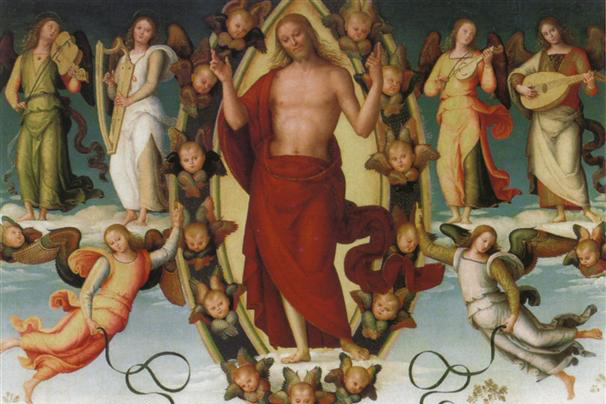
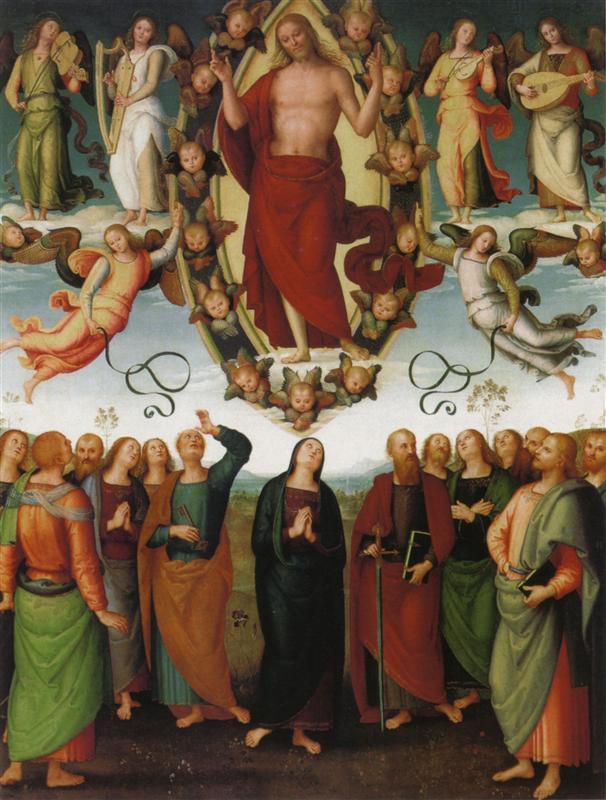
Every Round Goes Higher – A Meditation on the Feast of the Ascension

051113In more dioceses than not, the Feast of the Ascension is celebrated this weekend. The liturgist in me regrets the move, but here we are anyway. So let’s ascend with the Lord, three days late!

This marvelous feast is not merely about something that took place two thousand years ago. For, though Christ our head has ascended, we the members of his body are ascending with him. Since he was ascended, we too have ascended. In my own life, as a Christian, I am brought higher every year by the Lord who is drawing me up with him. This is not some mere slogan, but something I am actually experiencing. An old song says, I was sinking deep in sin, far from the peaceful shore. Very deeply stained with sin, sinking to rise no more. But he master of the sea, heard my despairing cry. And from the waters lifted me. Now safe am I. Love Lifted me, When nothing else could help. Love lifted me!

Yes, the feast of the Lord’s Ascension is our feast too, if we are faithful. Let’s look at it from three perspectives.

I. The Fact of the Ascension. – The readings today describe a wondrous event that the Apostles witnessed. The Lord, by his own power is taken to heaven. In so doing he opens a path for us too. The gates of paradise swing open again: Lift up your heads, O gates! and be lifted up, O ancient doors! that the King of glory may come in! (Psalm 24:7). In Christ, man returns to God. Consider three things about the Ascension:

A. The Reality – Imagine the glory of this moment. Scripture says, As they were looking on, he was lifted up and cloud took him from their sight….they were looking intently in the sky as he was going (Acts 1:9). So impressive was the sight that the angels had to beckon them to get along to Jerusalem as the Lord had said, Men of Galilee,” they said, “why do you stand here looking into the sky? This same Jesus, who has been taken from you into heaven, will come back in the same way you have seen him go into heaven (Acts 1:11). Yes, it was glorious. Jesus had once said as a summons to faith, What if you were to see the Son of Man ascending to where he was before? (John 6:62). He had also encouraged them saying: Truly, truly, I say to you, you will see heaven opened, and the angels of God ascending and descending upon the Son of man (John 1:51) So here is a glorious reality, and a fulfillment of what Jesus had said.

B. The Rescue – In the Ascension, it does not seem that the Lord entered heaven alone. As we have remarked, in his mystical body we also ascend with him. But consider too this remarkable text that affirms that: Therefore it is said, “When he ascended on high he led a host of captives, and he gave gifts to men. In saying, “He ascended,” what does it mean but that he had also descended into the lower parts of the earth? He who descended is he who also ascended far above all the heavens, that he might fill all things (Eph 4:8ff). Yes, the Lord had earlier, just after his death, descended to Sheol and awakened the dead and preached the gospel to them (cf 1 Peter 4:6). And now, for those he had justified, came the moment ascend with Jesus as a “host,” as an army of former captives, now set free. Behold the great procession that enters behind Christ through the now opened gates of heaven: Adam and Eve, Noah, Abraham, Sarah, Isaac Jacob, Rachel, Judith, Deborah, David, Samuel, Isaiah, Jeremiah, Ezekiel, Malachi, John the Baptist….and one day you! Yes this is a great rescue. Adam and his descendants have not simply been restored to some paradisaical garden, they have entered heaven.

C. The Rejoicing – Consider how, this once captive train, sings exultantly as they follow Christ upward to heaven. The liturgy today puts before us a likely song they sang: God mounts his throne to shouts of Joy! The Lord amid trumpet blasts. All you peoples clap your hands, shout to God with cries of gladness, for the Lord the most high, the awesome is the great king over all the earth. God reigns over the nations, God sits upon his holy throne (Psalm 47:6-7). I also have it on the best of authority that they were singing an old gospel song: I’m so glad, Jesus lifted me! Yes I also have it on the best of authority that they were even singing an old Motown song: Your love is lifting me higher, than I’ve ever been lifted before!

Yes, Here are some glorious facets of the Ascension.

II. The Fellowship of the Ascension – We have already remarked that, when Christ ascends, we ascend. Why and how? Scripture says, Now you are the body of Christ and individually members of it (1 Cor 12:27). It also says, All of us who were baptized into Christ Jesus were baptized into his death. By baptism we were buried together with him so that Just as Christ was raised from the dead by the glory of God the Father, we too might live a new and glorious life. For if we have been united with him by likeness to his death we shall be united with him by likeness to his resurrection (Rom 6:3ff). So, when Christ died we died. When Christ rose, we rose. When He ascends, we ascend.

But you may say, he is in glory, but I am still here, how is it that I am ascended or ascending? Consider a humorous example about our physical bodies. When I get on an elevator and punch the button for the top floor, the crown of my head gets there before the soles of my feet. But the whole body will get there unless some strange loss of integrity or tragic dismemberment takes place. So in an analogous way it is with Jesus’ Jesus mystical body. In Christ our head we are already in glory. Some members of his body have already gotten there. We who come later will get there too, provided we stay a member of the Body. Yes we are already ascended in Christ our head. We are already enthroned in glory with him, if we hold fast and stay a member of his Body. This is the fellowship of the Ascension.

III. The Fruitfulness of the Ascension – Jesus does not return to heaven to abandon us. He is more present to us than we are to ourselves. He is with us always to the end of the age (cf Matt 28:20). But in Ascending, without abandoning us, he goes to procure so very important things. Consider four of them:

A. Holy Ghost power – Jesus teaches very clearly that he is ascending in order to send us the Holy Spirit: Nevertheless I tell you the truth: it is to your advantage that I go away, for if I do not go away, the Counselor will not come to you; but if I go, I will send him to you (Jn 16:7ff) He also says, These things I have spoken to you, while I am still with you. But the Counselor, the Holy Spirit, whom the Father will send in my name, he will teach you all things, and bring to your remembrance all that I have said to you (Jn 14:25ff). And yet again, I still have many things to say to you, but you cannot bear them now. When the Spirit of truth comes, he will guide you into all the truth, for he will not speak on his own authority, but whatever he hears he will speak, and he will declare to you the things that are to come (Jn 16:13-14). So the Lord goes, that he might, with the Father, send the Holy Spirit to live within us as in a temple. In this way, and through the Eucharist, he will dwell with us even more intimately than when he walked this earth.

B. Harvest – Jesus says, And I, if I be lifted up from the earth, will draw all men unto me (John 12:32). While the immediate context of this verse is the crucifixion, the wonder of John’s gospel is that is that he often intends double meanings. Clearly Christ’s glorification is his crucifixion, but it also includes his resurrection and ascension. So, from his place in glory, Christ is drawing all people to himself. He is also bestowing grace on us from his Father’s right hand to be his co-workers in the harvest: But you shall receive power when the Holy Spirit has come upon you; and you shall be my witnesses in Jerusalem and in all Judea and Samaria and to the end of the earth (Acts 1:8). Yes, from his place in glory, Christ is bringing in a great harvest, as he said in Scripture: Do you not say, ‘Four months more and then the harvest’? I tell you, open your eyes and look at the fields! They are ripe for harvest. Even now the reaper draws his wages, even now he harvests the crop for eternal life, so that the sower and the reaper may be glad together. Thus the saying ‘One sows and another reaps’ is true. I sent you to reap what you have not worked for. Others have done the hard work, and you have reaped the benefits of their labor.” (Jn 4:35-38). Harvest! And it is the Lord’s work from heaven in which we participate.

C. Help – At the Father’s right hand Jesus intercedes for us. Scripture says, Consequently he is able, for all time, to save those who draw near to God through him, since he lives always to make intercession for them (Heb 7:25). The Lord links his ascension to an unleashing of special power: Amen, amen, I say to you, he who believes in me will also do the works that I do; and greater works than these will he do, because I go to the Father. Whatever you ask in my name, I will do it, that the Father may be glorified in the Son (Jn 14:12).

It is true, we must not understand asking in the name of Jesus as a mere incantation, for to ask in his Name means to ask in accord with his will. And yet, we must come to experience the power of Jesus to draw us up to great and wondrous things in his sight. Despite the mystery of iniquity all about us, we trust that Christ is conquering, even in the puzzling and apparent victories of this world’s rebellion. We read, In putting everything under him, God left nothing that is not subject to him. Though, at present we do not see everything subject to him, yet we see Jesus, who was made a little lower than the angels, now crowned with glory and honor….so that by his death he might destroy him who holds the power of death—that is, the devil— and free those who all their lives were held in slavery by their fear of death (Heb 2:8-9; 14-15). Thus, from heaven we have the help of the Lord’s grace which, if we will accept it, is an ever present help unto our salvation.

D. Habitation – Simply put, Jesus indicates that in going to heaven he is preparing a place for us: In my Father’s house are many mansions: if it were not so, I would have told you. I go to prepare a place for you. 3 And if I go and prepare a place for you, I will come again, and receive you unto myself; that where I am, there ye may be also (Jn 14:2ff) Yes, indeed, He has the blueprints out, and a hard hat on. He is overseeing the construction of a mansion for each of us that we may dwell with him, the Father and the Spirit forever.

Here then are the ways that Christ, by his love is lifting us higher, than we’ve ever been lifted before. Yes, love lifted me, when nothing else could help, Love lifted me.

Here’s a modernized version:

Four Gifts of Grace – A Meditation on the Gospel for the 6th Sunday of Easter

050413The Gospel for today has a number of “sayings” of the Lord Jesus which all amount to a kind of litany of love and setting forth of the gifts that He by his grace is and will accomplish in us. Lets get right to work and consider the wonderful gifts of grace.

I. Power Jesus said to his disciples: “Whoever loves me will keep my word

Here is a fundamental theology of grace: that the keeping of the commandments and mandates of the Lord’s word is the fruit of his Love. Let us state it plainly: the keeping of the Commandments is the fruit of Love, not the cause of it. “Yes,” says the Lord, “If you love me, the keeping of the commandments is sure to follow.” And note this too, we do not initiate this Love, God does. Scripture says, We love because he first Loved us (1 John 4:19).

Pay attention. No one can give what they do not have, and no one can possess what they have not received. God is the author and initiator of Love. Thus Love ALWAYS starts with him. The Lord is not setting up some sort of loyalty test here as if he were saying “If you love me, prove it by keeping the commandments.” That is not he gospel! The Gospel is that God has loved us, before we were ever born, before we could do anything to merit it. He loved us when we were dead in our sins. And HE took the initiative and loved us, when we hated him and crucified him.

And if we will accept this love, it will enable us to love God  with the same love with which he has loved us. And with his love in us we will begin to love what he loves and who he loves. We will love holiness, forgiveness, mercy, justice, compassion, chastity, generosity and so forth. And we will love our brethren and even our enemies. Why? Because God loves them and when his love is in our heart, so is his love for them, and for all the things he loves besides.

Do you get this? Love enables us to keep his word, to live it and love it. When I was young I dated a girl who liked square dancing. At the time I had no love for square dancing and thought it silly. But my love for her meant I started to love what she loved, and her family too. Do you see it? Love changes our heart  and our desires if we let it have its way.

So let Love have its way, and you will keep the commandments. The keeping of the commandments is the fruit of love, not its cause. Love is the power of grace at work in us to love what and who God loves. Jesus says, If you love me, you will keep my commandments (John 14:15).

II. Presence – [Jesus says] and my Father will love him, and we will come to him and make our dwelling with him.

One of the great desires of Jesus was to restore us to unity with the Father. Jesus was crazy about his Father and earnestly desired to have us know Him and love Him more deeply.

If we will but accept the Father’s love and shalom offered through Jesus, we will have a tender and joyful relationship with our Abba, our Father who loves us! Jesus often spoke of his Father almost as a doting Father. He was like a shepherd who left 99 in search of one, He was like someone who lost a coin and swept diligently to find it and, having found it, throws a party more costly that the value of the coin to celebrate. He is like a father whose son told him to drop dead but when His son finally returned, ran to meet him and threw a celebratory party.

Do you grasp this? The Father loves you and Jesus has reconciled you to him (cf 5:10). Now run to him, run to Abba,  God. If you take one step, he’ll take two, and start running to embrace you!

This is the Gospel: Jesus Christ has reconciled us to the Father, by the Father’s own request. He loves you. Now run to him and watch him run to you. He wants not distance, but intimate presence, love and embrace.

III. Perfection –I have told you this while I am with you. The Advocate, the Holy Spirit, whom the Father will send in my name, will teach you everything and remind you of all that I told you.

We all know that the Christian journey is not accomplished in an instant. But rather, we make this journey with God, the Holy Spirit, who teaches us and makes us mindful of all that Jesus has done for us, and taught us. Little by little we are given a new mind, a new heart, a new walk, and new priority, a new and better life. May God who has begun a good work in bring it to perfection (cf Phil 1:6).

And if we are open, he is faithful and he WILL do it. The process may be slow, but that is because we have foreheads of brass and necks of iron (cf Is 48:4). But God is faithful and patient. I am a witness; and if he can change me, he can change you too. He has promised and will do it.

We will be transformed by the renewal of our minds (cf Rom 12:2), for the Holy Spirit will bring to our mind all that the Lord IS and all that he taught. Let the Lord change your mind and heart. And if he does that, the rest will follow: sow a thought, reap a deed, sow a deed reap a habit, sow a habit reap and character, sow a character reap a destiny. And it all begins with the mind.

One of the gifts of grace is the renewing our minds, leading to total transformation.

IV. Peace – Jesus says, Peace I leave with you; my peace I give to you. Not as the world gives do I give it to you. Do not let your hearts be troubled or afraid. You heard me tell you, ‘I am going away and I will come back to you.’ If you loved me, you would rejoice that I am going to the Father; for the Father is greater than I. And now I have told you this before it happens, so that when it happens you may believe.

What is the gift of peace? Peace is shalom, it is more than an absence of conflict. It is the presence in the relationship of everything that should be there. Peace is the experience that everything is alright.

For us peace is access once again to the Father. It is to be able to walk with him once again in Love, in and through Jesus Christ. And we don’t just walk with him in some earthly garden paradise, as Adam and Eve did (but lost). Rather we walk with him in heaven. In Jesus we are seated with the Father in honor at his right hand.

So, what does it mean when the same Jesus who said, “The Father and I are One” (Jn 10:30), also says, “The Father is greater than I” (Jn 14:28)?

Theologically it means that the Father is the source in the Trinity. All the members are co-eternal, co-equal, equally divine, but the Father is the Principium Deitatis (“the Principle of the Deity”).

Jesus proceeds from the Father from all eternity. In effect Jesus is saying, “I delight that the Father is the principle of my being, even though I have no origin.”

Devotionally, Jesus is saying I always do what pleases my Father. Jesus loves his Father, is crazy about him, is always talking about him and pointing to him. In effect, he says, by calling the Father greater, “I look to my Father for everything and I do what I see him doing (Jn 5:19) and what I know pleases him (Jn 5:30). His will and mine are one, and what I will to do proceeds from him and I do what I know accords with his will, Whom I love.”

And here then is the source of our peace, that we, with Jesus love the Father and always do what pleases him. And Jesus “goes to the Father” but he takes us with him, for we are members of his mystical Body. In Jesus, we enter the holy of holies, and sit next to the Father in love and intimacy.

Here then are some important gifts of grace. It is for us to lay hold of them and live out of them. The Lord promises them to us, so they are ours. And if at times they seem distant, reach out and take back what the devil stole from you. These are gifts of the Lord’s resurrected grace.

Here’s a song that speaks of peace and presence, not to mention power.

A Brief Directive for Church Leaders from the Acts of the Apostles

XIR155497The Second reading from yesterday’s mass (5th Sunday of Easter) is very Catholic and too informative to merely pass up. It presents a Church as rather highly organized and possessed of some the structures we know to day in full form. Granted, some of these structures are in seminal (seed) form, but the ARE there.

We will also notice qualities of the original kerygma that are at variance with what some modern thinkers declare should be the methodology of the Church. The soft, cross-less Christianity of many today who remove the cross and replace it with a pillow and insist merely on inclusion and affirmation is strangely absent in this early setting.

Lets look the first reading from the Acts of the Apostles (Acts 14:21-27), and see the true path of priests, teachers and leaders in the Church. Four steps are prescribed for our consideration based on this reading. We note that they went forth announcing, admonishing, appointing and accounting.

I. Announcing = the Text says, After Paul and Barnabas had proclaimed the good news to that city and made a considerable number of disciples….

Notice that the happiness is linked to the harvest. Proclaiming the Good News, they yield a great harvest. We are not, as Catholics, sent out to proclaim a mere list of duties. We are sent to proclaim the Gospel. And the Gospel is this: that God has loved the world and sent his Son, who by dying and rising from the dead, has purchased for us a whole new life, free from sin and the rebellious obsessions of this world. He is victorious over all the death-directed drives of this present evil age. Simply put, he has triumphed over these forces and enabled us to walk in newness of life.

God save us from brands of the faith where mere rules and the recitation of obligations is all that is heard by: sour-faced saints, dead disciples, fussy pharisees, bored believers, and frozen chosen. Save us from Pharisaical philosophies that are obsessed with particularisms not even commanded by God, who sneer at things they consider lower than their mere preferences.

Rather no, we are sent to announce a new life, set free from the bondage of sin, rebellion, sensuality, greed, lust, domination and revenge. We are sent to announce a life of joy, confidence, purity, chastity, generosity, and devotion to the truth rooted in Love.

Yes, here is a joyful announcement rooted in the cry Anastasis! (Resurrection!) New Life, the old order of sin is gone, a new life of freedom from sin is here!

Did everyone accept this as good news? No, some, indeed many, were offended and sought to convict Christians as “disturbers of the peace.” Some don’t like to have their sin and bondage called as such. They prefer bondage, sin, and darkness to light, holiness and freedom.

But, at the end of the day, we, as Catholics announce what is intrinsically good news and we ought to start sounding like it by proclaiming it with joy, and without the bitterness and anger that sounds more like those who are trying to win an argument than joyfully announce something wonderful, freeing and true.

II. Admonishing – The text says, They returned to Lystra and to Iconium and to Antioch. They strengthened the spirits of the disciples and exhorted them to persevere in the faith, saying, “It is necessary for us to undergo many hardships to enter the kingdom of God.”

Notice first that preaching and teaching is a process. You don’t just preach or teach once and move on,  you return and reiterate. Note that they are retracing their steps back through towns that they evangelized. They do not just come, have a tent revival and move on. They return, and as we shall see they establish the Church.

Thus notice what they do They:

1. Encourage – They strengthened the spirits of the disciples
2. Exhort – exhorted them to persevere in the faith,
3. Explain – saying, “It is necessary for us to undergo many hardships to enter the kingdom of God.”

Lets focus especially on the last the point. In effect they announce and teach “If you’re not willing to endure the cross, no crown will come your way. If you can’t stand a little disappointment sometimes, If you can’t stand being talked about sometimes, if you think you should always be up, and never down, I’ve come to remind you, NO CROSS, NO CROWN.

Yes, beware of cross-less Christianity. We do have good news to proclaim but there is also the truth that we get to the resurrection and the glory are through the cross. There is a test in every testimony, a trial in every triumph. There are demands of discipleship, requirements for renewal, laws of love, and sufferings set forth for Saints.

Good preaching combines the hardship and happiness in one message. It is a joy to follow in the footsteps of our Lord who endured hostility, hardship and the horrors of the Cross but triumphed over all this, and showed that the wisdom of this world is foolishness to God. Yes, He has caught the wise in their craftiness, and shown that the thoughts of the wise in this word are futile (cf 1 Cor 3:20). He made a public spectacle of them, triumphing over them (paradoxically) by the cross (cf Col 2:15)

Thus, St Paul and Barnabas announce the Cross, a stumbling block to Jews and foolishness to Gentiles (cf 1 Cor 1:23). Many today insist that the Church soft-pedal the cross, use “honey, not vinegar.” No can do. We joyfully announce and uphold the paradox of the cross and must be willing to be a sign of contradiction to this world,  which sees only pleasure and the indulgence of sinful drives as a way forward, that exults freedom without truth or obedience, and calls good what God calls sinful.

Too many so-called Christian denominations have adopted the pillow as their image and a “give the people what they want” mentality. It is 180 degrees out of phase with the cross.

The Catholic Church does not exist to reflect the views of its members, but to reflect the views of its founder and head, Jesus Christ. And Jesus announced, without ambiguity the cross, saying, as he went out to die: Now is the time for judgment on this world; now the prince of this world will be driven out. And I, when I am lifted up from the earth, will draw all men to me. (John 12:31-32).

And so, we announce the cross, not merely as suffering, but as life, as power, and as love. It is possible, by the power of the cross, to live without sin, to overcome rebellion, pride, lust and greed. It is possible by the power of the cross to learn to forgive, and live the truth in love.

And the world will hate us for this. But such hardships, such crosses are necessary preludes to the hallelujah of heaven. The Church can do no less than to point to the cross. As the center of our faith is a cross not a pillow. And the Cross is our only hope (Ave Crux! spes unica nostra! – Hail O Cross our only hope).

Yes, the Church announces the cross and admonishes a world obsessed with pleasure and passing, fake happiness.

III. Appointing The text says, They appointed presbyters for them in each church and, with prayer and fasting, commended them to the Lord in whom they had put their faith. Then they traveled through Pisidia and reached Pamphylia. After proclaiming the word at Perga they went down to Attalia.

And thus we see the ordination of priests, leaders in every place. “Priest” is just a English mispronunciation of “presbyter.” And thus we see that Paul and Barnabas did not simply go about vaguely preaching and then moving on. They established local churches with an authority-structure. The whole Pauline corpus of writings indicates a need to continue oversight of these local churches and to stay in touch with the priest leaders they have established to lead these local parishes.

Later St Paul spoke of the need for this structure in other places when he wrote, for example, to Titus:

This is why I left you in Crete, that you might amend what was defective, and appoint presbyters in every town as I directed you, (Titus 1:5)

This appointment was done through the laying on of hands and is called ordination today. It is a way of establishing order and office in the Church to make sure the work continued and that the Church was governed by order. This is why we call the Sacrament involved here the “Sacrament of Holy Orders.”

Note too a critical task for leaders in the Church is to develop and train new leaders. Too many parishes depend on charismatic and gifted leaders who when they die or must move on leave a void, not an on-going ministry or organization. This should not be so. Good leaders train new leaders.

IV. Accounting – The text says, From there they sailed to Antioch, where they had been commended to the grace of God for the work they had now accomplished. And when they arrived, they called the church together and reported what God had done with them and how he had opened the door of faith to the Gentiles.

Note that Saints Paul and Barnabas are now returning to render an account for what they have done. Accountability is part of a healthy Church. Every priest should render an account to his bishop, every bishop to his Metropolitan, and to the Pope. Today’s ad limina visits of bishops to the Pope is the way this is done. Further, priests are accountable to their Ordinary through various mechanisms such as yearly reports, and other meetings.

A further background to this text is that Paul and Barnabas are returning to Antioch, because it was from there that they were sent forth by the local bishops and priests on this missionary task:

While they were worshiping the Lord and fasting, the Holy Spirit said, “Set apart for me Barnabas and Saul for the work to which I have called them.” 3 Then after fasting and praying they laid their hands on them and sent them off. (Acts 13:2).

Thus St. Paul was not the lone ranger some think him to be. He was sent, and was accountable. As we read elsewhere:

But when he who had set me apart before I was born, and had called me through his grace, was pleased to reveal his Son to me, in order that I might preach him among the Gentiles, I did not confer with flesh and blood, nor did I go up to Jerusalem to those who were apostles before me, but I went away into Arabia; and again I returned to Damascus. Then after three years I went up to Jerusalem to visit Cephas, and remained with him fifteen days. (Gal 1:15-18)

Then after fourteen years I went up again to Jerusalem with Barnabas, taking Titus along with me. I went up by revelation; and I laid before them (but privately before those who were of repute) the gospel which I preach among the Gentiles, lest somehow I should be running or had run in vain. (Gal 2:1)

The preacher and teacher must be accountable: For we shall all stand before the judgment seat of God; for it is written, “As I live, says the Lord, every knee shall bow to me, and every tongue shall give praise to God.” So each of us shall give account of himself to God. (Rom 14:10-12)

And thus we see some paths for priests, preachers, teachers and leaders. We must announce the Gospel as good news, with joy and confidence. We must admonish a world obsessed with pleasures (and Church members affected by this mentality) to embrace the cross as our only hope. We must continue to develop, train and appoint leaders to follow after us. And we must be accountable to one another.

A nice and quick portrait of some healthy traits for the Church.

The Legacy of Love – A Meditation on the Gospel for the 5th Week of Easter

062114The title of this sermon uses the word Legacy, which refers to something transmitted by or received from an ancestor or predecessor.

Perhaps the most accessible image of this is money. If I receive 100 million dollars from a dying relative I can tap into those funds and start living differently. My bills that now seem overwhelming, can be paid off the mere interest of my funds, and I can start enjoying things I thought I could never afford in the past. In other words, a legacy can utterly change the way I live, and open new possibilities.

It is in this sense that we explore today’s Gospel wherein our Lord sets forth for us a new power, the power of Love wherein we are able to live differently, if we will tap into it and draw from its riches. There is a kind of legacy, a deposit of riches form which we can draw, if we will but lay hold of it.

Lets look at this gospel in three stages and discover what the Lord has do for us and left us, by way of a legacy.

I. Provision and Pivot of the Passion – the text says: When Judas had left them, Jesus said, “Now is the Son of Man glorified, and God is glorified in him. If God is glorified in him, God will also glorify him in himself, and God will glorify him at once.

Note how the text speaks in the present, the Son of Man IS glorified. The aorist tense of the verb indicates something that has begun and is underway. Judas’ going forth has started a process that is now underway and will, by God’s grace, result in liberation and glorification for Jesus and for us. The Lord Jesus is no mere victim. Everything is unfolding exactly as foretold. The Son of Man will suffer, but in the end will be glorified.

And this glory will make available for us a whole new life.

Now this leads us to a question: WHAT HAPPENED WHEN THE SON OF GOD DIED AND ROSE FOR ME? Here we do not pose the mere catechism answer. But more deeply:  What difference does the passion, death and resurrection of Jesus Christ make for you today? Is it just an ancient historical event that is meaningful only because others say so? Or have you grasped and begun to lay hold of what Jesus has done for you??

Scripture says of this event that his death, is glorification and new life for us:  We know that our old self was crucified with him so that the sinful body might be destroyed, and we might no longer be enslaved to sin…We were buried therefore with him by baptism into death, so that as Christ was raised from the dead by the glory of the Father, we too might have a whole new life. (Rom 6:4-7)

In other words, the Son of Man, Jesus, is glorified in his passion and is destroying the power of sin and death by his cross and resurrection. And each of us need to spend our lives pondering what happened when the Son of God died for me. What we ponder is not some mere historical even. It is that, but is is far more. And to the degree that we will lay hold of this saving work, we will come to see and experience the power of the Cross of our Lord Jesus Christ to put sin to death and to bring new life forth in Christ.

Of this I am a witness for I have seen the power of the cross and known its power to quell sinful fears, worldly lusts, and endless preoccupations. On account of what Jesus endures for us, for me, Jesus ascends on high not to leave us, but to open the way for us to a greater and fuller life. It is a life wherein we see sin put to death and many graces and charisms come alive, charisms  of confidence, joy, hope and an increasing;y victorious life. It is for us to grasp this saving work and to the new life it offers us by the power of the Cross of Christ and him crucified.

This is the moment of glory, the pivotal point of all things. This the glory and the premise of a new life. Because of what Jesus does at this moment, his glory and ours is ushered in, it is all premised on this.

II. The Power and Produce of the Passion – The text says, I give you a new commandment: love one another. As I have loved you, so you also should love one another. –

When we hear the phrase “Love one another as I have loved you.” we can fall into the trap of thinking: “Uh Oh! I have to do more! I have to try harder. Since he loved me now I, out of my own flesh power, have to love others. But such thing is NOT the gospel. The phrase is not about rules, it’s about relationship. Jesus is not just saddling us with more responsibilities. He is equipping. empowering and enabling us to love with the same love by which He has loved us.

The point here is to let Jesus love you, to experience his love. And with this love, experienced and embraced, now be empowered to love others.

The Lord does not just say, “Love.” Rather he says, receive love and then love with the love that you have received. Scripture says,

– We love, because he first loved us. (1 John 4:19)
– As the Father has loved me, so have I loved you. Abide in my love! If you keep my commandments, you will abide in my love, just as I have kept my Father’s commandments and abide in his love. (John 15:9)

In other words, we have the power to keep his commandments and to love others to the degree that we receive and abide, that is remain, in his Love. We love with his love, not merely our own love.

Do not miss this point! Do you see it?! This is the gospel: That by the power of his love and grace we are empowered to love and keep his commandments and to see our lives changed. The gospel is not a moralism that says, “Keep a bunch of rules.” The Gospel is that God has sent his Son who died for you and rose to give you a wholly new and transformed life, a life that keeps the commands and loves others out the power of God’s own love received and experienced.

III. The Proof Positive of the Passion. The text says,  This is how all will know that you are my disciples, if you have love for one another.

We have reflected many times before on this blog that the usual Greek word for “know” is richer than our modern notion of “intellectual knowing.” The Greek word for merely knowing something intellectually is oida. But the Greek verb used here is γινώσκω (ginosko) which refers to experiential knowing, to knowing in a deeper, personal and experiential way.

Thus, the point is that others will notice the legacy of Love living us in a very real and experiential way. The Faith, Hope and Love that we proclaim will not, cannot, be a mere intellectualism, it is to be something that others can see and experience at work within us in an evidential way.

Hence, the proof, the evidence or picture of God’s love is not some vague feeling, or a mere intellectual attribute in us. It is a powerful and dynamic force that equips, empowers and enables us to love. The Lord says here that his love is something that changes us in a way that others will notice. It changes our relationships in a palpable, tangible and noticeable way. We notice and experience it power and so do others.

Yes, we will love even our enemies. And we will do this not out of our own flesh power or because “have to” but because we want to and have received a new heart from the Lord and the power to love.

And note this too. The love we have will not be some cheesy or merely sentimental love. It will be a true love, a love rooted in truth. It will be a love like Jesus has, a love that does not compromise the truth or water down its demands. It will be a love that speaks the truth but does so not to win an argument, but to summon the other to fulfillment and flourishing. This is what Jesus did. He loved, but he loved in truth and integrity. Nothing would compromise his love for his Father and the glorious vision and plan of the Father for all his children to abide in truth and holiness.

And thus for us, the proof positive that the legacy of love is at work within us is, first of all, our own transformed lives, that people can see. Secondly, it is the love that others can and do experience from us. Granted, this love will sometimes challenge and irritate some, as it did with Jesus love for the world. But it is a love that is difficult to deny, an integrity that is hard to impugn, a love that is even disconcerting, but one that is real, palpable and obvious.

Here then is the legacy of love. It is a treasure, an inheritance that the Lord Jesus has left us to draw from. This love is not our work, it is not our wealth, not our power. It is all his. He has left it fro us to draw on. Will you? Will I? Or will we make excuses about how we are not able to do the things to which he has summoned us? But, don’t you get it? It is not our power, not our love, it is his, and he has left this legacy, this inheritance for us to draw on.

Lay hold of this power, this love and let it transform your life. Let it turn you into proof positive of the power of the Cross to transform lives and bestow new life.

This song says, (enjoy the brass arrangements of this version!)

Souls in danger look above, Jesus completely saves,
He will lift you by His love, out of the angry waves.
He’s the Master of the sea, billows His will obey,
He your Savior wants to be, be saved today.

Love lifted me! Love lifted me!
When nothing else could help
Love lifted me!

What Did Jesus Call Me? A Meditation on the Gospel for Good Shepherd Sunday

Close-up of a Sheep's head in front of a crean backgroundThe Lord says, “My Sheep hear my voice…” That’s right he called you a sheep. No come on, get a little indignant with me here! The Lord is comparing us, not to the swift eagle, , the beautiful gazelle, the mighty bear, the swift horse, the mighty lion, or the clever and intelligent dog. No, he looks at us as says we’re like sheep. Hmm… While reality may hurt, the truth can liberate. For the fact is, sheep are lowly animals, but they are valuable as well. Let’s consider this Gospel in three stages: The Sign of the Sheep, the Safety of the Sheep and the Salvation of the Sheep.

I.THE SIGN OF THE SHEEP – In the text,  Jesus said: “My sheep…. “ What does the Lord mean in using sheep as a sign for us? Lets consider some qualities about sheep that may help illustrate what the Lord is teaching.

1. Sheep are WAYWARD It means that they just tend to wander off. It just grazes awhile then looks up, and looks around and says, in effect, “Where am I?” A sheep will nibble here and browse there and get lost lost, he doesn’t know how to get back to the sheep fold unless the shepherd goes and brings him back. Sheep just keep on going and don’t come back. Dogs and cats can find their way home, The horse can find the barn, But not the old sheep. It doesn’t know how to get back to the sheep fold unless the shepherd goes and brings him back.

Now don’t tell me that doesn’t describe us. All we like Sheep have gone astray, every one to his own way (Isaiah 53:6). This is how it is with us. We get easily lost. We need the sheep fold of the Church and we need the Shepherd, who is Christ, ministering through his Pope, bishops and priests. Otherwise we just wander here and there.

2. Sheep are WITLESS That is to say they just plain dumb. Ever hear of a trained sheep? We train dogs and birds, horses and even lions. But the sheep cannot be trained!

Now we human sheep like to think we are so smart. Sure we’ve been to the moon, and we have all this technical computer stuff. But too many of us aren’t even smart enough to pray every day, get to Church on Sunday, and follow God’s basic directions for life.

We’re so witless that we even do things that KNOW harm us. Even the simplest directions from God we either confuse or get stubborn about. We cop an attitude and say “We know a few things too.” That’s right, we do know a very few things.

We’re so dumb, we think we’re smarter than God! We think we have a better way than God’s way. No that’s really dumb.

3. Sheep are WEAK A sheep just has no way to protect himself. The mule can kick, the cat can scratch, the dog can bite, the rabbit can run, and the skunk…you know what he can do. But the old sheep? Without the care of the Shepherd and the sheep dogs, the sheep is history. The wolf comes and all he can do is stand there and get killed.

And so it is with us, if it were not for the care of Jesus the Good Shepherd, the world, the flesh and the devil have got us cornered. And if it were not for the Lord, and the power of his grace, we would be toast.

We like to think we’re strong. We have armies, we amass political power, monetary power, star-power. It all gives us the illusion that we are strong. But then the slightest temptation arises and we fall. We need the Lord and his grace and mercy or we don’t stand a chance because by our self we are weak and prone to sin.

AND YET…

4. Sheep are WORTHWHILE animals. The sheep is a valued animal. In Jesus’ day many a man counted his wealth by sheep. Sheep give meat and milk, produce lambs and wool. Shepherds made many sacrifices in Jesus’ day to breed, herd, and protect these valuable animals. And so it is with us. We may not feel worthy at times, but apparently we were worth saving because the Lord paid the price of our redemption. He saw the price, and paid it all. And not with any diminishable sum of silver and gold but with his own precious blood (1 Peter 1:18-19).

5. Sheep WALK together – Sheep flock together, and thus are safer. To be a solitary sheep is dangerous. It’s a good way to get devoured.

Be sober, be vigilant; because your adversary the devil, as a roaring lion, walketh about, seeking whom he may devour (1 Peter 5:8). The scriptures also say Woe to the solitary man! For if he should fall, he has no one to lift him up (Eccles 4:10). Sheep are not supposed to go off on their own, neither are we.

We are called to part of a flock and to be under the care of a shepherd. Most of us realize this in a parish setting. But in the wider sense, we are under a bishop’s care and ultimately the care of the Pope who is the chief Shepherd and the Vicar of Christ, the Good Shepherd.

The Lord Jesus said there is to be one flock and one shepherd (John 10:16). God wants us to be in the protection of the flock with a shepherd watching over us. An old spiritual says, “Walk together children. Don’t you get weary. There’s a great camp meeting in the promised land.” Now too many like to say, “That old Pope doesn’t know this or that.” But again please consider that to wander from the care of the flock and the Shepherd is a mighty dangerous thing.

6. Sheep are WARY Jesus says elsewhere, He who enters by the door is the shepherd of the sheep. To him the gatekeeper opens; the sheep hear his voice, and he calls his own sheep by name and leads them out. When he has brought out all his own, he goes before them, and the sheep follow him, for they know his voice. A stranger they will not follow, but they will flee from him, for they do not know the voice of strangers. (John 10:11-14).

Sheep have the remarkable quality of knowing their master’s voice and of instinctively fearing any other voice and fleeing from it.

In this matter, real sheep are smarter than most of us. For we do not flee voices contrary to Christ. Instead we draw close and say, “Tell me more.” In fact, we spend a lot of time and money to listen to other voices. We spend huge amounts of money to buy televisions so that the enemy’s voice can influence us and our children. We spend large amounts of time with TV, radio, Internet.

Yes, we can so easily be drawn to the enemy’s voice. And not only do we NOT flee it, but we feast on it. And instead of rebuking it, we turn and rebuke the voice of God and put his Word on trial, instead of putting the world on trial.

The goal for us is to be more wary, like sheep and to recognize only one voice, that of the Lord speaking though his Church, and to flee every other voice.

II. The SAFETY OF THE SHEEP – Jesus goes on to say, hear my voice; I know them, and they follow me. No one can take them out of my hand. My Father, who has given them to me, is greater than all, and no one can take them out of the Father’s hand.

Note the promises that Jesus will not be overpowered, no one can snatch from his hand. Dan 7:14 says, His kingdom is an everlasting kingdom that shall not be destroyed, his kingship shall not be destroyed. In other words, the devil can’t sheep-steal, in no way can he have power over Jesus or his flock.

But it’s all predicated on what’s been said. If we want protection and safety, we have to know only Jesus’ voice and stop running after all sorts of false shepherds and voices. We have to stay with the true Shepherd, Jesus, and in the protection of the flock. You want safety? Stay in the shelter of Jesus’ shepherding.

Let us be clear on this point, no weapon waged against us can ever prosper (Isaiah 54:17).  Satan cannot harm or get to any of us, UNLESS we open the door. Satan is like a dog on a leash, he can only harm us if we get too close by our own foolish decisions! Satan is a chained dog…do not stray into his range or territory!

Yet so many do! They savor pop culture, with all its darkness, click over to pornographic sites, take a steady diet of revengeful “action” movies, and watch endless commercials telling them to buy the latest product with its promises of empty fulfillment. A steady stream of polluted water and then we wonder why we are sick and weak, full of the parasites of sin.

Is it any wonder that our thinking is distorted, unbiblical, dark and foolish? At least sheep know to flee a false shepherd. What about us. Too many of us are intrigued by the ranting of false shepherds. We glamorize evil, and have our minds filled with false teaching and improper priorities.

And thus, while no one can snatch from Jesus’ hand, this is not some magical protection that prevents us from foolishly and sinfully walking away from him. And if we walk, woe to us, if we stray, our strength will fail!

Every ancient city had walls and gates to protect its citizens. But that citizen was fool who thought he could enjoy the protection of the city by journeying outside its protective walls. Yet too many Christians think they should enjoy the promises and protections of Jesus,  and yet stray form the safety of the protective walls of his kingdom. It simply doesn’t work that way.

Jesus calls anyone who hears his teaching and does not follow it a fool (Matt 7:26). Fools do not enjoy protection, since wisdom is of the Kingdom but foolery is of the world, headed for destruction.

And old spiritual says, Some seek God, don’t seek him right, they pray all day and fool at night! Well, living a double life is no way to enjoy the Lord’s protection. That only comes to those who live in the protection of His Kingdom, not for those who merely visit there. The Shelter of the Shepherd is the only safe harbor.

Yet another old song says, My mother taught me how to pray. My mother taught me how to pray. So if I die and my soul be lost, it’s nobody’s fault but mine. My savior taught me how to live, My savior taught me how to live. So if I die and my soul be lost it’s nobody’s fault but mine. 

Pay attention fellow sheep: do not stray from the Shepherd. He can protect you. But if you want to live a double life or open doors in your heart to Satan, understand that the protection of the Lord is only for those who desire and freely choose such protection. The Lord is not a slave owner. He is a lover who invites us to freely accept his offer of new life rooted in a loving and trusting relationship to him.

Do you know his voice? Do you know ONLY his voice? Do you run form every voice contrary to is? Or do you collect counselors who tell you what your itching ears want to hear? (cf 2 Tim 4:3).

If so, you have the protection of the Savior Jesus Christ, and nothing will ever harm you (Luke 10:19). But if you stray, be not surprised at the presence of wolves.

In deliverance ministry we look especially to the doors that the afflicted open to demons. For, unless they have opened a door does a demon have any power to be there. The key is to repent and close all doors, desiring only the care of the True Shepherd and Guardian of our souls (1 Peter 2:25).

III. THE SALVATION OF THE SHEEP – The text goes on to say, I give them eternal life, and they shall never perish.

Note that, for the flock of the Lord there is the gift of “eternal life.” Too many Christians equate this with some far off, distant future that they vaguely hope to attain.

But eternal life refers not only to the capacity to “live forever and never die.” It does mean this, but eternal life is so much more! It begins now. And “eternal” refers not only to length of life but toe the fulness of it.

In this sense, eternal life is now as we become ever more aware of an experience that, If anyone is in Christ, He is a new creation!” (2 Cor 5:17). Of this I am a witness, being far more alive at 51, than I ever was at 21!My body ages, but soul is younger and more vibrant than ever.

And here is the promise to lay hold of of: those who are in the shepherd’s care, come, by stages to experience life more fully, to become more fully alive. Jesus our Shepherd promises us eternal life. But this does not wait till heaven, it is now. The sheep are brought to salvation, to healing, we you will accept it.  If we choose freedom and the shepherd’s cares, it is ours! If we reject some or all of it, then we live apra from his care and vision and too easily savage wolves come and attack.

Are you smarter than a sheep? Do you know how to recognize the shepherd’s voice and follow only him? Or are you foolishly running after worldly advice and sinful priorities? On this Good Shepherd Sunday, strive to be a good sheep.

Yes he said it, a “sheep.” But sheep have this going for them, they recognize only their shepherd’s voice and run from any other.

Fighting fear with Fear – A Meditation on the Healing Gift of the Fear of the Lord

light

091014In the first reading from yesterday’s (Sunday) liturgy from the Acts of the Apostles (Full text here) we encounter Apostles and see that they are changed men. Prior to Pentecost, these had been frightened man, men who fled at the sight of trouble, en who could not be (except for John) found anywhere near the foot of the Cross. Even after the resurrection, these were men who gathered only behind locked doors “for fear of the Jews.”

But in this reading, which took place at yesterday’s liturgy, we see men who are no longer afraid. The Holy Spirit has quickened their faith and courage. In this passage, having been arrested for speaking of Jesus, then miraculously released by the angel of the Lord, we find them right back in the public square announcing Jesus. The  temple leaders having apprehended them yet again, say to them, We gave you strict orders [did we not?] to stop teaching in that name. Yet you have filled Jerusalem with your teaching (Acts 5:28). In response to the is second arrest, the Apostles once again display courage, also known as  “Foritude,” one of the seven gifts of the Holy Spirit, which they had received it Pentecost. But, in effect, they root their courage in another of the seven gifts, the gift of the “Fear the Lord.”  They say, We must obey God rather than men (Acts 5:29)

Note therefore how their confidence, their courage, is paradoxically rooted in Fear. It is not a cringing fear, but rather, a holy Fear, the Fear of the Lord. In effect, the Apostles fight fear with fear. More specifically, they conquer unholy fear with Holy Fear.

What is the fear the Lord? It is, as we have already noted, not a cringing fear, a fear merely rooted in servile anxiety about consequences or punishments. Rather, the Fear the Lord is the gift to hold God in awe. It is a gift, rooted in love of Him. Because I love God, love him with all my heart, I want to please him, obey him. I hold him in loving awe and respect, and I fear offending him who has  loved me so, and done so much for me. We do not have time to fully set forth here the biblical basis for this definition of the Fear the Lord. But I have written elsewhere on this and have analyzed quite extensively a biblical understanding of what is meant by the fear of the Lord. You can read it here: Understanding the Fear of the Lord and here: Studying the Fear of the Lord in the Psalms

Our context in this post, is that to Fear the Lord, as is counseled and commanded of us in Scripture, is not some mere egocentric demand of of a demanding God.  Rather, it is his loving way of both simplifying our life, (making it about one thing), and also, by this Holy Fear,  of helping us to cancel and diminish all other fears.

For if I truly fear the Lord, and to the degree that this becomes a reality not just a slogan in my life, but I really Fear him, I do not need to fear anyone else, and  my life also becomes simpler because I do not have to please ten thousand people, but only my loving Father in heaven.

But as it is, many of us struggle to experience this  magnificent gift of the Holy Spirit, called the fear the Lord, because we either have resisted it or have not laid hold of it. And on this account, our fears are many, our lives are disordered and focused on many things, rather than one thing. Because we have not received the gift and the desire to please and Fear God, we end up trying to please everyone, and our fears  multiply because there are many contradictory and contrary demands by the ten thousand voices we seek to please and pacify.

Jesus speaks to this grave condition by sayingNo one can serve two masters. Either you will hate the one and love the other, or you will be devoted to the one and despise the other. You cannot serve both God and money (Mat 6:24). To be frank, our condition is far worse than simply trying to serve two masters. Most of us have many more masters, and our lives are too easy dominated by many anxieties and fears, rooted in many contradictory, complex and conflicting priorities, given by the many different people, groups, and ideologies we seek to please, placate and serve.

The book of James says, The double minded man is unstable in all his ways (James 1:8). Would that we were simply double-minded, but in today’s complex situations we are often divided fifty-fold, even a hundredfold:  so many things to do, so many people to please. Frankly, too many of us are afraid of everyone and everything. What if person A is displeased with me?! But what if pleasing person A displeases person B,  and how will I explain things to person C?!! And thus our lives are divided, anxious, full of fears.

The Lord’s plan is to fight fear with Fear. His plan is to fight unholy fear with Holy Fear. God’s loving plan is, in effect, Fear me, reverence, respect and seek to please me out of love, and you will be less obsessed with what others think. “Yes,” says the Lord,  come to know me, not as some stranger, some abstract Deity running the universe, come to know me as your Father, someone who loves you, someone whom you deeply reverence and want to please. And to the degree that this happens in your life, that you receive this anointing of the Holy Spirit, this gift of the Holy Spirit called the Fear the Lord, you will be set free from ten thousand other fears and anxieties.

And this leads us back to the Apostles in Sunday’s reading. A mere few weeks ago they were frightened, even terrified men,  behind locked doors. Now they boldly go about preaching Christ and him crucified. What happened to them? The Holy Spirit has happened, and in particular, His gifts of courage (fortitude), and the Fear the Lord. And thus the apostles are boldly able to speak to those who demand their loyalty, demand obedience, and they say We must obey God rather than men.

They say this with serenity because they’ve come to know the Father, have come to know Jesus and the power the Holy Spirit. Fearing God, they no longer fear any weapon waged against them, they no longer fear any man. And this is how fear is fought with Fear. One Fear eclipses all others fears. It is Holy Fear, loving Fear, yes, even a joyful Fear. When I fear God I need fear no one else. When I kneel before God, I can stand before any man.

Here then is the gift of the fear the Lord. Seek it, lay hold of it, allow it to have its effects. If we can do this, so many other fears go away, so many other conflicts are resolved. When we need to please only One, we no longer need to please many. When we Fear one, the fear the others goes away.

Finding Jesus where He actually is – A Meditation on the Gospel for the 2nd Sunday of Easter

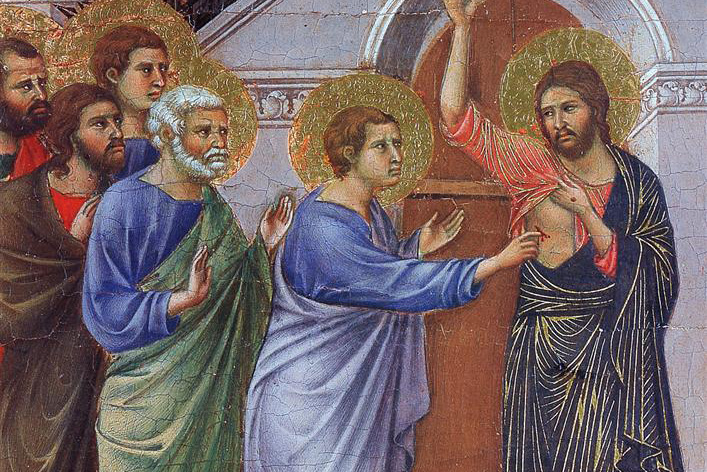
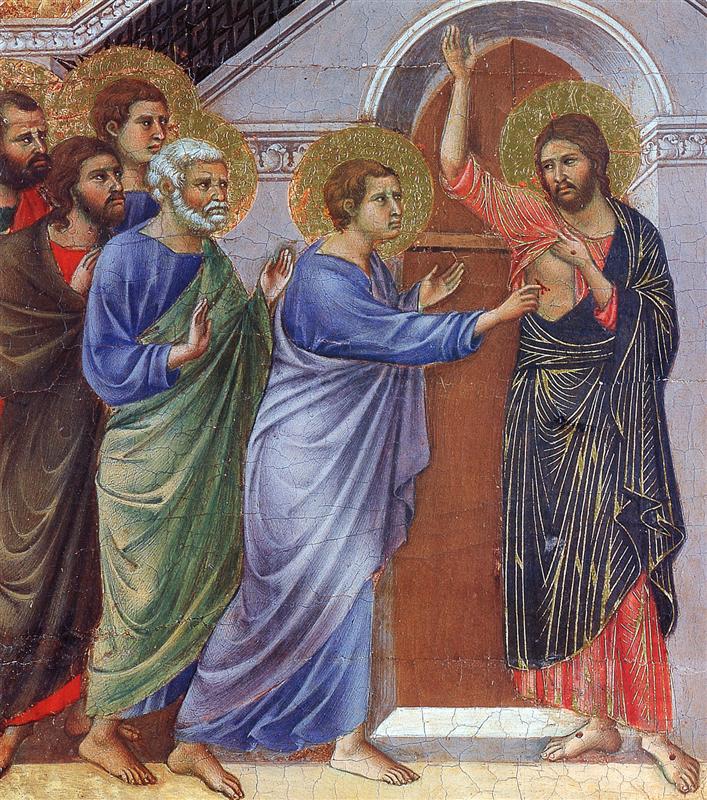
040613In today’s Gospel we see that the Risen Lord appeared to the apostles who were gathered together in one place. The fact that they were gathered in one place is not without significance, for it is there that the Lord appears to them. One of them, as we shall see, was not in the gathering and this missed the blessing of seeing and experiencing the risen Lord. It might be said that Thomas, the absent disciple, blocked his blessing.

Some people want Jesus without the Church. No can do. Jesus is found in his Church, among those who have gathered. There is surely a joy in a personal relationship with Jesus, but the Lord also announced a special presence whenever two or three are gathered in his name (cf Mat 18:20). It is essential for us to discover how Mass attendance, and walking in fellowship with the Church, is essential for us if we want to experience the healing and blessing of the Lord. This Gospel has a lot to say to us about the need for us to gather together find the Lord’s blessing in the community of the Church, in his Word and the Sacraments. Lets look at the gospel in five stages.

I. The Fearful Fellowship – Notice how the text describes the apostles gathering: On the evening of that first day of the week, when the doors were locked, where the disciples were, for fear of the Jews..… These men are frightened, but they are in the right place. It is Sunday, the first day of the week, and they have gathered together. The text says nothing of what they are doing, other than that they have gathered. But in a sense, this is all we need to know, for this will set the stage for blessings and for the presence of the Lord.

And these are men who need a blessing. The locked doors signify their fear of the Jewish authorities. One may also presume that they are discouraged, lacking in hope, even angry. For they have experienced the earthquake that Jesus’ crucifixion was for them. It is true that some of the women in their midst claimed to have seen him alive. But now it is night and there have been no other sightings of which they have heard.

But, thanks be to God, they have gathered. It is not uncommon for those who have “stuff” going on in their lives to retreat, withdraw, even hide. Of course this is probably the worse thing to do. And it would seem that Thomas may have taken this approach, though is absence is not explained. Their gathering, as we shall see, is an essential part of the solution for all that afflicts them. This gathering is the place in which their new hope, new heart and mind will dawn.

And for us too, afflicted in many ways, troubled at times, and joyful at others, there is the critical importance of gathering each Sunday, each first day of the week. Here too for us in every Mass, is the place where the Lord prepares blessings for us. I am powerfully aware at how every Mass I celebrate, especially Sunday Mass, is a source of powerful blessings for me. Not only does God instruct me with his Word, and feed me with his Body and Blood, but he also helps form me through the presence and praise of others, the people I have been privileged to serve. I don’t know where I’d be if it were not for the string and steady support of the People of God, their prayers, their praise, their witness and encouragement.

The Book of Hebrews states well purpose and blessing of our liturgical gatherings:

Let us hold fast the confession of our hope without wavering, for He who promised is faithful; and let us consider how to stir up one another to love and good deeds, not neglecting to meet together, as is the habit of some, but encouraging one another; and all the more as you see the Day drawing near. Heb 10:22-25

So here they are, meeting together, encouraging one another. As we shall see, the Apostles are about to be blessed. But the blessing occurs only the context of the gathering. Thomas, one of the apostles, is missing, and thus he will miss the blessing. This blessing is only for those who are there. And so it is for us who have also have blessings waiting, but only if we are present, gathered for holy Mass. Don’t block your blessings!

II. The Fabulous Fact – And sure enough here comes the blessing, For where two or three are gathered in my name, there am I among them (Matt 18:20). The text from today’s Gospel says, Jesus came and stood in their midst and said to them, “Peace be with you.” When he had said this, he showed them his hands and his side. The disciples rejoiced when they saw the Lord. Jesus said to them again, “Peace be with you.

Suddenly there is a completely new reality, a new hope, a new vision. Note too, there is also a new serenity, a peace, a shalom. For not only do they see and come to experience a wholly new reality, but they also receive an inner peace. Observe again, this is only to those who are present.

And here is a basic purpose of walking in Fellowship with the Church and of the gathering we call the sacred liturgy. For it is here that we are invited to encounter the Living Lord, who ministers to us and offers us peace. Through his word, we are increasingly enabled to see things in a wholly new way, a way which gives us hope, clarity and confidence. Our lives are reordered. Inwardly too, a greater peace is meant to come upon us in an increasing way as the truth of this newer vision begins to transform us, giving us a new mind and heart. And, looking to the altar we draw confidence that the Lord has prepared a table for me in the sight of my enemies and my cup is overflowing (Ps 23). The Eucharist is thus the sign of our victory and election and, as we receive the Body and the Blood of the Lord we are gradually transformed into the very likeness of Christ.

Elaboration: Is this your experience of the gathering we call the Mass? Is it a transformative reality, or just a tedious ritual?

As for me, I can say that I am being changed, transformed into a new man, into Christ, by this weekly, indeed, daily gathering we call the Mass. I have seen my mind and heart changed, and renewed. I see things more clearly, have greater hope, joy and serenity. I cannot imagine what my life would be like, were it not for this gathering of the Holy Sacrifice of the Mass where Jesus is present to me and says, “Shalom, peace be with you.” Over the years, I am a changed man.

Yes, the Mass works, it transforms, gives a new mind and heart. Don’t bloc your blessings, be there every Sunday.

III. Forgiving Fidelity – Next comes something quite extraordinary that also underscores the necessity of gathering and simply cannot take place in a privatistic notion of faith. The text says, As the Father has sent me, so I send you.” And when he had said this, he breathed on them and said to them, “Receive the Holy Spirit. Whose sins you forgive are forgiven them, and whose sins you retain are retained.”

In this remarkable moment, the Lord gives the apostles the power to forgive sin. Note that he is not simply giving the ability to announce that we are forgiven. He is giving them a juridical power to forgive, or in certain cases, to withhold or delay forgiveness. This is extraordinary. Not only has he given this authority to men (cf Matt 9:8), but he has also given it to men, all of whom but one, had abandoned him at his crucifixion. These are men well aware of their shortcomings! Perhaps only with this awareness can he truly trust them with such power.

Here is the heart of Divine Mercy Sunday: the Lord’s mercy for us, and that mercy available to us through his presence on earth, his mystical Body, the Church.

Elaboration: There are those who deny Confession is a Biblical sacrament.But here it is, right here in this biblical text. There are other texts in Scripture that also show confession to be quite biblical. For example:

  1. Also many of those who were now believers came, confessing and divulging their practices. (Acts 19:18).
  2. Is any one of you sick? He should call the presbyters of the church to pray over him and anoint him with oil in the name of the Lord. And the prayer offered in faith will make the sick person well; the Lord will raise him up. If he has sinned, he will be forgiven. Therefore confess your sins to one another and pray for each other so that you may be healed. The prayer of a righteous man is powerful and effective. (James 5:14-16).

Many consider it sufficient merely to speak to God privately about their sins. But the Scriptures once again instruct us away from a solitary notion and bid us to approach the Church. The Lord gives the apostles authority to adjudicate and then absolve or retain sin, but this presupposes that someone has first approach them interpersonally. Paul too was approached by the believers in Ephesus who made open declaration of their sins. The Book of James also places the forgiveness of sins in the context of the calling of the presbyters, the priests of the Church and sees this as the fulfillment of “declare your sins to one another…the prayer of the righteous man has great power.”

Thus, again, there is a communal context for blessing, not merely a private one. More on the biblical roots of confession here: Confession in Biblical

IV. Faltering Fellowship – We have already noted that Thomas blocked his blessing by not being present. The text says, Thomas, called Didymus, one of the Twelve, was not with them when Jesus came. So the other disciples said to him, “We have seen the Lord.” But he said to them, “Unless I see the mark of the nails in his hands and put my finger into the nail marks and put my hand into his side, I will not believe.”

Thomas exhibits faltering fellowship in two ways.

First he is not with the other apostles on resurrection evening. Thus he misses the blessing of seeing and experiencing the resurrection and the Lord.

Secondly, Thomas exhibits faltering fellowship by refusing to believe the testimony of the Church that the Lord had risen.

One of the most problematic aspects of many people’s faith is that they do not understand that the Church is an object of faith. In the Creed every Sunday, we profess to believe in God the Father, and to believe in Jesus Christ, his only Son, our Lord, and to believe in the Holy Spirit, the Lord and giver of life. But we are not done yet. We go on to say that we believe in one, holy, catholic and apostolic Church. We know and believe what we do about Jesus Christ on the basis of what the Church hands on from the apostles. Some say, “No, I believe in what the Bible says.” But the Bible is a Book of the Church. God has given it to us through the Church who, by God’s grace, collected and compiled its contents and vouches for the veracity of the Scriptures. Without the Church there would be no Bible.

So in rejecting the testimony of the Church, Thomas is breaking fellowship and refusing to believe in what the Church, established by Christ to speak in his name (e.g. Lk 24:48; Lk 10:16; Matt 18:17; Jn 14:26; 1 Tim 3:15; inter al.). And so do we falter in our fellowship with the Church if we refuse to believe the testimony of the Church in matters of faith and morals. Here too is a privatization of faith, a rejection of fellowship, and a refusal to gather with the Church and accept what she proclaims through her Scriptures, Tradition, and the catechism.

But note, as long as Thomas is not present, he has blocked his blessings. He must return to gather with the others in order to overcome his struggle with the faith.

V. Firmer Faith – Thomas returns to fellowship with the other Apostles. As we do not know the reason for his absence, his return is also unexplained. Some may want to simply chalk up his absence to some insignificant factor such as merely being busy, or in ill health or some other possible and largely neutral factor. But John seldom gives us details for neutral reasons. Further, Thomas DOES refuse to believe the testimony of the others, which is not a neutral fact.

But praise God, he is now back with the others and now in the proper place for a blessing. Whatever his struggle with the faith, he has chosen to work it out in the context of fellowship with the Church. He has gathered with the others. And now comes the blessing.

You know the story, but the point here for us is that whatever our doubts and difficulties with the faith, we need to keep gathering with the Church. In some ways faith is like a stained glass window that is only best appreciated when one goes inside the Church. Outside, there may seem very little about it that is beautiful. It may even look dirty and leaden. But once inside and adjusted to the light the window radiates beauty.

It is often this way with the faith. I have personally found that some of the more difficult teachings of the Church could only be best appreciated by me after years of fellowship and instruction by the Church in both here liturgy and in other ways. As my fellowship and communion have grown more intense, so has my faith become clearer and more firm.

Thomas, now that he is inside the room sees the Lord. Outside he did not see and doubted. The eyes of our faith see far more than our fleshly eyes. But in order to see and experience our blessings, we must gather, must be in the Church.

Finally, it is a provocative but essential truth that Christ is found in the Church. Some want Christ without the Church. No can do. He is found in the gathering of the Church, the ekklesia, the assembly of those called out. Whatever aspects of his presence are found outside are but mere glimpses, shadows emanating from the Church. He must be sought where he is found, among sinners in his Church. The Church is his Body, and his Bride. Here he is found. That his presence may be “felt” alone on some mountaintop can never be compared to the words of the priest, “Behold the Lamb of God.”

Thomas found him, but only when he gathered with the others. It is Christ’s will to gather us and unite us (Jn 17:21). Congregavit nos in unum Christi amor (the love of Christ has gathered us in one).

Image: From Florence

This song says that we “need each other to survive.” Don’t block you blessings, get to Church on Sunday

In this Video, Cardinal Dolan speaks of those who want Christ without the Church: