One of the great human inadequacies is our inability to give proper and adequate thanks to God. Perhaps the biggest problem is that we don’t even realize the vast majority of what He does for us; it is hidden from our eyes.
A further problem is that in our fallen condition we seem to be wired to magnify our problems and minimize or discount the enormous blessings of each moment. God sustains every fiber of our being and every atom of creation. God’s blessings are countless and yet we get angry if our iPhone malfunctions or if a few of His myriad blessings are withdrawn.
An old gospel song says it well:
I’ve got so much to thank God for; So many wonderful blessings and so many open doors. A brand new mercy along with each new day. That’s why I praise You and for this I give You praise. For waking me up this morning, For starting me on my way, For letting me see the sunshine, of a brand new day. That’s why I praise You and for this I give You praise. So many times You´ve met my needs, So many times You rescued me. That’s why I praise You.
For every mountain You brought me over, For every trial you’ve seen me through, For every blessing, For this I give You praise.
Fundamental Question – The question at the heart of this Sunday’s Gospel is best expressed in the Book of Psalms: What return shall I make to the Lord for all the good he has done for me? The same psalm goes on to answer the question in this way: The cup of salvation I will take up and call on the name of the Lord (Psalm 116:12).
The Mass is signified – Indeed, how can I possibly thank the Lord for all the good He has done for me? Notice that the psalm points to the Eucharist in saying, The cup of salvation I will take up …. As you know, the word Eucharist is a Greek word meaning “thanksgiving.” We cannot thank God our Father adequately, but Jesus can. In every Mass, we join our meager thanksgiving to His perfect one. At every Mass, Jesus takes up the cup of salvation through the priest and shows it to us. This is the perfect and superabundant thanks to the Father that only Jesus can offer. In every Mass, Jesus joins us to His perfect sacrifice of thanks. That is how we give thanks in a way commensurate with the manifold blessings we have received.
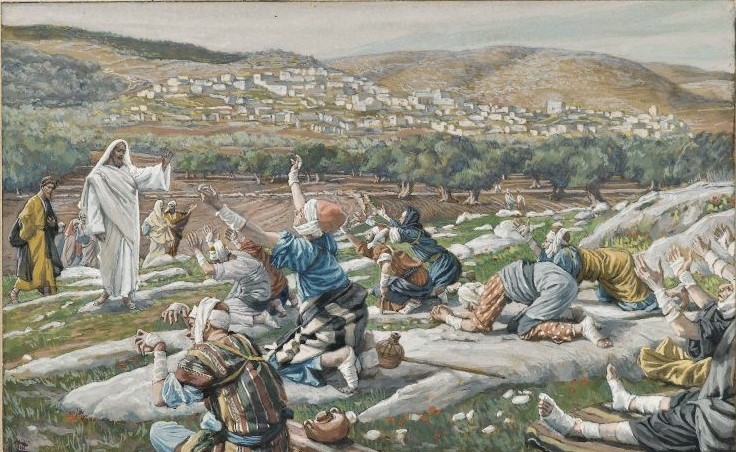
Hidden Mass – The Gospel for this day makes the point that the Mass is the perfect offering of thanks to the Father in a remarkable and almost hidden way. But for Catholics, it is right there for us to see if we have eyes to see it. The Gospel contains all the essential elements of Holy Mass. It is about giving thanks and reminds us once again that it is the Mass that is the perfect thanksgiving, the perfect “Eucharist.”
Let’s look and see how it is a Mass:
1. Gathering – Ten lepers (symbolizing us) have gathered and Jesus comes near as He passes on His way. We do this in every Mass: we gather and the Lord draws near. In the person of the priest, who is the sacrament, the sign of His presence, Jesus walks the aisle of our church just as He walked those ancient roads.
2. Kyrie – The lepers cry out for mercy, just as we do at every Mass. Lord, have mercy! Jesus, Master, have pity on us!
3. Liturgy of the Word – Jesus quotes Scripture and then applies it to their lives, just as He does for us at every Mass. (In saying, “Go show yourselves to the priests,” Jesus is referencing Leviticus 13, which gives detailed instructions on how the priests of old were to diagnose leprosy or its having been cured.) Yes, this is what we do at every Mass: we listen to the Lord Jesus, through the priest or deacon, proclaiming God’s Word and then applying it to our lives.
4. Liturgy of the Eucharist – The Gospel relates that one of them fell at the feet of Jesus and thanked him. This is what we do during the Eucharistic prayer: we kneel and thank Jesus, and along with Him, give thanks to the Father. As we have noted, the word “Eucharist” comes from the Greek and means “thanksgiving.” Here is the perfect thanks rendered to the Father. Those who claim that they can stay home and give adequate thanks to God should be rebuked for being prideful. Only Jesus can give perfect thanks to the Father, and we can only give adequate thanks by following Jesus’ command to “Do this in memory of me.” We have to be at Mass.
5. Ite, missa est – Finally, Jesus sends the thankful leper on his way, saying, Stand up and go; your faith has saved you. We, too, are sent forth by Jesus at the end of every Mass, when He speaks through the priest or deacon: “The Mass is ended, go in peace.”
So, there it is. Within this Gospel, which very clearly instructs us to give thanks to God, is the very structure of the Mass. If you want to give proper thanks to God, the right place to do it is at Mass. Only at Mass is perfect and proper thanks given to God.
It was all prefigured in the psalm long ago: What return shall I make to the Lord for all the good he has done for me? The cup of salvation I will take up and call on the name of the Lord (Psalm 116:12). Yes, it is the very cup of salvation, the chalice containing Christ’s blood, that is held up at every Mass. It is the perfect sacrifice of thanks. It is the prescribed sacrifice of praise. It is the proper sacrifice of praise.
The readings for this Sunday’s Mass richly describe some essential qualities of faith and living in this world as a Christian. There are five fundamentals that can be seen:
Wanting–The apostles said to the Lord, “Increase our faith” (Luke 17:5-6).
There’s an old saying that what you want, you get. Many doubt this, thinking that they have wanted many things that they did not get. The reason for this, however, is usually because they didn’t want it enough. When we really want something (provided it is not an impossibility) we usually get it, because we have a passion for it and work at it.
Many people who say that they don’t have time to pray or to go to Mass still find time to golf and watch TV television. They find the time because they want to do these things. They don’t find time to pray or to go to Mass because they do not want to do these things enough.
When the apostles ask the Lord to increase their faith, they are asking for a deeper desire to know Him. Too often we miss a step in our prayer. We might ask the Lord to help us to pray when we really should be asking Him to give us the desire to pray. When we want to pray, we will pray. When we want to be holy, we will naturally strive for holy practices. It is about what we truly desire. Ask the Lord to help you want Him and His kingdom. Ask the Lord for a new heart that has proper wants and desires. Ask the Lord for a new mind that has the proper priorities and prefers to think about what is good, true, and beautiful. What you want, you get.
Waiting– The first reading speaks of our need to wait for the Lord’s action: How long, O LORD? I cry for help, but you do not listen! I cry out to you, “Violence!” but you do not intervene. Why do you let me see ruin; why must I look at misery? Destruction and violence are before me; there is strife, and clamorous discord. … Then the LORD answered me and said, Write down the vision clearly upon the tablets, so that one can read it readily. For the vision still has its time, presses on to fulfillment, and will not disappoint; if it delays, wait for it, it will surely come, it will not be late. The rash one has no integrity (Hab 1:2-3; 2:2-4).
Waiting is one of the great mysteries of the Christian life. It is not always clear why God makes us wait. Perhaps He is trying to strengthen our faith. Perhaps He is helping us to clarify or confirm our desires. Scripture consistently tells us that we must learn to wait for the Lord and that there are blessings for those of us who do. Here are some examples:
Fret not yourself; it tends only to evil … those who wait for the LORD shall possess the land (Ps 37:8).
Those who wait for me shall not be put to shame (Is 49:23).
The LORD is good to those who wait for him, to the soul that seeks him. It is good that one should wait quietly for the salvation of the LORD (Lam 3:25).
But they who wait for the LORD shall renew their strength, they shall mount up with wings like eagles, they shall run and not be weary, they shall walk and not faint (Is 40:31).
Waiting is a fundamental of firm faith. Gospel music is replete with waiting themes. One song says, “You can’t hurry God, you just have to wait, trust, and never doubt him, no matter how long it takes. He may not come when you want him but he’s always right on time.” Another song says, “Weeping may endure for a night, but joy will come with the morning light.” Other songs counsel that we must hold on and hold out:
“I promised the Lord that I would hold out, he said he’d meet me in Galilee.”
“Hold on just a little while longer, everything’s gonna be all right.”
“Keep your hand on the plow. Hold on!”
“Lord help me to hold out until my change comes!”
The reading from Habakkuk above warns that the rash man has no integrity. That is another way of saying that waiting is integral to the Christian life; it is a fundamental of faith. To have integrity means to have all the necessary parts that make up the whole. To lack patience, then, is to lack integrity, to lack a fundamental of the Christian faith.
Withstanding– The second reading counsels us, God did not give us a spirit of cowardice but rather of power and love and self-control. So do not be ashamed of your testimony to our Lord, nor of me, a prisoner for his sake; but bear your share of hardship for the gospel with the strength that comes from God (2 Tim 1:6-8).
This passage tells us that life has difficulties and challenges. Becoming a Christian does not necessarily make things easier. In fact, things often get harder, because we must endure the hatred and ridicule of the world. A fundamental of the Christian Faith is that being able to withstand such trials with courage.
Notice that this courage, power, and love come from God, not from us. Hence, it is grace that is being described here. This is not a moral slogan. Withstanding means that God is “standing with” us, and we with Him. Such withstanding is only possible by the relationship with God that comes by faith. In this way, we discover the power, the capacity, to withstand, to live the Christian faith courageously in a hostile world.
Working– The Gospel teaches, Who among you would say to your servant who has just come in from plowing or tending sheep in the field, “Come here immediately and take your place at table”? Would he not rather say to him, “Prepare something for me to eat. Put on your apron and wait on me while I eat and drink. You may eat and drink when I am finished”? Is he grateful to that servant because he did what was commanded? So should it be with you. When you have done all you have been commanded, say, “We are unprofitable servants; we have done what we were obliged to do” (Luke 17:6-10).
This teaching of the Lord’s can irritate us and even seem hurtful if we misunderstand grace and seek to understand this text by the flesh. Our flesh is self-centered and thinks we deserve praise and good things from God in return for the good things we do. The flesh expects—even demands—rewards, but God can never be indebted to us, never. Our good works are not our gift to God; they are His gift to us.
All our works of charity and faith, for which our flesh wants credit, are God’s work and His gift. This is made clear in this passage from the Letter to the Ephesians:
For by grace you have been saved through faith; and this is not your own doing, it is the gift of God– not because of works, lest any man should boast. For we are his workmanship, created in Christ Jesus for good works, which God prepared beforehand, that we should walk in them (Eph 2:8-10).
If I think that I did something deserving of praise and reward, I am thinking in terms of the flesh, not the Spirit. When I have done something good all I can really do is to say, “Thank you” to God. His grace alone permitted me to do it. God may speak elsewhere of rewarding us, but that is His business. He is not indebted to us in any way. When we have done everything we ought, our one disposition should be gratitude. We are useless servants in the sense that we can do nothing without God’s grace. We can only do what He enables us to do.
That said, it is clear that work is a pillar of faith. The text from today’s Gospel and the text from Ephesians above both make clear that work is something God has for us. So faith by itself, if it has no works, is dead (James 2:17). Likewise, Jesus says, “It was not you who chose me. It was I who chose you that you should go and bear fruit that will last” (Jn 15:16). Yes, work is a fundamental of faith.
Winning– We conclude with a reference back to the first reading: For the vision still has its time, it presses on to fulfillment and it will not disappoint. If it delays, wait for it, it will surely come, it will not be late (Hab 2:3).
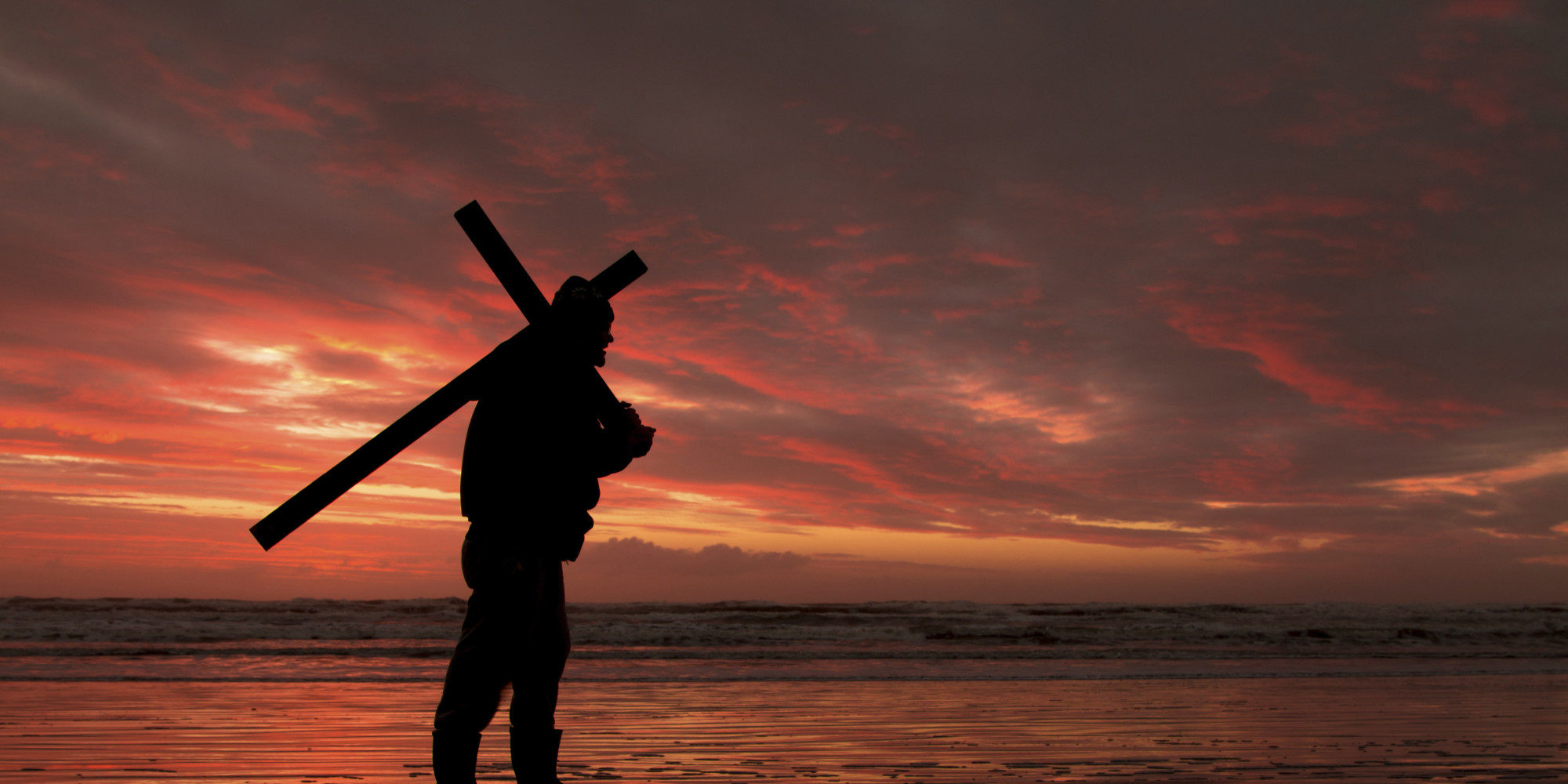
See what the end shall be! It is true that we must want, wait, withstand, and work, but we do not do so for no reason. We have a cross to carry, but if we carry it with the Lord, we carry it to glory. There is an old gospel song with these lyrics:
Harder yet may be the fight, Right may often yield to might, Wickedness awhile may reign, Satan’s cause may seem to gain, There is a God that rules above, With hand of power and heart of love, If I am right, He’ll fight my battle, I shall have peace some day. I do not know how long ’twill be, nor what the future holds for me. But this I know, if Jesus leads me, I shall get home someday.
This is just what Habakkuk describes: we will win with Jesus. He describes a victory that is
Future – the vision still has its time; it presses on to fulfillment
Fantastic – it will not disappoint
Firm – it will surely come
Fixed – it will not be late
For all those who walk with Jesus on the way of the cross, there is victory ahead. Even here in this life we already enjoy the fruits of crosses past. Our withstanding in the past has given us strength for today. Our waiting in the past has had its fulfillment and provides the hope that our current waiting will also be fruitful. Our past work, by God’s grace, has already granted benefits to us and to others.
These are but a small foretaste of a greater glory to come, the glory that waits for us in Heaven. Yes, if we want, wait, withstand, and work, we will win! I promise it to you in the Lord Jesus Christ.
I was alerted to a fascinating article by Ali Binazir who sets forth mathematically the odds of you or I existing, just as we are genetically. It turns out that, when taking into consideration the astonishing number of possibilities of parents meeting, grandparents before them and on and on going back the generations, and adding also the vast numbers of sperm and ova in possible combination over a the lifetime of the marital acts, of all those generations, it would seem that the odds of me existing just as I do, are 1 in 102,685,000. That’s a number so huge it hurts to think about it.
To say that we are contingent beings, is a vast understatement. To say that some one or something is contingent is to say that the existence of same is not inevitable, but can only come about based on any number of previous things being true in a chain of being or causality. Hence I would not exist if my parents had not existed and met. Further, they would not exist if the parents had not existed and met, the chain going back many generations. Thus, my existence depends on a vast number of “meetings” going just right, or I am not here.
Consider some of the contingencies and requirements for your existence as set forth by Mr Binazir. Some of the numbers are based on hunches, but generally those numbers are on the conservative side. I am only publishing a small amount of his musings here. You can read his full article here: What are the Chances of You Being Born? and see how he comes up with these numbers.
So here are listed some of the probabilities of required events for you to be born:
Probability of boy meeting girl: 1 in 20,000.
Now let’s say the chances of them actually talking to one another is one in 10.
And the chances of that turning into another meeting is about one in 10 also.
And the chances of that turning into a long-term relationship is also one in 10.
And the chances of that lasting long enough to result in offspring is one in 2.
So the probability of your parents’ chance meeting resulting in marriage and kids is about 1 in 2000
So the combined probability is already around 1 in 40 million
Now things start getting interesting. Why? Because we’re about to deal with eggs and sperm, which come in large numbers. Each sperm and each egg is genetically unique because of the process of meiosis; you are the result of the fusion of one particular egg with one particular sperm. A fertile woman has 100,000 viable eggs on average. A man will produce about 12 trillion sperm over the course of his reproductive lifetime.
Let’s say a third of those (4 trillion) are relevant to our calculation, since the sperm created after your mom hits menopause don’t count. So the probability of that one sperm with half your name on it hitting that one egg with the other half of your name on it is 1/(100,000)(4 trillion)= 1/(105)(4×1012)= 1 in 4 x 10¹⁷, or one in 400 quadrillion.
But because the existence of you here now on planet earth presupposes another supremely unlikely and utterly undeniable chain of events. Namely, that every one of your ancestors lived to reproductive age we must also go further presuming 150,000 generations going back to man’s origin.
Well then, that would be one in 2150,000 , which is about 1 in 1045,000– a number so staggeringly large that my head hurts just writing it down.
But let’s think about this some more. Remember the sperm-meeting-egg argument for the creation of you, since each gamete is unique?
Well, the right sperm also had to meet the right egg to create your grandparents. Otherwise they’d be different people, and so would their children, who would then have had children who were similar to you but not quite you.
This is also true of your grandparents’ parents, and their grandparents, and so on till the beginning of human time. If even once the wrong sperm met the wrong egg, you would not be sitting here noodling online reading fascinating articles like this one. It would be your cousin Jethro, and you never really liked him anyway.
That means in every step of your lineage, the probability of the right sperm meeting the right egg such that the exact right ancestor would be created that would end up creating you is one in 1200 trillion, which we’ll round down to 1000 trillion, or one quadrillion.
So now we must account for that for 150,000 generations by raising 400 quadrillion to the 150,000th power: That’s a ten followed by 2,640,000 zeroes, which would fill 11 volumes of a 250 page book with zeroes.
For the sake of completeness: (102,640,000)(1045,000)(2000)(20,000) = 4x 102,685,007 ≈ 102,685,000
Probability of your existing at all: 1 in 102,685,000
Now, there are some assumptions you may quibble with. I would certainly add in (sadly) some probabilities related to being aborted, or miscarried. But even a simpler analysis yields astonishing numbers. One of my brothers made his own calculation regarding one of Binazir’s numbers:
My numbers are more simplistic. But assuming 100,000 eggs/woman & 12T sperm/man, that creates 1.2 x 10^18 combinations for every man/woman pairing (i.e., signficantly more combos than 400T or 4 x 10^14 mentioned in the article). If you assume 3B women on earth & 3B man, that means 3 x 10^14 eggs and 3.6 x 10^22 sperm currently on the planet, for a total combination of 1.1 x 10^37 pairings. If you assume current population is 1% of the history of humanity, total combos go to 1.1 x 10^39.
Not only are you and I contingent, we are very improbable! Yet here we are! Mirabile visu! (wondrous to behold).
Theologically of course we are no accident or happenstance. God has always known us, intended us, loved us and planned for us. Scripture says,
Before I formed you in the womb I knew you (Jer 1:5).
Come, you who are blessed by my Father; take your inheritance, in the kingdom prepared for you since the creation of the world (Matt 25:34)
For you created my inmost being; you knit me together in my mother’s womb.I praise you because I am fearfully and wonderfully made; your works are wonderful, I know that full well.My frame was not hidden from you when I was made in the secret place. Your eyes saw my unformed body. All the days ordained for me were written in your book before one of them came to be. (Psalm 139:13-16)
Yes, you’re here alright, and math can barely account for your existence, so tiny are the odds. But God has overseen every detail and knew you long before you were born. In fact he has been preparing a place for us in the kingdom, from before the creation of the world. Not only has he always known us, but he has known everything we would do, for every one of our days have been written in his book before one of them ever came to be.
The great mystery of our existence stretches back in time into the very heart and mind of God who has always known and loved us, has prepared for us and made a way for us. You are wonderfully and fearfully made and God has done a marvelous thing. You’re not just one in a million, you’re one in a 102,685,000
In this Sunday’s Gospel, the Lord Jesus gives a penetrating analysis of the state of the sinner and some very sobering advice to us would-be saints. Let’s look at the Gospel in two stages:
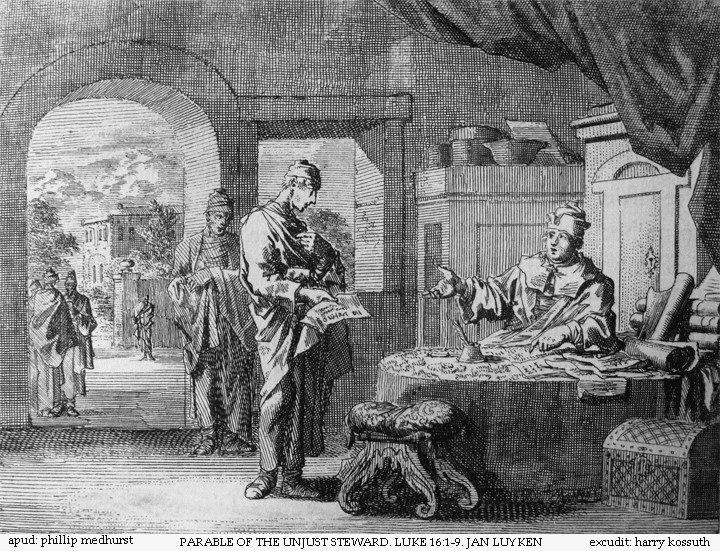
I. ANALYSIS OF THE SINNER – In the opening lines of the Gospel, Jesus describes a sinful steward.
DELUSION (of the sinner) –Jesus said to his disciples, “A rich man had a steward …”
Notice that the man is referred to as a steward rather than an owner. God is the owner of everything; we are but stewards. A steward must deal with the goods of another according to that person’s will. We may have ownership in relation to other human beings, but before God we own nothing, absolutely nothing.
Part of the essence of sin is behaving as though we are the owner. We develop the arrogant attitude that what we have is ours to do with as we please: “It’s mine; I can do what I want with it.” “It’s my body, and I can do with it as I please.” But in fact, everything belongs to God.
Scripture affirms,The earth is the LORD’S and the fullness thereof; the world, and they that dwell therein (Ps. 24:1). Even of our bodies, which we like to think of as our own, Scripture says, You are not your own; you were bought with a price. So glorify God in your body (1 Cor 6:19). There’s a song that says, “God and God alone created all these things we call our own. From the mighty to the small, the glory in them all is God’s and God’s alone.” The Lord compares the sinner to a steward who acts as if he were the owner.
DISSIPATION (of the sinner) – “… who was reported to him for squandering his property.”
The Lord here describes the essence of many of our sins: we squander His gifts. We waste the gifts we have received and use them for sinful ends.
For example, in greed we hoard the gifts He gave us. Instead of using them to help others, as God intended, we store them up for ourselves. Yet all the goods of the world belong to all the people of the world, and they ought to be shared to the extent that we are able.
Other examples of squandering the things of God are these: in gossip, lying, and cursing, wherein we misuse the gift of speech; in laziness, wherein we misuse the gift of time; in all sin, wherein we abuse the gift of our freedom. This is the dissipation, the squandering, of God’s goods.
God has given us many good things, but instead of using them to build the Kingdom, we squander them and dissipate it.
DEATH (of the sinner) – “He summoned him and said, ‘What is this I hear about you? Prepare a full account of your stewardship, because you can no longer be my steward.’”
Here the Lord reminds us that someday our stewardship will end, and we will be called to account. Scripture reminds us, So whether we are at home or away, we make it our aim to please him. For we must all appear before the judgment seat of Christ, so that each one may receive good or evil, according to what he has done in the body (2 Cor 5:9).
We have an appointed time to exercise our stewardship, but at some point, our stewardship will end, and the books will be opened. Scripture says, And books were opened. Another book was opened, which is the book of life. The dead were judged according to what they had done as recorded in the books (Rev 20:11).
Although many pay little heed to the fact of judgment, Scripture warns,Say not, “I have sinned, yet what has befallen me?” For the Lord bides his time. Of forgiveness be not over-confident, adding sin upon sin. Say not, “Great is his mercy, my many sins he will forgive.” For mercy and anger are alike with him; upon the wicked alights his wrath. Delay not your conversion to the Lord, put it not off from day to day. For suddenly his wrath flames forth; at the time of vengeance you will be destroyed (Sirach 5:4).
Every steward (each of us) will die. Our stewardship will end and we will be called to render an account. Therefore, we ought to listen to the Lord’s advice.
II. ADVICE TO THE SAINTS – After analyzing the sinner, the Lord has some advice for those of us sinners who want to be saints. He lays out four principles we ought to follow:
1. Principle of INTENSITY – The text says, the steward said to himself, ‘What shall I do, now that my master is taking the position of steward away from me? I am not strong enough to dig and I am ashamed to beg. I know what I shall do so that, when I am removed from the stewardship, they may welcome me into their homes.’ He called in his master’s debtors one by one. To the first he said, ‘How much do you owe my master?’ He replied, ‘One hundred measures of olive oil.’ He said to him, ‘Here is your promissory note. Sit down and quickly write one for fifty.’ Then to another the steward said, ‘And you, how much do you owe?’ He replied, ‘One hundred kors of wheat.’ The steward said to him, ‘Here is your promissory note; write one for eighty.’ And the master commended that dishonest steward for acting shrewdly. For the children of this world are more shrewd in dealing with their own generation than are the children of light.
The Lord is telling us here that many of the worldly are craftier in what matters to them than are the spiritually minded in what (supposedly) matters to them.
Many people are dedicated and intense in worldly matters. They spend years in college, preparing for their career. They work hard to climb the company ladder. They develop (worldly) skills and become knowledgeable in their profession. In earning money and holding down a job, many display great discipline: getting up early to go to work, working late, going the extra mile to please the boss.
When it comes to faith, however, many of these same people display only a rudimentary knowledge of things spiritual and show little interest in praying or advancing in the faith. They will expend effort to please the boss, to please other people, but not to please God. Parents will fight for scholarships for their children to get into the “best” schools but not quite so dedicated to ensuring they learn the saving truth; the pews are empty, and Sunday School is poorly attended.
The Lord says to us here that the spiritually minded ought to show the same intensity, organization, dedication, and craftiness that the worldly show in their pursuits. We ought to be zealous for the truth, for prayer, and for opportunities to sharpen our spiritual skills and increase our holiness. We ought to be as zealous to be rich in grace as we are to be rich in money.
2. Principle of INVESTMENT – I tell you, make friends for yourselves with dishonest wealth, so that when it fails, you will be welcomed into eternal dwellings.
The Lord tells of how the dishonest steward made use of the money at his disposal to make friends who would help him in the next stage of his life. How about us? Are we willing to use our money and resources to bless others (especially the poor, who can bless us in the next stage of our life)?
On the day of your judgment, will the poor and needy be able to speak up on your behalf? Will they be among the angels and saints who welcome you to eternal dwellings? I don’t know about you, but I’m going to want the poor to pray and to speak to God on my behalf! Scripture says that the Lord hears the cry of the poor and needy. In this world, the poor need us but in the next world we’re going to need them. In this world, those with money and power are heard; in the Kingdom, it’s the poor and suffering who are heard. It’s a wise investment to bless the poor and needy.
In effect, the Lord Jesus tells us to be wise in our use of worldly wealth. The world tells us to take our money and invest it so that it will reap future rewards; so too does the Lord. How? By storing our wealth up in Heaven. And how do we do that? By giving it away! Then it will really be ours.
You can’t take it with you, but you can send it on ahead. Scripture elaborates on this idea: Command those who are rich in this present world not to be arrogant nor to put their hope in wealth, which is so uncertain, but to put their hope in God, who richly provides us with everything for our enjoyment. Command them to do good, to be rich in good deeds, and to be generous and willing to share. In this way they will lay up treasure for themselves as a firm foundation for the coming age, so that they may take hold of the life that is truly life (1 Tim 6:17). Notice that the passage says that through their generosity in this world, the rich store up treasure for themselves in Heaven.
This is the scriptural principle and the great paradox in the Kingdom of God: we keep something for eternity only by giving it away. We save our life by losing it. By giving away our treasure, we keep it and store it in Heaven.
So, invest, my friends. Invest wisely!Store up for yourselves treasures in heaven, where moth and rust do not destroy, and where thieves do not break in and steal (Matt 6:20).
3. Principle of INCREASE – The person who is trustworthy in very small matters is also trustworthy in great ones; and the person who is dishonest in very small matters is also dishonest in great ones. If, therefore, you are not trustworthy with dishonest wealth, who will trust you with true wealth? If you are not trustworthy with what belongs to another, who will give you what is yours?
What is the “small matter” of which the Lord speaks and in which we can prove trustworthy? The small matter is money. Most people make money the most important thing in life, but spiritual matters are far more important.
Scripture attests to this clearly. The Book of 1st Peter says that our faith is more precious than fire-tried gold. The Book of Psalms (19:10) says, The words of the Lord are more precious than gold, than much pure gold; they are sweeter than honey, than honey from the comb.
So, God says, let’s see how you are in the small but significant matter of money;then I’ll decide if you’re able to able to handle bigger blessings. Do you think you can handle Heaven and the spiritual blessings of holiness? If you’re trustworthy with worldly wealth, God will give you true wealth. If you’re trustworthy in what belongs to God, He’ll give one day what is yours.
Do you want more? Then use well what you’ve already received. Only then will God know that He can trust you with more. There’s a gospel song that says, “You must be faithful over a few things to be ruler over many things. Be faithful unto death, and God will give you a crown of life.”
4. Principle of INDIVISIBILITY – No servant can serve two masters. He will either hate one and love the other, or be devoted to one and despise the other. You cannot serve both God and mammon.
Pay attention! To serve means to obey. Most people obey money and affluence; they worship a high standard of living before they obey God. They meet their world obligations first and then give God what is left over.
We are called to obey God alone, to have an undivided heart. The wording here is strong. You cannot obey the world (money) and think that you’re also going to obey God. You must choose which will be more important.
Now don’t tell me we don’t need a lot of grace and mercy! Money and the lure of the world are very powerful. It’s time to get on our knees and pray for the miracle of preferring God to the world.
The Readings for today’s Feast of the Exaltation of the Holy Cross provide a rich teaching on the Cross. Let’s look at five themes, each in turn.
I. The Pattern of the Cross – One of the stranger passages in the Old Testamentis one describing a command Moses received from God to mount a bronze snake on a pole.
The people had grumbled against God and Moses for the “wretched” manna they had to consume (Numbers 21:5). They were sick of its bland quality even though it was the miracle food, the bread from Heaven that had sustained them in the desert. (Pay attention, Catholics who treat the Eucharist lightly or find it boring!) God grew angry and sent venomous snakes among them, which caused many to die (Nm 21:6). The people then repented and, in order to bring healing to them, God commanded a strange and remarkable thing: Make a snake and put it up on a pole; anyone who is bitten can look at it and live (Nm 21:8).
No Graven Images?? Now remember, it was God who had said earlier in the Ten Commandments, Thou shalt not make unto thee any graven image, or any likeness of anything that is in heaven above, or that is in the earth beneath, or that is in the water under the earth(Ex 20:4). Yet here He commands a graven (carved) image be made.
Why does God do this? That is covered in the next point.
II. The Palliative Quality of the Cross – And yet when Moses made it of bronze and showed it to the people, those who looked at it became well (Nm 21:9).
In a way it is almost as if God were saying to Moses, “The people, in rejecting the Bread from Heaven have chosen Satan and what he offers. They have rejected me. Let them look into the depth of their sin and face their choice and the fears it has set loose. Let them look upon a serpent. Having looked, let them repent and be healed; let the fear of what the serpent can do depart.”
Jesus takes up the theme in today’s Gospel and fulfills it when He says, And just as Moses lifted up the serpent in the desert, so must the Son of Man be lifted up, so that everyone who believes in him may have eternal life (John 3:14). It is almost as if to say, “Let the people face their sin and see the ugly reality that it is and what it does to me, to them, and to others. Let them face their choice and seek healing repentance. Let them also see the outstretched arms of God’s mercy and find peace.”
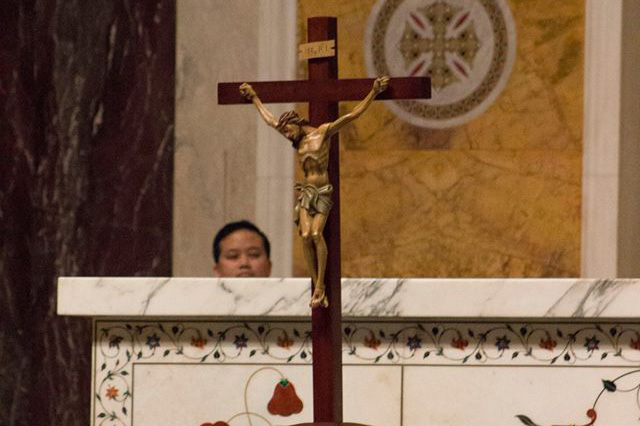
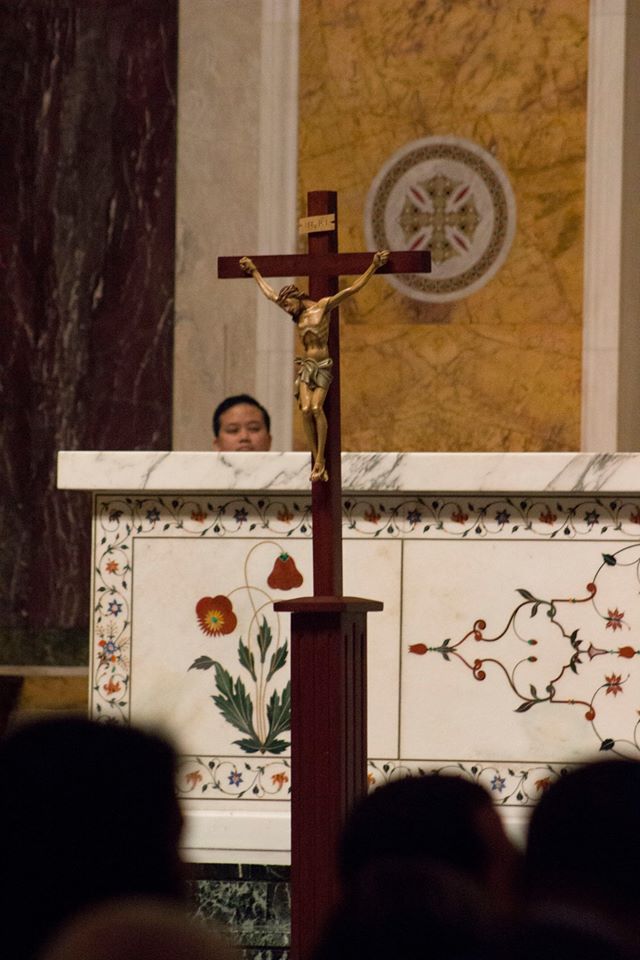
There is something about facing our sins, our shortcomings, our anxieties, and our fears. There is something about looking them in the face in order to find healing. One of the glories of the Catholic faith is that it has never hidden the Cross. We have never run from it. There have been brief times when, shamefully, we de-emphasized it. But throughout most of our history, the crucifix has been prominently, proudly, and fearlessly displayed in our churches. We cling to it and glory in it.
Do you know how shocking this is? Imagine that you were to walk into a church and instead of seeing a crucifix you saw Jesus dangling from a gallows, a rope around His neck. Crucifixion was the form of execution reserved for the worst of criminals. It was shocking, horrifying, and emblematic of the worse kind of suffering. When the Romans saw or thought of something awful they would cry out in Latin, “Ex cruce!” (From the cross!) for they could think of nothing more horrible to compare it to. And this is the origin of the English word “excruciating.” Crucifixion is brutal—an awful, slow, ignoble, and humiliating death: ex cruce!
But there it is, front and center in just about every Catholic Church. There it is, at the head of our processions. There it is, displayed in our homes. And we are bid to look upon it daily. Displayed there is everything we most fear: suffering, torment, loss, humiliation, nakedness, hatred, scorn, mockery, ridicule, rejection, and death. And the Lord and the Church say, “Look! Don’t turn away. Do not hide this. Look! Behold!” Face the crucifix and all it means. Stare into the face of your worst fears; confront them and begin to experience healing. Do not fear the worst that the world and the devil can do, for Christ has triumphed overwhelmingly. He has cast off death like a garment and said to us, In this world ye shall have tribulation. But have courage! I have overcome the world (Jn 16:33).
III. The Paradox of the Cross – A paradox refers to something that is contrary to the common way of thinking, something that surprises or even perturbs us by its reversal of the usual standards. In a world dominated by power and its aggressive use, the humility and powerlessness of the Cross accomplishing anything but defeat both surprises and upsets the normal worldly order.
At the heart of today’s second reading is the declaration that Christ humbled Himself and became obedient unto death—death on the Cross. But far from ending His work, it exalted Him and brought Him victory. To the world this is absurdity, but to us who are being saved it is the wisdom and power of God. Consider that darkness cannot drive out darkness; only light can do that. Hatred cannot drive out hatred; only love can do that. And pride cannot drive out pride; only humility can do that. At the heart of Original Sin and every personal sin is the prideful notion that we know better than God. Satan’s fundamental flaw is his colossal pride; he considers himself equal to God. He is narcissistic, egotistical, and prideful.
But the solution to conquering pride is not to have greater pride, but rather to manifest great humility, as Jesus did. And while Satan disobeyed God, Jesus humbly obeyed His Father. He did not cling to His divine prerogatives, but rather laid them aside, taking up the form of a slave and being seen as a mere human being. It was thus that He humbled Himself and obeyed even unto the Cross. Jesus was seen as the lowest of human beings, accepting a death reserved for the worst of criminals and sinners though He himself was sinless and divine.
So astonishing is Jesus’ humility, that it literally undoes Satan’s pride and all of our collective pride. It is the great paradox of the Cross that humility conquers pride, that God’s “weakness” conquers human power and aggression, that love conquers hate, and that light dispels the darkness.
It is the great paradox of the Cross that makes a public spectacle of every human and worldly presumption.
IV. The Power of the Cross – The gospel today announces the great power of the cross: So must the Son of Man be lifted up, so that everyone who believes in him may have eternal life. Thus Jesus, the Son of Man, when He was lifted up from the earth called to the heart of every human person. And those who believe in him and look to him are saved from their sins and snatched from the hands of the devil. The power of the Cross is the power to save.
And not only are we saved from the effects of our sins, we are empowered to live a whole new life. For the text says that God does this that we might not perish, but that we might have eternal life. The word eternal does not refer simply to the length of life, but also to its fullness. And therefore, by the power of the Cross, we are given the gift to live a completely new life, transformed increasingly into the very holiness, freedom, joy, and blessedness of the very life of Christ. In dying with Him in baptism to this old life, we rise to the new life that He offers: a life increasingly set free from sin, a life transformed from vice to virtue, from sorrow to joy, from despair to hope, and from futility to meaningfulness and victory. Thus the power of the Cross is manifest as the power of the tree of life.
V. The Passion of the Cross – And why all this? Why this undeserved gift? In a word, love. “For God so loved the world…” Yes, God loves the world. Despite our rebellion, our unbelief, our scoffing, and our murderous hatred, God goes on loving us. He sent His Son to manifest His love and to obey Him within the capacity of His humanity. Cassian says that we are saved by the human decision of a divine person. Jesus loved His Father too much, and loves us too much to ever say no to Him. And the Father loves us too much to have ever withheld the gift of His Son from us, though Jesus is His only begotten Son, the greatest gift He could ever offer. And in His love, He does not withhold this gift, but offers Him.
Why do you exist? Why is there anything at all? How are you saved? God so loved the world. God so loved you. God is love. And God, who loves us, proclaims the truth to us and invites us to except His truth. He does not force His love upon us, but invites us and gives us every grace to turn and to come to Him. But why does He care? Why does He not simply force us to obey? God is love and love invites; it does not force. Love respects the will of the beloved and seeks only the free response of love in return.
The Cross—nothing is more provocative; nothing is more paradoxical; nothing is greater proof of God’s love for us and of His desire to do whatever it takes to procure our yes to His truth, His way, and His love. Run to the Cross and meet the Lord, who loves you more than you deserve and more than you can imagine. Run to Him now, because He loves you.
In the wake of recent violence at Annunciation School and the assassination of Charlie Kirk, I propose the following reflection on the widespread theme of vengeance in movies, video games and other modern cultural expressions. The video below is from an unusual source, but I think he is 100% right in calling out hypocrisy in much of Hollywood and other cultural outposts.
When I was a young man in my twenties I loved “action movies.” I remember that we guys often talked about the “kill ratio” as a way of rating the movie. High kill ratio movies were “good,” and low kill ratio movies were poor and dangerously on the way to becoming a “chick flick.” Car chases, buildings being blown up, and the bad guys being killed in large numbers, was the recipe we looked for.
In fact, I’ll save you some money and give you the plot of every adventure movie ever made or to be made. The movie opens with some bad guy, a guy who is unambiguously evil, doing some terrible thing. Perhaps he kills some one, takes hostages, or engages in a terrorist act. After this our hero steps on the scene. And, after about ninety minutes of car chases, blowing things, up and killing people, he exacts vengeance, restores justice and walks off the scene, girl in arm, burning city in the background, roll credits. (There is usually a sub-plot which involves the girl wherein she enters the scene, complicating things for our hero, and is usually a combination of an insistent partner to our hero, and also plays the role of damsel in distress. OK, so save your $15. You’ve just had them all presented to you. There is almost no variance to this theme and it is usually downright cartoonish.
In recent years I have lost interest in these movies. Some of it is age. But a lot of it is my Christian walk. I no longer love these movies because it is clear to me that the Lord does not love them. For a Christian of some depth, it becomes clear that, violence should not be proposed as entertainment, or be experienced as entertaining. Violence is always regrettable and is a cause for sober reflection, not exuberant joy.
I am no pacifist, there are times when the police have to repel or restrain criminals with violent force. There are times when nations, for a grave reason, and as a last recourse, must go to war. But this is always lamentable, and surely not entertaining. People often die terribly in war, and in other violent ways.
The adventure movies and video games often present simplistic and cartoonish notions of violence. For example, our hero may be involved in a high speed car crash. Despite this, he often walks away from it and remains quite fit to do further battle. But in reality no one walks away from a high speed car crash unscathed. The whole body is wrenched and there are almost always neck and back injuries that require months to recover from. Some never recover. Further, as our hero kills bad guys left and right, we are never invited to consider that in real life death has terrible ripple effects as families, children and others, related to the dead, experience the tragedy and often never recover.
I intend no crusade here. I am not calling for abolishment of such games, or of adventure movies. I will even say I oppose those who refuse to let little boys have toy guns and play war. I figure for them it is just a stage, a boy thing. But that is a central point, it should be just a stage.
So what I do propose is that, as we grow in our Christian walk, the notion of raw violence as a form of entertainment, becomes increasingly untenable for us. Violence is something we increasingly mourn, increasingly find troubling. If it ever did appeal to us, it appeals less and less. The voice of Jesus echoes in our conscience: Put away your sword (Matt 26:52).
And as we grow in grace, that still small voice of Jesus gradually has its way. The swords are sheathed, the video controllers are set aside, the movies look silly, and violence becomes unappealing, lamentable, and a subject for prayer, rather than a form of entertainment.
A common reading at the funeral Mass is this powerful one from the Book of Ecclesiastes:
I have considered the task that God has appointed for the sons of men to be busied about. He has made everything appropriate to its time, and has put the timeless into their hearts, without man’s ever discovering, from beginning to end, the work which God has done (Eccl 3:10-11).
Somewhere in our hearts is something that the world cannot, and did not, give us. This passage calls it “the timeless.” We also refer to it as eternity or even infinity.
But where did this concept come from? The world is finite. Time here is serial. Things have a beginning, a middle, and an end. We do not experience anything of the timeless. Rather, everything is governed by the steady ticking of the clock. Every verb we use is time-based. Everything is rooted in chronological time. Yet somehow we can grasp the timeless. Yes, we do know it.
The experience of “forever” does not exist in this world, but it is still there our minds and hearts. There is no way to travel through time here in this world. Yet instinctively we know that somehow we can. Science fiction and fantasy novels often feature going back to the past or into the future. The world could not teach us this because we are locked in the present and have never actually travelled in time. Somehow, though, we know that we can do it.
The word “eternity” comes from the Greek word “aeon,” which means “the fullness of time.” It is not just a long time; it is all time: past, present, and future all at once. If you look at a clock you’ll notice that at the center dot, 10 AM, 2 PM, and 6 PM are all the same, even though 10 AM is in the past, 2 PM is now, and 6 PM is in the future. This is aeon, eternity, the fullness of time; this is timelessness.
From whence did we get such a concept? The world cannot give it, for the world does not have it. Nothing can give what it does not have. The world is finite, limited, and time-bound—not timeless. It cannot, therefore, give what is infinite or “timeless.” If we have such a notion it must come from outside time or in the fullness of time, something that contains the full sweep of time all at once. But what is outside time?
In Sunday’s Gospel, Jesus defines four demands of discipleship. Let’s look at them one by one.
I.The CONTEXT of discipleship – The text says that large crowds were following Jesus and so He turned to address them. Just about any time you find mention of a big crowd in the Bible, fasten your seat belt and prepare for a hard teaching. Jesus didn’t trust large crowds, who were often merely after what they could get out of Him. They were looking for miracles, for multiplied (and free) bread, for physical healing, and for a fiery sermon.
So, upon sensing a large crowd of people, Jesus turned to address them. He then gives a series of hard teachings, which almost seem designed to thin the ranks and distinguish true disciples from ones who are merely giving “lip service.”
Before discussing what Jesus says to them, let’s examine some other incidents in the Gospels that also illustrate His tendency to distrust big crowds:
Enter by the narrow gate; for the gate is wide and the way is easy, that leads to destruction, and those who enter by it are many. For the gate is narrow and the way is hard, that leads to life, and those who find it are few (Matt 7:13).
For many are called, but few are chosen (Matt 22:14).
Woe to you, when all men speak well of you, for so their fathers did to the false prophets (Luke 6:26).
Often the mention of a large crowd is followed by a hard teaching:
When Jesus had finished saying these things, he left Galilee and went into the region of Judea to the other side of the Jordan. Large crowds followed him, and he healed them there. Some Pharisees came to him to test him. They asked, “Is it lawful for a man to divorce his wife for any and every reason?” “Haven’t you read,” he replied, “that at the beginning the Creator ‘made them male and female,’ and said, ‘For this reason a man will leave his father and mother and be united to his wife, and the two will become one flesh’? So they are no longer two, but one. Therefore, what God has joined together, let man not separate” (Matt 19:1-6; Mark 10).
As the crowds increased, Jesus said, “This is a wicked generation. It asks for a miraculous sign, but none will be given it except the sign of Jonah” (Luke 11:29).
Large crowds were traveling with Jesus and turning to them he said: “If anyone comes to me and does not hate his father and mother, his wife and children, his brothers and sisters—yes, even his own life—he cannot be my disciple. And anyone who does not carry his cross and follow me cannot be my disciple” (Luke 14:26-27).
… and a great crowd of people followed him because they saw the miraculous signs he had performed on the sick … and He said to them, “I am the living bread come down from heaven” … the crowds murmured (John 6:2).
So, the context of discipleship is not usually with the crowd. Though many are called—indeed, all are called—few make the cut and become true disciples. There is a kind of remnant theology at work here, to be sure, but it is a common pattern that Jesus thins the ranks and distinguishes the many who are called from the few who are chosen.
This is not just a fact in the Scriptures; the Lord has often had to prune His Church. Even now we are seeing a large falling away, a pruning, as many who are not able to accept the hard sayings of Jesus and the Scriptures (about sexuality, forgiveness, love of one’s enemies, heroic charity, and generosity) depart. The context of discipleship is with the few rather than the many.
This insight about the context is also important today because there are many who argue that the Church should “get with the times,” that she should listen to the people, that she should give them what they want, that she should reflect the views of the faithful. The role of the Church is not to reflect the views of its members, as if it were some political party. Rather, it is to reflect the views of its Founder, Jesus Christ, who handed on His teachings through the apostles and evangelists. More often than not, these teachings will not be in lockstep with what is popular or current.
The context of discipleship is often at odds with great crowds of people. We see this when Jesus turns on them. The first reading today reminds us: For the deliberations of mortals are timid, and unsure are our plans. For the corruptible body burdens the soul and the earthen shelter weighs down the mind that has many concerns. And scarce do we guess the things on earth, and what is within our grasp we find with difficulty (Wisdom 9:13-16).
II. The CENTRALITY of discipleship– Jesus indicates that if we are going to be His disciples, we can love no one more than we love Him. This extends even to our family relationships: If anyone comes to me without hating his father and mother, wife and children, brothers and sisters, and even his own life, he cannot be my disciple.
The use of the word “hate” here does not mean that we are to have contempt for others or to nourish unrighteous anger toward them. Rather, this is a Jewish idiom. For some reason, the Hebrew language has very few comparative words such as more/less and greater/ fewer. If one preferred vanilla ice cream to chocolate, one would say (in ancient Hebrew), “I love vanilla but hate chocolate.” This would mean that I prefer vanilla to chocolate, not that I actually hate chocolate.
So, what Jesus means is that we cannot prefer anyone or anything to Him. He is first; He is number one. Jesus says that He must have absolute priority over even the closest human relationships in your life.
If there’s anyone in your life who can talk you out of obeying God, forget ’em! Anyone who keeps you away from God has too much power. Anyone who can keep you from your Christian walk has too much power. Anyone who can pull you into unrighteousness has too much power.
If your boss instructs you to do something immoral, just say, “Sorry, Boss.” If your accountant advises you to save money by paying unjust wages or cutting necessary benefits, say “Sorry, no.” If your boyfriend or girlfriend pressures you to have sex, say, “Sorry, Dear.” If your “friend” pressures you to use drugs, abuse alcohol, skip school, or steal, say, “Sorry, Buddy.” If your spouse calls you away from teaching your children the ways of faith, tell him/her “Sorry, Honey.” If your child pressures you to give him something unwise or sinful, say, “Sorry, child of mine.”
Do you get it? No one is to have priority over Jesus Christ and what He teaches. The word “hate” here may not be meant literally, but if Jesus really does have priority in our life it may cause some people to say to us, “You’re so devoted to Him that I think you hate me!”
We need to attend to this, because too many of our human relationships cause us to compromise our walk with Jesus. Some people have too much power over us, a power that belongs to the Lord.
III. The CROSS of discipleship – Jesus says, Whoever does not carry his own cross and come after mecannot be my disciple. If we want to be a disciple, we must be willing to carry the cross.
The cross comes in many forms, but in the end, being a disciple does not mean that we are in any way exempt from the troubles and trials of this world. Jesus indicates that we will be hated (cf Jn 15:20), persecuted, and sorely tempted by the world. If we hold out, though, victory will be ours.
It is a simple rule: No cross, no crown. There are some who want to preach a prosperity gospel. There are others who demand a gospel stripped of its moral imperatives. Still others demand an updated faith that tickles their ears and affirms their sinful behavior.
Jesus points to the cross not to torture us but because it is the only way to glory.In the world ye shall have tribulation: but be of good cheer; I have overcome the world (John 16:33). Now, for a little while you may have to suffer various trials (1 Peter 1:6). This wisdom is already evident if we consider that even in this world, all of what we value most (family, talents, career, achievements) comes at the cost of sacrifice. Sacrifices bring blessings. Jesus is not into pain for its own sake but because sacrifice brings blessings.
IV. The COST of discipleship –Which of you wishing to construct a tower does not first sit down and calculate the cost to see if there is enough for its completion? Otherwise, after laying the foundation and finding himself unable to finish the work the onlookers should laugh at him and say, “This one began to build but did not have the resources to finish.” Or what king marching into battle would not first sit down and decide whether with ten thousand troops he can successfully oppose another king advancing upon him with twenty thousand troops? But if not, while he is still far away, he will send a delegation to ask for peace terms. In the same way, anyone of you who does not renounce all his possessions cannot be my disciple.
In this teaching, Jesus asks us to count the cost. Discipleship is costly. Jesus gives the images of someone building a tower and of a king going into battle. These examples may seem distant to us, so Jesus “brings it home” by saying, anyone of you who does not renounce all his possessions cannot be my disciple.
The Greek word ἀποτάσσω (apotasso), translated here as “renounce,” also means “to say farewell.” The Lord is reminding us that Heaven costs everything. Ultimately, we must say farewell to everyone and everything we consider precious in this world in order to inherit Heaven. This is not something that happens all at once when we die.
On one level, we give back everything to God little by little as we go through life. We have all given back loved ones. Perhaps we have already given back our youthful physique, strength, or good health. Ultimately, though, we will give it all back.
On another level, the Lord is saying that we must be willing to part now with anything that hinders discipleship. Many things attach us to this world and make discipleship difficult. Are we willing to simplify our life and focus on being a disciple? Or will we continue setting down roots here and amassing a worldly kingdom?
What’s it going to be: the world or the Kingdom? Count the cost. See what it costs and then decide. In the end, Heaven costs everything—but you’re going to lose it all anyway. It is a wise man who gives away what he cannot keep in order to gain what he could never buy.
What Jesus is looking for are disciples who, having counted the cost and realistically assessed it, are nonetheless ready to be His disciples. Tag-alongs, lip-service Christians, and fair-weather friends need not apply. In today’s Gospel Jesus is teaching a big crowd in a way that is meant to distinguish true disciples from those merely giving lip service. We are asked to ponder in which category we fall.