Faith Has to Become Flesh

At Christmas we celebrate the fact of the Word Becoming Flesh. God’s love for us is not just some theory or idea. It is a flesh and blood reality that can actually be seen, heard and touched. But the challenge of the Christmas season is for us to allow the same thing to happen to our faith. The Word of God and our faith cannot simply remain on the pages of  a book or the recesses of our intellect. They have to become flesh in our life. Our faith has to leap off the pages of the Bible and Catechism and become flesh in the very way we live our lives, the decisions we make, the very way we use our body, mind, intellect and will.

Consider a passage from the liturgy of the Christmas Octave from the First Letter of John. I would like to produce an excerpt and then make a few comments.

The way we may be sure that we know Jesus is to keep his commandments. Whoever says, “I know him,” but does not keep his commandments is a liar, and the truth is not in him. But whoever keeps his word, the love of God is truly perfected in him. This is the way we may know that we are in union with him: whoever claims to abide in him ought to walk just as he walked.  (1 John 2:3ff)

  1. Faith is incarnational – Note first of all what a practical man John is. Faith is not an abstraction, it is not about theories and words on a page. It is not about slogans. It is about a transformed life, it is about the actual love of God and his Commandments. It is about the actual love of of my neighbor. True faith is incarnational, it takes on flesh in my very “body-person.” Remember, we human beings are not pure spirit, we are not intellect and will only, we are also flesh and blood. And what we are cannot remain merely immaterial. What we most are must be reflected in our bodies, what we actually, physically do as well. Too many people often repeat the phrase, “I’ll be with you in spirit.” Perhaps an occasional absence is understandable but after a while the phrase rings hollow. Actually showing up and actually doing what we say is an essential demonstration of our sincerity. We are body persons and our faith must have a physical, flesh and blood dimension. Our faith is to be reflected in our actual behavior and the physical conduct of our life.
  2. A sure sign – John says that The way we may be sure that we know Jesus is to keep his commandments. Now be careful of the logic here. The keeping of the commandments is not the cause of faith, it is the fruit of it. It is not the cause of love, it is the fruit of it. Note this too, in the Scriptures, to “know” is always more than a mere intellectual knowing. To “know” in the Scriptures means, “deep intimate personal experience of the thing or person known.” It is one thing to know about God, it is another thing to “know the Lord.” So, what John is saying here is that to be sure we authentically have deep intimate personal experience of God is to observe the fact that this changes the way we live. An authentic faith, an authentic knowing of the Lord will change our actual behavior in such a way that we keep the commandments as a fruit of that authentic faith and relationship with the Lord. It means that our faith becomes flesh in us. It changes the way we live and move and have our being. For a human being who is a body-person faith cannot be an abstraction, it has to become flesh and blood if it is authentic. John also uses the image of walking: This is the way we may know that we are in union with him: whoever claims to abide in him ought to walk just as he walked.  Now walking is a very physical thing. It is also a very symbolic thing. The very place we take our body is both physical and indicative of what we value, what we think.
  3. Liar? – John goes on to say Whoever says, “I know him,” but does not keep his commandments is a liar. John uses strong language here. Either we believe and keep the commandments or we fail to keep the commandments and thus lie about knowing the Lord. But all of us struggle to keep the commandments fully!  John seems so “all or nothing.” But his math is clear. To know the Lord fully, is never to sin (cf 1 John 3:9). To know him imperfectly is still to experience sin. Hence, the more we know him (remember the definition of know from above!) the less we sin. If we still sin it is a sign that we do not know him enough. It is not really John who speaks too absolutely. It is really we who do so. We say, “I have faith, I am a believer, I love the Lord, I know the the Lord!”  We speak so absolutely. Perhaps we could better say, I am growing in faith, I am striving to be a better believer, I’m learning to love and know the Lord better and better. Otherwise we risk lying. Faith is something we grow in. Many Protestants have a bad habit of reducing faith to an event such as answering an altar call, or accepting the Lord  as “personal Lord and savior.” But we Catholics do it too. Many think all they have to do is be baptized but they never attend Mass faithfully later. Others claim to be “loyal” even “devout” Catholics  but they dissent from important Church teachings. Faith is about more than membership. It is about the way we walk, the decisions we actually make. Without this harmony between faith and our actual walk we live a lie. We lie to ourselves and to others. Bottom line: Come to know the Lord more an more perfectly and, if this knowing is real knowing,  we will grow in holiness, keep the commandments be of the mind of Christ. We will walk just as Jesus walked.
  4. Uh Oh! Is this salvation by works? Of course not. The keeping of the commandments is not the cause of saving and real faith it is the result of it. The keeping of the commandments is the necessary evidence of saving faith but it does not cause us to be saved, it only indicates that the Lord is saving us from sin and its effects. But here too certain Protestants have a nasty habit of dividing faith and works. The cry went up in the 16th Century by the Protestants that we are saved by faith “alone.”  Careful. Faith is never alone. It always brings effects with it. Our big brains can get in the way here and we think that just because we can distinguish or divide something in our mind we can divide it in reality. This is arrogant and silly. Consider for a moment a candle flame. Now the flame has two qualities: heat and light. In our mind we can separate the two but not in reality. I could never take a knife and divide the heat of the flame and the light. They are so together as to be one reality. Yes, heat and light in a candle flame are separate theoretically but they are always together in reality. This is how it is with faith and works. We are not saved by works but as John here teaches to know the Lord is always accompanied by the evidence of keeping the commandments and walking as Jesus did.

Faith is real. It is incarnational. The Word became flesh and dwelt among us, really and physically. So too our own faith must become flesh in us, really, physically in our actual behavior in our very body-person.

I put this video together with a lesser known carol (possibly by Praetorius). The translation is as follows:

  • Verbum Caro Factum Est (The Word was made flesh)
  • Habitavit in Nobis (And dwelt among us)
  • Alleluia
  • Notum fecti Dominus (The Lord has made known)
  • Salutare suum (His Salvation)
  • Alleluia
  • Prope invocavit me: (Near is he who calls me: )
  • Frater meus est tu!”” (“You are my brother!”)
  • Alleluia

Jesus is the reason for ANOTHER season – New Years!

How remarkable is it that one man could affect the world so much that our entire calendar system is based on his life and ministry?

What is today’s date?

Once, a man who said that he did not believe in Jesus challenged me. Understand, he was not someone struggling with his faith. Rather, he was obstinate in his disbelief and openly hostile to mine. After listening to his faulty arguments about the non-existence of Christ, I casually asked him for the day’s date. When he responded, I pointed out that his response was based on the life, death and resurrection of a man that supposedly did not exist.

No one else in human history can claim influence over the direction of the world like Christ. No monarch, president or billionaire will ever again change the world to the point that our entire calendar system would be based on his or her life.

Jesus Christ is Lord!

Only a truly divine being could do such a thing. Even without faith in Him, the life of Jesus has touched anyone who has dated a check, booked an airline or hotel reservation, disclosed his or her own birthday or simply answered the question, “What is today’s date?”

2010 AD

In recent years, some have tried to diminish this undeniable fact. For example, some historians have abandoned the designation “A.D.” or “Anno Domini”, which means “Year of our Lord” in favor of the secular “C.E.” which means “Christian Era.” Or “B.C.” or “Before Christ” is replaced with “B.C.E.” or “Before the Christian Era.”  Despite these efforts at secularization, our calendar system is STILL based on the life of Our Lord and Savior, Jesus Christ. A rose by any other name is still a rose. So, as we celebrate the New Year, think about the fact that this is may be the one day everyone in the world expresses a belief in Christ, whether they like it or not.

Happy New Year – New Year of our Lord that is!

The Church Must Be Willing to Be A Sign of Contradiction

It is often demanded of the Church today (bothby non-Catholics and Catholics) that she ought to strive to fit in more, be kinder and gentler than in the past,  and that her essential mission is merely to accept everyone and make sure they feel good about themselves.  She ought to be more appealing and less “alienating” then her membership will increase. When the Church solemnly and unequivocally speaks on moral questions she is often criticized for being too harsh, or perhaps of being judgemental and  intolerant, or out of touch with modern realities. In recent discussions on this very blog many critics of the Church’s position on same-sex marriage have accused her of being “on the wrong side of history.”

But is this really the role of the Church? Is it really her role to be with the times? Surely not, since she is the Bride of Christ and also Body of Christ (for in this holy Marriage she and her spouse are one). And of this Church, there is a teaching in today’s Gospel (the 5th Day of the Octave of Christmas).  Simeon turns to Mary and says:

Behold, this child is destined for the fall and rise of many in Israel, and to be a sign that will be contradicted (and you yourself a sword will pierce)so that the thoughts of many hearts may be revealed. (Lk 2:34)

Simeon looked to Jesus and saw that he would be a sign of contradiction to many. Surely Jesus would not be the affirmer in chief but rather, as one who spoke the truthand feared no man, he would stand clearly and announce the truth without compromise. Some would love him and many would hate him, but no one could remain neutral. He would make us choose, tertium non datur (no third way is given).

And to the Church Christ said two very important things:

  1. If the world hates you, keep in mind that it hated me first. If you belonged to the world, it would love you as its own. As it is, you do not belong to the world, but I have chosen you out of the world. That is why the world hates you. Remember the words I spoke to you: ‘No servant is greater than his master.’If they persecuted me, they will persecute you also. If they obeyed my teaching, they will obey yours also. They will treat you this way because of my name, for they do not know the One who sent me. (John 15:18-21)
  2. Woe to you when all men speak well of you, for that is how their fathers treated the false prophets.(Luke 6:26)

So, that world hates us is not necessarily due to the fact that we have done anything wrong. It is often a sign that we have done something precisely right for it is often our lot, as the Body of Christ,  to be a “sign of contradiction.” That is to say that we must announce the Gospel to a world that is often and in increasing measure, stridently opposed to it. St. Paul admonished Timothy to preach the Gospel, whether in season or out of season (2 Tim 4:2). Increasingly now it is out of season and the world hates us for what we say. But we can do no other, for if we are  faithful, we must speak.

Pope Paul VI said it so well in the very in the “out of season” encyclical Huamane Vitae:

It is to be anticipated that perhaps not everyone will easily accept this particular teaching. There is too much clamorous outcry against the voice of the Church, and this is intensified by modern means of communication. But it comes as no surprise to the Church that she, no less than her divine Founder, is destined to be a “sign of contradiction.”  She does not, because of this, evade the duty imposed on her of proclaiming humbly but firmly the entire moral law, both natural and evangelical.  Since the Church did not make either of these laws, she cannot be their arbiter—only their guardian and interpreter. It could never be right for her to declare lawful what is in fact unlawful, since that, by its very nature, is always opposed to the true good of man. (H.V. # 18)

We in the Church must courageously accept our lot. Simeon spoke of it clearly in the beginning as he held the infant Christ (and thus the infant Church). And then, looking at Mary, who also represents the Church as mother and bride, he says. “A sword will pierce your heart too!” So the Church as Body of Christ and the Church as Bride and Mother cannot evade the fact that we will often be called to be a sign of contradiction. And we will often be required to suffer for our proclamation. The world will try and shame us, try to cause us to experience guilt through indignant outcries and labels such as: Rigid, backward, conservative, right wing, fundamentalist, homophobic, judgmental, intolerant, harsh, mean-spirited, hateful and so on. But do not be amazed and do not buy into the false guilt. Simply pray and accept the fact that the Church is a sign of contradiction and we must continue to address ourselves to the conscience of a world that seems bent on going morally insane. To this world our announcement of the Truth of Gospel must be courageous, clear, consistent, constant and quite often a sign of contradiction. This is our lot, we can do no other, we can be no other.

Pondering Abortion on the Feast of the Holy Innocents

We know well that Holy Innocents continue to be killed in our world through abortion. The Feast of the Holy Innocents is an often over-looked feast on the Church’s Calendar coming is the busy week of the Christmas Octave. And yet there is something very astonishing and even dangerous to consider on this feast.

I’ll explain what I mean by dangerous in a moment. But for now consider some biblical facts with me.

  1. When God was drawing close to liberating his chosen people from slavery in Egypt there occurred the order to murder of the all the baby boys among the Hebrews. It is almost as though Satan sensed that God was up to something good and Satan raged through Pharaoh in murderous anger and fear. Thankfully the actual numbers were reduced since the Egyptian midwives engaged in civil disobedience, refusing to allow the practice to continue.
  2. At the time of Jesus, when God was preparing to liberate his People from sin, there also occured the murder of innocent baby boys. Here too it was almost as though the Devil sensed that God was up to something good and he once again raged, this time through Herod in murderous anger and fear.  Thankfully too this infanticide also ended at some point.
  3. Notice the pattern. When God prepared a great liberation the Devil went after the babies. In our time, on a scale as never before, the Devil is going after our babies in murderous anger and fear. What is he afraid of? Is God planning something big in the near future? Is there a great liberation at hand? Is there a great advancement of evangelization and conversion in the offing? We can only speculate. But patterns are patterns and Scripture has a way of repeating its patterns and echoing down through the centuries.

Why is this a dangerous reflection? Because I want to make it clear that abortion, the killing of the innocents in our age, is NOT and never can be considered something good, or a “positive sign.” Such a speculation as this might cause some to wrongly conclude that abortion is part of God’s plan or something we should see “positively.” We should not. It must be fought. It is of Satan. I want to conclude by reminding you that the great liberation that followed the past infanticides did not occur until AFTER those murderous rages were stopped. Hence, to follow the pattern established in Scripture and to see a potentially great and liberating act of God we must first see an end to the slaughter. Work and pray to end abortion. May the Holy Innocents pray for us!

I put the following video together to honor these young martyrs. The musical setting is by Michael Haydn of the hymn for the Feast of the Holy Innocents: Salvete Flores Martyrum – It is from his Vesperae In F for Equal Voices, Soli and Orchestra.  The singers are the The Group singing is Collegium Instrumentale Brugense. This music is available at iTunes. The Latin text of this ancient hymn is quite beautiful. I produce here the Latin text followed by a fairly literal translation. I would like to call your attention to the second verse  and a very charming detail. That verse described these young, two year old martyrs and holding palm branches (the symbol of martyrdom) but as they hold them they play with them, in the way a young child will often fiddle with palm branches in Church. Beautiful and so very human!

Salvete flores martyrum, – Hail Martyr Flowers
quos lucis ipso in limine – On the very threshold of the dawn (of life)
Christi insecutor sustulit – Christ’s persecutor destroyed (you)
ceu turbo nascentes rosas. – like the whirlwind does the budding roses.

Vos prima Christi victima, – You Christ’s firstfruits
grex immolatorum tener, – A flock of tender sacrificial victims
aram sub ipsam simplices – right up by the very altar
palma et coronis luditis. – now play with your palms and crowns

Iesu, tibi sit gloria, – Jesus to you be glory
qui natus es de Virgine, – who were born of the Virgin
cum Patre et almo Spiritu, – with the Father and loving Spirit
in sempiterna saecula. Amen. – unto to eternal ages. Amen.

Rediscovering God’s Vision For Family Life

Today is the Feast of the Holy Family on the Liturgical Calendar and in an era when the family has such on-going damage, we do well to review God’s plan for marriage and how the modern age has so systematically departed from that plan. It is the departure from God’s plan that has brought about devastating consequences for the Church, the nation and especially for children. On this Feast of the Holy Family we do well to call upon God’s mercy and, frankly, for miracles to restore a proper and Godly realization of family life.

It is not news that the family is in great crisis. The combined effects of divorce and never married single parents mean that nearly one-third of children in the U.S. (32 percent or 22 million children) were living with one parent, usually their mother (KIDS COUNT Data Center, 2009). The share of children in one-parent families has nearly tripled since 1970, when the rate was 11 percent (Amato, 2008). This trend has disproportionately affected impoverished children and also children of color: 65 percent of black children, 49 percent of American Indian children, 37 percent of Hispanic children, (KIDS COUNT Data Center, 2009). With these numbers go a great number of social ills manifest by such children including higher poverty, lower scholastic achievement, behavioral problems,  promiscuity, STDs, teenage pregnancy, higher school dropout rates, early criminal records and the like. It is clear, when the family is in crisis children suffer most. Only a return to God’s plan for marriage and family can reverse these trends.

What then is God’s plan? Actually it is spelled out quite clearly in the Book of Genesis in these verses along with my commentary:

  1. The LORD God said, “It is not good for the man to be alone. I will make a helper suitable for him.” (Gen 2:18)  The chapter goes on to describe the creation of woman. Notice that the text says that it is not good to be alone. Partnership is essential. A man should not be alone, a woman should not be alone. God intends woman for man, man for woman. The partnership is obviously complimentary in that a man brings things to the marriage a woman does not. A woman brings things to the relationship that a man does not. The sexes are not merely interchangeable, they each bring essential ingredients to the marriage and to being parents. Parenting is to be a partnership, not a solo act.
  2. For this reason a man leaves his father and mother and clings to his wife, and they  become one flesh (Gen 2:24).  Notice here the pre-eminence of the relationship and its stability. It is preeminent  because a man leaves the most important relationship he has up until that time (his family of origin) in order to establish a relationship of now greater priority, his marriage. It is stable because he is to cling to his wife. “Cling”  is a strong word. It means to stick like glue. A man is to preserve union with his wife in a strong and decisive manner. Marriage is not to be a temporary relationship.
  3. God blessed them and said to them, “Be fruitful and multiply; fill the earth and subdue it. (Gen 1:28) Here is the fundamental mission God gives to marriage: the procreation and raising of children. This verse also helps give reason to the first two teachings that the marriage be heterosexual and stable. Since children are the expected fruit of marriage it is obvious  that heterosexuality is necessary and essential. Further it is necessary and essential that the marriage be stable, for children need the stability and complementary witness of both their parents to best develop and thrive. Hence Adam is to cling to his wife and in the context of that stable union they are to conceive and raise their children.

The Catechism of the Catholic Church says that In creating man and woman, God instituted the human family and endowed it with its fundamental constitution.(CCC # 2203). Here then in a brief few verses Scripture details the fundamental vision of God for marriage and the family: One man for one woman in a stable, life long, complimentary relationship oriented to the procreation and formation of children. It is simple yet clear. But in recent decades we have seemed hell-bent (literally) on a systematic dismantling of every component of God’s plan for marriage. Let’s consider some of the modern trends that have dismantled God’s plan.

  1. A subtle but sure moving away from the understanding that children are the essential purpose and fruit of marriage to a rather subjective notion that marriage’s essential purpose is the “happiness” of the spouses.  Many decades ago when I was a child, divorce was uncommon, even shocking. Unhappy marriages surely existed in those days prior to 1969 but there was an accepted understanding that you stuck it out “for the sake of the kids.” Commitments had been made and they should be honored. Children should not be exposed to the shame and sorrow of divorce. Or so the thinking went. Civil law backed these notions and made it difficult to get a divorce. But, through the 1950s and 1960s as the first celebrity divorces began to hit the news the shame of divorce began to erode and a notion that people shouldn’t have to stay in unhappy marriages grew. A happy marriage is surely something to be desired but notice that God did not say anything about that as an essential end of marriage. It is true that spouses ought to provide one another mutual support by sharing duties and thereby work for each-other’s mutual good, but happiness is another matter. Life in general brings with it both happiness and sorrow, joys and hardships. That is the nature of life and marriage is no different. While it is generally hoped that spouses will bring each other happiness that it not always the case even in the best marriages which have an admixture of pleasant and unpleasant qualities as does life in general. How else can we explain the vow “for better or worse?” So what was happening through the 1960s was as subtle but sure “redefining” of marriage, a replacing of the good of children with the preeminent notion of happiness. In recent years the Gay community has insisted that since marriage is just about two people being happy they should be allowed to marry since they deserve this happiness too. While Gay marriage should be opposed, it remains true that opponents are caught a bit flat footed when children are now only a way of “accessorizing” marriage and happiness is the overarching principle in the minds of most Americans. Only if children are an essential end of marriage does limiting marriage to heterosexuals really win the day.
  2. Increasing contraceptive use and a shunning of marriage’s  greatest gift– Contraceptives were all but illegal in this country until the 1950s when they gradually became “respectable.” At the heart of contraceptive use is the notion that somehow children are a burden more than a blessing; that they limit happiness, freedom, and the share of resources in a family. From Biblical times until very recently children were considered a great blessing and large families were sought for. But a modern notion of Children being a burden swept the western world and contraceptive use dramatically reduced family size. Here too, a redefinition of marriage was taking place wherein God’s mandate to be fruitful and multiply was being set aside in favor of the wishes and happiness of the couple. And most couples began to see children in larger numbers as a hindrance to their happiness. This was getting very far from God’s plan.
  3. No Fault Divorce – In 1969 California Governor Ronald Regan signed the first “no-fault” divorce law in the country. The fundamental purpose of such a law was to make divorces easier and quicker to get. Why should people be “forced” to stay in unhappy relationships? Why should the government care? These were notions underlying no-fault or streamlined divorce. Of course the government SHOULD care since higher divorce rates have terrible effects on many things, not to mention children. As we have seen high divorce rates are directly tied to issues of poverty, public health, crime rates, the overall performance, productivity  and success of children as they grow older and so forth. But here too, God’s plan that a man should cling to his wife, that marriage should be a stable, lasting union, was set aside. Marriage was being redefined.
  4. General promiscuity – with the wider availability of contraceptives it is not surprising that promiscuity skyrocketed. The notions that sex was tied to the procreation of children and hence to marriage was set aside. Generalized promiscuity weakens marriage for many reasons. First it takes a reward and pleasure that was the privilege of marriage and distributes it to any who want it. Thus an important incentive to marriage is lost. It is not surprising that the average age of marriage is now approaching the 30s for most young people. They see little “need” to get married. It is more of a formality for many of them who routinely fornicate and even have children apart from marriage. Many young men routinely quip: “Why buy the cow when you get the milk for free?” And many young women seem unfazed by such thinking. It seems many of them too prefer the “less complicated” world of casual dating and hooking up (with sex included) to the more “complicated” world of marriage. The unique privilege of the marriage bed has been given away and an important draw that God intended for marriage is lost. Over and over again God forbids fornication (pre-marital sex). The texts are too numerous to reproduce here (I have posted them here: Fornication) but the clear will of God is that he intends sex for the marriage bed alone, not because he wants to limit our fun but because he wants to protect marriage. There is a clear correlation between the rise in promiscuity and higher divorce rates along with the single and never married parent phenomenon. Promiscuity amounts to an attack on marriage. Scripture says, Let the marriage bed be honored in every way for God will judge fornicators and adulterers (Heb 13:4). All this has led to the final facet of dismantling that I would like to mention.
  5. Casual tolerance of single and never married parenting – Here too is a major trend in our modern society. Single never married parents used to be a rare and rather stunning thing.  Today it is commonly held that such situations are not only acceptable but that they should even be considered on par with other “arrangements” like the traditional family. And once again we are redefining the family as God has set it forth. God clearly had a stable, heterosexual union in mind for the rearing of children. The sexes are not just interchangeable. A male father has important things to teach and model for his children. Likewise a female mother. These cannot simply be set aside without detriment, even harm to the children. Children need both the male and female, the mother and father, this is what is best for them and what God intends. Further that the influence of both parents be consistent, not just an on-again off-again influence based on visitation rights.  Once again the Gay community in insisting that they be on equal footing for adopting children runs afoul of God’s plan. But their demands have become harder to resist after years of heterosexual misbehavior.

In the end it is the children who suffer most. God’s plan for the family is best and we know it.

Married couples with children, on average, have a higher standard of living and greater economic security than one-parent families (Thomas & Sawhill, 2005). Parents raising children together tend to have more money, more flexibility and more time to supervise their children, offer emotional support, take an active part in their  education, and arrange other activities for them. In contrast, one-parent families are more likely to experience economic hardship and stressful living conditions—including fewer resources, more frequent moves, and less stability—that take a toll on adults and children alike. When economic hardship and stressful living conditions are present, children are at greater risk of poor achievement as well as behavioral, psychological, and health problems.  (Amato & Maynard, 2006).  Quote from the Document Kids Count by the Annie Casey Foundation, July 2009)

While it is true that many very good people have struggled to fully realize God’s plan for marriage and family it also remains true that we cannot fail to announce it and insist upon it as the norm, the model and goal for everyone on this planet. Too many priests and other teachers have grown silent on this and worry too much about “offending” people who are in irregular situations and so we fail to point clearly to what God teaches. No one will follow an uncertain trumpet. On this Feast of the Holy Family it is time to trumpet God’s plan. We will ALL admit we have fallen short but this is no time to abandon the vision. God has a plan, we have only to follow it.

The Threefold Sign of Christmas

  • And  this will be a sign for you.
  • You will find an infant,
  • wrapped in swaddling clothes,
  • and lying in a manger.
  1. An infant – here we have show for us the humility of our God. The infinite, becomes an infant. The voice that summoned the universe into existence is now heard as the crying of an infant. The hand from which galaxies tumbled into existence now grips the finger of his mother. He who holds all creation together in himself, is now held by his mother. He who looks down on all creation now looks up from a manger. Alpha et O, matris in gremio (Alpha et Omega is sitting in Mommy’s lap).  The humility of our God, who humbles himself so that we will not fear to approach. This is the first sign.
  2. Wrapped in swaddling clothes – Women in the ancient world “swaddled” their newborn children. That is to say they wrapped them in linens that were rather tight and constricted the the movement of their arms and legs. It was thought that the newborn infant might injure himself by jerky motions of the limbs so newly freed from the tight confines of the womb. The wrappings kept such motions to a minimum for the first days after birth. The sign here of the infant Jesus being wrapped in linens in a foreshadowing of the wrapping (same verb) of his body after it was taken down from the cross. The binding of the limbs too reminds us of his limbs being nailed to a cross some thirty years later.
  3. Lying in a manger – A manger is a feeding trough for animals. Jesus would later speak of himself as our food in John 6. He who was born in Bethlehem (a name which means  House of bread) and laid in a feeding trough would one declare himself to be the Bread of Life and that his flesh was real food and his blood real drink (John 6).

Alright Christian, have you beheld the threefold sign of Christmas? Our God humbles himself for us in his birth, would die for us, and feed on with his very flesh and blood. Behold our God, Behold the Lamb of God.

When Joy Came

Last night, I babysat my cousin’s five young children while she and her husband enjoyed a Christmas overnight downtown. Along with playing board games, taking a walk in the snow, and watching their favorite Christmas movie, we read a number of books.

One of these was “When Joy Came: The Story of the First Christmas” by Pauline Palmer Meek. I recognized the cover from the stack of Christmas books we used to have when I was little. But I don’t think I had ever actually read the book myself, so I decided to take a peek.

What a beautiful book! The vivid illustrations sweeping across each page brought the Nativity story to life in a way that it hadn’t yet for me this Christmas. I realized that, though I may have read the scripture at home or listened to the gospel at Mass, I had missed the wonder of engaging my imagination in the Nativity story.

So if you get a chance to poke around your child, cousin, niece, nephew, sister, or brother’s collection of Christmas picture books, take a moment to put yourself in the story and just imagine…

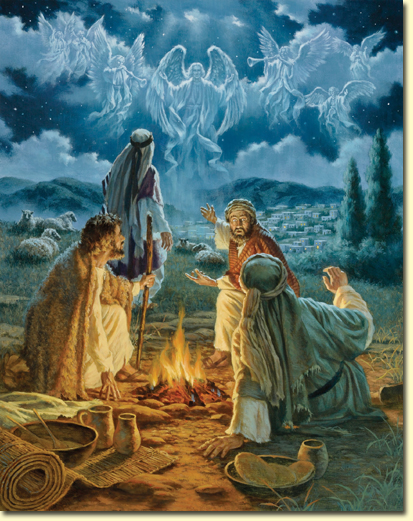
Behold, I proclaim to you good news of great joy that will be for all the people. For today in the city of David a savior has been born for you who is Messiah and Lord. And this will be a sign for you: you will find an infant wrapped in swaddling clothes and lying in a manger.” And suddenly there was a multitude of the heavenly host with the angel, praising God and saying: “Glory to God in the highest and on earth peace to those on whom his favor rests.”
Luke 2:10-14

Which Was the Son Of

The_Adoration_of_the_Magi_by_Fra_Angelico_and_Filippo_Lippi-763314

On Christmas Eve, in the Office of the Liturgy of the Hours, the genealogy of Jesus is read from Luke 5. This passage which is difficult enough to read aloud was set to music by the contemporary Estonian composer Arvo Part, whose inspiration for many of his classical pieces comes from Gregorian chant.

It is a beautiful song that for me brings alive the unfolding of the story of salvation as seen in the mind of God. The song is called “Which was the son of.” It is a perfect reflection for the eve of Christmas.

Open Luke 5 to verse 23 and read along as the choir sings

May you have a happy and holy Christmas.

****


****