What Little Children Can Teach Us About Prayer.

When it comes to our struggle in  prayer there are some things that we need to unlearn. For too many private prayer is often a formal, even stuffy affair that drips of boredom and unnecessary formality and has lots of rules. Perhaps we learned some of our lessons too well. And yet many of the youngest children have not learned these lessons and they seem to pray with great ease. They are unassuming and will say almost anything to God. It is true that children may have a lot to learn about public and liturgical prayer, but when it comes to personal and private prayer they have much to teach us. Perhaps a parable is in order:

A young girl received her First Holy Communion and, when she returned to her pew, she was noticed by her parents to be in rather deep prayer. After Mass they asked her, “What were you praying about after your First Communion?” “Well,” she said, “I prayed for you, mommy and daddy, and my (dumb) brother too! And then I sang Jesus a song and told him my favorite ghost story.”

So informal, so conversational, so unassuming, so real. And yet it is the way little children pray. But over the years it seems we drift away from this honest simplicity and layer on lots of “shoulds and oughts.”  Perhaps we over learn or over apply some of the lessons we learn about human interactions. I remember as a child that a neighbor woman took up a goofy hair style. And so I said to my mother in a voice that might be overheard, “Mom, why does that lady have Goofy hair?” “Shhhh….” she said, “Don’t say that, you might hurt her feelings.”  She later admitted to me that the hair WAS goofy but explained that there are many things we shouldn’t say. We should keep certain things to our self.

This sort of lesson is an important one to learn and has its place. But like any lesson it can be over applied. The fact is that many today remain silent when they should speak out by way of fraternal correction. There are times when we need to be honest and clear. So too in our personal prayer with God.

Early in my priesthood a woman came to me and spoke quite frankly and vividly about her anger and disappointment with God who had made her suffer loss. “Have you talked to God about this?” I asked. “Oh no! Father,” she said with her hands in the air, “You’re not supposed to talk to God like this.” And she smiled as these words left her mouth because she knew they were silly. I smiled too and said, “He already knows doesn’t he….So you know what your prayer needs to be about. Now talk to him just like you talked to me.”

The Book of Psalms is the prayerbook that God entrusted to Israel. In it is enshrined every human emotion, thought and experience. There is joy, exultation, praise and serenity. But there is also anger, fear, disappointment and even hatred. It’s all in God’s official prayer book. And thus God teaches that the whole range of experience, thought and emotion is the stuff of prayer. It is precisely these things that God wants  to engage us on.

Little children seem to know this instinctively. They pray about what is going on, what interests them and they do so plainly and without a lot of formality. Even the bad stuff is out there. I have a brief but clear memory of my prayer life as a little child. I must have been about 5 or 6 and there was a Sacred Heart statue on the dresser. I would see that statue and start talking to God in the freest way and God would speak to me, simply and in a way a child could understand. But it was very real. And then the memory shuts off. It is just a small window into my early childhood, one of the few, and it was filled with God. Since my late 20s I have strived to find my way back to that simple and profound experience of the presence of God in prayer. So simple, yet so real. Somewhere along the line it faded. Perhaps I had over learned the lesson that there are just things you’re not supposed to say and the conversation became strained and unreal and ultimately assumed the “irrelevance” that many today claim of  their prayers.

I have made a lot of progress in journey back by unlearning some of the rules I applied. Hearing little children pray has been a great help. It is the littlest ones really who seem to live in that enchanted world of the presence of God. By 5th grade it is fading fast and by 7th grade the flesh has fully manifested and a kind of spiritual dullness seems to overtake most middle school kids. But wow, can little kids pray.  The Book of Psalms says ex ore infantiumfrom the mouth of infants and little children you have perfected praise O Lord unto the exasperation of your enemies. (Psalm 8:2).

Do a little unlearning where required in the prayer department. Though we need to teach kids about the liturgical and public prayer which has its necessary rules, they have much to show us in terms of private prayer; a prayer that is personal, unassuming, about real things and spoken with childlike simplicity and trust. Amen I say to you,  unless you receive the kingdom of God like a little child you shall not enter it.  (Mark 10:15)

This video is about the prayer of children and beautifully illustrates what I am trying to say.
Despite Her Pain, She Chose Life

The video below is a very moving story about a child who was conceived as the result of a rape. But his mother, despite her pain chose life. She brought him to term and the child, Ryan, was adopted by a large family of what became 13 Children, 10 of them adopted.

It is thought by many that rape and incest should be exceptions to the opposition to abortion.  But the more radical and true position of the Christian faith is that no child is unwanted or unplanned by God. We may not always understand the reasons and circumstances of every conception,  but God wills every human life, even those conceived by rape. This video beautifully depicts that God can draw good even from unspeakable and heinous acts.

Many centuries ago Joseph was sold into slavery by his envious brothers. He wound up in Egpyt and by his sheer giftedness became the Prime Minister of that Land. His position enabled him later to save the very brothers who had sold him into slavery. As Joseph stood before his brothers he said, You intended to harm me, but God intended it for good to accomplish what is now being done, the saving of many lives  (Gen 50:20).

As for Ryan’s mother, in 1970 she experienced a great evil, but God drew good from it, and despite her pain she chose life.

Enjoy this moving video that depicts the potential and beauty of every human life, no matter how we are conceived. Behold what follows from one woman’s selfless choice.

The ultimate gold medal

Now that’s a Gold Medal!

My wife has a wonderful devotion to the Blessed Virgin. As a convert to the faith, she often credits the Mother of God with drawing her closer to her Son, Jesus Christ. As part of her devotion, she almost always wears a Miraculous Medal given to her as a gift when she was received into the Catholic Church. For Lent, she asked me to say the prayer on the Medal daily and to think of her while I pray it.

I am victorious!

As we were watching the Olympics recently, we enjoyed witnessing the joy on an athlete’s face when they put the medal around their necks symbolizing their respective victories.

Brothers and sisters, Our Lady’s Miraculous Medal symbolizes victory as well. It symbolizes a victory over sin and death. And unlike an Olympic medal, it is available to anyone who seeks victory over death through Jesus Christ. Also, unlike Olympic medals, the glory of this victory will never fade but only increase. If you have one, put it on. If not, buy one. Few things say, “I believe in Christ!” like a Miraculous Medal.

Take your place on the medal stand!

Let God and your faith in His Only Son, Jesus Christ, put you on the platform and place the ultimate gold medal around your neck!

“O Mary, conceived without sin, pray for us who have recourse to thee.”

One Hundred Questions that Jesus Asked and YOU must answer.

One of the bigger mistakes people make in reading Scripture is that they read it as a spectator. For them Scripture is a collection of stories and events that took place thousands of years ago. True enough, we are reading historical accounts. But, truth be told these ancient stories are our stories. We are in the narrative. You are Abraham, Sarah, Moses, Deborah, Jeremiah, Ruth,  Peter, Paul, Magdalene, Mother Mary, and, if you are prepared to accept it, you are also Jesus. As the narrative we read unfolds, we are in the story. We cannot simply watch what others say or do or  answer. For what Peter and Magdalene and others did, we do. Peter denied and ran. So do we. Magdalene loved and never gave up, should should we. Magdalene had a sinful past and a promising future, so do we. Peter was passionate and had a temper so do we. But Peter also loved the Lord and ultimately gave his life for the Lord. So can we. Jesus suffered and died but rose again and ascended to glory. So have we and so will we.

The scriptures are our own story. We are in it. To read scripture as a mere spectator looking on is to miss the keynote. Scripture is our story.

In the light of this keynote there emerges another very important and powerful key to unlocking the text. The key is simply this: Answer the Question! Among the many things Jesus did, he asked a lot of questions! And whenever you read the Gospels and Jesus asks a question, answer it! Do not wait to see what Peter or Magdalene, or the Pharisees or the crowd say for an answer. You answer the question, in your own words. This brings Scripture powerfully alive.

So twenty years ago Bishop John Marshall,  Bishop of Burlington VT. and later Springfield Mass compiled a book: But Who Do You Say That I Am? In the book he collected and listed all the questions Jesus asked in the Gospels. And he encourages us to answer the question. He also listed questions asked by others in another section of the book. Bishop Marshall in listing the question gives extra verses for context and adds brief commentaries. However, I would like to list just the raw questions. I will give the verse reference so you can look it up. But I encourage you to print this list and take it to prayer. Read it slowly, perhaps over days or weeks. I have attached a PDF version of the List here: 100 Questions that Jesus asked and YOU must answer. Ponder each question. Answer each question prayerfully and reflectively. This is not the complete list of questions but it is surely food for thought. Now, answer the questions:

100 Questions that Jesus asked and YOU must answer:

  1. And if you greet your brethren only, what is unusual about that? Do not the unbelievers do the same? (Matt 5:47)
  2. Can any of you by worrying add a single moment to your lifespan? Matt 6:27
  3. Why are you anxious about clothes? Matt 6:28
  4. Why do you notice the splinter in your brother’s eye yet fail to perceive the wooden beam in your own eye? (Matt 7:2)
  5. Do people pick grapes from thornbushes or figs from thistles? (Matt 7:16)
  6. Why are you terrified? (Matt 8:26)
  7. Why do you harbor evil thoughts? (Matt 9:4)
  8. Can the wedding guests mourn so long as the Bridegroom is with them? (Matt 9:15)
  9. Do you believe I can do this? (Matt 9:28)
  10. What did you go out to the desert to see? (Matt 11:8)
  11. To what shall I compare this generation? (Matt 11:6)
  12. Which of you who has a sheep that falls into a pit on the Sabbath will not take hold of it and lift it out? (Matt 12:11)
  13. How can anyone enter a strong man’s house and take hold of his possessions unless he first ties up the strong man? (Matt 12:29)
  14. You brood of vipers! How can you say god things when you are evil? (Matt 12:34)
  15. Who is my mother? Who are my brothers? (Matt 12:48)
  16. Why did you doubt? (Matt 14:31)
  17. And why do you break the commandments of God for the sake of your tradition? (Matt 15:3)
  18. How many loaves do you have? (Matt 15:34)
  19. Do you not yet understand? (Matt 16:8)
  20. Who do people say the Son of Man is? (Matt 16:13)
  21. But who do you say that I am? (Matt 16:15)
  22. What profit would there be for one to gain the whole world and forfeit his life  and what can one give in exchange  for his life? (Matt 16:26)
  23. O faithless and perverse generation how long must I endure you? (Matt 17:17)
  24. Why do you ask me about what is good? (Matt 19:16)
  25. Can you drink the cup that I am going to drink? (Matt 20:22)
  26. What do you want me to do for you? (Matt 20:32)
  27. Did you never read the scriptures? (Matt 21:42)
  28. Why are you testing me? (Matt 22:18)
  29. Blind fools, which is greater, the gold or the temple that makes the gold sacred….the gift of the altar that makes the gift sacred? (Matt 23:17-19)
  30. How are you to avoid being sentenced to hell? (Matt 23:33)
  31. Why do you make trouble for the woman? (Matt 26:10)
  32. Could you not watch for me one brief hour? (Matt 26:40)
  33. Do you think I cannot call upon my Father and he will not provide me at this moment with more than 12 legions of angels? (Matt 26:53)
  34. Have you come out as against a robber with swords and clubs to seize me? (Matt 26:53)
  35. My God, My God, Why have you forsaken me? (Matt 27:46)
  36. Why are you thinking such things in your heart? (Mark 2:8)
  37. Is a lamp brought to be put under a basket or under a bed rather than on a lamp stand? (Mark 4:21)
  38. Who has touched my clothes? (Mark 5:30)
  39. Why this commotion and weeping? (Mark 5:39)
  40. Are even you likewise without understanding? (Mark 7:18)
  41. Why does this generation seek a sign? (Mark 8:12)
  42. Do you not yet understand or comprehend? Are your hearts hardened? Do you have eyes and still not see? Ears and not hear? (Mark 8:17-18)
  43. How many wicker baskets full of leftover fragments did you pick up? (Mark 8:19)
  44. [To the Blind man] Do you see anything? (Mark 8:23)
  45. What were arguing about on the way? (Mark 9:33)
  46. Salt is good, but what if salt becomes flat? (Mark 9:50)
  47. What did Moses command you? (Mark 10:3)
  48. Do you see these great buildings? They will all be thrown down. (Mark 13:2)
  49. Simon, are you asleep? (Mark 14:37)
  50. Why were you looking for me? (Luke 2:49)
  51. What are you thinking in your hearts? (Luke 5:22)
  52. Why do you call me ‘Lord, Lord’ and not do what I command? (Luke 6:46)
  53. Where is your faith (Luke 8:25)
  54. What is your name? (Luke 8:30)
  55. Who touched me? (Luke 8:45)
  56. Will you be exalted to heaven? (Luke 10:15)
  57. What is written in the law? How do you read it? (Luke 10:26)
  58. Which of these three in your opinion was neighbor to the robber’s victim? (Luke 10:36)
  59. Did not the maker of the outside also make the inside? (Luke 11:40)
  60. Friend, who appointed me as your judge and arbiter? (Luke 12:14)
  61. If even the smallest things are beyond your control, why are you anxious about the rest? (Luke 12:26)
  62. Why do you not judge for yourself what is right?  (Luke 12:57)
  63. What king, marching into battle would not first sit down and decide whether with ten thousand troops he can successfully oppose another king marching upon him with twenty thousand troops? (Luke 14:31)
  64. If therefore you are not trustworthy with worldly wealth, who will trust you with true wealth? (Luke 16:11)
  65. Has none but this  foreigner returned to give thanks to God? (Luke 17:18)
  66. Will not God then secure the rights of his chosen ones who call out to him day and night? (Luke 18:7)
  67. But when the Son of Man comes, will he find any faith on earth? (Luke 18:8)
  68. For who is greater, the one seated a table or the one who serves? (Luke 22:27)
  69. Why are you sleeping? (Luke 22:46)
  70. For if these things are done when the wood is green, what will happen when it is dry? (Luke 23:31)
  71. What are you discussing as you walk along? (Luke 24:17)
  72. Was it not necessary that the Messiah should suffer these things and then enter his glory? (Luke 24:26)
  73. Have you anything here to eat? (Luke 24:41)
  74. What are you looking for? (John 1:38)
  75. How does this concern of your affect me? (John 2:4)
  76. You are a teacher in Israel and you do not understand this? (John 3: 10)
  77. If I tell you about earthly things and you will not believe, how will you believe when I tell you of heavenly things? (John 3: 12)
  78. Do you want to be well? (John 5:6)
  79. How is it that you seek praise from one another and not seek the praise that comes from God? (John 5:44)
  80. If you do not believe Moses’ writings how will you believe me? (John 5:47)
  81. Where can we buy enough food for them to eat? (John 6:5)
  82. Does this (teaching of the Eucharist) shock you? (John 6:61)
  83. Do you also want to leave me? (John 6:67)
  84. Why are you trying to kill me? (John 7:19)
  85. Woman where are they, has no one condemned you? (John 8:10)
  86. Why do you not understand what I am saying? (John 8:43)
  87. Can any of you charge me with sin? (John 8:46)
  88. If I am telling you the truth, why do you not believe me? (John 8:46)
  89. Are there not twelve hours in a day? (John 11:9)
  90. Do you believe this? (John 11:26)
  91. Do you realize what I have done for you? (John 13:12)
  92. Have I been with you for so long and still you do not know me? (John 14:9)
  93. Whom are you looking for? (John 18:4)
  94. Shall I not drink the cup the Father gave me? (John 18:11)
  95. If I have spoken rightly, why did you strike me? (John 18:23)
  96. Do you say [what you say about me] on your own or have others been telling you about me? (John 18:34)
  97. Have you come to believe because you have seen me? (John 20:29)
  98. Do you love me? (John 21:16)
  99. What if I want John to remain until I come?  (John 21:22)
  100. What concern is it of yours? (John 21:22)

After all this you might have a few questions for God:

“GodJoy”

Driving to work, a shiny new black corvette pulled up beside me. It was not the car that caught my attention but the license plate. The plate read “Godjoy.”  I think Godjoy captures the spirit of Lent. Lent is the penitential season and hopefully we have found the right rhythm for our prayer, fasting and alsmgiving.  We are sinners who forget at times that we have been saved and when we forget that we fall back into our old ways.

The faces of the saved

The past two Sundays there was lots of Godjoy in the Archdiocese as we celebrated the Rite of  Election and the Call to Conitnuing Conversion. Gathered in the huge upper church of the National Shrine of the Immaculate Conception were 1,192 people who are seeking to become Catholics or to complete the sacraments of initiation. 1,192 faces with smiles of pure Godjoy.  Together, with their sponsors they filled the Shrine and in the presence of Archbishop Wuerl and the auxiliary bishops of Washington, the sponsors announced these catechumens and candidates ready to receive the sacraments to initiation at Easter.

Sorrowful Joy

Another expression of Godjoy during Lent is found in the music of African-American Spirituals. Sometimes described as songs of sorrowful joy, they capture the spirit of Lent. Even in the misery of slavery and oppression, African-Americans, like the Israelites before them  found a joy in knowing God has not abandoned them and only God will save them.  Their song becomes the song of all sons and daughters of God.

God comes looking for us

At the Rite of Election, one Spiritual we sang is called Somebody’s Knockin at Your Door and it captures the Godjoy of the Spirituals and of Lent. We are not sinners with nowhere to turn, and the very act of turning is not our initiative but the spirit of God within us calling us back to our deepest joy-right relationship with God.  Take a moment to listen.

watch?v=roXOqRXODDM

Learning the Lessons of Lazarus and the Rich Man

The well known story of the Lazarus and the Rich Man was read at Mass yesterday morning. At one level the story seems plain enough: to neglect the poor is a damnable sin. But there are other important teachings contained in this Gospel, teachings about death, judgment, heaven and hell.  They are hidden in the details and are somewhat subtle. But that is the beauty of this story, its subtlety. Let’s take a look at some of the teachings beginning with the obvious one.

  1. Neglect of the Poor is a damnable sinThere was a rich man who dressed in purple garments and fine linen and dined sumptuously each day. And lying at his door was a poor man named Lazarus, covered with sores, who would gladly have eaten his fill of the scraps that fell from the rich man’s table. Dogs even used to come and lick his sores. The vision of Lazarus’ poverty is dramatic indeed. The unnamed rich man (dubbed Dives by some but this name simply means in Latin rich) does not so much act in an evil way toward Lazarus. His sin is a sin of neglect and omission. He seems undisturbed and remote from Lazarus’ suffering. This neglect, this omission, this insensitivity lands him in Hell as the text plainly says, The rich man died and was buried, and from the netherworld, where he was in torment, he raised his eyes. Care  for the poor will be a central theme of our judgment as is clear from Matt 25:31ff  where Jesus separates sheep from goats, the just from the unrighteous,  based on whether they cared for the least of his brethren. To those who fail in this regard the Lord Jesus says, Depart from me, you who are cursed, into the eternal fire prepared for the devil and his angels (Matt 25:41). How best to care for the poor is a matter of some dispute, But that we MUST care for them in some explicit way is not in dispute. Hence we find the Rich Man who sinfully neglected Lazarus now in Hell. Here is a call to sobriety about the reality of judgment and for us to review if our care for the poor is what it should be.
  2. Though in torment the Rich Man has not changed –  The Rich Man in torment, raised his eyes and saw Abraham far off  and Lazarus at his side. And he cried out, ‘Father Abraham, have pity on me. Send Lazarus to dip the tip of his finger in water and cool my tongue,  for I am suffering torment in these flames.’  Notice that the Rich Man still fails to see Lazarus’ dignity. In effect he still sees Lazarus as an errand boy who should step and fetch him water. Though he has to look up to see him, he still looks down on him. He does not ask Abraham to send Lazarus to him so that he may apologize for his sinful neglect and seek his forgiveness. Rather he merely wants Lazarus to serve him. The Rich Man, though in torment is unrepentant. He doesn’t like where he is but he remains unreconciled with Lazarus and seems to have no idea that he should even seek to be reconciled. He is hardened in his sin. While Lazarus lived he never saw his dignity. He is still blind to that dignity. Over time sin hardens our heart. The more we remain in sin the harder our hearts become and the less likely it is that we will ever change. Why is Hell eternal? Look at the the Rich Man. He will not change. He cannot change. His decision, his character and demeanor are forever fixed. There is an old litany that goes like this: sow a thought reap a deed; sow a deed reap a habit; sow a habit reap a character; sow a character, reap a destiny. The mystery of the world to come is that our character is forever fixed. The Fathers of the Church spoke of this mystery like clay on a potter’s wheel. As long as the clay is moist and on the wheel, the potter can shape and reshape it. But there comes a time when the clay form is placed in the kiln and when it is fired and its shape is forever fixed. It is this way for us when we come before God who judges us by fire (cf 1 Cor 3:12-15). Fire will forever fix who we are in terms of character and this judgment through fire will either purify us or bring us condemnation.  The fixed quality of the human person is illustrated in the Rich Man’s attitude.
  3. The Rich Man does not ask to come to heaven– It is a very strange fact that the Rich Man does not ask that he might come to heaven but asks that Lazarus be sent to Hell. One of the saddest facts about the souls in Hell must be that they would not be happy in heaven anyway. After all, heaven is about being with God, it is about justice, love of the poor, chastity, the heavenly liturgy, the celebration of the truth, the praise of God, and God (rather than me) being at the center. And the fact is, many show by the way they live that they do not want many of the things on this list. But heaven is about these things. It is surely unlikely that someone who has disliked, even hated these things will suddenly start liking such things at the moment of death. Someone who ignores or disdains God and considers his faithful to be hypocrites etc. would hardly be happy in heaven. The rich man demonstrates this by the fact that he does not ask to come to heaven. He surely does not like where he is, but shows no repentant desire for heaven either. The teaching, though subtle, seems clear enough, the souls in Hell have little real interest in heaven despite their dislike of Hell. Here too their desires and aversions are forever fixed. Abraham further affirms the fixed and insurmountable gulf between heaven and hell when he says Moreover, between us and you a great chasm is established to prevent anyone from crossing who might wish to go from our side to yours or from your side to ours.’ While it is not absolutely clear from the text,  there seems implied that while someone might possibly wish to cross from heaven to hell (presumably to help the poor souls) yet the word wish  is not repeated when the possibility is denied of someone crossing from Hell to Heaven. We are not unsafe in concluding that the text teaches there is no wish to do so on that side of the chasm.
  4. The Great Reversal – Abraham further indicates to the Rich Man and to us the “great reversal”: My child, remember that you received what was good during your lifetime while Lazarus likewise received what was bad; but now he is comforted here, whereas you are tormented. We spend a lot of time trying to be on top in this world. We want comfort, wealth, position, power, and so forth. But the Lord warns here that we ought to beware of the great reversal that is coming. Lazarus who was poor is now rich. The Rich Man is now poor. Jesus teaches this elsewhere:  But many who are first will be last, and the last first (Mk 10:31). Mary too remarked, he has scattered those who are proud in their inmost thoughts. He has brought down rulers from their thrones  but has lifted up the humble. He has filled the hungry with good things  but has sent the rich away empty. (Lk 1:51-53)  This is the great reversal. We so want to be rich and comfortable in this world and we run from any suffering or setback. But the Lord warns of riches: How hard it is for the rich to enter the kingdom of God! (Mk 10:23). Yet still we want to be rich. He also says Anyone who does not carry his cross and follow me cannot be my disciple (Luke 14:27) Yet still we run from the cross and suffering. The great reversal means that many who are first in this world will be last in the world to come. It is true we cannot assert a one-to-one correlation between success here and loss in the world to come. But neither should we simply ignore the teaching that striving to make it  in the world and be somebody is a dangerous path. And IF we have amounted to something we’d better humble ourselves by generosity to the poor and associating with the humble. Worldly success as a goal to be principally pursued is a dangerous plan for the great reversal is coming. Better to be found among the humble and poor or at least well associated with them than to be mighty and high. Beware the great reversal!
  5. To refuse the truth of Revelation is a damnable sin – The Rich Man does not repent to God, neither does he seek to be reconciled  with Lazarus. But he does have some concerns for his brothers, for his family. We need not assume that the souls in Hell have no affections whatsoever. It simply remains true that their affections are not for God and what God esteems. And so the Rich Man, still seeing Lazarus only as an errand boy for his own needs, asks Abraham to dispatch Lazarus to his family with warning. Perhaps a vision from the grave will convince them! But Abraham indicates quite clearly that they have the clear witness of God in the witness of the Moses and the Prophets. In other words they have the Scriptures, the very Word of God, to warn them. But the Rich Man insists: Oh no, father Abraham, but if someone from the dead goes to them, they will repent.’ Then Abraham said, ‘If they will not listen to Moses and the prophets, neither will they be persuaded  if someone should rise from the dead.  The last point is dripping with irony considering the fact that Jesus would rise from the dead. But the fact remains, and Abraham says it clearly, there are many sinners who are hardened in their sin and no matter what the Scriptures say or what the Church solemnly teaches, they will never be convinced. This is so very true today as many remain hardened in their sins. No amount of Scripture or Church teaching will convince them that they are wrong. This is what happens to us if we remain in unrepented sin. Our hearts are hardened, our minds are closed and our necks are stiffened. In the end, this story teaches that such hardness is damnable.

Five basic teachings from a well known parable. We do well to heed these lessons!

This song says, “Rock a My Soul in the Bosom is Abraham” and it amounts to a wish that we will find our way to glory. Heeding the lessons of this parable are surely one way to find our rest in God.

Do We Need a New Word for Marriage?

Here in Washington DC today Gay and Lesbian couples lined up to apply for “Marriage”  Licenses. It is a simple fact that word “marriage” as we have traditionally known it is being redefined in our times. To many in the secular world the word no longer means what it once did and when the Church uses the word marriage we clearly do not mean what the DC City Council means.

The Catechism of the Catholic Church defines Marriage in the following way:

The matrimonial covenant, by which a man and a woman establish between themselves a partnership of the whole of life, is by its nature ordered toward the good of the spouses and the procreation and education of offspring; this covenant between baptized persons has been raised by Christ the Lord to the dignity of a sacrament (CCC # 1601)

The latest actions by the DC Council, along with Connecticut, New Hampshire, Vermont, Massachusetts and Iowa have legally redefined the term marriage. Other states will likely join the list. The secular world’s definition of marriage no longer even remotely resembles what the Catechism describes.

To be fair, this is not the first redefinition of marriage that has occurred in America. The redefinition has actually come in three stages:

  1. In 1969 the first no-fault divorce law was signed in California. Within 15 years every state in this land had similar laws that made divorce easy. No longer did state laws uphold the principle which the Catechism describes as a partnership of the whole of life. Now marriage was redefined as a contract easily broken by the will of the spouses.
  2. The dramatic rise in contraceptive use and the steep drop in birthrates, though not a legal redefinition, amount to a kind of cultural redefinition of marriage as described in the Catechism which sees the procreation and education of offspring as integral to its very nature. Now the American culture saw this aspect as optional at the will of the spouses.
  3. This final blow completes the redefinition of marriage which the Catechism describes as being  a covenant, …which a man and a woman establish between themselves. Now secular American culture is removing even this, calling same-sex relationships “marriage”.

Proposal:  So the bottom line is that what the secular world means by the word “marriage” is not even close to what the Church means. Is it time for us to accept this and start using a different word? Perhaps it is and I would like to propose a new (really an old) term and hear what you think. I propose that we should exclusively refer to marriage in the Church as “Holy Matrimony.”  According to this  proposal the word marriage would be set aside and replaced by Holy Matrimony. It should be noticed that the Catechism of the Catholic Church refers to this Sacrament formally as “The Sacrament of Matrimony.”

The word matrimony also emphasizes two aspects of marriage: procreation and heterosexual complimentarity. The word comes from Latin and old French roots. Matri = “mother”  and mony, a suffix indicating “action, state, or condition.”  Hence Holy Matrimony refers to that that holy Sacrament wherein a woman enters the state that inaugurates an openness to motherhood. Hence the Biblical and Ecclesial definition of  Holy Matrimony as heterosexual and procreative is reaffirmed by the term itself. Calling it HOLY Matrimony distinguishes it from SECULAR marriage.

To return to this phrase “Holy Matrimony” is to return to an older tradition and may sound archaic to some but at least it isn’t as awkward sounding as “wedlock.” But clearly a new usage will be difficult to undertake. It is one thing to start officially referring to it as Holy Matrimony. But it is harder when, for example, a newly engaged couple approaches the priest and says, “We want to be married next summer.” It seems unlikely we could train couples to say,  “We want to be wed next summer.” or to say, “We want to have a wedding next summer.”  Such dramatic changes seem unlikely to come easily. Perhaps we cannot wholly drop the terms “marry” and  “married.” So the more modest form of the proposal is that we at least officially discontinue the use of the word marriage and refer to it as the “Sacrament of Holy Matrimony.”

What do you think? Do we need to start using a new word for marriage? Has the word been so stripped of meaning that we have to use different terminology to convey what we really mean?

Families Supporting Vocations

Around the year 461 A.D. St. Patrick of Ireland wrote:

“How else has it lately come about in Ireland that those how never even knew God, but up till now had always worshipped nothing but idols and impure things, are now suddenly made the people of the Lord, so that they are now called children of God?  Meanwhile, so many sons and daughters of the kings of the Irish are now proud to be counted monks and virgins of Christ…Not that their fathers agree with their decision; more often than not, they gladly suffer persecution, yes, and even false charges from their own parents. Yet, in spite of all, their number continues to grow more and more. …But the Lord has given his grace to so many women who are serving him in this way, so that even when they are forbidden, they continue steadfastly to follow his example.”
(The Confession of St. Patrick, Part IV, sections 41-42)

From what I hear from vocation directors and those who have chosen consecrated life themselves, this is just as true today as it was 1549 years ago.

Now I’m not going to go into some deep philosophical discussion about why this is true. Rather, I want to share what I plan to do when I have children, because honestly I’m pretty excited about the thought of one of my children being consecrated! (If I am blessed with children, God-willing!)

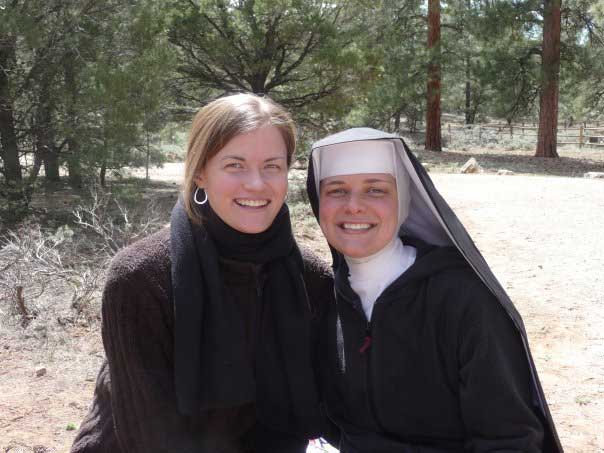
God has already put many wonderful people in my life who have consecrated themselves to God. It all started with a best friend from 7th grade summer camp who is now a nun, then I met her friend who is now a priest, then I met his friend who was a priest at my parish, and of course, now that I work at the Archdiocese I have met many more stellar priests and sisters.

I can’t wait to have them over for family dinners. I can’t wait to take my family to visit them in their parishes and monasteries. I can’t wait for my daughter to see the joy on my friend’s face when she talks about her love of God and her vocation to pray. I can’t wait for my son to watch my friend as he celebrates the Mass.

Is there a parish priest that you admire and want to invite to the next family cookout? Do you know a charismatic nun that your daughter could spend a Saturday with serving the poor? If not, make a new friend! Even if it’s not God’s will for them to become consecrated, at least they will witness your support of vocations and will come away with a respect and enthusiasm for consecrated life.

And they won’t grow up to be among the parents that St. Patrick describes!