The Assumption of Mary is Our Feast, Too

Let’s ponder this feast in three stages.

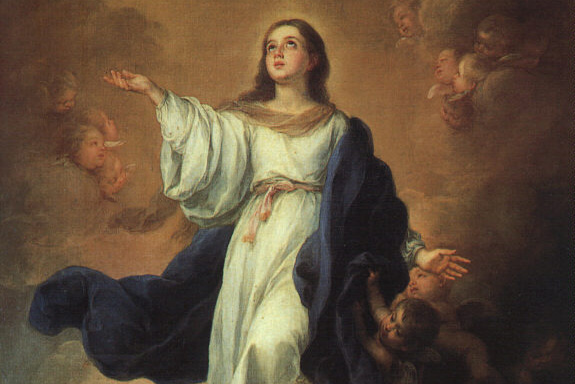
I. ExplainedTo be “assumed” means to be taken up by God bodily into Heaven. As far back as the Church can remember we have celebrated the fact that Mary was taken up into Heaven. We do not just acknowledge that her soul was taken to Heaven as is the case with all the rest of the faithful who are taken there (likely after purgation). Rather, Mary was taken up soul AND body into Heaven after her sojourn on this earth was complete. There is no earthly tomb containing her body; neither are there relics of her body to be found among the Christian faithful. This is our ancient memory and what we celebrate today: Mary was taken up body and soul into Heaven.

II. Exemplified – The actual event of Mary’s Assumption is not described in Scripture. However, there are other assumptions recorded in the Scriptures, thus the concept itself is biblical.

    1. It happened to Enoch in the Old Testament. The Book of Genesis records: Enoch walked with God; then he was no more, because God took him away (Gen. 5:24). Hebrews 11:5 elaborates: By faith Enoch was taken up so that he should not see death; and he was not found, because God had taken him. Now before he was taken he was attested as having pleased God.
    2.  It also happened to Elijah as he walked with Elisha: And as they still went on and talked, behold, a chariot of fire and horses of fire separated the two of them. And Elijah went up by a whirlwind into heaven … And he was seen no more. (2 Kings 2:11 ).
    3. Some say that Moses, too, was taken up since his grave is not known: He was buried  in Moab, in the valley opposite Beth Peor, but to this day no one knows where his grave is (Dt. 34:6). The text of course does not say that his body was taken up, and even if it was, it occurred after death and burial. Jude 1:9 hints at that fact when it says, But even the archangel Michael, when he was disputing with the devil about the body of Moses … (Jude 1:9). Some further credibility is lent to the view of Moses being assumed by the fact that he appears alongside Elijah in the Transfiguration account. Some of the Church Fathers held this view and there is also a Jewish work from the 6th Century AD entitled The Assumption of Moses that represents the tradition of Moses’ assumption. But in the end the assumption of Moses is a view held only by some, and it not officially held by the Church.
    4. And while it is true that the historical event of Mary’s Assumption is not recorded in Scripture nor are there historical accounts of the event, there may be one other scriptural account that evidences Mary’s whereabouts, body and soul.  The Church presents for our consideration in today’s second reading a passage from the Book of Revelation wherein John records his sighting of the Ark of God:

Then God’s temple in heaven was opened, and within his temple was seen the ark of his covenant. And there came flashes of lightning, rumblings, peals of thunder, an earthquake and a great hailstorm. A great and wondrous sign appeared in heaven: a woman clothed with the sun, with the moon under her feet and a crown of twelve stars on her head. She was pregnant and cried out in pain as she was about to give birth. Then another sign appeared in heaven: an enormous red dragon with seven heads and ten horns and seven crowns on his heads … The dragon stood in front of the woman who was about to give birth, so that he might devour her child the moment it was born. She gave birth to a son, a male child, who will rule all the nations with an iron scepter (Rev 11:19 – 12:5).

The woman is clearly Mary since the child is clearly Jesus. And where is Mary seen? In Heaven. Now some may argue that this passage does not necessarily indicate that her body is in Heaven but rather may only be referring to her soul. However, the physical description of her in the text is rather strong.  Some also argue that Mary is linked to John’s sighting of the Ark of the Covenant, which is seen by John in Heaven. He mentions the Ark and goes on to describe the woman clothed with the sun (Mary) and there is a possibility that he is still describing the Ark. (I have written on this elsewhere: Mary: The Ark of the New Covenant.)  If Mary is the Ark described, then she is in Heaven, since the Ark is clearly described as being in Heaven.

So the biblical record, while not recording the event of the Assumption of Mary, does set forth other assumptions and thus shows that assumption itself is a biblical concept. Further, Mary’s physical presence in Heaven seems to be hinted at by John and some would argue that the passage actually attests to her physical presence there.

But remember, the Church does not rely solely on Scripture. In this case what we celebrate is most fundamentally taught to us by Sacred Tradition in that the memory of Mary’s Assumption goes back as long as we can remember.

III. Extended – The Feast of the Assumption may be of theological interest to some and may provide for interesting biblical reflection, but eventually the question is bound to arise: “So what? How does what happened to Mary affect my life and what does it mean for me?” The answer to this question is bound up in nearly every Marian doctrine. Simply put, what happened to Mary, in a profound and preliminary way, will also happen to us in the end. As Mary bore Christ into the world, we too bear him there in the Holy Communion we receive and in the witness of his indwelling presence in our life. As Mary is (and always was) sinless, so too will we one day be sinless (immaculate) with God in Heaven. As Mary cared for Christ in His need, so do we care for Him in the poor, the suffering, the needy, and the afflicted. And as Mary was assumed body and soul into Heaven, so too will we be there one day, both body and soul.

For now, our soul goes to Heaven (once purified) but our body lies in a tomb. But one day when the trumpet shall sound, on that “great gettin’ up morning,” our body will rise and be joined to our soul:

For we will all be changed—in a flash, in the twinkling of an eye, at the last trumpet. For the trumpet will sound, the dead will be raised imperishable, and we will be changed. For the perishable must clothe itself with the imperishable, and the mortal with immortality. When the perishable has been clothed with the imperishable, and the mortal with immortality, then the saying that is written will come true: “Death has been swallowed up in victory.” “Where, O death, is your victory? Where, O death, is your sting?” … Thanks be to God! He gives us the victory through our Lord Jesus Christ (1 Cor 15:51-57).

So our body shall be assumed, shall rise and be joined to our soul.

Improved model!  An older woman once said to me (upon hearing that her body would rise): “Father if this old body has to rise, I’m hoping for an improved model!” Yes indeed! Me too! I want my hair back, my slender figure to return, and I want knees that work! I want to upgrade from a general issue version to a luxury model. And God will in fact do that. Scripture says,

    • He will take these lowly bodies of ours and transform them to be like his own glorified body (Phil 3:21).
    • But someone may ask, “How are the dead raised? With what kind of body will they come?” How foolish! What you sow does not come to life unless it dies. When you sow, you do not plant the body that will be, but just a seed, perhaps of wheat or of something else. But God gives it a body as he has determined, and to each kind of seed he gives its own body … So will it be with the resurrection of the dead. The body that is sown is perishable, it is raised imperishable; it is sown in dishonor, it is raised in glory; it is sown in weakness, it is raised in power; … And just as we have borne the likeness of the earthly man, so shall we bear the likeness of the man from heaven (1 Cor 15:35-49).
    • Yes, we shall also be taken up—assumed—and then shall be fulfilled for us the saying of Job, I know that my Redeemer lives, and that in the end he will stand upon the earth. And after my skin has been destroyed, yet in my flesh I will see God; I myself will see him with my own eyes—I, and not another ‘s (Job 19:25-27).

The assumption of our bodies, prefigured by Christ in His own power and also in Mary by the gift of God, will one day be our gift, too. For now, though, it waits till that “great gettin’ up morning.” Until that day and on that day, fare you well; fare you well!

This song is an African-American Spiritual and speaks of that “great gettin’ up morning” when our bodies will rise. And if we have been faithful they will rise to glory!

I’m gonna tell you about the coming of the judgment (Fare you well) There’s a better day a coming … In that great gettin’ up morning fare you well! Oh preacher fold your Bible, For the last soul’s converted … Blow your trumpet Gabriel … Lord, how loud shall I blow it? Blow it right calm and easy Do not alarm all my people … Tell them to come to the judgment … In that great gettin’ up morning fare you well. Do you see them coffins bursting? Do you see them folks is rising? Do you see the world on fire? Do you see the stars a falling? Do you see that smoke and lightning? Do you hear the rumbling thunder? Oh Fare you well poor sinner. In that great gettin’ up morning fare you well.

Are Some of the Psalms Boastful?

To anyone who regularly reads the Liturgy of the Hours, some of the psalms seem downright boastful. They sound too much like the Pharisee who went to pray and said, God, I thank you that I am not like other people — robbers, evildoers, adulterers — or even like this tax collector. I fast twice a week and give a tenth of all I get (Luke 18:11-12). In the very next verse, Jesus recommends a briefer prayer for us: God, have mercy on me, a sinner (Luke 18:13).

How, then, are we to understand some of the psalms that seem to take up a rather boastful and presumptuous tone? Consider these three passages:

    • The Lord has dealt with me according to my righteousness; according to the cleanness of my hands he has rewarded me. For I have kept the ways of the Lord; I am not guilty of turning from my God. All his laws are before me; I have not turned away from his decrees. I have been blameless before him and have kept myself from sin. The Lord has rewarded me according to my righteousness, according to the cleanness of my hands in his sight (Psalm 18:21-24).
    • My heart is not proud, Lord, my eyes are not haughty; I do not concern myself with great matters or things too wonderful for me. But I have calmed and quieted myself, I am like a weaned child with its mother; like a weaned child I am content. (Psalm 131:1-4).
    • I have kept my feet from every evil path so that I might obey your word. I have not departed from your laws, for you yourself have taught me … therefore I hate every wrong path (Psalm 119:100-102).

For us who would pray these, the spiritual approach is twofold.

These psalms are prayed in hope. While we are not worthy to say such words without a lot of qualifications, by God’s grace they will one day be true for us. God is drawing us to perfection. While total perfection will not come until we attain Heaven, if we are faithful we should be progressing toward this lofty reality even now.

Hope is the confident expectation of God’s help in attaining holiness and salvation. One day in Heaven we will be able to say, “I do not sin; I am blameless before God. I am not proud and never depart from your decrees, O Lord.” Hope is the vigorous expectation that these words will one day apply to us fully; for now, we recite them in that fervent hope.

In effect, we are memorizing our lines for a future moment, when by God’s grace we will actually be able to recite them truthfully. Praying psalms like these is like a dress rehearsal for Heaven. These psalms amount to prolepses of a sort, whereby we proclaim a future reality as if it were already present. Our confidence to speak proleptically is in Christ alone.

These psalms are on the lips of Christ. When the Church prays, Head and members pray together; it is the whole Body of Christ that proclaims these psalms.

Christ never wavered, never drew back from God’s Law. He never sinned; His hands were clean from defilement and He was rewarded for His righteousness. Christ alone prays these psalms without any qualification.

In the Old Testament, these psalms pointed forward to the Christ, to the anointed Messiah. Today, they still point to Christ and He alone utters them authentically. None of us can really pray them apart from Christ, as members of His Body.

Even the perfected in Heaven cannot pray them without reference to Christ, for it is He who accomplished in them the perfection that makes such psalms a reality for them.

It is Christ who prays these psalms, and we—through Him, with Him and in Him—head and members—are praying them to the Father.

Without Christ, such psalms amount to haughty boasts and presumptuous declarations, but with Christ our Head, they are true; we can rightly pray them in the hope of our own perfection, one day, by His grace. We can also pray them in the joy that some of our brothers and sisters in Heaven have already attained to the perfection described therein. This is because the grace of Christ has had in them its full effect.

By Breaking a Wooden Yoke, You Forge an Iron Yoke!

Monday of last week (18th Week of the year) there was a powerful passage from the Book of Jeremiah. It is practical, profound, and sweeping in its implications, and it comes to us from the Lord through the mouth of Jeremiah the Prophet:

By breaking a wooden yoke, you forge an iron yoke! (Jeremiah 28:13)

Rather than looking at the historical meaning (i.e., that God was going to use Assyria to humble Israel), let’s consider what it means for us today.

What is the wooden yoke if it is not the cross? Indeed, the Lord says as much: Come to me, all who labor and are heavy laden, and I will give you rest. Take my yoke upon you and learn from me; for I am gentle and lowly in heart, and you will find rest for your souls. For my yoke is easy, and my burden is light (Matt 11:28-30).

The Lord has a paradoxical answer for us who labor and are heavily burdened. He tells us to take the yoke and burden that He has for us. The yoke is a symbol for the cross, and like most yokes, it connects us with another—the Lord! To be sure, God does have a yoke for us. We do need purification and discipline. However, the yoke He has for us is “easy.” The Greek word used is χρηστός (chrestos), which also has the connotation of being well-fitting, serviceable, or adapted to its purpose. The Lord’s yoke for us is productive unto the end He has in mind: our healing and salvation.

Do not turn the yoke (cross) into something abstract or think of it only in terms of major things such as cancer. The cross also has real, practical, daily dimensions such as exercising self-control and moderation. The cross (yoke) includes resisting sin, forgiving, and living chastely and courageously despite difficulties or persecution. These crosses are common to all true Christians. There are also some specific crosses that each of us carries, ones that the Lord permits for our humility and purification. Perhaps it is a physical illness or infirmity; maybe it is a spiritual emotional struggle; perhaps it is the loss of a loved one, job, or home.

These things are the wooden yoke, the cross of the Lord, and He carries it with us for we are yoked with Him (praise God). Because these burdens are from Him, they are well-suited to us; they are just what we need to avoid even worse things, including Hell itself.

What if we break and cast aside the wooden yoke, as many do today by ridiculing the Christian moral vision and the wisdom of the cross given to us by Jesus?

By breaking a wooden yoke, you forge an iron yoke! (Jeremiah 28:13)

How is this? Consider the toll that indulging in the moment can take: 

    • In rejecting the wooden yoke of moderation, chastity, and the limits of God’s moral law, we forge the iron yoke of addiction, obesity, financial trouble, sexually transmitted diseases, broken families, and all the heartache that follows. Pornography, lust, alcohol, and drugs enslave with an iron yoke.
    • In refusing the grace to forgive, we fuel violence and conflict. Many wars in the world today are fought over grievances that stretch back hundreds or even thousands of years.
    • Our greed fuels an insatiable desire for more, and we begin to live beyond our means or to live in such a way that bring us more stress than happiness.
    • Even the simple neglect of our daily duties causes work to pile up and seem overwhelming.
    • Our culture has become ever more severe as we abandon the wooden yoke of common moral standards and simple human decency. What we end up with is a culture that is more unforgiving and severe than ever. General moral standards give way to selective moral outrage resulting in: cancel culture, growing lists of grievances, and an easily offended victim-culture,  a bewildering list of words  are now forbidden and an outright criminalizing of views contrary to the sexual revolution. It is an iron yoke.  

All of these iron yokes, and more come upon us because we break the wooden yoke of the cross. To be sure, fulfilling our daily duties, living moderately, chastely, and soberly are all crosses because they involve some degree of self-denial, at least in the moment. However, the wooden yoke is a lot easier than the iron yoke that results if we cast aside the more manageable, and well-fitting yoke of the cross.

Pay attention, fellow Christian, Satan is a liar. He offers to lift the gentle yoke of the Lord. He expresses “outrage” that the Lord should require any suffering or discipline from us. He “takes our side” and utters a complaint on our behalf, but he is a liar and a fraud. Once we let him lift the wooden yoke he locks us in an iron yoke. Do not forsake the wooden yoke of the cross, for if you do, an iron yoke is sure to follow.

It is a simple pearl of wisdom, yet it is so often ignored: By breaking a wooden yoke, you forge an iron yoke! (Jeremiah 28:13)

Believe What Jesus Says – A Homily for the 19th Sunday of the Year

The Gospel this Sunday amounts to a summons to faith by Jesus. He is summoning us to faith in Himself and in the truth He proclaims about His presence in the Holy Eucharist. Last week’s Gospel ended with Jesus declaring that He was the bread come down from Heaven. This Sunday’s Gospel opens with His Jewish listeners grumbling because He claims to have come from Heaven. Throughout the Gospel Jesus stands firm in His call to faith; He teaches them of the necessity of faith, its origins, and its fruits. Let’s look at what the Lord teaches in four stages.

I. The Focus of FaithThe Jews murmured about Jesus because he said, “I am the bread that came down from heaven,” and they said, “Is this not Jesus, the son of Joseph? Do we not know his father and mother? Then how can he say, ‘I have come down from heaven’?”

Their lack of faith is a scandal. In addition, it shifts our focus to the need for faith and emphasizes how difficult it is to have faith. Both the scandal and the difficulty are illustrated in the background to the crowd’s lack of faith.

Recall that Jesus had just fed over 20,000 people with five loaves and two fishes, leaving 12 baskets full of scraps. It was this very miracle that led many of them follow Him to the other side of the lake. All the miracles Jesus worked were meant to summon people to faith and to provide evidence for the truth of His words. The Gospel of John recounts Jesus saying, for the works which the Father has granted me to accomplish, these very works which I am doing, bear witness that the Father has sent me (John 5:36).

Yes, their lack of faith, their grumbling, and their murmuring was scandalous. The multiplication of the loaves and fishes was not the first miracle Jesus had worked to this point and it would not be the last. Recall that he had

Changed water into wine, healed lepers, healed the centurion’s servant, cast out demons, healed the lame, healed the woman with a hemorrhage, raised Jairus’ daughter, cast out blindness, cured the man with a withered hand, walked on water, calmed storms at sea, healed the deaf and mute, caused miraculous catches of fish, raised the widow’s son, and raised Lazarus!

What do they focus on? On what Jesus does or on where He is from? It seems clear they are more focused on His human origins: where He is from and who His human kin are.

How many people today really put their focus on what God is doing, on the many daily miracles of simple existence, and on the many ways that even defeats become victories?

Jesus focuses on faith because we humans are a hard case and our faith needs to grow.

II. The Font of Faith – Noting their lack of faith, Jesus rebukes them in these words: Stop murmuring among yourselves. No one can come to me unless the Father who sent me draw him, and I will raise him on the last day. It is written in the prophets: They shall all be taught by God. Everyone who listens to my Father and learns from him comes to me.

Jesus teaches two things here: that our faith in Him comes from the Father, and that we are a hard case.

First, Jesus teaches that His Father is the source of our faith in Him. Scripture teaches this truth elsewhere as well:

  • For by grace are ye saved through faith; and that not of yourselves: it is the gift of God (Eph 2:8).
  • This is my beloved son, listen to him (Matt 3:17).
  • But the testimony which I have is greater than that of John; for the works which the Father has granted me to accomplish, these very works which I am doing, bear me witness that the Father has sent me. And the Father who sent me has himself borne witness to me (John 5:36).
  • I bear witness to myself, and the Father who sent me bears witness to me (John 8:18).

The central work of the Father is to save us by drawing us to faith in His Son, whom He sent to redeem the world.

Jesus also teaches that this work of God generally meets considerable resistance from us. This is evident in Jesus’ words: the Father must “draw” us to the Son. The Greek word used here is ἑλκύσῃ (helkuse), which means to drag, draw, pull, or persuade; it implies that the thing being drawn or dragged is resisting. This same word is used in John 21:6 in describing drawing a heavily laden net to shore.

Thus, Jesus points to their stubbornness in coming to faith. We are stubborn and stiff-necked, so the Father must exert effort to draw—even drag—us to Jesus.

Yes, we’re a hard case and sometimes we have to be “drug.” Someone once said,

I had a drug problem when I was young: I was drug to church on Sunday morning. I was drug to church for weddings and funerals. I was drug to family reunions and community socials no matter the weather. I was drug by my ears when I was disrespectful to adults. I was also drug to the woodshed when I disobeyed my parents, told a lie, brought home a bad report card, did not speak with respect, spoke ill of the teacher or preacher, or if I didn’t put forth my best effort in everything that was asked of me. I was drug to the kitchen sink to have my mouth washed out with soap if I uttered a profane four-letter word. I was drug to pull weeds in Mom’s garden and to do my chores. I was drug to the homes of family, friends, and neighbors to help some poor soul who had no one to mow the yard, repair the clothesline, or chop some fire wood. And if my mother had ever known that I took a single dime as a tip for this kindness, she would have drug me back to the woodshed. Those drugs are still in my veins and they affect my behavior in everything I do, say, and think. They are stronger than cocaine, crack, or heroin. If today’s children had this kind of drug problem, America might be a better place.

III. The Functioning of Faith Jesus goes on to teach about how faith functions and what its fruit is: Amen, amen, I say to you, whoever believes has eternal life.

Regarding the functioning of faith, the Greek text is clearer than the English translation. The Greek word used here for “believes” is πιστεύων (pisteuon), a present, active participle. This construction signifies an ongoing action and is better translated as “He who goes on believing” or “He who is believing.”

The danger is in reducing faith to an event or an act. Some say that they answered an altar call; others point to their baptism. That’s good, but what is going on today? What is prescribed here by the Lord is lasting, ongoing faith. It is a lasting faith because faith is more than a one-time event; it is an ongoing reality. Faith is more than something you have; it is something you do, daily. It involves learning and trusting in God. It is a basing our whole life on His Word, the daily obedience of faith.

Here are a few other Scripture passages about the ongoing need for faith:

  • But you must hold fast to faith, be firmly grounded and steadfast in it. Unshaken in the hope promised you by the gospel you have heard (Col 1:21ff).
  • Brethren I want to remind you of the gospel I preached to you, which you received and in which you stand firm. You are being saved by it at this very moment provided you hold fast to it as I preached it to you. Otherwise you have believed in vain (1 Cor 15:1).
  • He who perseveres to the end will be saved (Matt 24:13).

IV. The Fruit of Faith – Having taught of the ongoing quality of faith, Jesus also speaks of its fruit: eternal life.

The Christian use of the word “eternal” does not refer only to the length of life but to its fullness or quality. The Greek word that is used here is αἰώνιος (aionios), from which we get the English word (a)eon). According the Greek lexicon of Scripture, the word does not focus on the future per se, but rather on the quality of the age.

Note, too, that the Greek word translated here as “has” is ἔχει (echei), which is a present, active indicative. Thus, it does not refer just to something that we will have but something we now have. Believers live in “eternal life” right now, experiencing this quality of God’s life now as a present possession. We do not enjoy it fully, as we will in Heaven, but we do have it now and it is growing within us.

Thus, Jesus teaches that the believer enjoys the fullness of life in him even now, and in a growing way each day. One day we too we will enjoy the fullness of life, to the top, in Heaven.

Here, then, is Jesus teaching on the functioning of faith (its ongoing quality) and the fruit of faith (eternal life, i.e., the fullness of life).

V. The Food of Faith – Having set forth the necessity of faith, Jesus now prepares to turn the heat up a bit and test their faith. Not only does He tell them that He has come from Heaven, but also that He is Bread they must eat. Your ancestors ate the manna in the desert, but they died but this is the bread that comes down from heaven so that one may eat it and not die. I am the living bread that came down from heaven; whoever eats this bread will live forever; and the bread that I will give is my flesh for the life of the world.

This final verse points to next week’s Gospel, in which this concept will be developed more fully and more graphically.

Having warned them of the necessity of faith, Jesus now points to one of His most essential teachings: the Holy Eucharist, the Sacrament of His Body and Blood.

Without faith, they cannot grasp or accept this teaching. As we shall see in next week’s Gospel reading, most of them turned away and would no longer follow Him because they could not accept what He was saying; they did not have the faith to trust Him in this matter. Instead, they scoff and leave Him. We will say more about this next week as John 6 continues to unfold.

For now, let the Lord ask you, “Do you have faith to believe what I teach you on this?” Perhaps, like the centurion, we can say, “I do believe; help my unbelief.” Perhaps, like the apostles, we can say, “Increase our faith.” Perhaps we can imitate St. Thomas Aquinas and say,

Visus, tactus, gustus in te fallitur, (Sight, touch and taste, in thee fail)
 Sed auditu solo tuto creditur. (But only the hearing is safely believed)
 Credo quidquid dixit Dei Filius; (I believe whatever the Son of God says)
 Nil hoc verbo veritátis verius. (Nothing is more true than this word of truth)

In the end we either have faith or will be famished. We will have the faith to approach the Lord’s table or we will go unfed. Jesus says later, Unless you eat the flesh of the Son of Man and drink his Blood, you have no life in you (Jn 6:53). In other words, we starve spiritually without the faith that brings us to God’s table.

How few come to the Lord’s table today, in these times when faith is so lacking. Only about a quarter of American Catholics attend Mass regularly. How can we stay away if we have faith in the Eucharist? We cannot. If we truly we believe, we will never deliberately miss Sunday Mass. Our devotion to the Lord will grow daily and our experience of the fullness of life (eternal life) will grow.

It’s faith or famine. Do you believe?

Why Children Singing Lennon’s “Imagine” At the Olympics Should Trouble You.

In the Tokyo Olympics opening ceremonies, there was the sad spectacle of a children’s choir singing the John Lennon song, “Imagine.” While some just think of the song as “pretty” the radical atheist/globalist words are a direct attack on things central to the existence of any civilization. Lennon imagines, with approval, a world without God, religion, or country. In effect no piety, no loyalties, and nothing worth dying for. He also dismissed the idea of heaven, hell, and more than implies that religion, faith and God are the source of violence, greed and disunity.

As you will see below, there is strong evidence that John Lennon himself later distanced himself from many of the notions celebrated in the song lyrics.

I wonder if the kids knew how truly empty, dark, unrealistic, and dystopian the world they sang of was. I wonder too, if the organizers of the opening ceremonies understood the irony of singing of world without countries, even as athletes marched in under different flags from different countries prepared to compete.

Here are some of the lyrics of Lennon’s song:

Imagine there’s no heaven
It’s easy if you try
No hell below us
Above us only sky
Imagine all the people living for today

Imagine there’s no countries
It isn’t hard to do
Nothing to kill or die for
And no religion too
Imagine all the people living life in peace

You, you may say
I’m a dreamer, but I’m not the only one
I hope some day you’ll join us
And the world will be as one

Imagine no possessions ….etc.

So there it is, a world without faith, religion, Church, Country, piety, patriotism and the free market economy. The song implicitly endorsed atheistic Communism, or at least Socialism in its dream of “no possessions.” Imagine, was perhaps the most secular and radical of popular songs ever written, dripping with contempt, deconstructionist, revolutionary, and reductionist, a Magna Carta for secular humanism, and Communism.

And yet, it would seem John Lennon either disavowed much of the song, or never meant it in the first place. In a 1980 interview given shortly before his death, perhaps his last, he says some remarkable things that indicate a very different John Lennon than the song portrays. The interview (quoted below in a secondary source) seems largely forgotten since Lennon’s murder wholly changed the conversation and froze his image as the “60s radical.” It would seem he was far from that when he died. I am only here quoting a small part of the article, which you can read in its entirety here: Stop Imagining

Here are the pertinent excerpts:

In his definitive song, “Imagine”….[Lennon]  famously dreams of a world with “no possessions.” The mature Lennon explicitly disavowed such naïve sentiments:

I worked for money and I wanted to be rich….What I used to be is guilty about money. … Because I thought money was equated with sin. I don’t know. I think I got over it, because I either have to put up or shut up, you know. If I’m going to be a monk with nothing, do it. Otherwise, if I am going to try and make money, make it. Money itself isn’t the root of all evil.

The man who famously called for imagining a world with “No religion” also jettisoned his anti-theism.

“People got the image I was anti-Christ or anti-religion,” he said. “I’m not at all. I’m a most religious fellow. I’m religious in the sense of admitting there is more to it than meets the eye. I’m certainly not an atheist.”

Even more shocking to the idea of Lennon as a secular leftist, or a deep thinker, the man rejected evolution.

“Nor do I think we came from monkeys, by the way,” he insisted. “That’s another piece of garbage. What the hell’s it based on? We couldn’t’ve come from anything—fish, maybe, but not monkeys. I don’t believe in the evolution of fish to monkeys to men. Why aren’t monkeys changing into men now? It’s absolute garbage.”

……His final interviews make clear he was above all concerned with his family.

“I’m not here for you,” he said, speaking to his fans. “I’m here for me and [Yoko] and the baby.” He revered the institution of marriage, explaining how much it meant to get the state approving his union with Ono. “[R]ituals are important, no matter what we thought as kids. … So nowadays it’s hip not to be married. But I’m not interested in being hip.” [1]

So there it is, the revolutionary, it would seem, either reconsidered, or never fully embraced the radicalism of the song “Imagine.” Elsewhere in the article he is quoted as saying,

“It’s easier to shout ‘Revolution’ and ‘Power to the people’ than it is to look at yourself and try to find out what’s real inside you and what isn’t, when you’re pulling the wool over your own eyes. That’s the hardest one.

I do not hold John Lennon up as anything other than he was, a singer and composer, and quite a good one at that. I personally cannot stand it when we elevate movie stars, and entertainers to the status of cultural and political experts. But given the fact that others do, it is worth noting that one of the icons of the secular humanist movement and the radical left, made something of a journey back to traditional values, family, faith, and personal accountability.

I do not sanction everything Lennon says in the article, I only note the journey he made and claim the hope that Lennon did not die the radical atheist some thought him to be. I pray too others will and are making the journey he apparently did.

Come Over Here Where the Feast of the Lord Is Going On – A Homily for the 18th Sunday of the Year

All of the readings in this Sunday’s Mass speak of human desire. In the first reading, the Israelites in the desert are hungry, so are the people by the lakeside with Jesus in the Gospel reading, and in the Epistle, St. Paul warns of deceitful desires. In all these passages, God teaches us that our desires are ultimately directed to Him, who alone can truly satisfy us. Why is this? Because our desires are infinite, and thus a finite world cannot satisfy them.

Let’s look at what the Lord teaches by focusing on the Gospel, but also including insights from the other readings. There are three basic parts to the teaching on desire.

I. THE HUNGER OF DESIRE – Today’s Gospel begins where last week’s left off. (To refresh your memory, Jesus had multiplied the loaves and fishes and satisfied the crowd with abundant food but then slipped away and headed across the lake to Capernaum.) Today’s text begins, When the crowd saw that neither Jesus nor his disciples were there, they themselves got into boats and came to Capernaum looking for Jesus.

We begin by simply noting the hunger of the people. Allow hunger to represent all of our desires. Desires, of themselves, are good and God-given. It is the people’s hunger, their desire, that makes them seek Jesus. Further, their desire is deep and strong; they are willing to journey a significant distance to find Jesus.

Desire has something important to teach us. It is easy to see that our desires motivate us, but we should also recognize that they are infinite, unlimited. No matter how much we get, we always want more. We may experience some temporary satisfaction, especially with things like food, but it doesn’t last long. Taken together, our desires are limitless.

This limitless, infinite quality demonstrates God’s existence, for a finite world cannot give what it doesn’t have. Our infinite longings point to God and must come from Him. Our hearts, with all their infinite longings, teach us that we were made for God and will not find rest apart from Him.

Purification is needed. The journey of the people around the lake to find Jesus is good in itself, but their hunger needs purification and a more proper focus. They do not seek Jesus as God, but rather as the “bread king.” They seek food for their stomachs, but the Lord wants to teach them that their desires really point higher.

II. THE HEALING OF DESIRE – As already noted, desire is good and God-given, but due to our fallen condition, our desires are often unruly, and our darkened minds often misinterpret what our desire is really telling us.

Desires are unruly because we desire many things out of proportion to what we need, and to what is right and good.

Our minds are darkened in that we consistently turn to the finite world in a futile attempt for satisfaction, and, when it fails, we keep thinking that more and more of the finite world will satisfy our infinite longing. This is futile and is the sign of a confused and darkened mind, because the world cannot possibly satisfy us. More on this in a moment.

For now, Jesus must work with these bread-seekers (us) and help them to realize that their desire for bread is about much more than mere food; it is about God. He is the Lord whom they really seek. Let’s observe how He works to heal their desires.

The Doctor is in – The text says, And when they found him across the sea they said to him, “Rabbi, when did you get here?Their question is somewhat insincere, because they know exactly when He got there; they are simply trying to strike up a conversation in order to get more bread. As we shall see, Jesus calls them on it. Note this much, however: they are looking for Jesus and they do call him “Rabbi.” Their desire, though imperfectly experienced, has brought them to Jesus, who can now teach them about what their longing is really telling them.

The Diagnosis – The text says, Jesus answered them and said, “Amen, amen, I say to you, you are looking for me not because you saw signs but because you ate the loaves and were filled.” In other words, you are not looking for me because you saw signs and want to believe in me but because you want your bellies filled.

This is our essential problem: we focus on our lower desires, our bodily needs, while neglecting our higher, spiritual desires. We have a deep, infinite longing for God, for His love, goodness, beauty, and truth. Instead of seeking these things, though, we think another hamburger will do the trick; or if not that then a new car, a bigger house, a better job, more money, more sex, more power, or more popularity. We think that if we just get enough of all this “stuff” we’ll finally be happy—we will not. A finite world cannot possibly satisfy our infinite longing.

In today’s second reading, St. Paul warns, I declare and testify in the Lord that you must no longer live as the Gentiles do, in the futility of their minds … that you should put away the old self of your former way of life, corrupted through deceitful desires, and be renewed in the spirit of your minds (Eph. 4:17, 20-23).

Note St. Paul’s use of the word “futility.” The Greek word is ματαιότης (mataiotes), here used to mean unreality, purposelessness, ineffectiveness; a kind of aimlessness due to a lack of purpose or any meaningful end; nonsense because it is not enduring.

This is exactly what the Lord is getting at in telling them that their desires are “messed up.” It is the sign of a darkened mind to amass finite, earthly goods in a futile attempt to satisfy infinite desires.

St. Paul goes on to say that some of our desires are deceitful. They are so because they bewitch us into thinking that our life is about them and that if we attend to them only we will be happy—we will not. Simply getting more food, sex, money, power, etc. will not cut it. These are finite things while our desires are ultimately infinite.

So the doctor, along with his assistant, St. Paul, has made the diagnosis: You and I are seeking mere bread when we should also be seeking Him who is the true Bread of Life. They say to us, in effect, you seek the consolations of God, but not the God of all consolation; you want good things, but do not seek the giver of every good and perfect gift.

We have our diagnosis: Our desires are our out of whack and/or our darkened minds misinterpret the message that our lower desires are really giving us.

The Directives – The Lord gives three essential directives:

Fix your focus – Jesus says, Do not work for food that perishes but for the food that endures for eternal life, which the Son of Man will give you.

The point is that we should attend more to things that endure unto life eternal than to the passing things of this world.

Most of us do just the opposite. The passing world and its demands get all our attention and things like prayer, Scripture, the sacraments, building our relationship with the Lord, learning His will, and obeying His will, all get short shrift. We attend to “the man” while telling God to “take a number.” It’s kind of dumb, really.

The passing world, a sinking ship, gets all our attention. Calling on the one who can rescue us and learning and following His saving directives gets little attention. Instead we “rearrange the deck chairs on the Titanic,” indulge ourselves on the “lido deck,” and get angry that we don’t have a first-class cabin.

The Lord tells us, fix your focus; that ship is going down and then what will you do? Why obsess about those things? Turn to me and listen carefully because I alone can save you.

Fix your focus: worry less about things that perish and focus more on the things that last and can save.

Firm Up your Faith – Jesus goes on to say, For on him the Father, God, has set his seal.” So they said to him, “What can we do to accomplish the works of God?” Jesus answered and said to them, “This is the work of God, that you believe in the one he sent.”

The ship is going down; the world is perishing. So how do we get saved from it? The answer is faith.

Faith here must be understood as more than just answering an altar call or reciting a creed. Surely it is more than “lip service.” Faith here is understood as being in a life-giving, transformative relationship with Jesus Christ.

Real faith puts us into a relationship with the Lord that changes the way we walk, that gives us a new mind, a new heart, and new priorities; indeed, a whole new self. To be in a relationship with Christ, through faith, is to be changed by Him. It is this change, this obedience of faith, this transformation, that saves us and gets us ready to meet God.

Find your Food – As the discussion with them continues, they show themselves to be a stubborn lot. They say, “What sign can you do, that we may see and believe in you? What can you do? Our ancestors ate manna in the desert, as it is written: He gave them bread from heaven to eat.”

In effect, they are back to demanding bread. It’s as if to say, all that higher stuff is fine, but we want bread for our bellies; give us that first and then we can talk about all that higher stuff and that bread that endures and does not perish; if you want us to have faith, first give us bread for our bellies.

They’re still more interested in the stuff of a sinking ship.

So Jesus says to them, “Amen, amen, I say to you, it was not Moses who gave the bread from heaven; my Father gives you the true bread from heaven. For the bread of God is that which comes down from heaven and gives life to the world.

Jesus is in effect saying, Don’t you see that the ancient bread in the wilderness was about God? It was not merely food to fill their bellies; it was food to draw them to deeper and saving faith. It was food to strengthen them for the journey to the Promised Land. So it must be for you. You must understand that even your lower desires are ultimately about God. If mere grain is your food, you are doomed, for food perishes and you along with it. If God Himself is your food, you can be saved, for I, the Lord and the Bread that endures, will draw you with me to eternal life.

III. THE HEART OF DESIRESo they said to him, “Sir, give us this bread always.” Jesus said to them, “I am the bread of life; whoever comes to me will never hunger, and whoever believes in me will never thirst.”

The Lord now makes it plain: I AM your food. I AM the fulfillment of all your desires. I AM the only one who can fulfill your infinite longings, for I AM the Lord and I AM infinite. Yes, I AM your true bread.

What does the Lord mean in saying we will never again hunger or thirst? To some extent we must understand that Jesus is employing an ancient Jewish way of speaking, which looks to the end of things and adopts them as now fully present. There is no time to fully develop this concept here and describe how it is used elsewhere, but in short it is the capacity to see things as “already but not yet,” and to begin to live out of the “already” while in the here and now.

In more modern language Jesus is saying, To the degree that you enter into a life- changing and transformative life with me, to the degree that I become your bread, to the degree that I become that which satisfies you, your desires will come into line and you will find them being satisfied more and more with each passing day. You will find in your life a satisfaction that the latest smartphone could never give; that money, power, sex, possessions, and all other passing goods could never give. One day, this satisfaction will be full and will never pass away when you are with me in Heaven.

Of this I am a witness, for with each passing day in my life of faith with the Lord, I can truly say that I am more and more satisfied. The things of this passing world are of less interest to me and the things of God and Heaven are increasingly the apple of my eye. I have a long way to go, but the Lord has been good to me and His promises are true, for I have tested them in the laboratory of my own life.

The old song is increasingly mine, which says, “I heard my mother say, Give me Jesus. You may have all this world, just give me Jesus.”

In the Gospel readings in the weeks ahead, the Lord Jesus will develop how He is bread for us in more than a metaphorical way. Rather, He is our True Bread in the Eucharist and the Bread He will give is His flesh for the life of the world. Yes, His Body and Blood are our saving food for the journey to the Promised Land.

I am mindful of an old gospel hymn that I’d like to give a Catholic spin, for I have it on the best of authority that when Jesus was speaking to the crowd in today’s Gospel, He started to tap his toe and sing this song:

What Is the Significance of the Veil Moses Wore?

The readings at  daily Mass this week are from Exodus and say that Moses wore a veil to cover the afterglow of God radiating from his face.

In most traditional Catholic settings, we think of the veil as something a woman wears as a sign of traditional modesty. In this sense most of us consider it something good and positive. 

In Exodus, however, the veil is presented in far more ambivalent terms:

As Moses came down from Mount Sinai with the two tablets of the commandments in his hands, he did not know that the skin of his face had become radiant while he conversed with the LORD. … the children of Israel … were afraid to come near him. … he put a veil over his face. Whenever Moses entered the presence of the LORD to converse with him, he removed the veil until he came out again. On coming out, he would tell the children of Israel all that had been commanded. Then the children of Israel would see that the skin of Moses’ face was radiant; so he would again put the veil over his face until he went in to converse with the LORD (Exodus 34).

The mere afterglow of God’s glory was something that the people of old could not tolerate, so Moses wore a veil that covered his face to shield them from it. Man, in his sinful state, is incapable of withstanding even the afterglow of God’s holiness.

The humility that they demonstrated is in many ways admirable. Unlike many people today, the ancients knew that God was utterly holy, and they were not. Many and varied were the rituals they carried out that recalled God’s holiness and man’s sinfulness.

An often repeated (but disputed) tradition is that the High Priest who went into the Holy of Holies once a year on the feast of Yom Kippur entered with much incense lest he catch a glimpse of the Holy One and be struck dead on account of his sins. It is also said that he wore bells sewn into his garment so that when he prayed, bowing and moving as he did so, those outside the veil knew that he was still alive. It is further said that he had a rope tied around his ankle so that if he were to be struck dead, he could be dragged out without others having to enter the inner sanctum and risk their own death in order to retrieve the body!

Whether this is true or not, it is clear that the ancient Jews understood that it was an awesome thing to be in the presence of the living and holy God, for who can look on the face of God and live? (cf Exodus 33:20)

How different this understanding is from that of us moderns, who manifest such a relaxed and comfortable posture in the presence of God in His holy Temple! Almost any sense of awe and holy fear has today been replaced by an extremely casual disposition, both in dress and in behavior. If the ancient Jewish practice was at one extreme, we are clearly at the other.

However, it would be a dubious position to hold that God expects Christians today the kind of fearsome reverence manifested in ancient Israel. Jesus came to grant us access to the Father through the forgiveness of our sins. Scripture says that as He died on the cross,

… Jesus cried out again with a loud voice and yielded up His spirit. And behold, the veil of the temple was torn in two from top to bottom; and the earth shook and the rocks were split (Matt 27:50-51).

Yes, the veil in the temple was torn in two from top to bottom. Extra-biblical traditions (e.g., Josephus) also hold that after the earthquake the large brass doors of the temple swung open and stayed that way.

Isaiah said, On this mountain he will destroy the veil that veils all peoples, the shroud that covers all nations (Is 25:7). This prophesy is fulfilled at the moment that Jesus dies on the cross on Mount Moriah (Golgotha) and the veil of the Temple is rent. On account of the cleansing blood of Jesus that reaches us in our baptism, we gain access again to the Father. Therefore, we have a perfect right (granted us by grace) to stand before the Father with hands uplifted to praise Him.

The veil is parted, torn asunder by Jesus. Thus, the veil that hid Moses’ face has a dual quality. While it does symbolize a great reverence, it also signifies a problem in need of resolution. We were made to know God, to be able to look on His face and live. Sin made us incapable of doing this, so the veil that Moses wore was one that ultimately needed to be taken away.

St. Paul speaks of us as looking on the face of the Lord with unveiled faces:

Setting forth the truth plainly, we commend ourselves to everyone’s conscience in the sight of God. And even if our gospel is veiled, it is only veiled to those who are perishing. The god of this age has blinded the minds of unbelievers, so that they cannot see the light of the gospel that displays the glory of Christ, who is the image of God. … For God, who said, “Let light shine out of darkness,” has made his light shine in our hearts to give us the light of the knowledge of God’s glory displayed in the face of Christ (2 Cor 4:2-6).

We are not like Moses, who would put a veil over his face to prevent the Israelites from seeing the end of what was passing away. But their minds were made dull, for to this day the same veil remains when the old covenant is read. It has not been removed, because only in Christ is it taken away. Even to this day when Moses is read, a veil covers their hearts. But whenever anyone turns to the Lord, the veil is taken away. … And we, who with unveiled faces contemplate the Lord’s glory, are being transformed into his image with ever-increasing glory, which comes from the Lord, who is the Spirit (2 Cor 3:13-18).

For some the veil remains; it is a veil that clouds their minds. It is not a veil of modesty or reverence; it is a veil of “unknowing,” which must be removed by the gift of faith.

In the Exodus account we have a kind of “veil in reverse.” As noted above, most of us think of the veil as something beautiful and reverent—and it is—but the veil of Moses spoke of the sins and sorrows of the people; it was a veil that needed to be removed.

That said, I think that we moderns must find our way back to a greater degree of reverence and awe before the presence of God. Even in the New Testament and after Jesus’ resurrection, there are stories of both St. John and St. Paul encountering the glory of the Lord Jesus manifested from Heaven. So awesome was this theophany that both of them were struck down. Paul, as yet unbaptized, was also blinded. John, though not blinded, fell to his face.

The removal of the veil of Moses is both necessary and prophesied. Cringing fear must give way to hopeful confidence and joy in the presence of the Lord. Especially in these proud times, when self-esteem is an inordinate focus, we must come to realize that we are in the presence of the Holy One of Israel.

As the ancient hymn from the Liturgy of St. James says, All mortal flesh must keep silence, and with fear and trembling stand, pondering nothing earthly minded, for with blessing in His, Christ our God to Earth descendeth, our full homage to demand.

The veil of Moses is removed, but the “veil” of reverence, whether physical or metaphorical, must remain.

Be Catholic to Save the World by Grace! Some Words of Encouragement from the Early Church

blog.8.26There are some who would have the Church step back to avoid persecution or giving offense. Perhaps there are assets like buildings and land to protect. And maybe some rapprochement with the world will attract more members. Or so the thinking goes.

But a study of earlier periods of persecution reveals a different plan for the way forward: confidence, courage, boldness, and love—even for our enemies. Let’s look at some texts.

St. John Chrysostom knew all about exile and persecution. At a difficult time for him and his flock, he preached from the following text of St. Paul’s:

For the word of the cross is folly to those who are perishing, but to us who are being saved it is the power of God. For it is written, “I will destroy the wisdom of the wise, and the discernment of the discerning I will thwart.” Where is the one who is wise? Where is the scribe? Where is the debater of this age? Has not God made foolish the wisdom of the world? For since, in the wisdom of God, the world did not know God through wisdom, it pleased God through the folly of what we preach to save those who believe. For Jews demand signs and Greeks seek wisdom, but we preach Christ crucified, a stumbling block to Jews and folly to Gentiles, but to those who are called, both Jews and Greeks, Christ the power of God and the wisdom of God. For the foolishness of God is wiser than men, and the weakness of God is stronger than men (1 Cor 1:18-25).

Of this passage, St. John Chrysostom said,

How the foolishness of God is wiser than men, and his weakness stronger than men! In what way is it stronger? It made its way throughout the world and overcame all men; countless men sought to eradicate the very name of the Crucified, but that name flourished and grew ever mightier. Its enemies lost out and perished; the living who waged a war on a dead man proved helpless.

Therefore, when a Greek tells me I am dead, he shows only that he is foolish indeed, for I, whom he thinks a fool, turn out to be wiser than those reputed wise. So too, in calling me weak, he but shows that he is weaker still. For the good deeds which tax-collectors and fishermen were able to accomplish by God’s grace, the philosophers, the rulers, the countless multitudes cannot even imagine (from a homily by St. John Chrysostom, bishop, on the First Letter of St. Paul to the Corinthians (Hom. 4, 3. 4: PG 61, 34-36)).

Such words ought to encourage us as well, for many today gleefully report the decline of faith and of the influence of the Church. 2000 years of history bears witness to the fact that those forecasting the doom of the Church will be long gone, and the Church will still be preaching the gospel.

Indeed, to paraphrase G.K. Chesterton, the Church has read the funeral rights over everyone who has predicated her demise. Where is Nero? Where is Domitian? Where is Napoleon? Where is Mao? Where is the Soviet Socialist Republic? Indeed, the largest statue of Christ in the world is reportedly being built in Russia right now. Where are so many heresiarchs? What happened to the erroneous philosophies and destructive trends that have been proposed? These things have come and gone; empires and nations have risen and fallen. But the Church is still here. Often persecuted, sometimes growing and sometimes struggling, but here, still here, always here. Twelve fishermen and other commoners with Jesus have established a stronghold in the world.

Scripture says,

Some trust in Chariots or Horses,
But we in the name of the Lord.
They will collapse and fall,
But we shall hold and stand firm
(Psalm 20:8).

But of course this will happen only to the extent that, by God’s grace, we DO hold and stand firm. It will not happen by adopting the world’s ways or fearfully caving in to its demands.

There is a powerful description in Scripture of the time when Peter and John were arrested for causing a commotion in the Temple area (by healing the lame beggar and proclaiming Jesus at the Beautiful Gate).

Now when [the Jewish leaders] saw the boldness of Peter and John, and perceived that they were uneducated, common men, they were astonished. And they recognized that they had been with Jesus (Acts 4:13).

Note that the Jewish leaders recognized that “they had been with Jesus.” Would anyone recognize this about you, or your parish, or your fellow parishioners, or even us clergy? This is our main goal in times like these: that others recognize that we have been with Jesus! In times like these, the Church must be the Church.

And notice this prayer in the Acts of the Apostles, of the early Church under persecution. It takes place just after the arrest of Peter and John, after they had been warned not to mention Jesus again.

“And now, Lord, look upon their threats and grant to your servants to continue to speak your word with all boldness, while you stretch out your hand to heal, and signs and wonders are performed through the name of your holy servant Jesus.” And when they had prayed, the place in which they were gathered together was shaken, and they were all filled with the Holy Spirit and continued to speak the word of God with boldness (Acts 4:29-31).

In her work on Acts, Dr. Mary Healy notes that they do not pray for safety or for their enemies to be vanquished; they pray to be able to continue to speak with boldness, to bring healing, and to announce Jesus and draw others to Him.

And this should be our prayer: Lord, keep us strong. Keep us bold and filled with love for our enemies and for all those who are troubled and in need of healing. Never allow us to hide or to be concerned for our own safety, but rather concerned only that your glorious and Holy Name bring healing and grace, conviction for our sins, repentance, and therefore mercy. Help us, Lord, to stay faithful, courageous, and bold no matter the threats, the hardships, the persecution, and even the ruthless attempts at suppression. May no one who looks at us conclude anything less than that we “have been with Jesus.”

Courage and holy boldness, fellow Catholics! The only way we will change the world (by grace) is to be Catholic through and through. The world does not know it, but Christ and His Body, the Church, are the only hope. Be authentically Catholic, and by that grace, save the world!