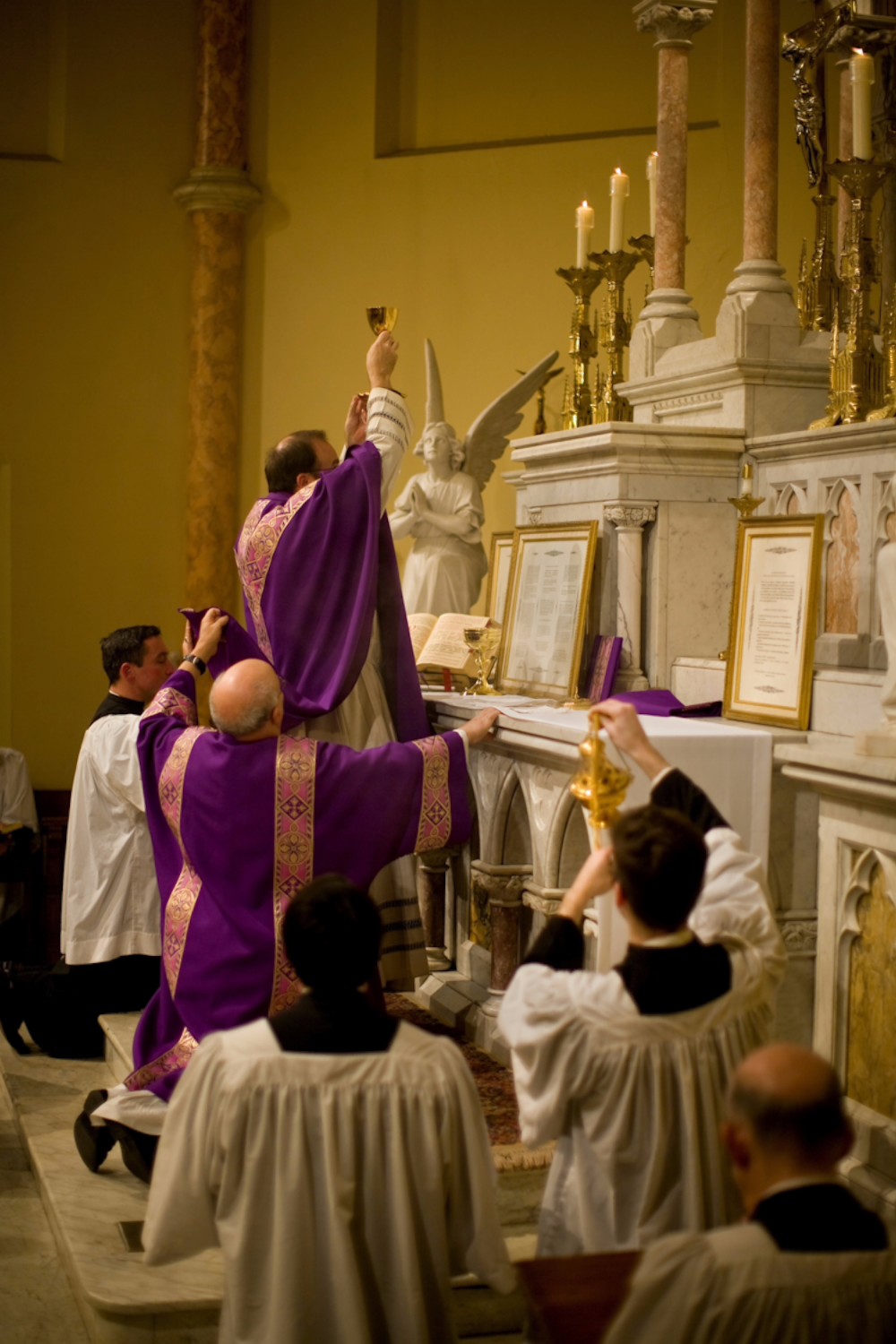
It was almost 15 years ago. I was At Old St. Mary’s here in D.C. celebrating Mass in the Latin (Extraordinary Form). It was a solemn high Mass. I don’t suppose I thought it any different than most Sunday’s but something quite amazing was about to happen.
As you may know the ancient Latin Mass is celebrated “ad orientem” (towards the Liturgical East). Priest and people all face one direction. What this means practically for the celebrant is that the people are behind him. It was time for the consecration. The priest is directed to bow low, his forearms on the altar table the host between his fingers.
As directed I said the venerable words of Consecration in a low but distinct voice, Hoc est enim Corpus meum (For this is my Body). The bells rang as I genuflected.
But behind me a disturbance of some sort, a shaking or rustling in the front pews behind me to my right. And then a moaning or grumbling. What was that? It did not really sound human, more like the grumbling of a large animal such as a boar or a bear, along with a plaintive moan that did not seem human. I elevated the host and wondered, “What was that?” Then silence. I could not turn to look easily for that is awkward for the celebrant in the ancient Latin Mass. But still I thought, What was that?
But it was time for the consecration of the chalice. Again, bowing low and pronouncing clearly and distinctly but in a low voice: Hic est enim calix sanguinis mei, novi et æterni testamenti; mysterium fidei; qui pro vobis et pro multis effundetur in remissionem pecatorum. Haec quotiescumque feceritis in mei memoriam facietis (for this is the cup of my Blood, of the new and eternal covenant; the mystery of faith; which will for the many be shed unto the remission of sins. When so ever you do this, you do it in my memory).
Then, I heard another sound this time an undeniable moan and then a shriek as some one cried out: “Leave me alone Jesus! Why do you torture me!” Suddenly a scuffling as some one ran out with the groaning sound of having been injured. The back doors swung open, then closed. Then silence.
Realization – I could not turn to look for I was raising the Chalice high over my head. But I knew in an instant that some poor demon-tormented soul had encountered Christ in the Eucharistic, and could not endure his real presence displayed for all to see. And the words of Scripture occurred to me: Even Demons believe and tremble (James 2:19).
Repentance – But just as James used those words to rebuke the weak faith of his flock I too had to repent. Why was a demon-troubled man more aware of the true presence and astonished by it than me? He was moved in the negative sense to run. Why was I not more moved in a positive and comparable way? What of the other believers in the pews? I don’t doubt that any of us believed intellectually in the true presence. But there is something very different and far more wonderful in being moved to the depth of your soul! It is so easy for us to be sleepy in the presence of the Divine, forgetful of the miraculous and awesome Presence available to us.
But let the record show that one day, almost 15 years ago, it was made quite plain to me that I held in my hands the Lord of Glory, the King of heaven and earth, the just Judge, and Ruler of the kings of the earth. Is the Lord truly present in the Eucharist? You’d better believe it, even demons believe that!
We recall today the birthday of Mary- a time of new beginnings. Not only do we celebrate the birth of a new life, we also celebrate the beginning of a new chapter in salvation history. We ourselves may be experiencing new beginnings at this time of year- perhaps the start of a new school year, or the launch of new work initiatives after the summer slowdown.
Any new beginning can be a time of excitement and hope as we anticipate its possibilities, opportunities, and challenges. But new beginnings can also give rise to apprehension and worry. We may fear what the future may hold, or become anxious about letting go of what’s comfortable and familiar.
If this is true for us, today’s Scripture readings can speak to our situation in three ways:
First, Paul explained that all things work together for the good of those who have been called by God- and that means us!
Second, as Luke’s gospel asserts that Jesus’ birth came about only through the power of the Holy Spirit, we are reminded of the Spirit’s presence and power in our lives;
Third, the gospel reminds us that God has a plan. He had a plan for our salvation that lead to the births of Mary and Jesus; and he has a plan for each of our lives as well.
In short, for each and every one of our new beginnings, the Holy Spirit is always present to guide us to embrace God’s unique plan for our lives, which we’re assured is designed for our good. And, since it is her birthday, we can entrust our new beginnings to the protection of Mary our Mother, as together we pray: Hail Mary…
Why not? Why shouldn’t I aim high? And really, is it that high? Is it really so unrealistic to ask every member of my congregation to shepherd one soul back to the sacraments and the practice of the faith in the next year? Is that so impossible, for each one to reach one, and work with them for a year and to invite them to come and learn more of the faith?
Well, I’m going to try. As a parish we have been engaged in a door-to-door evangelization campaign and that’s been going quite well, actually. Over 1500 homes have been visited and our Sunday numbers are up by 50.
But I am also aware that friendship and family are a more fruitful vein than the “cold-contact” approach of door to door. We’re going to keep doing that because we need to obey Christ who sends us out two by two. But every congregant knows at least five members from among their family or friends who need to come to God’s house either because they have drifted, or because they have never had a Church home at all. It’s time to go to work and shepherd them back.
And this isn’t going to be a one-time ask, a la “Come to Christmas Mass with me.”
What I am am asking is a year-long effort that would include some of the following:
Introduce – On our Parish feast day in couple of weeks I am going to ask every member of the congregation to prepare to commit to the Lord that they will shepherd one soul back to mass.
Pray and discern – Between September 18th and the Feast of Christ the King, we are to pray and ask the Lord who that person might be. It may not be the obvious one, such as a spouse or a child. Then again it may be. But pray and ask the Lord for guidance: “Who Lord? Who? Speak to my heart Lord, show me who. Who is it that I reasonably know and will be able to gently shepherd?”
Commit – On the feast of Christ the King we will be asked to commit to shepherd the soul to the Lord by spending the next year praying, some fasting and abstaining too, befriending, drawing closer and meeting with that person. They will be ask to place the name of this person on a card. The cards will be collected and placed near the altar, Masses will be offered each week for these souls.
Reflect on personal testimony – During Advent each congregant who has agreed will be asked to write a letter of testimony and thanksgiving to the Lord thanking him for the gift of the faith, the Church and Sacraments and to say something of why they are glad to be a Catholic and how the Lord has blessed them in their practice of the faith. These letters will be presented as a gift of thanksgiving to God at Christmas time. Writing these letters will also help the faithful to hone their own testimony which they can later share with the soul they are shepherding.
On-going Parish formation – During the period after Christmas and through Lent, directed Bible Studies and seminars will also be conducted in the parish that will guide people on how to lovingly converse with the person they are leading back. There are many “meeting stories” in the Bible (e.g. Jesus with the woman at the well, Nicodemus, Peter and Andrew and so forth). These passages and other resources will be given the parishioners to help them engage in a kind of friendship evangelization. The first step in friendship evangelization is friendship. And these studies will help equip parishioners to draw close to the person they are praying to lead back in a way that is not manipulative or secret, but which is also not filled with pressures.
Relate and befriend – Over the period of the year, make it a habit to contact and speak with the person. Talk with them, listen to their stories and ideas. Find out where they hurt and where they find joy. Find out how they drifted from Church or why they have never gone in the first place. Perhaps they have felt hurt or betrayed by the Church, perhaps they are not used to considering the real meaning of their life and have never taken time to consider that this life will end. There is a real power in listening to people in a respectful and loving way. In this stage we also tell our own stories and how the Lord has blessed us and what the Church, the sacraments, the Word of God and fellowship have done for us.
Invite – Without lots of pressure, begin to invite them to Church functions. They may not be ready to sit in a pew on Sunday for worship. But we will have concerts, Bible studies, dinners, movie nights, the blessing of the animals.
Pray and fast – Continue to pray, as will the parish. Consider some fasting, and abstinence, or take up a spiritual practice such as the Rosary or Divine Mercy Chaplet, devotional reading etc. and offer it as a sacrifice to the Lord for the return to the faith the person you are shepherding.
Invite – As the relationship deepens, let the Lord help you to know when and how it is best to explicitly ask this person to either resume the regular practice of their faith or to begin to come regularly on Sunday’s with you. A good time to aim for this is early October when RICA and Adult education classes resume.
Assess – As the year draws to a close on the Feast of Christ the King 2012, we will see if our numbers have doubled.
There is an acronym that is applied to projects that are undertaken: S.M.A.R.T. And I think this on meets the Criteria:
Specific – Each one reach one
Measurable – Double the size of Sunday attendance
Achievable – It is quite possible for every congregant to take up this challenge and, over a year meet many if not all the milestones.
Realistic – to Double our Sunday Attendance is challenging but not unrealistic if everyone does their part and we remember that the Lord has our back.
Time Based – 1 year, with specific milestones on the way.
It is a true fact that simply increasing numbers is not the only, or even most important goal. But rather, that we should authentically evangelize and draw souls to Christ, to his Sacraments, his Word and the fellowship of the Church. At the heart of evangelization is relationship: meeting Christ in others, allowing them to meet Him in us. This is what Christ did, he went out and met others and summoned them to the Kingdom by stages and through relationships. He tells us to do them: Go therefore and make disciples of all the nations, baptizing them and teaching them to observe all that I have commanded you. And Lo I am with you always, until the end of the world. (Matt 28:19)
Am I crazy? Perhaps, but at least call me a fool for Christ. I am going to aim high, that we double our Sunday numbers. Not just for the number’s sake, but for what they represent, souls coming back to God’s house, to be nourished at the altar of the Word and Eucharist, to be more deeply immersed in Christ.
How about you? Will you be crazy too? Are you willing to join me in being a fool for Christ? Let’s get started, there is a work to do.
Photo Credit: A Painting by the artist Atanur Dogan
Here’s a nice video that celebrates the Catholic Faith and can help us get our testimony together. The second half of the video contains a wonderful litany of gifts that are present in the Catholic Church.
I recently came across the following dialogue. I do not know the source, though it is in the form of the sayings of the desert Fathers:
To a distressed person who came to him for help the Abbot said, “Do you really want a cure?” And the man replied, “If I did not, would I bother to come to you?” “Oh yes” said the Abbot, “Most people do.” “If not for a cure, then for what do they come?” asked the distressed man. And the Abbot said, “They come not for a cure, that’s painful. They come for for relief.”
Yes, real cures, and substantial healing are not easy. Often true healing comes only after lengthy surgery, whether physical or spiritual. And those who have sought true healing know, and have come to experience, that it takes guts to be healed.
True spiritual and moral healing requires that we accept significant change and be willing to have our thinking and habitual practices challenged and replaced. In confronting what ails us, we often come to discover that its cause is far deeper than we thought, and that its remedies are far more sweeping and paradoxical than we had imagined.
Once, in the aftermath of a nervous breakdown, that saw me hospitalized for a week and ordered to take a month off to recuperate, I went to a priest and spiritual director who specialized in the care of priests in need of psycho-therapeutic counseling. I explained to him that I had frozen in fear, and panic, and I felt my life had gone out of control. “I never want my life to go out of control again,” I said. He said, “Until you let go of your need to be in control, you will never be well.”
Paradoxical indeed, and scary too. But I have discovered through the years how right he was. My only way “out” of my anxiety was to journey deeper toward its center and find the Lord waiting for me there. Yes, it took guts to be healed. And I’m glad the Lord didn’t let me run somewhere else for mere relief. Healing was harder than relief, but better and lasting.
The Lord Jesus was journeying one day through Jericho (cf Luke 18:35ff) and a certain blind man kept calling out, “Jesus Son of David, have mercy on me!” Finally the Lord stopped and asked this blind man, “What do you want me to do for you?” A strange question, perhaps, to ask of a blind man. But consider that this man’s life will be totally changed if Jesus heals him. More will be expected of him and it will no longer be tolerated that he should sit and beg of others. All that he has known will vanish as a new world, and new expectations dawns on him. So Jesus asks what he really wants, healing or relief? “Lord I want to see!” And he not only saw, but proceeded to follow Jesus up the road. A new vision, a new path, a new destination, a new life. It takes guts to be healed.
And so Jesus asks you and me too, “What do you want me to do for you?” Careful how you answer. Remember, it takes guts to be healed. Too many want mere relief and not real healing. They want comfort rather than true change.
“What do you want me to do for you?”
As you view this video, I ask your prayers for a young man (in his late 20s) who visited the parish this week. He came back to the church of his childhood, remembering a more innocent and simple time in his life. And now that his life has become hell though drugs and other bad choices, he has a decision to make. Pray that he has the guts to accept the long healing he will need to come forth from his hell on earth. As I heard his story I thought of this song:
The other day I spoke with a woman who attends the 7:15 am daily Mass at my parish. She comes to Mass and then stays to pray before the Blessed Sacrament. “I just can’t pray at night,” she said, “so I have to do it early in the morning.”
I know exactly what she means. I have some friends who love all-night adoration at a local parish, and they’re always trying to get me to come. However, I’m not good for much after 10:00 PM, and I joke with my friends that I’m not a “nocturnal Christian.” My best praying, like the woman at my parish, is done in the morning.
Which is okay! God makes both early birds and night owls. One is not necessarily better than the other. But regardless of which one we are, we do need to pray, and we need to pray in a regular, disciplined way.
For prayer to become a “holy habit,” it’s best to pick a particular time and place- just like Jesus, who in today’s gospel chose to pray at night, on the top of a mountain. We might find it best to pray at night, like our Lord, or we might prefer the morning. It ultimately doesn’t matter, as long as we do it. Especially as God is available, all the time.
I assisted at a wedding this past weekend that encompassed both space and time. The groom was a White American, the Bride was Ethiopian. Now you will surely understand that space is involved, for Ethiopia is far from the USA. But time is also involved here, for the African notion of “Saturday at 10:00 AM” is not the same as the American one, at all.
Be on time. Not! – Yes, the wedding was scheduled for Saturday at 10:00 AM. The priest from Ethiopia cautioned the wedding party at the Friday rehearsal (which started late), “You must be on time tomorrow, for the organist is from America and must be somewhere else at noon. And the parish is American, and Americans go by the clock! So, be on time!”
Come Saturday morning and it is just before 10:00 AM. The groom’s side of the Church is filled with White Americans. On the bride’s side, not a soul! The wedding finally began about 11:15 AM and many of the the lovely Ethiopian bridesmaids felt hurried, at that! “Why are you rushing us?” one said, “This is a moment to be enjoyed!” The priest from Ethiopia was embarrassed but not surprised. “Neither am I surprised” I reassured him. “If the organist must leave, I will supply the recessional .”
No I was not not surprised. For I have come to discover in various ways, that we Americans (and some Europeans) are really the few for who “the clock” has all that much to say. For most of the rest of the world, “the clock” is more like the speed limit sign is for us in America, a “suggestion,” a general “parameter,” more than something to be all that particular about.
A few stories to illustrate:
A friend of mine went to the Dominican Republic a few years back. He called the local Catholic parish and inquired (in Spanish) of the priest: “What times are Masses this weekend?” After a pause the priest said, “Sunday.” “I know” said my friend, “But what time on Sunday?” Again a puzzled silence, and the priest said again, “Sunday.” “Hmm…?” pondered my friend…. Then, like a light going off the priest said, “Ah! I sense by your accent that you are an American, si?” “Yes” said my friend. “Well here in our Country, you see,” said the priest, “We gather on Sunday morning, and when most have arrived, we begin…So, you see, Mass is Sunday morning, when all have arrived! Please come and join us on this Sunday morning, you are most welcome!”
Once, at my last parish, we celebrated the First Mass of a new priest, Fr. Carlos. It was scheduled for 8:00 pm Saturday, and the whole extended Latino family had joyously decorated the hall that afternoon, after the Ordination. Silly me, I actually had the Church unlocked and ready to go at 8:00 pm. But there was not a soul in sight, nor a car in the parking lot. By 8:45 pm the first people began to arrive. Slowly folks trickled in. Now it is 9:15 pm and the new priest arrives. Along with him an entourage of other priests. By 9:30 pm I, the ugly American, am fully anxious. I gathered the priests and said, “Fathers, we must vest now! Please, come to the sacristy at once.” One of the older Latino priests looked at me and said, “Father! Do not worry of the time, we live in eternity!” “Fine Father,” I responded, “But I have to be up for 8:00 AM Mass! Let’s get this Mass underway.” The priests looked a me with pity and began to vest.
In my own experience with the African American Community I have also come to experience the reality of what many playfully call “colored people time” (aka “CP Time”). Now we’re not as bad as being an hour or more late, but our 11:00 am Mass never begins at 11:00 am, usually 10 past, or even 15 past the hour. Neither do we have a fixed time when Mass has to be over. The 8:00 AM Mass usually goes toward 9:15 or 9:30. The 11:00 am Mass ends toward 1:00 pm. Why rush when you’re with the Lord? One time I got Mass done in under an hour, and a rather angry African American woman came to me and said, “Next time you don’t have enough to say Father, send the Deacon over.” For, a Mass in under hour, seems something of a disgrace to an African American matriarch.
I once asked a Latino friend, “How do you catch a plane in your culture, what with time being so vague?” “Well,” said he, “We go to the airport, and if the plane has already left, (and they never leave on time), then we go to the lady at the booth and book another one. We are not anxious, these things happen.”
Yes, anxious, I guess that is the key word. We Americans do fret the clock. There is an old expression, Let not the sands of time get in your lunch. In other words, the moment is to be savored, there will be time to take care of other things. An old gospel song says, Don’t let this moment pass you by.
I am not convinced our American way is so bad. In our culture, timeliness is a way of showing respect, and is experienced as a kind of charity. Being on time ensures everyone is both respected and treated with kindness. Further it means that things go smoothly and are well coordinated. Without this agreed upon framework, most Americans are bewildered and angry and feel personally disrespected.
But I have also come to experience that our close attention to clock time is not shared by most of the rest of the world. Further, they mean no disrespect when they are incredibly late by American standards. In fact, I usually get a blank look when I exhibit consternation that a someone is almost 1.5 hours late for a wedding. They just don’t “get it” when I say, “Why are you so late?!” I might as well be saying, “Why whirlwind major drum marcher flibberdy-jibbet?!” I just get a blank stare from them, as if to say, “Late?” They find my exasperation strange and unfathomable and look to others around them who just shrug.
We Americans control things by measuring them. In the careful measuring of time, land, money, assets, polls, statistics, and scientific data, we feel a sense of control, and often try to show superiority to others with command of such facts. There is something consoling about the notion that we know we are 93 million miles from the sun, our planet circles it in 365 .25 days, that this is Tuesday, and 95% of American have some belief in God. Further the average temperature in DC is 84 degrees for this day. Yes, we feel better, some how in control, when we know these things and have them carefully measured.
And as for time, I surely feel in control when I know that I have a meeting at 10, and appointments at 2 and 3 pm. Now I know what my day will be like. Or so I think.
But it is fascinating to me that so many others in the world neither need or value this sort of control. For them it seems OK to have general plans and then, let things unfold, rather than attempt to control and manipulate all outcomes. Yes, a completely different way of living.
And we may boast that we have the strongest and most efficient economy in the world on account of this. The Chinese and Japanese also have strong economies and, as far as I know, they also have a precision about clock time.
But at what price do we have these things? Just over 40% of Americans are prescribed psychotropic drugs to deal with the stress of our culture (Oh!, did I just quote a statistic? Sorry! Some how knowing numbers makes me feel in control).
I am not sure what is best, but huge numbers of Africans, Central and South Americans are just not obsessed with time like we are. Neither are Middle Easterners. It seems a little humbling to me that so many others live in a completely different world than I do, time wise. I am not saying we are wrong, only that billions live differently, and are more focused on the present, than what comes next, according to a mechanical clock. I frankly don’t know how they do it, so wedded am I to a clock. But they do.
God too reminds us that for him a thousand years are like a day, or a watch in the night. Further, eternity is not chronological time, it is the fulness of time. And for those of us who are obsessed with clock time, God cautions, wait, be still, have patience, be not anxious. The Lord says he is coming soon, but he does not mean it according to our clocks. And to those who insist on knowing times and seasons, he says we know not the day or the hour, and it is not for us to know the times or the seasons of God’s plan (eg. Matt 24:36; Acts 1:7).
Does anybody really know what time it is? No, actually we do not. But time is something that surely divides us. Some of us see the clock as a precision instrument to be strictly followed, others of us see it as a sort of speed limit sign that is broadly interpreted.
I like our Western precision, but admit it comes at a price for indeed, too often the sands of time get in our lunch.
In this video, Fr. Francis Martin talks a it about the concept of time in the Middle East and the flexible notions of time that predominate in the Scriptures. The context of his reflection is the incident of the cleansing of the Temple. John says Jesus did that at the beginning of his ministry, and the synoptic Gospels place it at the end of Jesus’ ministry. The discrepancy about time bothers us Westerners, but time was less an obsession to the evangelists who used time creatively and theologically, and were less obsessed with measurements. This video is an excerpt. Please see all of Fr. Martin’s videos here: Fr Martin Videos
Today is “Labor Day” in the United States of America. With this in mind I thought it good to reflect on some teachings about human labor and work that are given in the Catechism of the Catholic Church. Here follow the teachings. My own comments are added in RED to the catechism text (which is italicized):
Human Labor precedes Original Sin and hence is not an imposition due to sin but part of our original dignity – God places [Man] in the garden. There he lives “to till it and keep it”. Work is not yet a burden, but rather the collaboration of man and woman with God in perfecting the visible creation. (CCC # 378) Thus note that our dignity is that we are to work WITH God to perfect creation. Adam and Eve were told by God to fill the earth and subdue it. (Gen 1:28) Radical environmentalism often sets aside any notion that we are to help perfect creation and presents a far more negative portrait of humanity’s interaction with the environment. True enough we have not always done well in treating the environment, but it is wrong to think of the created world as better without humanity’s presence. It is rather our dignity to work with God in perfecting nature. Note too the description of work as not burdensome prior to sin. Man and woman HAD a work to do, but it was not experienced as a burden. Only after Original sin does work come to be experienced in this way for Eve will bring forth her children in pain and Adam will only get his food by the “sweat of his brow.” (Gen 3:16, 19)
Human Work is a duty and prolongs the work of Creation – Human work proceeds directly from persons created in the image of God and called to prolong the work of creation by subduing the earth, both with and for one another. Hence work is a duty: “If any one will not work, let him not eat.”[2 Thess 3:10] Work honors the Creator’s gifts and the talents received from him.(CCC 2427) See again the emphasis of our dignity as collaborators with God in the work of creation and in perfecting what God has begun! As to the duty of work, it is true that not everyone can work in the same way. Age and handicap may limit a person’s ability to do manual labor. Further, talents and state in life will tend to focus one’s work in specific areas. But all are called to work. Even the bedridden can pray and offer their sufferings for the good of others.
Work can be sanctifying and redemptive – [Work] can also be redemptive. By enduring the hardship of work in union with Jesus, the carpenter of Nazareth and the one crucified on Calvary, man collaborates in a certain fashion with the Son of God in his redemptive work. He shows himself to be a disciple of Christ by carrying the cross, daily, in the work he is called to accomplish. Work can be a means of sanctification and a way of animating earthly realities with the Spirit of Christ. (CCC 2427)…In his mercy God has not forsaken sinful man. The punishments consequent upon sin, “pain in childbearing” and toil “in the sweat of your brow,” also embody remedies that limit the damaging effects of sin. (CCC # 1609) Sin has brought upon us many weaknesses and a selfish tendencies. Work can serve as a remedy wherein we are strengthened unto discipline, the common good and cooperation with others in attaining good ends.
Work is an acceptable sacrifice to God – [The] laity, dedicated as they are to Christ and anointed by the Holy Spirit, are marvellously called and prepared so that even richer fruits of the Spirit maybe produced in them. For all their works, prayers, and apostolic undertakings, family and married life, daily work, relaxation of mind and body, if they are accomplished in the Spirit – indeed even the hardships of life if patiently born – all these become spiritual sacrifices acceptable to God through Jesus Christ. In the celebration of the Eucharist these may most fittingly be offered to the Father along with the body of the Lord. (CCC # 901).
To work is participate in the Common Good – Participation [in the common good]is achieved first of all by taking charge of the areas for which one assumes personal responsibility: by the care taken for the education of his family, by conscientious work, and so forth, man participates in the good of others and of society. (CCC # 1914) Hence, we work not only to benefit ourselves but also to contribute to the good of everyone. We do this first by caring for our own needs to the extent possible and thus not burdening unnecessarily, others with our care. We also contribute to the common good by supplying our talent and work in such a way as to contribute to the overall availability of goods and services in the economy and community. We supply human talent and the fruits of our works to others in addition to purchasing, from our resources, the goods and services of others. Hence to work is to participate in the common good.
So, the key word seems to be “Dignity.” Human work proceeds from our dignity as collaborators with God in perfecting and completing the work of creation. Everyone can work and should work in the way that is possible for them not merely because every one has a duty, but also because this is of the essence of their dignity. Happy Labor Day.
Have you ever met for the first time someone you expected to dislike because you had heard negative or nasty things about him or her? But then, after you had met, you actually liked that person, and maybe even became friends? Your liking this person came as something of a surprise, because you had been biased against him or her. You had heard some piece of gossip, or been told something you really didn’t have a need or a right to know. As a result, that person almost didn’t get a chance to make a good first impression, because he or she had been given a bad name by somebody else.
And that’s not fair, is it? Our Church teaches that everyone has a right to a good reputation, and that it’s a sin to gossip or reveal things about people that others shouldn’t hear. To do that is to violate a person’s privacy, hurt their relationships with others, and maybe even put them in danger in some way. People can end up losing their jobs, for instance, because of gossip. And as the “greatest generation” used to be reminded: “Loose lips sink ships.”
Just consider what Jesus taught in today’s gospel. Whenever someone has offended or hurt us in some way, we are to first of all approach that person in private in the hope of resolving the situation. We aren’t to go around telling everyone how this person hurt us or how we think that he or she is a jerk. Jesus knows that it’s tempting to do this, because “Misery loves company.” It can feel good to get other people on “our side” of the conflict. Not only do we receive sympathy, it’s a way for us to “get back” at that person by making him or her look bad in another’s eyes. When we gossip about a person who has hurt us, or maybe even just really annoys us, our real intention is to punish.
As today’s gospel makes clear, this is not something our Lord wants us to do. Gossiping is referred to as the sin of “detraction,” it detracts from a person’s reputation and takes the shine of his or her good name. Gossiping, to say the least, is not an act of love. It’s ironic, therefore, that sometimes we do it about the very people we should love the most. Husband and wives, for instance, sometimes complain about their spouse’s behavior to their friends or acquaintances. They say things like: “My husband is so clueless; he can’t even screw in a light bulb.” Or, “My wife is such an airhead: she can’t even balance a checkbook.” Or, “He’d rather go fishing than spend time with his family.” Or, “If I spent the way she did, we’d be in the poorhouse.” If people said things like this to us about our spouses, we’d get angry and come to their defense. But we don’t hesitate to say these things ourselves.
There may be truth to what we say. But saying it doesn’t improve the situation or resolve the problem or help the relationship to heal or grow. Sometimes we’ll excuse ourselves by thinking that now we’ve gotten it off our chest, we won’t fight with our spouse later. But that’s baloney. All we accomplish is to make someone we love look bad in the eyes of others. And what will they think of our spouse the next time they see him or her? They’ll remember what you said, and look down upon your spouse. You’ve given them a bad reputation, and the harm we’ve caused can be almost impossible to repair. The damage is done.
Great damage can be done by gossip in the workplace, too. We’ve all experienced it, if we’ve ever had a job. And it’s hard to resist, sometimes because it sounds so juicy, and sometimes because we don’t want to be left out of the crowd and miss what’s being said. But workplace gossip wastes time, lessens productivity, poisons workplace morale, leads to divisions and cliques, and can ruin reputations and careers. A recent poll revealed that 60 percent of us rate “workplace gossip” as our number one on-the-job pet peeve.
These days, we might even say that we’re drowning in a virtual sea of gossip. There are nearly 400 gossip magazines on newsstands devoted to nothing more than revealing intimate details of the social and personal lives of celebrities and other public figures- things we don’t need to know and, I add, we shouldn’t seek to know or pay to learn about. Add to this the gossip spread around the internet through blogs, tweets, and Facebook, and what we have is something like a tsunami.
On our own, we probably can’t hope to stop it. But we can make a choice not to contribute to it. Let’s walk away from the water-cooler scuttlebutt, refuse to buy the trashy magazines, and not visit the offending websites. And most of all, let’s keep guard over what comes out of our mouths. It may be that someone may have hurt us, but that doesn’t mean that everyone and their brother needs to know about it. Because according to Jesus, we should treat the person we’re talking about as our brother. And he wants us to “win them over.” Not put them down.