Toward the end of his life, Albert Einstein removed from his wall the portraits of two famous scientists, Isaac Newton and James Maxwell. In their place, he hungpictures of Mahatma Gandhi and the medical missionary, Albert Schweitzer. When asked why he did this, Einstein explained that it was time to replace the image of success with the image of service.
This is precisely what Jesus tried to do for his disciples in today’s gospel. The disciples were preoccupied with success. That’s why they argued about who was the greatest. But Jesus challenged their attitude by placing a child in the midst. To serve a child, you see, could in no way bring them any worldly success. But it would make them great in the kingdom of God.
Like the disciples, our culture today often seems more concerned with success than it does with service. We see this attitude whenever children are perceived as obstacles to lifestyles and careers; it’s seen in crumbling relationships where people are focused only on their own needs; it’s seen whenever the workplace becomes a “dog eat dog” rat race; it’s seen whenever people do things simply to enhance their resume or college application; and it’s seen in the church whenever worship and prayer take a backseat to meetings, quotas, and agendas.
This may be the world’s way, but it is not our way. Jesus calls each one of us today to lives of service, and not the pursuit of success. As his disciples, we’re to be concerned not with self-promotion, but self-donation- with giving of ourselves for the benefit of others. Just as Jesus did for us on the cross; just as he does for us in this Eucharist.
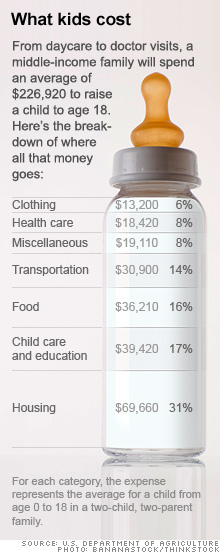
I was alerted to an article on the cost of raising children by one of my brothers who, with his wife, has six children. The USDA estimates that the cost of raising children from birth to age 18 for a middle-income, two-parent family now averages $226,920. That’s up by 40% from just ten years ago. Now, right away, you ought to question a reports that inflates the cost of some activity by 40% in just ten years. It strikes me that how they collect the data has changed, not just the costs. My brother, father of six, says, I’m supposed to believe that my six children are likely to dent my pocketbook by over 1.3 million dollars ($262,000/kid), not including college and wedding expenses? Something about “lies, damned lies, and statistics” comes to mind here. Me thinks that the USDA needs to get back to inspecting meat!
Let’s look at the report, and then ask some technical and philosophical questions. I am here quoting from a CNN Money report on the study. These are excerpts, the full report can be read here: HERE. As usual, the original text is in bold, italic, black, and my comments are plain text red.
Forget designer strollers and organic baby formula, just providing a child with the basics has become more than most parents can afford. The cost of raising a child from birth to age 18 for a middle-income, two-parent family averaged $226,920 last year (not including college), according to the U.S. Department of Agriculture. That’s up nearly 40% — or more than $60,000 — from 10 years ago. Just one year of spending on a child can cost up to $13,830 in 2010, compared to $9,860 a decade ago.
Again, beware of a 40% figure here. The average annual inflation rate for the past 10 years is 2.37% [1]. Hence it would seem other things than just inflation are factored into the number. What are they? Do parents do more voluntary spending on their children? Are they less able to say “no” ? It is not clear. So even if we accept the number, (which I am not certain I do), we need to know what factors went into the assessment. This is because the 40% increase is almost double the inflation rate for the ten year period. And remember this, even the inflation rate of 2.37% can mislead if we do not remember that wages have also inflated in the period. Some will argue, and I agree, that wages have not kept pace recently with inflation, due to higher unemployment. But remember 2.37% inflation over ten years is not an absolute cost number, since wages have increased some, as well.
“Everything is more expensive and each family makes its own set of trade-offs,” said Ellen Galinsky, president of the Families and Work Institute in New York. “Many parents are working longer hours, or another job, and they are giving up time at home….
OK, but to be fair, wages are up in the past ten years. Let’s admit they have lagged behind inflation a bit. So the deeper question remains, Why is the cost of raising a child up 40% in ten years? If, and I do not cede this point, the number is real, why? It is more than inflation. There are behavioral issues at work here too. Not every parent feels compelled to buy tennis shoes that light up for their children, others do. This is behavior, not just unavoidable costs. Some parents use “hand-me-downs” in their families, others do not. This is behavior. Some use a lot of childcare (costly), others do not. This is behavior. We do not need to be locked into this $226K number. Chosen behaviors can have a lot of influence.
From buying groceries to paying for gas, every major expense associated with raising a child has climbed significantly over the past decade, said Mark Lino, a senior economist at the USDA.
But again, the ten year inflation rate is NOT 40%. So the question is, if these cost have acutally risen, why? Are all the costs unavoidable?
Food prices, in particular, have weighed on parents’ budgets as rising demand for commodities like corn and wheat, along with other factors such as rising oil prices, drought and floods, have made even a box of cereal a pricey proposition.
Almost two years ago, I blogged on whether the cost of basic essentials is really higher today, than in the 1950s, a period widely perceived to be a prosperous time for US families. In that post, (read it HERE), we explored a significant amount of data that indicated that the cost of almost everything was higher in the 1950s (in inflation adjusted dollars) than today. The essential problem today is that we need and want more of everything. Life was simpler back in the 1950s, but today we “require” many more add-ons. Thus, while we can look at food prices in the past few years, the big picture indicates that, many years ago, things like food and gas and clothing, took a higher chunk of our income than today.
Even more recently, in the economic downturn, the Consumer Price Index (CPI) has only slightly elevated to about 3.7%. Food prices edged upward, especially in 2007, as a percentage, but other prices came down. And then things became more stable as the economy slouched in later 2007.[2] Hence, while prices are higher, the overall CPI has not dramatically jumped, as the the CNN Money report seems to want to indicate. Wages of course, in this era of higher unemployment are less upward and will tend to lag behind the CPI. But remember if we look at ten years (as the CNN report and the USDA report claim to do), rather than focus only on the past few years, the overall numbers are still, steady as you go.
Many employers scaled back or even did away with medical coverage in recent years, leaving many families to cover that bill, said Lino. At the same time, costs for doctors visits, medications and other health services also climbed. As a result, health care costs for families with children rose 58% over the decade, he said.
Here too, there are a lot of behavioral issues involved. In recent years we run to the doctor more quickly. All but free medical care has made us prone to presume a doctor needs to see us for the merest reason, and that prescription medicines should be available to us free of cost. When I was a child, the emergency room was for real emergencies, a place rarely seen, and the doctor was consulted only after the usual drug store products proved ineffectual. There was the usual “yearly check-up” to get a few shots, and do preventative medicine. But today, the expectations are much higher.
Demand for services inflates costs, and we do well to ask questions not only of employers, insurance companies, and doctors, but also of ourselves. Medical costs don’t have to be up 58% in every household.
I realize that some, reading this will say, “How dare you, and a priest at that, suggest that complete medical coverage is not an absolute and inalienable right of every human being?!” But in the end we do take care of uninsured people in this country. Most emergency rooms, if accredited, are required to provide care even if a medical insurance provider is not identified. We ought to provide urgent medical care for to the poor. But the focus here is families, and it remains a valid question as to whether all recourse to the doctor and hospital is immediately required just because I happen to think so. A little personal triage is helpful in families to keep costs down and medical costs don’t have to be 58% higher for all families in all circumstances.
All of this comes at a time when incomes are shrinking and unemployment is near an all-time high. Over the past decade, median household income has fallen 7%, according to a recent report from the Census Bureau.Granted, this is true in the last four years. But remember the USDA numbers cover ten years. There are cycles, this one has been severe, but children are part of a twenty year cycle and the numbers there are still steady.
The child care crunch – The early years are among the toughest for parents who must find a way to afford all of those costs, plus child care. “It takes half of my paycheck to pay for my child care — you start to feel like, Is this even worth it?” said Anna Aasen, a mother of two from Roseburg, Ore. Although housing generally represents a family’s largest expense, putting more than one child in day care tips the scales.
Here too we have a lot of behaviors in the mix that are not always required. Most families today decide that, to afford their lifestyle, to live in the kind of home and place they want to live, they need double incomes. But who says you need a 3000 square foot home, three flat screen TVs, in the perfect neighborhood? These are largely voluntary lifestyle choices.
Most of us who are older lived in homes far smaller (1200-1500 square feet), had one TV, one car, hand-me down clothes, and children often shared bedrooms. We survived this extreme deprivation. I was kidding a parish family but spoke truly when I said to them that their “great room” was larger than the entire house I grew up in, and it was.
What if a family decided to resign from the current circus, and live more simply and needed only one income? Child care IS crazy when we think of it. Ms Aasen, in the report above, asks a very valid question, “Is this even worth it?” Exactly. Why ask some one else to raise your kids? Why not live in a simple house or even an apartment and raise your own kids? It is true there may be not yard for them to run in, and the neighborhood may be less than ideal, but its the inside of the home, more than the outside that ought to influence the children.
Better a little, with love, than lots with stress and anxiety (cf Prov 16:8). Again, behavior may have more influence on the cost of raising kids than simple “inflation.“
For many parents, choosing to work and pay for child care is often a difficult trade off when they might otherwise stay home. “The sad truth is, when you weigh the cost of child care and the cost of my wife driving back and forth to work it comes out to an extra $2 to $3 an hour,” Ben Hammond, 31, said of his wife’s decision to return to the workforce after their second son was born. “But we can’t really live without that.“
I’d like to know why. I will not personally judge a situation where I don’t know all the details, but I wonder if this family really needs everything they choose to pay for. What are some of the voluntary things that could be foregone? Even Air Conditioning in every room, and two cars aren’t always essential. Smaller houses, fewer commodities (extended cable, etc) can make a difference. Prioritized spending can put to the lie many things on the list that we say we cannot live without.
OK, well you get the point. USDA and CNN Money report that child care costs have risen 40%. But it seems, I would suggest, there is more behind this data than mere inflation and victimized families caught up in an unjust economy. There are many personal lifestyle decisions that all of us Americans engage in. The list of things we cannot live without grows ever longer. And it is worth asking, “Is it really true that I cannot live without all these things?”
I am not immune from such questions. In recent years, due to the terrible economy, the Lord has called me to be more generous to the poor. This means that I too have had to ask what creature comforts and latest gadgets I can do without. The fact is, we Americans want a very comfortable and very pricey life. Fifty years ago most Americans easily lived without most of the things we deem essential today. I admit most of us are expected to have cell phones and some Internet connectivity. I do not suggest that we can simply get in a time machine and live exactly like we did in 1960. But, in the end, there are choices we can make to simplify and lower our expectation that life should always be a peach.
A final philosophical question. Why does our culture always seem to talk about and emphasize the cost of raising children, and not discuss the benefits? Children are a wonderful gift from God, (or a least we used to think so). Today they are more often described as a burden, as a cost center. We did not used to think of children in this way. In the not so distant past (60-70 years ago and prior) large families were desirable, children were valued, pregnancy and birth were called the “blessed event.” Scripture says, May your wife be like a fruitful vine within your house, Your children like olive plants around your table (Ps 128:3). Today, the birthrate has plummeted and children are more often seen as something to contracept, (God forbid) abort, and generally to be tolerated in only small numbers.
Some will say, “But Father, it costs so much today.” That is debatable, but I still think that the real reason is that what we value most has changed; our priorities and preferences have shifted. They have shifted away from life and family, to things and creature comforts. There are many complexities that may also factor in, but in the end, an awful lot comes down to what we really value and want. It is not so much the economy that has changed, it is we who have changed.
As always, I write, not to have the last word, but to begin a discussion. Please add to this, indicate necessary distinctions, and feel free to differ or say “yes, but.”
This video shows just a few ways to cut costs, of course many other things could be added: hand-me-downs, smaller houses, fewer amenities, smarter shopping using coupons, less shopping, don’t need every upgrade, etc. So much of what we call essential is not absolutely so, or is at least not necessary all the time.
As I watched a young boy play a popular video game, I was surprised at how many times his character could be killed and come back to life. He’d fall into a fiery pit,get chomped by alligators, and be crushed by a boulder, but it didn’t seem to matter. It fact, the boy thought it funny to make these things happen to his character! He explained that although his character might lose points, it couldn’t really be killed, no matter what he did. Another adult with me said, half in jest but half seriously too: “What is this teaching our kids?” She was worried that perhaps they’re being taught that actions don’t have consequences.
That actions do have consequences is a primary point of today’s first reading, from Ezekiel. Simply put: Sin is punished and virtue is rewarded, and it’s up to us to choose between them. Evidently people back then needed to be reminded of this. But perhaps we need reminding too. These days we place a great deal of emphasis on God’s mercy. As well we should, because God is merciful! But there’s a danger that emphasizing God’s mercy can lead us to take it for granted, something the Church has traditionally referred to as the sin of “presumption.” When we presume upon God’s mercy, we figure we can do whatever we want, and it just won’t make a difference what we do. Kind of like the character in the video game. We think: God is so forgiving, that at the end of the day it doesn’t really matter what we do.
But what we do does matter to God. Consider today’s gospel story. Jesus told a parable of two sons. One said initially that he would do his father’s will, but then didn’t do it, while the other son said at first that he wouldn’t obey, but then changed his mind and did. When he explained this parable’s meaning, Jesus raised a few eyebrows, because he said that “tax collectors and prostitutes”- the obvious public sinners of the day- were entering the kingdom of God before the chief priests and elders, who considered themselves to be decent religious people. The former heard God’s call to change their ways, while the others did not, as they thought there was nothing to change. They were presumptuous.
Most of us, I imagine, probably consider ourselves to be decent religious people. That’s why we need to listen to Jesus words today, because they’re directed at us. It’s easy for us to look down upon the “tax collectors and prostitutes” of our day and think: “Boy are their lives a mess!” We compare ourselves to them and conclude that, all things considered, our lives are pretty much in order. And maybe they are. But we need to be careful, because it’s easy when we think this way to fall into presumption and conclude that since we’re fundamentally good people, it doesn’t really matter what we do, because God is so good and forgiving. Like the chief priests and elders in today’s gospel, we become deaf to God’s call to continued conversion.
In all fairness, it’s sometimes easier for the “tax collectors and prostitutes” of the world to hear that call. It can become very obvious to those stuck in serious sin that something’s not right with their lives- especially if they hit rock bottom and realize there’s nowhere else to turn but to God!
With us, we may not feel such a need for conversion. In fact, we may actually feel rather good about ourselves. One of the myths of modern pop psychology is that feeling good about one’s self is a sign of health. But that’s not always the case. It seems that that’s how the religious people in today’s gospel were feeling. That’s why they were so shocked and angry when Jesus suggested that they weren’t as close to God’s kingdom as they thought they were.
The truth is, as taught by the saints down through the ages, that that the closer we get to God, the more aware we become of our own sinfulness, and our distance from God. This means that if we aren’t aware of our sinfulness, we might not be as holy as we think we are. In today’s responsorial psalm, the author recalled his sins and cried: “Remember your mercies, O Lord.” Today, maybe God is saying to us: “Remember my mercies, O my people.”
Now, this isn’t meant to make us hate ourselves or become discouraged. Instead, God is calling us to action, repentance, and continued conversion. God doesn’t want us to be lulled into complacency and presume upon his mercy. Instead, he wants us to accept our need for change.
To do this, there are three things we might do. First, we can consult a good examination of conscience and use it regularly. This will help us become more aware of areas of sinfulness in our lives that we may have been overlooking, or never were aware of in the first place. Second, we can ask others to help us. As the sixth century spiritual writer St. John Climacus once observed, “God has arranged so that no one can see his own faults as clearly as his neighbor does.” Third, we can ask God to help us, because God knows us better than we know ourselves. We can pray to God: “Show me where I need to grow. Reveal to me what I need to change. Help me to see myself as you see me!”
And what does God see? Yes, he sees sin and brokenness. He sees someone who needed redeeming, and who needs guidance and grace. But more than this, he sees someone he loves. Someone for whom he has plans. Someone he created to become a saint. Someone with whom we wants to spend all eternity. God is indeed merciful! And he wants us to receive his mercy. Just not take it for granted.
In understanding this Gospel, we cannot overlook the audience Jesus was addressing. The text begins: Jesus said to the chief priests and elders of the people. In effect, Jesus was addressing the religious leaders of his day and the religiously observant. And he calls at least three things to their attention, three common sins of the pious, if you will: Lost Connections, Leaping to Conclusions and Lip Service.
Let’s look at each of these in turn, remembering that though they are not exclusive to the religiously observant, they are considered in the context of the religiously observant. Let’s also learn how they are particularly problematic when it comes to our mandate to hand on the faith through evangelizing our family and others.
I. Lost Connections – The text says, A man had two sons. Now the text will go on to describe these two sons as very different and also very similar. The man of course is God and we are all his children. And though very different, we all have the same Father and we all have sin. A man had two sons, which is another way of saying the sons had one Father. Yes we all have a connection we cannot deny, whatever our differences. We will look more at the differences between the two sons as we go on, but for now, consider merely this fact, A man (God) had two sons.
Why emphasize this? Because it is too easy for us to seek to severe the link we have with one another, to effect a kind of divorce from people we fear or do not like. For example, on the way to Mass, we may drive past tough parts of town and see drug dealers, scary gangs of young men near liquor stores, prostitutes and other outwardly troubled and rebellious people. And it is too easy to be cynical and say, “Some people’s children!” or “Look at that, how awful.” Or we may simply ignore them. Yet in all this we fail to recall: here are my brothers, here are my sisters. So easily we can dismiss them, write them off, strive to effect some sort of divorce. But God may has a question for us, “Where is your brother?” (Gen 4:9)
Yes, there are many whom we try to disown, if we are not careful. Perhaps they are of a different political party, a different economic class, a different race, or just someone we don’t like. We divide, but God unites. A man had two sons, yes they are different, but he is Father to them both, he loves them both. He speak to them both, and calls them his sons.
In terms of evangelization, it will be noted that Jesus has sent us to all the nations. No longer are Israel and the Gentiles to be separated, the one considered chosen people, the other not. And hence the Church is catholic, is universal, seeking unite all. For a man had two sons, but the two sons have one Father. In seeking to evangelize, has it ever occurred to you that the least likely member of your family could be the one God most wants you to reach? Be careful of lost connections, for on account of it souls can be lost.
II. Leaping to Conclusions – A second “sin of the pious” is to leap to the conclusion that someone is irredeemably lost, to write off someone. Many of the Scribes and Pharisees, the religiously observant of their day, had done just this with a large segment of the population. Rather than to go out and work among them to preach the Word and teach observance of the Law, many of them simply called the crowds “sinners” and dismissed them as lost. In fact they were shocked that “welcomed sinners and ate with them” (e.g. Lk 15:2). Jesus says, to them, in effect: “Not so fast. Don’t leap to conclusions and write anyone off. Sick people need a doctor and I have come to be their divine physician and to heal many of them.”
Thus Jesus, in today’s parable, speaks of a sinner who repents: [The Father] came to the first and said, ‘Son, go out and work in the vineyard today.’ He said in reply, ‘I will not, ‘ but afterwards changed his mind and went.
The point is that we just don’t know, and we should be very careful not merely to write people off, even those who seem locked in very serious and sinful patterns, or seem even to be hostile to God. The example of St. Paul should certainly give us hope, as also that of St. Augustine. In fact St. Augustine wrote well on the fact that we just don’t know how things will turn out, and that we should pray for everyone, and write no one off:
For what man can judge rightly concerning another? Our whole daily life is filled with rash judgments. He of who we had despaired is converted suddenly and becomes very good. He from who we had expected a great deal fails and becomes very bad. Neither our fear nor our hope is certain. What any man is today , that man scarcely know. Still in some way he does know. What he will be tomorrow however, he does not know. (Sermo 46, 25)
Scripture also says, The oppressed often rise to a throne, and some that none would consider, wear a crown. The exalted often fall into utter disgrace; ….Call no man happy before his death, for by how he ends, a man is known. (Sirach 11:28-29)
I know a man (who is now deceased) but he told me his story, of how he was raised in the Church, got all his Sacraments, went to Church regularly, and was a God-fearing man. But in his early 40s he descended into alcoholism, began to be unfaithful to his wife, stopped going to Church and was dismissive of God. Were you or I to have seen him at that time, we might have easily concluded it looked bad. But somewhere in his early 60s, he knows not how, (except that someone was praying for him), he pulled out of his rebellion and re-entered the vineyard. He sought help for his drinking and reconciled with his wife and children. Daily mass, weekly confession, daily rosary, and Stations of the Cross, yes, when he returned, he really returned. But he said to me he had done a lot of sinning, and now it was time to do a lot of praying, making up for lost time, as he put it. He died a penitent in the bosom of the Church.
You just never know. Don’t write anyone off. Nothing stabs evangelization in the heart more that the presumption by many of us that someone is an unlikely candidate for conversion. Keep praying and keep working. Jesus tells us of a son who told his father to buzz off, but later repented and went into the vineyard. Pray, hope and work, you just never know. Don’t give up.
And don’t think any one is completed yet and a permanent member of the vineyard. Indeed, pray, hope and work even for your own salvation, and that of others, who seem well within in the vineyard. For here too, You and I know many stories of former parishioners, even leaders who later drifted. St Paul spoke of how even regarding his own salvation he had a kind of sober vigilance: But I discipline my body and keep it under control, lest after preaching to others I myself should be disqualified (1 Cor 9:27)
III. Lip Service – The text says, The man came to the other son and gave the same order. He said in reply, ‘Yes, sir, ‘ but did not go.
So, consider the second son. He is personally respectful to his Father. When told to go into the vineyard he respectfully tells his Father he will do so. He would not dream of cursing his Father, or addressing him in any strident way. In terms of all God’s children, you might say he was religiously observant, outwardly respectful, a decent sort of person.
But in the end he does not get around to going to the vineyard. Whatever his reasons, his obedience to his Father was only cursory. He is emblematic of a great danger of the religiously observant, the danger of giving God lip service. Yes, we will praise the Lord, sing a hymn, shout Hallelujah and say Amen, all on Sunday. But on Monday will we obey and go to the vineyard of obedience, of forgiving those who have wronged us, of being generous to the poor, of being chaste, of being compassionate, of loving our spouse and children, of speaking the truth in love, of evangelizing and being God’s prophets? Will we go to the vineyard? Or is it all just lip service we pay to God.
And the greatest sadness of all is that it is our very religious observance (a good and commanded thing to be sure) that often blinds us to our wider disobedience. For it is too easy and too common that religiously observant person will reduce the faith merely to rituals and, once the rituals are observed, check off the “God-box.” In effect saying or thinking, “OK, I’ve gone to Mass, paid my tithes, said a few Amens and praised the Lord by singing. Now I’m done,” the God-box is checked. Yes with our lips we have praised God on Sunday. But do we go to the vineyard on Monday?
And lip service Christians are a terrible witness and a real blow to evangelization, because people can spot them a mile away. How on earth can we ever hope to win souls for Christ if they just see us going through the motions, and checking off the God-box, but living lives that are unreformed, and un-transformed? Our greatest witness has got to be a life that is being changed by Jesus Christ, a life that manifests biblical principles of love, justice, and charity; a biblical understanding of sexuality, biblical priorities of forgiveness, mercy and generosity, a renewed mind and heart.
Now none of us do this perfectly, but pray God his transformative power is at work in us and that people can notice it in us. Nothing is more destructive to evangelization, than lip service Christians, who give the outward appearance of obedience and religiosity, but everyone knows they are really phoney. And nothing is more helpful to evangelizing our children, family members and friends than Christians who show lives that are being transformed and made joyful, serene and holier.
And all this leads to the title of this message, “God can use anything, but he shouldn’t have to.” In other words, it is true, none of us are perfect disciples and, despite this, God can work through us anyway. But, frankly God shouldn’t have to do this.
So in today’s Gospel Jesus points out three powerful obstacles to his grace flowing through us to others: lost connections, leaping to conclusions, and lip service. All of these things lessen our effectiveness as disciples, prophets and evangelizers sent out to make disciples of all the nations. Yes, God can use anything, but he shouldn’t have to.
Drawing above: Two sons, by Davis
This song is an old African American Spiritual and it says, Oh fix me! Fix me Jesus, fix me. Yes, God can use anything, but he shouldn’t have to, and so, as the song says, Fix me Jesus, fix me.
Well, I’m at it again. I saw the State Farm commercial in the video below and something said to me, “Pay attention this is a parable about the Kingdom.” And upon further reflection, Indeed it is. You will call me crazy, but please add that I was crazy for Christ. I am also aware that I am reading into the commercial what the creators did not likely intend. But there’s just something about the way biblical archetypes still find their way into our culture. Let’s look more closely at this commercial.
Perhaps we do well to look at it by analyzing the dramatis personae (cast of characters) and weaving in the plot.
As the scene opens there are three women who come upon a car belonging to one of them. The car has been damaged. The three women may be likened to three different kinds of Christian and there is also a Christ figure who makes appearance:
There is the sensible Christian, the woman in the center. She owns the car and, upon seeing the damage, is unfazed. She knows exactly what to do. She summons her State Farm agent who appears as if out of nowhere. She trusts him to handle everything and even encourages her friends to call on him.
Her State Farm agent is a Christ figure. He wears a red tie, reminding us of the blood that was shed for us. He has a book in his hand, wherein everything is recorded. He arrives not only to bring help, but also to make a judgement, and thus he consults his book and goes to work (cfRev 20:12ff). His name is “Rich” (cf2 Cor 8:9). Later, in the ad, he will rebuke the darkness.
A second woman to the left is a worldly Christian. Though the Christ figure stands in her midst, she ignores him and wants to see if she can come up with her own State Farm agent, an agent of her own making. For, it would seem the one standing there does not please her. She wants one who is cute and more “warm and sensitive.” Creature comforts, and an unchallenging agent, is what she wants, one who will be more soothing and surely not one who is dressed in a business suit (as is the Christ figure with the red tie, for he means business).
A third woman to the right is a carnal Christian. She is lustful, impetuous, daring and wants a man who is the same. She hardly makes notice of the Christ figure, except to powerfully reject him with a sneer. She calls for her “agent” and he appears. He is rouge, a thug really, lustful, arrogant, irresponsible, and immature. He is the perfect projection of her carnal, lustful and fallen nature, and you can see it in the glint of her eye. She calls him “Darkside.”
In the background the Christ figure just keeps working as if to say, My Father is always at his work to this very day, and I, too, am working (Jn 5:17).
But now the carnal thug is sitting on the car, sitting on the kingdom if you will. And so the Christ figure says to him: Hey Darkside! Get off the car! As if to say, Begone, Satan.
Yes, there it is, the Light rebuking the darkness, scattering it. Scripture says of Jesus:
The light shines in the darkness, and the darkness has not overcome it. (Jn 1:5)
I am the light of the world. Whoever follows me will never walk in darkness, but will have the light of life. (Jn 8:12)
For God did not send his Son into the world to condemn the world, but to save the world through him. Whoever believes in him is not condemned, but whoever does not believe stands condemned already because he has not believed in the name of God’s one and only Son. This is the verdict: Light has come into the world, but men loved darkness instead of light because their deeds were evil. Everyone who does evil hates the light, and will not come into the light for fear that his deeds will be exposed. But whoever lives by the truth comes into the light, so that it may be seen plainly that what he has done has been done through God.” (Jn 3:16-21)
In this parable, who are you: The Worldly Christian, the Carnal Christian or the Sensible Christian?
We have discussed on this blog before the slow but steady erosion of religious liberty here in America (HERE, HERE, & HERE). We are experiencing a time wherein it is increasingly asserted that the only place for religious expression in our culture is inside church buildings. Religious involvement of any sort in the public forum is often intentionally forbidden. Interpretations of the “separation of Church and State” (a phrase not found in the Constitution) are becoming more extreme in the secular sense. In addition, another threat to religious liberty is that common Catholic teachings are increasingly be labeled as “hate-speech.”
All this has meant that the Church is beginning to face legislation that, if enacted, will limit our practice of the faith or seek to compel us to act against our faith. A lawsuit was recently initiated against the Catholic University of America indicating that it’s policy of single sex dorms violates the human rights law of the District of Columbia. Catholic Charities recently had to give up its adoption agency (one of the largest in the City) because it could not accept being required to give no favor to heterosexual couples over homosexual ones. Many Church agencies have also face various suits and actions by State and local governments requiring our medical plans to provide contraceptives and/or pay for abortions.
Even where there are “religious exemptions” written into laws (so they can pass legislatures), State and Federal agencies are increasingly interpreting these in a very strict sense. Hence, a Catholic agency or university can only be considered Catholic (and therefore exempt) if it serves only Catholics and employs only Catholics. This standard can obviously not be met in 99% of the cases, since Catholic institutions, agencies and parishes serve everyone and usually employ non-Catholics in many positions.
So here we are, in an increasingly hostile and secular atmosphere wherein our religious liberty is being threatened. As would be expected from the currently hyper-sexualized culture, most of the threats center around our teaching on human sexuality. And this is seen from the examples above.
A recent and national threat comes from the Obama Administration and it centers on requiring ALL insurers to provide contraceptives for their clients. Here in the Archdiocese our Archbishop, Cardinal Wuerl, was informed us of what he calls an unprecedented attack on religious liberty:
In implementing the new health care reform law, HHS recently issued a rule that requires private health care plans nationwide to cover contraception and sterilization as “preventative services” for women. The new rule would force all insurance plans to cover “all Food and Drug Administration approved contraceptive methods, sterilization procedures, and patient education and counseling for all women with reproductive capacity.” The mandate includes drugs that may cause an abortion both before and after implantation of a newly conceived human being. Never before has the federal government required private health plans to include such coverage.
The narrow religious exemption in HHS’s new rule protects almost no one. It covers only a “religious employer” that has the “inculcation of religious values” as its purpose and primarily employs and serves persons who share its religious tenets. Most Catholic charitable organizations that serve the public, including hospitals, health care clinics, social service programs, and schools, colleges and universities, will be ineligible. Individuals and religiously affiliated health insurers will not qualify for the exemption.
The public comment period on this rule ends September 30. The USCCB is encouraging Catholics to send an e-mail message to HHS urging our government leaders to ensure that such federal regulations do not violate Americans’ moral and religious convictions. This can be easily done simply by visiting The USCCB Website on Conscience and Religious Liberty
Please share the attached information with your parishioners and encourage them to send their comments to HHS by the September 30th deadline.
Well, you know I would like you, who read this to do the same. Please send your comments before September 30 to HHS.The Fundamental message to HHS is this:
“Pregnancy is not a disease, and drugs and surgeries to prevent it are not basic health care that the government should require all Americans to purchase. Please remove sterilization and prescription contraceptives from the list of ‘preventive services’ the federal government is mandating in private health plans. It is especially important to exclude any drug that may cause an early abortion, and to fully respect religious freedom as other federal laws do. The narrow religious exemption in HHS’s new rule protects almost no one. I urge you to allow all organizations and individuals to offer, sponsor and obtain health coverage that does not violate their moral and religious convictions.”
Please note, as we have been saying, as our world gets more secular, threats to religious liberty and efforts to compel the religiously observant to comply with secular norms is going to increase. We have to fight this at every stage and insist on our rights or they will be taken from us. Sadly, since the attacks are occurring on many fronts, we have to remain very vigilant and at times will sound like a broken record as we bring these threats before the people of God. But bring them we must.
Further, do not allow the militant secularists to attempt to shame you into silence or submission. They will inevitably raise charges (probably right in this combox) that we hate homosexuals, or women, or “sexual freedom” and want to impose our values etc. Do not give way to the notion that anyone should be able to compel us by Law to act against what our faith teaches, or pay for things we consider immoral and in some cases murderous (i.e. abortion). Others will try and say “You’re making a mountain out of a mole hill…no one is taking away your liberty.” But asking us to pay for contraceptives and abortifacients is no mole hill and any attack against our liberty that is ceded is sure to bring more.
If you find a good fight – get in it. And this is a good and necessary fight, not only for Catholics but for people of all faiths, for militant secularism threatens us all. Write to HHS today by going here:The USCCB Website on Conscience and Religious Liberty
Photo credit: Department of HHS, thanks to Flickr user liangjinjian, available under by-nc-nd v2.0
OK, it’s gotten controversial to say it, but I want to say it anyway, that creation shouts its maker. It reveals its creator, and manifests its God. While the more militant atheists the more extreme followers of scientism and secularism may well scoff and urge believers like me to the door, I want to say again, I see God in what he has made, and he has done a marvelous thing.
Scripture often sings of the majesty of God manifest in what he has made. Some of my favorite verses in this regard come from the song of creation at the end of the Book of Sirach:
The sun at its rising shines at its fullest, a wonderful instrument, the work of the Most High! Great indeed is the LORD who made it, at whose orders it urges on its steeds. (Sir 43:2,5)
Behold the rainbow! Then bless its Maker, for majestic indeed is its splendor (43:11)
The thunder of his voice makes the earth writhe; by his power he shakes the mountains. (43:16)
He makes the snow fly like birds; Its shining whiteness blinds the eyes, the mind is baffled by its steady fall. (43:17)
Those who go down to the sea recount its extent, and when we hear them we are thunderstruck; In it are his creatures, stupendous, amazing, all kinds of life, and the monsters of the deep! (43:23-25)
Beyond these, many things lie hidden; only a few of his works have we seen! (43:32)
More than this we need not add; let the last word be, he is the all! Let us praise him the more, since we cannot fathom him, for greater is he than all his works; (43:27-28)
Yes, creation shouts, proclaims and sings the Lord who made it. And we too, who believe ought to take up the song, today more than ever. For increasingly there are those who see the created world only as an impersonal machine of sorts, rather than a living revelation of God. We who believe must take up the ancient song, too easily cast aside by a secular world. Some may call us fools, but at least add that we are fools for Christ!
With that in mind I would like to share with you a minor masterpiece of English and German hymnody that will help us take up the song.
Some of you who read this blog regularly know that I am a fan of hymns, and especially those from the English and German tradition. One of my regrets is that, when we went over to the use of English in the Mass here in America, we did not draw more deeply on 400+ year tradition of hymns, but instead went to mimeographed and stapled song sheets containing mostly (poor) folk music, quickly composed to fill a gap. Many of the great hymns in the English hymnals were often beautiful translations of old Catholic, Gregorian hymns. The German hymnals also effectively imported ancient material and adapted it well. Many of the German hymns were then taken into the English hymnals as well.
And this song of creation taps into these rich traditions. I consider the song a minor masterpiece in terms of its poetic rhyme and the various tunes (Usually Haydn’s Creation) are also quite wonderful. Consider this text which is a gloss on Psalm 19:1-6):
The spacious firmament on high,
with all the blue ethereal sky,
and spangled heavens, a shining frame,
their great Original proclaim.
Unwearied sun from day to day
does his Creator’s power display;
and publishes to every land
the work of an almighty hand.
Soon as the evening shades prevail,
the moon takes up the wondrous tale,
and nightly to the listening earth
repeats the story of her birth:
whilst all the stars that round her burn,
and all the planets in their turn,
confirm the tidings, as they roll
and spread the truth from pole to pole.
And though in solemn silence all
move round our dark terrestrial ball?
And though no real voice nor sound
amid their radiant orbs be found.
In reason’s ear they all rejoice,
and utter forth a glorious voice;
for ever singing as they shine,
“The hand that made us is divine!”
Yes, the hand that made us is divine! And note the way that the text says, “In reason’s ear” for I will assert what was never controversial until the last Century, that the created world demonstrates to our reason, our intellect, that all this was created by an intelligent, orderly (and I would add) loving Creator. And this Creator we call God. Some in this modern world will call us kooks and fanatics, but at least add that we are kooks for Christ, and fanatics who are trying to be faithful.
What a magnificent poem indeed. Imagine the stars and planets, forever singing as they shine, “The hand that made us is divine!” And remember, as Sirach (Jesus Ben Sira) said above: Beyond these, many things lie hidden; only a few of his works have we seen!
Here is a version of the song sung to a different melody than is commonly used, but I post it first because of its higher production quality:
St. Matthew knew what it was like to feel excluded. Although he was Jewish, he was shunned by other Jews, because his work as a tax collector made him a collaborator with the hated Romans. Socially, he was an outsider, and outcast. His fellow countrymen wanted nothing to do with him.
We can only imagine that this exclusion filled him with loneliness and pain. Maybe that’s why, when Jesus said to him, “Follow me,” Matthew jumped at the chance. He wanted desperately to be welcomed and included. Which is precisely what Jesus does.
When Jesus dined at Matthew’s house later that day, Jesus was happy to sit and eat with more excluded people- other tax collectors and people identified only as “sinners.” Jesus welcomed them as well- something he does throughout the gospels, including the one that bears St. Matthew’s name.
Jesus invites everyone to be his disciple and enter his kingdom- regardless of race, ethnicity, nationality, gender, age, education, income or appearance. Jesus welcomes all people without exception, because all of us are sinners in need of redemption, and all of us are equally loved by God the Father.
Jesus challenges us today to be as welcoming and inclusive as he is. This may involve examining some of our actions and attitudes. For instance, do we harbor racist thoughts or tendencies? Do we look down on people we think are beneath us economically or socially? Do we envy or resent those we think are above us economically or socially? Do we see members of the opposite sex as equals? Do we scorn the young or marginalize the elderly? Are we intellectual snobs or athletes who mock non-jocks? Are we indifferent to the needs of persons with disabilities? Are we the pious who scorn the unbelieving or unrighteous? Do we ignore or avoid those who are different from us in some way?
If we answer “Yes” to any of these questions, it’s time for an attitude adjustment, so we can each do our part to bring about the vision St. Paul spoke of in our first reading: that we be one family, celebrating one faith, united in one Lord.

 Toward the end of his life, Albert Einstein removed from his wall the portraits of two famous scientists, Isaac Newton and James Maxwell. In their place, he hungpictures of Mahatma Gandhi and the medical missionary, Albert Schweitzer. When asked why he did this, Einstein explained that it was time to replace the image of success with the image of service.
 I was alerted to an article on the cost of raising children by one of my brothers who, with his wife, has six children. The USDA estimates that the cost of raising children from birth to age 18 for a middle-income, two-parent family now averages $226,920. That’s up by 40% from just ten years ago. Now, right away, you ought to question a reports that inflates the cost of some activity by 40% in just ten years. It strikes me that how they collect the data has changed, not just the costs. My brother, father of six, says, I’m supposed to believe that my six children are likely to dent my pocketbook by over 1.3 million dollars ($262,000/kid), not including college and wedding expenses? Something about “lies, damned lies, and statistics” comes to mind here. Me thinks that the USDA needs to get back to inspecting meat!