
A Man Who Saw by Hearing – A Meditation on the Gospel of the 30th Sunday of the Year

In today’s gospel there is a very familiar story of the healing of the blind man Bartimaeus. As with any familiar story, the danger is that we, upon hearing its opening lines say, “Oh that story,” and we just sort of tune out. But there are many things in the details of the story that we can easily miss. Ultimately the story of Bartimaeus is also our story, for we too must let the Lord heal our blindness and give us sight. One paradox of this gospel that we shall note, is that the man receives his sight as the result of hearing.

Let’s look at this gospel in 6 stages.

Stage I–Perception of the Problem–the text says, As Jesus was leaving Jericho with his disciples, and a sizable crowd, Bartimaeus, a blind man sat by the roadside begging.

Bartimaeus has many troubles, he is blind, and he is poor. But although he is physically blind, he is not spiritually blind. For he knows he has troubles, he knows he is blind. And to know our troubles, to be in touch with our neediness, is an important spiritual insight that many lack.

It is possible for some to feel self-satisfied and to be unaware of how blind, pitiable, poor and naked they really are before God (cf Rev 3:17). Indeed, so poor and so needy that we depend on God for every beat of our heart. But some who are spiritually blind, lose this insight in becoming proud. They fail to ask for help from the Lord,  they fail to ask for grace. Jesus once said to the Pharisees Jesus said, “If you were blind, you would not be guilty of sin; but since you claim you can see, your guilt remains.” (John 9:41)  In other words, physical blindness is not their problem, spiritual blindness is. And because they think themselves righteous on their own power, they do not need God nor do they truly seek him. Only humility and a true “vision” and experience of one’s poverty can help us to call out as we should.

But our blind man knows that he is blind and so he calls for help. As we shall see, however, his cries for help need some direction, a need to be properly specified and directed.

So we begin by simply noting this man is blind, but still, he has spiritual insight.

Do we have this? Do we really understand how blind we are? We struggle to see God, we struggle to see and understand ourselves, we struggle to see others with compassion and understanding. Indeed, God is more present to us than anything in this world. Yet, we see all the things of this world, and still struggle to see God. Neither do we see our own dignity, or the dignity and the gift of others,  yes, even the dignity of our enemies. We do not see or understand how things work together, and we struggle to see and find meaning in the events of our day. We are also blind to our sin, and we seldom understand what harm our sin actually does.

Yes, we have a great deal of blindness, we do struggle to see. But perhaps our worst blindness is it we do not even consider how blind we are. But too easily, like the Pharisees we go on thinking that we know a few things, and that therefore we know many things.

Consider the humility of the blind man, who knows he is blind who knows he needs help, and grace, and mercy. It is a humility that opens the door. Stage one in our journey must be the perception of the problem.

Stage II–the Proclamation that is Prescribed. – The text says  On being told it was Jesus of Nazareth who was passing by, he began to cry out and say “Jesus son of David have pity on me.”

Note the subtle but important transition here. Up until this point he was calling upon anyone, who happened to pass by, for help. But no mere passerby, nor anyone in this world, can ultimately help him with his real problem.

It is the same with us. Though we may turn to science, or medicine, philosophy, economics or politics, none of these can really help us. At best they can specify what is wrong, give us temporary medicines, passing comforts, etc. But all their solutions will be rooted in this world, which is passing away.

True vision can only be granted by the Lord, who opens for us a vision of glory, and who alone can draw safely to that place where joys will never end and visions never cease.

The blind man is told of the presence of Jesus. And hearing this, he directs his cry away from any mere passerby to the Lord who alone can heal him: Jesus, son of David, have pity on me! The world, and passersby can get him money, perhaps a meal, but only Jesus can give him meaning, the true vision that he really needs to see.

And do not miss this point that’s seeing comes paradoxically through hearing. For faith comes by hearing, and hearing from the word of God (cf Rom 10:17). It is a truth that faith is about hearing, not seeing. For most frequently, we doubt what we see. Even if our eyes see marvels, we think, “They have a way of doing that.” No, the eye is never satisfied with seeing (cf Eccl. 1:8). Faith comes by hearing, and faith is obedience to what is heard. We walk by faith, by an inner seeing, not by physical sight.

Thus, it is by hearing that the blind man will come to see Jesus who can help them to see. He hears from others that Jesus is passing by, and he takes up the proclamation that is prescribed, “Jesus, son of David, have pity on me!”

Stage III–the Perseverance that Produces–the text says, And they rebuked him, telling him to be silent. Yet he kept calling all the more, “Son of David, have pity on me!” Jesus stopped and said, “call him.” So they called the blind man saying to him, “Take courage; get up. Jesus is calling you.

Is it true fact, that those of us who seek to put our trust in the Lord, and call on him, will often experience rebuke, hostility, and ridicule from the world. Note that the blind man ignores all of this. And so should we. He has heard the Name above all names, who alone in heaven and earth can save, and he calls upon him.

Yes, Jesus does delay, he does not answer him right away. But the blind man persevered, calling out all the more, and eventually, Jesus stopped and said, “Call him.”

Why does God delay? This is a very deep mystery, but it is clear that one of the effects of his delay would seem to be to test our faith and strengthen it. In the end, it is not an incantation that saves us, but faith. Simply shouting, “In the name of Jesus!” Is not enough. The Name of Jesus is not some incantation like, “Open sesame.” Rather, it is an announcement of faith, and faith is more than words. Ultimately, it is not words alone that save us, but the faith that must underlie those words, “Jesus! Save me”

Stage IV–the Priority that is Presented–the text says, He threw aside his cloak, sprang up, and came to Jesus.

Do not miss this important detail. His cloak was probably the most valuable thing he owned. In that climate, a very arid climate, it gets cool in the evening after sunset. The temperature drops rapidly. So critical was the cloak, that Scripture forbade the taking of a cloak as collateral for a loan:  If a man is poor, do not go to sleep with his pledge in your possession. Return his cloak to him by sunset so that he may sleep in it. (Deut 24:12-13)

But note, this man cast aside his cloak, and leaving it behind, he went to Jesus. Thus, he leaves behind perhaps the most valuable and necessary thing for his survival in this world. To miss a meal, might be inconvenient but it would not kill him. But to sleep one night, a cold night, without his cloak might well end his life through hypothermia. But leaving everything, he runs to the Lord.

What of us? What are we willing to leave behind to find Christ? An old gospel song says, I’d rather have Jesus than silver and gold. Another old hymn says, There’s nothing between my soul in the Savior. Is there? Are you willing to leave it behind?? Are you and I free enough to do so?

Stage V–The Permission that is Procured–the text says, Jesus said to him in reply, “What do you want me to do for you?” The blind man replied to him, Master, I want to see!

Why does Jesus asked this question? Can he not see what a blind man needs? Perhaps.

But honestly, healing takes courage. The fact is, in life, most seek mere relief. True healing takes courage because it brings change, and new demands. If the blind man is healed, it would no longer be acceptable that he should sit and beg. Having been healed, more will be expected of him. His life will be irrevocably changed.

Yes, to be healed requires courage. Many of us wonder, of the Lord’s delay in answering our prayers. Perhaps a question from last week’s gospel is applicable as we cry to the Lord: Do you have any idea what you are asking?” Often we do not.

Truth be told, most of us want relief more than healing. There is a big difference. The Lord is in the healing business, but most of us just want relief. Do not miss what the Lord says here. In effect, he says to the blind man, and to us, “Are you really sure you want healing?” The Lord respects us, and our freedom. He wants our consent before he goes to work. And often, though many of us think we want healing, we don’t really know what we are asking.

The Lord waits, until a request makes real sense. He knows that most of us are not always ready for what he really offers. He asks, and when our yes becomes definitive, he goes to work.

Stage VI – The Path that is Pursued–the text says, Jesus told him, “Go your way; your faith has saved you.” Immediately he received his sight and followed Jesus on the way.

As we have already seen, true healing brings forth radical change. And now man who sat by the road begging, sees, but is also up and walking about. And what is he doing? He is  following Jesus. For faith has saved him, and faith not only gives sight, but summons us to obedience, an obedience that has us walk in the path of the Lord.

You see, (pardon the pun), faith is more than an offer of relief. True faith instills real change. A change in direction, a change in the way we walk.

And thus this gospel speaks to us of a man who was blind. And paradoxically he received his faith by hearing. For he heard of Jesus and called on him. Yes, his sight came from his hearing. And faith grants to vision by hearing. True vision, is to see Christ, and having seen him by hearing, to follow after him.

I have it on the best authority that as he followed Jesus up the road, he sang this song:
Satan Likes to Hide, but every now and then, He shows his face.

The video below is a humorous commercial that illustrates that sometimes our enemy, Satan disguises himself in very unlikely ways.

It would seem that one of the more common tactics of Satan in our times is to hide and/or disguise himself. Indeed, in our times he is never more powerful than when he is denied or forgotten. In secular and rationalistic times why should he tip his hand too frequently or do anything that might cause further belief in the supernatural?

In other ages, more noted for faith, and where few denied either the existence of God nor the presences of demons and angels, it would seem that Satan was far more likely to use fear and would often disclose his presence more widely. Demonic torments, obsessions and possessions were more frequent, and people took the presence of demons for granted. Jesus Frequently drove demons out, and exorcism was once a widely used sacramental in the Church.

But the fact is, Satan is no less present today, in fact he may be more present given the widespread darkness of these times.

I can tell you I have surely had to wrestle with him, and there terrible torments for me in my mid thirties. There was a dark presence in my bedroom and I often could nit sleep there for both fear and torment. I slept often in those years in my outer room with the hallway door open. In my own bedroom, terrible demons of anxiety would torment me and deprive me of sleep. And often, when I had finally found relief, and the demons, which may have been gone for weeks, would often suddenly assail me for no apparent cause or activating event.

It was all quite inexplicable from any merely psychological or physical reason. When people would notice my tense looks, I would just say that my anxiety demon had jumped my back, once again. It took me the better part of 15 years to be wholly free from their sudden influence.

Oh, I know there is a devil and that demons are about. I also know that the Lord has rescued me. Thank you Lord, I am largely free of anxiety and my terrors now.

As a spiritual director I can also say I have a few directees who are sorely assailed by demons, much like many of the saints of old were. They are not possessed, but they are tormented, just as I was. And it takes a constant barrage of deliverance prayers and holy water to keep things in check. I will not recount the details, for discretion prevents me from speaking of confidential matters. But let me just say, their torments are real. These are not crazy people.

Yes, Satan is real. I have surely encountered him, and know others who have as well.

But more often today with most, he is quieter. And we moderns are more prone to attribute physical causes to things rather than spiritual ones. Never mind that demons can effect physical things, Satan is quite content not to get the credit in these current times and draws a greater harvest from our foolish denial and redefinition of him and his effects.

Of Satan’s many disguises I have written more HERE.

But for today just this brief reflection that some how this commercial inspired. You may count yourself lucky if you have never encountered Satan or demons in any obvious way. But don’t be too sure about that. Satan and his fallen demons often have their greatest power when we deny or ignore them, or insist that their work is simply explained by disease, insanity or foolish superstition. And while such things are sometimes operative, Satan prefers and relishes the fact that we so quickly conclude that today.

The commercial actually gives some good advice in a humorous way. Namely that we should proceed with caution and not conclude so quickly that our enemy may be lurking in unlikely situations.

The Good News needs the bad news to make sense. A call for the balance of orthodoxy.

One of the struggles that many people have an understanding the good news the Church proclaims, is that many people have either not heard, or are not in touch with the bad news.

Imagine a man reading the headlines of the newspaper announcing a miraculous cure for a terrible and deadly disease. But imagine again that the man has never heard of the disease, let alone knows that he has it. Thus, the headline of the miraculous cure would likely have little impact on him, and he would think to himself “Ho hum, let’s see what else is in the paper.”

Only in knowing the bad news, does the good news really have impact on him. And, to the degree that the bad news has impacted him personally, or someone he knows, the good news will be an even greater joy for him.

Imagine now, that his experience of the disease has been clear for him, and thus, having read of the miraculous cure that is available, he will have a kind of evangelical glee and zeal. Barely will he have read the column, when he will be on the phone calling family and friends to rejoice with him and to spread the good news!

Yes, somehow there is a paradoxical truth that only experiencing the depths of the bad news, do the heights of the good news look wonderful. There is a “test” in every testimony, a trial in every witness’ smile.

One of the difficult balances for the Church, and every individual preacher or disciple to get right, is the balance between articulating the bad news, and celebrating the good news.

The balance is set forth in the very opening words of Jesus, in his public ministry,”Repent, and believe the good news!” (Mark 1:15) As Jesus himself clearly demonstrates, both truths are necessary: the repentance that calls us to be sober and sorrowful about sin, and also the belief in the good news, which summons us to accept the glorious news that the Lord can utterly transform us to be a new creation in Christ.

Some have argued that the church of the 1950s was all about repentance, and the following the rules more out of fear, than because they made sense. Having been born in 1961 I cannot personally verify this, but many who I trust have told me this, and I will except their word. Somewhere in all that the good news was either lost or postponed to some far-off heaven.

But if that was the case then it would seem that we over-corrected through the late 1960s and into the 1980s where there seemed, almost, to be an embarrassment in speaking about sin in any specific sort of away. And to the degree that sin was mentioned at all, it tended to be social sin, and described more in abstractions and generalities.

In both eras, exceptions were to be found among the preachers and the faithful, but it would seem, that finding the proper balance between “repent, and believe the good news,” has been hard to come by, either in the severe “old” Church or the anxious “new” Church.

As has already been stated, balance is needed. Heresy, when confronted by tensions like “repent and “good news” chooses one thing and discards the other. Heresy means “choice,” but orthodoxy says “hold both.”

In our own time the heresy, or the extremism tends to be to emphasize the “Good news!” part of the kerygma and reject or strongly downplay the “repent” part. But the ancient Kerygma, (a term which refers to the first and fundamental apostolic preaching), in the early days just after the resurrection contained a balance. The early preaching of the apostles spoke of this as being the time fulfillment, the “latter days” which the prophets foretold. The Lord has by his birth, life, ministry, death and resurrection, ushered in this new age and is now exalted at the right hand of the Father. He has sent the Holy Spirit on the Church as the sign of Christ’s present power and glory. And give all this, the time of decision is at hand: Choose the Lord! Repentance is needed with the offer of forgiveness, and with this repentance comes the Holy Spirit, and ultimate salvation. The Kerygma also incited urgency for the Messianic Age will reach its consummation in the return of Christ who will judge the nations and the secret intentions of hearts.

So there is good news, but there is also the need to repent and the urgency that we do so.

But again let us state, without a deep knowledge, a clear experience of the “bad news” of our sinfulness, the good news of the Savior, who was born suffered and died for us, and rose gloriously, is but ancient, trite, and sentimental story from the ancient world that has little relevance in our life.

It is no wonder that, as many in the Church who preach and teach stopped speaking in clear ways about sin, our churches began to empty, and people began to question the relevance of the Church, the need for sermons or sacraments, for prayer or scripture.

Who goes to the doctor? Only those who know they are sick, or those who, being aware what illness can do, seek to avoid it by regular check ups. But unless one is deeply imbued with a sense of how bad sickness can be, it is unlikely they will be motivated to go regularly to any doctor.

And so it is today with any number of Catholics who either make light of sin, deny they are sinful, or that sin has any real and negative effects in their life. What possible relevance can going to Church and receiving her healing sacraments, or being ministered to by her sacred liturgy have for them? At best, they are left with a vague sense of fellowship as a motive for what is good about going to church. And while fellowship is good, one might just as well join a bowling league if this is the only value.

And thus we see a reaction to the severity of the 1950s, that was extreme and overthrew the fundamental call of the kerygma to repentance.

Imagine doctors getting together as a group and largely saying to the American people, “Sickness and disease are not really a problem to be anxious about. In fact, most of you are in good health don’t worry if you’re overweight, don’t worry about things like sugar and cholesterol everything is really just fine….No matter what we’re all going to live to be a ripe old age!”

We might not be surprised to find that, after a steady diet of this sort of pronouncement from the medical community, that doctor’s offices would largely empty of patients. And to the degree that anyone found their way to doctor’s offices, it would only be after their illnesses were fairly advanced and there would be little the medical community could do. Thus, after creating the impression that regular medical attention was irrelevant and unnecessary, the medical community with then suffer the notion about itself that it was also ineffective and further eroding its credibility.

If this scenario seems strange and non-credible to you, it is quite clearly what many priests catechists have done in the Catholic Church for many years now. In effect, our pulpits have grown silent about sin. And to one degree or another, the message was often and merely some version of “I’m okay you’re okay,” that sin is somehow no big deal, that basically everyone is going to heaven no matter what, and that somehow everyone is basically good, and means well.

Of course it should not surprise us that many would come to the conclusion that the Churches is unnecessary and irrelevant. Who needs to pray or receive sacraments? What’s the point of God’s Word or a sermon? If it isn’t really necessary, and everybody goes to heaven whether or not they undertake these things or not, why bother?

And thus we see how without the bad news, the good news seems pointless, irrelevant and uninspiring.

I do not argue here that priests and catechists, or parents are intentionally and consciously said “Sin is no big deal,” but that does seem to be the general message that was received. More often than not it was the silence of the pulpits the created this message, rather then the explicit formulation of this view. But silence can be very subtle, pernicious, and cumulative it its effects.

When there is no reference to the bad news, the good news fades into insignificance.

This reflection should not amount to swing to the other extreme where in the Church, or individual preacher merely shouts “repent.” Today’s common lack of balance should not be replaced tomorrow by another lack of balance.

Therefore, good preaching, it would seem, should not hesitate to vigorously set forth the need for grace, salvation, the sacraments, and the ministry of the Church, but it should also announce with joy the wonder-working power of God’s saving grace through these remedies offered in the Church. And every preacher, should witness constantly the magnificence of the good news, having established the foundation for it.

The Greek word for repentance, is metanoia which does not simply speak of conversion, but of a change of mind. It also implies a new heart. And the new mind and the new heart, while knowing well the reality of sin, are also able to authentically and powerfully rejoice in the good news of God’s saving love.

In the end, we ought to seek for the balance that orthodoxy requires. Good news without a context and the well-established antithesis of the bad news, does not stand forth as good news. Light, with no reference to darkness, is hard to define or distinguish.

Yet, also, the bad news, with no reference to the good news tends only to incite fear, and fear incites anger and avoidance. And even if one were to argue that fear motivates, the motivation is not usually long-lasting, and then, anger and/or avoidance are most sure to follow.

Ultimately, it is the ancient kerygma which sets forth the proper balance: Repent and believe the good news. Peter also says, Repent and be baptized, every one of you, in the name of Jesus Christ for the forgiveness of your sins. And you will receive the gift of the Holy Spirit. The promise is for you and your children and for all who are far off–for all whom the Lord our God will call. (Acts 2:38-39)

Yes, balance. An articulation of sin and the need for repentance that has clarity and charity. And also a proclamation of the Good News of God’s grace and help in attaining the promises that are now operative for all who will joyfully embrace them.

Here is a new Catechetical program that has become available. I have not seen the series but have ordered one. It emphasizes the original and fundamental kerygma (hence it’s name “alpha”).

The immeasurable riches of His grace

Are You Smarter than a Fifth-Grader?

Archdiocese of Washington: Year of Faith series

Written by:Dominican Brothers of the Province of St. Joseph

As frustrating and humiliating as our own bad decisions in life can be, watching a loved one make a drastic mistake is often much worse. How are we supposed to help someone to see how wrong the choice he is making is when he utterly refuses to listen to us and see the error of his ways?  This problem is the one St. Monica faced with her son, Augustine.  Though she tried to instill the Christian faith in her son, it did not take root. She fell back to the only resource she had left: fervent prayer.

For his part, Augustine felt he had given Christianity a fair shake but found it lacking.  He was very intellectual, and so he sought the truth in many philosophies and religions, but none of them satisfied him.  His restless heart eventually led him back to the Catholic Church.  Augustine became one of the foremost defenders and preachers of the Catholic faith.  How did Augustine become a staunch Catholic after being a critical despiser of the faith?

The virtue of faith, that confidence to trust in God and cleave to the truths he has revealed (cf. CCC 154), is a gift.  It’s not irrational to trust and believe in God, but we cannot simply convince ourselves to do so without His grace.  We see this quite clearly in Augustine’s conversion.  Initially, he found Christianity’s arguments unconvincing, and he felt the Bible was simplistic and unsophisticated. It took a good preacher – St. Ambrose – to open Augustine’s mind to understand the spirit and meaning of the Scriptures.  Augustine began to love the Scriptures, not in spite of, but because of the lowliness and humility of the truths they presented.  After years of thoughtful searching he overcame his critical objections to the Christian faith, but he still could not truly believe it.  Our merely human efforts are not enough to bring about true faith.  We can only do so if our will is “moved by God through grace.” (CCC 155).  Augustine’s conversion shows the power of God’s action in a truly remarkable way.

Some friends brought Augustine the story of the first monks of Egypt who left everything to follow Jesus Christ.  He considered his own weakness and was distraught.  Why did he keep delaying?  Why not commit now? As he became more upset and more distraught, he withdrew into the garden.  Then he heard a child’s voice call out “take up and read.”   Taking it to be a command from God, he picked up a nearby book of the letters of Paul.  One verse pierced through his heart.  In that moment of profound grace He says, “[a]ll the shadows of doubt were dispelled.”

St. Augustine’s is a profound case that sheds light on the truth that faith is a gift.  Who does Augustine have to thanks for his faith?  There is himself, in part, for his honest searching, St. Ambrose, for his preaching and teaching, and his mother for her consistent prayer, to name only a few.  Of course, first and foremost, he has God to thank, as is made clear in his final conversion, for the grace necessary to assent freely to the truth, as well as for the countless graces offered in preparing him to accept that gift.  When considering friends or family that seem far from God, we should not despair of our efforts to lead them to Jesus Christ, most especially through our prayers, for it is only His grace that will lead them to believe.

Promises, Promises! A little parable on the false promises of this world

One of the great illusions under which we labor is, that if we just get one more thing from this world, then we will be happy. Perhaps we think that if we just had a little more money, or a better job, or the latest iPad, or if we were married to so and so, or if we just lived in a better neighborhood….then we would be satisfied and content, at last. But “at last” never comes, even if we do get some of the things on our list. As Ecclesiastes puts it: The eye never has enough of seeing, nor the ear its fill of hearing (Ecc 1:8). Or again, Whoever loves money never has money enough; whoever loves wealth is never satisfied with his income (Ecc. 5:8).

Though we know this, somehow we continue to buy into the lie, again and again, that just one more thing will do it. So we lay out the money, and spend the time, and the delight lasts twenty minutes, max. The world just can’t close the deal.

There is a little preacher’s parable that illustrates the endless treadmill the world has us on, and how it endlessly seduces us for “just one more thing.” In the end this seduction leads us to neglect the one thing most necessary. Here is the parable, then some commentary:

There was a man who was lonely and thought, perhaps, that buying pet would help his loneliness. At the pet store he looked at many animals, and found himself drawn to one in particular. The sign over the cage said, “Talking Parrot: Guaranteed to talk!” This will surely solve my problem,” thought the man,” For here is an animal that can even talk!”

“That’ll be $250,” said the merchant.

One week later the man returned saying, “This Parrot isn’t talking!”
“You mean to say,” said the Merchant, “He didn’t climb the Ladder and talk?”
“Ladder?” You didn’t tell me about a ladder!”
“Oh, sorry.” said the Merchant, “That’ll be $10.”

One week later the man returned saying, “This Parrot still isn’t talking!”
“You mean to say,” said the Merchant, “He didn’t climb the Ladder and look in the mirror and talk?”
“Mirror?” You didn’t tell me about a Mirror!”
“Oh, sorry.” said the Merchant, “That’ll be $10.”

One week later the man returned saying, “This Parrot still isn’t talking!”
“You mean to say,” said the Merchant, “He didn’t climb the Ladder and look in the mirror, peck the bell and talk?”
“Bell?” You didn’t tell me about a Bell!”
“Oh, sorry.” said the Merchant, “That’ll be $10.”

One week later the man returned saying, “This Parrot still isn’t talking!”
“You mean to say,” said the Merchant, “He didn’t climb the Ladder and look in the mirror, peck the bell, Jump on the swing and talk?”
“Swing?” You didn’t tell me about a Swing!”
“Oh, sorry.” said the Merchant, “That’ll be $10.”

One week later the man came to the shop and the merchant asked, “How’s the Parrot?”
“He’s dead!” said the man.
“Dead?!” said the Merchant…Did he ever talk before he died?”
“Yes! He finally talked” said the man.
“Well, what did he say?”
“He said, ‘Don’t they sell any birdseed at that store?'”

Lesson 1: Promises, Promises – And thus this parable teaches us in a humorous kind of way that the world, and the “prince of this world” are always promising results, yet when those results are lacking, the practice is simply to demand more of the same. The bird, the ladder, the bell, the mirror, the swing…. Always something more, and then the perfect result will surely come! This is a lie. The lie comes in many forms: just one more accessory, just go from the free to the paid version, the upgrade solves the difficulty, just one more drink, one more failed diet, a newer car, a bigger house, a face lift, bariatric surgery, just one more thing…then you’ll make it, happiness is just past the next purchase.

Jesus, in speaking the woman at the well said of the water of that well (which represents the world), Everyone who drinks this water will be thirsty again (Jn 4:13). And that is the sober truth about this world, it cannot finally quench our thirst, which is a thirst for God and heaven. But time and time again we go back to the world and listen to the same lie, thinking, this time it will be different.

Surely it is sensible that we make use of the things of this world, insofar as they aid us to accomplish our basic duties. But they are not the answer to our deeper needs. The big lie is that they are the answer. And when they fail, the lie just gets bigger by declaring that a little more of the failed product will surely close the deal. It’s a big, and bigger lie.

Lesson 2: The One thing Most Necessary – In all the pursuit of the mirrors, bells and ladders, the one thing most necessary was neglected: the food. Here too for us. We seek to accumulate worldly toys and trinkets that are passing away, and neglect eternal and lasting realities. There is time for TV, sports, gossip, shopping, you name it. But prayer, Scripture, Sacraments, Liturgy, worship, and developing any kind of relationship with the Lord, is most often neglected or wholly forgotten in our pursuit of mirrors, bells and ladders. We are staring into the mirror focused so much on our self. The bells of this world summon us to endless things, mostly trivial in the long run, and we are climbing the ladder of success with little care as to what wall it is leaning against.

And all of these less important matters divert us from the one thing necessary: which is to feed our souls on the Lord: Whoever eats my flesh and drinks my blood remains in me, and I in him…the one who feeds on me will live because of me... (Jn 6:56-58).

Ah, but no time for all that….getting to Church, praying, receiving communion….? No time! For, I hear a bell summoning me to just one more diversion, one more meeting, I am too busy climbing the ladder of success, and looking at myself in a mirror to make sure I fit in, and that everyone likes me.

Did [the bird] ever talk before he died?”
“Yes! He finally talked” said the man.
“Well, what did he say?”
“He said, ‘Don’t they sell any birdseed at that store?”

Just a little parable on the lies of the devil and the false promises of this world.

The Most Important Building isn’t even on the Tour!

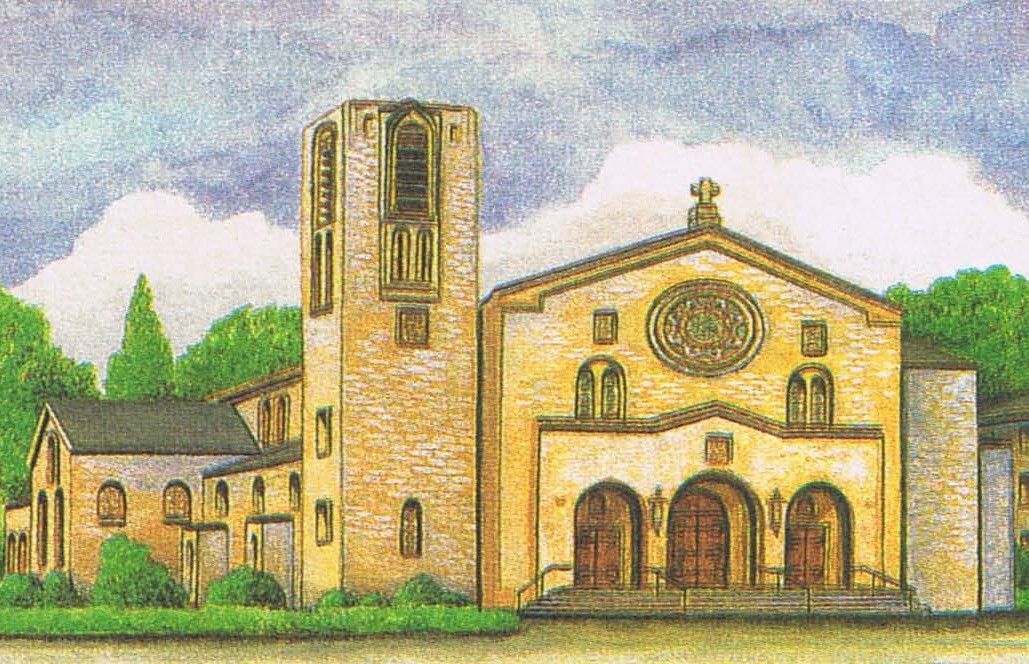
I live in Washington DC on East Capitol Street. If you picture the United States Capitol in your mind, one side faces the long grassy Mall where so many large gatherings and protests take place. Behind the Capitol, on the exact opposite side is a long street that stretches through the Capitol Hill Neighborhood called “East Capitol Street.” My parish is just 14 blocks up on the right. It is a “merged” Parish of St. Cyprian (building lost in 1966) and Holy Comforter (a title of the Holy Spirit).

I want to tell you of the two most important buildings on East Capitol Street. Let me begin with the second most important building, the United States Capitol.

The United States Capitol is the epicenter of the free world. It is the nerve center in the Capital of the most powerful country on this planet. It is here that some of the most powerful people in the world craft legislation and ponder great issues. Presidents have stood in the well of the House chamber to deliver important addresses. Other heads of state have also visited here. In fact people from all over the world travel to this country just to visit and perhaps transact business with the United States Government.

Decisions are made in this building that impact the lives of over 300 million Americans and even more all around the world. Decisions are made here that change world history. Decisions about more money than you can imagine are made in this building on a daily basis.

Perhaps no other building is more identified with this great country of ours than the US Capitol. It’s beauty and grandeur bespeak a powerful and confident land. The US Capitol: the second most important building on East Capitol Street in Washington DC.

What then you ask is the MOST important building on East Capitol Street in Washington DC?! It is Holy Comforter – St Cyprian Roman Catholic Church at 1357 East Capitol Street. In this holy place, some one greater than any head of state, God himself, dwells in the tabernacle. Jesus the Lord and King of the whole universe dwells here, speaks here, ministers here. The prayers and worship that take place in Holy Comforter Church not only change world history but these prayers are also what enable the decisions at the second most important building on East Capitol to have any good effect.

In the US Capitol human work takes place. In Holy Comforter Catholic Church God’s work takes place. In the US Capitol important but ordinary things happen. In Holy Comforter Church miracles happen as ordinary bread and wine become the Body and Blood of Jesus, as sins are forgiven, as heaven is opened. In the US Capitol many words are exchanged and written that impact the day to day activities of America. In Holy Comforter Catholic Church, the Word of God does not just inform, it performs and it transforms.

Many people come to visit the US Capitol. But in Holy Comforter Catholic Church the congregation is joined in worship by myriads upon myriads of angels and a company of saints which cannot be numbered. The US Capitol represents a government that we hope will endure for a long time but Holy Comforter is an outpost of a Church that the gates of Hell will never prevail against. In the US Capitol laws are passed that may one day be changed. But in Holy Comforter Church there is announced each week a law that will never pass away. The Senate majority leader and the Speaker of the House will come and go, changing year by year. But the High Priest, Jesus Christ who ministers at Holy Comforter Church will never die and has a kingdom that will never be destroyed.

Well, OK I suspect you know by now why the US Capitol is the second most important building on East Capitol Street in the Nation’s Capital. Holy Comforter – St Cyprian Roman Catholic Church far outranks in dignity and importance any other building on the street. This is true not because of the human elements involved, but rather the Divine. But I hope you will agree, the US Capitol is the second most important building on East Capitol Street, a distant second!

Funny thing though, all the tour buses drive right past Holy Comforter Church on their way to the second most important building. Wonder what that’s about? You’d think they’d at least stop to take a few pictures and ask to see God. Hmm…. There’s just no accounting for taste is there? Imagine, driving right past the House of God to see “the man” and his house. Imagine that!

In your visits to Washington, perhaps you too missed seeing the most important building on East Capitol Street. It’s probably not your fault. Those silly tour companies just don’t know any better and you depended on them to get you around. But here for you in the video below are pictures, historical and current of the MOST important building on East Capitol Street in the Nation’s Capital.

By the way, when I published a shorter version of this three years ago, I actually got some hate mail from “offended” people. Please, allow a little friendly boasting, the wearing of school (church) colors and know that I write with my tongue firmly planted in my cheek. It’s called humor y’all. And while there are elements of truth in what I write, my “excesses” are in good fun. Get it? Humor! 🙂

The Lord Must Follow after the Preacher – An insight from Pope St. Gregory for those who preach and those who hear.

The other day in the Divine Office I read a passage from St Gregory the Great on preachers and preaching. It is interesting that I have been reading the Breviary every day for 27 years now, and this passage never struck me before. More proof I suppose that when the student is ready the teacher will appear.

There is also a Latin expression that captures how we often see things we missed before even in familiar texts. The expression is Non nova, sed nove, meaning that, though the text is not a new thing, it is experienced in a new way, or newly.

At any rate, what struck me about this teaching is St. Gregory’s assertion that the preacher goes ahead of the Lord, announcing him as it were, and the Lord comes behind to close the deal. It is an important insight that can also help the preacher avoid both pride and also an exaggerated sense of responsibility. I’ll say more of this in a moment but for now listen to St. Gregory:

Beloved brothers, our Lord and Savior….sends his disciples out to preach two by two…

Rightly is it said that he sent them ahead of him into every city and place where he himself was to go. For the Lord follows after the preachers, because preaching goes ahead to prepare the way, and then when the words of exhortation have gone ahead and established truth in our minds, the Lord comes to live within us. To those who preach Isaiah says: Prepare the way of the Lord, make straight the paths of our God. And the psalmist tells them: Make a way for him who rises above the sunset…. Therefore, we make a way for him who rises above the sunset when we preach his glory to you, so that when he himself follows after us, he may illumine you with his love.

Think over, my beloved brothers, think over his words: Pray the Lord of the harvest to send laborers into his harvest. Pray for us so that we may be able to labor worthily on your behalf, that our tongue may not grow weary of exhortation, that after we have taken up the office of preaching our silence may not bring us condemnation from the just judge.

From a homily on the gospels by Saint Gregory the Great, pope
(Hom 17, 1-3: PL 76, 1139 )

It is a powerful and helpful insight that the preacher goes before the Lord, who follows after to quicken the Word that is planted.

And here is a remedy first of all for pride. For the preacher is not the Lord. And, even if it is the Lord’s own word he preaches, mere human eloquence cannot completely express what God alone, who is love, can effect in the human heart. The preacher can but sow the Word, but only God can bring forth the harvest. As St. Paul wrote,

I planted, Apollos watered, but God gave the increase. So neither he who plants nor he who waters is anything, but only God, who makes things grow (1 Cor 3:6-7).

The preacher can propose, but the Lord must come after to “close the deal.” The Samaritan woman was rather abruptly but truthfully told this by the townsfolk:

We no longer believe just because of what you said; now we have heard for ourselves, and we know that this man really is the Savior of the world.” (Jn 4:42)

And every preacher should delight to hear this. It is a valuable lesson for the preacher to remember his place. He goes before to announce the presence of the one who alone can heal and bring in the truest harvest by his grace.

The preacher is like the best man in an ancient Jewish wedding, to whom St. John the Baptist equated himself:

He who has the bride is the bridegroom; but the friend of the bridegroom, who stands and hears him, rejoices greatly because of the bridegroom’s voice. So this joy of mine has been made full. He must increase, but I must decrease. (Jn 3:29-30).

St. Gregory’s insight is also helpful to preacher so that the preacher can avoid an exaggerated sense of responsibility. For it sometimes happens that a preacher may think too much rests on him, on his eloquence, and finding just the right analogy or formulae. And while it is true that every preacher must work to hone his skills, it also remains true that Unless the LORD builds the house, its builders labor in vain (Ps 127:1).

Thus the preacher can help lay a foundation, but it is the Lord who must build the house. It is freeing and helpful for the preacher remember that he merely goes before the Lord, and that the Lord will follow after, with every good grace. For what preacher can possibly know everything that every individual soul needs to find Christ. He must do his part in proclaiming the authentic word of God but only the Lord can perfect the message in every soul.

This is freeing and reassuring. And most of us who preach realize this from time to time when some one tells us something we have said, but recounts it in a way that surprises us. And this shows how the Lord helps them to hear what our feeble words only suggested.

In the end every preacher must trust the Lord who comes after him to complete what is lacking and bring forth the fruits that the preacher can only point to.

On the problem of pretending in the Christian life, and its solution.

One of the Gospels from last week’s daily masses (Luke 12:1–7) opens up some important insights on the “problem of pretending” in the Christian life. One of the problems in getting to this insight of the Lord, is the understanding we have today of the word hypocrisy. To some extent, we have lost the more subtle distinctions and nuances of the word hypocrisy. For most of us today, hypocrisy means, in effect, that our deeds do not match our truest beliefs. There we are inconsistent, that, in effect, we say one thing and do another. While this is part of hypocrisy, is not the whole story.

Let’s look at the passage from Luke 12 and see with the Lord teaches, on the subtleties of hypocrisy.

Here is the full text of that gospel:

At that time:
So many people were crowding together
that they were trampling one another underfoot.
Jesus began to speak, first to his disciples,
“Beware of the leaven–that is, the hypocrisy–of the Pharisees.

“There is nothing concealed that will not be revealed,
nor secret that will not be known.
Therefore whatever you have said in the darkness
will be heard in the light,
and what you have whispered behind closed doors
will be proclaimed on the housetops.
I tell you, my friends,
do not be afraid of those who kill the body
but after that can do no more.
I shall show you whom to fear.
Be afraid of the one who after killing
has the power to cast into Gehenna;
yes, I tell you, be afraid of that one.
Are not five sparrows sold for two small coins?
Yet not one of them has escaped the notice of God.
Even the hairs of your head have all been counted.
Do not be afraid.
You are worth more than many sparrows.”

Note that the passage begins as follows, “Beware of the leaven, that is, the hypocrisy of the Pharisees.” (Luke 12:2). Now the Greek word that is translated into English hypocrisy, is ὑπόκρισις (hypocrisis). And its nominative form is  ὑποκριτής (hypocrites) meaning, most literally, “actor.”

Now obviously, an actor, is someone who plays a role. The actor who plays Julius Caesar, is not in fact Julius Caesar. He is, in fact, John Smith, who plays the part of Julius Caesar, but is not Julius Caesar. In a certain sense, they are “pretending” to be Julius Caesar.

Now, everyone accepts this fact, and it is fine for a true actor to “pretend,” for time, to be someone they are not. But it is not good in the spiritual sense to go one “acting” or “pretending.” And when Jesus warns of hypocrisy he is warning that we tend to go on pretending to be someone that we are not, or to be living in a world, or a time, or set of circumstances, which are not, in fact, real.

Pretending is all right on the stage, for a prescribed time. But pretending is not all right in daily life. To pretend, to be an actor in daily life, is to engage in hypocrisy. And the Lord warns against this. We ought not to pretend to be someone we are not, or to be living in an unreal or “pretend” or “make-believe” world.

And so, with all this in mind the Lord warns us not to engage in “hypocrisy.” In effect, he is warning us not to pretend, not to engage in fantasy or live in a make-beleive world. And this line, “Beware of the leaven, that is, the hypocrisy of the Pharisees” serves as the opening framework of all that is to follow.

And what does follow? Fundamentally, the Lord lays out the reality, that the pretend world, denies the reality of judgment. This amount to playing “pretend.” He goes on in the text to warn us that there is nothing that is concealed that will not, one day, be revealed; nothing that is secret that will not be made known. He warns that, but we have said in the darkness, is heard in the light and, that everything we say or to is known to him. (Cf. Mk 4:22ff), He then, further warns us not to be obsessed with what other people think of us, not to be concerned with those who only have the capacity to kill the body, or somehow impact our worldly living. Rather, he tells us that we should  have greater fear for the one “who after killing, has the power to cast into Gehenna”.

So what does all this have to do with hypocrisy? Simply this, we like to go on pretending, that is acting and living in a fantasy world. And the fantasy, the pretend, the “make-believe”  is that what we do, and what we say, will have no consequences. We like to go on pretending that the Lord is some sort of pushover, some sort of “lollipop King”  who just goes on doting over us, and that what we say or do does not ultimately matter.

In effect, the Lord tells us to stop going on pretending, to stop living in fantasy and following the lines of the script that is not the real world, the real God, or the reality that is my own life.

Most people today, living in outright heresy. They simply deny, or discount the reality that there will be a day of judgment, that there will be a day of reckoning. They simply gloss over the notion, that we will come before the judgment seat of Christ, and that we will render an account, as Scripture says, for every idle word (Mt 12:36), for what we’ve done in secret (Mk 4:22), that we will stand before he him who judges the intentions of the heart (Heb 4:12) and that nothing will lay hid from Him (Heb 4:13). We make light of this, we discount it. In effect, we pretend. And pretending is acting, pretending is a form of hypocrisy.

When Jesus warned of the hypocrisy of the Pharisees, he was referring to their sense of self-righteousness. In other words, they thought that they had nothing to worry about, for they were “good people,” unlike other less stellar examples of people around them. They had checked off the “God box”, they said their prayers, they fasted on Wednesdays, paid their tithes, and so forth; they were the good people. On the day of judgment they figured they would walk right on into heaven. This is self-righteousness. This is the attitude that, somehow, on my own power, I can attain to eternal life.

Too many people, have this attitude of self righteousness today. They may invoke God’s grace and mercy, but they are not really willing to consider the fact that they may by their own sinfulness disqualify themselves. Perhaps one has been fortunate to avoid the shameful sexual sins of the day, but have they loved the poor, have they been merciful and forgiving, and vice-versa. It is so easy to emphasize certain aspects of holiness and discount others. This is acting, this is hypocrisy and self-righteousness.

Too many breeze past any notions that they will have to render an account to the Lord. “Oh yeah, I know there’s a day of judgment, but God is love, and everything will be just fine and nobody is really going to Hell.” In other words, the common attitude today is a hell is a remote possibility, that judgment is a mere formality, nothing to be too anxious about. Never mind that this attitude is in direct contradiction to the whole of Scripture, most today live in outright heresy when it comes to this. (Some, sadly hold the opposite extreme of despair as well).

To all of this the Lord says he careful of hypocrisy be careful that you’re not living in a pretend world. God is very holy. Regarding heaven, none can walk up there but the pure in heart. Do not be so quick to simply presume you or I have the purity of heart to simply walk into heaven. God is very holy, and heaven is a place of the souls of just men made perfect (Heb 12:23). Jesus says, you must be perfect as a heavenly father is perfect (Mat 5:48). This is reality, is not pretend. But hypocrisy likes to “play act.” It thinks of holiness, only as playing a role, or as a light matter, simply the memorizing a few lines, and the playing of a certain part. This is pretend, this is acting, this is hypocrisy. And the Lord warns of it.

The Lord goes on to call another question. He points out that most of us are afraid of those who can kill the body, but cannot kill the soul. He goes on to summon us to a holy reverence. He says, “I shall show you whom to fear. Be afraid of the one, who after killing, has the power to cast into Gehenna (that is, hell).” He is speaking of himself. Scripture says, for we must all appear before the judgment seat of Christ, and render an account for what we’ve done in the body, whether good or ill, that we may receive recompense.” (cf 2 Corinthians 5:10).

Now the Lord is speaking to us here of real life. He is summoning us away from a pretend world where God “does not really care” about good or evil, or care about our holiness. Instead, Jesus is summoning us to the real world where God has a passion for what is right. He has a vigorous love for us, a love that wants for us true perfection, real holiness. God does not want to play or  pretend with us, he seeks real, and true righteousness and holiness for us. He is not going to go on playing games with us. He does not want us to accept that it is enough for us to go on pretending that somehow reciting a few lines and learning a few moves on the stage is enough for us. He seeks for us to be truly, and really holy, righteous, and perfect.

Thus, when the Lord warns against hypocrisy, he is not merely speaking of severe and pretentious religious leaders of the past. He is speaking to you and me. He is telling us to stop pretending, to stop play acting, and to accept that he is about real change in our life. There is a real standard to meet, not just a pretend one. There is a real judgment to get ready for, not just a brief and perfunctory “play” before the throne of God. God is not playing games with us, he is not interested in the game of, “let’s pretend.”

Very little angered Jesus more than hypocrisy. And while we may like to gleefully observe how he excoriates the Pharisees of old we need to understand, and appreciate, that he spoke this warning to his own disciples, that is to us, that we too should beware, that is the wary of, that is “be aware” of the fact that we too can easily again engage in hypocrisy, in acting, in playing “Lets pretend.”

What then, is the solution to this problem of hypocrisy, of playing pretend? In effect, the Lord teaches here that we should ask for the gift of the Holy Spirit, which is, “the Fear of the Lord.”

What does it mean to fear the Lord? To fear the Lord, is not a kind of cringing fear, a fear merely rooted in concern to avoid punishment. Rather, the fear of the Lord is rooted in a deep love for God. It is rooted in a sense of wonder and awe, a deep appreciation of God’s holiness, of his Majesty, of his power, and of his loving providence.

The fear of the Lord is a fear of offending the Lord who has been so good to us, and to whom we owe everything. When we fear the Lord, but we do not trivialize him. We do not pretend that he is some sort of “lollipop King,” some sort of doting Father who does not really care that we run off into self-destructive, and other-destructive behaviors. Rather, when we fear the Lord, we accept that He is holy, and that He is passionate about setting right whatever is wrong within us, or in this world.

The Lord tells us to fear him who has power to cast him to Gehenna. In other words, he couches the fear the Lord in the context of judgment. The Fear the Lord is the gift to be serious and sober about the fact that one day we will answer to the Lord for what we have done, and what we have failed to do. Praise God, we will answer to a God who loves us, but we will answer to him.

In effect the gift of the fear the Lord is meant to instill in us a balance. On the one hand we must be sober and serious about the fact that we will be judged, and that there are, in fact, consequences for the choices we make and the behaviors we exhibit.

But before we merely cringe in fear, the Lord summons us to remember his love for us. He goes on to say “Do not be afraid, you’re worth more than many sparrows.” In other words, our fear of the Lord should not be a servile, a cringing fear. Rather, it should be a fear rooted in love, and the experience of God’s love for us. The fear the Lord is something which balances the reality of judgment with the reality of God’s love. Both are real, both are taught.

As noted, today, most people live in outright heresy (material more than formal), practically, if not totally, denying the reality of judgment, and of Hell. No one loves us more than Jesus Christ, but no one spoke and warned of Hell more than Jesus Christ. No one spoke to us more thoroughly on the reality of judgment, and the need to be ready for it than Jesus Christ.

The gift of the Fear of the Lord balances his love for us, with a sober appreciation that his love is a vigorous love, a love that insists that our justice, our holiness must be real, not pretend. We may wish to go on pretending that judgment is no big deal, but Jesus teaches otherwise, the same Jesus who loves us. Anything else is hypocrisy, is pretending. The gift of the Fear the Lord seeks to hold in balance the love God and the reality of our need to allow God’s love to effect real change in us, not just pretend stuff.

A personal story. The other day I was privileged to preach at a Mass in the great upper church of the Basilica of the National Shrine of the Immaculate Conception. As I, with the Bishop from Cameroon and a good number of other priests concelebrants processed up the aisle, I looked up and saw the great mural of Christ, seated in judgment over the nations. As we processed, we were singing the Battle Hymn of the Republic, and just as I rounded the corner heading up the main aisle, the following lines of the hymn were sung,

He has sounded forth the trumpet that shall never sound retreat; He is sifting out the hearts of all, before his judgment seat; Oh be swift my soul to answer my soul to answer, oh be jubilant my feet! His Day is marching on!

I was given the gift of tears, as I looked up and saw Christ seated in Majesty. It is a mural that many do not like, for many reasons. Some see Him as too severe, other reject it for other reasons.But as I looked up, I was moved to weep. Yes, I thought, I will answer to him. But I love Him and know and have experienced that he loves me. Yes, I love Him and  I have respect for Him, but I must answer to Him. I will not trivialize him, but neither do I doubt his love for me or the fact that his love is a healing love, a powerful love that brings eternal healing.

The Fear the Lord is the beginning of Wisdom, the gift to reverence God and yet trust his love. If you look carefully at the eyes of Christ seated in Majesty in the mural of the great upper Church in the Basilica, you will notice that the right eye of the Lord shows a kind of severity, for his right eye signifies his righteousness, his justice and his passion for what is right and true. But the left eye is more open more rounded, more serene, and this bespeaks his grace and mercy. On the one face of Christ a feature common in Eastern iconography, is both the justice and mercy of God. For God justice and mercy are alike with him (Sirach 5:7). Some, looking up at that great mural see only the severity. But there is subtlety of the image of His eyes that speak of balance: Justice in the right eye, grace and mercy in the left, One God in whom justice and mercy are alike.

The Fear the Lord respects this balance. The Lord warns of hypocrisy, a kind of heresy that pretends, that play acts that somehow justice and righteousness is simply a matter of reciting a few lines. They are not, they are far deeper. But the Fear the Lord also reverences the fact that only the love of God can utterly transform us into the holiness that is required as we prepare for our appointment before the great judgment seat of Christ.

Avoid hypocrisy, avoid pretending. It is not only the problem of the Pharisees of old, it it, too easily, our very own problem.