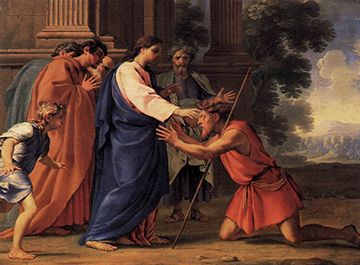
A Man Who Saw by Hearing

blog10-24Today’s gospel features the well-known story of the healing of the blind man (Bartimaeus). As when listening to any familiar story, we are inclined, upon hearing its opening lines, to think, “Oh, that story,” and just sort of tune out. But if we do so, we may miss many important details. The story of Bartimaeus is also our story; we, too, must let the Lord heal our blindness and give us sight. One paradox of this gospel is that the man receives his sight as the result of hearing.

Let’s look at this gospel in six stages.

I. The Perception of the Problem

The text says, As Jesus was leaving Jericho with his disciples and a sizable crowd, Bartimaeus, a blind man, sat by the roadside begging.

Bartimaeus has troubles; he is both blind and poor. But although he is physically blind, he is not spiritually blind. For he knows he has troubles; he knows he is blind. Knowing our troubles, being in touch with our neediness, is an important spiritual insight that many lack.

We are all so poor and needy that we depend on God for every beat of our hearts. Some people, though, feel self-satisfied, unaware of how blind, pitiable, poor, and naked they really are before God (cf Rev 3:17). In their pride, those who are spiritually blind lose this insight. They fail to ask for help from the Lord; they fail to ask for grace. Jesus said to the Pharisees, “If you were blind, you would not be guilty of sin; but since you claim you can see, your guilt remains” (John 9:41). In other words, physical blindness is not their problem, spiritual blindness is. And because they think themselves righteous on their own power, they think they do not need God and do not truly seek Him. Only humility and a true “vision” and experience of our poverty can help us to call out to God as we should.

But our blind man knows that he is blind, so he calls for help. As we shall see, however, his cries for help need some direction; they need to be properly specified and directed.

So we begin by noting that though Bartimaeus is blind he has spiritual insight.

Do we have this insight? Do we really understand how blind we are? We struggle to see God; we struggle to see and understand ourselves; we struggle to see others with compassion and understanding. Indeed, God is more present to us than is anything in this world. Yet somehow we can see all the things of this world, but struggle to see God. Neither do we see our own dignity, or the dignity and the gift of others, even our enemies. We do not see or understand how things work together, and we struggle to see and find meaning in the events of our day. We are also blind to our sin and seldom fully comprehend the harm our sin does.

Yes, we have a great deal of blindness; we struggle to see. But perhaps our worst blindness is that we do not even realize how blind we are. Like the Pharisees, we think that because we know a few things, we therefore know many things.

Consider the humility of the blind man: he knows he is blind; he knows he needs help, grace, and mercy. It is this humility that opens the door. Stage one in the journey must be the perception of the problem.

II. The Proclamation that is Prescribed

The text says, On being told it was Jesus of Nazareth who was passing by, he began to cry out and say, “Jesus son of David have pity on me.”

Note the subtle but important transition here. Up until this point, Bartimaeus has been calling upon anyone passing by for help. But no mere passerby, nor in fact anyone in this world, can ultimately help him with his real problem.

It is the same with us. Though we may turn to science, medicine, philosophy, economics, or politics, none of these can really help us. At best they can serve to specify what is wrong or to provide us with temporary medicines and passing comforts. But all these solutions will be rooted in this world, which is passing away.

True vision can only be granted by the Lord, who opens for us a vision of glory and who alone can draw us safely to that place where joys will never end and visions never cease.

When the blind man is told of the presence of Jesus, he directs his cry away from just any random passerby to the Lord, who alone can heal him: Jesus, son of David, have pity on me! The world, and passersby, can give him money or perhaps a meal, but only Jesus can give him meaning, the true vision that he really needs to see.

Do not miss the fact that his seeing comes, paradoxically, through hearing. For faith comes by hearing and hearing from the Word of God (cf Rom 10:17). It is a truth that faith is about hearing, not seeing. We often doubt things that we see. Even if our eyes see a marvel, we tend to dismiss it, thinking, “Oh, they have a way of doing that.” No, the eye is never satisfied with seeing (cf Eccl. 1:8). Faith comes by hearing and faith is obedience to what is heard. We walk by faith, by an inner seeing, not by physical sight.

Thus, it is by hearing that the blind man will come to see Jesus, who can help him to see. Bartimaeus hears from others that Jesus is passing by and takes up the proclamation that is prescribed: “Jesus, Son of David, have pity on me!”

III. The Perseverance that Produces

The text says, And they rebuked him, telling him to be silent. Yet he kept calling all the more, “Son of David, have pity on me!” Jesus stopped and said, “Call him.” So they called the blind man saying to him, “Take courage; get up. Jesus is calling you.”

It is true that those of us who seek to put our trust in the Lord and call on Him will often experience rebuke, hostility, and ridicule from the world. Bartimaeus ignores all of this; and so should we. He has heard the Name above all names, who alone in Heaven and earth can save, and calls upon Him.

Yes, Jesus does delay, not answering him right away. But the blind man perseveres, calling out all the more. Eventually, Jesus stops and says, “Call him.”

Why does God delay? While this is a very deep mystery, it is clear that one of the effects of His delay is to test our faith and strengthen it. In the end, it is not an incantation that saves us, but faith. Simply shouting, “In the name of Jesus!” is not enough. The name of Jesus is not some incantation like, “Open sesame.” Rather, it is an announcement of faith, and faith is more than words. Ultimately, it is not words alone that save us, but the faith that must underlie the words “Jesus, save me!”

IV. The Priority that is Presented

The text says, He threw aside his cloak, sprang up, and came to Jesus.

Do not miss this important detail. Bartimaeus’ cloak is probably the most valuable thing he owns. In that very arid climate, the temperature drops rapidly after sunset and it gets quite cool. In fact, so critical was the cloak that Scripture forbade taking one as collateral for a loan:  If a man is poor, do not go to sleep with his pledge in your possession. Return his cloak to him by sunset so that he may sleep in it (Deut 24:12-13).

But still, Bartimaeus casts aside his cloak and goes to Jesus. Thus, he leaves behind perhaps the most valuable and necessary thing for his survival in this world. Missing a meal might be inconvenient or uncomfortable but it would not kill him. But to spend one cold night without his cloak might well cause his death by hypothermia. In spite of this, Bartimaeus leaves everything behind and runs to the Lord.

What about us? What are we willing to leave behind in order to find Christ? An old gospel song says, “I’d rather have Jesus than silver and gold.” Another old hymn says, “There’s nothing between my soul and the Savior.” Is that true? Are you willing to leave it behind? Are you free enough to do so?

V. The Permission that is Procured

The text says, Jesus said to him in reply, “What do you want me to do for you?” The blind man replied to him, Master, I want to see!

Why does Jesus ask this question? Can He not see what a blind man needs?

But being healed takes courage. In this life, most of us seek mere relief, not healing. Tue healing takes courage because it brings about change and new demands on us. If the blind man is healed, it will no longer be acceptable for him to sit and beg; more will be expected; his life will be irrevocably changed.

Yes, to be healed requires courage. Many of us wonder why the Lord delays in answering our prayers. Perhaps we should think about a question from last week’s gospel: “Do you have any idea what you are asking?” Often we do not.

Truth be told, most of us want relief more than we want healing; there is a big difference. And the Lord is in the healing business. Do not miss what the Lord is really saying here. In effect, he says (to the blind man and to us), “Are you sure you really want healing?” The Lord respects us and our free will. He wants our consent before going to work. Though many of us think we want healing, we often don’t really know what we are asking.

The Lord waits … until a request makes real sense. He knows that many times we are not really ready for what he offers. He asks us, and only when our yes becomes definitive does He go to work.

VI. The Path that is Pursued

The text says, Jesus told him, “Go your way; your faith has saved you.” Immediately he received his sight and followed Jesus on the way.

As we have already seen, true healing brings forth radical change. The man who sat by the road begging now sees, but he is also up and walking about. And what is he doing? He is following Jesus. Faith has saved him. Faith not only gives sight but also summons us to obedience, an obedience that has us walk in the path of the Lord.

You see (pardon the pun), faith is more than an offer of relief. True faith instills real change: change in direction and change in the way we walk.

And thus today’s gospel speaks to us of a man who was blind, but, paradoxically, receives his sight and his faith by hearing. Bartimaeus heard of Jesus and then called on Him. Yes, his sight came from his hearing. And faith grants vision by hearing. True vision is seeing Christ, and having seen Him by hearing, following after Him.

I Want to Walk as a Child of the Light

1. I want to walk as a child of the light;
I want to follow Jesus.
God set the stars to give light to the world;
the star of my life is Jesus.

Refrain
In him there is no darkness at all;
the night and the day are both alike.
The Lamb is the light of the city of God;
Shine in my heart, Lord Jesus.

2. I want to see the brightness of God;
I want to look at Jesus.
Clear Sun of righteousness, shine on my path,
and show me the way to the Father.

3. I’m looking for the coming of Christ;
I want to be with Jesus.
When we have run with patience the race,
we shall know the joy of Jesus.


Let’s Pretend We Know What We’re Talking About – As Seen in a Commercial

blog10-23In life we don’t always have answers. There are just times when the best answer is, “I don’t know.” This is especially the case with the deeper mysteries of life such as the problem of evil, the “why” of suffering, and the reason why things sometimes don’t make sense.

As a younger priest I felt a lot of pressure to “have the answers” when tragedies occurred or when people experienced persistent setbacks in their lives. In more recent years I’ve learned to say less and to be more willing to sit quietly with people in their pain. To be sure, we have some answers, but explanations are poor substitutes for understanding and acceptance. Whatever explanations I can offer still leave even more things unexplained.

In life we sometimes must make decisions even though we don’t have all the information we’d like. Sometimes we simply have to guess at what’s best. At other times we have information and lots of (often-conflicting) advice, yet still remain uncertain as to what to do. We have to decide to trust God, remaining humbly open to His providence.

All of this is hard for us, especially these days, because we’ve cultivated such a high sense of being in control. But control, in anything but a limited sense, is an illusion. While you may have plans for tomorrow, tomorrow isn’t promised; you’re not even guaranteed the next beat of your heart. Your control of little things is based on myriad other things you can’t control.

Enjoy the video below, which humorously reminds us that we aren’t always certain what the best answer is even when the whole world is waiting for us to decide. Sometimes the best we can do is to decide and then accept the consequences of that decision. Hypocrisy—in this case pretending that the decision is all wise and fully informed—has a way of bringing scorn upon us that is far worse that what simple humility offers. Sometimes it’s OK to say, “I’m not sure,” or to accept that our decisions may be flawed.

Divine revelation is certain, but human decisions are flawed and uncertain.

Earth, Air, Fire, and Water: Great and Yet Terrifying Blessings

blog10-22-2015Some of God’s gifts come in strange and terrifying packages. The book of Job says,

The earth, though out of it comes forth bread,
is in fiery upheaval underneath (Job 28:2).

It is a fact that we live just above a fiery cauldron separated from us by a thin membrane of earthly crust rife with cracks through which fire routinely flares in volcanoes in fissures, a crust that is always shifting and even shaking violently in earthquakes.

And yet were it not for this violent cauldron beneath us, it seems unlikely that we would have life here at all. Volcanoes and other tectonic activity keep our soil rich and recycled. In this fiery cauldron are brewed some of our most useful minerals and most beautiful gems. Whole island chains and land masses are formed by eruptions and geothermal energy is a resource we have only just begun to tap. Many scientists think that volcanoes had a profound influence on the formation of an atmosphere in the early Earth period and that the molten core of the earth has an important influence on the Van Allen belt, a magnetic field that keeps the harmful portion of the sun’s radiation away from the earth’s surface.

Yes, Job had it right, some of God’s gifts come strange packages. The earth’s capacity to bring forth bread is directly connected to the fact that it is on fire beneath. And yet what a strange and terrifying package this gift comes in! For volcanoes and other seismic activity have claimed an enormous number of lives and a huge amount of property.

Water, too, such a rich source of life and blessing, can also turn in a moment to utterly destroyed life in huge numbers. Floods and tsunamis can sweep away huge areas in a flash.

And yet who could ever deny that without water life would be impossible? Ah, water, nothing more life-giving and nothing more deadly. Yes, some of God’s gifts come in strange and terrifying packages.

I have often wondered why so many cities throughout the world are built on or near floodplains and along the “ring of fire,” with its volcanoes and fault lines. But of course the answer is plain enough: it is in these very areas that some of the richest soil and the greatest resources are to be found.

God’s and nature’s most life-giving gifts are but a few degrees separated from disaster and instant death. We live on the edge of an abyss because that is where life is found.

Such a thin line, really. Mors et vita duello, conflixere mirando! (Death and life compete in a stupendous conflict!)  To live is to cheat death.

All the basic elements and forces: earth, air, water, and fire are so death-dealing and yet so life-giving; somehow they are all part of the great cycle of living and dying that God intends.

Only God is existence itself; the rest of us are contingent beings and part of a cycle. Only in union with Christ, who said, I am the life, will we ever cheat death. As Fulton Sheen once said, “Christ gave the earth the only serious wound it ever received, the wound of an empty tomb.” And with Christ, and only with Christ, will we one day give the earth that same wound.

For now, we live above the cauldron upon a thin crust; beneath us burns a tremendous fire. But somehow, mysteriously, it is the source of our bread.

The earth, though out of it comes forth bread,
is in fiery upheaval underneath (Job 28:2).

Yes, some of God’s greatest gifts come in strange and terrifying packages.

On the Relationship Between Light, Time, and the Mystery of God

blog.10.21I was meditating on time today, precipitated by some mysteries I’ve recently learned about the light of the Sun that reaches this earth.

I have long known that to look up into the night sky is to look far into the past. Looking up at the star Sirius, I am seeing 9 years into the past. Looking over at the star Antares, I am seeing 250 years into the past. And when I look the star Rigel, I am seeing 600 years into the past. Looking further still at the Andromeda galaxy, I am seeing one million years into the past. That is how long it takes the light of these stars and galaxies to reach us! We are not seeing them as they are now, but as they were then. The past, even the distant past, is very present to us.

The light of the sun takes 8.25 minutes to reach us. Thus we see the surface of the sun not as it is now, but as it was more than 8 minutes ago.

But I learned yesterday that the light of the sun is even older than I had thought. A little research on my part revealed this astonishing fact: the photons of light that reach the surface of the sun (and then reach us 8+ minutes later) were actually generated 100,000 years ago in the sun’s core.

Emerging from the sun’s core as the result of nuclear fusion, a photon of light enters the radiative zone (see diagram above). The plasma in that radiative zone is quite a maze for the photon to get through, such a maze that it takes the better part of 100,000 years to make the journey to the convective zone and the photosphere where it finally begins a rapid journey out into the vacuum of space.

Why does it take this long? Imagine being in a large room filled with people, trying to get to the door on the other side the room. But as you try to make your way across the room, person after person strikes up a conversation with you, delaying your progress. It won’t take you 100,000 years to get to the door, but you get the idea.

The diagram above shows the meandering, zigzag motion of a photon as it makes it way through a maze of plasma that detains the photon for up to 100,000 years!

Thus, the sunlight we currently bask in is much more than 8 minutes old; it’s 100,000 years old! The light we see today was made in the sun’s core back during the beginning of the last ice age.

The great mystery of time is on display for us at every moment. The past is present in many ways. And our past is on display and still present as well. If anyone on a planet near Rigel were looking back through a telescope at the earth right now, he would not see us as we are today, he might see Joan of Arc and her contemporaries of the 15th century. The light of our “today” will not reach Rigel for 600 years.

What is the present? That is mysterious as the sum total space of the universe and it depends on where you are. God, who is just as present at Rigel as He is here, has the same access to the images of 1415, as he does to those of 2015. Indeed, He is present at Andromeda just as much as here on earth; and a million years ago is just as accessible to Him as is now.

The future is even more mysterious, but that is just as available to God as is the past.

Do not miss the irony of the fact that the light of the sun (and the reflected light of the moon), by which we set our clocks and calendars to measure time and tell what time it is now, is 100,000 years old.

Does anybody really know what time it is? Only God, only God. Time is very mysterious and the more we think we know, it seems the less we really do.

All the days ordained for me were written in your book before one of them came to be. How precious to me are your thoughts, God How vast is the sum of them! Were I to count them, they would outnumber the grains of sand—when I awake, I am still with you (Psalm 139:16-18).

A Meditation on the Beautiful Gift of Sleep

deep-sleep=giftOne of God’s greatest gifts is that of sleep, especially deep, peaceful sleep. Alas, like many hyperactive and overstimulated moderns, I sometimes struggle to find deep sleep. My mother often said that she was a light sleeper, so maybe I also got it from her. But when deep sleep does come, what a wonderful gift! A deep night’s sleep can be so refreshing, truly one of life’s great pleasures.

Some of the Psalms speak of sleep. This Psalm speaks with gratitude of the gift of God to fall asleep quickly and to sleep deeply:

I will lie down in peace and sleep comes at once for you alone, Lord, make me dwell in safety (Ps 4:9).

Another Psalm speaks to us of how God blesses us while we sleep:

In vain is your earlier rising, your going later to rest, you who toil for the bread you eat, when he pours gifts on his beloved while they slumber (Ps 127:2).

What a magnificent thing to think of God bestowing blessings on us while we slumber! The image I have in mind is that of a parent coming to the bedside of a sleeping child and gently kissing him on the forehead, making sure he is all tucked in for the night.

Yet another Psalm speaks of the blessing of not having to get up in the middle of the night (to take care of you know what):

I will bless the LORD who gives me counsel; even in the night he admonishes my kidneys (Psalm 16:7).

Yes, an unusual blessing that God would keep watch over my kidneys! Many of the translators, finding this peculiar, translate it that God keeps watch over our hearts at night. Now that’s a nice thing, too, but the first meaning of the Hebrew word kilyah is “kidney.” There’s something earthy and practical about God keeping watch over our kidneys. Thank you, Lord! Not having to arise several times at night allows me to sleep more deeply. Thank you, Lord, for watching over my kidneys!

So yes, restful and peaceful sleep is such a great gift, a blessing itself, and also a source of blessings. Grant us, good Lord, a restful night and a peaceful slumber!

Dr. Ralph Martin, commenting on a teaching by St. Therese of Lisieux, has this amusing and consoling reflection on the relation of sleep and prayer:

Therese shares about her own long struggle to refrain from falling asleep during prayer times and offers some interesting advice:

I should be desolate for having slept (for seven years) during my hours of prayer and my thanksgivings after Holy Communion; well I am not desolate. I remember that little children are as pleasing to their parents when they are asleep as well as when they are wide awake; I remember, too, that when they perform operations, doctors put their patients to sleep. Finally, I remember that: “the Lord knows our weakness, that he is mindful that we are but dust and ashes.

[Dr. Martin observes]: Those of us who are parents know that we sometimes love our children even more when they finally go to sleep! Therese’s message is one of great confidence in God’s love for us. He knows our weaknesses and loves us anyway. If we just do the little bit we can, he’ll be able to continue the process of transformation even if prayer is sleepy and dry … little by little, even imperfect prayer will change us (Dr. Ralph Martin, The Fulfillment of All Desire, pp. 283-284).

Of course it is also clear that one of the more unpleasant experiences in life is to have a restless or sleepless night, especially if it is accompanied by anxiety or fear. In the worst years of my struggle with anxiety in my mid-thirties, I was actually afraid to go to sleep. I would often fall asleep and then within an hour be startled awake, racked with fear and wrestling with a demonic presence in my room. Somehow, in falling asleep, all my psychological and spiritual defenses seemed to shut down and I would awaken to terrors and fearsome assaults. Those were the difficult years when I feared, as late night drew on, that it was time to try to sleep.

The Book of Job well describes the nights I once experienced:

When I say, “My bed shall comfort me,
My couch shall ease my complaint.”
Then you [O Lord] affright me with dreams,
and with visions terrify me.
In bed I say, “When shall I arise!?”
But the night drags on;
And I am filled with restlessness until the dawn (Job 7:13-14; 4).

I used to keep a printed version of this on my nightstand. And in those dark nights at three in the morning I read it out loud as a kind of complaint to God.

Thanks be to God, I am delivered from those awful times. Thank you, Lord! But I am sympathetic to those whose bed provides no comfort and whose couch permits no sleep. It is an awful thing and a difficult cycle to break. I can only, with sympathy, encourage them to make the journey I’ve had to make: growing in trust, finding greater serenity, and taking back what the devil stole—the gift of a restful night and the peace and serenity the Lord wants to give.

Ah, yes, the gift of restful sleep and quiet nights! It is a beautiful gift to seek from the Lord each night. In the night prayer of the Church, there are these beautiful lines:

Protect us Lord as we stay awake, watch over us as we sleep, that awake we may keep watch with Christ, and asleep rest in his peace.

The office ends with the beautiful wish: May the Lord grant us a restful night and a peaceful death. The Salve Regina having been sung, the lights are switched off and we rest in the arms of God.

Here is one of the most beautiful Night Prayer Hymns:

God, that madest earth and Heaven, darkness and light;
Who the day for toil hast given, for rest the night;
May Thine angel guards defend us,
Slumber sweet Thy mercy send us;
Holy dreams and hopes attend us, all through the night.

When the constant sun returning unseals our eyes,
May we, born anew like morning, to labour rise;
Gird us for the task that calls us,
Let not ease and self enthrall us,
Strong through Thee whate’er befall us, O God most wise!

Guard us waking, guard us sleeping, and when we die,
May we in Thy mighty keeping all peaceful lie;
When the last dread call shall wake us,
Do not Thou, our God, forsake us,
But to reign in glory take us.

A Tribute to the Holy Women of the Mystical Tradition

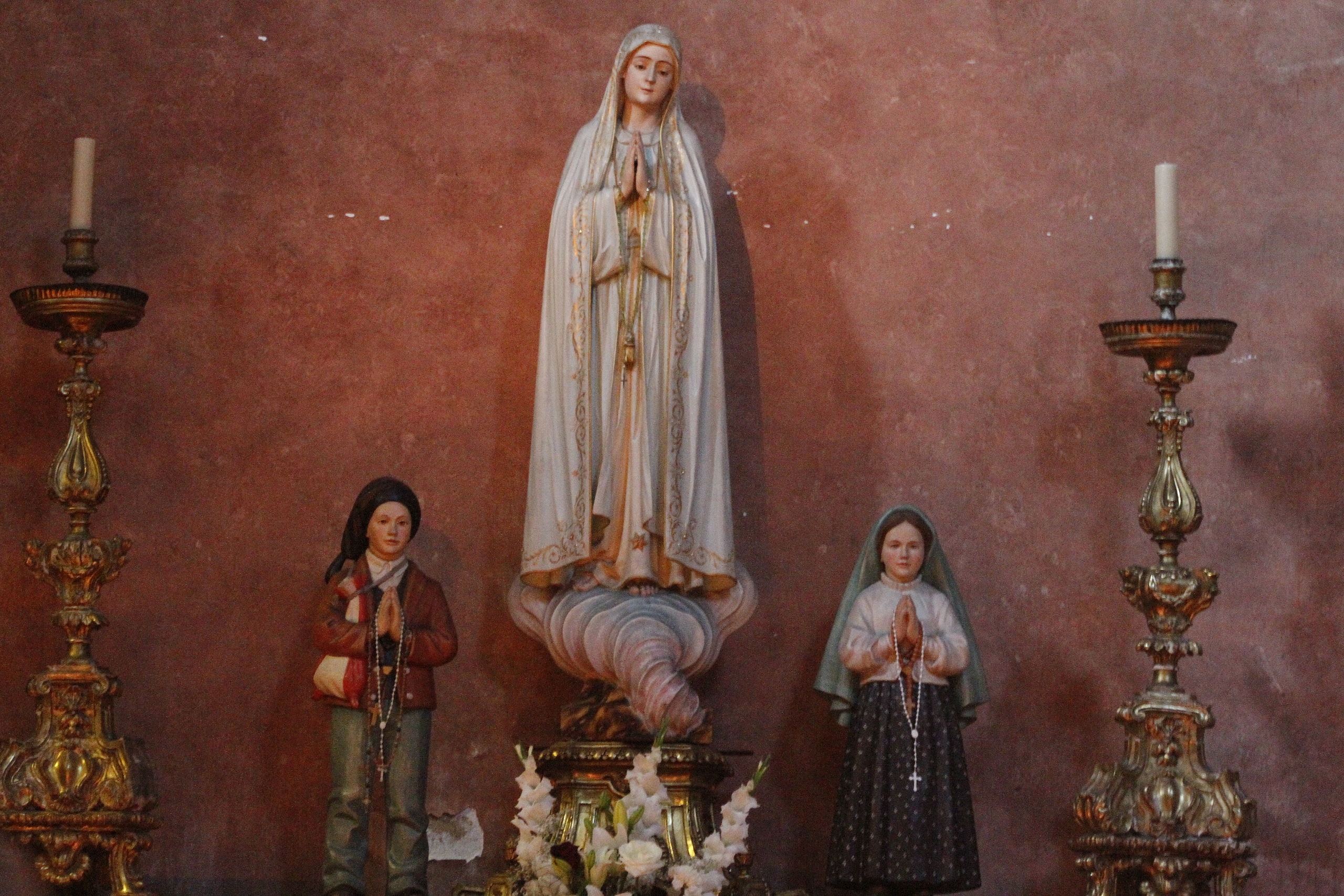
Our_Lady_of_Fátima_and_the_Children_-_Igreja_de_São_Domingos_-_Lisbon
© José Luiz Bernardes Ribeiro / CC-BY-SA-3.0

This past week, I have been traveling in Europe: Fatima, Lourdes, Avila, and soon enough up to Notre Dame in Paris. What a privilege it is to be in these places so near to the feasts of our Lady of Fatima (10/13) and St. Teresa of Avila (10/15)! Yes, two very important women in my life: Mother Mary and St. Teresa.

Indeed, I have come to realize my need for and indebtedness to the holy women of God’s Church, to those who are living and those who have gone before and set forth a glorious testimony of the feminine genius and mystique of deep, mystical prayer.

Ah, the Holy Women! To be sure, there are also men: St. John of the Cross and St. Bernard of Clairvaux, whose towns I am also visiting. They, too, have set forth the great mystical vision. But I must say, I am particularly indebted to the great women, to the mystics and Doctors of the Church such as St. Catherine of Sienna, St. Teresa of Avila, St. Rose of Lima, St. Therese of Lisieux, Sister Faustina, and others who ventured into deep, contemplative, and spousal union with the Lord.

How their deep love, their intensity, and their union with God has inspired me in my own journey toward contemplative prayer! Though I cannot access their spousal love for the Lord, I am able to transpose their experiences to a deep spiritual experience of sonship with God the Father, for He is Abba and I am a son of His.

Ah, the great Catherine of Sienna: her love for the Lord and her wisdom, rooted in both suffering and affliction, joy and ecstasy! She personally met the Lord. What a witness! What a glory! What a testimony the mystics gave us! St. Teresa of Avila: she who encountered the Lord and yet suffered greatly. She was even suspected of heresy and her visions and experiences submitted to the Inquisition.

Alas, Lord, spare us for our suspicious rejection of the normal Christian life! St. Rose of Lima, St. Margaret Mary, and Sister Faustina were considered by many of their contemporaries to be strange, excessive—even possessed! Yet, they knew Him whom they had encountered. They knew His love for them and were willing to suffer with Him and for Him.

Spare us, O Lord, for our obtuseness, our doubt, and our lack of faith in assigning to them, who experienced a normal Christian life, the label of insanity, oddness, extremeness, mental unbalance, and even possession!

They encountered you. They had met you and experienced you. Yet so many of us thought them strange and unbalanced. Forgive us, Lord. Too often have we substituted extreme rationalism for the mystical vision of you, who go beyond mere words and human descriptions.

Forgive us, Lord, for while our intellect is our crowning glory, sometimes we forget that you cannot be reduced to the limits of human concepts.

The mystics remind us of God’s transcendence and we often made them suffer for this.

Yes, Lord, while it is surely our obligation to submit all things to your holy Magisterium, forgive us, Lord, for the times when we have been too slow or skeptical to accept the bold testimony that the mystics gave us: that you are Other and that you draw us beyond what is comfortably understood by us.

Thank you, Lord, for the mystical tradition, for the holy women and men, beginning with John the Apostle, who have testified to us of you, who may have encountered you in ways more deep than words. They suffered much, often at our hands, for their visions, but they knew and would not deny you, whom they encountered.

The intellectual tradition of the Church is magnificent and necessary, but so is the mystical tradition, a tradition not opposed to, or really even distinct from, the intellectual tradition. For the same God is experienced and speaks in both ways. And while all things must be submitted to the sacred Magisterium of the Church, the intellectual and the mystical traditions should both be appreciated and respected.

In particular I must say that as a man, so relentlessly male, I must, despite my gifts as a man, be balanced and completed by the holy women of the Church. Indeed they have been my teachers, especially in the ways of prayer.

Thanks be to God. Some of the most beautiful women I know hang out at the basilica here in Washington D.C. Here is a video I have compiled in gratitude to some very important women in my life:

Restoring Greater Reverence to Sick Calls: Some Considerations

sick-callsIn my Parish, I work with the men of the Holy Name Society and the women of the Sodality to ensure that the numerous sick are visited regularly. I try to visit each of the sick members of my parish at least once per quarter to ensure that they have had Confession and the Anointing of the Sick. But since I do not have an assistant priest, as a general rule I must depend on the men and women of these organizations to bring Holy Communion to the sick on a more frequent basis.

We met as a group some time ago and had an interesting discussion about a concern voiced by many: that of a lack of reverence. When they arrive at the home of the sick individual, it is not uncommon to find a television blaring, and that the person to whom they are bringing Holy Communion has not been prepared by others to receive the Eucharist. Often, the extraordinary minister must ask that the television be turned down and that others prayerfully participate. I, too, upon visiting many of the sick encounter similar issues: loud televisions, other family members who do not understand the sacredness of the moment, and a generally difficult setting in which to pray or reflect.

I do not blame either the sick or their family members for this situation. I blame myself and my fellow clergy, many (though not all) of whom have failed to teach or explain to parishioners and family members (some of whom are not Catholic) the proper protocol in this matter.

I explained to the extraordinary ministers that we must re-catechize and teach on this matter. It will take time, but little by little perhaps we can make progress toward restoring a greater reverence to sick calls. Sick calls have become very informal over the past forty years. When the liturgy underwent sweeping changes in the 1970s, many things were dropped (though we were not directed to drop them) that we are now rediscovering to be of importance.

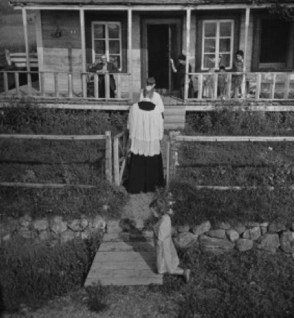
In the “old days,” the visit of the priest to bring Holy Communion and/or Anointing of the Sick was a matter of some formality. Most homes had a “Sick Call Set” on hand that included things like a crucifix, candles, a cloth, cotton, and a bowl of water. If the priest were on First Friday rounds he might even be escorted by a server with a lit candle. At other times, a family member might greet the priest at the door with a candle and escort the priest to the room where the sick person was. Family members usually stood by quietly while the priest administered the Sacraments. If the priest did talk with the sick person or the family, it was usually very brief. Since He had the Blessed Sacrament with him, casual talking was kept to a minimum. As he left, if he still had the Blessed Sacrament, he was again escorted by a family member with a candle.

Now what is described in the paragraph above did vary based on location and circumstances. First Friday Holy Communions were more formal than others. On the other hand, emergencies might cause the exclusion of some of the formalities. And there were also ethnic differences. Other factors (e.g., the catholicity of other family members and how devout each family was) were also taken into account. But what I described above was the usual practice, give or take a few details.

In recent times, though, most of these details have fallen away. As with so many things in our culture, we have become very casual, very informal with sick calls. But it may be beneficial for us to rediscover some of the older practices in order to restore greater reverence. I would like to suggest a few matters of protocol for your reflection. I will begin with a few disclaimers and then offer some suggestions.

Disclaimers:

  1. Not everything in the list that follows is possible or even advisable in every situation. Sometimes sick calls are hastily arranged due to emergencies, and preparing a sick call altar might mean time away from a distressed or dying relative. Sometimes in nursing homes all the implements are not available or even allowed. For example, many nursing homes do not permit the burning of candles. Hence, prudential judgment should be used to determine what is necessary, possible, or even advisable.
  2. Family situations may also affect the preparation of the sick call altar and other protocols. There may be no one in the home healthy enough to assemble the implements. There may be family members who are non-Catholic and choose not to participate in the rites and preparations.
  3. Not all the implements mentioned above are necessary for every sick call. Sometimes there will not be anointing. If that is the case, then a fair number of the items are not necessary. Even if there is an anointing, not every item may be required.
  4. What follows are recommendations only, not absolute requirements. The hope is to instill some thoughtfulness as to the reverence due to the occasion of a sick call. Reverence is not a pure science. Externals can and do help, but ultimately it is our internal disposition that is most important.
  5. Regarding these recommendations, take what you like and leave the rest. Add to them and distinguish as you wish. Discussion with your parish priest is also helpful.

Recommendations:

    1. Consider preparing the place where the sacraments will be celebrated. If possible and necessary, tidy up a bit.
    2. Consider preparing a sick call table or altar. Most commonly such a table includes at least a candle, and preferably a crucifix and two candles. A small glass of water is helpful since a sick person can sometimes have trouble swallowing the host. A spoon can be useful if the person has a hard time sitting up to drink the water. A napkin of some sort can help if the person spills any water when drinking. If the priest is going to anoint the sick person, it may be useful to have some cotton balls for him to wipe his fingers. If he does use them, though, they should later be burned. Bread and lemons can be used to help the priest to purify his fingers after anointing, but they are rarely necessary and should not be supplied unless the priest asks for them ahead of time.
    3. Sick call sets containing many of these items are available through Catholic catalogues (for example, HERE).
    4. If possible and advisable, have the sick person awake and aware that the sacraments are about to be celebrated.
    5. Be sure that when the priest, deacon, or extraordinary minister arrives, the television, radio, etc. are turned off and that other unnecessary conversations and activities in the house are ended.
    6. In the past, it was customary for someone to meet the priest at the door with a candle. This was done out of reverence for the Blessed Sacrament. This can still be done today and is a wonderful way to teach others of the sacredness of the moment.
    7. It is preferable to have all the members of the household prayerfully aware of what is taking place. If the room is large enough, they can all be encouraged to pray along. It may be necessary for some brief privacy while the priest hears confession, but otherwise, members of the household can and should join in prayer. It is certainly inappropriate for loud conversations to be taking place in the next room, for children to be playing video games, and for unnecessary activities to be taking place. Even non-Catholics should be respectful of the sacred rites. Usually just a word of invitation/encouragement is all that is needed.
    8. It is best for the priest, deacon, or extraordinary minister to celebrate the rites without delay. Surely a greeting is appropriate, but long conversations prior to the reception of sacraments is inadvisable. After the celebration of the sacraments, longer conversations may take place. Sometimes the priest, deacon, or extraordinary minister has other stops to make and thus is still carrying the Blessed Sacrament. In such a case it is not wrong to have a conversation with the sick person as an act of charity, but one ought to balance the fact of the presence of the Blessed Sacrament and the need for conversation with prudence and reverence. Staying for lunch and lengthy, chatty visits are discouraged in such cases.
    9. Reverential prayer and celebration of the rites is also necessary for those who bring Holy Communion.
    10. Those who bring Holy Communion to the sick should go immediately to them and not make stops along the way there. While transporting the Blessed Sacrament it is best to drive in silence, pray, or listen to religious music rather than secular radio.

So those are some of my recommendations. Remember that all of these are not possible all of the time. The recommendations are made in the hope of provoking thought and discussion about reverence in sick calls. They are made more as gentle reminders than polemical pronouncements. I do not assume that any one intends to be irreverent. It is just that we have become very casual these days and reminders seem opportune. I invite you to chime in with your additions and/or critiques in the comment section.

No Cross, No Crown: A Homily for the 29th Sunday of the Year

blog10-17In today’s gospel, the Lord Jesus speaks of crosses and crowns. The apostles have only crowns in mind, but the Lord Jesus knows the price of that crown. And so He must teach them and us that crowns—the things that we value most—come only through the Cross.

It may help to remember the context of this gospel. Jesus is making His final journey to Jerusalem. He is on his way to the Cross, having already announced this to His disciples on two occasions. But throughout this final journey they prove unwilling and/or incapable of grasping what He is trying to teach them.

Today’s gospel is a perfect illustration of a common biblical theme known as the “inept response.” This refers to the common pattern in the gospels wherein Jesus presents a profound and important teaching, and within a matter of verses, or sometimes even just a few words, the apostles demonstrate that they have absolutely no understanding of what He just told them.

Today’s gospel illustrates the inept response. You may recall that on the previous two Sundays, the Lord gave two critically important teachings. Two weeks ago he stood a young child in their midst and spoke of the child as being truly great. He also warned that we must be able to receive the kingdom of God like a little child. Last week, He warned of the pernicious effects of wealth and spoke about how hard it is for the rich to enter the kingdom of Heaven.

And yet as this gospel opens, on very heels of those teachings, James, John, and later all the apostles wish honors upon themselves. They want seats at the head of the table, high offices in the Kingdom, which they still conceive of in very worldly terms. Never mind that Jesus has taught them that the place of honor is not at the head of the table or even at the foot of the table; the honor is upon those who wait on tables.

And thus we see here the inept response. The apostles (and we) just don’t get it. No matter how clear Jesus is, no matter how often he repeats Himself, we just don’t get it.

Let’s look at this gospel in three specific stages.

I. Misplaced Priorities – The Gospel opens with James and John approaching the Lord with an inept question, even a demand. “Grant that in your glory, we may sit, one at your right, and the other at your left.”

As we have already seen, this is a misplaced priority. Their understanding of the place of honor is worldly. Further, they want to move right to the head of the table. They want the Lord to grant them this honor. Even in a worldly way of thinking, places of honor must usually be earned. While some are born into royalty, most attain leadership and honors only after years of effort. Thus, even from a worldly point of view, James and John are being utterly bold, exhibiting little understanding that prior to honors comes labor, comes the earning of those honors. Their priorities are misplaced. They want the crown but without the Cross.

II. Major Price – The Lord Jesus replies to them, “You do not know what you are asking! Can you drink the cup that I drink, or be baptized with the baptism with which I am baptized?”

Was Jesus astonished, was He amused, or was He sad? It is not easy to say. But the bottom line is clear: they had absolutely no idea what they were asking. And neither do we. So often we want blessings, honors, or seats in high places. But we give little thought to the crosses that are necessary both to get there and to stay there.

Those who finally do attain leadership often know what a cross it is. It can be lonely; there are many pressures; often there are many long hours and the heavy weight of responsibility. True leadership has its perks, but it is hard. Most leaders know also the consistent sting of criticism and isolation.

There is an old joke among bishops that goes something like this: “When a man becomes a bishop, two things are certain: he will never again have a bad meal, and he will never again hear the truth.” Leaders in many other walks of life know something very similar.

And thus the Lord Jesus wonders if James and John have any idea what they are really talking about, what they are really asking for. His question is also poignant, for He has been trying to teach them of the passion, the pain, the crucifixion that awaits Him, and which even He, the Lord of glory, must endure before entering into His glory. No, not only do they not know what they are asking, they just don’t get it.

And this must make the Lord very sad. Sometimes we underestimate the kind of suffering the Lord endured long before the garden of Gethsemane that fateful night, when the sufferings of His passion began in earnest. Prior to that evening, the Lord endured a kind of death by a thousand cuts: enemies trying to trap Him, crowds wanting medical miracles but no true healing, strident and judgmental Pharisees and other religious leaders, ridicule, and disciples who walked away from Him as he taught about the Eucharist. And even the Twelve, to whom He looked for friendship, seemed completely disconnected from what He was trying to teach them. He also knew that one would betray Him, another deny Him, and all but one would abandon Him, never making it to the foot of the Cross. Oh, the grief that they gave the Lord!

And, oh, the grief that we continue to offer up! How we continue to offend His external glory and be difficult cases for Him! How easy it is for us to be hardheaded and stubborn, to have necks of iron and foreheads of brass! No, we shouldn’t be so quick to scorn the apostles because we do the very same things.

The Lord can only remind them and us of the monumental price, the true cost. No Cross, no crown! Ultimately, Heaven costs everything, for we must leave this world behind to reach Heaven. The Easter Sunday of glory, whether in this world or in the world to come, is accessed only by a journey through Good Friday.

It is a major price, but it is a price that James and John seem to dismiss. They simply state, categorically, that they are able to drink the cup that the Lord drinks and to be baptized into His death. But they have no idea what they’re talking about, and neither do most of us.

III. Medicinal Prescription – The other apostles join in the inept response by becoming indignant that James and John are trying to get special dibs on the seats of honor. Their indignity simply shows that they also have no idea of anything that the Lord is talking about.

So the Lord tries to bring the big picture of the Cross more down to earth. He tries to make it plain. He says that the greatest in the kingdom is the servant of all, indeed, the slave of all. Is this straightforward enough? It is not those who sit at the head of the table, even those who sit at the foot of the table, nor at any place at the table who are the greatest; the greatest are those who wait on the table, who serve.

Do they get it? Probably not, and neither do we. It takes most of us a lifetime before we finally get it through our thick skulls that the point in life is not to have the corner office with the view. We have everything upside down, exactly backwards. We are not rich in what matters to God. We think of bank accounts, prestigious addresses, the square footage of our homes, big salaries, and impressive titles—not service.

We may be on our death beds before we finally realize that the greatest people in our lives are those with the ministry of care, those who feed us, perhaps change our bandages and give us basic care.

Like the apostles, we can be so foolish. At the end of the day, and at our final judgment, God will not care about the square footage of our house, our titles, or our worldly honors. What will capture His notice is the times when we served, when we gave a cup of cold water to the thirsty or food to the hungry, when we instructed the ignorant, prayed for the dying, or cared for needs of the poor. He will look for the calluses and the wounds of our service. He will listen for our proclamation of His kingdom. And He will tell us that what we did for the least of our brothers, we did for Him.

Don’t miss the point of this gospel. There is no crown without the Cross. In the Kingdom, honors and crowns are reserved for those who serve, who take up the cross of washing the feet of others, of going to the lowest of places.

In today’s gospel, the Lord speaks of crosses and crowns, and in that specific order. We will not, we cannot, gain any crown in His kingdom without being baptized into His death, into His Cross, into the humble servitude of dying for others in loving service.