What is Life?

blog-08-03What is life? It seems the simplest and most basic reality, but it is hard to define in a way that is satisfying. One philosopher I know defined it as “ordered energy.” But does that really advance the understanding of the mystery we call life?

Consider an example: I have in one hand a small rock, and in my other, an acorn. They are similar in both shape and color. Now I place each of them in the ground and water them. The small rock just sits there; even a thousand years of water and sunshine would do nothing to change it. But in the case of the acorn, the water is able to reach a mysterious spark of life within it and fuel its mysterious power. The life takes the water in and springs forth. Soon enough, it thrusts through the soil and over time becomes a mighty oak.

What is this secret, mysterious force we call life? Yes, it is ordered energy, but it is so much more than that.

When we say that someone dies, what has really changed?

I remember when my father died. After watching him struggle through weeks of labored breathing and agitation, it was eerie to see him lying so still; he was peaceful for the first time in weeks. His body was still warm, but he was gone. He was a giant in my life. The man through whom God gave me life lay still and silent. His life, his soul, his life-giving principle, his “ordered energy” was gone. No amount of words could fully describe the reality before me. On the surface, nothing appeared so very different. Surely he would stir in a moment and speak to me! He did not. The something mysterious we call life was gone. We can say that he died or that his life ended, but mere words do not explain, they only describe; they are empty sounds before so great a mystery.

I have also seen many of my pets die. One moment there is life and movement, the next a great stillness as the something we call life has departed. What is that mysterious force?

I don’t know.

On my street there are two elm trees. One is luxuriant and full of leaves. The other is dead; it bears no green leaves and its branches are brittle. Something is gone from it, but is that something called life?

I don’t know.

We speak often of that great mystery called life, but a word is not reality; it is just a word. The word “life” cannot really tell us what life is. Saying that something is alive is more to tell us that it is not dead, nor is it inanimate.

Many decades before his death, my father talked to me about the mystery of life. He told me that when he was about ten years old, a powerful thought occurred to him: “I exist.” So stunned was he that he said he stayed very quiet for the next three days, just being silent in the face of a mystery too great for him to fathom. I have had similar moments of reverential silence, when I ponder consciousness and self-awareness, or when I think about the fact that I am thinking.

It is altogether too much. Simple or even complex definitions cannot ultimately provide satisfaction.

The secularism of our time seeks to suppress such matters because they are about meaning, not just about physical things that can be touched and measured. The mysterious reality we call life does not weigh anything. It cannot be seen as it arrives or departs. Its effects can be seen, but “it” cannot be seen. We cannot say of life, “Look, there it is!” or “There it goes!” It is certainly real and it affects physical things profoundly. But of itself, it seems more metaphysical than physical and defies simple categorization.

The secularism of our time would hurry us past questions such as “What is life?” Neither would it have us dwell on other questions of meaning that the physical sciences cannot speak to, such as:

  1. What is my life all about?
  2. What is the ultimate destiny of all things?
  3. Why is there something rather than nothing?

“No, no,” say secularism, atheism, and scientism. “Hurry along now; there is nothing to see here.”

But pardon me if I am not content with being hurried along and if I insist that suppressing such questions does great damage to individuals and cultures as a whole. Without appreciation for imponderable mysteries, there is little reverence. Indeed, too few ask the question “What is life?” And even fewer accept the imponderable quality of such a question.

What is life? It is a mystery too deep for words. Silent reverence, please, before so great a mystery.

These are some of the lyrics of a song written by Steve Green, a contemporary Christian singer:

God and God alone, created all these things we call our own;
from the mighty to the small, the glory in them all;
Is God’s and God’s alone.
God and God alone reveals the truth of all we call unknown;
And the best and worst of man can’t change the Master’s plan;
It’s God’s and God’s alone.

Crack the Whip and the Common Good – Our Lives Are More Connected Than We Think

Blog-08-02We like to think that our personal decisions have little or no impact on others, but our lives are far more intertwined than we imagine. This is especially the case today, when social media can allow sinful and foolish ideas to catch fire and “go viral” in a flash. And although this happens with edifying information and helpful ideas as well, the bad stuff seems to spread more quickly. Why? Well, this is a fallen world, with a fallen angel for its prince, and we have fallen natures.

Therefore, do not so easily dismiss the influence that bad ideas and poor decisions can have on others. Also consider that what may not harm those who are blessed to have other good influences and/or economic options may damage those who are not so fortunate. This warning should especially apply to cultural leaders, who have substantial influence on the lives of others. Those in the public eye have a special obligation to consider how the way they live their lives and the ideas they propose may affect others.

To illustrate, consider the game “Crack the Whip,” which some of us may remember from our days on the school playground. The “game” involved 10 to 20 children forming a straight line. Each child reached back with one arm and took the hand of the one behind him to create a long chain. The child at the front of the line then took off running and everyone else behind followed, still holding hands. Suddenly, the lead child would take a sharp turn. The children immediately behind him were able to successfully negotiate the turn, but the further back one was, the harder it was to hold on. The children toward the end of the line didn’t stand a chance. They were flung off by the centrifugal force and usually ended up on the ground.

This is an analogy for our times. There are some, those at the “front of the line,” who are well-positioned to take their thrill rides, engage in social experimentation, and indulge greed and excess with minimal damage. Among them are some of the Hollywood elite, pop music stars, political leaders, wealthy financiers, Madison Avenue marketers, Wall Street investors, and many other cultural, social, business, and government leaders. But at the “back of the line,” the damage is awful.

Let’s consider two basic areas of life in which “Crack the Whip” is much in evidence: social/moral ills and economic ills.

Social/moral ills – At the very front of the line are those who have sharply turned towards excesses of every sort: drugs, alcohol, sex, revolving-door marriages, glamorization of all sorts of dangerous and deleterious behaviors. These often come with terrible personal consequences.

At the front of the line they can afford (financially and socially, though not morally) the consequences of what they do. They can pay for the stays in rehabilitation centers, the treatments for STDs, and the therapy for their children (who are traumatized by divorce and other issues caused by their parents’ indulgences).

But at the back of the line the drug use, sexual promiscuity and confusion, and the divorce culture have had far more devastating effects. Lacking access to treatment programs, the addicted poor go to jail. Diseases like AIDS and other STDs are less treated and spread more easily. Poor families are more rapidly devastated by sexual promiscuity and divorce. Children are raised without fathers. The socials ills multiply quickly. And surely we cannot neglect the poorest of the poor, the most vulnerable of all, the child in the womb. They have paid supremely, with their very lives, for the moral excesses of a culture like ours. The death toll is unimaginable and it almost never gets mentioned.

It’s a sad game of “Crack the Whip.” At the front of the line, all the misbehavior looks “fun,” even “glamorous.” But at the back of the line, folks go flying off in all directions, staggering and reeling.

I do not write to absolve the poor from all responsibility and merely blame the rich and powerful. Being mesmerized by the glamor of evil is a human problem; it affects all of us. But in the end we ought to consider how our cooperation (whether by active promotion or by sinful silence) in the glamorization of sin and excess affects others—especially those at the “end of the line.”

Economic illsThose at the front of the line can also afford the lifestyles that greed demands. They can generally afford to pay the higher prices of an overheated economy and a lifestyle that expects more and more.

The poor are fined for not having insurance. Many cannot afford to drive. They often face tremendous economic hurdles in trying to open small businesses or even keep their homes. College educations and even advanced degrees are (unreasonably) required for many jobs, but the cost is exorbitant. Obtaining a college education leaves many young people in debt for decades. And the poor are largely locked out of many options.

A few years back it became trendy to leave the stock market and enter the real estate market, buying and “flipping” properties. The market overheated, the cost of housing skyrocketed, and even the upper-middle class found it hard to afford basic housing. The “bubble” burst in 2008 and left the economy reeling. Investors took a few hits and got government bailouts, but mainly they just went back to investing in the stock market. They left in their wake devastated homeowners facing “underwater” properties and foreclosures.

“Gentrification” also accelerated, bringing with it all the difficulties of social dislocation. The poor are economically and literally being moved to the margins as the disturbances to the housing market are still working themselves out. Here in Washington, D.C. the poor are moved to the margins of what many call “Ward 9.” There are actually only 8 Wards in D.C.—being in “Ward 9” is a euphemism for being moved to the margins, outside the city that is increasingly losing its economic diversity. What used to be poor, working-class neighborhoods are now filled with houses sporting prices approaching one million dollars.

It’s a classic case of “Crack the Whip.” Those at the front of the line can adjust to sudden shifts in the economy and “play the market,” but at the back of the line the less privileged are sent flying, staggering as they fall and go off to the “Ward 9s” of our cities.

I am a priest, not an economist, and I realize that economic realities are very complex. I am not calling for all sorts of government intervention, but I do know what I see as a priest working among all social classes. I cannot and should not devise policy solutions; I leave that to the experts among the laity. But what I can and should do is to remind the folks at the front of the line to remember those at the back. “Crack the Whip” is fun and exciting when you’re at the front of the line, but devastating if you’re at the back.

We need to rediscover concern for the common good. We should look at our own behavior regardless of where we are in the line. I am my brother’s keeper; his welfare ought to be important to me. It’s not just about money; it’s about taking care to build a culture that thinks more about those at the back of the line and those yet to be born. What of them? How does my life and lifestyle affect them?

A Tour Guide in the Land of Ruin

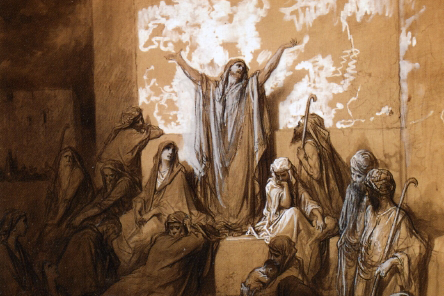
Feature-052014At Mass we are reading from the later chapters of Jeremiah the Prophet, who wrote in the time of the Babylonian exile. As such he serves as a kind of tour guide for us through a land of ruin, one that seems all too familiar to us today.

The Northern Kingdom of Israel had been destroyed by the Assyrians in 721 B.C. The Southern Kingdom of Judah, ignoring numerous warnings and calls to repentance, later experienced the same fate; the Babylonians laid siege and destroyed Jerusalem in 587 B.C. Just prior to this destruction, Jeremiah saw the glory of God lift from the Temple and move away to the east. The city and even the Temple now lay in ruins. The Ark of the Covenant was lost and the survivors were deported to Babylon.

Yes, it was a terrible destruction, but one that could have been avoided if the Lord’s people had only heeded the warnings of the prophets and returned wholeheartedly to the Lord and His commandments. With the Lord and within the safe walls of his commandments there is strength and protection. Outside the walls and His presence, Judah was a sitting duck, easy prey, low-hanging fruit.

Let’s consider the passage from Jeremiah (30:1-2.12-15.18-22) that we read at Mass today (Tuesday of the 18th Week) and see what the Lord says through Jeremiah. Let’s also ponder how this historical event speaks to our times as well.

I Ruin Thus says the LORD, the God of Israel: Incurable is your wound, grievous your bruise.

Yes, things have gone beyond simple medicines or bandages. These wounds are deep, foul, and festering. Sin does this to us spiritually as its evils go deeper and deeper. A simple skin cancer, untreated, can find its way into inner organs and even reach our bones. So, too, does sin, untreated by repentance, grow more serious. It renders us vulnerable to deeper and more serious sins that bring spiritual ruin, darkness, and a stubbornly unrepentant demeanor in which the cancer of pride is in its final stages. Judah has reached this stage and the only medicine that is left is for them to experience the full effects of their rejection of God.

And what of the once-Christian West? What of America? Can we possibly think that our cultural revolution, rooted in sinful rebellion against authority, sacred Tradition, the moral vision of the Scriptures, and the meaning of human sexuality and marriage can yield anything but corruption? Can our greed, our insatiable desire for more no matter the human (or monetary) cost, forever mortgage our future? Have not our wounds multiplied and gone deeper? The blood of our aborted children cries out to Heaven. Our broken families multiply due to promiscuity and rampant divorce; broken families yield a bumper crop of broken children as the cycle deepens. Are these wounds curable? Do we even show any willingness to take the necessary medicines of self-control, fidelity, and obedience to God’s vision? It seems not. Midnight fast approaches. As Jeremiah was once warned the people of his time, so must we in the Church today send up the warning cry that our wounds are getting worse, the intellectual and moral darkness is growing ever deeper, and our time to repent is getting shorter. Soon enough, as with Ancient Israel and Judah, the full bill for our sin will come due.

Scripture says,

Do not be deceived: God is not mocked, for whatever one sows, that will he also reap. For the one who sows to his own flesh will from the flesh reap corruption, but the one who sows to the Spirit will from the Spirit reap eternal life. And let us not grow weary of doing good, for in due season we will reap, if we do not give up. So then, as we have opportunity, let us do good to everyone, and especially to those who are of the household of faith (Gal 6:7-10).

II Rejection There is none to plead your cause, no remedy for your running sore, no healing for you. All your lovers have forgotten you, they do not seek you.

Among the things that the ancient Jews did was to run after other lovers and other remedies. They were entangled in foreign military alliances and were too enamored of pagan culture and religion. God spoke of their running after pagan gods as infidelity and adultery, for they were espoused to Him.

And as for us, in the formerly Christian West, while not espoused to God as a nation (but surely as members of the Bride of Christ), we too have often sought solutions far from God, even solutions opposed to Him. We have cast aside God’s plan for our happiness and bought into the notion that worldly indulgence and sin will bring us happiness and health. In so doing we call God a liar and forsake our covenant with Him. We run after other lovers, trusting the world, the flesh, and the devil instead of our God who made us and saved us. Secular mindsets and even outright atheism have made deep inroads into our culture. Church attendance has plummeted while attention to the “bread and circuses” of the modern world has reached new highs. We trust our affluence, power, medicine, and science (all themselves great gifts of God), but we do not trust the true Shepherd and Lord of our souls, the only one who can really save us.

And where are these philosophers that pose as healers and lovers, who have ushered in this ruin, now? They are doubling down on their false prescriptions and going ever deeper into darkness, repeating the lies of these worldly philosophies, glorying in the flesh, and marginalizing the vision of God. Moderns cry out “Love!” and speak of compassion. But it is a false love and a false compassion.

The text asks, “Where are these lovers now?” Where is the happiness and fulfillment they promised with their false notions of freedom? Yes, where are they?

III. Reason I struck you as an enemy would strike, punished you cruelly; Why cry out over your wound? your pain is without relief. Because of your great guilt, your numerous sins, I have done this to you.

The effects and consequences of sin cannot forever be postponed. Even if God mercifully protects us from some of the consequences, he will not do so forever. God’s patience is directed toward our salvation. He gives us time to repent. But at some point (known only to Him) our presumptiveness eclipses His patience. The boil must be lanced; gangrenous tissue must be cut away. Only strong, even desperate, measures will work; they may seem to us to be cruel. But to do nothing would be to lose all, and that is a far worse cruelty. Our sins and unrepentance “force” these difficult measures, so that at least a few might be saved.

When does a person, a culture, or a nation reach such a point? God only knows. But why test the situation and draw this necessary measure? The Lord says,

“… O Israel, if you would but listen to Me! ‘You shall not have in your midst a foreign god; you shall not bow to an alien god. I am the LORD your God Who brought you up out of the land of Egypt’—open wide your mouth, and I will fill it.” But My people did not listen to My voice, Israel did not yield to Me; so I set him free with their stubborn heart, that they could follow their own counsels. O that My people would listen to Me, that Israel would follow My ways! At once I would subdue their enemies, against their foes bring back My hand. Those who hate the LORD shall cringe before Him; their doom will last forever. But He would [rather] feed him the finest wheat: and sate you with honey from the rock. (Ps 81:9-17).

IV. Restoration Thus says the LORD: See! I will restore the tents of Jacob, his dwellings I will pity; City shall be rebuilt upon hill, and palace restored as it was. From them will resound songs of praise, the laughter of happy men. I will make them not few, but many; they will not be tiny, for I will glorify them. His sons shall be as of old, his assembly before me shall stand firm; I will punish all his oppressors.

God permits these terrible ills to befall His people so that He might save at least some, a faithful remnant.

The people of Israel spent eighty years in Babylon, and then as if miraculously, God brought them back. The Babylonians were defeated by the Persians; Cyrus, King of Persia, permitted them to return to their land and even offered to help rebuild Jerusalem! Now that there is a purified remnant, God will begin again with His people. Future purifications will also be necessary.

And what of us? In times of old, there was a faithful remnant that did not fully succumb to the darkness of the days. There were others who did repent; it is for their sake that God acts to bring an end to widespread evil lest all of His people be consumed. Though none of us has lived perfectly, through repentance we should seek to be the faithful remnant whom God acts to save. We are likely going to see even darker days before the evil of our times plays out and is purged. The battle is the Lord’s. For our part, we should seek to stay faithful, repent when we fall, and look to the day when God will restore this world or come again in glory.

The Church has survived many ups and downs in this world. Empires have risen and fallen, nations and cultures have come and gone, but we are still here proclaiming the Gospel, in season and out of season, until the Lord shall come.

What is your mission and mine? Be the remnant! Yes, Lord, do what you need to do, but please, help some of us to stay faithful!

V. Reunion His leader shall be one of his own, and his rulers shall come from his kin. When I summon him, he shall approach me; how else should one take the deadly risk of approaching me? says the LORD.  You shall be my people, and I will be your God.

Here is the endgame. Whatever the ups and downs of this world, the Lord’s ultimate work for each of us is to restore ourselves to union with Him. Jesus came to give us access to the Father through the shedding of His precious blood. Jeremiah’s word to us is to stay faithful unto death, when we will be summoned to the Father, and by the grace of our Lord Jesus approach Him with the confidence of holiness granted to us by that grace. The Book of Hebrews describes this and gives us both hope and an exhortation.

Therefore, brothers, since we have confidence to enter the holy places by the blood of Jesus, by the new and living way that he opened for us through the veil, that is, through his flesh, and since we have a great priest over the house of God, let us draw near with a true heart in full assurance of faith, with our hearts sprinkled clean from an evil conscience and our bodies washed with pure water. Let us hold fast the confession of our hope without wavering, for he who promised is faithful. And let us consider how to stir up one another to love and good works, not neglecting to meet together, as is the habit of some, but encouraging one another, and all the more as you see the Day drawing near (Heb 10:19-25).

Thus a quick tour through a ruined land, but with our eyes set on a glorious reunion.

Meanwhile, be the remnant and stay faithful, by His grace. Let God do His work. Maranatha!

Beware the Deception of False Prophets

Blog-07-31In today’s first reading (Monday of the 18th Week) the Prophet Jeremiah denounces the false prophets of his day, who promise all sorts grand visions for Israel despite its sin. Jeremiah says to the people, By breaking a wooden yoke, you forge an iron yoke! (Jer 28:13) In other words, by failing to repent (breaking the wooden yoke) you shall know an iron yoke. (Think about the addiction to sin of many who do not show restraint earlier in life.) To the false prophets of his day Jeremiah said, The LORD has not sent you, and you have raised false confidence in this people (Jer 28:15). Confidence is a good thing, but false confidence is terrible in its deception.

False prophets deceive God’s people; their words are worse than silence. There are many false prophets today who tickle people’s ears, assuring them that what God calls sins is actually progressive and glamorous.

A great clarion call goes up quite often in Scripture: “Do not be deceived!” This call must go up as never before, because we live in times of great deception. So many have been deceived about marriage, sexuality, the existence of God, and what life is really all about. And while there is widespread deception in our current times, deceiving and being deceived are common human tendencies, especially given the fallen human condition. Scripture speaks often of this problem, and we do well to look to some of the texts and see what they have to teach us.

Perhaps it is good to look first to the Latin and Greek roots of the word deceive.

Latin: The Latin root of deceive is decipere, meaning to ensnare (de (of or up) + capere (to seize or take)). And thus the Latin emphasizes our tendency to be easily caught up or carried away, to be ensnared by error. It evokes the image of an animal being carried off as prey in the mouth of a lion. We are so easily carried away by the latest fashions, trends, and thinking of the world. And having been carried away, we are ensnared by error and to some degree cut off from the truth.

Greek: There are several words in the Greek New Testament that are translated as deceive in English. By far the most common is πλανάω (planao), meaning to go astray, to wander off course, to deviate from the correct path, to roam into error, to be misled. (Planao is the also the Greek root of the English word planet (literally, wandering body)). In the Greek New Testament, this term nearly always conveys the sin of roaming from the truth. And thus we see that the Greek emphasizes that we go astray or are led astray, that we wander off. Isaiah the prophet lamented, All we like sheep have gone astray; every one to his own way (Is 53:6). Yes, and if sheep are wayward animals, human beings are more so, for at least a sheep knows its master’s voice. Too many of us will listen to and follow anyone but the Lord.

We humans are involved in deception in three different ways.

I. We are sometimes the victim of deception. The Scriptures frequently warn, “Do not be deceived.” Jesus warned, At that time many will fall away and will betray one another and hate one another. Many false prophets will arise and will mislead many (Mat 24:11).

St. Paul also lamented false apostles and Judaizers who misled many. He warned, savage wolves will come in among you, not sparing the flock; and from among your own selves men will arise, speaking perverse things, to draw away the disciples after them (Acts 20:29-30). He also spoke of some who will fall away from the faith, paying attention to deceitful spirits and doctrines of demons (1 Tim 4:1).

St. John warned of the spirit of the antichrist, which you have heard is coming and even now is already in the world (1 John 4:3).

Thus to some degree we are victims of deceivers. The Scriptures warn us to be on our guard: Do not be deceived! We are not to allow these deceivers to lead us astray, to make us wander about in error and sin. We are to resist them and see them for the deceivers they are.

II. We can be among those who deceive (though hopefully this is less frequent). This refers to something deeper than the more common human foible of lying. The deception here involves misleading people in matters of the true faith.

God warns deceivers, Why do you boast of evil, you wicked man? Why do you boast all day long, you who are a disgrace in the eyes of God? You who practice deceit, your tongue plots destruction; it is like a sharpened razor. You love evil rather than good, falsehood rather than speaking the truth. You love every harmful word, you deceitful tongue! Surely God will bring you down to everlasting ruin (Psalm 52:1-5).

God declares a curse on those shepherds who mislead His flock: “Woe to the shepherds who mislead and scatter the sheep of My pasture!” declares the LORD. Therefore, thus says the LORD God of Israel concerning the shepherds who are tending My people: “You have scattered My flock and driven them away, and have not attended to them; behold, I am about to attend to you for the evil of your deeds” (Jer 23:1-3).

Jesus declares, If anyone causes one of these little ones—those who believe in me—to stumble, it would be better for them to have a large millstone hung around their neck and to be drowned in the depths of the sea (Mat 18:6).

St. Paul speaks of the lot of deceivers: But evil men and impostors will proceed from bad to worse, deceiving and being deceived (2 Tim 3:13).

III. We can connive in deception. This final category is perhaps the most troubling of all. It is a kind of a middle ground between being a victim of deception and a perpetrator of deception. We allow deceivers to speak to us, and not only do we not rebuke them for their deception, we actually perk up our ears and say, in effect, “Please go on; tell me more!”

We do this because to some degree we want to be deceived. We want to be affirmed in our sin, in our weakness. Many want the truth to be watered down and are delighted to listen to those who call into question the demands of righteousness. Yes, many of us connive; we enter into partnership with the deceivers.

Many of the warnings that we “not be deceived” are not simply alerting us to the presence of deceivers; they are cautioning us to be wary our own tendency to enter into agreement with those would deceive us. In this context, the warning, “Do not be deceived,” takes on more of this tone:

“Don’t kid yourself; don’t tell lies to yourself; don’t go on playing the fool. You know better. The voice of God echoing in your conscience bears witness to the fact that you’re lying to yourself and you’re letting others lie to you.”

Premier among the “conniving” texts is St. Paul’s warning to Timothy: For the time will come when people will not tolerate sound doctrine. Instead, to suit their own desires, they will gather around them a great number of teachers to say what their itching ears want to hear, and will turn away from the truth (2 Tim 4:3).

What are some of the common things people “want” to be deceived into believing? A brief survey of Scripture reveals this. (I have boldfaced the various forms of the word deceive to illustrate that God is teaching us about the various forms of this sinful connivance.)

A. That our actions will not have consequences: Do not be deceived: God is not mocked, for whatever one sows, that will he also reap. For the one who sows to his own flesh will from the flesh reap corruption, but the one who sows to the Spirit will from the Spirit reap eternal life (Galatians 6:7-8).

B. That faith can be perfunctory, intellectual, or mere lip service; that good intentions are enough; that one can love the world: But be doers of the word, and not hearers only, deceiving yourselves … If anyone thinks he is religious and does not bridle his tongue but deceives his heart, this person’s religion is worthless. Religion that God our Father accepts as pure and faultless is this: to look after orphans and widows in their distress and to keep oneself from being polluted by the world (James 1:22-27).

Hear the word of the Lord, all you men of Judah who enter these gates to worship the Lord. Thus says the Lord of hosts, the God of Israel: Amend your ways and your deeds, and I will let you dwell in this place. Do not trust in these deceptive words: “This is the temple of the Lord, the temple of the Lord, the temple of the Lord.” If you really change your ways and your actions and deal with each other justly, if you do not oppress the foreigner, the fatherless or the widow and do not shed innocent blood in this place, and if you do not follow other gods to your own harm, then I will let you live in this place, in the land I gave your ancestors for ever and ever. But look, you are trusting in deceptive words that are worthless. Will you steal and murder, commit adultery and perjury, burn incense to Baal and follow other gods you have not known, and then come and stand before me in this house, which bears my Name, and say, “We are safe—safe to do all these detestable things?” Has this house, which bears my Name, become a den of robbers to you? But I have been watching! declares the Lord (Jeremiah 7:1-11).

C. That sexual sin is no big deal: Do not be deceived: Neither the sexually immoral nor idolaters nor adulterers nor men who have sex with men, nor thieves nor the greedy nor drunkards nor slanderers nor swindlers will inherit the kingdom of God (1 Cor 6:9-10).

Be sure of this, no fornicator, impure or greedy person—such a person is an idolater—has any inheritance in the kingdom of Christ and of God. Let no one deceive you with empty words, for because of such things God’s wrath comes on those who are disobedient. For you were once darkness, but now you are light Therefore, do not be partners with them. in the Lord. Live as children of light … and find out what pleases the Lord. Have nothing to do with the fruitless deeds of darkness (Eph 5:5-11).

When lust has conceived, it gives birth to sin; and when sin is accomplished, it brings forth death. Do not be deceived, my beloved brethren (James 1:16).

D. That regular consort with sinners will not affect us: Do not be deceived: “Bad company corrupts good morals.” Become sober-minded as you ought, and stop sinning; for some have no knowledge of God. I speak this to your shame (1 Cor 15:33).

But encourage each other daily, while it is still today, so that none of you is hardened by sin’s deception (Heb 3:13).

E. That we can wholly avoid deception and error apart from Scripture and the teaching of the Church: Jesus answered them, “You are deceived, because you don’t know the Scriptures or the power of God” (Matt 22:29).

Wickedness deceives those who are perishing. They perish because they refused to love the Truth and so be saved (1 Thess 2:10).

This, then, is a brief excursus on the lamentable human tendency to wander, to be carried off, to be deceived. And frankly, too many of us want to be deceived. Be alert to this deep drive rooted in sloth and pride; learn its moves and despise its lures.

You Can’t Take It with You, But You Can Send it on Ahead! Five Teachings on Wealth

Blog-7-30The Gospel today is not merely a warning against greed; it is an instruction on income and wealth given by Jesus to help us root out greed. As the Gospel opens, the problem of greed is presented. Following that, a prescribed perspective on wealth is offered. Let’s take a look at both parts of this Gospel.

I. The Problem that is Portrayed The text begins, Someone in the crowd said to Jesus, “Teacher, tell my brother to share the inheritance with me.” He replied to him, “Friend, who appointed me as your judge and arbitrator?” Then he said to the crowd, “Take care to guard against all greed, for though one may be rich, one’s life does not consist of possessions.”

Note that Jesus turns to the crowd (to avoid personally indicting the man for something of which all can be guilty) and warns without ambiguity that greed must be guarded against. Greed is the insatiable desire for more. It is to want possessions inordinately, beyond what is reasonable or necessary.

Greed is often downplayed today; accumulation and the ostentatious display of wealth are often celebrated.  Great rooms with cathedral ceilings, huge flat screen TVs (even private home theaters), and fancy cars are shamelessly flaunted.

Greed is at the root of a lot of evils and suffering. Scripture says,

For we brought nothing into the world, and we cannot take anything out of the world; but if we have food and clothing, with these we shall be content. But those who desire to be rich fall into temptation, into a snare, into many senseless and hurtful desires that plunge men into ruin and destruction. For the love of money is the root of all evils; it is through this craving that some have wandered away from the faith and pierced their hearts with many pangs (1 Tim 6:7-10).

These are indeed very strong words. Greed causes us to be discontented and ungrateful, both of which are signs of unhappiness. It also leads us into temptations, into snares or traps that set loose harmful desires that seem to expand in ever increasing ways. And this desire for more too easily leads us to personal destruction, and to inflict great harm, insensitivity, and injustice upon others.

On account of greed we almost never say, “I have enough; I will give away the rest or use it for the benefit of others.” Many also wander away from the faith because wealth is generally tied to this world and its demands, and they feel they have “too much to lose.” Hence the faith is set aside in favor of the world; greed overrules God and the demands of the Gospel.

The Lord will develop more of this in the parable ahead. But for now, note that the Lord warns about the serious and destructive problem of greed. This is the problem that is portrayed.

II. The Perspective that is Prescribed But the Lord does not simply condemn greed. He goes on to tell a parable that strives to provide a proper perspective on wealth. In itself, wealth is not evil. But without the proper perspective, we too easily fall into greed. Hence the Lord provides five teachings on wealth to help us to keep it in perspective and to avoid greed.

A. The INITIATION of wealth The text says, There was a rich man whose land produced a bountiful harvest. 

Notice that it is the land, not the man, that yields the increased harvest. Whatever we have has come from God and what God has given. Scripture says,

  1. But remember the LORD your God, for it is he who gives you the ability to produce wealth (Deuteronomy 8:18).
  2. The earth is the Lord’s and the fullness thereof, the world and those who dwell therein (Psalm 24:1).
  3. Every good and perfect gift is from above, and comes down from the Father of lights, with whom is no variableness, neither shadow of turning. (James 1:17).
  4. What do you have that you did not receive? And if you did receive it, why do you boast as though you did not? (1 Cor 4:7)

As such, wealth is not bad or evil. But we must never forget that God is the true owner of all things while we are the stewards. An old song says, “God and God alone created all these things we call our own: From the mighty to the small the glory in them all is God’s and God’s alone.”

God provides the increase and is the initiator of every blessing, but God remains the owner. As stewards, we are expected to use what belongs to God in accord with what He, the true owner, wills. Too easily we forget this and usher in many woes.

What is the will of God regarding our wealth? The Catechism speaks of God’s will as the “Universal Destination of Goods.”

God gave all the goods of the earth for all the people of the earth. This means that the goods of creation are destined for the whole human race…In his use of things man should regard the external goods he legitimately owns not merely as exclusive to himself but common to others also, in the sense that they can benefit others as well as himself. The ownership of any property makes its holder a steward of Providence, with the task of making it fruitful and communicating its benefits to others, first of all his family (Catechism 2402, 2404).

If we will remember that we are stewards of God’s gifts and that He ultimately intends all to be blessed, we can understand that greed is a form of theft, for it inordinately clings to what should be given to another out of justice. If I have two coats, one of them belongs to the poor.

Remembering that the initiation of my wealth is God. I can help to avoid greed by using my wealth for the purposes God intends. It is not just for me; it is for all the people of this world.

B. The INCONVENIENCE of wealth – The parable continues, He asked himself, ‘What shall I do, for I do not have space to store my harvest?”

The man is burdened by his wealth because he does not consider generosity an option. “What shall I do?” he asks anxiously. To be honest, great wealth does bring comfort, but it is also a source of inconvenience. Consider just a few things that usually go along with wealth:  locks, alarms, storage facilities, insurance, worries, fears, repairs, maintenance, and upgrades. We live in an affluent age, but just think about the stress! Consider also the loss of other, more important values. We have bigger houses but smaller families; our “McMansions” are really more houses than homes.

Scripture says,

  1. The rest of a laborer is sweet, whether he eats little or much, but the abundance of a rich man permits him no sleep (Eccl 5:12).
  2. Better is a little with the fear of the LORD than great treasure and trouble with it (Prov 15:16).
  3. Better a dry crust with peace and quiet than a house full of feasting, with strife (Prov 17:1).
  4. Whoever loves money never has money enough; whoever loves wealth is never satisfied with his income. This too is meaningless (Eccl 5:10).

So wealth certainly has its comforts, but it also brings with it many inconveniences that make our lives more stressful and complicated. Better to be free of excessive wealth in accordance with God’s will than to be burdened by it. This is another perspective that helps us to avoid greed.

C. The ILLUSION of wealth The parable goes on to say, And [the man] said, “This is what I shall do: I shall tear down my barns and build larger ones. There I shall store all my grain and other goods and I shall say to myself, ‘Now as for you, you have so many good things stored up for many years, rest, eat, drink, be merry.’”

Here we are taught that riches easily lead us to an illusion of self-sufficiency. We start to rely on self and on riches instead of on God. But as we shall see, the man’s wealth will utterly fail him before the night is out.

Riches can buy us out of temporary troubles, but it cannot help with the central problem we face. No amount of money can postpone our appointment with death and judgment. Riches can get us a first class cabin on the ship, but on the “Titanic” of this world we are in no better shape than the people in steerage. In fact, because of the illusion it creates wealth will more likely hinder us in our final passage. For it is only in trusting in God that we can make it to the other shore. Too much wealth and self-reliance can hinder our capacity to call on the Lord and trust Him. Yes, wealth tends to create an illusion that cripples us from reaching our goal. Scripture says,

  1. But man, despite his riches, does not endure; he is like the beasts that perish. This is the fate of those who trust in themselves, and of their followers, who approve their sayings (Ps 49:12).
  2. Command those who are rich in this present world not to be arrogant nor to put their hope in wealth, which is so uncertain, but to put their hope in God, who richly provides us with everything for our enjoyment (1 Tim 6:17).
  3. Whoever trusts in his riches will fall (Prov 11:28).
  4. For the sun rises with its scorching heat and withers the grass; its flower falls, and its beauty perishes. So will the rich man fade away in the midst of his pursuits (James 1:11).
  5. Give me neither poverty nor riches, but give me only my daily bread. Otherwise, I may have too much and disown you and say, “Who is the LORD?” Or I may become poor and steal, and so dishonor the name of my God (Prov 30:8).

An old gospel song says, “Well the way may not be easy, but you never said it would be, ’cause when my way gets a little too easy you know I tend to stray from thee.”

The illusion of riches is well illustrated in the modern age. Our wealth has tended to make us less religious, less dependent on God. But really, can all our wealth, power, technology, and science ultimately save us? We know that it cannot.

Yet strangely we entertain the illusion of wealth anyway. Like the man in the parable, we think, “Now I’ve got it; now I’m all set.” This is an illusion, a set up. Coming to see it for the illusion that it is will help us to avoid greed.

D. The INSUFFICIENCY of wealthBut God said to him, “You fool, this night your life will be demanded of you; and the things you have prepared, to whom will they belong?”

And thus we see the illusion give way to the reality of insufficiency. Scripture says,

  1. There are men who trust in their wealth and boast of the vastness of their riches. But no man can buy his own ransom, or pay a price to God for his life. The ransom of his soul is beyond him. He cannot buy life without end nor avoid coming to the grave. He knows that wise men and fools must perish and leave their wealth to others. Their graves are their homes for ever, their dwelling place from age to age though their names spread wide through the land. In his riches man lacks wisdom, he is like the beast that perish (Psalm 49:5).
  2. For what will it profit a man, if he gains the whole world and forfeits his life? Or what shall a man give in return for his life? (Mat 16:26)

Money, wealth, power, popularity, and prestige can never really get us what we need. We have sought so many saviors in this world, thinking they can somehow save us.

  1. SCIENCE can’t you save me? No, I can’t save you. I can tell you how far it is from the Earth to the Sun. I can tell you how to fly in rocket ships into outer space, but I can’t tell you how to climb to Heaven. I can’t save you.
  2. PHILOSOPHY can’t you save me? No, I can’t save you. I can tell you more and more about less and less until you know everything about very little. I can tell you about the thoughts and opinions of the greatest thinkers, but I can’t save you
  3. EDUCATION can’t you save me? No, I can’t save you. I can make you smart, but I can’t make you wise. I can’t save you.
  4. CULTURE can’t you save me? No, I can’t save you. I can make the world a more beautiful and entertaining place from which to go to Hell, but I can’t save you.
  5. ECONOMICS, can’t you save me? No, I can’t save you. I can make you richer, but not rich enough to buy your salvation. I can’t save you.
  6. POLITICS, can’t you save me? No, I can’t save you. I can give you access to worldly power, but the world as we know it is passing away. I can’t save you.

At the end of the day, this world and all of its riches cannot save us; only God can do this. This is another perspective on wealth that helps us to avoid greed.

E. The INSTRUCTION about wealth – The parable concludes, Thus will it be for all who store up treasure for themselves but are not rich in what matters to God.

As we have already remarked, wealth is not intrinsically evil. It is our greed that is sinful and gets us into trouble. Greed clings to wealth unreasonably and excessively. With greed, we “store up treasure for ourselves and are not rich in what matters to God.”

So what matters to God? What matters is that we be rich in justice, mercy, love, holiness, and truth; that we be generous sharers of the bounty He bestows. And thus the Lord teaches us to share what we have generously, above what we do not need. Consider the following teachings:

  1. I tell you, use worldly wealth to gain friends for yourselves, so that when it is gone, you will be welcomed into eternal dwellings (Luke 16:9).
  2. Do not store up for yourselves treasures on earth, where moth and rust destroy, and where thieves break in and steal. But store up for yourselves treasures in heaven, where moth and rust do not destroy, and where thieves do not break in and steal (Mat 6:19).
  3. Command those who are rich in this present world not to be arrogant nor to put their hope in wealth, which is so uncertain, but to put their hope in God, who richly provides us with everything for our enjoyment. Command them to do good, to be rich in good deeds, and to be generous and willing to share. In this way they will lay up treasure for themselves as a firm foundation for the coming age, so that they may take hold of the life that is truly life (1 Tim 6:17-19).

There is an old saying that “You can’t take it with you.” And this is true, but only partially. The Lord suggests that we can send our wealth on ahead, that we can store it up in Heaven, that we can invest it in eternity. How? Do we put our gold in a balloon and float it up into the sky? No, we send it up, we send it on ahead by bestowing it on the poor and the needy. This can include our family members, for charity begins at home, but it does not end there. Our generosity should extend beyond the family to many of the poor.

If we do this the Lord teaches that the poor we bless will welcome us to Heaven and speak on our behalf before the judgment seat. The Lord says that when we bless the poor our treasure will be great, and safe in Heaven. Further, our generosity and mercy will benefit us greatly on the day of judgment and help us, as St. Paul says above, to lay hold of the life that is truly life.

So you can’t take it with you, but you can send it on ahead.

This final teaching or perspective on wealth is that we should be rich in what matters to God by being generous, not greedy.

And thus we have five teachings on wealth meant to give us perspective, so as to avoid greed.

Trust God! Greed is rooted in fear, but generosity trusts that God will not be outdone in generosity! While our greatest rewards remain in Heaven, God sends “interest payments” to the generous even now. Scripture says,

  1. One man gives freely, yet grows all the richer; another withholds what he should give, and only suffers want. A generous man will be enriched, and one who waters will himself be watered (Prov 11:24).
  2. Cast your bread upon the waters: after many days it will come back to you (Eccl 11:1).
  3. Give, and it will be given to you; good measure, pressed down, shaken together, running over, will be put into your lap. For the measure you give will be the measure you get back (Luke 6:38).

Since you can’t take it with you, you might as well send it on ahead. Guard against greed by allowing these five teachings on wealth to give you a proper perspective on wealth.


Love, It’s What God Does – As Seen in a Commercial

Blog-07-29I enjoy the GEICO “It’s what you do” commercials (which I manage to see in the less than one hour of television I watch each day). They remind me of a sort of syllogism I’ve used to explain why Gods loves us: God loves us because God is love. When love is what you are, love is what you do. Therefore, God loves.

Why does God love us? Because God is love and that is what love does: it loves.

God does not love us because we are good or because we deserve it; He loves because He is love.

Enjoy this “It’s what you do” commercial. It illustrates the old maxim agere sequitur esse (action follows being). In other words, what one does follows from what one is.

Sports as an Image of the Christian Life

68875In several places, St. Paul used the image of an athlete to describe the Christian life. Consider this one:

Do you not know that the runners in the stadium all run in the race, but only one wins the prize? Run so as to win. Every athlete exercises discipline in every way. They do it to win a perishable crown, but we an imperishable one. Thus I do not run aimlessly; I do not fight as if I were shadowboxing. No, I drive my body and train it, for fear that, after having preached to others, I myself should be disqualified (1 Cor 9:25-27).

Clearly there are many virtues of the athlete that are also of great necessity to the Christian.

  • Discipline – The athlete must carefully and regularly train his body. Without this discipline, he will not master the sport nor will his body have the necessary stamina, strength, and coordination. Athletes train every day and work to master their sport. So too must Christians be disciplined and train themselves in the ways of faith through prayer, scripture, the sacraments, moral virtue, and self-mastery. The Christian must practice every day.
  • Persistence – The athlete must be disciplined all the time, not just occasionally. To fail in persistent training not only jeopardizes good performance but also risks injury. So too for the Christian. We cannot expect much progress with an on-again, off-again regimen. Without the habit of persistent prayer, scripture, the sacraments, and moral virtue the Christian not only stunts his progress but also risks injury (sin).
  • Rules – Every sport has rules that must be accepted and followed. Athletes are not free to reinvent the game. They must play by the rules or risk exclusion and/or disqualification. So too the Christians must play by the rules set by God. If we are going to be on the winning team and secure the victory, we have to abide by the rules. To refuse this is to risk being disqualified. We are not free to reinvent Christianity as so many try to do today. There is only one playing field and one game. Follow the rules or be ejected.
  • Alert for Injury – A good athlete listens carefully to his or her body and watches for any sign of injury. If athletes detect an injury they see the team doctor and take measures to heal as quickly as possible. Athletes also avoid injury by learning proper form, stretching, etc. So too for the Christian. We must monitor ourselves for injury; upon discovery of even a minor injury we should consult our team physician (a priest) and get on the mend quickly. Further, we should try to avoid injury by learning proper Christian form (a moral life) and avoiding whatever leads us to sin (a kind of “stretching” so as to avoid moral injury).
  • Teamwork – Many sports involve a group of athletes working together toward the goal. Athletes cannot merely seek glory for themselves; they must have the good of the whole team in mind. They must learn to work with others for the common good and overcome any idiosyncrasies or selfishness that hinder the achievement of the common goal. So too Christians must strive to overcome petty and selfish egotism and work for the common good, learning to appreciate the gifts of others. The team is stronger than the individual alone. Life is about more than just me. When others are glorified so am I, if I am on the same winning team.

Why not add a few of your own thoughts on how engagement in sports is an analogy for the Christian life?

What would happen if we applied some of the principles of this video to the Christian life?

How Long, O Lord? A Meditation on Anger and Disappointment

prayerIn times like these, filled with moral confusion and acts of terrorism (including the recent murder of a French priest by self-proclaimed “soldiers of ISIS”), it is natural to cry out “How long, O Lord!” Indeed, among the struggles that many face in their spiritual lives are anger with God and feelings of discouragement due to the seeming lack of relief from Him.

The knowledge that God can prevent bad things often leads to the expectation that he should. And then when such expectations are not met, resentment, disappointment, or anger can follow.

Sometimes our anger at God is obvious to us. At other times, however, it can manifest itself more subtly: depression, spiritual sadness, avoidance of God and spiritual things, loss of hope, or a reduction in asking things of God in prayer. Sometimes, too, we like to minimize our anger by saying that we are merely “disappointed,” or “frustrated.”

But the reality is that at times we are angry with God, sometimes very angry. What to do about this anger?

God Himself seems to say over and over again in the Scriptures that He wants us to talk to Him about it, to tell Him that we are angry, and to pray out of this reality in our life.

God actually models this in the Scriptures. The book of Psalms is the great prayer book that God gave to Israel. In the Psalms is enshrined every sort of human experience and emotion: joy, exultation, hope, gratitude, dejection, hatred, despair, and anger—yes, even anger at God. God Himself, through the Holy Spirit, authors the very prayers of the Psalms. He tells us, in effect, that every human emotion is the stuff of prayer. He models for us how to pray out of our experiences, not only of joy and gratitude, but also of despair and anger. God says that whatever you’re going through should be the focus of your prayer.

Thus, God tells us that even if we are angry with Him, we should speak to Him about it. And He does not ask us to mince words, to minimize our emotions, or even to speak politely.

One of the most common expressions of anger toward God in the Scriptures appear in what might be called the “usquequo verses.” The Latin word usquequo is most literally translated “how long?” And thus, in the Psalms and in other verses of Scripture, will often come the question, “How long, O Lord?”

While the adverb usquequo can simply be part of a straightforward question such as “How long until lunch?” it is usually used in rhetorical fashion, such as when one asks “How long?” in a plaintive and exasperated tone, as in “How much longer?” It’s as if to say, “O Lord, why do you let this awful situation go on? Where are you?” Thus, the word bespeaks not only disappointment, but also a certain feeling of injustice that God would care so little about us that He would allow such terrible things to go on for so long.

God knows that we sometimes feel this way. And even if our intellect can supply some possible reasons that God would allow bad things to go on, or that He is not entirely to blame for the mess that we’re in, still it is clear that our feelings often are not satisfied with any rational explanation. And we simply cry out, “How long, O Lord?

God knows this about us. He knows that we are feeling like this and wants us to talk to Him directly about it, to articulate it, and to pray out of this experience.

Here are some representative passages from Scripture:

  • Psalm 13:1-2 How long, Lord? Will you forget me forever? How long will you hide your face from me? How long must I wrestle with my thoughts and day after day have sorrow in my heart? How long will my enemy triumph over me?
  • Psalm 6: 3-6 My soul is in deep anguish. How long, Lord, how long? Turn, Lord, and deliver me, save me because of your unfailing love. Among the dead no one proclaims your name. Who praises you from the grave? I am worn out from my groaning.
  • Psalm 10:1-2 Why, Lord, do you stand far off? Why do you hide yourself in times of trouble? In his arrogance, the wicked man hunts down the weak, who are caught in the schemes he devises.
  • Psalm 35:17 How long, Lord, will you look on? Rescue me from their ravages, my precious life from these lions.
  • Psalm 44:24 Awake, Lord! Why do you sleep? Rouse yourself! Do not reject us forever. Why do you hide your face and forget our misery and oppression?
  • Psalm 89:46 How long, Lord? Will you hide yourself forever? How long will your wrath burn like fire? Remember how fleeting is my life. For what futility you have created all humanity! Lord, where is your former great love, which in your faithfulness you swore to David?
  • Psalm 79:5-7 How long, Lord? Will you be angry forever? How long will your jealousy burn like fire? Pour out your wrath on the nations that do not acknowledge you, on the kingdoms that do not call on your name; for they have devoured Jacob and devastated his homeland.
  • Psalm 74:10-11 How long will the enemy mock you, God? Will the foe revile your name forever? Why do you hold back your hand, your right hand?
  • Psalm 94:2-3 Rise up, Judge of the earth; pay back to the proud what they deserve. How long, Lord, will the wicked, how long will the wicked be jubilant?
  • Lam 5:20 Why do you always forget us? Why do you forsake us so long?
  • Habakkuk 1:1-4 How long, Lord, must I call for help, but you do not listen? Or cry out to you, “Violence!” but you do not save? Why do you make me look at injustice? Why do you tolerate wrongdoing? Destruction and violence are before me; there is strife, and conflict abounds. Therefore, the law is paralyzed, and justice never prevails. The wicked hem in the righteous, so that justice is perverted.
  • Job 7:18-19 Will you never look away from me, or let me alone even for an instant? If I have sinned, what have I done to you, you who see everything we do? Why have you made me your target? Have I become a burden to you? Why do you not pardon my offenses and forgive my sins? For I will soon lie down in the dust; you will search for me, but I will be no more.

Thus we see modeled for us that God wants us to say what we are feeling, to give voice to our anger. Why is this? First of all, He already knows that we are angry. He doesn’t want our prayer to be suppressed, pretentious, or phony. If anger is the “elephant in the living room,” let’s admit it rather than trying to pretend it’s not there. Second, expressing our emotions aloud often helps to vent them or at least to reduce their power over us. Suppressed feelings often become depression if they are not given respect and a voice. 

The biblical texts also model a kind of Jewish insight and practice known as “taking up a rib” (pronounced “reeb”) wherein one argues, complains, contends, strives, or pleads a case with God. Even early on in Scripture we see Abraham and Moses in (sometimes tense) negotiations with God (e.g., Genesis 18:16ffExodus 3Numbers 14:10ff). And thus the psalms and similar texts model a kind of “rib” wherein one asks God to deliver on His promises and expresses exasperation at His apparent delay in doing so. God the Holy Spirit models and encourages this sort of prayer by including it in the inspired text.

Mysteriously, God does not often answer the “Why?” that is implicit in our groans. But He is most willing to hear them. And sometimes it is our very groans that yield the desired relief. Scripture says, I love the Lord, for he heard my voice; he heard my cry, my appeal. He turned his ear to me, and thus, I will call on him as long as I live (Ps 116:1-2). Those who sow with tears will reap with songs of joy (Psalm 126:5). St. Augustine said, More things are wrought in prayer by sighs and tears, than by many words (Ltr to Proba, 2).

Our groans and soulful protests do reach God’s ears.

At other times when we protest suffering or evil, God gives a Job-like answer (cf Job 38 ff), in which He reminds us of our inability to see the whole picture. His answer is a kind of “non-answer,” in which He reminds us that our minds are very small.

Nevertheless, the point is that God instructs us to ask, to protest, “How long?” This instruction is a sign of His understanding—even respect—for our anger and exasperation.

It is interesting to note that God oftentimes takes up the complaint “How long?” Himself! It ought not to surprise us that God is at times “exasperated” with us. In a kind of anthropomorphic turning of the tables, He sometimes laments, “How long?” Here are some of those texts:

  • Psalm 82:1 God presides in the great assembly; he renders judgment among the gods: “How long will you defend the unjust and show partiality to the wicked?”
  • Jer 4:21-22 How long must I see the battle standard and hear the sound of the trumpet? My people are fools; they do not know me. They are senseless children; they have no understanding. They are skilled in doing evil; they know not how to do good.
  • Jer 23:26-28 I have heard what the prophets say who prophesy lies in my name. They say, “I had a dream! I had a dream!” How long will this continue in the hearts of these lying prophets, who prophesy the delusions of their own minds? They think the dreams they tell one another will make my people forget my name …
  • Matt 17:17 Jesus replied, “Unbelieving and perverse generation, how long must I stay with you? How long shall I put up with you? 

So it would seem that God is willing to admit into prayer both our anger and His. Where there is love there is also bound to be some anger, for when we love, things matter. God would rather have us speak openly and honestly of our anger toward Him. He also often reveals His anger toward us. Vituperative anger, name calling, and cursing are in no way commended, only honest airing of the fact of our anger and the basis for it.

There is an old saying, “No tension, no change.” The simple fact is that God allows some tension in our lives and in our relationship with Him. One reason for this is that tension helps to keep our attention and evokes change. In instructing us to cry out, “How long, O Lord?” He invites us to take up the energy and tension of our anger and make it the “stuff” of our prayer. In so doing, our prayer is more honest, and it soars on the wings of passion. It keeps us engaged and energized; it fuels a kind of insistence and perseverance in our prayer.

Within proper bounds, and with humility presumed, anger in prayer has a proper place. God Himself both prescribes it and models it for us in the Book of Psalms as well as in other texts. Be angry, but sin not (Eph 4:26).

The video below is a wonderful musical setting of Henri Desmarets’ (1661-1741) Usquequo Domine. It is rather long, so you might want to play it in the background.

The translation of Psalm 13 sung here is as follows:

How long O Lord will thou forget me, must thy look still be turned away from me? Each day brings a fresh load of care, fresh misery to my heart; must I be ever the sport of my enemies? Look upon me, O Lord my God, and listen to me; give light to these eyes, before they close in death; do not let my enemies claim the mastery, my persecutors triumph over my fall! I cast myself on thy mercy; soon may this heart boast of redress granted, sing in praise of the Lord, my benefactor.

https://youtu.be/ds42GmRDNJ4