The Paradoxes of Evangelization: Why Simply Imitating the Worldly Marketing Schemes May Not Be the Answer

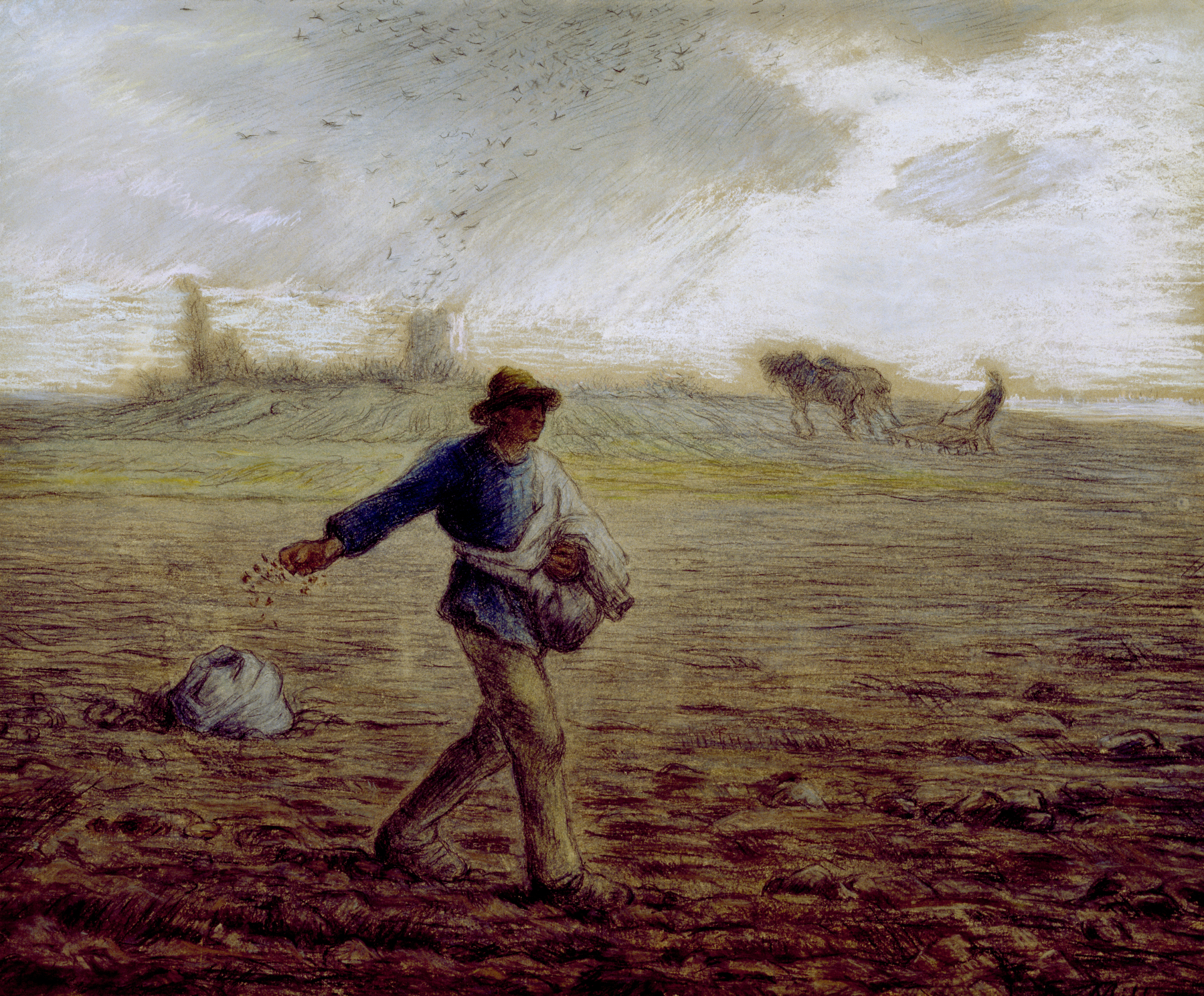
J.F. Millet, The Sower

In the Church throughout the world today, we are more focused on evangelization — and rightly so. A huge conference is planned next week in Orlando on the topic. Yes, it is “job one,” and Jesus could not have been clearer: Therefore, go and make disciples of all nations, baptizing them in the name of the Father and of the Son and of the Holy Spirit, and teaching them to obey everything I have commanded you (Matt 28:18-20).

However, even as we become more serious and practical about effective evangelization, we must also remember the paradox and the mysteries that underlie the growth of the Kingdom. We can and should strive to learn “best practices,” what makes for dynamic parishes and effective outreach, but even when many of these things are in place (e.g., good liturgy, dynamic preaching, Eucharistic adoration, welcoming parish), growth does not always come; sometimes numbers may even continue to decrease. Conversely, even in parishes where the liturgy is perfunctory, preaching is weak, and devotions are hurried, there may be significant growth. I know parishes that should be growing, but are not; I also know parishes that are growing almost in spite of themselves.

There are mysterious aspects to the growth or decline of the Church. Jesus said,

This is how it is with the Kingdom of God; it is as if a man were to scatter seed on the land and would sleep and rise night and day and the seed would sprout and grow, he knows not how (Mark 4:26-29).

Thus the Lord teaches that much of the growth in the Kingdom of God is mysterious and works “we know not how.”

Only one thing is clear: we must sow the seed. That’s “job one.” Indeed, we must work ardently to “scatter seed.” By extension, we should do our best to prepare the soil well, and after sowing the seed, cultivate. But much that is mysterious lies beyond our knowledge or control.

Perhaps with this and other things in mind, St. Paul further developed the paradox of God’s ways of reaching the world. What we tend to think is good or bad marketing does not seem to impress God. He delivers to the world a message that is not popular, but because it is of God, wins the day. Consider this passage:

Where is the wise person? Where is the teacher of the law? Where is the philosopher of this age? Has not God made foolish the wisdom of the world? For since in the wisdom of God the world through its wisdom did not know him, God was pleased through the foolishness of what was preached to save those who believe. Jews demand signs and Greeks look for wisdom, but we preach Christ crucified: a stumbling block to Jews and foolishness to Gentiles, but to those whom God has called, both Jews and Greeks, Christ the power of God and the wisdom of God. For the foolishness of God is wiser than human wisdom, and the weakness of God is stronger than human strength. Brothers and sisters, think of what you were when you were called. Not many of you were wise by human standards; not many were influential; not many were of noble birth. But God chose the foolish things of the world to shame the wise; God chose the weak things of the world to shame the strong. God chose the lowly things of this world and the despised things—and the things that are not—to nullify the things that are, so that no one may boast before him. It is because of him that you are in Christ Jesus, who has become for us wisdom from God—that is, our righteousness, holiness and redemption. Therefore, as it is written, “Let the one who boasts boast in the Lord” (1 Cor 1:20ff).

Yes, this passage is certainly a paradox! Consider some of the paradoxical and countercultural ways in which St. Paul says we engage the world:

  1. The cross, not comfort – Many today say that we should speak more tenderly in this tender age. We should be more positive, less demanding, more merciful, more known for what we are for than what we are against. Sugar and honey attract more than do vinegar and gall. But St. Paul and the Holy Spirit didn’t get this memo, for we are exhorted to preach “Christ crucified,” even though this is an absurdity to the world. Let us not forget to manifest our joy, but even in doing so, let us not neglect to embrace the paradox of the cross.
  2. Fools more so than formally educated – Studying and learning have their place. Learn your faith well and be prepared to defend it with patience and love. Parishes need to do a better job of teaching the faith to those who would spread it. But in this, we must not simply equate learning with Godly Wisdom. As St. Paul notes, the early Church did not draw foremost from the educated classes, but rather from the humble, the poor, the ignoble, and the uneducated. They won the ancient world not merely by learning, but also by joy, faith, courageous martyrdom, and simple virtue.
  3. Apologetics but not apologies – Notice that St. Paul accepts that many in the world call us foolish. Apologetics has its place (so that we can reach the reasonable of this world by explaining and setting forth the reasonableness of faith), but as any good apologist knows, apologetics is explaining and defending the faith, not making apologies for it. We run the risk of trying to make the faith too agreeable to others. We can end up subtly watering down truths that challenge or forever delaying the “hard” truths. Jesus started with the hard things. “Repent!” was his opening word. Whatever prudential methods we choose, we cannot through endless prudence forever postpone proclaiming the whole counsel of God, in season and out of season. Some will scoff and say, “This is a hard saying who can endure it?” (John 6:60) A true apologist has not necessarily lost when someone scoffs; he has only lost when he fails to proclaim the whole faith. Scoffers may reconsider; those who reject the truth may repent; but truth unspoken, distorted, or watered down is a total victory for Satan.
  4. Pure more than palatable – Faith that is made too “palatable” is almost certainly not the faith at all. Now this may be in violation of “Marketing 101,” but God is not in receipt of the world’s memos. True evangelization is often paradoxical because it does not fit easily into the tidy categories of marketers and sociologists, who are often horrified at how “off-message” the faith can seem to the modern world. Even in the Church, many demand that the faith be conformed to what the majority of people think. Remember, God has been at this work just a little longer than marketers and publicity folks. His paradoxes have a way of winning the day when the ephemeral and fickle views of the world fade away.

Should we continue to do everything we can to spread the faith in the usual manner using various media, training, and the widest possible exposure? Sure! Today at least, this is how we prepare the soil, sow the seed, and help to cultivate.

However, in humility and serenity, we must also accept that there are mysteries as to what works and what does not. Growth sometimes comes out of nowhere for no discernible reason. God often surprises us with sudden growth spurts that are hard to explain. Meanwhile, we work as best as we can and do what seems wisest.

How about a little humility that allows paradoxical things to work (paradoxical because they do not conform to the rules of the world)? How about a little humility that is willing to listen to God? We are always asking God to bless what we do. Why not (at least occasionally) find out what God is already blessing and do that?

Paradox and mystery may well have a lot more to do with effective evangelization than all our grand plans and glossy marketing.

Lord, we seek a miraculous catch of fish in our day and we are open to surprises. Keep us faithful to your teachings, which are “out of season” today. Help us to cast your nets faithfully and be willing, like Peter, to cast them where you say, often in tension with our own instincts. And, like Peter, may we experience the astonishing miracle of a great catch that will make us fall to our knees in wonderment and humility at the mystery and paradox of your work. Have mercy on us, Lord, and work, often in spite of us, to enrich your kingdom in ways “we know not how.” In Jesus’ name, Amen.

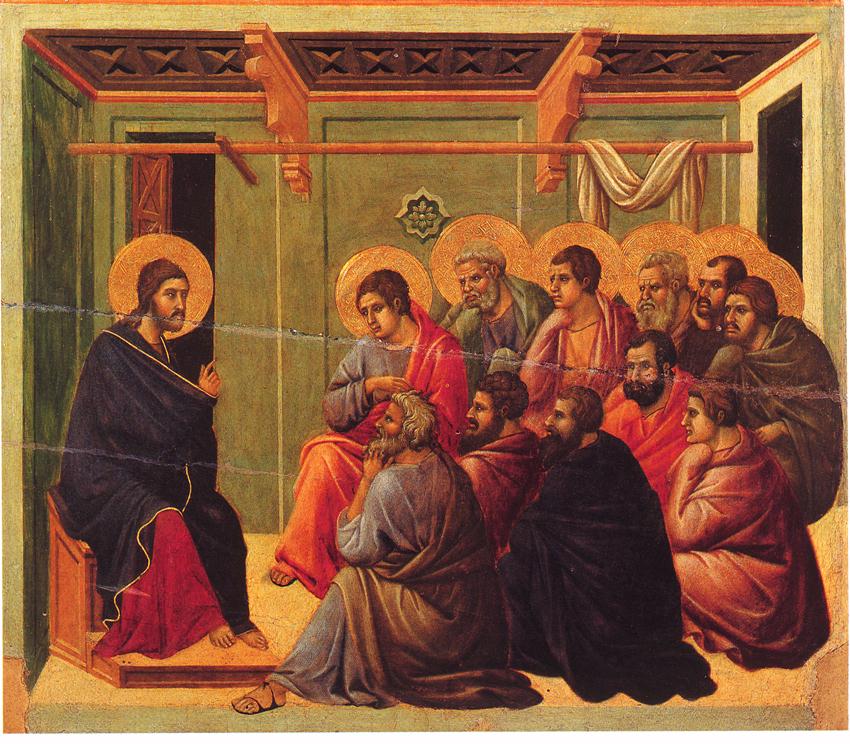
Is Jesus exhibiting good evangelization here? You decide.
Who Am I Not to Judge? Correcting the Sinner Is an Essential Work of Charity

fraternal correctionIn the Gospel for Monday of the 12th Week in Ordinary Time, there is a Scripture passage that is almost too well known. I say this because the world has wielded it like a club to swing at Christians. The text is quoted almost as if it represented the entirety of the Bible’s teaching; it is often used to shut down discussions of what is right vs. wrong, what is virtuous vs. sinful. Even many Christians misinterpret the passage as a mandate to be silent in the face of sin and evil. I say that it is too well known because it is remembered while everything else in the Scriptures that balances or clarifies it is forgotten. Here is the passage:

Do not judge, or you too will be judged. For in the same way you judge others, you will be judged, and with the measure you use, it will be measured to you. Why do you look at the speck of sawdust in your brother’s eye and pay no attention to the plank in your own eye? How can you say to your brother, “Let me take the speck out of your eye,” when all the time there is a plank in your own eye? You hypocrite! First take the plank out of your own eye, and then you will see clearly to remove the speck from your brother’s eye (Matt 7:1-5).

Anytime the Church or an individual Christian labels a particular behavior as wrong or sinful, wagging fingers are raised. This is followed, in an indignant tone, with something like this: “You’re being judgmental! The Bible says, ‘Judge not.’ Who are you to judge your neighbor?” This is clearly an attempt to shut down discussion and to shame Christians, or the Church, into silence.

To a large degree this tactic has worked. Modern culture has succeeded in shaming many Christians from this essential work: correcting the sinner. Too many are terrified when they are said to be “judging” someone by calling attention to sin or wrongdoing. In a culture in which tolerance (a mistaken notion of tolerance at that) is one of the only virtues left, “judging” is deemed one of the worst offenses.

Pay careful attention to what this Gospel text is actually saying. The judgment spoken of does not refer to discerning between right and wrong. Rather, it refers to determining punishment or condemnation. The next sentence makes this clear when it speaks of the measure we use, the level of condemnation, harshness, or punishment. A parallel passage in Luke’s Gospel makes this clear:

Stop judging and you will not be judged. Stop condemning and you will not be condemned. Forgive and you will be forgiven. … For the measure with which you measure will in return be measured out to you (Luke 6:36-38).

The judgment here refers to unnecessarily harsh and punitive condemnation. To paraphrase the opening verses colloquially, “Be careful not to condemn, because if you lower the boom on others, you will have the boom lowered on you. If you throw the book at others, it will be thrown at you.”

Further, the parable that follows in the passage above from the Gospel of Matthew does not say that we should refrain from correcting sinners. Rather, it says that we should get right with God and understand our own sin in order that we will see clearly enough to be able to correct our brother. Far from forbidding the correction of the sinner, the passage actually emphasizes the importance of correction by underscoring the importance of doing it well and with humility and integrity.

One of the most forgotten obligations we have is that of correcting the sinner. It is listed among the Spiritual Works of Mercy. St. Thomas Aquinas lists it in the Summa Theologica as a work of Charity:

[F]raternal correction properly so called, is directed to the amendment of the sinner. Now to do away with anyone’s evil is the same as to procure his good: and to procure a person’s good is an act of charity, whereby we wish and do our friend well (Summa Thelogica II, IIae, 33.1).

Go be sure, there are some judgments that are forbidden us.

  1. We cannot assess that we are better or worse than someone else before God.
  2. We cannot always understand the ultimate culpability or inner intentions of another person as though we were God. Scripture says regarding judgments such as these, Not as man sees does God see, because man sees the appearance but the LORD looks into the heart (1 Sam 16:7).
  3. We cannot make the judgment of condemnation. That is to say, we do not have the power or knowledge to condemn someone to Hell. God alone is judge in this sense.
  4. We must not be unnecessarily harsh or punitive. Be merciful, just as your Father is merciful. Stop judging and you will not be judged. Stop condemning and you will not be condemned. Forgive and you will be forgiven … For the measure with which you measure will in return be measured out to you (Luke 6:36-38).

Scripture both commends and commands fraternal correction: I remarked above that the Gospel from today’s Mass is too well known because it has been embraced to the exclusion of everything else in the Bible on the subject of correcting sinners. Over and over again Scripture tells us to correct the sinner. Far from forbidding fraternal correction, the Scriptures command and commend it. I would like to share some of those texts here and add a little commentary of my own in red text.

  1. If your brother sins against you, go and tell him his fault, between you and him alone. If he listens to you, you have gained your brother. But if he does not listen, take one or two others along with you, that every word may be confirmed by the evidence of two or three witnesses. If he refuses to listen to them, tell it to the church; and if he refuses to listen even to the church, let him be to you as a Gentile and a tax collector. Truly, I say to you, whatever you bind on earth shall be bound in heaven, and whatever you loose on earth shall be loosed in heaven (Matt 18:15-18). Jesus instructs us to speak to a sinning brother and summon him to repentance. If private rebuke does not work (assuming the matter is serious), others who are trustworthy should be summoned to the task. As a final resort, the Church should be informed. If he will not listen even to the Church, then he should be excommunicated (treated as a tax collector or Gentile). In serious matters, excommunication should be considered as a kind of medicine that will inform the sinner of just how serious the situation is. Sadly, this “medicine” is seldom used today, even though Jesus clearly prescribes it (at least in serious matters).
  2. It is actually reported that there is immorality among you, and of a kind that is not found even among pagans; for a man is living with his father’s wife. And you are arrogant! Ought you not rather to mourn? Let him who has done this be removed from among you. For though absent in body I am present in spirit, and as if present, I have already pronounced judgment in the name of the Lord Jesus on the man who has done such a thing. When you are assembled, and my spirit is present, with the power of our Lord Jesus, you are to deliver this man to Satan for the destruction of the flesh, that his spirit may be saved in the day of the Lord Jesus. Your boasting is not good. Do you not know that a little leaven leavens the whole lump? Cleanse out the old leaven that you may be a new lump, as you really are unleavened … I wrote to you in my letter not to associate with immoral men; not at all meaning the immoral of this world, or the greedy and robbers, or idolaters, since then you would need to go out of the world. But rather I wrote to you not to associate with anyone who bears the name of brother if he is guilty of immorality or greed, or is an idolater, reviler, drunkard, or robber not even to eat with such a one. For what have I to do with judging outsiders? Is it not those inside the church whom you are to judge? God judges those outside. Drive out the wicked person from among you (1 Cor 5:1-13). The Holy Spirit, speaking through Paul, commands that we “judge” the evildoer. In this case the matter is very serious (incest). Notice how the text says that he should be excommunicated (handed over to Satan). Here, too, the purpose is medicinal. It is hoped that Satan will beat him up enough that he will come to his senses and repent before the Day of Judgment. It is also medicinal in the sense that the community is protected from bad example, scandal, and the presence of evil. The text also requires us to be able to size people up. There are immoral and unrepentant people in the world and it is harmful for us to associate with them. We are instructed not to keep company with people who can mislead us or tempt us to sin. This requires a judgment on our part. Some judgements are actually required of us.
  3. Brethren, if a man is overtaken in any sin, you who are spiritual should recall him in a spirit of gentleness. Look to yourself, lest you too be tempted. Bear one another’s burdens, and so fulfill the law of Christ (Gal 6:1-2). We are called to notice when a person has been overtaken in sin and to correct him. The text cautions us to do so in a spirit of gentleness, otherwise we risk sinning in the very process of correcting the sinner. We can be prideful or unnecessarily harsh in our words of correction; this is no way to correct. The instruction here is to be gentle and humble, yet clear. It also seems that patience is called for, because we must share in the burdens of one another’s sin. First, we accept the fact that others have imperfections and faults that trouble us; second, we bear the obligation of helping others to know their sin and of helping them to repent.
  4. My brethren, if any one among you wanders from the truth and someone brings him back, let him know that whoever brings back a sinner from the error of his way will save his soul from death and will cover a multitude of sins (James 5:19). The text is ambiguous as to whose soul is actually saved, but that is good, because it seems that both the corrected and the corrector are beneficiaries of well-executed fraternal correction.
  5. You shall not hate your brother in your heart: You shall in any case rebuke your neighbor, and not suffer sin upon him (Lev 19:17). This text teaches us that refusing to correct a sinning neighbor is a form of hatred. Instead we are instructed to love our neighbors by not wanting sin to overtake them.
  6. If anyone refuses to obey what we say in this letter, note that man, and have nothing to do with him, that he may be ashamed. Do not look on him as an enemy, but warn him as a brother (2 Thess 3:14). The medicine of rebuke, even to the point of refusing fellowship, is commanded here. Note, too, that even a sinner does not lose his dignity; he is still to be regarded as a brother, not as an enemy. A similar text says, We instruct you, brethren, in the name of our Lord Jesus Christ, to shun any brother who walks in a disorderly way and not according to the tradition they received from us (2 Thess 3:6).
  7. Let the word of Christ dwell in you richly, teach and admonish one another in all wisdom (Col 3:16). To admonish means to warn. If the word of Christ is rich within us, we will warn when necessary. A similar text says, All scripture is inspired by God and profitable for teaching, for reproof, for correction, and for training in righteousness, that the man of God may be complete, equipped for every good work (2 Tim 3:16). Reproof and correction are thus part of what is necessary to equip us for every good work.
  8. And we exhort you, brethren, admonish the unruly, encourage the fainthearted, help the weak, be patient with them all (1 Thess 5:14). Fraternal correction is described here as admonishing, encouraging, and helping. We are also exhorted to patience in these works.

There are more of these passages, but I’m sure you get the point by now. Fraternal correction, correcting the sinner, is prescribed and consistently commanded by Scripture. We must resist the shame that the world tries to inflict on us for “judging” people. Not all judgment is forbidden; in fact, some judgment is commanded. Correction of the sinner is both charitable and virtuous.

We have failed to correct – If we are to have any shame about fraternal correction, it should be that we have failed to correct when necessary. Because of our failure in this regard the world is a much more sinful, coarse, and undisciplined place. Too many people today are out of control, undisciplined, and incorrigible. Too many are locked in sin and have never been properly corrected. The world is less pleasant and charitable, less teachable. It is also more sinful and in greater bondage. To fail to correct is to fail in charity and mercy; it is to fail to be virtuous and to fail in calling others to virtue. We are all impoverished by our failure to correct the sinner. He who winks at a fault causes trouble; but he who frankly reproves promotes peace. … A path to life is his who heeds admonition; but he who disregards reproof goes go astray (Proverbs 10:10, 17).

The following video basically captures the problem that Christians face and explains fairly well some of the distinctions I make here:

Decide Now Whom You Will Fear: A Homily for the 12th Sunday of the Year

The Lord speaks to us today of one of the most central struggles in our life: fear. Yes, fear is one of our deepest drives and though it has a positive purpose, too often we miss the mark in directing its energy. The positive role of fear is to alert us that something is wrong and to divert us from danger. With our fallen nature, though, we often fear the wrong things while lacking a sober fear of the right things. We major in the minors of life; we get all worked up about passing things but do not have a sober and reverent fear of eternal things. We fear sinful and weak human beings, but not God, who is just, who sees all, and who will assign us our eternal destiny.

The Lord thus teaches us today in order to help us to “get fear right.” He sets forth the proper object of our fear, points to the outcome of succeeding or failing in this matter, and reminds us of our proper role in this world as we master our fear.

I.  The Object of Fear Jesus said to the Twelve: “Fear no one … And do not be afraid of those who kill the body but cannot kill the soul; rather, be afraid of the one who can destroy both soul and body in Gehenna … Are not two sparrows sold for a small coin? Yet not one of them falls to the ground without your Father’s knowledge. Even all the hairs of your head are counted. So do not be afraid; you are worth more than many sparrows.”

Wrong Fear In speaking to the object of fear, Jesus is asking us to consider what and whom we fear most. We are going to fear someone and something. We are just too tiny and weak to be wholly free of fear. Yes, fear has its place and purpose; the problem is that we often fear the wrong things. We are a bit like Chicken Little, who was afraid of an utterly false threat (that the sky was falling) and in her panic ran right into the wolf, who devoured her.

Jesus is clear: Fear no man. The worst thing a human being can do to you is to kill you physically. Even if that happens, though, if you are faithful, dying is the path to Heaven; it’s a maximum promotion! Maybe people can steal your things or make your brief life here a little less pleasant, but life does not consist in our possessions. As an old gospel hymn says, “Trouble don’t last always.”

In a moment, Jesus will tell us whom we should fear. For now, consider again Jesus’ teaching: Fear no man. Yet the fact is that we do fear human beings. It’s incredible to find out how afraid we are. We’re afraid of everybody and everything! We’re more afraid of men than we are of God. We’re afraid of physical dangers, certainly, but even more so we’re afraid of being rejected by other people; of not being liked by others. We’ll do just about anything to ingratiate ourselves to others and to assuage our fear of being rejected or laughed at. We’ll gossip and lie; we’ll spend a lot of money on clothes, cosmetics, fancy cars, big houses, or the latest iPhone. Desperate to fit in, young people may join gangs, drop out of school, use drugs, fornicate, and/or engage in self-destructive behaviors, all in a desperate quest to be thought “hip” and loved.

Yes, too many of all ages have a mighty fear of rejection and humiliation by other human beings. And because we’re afraid of not being liked, we’ll do almost anything.

Not only does this fear drive us to do many things we shouldn’t, it also keeps us from doing many things we ought to do such as preaching the Gospel and insisting on what is right. Think of the martyrs of old who died professing the faith, and here we are afraid that someone will raise an eyebrow!

Fear is one of the chief habit patterns of sin, and it brings about countless other sins. It has to go.

Thus Jesus says, “Fear no one.” That is, fear no man. Whom do you fear more, men or God? Honestly?

Right Fear God is the proper object of our fear.

Jesus teaches very provocatively, … rather, be afraid of the one who can destroy both soul and body in Gehenna …

Some think that this text refers to Satan, but it does not. Luke’s version makes this even clearer: But I will show you whom you should fear: Fear the One who, after you have been killed, has power to throw you into hell. Yes, I tell you, fear Him (Luke 12:5).

This cannot be Satan because Satan is not our judge. Although he can tempt us, he has no authority to determine our final destiny. Scripture says that Satan, our accuser, has been cast out (see Rev 12:10). Further, it declares, The Father judges no one, but has consigned all judgment to the Son that the world may revere him (Jn 5:22).

Many are uncomfortable thinking of the Lord in this way. They prefer to think of Him as an affable fellow, a harmless hippie who’s not all that concerned with things like holiness and conversion, and who in the end will just wave everyone through.

This is simply not what Scripture teaches. God is holy, and His holiness exudes a power and glory that we must be purified in order to endure, let alone enjoy. Frankly, Heaven would be a miserable place for anyone who has not been brought up to the temperature of Heaven or been accustomed to the bright light of God’s truth. Heaven is not our personal “designer paradise.” It is the Kingdom of God in all its fullness and with all its values: forgiveness, generosity, love of one’s enemies, chastity, and so forth. There are many who don’t want anything to do with some or any of these values. They are much like the older son in the parable of the prodigal son, the one who stands outside angry and unwilling to the enter the feast given by his father. He finds forgiveness untenable; he loathes the feast because his wayward brother is honored there. Judgment Day is something to have a holy fear about, for it is the day when God will ask this question: “Do you want the Heaven I offer on its terms or not?” On the Day of Judgment, God will assess what our decision has amounted. He will either welcome us into the feast or close the door and consign us to the “other arrangements” we ourselves have made and perversely preferred. Jesus says, As for anyone who hears My words and does not keep them, I do not judge him… The word that I have spoken will judge him on the last day (John 12:47-48).

Balanced Fear This proper fear is not a cringing one, rooted only in the dread of punishment (though if that’s all you’ve got, go with it). Rather, it is a reverential fear that remembers God’s love for us and His desire to save us. Jesus says, Are not two sparrows sold for a small coin? Yet not one of them falls to the ground without your Father’s knowledge. Even all the hairs of your head are counted. So do not be afraid; you are worth more than many sparrows.

Although this proper fear remembers God’s love and does not give way to the imbalance of purely servile fear, neither does it swing to the other imbalance, which disregards the loving respect we should have for God and His holiness. God is who He is and Heaven is what it is. We simply cannot endure such realities without being purified and prepared for them first. God must have our repentance in order to do the work necessary to enable us for Heaven’s brightness and His fiery glory.

A reverential and balanced fear acknowledges God’s love and mercy, but also His awesome glory. Such a fear takes seriously our need to prepare for judgment and to avail ourselves of God’s graces in the sacraments, the Liturgy, His Word, and prayer.

II.  The Outcome of Fear Jesus adds, There is nothing that is concealed that will not be revealed, nor secret that will not be known … Everyone who acknowledges me before others I will acknowledge before my heavenly Father. But whoever denies me before others, I will deny before my heavenly Father.

Our fear is going to have an outcome for either good or ill. If we have the wrong fear (fearing man more than God), it will lead us to silence and even outright denial of God and His truth before others. Fearing the opinion of the world and human beings more than God makes us silent and too easily conformed to a world opposed to Him. This amounts to a tacit denial (by silence) or to an outright denial wherein we publicly scorn God and/or His revealed truth in order to ingratiate ourselves to this world. The consequence of this denial is Jesus’ affirmation of our denial of God the Day of Judgment. The martyrs and confessors of the faith shine brightly before God, but we cannot endure their brightness because we have hidden out in the dark places and preferred the darkness of error to the light of truth.

If we have the right fear, we want to please God rather than man. We delight in representing Him and His teachings before others, even joyfully enduring the world’s scorn. If we fear God, we fear no one else. If we can kneel before God, we can stand before any man. If we fearlessly, charitably, and joyfully acknowledge God before others, we will be acknowledged before God the Father as someone who truly sought Him and witnessed to Him. A proper and balanced fear brings an outcome of glory and happiness. An improper fear (of man rather than God) brings denial, because we fear and prefer the opinions of men and this world rather than God. On Judgment Day the Lord will acknowledge our preference to His Father.

For a good outcome, make sure you have the right and balanced fear!

III. The Office of Holy Fear What I say to you in the darkness, speak in the light; what you hear whispered, proclaim on the housetops.

The Lord is summoning us to speak fearlessly to the world on account of a holy fear of Him.

1. But in the face of strong opposition, we were bold in our God to speak the gospel of God to you. … We speak … not in order to please men but God, who examines our hearts. As you know, we never used words of flattery or any pretext for greed. God is our witness! Nor did we seek praise from you or from anyone else (1 Thess 2:2-6).

2. Do you think I am seeking the approval of men, or of God?… I would not be a servant of Christ (Gal 1:10).

3. From henceforth let no man trouble me; for I bear in my body the brand marks of the Lord Jesus (Gal 6:17).

4. But Peter and John replied, “Judge for yourselves whether it is right in God’s sight to listen to you rather than God. For we cannot stop speaking about what we have seen and heard” (Acts 4:19-20).

What about you? Do you speak the word of God to an often-scoffing world? Or do you fear the world more than God, and therefore stay silent, hiding out? If we reverently fear God more than the world, then we will speak out even in the face of opposition. We love the Lord more than we love the world. Therefore, we speak!

Summation – Make sure you fear the right thing, in this case the right One. Here is what Jesus teaches: Do not fear man. Rather, have a holy reverent fear of God. Get fear right. Stop getting so anxious about what mere mortals think of you. Your destiny will hinge on getting fear right. Fear the Lord; acknowledge Him before men and proclaim His world, and you be acknowledged greatly by him in Heaven. If you fear men and the world, just watch how quickly cave in, compromise, and deny the Lord, preferring worldly trinkets and the praise to eternal glories. But if you go that route, that’s all you’ll get. Beware, the Lord will one day have to acknowledge your preference: “Father He denied. He said no to our offer.”

Decide now whom you will fear. Your destiny depends on that decision.

If You Know The End Of The Story, There’s A Lot You Can Disregard – As Seen On TV

Usually we don’t like to know the end of the story. When someone blurts out the ending it’s called a “spoiler.” What fun is it to read a whodunit when you already know who done it?

When it comes to the faith, though, not only should we know the end of the story, but we must never forget it and must base our very lives upon it. As we look about the world, it is easy to get discouraged and think that evil is winning. Yet Scripture plainly states that Satan’s plans are going nowhere, that Jesus has already won the victory. Mysteriously, the Lord allows Satan a little time to sift through the ruins of his former kingdom. Do not be deceived—Satan has lost and so have all who are allied with him.

Some lines from Psalms come to mind:

Wait a little, and the wicked will be no more; look for them and they will not be there. But the poor will inherit the earth, will delight in great prosperity. But my Lord laughs at the wicked, because he sees that their day is coming. Wait eagerly for the LORD, and keep his way; He will raise you up to inherit the earth; you will see when the wicked are cut off. I have seen a ruthless scoundrel, spreading out like a green cedar. When I passed by again, he was gone; though I searched, he could not be found. mark the upright; Because there is a future for a man of peace. Sinners will be destroyed together; the future of the wicked will be cut off (Psalm 37).

Spoiler alert! Yes, dear brethren, I checked. I went to the end of the story and, sure enough, Jesus wins! There it is, right at the end of the Bible. This is a spoiler you need to know, because you have to choose which team you’ll be on and it’s nice to know ahead of time whose team has already won. It’s like going to today’s horserace armed with tomorrow’s newspaper. You’d be a fool to bet on any horse other than the winning one. Well, you have tomorrow’s paper, and here’s what it says:

When the thousand years are completed, Satan will be released from his prison. He will go out to deceive the nations at the four corners of the earth, Gog and Magog, to gather them for battle; their number is like the sand of the sea. They invaded the breadth of the earth and surrounded the camp of the holy ones and the beloved city. But fire came down from heaven and consumed them. The Devil who had led them astray was thrown into the pool of fire and sulfur, where the beast and the false prophet were. There they will be tormented day and night forever and ever. Next I saw a large white throne and the one who was sitting on it. The earth and the sky fled from his presence and there was no place for them. I saw the dead, the great and the lowly, standing before the throne, and scrolls were opened. Then another scroll was opened, the book of life. The dead were judged according to their deeds, by what was written in the scrolls. The sea gave up its dead; then Death and Hades gave up their dead. All the dead were judged according to their deeds. Then Death and Hades were thrown into the pool of fire. (This pool of fire is the second death.) Anyone whose name was not found written in the book of life was thrown into the pool of fire (Rev 20:7–15).

Then I saw a new heaven and a new earth. The former heaven and the former earth had passed away, and the sea was no more. I also saw the holy city, a new Jerusalem, coming down out of heaven from God, prepared as a bride adorned for her husband. I heard a loud voice from the throne saying, “Behold, God’s dwelling is with the human race. He will dwell with them and they will be his people and God himself will always be with them [as their God]. He will wipe every tear from their eyes, and there shall be no more death or mourning, wailing or pain, [for] the old order has passed away.” The one who sat on the throne said, “Behold, I make all things new.” Then he said, “Write these words down, for they are trustworthy and true.” He said to me, “They are accomplished. I [am] the Alpha and the Omega, the beginning and the end. To the thirsty I will give a gift from the spring of life-giving water. The victor will inherit these gifts, and I shall be his God, and he will be my son. But as for cowards, the unfaithful, the depraved, murderers, the unchaste, sorcerers, idol-worshipers, and deceivers of every sort, their lot is in the burning pool of fire and sulfur, which is the second death” (Rev 21:1–8).

And he said to me, “These words are trustworthy and true, and the Lord, the God of prophetic spirits, sent his angel to show his servants what must happen soon.” “Behold, I am coming soon.” Blessed is the one who keeps the prophetic message of this book. … The one who gives this testimony says, “Yes, I am coming soon.” Amen! Come, Lord Jesus! The grace of the Lord Jesus be with all (Rev 22:6–7; 20-21).

Keep this in mind; keep it always on your mind. The result of this victory is obtained in the paradox of the cross. Jesus destroyed death by dying and tells us that to save our life we must lose it to this world. Whatever your struggles and setbacks, do not be dismayed. Love and humility have already overcome hatred and pride. Darkness cannot drive out darkness; only light can do that. Hate cannot drive out hate; only love can do that. Pride cannot drive out pride; only humility can do that. The Lord allows opportunities for the light of truth to shine in the error of darkness, for love to endure in the face of hatred, and for humility to put pride to shame.

Until the last day when the trumpet shall sound, the drama carries on. But see what the end shall be. You already know the end of the story; make sure that you serve in the Lord’s army and wield the weapons of light, love, and humility.

I know this video is going to seem strange after such a serious reflection, but what could be more humble than a pig “spoiling” the movie for the entering patrons? If you listen to his advice, though, he’s basically saying what I just did: “Don’t waste your time on losers. Don’t waste your time going down a path of wrong ideas or theories. Don’t get all worked up about characters and things that don’t matter—here’s what’s really going on in the movie.”

It’s not bad advice for life, either. If you know the end of the story, there’s a lot you can disregard along the way. You’ll know where to set your focus. Keep your eyes on Jesus and the truth of His Gospel.

Fortnight for Freedom: Please Spend Some Time Working and Praying to Protect Your Religious Liberty

There has been a steady erosion of religious liberty in the United States in recent years. It has been challenged through a broad range of incidents, requirements from the medical world, health insurance mandates, and court decisions. We often take our religious freedom for granted, but it is under substantive though sometimes subtle challenge. We are in the midst of a sea change; we are being told that religion has no place in the marketplace, in the public forum.

It is one thing to request that the government, in its official capacity, refrain from sponsoring sectarian prayer, but it is quite another to tell believers that they are not allowed to express their religion, refer to God, or pray in any sort of public way.

Further, religious exemptions — historically granted when religious beliefs and government policy collide — are gradually being removed, not included at all, or interpreted so strictly that they can never apply. Catholic institutions are gradually being pressured to provide contraceptives in medical plans, to cooperate in adoptions by gay couples or single parents, to provide spousal benefits to gay couples, and to cooperate in providing abortion coverage (by not being able to opt out of plans that provide such coverage).

Some of the erosion of religious liberty is subtle, hidden deep in the details of legislation and the strict interpretations of various judges. It requires the Church and other religious organizations to fight on multiple fronts in a wearying number of cases involving (arcane but significant) legal minutia.

On some level, the erosion of religious liberty is simply due to the sheer number of legal maneuvers occurring in multiple jurisdictions simultaneously. The Church and other religious entities may win an individual battle in one case only to have to face multiple appeals and similar battles in other jurisdictions. Keeping the faithful organized and alert, and maintaining the legal resources to meet every challenge is difficult. It is a kind of death by a thousand cuts.

Consider the following small sample involving the Church and/or fellow Christians:

•  Catholics Charities no longer able to provide adoption services –  As reported by the United States Conference of Catholic Bishops (USCCB), “Catholic Charities of the Archdiocese of Washington — which has provided support to children and families for over eighty years — had a partnership with the District of Columbia for its foster care and public adoption program.  However, in 2010, a law redefining legal marriage to include two people of the same sex took effect.  The District then informed Catholic Charities that it would no longer be an eligible foster care and adoption partner.  Why?  Because, as a Catholic organization, Catholic Charities was committed to placing children with married [opposite sex] couples so that each child would have the experience of a mom and a dad.” Similar “decertification” occurred in foster care/ adoption services in Boston, San Francisco, and Illinois. “In the name of tolerance, we’re not being tolerated,” said Bishop Thomas J. Paprocki of the Diocese of Springfield, Illinois.

•  Christian business owners threatened with fines and/or decertification – Increasing numbers of laws are being passed which seek to force business owners with firmly held religious beliefs to choose between providing services that violate those religious beliefs and suffering potentially devastating legal/financial consequences. A few such cases follow:

o  New Mexico – The owners of a photography studio refused to photograph a same-sex “commitment ceremony” because they did not want to participate in a ritual that contradicted their beliefs. In 2013, the New Mexico Supreme Court denied the owners’ appeal, affirming the lower court opinion that the studio violated the New Mexico Human Rights Act.
o  Idaho – In 2014, two Protestant ministers (a husband and wife) who operate a wedding chapel in Coeur d’Alene refused to officiate at a same-sex “wedding.” City officials informed the ministers that this violated the city’s ordinance outlawing discrimination in public accommodations on the basis of “sexual orientation.” The city eventually chose not to prosecute the ministers.
o  Washington – A florist who turned down a request to provide flowers for a same-sex “wedding” was sued by the Washington State Attorney General. In February 2017, the Washington Supreme Court ruled against the florist on the basis that she had violated the state’s anti-discrimination laws, despite the fact that she had served this particular customer (who she knew was in a same-sex relationship) for almost ten years before declining to participate in this particular event.
o  Colorado – Two men “married” in Massachusetts approached a Denver bakery to make a “wedding” cake for their “wedding” reception in Denver. For religious reasons, the owner of the bakery declined to make the cake. The two men filed a complaint with the Colorado Division of Civil Rights, which found that the bakery had violated the law. The Colorado State Attorney General’s office then filed a complaint against the bakery, resulting in further rulings against the bakery. The baker has appealed to the U.S. Supreme Court.
o  Vermont – For allegedly not hosting a “wedding” reception for a same-sex “couple,” the Catholic owners of a bed and breakfast establishment settled a discrimination lawsuit, requiring them to (1) pay a $10,000 civil penalty, (2) pay $20,000 to a charitable trust, and (3) not host wedding receptions of any kind. Upon settling the lawsuit, the owners of the bed and breakfast said, “No one can force us to abandon our deeply held beliefs about marriage.”
o  New Jersey – The New Jersey Division on Civil Rights found that a Methodist organization violated a public accommodations law by not allowing a same-sex civil union ceremony to take place at its boardwalk pavilion.

Business owners should not be compelled to act against their deeply held religious beliefs. There are plenty of businesses willing to serve those who wish to engage in these controversial behaviors, which challenge long-held (even ancient) moral understandings. If a Christian baker refuses to serve a person with same-attraction who seeks to buy a cake, simply due to the customer’s sexual orientation, that would constitute an unreasonable act of discrimination by the part of the baker. However, if this same person seeks to engage the Christian baker to provide a cake that directly celebrates and/or affirms an act that the baker considers sinful, that would impose an undue and unnecessary burden on the baker. This is because it compels the baker to either violate his conscience or face serious legal and/or financial consequences.

•  Catholic employers required to cover objectionable medicines and “medical” procedures – The Health and Human Services (HHS) mandate — which requires coverage for sterilization, contraception, and abortifacients, abortion-inducing drugs — still contains language requiring religious institutions to facilitate or fund such coverage even if it is contrary to their moral teaching. This is because the federal government claims the right to define which religious institutions are “religious enough” to merit protection of their religious liberty.

•  Catholic humanitarian services organization required to provide or refer for objectionable medicines and “medical” procedures – After years of excellent performance by the U.S. Conference of Catholic Bishops’ Migration and Refugee Services (MRS) in administering contract services for victims of human trafficking, the federal government changed its grant specifications such that MRS was required to provide or refer for contraceptive and abortion services, in direct violation of Catholic teaching.

•  Christian student organizations not officially recognized on campus – In its history of over 100 years, the University of California Hastings College of Law has denied official recognition to only one student group — the Christian Legal Society — because it requires its leaders to be Christian and to abstain from sexual activity outside of marriage.

•  Christians may not rent school buildings to hold services – In 1994, New York City’s Department of Education denied the request of the Bronx Household of Faith and several other Christian Churches to rent space from public schools on weekends for worship services, even though non-religious groups were permitted to rent the same space for numerous other purposed. In 2011, a federal appellate court upheld New York City’s ban (on allowing private worship services to be conducted in vacant public schools on weekends) and the U.S. Supreme Court refused to hear the case. The city’s policy is a simple case of discrimination against religious believers: people may assemble in vacant school space for any peaceful purpose—except religious worship.

These sorts of bans, legal motions, suits, and fines, are becoming increasingly widespread, and the legal landscape is often shifting. This steady “drip, drip, drip” is helping to erode religious liberty and free speech related to religion.

It is essential that we remain vigilant in these matters. Some want to exclude Christians — indeed all believers — from the public marketplace of ideas. There are increasing numbers of strident secularists who insist that the only legal place for religious expression is inside of a church building or on church-owned property. This is not right and it is not constitutional:

Congress shall make no law respecting an establishment of a religion, or prohibiting the free exercise thereof; or abridging the freedom of speech, or of the press; or the right of the people peaceably to assemble, and to petition the Government for a redress of grievances. (First Amendment to the U.S. Constitution).

Christians and other religious individuals have no less right to free speech, to assemble peaceably, or to petition the government, than any other individuals or groups. Yet many are increasingly arguing that the mere fact that a religious perspective is involved (or that this perspective is not in keeping with recent moral shifts in our culture) should exclude religious people altogether from having a place in the public square. Indeed, in many cases they argue that we should be fined and forced out of the marketplace.

Recognize that in many public schools, our children can be exposed to almost any philosophy, some of them aberrant and with limited supported from the general populace. At the same time, even referring to the Bible as an historical factor in this nation’s history may trigger a lawsuit. Condoms are freely distributed in most schools, yet the mere presence of a Bible is often greeted with hostility by school administrators. Providing information about (and even celebrating) “gay pride,” “transgenderism,” and “gender diversity” is often required in schools, but the mere mention of Jesus (or Christianity) or Christian students quietly praying voluntarily in the school courtyard is often forbidden. This is exclusion of the Catholic and biblical vision is both inequitable and illegal.

Religious Liberty is about more than institutions such as the Catholic Church having rights. The point is that you have a right to the free exercise of your faith. There are people, organizations, and governments agencies seeking to limit or even eliminate your right to religious liberty.

You also have the right to free speech, and there is nothing in the Constitution that says your free speech rights don’t include religious topics or references to God and the biblical moral view. Many people and organizations are seeking to legally silence any religious speech and any religiously based motivations.

Don’t let this happen. Be sober and vigilant about these threats to your liberties. Insist that Christians have the same rights that other citizens do in speaking to their values publicly and in seeking to influence public discussion and public policy.

We need to be alert in these matters and stay thirsty for justice. Work with your local diocese and take part in needed actions such as contacting your representatives when laws are under consideration.

The USCCB maintains a website with a wealth of information on this topic, and it is updated frequently: Fortnight for Freedom.

It’s a Glorious, Glorious Life

Last week, in preparation for our celebration of the Archdiocese of Washington’s Marriage Jubilarian Mass, we produced this video about Bob and Laurin Balkam, a husband and wife from the Greatest Generation.

Before the interview could start, Bob said, “I’ll tell you my life story and you see what you think. And I’ll try to do it in about five minutes.” But you can neither tell a 75-year love story in five minutes, nor help but take away some life lessons.

The first lesson to take away is the transformative power of faith. Bob and Laurin were not Catholic when they married. They were Protestant. And that’s just how Bob liked it. Until one day, that is, when he came home and Laurin was reading a book about the Blessed Mother. “Uh oh,” he thought. Laurin then went on to tell Bob that she had met a Catholic priest … and that he was coming for dinner. Bob wasn’t happy.

Even worse for Bob: after meeting the priest, he really liked him and would go on to meet with him several times. Bob said after that, he “knew in the soles of his feet” that God wanted him to become Catholic. The Balkams converted and raised all eight of their children in the faith, with God guiding, correcting, loving and just being present with them.

The second lesson involves the power of marriage. In the video, Bob says of his union, “Like the faith, Laurin has enriched me, instructed me, corrected me and encouraged me. She loves me.”

When they were first married Bob was about to take a job until Laurin told him, “No, Bob, you’re not going to take that job. It’s not good enough for you.” He went back the next day and asked for another position and got it. He ended up staying in that job for 20 years, but the most important thing that he received, he said, “was a gift from my wife … a transformation in my view of myself.”

The third lesson is the true meaning ofvisible signs.” A few years ago, Laurin was diagnosed with Alzheimer’s disease. For both Laurin and Bob it was a terrible shock. There is little doubt that their faith has helped carry them through challenging times. But if ever there were a couple who serve as a visible sign of an abiding faith in the love of God and faith in the path that He presents each of us – should we choose to follow – it is the Balkams.

For example, Laurin is no longer able to speak, and I wondered how they communicated. Bob showed me. As I watched from a distance so as not to intrude, Bob began speaking to her in their own “language.” He took his bride’s hand and looked into her eyes, and she responded immediately, full of life and animated. It is a language of joy and of laughter; it is their language of love. It is the language of a 75-year marriage that Bob calls, “a glorious, glorious life.”

* * *

Join us for the Archdiocese of Washington’s Jubilarian Mass for Married Couples, celebrated by Cardinal Donald Wuerl, Archbishop of Washington, on Sunday, June 25, at 2 p.m., at the Basilica of the National Shrine of the Immaculate Conception in Washington, D.C.

Christopher Baker is Director of Multimedia Production for the Archdiocese of Washington. To view more inspiring videos produced by the Office of Multimedia Production, please go to the WashArchdiocese YouTube page.

A Brief Meditation on the Fiery “Violence” of Love

One of the great paradoxes of creation and our existence in God’s world is that many blessings are unlocked by explosive, even violent forces. The very cosmos itself is in a kind of process of hurtling outward in a massive explosion. And here we are, living midway (?) through that explosion.

When I see fireworks on the Fourth of July, I often think that each of those beautiful, fiery explosions is a miniature replica of the cosmos. Everywhere in the universe, the burning embers we call stars and galaxies glow brightly as they hurtle outward at close to one hundred million miles per hour. Yes, from one great singularity, God sent the power of His fiery, creative love expanding outward, giving life, and seeming almost limitless. The cosmos is unimaginably large, and yet its creator is infinitely large.

Even here on Earth, a relatively cool and stable bit of dust compared to the Sun, we stand upon a thin crust of land floating over an explosive sea of molten, fiery rock. The Book of Job says,

As for the earth, out of it comes bread; Yet underneath it is turned up as it were by fire (Job 28:5).

This fiery cauldron produces the rich soil in which we grow our very bread. The smoke and gases of the fires provide essential ingredients of the atmosphere that sustains us. The molten fires beneath us also create a magnetic field that envelops Earth and deflects the most harmful of the Sun’s rays.

Yes, all around us there is fire with its explosive violence, yet from it come life and every good gift.

To such small creatures like us, God’s expansive love can seem almost violent. Indeed, there are terrifying experiences near volcanos and from solar bursts that remind us that love is both glorious and unnerving. It is an awesome thing to fall into the hands of a living God (Heb 10:31).

We, too, in some of our greatest works, use violent means. The blades of our plows cut into the earth, violently overturning it. We raise animals and yet lead them to slaughter for food and clothing. We break eggs to make omelets. We stoke fires to cook our foods and warm our homes. We smelt the iron and other ore we violently cut from the earth. Even as we drive about in our cars, the ignition of the fuel/air mixture in the engine causes explosions, the energy from which is ultimately directed toward moving the vehicle.

Violent though much of this is, we do these things (at least in our best moments) as acts of love and creativeness. By them we bring light, warmth, and food. We build and craft; we move products and people to help and bless.

Yes, there is a paradoxical “violence” that comes from the fiery heat of love and creativity. The following is an excerpt from Bianco da Siena’s 14th century hymn to the Holy Spirit, “Come Down, O Love Divine”:

Come down, O Love divine,
seek thou this soul of mine,
and visit it with thine own ardor glowing;
O Comforter, draw near,
within my heart appear,
and kindle it, thy holy flame bestowing.

O let it freely burn,
till earthly passions turn
to dust and ashes in its heat consuming;
and let thy glorious light
shine ever on my sight,
and clothe me round, the while my path illuming
.

Fire—you can’t live with it, can’t live without it. Let the fire burn; let the seemingly transformative “violence” have its way. It makes a kind of paradoxical sense to us living in a universe that is midway through its fiery, expansive explosion of God’s love and creativity.

Disclaimer: Gratuitous violence for selfish and/or merely destructive ends is not affirmed in this post. The term “violence” is used here in a qualified manner, as an analogy to convey the transformative and creative power of love phenomenologically.

Love Your Enemies, says the Lord; I am Coming Soon!

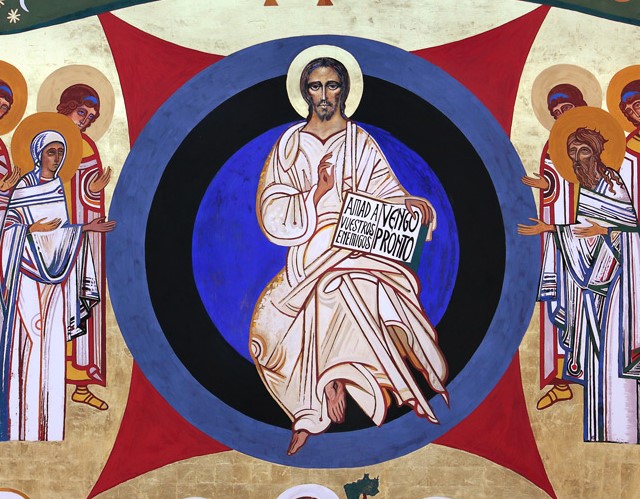
There is a specific depiction of Christ known as Christ Pantocrator.  It was widespread in the ancient world and still is today. The title “Pantocrator” is most often translated as “The Almighty One” or “The Omnipotent One.” It comes from the Greek words παντός (pantos, meaning all) and κράτος (kratos, meaning strength, might, or power).

In the particular image at right, Christ is seated (as a sign of authority). In many of the specific images he holds a book, sometimes open and sometimes closed. If the book is open, there can be a few of many different texts displayed. In some of the images there is an interesting juxtaposition of texts meant to provoke thought and lead to both catechesis and repentance.

Among the more interesting and provocative juxtapositions of texts is the one commonly used in the Neocatechumenal communities (see above right). On the left-hand page of the open book is the Gospel from today’s mass (Tue. of 11th Week), in which Jesus says, “Love your enemies” (Matt 5:44). On the right is the one in which Jesus says, “I am coming soon” (Rev. 22:7).

Provocative, indeed—and a sober call repentance! It is hard to see how we could hope to enter Heaven with hatred or vengeful anger for our enemies in our heart. With that eating away at our heart it wouldn’t be Heaven! Therefore, we should consider our final end and beg for the grace to love our enemies by praying for them, working for their conversion, and supplying their basic human needs (cf Rom 12:20; Prov. 25:21). Our goal is to be at one with them in Heaven, and even here in this life if it be possible and rooted in the truth.

Jesus sets apart the love of one’s enemies as the “acid test” for Christians:

Love your enemies and pray for those who persecute you, so that you may be sons of your Father who is in heaven. For he makes his sun rise on the evil and on the good, and sends rain on the just and on the unjust. For if you love those who love you, what reward do you have? Do not even the tax collectors do the same? And if you greet only your brothers, what more are you doing than others? Do not even the Gentiles do the same? You therefore must be perfect, as your heavenly Father is perfect (Matt 5:44-48).

There’s nothing like a passage such as this one to get us on our knees asking for grace and mercy! Indeed, we will surely fail if we seek to love our enemies only through the power of our own flesh or from our own fallen nature.

Jesus is coming soon and He will look for this fruit in us. All the more reason, then, to ask it of Him:

Good Jesus, who alone can save me from my hard heart, grant me the grace to love my enemies and pray for those who persecute me. I am too weak, self-centered, and thin-skinned to do it on my own. I consent, good and merciful Jesus, to this work of yours in me. Accomplish this, Lord, by your grace!

Love your enemies; He is coming soon!